
Previous Article in Journal
Data-Driven Prioritization of User Requirements in Health E-Commerce: An Explainable Machine Learning Study
 
 
Due to scheduled maintenance work on our servers, there may be short service disruptions on this website between 11:00 and 12:00 CEST on March 28th.
Article

Impact of Social Media Influencer Capability on Brand Loyalty in Saudi Arabia: The Mediating Role of Brand Trust and Moderating Effect of Authentic Leadership

by
Ahmed Saif Abu-Alhaija
* and
Mahmoud Mohamed Elsawy
Business Administration Department, Faculty of Business Studies, Arab Open University, Riyadh 11681, Saudi Arabia
*
Author to whom correspondence should be addressed.
J. Theor. Appl. Electron. Commer. Res. 2026, 21(4), 105; https://doi.org/10.3390/jtaer21040105 (registering DOI)
Submission received: 20 February 2026 / Revised: 12 March 2026 / Accepted: 20 March 2026 / Published: 28 March 2026
(This article belongs to the Section Digital Marketing and the Evolving Consumer Experience)

Abstract

Social media influencers (SMIs) have become effective intermediaries that influence consumer perceptions, attitudes, and behavioral intentions through their online presence and persuasion skills; this has made it imperative to comprehend how buyer-related variables contribute to brand loyalty within contemporary marketing research. This study, therefore, examines the effect of social media influencer capability on brand loyalty in Saudi Arabia, using brand trust as a mediating variable and authentic leadership as a moderating variable. Utilizing Social Exchange Theory and Authentic Leadership Theory, the study applied a quantitative cross-sectional survey design. Data were purposively collected from 476 active social media users in three major commercial hubs in Saudi Arabia (Riyadh, Jeddah, and Dammam). The data were analyzed using Partial Least Squares Structural Equation Modeling (PLS-SEM). The findings reveal that authenticity and communication skills have a positive and significant influence on brand trust and brand loyalty, but expertise and influence only have a significant and positive influence on brand trust, not on brand loyalty directly, which means that the two constructs are indirectly influencing brand loyalty. The study also finds that authentic leadership significantly moderates the relationship between expertise, influence, and communication skills and brand loyalty, while the interaction with authenticity is not significant. Moreover, the mediation analysis shows that brand trust plays a significant mediating role in the relationships between communication skills, expertise and influence and brand loyalty, implying that the antecedents play a leading role in fostering loyalty by first developing trust. The study contributes to theory by offering a process-based perspective on the concept of brand loyalty that positions brand trust as a fundamental mechanism and authentic leadership as a vital enabling context. The findings have practical implications for organizations that want to strengthen brand loyalty through authentic communication, trust-building strategies, and leadership practices in social media-based contexts.

1. Introduction

The fast-paced development of social media has essentially modified marketing communication and consumer-brand relationships across the globe. Social media influencers (SMIs) have become effective intermediaries that influence consumer perceptions, attitudes, and behavioral intentions through their online presence and persuasion skills. With the help of WhatsApp, Instagram, TikTok, Snapchat, and X, the influencers have become a part of brand communication plans to promote a better customer experience and promote long-term relationship results, including brand loyalty. Consequently, this has made it imperative to comprehend how buyer-related variables contribute to brand loyalty within contemporary marketing research.
This is particularly true in an emerging digital economy, like the Kingdom of Saudi Arabia, where influencer marketing is significantly important. The Kingdom is ranked as having one of the highest rates of internet and social media penetration in the world, due to a young and digitally literate population and a well-invested government, with digital transformation as part of Vision 2030 [1,2,3]. Saudi consumers are actively using influencers to obtain information about products, inspiration on how to live, and recommendations on brands; influencer capability is becoming a strategic resource in firms that want to gain a competitive advantage [4,5]. Though managerial interest is increasing, there is limited empirical evidence to indicate how and why the capability of influencers translates to brand loyalty in the Saudi context, and this marks a gap in the literature.
Previous studies in marketing research indicate that the ability of social media influencers frequently manifests through expertise, credibility, and attractiveness; as such, the quality of content is critical in determining consumer confidence and brand-related performance [6,7]. However, brand loyalty is established neither easily nor in a direct manner, and instead, brand loyalty is usually built through its relational aspects. One such aspect is brand trust, which is understood as the trustworthiness of a brand that reflects the dependability of a brand, its honesty and its performance [8,9]. Even though previous studies have recognized the role of trust in influencer brand relationships, little empirical data on brand trust as an intervening variable between influencer capability and brand loyalty has been conducted, especially in Middle Eastern markets.
Furthermore, contemporary organizations are becoming more aware of the authenticity of leadership as a factor that enhances trust-based relationships and ethical communication [10,11]. Authentic leadership with a self-aware view, transparency, moral standpoint, and balanced processing can influence the perception of a brand and the interpretation of a message introduced by influencers to consumers [12,13]. Although research on leadership has thoroughly studied outcomes in an organization internally, its moderating position in digital marketing and the effectiveness of influencers is under-researched (Okongo, 2024) [14]. Particularly, little focus has been put on the idea of whether authentic leadership is able to enhance or weaken the effect of influencer capability on brand loyalty by strengthening trust and believability in brand communication [15].
To fill these gaps, this study examines the effect of social media influencer capability on brand loyalty in Saudi Arabia, using brand trust as a mediating variable and authentic leadership as a moderating variable. This study makes several breakthroughs by combining influencer marketing, relationship marketing, and leadership theories into a unified empirical framework. First, it contributes to the influencer marketing literature by investigating the psychological process by which influencer capability facilitates brand loyalty. Second, it proposes authentic leadership as a boundary condition in digital consumer behavior studies and broadens the leadership theory to the organizational context. Lastly, the results offer practical implications to marketers, brand managers, and policymakers who need to develop effective influencer programs to promote long-term brand loyalty in the Saudi digital marketplace.
Accordingly, this study attempts to answer the following research questions: How does social media influencer capability influence brand loyalty in Saudi Arabia, and to what extent are these relationships mediated by brand trust and moderated by authentic leadership? It is in line with this question that the primary objective of this study is to examine the impact of social media influencer capability on brand loyalty among consumers in Saudi Arabia while investigating the mediating role of brand trust and the moderating effect of authentic leadership in shaping this relationship.
The research paper is divided into five broad parts. The Section 1 gives the background of the study, outlines the research problem, and highlights the objective and importance of evaluating the effect of social media influencer competence on brand loyalty in Saudi Arabia. The Section 2 critically examines the earlier studies on the capabilities of social media influencers, brand loyalty, brand trust and authentic leadership, and then develops the hypotheses and conceptual framework of the research. The Section 3 includes the research design, population and sample size, data collection procedures, and the variable and analytical methods for measurement that were used. The Section 4 provides and presents the empirical results, which entail analysis of the measurement and structural models, mediation and moderation analysis. Finally, the Section 5 summarizes the main findings, explores theoretical and practical implications, recognizes study limitations, and makes recommendations for practitioners and possible directions for future research.

2. Literature Review

2.1. Social Media Influencer Capability

The literature describes social media influencer capability as the aggregate of the characteristics and skills that allow influencers to successfully influence the perceptions, attitudes and behaviors of their audiences in online settings [16,17,18]. Previous literature defines influencer capability as a multidimensional construct, which includes expertise, authenticity, influence, and communication skills [6,19,20]. High-capability influencers are viewed as informed and credible sources of information, and their recommendations are more appealing than any other form of advertising [21,22]. By staying active in production, remaining interactive, and feeling authentic, effective influencers can build parasocial relationships with their followers, which improves the acceptance of their messages and brand-related judgments. Influencer capability has been observed to be a powerful factor affecting consumer attitudes, purchase intentions, and outcomes related to brands in highly social media-driven markets [23,24].
According to recent studies, the ability of influencers is a key factor in the formation of brand trust and long-term brand loyalty, especially in online consumer markets [25,26,27]. When influencers are competent, exhibit transparency, and align with brand values, consumers tend to take the trust built by influencers and associate it more with the endorsed brand, which is a process that increases relational bonds [28,29]. This type of mechanism of transferring trust is particularly applicable in collectivist and high-context cultures like Saudi Arabia, where credibility and social approval play a critical role in determining consumer behavior. Empirical studies reveal that influencer capability is also associated with both short-term and long-term consumer behavior, as it also helps to cement positive brand beliefs and feelings [30,31]. However, the increasing body of research on this topic has yet to pay much attention to investigating the conditional factors that can either support or limit the role influencer capability has in promoting brand loyalty, which is why further studies are necessary.

2.2. Brand Loyalty

The most common construct in marketing literature is brand loyalty, which is usually described as the intense loyalty of a consumer to repurchase goods from or always use a favorite brand, regardless of the situational factors and marketing campaigns of the competitors [32,33]. Initial thinking separated brand loyalty into a behavioral response, which comprises a repeated purchase and an attitudinal orientation, in terms of emotional attachment, preference, and promotion of a brand [34,35]. Previous literature established brand loyalty as a multi-stage concept that includes attitudinal loyalty and behavioral loyalty [36,37], wherein attitudinal loyalty involves a psychological commitment of the consumer, good feelings, and preference for a brand [38,39]. Whereas behavioral loyalty is observed by consumers as repeat purchases, continued use, and promotion of a brand [35,39]. Therefore, brand loyalty is generally considered to be a strategic resource to any firm since loyal clients stand a higher chance of positive word of mouth, are less price sensitive and exhibit long-term profitability [40].
Online interactions and communication through influencers are becoming predominant factors that influence brand loyalty in the digital marketing and social media domain. The impact of social media influencers through communication skills, influence, authenticity and expertise can potentially impact brand ratings and loyalty intentions of consumers [41]. Previous research also indicates that content created by influencers increases brand engagement and emotional attachment, which are essential antecedents of loyalty over the internet [42,43]. However, brand loyalty developed with the help of influencer marketing is frequently indirect, acting on a relational basis, including brand trust that enhances consumer belief in the promises and reliability of a brand [44]. Moreover, organizational elements can substantiate loyalty by revealing ethical behavior, transparency, and value consistency, and, as a result, increase consumer confidence and long-term devotion to a brand [45,46]. Although there is an increased interest in influencer marketing, few empirical studies have incorporated the concept of influencer capability, brand trust, and authentic leadership in a single framework to define brand loyalty, specifically in the Saudi Arabian digital marketplace.

2.3. Brand Trust

One of the key concepts in relationship marketing and consumer behavior literature is brand trust, which is described as the confident belief of a consumer that a brand is reliable, honest, and able to achieve the promises they make [47,48]. It demonstrates the perceptions of consumers on the credibility, integrity and benevolence of a brand, which leads to lower perceived risk and uncertainty when making purchase decisions. Brand trust is especially imperative in the digital and social media setting since, in both instances, consumers tend to trust indirect channels of information, like influencer promotion, more than direct brand experience [21,49]. According to previous studies, brand trust contributes to the readiness of consumers to interact with a brand, their positive attitudes towards a brand, and the creation of long-term relationship links, which is an important antecedent of sustainable brand loyalty [50,51].
In the field of influencer marketing, the concept of brand trust is commonly identified as a psychological process by which the personality traits of an influencer are converted into positive brand performance [52]. When influencers are highly competent in terms of expertise, genuineness, and quality content, they are able to transpose trust toward the brand endorsed, as the information asymmetry is minimized, and the perceived brand trust is increased [15]. Empirical data indicate that the credibility and expertise of an influencer have a positive effect on brand trust, which subsequently translates to a better brand commitment and brand loyalty intentions [53,54]. Brand trust is therefore a mediating variable that describes the indirect impact of social media influencer capability on brand loyalty [55,56]. As such, brand trust stands as a highly salient mediating force in enhancing the efficacy of influencer marketing strategies in the context of Saudi Arabia, where consumers put their trust in credibility, ethical behavior, and relational assurance in their behaviors.

2.4. Authentic Leadership

Authentic leadership is a positive managerial construct that focuses on self-awareness, relational transparency, internalized moral perspective, and balanced information processing [57,58,59]. Authentic leaders follow their fundamental principles, are honest and act ethically, which will instill confidence and trust among stakeholders [60,61]. In marketing and branding situations, authentic leadership is not only related to the internal organizational goals but also influences the relationship between organizations and customers and the way the organizations manage the external relationships [62,63]. The authenticity of corporate leaders makes their activities look genuine and dedicated to integrity and ethical principles, which may enhance the perception of brand sincerity and reliability by consumers [64,65]. Consequently, genuine leadership creates an atmosphere where influencer-driven marketing communication can be considered more authoritative and trustworthy.
In theory, the concept of authentic leadership is expected to moderate the relationship between social media influencer capability and brand loyalty by enhancing the trust-building process that forms the basis of consumer-brand relationships [66]. A high level of influencer capability does not always translate into brand loyalty unless it is supported by authentic leadership practices that support ethical communication, transparency, and value congruence [67,68]. The influencer endorsement of a company that has a high level of authentic leadership tends to be more consistent with brand values and is perceived to be authentic instead of promotional, building brand trust and, eventually, loyalty [28]. However, in a situation where authentic leadership is not present, even highly successful influencers cannot evoke long-term loyalty, as questions about brand objectives may be raised [67]. Thus, authentic leadership acts as a key boundary condition that determines the efficiency of influencer marketing techniques, especially in trust-sensitive markets like Saudi Arabia.

2.5. Theoretical Background

2.5.1. Social Exchange Theory (SET)

The Social Exchange Theory (SET) postulates that social behavior is a product of an exchange mechanism where the parties aim at maximizing gains and reducing costs in their interaction [69,70,71]. In the marketing and consumer behavior literature, SET has been extensively used in understanding how consumers judge relational exchange relationships with the company, brands, and endorsers based on perceived value, reciprocity, and trust [72,73]. In the digital space, social media interactions have been seen as continuous interactions where consumers are given informational, emotional, or social rewards in exchange for their attention, engagement, and loyalty [74]. Based on this, influencer–consumer relations can be formulated as exchange relations where the influencer’s competence, including communication skills, influence, authenticity, expertise and the quality of the content, can be seen as a resource that can be utilized as a valuable means of facilitating reciprocal consumer response in the form of favorable brand-related reactions [75,76].
It is important to note that social media influencers are divided into various categories, which depend on characteristics such as the number of followers, reach, and engagement with the audience. The most common categories are mega-, macro-, micro-, and nano-influencers, which are the different levels of online presence and interaction with followers [77] The differences between these categories are usually on the level of persuasiveness, mode of communication, and perceived influence in digital marketing. For example, micro- and nano-influencers usually have more direct and closer contacts with their followers, which can lead to a higher perception of authenticity and trust, while macro- and mega-influencers usually provide more visibility to brands.
Considering Social Exchange Theory, brand trust acts as a critical mediating factor that enhances exchange relations in the long run [77,78]. Being competent, honest, and consistent in their content leads to lower perceived relational risk and increased exchange benefits by consumers, building trust between them and the influencer, as well as in the brand endorsed. According to SET, trust develops as the exchanges become predictable and profitable, and hence, consumers are more willing to persist in the relationship [70,79]. Trusted transactions in the scenario of influencer marketing contribute to the emotional attachment and dedication to the brand among consumers, which, eventually, leads to brand loyalty [42]. Therefore, brand trust can be used to explain why the ability of influencers becomes long-term loyalty and not just a short-term attitudinal or behavioral reaction [67,80].
Moreover, authentic leadership can be viewed from the perspective of SET as a situational element that determines the quality and credibility of exchange relationships. Authentic leaders encourage communication skills, influence, authenticity and expertise, which are indicative of fairness and morality in relationships between a brand and consumers [81]. Such leadership qualities lessen perceived opportunism and add to relational value, which strengthens the positive impact of influencer capability on trust-based interactions [82,83]. Within the Saudi Arabian setting, where cultural values are focused on communication skills, influence, authenticity and expertise, authentic leadership shows promise in strengthening trust perceptions of consumers and increasing the reciprocal exchange process. Therefore, SET offers a sound theoretical foundation in explaining the mediating effect of brand trust and the moderating impact of authentic leadership in the connection between social media influencer capability and brand loyalty [84,85].

2.5.2. Authentic Leadership Theory

The Authentic Leadership Theory pays attention to the importance of sincerity, morality, and self-awareness of leaders in the development of trustful relations with followers. The theory, which is based on positive organizational behavior, assumes that authentic leaders behave based on their organizational values, are transient in their decision-making, and are also consistent in their speech and deeds [86,87]. These leaders are described along four dimensions, including self-awareness, relational transparency, internalized moral perspective, and balanced processing [59]. All these attributes help leaders to establish a credible and trustworthy setting, which is crucial in determining the perceptions and long-term relational outcomes of the stakeholders [88].
The Authentic Leadership Theory can be a useful perspective for the marketing and digital communication setting, as the authenticity of leadership can be used to control consumer trust and brand-related behaviors [89,90]. Authentic leaders are more likely to prioritize honesty, integrity and morals in their communications plan, including influencer partnerships [91,92]. When social media influencers are representatives of the brand that can be seen as having authentic leadership, the information they convey is more likely to be viewed as genuine and trustworthy [93]. This identification strengthens brand loyalty by building brand trust, which is a key antecedent of brand loyalty in relationship marketing literature [94].
Further, the Authentic Leadership Theory proposes that authenticity is a contextual aspect that reinforces or weakens relational exchange. Within the influencer marketing framework, even the most competent influencers—ones that possess strong communication skills, influence, authenticity, expertise and content quality—might not be able to create long-lasting brand loyalty when the leadership at the brand lacks authenticity [95]. On the other hand, the influence of influencer capability can be enhanced by authentic leadership, which can provide coherence between influencer messages and the ethical principles of the brand [96]. This theoretical approach underlines the point of view that authentic leadership is a moderating factor, as it determines the intensity of the relationship between social media influencer ability and brand loyalty through high trust and perceived integrity [97,98].
Culturally and contextually speaking, the applicability of the Authentic Leadership Theory is especially high in Saudi Arabia, where the importance of trust, moral values, and credibility in business relationships by consumers is high. Leadership authenticity in high-context societies implies social responsibility and ethical correctness, which is important in shaping consumer attitudes and loyalty behaviors [99,100]. Incorporating the Authentic Leadership Theory in the suggested framework, the current study expands the field of the previously dominant leadership theory to the sphere of digital marketing by showing how authentic leadership can shape consumer reactions towards influencer marketing and consequently generate long-term brand loyalty through the mechanism of trust.
This study is primarily underpinned by the Social Exchange Theory to explain how consumers reciprocate perceived organizational actions with favorable responses. Also, Authentic Leadership Theory is applied to explain how perceived authentic leadership shapes the strength of these relationships. In addition, signaling and source credibility perspectives provide additional explanations for how external stakeholders interpret corporate signals and judge the authenticity of organizational leadership.

2.6. Hypotheses Development

2.6.1. Social Media Influencer Capability and Brand Loyalty Relationship

Social media influencer capability has become an important factor in consumer–brand relations online. Influencer capability is a phenomenon that defines how influencers have the skills, attributes, and competencies necessary to deliver brand messages and convince followers [101,102]. Previous studies reported that strong influencers are also able to influence consumer attitudes, emotional attachment, and purchase intentions, which are major antecedents of brand loyalty [103,104,105]. Influencer capability is likely to have a major role in stimulating attitudinal loyalty (positive psychological commitment) and behavioral loyalty (repeat purchase and advocacy) in markets that are driven by social media and depend on influencers as product evaluators and recommenders of products to consumers (Saudi Arabia). In this regard, it is hypothesized that there would be a positive correlation between social media influencer ability and brand loyalty.
Communication skills are also an essential aspect of social media influencer capability, which has to do with how effectively, interestingly, and convincingly an influencer puts across messages [106,107]. Strong communicators may be able to provide brand information in a manner that is easy to comprehend, is emotionally compelling and in a manner that is applicable to the needs of the followers [108,109,110]. According to the literature, good communication increases brand-related attitudes of consumers, makes them better at understanding the message and keeps them emotionally interested, as well as prompts them to repeat their engagement and purchase patterns [111,112,113]. Storytelling and relational communication are cultural values in the Saudi digital environment, and the influence skills of influencers are likely to positively affect the attitudinal and behavioral loyalty to the brand [114,115]. Thus, the study proposed that the communication skills of influencers have a positive impact on brand loyalty.
H1. 
Communication skills have a significant positive effect on brand loyalty.
The concept of influence, which is an aspect of social media influencer capability, involves the power of an influencer to influence the thoughts, attitudes, and actions of their audience among the virtual community [116,117]. Strong influencers usually have a large following, high involvement levels, and perceived authority, making them effective in the process of influencing the decision-making process of the consumer [118,119,120]. Past research has shown that, under the influence of influencers perceived to be influential, consumers tend to prefer the endorsed brand and develop repeat purchase behavior [121,122]. This influence promotes a positive attitude towards the brand and translates into actual loyal behavior in the form of brand advocacy and repurchased goods. Therefore, the beneficial impact of an influencer’s influence on both dimensions of brand loyalty would be significant.
In addition, recently published studies noted that the dimension of influence among social media influencers has been widely linked with brand loyalty in the context of digital marketing [123,124,125]. Recent research came to the conclusion that the influence of influencers is so strong that they can influence consumer perceptions and attitudes towards brands, and unite the relationships between consumers, brands, and their brand loyalty [75,126]. In particular, it has been discovered that the capacity of social media influencers to effectively persuade and influence the behavior of their followers directly leads to greater brand loyalty, as consumers who are exposed to influencer content exhibit greater attachment and repeat engagement with the brand [127,128]. The perceived credibility and reliance of the influencer usually promote this influence and increase the persuasive effect on the attitudes of followers, and strengthen their loyalty to the brand [129,130]. Additionally, the beneficial impact of social media influencers is not only demonstrated in influencing consumer purchase intentions but also in indirectly contributing to the development of loyalty by creating stronger emotional and cognitive connections between the consumer and the brand [131,132]. Subsequently, using theories and available empirical evidence, the research proposed that influence, as a core competence of social media influencers, would positively impact brand loyalty. Thus, the following hypothesis:
H2. 
Influence has a significant positive effect on brand loyalty.
Authenticity is widely acknowledged as an essential element of success in influencer marketing. Authentic influencers are viewed as real, honest, and consistent in their values and content, which strengthens followers’ emotional connection and trust [133,134]. Previous literature indicated that consumers become psychologically attached to influencer-endorsed brands, and their attitudinal loyalty is enhanced by the authenticity of the influencer [135,136]. Authenticity is particularly critical in culturally aware markets such as Saudi Arabia, where the customers are fond of simple and value-based communication. Therefore, influencer authenticity can increase both attitudinal and behavioral brand loyalty.
Authenticity has turned into a key feature of social media influencer capacity that greatly defines consumer attitude and subsequent brand loyalty, particularly in the Saudi Arabian online market. Depending on authenticity, openness, storytelling with a real-life approach, and cultural attractiveness, the goal of influencer content is to engage more emotionally and build trust between the influencer and the brand promoted [137,138]. For example, people become more involved with influencers who share their personal experiences and a realistic depiction of products/services. Consumers in Saudi Arabia are moving towards influencer content that resonates with the values, traditions and lifestyles associated with Saudi Arabia because this authenticity enhances relational connections and encourages consumers to engage with brands repeatedly, which is a shift towards a form of loyalty beyond transactional relationships [139,140]. Further, authenticity as a social proof enhances consumer trust and decreases doubt towards sponsored content, which is essential in a market where trust is a significant factor in ensuring long-term brand loyalty [141,142]. These culturally grounded dynamics indicate that authentic influencer recommendations have a positive effect on brand loyalty by cultivating credibility, emotional connection, and trust in the Saudi digital ecosystem of consumers. Based on the preceding discussion, the study proposed the following hypothesis:
H3. 
Authenticity has a significant positive effect on brand loyalty.
Expertise is the perceived knowledge, experience and competence of an influencer in every category or sector of a product [143,144]. The presence of relevant information in the content of influencers who possess high expertise positions them as reputable sources of information, and this reduces uncertainty and perceived risk among customers making buying decisions. Previously existing research has demonstrated that expert endorsement increases consumer confidence in brands, reinforces positive perceptions, and enhances the probability of buying the brand again [145,146]. In the social media marketing context of Saudi Arabia, consumers are more likely to stimulate brand loyalty and long-term purchasing behavior through expert influencers. Therefore, brand loyalty can be enhanced through influencer expertise.
Similarly, expertise is a well-established concept in the influencer marketing literature as a factor of influencer capability that determines consumer perceptions and, ultimately, brand loyalty [146,147]. The previous studies, which are based on the Source Credibility Theory, presuppose that knowledgeable and competent influencers have the potential to increase consumer trust in the influencer and, ultimately, the brand being endorsed, which allows for cultivating more positive attitudes and long-term loyalty [145]; this is discussed in recent research as well [148]. Research revealed that expertise has a positive impact on brand trust, which is a major antecedent to brand loyalty, as it mitigates perceived risk and enhances confidence in purchasing decisions, especially in social media contexts wherein followers depend on influencers to acquire information about a product, which informs purchasing decisions [149,150]. As an example, it has been shown that an increased degree of perceived influencer expertise positively relates to consumer trust in a brand, which subsequently leads to increased commitment and loyalty (empirical evidence on influencer characteristics that affect brand trust and brand loyalty).
Furthermore, meta-analytic results determined expertise as one of the many influencer characteristics that have significant links with customer engagement and purchase outcomes, which in turn are predictors of loyalty behavior [151,152]. These findings support the assumption that knowledge, through increasing trust and credibility, has a significant role to play in brand loyalty in social media influencer marketing systems.
H4. 
Expertise has a significant positive effect on brand loyalty.
These hypotheses form the foundation for examining how influencer capability drives loyalty outcomes and provide a basis for further investigating the mediating role of brand trust and the moderating effect of authentic leadership within the proposed research framework.

2.6.2. Mediating Role of Brand Trust in the Relationship Between Social Media Influencer Capability and Brand Loyalty

Communication skills are among the fundamental aspects of social media influencer capability, since they define the extent to which influencers can communicate brand-related messages to their audiences [153]. Influencers who possess effective communication skills can deliver information in a proper way, involve the followers with interactive materials, and provide constructive feedback on comments from audience members [154,155]; thus, contributing to the understanding of a given message and its endorsing power. According to previous research, lucid, consistent and interactive communication gives the consumer confidence in the person influencing them as well as the brand being endorsed, thus enhancing brand trust [124,156]. Once consumers gain trust in a brand, the chances of forming positive attitudes and repeat purchasing intentions, which is a major behavior of brand loyalty, would rise [157]. In this regard, this paper theorizes that influencer communication skills on social media have a positive impact on brand trust, which further leads to brand loyalty.
However, the literature reported that communication skills of social media influencers, such as responsiveness and meaningful engagement with audiences, are critical in influencing consumer perceptions and responses in the digital spaces [158,159]. By being an effective communicator–influencer, they would be more prone to pass on brand messages in a manner that followers will embrace [160], therefore increasing the credibility, relatability, and trustworthiness of the influencer in the eyes of the followers. According to previous studies, brand trust is an essential mediating variable between the features of influencer communication and the downstream results for a brand: influencers with credibility and trustworthiness are more likely to establish high consumer trust that consequently leads to higher brand loyalty among followers [161,162]. For example, researchers have identified influencer credibility as an important contributor to the strength of trust-based relationships, which leads to brand loyalty, as well as the increase in the likelihood of repetitive behavior and recommendation.
Equally, there is empirical evidence to support the notion that the correlation between the activities of social media influencers and brand loyalty is enhanced in the case where consumers have trust in the brand, which highlights the mediating effect of trust in transforming effective communication into brand loyalty. Based on these results, it is hypothesized that the communication skills of social media influencers will positively affect brand loyalty with the mediation of brand trust in the framework of the social media environment in Saudi Arabia.
H5. 
Brand trust mediates the relationship between influencer communication skills and brand loyalty.
The power of social media influencers is determined by their power to influence their followers’ political opinion, attitudes, and choice of behavior, using perceived social power, popularity, and persuasive coverage. Influencers who have a high level of influence are usually regarded as opinion leaders, whose endorsements are taken seriously and should be considered [163,164]. The literature on social influence and electronic word-of-mouth shows that perceived influence positively affects the confidence of consumers in the information connected to a brand, which strengthens brand trust [165,166]. Since trust is an important basis of consumer-brand relationships in the long run, increased brand trust will be converted to increased brand loyalty [167,168]. Thus, brand loyalty will indirectly be motivated by the type of impact that the influencers have due to the formation of brand trust [169].
In the context of social media influencer marketing, influence—considered as perceived persuasive power, credibility, and relational connection an influencer maintains with brand followers—is one of the crucial antecedents of consumer reactions towards brands. Most studies in the past showed that influencer qualities like credibility, authenticity, and expertise have a positive influence on how consumers rate brands through increasing brand trust, which subsequently reinforces emotional and behavioral dedication to the brand [170] (expertise and homophily positively affect brand trust). Brand trust has been extensively reported to be a decisive mediator that lowers the perceived risk, raises confidence in the brand and leads to repeat purchasing and loyalty in social media contexts [171]. Researchers have demonstrated that the impact of influencer communication within the digital environment tends to work indirectly, in terms of trust building, whereby consumers who determine influencers as credible and authentic indicate an increased trust in the brand endorsed, which, in turn, increases their loyalty intentions and advocacy behavior (Kim & Kim, 2021) [172].
This mediating effect of brand trust is congruent to theoretical views emphasizing trust as a psychological process connecting external marketing stimuli to long-term brand relationships [173,174]. Therefore, there would be a positive effect on brand loyalty within the influence dimension of social media influencer capability, and that relationship would be mediated through brand trust [175], whereby the more perceived influencer influence, the more brand trust, and eventually, higher brand loyalty. Thus, the study proposed the following hypothesis:
H6. 
Brand trust mediates the relationship between influencer influence and brand loyalty.
Authenticity is now a substantial part of influencer marketing because consumers tend to believe in the influencers who are authentic, transparent, and consistent with their proclaimed values. True influencers can be perceived as honest and as people who not only focus on commercial interests but also strive for honest communication with consumers [176]. This results in followers who are less likely to be skeptical of sponsored materials. According to previous studies, perceived authenticity will increase trust in both the influencer and the brand endorsed, since it indicates credibility and intent to do what is ethical [177,178]. This increased brand trust enhances the emotional attachment and loyalty of the consumers to the brand, which in turn leads to brand loyalty [179,180]. Therefore, the authenticity of influencers should have a positive impact on brand trust that mediates its connection with brand loyalty.
However, authenticity has turned out to be a key influencing factor in the impressions and resultant brand performance [181,182]. Previous studies have found that, in the situation where social media influencers are perceived to be authentic and transparent in their real-world endorsements, as well as in their relatable content, the influencers are likely to be more successful in generating trust in the brands they endorse [183], since the followers perceive the endorsements as genuine and not just a promotion tactic. Similarly, research in influencer marketing has documented authenticity as a major source of brand trust; authentic influencer content increases consumer trust in the influencer and the brand [184] (through personal narrative, clarity in affiliation, and closeness), which further intensifies long-term relationship performance. Moreover, brand trust has been demonstrated to have a considerable impact on consumer commitment and loyalty as a psychological process, by which positive attitudes and repeat patronage are developed [185,186]. Authenticity is therefore postulated to affect brand loyalty indirectly by positively affecting brand trust as an important mediating variable in the correlation of social media influencer capability and brand loyalty outcomes.
H7. 
Brand trust mediates the relationship between influencer authenticity and brand loyalty.
Expertise is the degree to which a social media influencer is believed to be knowledgeable, experienced and competent in a certain category or field of products [187,188]. Expert influencers are informative and credible, which minimizes perceived risk and uncertainty in the purchasing choices of consumers [189,190]. Based on the source credibility and trust-based relationship theories, expert endorsers increase the trust of consumers in brand claims, resulting in better brand trust [191,192]. Since brand trust is central in the perpetuation of long-term consumer relationships, brand trust is anticipated to positively impact brand loyalty [186,193]. Influencer expertise is, therefore, suggested to have an indirect impact on brand loyalty through brand trust.
Previous studies reported that expertise is an important aspect of social media influencer capacity, which increases consumer attitudes of reliability and trust [187]. Expertise is the perceived capability, knowledge and proficiency that an influencer has in a particular field [194], which enhances the information of his recommendation and its effectiveness to the followers. Research has indeed identified that influencers who are seen as knowledgeable and skilled greatly increase the trust in the brand because the consumer will consider their recommendations as credible and trustworthy [188], especially in those product categories where technical expertise is important. Empirical evidence has shown that the expertise of the influencer has a positive impact on consumer faith in the promoted brand, which enhances the psychological confidence that customers have in attributes of the brand [21,195]. This enhanced brand trust, in turn, has been related to enhanced brand loyalty: as trust minimizes perceived risk, it promotes a long-term commitment that will result in repeat purchases and referrals. Thus, the study proposed that the relationship between influencer expertise and brand loyalty through the mediating effect of brand trust supports the large body of literature that defines brand trust as an important mediator between influencer credibility dimensions and the effect of influencer capability on loyal consumer behavior.
H8. 
Brand trust mediates the relationship between influencer expertise and brand loyalty.

2.6.3. Moderating Effect of Authentic Leadership in the Relationship Between Social Media Influencer Capability and Brand Loyalty

The concept of authentic leadership has been commonly identified for bringing transparency, ethical behavior and relationship based on trust within and outside organizational boundaries. Authentic leadership in the marketing and brand communication domain may influence how brands direct influencer activities to real values, truth, and consistency [196]. The greater the influence of influencer capability on consumer results, the greater influencer communications—when executed by brand leaders—are considered credible and consistent with brand identity [197,198]. In this respect, authentic leadership can become a significant contextual element improving the effectiveness of influence-related qualities in bringing about brand loyalty.
Communication skills should be considered as one of the essential aspects of social media influencer competence that allows influencers to deliver brand messages in a clear, convincing, and interesting manner [199,200]. According to previous research, effective communication enhances relationships between consumers and brands by clarifying the message and triggering emotions [201,202,203]. However, the level to which communication skills are converted to brand loyalty can be determined by how authentic the leadership in the brand is [204,205]. The perceived sincerity in influencer communication is more transparent and value-focused when leadership performance is authentic and exhibits stronger conviction and commitment to consumers of the brand in the long term [206,207]. On the other hand, without the touch of true leaders, even messages that have been well phrased can be treated with suspicion [208,209]. As such, authentic leadership should boost the perceived connection between influencer communication skills and brand loyalty.
H9. 
Authentic leadership moderates the relationship between influencer communication skills and brand loyalty.
Influence, which can be described as the capability of an influencer to impact the attitude, opinion, and purchase decision, is one of the focal processes by which an influencer influences consumer behavior [210,211]. The level of influence by the influencers tends to be heightened when the brand communication is articulated in a consistent, ethical and reliable environment that is highly aligned with the authentic leadership [212]. Authentic leaders endorse honesty and ethical principles, which can justify influencer recommendations, eliminating any sense of manipulation or business favoritism [213,214]. Consequently, consumers tend to internalize the recommendations of influencers more and become loyal to the brand in the long run [215]. Therefore, it is hypothesized that authentic leadership positively moderates the relationship between the influence of the influencer and brand loyalty.
It has been demonstrated how the power of social media influencers in various forms, through factors such as expertise and authenticity, can affect consumer perceptions and decision-making, with outcomes such as brand loyalty [216,217]. It has been shown that credible and trustworthy influencers could increase consumer confidence in brand endorsers, which in turn would boost brand trust, which is an essential antecedent of loyalty behaviors (repeat purchases and advocacy) in online environments [218,219]. For example, research reveals that the credibility of influencers and their resonance with consumers is a major factor in shaping brand trust that subsequently leads to brand loyalty through the development of an emotional connection and a perception of lower risk when it comes to a purchase [220,221].
Brand trust serves as a strategic intervening variable in this relationship, connecting influencer attributes with the loyalty results, by creating favorable consumer attitudes and a commitment to a brand over a long period of time [222,223]. The degree to which an influencer’s influence converts into loyalty might, however, differ with the level of brand trust, implying a moderating influence where strong levels of brand trust will increase the positive contribution of influencer influence on loyalty [222,224]. Such conceptualization is in line with the new evidence that trust not only mediates but can moderate the role of influencer-motivated perceptions into loyal consumer behavior, as it has proven to be central to digital marketing paradigms (Kim, 2020) [225]. Thus, the study proposed the following hypothesis:
H10. 
Authentic leadership moderates the relationship between influencer influence and brand loyalty.
Authenticity was identified as a dimension of influencer capability that is considered an important element, having a direct impact on consumer perceptions of credibility and reliability. Authenticity on the part of influencers depicts a sense of genuineness and honesty [226]. This attribute is critical in the development of loyalty; however, its effect can be determined by the larger leadership environment of the brand. Authentic leadership strengthens ethical practices and transparency, creates such an environment wherein influencer authenticity and knowledge become easier to trust and even appreciated by consumers [227,228]. The positive influence of influencer authenticity on brand loyalty should be more pronounced in cases where there is a high level of authentic leadership, as consumers would see a stronger correspondence between influencer information and brand values [229]. Based on this, authentic leadership should increase the marketability of authenticity and transform such influence into brand loyalty.
The authenticity of the influencer, perceived as sincerity, openness, and consistency of the content an influencer produces in relation to their personal ideals and the expectations of the audience, has been identified as one of the most vital factors that affect consumer reactions in the social media setting. Previous studies indicate that influencers are perceived to be authentic, and that this perception leads to increased brand trust among consumers [230,231], as the authenticity would undercut their skepticism and would signify that the influencer is credibly endorsing the proposed value of a brand, which then enhances the psychological bond between the consumer and the brand. For example, research evidence shows that perceived influencer authenticity greatly increases consumer trust and has a positive effect on brand-related attitudes (perceived brand trust and credibility) when carried out in the context of an influencer marketing campaign [229,232]. Brand trust, on its part, has been extensively determined as an antecedent of brand loyalty [233,234]; a central psychological process that would alter positive perceptions and beliefs into enduring consumer commitment and intentions to repurchase goods.
Therefore, in the context of predicted connections, authenticity is projected to have a beneficial impact on brand loyalty both directly and indirectly through increased brand trust. In addition, because authenticity promotes deeper emotional and cognitive engagement, it is believed that brand trust regulates the strength of the association between influencer authenticity and brand loyalty [235,236], resulting in increased positive effect of authenticity on loyalty as brand trust increases. This integrative pathway aligns with established findings that credible and authentic influencer endorsements enhance trust, which consequently nurtures stronger brand loyalty outcomes [237]. Thus, the study proposed the following hypothesis:
H11. 
Authentic leadership moderates the relationship between influencer authenticity and brand loyalty.
Expertise is generally considered a focal point of influencer credibility that determines the way the audience perceives and reacts to influencer-promoted content [238,239]. The expertise and the ability associated with the product, plus influence, increase the believability of an influencer to their followers, according to the Source Credibility Theory [240]. The less the influencer is viewed as an expert in a particular field, the less likely consumers are to believe the recommendations and the brand being promoted by the influencer [21,22]. Empirical research has already indicated that the expertise of influencers has a positive impact on brand trust since they are more likely to trust the recommendations made by expert influencers than those made by less credible sources [241], and thus, they perceive less risk when making decisions (see Iqra University study on effects of trust and expertise) [242].
Expertise-based trust has been found to be converted into positive consumer reactions, such as the intention to purchase and affective brand loyalty (systematic review results) [243,244]. The literature indicates that expertise directly and indirectly affects the followers’ perceptions, as well as indirectly affects brand loyalty, by first determining the degree of trust that consumers place on a brand after the endorsement by influencers [42]. According to previous studies, trust is the fundamental aspect of consumer–brand relationships; the greater the trust, the greater the chances that consumers make repeat purchases, advocate for the brand, and stay loyal [245]. Considering the example of social media influencers, the research conducted has demonstrated that influencer expertise must be credible to promote brand trust, which, in turn, stimulates the emergence of greater brand loyalty among followers [246].
Lack of trust can prevent even very-skilled influencers from turning positive perceptions into long-lasting loyalty, which supports the conditional nature of trust in the influencer–loyalty relationship [247]. Thus, brand trust mediates, but possibly moderates, the impact of influencer expertise on brand loyalty: the positive impact of expertise on brand loyalty is more significant in conditions when the followers have high trust in the brand [53]. This moderating effect is consistent with consumer behavioral models, which have trust as a restraint condition when converting cognitive assessments of a message source to behavioral consequences, like loyalty [248]. Thus, the study suggests the following hypothesis:
H12. 
Authentic leadership moderates the relationship between influencer expertise and brand loyalty.

2.7. Research Model

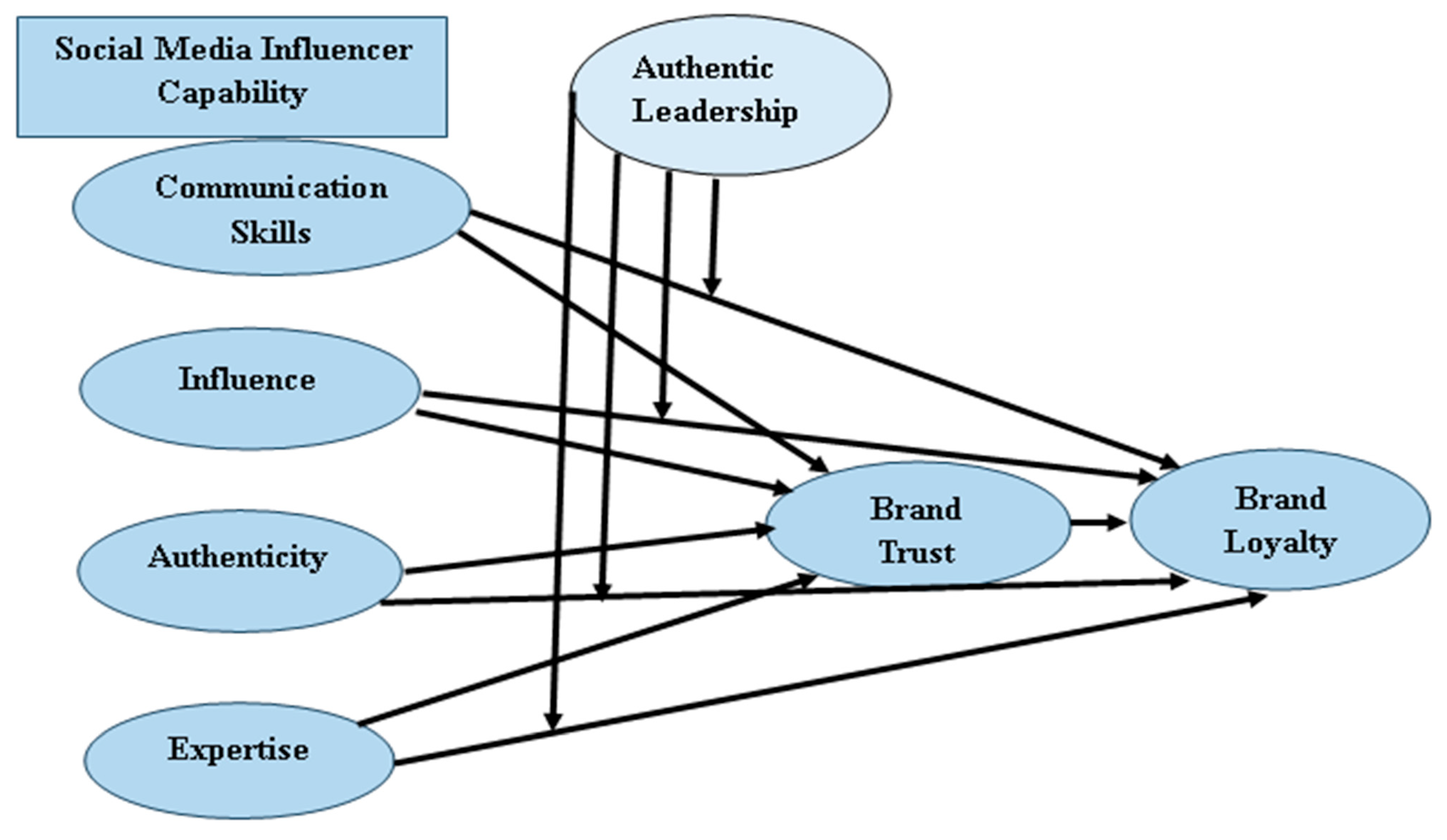
In view of the above established hypotheses, the study presents the proposed model in Figure 1. The model shows the direct relationship between social media influencer capability under four dimensions (communication skills, influence, authenticity and expertise) and brand loyalty. It further shows the mediating role of brand trust in the relationship between social media influencer capability (communication skills, influence, authenticity and expertise) and brand loyalty. Similarly, authentic leadership moderates the relationship between social media influencer capability (communication skills, influence, authenticity and expertise) and brand loyalty. However, brand loyalty is presented under two dimensions (attitudinal and behavioral loyalty), while brand trust (mediator) and authentic leadership (moderator) are unidimensional constructs.

3. Methodology

3.1. Research Design

The research design used in this study is a quantitative, cross-sectional study design, which best fits to study the relational effects of latent variables, as well as test mediation and moderation in one period. An appropriate survey design, in this case, is quantitative in nature since it enables the collection of standardized data based on a large sample and statistical generalization of the target population [249,250]. This design aligned with previous studies that test ways to explain social media-driven consumer behavior [21,172]; this design makes it possible to empirically test the conceptual connections between social media influencer capability, brand trust, brand loyalty, and authentic leadership.

3.2. Population, Sample and Data Collection

The target population comprises social media users in three commercial hubs of Saudi Arabia (Riyadh, Jeddah and Dammam) who actively follow, interact with, and purchase products/services recommended by influencers. Thus, the unit of analysis is individual consumers. Similarly, data were collected using a structured questionnaire, adapted from validated scales used in previous studies. A non-probability purposive sampling technique was adopted [251], as respondents must meet a qualifying criterion: following one or more social media influencers within the last six months. As a result, the sample should not be interpreted as statistically representative of the entire population in a strict probabilistic sense.
The survey instrument was distributed electronically through the four leading messaging and social communication platforms in Saudi Arabia, used by many internet users for daily chats, group communication, and business communication. These platforms are WhatsApp, Instagram, TikTok and Snapchat, which were selected to reach a broad and diverse sample of Saudi residents in the three study areas.
However, records show that there are approximately 6.99 million residents of Riyadh who are actively on the internet, while Jeddah records 3.7 million and Dammam records 1.5 million. Those from the age of 18 and above represent 72% of a population of about 9 million [252,253]. Since the entire population in the three study areas is about 9 million, it is important to identify a reasonable sample size that will ensure representativeness and statistical validity. Ref. [254] suggests that with a population of 1,000,000 or above, the minimum size of sample that is adequate to obtain a 95% confidence level and a 5% margin of error is 384 respondents. Thus, according to Krejcie and Morgan’s sample size determination table, the current study adopted a sample size of 384, which seemed sufficient and statistically acceptable considering the total population of 9 million. The Krejcie and Morgan (1970) sample-size guidelines were only consulted to ensure an adequate number of observations for statistical analysis rather than to claim probabilistic representativeness [254]. In addition, the study added 30% of 384 to take care of missing values, nonresponse and inappropriate filling of the questionnaire [255], and the total sample size was determined to be 499. From the 499 survey instruments distributed online, 485 were received from the respondents. After careful screening, 9 were dropped, and the actual sample for analysis was 476 at a 95% response rate. Partial Least Squares Structural Equation Modeling (SEM-PLS) was employed for data analysis using SmartPLS 4.0. PLS-SEM, which was deemed appropriate for this research.

3.3. Measurement of Variables

The study measured the independent variable (social media influencer capability) with four dimensions adapted from [19], with two items each. The dependent variable (brand loyalty) was measured using two dimensions adapted from [256], with two items each. Similarly, the mediating variable (brand trust) was measured as a unidimensional variable adapted from [257], with five items. While the moderating variable (authentic leadership) was measured as a one-dimension variable adapted from [59], with eight items. To ensure that using the two-item measures for both independent and dependent variables did not compromise measurement quality, several reliability and validity assessments were conducted in line with the recommended procedures for structural equation modeling. Specifically, the measurement model assessment included indicator loadings, composite reliability, Cronbach’s alpha, and average variance extracted (AVE). The results show that the two-item constructs demonstrated acceptable reliability and convergent validity, with loadings exceeding recommended thresholds and AVE values above 0.50. Moreover, the study used a five-point Likert scale to measure the items, ranging from strongly agree (1) to strongly disagree (5).

4. Data Analysis and Results

In this section, the empirical findings of the partial least squares structural equation modeling (PLS-SEM) are presented and discussed. Following the conventional methodological practices, the analysis is performed in two phases: the measurement model and the structural model evaluation [258,259]. This is a sequential approach in PLS-SEM, since, unless the latent constructs have the required reliability and validity, no meaningful interpretation of the structural relationships can be made [260]. In this regard, the findings of the measurement model evaluation show the reliability, internal consistency reliability, and convergent and discriminant validity of indicators. In order to determine these measurement properties, it must be ensured that the constructs are adequate to measure the underlying theoretical concepts, and the relationships that are observed are not due to measurement deficiencies [260,261]. One of the conditions of strong structural inference in variance-based structural equation modeling is achieved by this analysis [258].
A structural model is applied to test the hypothesized relationship among the study constructs after the validation of the measurement model. The given assessment analyzes the possible issue of collinearity, the significance of the path coefficients, and the explanatory power, as shown in the coefficient of determination (R2), effect sizes (f2), and predictive relevance [262]. Instead of focusing on the statistical significance, the discussion also highlights the substantive relevance and theoretical meaning of the estimated effects in line with recent suggestions for theory development and prediction-oriented research using PLS-SEM [262,263]. Generally, the integration of results and discussion is expected to give a logical explanation of the empirical data by explicitly relating the statistical results to the theoretical framework of the study. In doing so, this section highlights how the findings support, extend or contradict previous studies, thus explaining the contribution of the study to theory, practice and future research directions.
The measurement and structural models’ evaluation in PLS-SEM is based on established threshold values. In reflective measurement models, the reliability of indicators is usually supported by an outer loading of 0.70 or above, but loadings between 0.40 and 0.70 may be retained in the case of satisfactory composite reliability and convergent validity [260,263]. Composite reliability (CR) is used to measure internal consistency reliability, and a score of 0.70 or above indicates that reliability is acceptable, whereas a score of over 0.95 could mean that the indicators are redundant [263]. The convergent validity measure is evaluated using the average variance extracted (AVE), which is expected to be more than 0.50, i.e., the constructs are supposed to explain more than half of the variance of the indicators [261]. Heterotrait–monotrait ratio (HTMT) is generally used to determine the discriminant validity, where values less than 0.85 or 0.90 are considered good discriminant validity [263,264].
The collinearity in the structural model was assessed through the variance inflation factor (VIF), which, by standard, should not exceed 5.0, and values of 3.3 and above are considered as the potential maximum [258,263]. R2 values are used to evaluate the predictive power of the model, which can be strong, moderate, and or weak (0.75, 0.50, and 0.25, respectively) depending on the context of the research [259]. The effect size (f2) interpretation is based on the benchmarks of 0.02 (small), 0.15 (medium), and 0.35 (large), which are measures of the effects that exogenous constructs have on endogenous variables in a relative manner [263,265]. In cases where the prediction-oriented assessment is applicable, the predictive relevance is determined by Q2 values, which, when greater than zero, suggest the validity of a predictive model when applied to a particular endogenous construct [262].

4.1. Measurement Model Assessment

The measurement model was tested to determine the reliability and validity of the latent constructs before structural relationships were tested. In line with the best practices of PLS-SEM, the reliability of the indicator, internal consistency reliability, and convergent and discriminant validity were determined to ensure that the constructs were measured accurately without excessive overlap [259,260]. Establishing satisfactory measurement properties is a significant requirement prior to any meaningful interpretation of the structural model results and the validity of the theoretical inferences [258].
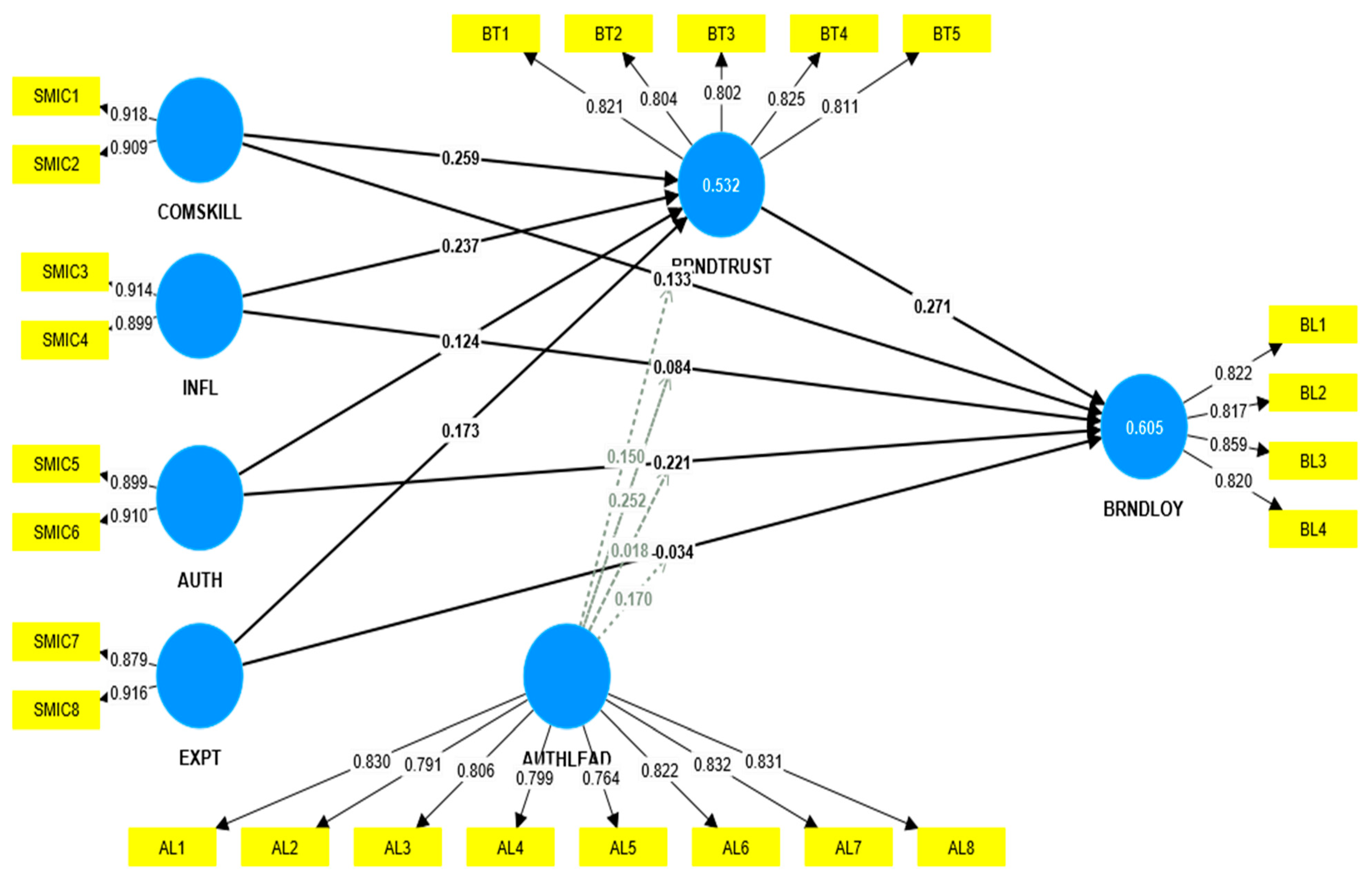
The results of the construct reliability and convergent validity measurement are provided in Table 1. In general, the results show that the constructs have acceptable reliability and validity. The values of Cronbach’s alpha are between 0.760 and 0.927, which is higher than the suggested number of 0.70, indicating that there is sufficient internal consistency among constructs. In the same manner, the composite reliabilities (ra and rc) of all the variables under consideration are significantly above the standard cutoff of 0.70, which also proves the reliability of the constructs in question and suggests that the indicators are always reliable in measuring their corresponding latent variables. Convergent validity is confirmed because all the constructs demonstrated larger values of average variance extracted (AVE) of 0.656 to 0.834, which means that each construct contributed a significant amount of variance in its indicators. It is worth noting that the results for constructs, including authenticity, communication skills, expertise, and influence, exhibited very high AVE values, which point to high convergent validity. The combination of these results can be taken to suggest that the measurement model has sufficient reliability and convergent validity, which provides a good basis for analyzing the structural model. The values in Table 1 are also represented in Figure 2.
Discriminant validity was evaluated to make sure that every construct was empirically distinct and captured phenomena that the other constructs in the model did not measure. In line with the existing best practices of PLS-SEM, discriminant validity was measured to ensure that the indicators share more variance with their corresponding construct than with the other constructs, which helps prevent conceptual overlap and biased structural estimates [264,266]. Establishing discriminant validity is necessary for ensuring valid hypothesis testing, and theoretical interpretation depends on establishing discriminant validity.
The results in Table 2 demonstrate that satisfactory discriminant validity is observed according to the Fornell-Larcker criterion [267]. The square roots of the average variance extracted (AVE) indicated on the diagonal are 0.810 to 0.913, and are greater than the inter-construct correlations in the corresponding rows and columns. This shows that each construct had more variation with its indicators compared to other constructs in the model. Whereas some of the constructs have quite strong correlations (e.g., authenticity and communication skills, expertise and influence), these correlations are still less than the square root of the AVE of each of the constructs, which indicates adequate construct distinctiveness. The low correlations between authentic leadership and other constructs also reinforce discriminant validity. In general, these results prove that the constructs are empirically different, which meets the conditions of discriminant validity and provides the basis for structural model analysis.
Recent methodological suggestions point out that the choice of discriminant validity assessment should be based on model characteristics and research objectives instead of being applied mechanically. Although the heterotrait–monotrait ratio (HTMT) is recommended as a more sensitive test in cases when the constructs are conceptually similar, or when there are potential discriminant validity problems, it is not a mandatory condition when the constructs are theoretically differentiated, and the Fornell–Larcker results are clear-cut [258,263]. Based on this, since the AVE values are high, the diagonal elements are significantly dominant over inter-construct correlations, and strong theoretical separation among constructs is observed, the Fornell–Larcker criterion was considered to be an appropriate method of evaluating the discriminant validity in this study.
The VIF values reported in Table 3 do not indicate a multicollinearity problem in the structural model. All VIFs are between 1.030 and 4.414, which is less than the standard upper threshold of 5.0 and, to a large extent, less than the more conservative value of 3.3 used as a criterion for PLS-SEM. This implies that there is no undue collinearity among the predictor constructs and that the estimated path coefficients are not likely to be inaccurate because of redundancy among predictors. A few relationships have relatively high values of VIF; however, they still fall within the acceptable limits and are expected in light of the inclusion of interaction terms, which, in any case, would increase collinearity. In general, the findings confirm that collinearity is not a significant risk to the stability or interpretability of the structural model estimates.
The model fit indices of the saturated model and the estimated model are given in Table 4. The saturated model Standardized Root Mean Square residual (SRMR) of 0.041 and 0.042 for the estimated models are significantly lower than the suggested value of 0.08, which means that the model fits well in general. The discrepancy measures, d_ULS and d_G, indicate low and similar values in both models, suggesting that there is little difference between the empirical and the model-implied correlation matrices, which demonstrate the adequacy of the model specification. The saturated and estimated models also have similar values for chi-square, meaning that there is no significant deterioration in the fit between the saturated and the estimated model. Moreover, the Normed Fit Index (NFI) values are higher than the widely used standard of 0.80 for PLS-SEM (at 0.851 and 0.852), which suggests that there is an acceptable incremental fit as compared to a null model. In general, these findings indicate that the proposed model has an adequate-to-good fit with the observed data, which is why it can be used further for analysis and interpretation of the structural relationships.

4.2. Structural Model Assessment

The structural model was evaluated after establishing the adequacy of the measurement model to test the hypothesized relationships among the latent constructs. In line with the PLS-SEM guidelines, this assessment focused on examining collinearity among predictor constructs, the magnitude and significance of the path coefficients, and the explanatory power and predictive ability of the model [258,263]. The process ensured that the estimated relationships were robust and meaningful in a statistical and theoretical sense, serving as the basis of testing the proposed hypotheses.
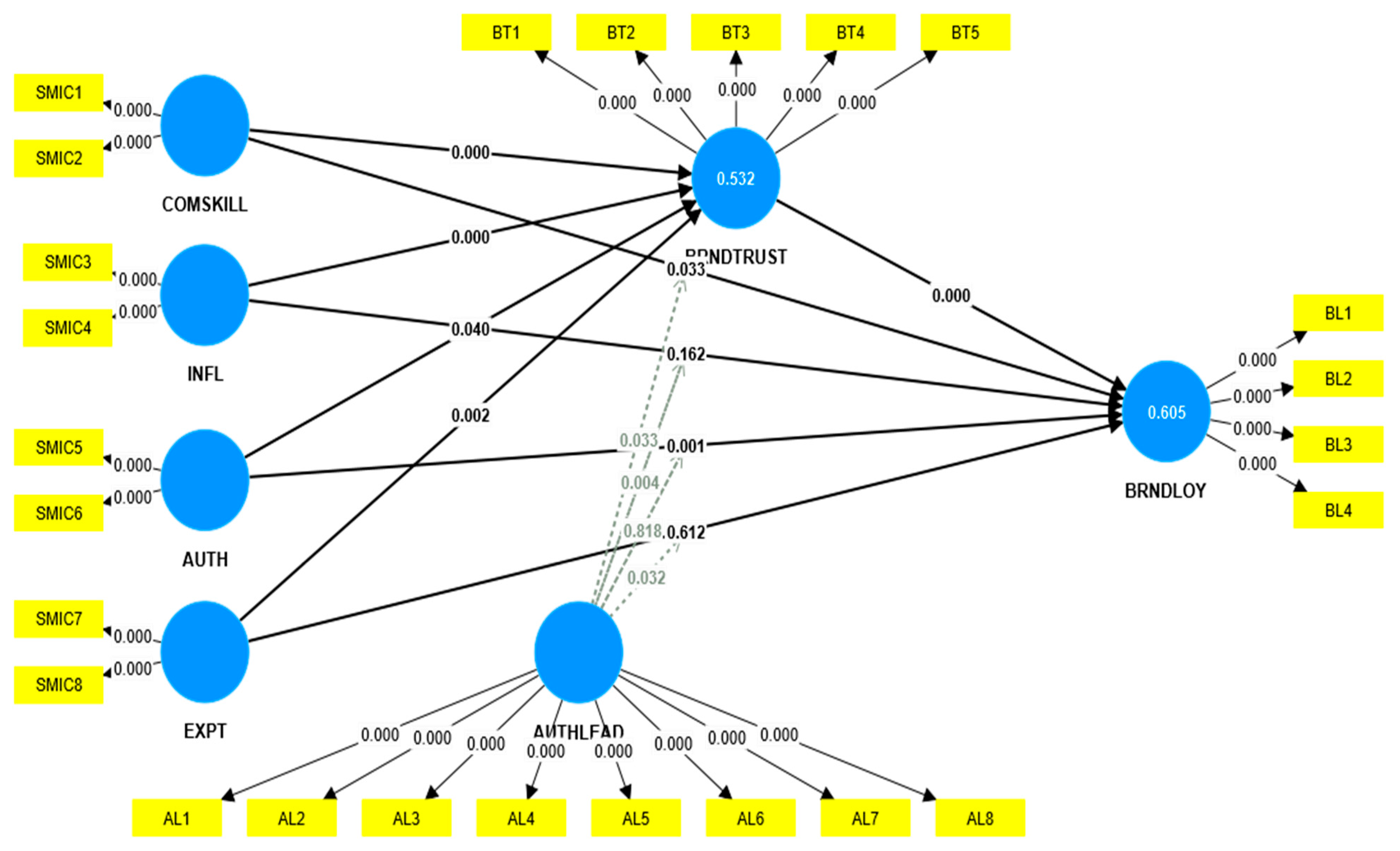
The results of the structural model assessment, comprising the direct, moderating, and mediating effects, are reported in Table 5 and Figure 3. The results show that authenticity positively and significantly influences brand loyalty (b = 0.221, p = 0.001) and brand trust (b = 0.124, p = 0.040), which proves the hypothesized relationships. The results support the findings of previous studies [135,136]. Brand trust, in its turn, has a significant positive impact on brand loyalty (b = 0.271, p < 0.001), which means that it is central to brand loyalty. Communication skills also have a strong positive influence on brand trust (b = 0.259, p < 0.001) and brand loyalty (b = 0.133, p = 0.033); however, expertise and influence have a significant positive influence on brand trust but not on brand loyalty directly, which means that the two constructs are indirectly, but not directly, influencing brand loyalty. This is in line with past studies on similar relationships [111,112,146,147,268]. The results further show that authentic leadership does not have a direct impact on brand loyalty, but it has a significant moderating effect on the direct relationships, which corroborate past studies [22,201,202,203,229]. Specifically, authentic leadership significantly moderates the relationship between expertise, influence, and communication skills with brand loyalty [21], which is supported by the strong interaction effects, while the interaction with authenticity is not significant. Moreover, the mediation analysis shows that brand trust plays a significant mediating role in the relationships between communication skills, expertise, and influence on brand loyalty, implying that the antecedents play a leading role in fostering loyalty by first developing trust. These findings also support previous research [158,159,163,164]. In summary, the findings support the critical role of brand trust as a predictor and mediator of the relationship, as well as highlight the contextual significance of authentic leadership in the process of strengthening the key antecedents of brand loyalty.
The results of the R-Squared analysis, presented in Table 6, show that the structural model demonstrates a high level of explanatory power on the endogenous constructs. In particular, the model predicts 60.5% of the variance in brand loyalty (R2 = 0.605; adjusted R2 = 0.597), which is a strong indication that the exogenous constructs are good predictors of brand loyalty. Equally, the model moderately explains the variance in brand trust (R2 = 0.532; adjusted R2 = 0.528), which suggests that the model has moderate and strong explanatory power. The fact that both constructs have close similarities in the level of R-squared and adjusted R-squared values indicates that the model is well-specified and not exceedingly overfitted. In general, the results of this study confirm that the model has strong explanatory power, particularly for brand loyalty, which proves the strength of structural relationships.
Table 7 presents the values of the effect size (f2) analysis, which shows the relative contribution of each exogenous construct to the explained variance of the endogenous variables. There is a general pattern of small effect sizes in most relationships, which is expected in complex behavioral models. Among the direct effects on brand loyalty, brand trust has the strongest effect (f2 = 0.085), which means that it has a significant contribution in the explanation of brand loyalty, even though it still remains within the small effect size range. Authenticity (f2 = 0.030) and communication skills (f2 = 0.011) have a small effect on brand loyalty, whereas authentic leadership and expertise have negligible effects on brand loyalty. With regard to brand trust, communication skills (f2 = 0.038) and influence (f2 = 0.035) have the largest contributions, followed by expertise (f2 = 0.018), which implies that they have a relatively minor yet significant effect on the formation of trust. The results demonstrate the moderating effect of authentic leadership on expertise and influence.
The Q2 values in Table 8 indicate the predictive relevance of the structural model using the blindfolding procedure. As expected, the exogenous constructs have a Q2 of 0.000, as predictive relevance is only assessed for endogenous constructs. Notably, brand loyalty (Q2 = 0.407) and brand trust (Q2 = 0.346) both have Q2 values that are far above zero, which implies that the model has a high predictive relevance to the two endogenous variables. The relatively large Q2 values indicate that the model can be used to accurately predict the observed values of brand loyalty and brand trust, not just by sample-specific estimation. Overall, these results prove that the proposed model has significant out-of-sample predictive power for the endogenous constructs, which makes the structural model robust and practically relevant.
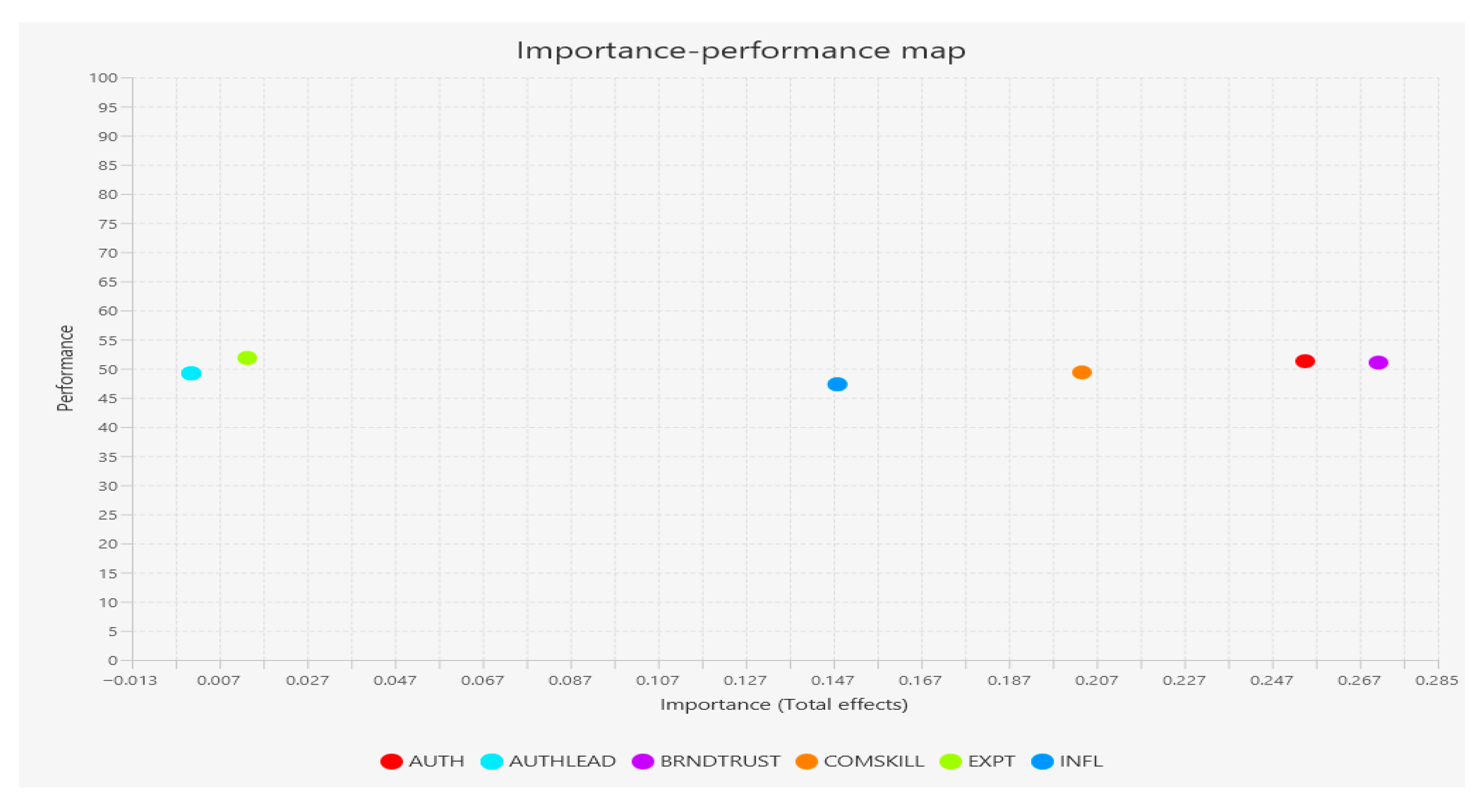
The Importance–Performance Map Analysis (IPMA), whose results are shown in Figure 4, is used to show the relative performance of the antecedent constructs in terms of their relative importance (total effects) and ability to explain the target construct (brand loyalty). The findings indicate that brand trust and authenticity are located in the high-importance and rather high-performance quadrant, which implies that they are critical contributors to brand loyalty and are already performing well; therefore, they should be maintained as strategic priorities. Communication skills and influence also show moderate performance and relatively high importance, which means that the improvement of these constructs may bring significant changes to the target construct. In contrast, expertise and authentic leadership have low importance and relatively low performance, signifying that, although relevant, investments in such constructs may generate limited returns in improving brand loyalty. Overall, brand trust and authenticity are identified as the main strengths according to IPMA, and communication skills and influence represent areas where specific managerial intervention would help to improve the overall model performance.

4.3. Discussion and Implications

Besides reinforcing the existing theories of branding and relationship marketing, the findings also lead to a better understanding of the operation of the various predictor variables in the brand loyalty formation process. The presence of direct and indirect impacts of communication skills suggests that the way a brand communicates (in the context of clarity, consistency, and responsiveness) has a twofold impact of influencing perceptions of customer trust and causing immediate loyalty reactions at the same time. Conversely, expertise and influence seem to be signs of credibility, the impact of which on loyalty depends on trust formation. Such a difference plays a role in theory by demonstrating that not every brand-related capability will likely result in loyalty, but certain attributes must undergo certain psychological processes, including trust, to become behaviorally consequential. The findings, therefore, support a process-based view of brand loyalty, where relational and competence-based signals interact sequentially rather than independently.
In practice, the results imply that managers need to apply a layered approach to the strategies of creating loyalty. The advantages of authenticity and adequate communication could be realized both in the short term and long term because they could directly lead to loyalty and trust. Nevertheless, when combined with a bigger system of building trust, attempts to establish oneself as knowledgeable and powerful would work best. This underscores the need to be consistent in what brands say and do in the long term. Organizations can create more targeted branding and communication strategies that will help them build stronger and more lasting customer relationships by prioritizing trust as a strategic asset and understanding various ways in which exogenous constructs can influence loyalty.
The moderating impact of authentic leadership helps to increase the explanatory power of the model as it emphasizes leadership as a situational factor, rather than as a causal variable, of brand loyalty. The high interaction effect indicates that in areas where leadership is perceived to be genuine, stakeholders are more inclined toward expertise, influence and communication skills, which strengthen the conversion to loyal behavior. This observation aligns with the leadership and social exchange theories, which assume that true leaders foster credibility, psychological safety, and value congruence, which result in the creation of an environment where relational and competence-based cues are readily internalized. True leadership in this sense acts as an accelerant that greatly increases the persuasive nature of an organizational ability, but not the determination of loyalty on its own.
The fact that the moderating role in the authenticity–brand loyalty relationship is not significant also shows that authenticity is a fundamental brand attribute whose influences are more consistent and less dependent on the situation of leadership. This implies that authenticity must be inculcated in broader organizational values and practices that have direct appeal to the stakeholders, regardless of the leadership style. Managerially, this reminds us of the importance of alignment between leadership development and brand strategy: although authenticity must be applied across brand communications and behaviors, authentic leadership could amplify the impact of competencies and customer interactions on the part of the employees. One way through which organizations can create a reinforcing mechanism to boost the trust-based channels to loyalty is through the creation of leaders who are transparent, ethical, and self-aware at all times. Collectively, these results extend the existing literature by showing that brand loyalty is a result of an interactive process between organizational characteristics, relationship processes, and leadership environment, and not the unilateral impacts of the individual predictors.
The summary of the hypotheses tests results are presented in Table 9. The decisions for each hypothesis is also given in the table.

5. Conclusions

The present study concludes that brand loyalty is determined by a complex and integrated combination of relational, competence-based, and contextual antecedents as opposed to singular antecedents. Authenticity is found to be one of the driving forces that affirmatively enhance brand trust and brand loyalty, which proves its fundamental position in relationship-based branding. Brand trust is not only a central mechanism in the loyalty formation process, but it is also one of the main channels where communication skills, expertise and influence operate. These results prove that trust is the primary channel by which brands can convert perceived competence and credibility into long-term loyal behavior. Moreover, the study concludes that authentic leadership is an important enabling variable that strengthens the relationship between the antecedents and brand loyalty, but it does not directly influence it. This underscores the context in which leadership enhances the interpretation of and the response to the relational and competence-based cues on the side of the stakeholders. Therefore, the findings, altogether, prove that sustainable brand loyalty is developed through the alignment of authentic brand values, the relational mechanism of trust, and a supportive leadership climate; this conclusion offers a more detailed understanding of loyalty development in contemporary branding contexts.
The study extends existing models by empirically establishing brand trust as a fundamental explanatory construct that mediates the impact of the main relational and competence-based antecedents, such as communication skills, expertise, and influence, and how their effects are translated into loyal behavior outcomes. The paper also transcends the mainstream direct-effect models by including authentic leadership as a moderating variable and illustrates the situational circumstances in which the exogenous constructs are more or less effective. In so doing, the study integrates signaling theory, social exchange theory and leadership theory to demonstrate that brand loyalty is an outcome of the dynamic interaction of organizational values, relationship processes based on trust, and leadership context, hence providing a more comprehensive and theoretically enriched explanation of loyalty development.

Limitations and Suggestions for Future Research

Despite its contributions, this study is plagued with several methodological limitations that must be taken into consideration when interpreting the study’s results. First, the use of a cross-sectional research design limits the ability to make causal inferences between the constructs that are examined. Although the PLS-SEM is capable of testing complex relationships, such as mediation and moderation, the data were gathered at a single point in time, which restricts conclusions about temporal dynamics and causal directionality between influencer capabilities, brand trust, and brand loyalty. Second, the study used a non-probability purposive sampling technique, which, while suitable for targeting active social media users who follow influencers, may restrict the generalizability of the study findings beyond the sample population. The study’s respondents were selected from three major commercial hubs in Saudi Arabia, which may not be representative of social media users in smaller cities, where consumption patterns and influencer engagement may vary.
Third, all data were obtained through a self-administered online questionnaire, which increases the potential of common method bias and social desirability bias due to the fact that all measures were obtained through the same source and at the same time. Even though validated scales were employed, the self-reported perceptions of the respondents might not entirely reflect actual behavioral outcomes, such as repeated purchase of goods or loyalty. Fourth, the research is limited to influencer-based consumer behavior in relation to social media use in Saudi Arabia and, thus, cannot be generalized across cultures. Lastly, even though the sample is statistically adequate and consistent with the established standards, the research does not consider the possibility of differences in platform-specific dynamics (e.g., Instagram vs. TikTok or Snapchat) that can affect the perception of influencer capabilities and leadership authenticity. To further extend and validate the findings of this study, longitudinal designs, probability sampling, multi-source sampling, and cross-cultural or platform-comparative designs could be adopted by future researchers. Similarly, it is recommended that future research use more comprehensive multi-item scales for social media influencer capability and brand loyalty to enhance content validity and capture additional facets of these constructs.

Author Contributions

Conceptualization, A.S.A.-A.; methodology, A.S.A.-A.; software, A.S.A.-A.; validation, A.S.A.-A.; formal analysis, M.M.E.; investigation, A.S.A.-A. and M.M.E.; re-sources, A.S.A.-A. and M.M.E.; data curation, M.M.E.; writing—original draft preparation, A.S.A.-A.; writing—review and editing A.S.A.-A. and M.M.E.; visualization, M.M.E.; supervision, A.S.A.-A. and M.M.E.; project administration, A.S.A.-A. and M.M.E.; funding acquisition, A.S.A.-A. and M.M.E. All authors have read and agreed to the published version of the manuscript.

Funding

This research received no external funding.

Institutional Review Board Statement

This research was approved by the Research Committee of the Arab Open University (AOU), School of Business Studies, Saudi Arabia. All the participants were presented with an informed consent statement in a way that was easy to understand and indicated the purpose of the study. The voluntary nature of participation and their right to withdraw without repercussions were made very clear to them prior to filling the questionnaire. All data were anonymized to guarantee the confidentiality of participants’ information.

Informed Consent Statement

The study was conducted on a voluntary basis, and informed consent was obtained from all the respondents prior to their participation. The research purpose, anonymity of responses and respondents’ right to withdraw at any time without penalty were explained to the respondents before the survey. The respondents were assured that all information provided would be treated with strict confidentiality and used exclusively for academic purposes. The research was conducted in accordance with the ethical principles of the Declaration of Helsinki [269] and was in line with all the relevant ethical standards of conducting research in the Kingdom of Saudi Arabia.

Data Availability Statement

The data used in this study are primary data collected by the authors. Due to confidentiality, privacy concerns, and the terms under which participants consented to fill the questionnaire, the data are not publicly available.

Acknowledgments

The authors admit that when writing the manuscript, the support of artificial intelligence (AI) tools was only applied in the process of refining the language, maintaining the formatting, and structuring references. All the conceptualization, data collection, data analysis and interpretation of results and final intellectual contributions were done by the authors. The AI tools were not used to come up with the original research ideas, findings, and conclusions. The authors take full responsibility for the content, the accuracy and integrity of this work.

Conflicts of Interest

The authors declare that there are no conflicts of interest regarding the publication of this paper.

References

  1. Alsulami, O.A. Digital Citizenship and its Role in Achieving the Vision of Kingdom of Saudi Arabia 2030. Int. J. Comput. 2022, 11, 39–53. [Google Scholar]
  2. Alkorbi, S.; Alrwais, O. An Empirical Case Study of Digital Government Transformation in Saudi Arabia. Information 2025, 16, 1110. [Google Scholar] [CrossRef]
  3. Alayed, S. Technology and Digital Transformation in Saudi Arabia. In Saudi Arabia’s Business Transformation:Strategies for Success in a Changing Economy; Services for Science and Education: Birminghami, UK, 2023; p. 106. [Google Scholar]
  4. Alibrahim, I.A.A. Investigating Social Media Influencers’ Impact on Brand Equity of Electronic Retailer Brands in Saudi Arabia. Ph.D. Thesis, Victoria University, Melbourne, VIC, Australia, 2024. [Google Scholar]
  5. Almughayribi, L. A Critical Evaluation of the Role of Influencers in Festivals and Events Marketing Strategies: A Case Study of Saudi Arabia. Ph.D. Thesis, University of Exeter, Exeter, UK, 2024. [Google Scholar]
  6. AlFarraj, O.; Alalwan, A.A.; Obeidat, Z.M.; Baabdullah, A.; Aldmour, R.; Al-Haddad, S. Examining the impact of influencers’ credibility dimensions: Attractiveness, trustworthiness and expertise on the purchase intention in the aesthetic dermatology industry. Rev. Int. Bus. Strateg. 2021, 31, 355–374. [Google Scholar] [CrossRef]
  7. Yu, J.; Liang, M.; Jin, C.-H. The effects of luxury brand influencer characteristics on self-brand connection: Focused on consumer perception. Sustainability 2023, 15, 6937. [Google Scholar] [CrossRef]
  8. Cardoso, A.; Gabriel, M.; Figueiredo, J.; Oliveira, I.; Rêgo, R.; Silva, R.; Oliveira, M.; Meirinhos, G. Trust and loyalty in building the brand relationship with the customer: Empirical analysis in a retail chain in northern Brazil. J. Open Innov. Technol. Mark. Complex. 2022, 8, 109. [Google Scholar] [CrossRef]
  9. Bidmon, S. How does attachment style influence the brand attachment–brand trust and brand loyalty chain in adolescents? Int. J. Advert. 2017, 36, 164–189. [Google Scholar] [CrossRef]
  10. Chen, J.K.C.; Sriphon, T. Authentic leadership, trust, and social exchange relationships under the influence of leader behavior. Sustainability 2022, 14, 5883. [Google Scholar] [CrossRef]
  11. Sohail, M.; Iqbal, S.; Asghar, W.; Haider, S.A. Corporate social responsibility for competitive advantage in project management: Evidence from multinational fast-food companies in Pakistan. J. Bus. Soc. Rev. Emerg. Econ. 2020, 6, 1277–1288. [Google Scholar] [CrossRef]
  12. Kelly, L. Authentic leadership: Roots of the construct. In Mindfulness for Authentic Leadership: Theory and Cases; Springer: Berlin/Heidelberg, Germany, 2023; pp. 17–52. [Google Scholar]
  13. Almutairi, M.; Timmins, F.; Wise, P.Y.; Stokes, D.; Alharbi, T.A.F. Authentic leadership—A concept analysis. J. Adv. Nurs. 2025, 81, 1775–1793. [Google Scholar] [CrossRef]
  14. Okongo, F.O. Influence of Strategic Leadership on Organizational Performance: The Moderating Role of Digital Capability in The Government Sponsored Youth Empowerment Organizations in Kenya. Ph.D. Thesis, KeMU, Neela Gumbad, Pakistan, 2024. [Google Scholar]
  15. Helme, E. The Role of Authentic Communication on Perceived Information Credibility in Influencer Marketing. Master’s Thesis, LUT University, Lappeenranta, Finland, 2023. [Google Scholar]
  16. Vrontis, D.; Makrides, A.; Christofi, M.; Thrassou, A. Social media influencer marketing: A systematic review, integrative framework and future research agenda. Int. J. Consum. Stud. 2021, 45, 617–644. [Google Scholar] [CrossRef]
  17. Ouvrein, G.; Pabian, S.; Giles, D.; Hudders, L.; De Backer, C. The web of influencers. A marketing-audience classification of (potential) social media influencers. J. Mark. Manag. 2021, 37, 1313–1342. [Google Scholar] [CrossRef]
  18. Enke, N.; Borchers, N.S. Social media influencers in strategic communication: A conceptual framework for strategic social media influencer communication. In Social Media Influencers in Strategic Communication; Routledge: London, UK, 2021; pp. 7–23. [Google Scholar]
  19. Ryu, E.A.; Han, E. Social media influencer’s reputation: Developing and validating a multidimensional scale. Sustainability 2021, 13, 631. [Google Scholar] [CrossRef]
  20. Lee, J.A.; Eastin, M.S. Perceived authenticity of social media influencers: Scale development and validation. J. Res. Interact. Mark. 2021, 15, 822–841. [Google Scholar] [CrossRef]
  21. Lou, C.; Yuan, S. Influencer marketing: How message value and credibility affect consumer trust of branded content on social media. J. Interact. Advert. 2019, 19, 58–73. [Google Scholar] [CrossRef]
  22. Weismueller, J.; Harrigan, P.; Wang, S.; Soutar, G.N. Influencer endorsements: How advertising disclosure and source credibility affect consumer purchase intention on social media. Australas. Mark. J. 2020, 28, 160–170. [Google Scholar] [CrossRef]
  23. Hussain, A.; Yaqoob, A.; Bano, S.; Nisar, A. The role of influencer attributes in shaping purchase propensity intention by analyzing the mediating impact of opinion leadership. Contemp. J. Soc. Sci. Rev. 2025, 3, 2644–2657. [Google Scholar]
  24. Ghosh, T.; Parven, S.; Sakib, A.I. The interaction effects of social media-driven advertising on consumers’ purchase intention. J. Ekon. 2024, 6, 54–63. [Google Scholar] [CrossRef]
  25. Surjono, W. Impact of Social Media Influencers on Shaping Brand Loyalty and Consumer Trust. Techno-Socio Ekon. 2025, 18, 1–9. [Google Scholar] [CrossRef]
  26. Reddy, M.S.; Malhotra, S.; Samayamantri, L.S.; Singhal, S.; Saxena, S.K.; Singh, N. Navigating the shift in brand loyalty: The impact of social media influencers. Int. J. Intell. Enterp. 2025, 12, 148–170. [Google Scholar] [CrossRef]
  27. Miranda, M.M. Investigating the Impact of Influencer Marketing on Long-Term Brand Perception and Consumer Loyalty. Master’s Thesis, Dublin Business School, Dublin, Ireland, 2025. [Google Scholar]
  28. Okonkwo, I.; Namkoisse, E. The role of influencer marketing in building authentic brand relationships online. J. Digit. Mark. Commun. 2023, 3, 81–90. [Google Scholar] [CrossRef]
  29. Duffek, B.; Eisingerich, A.B.; Merlo, O.; Lee, G. Authenticity in Influencer Marketing: How Can Influencers and Brands Work Together to Build and Maintain Influencer Authenticity? J. Mark. 2025, 89, 21–46. [Google Scholar] [CrossRef]
  30. Turku, N. The Consumer Perception of Short-Term and Long-Term Influencer Marketing Campaigns on Instagram and Their Effect on Consumer Brand Awareness. Master’s Thesis, University of Helsinki, Helsinki, Finland, 2023. [Google Scholar]
  31. Makrides, A. Consumer Well-Being and Consumer Behavior: The Role of Influencer Marketing. Ph.D. Thesis, University of Nicosia, Nicosia, Cyprus, 2021. [Google Scholar]
  32. Khan, M.T. Customers loyalty: Concept & definition (a review). Int. J. Inf. Bus. Manag. 2013, 5, 168–191. [Google Scholar]
  33. Kabiraj, S.; Shanmugan, J. Development of a conceptual framework for brand loyalty: A Euro-Mediterranean perspective. J. Brand Manag. 2011, 18, 285–299. [Google Scholar] [CrossRef]
  34. Amine, A. Consumers’ true brand loyalty: The central role of commitment. J. Strateg. Mark. 1998, 6, 305–319. [Google Scholar] [CrossRef]
  35. Yim, C.K.; Kannan, P.K. Consumer behavioral loyalty. J. Bus. Res. 1999, 44, 75–92. [Google Scholar] [CrossRef]
  36. Roy, S.K.; Butaney, G.; Sekhon, H.; Butaney, B. Word-of-mouth and viral marketing activity of the on-line consumer: The role of loyalty chain stages theory. J. Strateg. Mark. 2014, 22, 494–512. [Google Scholar] [CrossRef]
  37. Bourdeau, B.L.; Cronin, J.J.; Voorhees, C.M. Customer loyalty: A refined conceptualization, measurement, and model. J. Retail. Consum. Serv. 2024, 81, 104020. [Google Scholar] [CrossRef]
  38. Khan, M.T.; Humayun, A.A.; Sajjad, M. Customer loyalty-attitudinal and behavioral aspects (A review). Int. J. Inf. Bus. Manag. 2015, 7, 163. [Google Scholar]
  39. Bandyopadhyay, S.; Martell, M. Does attitudinal loyalty influence behavioral loyalty? A theoretical and empirical study. J. Retail. Consum. Serv. 2007, 14, 35–44. [Google Scholar] [CrossRef]
  40. Popp, B.; Woratschek, H. Consumer–brand identification revisited: An integrative framework of brand identification, customer satisfaction, and price image and their role for brand loyalty and word of mouth. J. Brand Manag. 2017, 24, 250–270. [Google Scholar] [CrossRef]
  41. Wang, E.S.-T.; Weng, Y.-J. Influence of social media influencer authenticity on their followers’ perceptions of credibility and their positive word-of-mouth. Asia Pac. J. Mark. Logist. 2024, 36, 356–373. [Google Scholar] [CrossRef]
  42. Jun, S.; Yi, J. What makes followers loyal? The role of influencer interactivity in building influencer brand equity. J. Prod. Brand Manag. 2020, 29, 803–814. [Google Scholar] [CrossRef]
  43. Ahmed, S.; Ghaffar, A.; Zaheer Zaidi, S.S.; Islam, T.; Khan, M.M.; Islam, F.; Kincl, T.; Sheikh, A.A. Influencer-driven loyalty: Understanding the mediating role of customer brand engagement in the relationship between social media influencers and brand loyalty. J. Glob. Sch. Mark. Sci. 2024, 34, 207–230. [Google Scholar] [CrossRef]
  44. Valmohammadi, C.; Asayesh, F.; Mehdikhani, R.; Taraz, R. Influencer marketing, EWOM, E-brand experience, and retail E-brand loyalty: Moderating influence of E-brand love. J. Relatsh. Mark. 2025, 24, 66–92. [Google Scholar] [CrossRef]
  45. Agu, E.E.; Iyelolu, T.V.; Idemudia, C.; Ijomah, T.I. Exploring the relationship between sustainable business practices and increased brand loyalty. Int. J. Manag. Entrep. Res. 2024, 6, 2463–2475. [Google Scholar] [CrossRef]
  46. Celestin, M.; Sujatha, S.; Kumar, A.D. Analyzing the role of ethical business practices in building consumer trust and long-term brand loyalty: Leveraging corporate ethics as a competitive advantage. World 2024, 1, 1–9. [Google Scholar]
  47. Lassoued, R.; Hobbs, J.E. Consumer confidence in credence attributes: The role of brand trust. Food Policy 2015, 52, 99–107. [Google Scholar] [CrossRef]
  48. Afzal, H.; Khan, M.A.; ur Rehman, K.; Ali, I.; Wajahat, S. Consumer’s trust in the brand: Can it be built through brand reputation, brand competence and brand predictability. Int. Bus. Res. 2010, 3, 43. [Google Scholar] [CrossRef]
  49. Nuji, M.N.N.; Ali, A.; Noordin, W.N.W.; Thaheer, B.; Mathiew, V. Of trust and influence: A look at social media influencers and brand promotion. Int. J. Acad. Res. Bus. Soc. Sci. 2023, 13, 2152–2170. [Google Scholar] [CrossRef]
  50. Huo, C.; Hameed, J.; Zhang, M.; Bin Mohd Ali, A.F.; Nik Hashim, N.A.A. Modeling the impact of corporate social responsibility on sustainable purchase intentions: Insights into brand trust and brand loyalty. Econ. Res. Istraživanja 2022, 35, 4710–4739. [Google Scholar] [CrossRef]
  51. Khandai, S.; Mathew, J.; Yadav, R.; Kataria, S.; Kohli, H. Ensuring brand loyalty for firms practising sustainable marketing: A roadmap. Soc. Bus. Rev. 2023, 18, 219–243. [Google Scholar] [CrossRef]
  52. Ki, C.-W.C.; Cuevas, L.M.; Chong, S.M.; Lim, H. Influencer marketing: Social media influencers as human brands attaching to followers and yielding positive marketing results by fulfilling needs. J. Retail. Consum. Serv. 2020, 55, 102133. [Google Scholar] [CrossRef]
  53. Ali, U.A.; Faraz, M.; Salman, S.M.; Memon, J.A.; Aziz, A. Integrated Perspective of Social Media Influencer, Brand Engagement, Consumer Trust, and Brand Loyalty: A Mediation-Moderation Approach in Pakistani Context. Int. Res. J. Relig. Stud. 2024, 4, 194–216. [Google Scholar]
  54. Liaquat, F.; Naveed, J.; Batool, F.; Shaikh, F.; Pasha, G.N.; Fatmi, S.I.A. The Role of Brand Trust in Healthcare Industry: Impact of Brand Experience, Influencer Expertise, and Cultural Values on Loyalty and Advocacy. J. Med. Health Sci. Rev. 2025, 2. [Google Scholar] [CrossRef]
  55. Samarah, T.; Bayram, P.; Aljuhmani, H.Y.; Elrehail, H. The role of brand interactivity and involvement in driving social media consumer brand engagement and brand loyalty: The mediating effect of brand trust. J. Res. Interact. Mark. 2022, 16, 648–664. [Google Scholar] [CrossRef]
  56. Bora Semiz, B.; Paylan, M.A. A study on the mediating effect of brand trust between perceived legitimacy of influencers and attitude toward brand: Evidence from Turkey. Asia Pac. J. Mark. Logist. 2023, 35, 2181–2197. [Google Scholar] [CrossRef]
  57. Barayuga, R.V.; Mangada, M.E.; Escobar, C.A.J.; Angeles, K.B.; David, R.D. Authentic leadership in action: Evaluating self-awareness, relational transparency, internalized moral perspective, and balanced processing among nurse managers. Cosm. Int. J. Manag. 2025, 14, 18. [Google Scholar]
  58. Hilson, N. Authentic Leadership Theory: Exemplifying Self-Awareness, Character and Transparency in Nursing Leadership. Nurs. Leadersh. Stud. J. 2018. Available online: https://journals.kpu.ca/index.php/nlsj/article/view/170 (accessed on 13 December 2025).
  59. Walumbwa, F.O.; Avolio, B.J.; Gardner, W.L.; Wernsing, T.S.; Peterson, S.J. Authentic leadership: Development and validation of a theory-based measure. J. Manag. 2008, 34, 89–126. [Google Scholar] [CrossRef]
  60. Walumbwa, F.O.; Christensen, A.L.; Hailey, F. Authentic leadership and the knowledge economy: Sustaining motivation and trust among knowledge workers. Organ. Dyn. 2011, 40, 110–118. [Google Scholar] [CrossRef]
  61. Akwa Nde, A. The Effects of Authentic Leadership, Moral Potency, and Leadership Virtues on Ethical Leadership Among Managers Working in Financial Sector Organisations. Ph.D. Thesis, University of the Free State, Bloemfontein, South Africa, 2021. [Google Scholar]
  62. Men, L.R.; Stacks, D. The effects of authentic leadership on strategic internal communication and employee-organization relationships. J. Public Relat. Res. 2014, 26, 301–324. [Google Scholar] [CrossRef]
  63. Fritz, K.; Schoenmueller, V.; Bruhn, M. Authenticity in branding–exploring antecedents and consequences of brand authenticity. Eur. J. Mark. 2017, 51, 324–348. [Google Scholar] [CrossRef]
  64. Amani, D. The mediating effects of perceived brand integrity on brand ethical behavior and corporate brand legitimacy in halal cosmetics. J. Islam. Mark. 2024, 15, 1461–1478. [Google Scholar] [CrossRef]
  65. Markovic, S.; Iglesias, O.; Singh, J.J.; Sierra, V. How does the perceived ethicality of corporate services brands influence loyalty and positive word-of-mouth? Analyzing the roles of empathy, affective commitment, and perceived quality. J. Bus. Ethics 2018, 148, 721–740. [Google Scholar] [CrossRef]
  66. Latifah, N. Influencer Marketing and Consumer Trust: Building Relationships in the Digital Age. 2025. Available online: https://papers.ssrn.com/sol3/papers.cfm?abstract_id=5127612 (accessed on 13 December 2025).
  67. Sankala, S. The impact of social media influencer marketing on consumer behavior and brand loyalty. Acad. Mark. Stud. J. 2024, 28, 1–12. [Google Scholar]
  68. Steils, N.; Martin, A.; Toti, J.-F. Managing the transparency paradox of social-media influencer disclosures: How to improve authenticity and engagement when disclosing influencer–sponsor relationships. J. Advert. Res. 2022, 62, 148–166. [Google Scholar] [CrossRef]
  69. Cropanzano, R.; Mitchell, M.S. Social exchange theory: An interdisciplinary review. J. Manag. 2005, 31, 874–900. [Google Scholar] [CrossRef]
  70. Blau, P.M. Justice in social exchange. Sociol. Inq. 1964, 34, 193. [Google Scholar] [CrossRef]
  71. Homans, G.C. Social behavior as exchange. Am. J. Sociol. 1958, 63, 597–606. [Google Scholar] [CrossRef]
  72. Kim, M.; Zoo, H.; Lee, H.; Kang, J. Mobile financial services, financial inclusion, and development: A systematic review of academic literature. Electron. J. Inf. Syst. Dev. Ctries. 2018, 84, e12044. [Google Scholar] [CrossRef]
  73. Mishra, M.; Mund, P. Fifty-two years of consumer research based on social exchange theory: A review and research agenda using topic modeling. Int. J. Consum. Stud. 2024, 48, e13074. [Google Scholar] [CrossRef]
  74. Siregar, N.; Nursyamsi, S.E.; Angellia, F.; Hamboer, M.J.E.; Riyantie, M. The role of social media in increasing customer interaction and brand loyalty. J. Minfo Polgan 2023, 12, 1865–1873. [Google Scholar] [CrossRef]
  75. Kiarie, A.W. Relationship Between Influencer Marketing and Consumer Loyalty to Fast-Moving Consumer Goods in Kasarani, Nairobi. Ph.D. Thesis, University of Nairobi, Nairobi, Kenya, 2023. [Google Scholar]
  76. Nguyen, T.T.-T.T.; Borgel, S. From Credibility to Connection: Exploring the Dynamics Between Influencer Credibility and Parascocial Relationships. Master’s Thesis, Lund University, Lund, Sweden, 2024. [Google Scholar]
  77. Zhou, C.; Xia, W.; Feng, T. Adopting relationship trust and influence strategy to enhance green customer integration: A social exchange theory perspective. J. Bus. Ind. Mark. 2024, 39, 1669–1686. [Google Scholar] [CrossRef]
  78. Khalid, S.; Ali, T. An integrated perspective of social exchange theory and transaction cost approach on the antecedents of trust in international joint ventures. Int. Bus. Rev. 2017, 26, 491–501. [Google Scholar] [CrossRef]
  79. Katsikeas, C.S.; Skarmeas, D.; Bello, D.C. Developing successful trust-based international exchange relationships. J. Int. Bus. Stud. 2009, 40, 132–155. [Google Scholar] [CrossRef]
  80. Ewans, E.; Rosenkilde, T.; Wedin, A. Navigating Long-term Brand Trust Through Digitalization in the Swedish Market: Experts Opinions Within the Marketing and Communication Sector in Sweden. Bachelor’s Thesis, Jönköping University, Jönköping, Sweden, 2024. [Google Scholar]
  81. Kurian, D.; Nafukho, F.M. Can authentic leadership influence the employees’ organizational justice perceptions?–a study in the hotel context. Int. Hosp. Rev. 2022, 36, 45–64. [Google Scholar] [CrossRef]
  82. Cao, T.T.; Le, P.B. Impacts of transformational leadership on organizational change capability: A two-path mediating role of trust in leadership. Eur. J. Manag. Bus. Econ. 2024, 33, 157–173. [Google Scholar] [CrossRef]
  83. Lei, H.; Nguyen, T.T.; Le, P.B. How knowledge sharing connects interpersonal trust and innovation capability: The moderating effect of leadership support. Chin. Manag. Stud. 2019, 13, 276–298. [Google Scholar] [CrossRef]
  84. Berraies, S.; Ben Rejeb, W. Effect of Social Media Fashion Influencers’ Authenticity on Brand Loyalty: Mediating Role of Brand Trust. 2023. Available online: https://hdl.handle.net/10779/lincoln.25179935 (accessed on 24 December 2025).
  85. Khadim, R.A.; Hanan, M.A.; Arshad, A.; Saleem, N.; Khadim, N.A. Revisiting antecedents of brand loyalty: Impact of perceived social media communication with brand trust and brand equity as mediators. Acad. Strateg. Manag. J. 2018, 17. Available online: https://www.abacademies.org/articles/Revisiting-antecedents-of-brand-1939-6104-17-1-162.pdf (accessed on 24 December 2025).
  86. Iszatt-White, M.; Kempster, S. Authentic leadership: Getting back to the roots of the ‘root construct’? Int. J. Manag. Rev. 2019, 21, 356–369. [Google Scholar] [CrossRef]
  87. Wong, C.; Cummings, G. Authentic leadership: A new theory for nursing or back to basics? J. Health Organ. Manag. 2009, 23, 522–538. [Google Scholar] [CrossRef]
  88. Roof, R. Authentic leadership questionnaire (ALQ) psychometrics. Asian J. Bus. Ethics 2014, 3, 57–64. [Google Scholar] [CrossRef]
  89. Campagna, C.L.; Donthu, N.; Yoo, B. Brand authenticity: Literature review, comprehensive definition, and an amalgamated scale. J. Mark. Theory Pract. 2023, 31, 129–145. [Google Scholar] [CrossRef]
  90. Rees, S. Public Relations, Branding and Authenticity: Brand Communications in the Digital Age; Routledge: London, UK, 2020. [Google Scholar]
  91. Duignan, P.A.; Bhindi, N. Authenticity in leadership: An emerging perspective. J. Educ. Adm. 1997, 35, 195–209. [Google Scholar] [CrossRef]
  92. Gilstrap, C.; White, Z.M.; Spradlin, A. Authentic Leadership Communication. J. Nonprofit Educ. Leadersh. 2015, 5, 47. [Google Scholar]
  93. Lee, J.A. What Makes Social Media Influencers Authentic? Understanding Perceived Authenticity of Social Media Influencers. Ph.D. Thesis, The University of Texas at Austin, Austin, TX, USA, 2020. [Google Scholar]
  94. Al Abdulrazak, R.M.; Gbadamosi, A. Trust, religiosity, and relationship marketing: A conceptual overview of consumer brand loyalty. Soc. Bus. Rev. 2017, 12, 320–339. [Google Scholar] [CrossRef]
  95. Yaramala, G.R. The Impact of Influencer Authenticity on Consumer Trust and Purchase Intentions in Social Media Marketing. Ph.D. Thesis, Dublin, National College of Ireland, Dublin, Ireland, 2025. [Google Scholar]
  96. Wellman, M.L.; Stoldt, R.; Tully, M.; Ekdale, B. Ethics of authenticity: Social media influencers and the production of sponsored content. J. Media Ethics 2020, 35, 68–82. [Google Scholar] [CrossRef]
  97. Baquero, A. Authentic leadership, employee work engagement, trust in the leader, and workplace well-being: A moderated mediation model. Psychol. Res. Behav. Manag. 2023, 16, 1403–1424. [Google Scholar] [CrossRef]
  98. Ahmad, S.; Liang, L.; Iqbal, A.; Hussain Sarki, I. Authenticity as a strategic weapon: Navigating the social media battlefield to enhance brand loyalty. Rev. Mark. Sci. 2024, 22, 133–167. [Google Scholar] [CrossRef]
  99. Yang, Y.-K. A conceptual model of authentic leadership in cross-cultural context. Int. J. Cross Cult. Manag. 2024, 24, 609–629. [Google Scholar] [CrossRef]
  100. Nugroho, C.A.; Wibowo, E.P.; Perdana, J.P.; Utomo, J.D. The effect of cultural differences on international marketing strategies. Int. J. Humanit. Soc. Sci. Bus. 2025, 4, 182–195. [Google Scholar]
  101. Zietek, N. Influencer Marketing: The Characteristics and Components of Fashion Influencer Marketing. Master’s Thesis, University of Borås, Borås, Sweden, 2016. [Google Scholar]
  102. Leung, F.F.; Gu, F.F.; Palmatier, R.W. Online influencer marketing. J. Acad. Mark. Sci. 2022, 50, 226–251. [Google Scholar] [CrossRef]
  103. Rui, Z.; Yang, C.; Zhenying, G.; Bhaumik, A. A look at the rising popularity of cashless economies around the world. Int. J. Recent Trends Bus. Tour. 2023, 7, 16–32. [Google Scholar] [CrossRef]
  104. Hemsley-Brown, J. Antecedents and consequences of brand attachment: A literature review and research agenda. Int. J. Consum. Stud. 2023, 47, 611–628. [Google Scholar] [CrossRef]
  105. Li, Y.; Peng, Y. Influencer marketing: Purchase intention and its antecedents. Mark. Intell. Plan. 2021, 39, 960–978. [Google Scholar] [CrossRef]
  106. Deutsch, D.M. The Influencer Effect: Exploring the Persuasive Communication Tactics of Social Media Influencers in the Health and Wellness Industry. Ph.D. Thesis, Liberty University, Lynchburg, VA, USA, 2023. [Google Scholar]
  107. Sundermann, G.; Raabe, T. Strategic communication through social media influencers: Current state of research and desiderata. Int. J. Strateg. Commun. 2019, 13, 278–300. [Google Scholar] [CrossRef]
  108. Uzunoğlu, E.; Kip, S.M. Brand communication through digital influencers: Leveraging blogger engagement. Int. J. Inf. Manag. 2014, 34, 592–602. [Google Scholar] [CrossRef]
  109. Lalicic, L.; Huertas, A.; Moreno, A.; Jabreel, M. Which emotional brand values do my followers want to hear about? An investigation of popular European tourist destinations. Inf. Technol. Tour. 2019, 21, 63–81. [Google Scholar] [CrossRef]
  110. Barrett, D.J. Strong communication skills a must for today’s leaders. Handb. Bus. Strateg. 2006, 7, 385–390. [Google Scholar] [CrossRef]
  111. Loureiro, S.M.C.; Bilro, R.G.; Japutra, A. The effect of consumer-generated media stimuli on emotions and consumer brand engagement. J. Prod. Brand Manag. 2020, 29, 387–408. [Google Scholar] [CrossRef]
  112. Sook Kwon, E.; Kim, E.; Sung, Y.; Yun Yoo, C. Brand followers: Consumer motivation and attitude towards brand communications on Twitter. Int. J. Advert. 2014, 33, 657–680. [Google Scholar] [CrossRef]
  113. Yang, K.F.; Yang, H.W.; Chang, W.Y.; Chien, H.K. The effect of service quality among customer satisfaction, brand loyalty and brand image. In 2017 IEEE International Conference on Industrial Engineering and Engineering Management (IEEM); IEEE: Piscataway, NJ, USA, 2017; pp. 2286–2290. [Google Scholar]
  114. Salim, D.F.; Salamah, M.W. Social media influencers and their role in enhancing Saudi Arabia’s national brand image in global media. Online Media Glob. Commun. 2025, 4, 647–675. [Google Scholar] [CrossRef]
  115. Alshehri, A. Exploring the Influence of Social Media Communication on Destination Branding: A Study of Saudi Arabia. Ph.D. Thesis, University of South Alabama, Mobile, AL, USA, 2025. [Google Scholar]
  116. Settou, H.; Aomari, A. The impact of the social digital influencer on the attitudinal change of his virtual community. S. Fla. J. Dev. 2024, 5, e4661. [Google Scholar] [CrossRef]
  117. Brown, D.; Fiorella, S. Influence Marketing: How to Create, Manage, and Measure Brand Influencers in Social Media Marketing; Que Publishing: Indianapolis, IN, USA, 2013. [Google Scholar]
  118. Zak, S.; Hasprova, M. The role of influencers in the consumer decision-making process. In SHS Web of Conferences; EDP Sciences: Les Ulis, France, 2020; p. 3014. [Google Scholar]
  119. Szikszai-Németh, K.; Nagy, A.S. Consumer Decision Making in Influencer Marketing; Oradea University Publishing House: Oradea, Romania, 2020. [Google Scholar]
  120. Javed, S.; Rashidin, M.S.; Xiao, Y. Investigating the impact of digital influencers on consumer decision-making and content outreach: Using dual AISAS model. Econ. Res. Istraživanja 2022, 35, 1183–1210. [Google Scholar] [CrossRef]
  121. Geng, R.; Chen, X.; Wang, S. Wear in or wear out: How consumers respond to repetitive influencer marketing. Internet Res. 2024, 34, 810–848. [Google Scholar] [CrossRef]
  122. Chopra, A.; Avhad, V.; Jaju, S. Influencer marketing: An exploratory study to identify antecedents of consumer behavior of millennial. Bus. Perspect. Res. 2021, 9, 77–91. [Google Scholar] [CrossRef]
  123. Ebrahim, R.S. The role of trust in understanding the impact of social media marketing on brand equity and brand loyalty. J. Relatsh. Mark. 2020, 19, 287–308. [Google Scholar] [CrossRef]
  124. Chan-Olmsted, S.; Kim, J.H. Exploring the dimensions of media brand trust: A contemporary integrative approach. J. Media Bus. Stud. 2023, 20, 109–135. [Google Scholar] [CrossRef]
  125. Kumar, B.R.; Madhuri, D.; Manchem, S.; Reddy, S. Exploring the impact of social media influencers on consumer behavior and brand loyalty in the digital age. Digit Age 2024, 21, 2656–2676. [Google Scholar]
  126. Oktaviani, D.; Sumiyarti, S.; Ratnawati, N. Household Behavior in Choosing Travel Destinations: The Impact of Social Media and Digital Influencers. Almana J. Manaj. Dan Bisnis 2025, 9, 50–64. [Google Scholar] [CrossRef]
  127. Chan, F. A study of social media influencers and impact on consumer buying behaviour in the United Kingdom. Int. J. Bus. Manag. Stud. 2022, 3, 1449–2694. [Google Scholar]
  128. Andrian, D.; Rachmawati, L.; Ilmi, M. The Influence of Investment Knowledge, Financial Literacy, Investment Risk, Social Media Influencers, and Technological Sophistication on Investment Interest in the Indonesian Capital Market. Artokulo J. Account. Econ. Manag. 2025, 2, 56–64. [Google Scholar]
  129. Belanche, D.; Casaló, L.V.; Flavián, M.; Ibáñez-Sánchez, S. Building influencers’ credibility on Instagram: Effects on followers’ attitudes and behavioral responses toward the influencer. J. Retail. Consum. Serv. 2021, 61, 102585. [Google Scholar] [CrossRef]
  130. Fikri, M.N. The Role of Influencers Characteristics in Increasing Brand Image and Purchase Intention of Xyz Hybrid Cars in Greater Jakarta. Ph.D. Thesis, Institute IPMI, Jakarta, Indonesia, 2025. [Google Scholar]
  131. Lim, X.J.; Radzol, A.M.; Cheah, J.; Wong, M.W. The impact of social media influencers on purchase intention and the mediation effect of customer attitude. Asian J. Bus. Res. 2017, 7, 19–36. [Google Scholar] [CrossRef]
  132. Zhang, Q.; Abdullah, F. The psychological mechanisms through which digital content marketing by online influencers affects customer loyalty: Evidence from multiple countries. Front. Commun. 2025, 10, 1702657. [Google Scholar] [CrossRef]
  133. Kapitan, S.; van Esch, P.; Soma, V.; Kietzmann, J. Influencer marketing and authenticity in content creation. Australas. Mark. J. 2022, 30, 342–351. [Google Scholar] [CrossRef]
  134. Ebulueme, J.; Vijayakumar, V. Authenticity and Influence: Interactions Between Social Media Micro-Influencers and Generation Z on Instagram. Master’s Thesis, Lund University, Lund, Sweden, 2024. [Google Scholar]
  135. Liu, H.; Xu, J.; Yu, K.; Gong, J. Bridging the virtual and real: Emotional engagement in virtual influencer endorsements. Young Consum. 2025, 26, 482–501. [Google Scholar] [CrossRef]
  136. Jha, D.A.K.; Rana, P.; Upadhyay, P.; Singh, P. The Impact of Influencer Authenticity on Consumer Behaviour. 2025. Available online: https://papers.ssrn.com/sol3/Delivery.cfm?abstractid=5101281&__cf_chl_tk=WWRcU46mAlCjD3b4xhtJt5jnw1gqVntCVrtOl.ssN20-1774589635-1.0.1.1-9pO.M9TSwqVkCfIVCm71ilzeH_qDcy_wlcNRK2fr9HI (accessed on 17 January 2025).
  137. Umoren, O.; Didi, P.U.; Balogun, O.; Abass, O.S.; Akinrinoye, O.V. Strategic digital storytelling techniques for building authentic brand narratives and driving cross-generational consumer trust online. Int. Sci. Ref. Res. J. 2022, 5, 238–261. [Google Scholar]
  138. Ghauri, K.; Ahmad, G.; Amin, M.A.; ul Ain, Q. Building Consumer Trust Through Influencer Authenticity: A Content Analysis of Sponsored Posts on Instagram. J. Bus. Manag. Res. 2025, 4, 78–94. [Google Scholar]
  139. Al Saab, H. The Influence of Social Media and Influencers on Fashion Trends and Consumer Behavior in the GCC. Bachelor’s Thesis, Effat University, Jeddah, Saudi Arabia, 2025. [Google Scholar]
  140. Alharethi, M.M. Bridging Tradition and Modernity: People’s Perceptions of Social Media’s Impact on Realizing Saudi Arabia’s Vision 2030; Ohio University: Athens, OH, USA, 2025. [Google Scholar]
  141. Usman, O.; Wijaya, C.N.S. The Influence of Social Proof and User-Generated Content (UGC) on Brand Perception through Consumer Trust among Digital Consumers. Int. Stud. Conf. Bus. Educ. Econ. Account. Manag. (ISC-BEAM) 2024, 3, 2654–2673. [Google Scholar] [CrossRef]
  142. Busser, J.A.; Shulga, L. V Involvement in consumer-generated advertising: Effects of organizational transparency and brand authenticity on loyalty and trust. Int. J. Contemp. Hosp. Manag. 2019, 31, 1763–1784. [Google Scholar] [CrossRef]
  143. Chekima, B.; Chekima, F.Z.; Adis, A.-A.A. Social media influencer in advertising: The role of attractiveness, expertise and trustworthiness. J. Econ. Bus. 2020, 3. Available online: https://ssrn.com/abstract=3739287 (accessed on 27 December 2025). [CrossRef]
  144. Iqbal, S.; Farid, T.; Khan, M.K.; Zhang, Q.; Khattak, A.; Ma, J. Bridging the gap between authentic leadership and employees communal relationships through trust. Int. J. Environ. Res. Public Health 2020, 17, 250. [Google Scholar] [CrossRef]
  145. Dwivedi, A.; Johnson, L.W.; McDonald, R.E. Celebrity endorsement, self-brand connection and consumer-based brand equity. J. Prod. Brand Manag. 2015, 24, 449–461. [Google Scholar] [CrossRef]
  146. Dalstam, M.; Nordlöf, H.; Holmgren, D. The NA-KD Truth About Influencer Marketing: Exploring Influencer Marketing Through Integrated Marketing Communication and the Influencer’s Role in Strengthening a Brand. Bachelor’s Thesis, Jönköping University, Jönköping, Sweden, 2018. [Google Scholar]
  147. Fauzi, M.A.; Ali, Z.; Satari, Z.; Megat Ramli, P.A.; Omer, M. Social media influencer marketing: Science mapping of the present and future trends. Int. J. Qual. Serv. Sci. 2024, 16, 199–217. [Google Scholar] [CrossRef]
  148. Rahmadi, D. Influencer driven strategies for regaining customer trust and loyalty in established brands. J. Soc. Commer. 2023, 3, 159–171. [Google Scholar] [CrossRef]
  149. Leite, F.P.; Baptista, P.d.P. The effects of social media influencers’ self-disclosure on behavioral intentions: The role of source credibility, parasocial relationships, and brand trust. J. Mark. Theory Pract. 2022, 30, 295–311. [Google Scholar] [CrossRef]
  150. Zhang, C.-B.; Li, Y.-N. How social media usage influences B2B customer loyalty: Roles of trust and purchase risk. J. Bus. Ind. Mark. 2019, 34, 1420–1433. [Google Scholar] [CrossRef]
  151. Han, J.; Balabanis, G. Meta-analysis of social media influencer impact: Key antecedents and theoretical foundations. Psychol. Mark. 2024, 41, 394–426. [Google Scholar] [CrossRef]
  152. Lee, J.; Walter, N.; Hayes, J.L.; Golan, G.J. Do influencers influence? A meta-analytic comparison of celebrities and social media influencers effects. Soc. Media+ Soc. 2024, 10, 20563051241269268. [Google Scholar] [CrossRef]
  153. Borchers, N.S.; Enke, N. Managing strategic influencer communication: A systematic overview on emerging planning, organization, and controlling routines. Public Relat. Rev. 2021, 47, 102041. [Google Scholar] [CrossRef]
  154. Michele Ewing, A.P.R.; Lambert, C.A. Listening in: Fostering influencer relationships to manage fake news. Public Relat. J. 2019, 12, 1–20. [Google Scholar]
  155. Delbaere, M.; Michael, B.; Phillips, B.J. Social media influencers: A route to brand engagement for their followers. Psychol. Mark. 2021, 38, 101–112. [Google Scholar] [CrossRef]
  156. Marmat, G. Online brand communication and building brand trust: Social information processing theory perspective. Glob. Knowl. Mem. Commun. 2022, 71, 584–604. [Google Scholar] [CrossRef]
  157. Chiu, C.-M.; Hsu, M.-H.; Lai, H.; Chang, C.-M. Re-examining the influence of trust on online repeat purchase intention: The moderating role of habit and its antecedents. Decis. Support Syst. 2012, 53, 835–845. [Google Scholar] [CrossRef]
  158. Pradhan, B.; Kishore, K.; Gokhale, N. Social media influencers and consumer engagement: A review and future research agenda. Int. J. Consum. Stud. 2023, 47, 2106–2130. [Google Scholar] [CrossRef]
  159. Sarkis, N.; Jabbour Al Maalouf, N.; Al Geitany, S. The Power of Digital Engagement: Unveiling How Social Media Shapes Customer Responsiveness in the Food and Beverage Industry. Adm. Sci. 2025, 15, 278. [Google Scholar] [CrossRef]
  160. Wang, L.; Wang, Z.; Wang, X.; Zhao, Y. Assessing word-of-mouth reputation of influencers on B2C live streaming platforms: The role of the characteristics of information source. Asia Pac. J. Mark. Logist. 2022, 34, 1544–1570. [Google Scholar] [CrossRef]
  161. Khan, S. The role of digital influencer credibility on purchase intention and the mediating effect of customer trust and engagement. Glob. J. Manag. Adm. Sci. 2023, 4, 19–45. [Google Scholar] [CrossRef]
  162. Kim, J.-Y.; Ko, S.-H.; Choi, Y. Unveiling the power of social influencers in brand trust and brand identification. S. Afr. J. Bus. Manag. 2024, 55, 4087. [Google Scholar] [CrossRef]
  163. Cocker, H.; Mardon, R.; Daunt, K.L. Social media influencers and transgressive celebrity endorsement in consumption community contexts. Eur. J. Mark. 2021, 55, 1841–1872. [Google Scholar] [CrossRef]
  164. Casaló, L.V.; Flavián, C.; Ibáñez-Sánchez, S. Influencers on Instagram: Antecedents and consequences of opinion leadership. J. Bus. Res. 2020, 117, 510–519. [Google Scholar] [CrossRef]
  165. Hajli, N.; Lin, X.; Featherman, M.; Wang, Y. Social word of mouth: How trust develops in the market. Int. J. Mark. Res. 2014, 56, 673–689. [Google Scholar] [CrossRef]
  166. Tafolli, F.; Qema, E.; Hameli, K. The impact of electronic word-of-mouth on purchase intention through brand image and brand trust in the fashion industry: Evidence from a developing country. Res. J. Text. Appar. 2025, 29, 1160–1176. [Google Scholar] [CrossRef]
  167. Khamitov, M.; Wang, X.; Thomson, M. How well do consumer-brand relationships drive customer brand loyalty? Generalizations from a meta-analysis of brand relationship elasticities. J. Consum. Res. 2019, 46, 435–459. [Google Scholar] [CrossRef]
  168. Lau, G.T.; Lee, S.H. Consumers’ trust in a brand and the link to brand loyalty. J. Mark. Manag. 1999, 4, 341–370. [Google Scholar] [CrossRef]
  169. Jung, S.; Tae-Hoon, K. The effects of influencer characteristics on brand trust, brand attachment, and brand loyalty among SNS sportswear consumers: Focusing on the MZ generation consumers. J. Asian Sci. Res. 2025, 15, 50. [Google Scholar] [CrossRef]
  170. Chavda, K.; Chauhan, R. Influencer marketing impact on consumer behavior: Trust, authenticity, and brand engagement in social media. J. Adv. Account. Econ. Manag. 2024, 1, 1–9. [Google Scholar] [CrossRef]
  171. Ibrahim, B.; Aljarah, A.; Sawaftah, D. Linking social media marketing activities to revisit intention through brand trust and brand loyalty on the coffee shop facebook pages: Exploring sequential mediation mechanism. Sustainability 2021, 13, 2277. [Google Scholar] [CrossRef]
  172. Kim, D.Y.; Kim, H.-Y. Trust me, trust me not: A nuanced view of influencer marketing on social media. J. Bus. Res. 2021, 134, 223–232. [Google Scholar] [CrossRef]
  173. Haider, M.I. Corporate Social Responsibility and Customer Responses: Analyzing the Role of Cause Related Marketing, Brand Trust and Brand Attachment. Ph.D. Thesis, Capital University of Science and Technology, Islamabad, Pakistan, 2020. [Google Scholar]
  174. Jiang, Y.; Sun, Y.; Tu, S. Economic implications of emotional marketing based on consumer loyalty of mobile phone brands: The sequential mediating roles of brand identity and brand trust. Technol. Econ. Dev. Econ. 2023, 29, 1318–1335. [Google Scholar] [CrossRef]
  175. Shahid, S.; Nauman, Z.; Ayyaz, I. The impact of parasocial interaction on brand relationship quality: The mediating effect of brand loyalty and willingness to share personal information. Int. J. Manag. Res. Emerg. Sci. 2023, 13, 51–82. [Google Scholar] [CrossRef]
  176. Borchers, N.S.; Enke, N. “I’ve never seen a client say: ‘Tell the influencer not to label this as sponsored’”: An exploration into influencer industry ethics. Public Relat. Rev. 2022, 48, 102235. [Google Scholar] [CrossRef]
  177. Kim, J.-H.; Song, H. The influence of perceived credibility on purchase intention via competence and authenticity. Int. J. Hosp. Manag. 2020, 90, 102617. [Google Scholar] [CrossRef]
  178. Jide, O.T. Social Media Influencer Marketing: Impact on Perceived Authenticity, Trust, and Purchase Intention Amongst Female Cosmetic Consumers in Nigeria. Ph.D. Thesis, Dublin, National College of Ireland, Dublin, Ireland, 2023. [Google Scholar]
  179. Atulkar, S. Brand trust and brand loyalty in mall shoppers. Mark. Intell. Plan. 2020, 38, 559–572. [Google Scholar] [CrossRef]
  180. Ardyan, E.; Kurnianingsih, H.; Rahmawan, G.; Wibisono, U.; Winata, W. Enhancing brand experience along with emotional attachment towards trust and brand loyalty. J. Manaj. Dan Kewirausahaan 2016, 18, 33–44. [Google Scholar]
  181. Manthiou, A.; Kang, J.; Hyun, S.S.; Fu, X.X. The impact of brand authenticity on building brand love: An investigation of impression in memory and lifestyle-congruence. Int. J. Hosp. Manag. 2018, 75, 38–47. [Google Scholar] [CrossRef]
  182. Moulard, J.G.; Garrity, C.P.; Rice, D.H. What makes a human brand authentic? Identifying the antecedents of celebrity authenticity. Psychol. Mark. 2015, 32, 173–186. [Google Scholar] [CrossRef]
  183. Pitafi, Z.R.; Awan, T.M. The rise of influencer culture: Marketing, monetization, and authenticity in the social sphere. In Social Media and Modern Society-How Social Media Are Changing the Way We Interact with the World Around; IntechOpen: London, UK, 2024. [Google Scholar]
  184. Khalfallah, D.; Keller, V. Authenticity, ethics, and transparency in virtual influencer marketing: A cross-cultural analysis of consumer trust and engagement: A systematic literature review. Acta Psychol. 2025, 260, 105573. [Google Scholar] [CrossRef]
  185. Rather, R.A.; Tehseen, S.; Itoo, M.H.; Parrey, S.H. Customer brand identification, affective commitment, customer satisfaction, and brand trust as antecedents of customer behavioral intention of loyalty: An empirical study in the hospitality sector. In Consumer Behaviour in Hospitality and Tourism; Routledge: London, UK, 2021; pp. 44–65. [Google Scholar]
  186. Delgado-Ballester, E.; Luis Munuera-Alemán, J. Brand trust in the context of consumer loyalty. Eur. J. Mark. 2001, 35, 1238–1258. [Google Scholar] [CrossRef]
  187. Al Jaeed, F.; Badghish, S. The effect of social media influencers’ trustworthiness and expertise on online purchase intentions of Saudi consumers and the mediating role of attitude. J. Halal Serv. Res. 2021, 2, 2021. [Google Scholar]
  188. Wiedmann, K.-P.; Von Mettenheim, W. Attractiveness, trustworthiness and expertise–social influencers’ winning formula? J. Prod. Brand Manag. 2021, 30, 707–725. [Google Scholar] [CrossRef]
  189. Cooley, D.; Parks-Yancy, R. The effect of social media on perceived information credibility and decision making. J. Internet Commer. 2019, 18, 249–269. [Google Scholar] [CrossRef]
  190. Ermeç, A. How effective are social media influencers’ recommendations? The effect of message source on purchasing intention and e-word of mouth (WOM) from a para-social interaction perspective. İşletme Araştırmaları Derg. 2022, 14, 1077–1095. [Google Scholar] [CrossRef]
  191. Hussain, S. Understanding the Concept of Trust Within the Context of Celebrity Endorsement and Examining Its Effects on Advertising Credibility, Brand Credibility, Corporate Credibility, and Corporate Image: A Study from the Perspectives of Consumers in United Kingdom. Ph.D. Thesis, Middlesex University, London, UK, 2018. [Google Scholar]
  192. Hussain, S.; Melewar, T.C.; Priporas, C.-V.; Foroudi, P.; Yusef, W. Understanding celebrity trust and its effects on other credibility and image constructs: A qualitative approach. Corp. Reput. Rev. 2021, 24, 247–262. [Google Scholar] [CrossRef]
  193. Shin, S.K.S.; Amenuvor, F.E.; Basilisco, R.; Owusu-Antwi, K. Brand trust and brand loyalty: A moderation and mediation perspective. Curr. J. Appl. Sci. Technol. 2019, 38, 1–17. [Google Scholar] [CrossRef]
  194. Aliaksandra, B. The Effect of Advertising Disclosure on the Intent of Instagram Users to Follow the Influencer: The Role of Perceived Expertise. Ph.D. Thesis, Seoul National University Graduate School, Seoul, Republic of Korea, 2021. [Google Scholar]
  195. Garg, M.; Bakshi, A. Exploring the impact of beauty vloggers’ credible attributes, parasocial interaction, and trust on consumer purchase intention in influencer marketing. Humanit. Soc. Sci. Commun. 2024, 11, 235. [Google Scholar] [CrossRef]
  196. Amini, M. Authenticity in the realm of influencer marketing: A systematic review. J. Promot. Commun. 2025, 11. Available online: https://www.promotionalcommunications-org.merj.info/index.php/pc/article/view/216 (accessed on 2 January 2026).
  197. Pegan, G.; Balzano, M. Authenticity as Consistency: Insights from Micro-influencers Partnerships with Sustainable Fashion Brands. In Sustainable Digital Marketing for Fashion and Luxury Brands: Theory and Practice; Springer: Berlin/Heidelberg, Germany, 2025; pp. 265–291. [Google Scholar]
  198. Hasan, S.; Zahid, H.; Qayyum, A. Influencer authenticity and intention to co-create brand value: An investigation of central and peripheral pathways. Cogent Bus. Manag. 2024, 11, 2393236. [Google Scholar] [CrossRef]
  199. Hudders, L.; De Jans, S.; De Veirman, M. The commercialization of social media stars: A literature review and conceptual framework on the strategic use of social media influencers. In Social Media Influencers in Strategic Communication; Routledge: London, UK, 2021; pp. 24–67. [Google Scholar]
  200. Audrezet, A.; De Kerviler, G.; Moulard, J.G. Authenticity under threat: When social media influencers need to go beyond self-presentation. J. Bus. Res. 2020, 117, 557–569. [Google Scholar] [CrossRef]
  201. Kim, Y.-K.; Sullivan, P. Emotional branding speaks to consumers’ heart: The case of fashion brands. Fash. Text. 2019, 6, 2. [Google Scholar] [CrossRef]
  202. Lynch, J.; De Chernatony, L. The power of emotion: Brand communication in business-to-business markets. J. Brand Manag. 2004, 11, 403–419. [Google Scholar] [CrossRef]
  203. Saratian, E.T.P.; Efendi, M.; Utami, M.P. Emotional Intelligence in Marketing: Connecting Brands with Consumers. J. Inform. Ekon. Bisnis 2024, 6, 471–475. [Google Scholar] [CrossRef]
  204. Thompson, A. A new model for brand leadership and loyalty. J. Brand Strateg. 2013, 2, 259–269. [Google Scholar] [CrossRef]
  205. Zehir, C.; Şahin, A.; Kitapçı, H.; Özşahin, M. The effects of brand communication and service quality in building brand loyalty through brand trust; the empirical research on global brands. Procedia-Soc. Behav. Sci. 2011, 24, 1218–1231. [Google Scholar] [CrossRef]
  206. Meng, J.; Tench, R. The Organization, the Leader, the Influencer: Getting Strategic Communication Right. In Strategic Communication and the Global Pandemic; Routledge: London, UK, 2025; pp. 73–134. [Google Scholar]
  207. Solak, E. Influencer Brand Equity: Conceptualising and Exploring the Practices of Building and Managing It. Ph.D. Thesis, University of Sussex, Brighton, UK, 2025. [Google Scholar]
  208. Bazerman, M. The Power of Noticing: What the Best Leaders See; Simon and Schuster: New York, NY, USA, 2014. [Google Scholar]
  209. Kouzes, J.M.; Posner, B.Z. The Truth About Leadership: The No-Fads, Heart-of-the-Matter Facts You Need to Know; John Wiley & Sons: Hoboken, NJ, USA, 2010. [Google Scholar]
  210. Maurine, S.N. Consumer Behaviour and the Role of Influencer Marketing on Purchase Decisions. Ph.D. Thesis, Mykolo Romerio Universitetas, Vilnius, Lithuania, 2023. [Google Scholar]
  211. Vidani, J.; Das, S.G. A Review on Evolution of Social Media Influencer Marketing: Reflection on Consumer Behaviour and Consumer’s Decision-Making Process. Turkish Online J. Qual. Inq. 2021, 12, 314–327. [Google Scholar]
  212. Moraes, M.; Gountas, J.; Gountas, S.; Sharma, P. Celebrity influences on consumer decision making: New insights and research directions. J. Mark. Manag. 2019, 35, 1159–1192. [Google Scholar] [CrossRef]
  213. Skiba, R. Leading and Influencing Ethical Practice; After Midnight Publishing: Melbourne, VIC, Australia, 2024. [Google Scholar]
  214. Sendjaya, S.; Pekerti, A.; Härtel, C.; Hirst, G.; Butarbutar, I. Are authentic leaders always moral? The role of Machiavellianism in the relationship between authentic leadership and morality. J. Bus. Ethics 2016, 133, 125–139. [Google Scholar] [CrossRef]
  215. Rachmawati, E. The role of influencer marketing, customer feedback, corporate social responsibility, and product quality on brand image and customer loyalty in the beauty and personal care market in Indonesia. Es Econ. Entrep. 2024, 3, 128–144. [Google Scholar] [CrossRef]
  216. Pop, R.-A.; Săplăcan, Z.; Dabija, D.-C.; Alt, M.-A. The impact of social media influencers on travel decisions: The role of trust in consumer decision journey. Curr. Issues Tour. 2022, 25, 823–843. [Google Scholar] [CrossRef]
  217. Zniva, R.; Weitzl, W.J.; Lindmoser, C. Be constantly different! How to manage influencer authenticity. Electron. Commer. Res. 2023, 23, 1485–1514. [Google Scholar] [CrossRef]
  218. Sun, W.; Song, L.; Mangi, T.A.; Khoso, W.M. Impact of social media celebrities credibility on followers’ online purchasing behavior: Mediating role of followers’ loyalty. Asia Pac. J. Mark. Logist. 2025. ahead-of-print. [Google Scholar] [CrossRef]
  219. Mim, K.B.; Jai, T.; Lee, S.H. The influence of sustainable positioning on eWOM and brand loyalty: Analysis of credible sources and transparency practices based on the SOR model. Sustainability 2022, 14, 12461. [Google Scholar] [CrossRef]
  220. Abass, N. The Impact of Emotional Marketing Strategies on Brand Loyalty Among Young Adults in the Cosmetic Industry. Master’s Thesis, Jyväskylä University, Jyväskylä, Finland, 2024. [Google Scholar]
  221. Zahran, I.; Aljuhmani, H.Y. Seduced by style: How instagram fashion influencers build brand loyalty through customer engagement in sustainable consumption. Sustainability 2025, 17, 7888. [Google Scholar] [CrossRef]
  222. Çelik, Z. The moderating role of influencer attractiveness in the effect of brand love, brand trust, brand awareness and brand image on brand loyalty. İstanbul Ticaret Üniversitesi Sos. Bilim. Derg. 2022, 21, 148–167. [Google Scholar] [CrossRef]
  223. Febriani, S.M. The effect of marketing communication on brand equity with brand image, brand trust, and brand loyalty as the intervening variables. Marketing 2021, 7, 7–16. [Google Scholar]
  224. Chaudhuri, A.; Holbrook, M.B. The chain of effects from brand trust and brand affect to brand performance: The role of brand loyalty. J. Mark. 2001, 65, 81–93. [Google Scholar] [CrossRef]
  225. Kim, D.O.Y. Examining the Underlying Mechanism of Influencer-Follower Relationships on Social Media: An Integrated Application of the Source Credibility and Attractiveness Models. Ph.D. Thesis, University of Minnesota, Minneapolis, MN, USA, 2020. [Google Scholar]
  226. Balaban, D.C.; Szambolics, J. A proposed model of self-perceived authenticity of social media influencers. Media Commun. 2022, 10, 235–246. [Google Scholar] [CrossRef]
  227. Zhu, Y. Authentic Leadership: Fostering Ethical Cultures, Employee Engagement, and Organizational Resilience in Complex Environments. In Proceedings of the International Conference on Research in Humanities and Social Sciences, Toronto, ON, Canada, 25–27 July 2025; pp. 1–14. [Google Scholar]
  228. Ahmed, A.; Ahmed, U. Ethical Marketing Practices: Building Trust and Authenticity. In Strategic Marketing Tactics: Developing Your Competitive Edge in Today’s Market; Eurasian Research Institute: Almaty, Kazakhstan, 2025; p. 292. [Google Scholar]
  229. Alinikula, O.; Larsson, A. When the Influencer Becomes the Brand: Exploring Trust and Reputational Recovery Through Perceived Authenticity. Master’s Thesis, Jönköping University, Jönköping, Sweden, 2025. [Google Scholar]
  230. Märlegård, H.; Raflund, J. Conveyed by Artificial Authenticity? The Impact of Virtual Influencers on Brand Trust—A Quantitative Study on Consumer Perceptions. Master’s Thesis, Gothenburg University, Gothenburg, Germany, 2024. [Google Scholar]
  231. Zhou, Y. Branding in the digital age: How influencers marketing and authenticity reshape brand perceptions. Highlights Bus. Econ. Manag. 2023, 23, 1053–1059. [Google Scholar] [CrossRef]
  232. Yang, M.; Al Mamun, A.; Mohiuddin, M.; Nawi, N.C.; Zainol, N.R. Cashless transactions: A study on intention and adoption of e-wallets. Sustainability 2021, 13, 831. [Google Scholar] [CrossRef]
  233. Kwon, J.-H.; Jung, S.-H.; Choi, H.-J.; Kim, J. Antecedent factors that affect restaurant brand trust and brand loyalty: Focusing on US and Korean consumers. J. Prod. Brand Manag. 2021, 30, 990–1015. [Google Scholar] [CrossRef]
  234. Setyawan, A.A.; Kussudiyarsana, I.; Imronudin, I. Brand trust and brand loyalty, an empirical study in Indonesia consumers. Br. J. Mark. Stud. 2015, 4, 37–47. [Google Scholar]
  235. Deng, Y.; Wang, X.; Li, D. How does brand authenticity influence brand loyalty? Exploring the roles of brand attachment and brand trust. Asia Pac. J. Mark. Logist. 2025, 37, 1255–1279. [Google Scholar] [CrossRef]
  236. Ma, H.; Chelliah, S. Influencing mechanism of social media content marketing and perceived brand authenticity on brand loyalty of China’s insurgent brands: The mediating role of customer engagement. Glob. Bus. Manag. Res. 2024, 16. Available online: https://gbmrjournal.com/pdf/v16n4s/V16N4s-52.pdf (accessed on 20 November 2025).
  237. Kukreja, T. Measuring the impact of social media influencer collaborations on brand trust and consumer loyalty. Int. J. Nov. Res. Econ. Financ. Manag. 2025, 2, 60–63. [Google Scholar]
  238. Chen, Y.; Chen, L.; Pan, Y. Social media influencer endorsement: The conditional effects of product attribute description in sponsored influencer videos. J. Mark. Manag. 2024, 40, 675–703. [Google Scholar] [CrossRef]
  239. Lunda, P. A Study on the Impact of Influencer Endorsement in Shaping Brand Perception Among Gen Z Consumers. Int. J. Med. Sci. Res. Pract. 2025, 12, 9–18. [Google Scholar]
  240. Bogoevska-Gavrilova, I.; Ciunova-Shuleska, A. Source credibility theory applied to influencer marketing. Econ. Dev. Razvoj 2022, 24, 71. [Google Scholar] [CrossRef]
  241. Kim, S.W. An investigation on the direct and indirect effect of supply chain integration on firm performance. Int. J. Prod. Econ. 2009, 119, 328–346. [Google Scholar] [CrossRef]
  242. Iqbal, A.; Wajidi, E.; Khan, M.; Khan, M.J. Impact of Review Quantity, Review Quality, Reviewer Expertise, Product/Service Rating on Purchase Intention: The Moderating role of Consumer Trust. J. Soc. Organ. Matters 2023, 2, 11–29. [Google Scholar] [CrossRef]
  243. Kim, T.; Yoon, H.J. The effectiveness of influencer endorsements for smart technology products: The role of follower number, expertise domain and trust propensity. J. Prod. Brand Manag. 2024, 33, 192–206. [Google Scholar] [CrossRef]
  244. Mohy-Ul-Din, S.; Samad, S.; Rehman, M.A.; Ali, M.Z.; Ahmad, U. The mediating effect of service provider expertise on the relationship between institutional trust, dispositional trust and trust in takaful services: An empirical investigation from Pakistan. Int. J. Islam. Middle East. Financ. Manag. 2019, 12, 509–522. [Google Scholar]
  245. Sarmad, I.; Ali, R. How does customer advocacy influence brand loyalty? A serial mediation of brand relationship quality and brand trust. Pakistan J. Commer. Soc. Sci. 2023, 17, 191–213. [Google Scholar] [CrossRef]
  246. Chen, N.; Yang, Y. The role of influencers in live streaming e-commerce: Influencer trust, attachment, and consumer purchase intention. J. Theor. Appl. Electron. Commer. Res. 2023, 18, 1601–1618. [Google Scholar] [CrossRef]
  247. Thakur, R.; Sharma, N. The Vocal for Local Campaign in India: A Concern for Imported Brands? In International Marketing Conference-II (iMarC 2022); Indian Institute of Management Shillong Umsawli: Shillong, India, 2022; pp. 62–71. [Google Scholar]
  248. Lee, D.K.C.; Teo, E.G.S. Emergence of FinTech and the LASIC Principles. J. Financ. Perspect. 2015, 3. Available online: https://ssrn.com/abstract=3084048 (accessed on 16 November 2025). [CrossRef]
  249. Nardi, P.M. Doing Survey Research: A Guide to Quantitative Methods; Routledge: London, UK, 2018. [Google Scholar]
  250. Almusaed, A.; Almssad, A.; Yitmen, I. Survey Research and Sampling Techniques. In Practice of Research Methodology in Civil Engineering and Architecture: A Comprehensive Guide; Springer: Berlin/Heidelberg, Germany, 2025; pp. 561–593. [Google Scholar]
  251. Rahman, M.M. Sample size determination for survey research and non-probability sampling techniques: A review and set of recommendations. J. Entrep. Bus. Econ. 2023, 11, 42–62. [Google Scholar]
  252. Merghemi, O.; Klibet, M.A.; Zermane, T. The reality and prospects of using internet of things (IoT) technology in the economies of the Arab region (Saudi Arabia, UAE, Qatar). J. Eng. Manag. Compet. 2025, 15, 83–99. [Google Scholar] [CrossRef]
  253. Alfalah, A.A.; Abubakar, A.A.; Al-Mamary, Y.H.; Goaill, M.M.; Al-Samhi, N.M.; Salisu, I.; Alhaidan, H. Bridging the digital divide: Empowering Saudi Arabia’s future through psychological resilience and digital literacy. Humanit. Soc. Sci. Commun. 2025, 12, 1627. [Google Scholar] [CrossRef]
  254. Krejcie, R.V.; Morgan, D.W. Determining sample size for research activities. Educ. Psychol. Meas. 1970, 30, 607–610. [Google Scholar] [CrossRef]
  255. Israel, G.D. Determining Sample Size. 1992. Available online: https://www.researchgate.net/publication/395968468_Determining_Sample_Size_Glenn_D_Israel_University_of_Florida_IFAS_Extension_PEOD6 (accessed on 10 November 2025).
  256. Sari, N.P.; Artha, B.; Hadi, A.S. Brand loyalty: A literature review. Int. J. Econ. Bus. Account. Res. 2023, 7, 66–75. [Google Scholar]
  257. Koschate-Fischer, N.; Gartner, S. Brand trust: Scale development and validation. Schmalenbach Bus. Rev. 2015, 67, 171–195. [Google Scholar] [CrossRef]
  258. Sarstedt, M.; Hair, J.F., Jr.; Nitzl, C.; Ringle, C.M.; Howard, M.C. Beyond a tandem analysis of SEM and PROCESS: Use of PLS-SEM for mediation analyses! Int. J. Mark. Res. 2020, 62, 288–299. [Google Scholar] [CrossRef]
  259. Hair, J.F.; Risher, J.J.; Sarstedt, M.; Ringle, C.M. When to use and how to report the results of PLS-SEM. Eur. Bus. Rev. 2019, 31, 2–24. [Google Scholar] [CrossRef]
  260. Hair, J.F., Jr.; Howard, M.C.; Nitzl, C. Assessing measurement model quality in PLS-SEM using confirmatory composite analysis. J. Bus. Res. 2020, 109, 101–110. [Google Scholar] [CrossRef]
  261. Hair, J.F.; Hult, G.T.M.; Ringle, C.M.; Sarstedt, M. A Primer on Partial Least Squares Structural Equation Modeling (PLS-SEM), 2nd ed.; Sage Publications Inc.: Thousand Oaks, CA, USA, 2017. [Google Scholar]
  262. Shmueli, G.; Sarstedt, M.; Hair, J.F.; Cheah, J.-H.; Ting, H.; Vaithilingam, S.; Ringle, C.M. Predictive model assessment in PLS-SEM: Guidelines for using PLSpredict. Eur. J. Mark. 2019, 53, 2322–2347. [Google Scholar] [CrossRef]
  263. Hair, J.F.; Black, W.C.; Babin, B.J.; Anderson, R.E. Multivariate Data Analysis (Eight); Cengage Learn: Hampshire, UK, 2019. [Google Scholar]
  264. Henseler, J.; Ringle, C.M.; Sarstedt, M. A new criterion for assessing discriminant validity in variance-based structural equation modeling. J. Acad. Mark. Sci. 2015, 43, 115–135. [Google Scholar] [CrossRef]
  265. Cohen, J. Statistical Power Analysis for the Behavioral Sciences, 2nd ed.; NJ Lawrence Erlbaum Associates, Publishers: Hillsdale, MI, USA, 1988. [Google Scholar]
  266. Hair, J., Jr.; Page, M.; Brunsveld, N. Essentials of Business Research Methods; Routledge: London, UK, 2019. [Google Scholar]
  267. Hilkenmeier, F.; Bohndick, C.; Bohndick, T.; Hilkenmeier, J. Assessing distinctiveness in multidimensional instruments without access to raw data—A manifest Fornell-Larcker criterion. Front. Psychol. 2020, 11, 223. [Google Scholar] [CrossRef]
  268. Yang, J.; Zheng, R.; Zhao, L.; Gupta, S. Enhancing customer brand experience and loyalty through enterprise microblogs: Empirical evidence from a communication framework perspective. Inf. Technol. People 2017, 30, 580–601. [Google Scholar] [CrossRef]
  269. Chaudhary, D.K. Mandatory of Helsinki Declaration and consideration of ethical aspects in human involvement research. EC Microbiol. 2016, 6, 801–802. [Google Scholar]
Figure 1. Research model.
Jtaer 21 00105 g001
Figure 2. Measurement model.
Jtaer 21 00105 g002
Figure 3. Structural model.
Jtaer 21 00105 g003
Figure 4. Importance–performance map analysis.
Jtaer 21 00105 g004
Table 1. Construct reliability and validity.
VariablesCronbach’s AlphaComposite Reliability (rho_a)Composite Reliability (rho_c)Average Variance Extracted (AVE)
Authenticity0.7770.7790.9000.818
Authentic leadership0.9270.9510.9380.656
Brand loyalty0.8490.8540.8980.689
Brand trust0.8710.8720.9070.660
Communication skills0.8010.8020.9090.834
Expertise0.7600.7750.8920.805
Influence0.7830.7860.9020.822
Table 2. Fornell–Larcker criterion.
VariablesAUTHAUTHLEADBRNDLOYBRNDTRUSTCOMSKILLEXPTINFL
AUTH0.904
AUTHLEAD−0.0420.810
BRNDLOY0.494−0.0620.830
BRNDTRUST0.662−0.0590.4910.813
COMSKILL0.818−0.0110.4940.6800.913
EXPT0.800−0.0600.4190.6600.7800.897
INFL0.793−0.0100.4560.6730.7790.7810.906
Table 3. Variance inflation factor.
RelationshipVIF
AUTH -> BRNDLOY4.180
AUTH -> BRNDTRUST4.139
AUTHLEAD -> BRNDLOY1.030
BRNDTRUST -> BRNDLOY2.183
COMSKILL -> BRNDLOY3.942
COMSKILL -> BRNDTRUST3.747
EXPT -> BRNDLOY3.650
EXPT -> BRNDTRUST3.538
INFL -> BRNDLOY3.624
INFL -> BRNDTRUST3.455
AUTHLEAD × EXPT -> BRNDLOY3.795
AUTHLEAD × AUTH -> BRNDLOY4.414
AUTHLEAD × INFL -> BRNDLOY3.823
AUTHLEAD × COMSKILL -> BRNDLOY3.496
Table 4. Model fit summary.
Saturated ModelEstimated Model
SRMR0.0410.042
d_ULS0.5570.578
d_G0.3920.391
Chi-square1145.9101140.259
NFI0.8510.852
Table 5. Path coefficient.
RelationshipOriginal Sample (O)Standard Deviation (STDEV)T Statistics (|O/STDEV|)p-ValuesDecision
AUTH -> BRNDLOY0.2210.0653.4040.001Supported
AUTH -> BRNDTRUST0.1240.0602.0530.040Supported
AUTHLEAD -> BRNDLOY0.0010.0490.0130.990Not Supported
BRNDTRUST -> BRNDLOY0.2710.0446.1830.000Supported
COMSKILL -> BRNDLOY0.1330.0622.1370.033Supported
COMSKILL -> BRNDTRUST0.2590.0644.0400.000Supported
EXPT -> BRNDLOY−0.0340.0660.5070.612Not Supported
EXPT -> BRNDTRUST0.1730.0573.0330.002Supported
INFL -> BRNDLOY0.0840.0601.3980.162Not Supported
INFL -> BRNDTRUST0.2370.0603.9710.000Supported
AUTHLEAD × EXPT -> BRNDLOY0.1700.0792.1510.032Supported
AUTHLEAD × AUTH -> BRNDLOY0.0180.0760.2300.818Not Supported
AUTHLEAD × INFL -> BRNDLOY0.2520.0872.9040.004Supported
AUTHLEAD × COMSKILL -> BRNDLOY0.1500.0702.1380.033Supported
AUTH -> BRNDTRUST -> BRNDLOY0.0340.0171.9520.051Not Supported
COMSKILL -> BRNDTRUST -> BRNDLOY0.0700.0213.3250.001Supported
EXPT -> BRNDTRUST -> BRNDLOY0.0470.0172.6860.007Supported
INFL -> BRNDTRUST -> BRNDLOY0.0640.0193.3210.001Supported
Table 6. Coefficient of determination.
R-Squared
R-squaredR-squared adjusted
BRNDLOY0.6050.597
BRNDTRUST0.5320.528
Table 7. Effect size.
f-Square
AUTH -> BRNDLOY0.030
AUTH -> BRNDTRUST0.008
AUTHLEAD -> BRNDLOY0.000
BRNDTRUST -> BRNDLOY0.085
COMSKILL -> BRNDLOY0.011
COMSKILL -> BRNDTRUST0.038
EXPT -> BRNDLOY0.001
EXPT -> BRNDTRUST0.018
INFL -> BRNDLOY0.005
INFL -> BRNDTRUST0.035
AUTHLEAD × EXPT -> BRNDLOY0.021
AUTHLEAD × AUTH -> BRNDLOY0.000
AUTHLEAD × INFL -> BRNDLOY0.042
AUTHLEAD × COMSKILL -> BRNDLOY0.017
Table 8. Predictive relevance.
SSOSSEQ2 (=1-SSE/SSO)
AUTH952.000952.0000.000
AUTHLEAD3808.0003808.0000.000
BRNDLOY1904.0001129.1870.407
BRNDTRUST2380.0001557.5600.346
COMSKILL952.000952.0000.000
EXPT952.000952.0000.000
INFL952.000952.0000.000
Table 9. Summary of hypotheses testing.
RelationshipDecision
AUTH -> BRNDLOYSupported
AUTH -> BRNDTRUSTSupported
AUTHLEAD -> BRNDLOYNot Supported
BRNDTRUST -> BRNDLOYSupported
COMSKILL -> BRNDLOYSupported
COMSKILL -> BRNDTRUSTSupported
EXPT -> BRNDLOYNot Supported
EXPT -> BRNDTRUSTSupported
INFL -> BRNDLOYNot Supported
INFL -> BRNDTRUSTSupported
AUTHLEAD × EXPT -> BRNDLOYSupported
AUTHLEAD × AUTH -> BRNDLOYNot Supported
AUTHLEAD × INFL -> BRNDLOYSupported
AUTHLEAD × COMSKILL -> BRNDLOYSupported
AUTH -> BRNDTRUST -> BRNDLOYNot Supported
COMSKILL -> BRNDTRUST -> BRNDLOYSupported
EXPT -> BRNDTRUST -> BRNDLOYSupported
INFL -> BRNDTRUST -> BRNDLOYSupported
Disclaimer/Publisher’s Note: The statements, opinions and data contained in all publications are solely those of the individual author(s) and contributor(s) and not of MDPI and/or the editor(s). MDPI and/or the editor(s) disclaim responsibility for any injury to people or property resulting from any ideas, methods, instructions or products referred to in the content.