
Elaborate or Succinct? The Impact of AI Chatbots’ Language Style on Customers’ Satisfaction in Online Service

Abstract
1. Introduction
2. Theoretical Background and Hypothesis Development
2.1. Language Style in Communication
2.2. The Role of Language in AI-Mediated Service Encounters
2.3. Language Style of AI Chatbots
2.4. Succinct and Elaborate Language Style
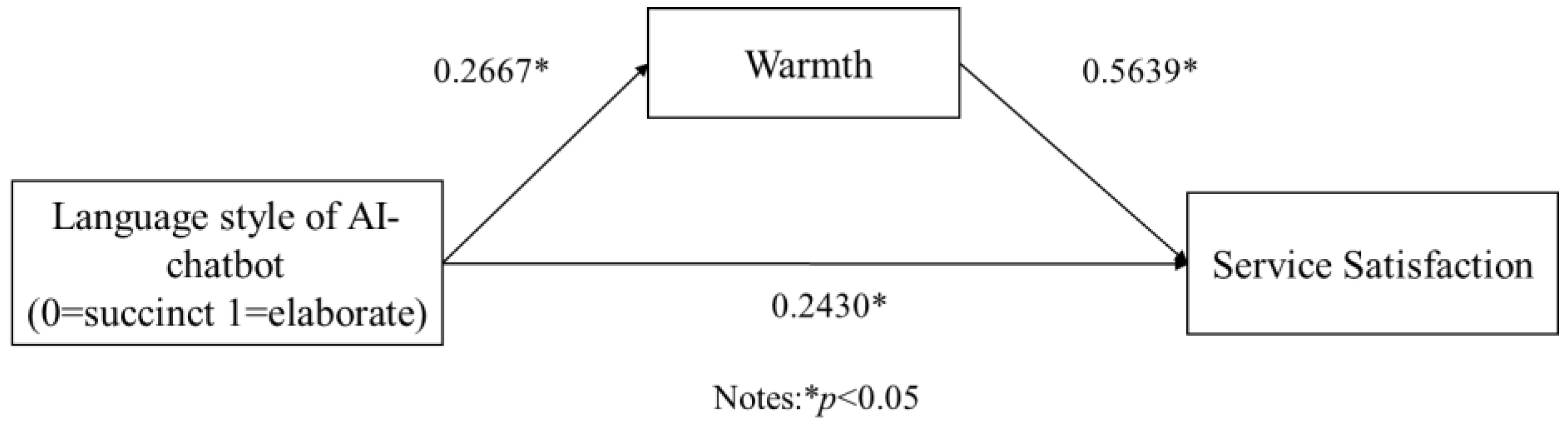
2.5. The Mediating Role of Warmth
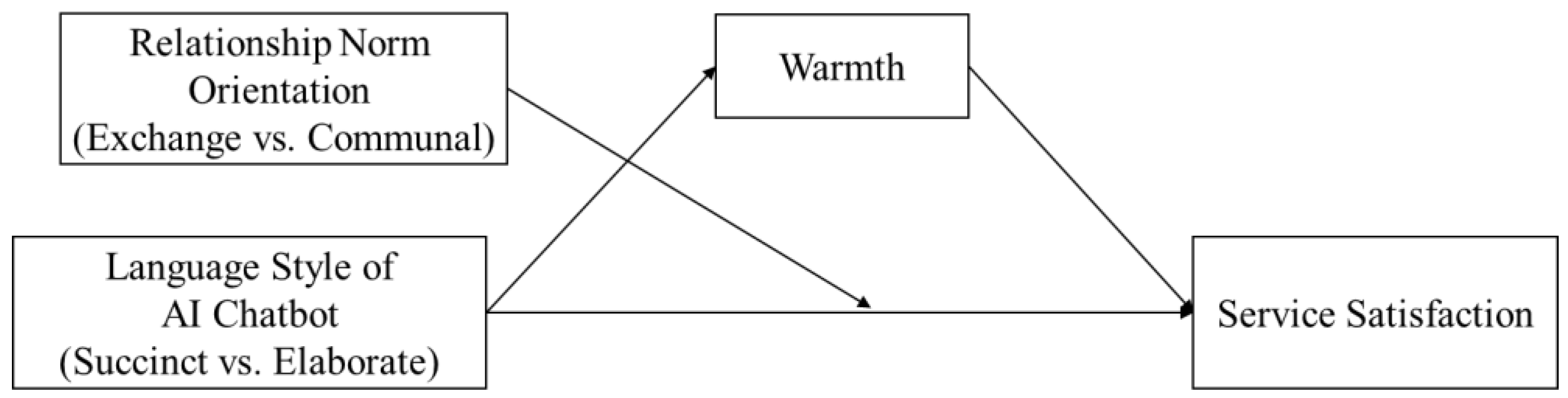
2.6. The Moderating Role of Relationship Norm Orientation
3. Methods
3.1. Study 1
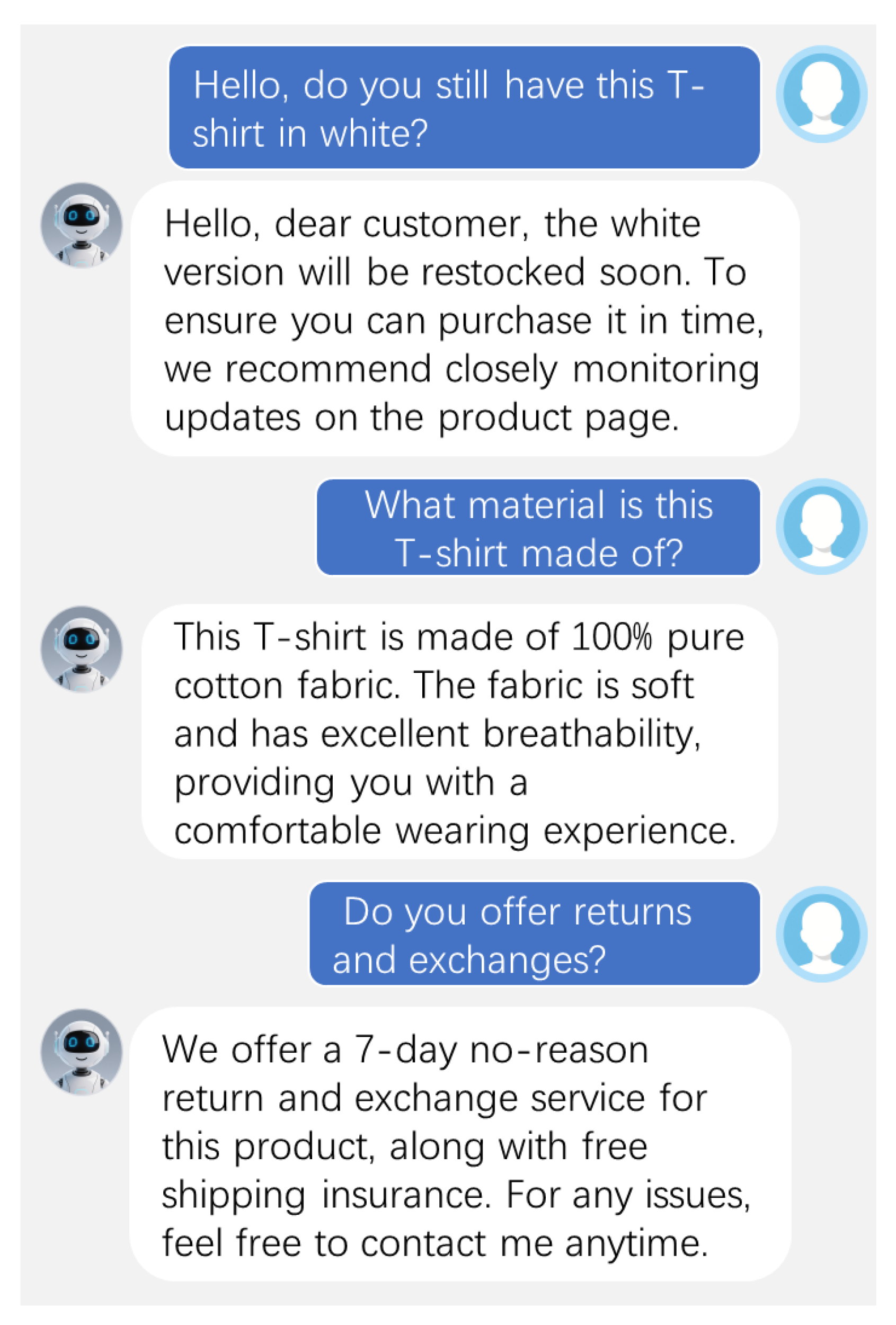
3.1.1. Participants and Experimental Stimuli
3.1.2. Procedure
3.1.3. Results
3.2. Study 2
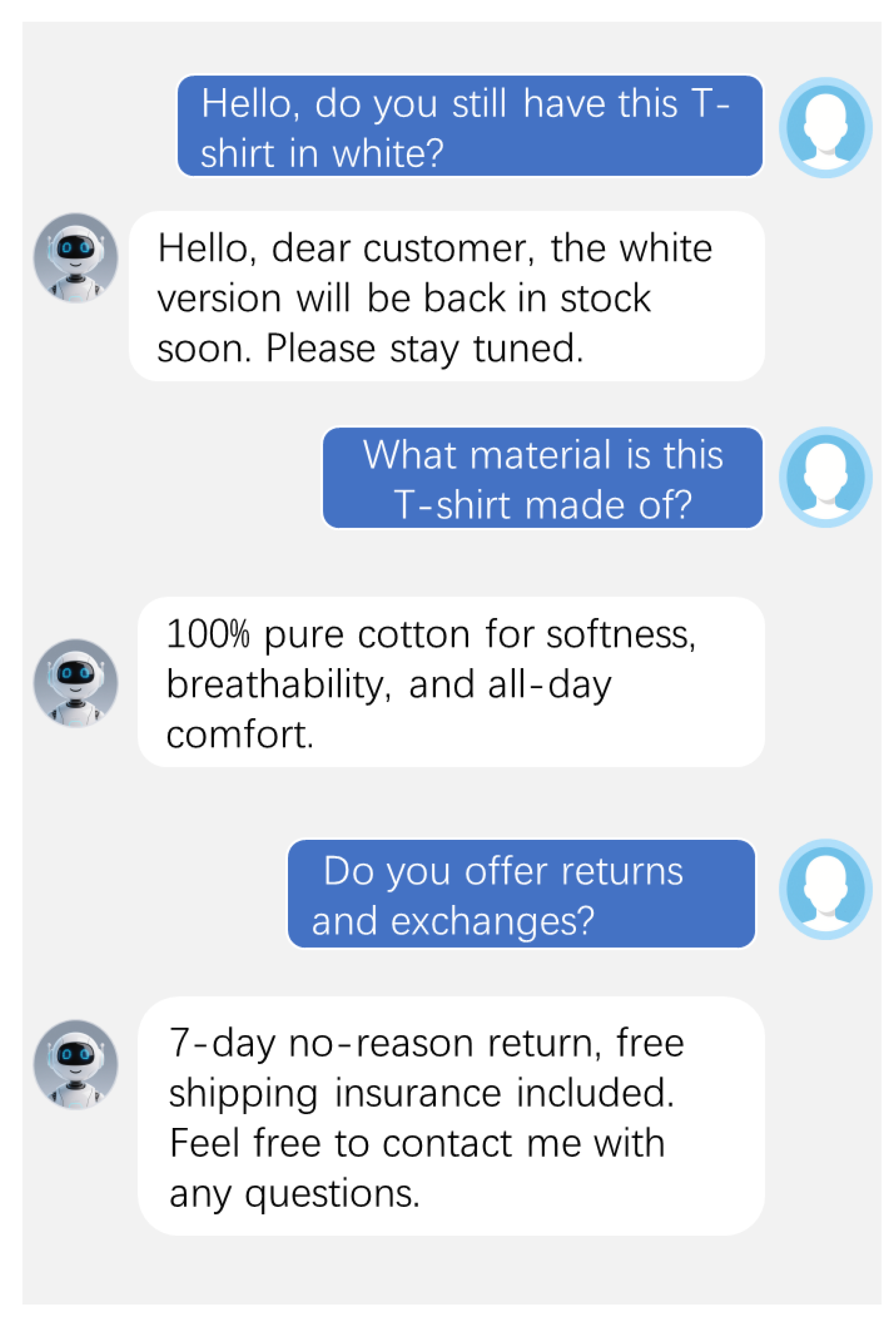
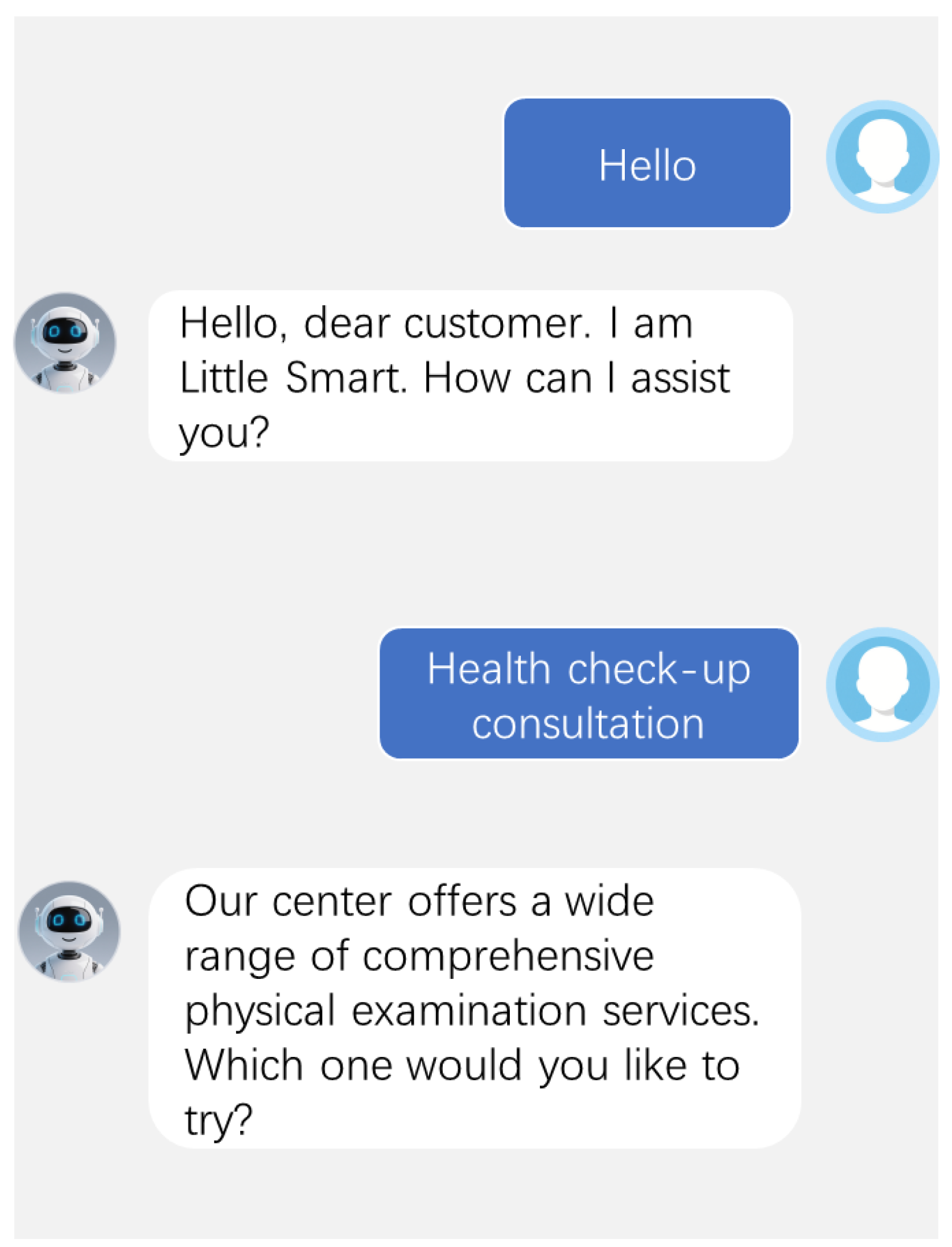
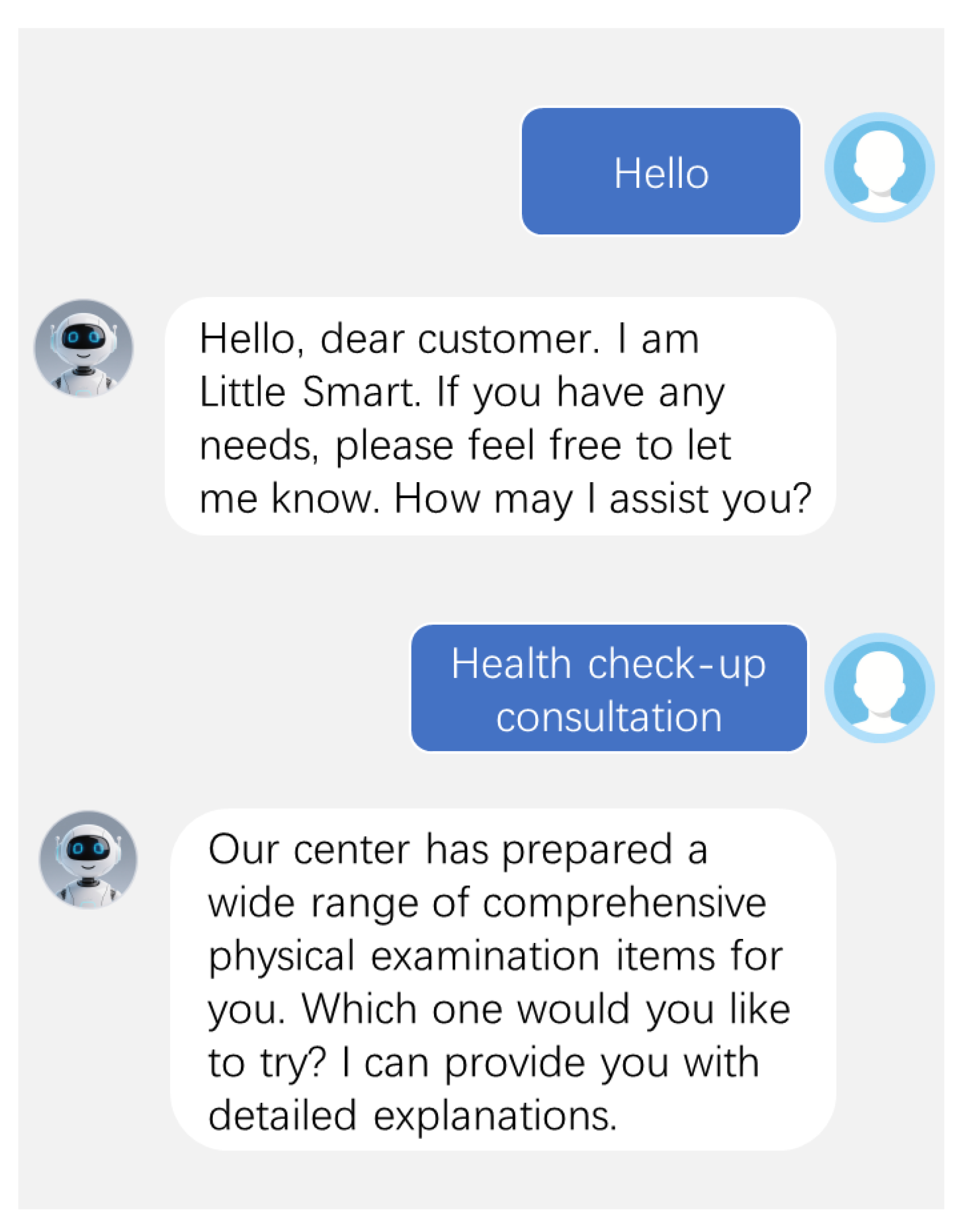
3.2.1. Participants and Experimental Stimuli
3.2.2. Procedure
3.2.3. Results
3.3. Study 3
3.3.1. Participants and Experimental Stimuli
3.3.2. Procedure
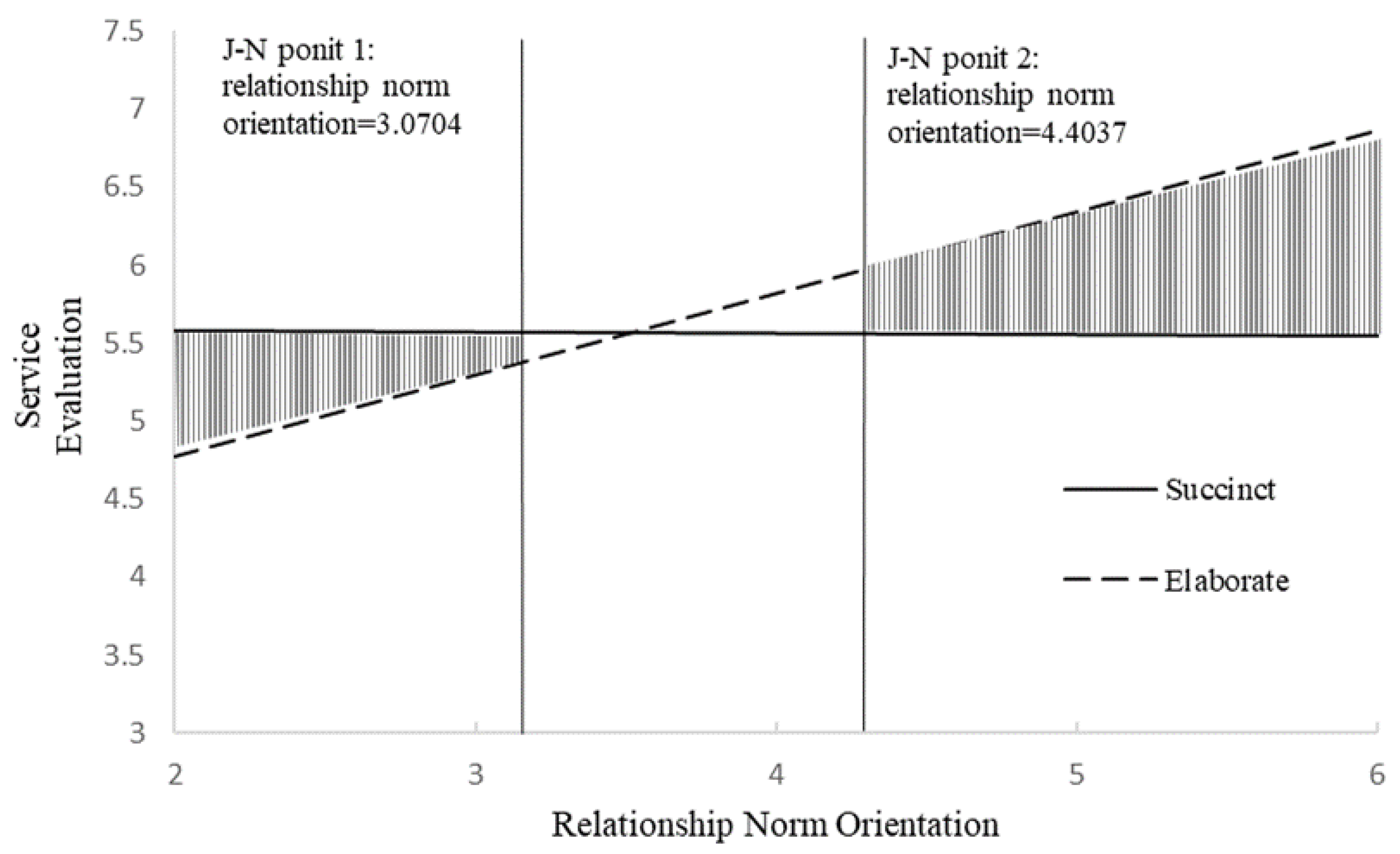
3.3.3. Results
4. Conclusions and Discussion
4.1. Theoretical Implications
4.2. Practical Implications
4.3. Limitations
Author Contributions
Funding
Institutional Review Board Statement
Informed Consent Statement
Data Availability Statement
Acknowledgments
Conflicts of Interest
Appendix A


References
- Choi, S.; Mattila, A.S.; Bolton, L.E. To err is human(-oid): How do consumers react to robot service failure and recovery? J. Serv. Res. 2021, 24, 354–371. [Google Scholar] [CrossRef]
- Jha, S.; Gupta, S.; Mahajan, R. The effect of motivated consumer innovativeness on the intention to use chatbots in the travel and tourism sector. Asia Pac. J. Tour. Res. 2023, 28, 729–744. [Google Scholar] [CrossRef]
- Huang, M.H.; Rust, R.T. The caring machine: Feeling AI for customer care. J. Mark. 2024, 88, 1–23. [Google Scholar] [CrossRef]
- Holmqvist, J.; Van Vaerenbergh, Y.; Grönroos, C. Language use in services: Recent advances and directions for future research. J. Bus. Res. 2017, 72, 114–118. [Google Scholar] [CrossRef]
- Packard, G.; Li, Y.; Berger, J. When language matters. J. Consum. Res. 2024, 51, 634–653. [Google Scholar] [CrossRef]
- Fang, D.; Zhang, Y.E.; Maglio, S.J. Shortcuts to insincerity: Texting abbreviations seem insincere and not worth answering. J. Exp. Psychol. Gen. 2025, 154, 39–57. [Google Scholar] [CrossRef]
- Coupland, N. Style: Language Variation and Identity; Cambridge University Press: Cambridge, UK, 2007. [Google Scholar]
- Packard, G.; Berger, J. How language shapes word of mouth’s impact. J. Mark. Res. 2017, 54, 572–588. [Google Scholar] [CrossRef]
- De Angelis, M.; Tassiello, V.; Amatulli, C.; Costabile, M. How language abstractness affects service referral persuasiveness. J. Bus. Res. 2017, 72, 119–126. [Google Scholar] [CrossRef]
- Li, M.; Wang, R. Chatbots in e-commerce: The effect of chatbot language style on customers’ continuance usage intention and attitude toward brand. J. Retail. Consum. Serv. 2023, 71, 103209. [Google Scholar] [CrossRef]
- Zhu, Y.; Zhang, J.; Liang, J. Concrete or abstract: How chatbot response styles influence customer satisfaction. Electron. Commer. Res. Appl. 2023, 62, 101317. [Google Scholar] [CrossRef]
- Kayeser Fatima, J.; Khan, M.I.; Bahmannia, S.; Chatrath, S.K.; Dale, N.F.; Johns, R. Rapport with a chatbot? The underlying role of anthropomorphism in socio-cognitive perceptions of rapport and e-word of mouth. J. Retail. Consum. Serv. 2024, 77, 103666. [Google Scholar] [CrossRef]
- Pfeiffer, B.E.; Sundar, A.; Cao, E. The influence of language style (formal vs. colloquial) on the effectiveness of charitable appeals. Psychol. Mark. 2023, 40, 542–553. [Google Scholar] [CrossRef]
- Choi, S.; Liu, S.Q.; Mattila, A.S. “How may I help you?” Says a robot: Examining language styles in the service encounter. Int. J. Hosp. Manag. 2019, 82, 32–38. [Google Scholar] [CrossRef]
- Hendriks, B.; van Meurs, F.; Korzilius, H.; le Pair, R.; le Blanc-Damen, S. Style congruency and persuasion: A cross-cultural study into the influence of differences in style dimensions on the persuasiveness of business newsletters in Great Britain and the Netherlands. IEEE Trans. Prof. Commun. 2012, 55, 122–141. [Google Scholar] [CrossRef]
- Mulac, A.; Bradac, J.J.; Gibbons, P. Empirical support for the gender-as-culture hypothesis: An intercultural analysis of male/female language differences. Hum. Commun. Res. 2001, 27, 121–152. [Google Scholar] [CrossRef]
- Lutz, B.; Pröllochs, N.; Neumann, D. Are longer reviews always more helpful? Disentangling the interplay between review length and line of argumentation. J. Bus. Res. 2022, 144, 888–901. [Google Scholar] [CrossRef]
- Davis, S.W.; Horváth, C.; Gretry, A.; Belei, N. Say what? How the interplay of tweet readability and brand hedonism affects consumer engagement. J. Bus. Res. 2019, 100, 150–164. [Google Scholar] [CrossRef]
- Kim, J.; Giroux, M.; Lee, J.C. When do you trust AI? The effect of number presentation detail on consumer trust and acceptance of AI recommendations. Psychol. Mark. 2021, 38, 1140–1155. [Google Scholar] [CrossRef]
- Yu, X.; Li, Y.; Huang, H.; Bogicevic, V. How recommendation conciseness shapes customers’ attitudes toward the AI chatbot. Int. J. Contemp. Hosp. Manag. 2025, 37, 3559–3577. [Google Scholar] [CrossRef]
- Berger, J.; Packard, G. Wisdom from words: The psychology of consumer language. Consum. Psychol. Rev. 2023, 6, 3–16. [Google Scholar] [CrossRef]
- Fang, D.; Maglio, S.J. Time perspective and helpfulness: Are communicators more persuasive in the past, present, or future tense? J. Exp. Soc. Psychol. 2024, 110, 104544. [Google Scholar] [CrossRef]
- Parhankangas, A.; Renko, M. Linguistic style and crowdfunding success among social and commercial entrepreneurs. J. Bus. Ventur. 2017, 32, 215–236. [Google Scholar] [CrossRef]
- Gretry, A.; Horváth, C.; Belei, N.; van Riel, A.C. “Don’t pretend to be my friend!” When an informal brand communication style backfires on social media. J. Bus. Res. 2017, 74, 77–89. [Google Scholar] [CrossRef]
- Packard, G.; Moore, S.G.; McFerran, B. (I’m) happy to help (you): The impact of personal pronoun use in customer–firm interactions. J. Mark. Res. 2018, 55, 541–555. [Google Scholar] [CrossRef]
- Stephan, E.; Liberman, N.; Trope, Y. Politeness and psychological distance: A construal level perspective. J. Pers. Soc. Psychol. 2010, 98, 268–280. [Google Scholar] [CrossRef]
- Nepomuceno, M.V.; Laroche, M.; Richard, M.O. How to reduce perceived risk when buying online: The interactions between intangibility, product knowledge, brand familiarity, privacy and security concerns. J. Retail. Consum. Serv. 2014, 21, 619–629. [Google Scholar] [CrossRef]
- Salancik, G.R.; Pfeffer, J. A social information processing approach to job attitudes and task design. Adm. Sci. Q. 1978, 23, 224–253. [Google Scholar] [CrossRef]
- Spence, M. Signaling in retrospect and the informational structure of markets. Am. Econ. Rev. 2002, 92, 434–459. [Google Scholar] [CrossRef]
- Boateng, S.L. Online relationship marketing and customer loyalty: A signaling theory perspective. Int. J. Bank Mark. 2019, 37, 226–240. [Google Scholar] [CrossRef]
- Wirtz, J.; Patterson, P.G.; Kunz, W.H.; Gruber, T.; Lu, V.N.; Paluch, S.; Martins, A. Brave new world: Service robots in the frontline. J. Serv. Manag. 2018, 29, 907–931. [Google Scholar] [CrossRef]
- Chauhan, R.; Mehra, P. Abstract or concrete language style? How chatbots of online travel agencies should apologise to customers. Asia Pac. J. Tour. Res. 2025, 30, 285–299. [Google Scholar] [CrossRef]
- Park, J.; Yoo, J.W.; Cho, Y.; Park, H. Examining the impact of service robot communication styles on customer intimacy following service failure. J. Retail. Consum. Serv. 2023, 75, 103511. [Google Scholar] [CrossRef]
- Wang, S.; Yan, Q.; Wang, L. Task-oriented vs. social-oriented: Chatbot communication styles in electronic commerce service recovery. Electron. Commer. Res. 2025, 25, 1793–1825. [Google Scholar] [CrossRef]
- Hu, Q.; Pan, Z. Is cute AI more forgivable? The impact of informal language styles and relationship norms of conversational agents on service recovery. Electron. Commer. Res. Appl. 2024, 65, 101398. [Google Scholar] [CrossRef]
- Lu, Z.; Min, Q.; Jiang, L.; Chen, Q. The effect of the anthropomorphic design of chatbots on customer switching intention when the chatbot service fails: An expectation perspective. Int. J. Inf. Manag. 2024, 76, 102767. [Google Scholar] [CrossRef]
- Yan, J.; Luo, B.; Zhang, K. Cute or competent? Contextual dynamics of consumer acceptance toward service robots. J. Hosp. Mark. Manag. 2025, 34, 681–703. [Google Scholar] [CrossRef]
- Huang, Y.; Gursoy, D. Customers’ online service encounter satisfaction with chatbots: Interaction effects of language style and decision-making journey stage. Int. J. Contemp. Hosp. Manag. 2024, 36, 4074–4091. [Google Scholar] [CrossRef]
- Zhu, J.; Jiang, Y.; Wang, X.; Huang, S. Social-or task-oriented: How does social crowding shape consumers’ preferences for chatbot conversational styles? J. Res. Interact. Mark. 2023, 17, 641–662. [Google Scholar] [CrossRef]
- Chen, J.; Li, M.; Ham, J. Different dimensions of anthropomorphic design cues: How visual appearance and conversational style influence users’ information disclosure tendency towards chatbots. Int. J. Hum. Comput. Stud. 2024, 190, 103320. [Google Scholar] [CrossRef]
- Baek, T.H.; Kim, H.J.; Kim, J. AI-generated recommendations: Roles of language style, perceived AI human-likeness, and recommendation agent. Int. J. Hosp. Manag. 2025, 126, 104106. [Google Scholar] [CrossRef]
- Chen, J.; Ke, W.; Wu, Y.; Zhang, J. Do cute language style chatbots make consumers more unethical? Int. J. Inf. Manag. 2025, 85, 102941. [Google Scholar] [CrossRef]
- Dean, D.L.; Hender, J.; Rodgers, T.; Santanen, E. Identifying good ideas: Constructs and scales for idea evaluation. J. Assoc. Inf. Syst. 2006, 7, 646–699. [Google Scholar]
- Guilford, J.P. Creativity: Yesterday, today and tomorrow. J. Creat. Behav. 1967, 1, 3–14. [Google Scholar] [CrossRef]
- Sevier, D.C.; Jablokow, K.; McKilligan, S.; Daly, S.R.; Baker, I.N.; Silk, E.M. Towards the development of an elaboration metric for concept sketches. In Proceedings of the ASME 2017 International Design Engineering Technical Conferences and Computers and Information in Engineering Conference, Cleveland, OH, USA, 6–9 August 2017. [Google Scholar]
- Jensen, M.L.; Averbeck, J.M.; Zhang, Z.; Wright, K.B. Credibility of anonymous online product reviews: A language expectancy perspective. J. Manag. Inf. Syst. 2013, 30, 293–324. [Google Scholar] [CrossRef]
- Fiske, S.T.; Cuddy, A.J.C.; Glick, P. Universal dimensions of social cognition: Warmth and competence. Trends Cogn. Sci. 2007, 11, 77–83. [Google Scholar] [CrossRef] [PubMed]
- Fiske, S.T.; Cuddy, A.J.C.; Glick, P.; Xu, J. A model of (often mixed) stereotype content: Competence and warmth respectively follow from perceived status and competition. In Social Cognition; Routledge: London, UK, 2018; pp. 162–214. [Google Scholar]
- Yang, L.W.; Aggarwal, P.; McGill, A.L. The 3 C’s of anthropomorphism: Connection, comprehension, and competition. Consum. Psychol. Rev. 2020, 3, 3–19. [Google Scholar] [CrossRef]
- Cuddy, A.J.C.; Glick, P.; Beninger, A. The dynamics of warmth and competence judgments, and their outcomes in organizations. Res. Organ. Behav. 2011, 31, 73–98. [Google Scholar] [CrossRef]
- Russell, S.J.; Norvig, P. Artificial Intelligence: A Modern Approach; Prentice Hall: Upper Saddle River, NJ, USA, 2010. [Google Scholar]
- Burgoon, M.; Miller, G.R. An expectancy interpretation of language and persuasion. In Recent Advances in Language, Communication, and Social Psychology; Giles, H., St. Clair, R., Eds.; Academic Press: Orlando, FL, USA, 1985; pp. 199–229. [Google Scholar]
- Brown, P. Politeness: Some Universals in Language Usage; Cambridge University Press: Cambridge, UK, 1987. [Google Scholar]
- Novak, L.; Malinakova, K.; Mikoska, P.; van Dijk, J.P.; Tavel, P. Neural correlates of compassion—An integrative systematic review. Int. J. Psychophysiol. 2022, 172, 46–59. [Google Scholar] [CrossRef]
- Van Doorn, J.; Mende, M.; Noble, S.M.; Hulland, J.; Ostrom, A.L.; Grewal, D.; Petersen, J.A. Domo arigato Mr. Roboto: Emergence of automated social presence in organizational frontlines and customers’ service experiences. J. Serv. Res. 2017, 20, 43–58. [Google Scholar]
- Yu, S.; Zhao, L. Emojifying chatbot interactions: An exploration of emoji utilization in human–chatbot communications. Telemat. Inform. 2024, 86, 102071. [Google Scholar] [CrossRef]
- Clark, M.S.; Mills, J. The difference between communal and exchange relationships: What it is and is not. Pers. Soc. Psychol. Bull. 1993, 19, 684–691. [Google Scholar] [CrossRef]
- Günürkün, P.; Haumann, T.; Mikolon, S. Disentangling the differential roles of warmth and competence judgments in customer–service provider relationships. J. Serv. Res. 2020, 23, 476–503. [Google Scholar] [CrossRef]
- Iacobucci, D.; Ostrom, A. Gender differences in the impact of core and relational aspects of services on the evaluation of service encounters. J. Consum. Psychol. 1993, 2, 257–286. [Google Scholar] [CrossRef]
- Li, X.; Chan, K.W.; Kim, S. Service with emoticons: How customers interpret employee use of emoticons in online service encounters. J. Consum. Res. 2019, 45, 973–987. [Google Scholar] [CrossRef]
- Han, E.; Yin, D.; Zhang, H. Bots with feelings: Should AI agents express positive emotion in customer service? Inf. Syst. Res. 2023, 34, 1296–1311. [Google Scholar] [CrossRef]
- Li, Z.; Tao, W.; Wu, L. Examining the joint impact of relationship norms and service failure severity on consumer responses. J. Public Relat. Res. 2020, 32, 76–91. [Google Scholar] [CrossRef]
- Solomon, M.R.; Surprenant, C.; Czepiel, J.A.; Gutman, E.G. A role theory perspective on dyadic interactions: The service encounter. J. Mark. 1985, 49, 99–111. [Google Scholar] [CrossRef]
- Chung, M.; Ko, E.; Joung, H.; Kim, S.J. Chatbot e-service and customer satisfaction regarding luxury brands. J. Bus. Res. 2020, 117, 587–595. [Google Scholar] [CrossRef]
- Lv, X.; Luo, J.; Liang, Y.; Li, C. Is cuteness irresistible? The impact of cuteness on customers’ intentions to use AI applications. Tour. Manag. 2022, 90, 104472. [Google Scholar] [CrossRef]
- Townsend, C.; Sood, S. Self-affirmation through the choice of highly aesthetic products. J. Consum. Res. 2012, 39, 415–428. [Google Scholar] [CrossRef]
- Hayes, A.F. Introduction to Mediation, Moderation, and Conditional Process Analysis: A Regression-Based Approach; Guilford Publications: New York, NY, USA, 2017. [Google Scholar]
- Mills, J.; Clark, M.S. Communal and exchange relationships: Controversies and research. In Theoretical Frameworks for Personal Relationships; Erber, R., Gilmour, R., Eds.; Psychology Press: London, UK, 2013; pp. 29–42. [Google Scholar]
- Chang, W.; Kim, K.K. Appropriate service robots in exchange and communal relationships. J. Bus. Res. 2022, 141, 462–474. [Google Scholar] [CrossRef]



| Context | Language Style | Outcome | Mediator (s) | Moderator (s) | Source |
|---|---|---|---|---|---|
| Service recovery | Informal vs. formal | Negative word of mouth | Intimacy and anger | Failure severity | Park et al. [33] |
| Concrete vs. abstract | Customer forgiveness | Perceived firm sincerity and empathy | Service failure severity | Chauhan and Mehra [32] | |
| Social-oriented vs. task-oriented | Service recovery satisfaction | Cognition-based trust/affect-based trust | Task complexity | Wand et al. [34] | |
| Literal vs. whimsical vs. kindchenschema cuteness | Customer forgiveness | Warmth and competence perception | Relationship norm orientation | Hu and Pan [35] | |
| Social-oriented vs. task-oriented | Switching intention | Service recovery expectations | Task criticality | Lu et al. [36] | |
| Cute vs. competent | Willingness to use the service robot | Perceived entertainment and perceived competence | Service context/relationship orientation | Yan et al. [37] | |
| Service response | Concrete vs. abstract | Customer satisfaction | Empathic accuracy | Cuteness | Zhu et al. [11] |
| Informal vs. formal | Customers’ intention to continue usage and brand attitude | Parasocial interaction | Brand affiliation | Li and Wang [10] | |
| Concrete vs. abstract | Customer satisfaction | Emotional support, informational support | Decision-making-journey stage | Huang and Gursoy [38] | |
| Social-oriented vs. task-oriented | Consumer acceptance | warmth and competence | Social crowding environment | Zhu et al. [39] | |
| Human-like vs. mechanical | Information disclosure tendency | Perceived security | Visual appearance | Chen et al. [40] | |
| Figurative vs. literal | Acceptance of AI-generated recommendations | Imagery vividness | Type of agent and perceived AI human-likeness | Baek et al. [41] | |
| Non-cute vs. cute | Unethical behavior | Moral self-concept and emotional arousal | Profile picture type | Chen et al. [42] | |
| Concise vs. verbose | Attitudes toward the AI chatbot | Decision Comfort | Consumption Context/social distance | Yu et al. [20] | |
| Succinct vs. Elaborate | Customer satisfaction | Warmth | Relationship norm orientation | Our paper |
| Study 1 | Study 2 | Study 3 | ||||
|---|---|---|---|---|---|---|
| Frequency | Percentage | Frequency | Percentage | Frequency | Percentage | |
| Gender | ||||||
| Male | 70 | 30.4 | 35 | 17.5 | 110 | 32.0 |
| Female | 160 | 69.6 | 165 | 82.5 | 234 | 68.0 |
| Age | ||||||
| 18–25 | 75 | 32.61 | 199 | 99.5 | 104 | 30.23 |
| 26–35 | 107 | 46.52 | 1 | 0.5 | 165 | 47.97 |
| 36–45 | 36 | 15.65 | 0 | 0 | 64 | 18.60 |
| 46–60 | 11 | 4.78 | 0 | 0 | 11 | 3.20 |
| ≥61 | 1 | 0.43 | 0 | 0 | 0 | 0 |
| Education | ||||||
| Middle school or below | 4 | 1.7 | 17 | 8.5 | 12 | 3.5 |
| Junior college | 12 | 5.2 | 1 | 0.5 | 31 | 9.0 |
| University | 179 | 77.8 | 161 | 80.5 | 243 | 70.6 |
| Postgraduate | 35 | 15.2 | 21 | 10.5 | 58 | 16.8 |
| Coefficient | SE | t | p | LLCI | ULCI | |
|---|---|---|---|---|---|---|
| Constant | 6.57 | 1.14 | 5.78 | 0.000 | 4.34 | 8.81 |
| Chatbot language style | −1.98 | 0.76 | −2.60 | 0.0097 | −3.4693 | −0.4814 |
| Relationship norm orientation | −0.24 | 0.26 | −0.94 | 0.3458 | −0.7459 | 0.2621 |
| Interaction effect | 0.49 | 0.17 | 2.85 | 0.0047 | 0.1504 | 0.8216 |
| Model summary | R | R2 | F | df1 | df2 | p |
| 0.33 | 0.11 | 14.08 | 3 | 340 | 0.0000 |
Disclaimer/Publisher’s Note: The statements, opinions and data contained in all publications are solely those of the individual author(s) and contributor(s) and not of MDPI and/or the editor(s). MDPI and/or the editor(s) disclaim responsibility for any injury to people or property resulting from any ideas, methods, instructions or products referred to in the content. |
© 2026 by the authors. Licensee MDPI, Basel, Switzerland. This article is an open access article distributed under the terms and conditions of the Creative Commons Attribution (CC BY) license.
Share and Cite
Fan, Y.; Yue, X.; Zhang, X.; Zhang, L. Elaborate or Succinct? The Impact of AI Chatbots’ Language Style on Customers’ Satisfaction in Online Service. J. Theor. Appl. Electron. Commer. Res. 2026, 21, 51. https://doi.org/10.3390/jtaer21020051
Fan Y, Yue X, Zhang X, Zhang L. Elaborate or Succinct? The Impact of AI Chatbots’ Language Style on Customers’ Satisfaction in Online Service. Journal of Theoretical and Applied Electronic Commerce Research. 2026; 21(2):51. https://doi.org/10.3390/jtaer21020051
Chicago/Turabian StyleFan, Yafeng, Xiaohui Yue, Xiadan Zhang, and Luyao Zhang. 2026. "Elaborate or Succinct? The Impact of AI Chatbots’ Language Style on Customers’ Satisfaction in Online Service" Journal of Theoretical and Applied Electronic Commerce Research 21, no. 2: 51. https://doi.org/10.3390/jtaer21020051
APA StyleFan, Y., Yue, X., Zhang, X., & Zhang, L. (2026). Elaborate or Succinct? The Impact of AI Chatbots’ Language Style on Customers’ Satisfaction in Online Service. Journal of Theoretical and Applied Electronic Commerce Research, 21(2), 51. https://doi.org/10.3390/jtaer21020051