


Exploring the Customer Experience Regarding AI-Powered Fintech Chatbots in Terms of SOR Theory


Abstract
1. Introduction
- (i)
- How do specific features of AI-powered fintech chatbots in smartphone applications influence the internal perceptions of Generation Z users, and how do these perceptions shape the ultimate customer experience?
- (ii)
- How does the complexity level of the financial task Generation Z users interact with, the human-like features expected from an AI-powered fintech chatbot, and the influence of these features on the customer experience change?
2. Theoretical Background
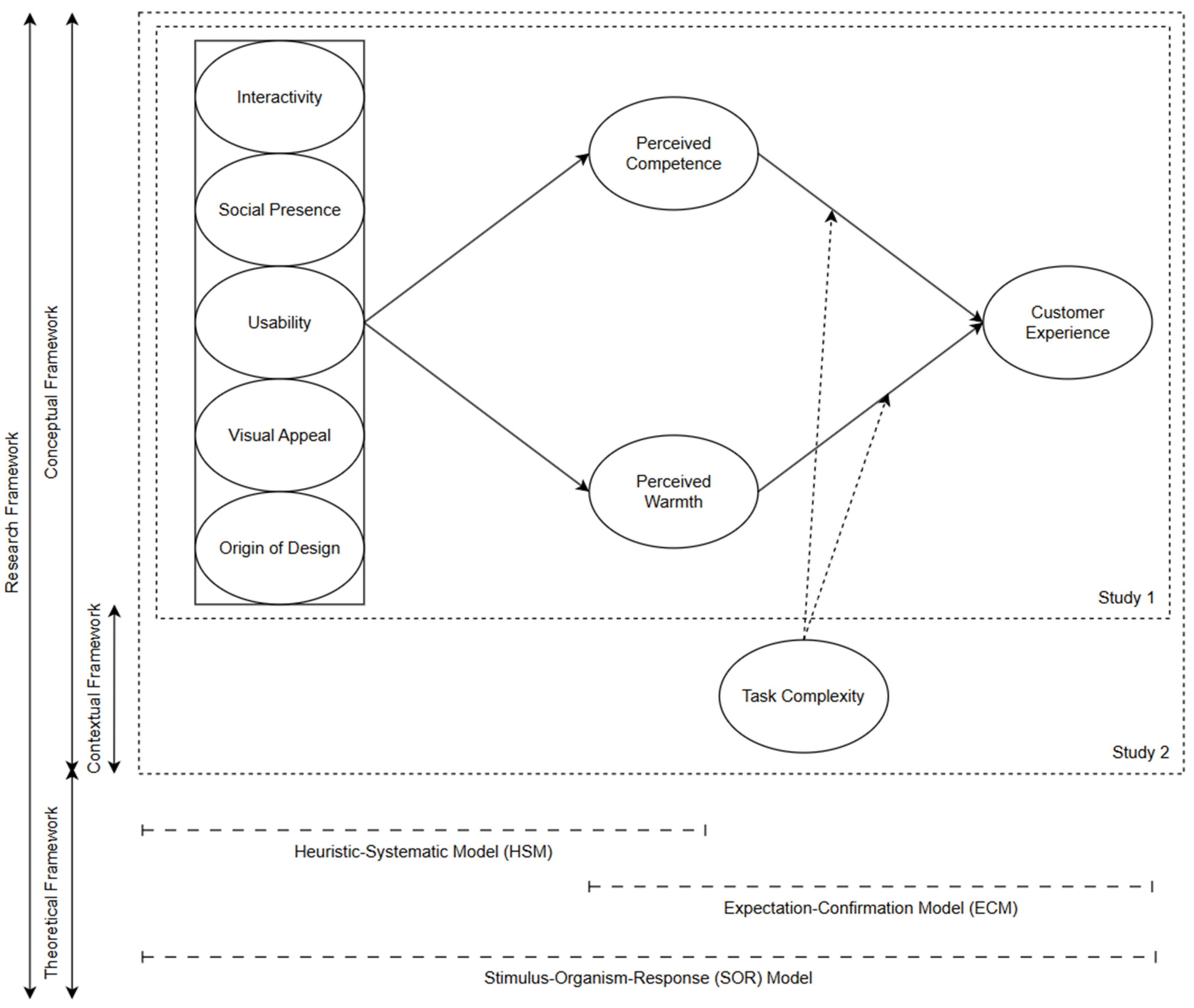
Stimulus-Organism-Response (S-O-R) Framework
3. Hypotheses Development
3.1. Usability (Us)
3.2. Interactivity (In)
3.3. Visual Appeal (VA)
3.4. Social Presence (SP)
3.5. Originality of Design (OD)
3.6. Perceived Competence (PC)
3.7. Perceived Warmth (PW)
3.8. Customer Experience (CX)
3.9. Moderating Role Task Complexity
4. Study 1
4.1. Objective and Overview
4.2. Methods
4.2.1. Scales
4.2.2. Participants and Sampling
4.2.3. Analysis
4.3. Results
4.3.1. Measurement Model Assessment
4.3.2. Structural Model Assessment
4.4. Discussion of Study 1
5. Study 2
5.1. Objective and Overview
5.2. Methods
5.2.1. Scales
5.2.2. Participants and Sampling
5.2.3. Analysis
5.3. Results
5.3.1. Measurement Model Assessment
5.3.2. Structural Model Assessment
5.4. Discussion of Study 2
6. General Discussion
6.1. Overview and Summary
6.2. Theoretical Implications
6.3. Practical Implications
7. Limitations
Author Contributions
Funding
Institutional Review Board Statement
Informed Consent Statement
Data Availability Statement
Conflicts of Interest
References
- We Are Social. Digital 2025 Global Overview Report. 2025. Available online: https://wearesocial.com/us/blog/2025/02/digital-2025-the-essential-guide-to-the-global-state-of-digital/ (accessed on 14 December 2025).
- Elayat, A.M.A.; Elalfy, R.M. Using SOR Theory to Examine the Impact of AI Chatbot Quality on Gen Z’s Satisfaction and Advocacy within the Fast-Food Sector. Young Consum. 2025, 26, 352–383. [Google Scholar] [CrossRef]
- Agnihotri, A.; Bhattacharya, S. Chatbots’ Effectiveness in Service Recovery. Int. J. Inf. Manag. 2024, 76, 102679. [Google Scholar] [CrossRef]
- Ramesh, A.; Chawla, V. Chatbots in Marketing: A Literature Review Using Morphological and Co-Occurrence Analyses. J. Interact. Mark. 2022, 57, 472–496. [Google Scholar] [CrossRef]
- Gupta, M.; Dheekonda, V.; Masum, M. Genie: Enhancing Information Management in the Restaurant Industry through AI-Powered Chatbot. Int. J. Inf. Manag. Data Insights 2024, 4, 100255. [Google Scholar] [CrossRef]
- Gursoy, D.; Chi, O.H.; Lu, L.; Nunkoo, R. Consumers Acceptance of Artificially Intelligent (AI) Device Use in Service Delivery. Int. J. Inf. Manag. 2019, 49, 157–169. [Google Scholar] [CrossRef]
- Hsu, C.-L.; Lin, J.C.-C. Understanding the User Satisfaction and Loyalty of Customer Service Chatbots. J. Retail. Consum. Serv. 2023, 71, 103211. [Google Scholar] [CrossRef]
- Puertas, S.M.; Manzano, M.D.I.; López, C.S.; Ribeiro-Cardoso, P. Purchase Intentions in a Chatbot Environment: An Examination of the Effects of Customer Experience. Oeconomia Copernic. 2024, 15, 145–194. [Google Scholar] [CrossRef]
- Nguyen, M.; Casper Ferm, L.-E.; Quach, S.; Pontes, N.; Thaichon, P. Chatbots in Frontline Services and Customer Experience: An Anthropomorphism Perspective. Psychol. Mark. 2023, 40, 2201–2225. [Google Scholar] [CrossRef]
- Borsci, S.; Malizia, A.; Schmettow, M.; van der Velde, F.; Tariverdiyeva, G.; Balaji, D.; Chamberlain, A. The Chatbot Usability Scale: The Design and Pilot of a Usability Scale for Interaction with AI-Based Conversational Agents. Pers. Ubiquit. Comput. 2022, 26, 95–119. [Google Scholar] [CrossRef]
- Luo, X.; Tong, S.; Fang, Z.; Qu, Z. Frontiers: Machines vs. Humans: The Impact of Artificial Intelligence Chatbot Disclosure on Customer Purchases. Mark. Sci. 2019, 38, 937–947. [Google Scholar] [CrossRef]
- Oksama, M.H.; Marsal, A.; Hamzah, M.L.; Syaifullah; Rozanda, N.E. Transforming Public Service: AI Chatbot Integration in SI-PEKA Mobile App Development. In Proceedings of the 2024 2nd International Symposium on Information Technology and Digital Innovation (ISITDI), Bukittinggi, Indonesia, 24–25 July 2024; pp. 234–240. [Google Scholar]
- Chung, M.; Ko, E.; Joung, H.; Kim, S.J. Chatbot E-Service and Customer Satisfaction Regarding Luxury Brands. J. Bus. Res. 2020, 117, 587–595. [Google Scholar] [CrossRef]
- Yen, C.; Chiang, M.-C. Trust Me, If You Can: A Study on the Factors That Influence Consumers’ Purchase Intention Triggered by Chatbots Based on Brain Image Evidence and Self-Reported Assessments. Behav. Inf. Technol. 2021, 40, 1177–1194. [Google Scholar] [CrossRef]
- Kim, M. Unveiling the E-Servicescape of ChatGPT: Exploring User Psychology and Engagement in AI-Powered Chatbot Experiences. Behav. Sci. 2024, 14, 558. [Google Scholar] [CrossRef] [PubMed]
- Size, Share & Trends Analysis Report By Offering (Solution, Services), By Type, By Medium, By Business Function, By Application, By Vertical By Region, and Segment Forecasts, 2025–2030. 2023. Available online: https://www.grandviewresearch.com/industry-analysis/Chatbot-market (accessed on 8 December 2025).
- Mutambik, I. Customer Experience in Open Banking and How It Affects Loyalty Intention: A Study from Saudi Arabia. Sustainability 2023, 15, 10867. [Google Scholar] [CrossRef]
- Van den Broeck, E.; Zarouali, B.; Poels, K. Chatbot Advertising Effectiveness: When Does the Message Get Through? Comput. Hum. Behav. 2019, 98, 150–157. [Google Scholar] [CrossRef]
- Shin, D. The Perception of Humanness in Conversational Journalism: An Algorithmic Information-Processing Perspective. New Media Soc. 2022, 24, 2680–2704. [Google Scholar] [CrossRef]
- Dwivedi, Y.K.; Balakrishnan, J.; Baabdullah, A.M.; Das, R. Do Chatbots Establish “Humanness” in the Customer Purchase Journey? An Investigation through Explanatory Sequential Design. Psychol. Mark. 2023, 40, 2244–2271. [Google Scholar] [CrossRef]
- Araujo, T. Living up to the Chatbot Hype: The Influence of Anthropomorphic Design Cues and Communicative Agency Framing on Conversational Agent and Company Perceptions. Comput. Hum. Behav. 2018, 85, 183–189. [Google Scholar] [CrossRef]
- Yoganathan, V.; Osburg, V.-S.; Kunz, W.H.; Toporowski, W. Check-in at the Robo-Desk: Effects of Automated Social Presence on Social Cognition and Service Implications. Tour. Manag. 2021, 85, 104309. [Google Scholar] [CrossRef]
- Bunea, O.-I.; Corboș, R.-A.; Mișu, S.I.; Triculescu, M.; Trifu, A. The Next-Generation Shopper: A Study of Generation-Z Perceptions of AI in Online Shopping. J. Theor. Appl. Electron. Commer. Res. 2024, 19, 2605–2629. [Google Scholar] [CrossRef]
- Ameen, N.; Hosany, S.; Taheri, B. Generation Z’s Psychology and New-Age Technologies: Implications for Future Research. Psychol. Mark. 2023, 40, 2029–2040. [Google Scholar] [CrossRef]
- Ramya, J.B.; Alur, S. The Mediating Role of Parasocial Relationship in Customer Services Chatbots Among Millennials and Gen Z Population. Int. J. Hum.-Comput. Interact. 2025, 41, 919–931. [Google Scholar] [CrossRef]
- Saklani, S.; Kala, D. Perception of Gen Z Customers towards Chatbots as Service Agents: A Qualitative Study in the Indian Context. JTDE 2024, 12, 356–376. [Google Scholar] [CrossRef]
- Jenneboer, L.; Herrando, C.; Constantinides, E. The Impact of Chatbots on Customer Loyalty: A Systematic Literature Review. J. Theor. Appl. Electron. Commer. Res. 2022, 17, 212–229. [Google Scholar] [CrossRef]
- Kumar, K.; Mishra, P. The Dynamic Role of Customer Experience in Shaping the Social Media Marketing-Purchase Intention Relationship: An S-O-R Perspective. Asian J. Econ. Bus. Account. 2024, 24, 252–265. [Google Scholar] [CrossRef]
- Chen, S.; Chaiken, S. The Heuristic-Systematic Model in Its Broader Context. In Dual-Process Theories in Social Psychology; The Guilford Press: New York, NY, USA, 1999; pp. 73–96. ISBN 978-1-57230-421-5. [Google Scholar]
- Merlo, O.; Lukas, B.A.; Whitwell, G.J. Heuristics Revisited: Implications for Marketing Research and Practice. Mark. Theory 2008, 8, 189–204. [Google Scholar] [CrossRef]
- Dogruel, L.; Joeckel, S.; Bowman, N.D. Choosing the Right App: An Exploratory Perspective on Heuristic Decision Processes for Smartphone App Selection. Mob. Media Commun. 2015, 3, 125–144. [Google Scholar] [CrossRef]
- Bhattacherjee, A. Understanding Information Systems Continuance: An Expectation-Confirmation Model. MIS Q. 2001, 25, 351–370. [Google Scholar] [CrossRef]
- Oliver, R.L. A Cognitive Model of the Antecedents and Consequences of Satisfaction Decisions. J. Mark. Res. 1980, 17, 460–469. [Google Scholar] [CrossRef]
- Nguyen, M.; Mehrotra, A.; Malik, A.; Pandey, R. Nexus between Generative AI Engagement, Quality and Expectation Formation: An Application of Expectation–Confirmation Theory. J. Enterp. Inf. Manag. 2025, 38, 798–820. [Google Scholar] [CrossRef]
- Alnaser, F.M.; Rahi, S.; Alghizzawi, M.; Ngah, A.H. Does Artificial Intelligence (AI) Boost Digital Banking User Satisfaction? Integration of Expectation Confirmation Model and Antecedents of Artificial Intelligence Enabled Digital Banking. Heliyon 2023, 9, e18930. [Google Scholar] [CrossRef]
- Bhatnagr, P.; Rajesh, A. Artificial Intelligence Features and Expectation Confirmation Theory in Digital Banking Apps: Gen Y and Z Perspective. Manag. Decis. 2024. ahead-of-print. [Google Scholar] [CrossRef]
- Mehrabian, A.; Russell, J.A. An Approach to Environmental Psychology; The MIT Press: Cambridge, MA, USA, 1974; p. xii, 266. ISBN 978-0-262-13090-5. [Google Scholar]
- Jacoby, J. Stimulus-Organism-Response Reconsidered: An Evolutionary Step in Modeling (Consumer) Behavior. J. Consum. Psychol. 2002, 12, 51–57. [Google Scholar] [CrossRef]
- Premathilake, G.W.; Li, H.; Li, C.; Liu, Y.; Han, S. Understanding the Effect of Anthropomorphic Features of Humanoid Social Robots on User Satisfaction: A Stimulus-Organism-Response Approach. Ind. Manag. Data Syst. 2024, 125, 768–796. [Google Scholar] [CrossRef]
- Hwang, S.; Kim, J. Toward a Chatbot for Financial Sustainability. Sustainability 2021, 13, 3173. [Google Scholar] [CrossRef]
- Gao, L.; Li, G.; Tsai, F.; Gao, C.; Zhu, M.; Qu, X. The Impact of Artificial Intelligence Stimuli on Customer Engagement and Value Co-Creation: The Moderating Role of Customer Ability Readiness. J. Res. Interact. Mark. 2022, 17, 317–333. [Google Scholar] [CrossRef]
- Yin, J.; Qiu, X. AI Technology and Online Purchase Intention: Structural Equation Model Based on Perceived Value. Sustainability 2021, 13, 5671. [Google Scholar] [CrossRef]
- Cheng, Y.; Jiang, H. Customer–Brand Relationship in the Era of Artificial Intelligence: Understanding the Role of Chatbot Marketing Efforts. J. Prod. Brand Manag. 2021, 31, 252–264. [Google Scholar] [CrossRef]
- Rafiq, F.; Dogra, N.; Adil, M.; Wu, J.-Z. Examining Consumer’s Intention to Adopt AI-Chatbots in Tourism Using Partial Least Squares Structural Equation Modeling Method. Mathematics 2022, 10, 2190. [Google Scholar] [CrossRef]
- Vafaei-Zadeh, A.; Nikbin, D.; Wong, S.L.; Hanifah, H. Investigating Factors Influencing AI Customer Service Adoption: An Integrated Model of Stimulus–Organism–Response (SOR) and Task-Technology Fit (TTF) Theory. Asia Pac. J. Mark. Logist. 2024. ahead-of-print. [Google Scholar] [CrossRef]
- Chen, Y.; Prentice, C.; Weaven, S.; Hisao, A. The Influence of Customer Trust and Artificial Intelligence on Customer Engagement and Loyalty—The Case of the Home-Sharing Industry. Front. Psychol. 2022, 13, 912339. [Google Scholar] [CrossRef]
- Nazir, S.; Khadim, S.; Ali Asadullah, M.; Syed, N. Exploring the Influence of Artificial Intelligence Technology on Consumer Repurchase Intention: The Mediation and Moderation Approach. Technol. Soc. 2023, 72, 102190. [Google Scholar] [CrossRef]
- Cheng, X.; Zhang, X.; Cohen, J.; Mou, J. Human vs. AI: Understanding the Impact of Anthropomorphism on Consumer Response to Chatbots from the Perspective of Trust and Relationship Norms. Inf. Process. Manag. 2022, 59, 102940. [Google Scholar] [CrossRef]
- Gao, J.; Ren, L.; Yang, Y.; Zhang, D.; Li, L. The Impact of Artificial Intelligence Technology Stimuli on Smart Customer Experience and the Moderating Effect of Technology Readiness. Int. J. Emerg. Mark. 2022, 17, 1123–1142. [Google Scholar] [CrossRef]
- Cheng, Y.; Wang, Y.; Lee, J. Using a Chatbot to Combat Misinformation: Exploring Gratifications, Chatbot Satisfaction and Engagement, and Relationship Quality. Int. J. Hum.-Comput. Interact. 2025, 41, 3913–3925. [Google Scholar] [CrossRef]
- Lee, J.; Lee, D.; Lee, J. Influence of Rapport and Social Presence with an AI Psychotherapy Chatbot on Users’ Self-Disclosure. Int. J. Hum.-Comput. Interact. 2024, 40, 1620–1631. [Google Scholar] [CrossRef]
- Khamaj, A. AI-Enhanced Chatbot for Improving Healthcare Usability and Accessibility for Older Adults. Alex. Eng. J. 2025, 116, 202–213. [Google Scholar] [CrossRef]
- Belanche, D.; Casaló, L.V.; Schepers, J.; Flavián, C. Examining the Effects of Robots’ Physical Appearance, Warmth, and Competence in Frontline Services: The Humanness-Value-Loyalty Model. Psychol. Mark. 2021, 38, 2357–2376. [Google Scholar] [CrossRef]
- Kim, W.B.; Hur, H.J. What Makes People Feel Empathy for AI Chatbots? Assessing the Role of Competence and Warmth. Int. J. Hum.-Comput. Interact. 2024, 40, 4674–4687. [Google Scholar] [CrossRef]
- Senda, D.A.F. The Role of Post-Purchase Customer Experience And Corporate Image on Repurchase Intention In Ikanku Bowl. J. Bus. Innov. Strategy 2025, 1, 12–20. [Google Scholar]
- Mainardes, E.W.; Coutinho, A.R.S.; Alves, H.M.B. The Influence of the Ethics of E-Retailers on Online Customer Experience and Customer Satisfaction. J. Retail. Consum. Serv. 2023, 70, 103171. [Google Scholar] [CrossRef]
- Petre, M.; Minocha, S.; Roberts, D. Usability beyond the Website: An Empirically-Grounded e-Commerce Evaluation Instrument for the Total Customer Experience. Behav. Inf. Technol. 2006, 25, 189–203. [Google Scholar] [CrossRef]
- Siow, J.S.; Teoh, B.A.; Ong, C.Z.; Chee, K.X. The Impact of AI Chatbot Adoption on Customer Experience in E-Retailing. Issues Perspect. Bus. Soc. Sci. 2025, 5, 27–36. [Google Scholar] [CrossRef]
- Ionașcu, A.E.; Bocanet, V.I.; Asaloș, N.; Lazăr, C.M.; Spătariu, E.C.; Barbu, C.A.; Nancu, D. Shifting Perceptions and Behaviors: The Impact of Digitalization on Banking Services. J. Theor. Appl. Electron. Commer. Res. 2025, 20, 295. [Google Scholar] [CrossRef]
- Chen, J.-S.; Le, T.-T.-Y.; Florence, D. Usability and Responsiveness of Artificial Intelligence Chatbot on Online Customer Experience in E-Retailing. Int. J. Retail Distrib. Manag. 2021, 49, 1512–1531. [Google Scholar] [CrossRef]
- Wang, J.; Ivrissimtzis, I.; Li, Z.; Shi, L. Impact of Personalised AI Chat Assistant on Mediated Human-Human Textual Conversations: Exploring Female-Male Differences. In Proceedings of the Companion Proceedings of the 29th International Conference on Intelligent User Interfaces, Greenville, SC, USA, 18–21 March 2024; Association for Computing Machinery: New York, NY, USA, 2024; pp. 78–83. [Google Scholar]
- Sun, Y.; Chen, J.; Sundar, S.S. Chatbot Ads with a Human Touch: A Test of Anthropomorphism, Interactivity, and Narrativity. J. Bus. Res. 2024, 172, 114403. [Google Scholar] [CrossRef]
- Ding, Y.; Najaf, M. Interactivity, Humanness, and Trust: A Psychological Approach to AI Chatbot Adoption in e-Commerce. BMC Psychol 2024, 12, 595. [Google Scholar] [CrossRef]
- Kim, M. Conceptualization of E-Servicescapes in the Fitness Applications and Wearable Devices Context: Multi-Dimensions, Consumer Satisfaction, and Behavioral Intention. J. Retail. Consum. Serv. 2021, 61, 102562. [Google Scholar] [CrossRef]
- Moore, R.J.; Arar, R. Conversational UX Design: An Introduction. In Studies in Conversational UX Design; Moore, R.J., Szymanski, M.H., Arar, R., Ren, G.-J., Eds.; Springer International Publishing: Cham, Switzerland, 2018; pp. 1–16. ISBN 978-3-319-95579-7. [Google Scholar]
- Tran, G.A.; Strutton, D.; Taylor, D.G. Do Microblog Postings Influence Consumer Perceptions of Retailers’ E-servicescapes? Manag. Res. Rev. 2012, 35, 818–836. [Google Scholar] [CrossRef]
- Mishra, A.; Shukla, A.; Sharma, S.K. Psychological Determinants of Users’ Adoption and Word-of-Mouth Recommendations of Smart Voice Assistants. Int. J. Inf. Manag. 2022, 67, 102413. [Google Scholar] [CrossRef]
- Corti, K.; Gillespie, A. Co-Constructing Intersubjectivity with Artificial Conversational Agents: People Are More Likely to Initiate Repairs of Misunderstandings with Agents Represented as Human. Comput. Hum. Behav. 2016, 58, 431–442. [Google Scholar] [CrossRef]
- Wut, T.M.; Chan, E.A.; Wong, H.S. Does Fun Matter? Using Chatbots for Customer Services. Informatics 2024, 11, 94. [Google Scholar] [CrossRef]
- Choi, Y.; Lee, S.; Choi, J. A Study on Factors Influencing Continuous Usage Intention of Chatbot Services in South Korean Financial Institutions. Int. J. Financ. Stud. 2025, 13, 56. [Google Scholar] [CrossRef]
- Klein, S.H. Chatbots as Social Actors: Towards a Better Understanding of Social Responses to TextBased Conversational Service Agents. Doctoral Dissertation, Universität Tübingen, Tübingen, Germany, 2024. [Google Scholar]
- Klein, S.H.; Papies, D.; Utz, S. How Interaction Mechanism and Error Responses Influence Users’ Responses to Customer Service Chatbots. Int. J. Hum.-Comput. Interact. 2025, 41, 4300–4318. [Google Scholar] [CrossRef]
- Schuetzler, R.M.; Grimes, G.M.; Scott Giboney, J. The Impact of Chatbot Conversational Skill on Engagement and Perceived Humanness. J. Manag. Inf. Syst. 2020, 37, 875–900. [Google Scholar] [CrossRef]
- Hess, T.; Fuller, M.; Campbell, D. Designing Interfaces with Social Presence: Using Vividness and Extraversion to Create Social Recommendation Agents. J. Assoc. Inf. Syst. 2009, 10, 889–919. [Google Scholar] [CrossRef]
- Wadinambiarachchi, S.; Kelly, R.M.; Pareek, S.; Zhou, Q.; Velloso, E. The Effects of Generative AI on Design Fixation and Divergent Thinking. In Proceedings of the Proceedings of the CHI Conference on Human Factors in Computing Systems, Yokohama, Japan, 26 April–1 May 2025; ACM: Honolulu, HI, USA, 2024; pp. 1–18. [Google Scholar]
- Arrighi, P.-A.; Masson, P.L.; Weil, B. Breaking the Dilemma Between Robustness and Generativeness: A Comparative Experiment on the Use of New Design Software at the Design-Gap; HAL Open Science: Istanbul, Turkey, 2013; pp. 1–33. [Google Scholar]
- Bitner, M.J. Servicescapes: The Impact of Physical Surroundings on Customers and Employees. J. Mark. 1992, 56, 57–71. [Google Scholar] [CrossRef]
- Yadav, R.; Mahara, T. Exploring the Role of E-Servicescape Dimensions on Customer Online Shopping: A Stimulus-Organism-Response Paradigm. J. Electron. Commer. Organ. 2020, 18, 53–73. [Google Scholar] [CrossRef]
- Bartneck, C.; Kulić, D.; Croft, E.; Zoghbi, S. Measurement Instruments for the Anthropomorphism, Animacy, Likeability, Perceived Intelligence, and Perceived Safety of Robots. Int. J. Soc. Robot. 2009, 1, 71–81. [Google Scholar] [CrossRef]
- Song, X.; Li, Y.; Leung, X.Y.; Mei, D. Service Robots and Hotel Guests’ Perceptions: Anthropomorphism and Stereotypes. Tour. Rev. 2023, 79, 505–522. [Google Scholar] [CrossRef]
- Hidayat-ur-Rehman, I. Examining AI Competence, Chatbot Use and Perceived Autonomy as Drivers of Students’ Engagement in Informal Digital Learning. J. Res. Innov. Teach. Learn. 2024, 17, 196–212. [Google Scholar] [CrossRef]
- Kumar, A.; Shankar, A.; Behl, A.; Chakraborty, D.; Gundala, R.R. Anthropomorphic Generative AI Chatbots for Enhancing Customer Engagement, Experience and Recommendation. J. Consum. Mark 2025. ahead-of-print. [Google Scholar] [CrossRef]
- Lam, A.Y.S. Artificial Intelligence Applications in Financial Technology. J. Theor. Appl. Electron. Commer. Res. 2025, 20, 29. [Google Scholar] [CrossRef]
- Mun, Y.; Kim, N. Leveraging Large Language Models for Sentiment Analysis and Investment Strategy Development in Financial Markets. J. Theor. Appl. Electron. Commer. Res. 2025, 20, 77. [Google Scholar] [CrossRef]
- Al-Daoud, K.I.; Abu-AlSondos, I.A. Robust AI for Financial Fraud Detection in the GCC: A Hybrid Framework for Imbalance, Drift, and Adversarial Threats. J. Theor. Appl. Electron. Commer. Res. 2025, 20, 121. [Google Scholar] [CrossRef]
- Tawfeeq, T.M.; Awqati, A.J.; Jasim, Y.A. The Ethical Implications of ChatGPT AI Chatbot: A Review. JMCER 2023, 2023, 49–57. [Google Scholar]
- Bayır, T.; Bozyiğit, S. Consumer Complaints Management in the Digital Era. In Digital Business and Optimizing Operating Strategies; IGI Global Scientific Publishing: Palmdale, PA, USA, 2024; pp. 57–90. ISBN 979-8-3693-0428-0. [Google Scholar]
- Tuna, M.F. Leveraging Text Analytics to Enhance Marketing Insights From Digital Customer Experiences. In New Trends in Marketing and Consumer Science; IGI Global: Palmdale, PA, USA, 2024; pp. 261–289. ISBN 979-8-3693-2754-8. [Google Scholar]
- Akdemir, D.M.; Bulut, Z.A. Business and Customer-Based Chatbot Activities: The Role of Customer Satisfaction in Online Purchase Intention and Intention to Reuse Chatbots. J. Theor. Appl. Electron. Commer. Res. 2024, 19, 2961–2979. [Google Scholar] [CrossRef]
- Morgan, B. How Chatbots Improve Customer Experience In Every Industry: An Infograph. Available online: https://www.forbes.com/sites/blakemorgan/2017/06/08/how-chatbots-improve-customer-experience-in-every-industry-an-infograph/ (accessed on 30 November 2025).
- Haugeland, I.K.F.; Følstad, A.; Taylor, C.; Bjørkli, C.A. Understanding the User Experience of Customer Service Chatbots: An Experimental Study of Chatbot Interaction Design. Int. J. Hum.-Comput. Stud. 2022, 161, 102788. [Google Scholar] [CrossRef]
- Ashfaq, M.; Yun, J.; Yu, S.; Loureiro, S.M.C. I, Chatbot: Modeling the Determinants of Users’ Satisfaction and Continuance Intention of AI-Powered Service Agents. Telemat. Inform. 2020, 54, 101473. [Google Scholar] [CrossRef]
- Hsu, P.-F.; Nguyen, T.; Wang, C.-Y.; Huang, P.-J. Chatbot Commerce—How Contextual Factors Affect Chatbot Effectiveness. Electron Mark. 2023, 33, 14. [Google Scholar] [CrossRef]
- Morgeson, F.P.; Humphrey, S.E. The Work Design Questionnaire (WDQ): Developing and Validating a Comprehensive Measure for Assessing Job Design and the Nature of Work. J. Appl. Psychol. 2006, 91, 1321–1339. [Google Scholar] [CrossRef]
- Wang, S.; Yan, Q.; Wang, L. Task-Oriented vs. Social-Oriented: Chatbot Communication Styles in Electronic Commerce Service Recovery. Electron. Commer. Res. 2023, 25, 1793–1825. [Google Scholar] [CrossRef]
- Xu, Y.; Shieh, C.-H.; van Esch, P.; Ling, I.-L. AI Customer Service: Task Complexity, Problem-Solving Ability, and Usage Intention. Australas. Mark. J. 2020, 28, 189–199. [Google Scholar] [CrossRef]
- Casadei, A.; Schlögl, S.; Bergmann, M. Chatbots for Robotic Process Automation: Investigating Perceived Trust and User Satisfaction. In Proceedings of the 2022 IEEE 3rd International Conference on Human-Machine Systems (ICHMS), Orlando, FL, USA, 17–19 November 2022; pp. 1–6. [Google Scholar]
- Murtaza, Z.; Sharma, I.; Carbonell, P. Examining Chatbot Usage Intention in a Service Encounter: Role of Task Complexity, Communication Style, and Brand Personality. Technol. Forecast. Soc. Change 2024, 209, 123806. [Google Scholar] [CrossRef]
- Kim, J.-H.; Kim, M.; Yoo, J.; Park, M. Augmented Reality in Delivering Experiential Values: Moderating Role of Task Complexity. Virtual Real. 2024, 28, 19. [Google Scholar] [CrossRef]
- Yoo, J. The Effects of Augmented Reality on Consumer Responses in Mobile Shopping: The Moderating Role of Task Complexity. Heliyon 2023, 9, e13775. [Google Scholar] [CrossRef] [PubMed]
- Cheng, X.; Bao, Y.; Zarifis, A.; Gong, W.; Mou, J. Exploring Consumers’ Response to Text-Based Chatbots in e-Commerce: The Moderating Role of Task Complexity and Chatbot Disclosure. Internet Res. 2021, 32, 496–517. [Google Scholar] [CrossRef]
- Hair, J.F.; Matthews, L.M.; Matthews, R.L.; Sarstedt, M. PLS-SEM or CB-SEM: Updated Guidelines on Which Method to Use. Int. J. Multivar. Data Anal. 2017, 1, 107–123. [Google Scholar] [CrossRef]
- Hair, J.F.; Risher, J.J.; Sarstedt, M.; Ringle, C.M. When to use and how to report the results of PLS-SEM. Eur. Bus. Rev. 2019, 31, 2–24. [Google Scholar] [CrossRef]
- Tenenhaus, M.; Vinzi, V.E.; Chatelin, Y.-M.; Lauro, C. PLS Path Modeling. Comput. Stat. Data Anal. 2005, 48, 159–205. [Google Scholar] [CrossRef]
- Dijkstra, T.K.; Henseler, J. Consistent Partial Least Squares Path Modeling. MIS Q. 2015, 39, 297–316. [Google Scholar] [CrossRef]
- Henseler, J.; Hubona, G.; Ray, P.A. Using PLS Path Modeling in New Technology Research: Updated Guidelines. Ind. Manag. Amp; Data Syst. 2016, 116, 2–20. [Google Scholar] [CrossRef]
- Hair, J.F.; Black, C.W.; Babin, B.J.; Anderson, R.E.; Tatham, R.L. Multivariate Data Analysis, 6th ed.; Pearson Prentice Hall: Upper Saddle River, NJ, USA, 2006. [Google Scholar]
- Hair, J.F.; Hult, G.T.M.; Ringle, C.M.; Sarstedt, M. A Primer on Partial Least Squares Structural Equation Modeling (PLS-SEM), 3rd ed.; Sage: Thousand Oaks, CA, USA, 2022. [Google Scholar]
- Henseler, J.; Ringle, C.M.; Sarstedt, M. A New Criterion for Assessing Discriminant Validity in Variance-Based Structural Equation Modeling. J. Acad. Mark. Sci. 2015, 43, 115–135. [Google Scholar] [CrossRef]
- Hair, J.F.; Black, C.W.; Babin, J.B.; Anderson, E.R. Multivariate Data Analysis, 8th ed.; Cengage: Andover, UK, 2019; ISBN 978-1-4737-5654-0. [Google Scholar]
- Magano, J.; Quintela, J.A.; Banerjee, N. Driving Consumer Engagement Through AI Chatbot Experience: The Mediating Role of Satisfaction Across Generational Cohorts and Gender in Travel Tourism. Sustainability 2025, 17, 7673. [Google Scholar] [CrossRef]
- Barbu, C.M.; Florea, D.L.; Dabija, D.-C.; Barbu, M.C.R. Customer Experience in Fintech. J. Theor. Appl. Electron. Commer. Res. 2021, 16, 1415–1433. [Google Scholar] [CrossRef]
- Huang, S.Y.B.; Lee, C.-J.; Lee, S.-C. Toward a Unified Theory of Customer Continuance Model for Financial Technology Chatbots. Sensors 2021, 21, 5687. [Google Scholar] [CrossRef]
- Meng, H.; Lu, X.; Xu, J. The Impact of Chatbot Response Strategies and Emojis Usage on Customers’ Purchase Intention: The Mediating Roles of Psychological Distance and Performance Expectancy. Behav. Sci. 2025, 15, 117. [Google Scholar] [CrossRef]
- Ramos, R.; Casaca, J.; Patrício, R. Adoption Drivers of Intelligent Virtual Assistants in Banking: Rethinking the Artificial Intelligence Banker. Computers 2025, 14, 209. [Google Scholar] [CrossRef]
- Oliveira, P.F.; Matos, P. Introducing a Chatbot to the Web Portal of a Higher Education Institution to Enhance Student Interaction. Eng. Proc. 2023, 56, 128. [Google Scholar] [CrossRef]
- Xia, Z.; Shannon, R. Navigating the Digital Frontier: Exploring the Dynamics of Customer–Brand Relationships Through AI Chatbots. Sustainability 2025, 17, 2173. [Google Scholar] [CrossRef]
- Manta, O.; Vasile, V.; Rusu, E. Banking Transformation Through FinTech and the Integration of Artificial Intelligence in Payments. FinTech 2025, 4, 13. [Google Scholar] [CrossRef]
- de Andrés-Sánchez, J.; Gené-Albesa, J. Explaining Policyholders’ Chatbot Acceptance with an Unified Technology Acceptance and Use of Technology-Based Model. J. Theor. Appl. Electron. Commer. Res. 2023, 18, 1217–1237. [Google Scholar] [CrossRef]
- Radenković, S.D.; Hanić, H.; Bugarčić, M. Applying Artificial Intelligence in the Digital Transformation of Banking Sector. Proceedings 2023, 85, 19. [Google Scholar] [CrossRef]
- Anton, C.E.; Ciobanu, E.; Brătucu, G.; Bucs, L. Using Chatbots to Enhance Integrated Reporting: Insights from Accounting and Consultancy Companies from Romania. Electronics 2024, 13, 4801. [Google Scholar] [CrossRef]
- Azevedo, N.; Aquino, G.; Nascimento, L.; Camelo, L.; Figueira, T.; Oliveira, J.; Figueiredo, I.; Printes, A.; Torné, I.; Figueiredo, C. A Novel Methodology for Developing Troubleshooting Chatbots Applied to ATM Technical Maintenance Support. Appl. Sci. 2023, 13, 6777. [Google Scholar] [CrossRef]
- Ridha, M.; Haura Maharani, K. Implementation of Artificial Intelligence Chatbot in Optimizing Customer Service in Financial Technology Company PT. FinAccel Finance Indonesia. Proceedings 2022, 83, 21. [Google Scholar] [CrossRef]
- Nguyen, D.M.; Chiu, Y.-T.H.; Le, H.D. Determinants of Continuance Intention towards Banks’ Chatbot Services in Vietnam: A Necessity for Sustainable Development. Sustainability 2021, 13, 7625. [Google Scholar] [CrossRef]
- Villegas-Ch, W.; García-Ortiz, J.; Mullo-Ca, K.; Sánchez-Viteri, S.; Roman-Cañizares, M. Implementation of a Virtual Assistant for the Academic Management of a University with the Use of Artificial Intelligence. Future Internet 2021, 13, 97. [Google Scholar] [CrossRef]


| Construct and Item | Convergent Validity | Internal Consistency/ Reliability | ||
|---|---|---|---|---|
| Outer Loading | AVE a | α b | ρ c | |
| Interactivity (In) | 0.644 (0.765) | 0.816 (0.898) | 0.878 (0.940) | |
| In1 | 0.765 (0.873) | |||
| In2 | 0.792 (0.884) | |||
| In3 | 0.847 (0.881) | |||
| In4 | 0.804 (0.861) | |||
| Social Presence (SP) | 0.718 (0.782) | 0.870 (0.907) | 0.911 (0.935) | |
| SP1 | 0.878 (0.872) | |||
| SP2 | 0.862 (0.891) | |||
| SP3 | 0.801 (0.892) | |||
| SP4 | 0.847 (0.882) | |||
| Usability (Us) | 0.683 (0.706) | 0.922 (0.930) | 0.938 (0.944) | |
| Us1 | 0.875 (0.881) | |||
| Us2 | 0.817 (0.875) | |||
| Us3 | 0.860 (0.849) | |||
| Us4 | 0.852 (0.821) | |||
| Us5 | 0.857 (0.794) | |||
| Us6 | 0.775 (0.861) | |||
| Us7 | 0.738 (0.795) | |||
| Visual Appeal (VA) | 0.708 (0.753) | 0.862 (0.890) | 0.906 (0.924) | |
| VA1 | 0.832 (0.840) | |||
| VA2 | 0.851 (0.883) | |||
| VA3 | 0.859 (0.910) | |||
| VA4 | 0.822 (0.837) | |||
| Originality of Design (OD) | 0.690 (0.732) | 0.850 (0.878) | 0.899 (0.916) | |
| OD1 | 0.814 (0.855) | |||
| OD2 | 0.872 (0.882) | |||
| OD3 | 0.768 (0.830) | |||
| OD4 | 0.864 (0.855) | |||
| Perceived Competence (PC) | 0.715 (0.724) | 0.920 (0.923) | 0.938 (0.929) | |
| Co1 | 0.785 (0.707) | |||
| Co2 | 0.867 (0.849) | |||
| Co3 | 0.806 (0.888) | |||
| Co4 | 0.862 (0.895) | |||
| Co5 | 0.864 (0.884) | |||
| Co6 | 0.885 (0.870) | |||
| Perceived Warmth (PW) | 0.730 (0.723) | 0.877 (0.872) | 0.915 (0.912) | |
| Wa1 | 0.810 (0.784) | |||
| Wa2 | 0.878 (0.882) | |||
| Wa3 | 0.841 (0.863) | |||
| Wa4 | 0.886 (0.869) | |||
| Customer Experience (CX) | 0.786 (0.762) | 0.909 (0.895) | 0.936 (0.927) | |
| CE1 | 0.864 (0.906) | |||
| CE2 | 0.901 (0.888) | |||
| CE3 | 0.926 (0.887) | |||
| CE4 | 0.854 (0.807) | |||
| Task Complexity (TC) | - (0.780) | - (0.859) | - (0.914) | |
| TC1 | - (0.902) | |||
| TC2 | - (0.891) | |||
| TC3 | - (0.855) | |||
| Construct | (1) | (2) | (3) | (4) | (5) | (6) | (7) | (8) |
|---|---|---|---|---|---|---|---|---|
| (1) Interactivity (In) | 0.802 | |||||||
| (2) Social Presence (SP) | 0.509 (0.596) | 0.847 | ||||||
| (3) Usability (Us) | 0.696 (0.800) | 0.547 (0.607) | 0.826 | |||||
| (4) Visual Appeal (VA) | 0.532 (0.631) | 0.470 (0.535) | 0.681 (0.762) | 0.841 | ||||
| (5) Originality of Design (OD) | 0.703 (0.838) | 0.618 (0.719) | 0.755 (0.849) | 0.708 (0.820) | 0.830 | |||
| (6) Perceived Competence (PC) | 0.625 (0.713) | 0.676 (0.746) | 0.671 (0.725) | 0.624 (0.699) | 0.747 (0.837) | 0.846 | ||
| (7) Perceived Warmth (PW) | 0.455 (0.537) | 0.473 (0.534) | 0.538 (0.595) | 0.629 (0.717) | 0.574 (0.658) | 0.632 (0.704) | 0.855 | |
| (8) Customer Experience (CX) | 0.616 (0.713) | 0.612 (0.685) | 0.717 (0.780) | 0.637 (0.716) | 0.703 (0.798) | 0.714 (0.777) | 0.680 (0.759) | 0.887 |
| Effect | Hypotheses | Path | β | t | p Values | Sig. |
|---|---|---|---|---|---|---|
| Direct | H1(a) | In → PC | 0.114 (0.210) | 1.270 (3.478) | 0.204 (0.001) | No (Yes) |
| H1(b) | SP → PC | 0.306 (0.103) | 2.637 (1.327) | 0.008 (0.184) | Yes (No) | |
| H1(c) | Us → PC | 0.102 (0.329) | 1.022 (3.436) | 0.307 (0.001) | No (Yes) | |
| H1(d) | VA → PC | 0.129 (0.213) | 1.559 (3.389) | 0.119 (0.001) | No (Yes) | |
| H1(e) | OD → PC | 0.307 (0.095) | 2.319 (1.045) | 0.020 (0.296) | Yes (No) | |
| H2(a) | In → PW | 0.044 (0.081) | 0.339 (1.412) | 0.735 (0.158) | No (No) | |
| H2(b) | SP → PW | 0.157 (0.110) | 1.478 (1.339) | 0.139 (0.180) | No (No) | |
| H2(c) | Us → PW | 0.060 (0.252) | 0.539 (2.445) | 0.590 (0.015) | No (Yes) | |
| H2(d) | VA → PW | 0.393 (0.468) | 2.730 (5.568) | 0.006 (<0.001) | Yes (Yes) | |
| H2(e) | OD → PW | 0.127 (−0.009) | 0.737 (0.109) | 0.461 (0.913) | No (No) | |
| H3 | PC → CX | 0.470 (0.470) | 3.465 (4.930) | 0.001 (<0.001) | Yes (Yes) | |
| H4 | PW → CX | 0.386 (0.320) | 3.002 (3.637) | 0.003 (<0.001) | Yes (Yes) | |
| Indirect | H5(a) | In → PC → CX | 0.053 (0.099) | 1.202 (0.045) | 0.229 (0.175) | No (No) |
| H5(b) | SP → PC → CX | 0.140 (0.048) | 2.321 (−0.015) | 0.020 (0.143) | Yes (No) | |
| H5(c) | Us → PC → CX | 0.055 (0.155) | 0.859 (0.059) | 0.390 (0.289) | No (No) | |
| H5(d) | VA → PC → CX | 0.062 (0.100) | 1.363 (0.047) | 0.173 (0.173) | No (No) | |
| H5(e) | OD → PC → CX | 0.143 (0.045) | 1.934 (−0.027) | 0.053 (0.152) | No (No) | |
| H6(a) | In → PW → CX | 0.018 (0.026) | 0.313 (−0.008) | 0.754 (0.076) | No (No) | |
| H6(b) | SP → PW → CX | 0.061 (0.035) | 1.236 (−0.011) | 0.216 (0.107) | No (No) | |
| H6(c) | Us → PW → CX | 0.030 (0.081) | 0.455 (0.018) | 0.649 (0.188) | No (No) | |
| H6(d) | VA → PW → CX | 0.143 (0.150) | 2.611 (0.066) | 0.009 (0.240) | Yes (No) | |
| H6(e) | OD → PW → CX | 0.053 (−0.003) | 0.640 (−0.055) | 0.522 (0.058) | No (No) |
| Construct | (1) | (2) | (3) | (4) | (5) | (6) | (7) | (8) | (9) | (10) |
|---|---|---|---|---|---|---|---|---|---|---|
| (1) Interactivity (In) | 0.875 | |||||||||
| (2) Social Presence (SP) | 0.595 (0.655) | 0.884 | ||||||||
| (3) Usability (Us) | 0.732 (0.799) | 0.694 (0.753) | 0.840 | |||||||
| (4) Visual Appeal (VA) | 0.552 (0.616) | 0.570 (0.632) | 0.702 (0.771) | 0.868 | ||||||
| (5) Originality of Design (OD) | 0.639 (0.717) | 0.749 (0.840) | 0.726 (0.802) | 0.636 (0.717) | 0.856 | |||||
| (6) Perceived Competence (PC) | 0.691 (0.760) | 0.649 (0.706) | 0.773 (0.831) | 0.679 (0.745) | 0.681 (0.754) | 0.851 | ||||
| (7) Perceived Warmth (PW) | 0.584 (0.651) | 0.594 (0.654) | 0.710 (0.776) | 0.747 (0.840) | 0.606 (0.683) | 0.741 (0.809) | 0.850 | |||
| (8) Customer Experience (CX) | 0.623 (0.693) | 0.706 (0.784) | 0.758 (0.829) | 0.711 (0.792) | 0.679 (0.765) | 0.751 (0.822) | 0.721 (0.807) | 0.873 | ||
| (9) Task Complexity (TC) | 0.314 (0.355) | 0.307 (0.344) | 0.359 (0.399) | 0.382 (0.439) | 0.316 (0.363) | 0.376 (0.419) | 0.362 (0.418) | 0.391 (0.440) | 0.883 | |
| (10) (6) × (9) | - (0.138) | - (0.070) | - (0.176) | - (0.243) | - (0.118) | - (0.317) | - (0.328) | - (0.274) | - (0.133) | |
| (11) (7) × (9) | - (0.227) | - (0.091) | - (0.281) | - (0.242) | - (0.189) | - (0.307) | - (0.432) | - (0.328) | - (0.079) | - (0.822) |
| Effect | Hypotheses | Path | TC at … | β | t | p Values | Sig. |
|---|---|---|---|---|---|---|---|
| Direct | H7 | PC → CX | +1 SD | 0.523 | 3.461 | 0.001 | Yes |
| Mean | 0.470 | 4.930 | <0.001 | Yes | |||
| −1 SD | 0.417 | 3.370 | 0.001 | Yes | |||
| H8 | PW → CX | +1 SD | 0.252 | 1.898 | 0.058 | No | |
| Mean | 0.320 | 3.637 | <0.001 | Yes | |||
| −1 SD | 0.387 | 3.260 | 0.001 | Yes | |||
| Indirect | H9(a) | In → PC → CX | +1 SD | 0.110 | 2.615 | 0.009 | Yes |
| Mean | 0.099 | 3.084 | 0.002 | Yes | |||
| −1 SD | 0.088 | 2.489 | 0.013 | Yes | |||
| H9(b) | SP → PC → CX | +1 SD | 0.054 | 1.261 | 0.207 | No | |
| Mean | 0.048 | 1.240 | 0.215 | No | |||
| −1 SD | 0.043 | 1.093 | 0.274 | No | |||
| H9(c) | Us → PC → CX | +1 SD | 0.172 | 2.405 | 0.016 | Yes | |
| Mean | 0.155 | 2.690 | 0.007 | Yes | |||
| −1 SD | 0.137 | 2.217 | 0.027 | Yes | |||
| H9(d) | VA → PC → CX | +1 SD | 0.111 | 2.595 | 0.009 | Yes | |
| Mean | 0.100 | 3.229 | 0.001 | Yes | |||
| −1 SD | 0.089 | 2.680 | 0.007 | Yes | |||
| H9(e) | OD → PC → CX | +1 SD | 0.050 | 1.008 | 0.313 | No | |
| Mean | 0.045 | 1.008 | 0.313 | No | |||
| −1 SD | 0.040 | 0.912 | 0.362 | No | |||
| H10(a) | In → PW → CX | +1 SD | 0.021 | 0.952 | 0.341 | No | |
| Mean | 0.026 | 1.236 | 0.216 | No | |||
| −1 SD | 0.032 | 1.288 | 0.198 | No | |||
| H10(b) | SP → PW → CX | +1 SD | 0.028 | 0.959 | 0.338 | No | |
| Mean | 0.035 | 1.207 | 0.227 | No | |||
| −1 SD | 0.043 | 1.225 | 0.221 | No | |||
| H10(c) | Us → PW → CX | +1 SD | 0.064 | 1.169 | 0.243 | No | |
| Mean | 0.081 | 1.865 | 0.062 | No | |||
| −1 SD | 0.098 | 2.156 | 0.031 | Yes | |||
| H10(d) | VA → PW → CX | +1 SD | 0.118 | 2.117 | 0.034 | Yes | |
| Mean | 0.150 | 3.315 | 0.001 | Yes | |||
| −1 SD | 0.181 | 2.647 | 0.008 | Yes | |||
| H10(e) | OD → PW → CX | +1 SD | −0.002 | 0.089 | 0.929 | No | |
| Mean | −0.003 | 0.104 | 0.917 | No | |||
| −1 SD | −0.004 | 0.110 | 0.912 | No |
Disclaimer/Publisher’s Note: The statements, opinions and data contained in all publications are solely those of the individual author(s) and contributor(s) and not of MDPI and/or the editor(s). MDPI and/or the editor(s) disclaim responsibility for any injury to people or property resulting from any ideas, methods, instructions or products referred to in the content. |
© 2026 by the authors. Licensee MDPI, Basel, Switzerland. This article is an open access article distributed under the terms and conditions of the Creative Commons Attribution (CC BY) license.
Share and Cite
Çam, S.; Tuna, M.F.; Bayır, T. Exploring the Customer Experience Regarding AI-Powered Fintech Chatbots in Terms of SOR Theory. J. Theor. Appl. Electron. Commer. Res. 2026, 21, 49. https://doi.org/10.3390/jtaer21020049
Çam S, Tuna MF, Bayır T. Exploring the Customer Experience Regarding AI-Powered Fintech Chatbots in Terms of SOR Theory. Journal of Theoretical and Applied Electronic Commerce Research. 2026; 21(2):49. https://doi.org/10.3390/jtaer21020049
Chicago/Turabian StyleÇam, Selim, Murat Fatih Tuna, and Talha Bayır. 2026. "Exploring the Customer Experience Regarding AI-Powered Fintech Chatbots in Terms of SOR Theory" Journal of Theoretical and Applied Electronic Commerce Research 21, no. 2: 49. https://doi.org/10.3390/jtaer21020049
APA StyleÇam, S., Tuna, M. F., & Bayır, T. (2026). Exploring the Customer Experience Regarding AI-Powered Fintech Chatbots in Terms of SOR Theory. Journal of Theoretical and Applied Electronic Commerce Research, 21(2), 49. https://doi.org/10.3390/jtaer21020049