

Crossing Boundaries: How Cross-Niche Influencer Collaborations Enhance Brand Attitude Through Perceived Innovation

Abstract
1. Introduction
2. Literature Review
2.1. Optimal Distinctiveness Theory
2.2. Collaboration Type
2.3. Perceived Brand Innovation
3. Hypothesis Development
3.1. Collaboration Type, Perceived Brand Innovation and Brand Attitude
3.2. Consumer Need for Uniqueness
3.3. Category Expertise
4. Methodology
4.1. Overview of Study
4.2. Study 1: Main Effect
4.2.1. Purpose
4.2.2. Stimuli and Pretest
4.2.3. Procedure
4.2.4. Result
4.2.5. Discussion
4.3. Study 2: Mediating Role of Perceived Brand Innovation
4.3.1. Purpose
4.3.2. Stimuli and Pretest
4.3.3. Procedure
4.3.4. Result
4.3.5. Discussion
4.4. Study 3: Moderating Role of Consumer Need for Uniqueness
4.4.1. Purpose
4.4.2. Stimuli and Pretest
4.4.3. Procedure
4.4.4. Result
4.4.5. Discussion
4.5. Study 4: Moderating Role of Category Expertise
4.5.1. Purpose
4.5.2. Stimuli and Pretest
4.5.3. Procedure
4.5.4. Result
4.5.5. Discussion
5. General Discussion
5.1. Theoretical Contribution
5.2. Practical Contribution
5.3. Limitations
Author Contributions
Funding
Institutional Review Board Statement
Informed Consent Statement
Data Availability Statement
Conflicts of Interest
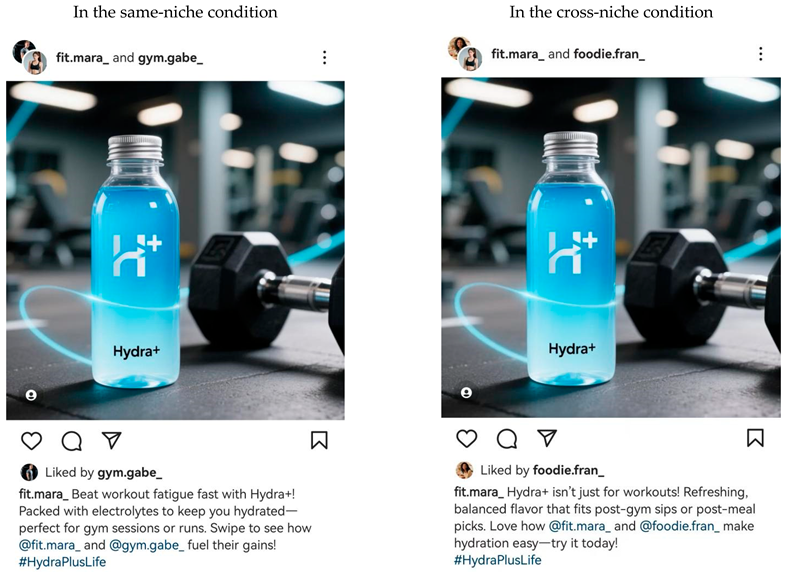
Appendix A. Stimuli Used in Study 1

Appendix B. Stimuli Used in Study 2
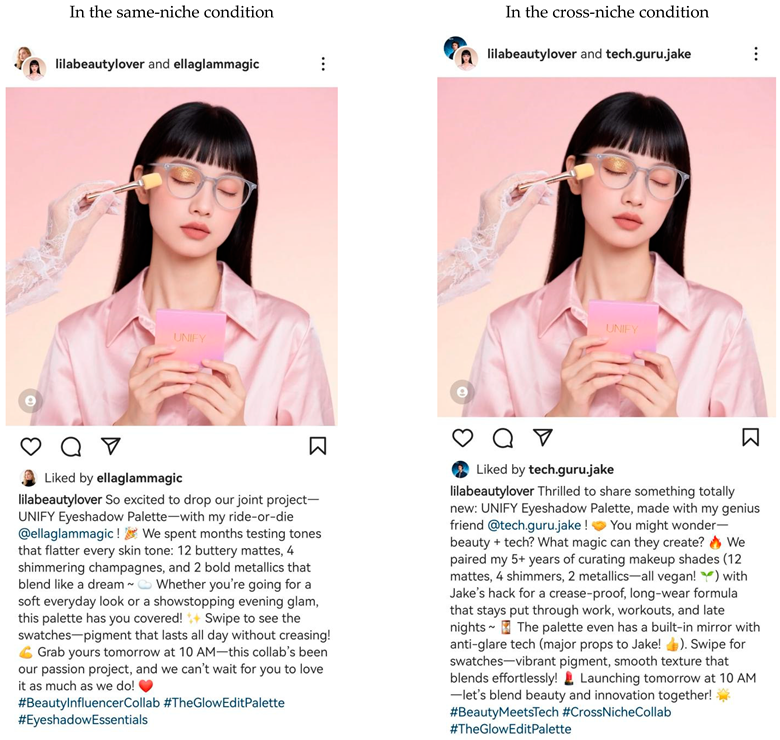
Appendix C. Stimuli Used in Study 3
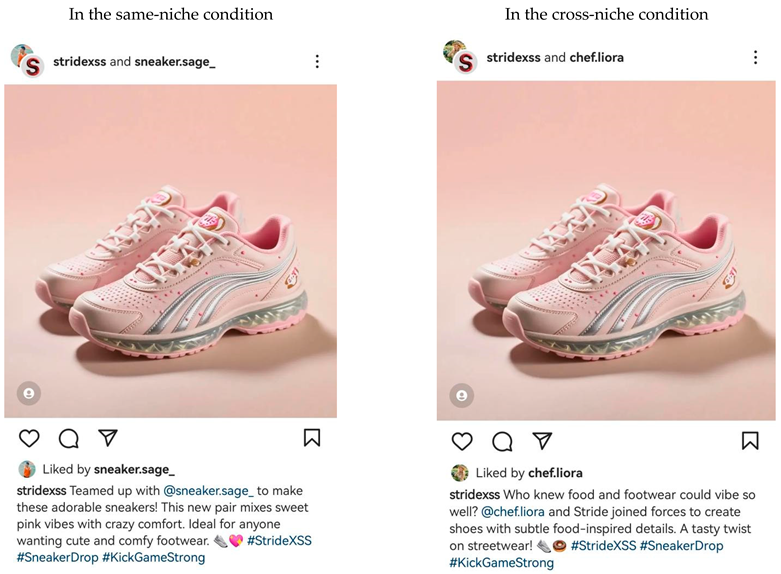
Appendix D. Stimuli Used in Study 4
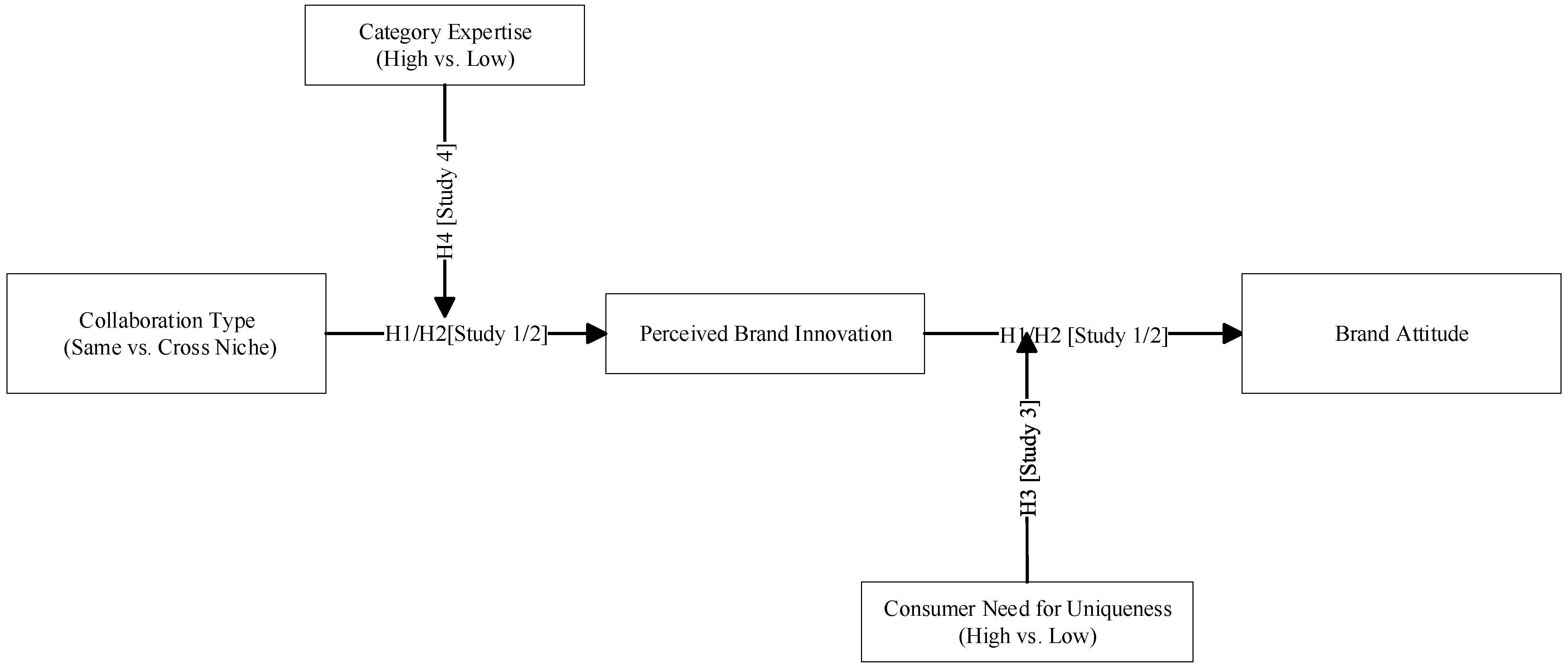
| Study | Main Purposes | Findings | Sample Size and Main Results |
| Study1 | To test whether same-niche influencer-influencer collaborations lead to more favorable brand attitudes than cross-niche influencer-brand collaborations. | Manipulation check confirmed the design; category-congruent collaborations enhanced brand attitude. | 200 participants (MTurk). Same-niche collaboration produced higher brand attitudes (M = 5.39) than cross-niche collaboration (M = 4.71), F(1, 198) = 23.07, p < 0.001, η2 = 0.10. |
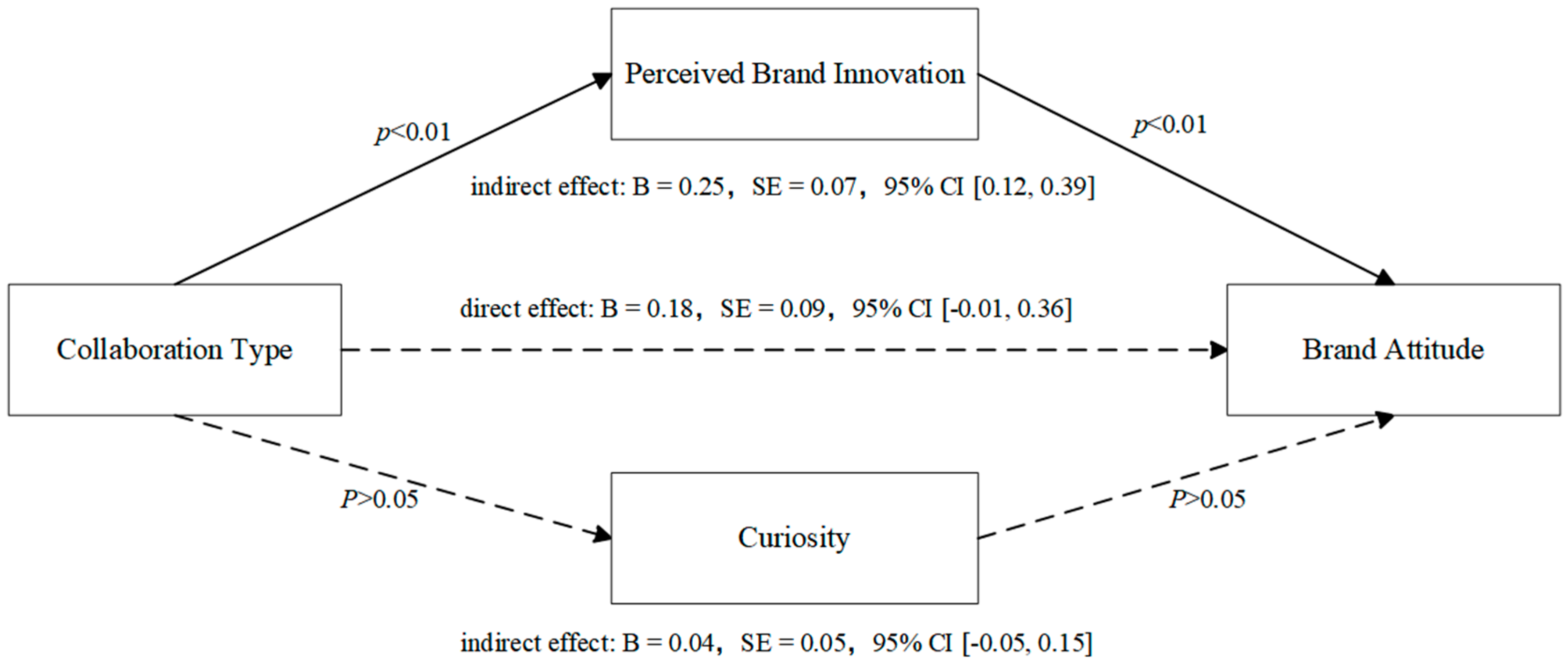
| Study2 | To test whether cross-niche (vs. same-niche) influencer collaborations increase brand attitude through perceived brand innovation and to assess curiosity as an alternative mediator. | Cross-niche collaborations improved brand attitude because they signaled greater innovativeness, not because of curiosity. | 200 U.S. participants (Prolific). Brand attitude: Cross-niche > Same-niche (M = 5.62 vs. 4.88), F(1, 198) = 28.91, p < 0.001, η2 = 0.13. Mediation: Perceived brand innovation fully mediated the effect (indirect B = 0.25, 95% CI [0.12, 0.39]); curiosity did not mediate. Manipulation check: F(1, 198) = 296.34, p < 0.001, η2 = 0.60. |
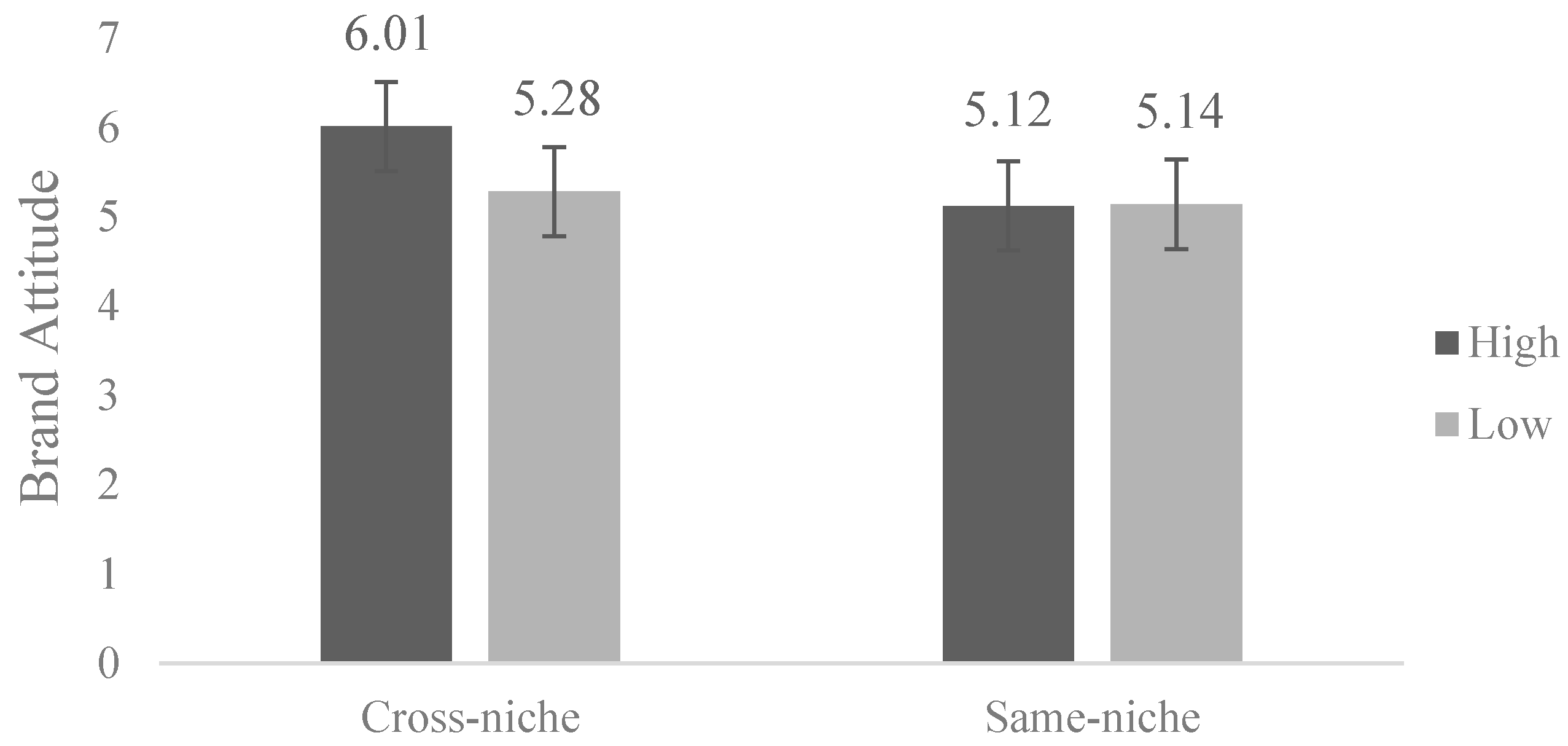
| Study3 | To test whether the positive effect of cross-niche influencer collaborations on brand attitude is moderated by Need for Uniqueness (NFU)—stronger for high-NFU consumers and weaker for low-NFU consumers. | Cross-niche collaborations enhance brand attitude only for high-NFU consumers, confirming NFU as a key boundary condition. | N400 U.S. participants (Prolific). Manipulation checks: Collaboration type (F(1, 398) = 1178.94, p < 0.001, η2 = 0.75); NFU prime (F(1, 398) = 1024.67, p < 0.001, η2 = 0.72). Brand attitude: Significant interaction between collaboration type and NFU (F(1, 398) = 20.36, p < 0.001, η2 = 0.05). High-NFU: Cross-niche > Same-niche (M = 6.01 vs. 5.12, p < 0.001). Low-NFU: No significant difference (M = 5.28 vs. 5.14, p = 0.318). |
| Study4 | To examine whether the positive effect of cross-niche collaborations on brand attitude is moderated by Need for Uniqueness (NFU). | Cross-niche advantage occurs only for high-NFU consumers, confirming NFU as a key moderator. | N = 400 (Prolific). Manipulation checks successful for collaboration type (F(1, 398) = 1178.94, p < 0.001) and NFU prime (F(1, 398) = 1024.67, p < 0.001). Brand attitude showed a significant interaction (F(1, 398) = 20.36, p < 0.001): High NFU → Cross-niche > Same-niche (M = 6.01 vs. 5.12, p < 0.001). Low NFU → No difference (M = 5.28 vs. 5.14, p = 0.318). |
References
- Association of National Advertisers. Guidelines for Awareness, Engagement, and Conversion Metrics in Influencer Marketing. 2024. Available online: https://www.ana.net/content/show/id/74274 (accessed on 19 July 2022).
- Influencer Marketing Hub. Influencer Marketing Benchmark Report. 2025. Available online: https://influencermarketinghub.com/influencer-marketing-benchmark-report/ (accessed on 25 April 2025).
- StackInfluence. Micro-Influencer Cross-Channel Collaborations Report. 2025. Available online: https://stackinfluence.com/micro-influencer-cross-channel-collaborations/ (accessed on 27 April 2025).
- Pappu, R.; Quester, P.G. How does brand innovativeness affect brand loyalty? J. Prod. Brand Manag. 2016, 25, 75–84. [Google Scholar] [CrossRef]
- Van Reijmersdal, E.A.; Aguiar, T.D.; van Noort, G. How influencer follower size relates to brand responses. Int. J. Advert. 2024, 43, 1–25. [Google Scholar]
- Steils, N.; Martin, A.; Toti, J.-F. Managing the transparency paradox of social-media influencer disclosures. J. Bus. Res. 2022, 139, 861–873. [Google Scholar] [CrossRef]
- Belanche, D.; Casaló, L.V.; Flavián, M.; Ibáñez-Sánchez, S. Building influencers’ credibility on Instagram: Effects on followers’ attitudes and behavioral responses toward the influencer. J. Mark. Manag. 2021, 37, 860–885. [Google Scholar] [CrossRef]
- Thomas, V.L.; Fowler, K.; Taheran, F. How social media influencer collaborations are perceived by consumers. J. Bus. Res. 2024, 154, 113319. [Google Scholar] [CrossRef]
- Filali-Boissy, D.; Jouny-Rivier, E.; Perren, R. Co-creating content with brands: Insights from influencers’ perceptions. J. Bus. Res. 2025, 162, 113487. [Google Scholar] [CrossRef]
- Mulholland, S.; Lang, B.; Lee, M.; Bentham, C. How mega- and micro-influencers strategically manage authenticity. J. Advert. Res. 2025, 65, 45–61. [Google Scholar] [CrossRef]
- Che, S.; Jin, X.; Sheng, G.; Lin, Z. Seeking effective fit: The impact of brand-influencer fit types on consumer brand attitude. J. Advert. 2025, 54, 238–259. [Google Scholar] [CrossRef]
- HireInfluence. The Top Trends in Influencer Marketing for 2025. 2025. Available online: https://hireinfluence.com/blog/trends-in-influencer-marketing/ (accessed on 13 December 2024).
- Ballester, E.; Ruiz, C.; Rubio, N.; Veloutsou, C. We match! Building online brand engagement behaviours through emotional and rational processes. J. Bus. Res. 2025, 162, 113494. [Google Scholar] [CrossRef]
- Gu, X.; Zhang, X.; Kannan, P.K. Influencer mix strategies in livestream commerce: Impact on product sales. J. Mark. 2024, 88, 98–118. [Google Scholar] [CrossRef]
- Kervyn, N.; Fiske, S.T.; Malone, C. Brands as intentional agents framework: How perceived intentions and ability can map brand perception. J. Consum. Psychol. 2012, 22, 166–176. [Google Scholar] [CrossRef] [PubMed]
- Farrell, J.R.; Campbell, C.; Sands, S. What drives consumers to engage with influencers? J. Interact. Mark. 2022, 58, 1–20. [Google Scholar] [CrossRef]
- Pozharliev, R.; Rossi, D.; De Angelis, M. A picture says more than a thousand words: Using consumer neuroscience to study Instagram users’ responses to influencer advertising. J. Interact. Mark. 2022, 59, 113–132. [Google Scholar] [CrossRef]
- Li, L.; Wang, Z.; Li, Y.; Liao, A. Consumer innovativeness and organic food adoption: The mediation effects of consumer knowledge and attitudes. Sustain. Prod. Consum. 2021, 28, 1465–1474. [Google Scholar] [CrossRef]
- Misra, A.; Dinh, T.D.; Ewe, S.Y. The more followers the better? The impact of food influencers on consumer behaviour in the social media context. Br. Food J. 2024, 126, 4018–4035. [Google Scholar] [CrossRef]
- Zhang, J.; Shao, Z.; Wang, K. Does your company have the right influencer? Influencer type and tourism brand personality. Tour. Manag. 2025, 107, 105079. [Google Scholar] [CrossRef]
- Brewer, M.B. The social self: On being the same and different at the same time. Personal. Soc. Psychol. Bull. 1991, 17, 475–482. [Google Scholar] [CrossRef]
- Chan, K.; Veloutsou, C.; Arnould, E. Creating identification with brand communities on Twitter: The balance between need for affiliation and need for uniqueness. J. Bus. Res. 2017, 74, 1–11. [Google Scholar]
- Brewer, M.B.; Chen, Y.R. Where (who) are collectives in collectivism? Toward conceptual clarification of individualism and collectivism. Psychol. Rev. 2007, 114, 133–151. [Google Scholar] [CrossRef]
- Lee, S.; Cillo, P.; Troilo, G. Multilevel optimal distinctiveness: Examining the impact of within- and between-organization distinctiveness of product design on market performance. Strateg. Manag. J. 2022, 43, 1234–1262. [Google Scholar]
- Azoulay, P.; Sengupta, S. Optimal distinctiveness across revenue models: Performance effects of differentiation of paid and free products in a mobile app market. Strateg. Manag. J. 2022, 43, 1875–1899. [Google Scholar] [CrossRef]
- Jiang, L.; Wang, P. Optimal distinctiveness in platform markets: Leveraging complementors as legitimacy buffers. Strateg. Manag. J. 2021, 42, 1859–1885. [Google Scholar]
- Berger, D.; Wirtz, J.; Zeithaml, V. What’s the value of being different when everyone is? The effects of distinctiveness on performance in homogeneous versus heterogeneous categories. Strateg. Manag. J. 2022, 44, 55–78. [Google Scholar]
- Li, X.; Cho, J.; Collins, C. Engaging in a culturally mismatched thinking style increases the preference for familiar consumer options for analytic but not holistic thinkers. J. Bus. Res. 2020, 109, 414–425. [Google Scholar]
- Boeing, M.; Brodbeck, F. Optimal distinctiveness: Broadening the interface between institutional theory and strategic management. Strateg. Manag. J. 2019, 40, 635–657. [Google Scholar]
- Warren, C.; Batra, R. Positioning for optimal distinctiveness: How firms manage competitive and institutional pressures under dynamic and complex environment. J. Mark. 2021, 85, 1–20. [Google Scholar]
- Liang, H.; Cho, C.H.; Lee, J. The color of choice: The influence of presenting product information in color on the compromise effect. J. Consum. Psychol. 2020, 30, 437–452. [Google Scholar]
- Mitchell, V.W.A.; Balabanis, G. The role of brand strength, type, image and product-category fit in retail brand collaborations. J. Bus. Res. 2021, 130, 655–667. [Google Scholar] [CrossRef]
- Zhang, F.; Li, H.; Xue, Z.; He, J. How brand coolness influences customers’ willingness to co-create? The mediating effect of customer inspiration and the moderating effect of customer interaction. J. Brand Manag. 2024, 31, 632–648. [Google Scholar] [CrossRef]
- Venciute, D.; Mackeviciene, I.; Kuslys, M.; Correia, R.F. The role of influencer–follower congruence in the relationship between influencer marketing and purchase behaviour. J. Retail. Consum. Serv. 2023, 75, 103506. [Google Scholar] [CrossRef]
- Dong, X.; Zhou, R.; Liao, J. Mega-influencer follower effect: The mediating role of sense of control in brand attitudes, purchase intentions and engagement. Eur. J. Mark. 2024; ahead-of-print. [Google Scholar] [CrossRef]
- Argyris, Y.A.; Muqaddam, A.; Miller, S. The effects of the visual presentation of an Influencer’s Extroversion on perceived credibility and purchase intentions—Moderated by personality matching with the audience. J. Retail. Consum. Serv. 2021, 59, 102347. [Google Scholar] [CrossRef]
- Brexendorf, T.O.; Keller, K.L. Leveraging the corporate brand: The importance of corporate brand innovativeness and brand architecture. Eur. J. Mark. 2017, 51, 1530–1551. [Google Scholar] [CrossRef]
- Zhang, Y.; Guo, X.; Qu, Y. Brand extension or co-branding: The consumer’s attribution of responsibility to the crossover strategies of heritage brands. J. Consum. Res. 2025, 52, 67–85. [Google Scholar] [CrossRef]
- Ding, Y.; Zhou, Z. Innovative glossiness and traditional matteness: Impact of product surface on consumer perception and evaluation. J. Prod. Innov. Manag. 2025, 42, 112–129. [Google Scholar] [CrossRef]
- Xu, Z.; Tong, Y.; Ye, M. How product-background color combinations influence perceived brand innovativeness. J. Mark. Res. 2024, 61, 238–255. [Google Scholar] [CrossRef]
- Bagga, C.K.; Noseworthy, T.J.; Dawar, N. Asymmetric consequences of radical innovations on category representations of competing brands. J. Consum. Psychol. 2016, 26, 475–486. [Google Scholar] [CrossRef]
- Estrada, I.; Faems, D.; de Faria, P. Coopetition and product innovation performance: The role of internal knowledge sharing mechanisms. Long Range Plan. 2016, 49, 151–163. [Google Scholar]
- Snyder, C.R.; Fromkin, H.L. Uniqueness: The Human Pursuit of Difference; Plenum Press: New York, NY, USA, 1980. [Google Scholar]
- Tian, K.T.; Bearden, W.O.; Hunter, G.L. Consumers’ need for uniqueness: Scale development and validation. J. Consum. Res. 2001, 28, 50–66. [Google Scholar] [CrossRef]
- Sadik-Rozsnyai, O.; Bertrandias, L. New technological attributes and willingness to pay: The role of social innovativeness. J. Prod. Brand Manag. 2019, 28, 805–821. [Google Scholar] [CrossRef]
- Aranega, A.Y.; Soriano, D.R.; Del Val Núñez, M.T.; Vázquez, J.S. Innovative behavior of consumers. J. Consum. Behav. 2023, 22, 15–31. [Google Scholar] [CrossRef]
- Alba, J.W.; Hutchinson, J.W. Dimensions of consumer expertise. J. Consum. Res. 1987, 13, 411–454. [Google Scholar] [CrossRef]
- Mandler, G. The structure of value: Accounting for taste. In Advances in Consumer Research; Holbrook, M.B., Hirschman, E.C., Eds.; Association for Consumer Research: Duluth, MN, USA, 1982; Volume 9, pp. 3–7. [Google Scholar]
- Hayes, A.F. Partial, conditional, and moderated moderated mediation: Quantification, inference, and interpretation. Commun. Monogr. 2018, 85, 4–40. [Google Scholar] [CrossRef]
- Meng, L.M.; Fu, T.; Duan, S.; Wang, Y.; Jiang, Y. The overlapping effect: Impact of product display on price–quality judgments. Mark. Lett. 2024, 35, 107–128. [Google Scholar] [CrossRef]
- Meng, L.; Wu, Q.; Wang, Y.; Duan, S. Health-Related Advertising: Leveraging Virtual and Human Influencers to Encourage Health Behaviors. J. Advert. 2025, 54, 548–565. [Google Scholar] [CrossRef]
- Meng, L.; Kou, S.; Duan, S.; Wang, Y.; Lü, K. Effect of Human Images in Advertisements on Consumers’ Experiential Purchase Intentions. J. Advert. 2025; ahead of print. [Google Scholar] [CrossRef]


| Experiment | Collaboration Type | Brand Attitude (M, SD) | F-Value (p) | Perceived Innovation (M, SD) | F-Value (p) | Key Moderator/Mediator Results |
|---|---|---|---|---|---|---|
| Study 1 | Same-Niche | 5.39 (1.02) | F(1, 198) = 23.07 (<0.001) | Not Measured | - | Main Effect: Same-niche > Cross-niche |
| Cross-Niche | 4.71 (1.19) | Not Measured | - | |||
| Study 2 | Same-Niche | 4.88 (1.04) | F(1, 198) = 28.91 (<0.001) | 4.88 (1.04) | F(1, 198) = 28.91, (<0.001) | Mediation: Perceived Innovation (B = 0.25, CI [0.12, 0.39]); Curiosity (n.s.) |
| Cross-Niche | 5.62 (0.97) | 5.62 (0.97) | ||||
| Study 3 | Same-Niche | 5.12 (1.02) | F(1, 398) = 18.92 (<0.001) | Not Measured | - | Moderation (NFU): Significant Interaction, F(1, 398) = 20.36, p < 0.001. Effect driven by High-NFU group. |
| Cross-Niche | 6.01 (0.83) | Not Measured | - | |||
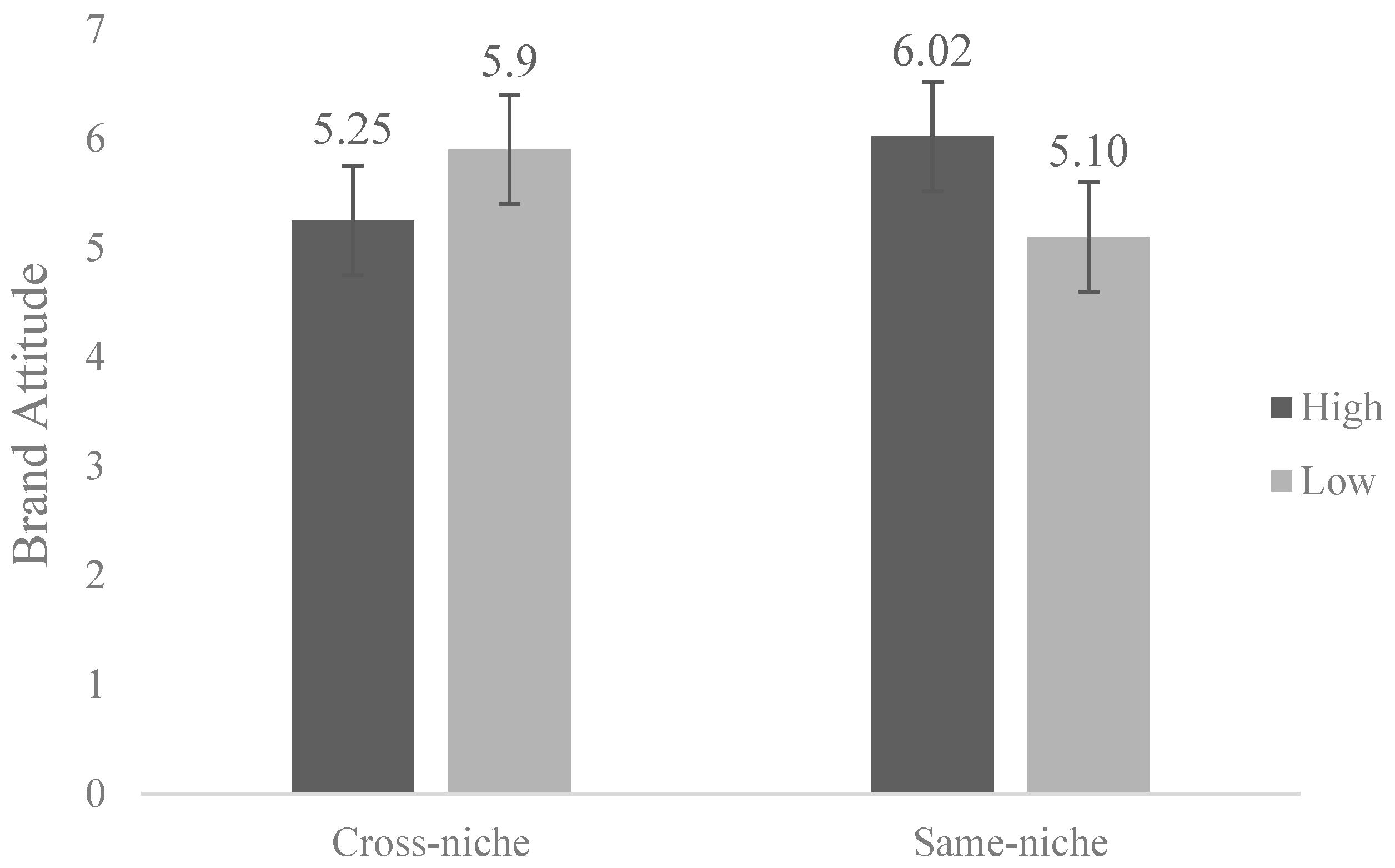
| Study 4 | Same-Niche | 6.02 (0.83) | F(1, 418) = 4.89 (0.028) | Not Measured | - | Moderation (Expertise): Significant Interaction, F(1, 418) = 28.45, p < 0.001. Experts prefer same-niche; Novices prefer cross-niche. |
| Cross-Niche | 5.25 (1.01) | Not Measured | - |
Disclaimer/Publisher’s Note: The statements, opinions and data contained in all publications are solely those of the individual author(s) and contributor(s) and not of MDPI and/or the editor(s). MDPI and/or the editor(s) disclaim responsibility for any injury to people or property resulting from any ideas, methods, instructions or products referred to in the content. |
© 2025 by the authors. Licensee MDPI, Basel, Switzerland. This article is an open access article distributed under the terms and conditions of the Creative Commons Attribution (CC BY) license (https://creativecommons.org/licenses/by/4.0/).
Share and Cite
Wang, X.; Zhang, H.; Feng, J.; Khayyam, M. Crossing Boundaries: How Cross-Niche Influencer Collaborations Enhance Brand Attitude Through Perceived Innovation. J. Theor. Appl. Electron. Commer. Res. 2025, 20, 350. https://doi.org/10.3390/jtaer20040350
Wang X, Zhang H, Feng J, Khayyam M. Crossing Boundaries: How Cross-Niche Influencer Collaborations Enhance Brand Attitude Through Perceived Innovation. Journal of Theoretical and Applied Electronic Commerce Research. 2025; 20(4):350. https://doi.org/10.3390/jtaer20040350
Chicago/Turabian StyleWang, Xiaoxue, Hongyu Zhang, Jiao Feng, and Muhammad Khayyam. 2025. "Crossing Boundaries: How Cross-Niche Influencer Collaborations Enhance Brand Attitude Through Perceived Innovation" Journal of Theoretical and Applied Electronic Commerce Research 20, no. 4: 350. https://doi.org/10.3390/jtaer20040350
APA StyleWang, X., Zhang, H., Feng, J., & Khayyam, M. (2025). Crossing Boundaries: How Cross-Niche Influencer Collaborations Enhance Brand Attitude Through Perceived Innovation. Journal of Theoretical and Applied Electronic Commerce Research, 20(4), 350. https://doi.org/10.3390/jtaer20040350