

Finding the Sweet Spot: Preferences for Effectiveness, Duration, and Side Effects in a Discrete Choice Experiment Among Uganda’s Key Populations

 ,
,  ,
,  , , ,
, , ,  , , ,
, , , 
Abstract
1. Introduction
2. Materials and Methods
2.1. Study Setting
2.2. Study Population
2.3. Sample Size
2.4. Discrete Choice Experiment
2.5. Experimental Design
2.6. Choice Task
2.7. Covariates
2.8. Data Collection
2.9. Data Analysis
2.10. Sensitivity Analysis
3. Results
3.1. Demographic Characteristics
3.2. HIV Risk Characteristics
3.3. Vaccine Confidence Index
3.4. Split-Sample Mixed Logit Analysis
3.5. Sensitivity Analysis Findings
4. Discussion
5. Conclusions
Supplementary Materials
Author Contributions
Funding
Institutional Review Board Statement
Informed Consent Statement
Data Availability Statement
Acknowledgments
Conflicts of Interest
Appendix A

| ≤50,000 UGX (n = 204) Coef, (95% CI) | >50,000 UGX (n = 172) Coef, (95% CI) | All (n = 376) Coef, (95% CI) | |
|---|---|---|---|
| Alt. Sp. Constant | 0.09 (−0.00, 0.18) | 0.07 (−0.01, 0.15) | 0.08 * (0.02, 0.14) |
| Type of injection (ref: HIV vaccine) | |||
| Injectable PrEP | 0.07 (−0.06, 0.20) | −0.03 (−0.15, 0.08) | 0.01 (−0.07, 0.10) |
| bNAbs injection | 0.03 (−0.10, 0.16) | −0.11 * (−0.22, 0.01) | −0.05 (−0.13, 0.04) |
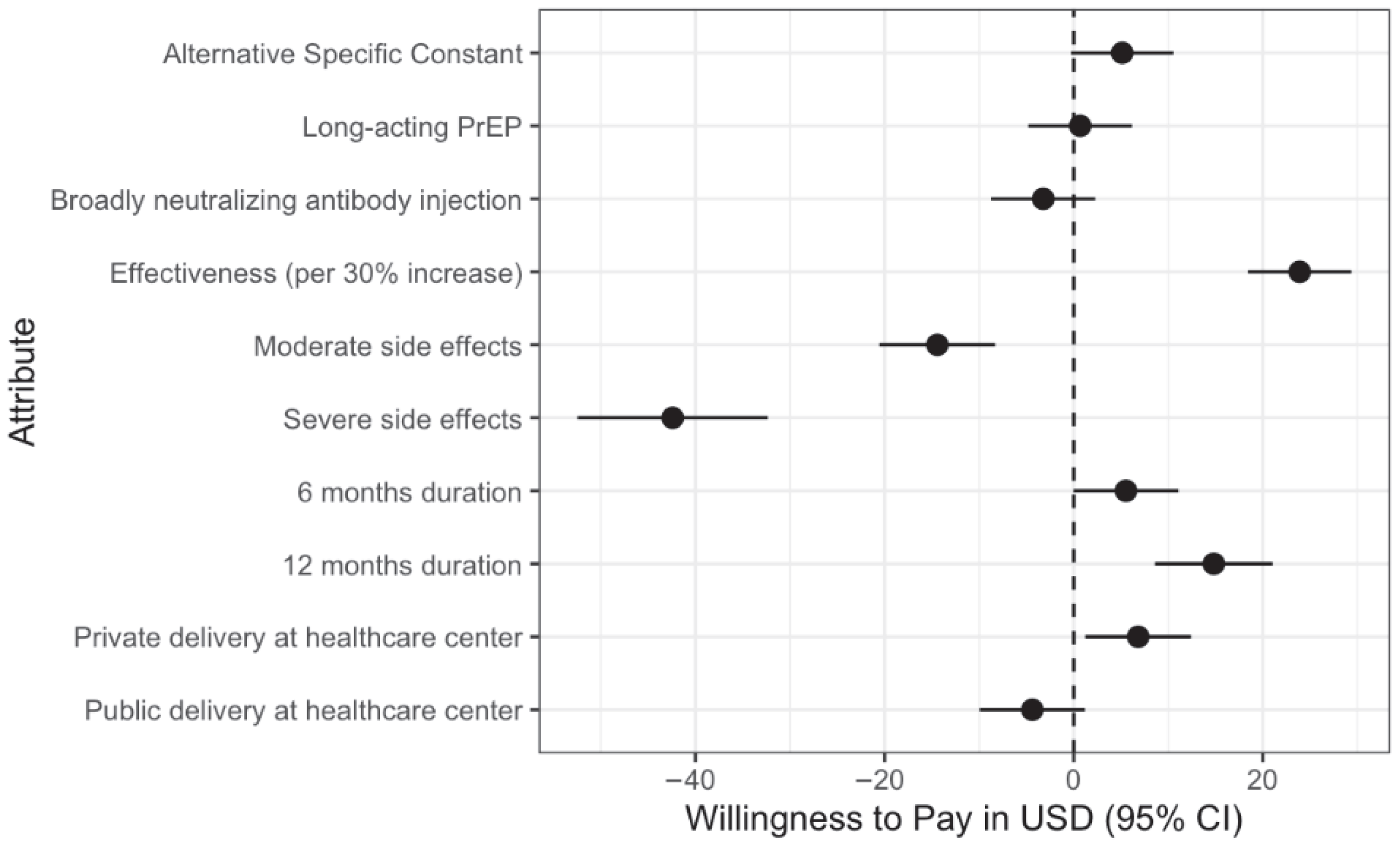
| Cost (per 50,000 UGX/USD 13.64) | −0.17 *** (−0.23, −0.11) | −0.23 *** (−0.29, −0.17) | −0.20 *** (−0.25, −0.16) |
| Effectiveness (per 30%) | 0.38 *** (0.32, 0.45) | 0.35 *** (0.29, 0.41) | 0.36 *** (0.32, 0.41) |
| Side effect severity (ref: mild side effects) | |||
| Moderate | −0.26 *** (−0.39, −0.14) | −0.17 ** (−0.29, −0.06) | −0.21 *** (−0.30, −0.13) |
| Severe | −0.80 *** (−0.93, −0.67) | −0.52 *** (−0.64, −0.40) | −0.64 *** (−0.73, −0.56) |
| Duration (ref: 3 months) | |||
| 6 months | 0.07 (−0.05, 0.20) | 0.08 (−0.03, 0.20) | 0.08 (−0.01, 0.16) |
| 12 months | 0.25 *** (0.12, 0.38) | 0.21 *** (0.10, 0.32) | 0.23 *** (0.14, 0.31) |
| Confidentiality (ref: Private at home) | |||
| Private at health facility | 0.10 (−0.02, 0.23) | 0.08 (−0.04, 0.19) | 0.09 * (0.01, 0.18) |
| Public at health facility | −0.08 (−0.21, 0.04) | −0.06 (−0.17, 0.06) | −0.07 (−0.15, 0.02) |
| Pseudo R2 | 0.0789 | 0.1129 | 0.0920 |
| AIC, BIC | 3408.285, 3480.623 | 2771.849, 2842.311 | 6174.637, 6253.701 |
| Log likelihood | −1693.1426 | −1374.9246 | −3076.3184 |
| Number of observations | 5304 | 4472 | 9776 |
| No Help (n = 109) Coef, (95% CI) | Some Help (n = 214) Coef, (95% CI) | a Lot of Help (n = 53) Coef, (95% CI) | All (n = 376) Coef, (95% CI) | |
|---|---|---|---|---|
| Alt. Sp. Constant | 0.08 (−0.03, 0.20) | 0.07 (−0.01, 0.15) | 0.09 (−0.07, 0.25) | 0.08 * (0.02, 0.14) |
| Type of injection (ref: HIV vaccine) | ||||
| Injectable PrEP | 0.02 (−0.14, 0.18) | −0.01 (−0.12, 0.10) | 0.09 (−0.14, 0.31) | 0.01 (−0.07, 0.10) |
| bNAbs injection | 0.03 (−0.13, 0.19) | −0.14 * (−0.26, −0.03) | 0.15 (−0.08, 0.38) | −0.05 (−0.13, 0.04) |
| Cost (per 50,000 UGX/USD 13.64) | −0.29 *** (−0.37, −0.20) | −0.20 *** (−0.26, −0.14) | −0.07 (−0.18, 0.04) | −0.20 *** (−0.25, −0.16) |
| Effectiveness (per 30%) | 0.38 *** (0.30, 0.46) | 0.36 *** (0.30, 0.42) | 0.38 *** (0.27, 0.50) | 0.36 *** (0.32, 0.41) |
| Side effect severity (ref: mild side effects) | ||||
| Moderate | −0.21 ** (−0.37, −0.05) | −0.17 ** (−0.28, −0.06) | −0.38 *** (−0.60, −0.15) | −0.21 *** (−0.30, −0.13) |
| Severe | −0.49 *** (−0.65, −0.33) | −0.73 *** (−0.84, −0.61) | −0.66 *** (−0.89, −0.43) | −0.64 *** (−0.73, −0.56) |
| Duration (ref: 3 months) | ||||
| 6 months | −0.01 (−0.16, 0.15) | 0.13 * (0.02, 0.24) | 0.01 (−0.22, 0.23) | 0.08 (−0.01, 0.16) |
| 12 months | 0.25 ** (0.09, 0.41) | 0.20 ** (0.09, 0.31) | 0.30 * (0.07, 0.52) | 0.23 *** (0.14, 0.31) |
| Confidentiality (ref: Private at home) | ||||
| Private at health facility | 0.02 (−0.14, 0.17) | 0.08 (−0.03, 0.19) | 0.30 ** (0.07, 0.53) | 0.09 * (0.01, 0.18) |
| Public at health facility | −0.13 (−0.29, 0.03) | −0.13 * (−0.24, −0.02) | 0.31 ** (0.08, 0.53) | −0.07 (−0.15, 0.02) |
| Pseudo R2 | 0.0952 | 0.1014 | 0.0979 | 0.0920 |
| AIC, BIC | 1799.424, 1864.868 | 3487.654, 3560.518 | 883.6569, 941.1692 | 6174.637, 6253.701 |
| Log likelihood | −888.71206 | −1732.8268 | −430.82845 | −3076.3184 |
| Number of observations | 2834 | 5564 | 1378 | 9776 |
| Without Opt Outs | With Opt Outs | |||
|---|---|---|---|---|
| Conditional Logit (n = 376) Coef, (95% CI) | Mixed Logit (n = 376) Coef, (95% CI) | Conditional Logit (n = 376) Coef, (95% CI) | Mixed Logit (n = 376) Coef, (95% CI) | |
| Alt. Sp. Constant | 0.08 * (0.02, 0.14) | 0.08 (−0.00, 0.17) | 0.26 *** (0.21, 0.32) | 0.28 *** (0.17, 0.39) |
| Standard deviation | 0.60 *** (0.50, 0.70) | 0.94 *** (0.85, 1.03) | ||
| Type of injection (ref: HIV vaccine) | ||||
| Injectable PrEP | 0.01 (−0.07, 0.10) | 0.01 (−0.08, 0.10) | 0.16 *** (0.09, 0.24) | 0.19 *** (0.11, 0.27) |
| bNAbs injection | −0.05 (−0.13, 0.04) | −0.05 (−0.14, 0.04) | 0.11 ** (0.03, 0.18) | 0.13 ** (0.04, 0.21) |
| Cost (per 50,000 UGX/USD 13.64) | −0.20 *** (−0.25, −0.16) | −0.22 *** (−0.27, −0.17) | −0.01 (−0.04, 0.03) | −0.02 (−0.05, 0.02) |
| Effectiveness (per 30%) | 0.36 *** (0.32, 0.41) | 0.39 *** (0.34, 0.44) | 0.43 *** (0.40, 0.46) | 0.51 *** (0.47, 0.55) |
| Side effect severity (ref: mild side effects) | ||||
| Moderate | −0.21 *** (−0.30, −0.13) | −0.24 *** (−0.33, −0.15) | −0.05 (−0.12, 0.03) | −0.03 (−0.11, 0.05) |
| Severe | −0.64 *** (−0.73, −0.56) | −0.69 *** (−0.78, −0.60) | −0.40 *** (−0.47, −0.32) | −0.45 *** (−0.53, −0.37) |
| Duration (ref: 3 months) | ||||
| 6 months | 0.08 (−0.01, 0.16) | 0.09 * (0.00, 0.18) | 0.20 *** (0.13, 0.27) | 0.24 *** (0.16, 0.33) |
| 12 months | 0.23 *** (0.14, 0.31) | 0.24 *** (0.15, 0.33) | 0.34 *** (0.27, 0.42) | 0.40 *** (0.31, 0.48) |
| Confidentiality (ref: Private at home) | ||||
| Private at health facility | 0.09 * (0.01, 0.18) | 0.11 * (0.02, 0.20) | 0.22 *** (0.14, 0.29) | 0.27 *** (0.19, 0.35) |
| Public at health facility | −0.07 (−0.15, 0.02) | −0.07 (−0.16, 0.02) | 0.08 * (0.00, 0.15) | 0.10 * (0.02, 0.18) |
| Pseudo R2 | 0.0920 | 0.1820 | ||
| AIC, BIC | 6174.637, 6253.701 | 6087.81, 6174.063 | 11,107.86, 11,194.55 | 10,328.75, 10,423.32 |
| Log likelihood | −3076.3184 | −3031.9052 | −5542.9308 | −5152.3732 |
| Number of observations | 9776 | 9776 | 19,552 | 19,552 |
| No Help (n = 109) | Some Help (n = 214) | A Lot of Help (n = 53) | |
|---|---|---|---|
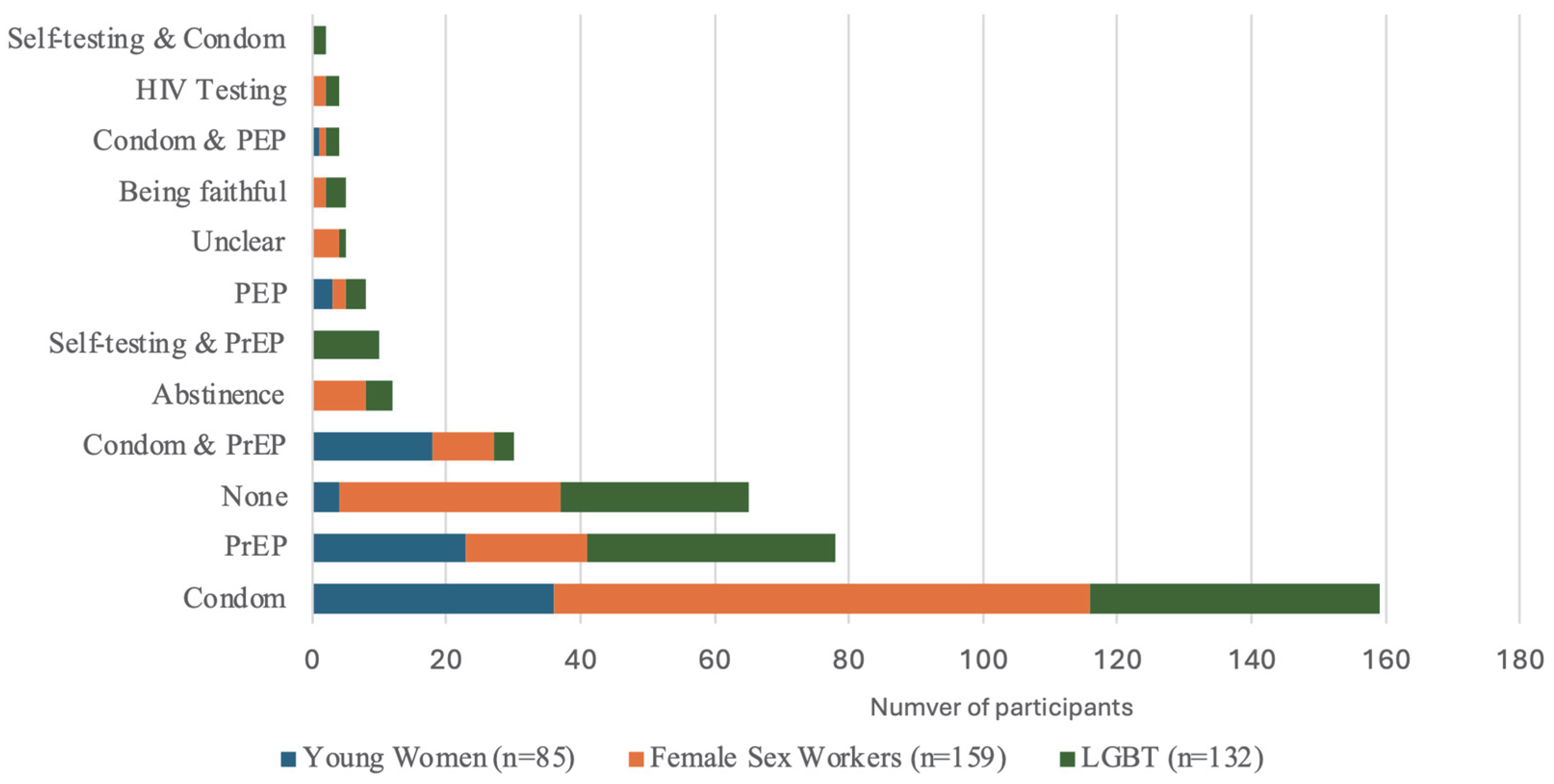
| Young Women (n = 85) | 25 (29.4%) | 52 (61.2%) | 8 (9.4%) |
| Female Sex Workers (n = 159) | 37 (23.3%) | 94 (59.1%) | 28 (17.6%) |
| LGBT (n = 132) | 47 (35.6%) | 68 (51.5%) | 17 (12.9%) |
| Injection Option | Prospective Percentage Uptake * | Willingness to Pay (in USD) * |
|---|---|---|
| CAB-LA: 79% effective, lasts 3 months, moderate side effects, private administration at clinic | 16.6% | 56.01 |
| Lenacapavir: 100% effective, lasts 6 months, severe side effects, private administration at clinic | 23.8% | 78.27 |
| HIV Vaccine: 75% effective, lasts 3 years, mild side effects, private administration at clinic | 25.0% | 81.38 |
| Injectable bNAbs: 90% effective, lasts 1 year, moderate side effects, private administration at clinic | 33.4% | 66.39 |
References
- UNAIDS. Uganda Country Factsheet. UNAIDS. Available online: https://www.unaids.org/en/regionscountries/countries/uganda (accessed on 30 October 2024).
- The World Factbook. HIV/AIDS-People Living with HIV/AIDS. Available online: https://www.cia.gov/the-world-factbook/about/archives/2021/field/hiv-aids-people-living-with-hiv-aids/country-comparison (accessed on 4 May 2022).
- Corlis, J.; Zhu, J.; Macul, H.; Tiberi, O.; Boothe, M.A.S.; Resch, S.C. Framework for determining the optimal course of action when efficiency and affordability measures differ by perspective in cost-effectiveness analysis-with an illustrative case of HIV treatment in Mozambique. Cost Eff. Resour. Alloc. 2023, 21, 62. [Google Scholar] [CrossRef]
- State of Uganda Population Report: Mindset Change for a Favourable Population Age Structure: A Prerequisite for WEALTH Creation; National Population Council U: New York, NY, USA, 2023.
- UNAIDS UACa. Synthesis, Consolidation and Building Consensus on Key and Priority Population Size Estimation Numbers in Uganda; UAC: Kampala, Uganda, 2019. [Google Scholar]
- Vithalani, J.; Herreros-Villanueva, M. HIV Epidemiology in Uganda: Survey based on age, gender, number of sexual partners and frequency of testing. Afr. Health Sci. 2018, 18, 523–530. [Google Scholar] [CrossRef]
- Muhumuza, R.; Ssemata, A.S.; Kakande, A.; Ahmed, N.; Atujuna, M.; Nomvuyo, M.; Bekker, L.-G.; Dietrich, J.J.; Tshabalala, G.; Hornschuh, S.; et al. Exploring perceived barriers and facilitators of PrEP uptake among young people in Uganda, Zimbabwe, and South Africa. Arch. Sex. Behav. 2021, 50, 1729–1742. [Google Scholar] [CrossRef] [PubMed]
- HIV.gov. Long-Acting HIV Prevention Tools. Available online: https://www.hiv.gov/hiv-basics/hiv-prevention/potential-future-options/long-acting-prep (accessed on 11 November 2022).
- Lukubuya, J.D.; Katana, E.B.; Baguma, M.; Kaguta, A.; Nambatya, W.; Kyambadde, P.; Muwonge, T.R.; Mujugira, A.; Odongpiny, E.A.L. Willingness to Use Long-acting Injectable Pre-exposure Prophylaxis Among Key Populations at a Large Hiv Prevention Clinic in Kampala, Uganda: A Cross-sectional Study. AIDS Res. Ther. 2025, 22, 81. [Google Scholar] [CrossRef] [PubMed]
- Marrazzo, J. Lenacapavir for HIV-1-potential promise of a long-acting antiretroviral drug. N. Engl. J. Med. 2022, 386, 1848–1849. [Google Scholar] [CrossRef] [PubMed]
- Dlamini, W.W.; Mirembe, B.G.; Krows, M.L.; Peacock, S.; Kotze, P.L.; Selepe, P.; Smit, J.; Mandona, N.; Louw, C.; Nuwagaba-Biribonwoha, H.; et al. Preferences for HIV pre-exposure prophylaxis formulations and delivery among young African women: Results of a discrete choice experiment. J. Int. AIDS Soc. 2025, 28, e26422. [Google Scholar] [CrossRef]
- Shamu, P.; Mullick, S.; Christofides, N.J. Service delivery characteristics preferences and trade-offs for long-acting injectable pre-exposure prophylaxis among female students in tertiary institutions in South Africa: A discrete choice experiment. Glob. Public Health 2025, 20, 2489710. [Google Scholar] [CrossRef]
- Lunkuse, J.F.; Kamacooko, O.; Price, M.A.; Muturi-Kioi, V.; Ruzagira, E.; Mayanja, Y. PA-246 Willingness to use long-acting injectable PrEP among high-risk young women in Kampala, Uganda. BMJ Glob. Health 2023, 8. [Google Scholar] [CrossRef]
- Mugyenyi, P.N. HIV vaccines: The Uganda experience. Vaccine 2002, 20, 1905–1908. [Google Scholar] [CrossRef]
- Kiwanuka, N.; Robb, M.; Kigozi, G.; Birx, D.; Philips, J.; Wabwire-Mangen, F.; Wawer, M.J.; Nalugoda, F.; Sewankambo, N.K.; Serwadda, D.; et al. Knowledge about vaccines and willingness to participate in preventive HIV vaccine trials: A population-based study, Rakai, Uganda. JAIDS J. Acquir. Immune Defic. Syndr. 2004, 36, 721–725. [Google Scholar] [CrossRef][Green Version]
- Kiwanuka, N.; Mpendo, J.; Nalutaaya, A.; Wambuzi, M.; Nanvubya, A.; Kitandwe, P.K.; Muyanja, E.; Ssempiira, J.; Balyegisawa, A.; Ssetaala, A.; et al. An assessment of fishing communities around Lake Victoria, Uganda, as potential populations for future HIV vaccine efficacy studies: An observational cohort study. BMC Public Health 2014, 14, 986. [Google Scholar] [CrossRef]
- Kiwanuka, N.; Ssetaala, A.; Mpendo, J.; Wambuzi, M.; Nanvubya, A.; Sigirenda, S.; Nalutaaya, A.; Kato, P.; Nielsen, L.; Kaleebu, P.; et al. High HIV-1 prevalence, risk behaviours, and willingness to participate in HIV vaccine trials in fishing communities on Lake Victoria, Uganda. J. Int. AIDS Soc. 2013, 16, 18621. [Google Scholar] [CrossRef]
- Asiki, G.; Abaasa, A.; Ruzagira, E.; Kibengo, F.; Bahemuka, U.; Mulondo, J.; Seeley, J.; Bekker, L.-G.; Delany, S.; Kaleebu, P.; et al. Willingness to participate in HIV vaccine efficacy trials among high risk men and women from fishing communities along Lake Victoria in Uganda. Vaccine 2013, 31, 5055–5061. [Google Scholar] [CrossRef]
- Mayanja, Y.; Abaasa, A.; Namale, G.; Price, M.A.; Kamali, A. Willingness of female sex workers in Kampala, Uganda to participate in future HIV vaccine trials: A case control study. BMC Public Health 2020, 20, 1789. [Google Scholar] [CrossRef] [PubMed]
- Mayanja, Y.; Kamacooko, O.; Senyonga, W.; Muturi-Kioi, V.; Chinyenze, K.V.; Seeley, J.; Kaleebu, P.; Price, M. Will-ingness of adolescent girls and young women in Kampala, Uganda to participate in future efficacy trials of novel biomedical HIV prevention interventions: The anti-retroviral implant. In Journal of the International AIDS Society; John Wiley & Sons Ltd.: Chichester, UK, 2021. [Google Scholar]
- Ruzagira, E.; Wandiembe, S.; Bufumbo, L.; Levin, J.; Price, M.A.; Grosskurth, H.; Kamali, A. Willingness to participate in preventive HIV vaccine trials in a community-based cohort in south western Uganda. Trop. Med. Int. Health 2009, 14, 196–203. [Google Scholar] [CrossRef] [PubMed]
- Quaife, M.; Eakle, R.; Cabrera Escobar, M.A.; Vickerman, P.; Kilbourne-Brook, M.; Mvundura, M.; Delany-Moretlwe, S.; Terris-Prestholt, F. Divergent preferences for HIV prevention: A discrete choice experiment for multipurpose HIV prevention products in South Africa. Med. Decis. Mak. 2018, 38, 120–133. [Google Scholar] [CrossRef] [PubMed]
- Mgodi, N.M.; Murewanhema, G.; Moyo, E.; Samba, C.; Musuka, G.; Dzinamarira, T.; Brown, J.M. Advancing the use of long-acting extended delivery formulations for HIV prevention in sub-saharan Africa: Challenges, opportunities, and recommendations. J. Int. AIDS Soc. 2023, 26, e26115. [Google Scholar] [CrossRef]
- Ryan, M.; Gerard, K.; Amaya-Amaya, M. Using Discrete Choice Experiments to Value Health and Health Care; Springer Science & Business Media: Berlin, Germany, 2007; Volume 11. [Google Scholar]
- Lancaster, K.E.; Lungu, T.; Bula, A.; Shea, J.M.; Shoben, A.; Hosseinipour, M.C.; Kohler, R.E.; Hoffman, I.F.; Go, V.F.; Golin, C.E.; et al. Preferences for pre-exposure prophylaxis service delivery among female sex workers in Malawi: A discrete choice experiment. AIDS Behav. 2020, 24, 1294–1303. [Google Scholar] [CrossRef]
- Orme, B. Sample size issues for conjoint analysis studies. In Sequim: Sawtooth Software Technical Paper; Sawtooth Software, Inc.: Provo, UT, USA, 1998. [Google Scholar]
- Larson, H.J.; Schulz, W.S.; Tucker, J.D.; Smith, D.M.D. Measuring vaccine confidence: Introducing a global vaccine confidence index. PLoS Curr. 2015, 7, ecurrents.outbreaks.ce0f6177bc97332602a8e3fe7d7f7cc4. [Google Scholar] [CrossRef]
- Larson, H.J.; De Figueiredo, A.; Xiahong, Z.; Schulz, W.S.; Verger, P.; Johnston, I.G.; Cook, A.R.; Jones, N.S. The state of vaccine confidence 2016: Global insights through a 67-country survey. EBioMedicine 2016, 12, 295–301. [Google Scholar] [CrossRef]
- Ride, J.; Goranitis, I.; Meng, Y.; LaBond, C.; Lancsar, E. A Reporting Checklist for Discrete Choice Experiments in Health: The DIRECT Checklist. Pharmacoeconomics 2024, 42, 1161–1175. [Google Scholar] [CrossRef] [PubMed]
- Bosire, S. Uganda’s anti-homosexuality act is causing harm and limiting access to healthcare. BMJ 2023, 382, 1963. [Google Scholar] [CrossRef] [PubMed]
- Minnis, A.M.; Atujuna, M.; Browne, E.N.; Ndwayana, S.; Hartmann, M.; Sindelo, S.; Ngcwayi, N.; Boeri, M.; Mansfield, C.; Bekker, L.; et al. Preferences for long-acting Pre-Exposure prophylaxis (PreP) for HIV prevention among South African youth: Results of a discrete choice experiment. J. Int. AIDS Soc. 2020, 23, e25528. [Google Scholar] [CrossRef]
- Kuteesa, M.O.; Quaife, M.; Biraro, S.; Katumba, K.R.; Seeley, J.; Kamali, A.; Nakanjako, D. Acceptability and predictors of uptake of anti-retroviral pre-exposure prophylaxis (PrEP) among fishing communities in Uganda: A cross-sectional discrete choice experiment survey. AIDS Behav. 2019, 23, 2674–2686. [Google Scholar] [CrossRef]
- Little, K.M.; Flomen, L.; Hanif, H.; Anderson, S.M.; Thurman, A.R.; Clark, M.R.; Doncel, G.F. HIV pre-exposure prophylaxis implant stated preferences and priorities: Results of a discrete choice experiment among women and adolescent girls in Gauteng Province, South Africa. AIDS Behav. 2022, 26, 3099–3109. [Google Scholar] [CrossRef]
- Terris-Prestholt, F.; Hanson, K.; MacPhail, C.; Vickerman, P.; Rees, H.; Watts, C. How much demand for new HIV prevention technologies can we really expect? Results from a discrete choice experiment in South Africa. PLoS ONE 2013, 8, e83193. [Google Scholar] [CrossRef]
- Smith, J.; Bansi-Matharu, L.; Cambiano, V.; Dimitrov, D.; Bershteyn, A.; van de Vijver, D.; Kripke, K.; Revill, P.; Boily, M.-C.; Meyer-Rath, G.; et al. Predicted effects of the introduction of long-acting injectable cabotegravir pre-exposure prophylaxis in sub-Saharan Africa: A modelling study. Lancet HIV 2023, 10, e254–e265. [Google Scholar] [CrossRef]
- Kanazawa, J.T.; Saberi, P.; Sasuceda, J.A.; Dubé, K. The LAIs are coming! Implementation science considerations for long-acting injectable antiretroviral therapy in the United States: A scoping review. AIDS Res. Hum. Retroviruses 2021, 37, 75–88. [Google Scholar] [CrossRef]
- Zakumumpa, H.; Alinaitwe, A.; Kyomuhendo, M.; Nakazibwe, B. Long-acting injectable antiretroviral treatment: Experiences of people with HIV and their healthcare providers in Uganda. BMC Infect. Dis. 2024, 24, 876. [Google Scholar] [CrossRef] [PubMed]
| Level 1 | Level 2 | Level 3 | |
|---|---|---|---|
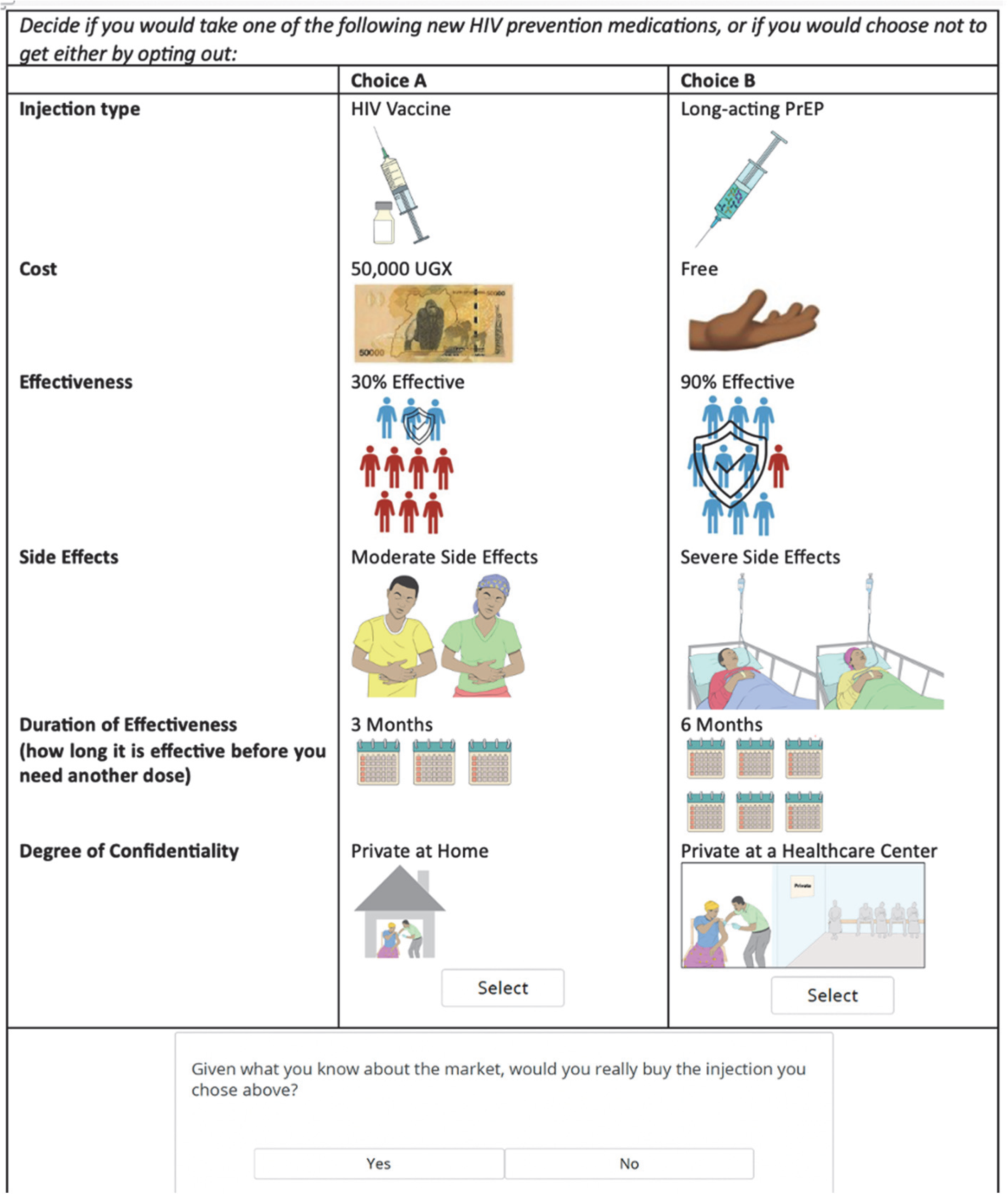
| Injection type | HIV Vaccine | Long-acting PrEP | Injectable bNAbs |
| Cost | Free | 50,000 UGX | 100,000 UGX |
| Effectiveness | 30% Effective | 60% Effective | 90% Effective |
| Side Effects | Mild Side Effects | Moderate Side Effects | Severe Side Effects |
| Duration of Effectiveness | 3 Months | 6 Months | 1 Year |
| Degree of Confidentiality | Private at Home | Private at a Healthcare Center | Public at a Healthcare Center |
| Young Women (n = 85) | Female Sex Workers (n = 159) | LGBT (n = 132) | Total (n = 376) | p-Value | |
|---|---|---|---|---|---|
| Site | <0.001 | ||||
| Kampala | 82 (96.5) | 112 (70.4) | 119 (90.2) | 313 (83.2) | |
| Kayunga | 3 (3.5) | 27 (17.0) | 0 (0) | 30 (8.0) | |
| Mukono | 0 (0) | 20 (12.6) | 13 (9.9) | 33 (8.8) | |
| Age, mean (SD) | 21.7 (1.9) | 26.0 (7.6) | 22.3 (3.1) | 23.7 (5.7) | <0.001 |
| Sex | <0.001 | ||||
| Male | 0 (0) | 0 (0) | 77 (58.3) | 77 (20.5) | |
| Female | 85 (100.0) | 159 (100.0) | 30 (22.7) | 274 (72.9) | |
| Other | 0 (0) | 0 (0) | 23 (17.4) | 23 (6.1) | |
| Refuse to respond | 0 (0) | 0 (0) | 2 (1.5) | 2 (0.5) | |
| Marital status | 0.039 | ||||
| Single/Never married | 86 (86.0) | 123 (78.3) | 104 (78.8) | 292 (77.7) | |
| Married | 6 (6.0) | 11 (7.0) | 22 (16.7) | 54 (14.4) | |
| Divorced/ Separated/Widowed | 6 (6.0 | 21 (13.4) | 3 (2.3) | 25 (6.7) | |
| Other | 2 (2.0) | 2 (1.3) | 3 (2.3) | 5 (1.3) | |
| Tribe | 0.261 | ||||
| Muganda | 49 (57.7) | 93 (58.5) | 96 (72.7) | 238 (63.3) | |
| Munyankole | 9 (10.6) | 15 (9.4) | 6 (4.6) | 30 (8.0) | |
| Musoga | 6 (7.1) | 15 (9.4) | 8 (6.1) | 29 (7.7) | |
| Another Ugandan tribe | 16 (18.8) | 29 (18.2) | 15 (11.4) | 60 (16.0) | |
| Other nationality | 5 (5.9) | 7 (4.4) | 7 (5.3) | 19 (5.1) | |
| Religion | 0.011 | ||||
| Catholic | 29 (34.1) | 41 (25.8) | 27 (20.5) | 97 (25.8) | |
| Other Christians | 37 (43.5) | 70 (44.0) | 45 (34.1) | 152 (40.4) | |
| Muslim | 19 (22.4) | 47 (29.6) | 60 (45.5) | 126 (33.5) | |
| Refused to respond | 0 (0) | 1 (0.6) | 0 (0) | 1 (0.3) | |
| Able to read and write | 76 (89.4) | 152 (95.6) | 130 (98.5) | 358 (95.2) | 0.009 |
| Education level * | 0.018 | ||||
| No schooling | 2 (2.4) | 3 (1.9) | 3 (2.3) | 8 (2.1) | |
| Primary school | 38 (44.7) | 62 (39.0) | 32 (24.2) | 132 (35.1) | |
| Secondary/Vocational | 40 (47.1) | 84 (52.8) | 78 (59.1) | 202 (53.7) | |
| University | 5 (5.9) | 10 (6.3) | 19 (14.4) | 34 (9.0) | |
| Employed | 65 (76.5) | 123 (77.4) | 96 (72.7) | 284 (75.5) | 0.641 |
| Number of people they provide for financially, ^ mean (SD) | 2.5 (0.7) | 2.5 (0.9) | 2.3 (1.0) | 2.4 (0.9) | 0.271 |
| Income per week (UGX), mean (SD) | 83.2 K (80.5 K) | 79.2 K (100.2 K) | 95.4 K (125.6 K) | 85.8 K (106.1 K) | 0.418 |
| Income per week in USD | ~22.75 (22.84) | 21.66 (27.40) | 26.09 (34.35) | 23.46 (29.02) |
| Young Women (n = 85), m (SD) | Female Sex Workers (n = 159), m (SD) | LGBT (n = 132), m (SD) | Total (n = 376), m (SD) | |
|---|---|---|---|---|
| Overall, I think vaccines are important for everyone to have. Overall, I think vaccines are safe. | 4.5 (0.8) | 4.5 (0.7) | 4.4 (1.0) | 4.5 (0.8) |
| 3.8 (1.3) | 3.8 (1.2) | 3.9 (1.2) | 3.9 (1.2) | |
| Overall, I think vaccines are effective. | 4.0 (0.9) | 3.9 (1.0) | 3.8 (1.1) | 3.9 (1.0) |
| Vaccines are compatible with my religious beliefs. | 3.9 (1.2) | 4.0 (1.1) | 3.6 (1.4) | 3.8 (1.3) |
| Vaccine Confidence Index Score * (out of 5): | 4.1 (0.6) | 4.1 (0.7) | 3.9 (0.9) | 4.0 (0.7) |
| Young Women (n = 85) β Coef, (95% CI) | Female Sex Workers (n = 159) β Coef, (95% CI) | LGBT (n = 132) β Coef, (95% CI) | All (n = 376) β Coef, (95% CI) | |
|---|---|---|---|---|
| Alt. Sp. Constant | 0.02 (−0.16, 0.20) | 0.15 * (0.02, 0.28) | 0.05 (−0.10, 0.20) | 0.08 (−0.00, 0.17) |
| Type of injection (ref: HIV vaccine) | ||||
| Injectable PrEP | 0.13 (−0.06, 0.32) | −0.04 (−0.18, 0.10) | −0.02 (−0.17, 0.13) | 0.01 (−0.08, 0.10) |
| bNAbs injection | −0.10 (−0.29, 0.09) | −0.02 (−0.16, 0.12) | −0.07 (−0.22, 0.08) | −0.05 (−0.14, 0.04) |
| Cost (per 50,000 UGX/USD 13.64) | −0.29 *** (−0.38, −0.19) | −0.19 *** (−0.26, −0.12) | −0.21 *** (−0.28, −0.13) | −0.22 *** (−0.27, −0.17) |
| Effectiveness (per 30%) | 0.41 *** (0.31, 0.51) | 0.38 *** (0.31, 0.45) | 0.39 *** (0.31, 0.47) | 0.39 *** (0.34, 0.44) |
| Side effect severity (ref: mild side effects) | ||||
| Moderate | −0.19 * (−0.38, 0.00) | −0.27 *** (−0.41, −0.14) | −0.22 ** (−0.37, −0.07) | −0.24 *** (−0.33, −0.15) |
| Severe | −0.64 *** (−0.83, −0.45) | −0.79 *** (−0.93, −0.65) | −0.63 *** (−0.78, −0.48) | −0.69 *** (−0.78, −0.60) |
| Duration (ref: 3 months) | ||||
| 6 months | 0.10 (−0.09, 0.29) | 0.24 *** (0.11, 0.38) | −0.05 (−0.20, 0.10) | 0.09 * (0.00, 0.18) |
| 12 months | 0.33 *** (0.14, 0.52) | 0.34 *** (0.20, 0.48) | 0.08 (−0.07, 0.23) | 0.24 *** (0.15, 0.33) |
| Confidentiality (ref: Private at home) | ||||
| Private at health facility | 0.10 (−0.08, 0.28) | 0.15 * (0.01, 0.29) | 0.07 (−0.08, 0.22) | 0.11 * (0.02, 0.20) |
| Public at health facility | −0.06 (−0.25, 0.13) | −0.11 (−0.25, 0.03) | −0.04 (−0.19, 0.12) | −0.07 (−0.16, 0.02) |
| AIC, BIC | 1376.521, 1444.93 | 2559.997, 2635.921 | 2171.068, 2244.758 | 6087.81, 6174.063 |
| Log likelihood | −676.26034 | −1267.9984 | −1073.5338 | −3031.9052 |
| Number of observations | 2210 | 4134 | 3432 | 9776 |
| Injection Option | Prospective Percentage Uptake * | Willingness to Pay (in USD) * (95% CI) |
|---|---|---|
| CAB-LA: 79% effective, lasts 3 months, moderate side effects, private administration at clinic | 16.6% | 56.01 (44.02, 68.00) |
| Lenacapavir: 100% effective, lasts 6 months, severe side effects, private administration at clinic | 23.8% | 78.27 (62.01, 94.53) |
| HIV Vaccine: 75% effective, lasts 3 years, mild side effects, private administration at clinic | 25.0% | 81.38 (63.02, 99.74) |
| Injectable bNAbs: 90% effective, lasts 1 year, moderate side effects, private administration at clinic | 33.4% | 66.39 (52.04, 80.80) |
Disclaimer/Publisher’s Note: The statements, opinions and data contained in all publications are solely those of the individual author(s) and contributor(s) and not of MDPI and/or the editor(s). MDPI and/or the editor(s) disclaim responsibility for any injury to people or property resulting from any ideas, methods, instructions or products referred to in the content. |
© 2025 by the authors. Licensee MDPI, Basel, Switzerland. This article is an open access article distributed under the terms and conditions of the Creative Commons Attribution (CC BY) license (https://creativecommons.org/licenses/by/4.0/).
Share and Cite
Ngaybe, M.G.B.; Muhumuza, R.; Antunes, M.; Musingye, E.; Joseph, K.K.; Nakaggwa, B.; Mugamba, S.; Ssuna, B.; Valdez, G.; Ehiri, J.; et al. Finding the Sweet Spot: Preferences for Effectiveness, Duration, and Side Effects in a Discrete Choice Experiment Among Uganda’s Key Populations. Vaccines 2025, 13, 1090. https://doi.org/10.3390/vaccines13111090
Ngaybe MGB, Muhumuza R, Antunes M, Musingye E, Joseph KK, Nakaggwa B, Mugamba S, Ssuna B, Valdez G, Ehiri J, et al. Finding the Sweet Spot: Preferences for Effectiveness, Duration, and Side Effects in a Discrete Choice Experiment Among Uganda’s Key Populations. Vaccines. 2025; 13(11):1090. https://doi.org/10.3390/vaccines13111090
Chicago/Turabian StyleNgaybe, Maiya G. Block, Richard Muhumuza, Mélanie Antunes, Ezra Musingye, Kawoya Kijali Joseph, Betty Nakaggwa, Stephen Mugamba, Bashir Ssuna, Gabriela Valdez, John Ehiri, and et al. 2025. "Finding the Sweet Spot: Preferences for Effectiveness, Duration, and Side Effects in a Discrete Choice Experiment Among Uganda’s Key Populations" Vaccines 13, no. 11: 1090. https://doi.org/10.3390/vaccines13111090
APA StyleNgaybe, M. G. B., Muhumuza, R., Antunes, M., Musingye, E., Joseph, K. K., Nakaggwa, B., Mugamba, S., Ssuna, B., Valdez, G., Ehiri, J., Ingram, M., Kiragga, A., Mirembe, G., Mwesigwa, B., Kibuuka, H., & Madhivanan, P. (2025). Finding the Sweet Spot: Preferences for Effectiveness, Duration, and Side Effects in a Discrete Choice Experiment Among Uganda’s Key Populations. Vaccines, 13(11), 1090. https://doi.org/10.3390/vaccines13111090

