Artificial Intelligence and the Transformation of Cell and Gene Therapy Development



Abstract
1. Introduction
1.1. What Is Cell and Gene Therapy
- In vivo gene therapy: The genetic material is introduced directly into the patient’s body, typically using viral vectors such as adeno-associated virus (AAV). This approach targets cells within the body without prior extraction [10].
- Ex vivo gene therapy: Cells are harvested from the patient (or a donor), genetically modified outside the body, often using lentiviral or retroviral vectors, and then reinfused. In ex vivo gene therapy strategies, the therapeutic effect comes from the genetic correction or addition, not from the cell type itself (gene-centric) [11].
1.2. Translational Differences Between Cell Therapy & Gene Therapy
1.3. The Inherent Complexity of CGT
- Biological Complexity: CGTs involve living matter. The behavior, potency, and safety profile of a modified cell or gene construct are highly dependent on complex, non-linear biological interactions that are difficult to predict a priori.
- Manufacturing Intricacy (The Vein-to-Vein Challenge): Especially for autologous cell therapies like CAR-T, manufacturing is a highly complex, patient-specific process. This complex, high-variability process is costly, time-consuming, and highly susceptible to batch failures, which could result in critical delays for patients. When failures occur, starting material often must be re-collected, which adds another risk for patients who are already immunocompromised and may not be clinically stable enough for another harvest [15,16].
- Scale-Out Complexities: CGT manufacturing often relies on scale-out rather than traditional scale-up, requiring the simultaneous operation of many small, parallel production runs. This introduces substantial challenges in maintaining consistency, facility throughput, staffing, scheduling, and quality control across hundreds to thousands of individualized batches, each effectively its own “mini-manufacturing run.”
- Translational Risk: Moving from in vitro or animal models to human clinical trials often reveals unexpected toxicity or efficacy issues due to the vast differences between model systems and the human physiological environment.
- Regulatory Uncertainty: The novelty and complexity of CGTs necessitate new frameworks for regulatory oversight, including product classification and donor eligibility. Particularly when integrating cutting-edge manufacturing controls and AI-driven quality systems.
1.4. How AI Contributes to CGT Discovery, Development, Manufacturing, and Lifecycle Management
1.5. AI-Enabled CGT Development vs. Conventional Approaches
2. AI in R&D for CGT: Design and Optimization of Constructs
2.1. Generative Design for Novel Constructs
- Vector Optimization: Viral vectors, such as Adeno-Associated Virus or lentiviruses, are crucial for gene therapy delivery [19]. AI models can predict the tropism (which tissues or cells the vector targets) and immunogenicity (the likelihood of an adverse immune response) based on the vector’s capsid protein sequence. Machine learning approaches also optimize promoter selection, codon usage, and regulatory elements to maximize transgene expression while minimizing off-target effects. Generative AI can design novel capsid variants with superior tissue specificity and reduced immunogenicity, circumventing the need for blind high-throughput screening [20]. These combined strategies enable rational design of next-generation vectors with improved safety and efficacy, particularly for in vivo gene therapies where precise targeting and long-term expression are essential.
- CAR Structure Design: For CAR-T cells, the sequence of the CAR dictates its binding affinity to the target, its signal transduction strength, and ultimately, the cell’s persistence and killing efficacy. Machine learning models, utilizing large datasets of receptor sequences and their corresponding in vitro functional outcomes, can predict the optimal amino acid sequences for the single-chain variable fragment (scFv), hinge, and co-stimulatory domains. This includes predicting the necessary balance between high binding affinity and low tonic signaling, a critical factor for CAR-T safety and efficacy. Recent work shows that deep-learning frameworks can design peptide binders directly from sequence by using language-model embeddings and contrastive learning to identify high-affinity candidates. This capability streamlines and accelerates the generation of targeted peptide components that may enhance next-generation cell therapy applications [21,22,23].
- AI is emerging as a powerful tool in the design and optimization of nucleotide delivery systems, particularly lipid nanoparticles (LNPs) and polymer-based vectors used for mRNA and gene therapies. Unlike traditional formulation approaches that rely on factorial design-of-experiments, AI models can capture nonlinear relationships among lipid composition, particle morphology, encapsulation efficiency, biodistribution, and toxicity [24]. Machine learning and generative chemistry frameworks have been applied to design novel ionizable lipids with optimized pKa values and biodegradability profiles, while Bayesian optimization and active learning strategies reduce the experimental burden required to identify high-performing formulations [25]. Importantly, AI enables integration of sequence-level features such as mRNA length, GC content, and secondary structure with formulation variables, allowing predictive modeling of stability, endosomal escape, and tissue targeting [26]. These approaches move delivery science from empirical optimization toward a mechanistically informed, data-driven paradigm, with potential to improve therapeutic index, manufacturability, and scalability of nucleotide-based CGTs.
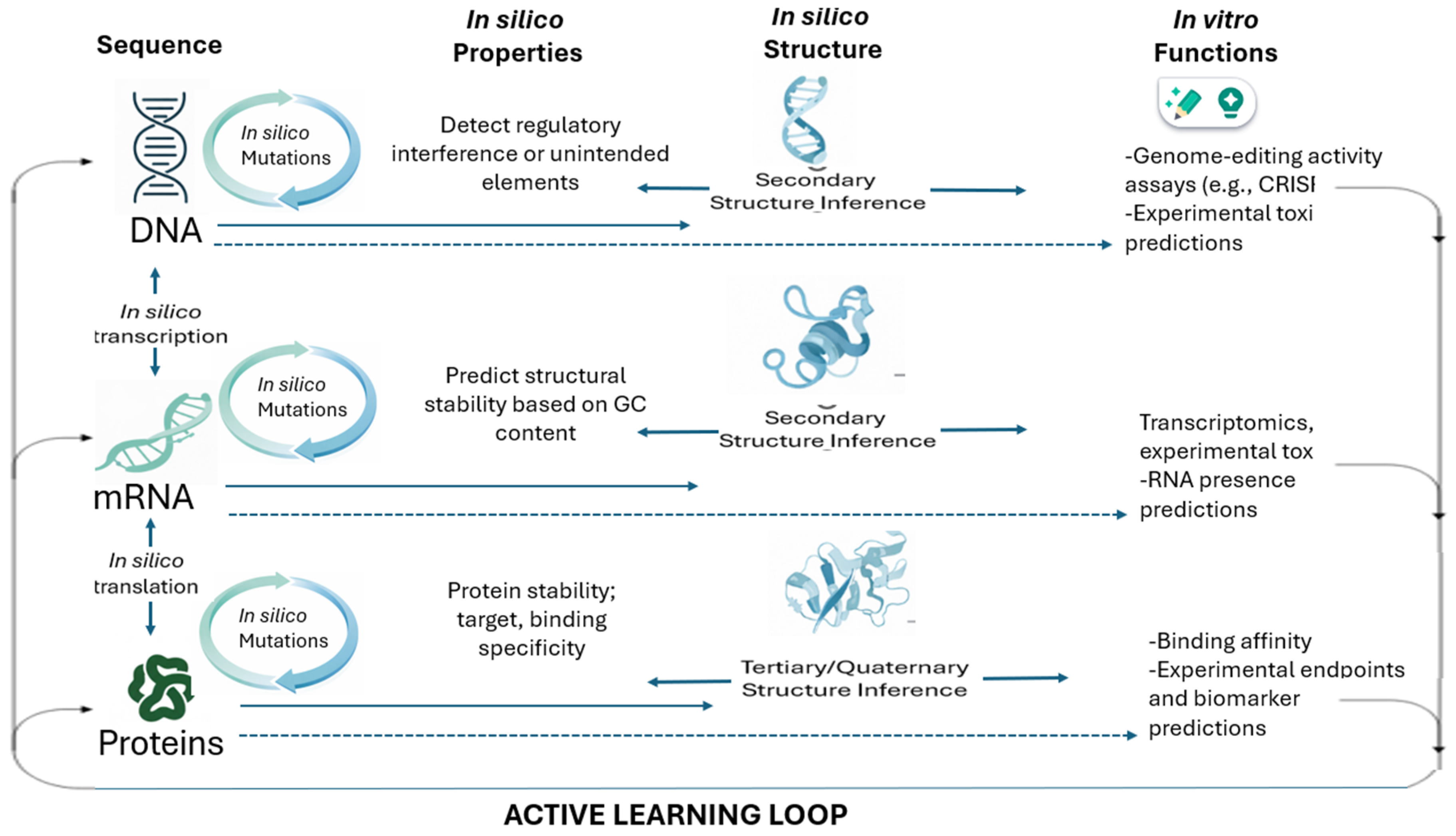
2.2. The Computational-Experimental Closed Loop (DBTL)
- Design (In silico): AI tools perform in silico mutations or sequence generation at the DNA, mRNA, and protein levels.
- Prediction (In silico Structure/Function): AI models predict properties of the newly designed sequences:
- DNA: Presence of regulatory elements, off-target gene editing effects (for CRISPR applications) make DNA design in CGT a highly repetitive, labor-intensive process. Integrating AI tools to design primers, optimize DNA sequences, and balance GC content can significantly streamline this otherwise manual and time-consuming workflow.
- mRNA: GC content, minimum free energy (related to stability). AI solutions select precise guide RNA (gRNA) sequences, reducing off-target effects and making gene editing safer.
- Protein: Stability, binding affinity (e.g., to the target antigen), and experimental endpoints like efficacy or toxicity. Learn (Active Learning): The resulting experimental data (e.g., transcriptomics, protein presence, toxicity scores) is fed back into the AI model. This Active Learning cycle refines the model’s predictive power, making the next generation of in silico designs even more efficient and accurate. This integrated process drastically shrinks the multi-year timeline associated with conventional construct optimization
3. CGT Translational Studies and Modeling: Predicting Human Outcomes
3.1. Digital Twins for Therapeutic Simulation
- Multimodal Data Integration: These models integrate omics data (genomics, transcriptomics, proteomics, metabolomics), imaging data (radiology, pathology), and clinical data (EHRs, patient history). Machine learning algorithms process this high-dimensional, heterogeneous data to create a unified, predictive profile of how an individual patient might respond to a specific CGT product.
- Simulating Efficacy and Safety: By modeling the immune system’s interaction with the therapy, AI can simulate critical outcomes:
- Efficacy: Predicting the persistence and proliferation of CAR-T cells in vivo, and their tumor-killing kinetics.
- Safety: Predicting the risk of serious adverse events like Cytokine Release Syndrome (CRS) and Immune Effector Cell-Associated Neurotoxicity Syndrome (ICANS). AI solutions predict individual patient risk from multi-omics data, allowing for proactive management and improved outcomes. This is exemplified by frameworks like CART-GPT, an AI linguistic framework that uses T-cell information to interpret neurotoxicity and therapeutic outcomes [28].
- Advanced Simulation for Gene Therapy: In gene therapy, digital twins can be leveraged to simulate vector biodistribution, transgene kinetics, and immune responses in silico, based on patient-specific anatomical and molecular data [29]. This enables the prediction of therapeutic windows, identification of patients at risk for adverse events, and optimization of dosing regimens. AI-powered models can also integrate longitudinal biomarker data to monitor transgene persistence and detect early signs of vector-related toxicity, supporting proactive clinical management.
3.2. Predictive Biomarkers and Patient Selection
- Pre-treatment Risk Prediction: ML models can analyze patient omics data (e.g., baseline inflammatory markers, cell repertoire features) to assign a toxicity risk score before the patient undergoes conditioning therapy and infusion [30]. This allows clinicians to tailor conditioning regimens, select appropriate bridging therapies, or even pre-emptively administer mitigating drugs, thereby improving safety and personalized patient management.
- Enhancing Clinical Trial Design: AI-enriched patient selection identifies subgroups most likely to respond positively, maximizing the statistical power and efficiency of small population CGT trials. Furthermore, AI enables adaptive trial designs, where the protocol is dynamically adjusted based on accumulating data. The use of virtual or external controls, derived from historical patient data analyzed by AI, can also reduce the need for large, traditional control arms, accelerating development [31].
3.3. AI and Reimbursement Modeling in Gene and Cell Therapy
4. Smart Manufacturing with Digital Twins and Machine Learning
4.1. The Concept of the Digital Twin in Biomanufacturing
- Process Simulation & Optimization: Before a physical manufacturing run begins, an AI-driven digital twin can simulate thousands of “what-if” scenarios. Developers can virtually test variations in raw material sources, temperature profiles, or nutrient feeding strategies, identifying the optimal process parameters for maximizing yield and Critical Quality Attributes in silico. This simulation capability significantly de-risks the process development phase [38].
- Real-Time Monitoring and in-line Quality Control: AI systems integrate with advanced biosensors to monitor Critical Process Parameters like glucose, CO2/O2 levels, and cell viability in real time.
- Predictive Quality Control: The digital twin continuously analyzes real-time sensor data to predict key quality attributes (e.g., cell viability, product potency) before the process is complete. AI algorithms detect subtle anomalies or drift trends that might lead to a failed batch, allowing for proactive intervention before a batch is lost.
- Dynamic Process Control: If the AI detects a process deviation, it can autonomously send commands back to the manufacturing equipment (e.g., adjusting nutrient flow rates) to maintain optimal conditions. This enables the transition to highly efficient and standardized autonomous manufacturing, utilizing tools like reinforcement learning for optimization [6,22,37,39,40,41].
- Integration of AI for Data Harmonization and Advanced Analytics:
- AI plays a critical role in optimizing the use of process and analytical data by making connections that are currently challenging to establish. A fundamental issue in biomanufacturing is that data are generated from multiple software systems with non-harmonized structures, making trending, analysis, and meta- or multivariate analyses difficult. AI can harmonize data presentation across disparate sources while maintaining data integrity—a prerequisite under GMP principles—ensuring that data are not modified during this process.
- Harmonized data across software systems can also enable automated report generation (e.g., for method development or product stability) and real-time evaluation of method performance. Instead of relying on a static snapshot from traditional validation at a single point in time, AI could continuously monitor and analyze method performance over time, automatically generating insights and alerts.
- In the near term, AI could support lower-value-added functions such as automated data double-checking and verification, improving data quality and compliance. Looking forward, AI has the potential to enable automated and unbiased data processing and interpretation, supporting advanced meta-analytical capabilities. However, this requires training AI models with appropriate and representative datasets—a significant challenge in cell and gene therapy due to limited prior knowledge, lack of platform products, small batch numbers, and few products currently on the market.
4.2. Optimizing the CAR-T Process & Machine Learning
- Cell Expansion Prediction: ML models trained on historical batch data (including initial cell quality, donor characteristics, and media components) can accurately predict the final cell yield and optimal harvest timing. This reduces the risk of process failure and improves product consistency.
- Predictive Maintenance: ML analyzes sensor data from the manufacturing equipment itself to forecast when components require maintenance. This proactive approach prevents costly, unplanned downtime and production interruptions.
4.3. End-to-End Supply Chain and Traceability
5. Regulatory Frameworks for AI in CGT
5.1. Evolving Regulations and Key Initiatives for CGT
- Framework for Regulatory Advanced Manufacturing Evaluation (FRAME) Initiative: The FDA’s FRAME program is crucial for assessing new manufacturing technologies, including those powered by AI. This initiative seeks to facilitate the adoption of advanced manufacturing techniques to improve drug quality and supply chain resilience [40].
- Cross-Center Strategy (2024): The FDA’s medical product centers outlined a unified strategy for AI across the product lifecycle. Center for Biologics Evaluation & Research (CBER), which regulates biologics like CGTs, has issued preliminary guidelines emphasizing risk management for AI applications in biologics production [40].
- AI-Derived Data for Regulatory Review: The FDA has issued guidance on “Considerations for the Use of Artificial Intelligence to Support Regulatory Decision-Making for Drug and Biological Products” [46]. This focuses on the standards for submitting and reviewing AI-derived data, ensuring that the results and predictions generated by these models are trustworthy, traceable, and understandable to reviewers.
5.2. Regulating the Evolving Regulatory Landscape
6. AI-Enabled Pharmacovigilance and Safety Monitoring
NLP and ML for Signal Detection
- NLP-Driven Case Processing: Natural Language Processing (NLP) can automatically process adverse event reports, patient narratives, and unstructured data from Electronic Health Records (EHRs) and registries. This capability drastically reduces the manual labor required for case intake and preparation.
- ML-Based Signal Detection: Machine Learning algorithms can detect safety signals across multiple, disparate data streams, including EHRs, patient registries, manufacturing data, and patient-reported outcomes. ML models are superior to traditional statistical methods for detecting subtle or complex patterns of AEs that may only manifest in specific patient subgroups or correlate with a manufacturing deviation.
- Linking Manufacturing to Outcome: One of the most powerful applications is linking detailed manufacturing process data (from the digital twin) to long-term patient safety and efficacy outcomes. AI can determine if a deviation in a bioreactor run five years ago is statistically correlated with a late-onset AE in a subset of patients, creating a closed-loop quality system that extends far beyond the point of product release.
7. Gaps, Challenges, and the Future Outlook
7.1. Gaps and Challenges
- Data Scarcity and Quality: This is the most fundamental bottleneck. CGT data is inherently scarce (due to small patient populations) and often remains siloed across institutions. The quality is inconsistent, lacking standardization in collection, annotation, and storage. Robust AI models require vast amounts of high-quality, structured data to train, hindering the generalizability and reliability of many current ML applications. Moreover, due to the small clinical data of GCT, RWD/RWE is widely used for data validation. However, the regulation of personal data protection (i.e., the level of protection) is different from country to country; it is sometimes difficult to collect sufficiently qualified data. This limits the data utilization and validation. For gene therapy, these challenges are even more pronounced: the rarity of target diseases and the need for long-term follow-up exacerbate scarcity, while heterogeneity in vector platforms, patient populations, and clinical endpoints complicates data aggregation and model generalizability. To unlock the full potential of AI-driven analytics, collaborative data-sharing initiatives and the development of a standardized data framework are urgently needed. Algorithmic Bias and Explainability: The “black box” nature of complex deep learning models presents a critical challenge in regulated environments. Regulatory bodies and clinicians require assurance that an AI-driven prediction is based on sound, non-biased evidence. Algorithmic bias, often stemming from non-diverse training data, could lead to therapies that are less effective or riskier for certain demographic groups. Thus, to manage the inherent risks of generative AI, the importance of traceability, transparency, and post-market performance monitoring should be emphasized.
- Patient Data Safety and Ethical Use: AI systems in CGT depend on large, high-dimensional patient datasets, often including genomic, immunological, and clinical information, which raises heightened concerns around privacy, consent, data provenance, and secondary use. Ensuring that these sensitive datasets are protected from misuse, securely integrated across platforms, and governed by transparent policies is essential to maintaining patient trust and meeting evolving regulatory expectations.
- Regulatory Uncertainty: Despite evolving position papers and guidelines from various regulatory bodies, there is a lack of clear, standardized regulatory frameworks to streamline the approval of Software as a Medical Device used in manufacturing or clinical decision support. For example, lack of harmonized AI terminology (i.e., no clear definition of explainability, understandability, and interpretability specific to the medical product area). It should be noted that most National Regulatory Authorities (NRAs) adopt a “horizontal AI definition”, where the highest risk management should be adopted. This may not be aligned with the sponsors/company’s approach. Without a clear definition, regulatory requirements could be ambiguous, and this makes risk management difficult to standardize.
7.2. Lack of Benchmarking AI Against Established Methods in CGT Development
7.3. Opportunities and Future Outlook
- The Integration of Synthetic Biology: The convergence of AI and synthetic biology will allow for the rapid design and testing of highly sophisticated synthetic gene circuits. These circuits will enable programmatic control of cell fate, proliferation, and function in vivo, making stem cell and immune cell therapies more robust, reproducible, and clinically applicable [22].
- Collaboration: The translation of artificial intelligence into cell and gene therapy (CGT) development increasingly depends on strategic partnerships across academia, industry, technology providers, and regulatory stakeholders. Academic–industry collaborations have enabled machine learning–guided vector engineering and construct optimization, while biopharmaceutical–technology partnerships are advancing digital twin platforms, predictive quality analytics, and AI-driven manufacturing scheduling to improve operational efficiency and reduce batch failure risk [56] (REF). At the clinical interface, multicenter data-sharing initiatives are facilitating AI-based toxicity prediction and real-world evidence generation. These collaborative models not only accelerate technical innovation but also promote data standardization, cross-site validation, and regulatory alignment, all critical elements for scaling AI-enabled CGT from experimental implementation to sustainable, industry-wide practice.
7.4. Next Steps for the Industry
- Build a Data-First Culture: Prioritize the collection of high-quality, structured, and richly annotated data from every step of the CGT lifecycle, from donor characteristics to long-term follow-up. Establishing industry-wide data standards is paramount.
- Embrace Strategic Partnerships and Collaborative Data Sharing: Given the scarcity of data, collaborations between technology vendors, academic research groups, and pharmaceutical companies are essential to pool resources, share insights, and build industry-wide benchmarks and standards for AI model performance.
- Start Small and Scale: Implement pilot projects to demonstrate the value of AI and digital twins on a small, focused scale before attempting a full-scale, facility-wide rollout.
- Engage with the NRAs early in the development process: Engaging early with regulatory authorities is essential in the development of CGTs due to the complexity, novelty, and evolving nature of these modalities. Early dialog enables sponsors to clarify regulatory expectations and align appropriate strategies for manufacturing, clinical development, and product characterization, particularly as many CGTs deviate from conventional product models. Proactive interaction helps address key challenges such as potency assay development, long-term safety follow-up, and vector or cell sourcing considerations, which, if left unresolved, can delay approvals. As regulatory frameworks are still maturing globally, establishing a shared understanding early on can significantly de-risk the development process.
8. Conclusions
Author Contributions
Funding
Institutional Review Board Statement
Data Availability Statement
Conflicts of Interest
References
- Sharma, A.; Farnia, S.; Otegbeye, F.; Rinkle, A.; Shah, J.; Shah, N.N.; Gill, S.; Maus, M.V. Nomenclature for Cellular and Genetic Therapies: A Need for Standardization. Transplant. Cell. Ther. 2022, 28, 795–801. [Google Scholar] [CrossRef]
- Lee, N.K.; Chang, J.W. Manufacturing Cell and Gene Therapies: Challenges in Clinical Translation. Ann. Lab. Med. 2024, 44, 314–323. [Google Scholar] [CrossRef]
- Delisle, J.-S.; Fournier, D.; Santerre, K.; Rochette, S.; Zawati, M.H.; Dumont-Lagacé, M.; Turcotte, S.; Guertin, J.R.; Vermette, P.; Tremblay, J.P.; et al. Harnessing the promises of cell therapy, gene therapy, and regenerative medicine in Québec, Canada. Front. Med. 2025, 12, 1581058. [Google Scholar] [CrossRef] [PubMed]
- Patel, K.K.; Tariveranmoshabad, M.; Kadu, S.; Shobaki, N.; June, C. From concept to cure: The evolution of CAR-T cell therapy. Mol. Ther. 2025, 33, 2123–2140. [Google Scholar] [CrossRef] [PubMed]
- Landscape-Report-2025-Q3.pdf. Available online: https://www.asgct.org/uploads/files/general/Landscape-Report-2025-Q3.pdf (accessed on 18 December 2025).
- U.S. Food and Drug Administration (FDA), Center for Biologics Evaluation and Research (CBER). Cellular & Gene Therapy Guidances. 2025. Available online: https://www.fda.gov/vaccines-blood-biologics/biologics-guidances/cellular-gene-therapy-guidances (accessed on 18 December 2025).
- Dhaliwal, S.; Gill, F.S.; Hamid, P. The Unprecedented Success of Chimeric Antigen Receptor T-Cell Therapy in the Treatment of Hematological Malignancies. Cureus 2024, 16, e59951. [Google Scholar] [CrossRef]
- Elsallab, M.; Ouvina, M.; Arfe, A.; Bourgeois, F.T. Mapping the Clinical Development Trajectory of Cell and Gene Therapy Products. Clin. Pharmacol. Ther. 2025, 117, 1264–1271. [Google Scholar] [CrossRef]
- Regulatory Considerations for Human Cells, Tissues, and Cellular and Tissue-Based Products: Minimal Manipulation and Homologous Use: Guidance for Industry and Food and Drug Administration staff—Digital Collections—National Library of Medicine. Available online: https://collections.nlm.nih.gov/catalog/nlm:nlmuid-9918227258706676-pdf (accessed on 23 February 2026).
- Wang, J.-H.; Gessler, D.J.; Zhan, W.; Gallagher, T.L.; Gao, G. Adeno-associated virus as a delivery vector for gene therapy of human diseases. Signal Transduct. Target. Ther. 2024, 9, 78. [Google Scholar] [CrossRef]
- Almeida-Oliveira, A.; Bonamino, M.H.; Simões, M.; Martins, V.H.V.; Freire, D.P.B.; Danowski, A.; Catão, T.P.; Varela, J.D.N.e.S.; Mazzi, M.T.; Gottgtroy, C.L.; et al. Landscape of ex vivo gene therapies: Technological trends and future prospects. Mol. Ther.-Methods Clin. Dev. 2025, 33, 101580. [Google Scholar] [CrossRef] [PubMed]
- Althafar, Z.M. Engineered immune cell therapies for solid tumors: Pharmacological advances, clinical outcomes, and future directions. Front. Pharmacol. 2025, 16, 1614325. [Google Scholar] [CrossRef]
- Dunbar, C.E.; High, K.A.; Joung, J.K.; Kohn, D.B.; Ozawa, K.; Sadelain, M. Gene therapy comes of age. Science 2018, 359, eaan4672. [Google Scholar] [CrossRef]
- Chancellor, D.; Barrett, D.; Nguyen-Jatkoe, L.; Millington, S.; Eckhardt, F. The state of cell and gene therapy in 2023. Mol. Ther. 2023, 31, 3376–3388. [Google Scholar] [CrossRef]
- Automation in Cell and Gene Therapy Manufacturing: From Past to Future|Biotechnology Letters. Available online: https://link.springer.com/article/10.1007/s10529-019-02732-z (accessed on 18 December 2025).
- Hort, S.; Herbst, L.; Bäckel, N.; Erkens, F.; Niessing, B.; Frye, M.; König, N.; Papantoniou, I.; Hudecek, M.; Jacobs, J.J.L.; et al. Toward Rapid, Widely Available Autologous CAR-T Cell Therapy–Artificial Intelligence and Automation Enabling the Smart Manufacturing Hospital. Front. Med. 2022, 9, 913287. [Google Scholar] [CrossRef]
- Singh, R.; Paxton, M.; Auclair, J. Regulating the AI-enabled ecosystem for human therapeutics. Commun. Med. 2025, 5, 181. [Google Scholar] [CrossRef]
- Dudek, N.K.; Precup, D. Towards AI-designed genomes using a variational autoencoder. Proc. R. Soc. B Biol. Sci. 2024, 291, 20241457. [Google Scholar] [CrossRef]
- Tan, F.; Dong, Y.; Qi, J.; Yu, W.; Chai, R. Artificial Intelligence-Based Approaches for AAV Vector Engineering. Adv. Sci. 2025, 12, e2411062. [Google Scholar] [CrossRef]
- Guo, J.; Lin, L.F.; Oraskovich, S.V.; de Jesús, J.A.R.; Listgarten, J.; Schaffer, D.V. Computationally guided AAV engineering for enhanced gene delivery. Trends Biochem. Sci. 2024, 49, 457–469. [Google Scholar] [CrossRef] [PubMed]
- Choudhury, M.; Deans, A.J.; Candland, D.R.; Deans, T.L. Advancing cell therapies with artificial intelligence and synthetic biology. Curr. Opin. Biomed. Eng. 2025, 34, 100580. [Google Scholar] [CrossRef] [PubMed]
- Bäckel, N.; Hort, S.; Kis, T.; Nettleton, D.F.; Egan, J.R.; Jacobs, J.J.L.; Grunert, D.; Schmitt, R.H. Elaborating the potential of Artificial Intelligence in automated CAR-T cell manufacturing. Front. Mol. Med. 2023, 3, 1250508. [Google Scholar] [CrossRef]
- Liu, B.; Greenwood, N.F.; Bonzanini, J.E.; Motmaen, A.; Meyerberg, J.; Dao, T.; Xiang, X.; Ault, R.; Sharp, J.; Wang, C.; et al. Design of high-specificity binders for peptide–MHC-I complexes. Science 2025, 389, 386–391. [Google Scholar] [CrossRef]
- Su, K.; Qiu, J.; Xu, T.; Liu, S. Artificial intelligence-guided design of lipid nanoparticles for mRNA delivery. Acta Pharm. Sin. B 2026, 16, 709–727. [Google Scholar] [CrossRef] [PubMed]
- Wang, W.; Chen, K.; Jiang, T.; Wu, Y.; Wu, Z.; Ying, H.; Yu, H.; Lu, J.; Lin, J.; Ouyang, D. Artificial intelligence-driven rational design of ionizable lipids for mRNA delivery. Nat. Commun. 2024, 15, 10804. [Google Scholar] [CrossRef] [PubMed]
- Serrano, D.R.; Luciano, F.C.; Anaya, B.J.; Ongoren, B.; Kara, A.; Molina, G.; Ramirez, B.I.; Sánchez-Guirales, S.A.; Simon, J.A.; Tomietto, G.; et al. Artificial Intelligence (AI) Applications in Drug Discovery and Drug Delivery: Revolutionizing Personalized Medicine. Pharmaceutics 2024, 16, 1328. [Google Scholar] [CrossRef] [PubMed]
- Shoshi, A.; Xia, Y.; Fieschi, A.; Ackermann, T.; Reimann, P.; Weyrich, M.; Mitschang, B.; Bauernhansl, T.; Miehe, R. A Flexible Digital Twin Framework for ATMP Production–Towards an efficient CAR T Cell Manufacturing. Procedia CIRP 2024, 125, 124–129. [Google Scholar] [CrossRef]
- Mao, T.; Shao, X.; Guo, W.; Jiang, Z.; Jing, R.; Li, X.; Zhu, Y.; Jin, T.; Ma, T.; Lu, Y.; et al. CART-GPT: A T Cell-Informed AI Linguistic Framework for Interpreting Neurotoxicity and Therapeutic Outcomes in CAR-T Therapy. bioRxiv 2025. [Google Scholar] [CrossRef]
- Silva, A.; Vale, N. Digital Twins in Personalized Medicine: Bridging Innovation and Clinical Reality. J. Pers. Med. 2025, 15, 503. [Google Scholar] [CrossRef]
- Lin, M.; Guo, J.; Gu, Z.; Tang, W.; Tao, H.; You, S.; Jia, D.; Sun, Y.; Jia, P. Machine learning and multi-omics integration: Advancing cardiovascular translational research and clinical practice. J. Transl. Med. 2025, 23, 388. [Google Scholar] [CrossRef]
- Jin, Q.; Wang, Z.; Floudas, C.S.; Chen, F.; Gong, C.; Bracken-Clarke, D.; Xue, E.; Yang, Y.; Sun, J.; Lu, Z. Matching patients to clinical trials with large language models. Nat. Commun. 2024, 15, 9074. [Google Scholar] [CrossRef]
- Naylor, N.R.; Hummel, N.; de Moor, C.; Kadambi, A. Potential Meets Practicality: AI’s Current Impact on the Evidence Generation and Synthesis Pipeline in Health Economics. Clin. Transl. Sci. 2025, 18, e70206. [Google Scholar] [CrossRef]
- Cell and Gene Therapy Patient Access and Reimbursement Market Key Factors Driving Growth. Available online: https://www.precedenceresearch.com/insights/cell-and-gene-therapy-patient-access-and-reimbursement-market (accessed on 23 February 2026).
- ADVI. 2026 Life Sciences Forecast: AI, Next-Gen Cell & Gene Therapy, and Policy Disruption. Available online: https://advi.com/insight/2026-life-sciences-forecast-ai-next-gen-cell-gene-therapy-and-policy-disruption/ (accessed on 23 February 2026).
- Reason, T.; Klijn, S.; Rawlinson, W.; Benbow, E.; Langham, J.; Teitsson, S.; Johannesen, K.; Malcolm, B. Using Generative Artificial Intelligence in Health Economics and Outcomes Research: A Primer on Techniques and Breakthroughs. PharmacoEconomics -Open 2025, 9, 501–517. [Google Scholar] [CrossRef]
- Melocchi, A.; Schmittlein, B.; Jones, A.L.; Ainane, Y.; Rizvi, A.; Chan, D.; Dickey, E.; Pool, K.; Harsono, K.; Szymkiewicz, D.; et al. Development of a robotic cluster for automated and scalable cell therapy manufacturing. Cytotherapy 2024, 26, 1095–1104. [Google Scholar] [CrossRef] [PubMed]
- Mayer, S.; Classen, T.; Endisch, C. Modular production control using deep reinforcement learning: Proximal policy optimization. J. Intell. Manuf. 2021, 32, 2335–2351. [Google Scholar] [CrossRef]
- Aghamiri, S.S.; Amin, R. The Potential Use of Digital Twin Technology for Advancing CAR-T Cell Therapy. Curr. Issues Mol. Biol. 2025, 47, 321. [Google Scholar] [CrossRef]
- Henn, A.D.; Wolff, M.; Mitra, K.; Alm, K.; Finger-Baker, I.; Bauer, S.R.; Terzic, A.; Yerden, R. Smart biomanufacturing for health equity in regenerative medicine therapies. Regen. Med. Rep. 2025, 2, 31–35. [Google Scholar] [CrossRef]
- Triantafyllou, N.; Bernardi, A.; Lakelin, M.; Shah, N.; Papathanasiou, M.M. A digital platform for the design of patient-centric supply chains. Sci. Rep. 2022, 12, 17365. [Google Scholar] [CrossRef]
- European Medicines Agency (EMA). Advanced Therapy Medicinal Products: Overview. Available online: https://www.ema.europa.eu/en/human-regulatory-overview/advanced-therapy-medicinal-products-overview (accessed on 18 December 2025).
- Verbeken, G.; Convents, L.; Delmotte, N.; Draye, J.; Jennes, S.; Vanderkelen, A.; Nijs, G.; Lewalle, P.; Baudoux, E.; Cornu, O.; et al. Current State-Of-Play of the EU Advanced Therapy Medicinal Product ( ATMP ) Field, With an Emphasis on Belgian Human Cell and Tissue Products. Wound Repair Regen. 2025, 33, e70039. [Google Scholar] [CrossRef]
- Wang, B.; Chen, R.Q.; Li, J.; Roy, K. Interfacing data science with cell therapy manufacturing: Where we are and where we need to be. Cytotherapy 2024, 26, 967–979. [Google Scholar] [CrossRef]
- Alaburde, S.; Ivaska, J.; Kaspute, G.; Ivaskiene, T. Impact of regulatory measures on the approval timelines of advanced therapy medicinal products by the European Medicines Agency. Front. Med. 2025, 12, 1623689. [Google Scholar] [CrossRef] [PubMed]
- Pizevska, M.; Kaeda, J.; Fritsche, E.; Elazaly, H.; Reinke, P.; Amini, L. Advanced Therapy Medicinal Products’ Translation in Europe: A Developers’ Perspective. Front. Med. 2022, 9, 757647. [Google Scholar] [CrossRef] [PubMed]
- Singh, R.; Zhou, K.; Auclair, J.R. Reimagining drug regulation in the age of AI: A framework for the AI-enabled Ecosystem for Therapeutics. Front. Med. 2025, 12, 1679611. [Google Scholar] [CrossRef] [PubMed]
- U.S. Food and Drug Administration (FDA), Center for Devices and Radiological Health (CDRH). Artificial Intelligence in Software as a Medical Device. 2025. Available online: https://www.fda.gov/medical-devices/software-medical-device-samd/artificial-intelligence-software-medical-device (accessed on 23 February 2026).
- Ebad, S.A.; Alhashmi, A.; Amara, M.; Miled, A.B.; Saqib, M. Artificial Intelligence-Based Software as a Medical Device (AI-SaMD): A Systematic Review. Healthcare 2025, 13, 817. [Google Scholar] [CrossRef]
- Center for Drug Evaluation and Research. Considerations for the Use of Artificial Intelligence To Support Regulatory Decision-Making for Drug and Biological Products. Available online: https://www.fda.gov/regulatory-information/search-fda-guidance-documents/considerations-use-artificial-intelligence-support-regulatory-decision-making-drug-and-biological (accessed on 23 February 2026).
- European Medicines Agency (EMA). Reflection Paper on the Use of Artificial Intelligence in the Lifecycle of Medicines. Available online: https://www.ema.europa.eu/en/news/reflection-paper-use-artificial-intelligence-lifecycle-medicines (accessed on 24 February 2026).
- Ramcharran, D.; Painter, J.L.; Kara, V.; Glaser, M.; Vanini, M.; Chalamalasetti, V.R.; Golds, C.; Abdelkarim, A.; Bate, A.; Stegmann, J.-U. Orchestrating generative AI in pharmacovigilance: Predicting and preempting the unpredictable. Ther. Adv. Drug Saf. 2025, 16, 20420986251396023. [Google Scholar] [CrossRef] [PubMed]
- Ye, J.; Woods, D.; Jordan, N.; Starren, J. The role of artificial intelligence for the application of integrating electronic health records and patient-generated data in clinical decision support. AMIA Summits Transl. Sci. Proc. 2024, 2024, 459–467. [Google Scholar]
- CDC. Health Insurance Portability and Accountability Act of 1996 (HIPAA). Public Health Law. Available online: https://www.cdc.gov/phlp/php/resources/health-insurance-portability-and-accountability-act-of-1996-hipaa.html (accessed on 23 February 2026).
- Chinta, S.V.; Wang, Z.; Palikhe, A.; Zhang, X.; Kashif, A.; Smith, M.A.; Liu, J.; Zhang, W. Correction: AI-driven healthcare: A review on ensuring fairness and mitigating bias. PLoS Digit. Health 2025, 4, e0000994. [Google Scholar] [CrossRef] [PubMed]
- EU AI Act: First Regulation on Artificial Intelligence. Topics|European Parliament. Available online: https://www.europarl.europa.eu/topics/en/article/20230601STO93804/eu-ai-act-first-regulation-on-artificial-intelligence (accessed on 18 December 2025).
- Maharjan, R.; Kim, N.A.; Kim, K.H.; Jeong, S.H. Transformative roles of digital twins from drug discovery to continuous manufacturing: Pharmaceutical and biopharmaceutical perspectives. Int. J. Pharm. X 2025, 10, 100409. [Google Scholar] [CrossRef] [PubMed]


| Attribute | Cell Therapies | Gene Therapies | Biologics | Small Molecules |
|---|---|---|---|---|
| Product Type | Living cells (autologous or allogeneic), minimally or more than minimally manipulated (e.g., MSCs, NK cells) | Genetic material delivered via viral/non-viral vectors; may involve in vivo or ex vivo modification | Large, complex proteins produced from living systems (e.g., MAb) | Small, chemically synthesized compounds |
| Molecular Size & Complexity | Extremely large; heterogeneous and variable | Large; structurally complex some cases well-characterized (e.g., rDNA protein products) | Small (~1 kDa); well-defined and reproducible | |
| Production Approach | Personalized; scale-out manufacturing | Personalized (especially ex vivo); vector design critical | Standardized; Large scale production via bioreactors | Bulk synthesis; highly standardized |
| Manufacturing Process | Most complex; long cycles; chain-of-identity; cryopreservation | Complex; vector production + cell manipulation (ex vivo) or direct delivery (in vivo) | Complex; Fed-batch or continuous process | Simple; reproducible chemical synthesis and compounding |
| Stability, Supply Chain & Logistics | Most complex; patient-specific chain-of-identity; just-in-time delivery; least stable; requires cryotemps storage and supply | Complex; requires vector stability and cell viability (ex vivo) or formulation stability (in vivo) | Cold chain supply, relatively shorter shelf-life | Simplest; longer shelf-life, broad distribution; room temp storage |
| Follow-on Products | No generics/biosimilars; each product is unique | Biosimilars via comparability studies | Generics approved via BA/BE studies | |
| Regulatory Pathway | Evolving but not many countries have regulatory framework | Well-established | Well-established | |
| Cost of Production | Very high; customized, labor- and resource-intensive | High; living cell production from bioreactors, closed and aseptic process required | Lower; scalable, cost-effective manufacturing | |
| Feature | Cell Therapy | Gene Therapy (Ex Vivo/In Vivo) |
|---|---|---|
| Source | Autologous or allogeneic cells | Patient or donor cells, or direct in vivo administration |
| Modification | Minimally or more than minimally manipulated (e.g., MSCs, iPSCs) | Gene editing or vector insertion |
| Potency Determinants | Viability, phenotype, functionality | Vector transduction (infectivity), transgene expression, delivery efficiency |
| Key Assay Focus | Identity, purity, immunomodulation | Vector copy number, product purity, off-target effects, durability |
| Regulatory Considerations | Focus on cell expansion & safety | Vector design, insertional mutagenesis, and immune response |
| Stage | Standard CGT Approach | AI-Driven CGT Approach |
|---|---|---|
| R&D/Design | Trial-and-error design of vectors; large experimental libraries, long cycles to optimize potency and safety. | AI predicts vector tropism, immune profile, and manufacturability; narrows candidates quickly; generative tools for novel capsids/CARs. |
| Preclinical & Translational | Animal models and small-scale assays; limited predictability for human outcomes. | Digital twins and in silico models simulate efficacy/toxicity; integration of omics and imaging for higher translational fidelity. |
| Manufacturing | Manual monitoring of bioreactors; batch failures detected late; corrective interventions after deviations. | Smart manufacturing with digital twins; real-time drift detection; predictive maintenance; adaptive control loops. |
| Clinical Trials | Broad eligibility, smaller populations, recruitment delays; adaptive designs are rare. | AI-enriched patient selection, adverse event risk prediction, adaptive trial designs; use of virtual/external controls. |
| Pharmacovigilance | Manual case intake, narrative writing, traditional signal detection in safety databases. | NLP-driven case processing; ML signal detection across multiple data streams (EHRs, registries, manufacturing data). |
| Regulatory Framework | Review based on static data packages; long cycles for post-approval monitoring. | Context-of-use validation of AI tools; real-time performance monitoring; adaptive regulatory engagement. |
Disclaimer/Publisher’s Note: The statements, opinions and data contained in all publications are solely those of the individual author(s) and contributor(s) and not of MDPI and/or the editor(s). MDPI and/or the editor(s) disclaim responsibility for any injury to people or property resulting from any ideas, methods, instructions or products referred to in the content. |
© 2026 by the authors. Licensee MDPI, Basel, Switzerland. This article is an open access article distributed under the terms and conditions of the Creative Commons Attribution (CC BY) license.
Share and Cite
Auclair, J.R.; Joung, J.; Singh, M.A.; Debauve, G.; Singh, R. Artificial Intelligence and the Transformation of Cell and Gene Therapy Development. Pharmaceutics 2026, 18, 356. https://doi.org/10.3390/pharmaceutics18030356
Auclair JR, Joung J, Singh MA, Debauve G, Singh R. Artificial Intelligence and the Transformation of Cell and Gene Therapy Development. Pharmaceutics. 2026; 18(3):356. https://doi.org/10.3390/pharmaceutics18030356
Chicago/Turabian StyleAuclair, Jared R., Jeewon Joung, Maya A. Singh, Gaël Debauve, and Rominder Singh. 2026. "Artificial Intelligence and the Transformation of Cell and Gene Therapy Development" Pharmaceutics 18, no. 3: 356. https://doi.org/10.3390/pharmaceutics18030356
APA StyleAuclair, J. R., Joung, J., Singh, M. A., Debauve, G., & Singh, R. (2026). Artificial Intelligence and the Transformation of Cell and Gene Therapy Development. Pharmaceutics, 18(3), 356. https://doi.org/10.3390/pharmaceutics18030356