

The Way to Pursue Truly High-Performance Perovskite Solar Cells



Abstract
1. Introduction
2. Light-Materials’ Interactions: Excited Bounded Electrons
3. Hot-Carrier Extraction at a Light-Absorbing Material/Electron Transport Layer (LAM/ETL) Interface
4. Hot-Carrier Extraction at a LAM/Hole Transport Layer (HTL) Interface
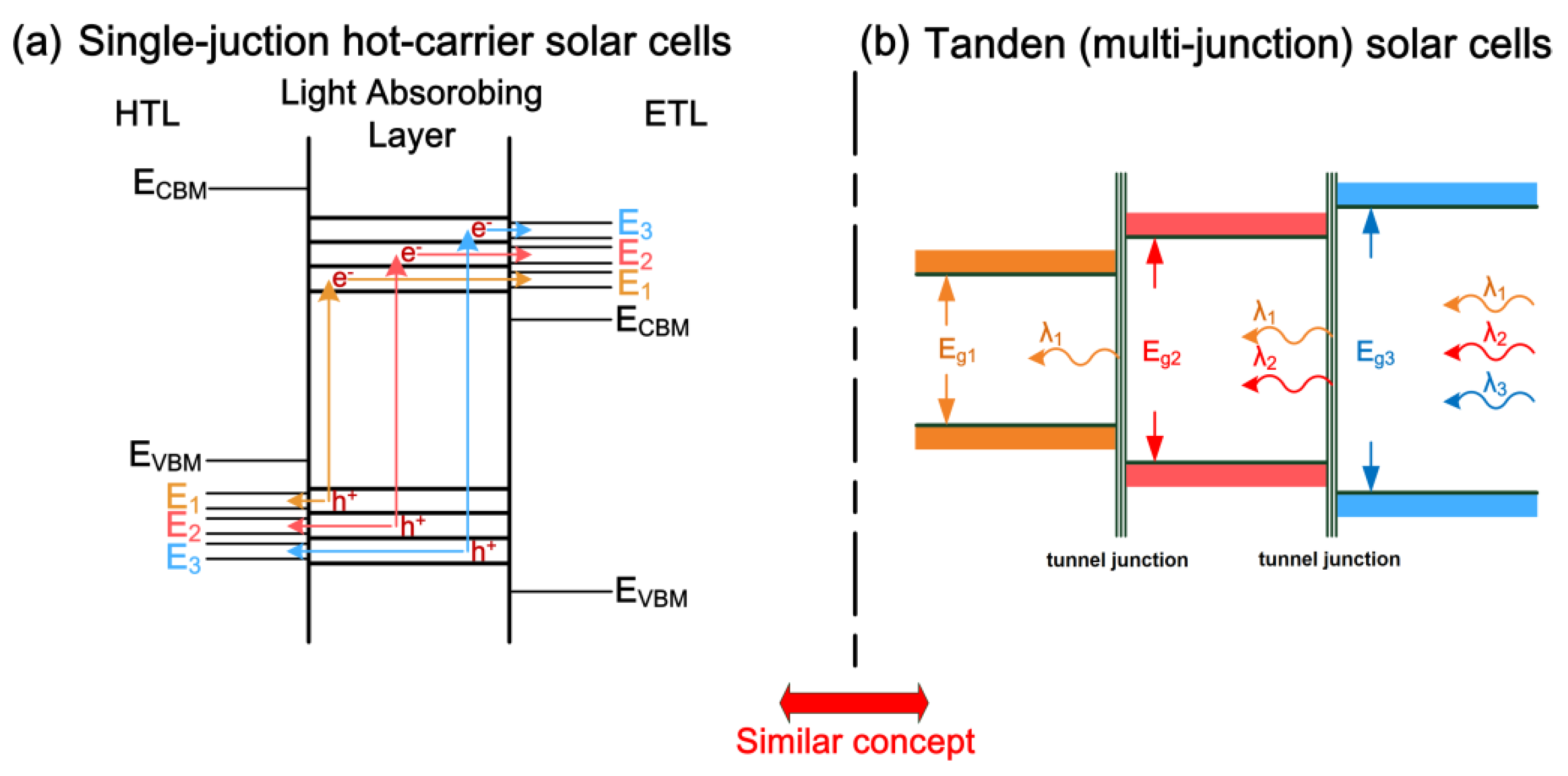
5. Theoretical Point of View
6. Experimental Challenges and Opportunities
7. Conclusions
Author Contributions
Funding
Conflicts of Interest
References
- Katayama, K.; Inagaki, Y.; Sawada, T. Ultrafast two-step thermalization processes of photoexcited electrons at a gold surface: Application of a wavelength-selective transient reflecting grating method. Phys. Rev. B 2000, 61, 7332–7335. [Google Scholar] [CrossRef]
- Xie, Y.; Li, Y.; Xiao, L.; Qiao, Q.; Dhakal, R.; Zhang, Z.; Gong, Q.; Galipeau, D.; Yan, X. Femtosecond Time-Resolved Fluorescence Study of P3HT/PCBM Blend Films. J. Phys. Chem. C 2010, 114, 14590–14600. [Google Scholar] [CrossRef]
- Bräm, O.; Cannizzo, A.; Chergui, M. Ultrafast fluorescence studies of dye sensitized solar cells. Phys. Chem. Chem. Phys. 2012, 14, 7934–7937. [Google Scholar] [CrossRef] [PubMed]
- Kirton, P.; Keeling, J. Thermalization and breakdown of thermalization in photon condensates. Phys. Rev. A 2015, 91, 033826. [Google Scholar] [CrossRef]
- Shockley, W.; Queisser, H.J. Detailed Balance Limit of Efficiency of p-n Junction Solar Cells. J. Appl. Phys. 1961, 32, 510–519. [Google Scholar] [CrossRef]
- Blakers, A.; Zin, N.; McIntosh, K.R.; Fong, K. High Efficiency Silicon Solar Cells. Energy Procedia 2013, 33, 1–10. [Google Scholar] [CrossRef]
- De Wolf, S.; Cuevas, A.; Battaglia, C. High-efficiency crystalline silicon solar cells: Status and perspectives. Energy Environ. Sci. 2016, 9, 1552–1576. [Google Scholar]
- Moon, S.; Kim, K.; Kim, Y.; Heo, J.; Lee, J. Highly efficient single-junction GaAs thin-film solar cell on flexible substrate. Sci. Rep. 2016, 6, 30107. [Google Scholar] [CrossRef]
- Liang, D.; Kang, Y.; Huo, Y.; Chen, Y.; Cui, Y.; Harris, J.S. High-Efficiency Nanostructured Window GaAs Solar Cells. Nano Lett. 2013, 13, 4850–4856. [Google Scholar] [CrossRef] [PubMed]
- Yamamoto, A.; Yamaguchi, M.; Uemura, C. High efficiency homojunction InP solar cells. Appl. Phys. Lett. 1985, 47, 975–977. [Google Scholar] [CrossRef]
- Yin, X.; Battaglia, C.; Lin, Y.; Chen, K.; Hettick, M.; Zheng, M.; Chen, C.-Y.; Kiriya, D.; Javey, A. 19.2% Efficient InP Heterojunction Solar Cell with Electron-Selective TiO2 Contact. ACS Photon. 2014, 1, 1245–1250. [Google Scholar] [CrossRef] [PubMed]
- He, Y.; Chen, H.-Y.; Hou, J.; Li, Y. Indene−C60Bisadduct: A New Acceptor for High-Performance Polymer Solar Cells. J. Am. Chem. Soc. 2010, 132, 1377–1382. [Google Scholar] [CrossRef] [PubMed]
- Guo, X.; Cui, C.; Zhang, M.; Huo, L.; Huang, Y.; Hou, J.; Li, Y. High efficiency polymer solar cells based on poly(3-hexylthiophene)/indene-C70 bisadduct with solvent additive. Energy Environ. Sci. 2012, 5, 7943–7949. [Google Scholar] [CrossRef]
- Zhang, H.; Yao, H.; Hou, J.; Zhu, J.; Zhang, J.; Li, W.; Yu, R.; Gao, B.; Zhang, S.; Hou, J. Over 14% Efficiency in Organic Solar Cells Enabled by Chlorinated Nonfullerene Small-Molecule Acceptors. Adv. Mater. 2018, 30, 1800613. [Google Scholar] [CrossRef] [PubMed]
- Roy, P.; Kim, D.; Lee, K.; Spiecker, F.; Schmuki, P. TiO2 nanotubes and their application in dye-senstized solar cells. Nanoscale 2010, 2, 45–49. [Google Scholar] [CrossRef] [PubMed]
- Liao, J.-Y.; He, J.-W.; Xu, H.; Kuang, D.-B.; Su, C.-Y. Effect of TiO2 morphology on photovoltaic performance of dye-sensitized solar cells: Nanoparticles, nanofibers, hierarchical spheres and ellipsoid spheres. J. Mater. Chem. 2012, 22, 7910–7918. [Google Scholar] [CrossRef]
- Fan, Y.-H.; Ho, C.-Y.; Chang, Y.-J. Enhancement of Dye-Sensitized Solar Cells Efficiency Using Mixed-Phase TiO2 Nanoparticles as Photoanode. Scanning 2017, 2017, 9152973. [Google Scholar] [CrossRef]
- Kojima, A.; Teshima, K.; Shirai, Y.; Miyasaka, T. Organometal Halide Perovskites as Visible-Light Sensitizers for Photovoltaic Cells. J. Am. Chem. Soc. 2009, 131, 6050–6051. [Google Scholar] [CrossRef] [PubMed]
- NREL Efficiency Chart. This Plot is Courtesy of the National Renewable Energy Laboratory, Golden. Available online: https://www.nrel.gov/pv/assets/pdfs/best-reserch-cell-efficiencies.20190802.pdf (accessed on 5 August 2019).
- Bi, C.; Shao, Y.; Yuan, Y.; Xiao, Z.; Wang, C.; Gao, Y.; Huang, J. Understanding the formation and evolution of interdiffusion grown organolead halide perovskite thin films by thermal annealing. J. Mater. Chem. A 2014, 2, 18508–18514. [Google Scholar] [CrossRef]
- Barker, A.J.; Sadhanala, A.; Deschler, F.; Gandini, M.; Senanayak, S.P.; Pearce, P.M.; Mosconi, E.; Pearson, A.J.; Wu, Y.; Kandada, A.R.S.; et al. Defect-Assisted Photoinduced Halide Segregation in Mixed-Halide Perovskite Thin Films. ACS Energy Lett. 2017, 2, 1416–1424. [Google Scholar] [CrossRef]
- Ran, C.; Xu, J.; Gao, W.; Huang, C.; Dou, S. Defects in metal triiodide perovskite materials towards high-performance solar cells: Origin, impact, characterization, and engineering. Chem. Soc. Rev. 2018, 47, 4581–4610. [Google Scholar] [CrossRef] [PubMed]
- Chang, S.H.; Lin, K.-F.; Chiang, C.-H.; Chen, S.-H.; Wu, C.-G. Plasmonic Structure Enhanced Exciton Generation at the Interface between the Perovskite Absorber and Copper Nanoparticles. Sci. World J. 2014, 2014, 128414. [Google Scholar] [CrossRef] [PubMed]
- De Wolf, S.; Holovsky, J.; Moon, S.-J.; Löper, P.; Niesen, B.; Ledinsky, M.; Haug, F.-J.; Yum, J.-H.; Ballif, C. Organometallic Halide Perovskites: Sharp Optical Absorption Edge and Its Relation to Photovoltaic Performance. J. Phys. Chem. Lett. 2014, 5, 1035–1039. [Google Scholar] [CrossRef] [PubMed]
- Xie, Z.; Liu, S.; Qin, L.; Pang, S.; Wang, W.; Yan, Y.; Yao, L.; Chen, Z.; Wang, S.; Du, H.; et al. Refractive index and extinction coefficient of CH3NH3PbI3 studied by spectroscopic ellipsometry. Opt. Mater. Express 2015, 5, 29–43. [Google Scholar]
- Chang, S.H.; Huang, W.-C.; Chen, C.-C.; Chen, S.-H.; Wu, C.-G. Effects of anti-solvent (iodobenzene) volume on the formation of CH3NH3PbI3 thin films and their application in photovoltaic cells. Appl. Surf. Sci. 2018, 445, 24–29. [Google Scholar] [CrossRef]
- Galkowski, K.; Mitioglu, A.; Miyata, A.; Plochocka, P.; Portugall, O.; Eperon, G.E.; Wang, J.T.-W.; Stergiopoulos, T.; Stranks, S.D.; Snaith, H.J.; et al. Determination of the exciton binding energy and effective masses for methylammonium and formamidinium lead tri-halide perovskite semicroductors. Energy Environ. Sci. 2016, 9, 962–970. [Google Scholar] [CrossRef]
- Chen, C.-C.; Chang, S.H.; Chen, L.-C.; Tsai, C.-L.; Cheng, H.-M.; Huang, W.-C.; Chen, W.-N.; Lu, Y.-C.; Tseng, Z.-L.; Chiu, K.Y.; et al. Interplay between nucleation and crystal growth during the formation of CH3NH3PbI3 thin films and their application in solar cells. Sol. Energy Mater. Sol. Cells 2017, 159, 583–589. [Google Scholar] [CrossRef]
- Yang, Y.; Yang, M.; Li, Z.; Crisp, R.; Zhu, K.; Beard, M.C. Comparison of recombination dynamics in CH3NH3PbBr3 and CH3NH3PbI3 perovskite thin films: Influence of exciton binding energy. J. Phys. Chem. Lett. 2015, 6, 4688–4692. [Google Scholar] [CrossRef] [PubMed]
- Chen, C.-C.; Chang, S.H.; Chen, L.-C.; Kao, F.-S.; Cheng, H.-M.; Yeh, S.-C.; Chen, C.-T.; Wu, W.-T.; Tseng, Z.-L.; Chuang, C.L.; et al. Improving the efficiency of inverted mixed-organic-cation perovskite absorber based photovoltaics by tailing the surface roughness of PEDOT: PSS thin film. Sol. Energy 2016, 134, 445–451. [Google Scholar] [CrossRef]
- Stranks, S.D.; Eperon, G.E.; Grancini, G.; Menelaou, C.; Alcocer, M.J.P.; Leijtens, T.; Herz, L.M.; Petrozza, A.; Snaith, H.J. Electron-Hole Diffusion Lengths Exceeding 1 Micrometer in an Organometal Trihalide Perovskite Absorber. Science 2013, 342, 341–344. [Google Scholar] [CrossRef]
- Guo, Z.; Manser, J.S.; Wan, Y.; Kamat, P.V.; Huang, L. Spatial and temporal imaging of long-range charge transport in perovskite thin films by ultrafast microscopy. Nat. Commun. 2015, 6, 7471. [Google Scholar] [CrossRef] [PubMed]
- Sha, W.E.I.; Ren, X.; Chen, L.; Choy, W.C.H. The efficiency limit of CH3NH3PbI3 perovskite solar cells. Appl. Phys. Lett. 2015, 106, 221104. [Google Scholar] [CrossRef]
- Bernardi, M.; Vigil-Fowler, D.; Ong, C.S.; Neaton, J.B.; Louie, S.G. Ab initio study of hot electrons in GaAs. Proc. Natl. Acad. Sci. USA 2015, 112, 5291–5296. [Google Scholar] [CrossRef] [PubMed]
- Cushing, S.K.; Zürch, M.; Kraus, P.M.; Carneiro, L.M.; Lee, A.; Chang, H.-T.; Kaplan, C.J.; Leone, S.R. Hot phonon and carrier relaxation in Si(100) determined by transient extreme ultraviolet spectroscopy. Struct. Dyn. 2018, 5, 054302. [Google Scholar] [CrossRef] [PubMed]
- Lock, D.; Rusimova, K.R.; Pan, T.L.; Palmer, R.E.; Sloan, P.A. Atomically resolved real-space imaging of hot electron dynamics. Nat. Commun. 2015, 6, 8365. [Google Scholar] [CrossRef] [PubMed]
- Gadret, E.G.; de Lima, M.M., Jr.; Madureira, J.R.; Chiaramonte, T.; Cotta, M.A.; Iikawa, F.; Cantarero, A. Optical phonon modes of wurtzite InP. Appl. Phys. Lett. 2013, 102, 122101. [Google Scholar] [CrossRef]
- Wang, Y.; Jackson, H.E.; Smith, L.M.; Burgess, T.; Paiman, S.; Gao, Q.; Tan, H.H.; Jagadish, C. Carrier Thermalization Dynamics in Single Zincblende and Wurtzite InP Nanowires. Nano Lett. 2014, 14, 7153–7160. [Google Scholar] [CrossRef] [PubMed]
- Madjet, M.E.-A.; Berdiyorov, G.R.; El-Mellouhi, F.; Alharbi, F.H.; Akimov, A.V.; Kais, S. Cation Effect on Hot Carrier Cooling in Halide Perovskite Materials. J. Phys. Chem. Lett. 2017, 8, 4439–4445. [Google Scholar] [CrossRef] [PubMed]
- Guo, Z.; Wan, Y.; Yang, M.; Snaider, J.; Zhu, K.; Huang, L. Long-range hot-carrier transport in hybrid perovskites visualized by ultrafast microscopy. Science 2017, 356, 59–62. [Google Scholar] [CrossRef]
- Fang, H.-H.; Adjokatse, S.; Shao, S.; Even, J.; Loi, M.A. Long-lived hot-carrier light emission and large blue shift in formamidinium tin triiodide perovskites. Nat. Commun. 2018, 9, 243. [Google Scholar] [CrossRef]
- Murakami, H. Femtosecond time-resolved fluorescence up-conversion spectrometer corrected for wavelength-dependent conversion efficiency using continuous white light. Rev. Sci. Instrum. 2006, 77, 113105. [Google Scholar] [CrossRef]
- Xu, J.; Knutson, J.R. Ultrafast fluorescence spectroscopy via upconversion: Applications to biophyiscs. Methods Enzymol. 2008, 450, 159–183. [Google Scholar] [PubMed]
- Maultzsch, J.; Reich, S.; Thomsen, C.; Requardt, H.; Ordejon, P. Phonon dispersion in graphite. Phys. Rev. Lett. 2004, 92, 075501. [Google Scholar] [CrossRef] [PubMed]
- Banerji, N.; Cowan, S.; Vauthey, E.; Heeger, A.J. Ultrafast Relaxation of the Poly(3-hexylthiophene) Emission Spectrum. J. Phys. Chem. C 2011, 115, 9726–9739. [Google Scholar] [CrossRef]
- Kaufmann, C.; Kim, W.; Nowak-Król, A.; Hong, Y.; Kim, D.; Würthner, F. Ultrafast Exciton Delocalization, Localization, and Excimer Formation Dynamics in a Highly Defined Perylene Bisimide Quadruple π-Stack. J. Am. Chem. Soc. 2018, 140, 4253–4258. [Google Scholar] [CrossRef]
- Knupfer, M. Exciton binding energies in organic semiconductors. Appl. Phys. A 2003, 77, 623–626. [Google Scholar] [CrossRef]
- Nayak, P.K. Exicton binding energy in small organic conjugated molecule. Synth. Met. 2013, 174, 42–45. [Google Scholar] [CrossRef]
- Chen, K.; Barker, A.J.; Reish, M.E.; Gordon, K.C.; Hodgkiss, J.M. Broadband Ultrafast Photoluminescence Spectroscopy Resolves Charge Photogeneration via Delocalized Hot Excitons in Polymer:Fullerene Photovoltaic Blends. J. Am. Chem. Soc. 2013, 135, 18502–18512. [Google Scholar] [CrossRef]
- Zhou, N.; Prabakaran, K.; Lee, B.; Chang, S.H.; Harutyunyan, B.; Guo, P.; Butler, M.R.; Timalsina, A.; Bedzyk, M.J.; Ratner, M.A.; et al. Metal-Free Tetrathienoacene Sensitizers for High-Performance Dye-Sensitized Solar Cells. J. Am. Chem. Soc. 2015, 137, 4414–4423. [Google Scholar] [CrossRef] [PubMed]
- Wu, K.; Bera, A.; Ma, C.; Du, Y.; Yang, Y.; Li, L.; Wu, T. Temperature-dependent excitonic photoluminescence of hybrid organometal halide perovskite films. Phys. Chem. Chem. Phys. 2014, 16, 22476–22481. [Google Scholar] [CrossRef] [PubMed]
- Wright, A.D.; Verdi, C.; Milot, R.L.; Eperon, G.E.; Pérez-Osorio, M.A.; Snaith, H.J.; Giustino, F.; Johnston, M.B.; Herz, L.M. Electron–phonon coupling in hybrid lead halide perovskites. Nat. Commun. 2016, 7, 11755. [Google Scholar] [CrossRef] [PubMed]
- Yang, J.; Wen, X.; Xia, H.; Sheng, R.; Ma, Q.; Kim, J.; Tapping, P.; Harada, T.; Kee, T.W.; Huang, F.; et al. Acoustic-optical phonon up-conversion and hot-phonon bottleneck in lead-halide perovskites. Nat. Commun. 2017, 8, 14120. [Google Scholar] [CrossRef] [PubMed]
- Ernst, T. Controlling the Polarity of Silicon Nanowire Transistors. Science 2013, 340, 1414–1415. [Google Scholar] [CrossRef] [PubMed]
- Masselink, W.T.; Fischer, R.; Klem, J.; Henderson, T.; Pearah, P.; Morkoc, H. Polar semiconductor quantum wells on onopolar substrates: (Al,Ga) As/GaAs on (100)Ge. Appl. Phys. Lett. 1984, 45, 457. [Google Scholar] [CrossRef]
- Yang, Y.; Ostrowski, D.P.; France, R.M.; Zhu, K.; van de Lagemaat, J.; Luther, J.M.; Beard, M.C. Observation of a hot-phonon bottleneck in lead-iodide perovskites. Nat. Photonics 2016, 10, 53–59. [Google Scholar] [CrossRef]
- Frost, J.M.; Whalley, L.D.; Walsh, A. Slow Cooling of Hot Polarons in Halide Perovskite Solar Cells. ACS Energy Lett. 2017, 2, 2647–2652. [Google Scholar] [CrossRef] [PubMed]
- Chang, S.H.; Chiang, C.-H.; Tseng, Z.-L.; Chiu, K.-Y.; Tai, C.-Y.; Wu, C.-G. Unraveling simultaneously enhanced open-circuit voltage and short-circuit current density in P3HT:ICBA:2,3-pyridinediol blended film based photovoltaics. J. Phys. D Appl. Phys. 2015, 48, 195104. [Google Scholar] [CrossRef]
- Lee, B.; Stoumpos, C.C.; Zhou, N.; Hao, F.; Malliakas, C.; Yeh, C.-Y.; Marks, T.J.; Kanatzidis, M.G.; Chang, R.P.H. Air-stable molecular semiconductor lodosalts for solar cell applications: Cs2SnI6 as a hole conductor. J. Am. Chem. Soc. 2014, 136, 15379–15385. [Google Scholar] [CrossRef] [PubMed]
- Zou, B.; Zhang, Y.; Xiao, L.; Li, T. Self-trapped state and phonon localization in TiO2 quantum dot with a dipole layer. J. Appl. Phys. 1993, 73, 4689–4690. [Google Scholar] [CrossRef]
- Chang, S.H.; Chiang, C.-H.; Cheng, H.-M.; Tai, C.-Y.; Wu, C.-G. Broadband charge transfer dynamics in P3HT:PCBM blended film. Opt. Lett. 2013, 38, 5342–5345. [Google Scholar] [CrossRef] [PubMed]
- Wang, H.-Y.; Gao, B.-R.; Wang, L.; Yang, Z.-Y.; Du, X.-B.; Chen, Q.-D.; Song, J.-F.; Sun, H.-B. Exciton diffusion and charge transfer dynamics in nano phase-separated P3HT/PCBM blend films. Nanoscale 2011, 3, 2280–2285. [Google Scholar] [CrossRef]
- Wu, C.-G.; Chiang, C.-H.; Chang, S.H. A perovskite cell with a record-high-VOC of 1.61 V based on solvent annealed CH3NH3PbBr3/ICBA active layer. Nanoscale 2016, 8, 4077–4085. [Google Scholar] [CrossRef] [PubMed]
- Chang, S.H.; Lin, K.-F.; Chiu, K.Y.; Tsai, C.-L.; Cheng, H.-M.; Yeh, S.-C.; Wu, W.-T.; Chen, W.-N.; Chen, C.-T.; Chen, S.-H.; et al. Improving the efficiency of CH3NH3PbI3 based photovoltaics by tuning the work function of the PEDOT:PSS hole transport layer. Sol. Energy 2015, 122, 892–899. [Google Scholar] [CrossRef]
- Chang, S.H.; Chen, W.-N.; Chen, C.-C.; Yeh, S.-C.; Cheng, H.-M.; Tseng, Z.-L.; Chen, L.-C.; Chiu, K.Y.; Wu, W.-T.; Chen, C.-T.; et al. Manipulating the molecular structure of PEDOT chains through controlling the viscosity of PEDOT:PSS solutions to improve the photovoltaic performance of CH3NH3PbI3 solar cells. Sol. Energy Mater. Sol. Cells 2017, 161, 7–13. [Google Scholar] [CrossRef]
- Yip, H.-L.; Jen, A.K.-Y. Recent advances in solution-processed interfacial materials for efficient and stable polymer solar cells. Energy Environ. Sci. 2012, 5, 5994–6011. [Google Scholar] [CrossRef]
- Fang, J.; Deng, D.; Zhang, J.; Zhang, Y.; Lu, K.; Wei, Z. High open-circuit voltage ternary organic solar cells based on ICBA as acceptor and absorption-complementary donors. Mater. Chem. Front. 2017, 1, 1223–1228. [Google Scholar] [CrossRef]
- Xia, Y.; Sun, K.; Ouyang, J. Solution-Processed Metallic Conducting Polymer Films as Transparent Electrode of Optoelectronic Devices. Adv. Mater. 2012, 24, 2436–2440. [Google Scholar] [CrossRef]
- Zhang, L.; Li, B.; Yuan, J.; Wang, M.; Shen, T.; Huang, F.; Wen, W.; Cao, G.; Tian, J. High-Voltage-Efficiency Inorganic Perovskite Solar Cells in a Wide Solution-Processing Window. J. Phys. Chem. Lett. 2018, 9, 3646–3653. [Google Scholar] [CrossRef]
- Yuan, H.; Zhao, Y.; Duan, J.; Wang, Y.; Yang, X.; Tang, Q. All-inorganic CsPbBr3 perovskite solar cell with 10.26% efficiency by spectra engineering. J. Mater. Chem. A 2018, 6, 24324–24329. [Google Scholar] [CrossRef]
- Hedley, G.J.; Quati, C.; Harwell, J.; Predhdo, O.V.; Beljonne, D.; Samuel, I.D.W. Hot-hole cooling controls the intial ultrafast relaxation in methylammonium lead iodide perovskite. Sci. Rep. 2018, 8, 8115. [Google Scholar] [CrossRef]
- Shen, Q.; Ripolles, T.S.; Even, J.; Zhang, Y.; Ding, C.; Liu, F.; Izuishi, T.; Nakazawa, N.; Toyoda, T.; Ogomi, Y.; et al. Ultrafast selective extraction of hot holes from cesium lead iodide perovskite films. J. Energy Chem. 2018, 27, 1170–1174. [Google Scholar] [CrossRef]
- Kang, Y.; Han, S. Intrinsic Carrier Mobility of Cesium Lead Halide Perovskites. Phys. Rev. Appl. 2018, 10, 044013. [Google Scholar] [CrossRef]
- Kahmann, S.; Loi, M.A. Hot carrier solar cells and the potential of perovskites for breaking the Shockley–Queisser limit. J. Mater. Chem. C 2019, 7, 2471–2486. [Google Scholar] [CrossRef]
- De Vos, A. Detailed balance limit of the efficiency of tandem solar cells. J. Phys. D Appl. Phys. 1980, 13, 839–846. [Google Scholar] [CrossRef]
- Wheeldon, J.F.; Valdivia, C.E.; Walker, A.W.; Kolhatar, G.; Jaouad, A.; Turala, A.; Riel, B.; Masson, D.; Puetz, N.; Fafard, S.; et al. Performance comparison of AlGaAs, GaAs and InGaP tunnel junctions for concentrated multijunction solar cells. Prog. Photovolt. 2011, 19, 442–452. [Google Scholar] [CrossRef]
- Nagae, M. Response Time of Metal-Insulator-Metal Tunnel Junctions. Jpn. J. Appl. Phys. 1972, 11, 1611–1621. [Google Scholar] [CrossRef]
- Bannai, R.; Kikuchi, A.; Kishino, K.; Lee, C.-M.; Chyi, J.-I. AlN/GaN double-barrier resonant tunneling diodes grown by rf-plasma-assisted molecular-beam epitaxy. Appl. Phys. Lett. 2002, 81, 1729–1731. [Google Scholar]
- Sollner, T.C.L.G. Resonant tunneling through quantum wells at frequencies up to 2.5 THz. Appl. Phys. Lett. 1983, 43, 588. [Google Scholar] [CrossRef]
- Lam, P.; Hatch, S.; Wu, J.; Tang, M.; Dorogan, V.G.; Mazur, Y.I.; Salamo, G.J.; Ramiro, Í.; Seeds, A.; Liu, H. Voltage recovery in charged InAs/GaAs quantum dot solar cells. Nano Energy 2014, 6, 159–166. [Google Scholar] [CrossRef]
- Shi, X.; Dong, G.; Fang, M.; Wang, F.; Lin, H.; Yen, W.-C.; Chan, K.S.; Chueh, Y.-L.; Ho, J.C. Selective n-type doping in graphene via the aluminium nanoparticle decoration approach. J. Mater. Chem. C 2014, 2, 5417–5421. [Google Scholar] [CrossRef]
- Rani, P.; Jindal, V.K. Designing band gap of graphene by B and N dopant atoms. RSC Adv. 2013, 3, 802–812. [Google Scholar] [CrossRef]
- Tian, P.; Tang, L.; Teng, K.; Lau, S. Graphene quantum dots from chemistry to applications. Mater. Today Chem. 2018, 10, 221–258. [Google Scholar] [CrossRef]
- Qian, F.; Li, X.; Tang, L.; Lai, S.K.; Lu, C.; Lau, S.P. Postassium doping: Tuning the optical properties of graphene quantum dots. AIP Adv. 2016, 6, 075116. [Google Scholar] [CrossRef]
- Qian, J.; Shen, C.; Yan, J.; Xi, F.; Dong, X.; Liu, J. Tailoring the electronic properties of graphene quantum dots by p doping and their enhanced performance in metal-free composite photocatalyst. J. Phys. Chem. C 2018, 122, 349–358. [Google Scholar] [CrossRef]
- Lee, S.I.; Song, W.; Kim, Y.; Song, I.; Jung, D.S.; Jung, M.W.; Cha, M.-J.; Park, S.E.; An, K.-S.; Park, C.-Y. P-Type Doping of Graphene Films by Hybridization with Nickel Nanoparticles. Jpn. J. Appl. Phys. 2013, 52, 75101. [Google Scholar] [CrossRef]
- Tsai, C.-Y. Carrier heating and its effects on the current-voltage relations of conventional and hot-carrier solar cells: A physical model incorporating energy transfer between carriers, photons, and phonons. Sol. Energy 2019, 188, 450–463. [Google Scholar] [CrossRef]
- Liang, P.-W.; Liao, C.-Y.; Chueh, C.-C.; Zuo, F.; Williams, S.T.; Xin, X.-K.; Lin, J.-J.; Jen, A.K.-Y. Additive Enhanced Crystallization of Solution-Processed Perovskite for Highly Efficient Planar-Heterojunction Solar Cells. Adv. Mater. 2014, 26, 3748–3754. [Google Scholar] [CrossRef] [PubMed]
- Xiao, M.; Huang, F.; Huang, W.; Dkhissi, Y.; Zhu, Y.; Etheridge, J.; Bach, U.; Cheng, Y.-B.; Spiccia, L.; Gray-Weale, A.; et al. A Fast Deposition-Crystallization Procedure for Highly Efficient Lead Iodide Perovskite Thin-Film Solar Cells. Angew. Chem. 2014, 126, 10056–10061. [Google Scholar] [CrossRef]
- Jeon, N.J.; Noh, J.H.; Kim, Y.C.; Yang, W.S.; Ryu, S.; Seok, S.I. Solvent engineering for high-performance inorganic–organic hybrid perovskite solar cells. Nat. Mater. 2014, 13, 897–903. [Google Scholar] [CrossRef]
- Chang, S.H.; Wong, S.-D.; Huang, H.-Y.; Yuan, C.-T.; Wu, J.-R.; Chiang, S.-E.; Tseng, Z.-L.; Chen, S.-H. Effects of the washing-enhanced nucleation process on the material properties and performance of perovskite solar cells. J. Alloys Compd. 2019, 808, 151723. [Google Scholar] [CrossRef]
- Yin, W.-J.; Shi, T.; Yan, Y. Unique Properties of Halide Perovskites as Possible Origins of the Superior Solar Cell Performance. Adv. Mater. 2014, 26, 4653–4658. [Google Scholar] [CrossRef] [PubMed]
- Shao, Y.; Xiao, Z.; Bi, C.; Yuan, Y.; Huang, J. Origin and elimination of photocurrent hysteresis by fullerene passivation in CH3NH3PbI3 planar heterojunction solar cells. Nat. Commun. 2014, 5, 5784. [Google Scholar] [CrossRef] [PubMed]
- March, S.A.; Clegg, C.; Riley, D.B.; Webber, D.; Hill, I.G.; Hall, K.C. Simultaneous observation of free and defect-bound excitons in CH3NH3PbI3 using four-wave mixing spectroscopy. Sci. Rep. 2016, 6, 39139. [Google Scholar] [CrossRef] [PubMed]
- Hsu, H.-L.; Hsiao, H.-T.; Juang, T.-Y.; Jiang, B.-H.; Chen, S.-C.; Jeng, R.-J.; Chen, C.-P. Carbon Nanodot Additives Realize High-Performance Air-Stable p-i-n Perovskite Solar Cells Providing Efficiencies of up to 20.2%. Adv. Energy Mater. 2018, 8, 1802323. [Google Scholar] [CrossRef]
- Chiang, C.-H.; Wu, C.-G. Film Grain-Size Related Long-Term Stability of Inverted Perovskite Solar Cells. ChemSusChem 2016, 9, 2666–2672. [Google Scholar] [CrossRef] [PubMed]
- Chen, C.-C.; Chang, S.H.; Chen, L.-C.; Cheng, H.-M.; Tseng, Z.-L.; Wu, C.-G. Manipulating multicrystalline grain size in CH3NH3PbI3 thin films for application in photovoltaics. Sol. Energy 2016, 139, 518–523. [Google Scholar] [CrossRef]
- Chang, S.H.; Chen, C.-C.; Chen, L.-C.; Tien, C.-L.; Cheng, H.-M.; Huang, W.-C.; Lin, H.-Y.; Chen, S.-H.; Wu, C.-G. Unraveling the multifunctional capabilities of PCBM thin films in inverted-type CH3NH3PbI3 based photovoltaics. Sol. Energy Mater. Sol. Cells 2017, 169, 40–46. [Google Scholar] [CrossRef]
- Murphy, K.F.; Piccione, B.; Zanjani, M.B.; Lukes, J.R.; Gianola, D.S. Strain- and Defect-Mediated Thermal Conductivity in Silicon Nanowires. Nano Lett. 2014, 14, 3785–3792. [Google Scholar] [CrossRef]
- Cohn, J.L.; Neumeier, J.J.; Popoviciu, C.P.; McClellan, K.J.; Leventouri, T. Local lattic distorsions and thermal transport in perovskite maganites. Phys. Rev. B 1997, 56, R8495–R9498. [Google Scholar] [CrossRef]
- Chen, L.-C.; Chen, C.-C.; Chang, S.H.; Lee, K.-L.; Tseng, Z.-L.; Chen, S.-H.; Kuo, H.-C. Formation and characterization of preferred oriented perovskite thin films on single-crystalline substrates. Mater. Res. Express 2018, 5, 066403. [Google Scholar] [CrossRef]
- Wei, W.; Zhang, Y.; Xu, Q.; Wei, H.; Fang, Y.; Wang, Q.; Deng, Y.; Li, T.; Gruverman, A.; Cao, L.; et al. Monolithic integration of hybrid perovskite single crystals with heterogenous substrate for highly sensitive X-ray imaging. Nat. Photon. 2017, 11, 315–321. [Google Scholar] [CrossRef]
- Park, S.-H.; Ahn, D.; Park, C.-Y. Intersubband absorption of p-type wurtzite GaN/AlN quantum well for fiber-optics telecommunication. J. Appl. Phys. 2017, 122, 184303. [Google Scholar] [CrossRef]
- Fan, Z.Y.; Li, J.; Nakarmi, M.L.; Lin, J.Y.; Jiang, H.X. AlGaN/GaN/AlN quantum-well field-effect transistors with highly resistive AlN epilayers. Appl. Phys. Lett. 2006, 88, 73513. [Google Scholar] [CrossRef]
- Hirayama, H.; Tanaka, S.; Aoyagia, Y. Fabrication of self-assembling InGaN and AlGaN quantum dots on AlGaN surfaces using anti-surfactant. Microelectron. Eng. 1999, 49, 287–290. [Google Scholar] [CrossRef]
- Tsai, M.-K.; Hu, S.-Y.; Lee, J.-W.; Lee, Y.-C.; Lee, M.-H.; Shen, J.-L. Morphology control and characteristics of ZnO/ZnS nanorod arrays synthesised by microwave-assistd heating. Micro Nano Lett. 2016, 11, 192–195. [Google Scholar] [CrossRef]
- Lin, T.N.; Santiago, S.R.M.; Yuan, C.T.; Huang, H.Y.; Shen, J.L. Origin of tunable photoluminescence from graphene quantum dots synthesized via pulsed laser ablation. Phys. Chem. Chem. Phys. 2016, 18, 22599–22605. [Google Scholar]
- Patra, M.; Manoth, M.; Singh, V.; Gowd, G.S.; Choudhry, V.; Vadera, S.; Kumar, N. Synthesis of stable dispersion of ZnO quantum dots in aqueous medium showing visible emission from bluish green to yellow. J. Lumin. 2009, 129, 320–324. [Google Scholar] [CrossRef]
- Wang, X.; Jiang, S.; Huo, X.; Xia, R.; Muhire, E.; Gao, M. Facile preparation of a TiO2 quantum dot/graphitic carbon nitride heterojunction with highly efficient photocatalytic activity. Nanotechnology 2018, 29, 205702. [Google Scholar] [CrossRef] [PubMed]
- Lee, K.-M.; Chen, K.-S.; Wu, J.-R.; Lin, Y.-D.; Yu, S.-M.; Chang, S.H. Hihgly efficient and stable semi-transparent perovskite solar modules with a trilayer anode electrode. Nanoscale 2018, 10, 17699–17704. [Google Scholar] [CrossRef]

| Materials | GaAs | Si | InP | P3HT | TPA-TTAR-A | CH3NH3PbI3 | HC(NH2)2PbI3 |
|---|---|---|---|---|---|---|---|
| EPhonon (meV) | 40 | 60 | 42 | None | None | 25 | 11.5 |
| τhc (ps) | 1.5 | 0.18 | 3400 | <0.1 | 1.01 | 20 | 124 |
| Ref. | [34] | [35,36] | [37,38] | [49] | [50] | [40,51] | [52,53] |
| Active Layer | MAPbBr3 | CsPbI2Br | CsPb0.97Tb0.03Br3 |
|---|---|---|---|
| ETL/LUMO | ICBA/−3.9 eV | TiO2/−4.1 eV | TiO2/−4.1 eV |
| HTL/EF or HOMO | PEDOT:PSS/−5.1 eV | Spiro-OMe TAD/−5.2 eV | NiOx/−5.1 eV |
| VOC (V) | 1.61 | ~1.3 | 1.57 |
| JSC (mA/cm2) | 6.04 | ~12 | 8.21 |
| FF (%) | 77.0 | ~74 | 79.6 |
| Ref. | [63] | [69] | [70] |
| p+-Type Substrate | HTL | ETL | Transparent Conductive Cathode |
|---|---|---|---|
| GaN | GaN/AlGaN QW | PCBM/BCP QW | Al-doped ZnO |
| AlN | AlGaN QDs | ZnO QDs | Ga-doped ZnO |
| SiC | p-type graphene QDs | TiO2 QDs | Al-Ga co-doped ZnO |
© 2019 by the authors. Licensee MDPI, Basel, Switzerland. This article is an open access article distributed under the terms and conditions of the Creative Commons Attribution (CC BY) license (http://creativecommons.org/licenses/by/4.0/).
Share and Cite
Wu, J.-R.; Thakur, D.; Chiang, S.-E.; Chandel, A.; Wang, J.-S.; Chiu, K.-C.; Chang, S.H. The Way to Pursue Truly High-Performance Perovskite Solar Cells. Nanomaterials 2019, 9, 1269. https://doi.org/10.3390/nano9091269
Wu J-R, Thakur D, Chiang S-E, Chandel A, Wang J-S, Chiu K-C, Chang SH. The Way to Pursue Truly High-Performance Perovskite Solar Cells. Nanomaterials. 2019; 9(9):1269. https://doi.org/10.3390/nano9091269
Chicago/Turabian StyleWu, Jia-Ren, Diksha Thakur, Shou-En Chiang, Anjali Chandel, Jyh-Shyang Wang, Kuan-Cheng Chiu, and Sheng Hsiung Chang. 2019. "The Way to Pursue Truly High-Performance Perovskite Solar Cells" Nanomaterials 9, no. 9: 1269. https://doi.org/10.3390/nano9091269
APA StyleWu, J.-R., Thakur, D., Chiang, S.-E., Chandel, A., Wang, J.-S., Chiu, K.-C., & Chang, S. H. (2019). The Way to Pursue Truly High-Performance Perovskite Solar Cells. Nanomaterials, 9(9), 1269. https://doi.org/10.3390/nano9091269

