A Validation Approach for Determining Fetal Blood Groups Non-Invasively by High-Sensitive Next-Generation Sequencing

Abstract
1. Introduction
2. Material and Methods
2.1. Assay Validation/Subjects
2.2. Cell-Free (Fetal) DNA Preparation
2.3. Assay Design
2.4. Targeted Massively Parallel Sequencing
2.5. Bioinformatics/Statistical Analysis
2.6. Definitions and a Priori Defined Cut-Off Values
3. Results
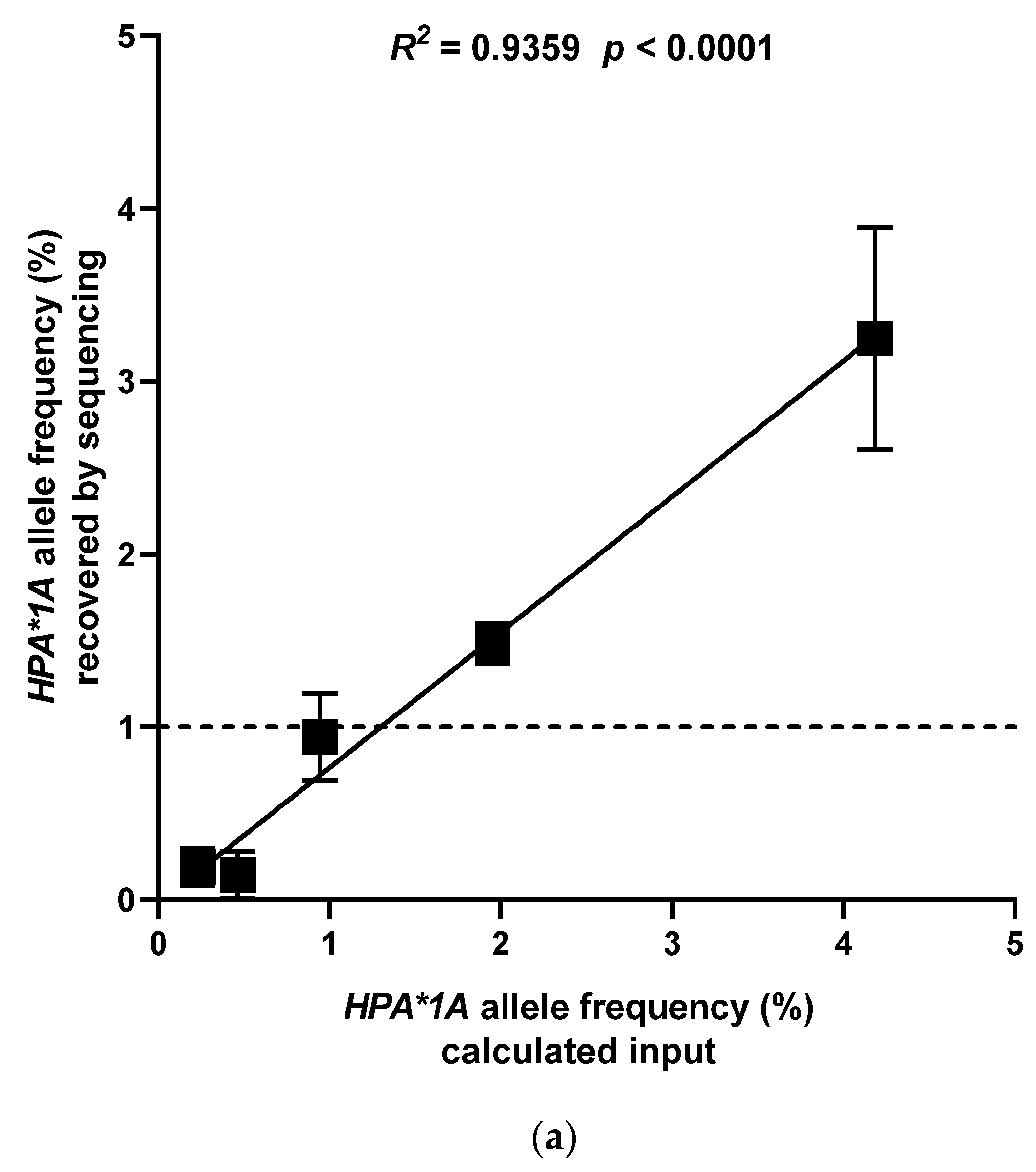
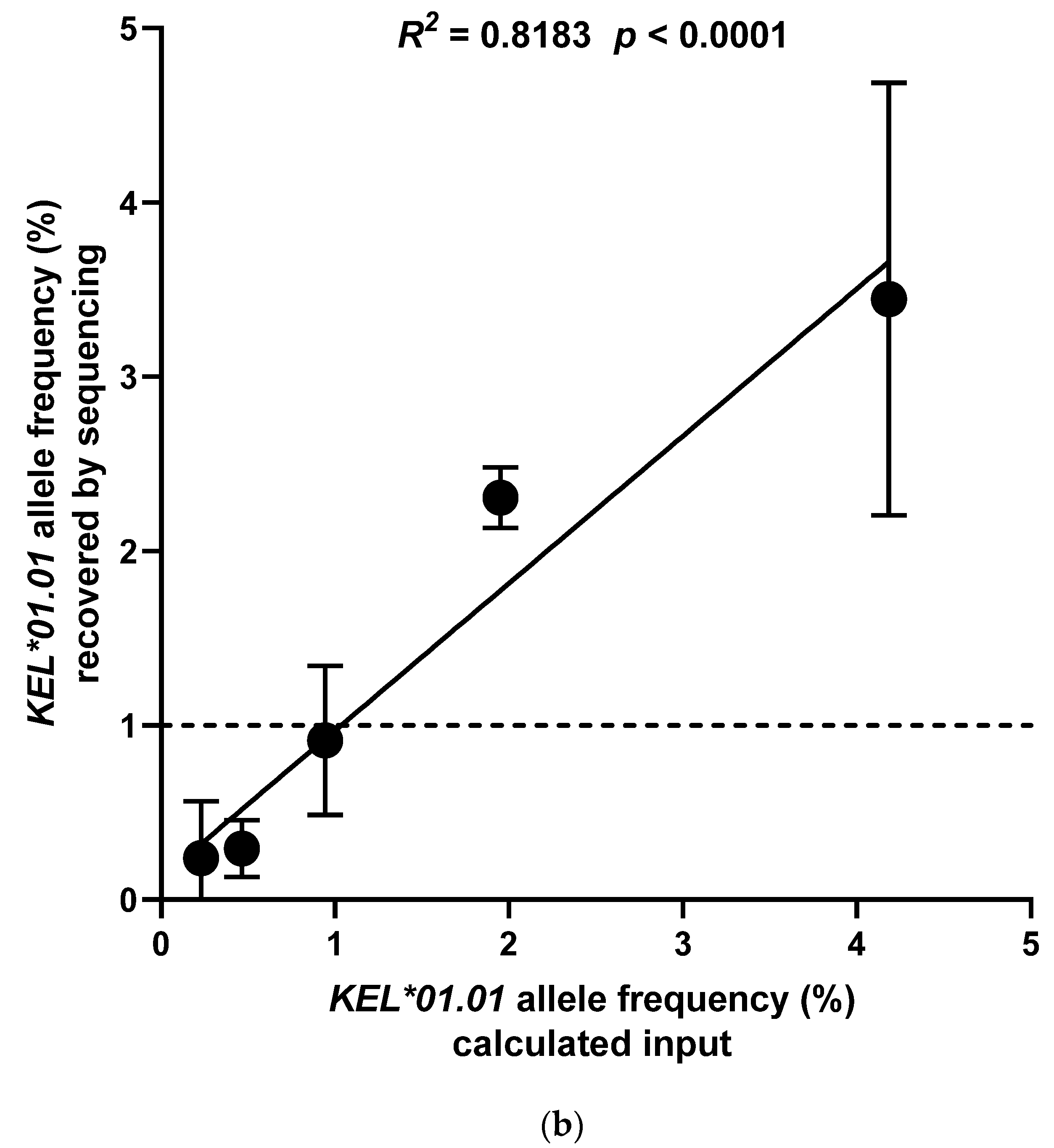
3.1. Range and Linearity
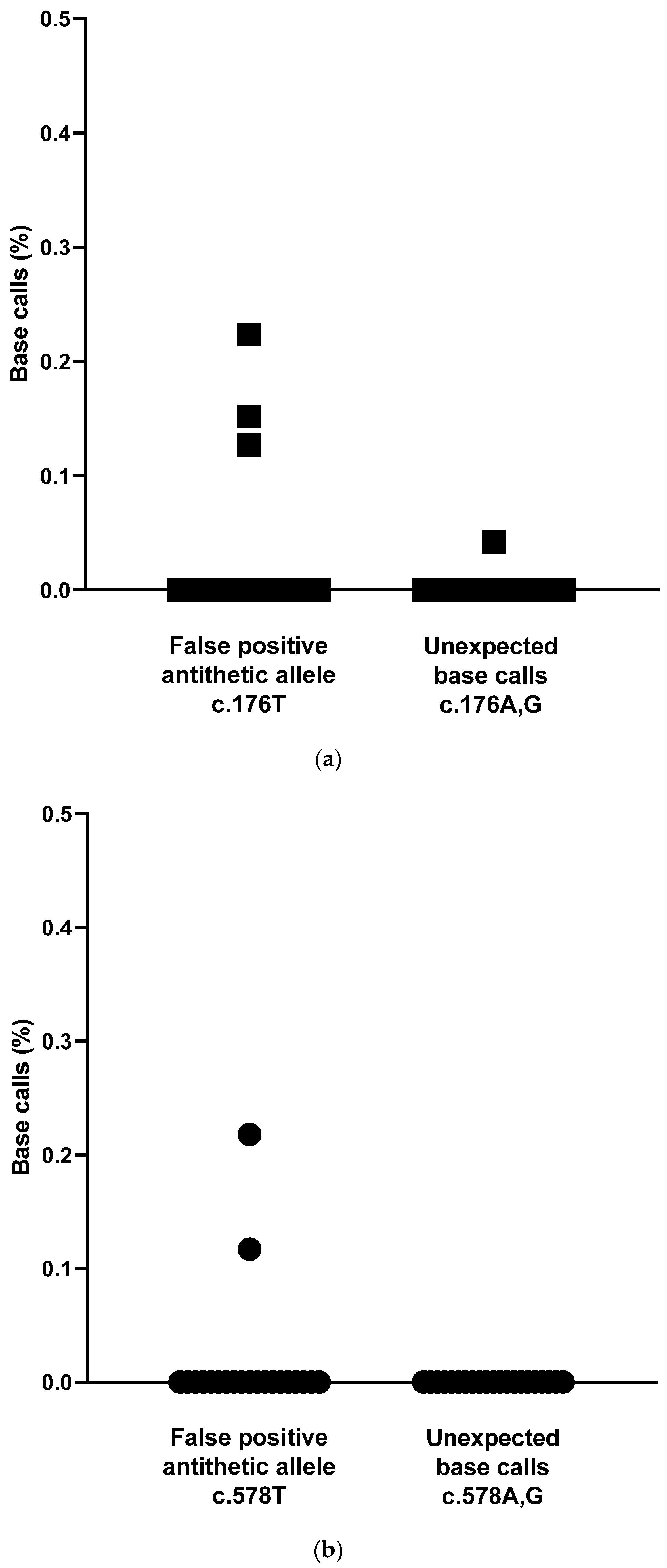
3.2. False-Positive Antithetic Alleles
3.3. Limit of Detection (LOD) and Limit of Quantification (LOQ)
3.4. Baseline Characteristics of NIPT Results in Diagnostic Samples
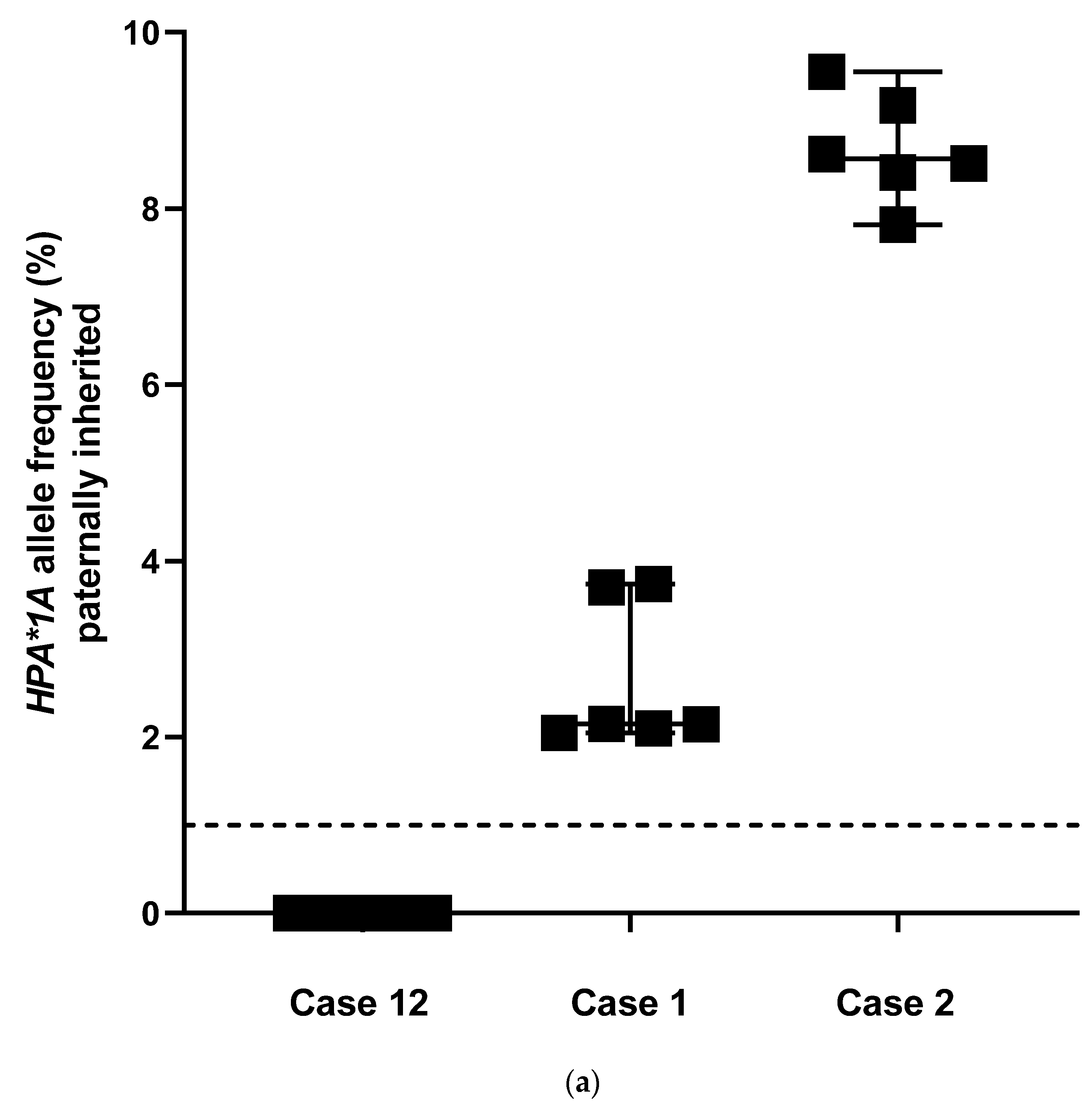
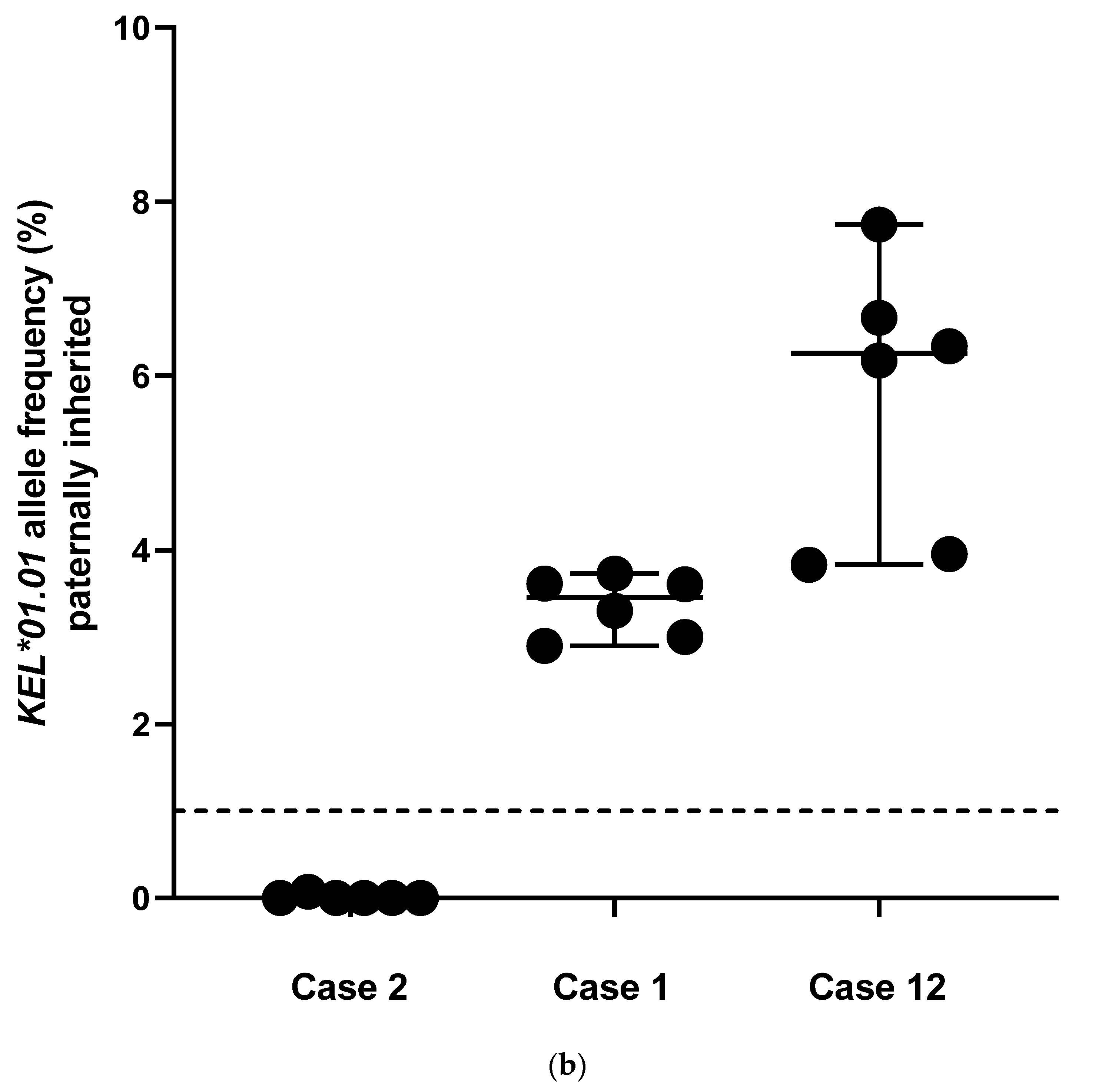
3.5. Detection of Paternally Inherited ITGB3 (HPA-1a) and KEL
3.6. False-Positive Antithetic Allele Frequencies of ITGB3 and KEL
3.7. Inter-Assay Variability
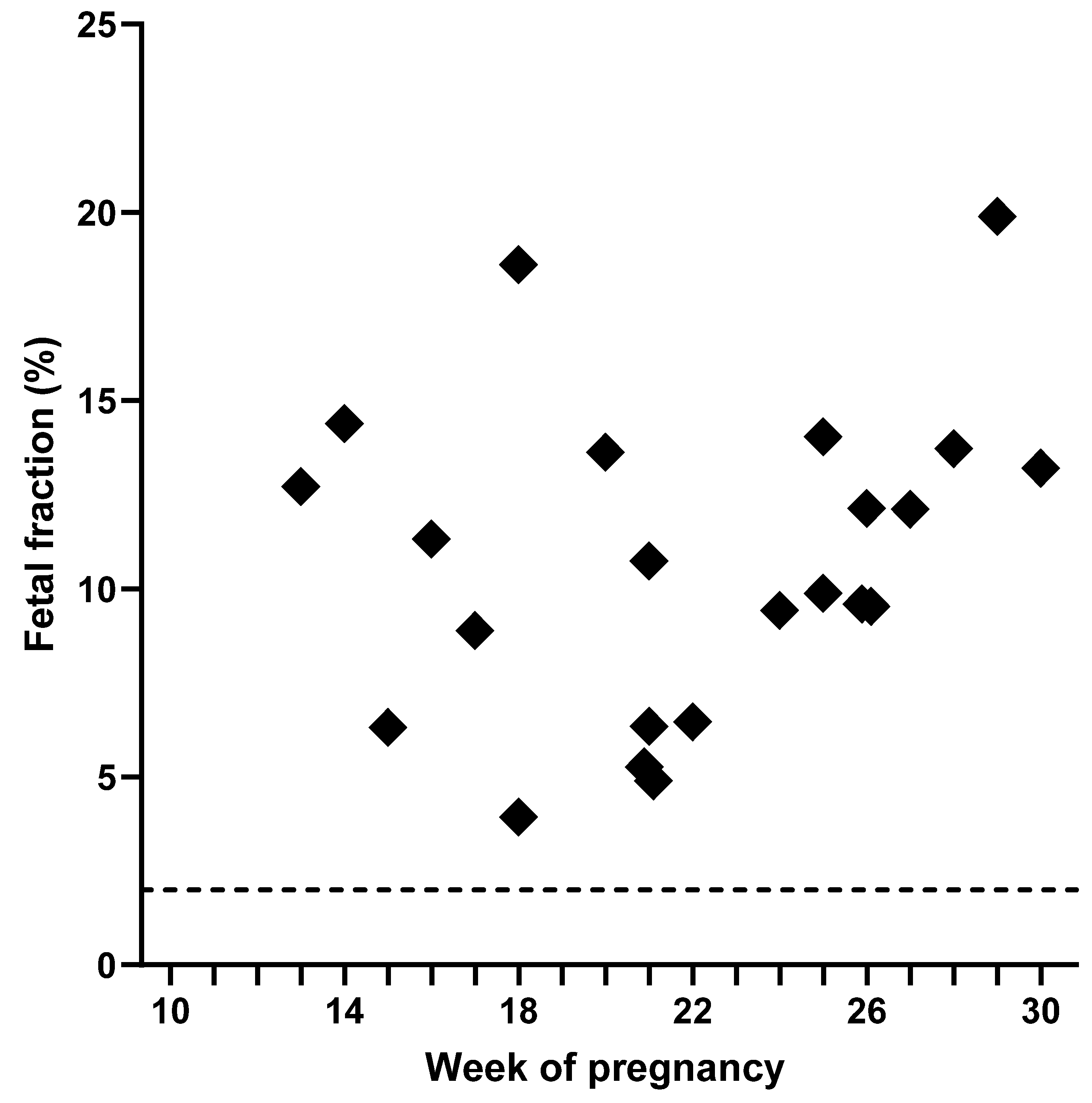
3.8. Quantification of Fetal Fraction Using SNPs
4. Discussion
5. Conclusions
Supplementary Materials
Author Contributions
Funding
Institutional Review Board Statement
Informed Consent Statement
Data Availability Statement
Acknowledgments
Conflicts of Interest
Abbreviations
| AF | Allele frequency |
| Bp | Base pairs |
| ccfDNA | Circulating cell-free DNA |
| cfDNA | Cell-free Deoxyribonucleic Acid |
| cffDNA | Cell-free fetal Deoxyribonucleic Acid |
| ddPCR | droplet digital PCR |
| HDFN | Hemolytic disease of the fetus and newborn |
| FNAIT | Fetal and neonatal alloimmune thrombocytopenia |
| FPATA | False-positive antithetic allele |
| GA | Gestational age |
| LOD | Limit of detection |
| LOQ | Limit of quantification |
| NGS | Next-Generation Sequencing |
| NIPD | Non-invasive prenatal diagnostic |
| NIPDT | Non-invasive prenatal diagnostic test |
| PGM | Personal Genome Machine |
| PLT | Platelet |
| RBC | Red Blood Cell |
| RT-PCR | Reverse Transcription PCR |
| SNP | Single-Nucleotide Polymorphism |
| UEBC | Unexpected base calls |
References
- Lakkaraja, M.; Jin, J.C.; Manotas, K.C.; Vinograd, C.A.; Ferd, P.; Gabor, J.; Wissert, M.; Berkowitz, R.L.; McFarland, J.G.; Bussel, J.B. Blood group A mothers are more likely to develop anemia during antenatal intravenous immunoglobulin treatment of fetal and neonatal alloimmune thrombocytopenia. Transfusion 2016, 56, 2449–2454. [Google Scholar] [CrossRef]
- Winkelhorst, D.; Murphy, M.F.; Greinacher, A.; Shehata, N.; Bakchoul, T.; Massey, E.; Baker, J.; Lieberman, L.; Tanael, S.; Hume, H.; et al. Antenatal management in fetal and neonatal alloimmune thrombocytopenia: A systematic review. Blood 2017, 129, 1538–1547. [Google Scholar] [CrossRef] [PubMed]
- Mustafa, H.J.; Najjariasl, P.; Aghajani, F.; Sambatur, E.V.; Khalil, A.; Moise, K.J.; Shamshirsaz, A.A. Diagnostic accuracy of cell-free DNA for the determination of fetal red blood cell antigen genotype: A systematic review and meta-analysis. Am. J. Obstet. Gynecol. 2025, in press. [CrossRef] [PubMed]
- Kamphuis, M.M.; Tiller, H.; Akker, E.v.D.; Westgren, M.; Tiblad, E.; Oepkes, D. Fetal and Neonatal Alloimmune Thrombocytopenia: Management and Outcome of a Large International Retrospective Cohort. Fetal Diagn. Ther. 2017, 41, 251–257. [Google Scholar] [CrossRef] [PubMed]
- de Haas, M.; Thurik, F.F.; Koelewijn, J.; van der Schoot, C. Haemolytic disease of the fetus and newborn. Vox Sang. 2015, 109, 99–113. [Google Scholar] [CrossRef]
- Clausen, F.B.; Hellberg, Å.; Bein, G.; Bugert, P.; Schwartz, D.; Drnovsek, T.D.; Finning, K.; Guz, K.; Haimila, K.; Henny, C.; et al. Recommendation for validation and quality assurance of non-invasive prenatal testing for foetal blood groups and implications for IVD risk classification according to EU regulations. Vox Sang. 2022, 117, 157–165. [Google Scholar] [CrossRef]
- Rieneck, K.; Bak, M.; Jønson, L.; Clausen, F.B.; Krog, G.R.; Tommerup, N.; Nielsen, L.K.; Hedegaard, M.; Dziegiel, M.H. Next-generation sequencing: Proof of concept for antenatal prediction of the fetal Kell blood group phenotype from cell-free fetal DNA in maternal plasma. Transfusion 2013, 11 (Suppl. 2), 2892–2898. [Google Scholar] [CrossRef]
- Wienzek-Lischka, S.; Krautwurst, A.; Fröhner, V.; Hackstein, H.; Gattenlöhner, S.; Bräuninger, A.; Axt-Fliedner, R.; Degenhardt, J.; Deisting, C.; Santoso, S.; et al. Noninvasive fetal genotyping of human platelet antigen-1a using targeted massively parallel sequencing. Transfusion 2015, 6 Pt 2, 1538–1544. [Google Scholar] [CrossRef]
- Orzińska, A.; Guz, K.; Dębska, M.; Uhrynowska, M.; Celewicz, Z.; Wielgoś, M.; Brojer, E. 14 Years of Polish Experience in Non-Invasive Prenatal Blood Group Diagnosis. Transfus. Med. Hemother. 2015, 42, 361–364. [Google Scholar] [CrossRef]
- Orzińska, A.; Guz, K.; Mikula, M.; Kluska, A.; Balabas, A.; Ostrowski, J.; Uhrynowska, M.; Kopeć, I.; Dębska, M.; Luterek, K.; et al. Prediction of fetal blood group and platelet antigens from maternal plasma using next-generation sequencing. Transfusion 2019, 59, 1102–1107. [Google Scholar] [CrossRef]
- Orzińska, A.; Kluska, A.; Balabas, A.; Piatkowska, M.; Kulecka, M.; Ostrowski, J.; Mikula, M.; Dębska, M.; Uhrynowska, M.; Guz, K. Prediction of fetal blood group antigens from maternal plasma using Ion AmpliSeq HD technology. Transfusion 2022, 62, 458–468. [Google Scholar] [CrossRef] [PubMed]
- McGowan, E.C.; O’BRien, H.; Sarri, M.E.; Lopez, G.H.; Daly, J.J.; Flower, R.L.; Gardener, G.J.; Hyland, C.A. Feasibility for non-invasive prenatal fetal blood group and platelet genotyping by massively parallel sequencing: A single test system for multiple atypical red cell, platelet and quality control markers. Br. J. Haematol. 2024, 204, 694–705. [Google Scholar] [CrossRef]
- Emahazion, T.; Badri, A.; Jalkesten, E.; Flodström, M.; Ajne, G.; Uzunel, M.; Wikman, A. Next-generation sequencing-based approach for fetal DNA quantification and blood antigen detection in alloimmunized pregnancies. Am. J. Obstet. Gynecol. MFM 2025, 7, 101694. [Google Scholar] [CrossRef]
- Oever, R.M.v.’; Verweij, E.J.T.; de Haas, M. How I use noninvasive prenatal testing for red blood cell and platelet antigens. Blood 2025, 145, 2266–2274. [Google Scholar] [CrossRef]
- Qiao, L.; Zhang, Q.; Liang, Y.; Gao, A.; Ding, Y.; Zhao, N.; Zhang, W.; Li, H.; Lu, Y.; Wang, T. Sequencing of short cfDNA fragments in NIPT improves fetal fraction with higher maternal BMI and early gestational age. Am. J. Transl. Res. 2019, 11, 4450–4459. [Google Scholar]
- Salk, J.J.; Schmitt, M.W.; Loeb, L.A. Enhancing the accuracy of next-generation sequencing for detecting rare and subclonal mutations. Nat. Rev. Genet. 2018, 19, 269–285. [Google Scholar] [CrossRef]
- Pakstis, A.J.; Speed, W.C.; Fang, R.; Hyland, F.C.L.; Furtado, M.R.; Kidd, J.R.; Kidd, K.K. SNPs for a universal individual identification panel. Hum. Genet. 2010, 127, 315–324. [Google Scholar] [CrossRef] [PubMed]
- Lo, Y.M.D.; Chan, K.C.A.; Sun, H.; Chen, E.Z.; Jiang, P.; Lun, F.M.F.; Zheng, Y.W.; Leung, T.Y.; Lau, T.K.; Cantor, C.R.; et al. Maternal plasma DNA sequencing reveals the genome-wide genetic and mutational profile of the fetus. Sci. Transl. Med. 2010, 2, 61ra91. [Google Scholar] [CrossRef]
- Hui, L.; Bianchi, D.W. Fetal fraction and noninvasive prenatal testing: What clinicians need to know. Prenat. Diagn. 2020, 40, 155–163. [Google Scholar] [CrossRef] [PubMed]
- Rieneck, K.; Clausen, F.B.; Bergholt, T.; Nørgaard, L.N.; Dziegiel, M.H. Non-Invasive Fetal K Status Prediction: 7 Years of Experience. Transfus. Med. Hemother. 2022, 49, 240–249. [Google Scholar] [CrossRef]
- Alford, B.; Landry, B.P.; Hou, S.; Bower, X.; Bueno, A.M.; Chen, D.; Husic, B.; Cantonwine, D.E.; McElrath, T.F.; Carozza, J.A.; et al. Validation of a non-invasive prenatal test for fetal RhD, C, c, E, K and Fya antigens. Sci. Rep. 2023, 13, 12786. [Google Scholar] [CrossRef] [PubMed]



| False-Positive Antithetic Allele Frequency of Negative Controls | HPA*1A (rs5918, c.176T>C) % T | KEL*01.01 (rs8176058, c.578C>T) % T | Unexpected Base Calls of Negative Controls | HPA*1A (rs5918, c.176T>C) % A,G | KEL*01.01 (rs8176058, c.578C>T) % A,G |
|---|---|---|---|---|---|
| Mean | 0.0239 | 0.0159 | Mean | 0.0020 | 0.0000 |
| Standard deviation | 0.0606 | 0.0516 | Standard deviation | 0.0090 | 0.0000 |
| 3× Standard deviation | 0.1818 | 0.1547 | |||
| Limit of detection (Mean + 3SD) | 0.2057 | 0.1706 | |||
| 10× Standard deviation | 0.6059 | 0.5155 | |||
| Limit of quantification (Mean + 10SD) | 0.6298 | 0.5314 |
| Case | Week of Pregnancy | Maternal Alloantibody | SNP ID | Fetal Allele Frequency (%) | Total SNP-Based Fetal Fraction (%) | Non-Invasive Prenatal Test Result | Postnatal Confirmatory Result |
|---|---|---|---|---|---|---|---|
| 1 | 15 | HPA-1a | rs5918 | 3.74 | 6.31 | positive | yes |
| 2 | 18 | HPA-1a | rs5918 | 9.51 | 18.61 | positive | yes |
| 3 | 26 | HPA-1a | rs5918 | 5.72 | 9.59 | positive | n.a. |
| 4 | 26 | HPA-1a | rs5918 | 3.24 | 9.53 | positive | yes |
| 5 | 26 | HPA-1a | rs5918 | 4.04 | 12.13 | positive | yes |
| 6 | 20 | HPA-1a | rs5918 | 0.00 | 13.63 | negative | yes |
| 7 | 29 | HPA-1a | rs5918 | 0.16 | 19.89 | negative | n.a. |
| 8 | 18 | HPA-5b | rs1801106 | 1.90 | 3.93 | positive | yes |
| 8 * | 21 | HPA-5b | rs1801106 | 2.10 | 4.89 | positive | yes |
| 9 | 25 | HPA-5b | rs1801106 | 3.84 | 9.88 | positive | yes |
| 10 | 28 | HPA-5b | rs1801106 | 0.08 | 13.72 | negative | n.a. |
| 11 | 24 | K | rs8176058 | 3.15 | 9.43 | positive | yes |
| 12 | 25 | K | rs8176058 | 7.74 | 14.04 | positive | yes |
| 13 | 27 | K | rs8176058 | 5.85 | 12.11 | positive | n.a. |
| 14 | 13 | K | rs8176058 | 0.00 | 12.72 | negative | yes |
| 15 | 14 | K | rs8176058 | 0.00 | 14.39 | negative | yes |
| 15 * | 21 | K | rs8176058 | 0.00 | 6.35 | negative | yes |
| 16 | 21 | K | rs8176058 | 0.00 | 5.27 | negative | yes |
| 17 | 16 | Jk(a) | rs1058396 | 6.97 | 11.32 | positive | yes |
| 18 | 17 | Jk(a) | rs1058396 | 2.48 | 8.89 | positive | n.a. |
| 14 # | 13 | Jk(a) | rs1058396 | 0.00 | 12.72 | negative | yes |
| 19 | 22 | E | rs609320 | 2.38 | 6.46 | positive | yes |
| 20 | 30 | E | rs609320 | 0.00 | 13.20 | negative | n.a. |
| 21 | 21 | S | rs7683365 | 0.00 | 10.74 | negative | yes |
Disclaimer/Publisher’s Note: The statements, opinions and data contained in all publications are solely those of the individual author(s) and contributor(s) and not of MDPI and/or the editor(s). MDPI and/or the editor(s) disclaim responsibility for any injury to people or property resulting from any ideas, methods, instructions or products referred to in the content. |
© 2025 by the authors. Licensee MDPI, Basel, Switzerland. This article is an open access article distributed under the terms and conditions of the Creative Commons Attribution (CC BY) license (https://creativecommons.org/licenses/by/4.0/).
Share and Cite
Wienzek-Lischka, S.; Soelter, M.; Froelich, A.; Ernst-Schlegel, M.; Gattenloehner, S.; Braeuninger, A.; Sachs, U.J. A Validation Approach for Determining Fetal Blood Groups Non-Invasively by High-Sensitive Next-Generation Sequencing. J. Clin. Med. 2025, 14, 6812. https://doi.org/10.3390/jcm14196812
Wienzek-Lischka S, Soelter M, Froelich A, Ernst-Schlegel M, Gattenloehner S, Braeuninger A, Sachs UJ. A Validation Approach for Determining Fetal Blood Groups Non-Invasively by High-Sensitive Next-Generation Sequencing. Journal of Clinical Medicine. 2025; 14(19):6812. https://doi.org/10.3390/jcm14196812
Chicago/Turabian StyleWienzek-Lischka, Sandra, Marion Soelter, Annika Froelich, Marion Ernst-Schlegel, Stefan Gattenloehner, Andreas Braeuninger, and Ulrich J. Sachs. 2025. "A Validation Approach for Determining Fetal Blood Groups Non-Invasively by High-Sensitive Next-Generation Sequencing" Journal of Clinical Medicine 14, no. 19: 6812. https://doi.org/10.3390/jcm14196812
APA StyleWienzek-Lischka, S., Soelter, M., Froelich, A., Ernst-Schlegel, M., Gattenloehner, S., Braeuninger, A., & Sachs, U. J. (2025). A Validation Approach for Determining Fetal Blood Groups Non-Invasively by High-Sensitive Next-Generation Sequencing. Journal of Clinical Medicine, 14(19), 6812. https://doi.org/10.3390/jcm14196812