The Use of Social Media in Children and Adolescents: Scoping Review on the Potential Risks
 , , ,
, , ,
Abstract
:1. Introduction
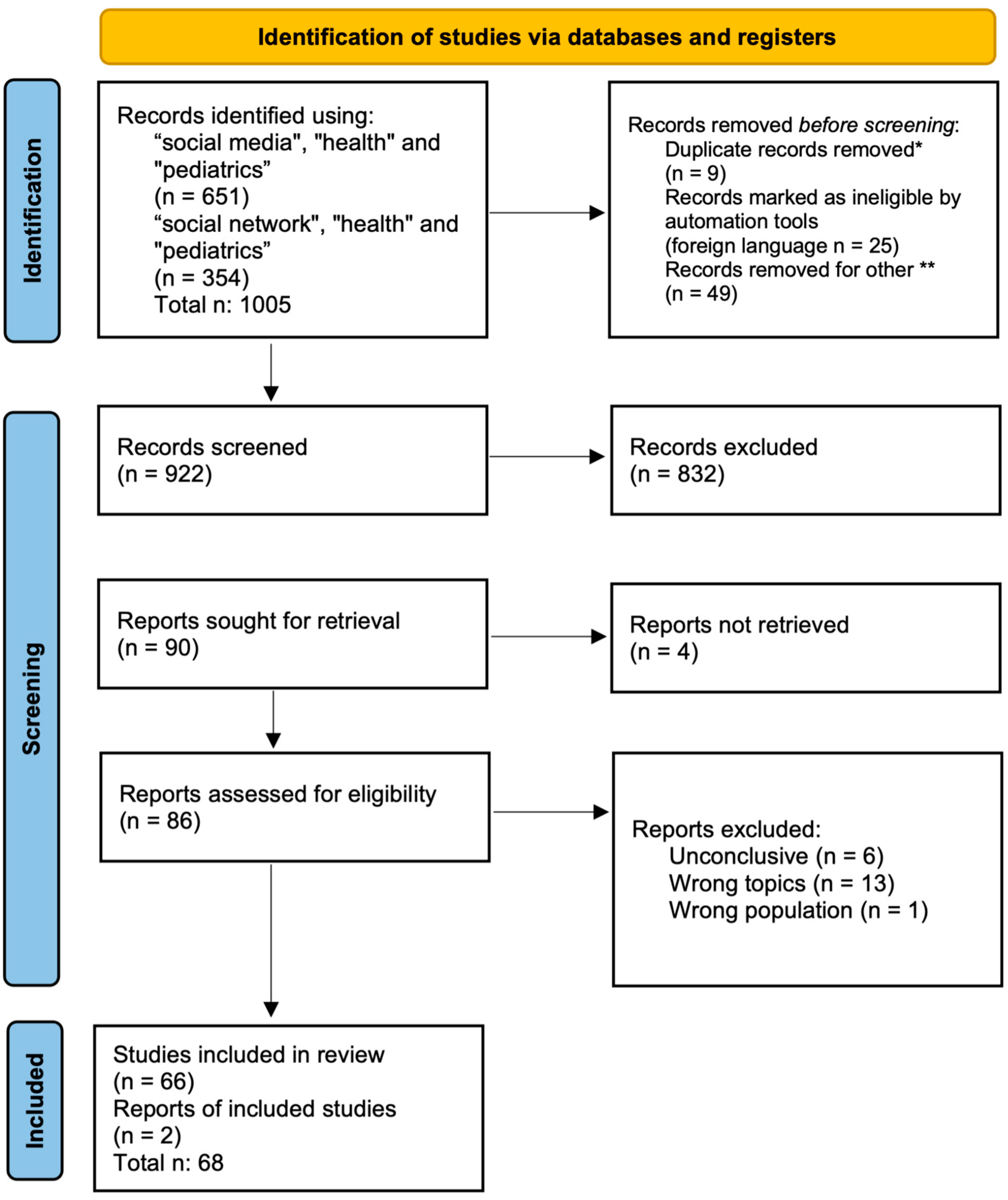
2. Materials and Methods
- -
- Full-length articles or reviews.
- -
- Pertaining to children and adolescents up to 18 years old.
- -
- Negative impact on a pediatric population using social media.
- -
- Social media meant as forms of electronic communication.
- -
- Reports not in English.
- -
- Duplications.
- -
- Not pertinent field of investigation (e.g., use of the social media to promote healthcare, benefits of social media, social media used to debate on health-related issues, and social network meant as real social interactions).
- -
- The population analyzed was adult (>18 years).
- -
- The population had previous pathologies.
3. Results
4. Discussion
4.1. Social Media and Depression
4.1.1. Before COVID-19 Pandemic
4.1.2. After COVID 19 Pandemic
4.2. Social Media and Diet
4.2.1. Before COVID-19 Pandemic
Junk Food Marketing
4.2.2. After COVID-19 Pandemic
4.2.3. Before COVID-19 Pandemic
Obesity
4.2.4. After COVID-19 Pandemic
4.3. Unhealthy Eating Behavior
4.4. Alcohol Marketing
4.5. Social Media and Cyberbullying
4.6. Psychological Problems and Social Media
4.6.1. Before COVID-19 Pandemic
4.6.2. After COVID-19 Pandemic
4.7. Social Media and Sleep
4.8. Social Media and Addiction
4.9. Social Media and Anxiety
4.9.1. Before COVID-19 Pandemic
4.9.2. After COVID-19 Pandemic
4.10. Social Media and Sex Related Problems
4.11. Social Media and Behavioral Problems
4.12. Social Media and Body Image
4.13. Social Media and Physical Activity
4.14. Online Grooming
4.15. Social Media and Sight
4.16. Social Media and Headache
4.17. Social Media and Dental Caries
5. Limitations
6. Conclusions
Author Contributions
Funding
Institutional Review Board Statement
Informed Consent Statement
Data Availability Statement
Conflicts of Interest
References
- Spina, G.; Bozzola, E.; Ferrara, P.; Zamperini, N.; Marino, F.; Caruso, C.; Antilici, L.; Villani, A. Children and Adolescent’s Perception of Media Device Use Consequences. Int. J. Environ. Res. Public Health 2021, 18, 3048. [Google Scholar] [CrossRef] [PubMed]
- Cittadini e ICT. Available online: https://www.istat.it/it/archivio/236920 (accessed on 17 July 2022).
- Censis. Quarto Rapporto Auditel Censis. 19 November 2021. Available online: https://www.censis.it/ (accessed on 19 July 2022).
- Tra-Digitale-e-Cyber-Risk-MOIGE-1.Pdf. Available online: https://www.moige.it/wp-content/uploads/2021/02/Tra-digitale-e-cyber-risk-MOIGE-1.pdf (accessed on 10 July 2022).
- Gonzales, A.; Hancock, J. Mirror, Mirror on My Facebook Wall: Effects of Exposure to Facebook on Self-Esteem. Cyberpsychol. Behav. Soc. Netw. 2010, 14, 79–83. [Google Scholar] [CrossRef]
- Le Heuzey, M.-F. Social media, children and pediatricians. Arch. Pediatr. 2012, 19, 92–95. [Google Scholar] [CrossRef] [PubMed]
- Carr, C.T.; Hayes, R.A. Social Media: Defining, Developing, and Divining. Atl. J. Commun. 2015, 23, 46–65. [Google Scholar] [CrossRef]
- Kudchadkar, S.R.; Carroll, C.L. Using Social Media for Rapid Information Dissemination in a Pandemic: #PedsICU and Coronavirus Disease 2019. Pediatr. Crit. Care Med. 2020, 21, e538–e546. [Google Scholar] [CrossRef] [PubMed]
- Obar, J.A.; Wildman, S.S. Social Media Definition and the Governance Challenge—An Introduction to the Special Issue. Telecommun. Policy 2015, 39, 745–750. [Google Scholar] [CrossRef]
- Most Used Social Media 2021. Statista. Available online: https://www.statista.com/statistics/272014/global-social-networks-ranked-by-number-of-users/ (accessed on 17 July 2022).
- Pietrobelli, A.; Pecoraro, L.; Ferruzzi, A.; Heo, M.; Faith, M.; Zoller, T.; Antoniazzi, F.; Piacentini, G.; Fearnbach, S.N.; Heymsfield, S.B. Effects of COVID-19 Lockdown on Lifestyle Behaviors in Children with Obesity Living in Verona, Italy: A Longitudinal Study. Obesity 2020, 28, 1382–1385. [Google Scholar] [CrossRef]
- Jones, M.E. LibGuides: Creating a PRISMA Flow Diagram: PRISMA. 2020. Available online: https://guides.lib.unc.edu/prisma/step-by-step (accessed on 25 March 2022).
- Ouzzani, M.; Hammady, H.; Fedorowicz, Z.; Elmagarmid, A. Rayyan-a Web and Mobile App for Systematic Reviews. Syst. Rev. 2016, 5, 210. [Google Scholar] [CrossRef]
- Page, M.J.; McKenzie, J.E.; Bossuyt, P.M.; Boutron, I.; Hoffmann, T.C.; Mulrow, C.D.; Shamseer, L.; Tetzlaff, J.M.; Akl, E.A.; Brennan, S.E.; et al. The PRISMA 2020 Statement: An Updated Guideline for Reporting Systematic Reviews. BMJ 2021, 372, n71. [Google Scholar] [CrossRef]
- Chiu, M.; Gatov, E.; Fung, K.; Kurdyak, P.; Guttmann, A. Deconstructing the Rise in Mental Health-Related ED Visits Among Children And Youth in Ontario, Canada. Health Aff. 2020, 39, 1728–1736. [Google Scholar] [CrossRef]
- Rutter, L.A.; Thompson, H.M.; Howard, J.; Riley, T.N.; De Jesús-Romero, R.; Lorenzo-Luaces, L. Social Media Use, Physical Activity, and Internalizing Symptoms in Adolescence: Cross-Sectional Analysis. JMIR Ment. Health 2021, 8, e26134. [Google Scholar] [CrossRef]
- Mougharbel, F.; Goldfield, G.S. Psychological Correlates of Sedentary Screen Time Behaviour among Children and Adolescents: A Narrative Review. Curr. Obes. Rep. 2020, 9, 493–511. [Google Scholar] [CrossRef] [PubMed]
- Hoge, E.; Bickham, D.; Cantor, J. Digital Media, Anxiety, and Depression in Children. Pediatrics 2017, 140 (Suppl. S2), S76–S80. [Google Scholar] [CrossRef] [PubMed]
- Hoare, E.; Werneck, A.O.; Stubbs, B.; Firth, J.; Collins, S.; Corder, K.; van Sluijs, E.M.F. Association of Child and Adolescent Mental Health with Adolescent Health Behaviors in the UK Millennium Cohort. JAMA Netw. Open 2020, 3, e2011381. [Google Scholar] [CrossRef]
- Ma, L.; Evans, B.; Kleppang, A.L.; Hagquist, C. The Association between Screen Time and Reported Depressive Symptoms among Adolescents in Sweden. Fam. Pract. 2021, 38, 773–779. [Google Scholar] [CrossRef] [PubMed]
- Chassiakos, Y.L.R.; Radesky, J.; Christakis, D.; Moreno, M.A.; Cross, C.; Council on Communications and Media. Children and Adolescents and Digital Media. Pediatrics 2016, 138, e20162593. [Google Scholar] [CrossRef]
- Maurer, B.T.; Taylor, L.C. The Effect of Digital Media on Children in Their Formative Years. JAAPA 2020, 33, 46–51. [Google Scholar] [CrossRef]
- Keles, B.; McCrae, N.; Grealish, A. A Systematic Review: The Influence of Social Media on Depression, Anxiety and Psychological Distress in Adolescents. Int. J. Adolesc. Youth 2020, 25, 79–93. [Google Scholar] [CrossRef]
- Khalil, S.A.; Kamal, H.; Elkholy, H. The Prevalence of Problematic Internet Use among a Sample of Egyptian Adolescents and Its Psychiatric Comorbidities. Int. J. Soc. Psychiatry 2022, 68, 294–300. [Google Scholar] [CrossRef]
- Richards, D.; Caldwell, P.H.Y.; Go, H. Impact of Social Media on the Health of Children and Young People. J. Paediatr. Child Health 2015, 51, 1152–1157. [Google Scholar] [CrossRef]
- Hadjipanayis, A.; Efstathiou, E.; Altorjai, P.; Stiris, T.; Valiulis, A.; Koletzko, B.; Fonseca, H. Social Media and Children: What Is the Paediatrician’s Role? Eur. J. Pediatr. 2019, 178, 1605–1612. [Google Scholar] [CrossRef] [PubMed]
- Hamm, M.P.; Newton, A.S.; Chisholm, A.; Shulhan, J.; Milne, A.; Sundar, P.; Ennis, H.; Scott, S.D.; Hartling, L. Prevalence and Effect of Cyberbullying on Children and Young People: A Scoping Review of Social Media Studies. JAMA Pediatr. 2015, 169, 770–777. [Google Scholar] [CrossRef]
- Carpenter, L.M.; Hubbard, G.B. Cyberbullying: Implications for the Psychiatric Nurse Practitioner. J. Child Adolesc. Psychiatr. Nurs. 2014, 27, 142–148. [Google Scholar] [CrossRef]
- Aboujaoude, E.; Savage, M.W.; Starcevic, V.; Salame, W.O. Cyberbullying: Review of an Old Problem Gone Viral. J. Adolesc. Health 2015, 57, 10–18. [Google Scholar] [CrossRef] [PubMed]
- Listernick, Z.I.; Badawy, S.M. Mental Health Implications of the COVID-19 Pandemic Among Children and Adolescents: What Do We Know so Far? Pediatr. Health Med. Ther. 2021, 12, 543–549. [Google Scholar] [CrossRef] [PubMed]
- Armitage, R.C. Social Media Usage in Children: An Urgent Public Health Problem. Public Health 2021, 200, e2–e3. [Google Scholar] [CrossRef] [PubMed]
- Caffo, E.; Asta, L.; Scandroglio, F. Predictors of Mental Health Worsening among Children and Adolescents during the Coronavirus Disease 2019 Pandemic. Curr. Opin. Psychiatry 2021, 34, 624–630. [Google Scholar] [CrossRef] [PubMed]
- Chen, I.-H.; Chen, C.-Y.; Pakpour, A.H.; Griffiths, M.D.; Lin, C.-Y.; Li, X.-D.; Tsang, H.W.H. Problematic Internet-Related Behaviors Mediate the Associations between Levels of Internet Engagement and Distress among Schoolchildren during COVID-19 Lockdown: A Longitudinal Structural Equation Modeling Study. J. Behav. Addict. 2021, 10, 135–148. [Google Scholar] [CrossRef]
- Théodore, F.L.; López-Santiago, M.; Cruz-Casarrubias, C.; Mendoza-Pablo, P.A.; Barquera, S.; Tolentino-Mayo, L. Digital Marketing of Products with Poor Nutritional Quality: A Major Threat for Children and Adolescents. Public Health 2021, 198, 263–269. [Google Scholar] [CrossRef]
- Radesky, J.; Chassiakos, Y.L.R.; Ameenuddin, N.; Navsaria, D.; Council on Communication and Media. Digital Advertising to Children. Pediatrics 2020, 146, e20201681. [Google Scholar] [CrossRef]
- Folkvord, F.; Naderer, B.; Coates, A.; Boyland, E. Promoting Fruit and Vegetable Consumption for Childhood Obesity Prevention. Nutrients 2021, 14, 157. [Google Scholar] [CrossRef] [PubMed]
- Sacks, G.; Looi, E.S.Y. The Advertising Policies of Major Social Media Platforms Overlook the Imperative to Restrict the Exposure of Children and Adolescents to the Promotion of Unhealthy Foods and Beverages. Int. J. Environ. Res. Public Health 2020, 17, 4172. [Google Scholar] [CrossRef] [PubMed]
- Tan, L.; Ng, S.H.; Omar, A.; Karupaiah, T. What’s on YouTube? A Case Study on Food and Beverage Advertising in Videos Targeted at Children on Social Media. Child Obes. 2018, 14, 280–290. [Google Scholar] [CrossRef]
- Murphy, G.; Corcoran, C.; Tatlow-Golden, M.; Boyland, E.; Rooney, B. See, Like, Share, Remember: Adolescents’ Responses to Unhealthy-, Healthy- and Non-Food Advertising in Social Media. Int. J. Environ. Res. Public Health 2020, 17, 2181. [Google Scholar] [CrossRef] [PubMed]
- Lutfeali, S.; Ward, T.; Greene, T.; Arshonsky, J.; Seixas, A.; Dalton, M.; Bragg, M.A. Understanding the Extent of Adolescents’ Willingness to Engage with Food and Beverage Companies’ Instagram Accounts: Experimental Survey Study. JMIR Public Health Surveill. 2020, 6, e20336. [Google Scholar] [CrossRef]
- Khan, M.A.; Smith, J.E.M. “Covibesity,” a New Pandemic. Obes. Med. 2020, 19, 100282. [Google Scholar] [CrossRef] [PubMed]
- Khajeheian, D.; Colabi, A.M.; Ahmad Kharman Shah, N.B.; Bt Wan Mohamed Radzi, C.W.J.; Jenatabadi, H.S. Effect of Social Media on Child Obesity: Application of Structural Equation Modeling with the Taguchi Method. Int. J. Environ. Res. Public Health 2018, 15, 1343. [Google Scholar] [CrossRef] [PubMed]
- Mazur, A.; Caroli, M.; Radziewicz-Winnicki, I.; Nowicka, P.; Weghuber, D.; Neubauer, D.; Dembiński, Ł.; Crawley, F.P.; White, M.; Hadjipanayis, A. Reviewing and Addressing the Link between Mass Media and the Increase in Obesity among European Children: The European Academy of Paediatrics (EAP) and The European Childhood Obesity Group (ECOG) Consensus Statement. Acta Paediatr. 2018, 107, 568–576. [Google Scholar] [CrossRef]
- Custers, K. The Urgent Matter of Online Pro-Eating Disorder Content and Children: Clinical Practice. Eur. J. Pediatr. 2015, 174, 429–433. [Google Scholar] [CrossRef] [PubMed]
- Borzekowski, D.L.G. Constancy (the New Media “C”) and Future Generations. Health Educ. Behav. 2019, 46 (Suppl. S2), S20–S29. [Google Scholar] [CrossRef] [PubMed]
- Moorman, E.L.; Warnick, J.L.; Acharya, R.; Janicke, D.M. The Use of Internet Sources for Nutritional Information Is Linked to Weight Perception and Disordered Eating in Young Adolescents. Appetite 2020, 154, 104782. [Google Scholar] [CrossRef] [PubMed]
- Purves, R.I.; Stead, M.; Eadie, D. “I Wouldn’t Be Friends with Someone If They Were Liking Too Much Rubbish”: A Qualitative Study of Alcohol Brands, Youth Identity and Social Media. Int. J. Environ. Res. Public Health 2018, 15, 349. [Google Scholar] [CrossRef] [PubMed]
- Wise, J. Social Media: End Self Regulation, Say MPs in Report on Children’s Health. BMJ 2019, 364, l486. [Google Scholar] [CrossRef] [PubMed]
- Bozzola, E.; Spina, G.; Ruggiero, M.; Vecchio, D.; Caruso, C.; Bozzola, M.; Staiano, A.M.; Agostiniani, R.; Del Vecchio, A.; Banderali, G.; et al. Media Use during Adolescence: The Recommendations of the Italian Pediatric Society. Ital. J. Pediatr. 2019, 45, 149. [Google Scholar] [CrossRef]
- Shah, J.; Das, P.; Muthiah, N.; Milanaik, R. New Age Technology and Social Media: Adolescent Psychosocial Implications and the Need for Protective Measures. Curr. Opin. Pediatr. 2019, 31, 148–156. [Google Scholar] [CrossRef]
- O’Keeffe, G.S. Overview: New Media. Pediatr. Clin. N. Am. 2012, 59, 589–600. [Google Scholar] [CrossRef]
- Nagata, J.M. New Findings from the Health Behaviour in School-Aged Children (HBSC) Survey: Social Media, Social Determinants, and Mental Health. J. Adolesc. Health 2020, 66, S1–S2. [Google Scholar] [CrossRef]
- Marengo, N.; Borraccino, A.; Charrier, L.; Berchialla, P.; Dalmasso, P.; Caputo, M.; Lemma, P. Cyberbullying and Problematic Social Media Use: An Insight into the Positive Role of Social Support in Adolescents-Data from the Health Behaviour in School-Aged Children Study in Italy. Public Health 2021, 199, 46–50. [Google Scholar] [CrossRef]
- Uludasdemir, D.; Kucuk, S. Cyber Bullying Experiences of Adolescents and Parental Awareness: Turkish Example. J. Pediatr. Nurs. 2019, 44, e84–e90. [Google Scholar] [CrossRef]
- Favotto, L.; Michaelson, V.; Pickett, W.; Davison, C. The Role of Family and Computer-Mediated Communication in Adolescent Loneliness. PLoS ONE 2019, 14, e0214617. [Google Scholar] [CrossRef]
- Boer, M.; van den Eijnden, R.J.J.M.; Boniel-Nissim, M.; Wong, S.-L.; Inchley, J.C.; Badura, P.; Craig, W.M.; Gobina, I.; Kleszczewska, D.; Klanšček, H.J.; et al. Adolescents’ Intense and Problematic Social Media Use and Their Well-Being in 29 Countries. J. Adolesc. Health 2020, 66, S89–S99. [Google Scholar] [CrossRef] [PubMed]
- Buda, G.; Lukoševičiūtė, J.; Šalčiūnaitė, L.; Šmigelskas, K. Possible Effects of Social Media Use on Adolescent Health Behaviors and Perceptions. Psychol. Rep. 2021, 124, 1031–1048. [Google Scholar] [CrossRef] [PubMed]
- McDool, E.; Powell, P.; Roberts, J.; Taylor, K. The Internet and Children’s Psychological Wellbeing. J. Health Econ. 2020, 69, 102274. [Google Scholar] [CrossRef] [PubMed]
- Twigg, L.; Duncan, C.; Weich, S. Is Social Media Use Associated with Children’s Well-Being? Results from the UK Household Longitudinal Study. J. Adolesc. 2020, 80, 73–83. [Google Scholar] [CrossRef]
- Walsh, S.D.; Sela, T.; De Looze, M.; Craig, W.; Cosma, A.; Harel-Fisch, Y.; Boniel-Nissim, M.; Malinowska-Cieślik, M.; Vieno, A.; Molcho, M.; et al. Clusters of Contemporary Risk and Their Relationship to Mental Well-Being among 15-Year-Old Adolescents across 37 Countries. J. Adolesc. Health 2020, 66, S40–S49. [Google Scholar] [CrossRef]
- Sümen, A.; Evgin, D. Social Media Addiction in High School Students: A Cross-Sectional Study Examining Its Relationship with Sleep Quality and Psychological Problems. Child Indic. Res. 2021, 14, 2265–2283. [Google Scholar] [CrossRef] [PubMed]
- Marino, C.; Lenzi, M.; Canale, N.; Pierannunzio, D.; Dalmasso, P.; Borraccino, A.; Cappello, N.; Lemma, P.; Vieno, A.; The 2018 HBSC-Italia Group. Problematic Social Media Use: Associations with Health Complaints among Adolescents. Ann. Ist. Super. Sanita 2020, 56, 514–521. [Google Scholar] [CrossRef] [PubMed]
- Varghese, N.E.; Santoro, E.; Lugo, A.; Madrid-Valero, J.J.; Ghislandi, S.; Torbica, A.; Gallus, S. The Role of Technology and Social Media Use in Sleep-Onset Difficulties among Italian Adolescents: Cross-Sectional Study. J. Med. Internet Res. 2021, 23, e20319. [Google Scholar] [CrossRef] [PubMed]
- Guerrero, M.D.; Barnes, J.D.; Chaput, J.-P.; Tremblay, M.S. Screen Time and Problem Behaviors in Children: Exploring the Mediating Role of Sleep Duration. Int. J. Behav. Nutr. Phys. Act. 2019, 16, 105. [Google Scholar] [CrossRef] [PubMed]
- Lund, L.; Sølvhøj, I.N.; Danielsen, D.; Andersen, S. Electronic Media Use and Sleep in Children and Adolescents in Western Countries: A Systematic Review. BMC Public Health 2021, 21, 1598. [Google Scholar] [CrossRef]
- Hawi, N.S.; Samaha, M.; Griffiths, M.D. The Digital Addiction Scale for Children: Development and Validation. Cyberpsychol. Behav. Soc. Netw. 2019, 22, 771–778. [Google Scholar] [CrossRef]
- Turhan Gürbüz, P.; Çoban, Ö.G.; Erdoğan, A.; Kopuz, H.Y.; Adanir, A.S.; Önder, A. Evaluation of Internet Gaming Disorder, Social Media Addiction, and Levels of Loneliness in Adolescents and Youth with Substance Use. Subst. Use Misuse 2021, 56, 1874–1879. [Google Scholar] [CrossRef]
- Emond, A.M.; Griffiths, M.D. Gambling in Children and Adolescents. Br. Med. Bull. 2020, 136, 21–29. [Google Scholar] [CrossRef]
- Unger, J.B.; Urman, R.; Cruz, T.B.; Majmundar, A.; Barrington-Trimis, J.; Pentz, M.A.; McConnell, R. Talking about Tobacco on Twitter Is Associated with Tobacco Product Use. Prev. Med. 2018, 114, 54–56. [Google Scholar] [CrossRef]
- Muzaffar, N.; Brito, E.B.; Fogel, J.; Fagan, D.; Kumar, K.; Verma, R. The Association of Adolescent Facebook Behaviours with Symptoms of Social Anxiety, Generalized Anxiety, and Depression. J. Can. Acad. Child Adolesc. Psychiatry 2018, 27, 252–260. [Google Scholar]
- Gazendam, N.; Cleverley, K.; King, N.; Pickett, W.; Phillips, S.P. Individual and Social Determinants of Early Sexual Activity: A Study of Gender-Based Differences Using the 2018 Canadian Health Behaviour in School-Aged Children Study (HBSC). PLoS ONE 2020, 15, e0238515. [Google Scholar] [CrossRef]
- Wana, G.W.; Arulogun, O.; Roberts, A.; Kebede, A.S. Predictors of Risky Sexual Behaviour among Pre-College Students in Adama Town, Ethiopia. Pan. Afr. Med. J. 2019, 33, 135. [Google Scholar] [CrossRef]
- Solecki, S. The Smart Use of Smartphones in Pediatrics. J. Pediatr. Nurs. 2020, 55, 6–9. [Google Scholar] [CrossRef]
- Collins, R.L.; Strasburger, V.C.; Brown, J.D.; Donnerstein, E.; Lenhart, A.; Ward, L.M. Sexual Media and Childhood Well-Being and Health. Pediatrics 2017, 140 (Suppl. S2), S162–S166. [Google Scholar] [CrossRef]
- McNamee, P.; Mendolia, S.; Yerokhin, O. Social Media Use and Emotional and Behavioural Outcomes in Adolescence: Evidence from British Longitudinal Data. Econ. Hum. Biol. 2021, 41, 100992. [Google Scholar] [CrossRef]
- Okada, S.; Doi, S.; Isumi, A.; Fujiwara, T. The Association between Mobile Devices Use and Behavior Problems among Fourth Grade Children in Japan. Psychiatry Clin. Neurosci. 2021, 75, 286–293. [Google Scholar] [CrossRef] [PubMed]
- Tahir, A.; Baig, L.A.; Ahmer, Z. Does Watching Violent Electronic and Social Media Content Lead to Increased Levels of Aggression? A Survey among Adolescents in an Urban Slum of Metropolitan Karachi. Int. J. Adolesc. Med. Health 2020, 20200037. [Google Scholar] [CrossRef] [PubMed]
- Deslandes, S.F.; Coutinho, T.; Ramos de Souza Costa Ferreira, T.; Flach, R.M.D. Online Challenges among Children and Adolescents: Self-Inflicted Harm and Social Media Strategies. Salud. Colect. 2020, 16, e3264. [Google Scholar] [CrossRef] [PubMed]
- Kemp, B.J.; Parrish, A.-M.; Cliff, D.P. “Social Screens” and “the Mainstream”: Longitudinal Competitors of Non-Organized Physical Activity in the Transition from Childhood to Adolescence. Int. J. Behav. Nutr. Phys. Act. 2020, 17, 5. [Google Scholar] [CrossRef] [PubMed]
- Forni, G.; Pietronigro, A.; Tiwana, N.; Gandolfi, C.E.; Del Castillo, G.; Mosillo, M.; Pellai, A. Little Red Riding Hood in the Social Forest. Online Grooming as a Public Health Issue: A Narrative Review. Ann. Ig. 2020, 32, 305–318. [Google Scholar] [CrossRef] [PubMed]
- Çaksen, H. Electronic Screen Exposure and Headache in Children. Ann. Indian Acad. Neurol. 2021, 24, 8–10. [Google Scholar] [CrossRef] [PubMed]
- Almoddahi, D.; Machuca Vargas, C.; Sabbah, W. Association of Dental Caries with Use of Internet and Social Media among 12 and 15-Year-Olds. Acta Odontol. Scand. 2022, 80, 125–130. [Google Scholar] [CrossRef]


| Issue | n | % |
|---|---|---|
| Depression | 19 | 27.9% |
| Diet | 15 | 22.1% |
| Cyberbullying | 15 | 22.1% |
| Psychological Problems | 14 | 20.6% |
| Sleep | 13 | 19.1% |
| Addiction | 10 | 14.7% |
| Anxiety | 10 | 14.7% |
| Sex Related | 9 | 13.2% |
| Behavioral Problems | 7 | 10.3% |
| Body Image | 6 | 8.8% |
| Physical Activity | 5 | 7.4% |
| Online Grooming | 3 | 4.4% |
| Sight | 3 | 4.4% |
| Headache | 3 | 4.4% |
| Dental Caries | 2 | 2.9% |
| Domains | Reference | Type of Publication | Highlighted |
|---|---|---|---|
| Depression Addiction Anxiety | Chiu M. et al. [15] | Clinical study | Social media increased use correlates to Emergency Department visits for mental illness, including depression, addiction, and anxiety. |
| Depression Anxiety | Rutter L.A. et al. [16] | Clinical study | Social media use correlates with depressive symptoms, anxiety, and loneliness. Physical activity negatively correlates with depression. |
| Depression Psychological problems Addiction Anxiety Body image | Mougharbel F. et al. [17] | Review | High levels of screen time and social media use correlates to depression, anxiety, and misperception of body image, addiction, and mental health outcomes. |
| Depression Sleep Anxiety | Hoge E. et al. [18] | Review | The more time adolescents spend on smartphone, the higher levels of depression, insomnia, and anxiety are found one year later. |
| Depression | Hoare E. et al. [19] | Clinical study | Adolescents suffering for depression and mental health impairment in adolescence reported a greater use of social media. |
| Depression | Ha L. et al. [20] | Clinical study | Swedish adolescents who spent more than 2 h on social media had higher odds of feeling depressed. |
| Depression Diet Cyberbullying Sleep Sex related problems Online grooming | Chassiakos Y.L.R. et al. [21] | Review | Risks of media device use include obesity, sleep, attention, and learning impairment, illicit substance use, high-risk sexual behaviors, depression, cyberbullying, and compromised privacy and confidentiality. |
| Depression Cyberbullying Sleep Anxiety Sex related problems Behavioral problems Sight | Maurer B.T. et al. [22] | Review | An increase in digital and social media use relates to physical and mental status impairment in children, including depression, anxiety, cyberbullying, sleep disturbance, behavioral problems, sexting, and myopia. |
| Depression Psychological problems Anxiety | Keles B. et al. [23] | Review | Time spent on social media, repetitive activities, addictive, or problematic use associated with depression, anxiety, and psychological impairment. Nevertheless, it is not possible to establish whether a causative effect exists. |
| Depression Addiction | Khalil S.A. et al. [24] | Clinical Study | A percentage of 65.6% of Egyptians adolescents are having internet addiction, especially Facebook addiction (92.8%) and gaming (61.3%). Those affected by Facebook addiction are at risk of dysthymia. |
| Depression Cyberbullying Body image | Richards D. et al. [25] | Review | Social media overuse impacts on mental health, self-esteem, and wellbeing. |
| Depression Cyberbullying Sleep Sex related problems | Hadjipanayis A. et al. [26] | Review | Social media use facilitates socialization, communication, learning skills, and may positively affect education. Potential risks include cyberbullying, Facebook depression, sleep disturbances, and sexting. |
| Depression Cyberbullying | Hamm M.P. et al. [27] | Review | Cyberbullying and depression correlate with a regular and constant social media use. |
| Depression Cyberbullying | Carpenter L.M. et al. [28] | Review | Internet, mobile devices, and social networking sites link to mental health impairment and cyberbullying. |
| Depression Cyberbullying | Aboujaoude E. et al. [29] | Review | Internet penetrance and connectivity are strictly related to cyberbullying and altered mental status. |
| Depression | Listernick Z.I. et al. [30] | Review | Depressive symptoms increased during COVID-19 pandemic era. Risk factors include social isolation, family stress, and social media overuse. |
| Depression Sleep Anxiety | Armitage R.C. et al. [31] | Letter to editor | The degree of social media usage in children correlates with depression, anxiety, and perceived stress level. Bedtime access to and use of mobile devices is significantly associated with inadequate sleep in terms of quality and quantity. |
| Depression Anxiety | Caffo E. et al. [32] | Review | Many factors including isolation, excessive social media use, and parental stress worsened mental status health during COVID-19 era. |
| Depression Psychological problems Anxiety | Chen I.H. et al. [33] | Review | During school closure in COVID-19 pandemic smartphone and social media use increased. An increase of 15–30 min daily negatively influenced mental health status in children. |
| Domains | Reference | Type of Publication | Highlighted |
|---|---|---|---|
| Depression Diet Cyberbullying Sleep Sex related problems Online grooming | Chassiakos Y.L.R. et al. [21] | Review | Risks of media device use include obesity, sleep, attention, and learning impairment, illicit substance use, high-risk sexual behaviors, depression, cyberbullying, and compromised privacy and confidentiality. |
| Diet | Théodore F.L. et al. [34] | Clinical Study | Digital Marketing represents a major threat for children and adolescents in Mexico, because of its persuasive techniques. |
| Diet Dental Caries | Radesky J. et al. [35] | Clinical Study | Exposure to advertising is associated with unhealthy behaviors. Children are uniquely vulnerable to the persuasive effects of advertising because of immature critical thinking skills and impulse inhibition. Ads also promote intake of foods that contribute to dental caries. |
| Diet | Folkvord F. et al. [36] | Review | Unhealthy food is advertised intensively on several media platforms that are increasingly used by children. This contributes to the obesity epidemic. |
| Diet | Sacks G. et al. [37] | Clinical Study | Exposure to the marketing of unhealthy products, on social media is associated with a higher risk of related unhealthy behaviors. Analysis of the advertising policies of the 16 largest social media platforms proved them ineffective in protecting children and adolescents from exposure to the digital marketing of unhealthy food. |
| Diet | Tan L. et al. [38] | Clinical Study | Unhealthy food marketing to children is a key risk factor for childhood obesity. Analysis of ads encountered in YouTube videos targeted at children revealed that food and beverage ads appeared most frequently with more than half of these promoting noncore or unhealthy foods. |
| Diet | Murphy G. et al. [39] | Clinical Study | Adolescents respond more positively to unhealthy food advertising compared to healthy food or non-food advertising. |
| Diet | Lutfeali S. et al. [40] | Clinical Study | Heavy social media users (>3 h/day) were 6.366 times more willing to comment on ads compared to light users (p < 0.001). |
| Diet | Khan M. et al. [41] | Clinical Study | The food industry has intensified online advertising focused on children during COVID-19 pandemic, helping the widespread of weight gain. |
| Diet | Khajeheian D. et al. [42] | Clinical Study | Students, in primary school and high school, who spend more time using social media, exhibit a greater increase in BMI. |
| Diet Sleep | Mazur A. et al. [43] | Clinical Study | Obesity correlated to junk food advertisement and a more sedentary lifestyle promoted by social media use. Poor or deregulated sleep affects the regulation of energy balance representing a risk factor for childhood obesity. |
| Diet | Custers K. et al. [44] | Review | Raising in the presence of pro-eating disorder content on websites and social media, which correlates of eating disturbances. |
| Diet Cyberbullying Psychological problems Body image Physical activity | Borzekowski D.L.G. et al. [45] | Review | Constant media access and exposure to unhealthy and risky media messages may increase the interactions, facilitating cyberbullying and exacerbating body image apprehension promoting poor nutrition, psychological problems, and leading to a more sedentary lifestyle. |
| Diet Body image | Moorman E.L. et al. [46] | Clinical Study | Greater use the internet sources for nutritional information is related to greater disordered eating. |
| Diet Sleep Online grooming | Purves R.I. et al. [47] | Clinical Study | Alcohol brands on social media portray drinking identities, appealing for young adolescent and with the potential risk to peer group acceptance. |
| Domains | Reference | Type of Publication | Highlighted |
|---|---|---|---|
| Depression Diet Cyberbullying Sleep Sex related problems Online grooming | Chassiakos Y.L.R. et al. [21] | Review | Risks of media device use include obesity, sleep, attention, and learning impairment, illicit substance use, high-risk sexual behaviors, depression, cyberbullying, and compromised privacy and confidentiality. |
| Depression Cyberbullying Sleep Anxiety Sex related problems Behavioral problems Sight | Maurer B.T. et al. [22]. | Review | An increase in digital and social media use relates to physical and mental status impairment in children, including depression, anxiety, cyberbullying, sleep disturbance, behavioral problems, sexting, and myopia. |
| Depression Cyberbullying Body image | Richards D. et al. [25] | Review | Social media overuse impacts on mental health, self-esteem, and wellbeing. |
| Depression Cyberbullying Sleep Sex related problems | Hadjipanayis A. et al. [26] | Review | Social media use facilitates socialization, communication, learning skills, and may positively affect education. Potential risks include cyberbullying, Facebook depression, sleep disturbances, and sexting. |
| Depression Cyberbullying | Hamm M.P. et al. [27] | Review | Cyberbullying and depression correlate with a regular and constant social media use. |
| Depression Cyberbullying | Carpenter L.M. et al. [28] | Review | Internet, mobile devices, and social networking sites link to mental health impairment and cyberbullying. |
| Depression Cyberbullying | Aboujaoude E. et al. [29] | Review | Internet penetrance and connectivity are strictly related to cyberbullying and altered mental status. |
| Diet Cyberbullying Psychological problems Body image Physical activity | Borzekowski D.L.G. et al. [45] | Review | Constant media access and exposure to unhealthy and risky media messages may increase the interactions, facilitating cyberbullying and exacerbating body image apprehension promoting poor nutrition, psychological problems, and leading to a more sedentary lifestyle. |
| Cyberbullying | Wise J. et al. [48] | Letter to Editor | Potential negative effects of social media include damage to sleep patterns, cyberbullying, and online grooming. |
| Cyberbullying Psychological problems Sleep Addiction Behavioral problems Physical activity Sight | Bozzola E. et al. [49] | Review | Cyberbullying, sleep impairment, psychological problems, addiction, musculoskeletal disorders, and eye problems are among the risks of media device use in adolescence. |
| Cyberbullying Sex related problems Body image | Shah J. et al. [50] | Review | Increased social media usage correlates with decreased self-esteem and body satisfaction, increment of cyberbullying, and exposure to pornographic material and risky sexual behaviors. |
| Cyberbullying Addiction Sex related problems | O’Keeffe G.S. et al. [51] | Editorial | Risks of social media overuse include sexting, cyberbullying, privacy issues, and Internet addiction, all of which may present with vague health symptoms. |
| Cyberbullying Psychological problems Addiction | Nagata J.M. et al. [52] | Editorial | More than 7% of adolescents have problematic media use and addiction to social media. Problematic media use is associated with cyberbullying, poor outcomes in life satisfaction, and mental health. |
| Cyberbullying | Marengo N. et al. [53] | Clinical study | The risk of cyber-victimization is higher in case of problematic social media use and in female gender. |
| Cyberbullying | Uludasdemir D. et al. [54] | Clinical study | Having daily access to the Internet and the sharing of gender on social media increased the likelihood of cyber victimization. |
| Domains | Reference | Type of Article | Highlighted |
|---|---|---|---|
| Depression Psychological problems Addiction Anxiety Body image | Mougharbel F. et al. [17] | Review | High levels of screen time and social media use correlates to depression, anxiety, misperception of body image, and mental health outcomes. |
| Depression Psychological problems Anxiety | Keles B. et al. [23] | Review | Time spent on social media, repetitive activities, addictive, or problematic use associated with depression, anxiety, and psychological impairment. Nevertheless, it is not possible to establish whether a causative effect exists. |
| Depression Psychological problems Anxiety | Chen I.H. et al. [33] | Review | During school closure in COVID-19 pandemic smartphone and social media use increased. An increase of 15–30 min daily negatively affected mental health status in children. |
| Diet Cyberbullying Psychological problems Body image Physical activity | Borzekowski D.L.G. et al. [45] | Review | Constant media access and exposure to unhealthy and risky media messages may increase the interactions, facilitating cyberbullying and exacerbating body image apprehension promoting poor nutrition, psychological problems, and leading to a more sedentary lifestyle. |
| Cyberbullying Psychological problems Sleep Addiction Behavioral problems Physical activity Sight | Bozzola E. et al. [49] | Review | Cyberbullying, sleep impairment, psychological problems, addiction, musculoskeletal disorders, and eye problems are among the risks of media device use in adolescence. |
| Cyberbullying Psychological problems Addiction | Nagata J.M. et al. [52] | Editorial | More than 7% of adolescents have problematic media use and addiction to social media. Problematic media use is associated with cyberbullying, poor outcomes in life satisfaction, and mental health. |
| Psychological problems | Favotto L. et al. [55] | Clinical study | Children with low family communication have high levels of media use and loneliness. |
| Psychological problems | Boer M. et al. [56] | Clinical study | Data among 154,981 adolescents of the world, described that problematic media use is associated with lower well-being. |
| Psychological problems Sleep Physical activity | Buda G. et al. [57] | Clinical study | Problematic social media use correlates with about two times higher odds for worse sleep quality and lower life satisfaction, and it is related to lower levels of vigorous physical activity in girls. |
| Psychological problems | Mc Dool E. et al. [58] | Clinical study | Among 6300 English students, internet use is negatively associated with feel about appearance, especially in girls. |
| Psychological problems | Twigg L. et al. [59] | Clinical study | Higher levels of social media use are associated with lower happiness, especially in girls. |
| Psychological problems | Walsh S.D. et al. [60] | Clinical study | Problematic social media use such as substance use, bullying, and low social support, have been identified as clusters of risk for children mental health. |
| Psychological problems Sleep | Sümen A. et al. [61] | Clinical study | Social media addiction in school students is related with lower communication among families, loneliness, emotional problems, attention deficit, peer problems, and it decreases students’ sleep efficiency. |
| Psychological problems Headache | Marino C. et al. [62] | Clinical study | Adolescent problematic Internet users have higher levels of somatic symptoms such as headaches and psychological consequences of social media use such as loss of control and relational problems with family and friends. |
| Domains | Reference | Type of Article | Highlighted |
|---|---|---|---|
| Depression Sleep Anxiety | Hoge E. et al. [18] | Review | The more time adolescents spend on smartphone, the higher levels of depression, insomnia, and anxiety are found one year later. |
| Depression Diet Cyberbullying Sleep Sex related problems Online grooming | Chassiakos Y.L.R. et al. [21] | Review | Risks of media device use include obesity, sleep, attention, and learning impairment, illicit substance use, high-risk sexual behaviors, depression, cyberbullying, and compromised privacy and confidentiality. |
| Depression Cyberbullying Sleep Anxiety Sex related problems Behavioral problems Sight | Maurer B.T. et al. [22]. | Review | An increase in digital and social media use relates to physical and mental status impairment in children, including depression, anxiety, cyberbullying, sleep disturbance, behavioral problems, sexting, and myopia. |
| Depression Cyberbullying Sleep Sex related problems | Hadjipanayis A. et al. [26] | Review | Social media use facilitates socialization, communication, learning skills, and may positively influence education. Potential risks include cyberbullying, Facebook depression, sleep disturbances, and sexting. |
| Depression Sleep Anxiety | Armitage R.C. et al. [31] | Letter | The degree of social media usage in children correlates with depression, anxiety, and perceived stress level. Bedtime access to and use of mobile devices is significantly associated with inadequate sleep in terms of quality and quantity. |
| Diet Sleep | Mazur A. et al. [43] | Clinical study | Obesity correlated to junk food advertisement and a more sedentary lifestyle promoted by social media use. Poor or deregulated sleep affects the regulation of energy balance representing a risk factor for childhood obesity. |
| Diet Sleep Online grooming | Purves R.I. et al. [47] | Letter | Potential negative effects of social media include damage to sleep patterns, cyberbullying, and online grooming. |
| Cyberbullying Psychological problems Sleep Addiction Behavioral problems Physical activity Sight | Bozzola E. et al. [49] | Review | Cyberbullying, sleep impairment, psychological problems, addiction, musculoskeletal disorders, and eye problems are among the risks of media device use in adolescence. |
| Psychological problems Sleep Physical activity | Buda G. et al. [57] | Clinical study | Problematic social media use correlates with about two times higher odds for worse sleep quality and lower life satisfaction, and it is related to lower levels of vigorous physical activity in girls. |
| Psychological problems Sleep | Sümen A. et al. [61] | Clinical study | Social media addiction in school students is related with lower communication among families, loneliness, emotional problems, attention deficit, peer problems, and it decreases students’ sleep efficiency. |
| Sleep | Varghese N.E. et al. [63] | Clinical study | Exposure to media device and social media is significantly associated with adolescent sleep-onset difficulties. |
| Sleep Behavioral problems | Guerrero M.D. et al. [64] | Clinical study | Time spent on screen has been associated to sleeping problems, especially sleep duration, and with problematic behaviors, higher internalizing, and externalizing symptoms. |
| Sleep | Lund L. et al. [65] | Review | Relationship between social media use, late sleep onset, sleep quality, and duration. |
| Domains | Reference | Type of Article | Highlighted |
|---|---|---|---|
| Depression Addiction Anxiety | Chiu M. et al. [15] | Clinical Study | Social media increased use correlates to Emergency Department visits for mental illness, including depression, addiction, and anxiety. |
| Depression Psychological problems Addiction Anxiety Body image | Mougharbel F. et al. [17] | Review | High levels of screen time and social media use correlates to depression, anxiety, and misperception of body image, addiction, and mental health outcomes. |
| Depression Addiction | Khalil S.A. et al. [24]. | Clinical Study | A percentage of 65.6% of Egyptians adolescents are having internet addiction, especially Facebook addiction (92.8%) and gaming (61.3%). Those affected by Facebook addiction are at risk of dysthymia. |
| Cyberbullying Psychological problems Sleep Addiction Behavioral problems Physical activity Sight | Bozzola E. et al. [49] | Review | Cyberbullying, sleep impairment, psychological problems, addiction, musculoskeletal disorders, and eye problems are among the risks of media device use in adolescence. |
| Cyberbullying Addiction Sex related problems | O’Keeffe G.S. et al. [51] | Editorial | Risks of social media overuse include sexting, cyberbullying, privacy issues, and Internet addiction, all of which may present with vague health symptoms. |
| Cyberbullying Psychological problems Addiction | Nagata J.M. et al. [52] | Editorial | More than 7% of adolescents have problematic media use and addiction to social media. Problematic media use is associated with cyberbullying, poor outcomes in life satisfaction, and mental health. |
| Addiction | Hawi N.S. et al. [66] | Clinical Study | The Digital Addiction Scale for Children was validated on 822 participants, to assess the behavior of children 9 to 12 years old in association with video gaming, social media, and texting. Females are more susceptible to social media addiction. |
| Addiction | Turhan P. et al. [67] | Clinical Study | Among a group of 93 adolescents with substance abuse, social media addiction and gaming disorders have been documented more than control group. |
| Addiction | Emond A.M. et al. [68] | Review | Gambling and gaming addiction are emerging problems in children and adolescents. Children are exposed to gambling adverts using media device and television. Moreover, social media sometimes promotes gambling. |
| Addiction | Unger J.B. et al. [69] | Clinical Study | Tobacco use in adolescents correlates to tobacco content on social media. In particular, adolescents with more tobacco tweets were more likely to use cigarettes. Advertising messages about tobacco shared trough social media have been connected to tobacco use in adolescents. |
| Domains | Reference | Type of Publication | Highlighted |
|---|---|---|---|
| Depression Addiction Anxiety | Chiu M. et al. [15] | Clinical Study | Social media increased use correlates to Emergency Department visits for mental illness, including depression, addiction, and anxiety. |
| Depression Anxiety | Rutter L.A. et al. [16] | Clinical Study | Social media use correlates with depressive symptoms, anxiety, and loneliness. Physical activity negatively correlates with depression. |
| Depression Psychological problems Addiction Anxiety Body image | Mougharbel F. et al. [17] | Review | High levels of screen time and social media use correlates to depression, anxiety, and misperception of body image, addiction, and mental health outcomes. |
| Depression Sleep Anxiety | Hoge E. et al. [18] | Review | The more time adolescents spend on smartphone, the higher levels of depression, insomnia, and anxiety are found one year later. |
| Depression Cyberbullying Sleep Anxiety Sex related problems Behavioral problems Sight | Maurer B.T. et al. [22] | Review | An increase in digital and social media use relates to physical and mental status impairment in children, including depression, anxiety, cyberbullying, sleep disturbance, behavioral problems, sexting, and myopia. |
| Depression Psychological problems Anxiety | Keles B. et al. [23] | Review | Time spent on social media, repetitive activities, addictive or problematic use associated with depression, anxiety, and psychological impairment. Nevertheless, it is not possible to establish whether a causative effect exists. |
| Depression Sleep Anxiety | Armitage R.C. et al. [31] | Letter | The degree of social media usage in children correlates with depression, anxiety, and perceived stress level. Bedtime access to and use of mobile devices is significantly associated with inadequate sleep in terms of quality and quantity. |
| Depression Anxiety | Caffo E. et al. [32] | Review | Many factors including isolation, excessive social media use and parental stress worsened mental status health during COVID-19 era. |
| Depression Psychological problems Anxiety | Chen I.H. et al. [33] | Review | During school closure in COVID-19 pandemic smartphone and social media use increased. An increase of 15–30 min daily negatively influenced mental health status in children. |
| Anxiety | Muzaffar N. et al. [70] | Clinical Study | Increased anxiety correlates with increased Facebook use and repetitive behavior on social media among adolescents. |
| Domains | Reference | Type of Publication | Highlighted |
|---|---|---|---|
| Depression Diet Cyberbullying Sleep Sex related problems Online grooming | Chassiakos Y.L.R. et al. [21] | Review | Risks of media device use include obesity, sleep, attention, and learning impairment, illicit substance use, high-risk sexual behaviors, depression, cyberbullying, and compromised privacy and confidentiality. |
| Depression Cyberbullying Sleep Anxiety Sex related problems Behavioral problems Sight | Maurer B.T. et al. [22]. | Review | An increase in digital and social media use relates to physical and mental status impairment in children, including depression, anxiety, cyberbullying, sleep disturbance, behavioral problems, sexting, and myopia. |
| Depression Cyberbullying Sleep Sex related problems | Hadjipanayis A. et al. [26] | Review | Social media use facilitates socialization, communication, learning skills, and may positively affect education. Potential risks include cyberbullying, Facebook depression, sleep disturbances, and sexting. |
| Cyberbullying Sex related problems Body image | Shah J. et al. [50] | Review | Increased social media usage correlates with decreased self-esteem and body satisfaction, increment of cyberbullying, exposure to pornographic material, and risky sexual behaviors. |
| Cyberbullying Addiction Sex related problems | O’Keeffe G.S. et al. [51] | Editorial | Risks of social media overuse include sexting, cyberbullying, privacy issues, and Internet addiction, all of which may present with vague health symptoms. |
| Sex related problems | Gazendam N. et al. [71] | Clinical Study | Sexual activity has been described in a sample of 7882 Canadian students. An increase of sexual activity has been observed in both girls and boys using media. A great social media use has been connected to the strongest association with early sexual activity for girls (RR = 1.42, 95% CI: 1.01–1.47). |
| Sex related problems | Wana G. et al. [72] | Clinical Study | Social media use has been described as a risk factor for sexual behavior. About 7% of adolescents use media to watch pornographic content. |
| Sex related problems Body image Physical activity Sight Headache | Solecki S. et al. [73] | Clinical Study | Addictive, smart phone activities of youth is directly affecting their perception of the body, also causing physical problems, eye diseases, headache, and exposure to unwanted sexual material online. |
| Sex related problems | Collins R.L. et al. [74] | Clinical Study | Traditional media and social media use among adolescents are related to sexual activities and behavior. Video games contain sexual contents. New technologies facilitate pornography access among young. |
| Domains | Reference | Type of Publication | Highlighted |
|---|---|---|---|
| Depression Cyberbullying Sleep Anxiety Sex related problems Behavioral problems | Maurer B.T. et al. [22]. | Review | An increase in digital and social media use relates to physical and mental status impairment in children, including depression, anxiety, cyberbullying, sleep disturbance, behavioral problems, sexting, and myopia. |
| Cyberbullying Psychological problems Sleep Addiction Behavioral problems Physical activity Sight | Bozzola E. et al. [49] | Review | Cyberbullying, sleep impairment, psychological problems, addiction, musculoskeletal disorders, and eye problems are among the risks of media device use in adolescence. |
| Sleep Behavioral problems | Guerrero M.D. et al. [64] | Clinical Study | Time spent on screen has been associated to sleeping problems, especially sleep duration, and with problematic behaviors, higher internalizing, and externalizing symptoms. |
| Behavioral problems | McNamee P. et al. [75]. | Clinical Study | Excessive time of media use has a strong association with emotional distress and worse behavioral outcomes. |
| Behavioral problems | Okada S. et al. [76]. | Clinical Study | Association between hours of media use and behavioral problems has been documented among children aged 9–10 years old, in Japan. |
| Behavioral problems | Tahir A. et al. [77]. | Clinical Study | Regression analysis predicted a strong positive association of exposure to violent social/electronic media content with level of aggression of adolescents (β = 0.43). |
| Behavioral problems | Deslandes S.F. et al. [78]. | Clinical Study | Online challenges are a powerful communicative resource but can involve potential self-inflicted injuries to participants, with risks ranging from minor to lethal. |
| Domains | Reference | Type of Publication | Highlighted |
|---|---|---|---|
| Depression Psychological problems Addiction Anxiety Body image | Mougharbel F. et al. [17] | Review | High levels of screen time and social media use correlates to depression, anxiety, and misperception of body image, addiction, and mental health outcomes. |
| Depression Cyberbullying Body image | Richards D. et al. [25] | Review | Social media overuse impacts on mental health, self-esteem, and wellbeing. |
| Diet Cyberbullying Psychological problems Body image Physical activity | Borzekowski D.L.G. et al. [45] | Review | Constant media access and exposure to unhealthy and risky media messages may increase the interactions, facilitating cyberbullying and exacerbating body image apprehension promoting poor nutrition, psychological problems, and leading to a more sedentary lifestyle. |
| Diet Body image | Moorman E.L. et al. [46] | Clinical Study | Greater use the internet sources for nutritional information is related to greater disordered eating. |
| Cyberbullying Sex related problems Body image | Shah J. et al. [50] | Review | Increased social media usage correlates with decreased self-esteem and body satisfaction, increment of cyberbullying, exposure to pornographic material, and risky sexual behaviors. |
| Sex related problems Body image Physical activity Sight Headache | Solecki S. et al. [73] | Review | Addictive, smart phone activities of youth is directly affecting their perception of the body, also causing physical problems, eye diseases, headache, and exposure to unwanted sexual material online. |
| Domains | Reference | Type of Publication | Highlighted |
|---|---|---|---|
| Diet Cyberbullying Psychological problems Body image Physical activity | Borzekowski D.L.G. et al. [45] | Review | Constant media access and exposure to unhealthy and risky media messages may increase the interactions, facilitating cyberbullying, and exacerbating body image apprehension promoting poor nutrition, psychological problems, and leading to a more sedentary lifestyle. |
| Cyberbullying Psychological problems Sleep Addiction Behavioral problems Physical activity Sight | Bozzola E. et al. [49] | Review | Cyberbullying, sleep impairment, psychological problems, addiction, musculoskeletal disorders, and eye problems are among the risks of media device use in adolescence. |
| Psychological problems Sleep Physical activity | Buda G. et al. [57] | Clinical Study | Problematic social media use correlates with about two times higher odds for worse sleep quality and lower life satisfaction, and it is related to lower levels of vigorous physical activity in girls. |
| Sex related problems Body image Physical activity Sight Headache | Solecki S. et al. [73] | Review | Addictive, smart phone activities of youth is directly influencing their perception of the body, also causing physical problems, eye diseases, headache, and exposure to unwanted sexual material online. |
| Physical activity | Kemp B.J. et al. [79] | Clinical Study | Australian children between 11 y and 13 y who had a larger increase in social media use had lower participation in overall physical activity. |
| Domains | Reference | Type of Publication | Highlighted |
|---|---|---|---|
| Depression Diet Cyberbullying Sleep Sex related problems Online grooming | Chassiakos Y.L.R. et al. [21] | Review | Risks of media device use include obesity, sleep, attention, and learning impairment, illicit substance use, high-risk sexual behaviors, depression, cyberbullying, and compromised privacy and confidentiality. |
| Diet Sleep Online grooming | Purves R.I. et al. [47] | Letter | Potential negative effects of social media include damage to sleep patterns, cyberbullying, and online grooming. |
| Online grooming | Forni G. et al. [80] | Review | This review describes the online grooming phenomenon, victim and perpetrators characteristics, and the importance to implement attention on this problem with preventive measures. |
| Domains | Reference | Type of Publication | Highlighted |
|---|---|---|---|
| Depression Cyberbullying Sleep Anxiety Sex related problems Behavioral problems Sight | Maurer B.T. et al. [22]. | Review | An increase in digital and social media use relates to physical and mental status impairment in children, including depression, anxiety, cyberbullying, sleep disturbance, behavioral problems, sexting, and myopia. |
| Cyberbullying Psychological problems Sleep Addiction Behavioral problems Physical activity Sight | Bozzola E. et al. [49] | Review | Cyberbullying, sleep impairment, psychological problems, addiction, musculoskeletal disorders, and eye problems are among the risks of media device use in adolescence. |
| Sex related problems Body image Physical activity Sight Headache | Solecki S. et al. [73] | Review | Addictive, smart phone activities of youth is directly influencing their perception of the body, also causing physical problems, eye diseases, headache, and exposure to unwanted sexual material online. |
| Domains | Reference | Type of Publication | Highlighted |
|---|---|---|---|
| Psychological problems Headache | Marino C. et al. [62] | Clinical Study | Adolescent problematic Internet users have higher levels of somatic symptoms such as headaches and psychological consequences of social media use such as loss of control and relational problems with family and friends. |
| Sex related problems Body image Physical activity Sight Headache | Solecki S. et al. [73] | Review | Addictive, smart phone activities of youth is directly influencing their perception of the body, also causing physical problems, eye diseases, headache, and exposure to unwanted sexual material online. |
| Headache | Çaksen H. et al. [81] | Review | Abuse of electronic screens more than 2 h contributes to the chance of reporting headache. |
| Domains | Reference | Type of Publication | Highlighted |
|---|---|---|---|
| Diet Dental Caries | Radesky J. et al. [35] | Clinical Study | Exposure to advertising is associated with unhealthy behaviors. Children are uniquely vulnerable to the persuasive effects of advertising because of immature critical thinking skills and impulse inhibition. Ads also promote intake of foods that contribute to dental caries. |
| Dental Caries | Almoddahi D. [82] | Clinical Study | Study conducted in England, Wales, and Northern Ireland. Excessive internet use is associated to dental caries, and this could be mediated by health behaviors. |
Publisher’s Note: MDPI stays neutral with regard to jurisdictional claims in published maps and institutional affiliations. |
© 2022 by the authors. Licensee MDPI, Basel, Switzerland. This article is an open access article distributed under the terms and conditions of the Creative Commons Attribution (CC BY) license (https://creativecommons.org/licenses/by/4.0/).
Share and Cite
Bozzola, E.; Spina, G.; Agostiniani, R.; Barni, S.; Russo, R.; Scarpato, E.; Di Mauro, A.; Di Stefano, A.V.; Caruso, C.; Corsello, G.; et al. The Use of Social Media in Children and Adolescents: Scoping Review on the Potential Risks. Int. J. Environ. Res. Public Health 2022, 19, 9960. https://doi.org/10.3390/ijerph19169960
Bozzola E, Spina G, Agostiniani R, Barni S, Russo R, Scarpato E, Di Mauro A, Di Stefano AV, Caruso C, Corsello G, et al. The Use of Social Media in Children and Adolescents: Scoping Review on the Potential Risks. International Journal of Environmental Research and Public Health. 2022; 19(16):9960. https://doi.org/10.3390/ijerph19169960
Chicago/Turabian StyleBozzola, Elena, Giulia Spina, Rino Agostiniani, Sarah Barni, Rocco Russo, Elena Scarpato, Antonio Di Mauro, Antonella Vita Di Stefano, Cinthia Caruso, Giovanni Corsello, and et al. 2022. "The Use of Social Media in Children and Adolescents: Scoping Review on the Potential Risks" International Journal of Environmental Research and Public Health 19, no. 16: 9960. https://doi.org/10.3390/ijerph19169960
APA StyleBozzola, E., Spina, G., Agostiniani, R., Barni, S., Russo, R., Scarpato, E., Di Mauro, A., Di Stefano, A. V., Caruso, C., Corsello, G., & Staiano, A. (2022). The Use of Social Media in Children and Adolescents: Scoping Review on the Potential Risks. International Journal of Environmental Research and Public Health, 19(16), 9960. https://doi.org/10.3390/ijerph19169960