


Journal Menu
► ▼ Journal Menu-
- CivilEng Home
- Aims & Scope
- Editorial Board
- Topical Advisory Panel
- Instructions for Authors
- Special Issues
- Topics
- Sections & Collections
- Article Processing Charge
- Indexing & Archiving
- Editor’s Choice Articles
- Most Cited & Viewed
- Journal Statistics
- Journal History
- Journal Awards
- Conferences
- Editorial Office
Journal Browser
► ▼ Journal BrowserNeed Help?
Announcements
10 June 2026
Prof. Dr. Yu Huang Appointed Section Editor-in-Chief of the Section “Geotechnical, Geological and Environmental Engineering” in CivilEng
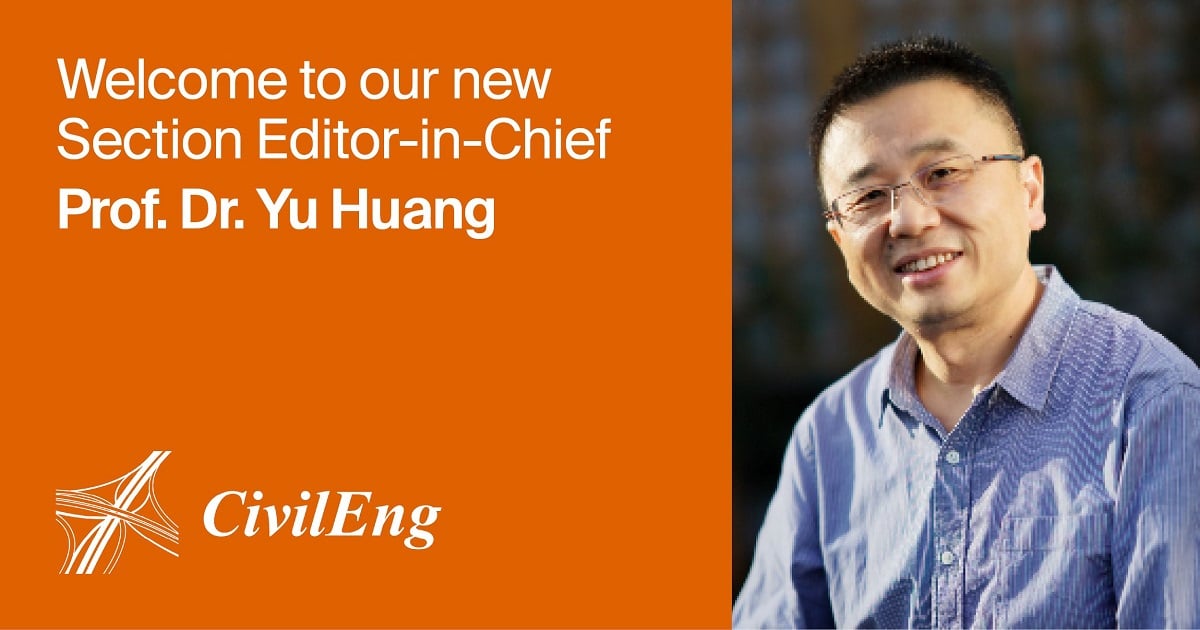
CivilEng (ISSN: 2673-4109) is pleased to announce the appointment of Prof. Dr. Yu Huang (Tongji University, China) as Section Editor-in-Chief (SEiC) of the “Geotechnical, Geological and Environmental Engineering” Section.
Prof. Yu Huang is Dean of the College of Civil Engineering, Tongji University. He earned his bachelor’s and doctoral degrees from Tongji University, and he has undertaken visiting research in the UK and postdoctoral studies in Japan. With long-term academic working experience in geotechnical and geological engineering, he devotes himself to civil engineering research and education and international academic cooperation and boasts outstanding academic influence in this field.
The following is a short Q&A with Prof. Dr. Yu Huang, who shared his vision for the journal with us, as well as his views of the research area and advice for young scholars.
1. What appealed to you about the journal that made you willing to serve as Section Editor-in-Chief?
The “Geotechnical, Geological and Environmental Engineering” Section aligns perfectly with the research areas I’ve been working in for decades. More importantly, I see the enormous potential of this young journal in advancing global open science and leading interdisciplinary innovation.
We’re living through a once-in-a-century global shift, and challenges like climate change, extreme weather events, and resource scarcity are only getting worse. Civil engineering, as the bedrock of human survival and progress, is at a pivotal turning point—shifting from traditional practices to digital-intelligent, green, and resilient solutions. There is an urgent need for an international platform that can rapidly respond to cutting-edge breakthroughs and facilitate cross-regional and interdisciplinary exchanges. For me, being part of this journey and watching the journal grow into a world-class academic platform is both a great honor and a profound responsibility.
2. As an author, what factors will you consider when choosing a journal to publish your work?
Academic reputation and recognition within the discipline have always been my top priorities when selecting a journal. A truly impactful journal should serve as the go-to forum for scholars to access cutting-edge literature and exchange original research results.
On this basis, I place particular emphasis on a journal’s commitment to supporting basic research and its openness to interdisciplinary scholarship—since transformative advances in civil engineering often originate from innovations in fundamental theories and deep cross-disciplinary collaboration.
Additionally, the journal’s open access policy, the fairness and timeliness of its peer review, the reasonableness of Article Processing Charges (APCs), and its capacity to provide professional academic dissemination services for authors are also important considerations in my selection.
3. As an expert in the field of geotechnical engineering, which research topics do you think are popular at present, and what is the future of this field?
The global civil engineering discipline is currently undergoing a profound paradigm revolution, with digital-intelligence, green development, and resilience emerging as the three irreversible core development trends. Breakthroughs in basic research underpin all these transformations.
- Digital-intelligent geotechnical engineering: The deep integration of AI, big data, digital twins, and IoT with traditional geomechanics is completely reimagining the entire lifecycle of how we design, build, and manage geotechnical projects. Over the next decade, top priorities for researchers worldwide will include combining physical mechanisms with data-driven approaches to model geomaterial behavior, developing full-coverage intelligent sensing and early warning systems for complex geological conditions, and building full-lifecycle digital twins with smart decision-making capabilities for underground engineering. This work will be critical to making global construction more efficient and helping bridge the technology gap between nations;
- Green geotechnical engineering: As we work toward global carbon neutrality and sustainable development, fields like low-carbon geotechnical materials, high-value recycling of construction waste, eco-friendly ground improvement techniques, and ecological protection in urban underground space development are set to explode. We need to approach this with a mindset of harmony between humanity and nature, building green geotechnical systems that span every stage of a project—from planning and design to construction and operation. This is how we'll contribute engineering wisdom to protecting our planet's ecosystems and driving the global shift to a greener economy;
- Resilient geotechnical engineering: With extreme weather events becoming more frequent, disaster chains growing more complex, and human engineering expanding into the "three deeps"—deep sea, deep earth, and deep space—engineering resilience has never been more critical to our collective survival and progress. We urgently need to crack the fundamental theoretical puzzle of how rock and soil behave under extreme multi-field coupling conditions. We have to build a complete technical system that covers everything from accurate disaster risk assessment and resilient design to smart, lifelong maintenance and rapid post-disaster recovery. This will let us shscientificanagement from reactive response to proactive prevention, laying the scientific groundwork for a shared future, a safer planet, and a more livable world for all.
4. What is your vision for the journal and Section?
My core objective is to develop the “Geotechnical, Geological and Environmental Engineering” Section into a world-class academic highland for basic research and interdisciplinary innovation in civil engineering.
First, on the basis of our current rational section division, we will further focus on the three strategic directions of digital-intelligence, green development, and resilience. We will plan and launch a series of forward-looking and leading thematic special issues to centrally display global original basic research achievements and major engineering practice breakthroughs.
Second, we will strive to build a more fair, efficient and transparent peer review system, shorten the publication cycle of high-quality achievements, and provide a rapid platform for global scholars, especially early-career researchers, to showcase their research results. Meanwhile, we will actively promote open science practices to facilitate global sharing and collaborative innovation of academic achievements.
Finally, we will strengthen cooperation with internationally renowned academic institutions and organizations, invite top global scholars to join the editorial board, and build an academic exchange brand with extensive international influence. I am convinced that through unremitting efforts, CivilEng will surely become one of the recognized top-tier journals in the field of civil engineering, making important contributions to the progress of the global civil engineering discipline and the sustainable development of human society.
5. What advice would you give to young scholars and graduate students entering the civil engineering field?
Civil engineering is a discipline with both profound theoretical depth and extensive practical scope, bearing the sacred mission of supporting global major engineering construction and ensuring the safety of humanity’s shared living environment. For young research scholars, I have three core suggestions.
First, deepen your grasp of fundamental theories and bravely venture into the “no-man’s-land” of original innovation. Basic research is the source of vitality for scientific and technological innovation, and breakthroughs in many major engineering technical problems ultimately depend on innovations in basic theories. I hope you can stay focused and patient, solidly master core basic theories such as engineering geology and geomechanics, dare to challenge traditional cognitions, focus on key basic scientific issues including multi-field coupling and multi-scale evolution, and strive to make original contributions from zero to one that serve the common good of humanity.
Second, address global shared challenges and overcome engineering difficulties in extreme environments. At present, humanity is collectively promoting major global initiatives such as deep-space exploration, deep-sea development, and deep-earth resource utilization. Fields such as next-generation aerospace construction, polar engineering, and deep-sea engineering have posed unprecedented challenges to geotechnical engineering. I hope you can closely integrate your personal research directions with humanity’s shared needs, actively carry out interdisciplinary research, break through the core technical bottlenecks of geotechnical engineering in extreme environments, and provide solid technical support for the global advancement of these critical frontiers.
Third, embrace open science and participate deeply in global academic cooperation. Science has no national boundaries, and many global challenges in the field of civil engineering require the joint efforts of scholars from all countries. I hope you can actively participate in international academic exchanges and cooperation, actively integrate into the global academic network, make full use of open science platforms to share research results and learn advanced experience, and contribute your insights to the global scientific community. Become a new force promoting the coordinated development of global civil engineering disciplines and building a community with a shared future for mankind.
We warmly welcome Prof. Dr. Yu Huang as the Section Editor-in-Chief of “Geotechnical, Geological and Environmental Engineering”, and we look forward to him leading CivilEng to achieve many more milestones.
