Effectiveness of Conversational Agents on Patient-Reported Outcomes in Chronic Pain Management: A Systematic Review and Meta-Analysis
 , , , and
Highlights
- CA-based interventions improve patient-reported outcomes in adults with chronic pain, with the most consistent effects observed for pain intensity.
- CA-based intervention may present beneficial effects across psychological and functional outcomes.
- Conversational agents may offer a scalable approach to support symptom monitoring, self-management, and behavioral guidance in chronic pain care.
- Interventions that incorporate frequent, structured, and interactive delivery formats may be particularly suitable for maximizing patient engagement and clinical benefit.
Abstract
1. Introduction
2. Materials and Methods
2.1. Study Registration
2.2. Search Strategy
2.3. Study Selection
2.4. Data Extraction
2.5. Qualitative Synthesis and Quality Assessment
2.6. Meta-Analysis
3. Results
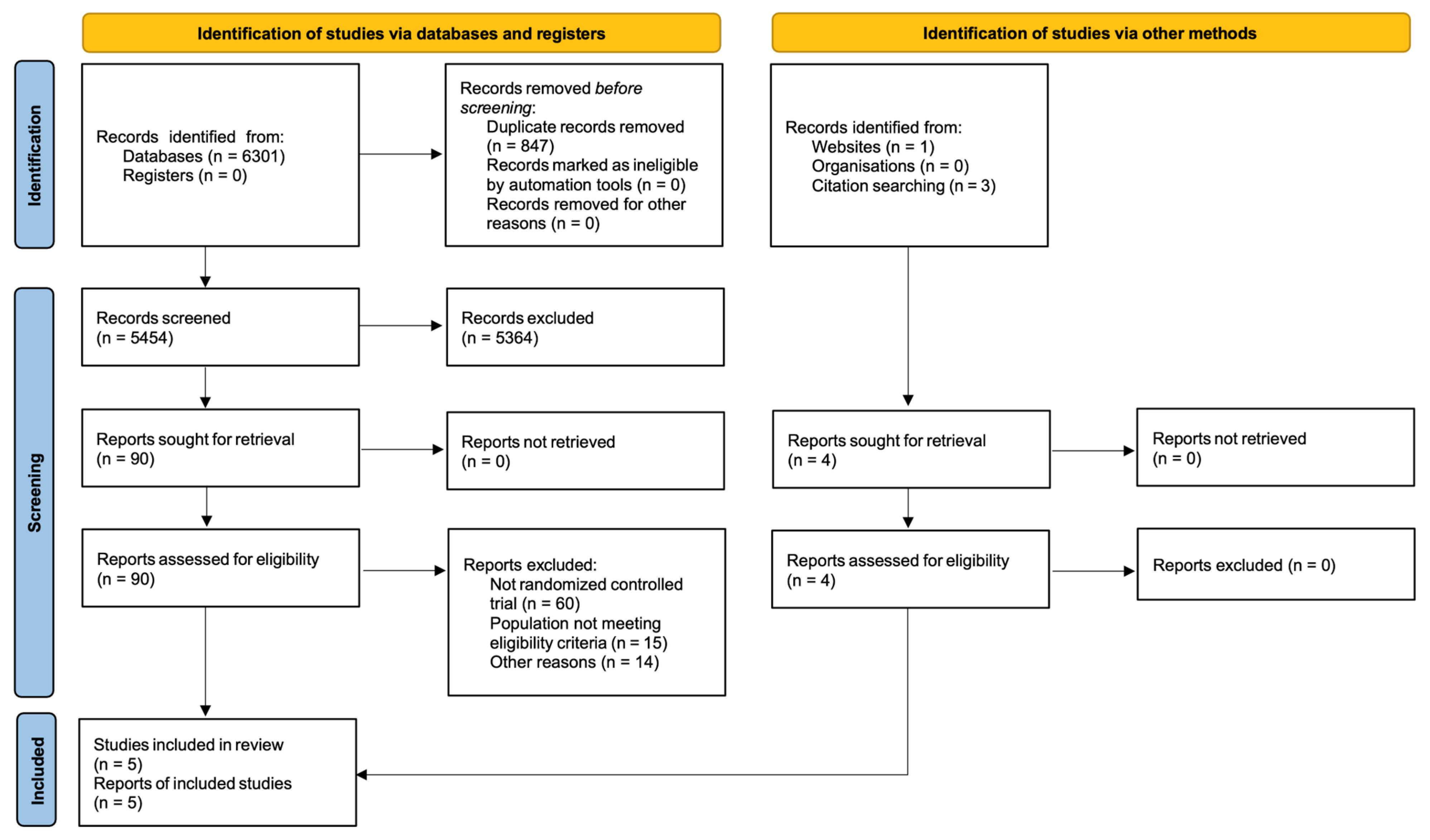
3.1. Study Selection
3.2. Study Characteristics
3.3. Results of Individual Studies
3.4. Quality Assessment and Risk of Bias
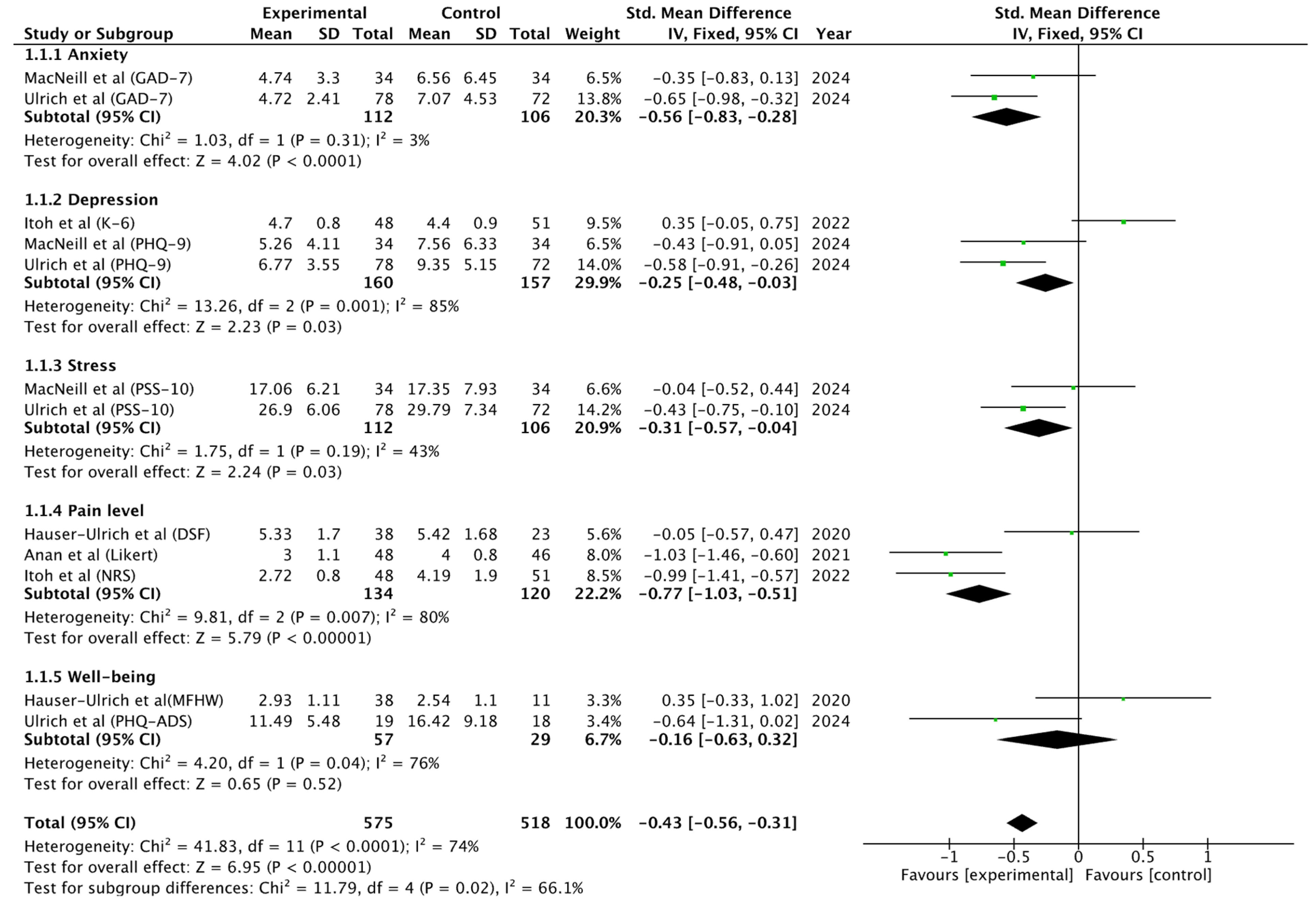
3.5. Results of Meta-Analysis
4. Discussion
Limitations
5. Conclusions
Supplementary Materials
Author Contributions
Funding
Institutional Review Board Statement
Informed Consent Statement
Data Availability Statement
Acknowledgments
Conflicts of Interest
Abbreviations
| PROMs | Patient-reported outcome measures |
| CAs | Conversational agents |
| RoB 2 | Cochrane Risk of Bias 2 tool |
| RevMan | Review Manager |
| SMDs | Standardized mean differences |
| AI | Artificial Intelligence |
References
- Treede, R.-D.; Rief, W.; Barke, A.; Aziz, Q.; Bennett, M.I.; Benoliel, R.; Cohen, M.; Evers, S.; Finnerup, N.B.; First, M.B.; et al. Chronic pain as a symptom or a disease: The IASP Classification of Chronic Pain for the International Classification of Diseases (ICD-11). Pain 2019, 160, 19–27. [Google Scholar] [CrossRef]
- Cohen, S.P.; Vase, L.; Hooten, W.M. Chronic pain: An update on burden, best practices, and new advances. Lancet 2021, 397, 2082–2097. [Google Scholar] [CrossRef]
- Rometsch, C.; Martin, A.; Junne, F.; Cosci, F. Chronic pain in European adult populations: A systematic review of prevalence and associated clinical features. Pain 2025, 166, 719–731. [Google Scholar] [CrossRef]
- Yong, R.J.; Mullins, P.M.; Bhattacharyya, N. Prevalence of chronic pain among adults in the United States. Pain 2022, 163, e328–e332. [Google Scholar] [CrossRef]
- Societal Impact of Pain (SIP). The Socioeconomic Burden of Chronic Pain in Europe: 2024 Report on GDP and Productivity Loss; European Pain Federation EFIC: Brussels, Belgium, 2024; Available online: https://www.sip-platform.eu/resources/ (accessed on 1 April 2026).
- Hogg, M.N.; Gibson, S.; Helou, A.; DeGabriele, J.; Farrell, M.J. Waiting in pain: A systematic investigation into the provision of persistent pain services in Australia. Med. J. Aust. 2012, 196, 386–390. [Google Scholar] [CrossRef]
- Deslauriers, S.; Roy, J.-S.; Bernatsky, S.; Feldman, D.E.; Pinard, A.M.; Desmeules, F.; Fitzcharles, M.-A.; Perreault, K. The association between waiting time and multidisciplinary pain treatment outcomes in patients with rheumatic conditions. BMC Rheumatol. 2020, 4, 59. [Google Scholar] [CrossRef]
- Gerdle, B.; Rivano Fischer, M.; Cervin, M.; Ringqvist, Å. Spreading of pain in patients with chronic pain is related to pain duration and clinical presentation and weakly associated with outcomes of interdisciplinary pain rehabilitation: A cohort study from the Swedish Quality Registry for Pain Rehabilitation (SQRP). J. Pain Res. 2021, 14, 173–187. [Google Scholar] [CrossRef] [PubMed]
- Elhassan, H.; Pardhan, S.; Hewage, R.; Harvey, B.P.; Gyllensten, H. Costs and health outcomes in economic evaluations of person-centered care: A systematic review. Value Health 2025, 28, 852–865. [Google Scholar] [CrossRef] [PubMed]
- Weldring, T.; Smith, S.M.S. Patient-reported outcomes (PROs) and patient-reported outcome measures (PROMs). Health Serv. Insights 2013, 6, 61–68. [Google Scholar] [PubMed]
- Pogatzki-Zahn, E.; Schnabel, K.; Kaiser, U. Patient-reported outcome measures for acute and chronic pain: Current knowledge and future directions. Curr. Opin. Anaesthesiol. 2019, 32, 616–622. [Google Scholar] [CrossRef]
- Zidarov, D.; Zidarova-Carrié, A.; Visca, R.; Miller, J.M.; Brecht, K.; Viens, N.; Ahmed, S. Core patient-reported outcome domains for routine clinical care in chronic pain management: Patients’ and healthcare professionals’ perspective. Qual. Life Res. 2020, 29, 2007–2020. [Google Scholar] [CrossRef]
- Alebouyeh, F.; Boutron, I.; Ravaud, P.; Tran, V.-T. Psychometric properties and domains covered by patient-reported outcome measures used in trials assessing interventions for chronic pain. J. Clin. Epidemiol. 2024, 170, 111362. [Google Scholar] [CrossRef] [PubMed]
- Bartels, S.L.; Pelika, A.; Taygar, A.S.; Wicksell, R.K. Digital approaches to chronic pain: A brief meta-review of eHealth interventions—Current evidence and future directions. Curr. Opin. Psychol. 2025, 62, 101976. [Google Scholar] [CrossRef]
- Slattery, B.W.; Haugh, S.; O’Connor, L.; Francis, K.; Dwyer, C.P.; O’Higgins, S.; Egan, J.; McGuire, B.E. An evaluation of the effectiveness of the modalities used to deliver electronic health interventions for chronic pain: Systematic review with network meta-analysis. J. Med. Internet Res. 2019, 21, e11086. [Google Scholar] [CrossRef]
- Main, A.; McCartney, H.; Ibrar, M.; Muirhead, F.; Mavroeidi, A.; Rai, H.K.; Maguire, R. Patients’ experiences of digital health interventions for the self-management of chronic pain: Systematic review and thematic synthesis. J. Med. Internet Res. 2025, 27, e69100. [Google Scholar] [CrossRef]
- Strain, J.D.R.; Welch, L.; Sadler, E. Systematic review and narrative synthesis of the experiences of individuals with chronic pain participating in digital pain management interventions. PLoS ONE 2024, 19, e0306455. [Google Scholar] [CrossRef] [PubMed]
- Michie, S.; van Stralen, M.M.; West, R. The behaviour change wheel: A new method for characterising and designing behaviour change interventions. Implement. Sci. 2011, 6, 42. [Google Scholar] [CrossRef]
- Oinas-Kukkonen, H.; Harjumaa, M. Persuasive systems design: Key issues, process model, and system features. Commun. Assoc. Inf. Syst. 2009, 24, 485–500. [Google Scholar] [CrossRef]
- Laranjo, L.; Dunn, A.G.; Tong, H.L.; Kocaballi, A.B.; Chen, J.; Bashir, R.; Surian, D.; Gallego, B.; Magrabi, F.; Lau, A.Y.S.; et al. Conversational agents in healthcare: A systematic review. J. Am. Med. Inform. Assoc. 2018, 25, 1248–1258. [Google Scholar] [CrossRef] [PubMed]
- Griffin, A.C.; Xing, Z.; Khairat, S.; Wang, Y.; Bailey, S.; Arguello, J.; Chung, A.E. Conversational agents for chronic disease self-management: A systematic review. AMIA Annu. Symp. Proc. 2021, 2020, 504–513. [Google Scholar]
- Souza, F.L.; Bowman, H.; Yang, F.; Hesam-Shariati, N.; Linke, J.; Gilanyi, Y.L.; Jones, M.D.; Z-Pinto, R.; McAuley, J.H.; Rizzo, R.R.N. Conversational agents to support pain management: A scoping review. Eur. J. Pain 2025, 29, e70016. [Google Scholar] [CrossRef]
- Page, M.J.; McKenzie, J.E.; Bossuyt, P.M.; Boutron, I.; Hoffmann, T.C.; Mulrow, C.D.; Shamseer, L.; Tetzlaff, J.M.; Akl, E.A.; Brennan, S.E.; et al. The PRISMA 2020 statement: An updated guideline for reporting systematic reviews. BMJ 2021, 372, n71. [Google Scholar] [CrossRef]
- Amir-Behghadami, M.; Janati, A. Population, Intervention, Comparison, Outcomes and Study (PICOS) design as a framework to formulate eligibility criteria in systematic reviews. Emerg. Med. J. 2020, 37, 387. [Google Scholar] [CrossRef]
- Downs, S.H.; Black, N. The feasibility of creating a checklist for the assessment of the methodological quality both of randomised and non-randomised studies of health care interventions. J. Epidemiol. Community Health 1998, 52, 377–384. [Google Scholar] [CrossRef] [PubMed]
- Eysenbach, G.; Consort-EHEALTH Group. CONSORT-EHEALTH: Improving and standardizing evaluation reports of Web-based and mobile health interventions. J. Med. Internet Res. 2011, 13, e126. [Google Scholar] [CrossRef]
- Sterne, J.A.C.; Savović, J.; Page, M.J.; Elbers, R.G.; Blencowe, N.S.; Boutron, I.; Cates, C.J.; Cheng, H.-Y.; Corbett, M.S.; Eldridge, S.M.; et al. RoB 2: A revised tool for assessing risk of bias in randomised trials. BMJ 2019, 366, l4898. [Google Scholar] [CrossRef]
- The Cochrane Collaboration. Review Manager 5 (RevMan 5) [Computer Program], Version 5.4; The Cochrane Collaboration: Copenhagen, Denmark, 2020.
- Hauser-Ulrich, S.; Künzli, H.; Meier-Peterhans, D.; Kowatsch, T. A Smartphone-Based Health Care Chatbot to Promote Self-Management of Chronic Pain (SELMA): Pilot Randomized Controlled Trial. JMIR Mhealth Uhealth 2020, 8, e15806. [Google Scholar] [CrossRef] [PubMed]
- Anan, T.; Kajiki, S.; Oka, H.; Fujii, T.; Kawamata, K.; Mori, K.; Matsudaira, K. Effects of an Artificial Intelligence–Assisted Health Program on Workers with Neck/Shoulder Pain/Stiffness and Low Back Pain: Randomized Controlled Trial. JMIR Mhealth Uhealth 2021, 9, e27535. [Google Scholar] [CrossRef]
- Itoh, N.; Mishima, H.; Yoshida, Y.; Yoshida, M.; Oka, H.; Matsudaira, K. Evaluation of the Effect of Patient Education and Strengthening Exercise Therapy Using a Mobile Messaging App on Work Productivity in Japanese Patients with Chronic Low Back Pain: Open-Label, Randomized, Parallel-Group Trial. JMIR Mhealth Uhealth 2022, 10, e35867. [Google Scholar] [CrossRef] [PubMed]
- MacNeill, A.L.; Doucet, S.; Luke, A. Effectiveness of a Mental Health Chatbot for People with Chronic Diseases: Randomized Controlled Trial. JMIR Form. Res. 2024, 8, e50025. [Google Scholar] [CrossRef]
- Ulrich, S.; Gantenbein, A.R.; Zuber, V.; Von Wyl, A.; Kowatsch, T.; Künzli, H. Development and Evaluation of a Smartphone-Based Chatbot Coach to Facilitate a Balanced Lifestyle in Individuals with Headaches (BalanceUP App): Randomized Controlled Trial. J. Med. Internet Res. 2024, 26, e50132. [Google Scholar] [CrossRef]
- Morone, G.; De Angelis, L.; Martino Cinnera, A.; Carbonetti, R.; Bisirri, A.; Ciancarelli, I.; Iosa, M.; Negrini, S.; Kiekens, C.; Negrini, F. Artificial intelligence in clinical medicine: A state-of-the-art overview of systematic reviews with methodological recommendations for improved reporting. Front. Digit. Health 2025, 7, 1550731. [Google Scholar] [CrossRef]
- Dueñas, M.; Ojeda, B.; Salazar, A.; Mico, J.A.; Failde, I. A review of chronic pain impact on patients, their social environment and the health care system. J. Pain Res. 2016, 9, 457–467. [Google Scholar] [CrossRef] [PubMed]
- Inkster, B.; Sarda, S.; Subramanian, V. An Empathy-Driven, Conversational Artificial Intelligence Agent (Wysa) for Digital Mental Well-Being: Real-World Data Evaluation Mixed-Methods Study. JMIR Mhealth Uhealth 2018, 6, e12106. [Google Scholar] [CrossRef]
- Abd-Alrazaq, A.; Rababeh, A.; Alajlani, M.; Bewick, B.M.; Househ, M. Effectiveness and safety of using chatbots to improve mental health: Systematic review and meta-analysis. J. Med. Internet Res. 2020, 22, e16021. [Google Scholar] [CrossRef]
- Linardon, J.; Cuijpers, P.; Carlbring, P.; Messer, M.; Fuller-Tyszkiewicz, M. The efficacy of app-supported smartphone interventions for mental health problems: A meta-analysis of randomized controlled trials. World Psychiatry 2019, 18, 325–336. [Google Scholar] [CrossRef]



| Study (Year) | Country | Pain Population | Sample (% Female) | Age (Mean ± SD) | Risk of Bias | Quality |
|---|---|---|---|---|---|---|
| Hauser-Ulrich et al. (2020) [29] | Switzerland | Mixed chronic pain aetiologias | EG: 59 (86%) CG: 43 (72%) | EG: 42.97 ± 12.17 CG: 44.88 ± 13.50 | High risk | 14/28 |
| Anan et al. (2021) [30] | Japan | Work associated musculoskeletal pain | EG: 48 (19%) CG: 46 (28%) | EG: 41.8 ± 8.7 CG: 42.4 ± 8.0 | High risk | 18/28 |
| Itoh et al. (2022) [31] | Japan | Chronic low back pain | EG: 48 (44%) CG: 51 (45%) | EG: 47.9 ± 10.2 CG: 46.9 ± 12.3 | High risk | 17/28 |
| MacNeill et al. (2024) [32] | Canada | Different chronic etiologies | EG: 41 (69%) CG: 38 (69%) | 42.87 ± 11.27 | Some concerns | 17/28 |
| Ulrich et al. (2024) [33] | Switzerland, Germany, Austria | Chronic headache | EG: 110 (87.3%) CG: 88 (86.4%) | EG: 39.03 ± 11.46 CG: 38.28 ± 12.82 | Some concerns | 19/28 |
| Study (Year) | Communication Platform (app); Conversational Agent Type | Interaction Modalities (Input/Output) | Key Components | Comparator | Outcomes | Main Results |
|---|---|---|---|---|---|---|
| Hauser-Ulrich et al. (2020) [29] | Smartphone app (SELMA); text-based healthcare chatbot | Input: Mixed (fixed-choice + free-text) Output: Mixed (written + multimedia) | CBT-based pain self-management, psychoeducation, coping strategies | Waitlist | Pain-related impairment (BPI) Pain intensity (DSF), general well-being (MFHW), working alliance (WAI-SR bond) | Working alliance EG > CG (p = 0.005) NS results: Pain-related impairment 71% intervention adherence Usefulness: 5.47/7 Usability 6.34/7 |
| Anan et al. (2021) [30] | Mobile messaging app (LINE); conversational exercise-support chatbot | Input: Fixed-choice Output: Mixed (written + visual) | Exercise support, stretching, posture, mindfulness | Usual care: regular workplace exercise routine | Pain severity of neck/shoulder stiffness/pain or low back pain (1–5 scale), Presence of severe pain according to subjective pain scores (score 4–5), Achievement of subjective symptom improvement (improved/slightly improved) | Pain severity EG < CG (p < 0.001) 92% intervention adherence NR Acceptability |
| Itoh et al. (2022) [31] | Mobile messaging app (LINE); conversational exercise-therapy chatbot | Input: NR Output: Mixed (written + multimedia) | Patient education, exercise therapy, posture/core alignment | Usual medical care: routine CLBP medical care | Work productivity (QQ method) Severe pain at 12 weeks (score 4–5); subjective improvement (improved/slightly improved) at 12 weeks Work productivity (WPAI-GH), low back pain and shoulder stiffness (NRS), subjective CLBP improvement (1–5 scale), disease-specific QoL (RDQ-24), health-related QoL (EQ-5D-5L), kinesiophobia (TSK-11), depression/psychological distress (K-6) | Subjective CLBP improvement EG < CG (p = 0.04) Health-related QoL EG > CG (p = 0.03) NS results: Work productivity, Low back pain, Disease-specific QoL, Depression/psychological distress 65–77% intervention adherence NR Acceptability |
| MacNeill et al. (2024) [32] | Smartphone app (Wysa); mental health chatbot | Input: Mixed (free-text + fixed-choice) Output: Mixed (written + multimedia) | Mental health support, self-care exercises, check-ins/reminders | No-treatment control | Depression (PHQ-9), anxiety (GAD-7), stress (PSS-10) | Depression EG < CG (p < 0.001) Anxiety EG < CG (p < 0.001) NS results: Stress NR Adherence “Generally positive; easy to use, convenient and accessible. Some conversational issues reported” |
| Ulrich et al. (2024) [33] | Smartphone coaching app (BalanceUP); conversational agent coach | Input: Mixed (fixed-choice + free-text) Output: Mixed (written + multimedia) | Headache coaching, psychoeducation, behavior change/action planning, relaxation | Waitlist | Mental well-being (PHQ-ADS), depression (PHQ-9), anxiety (GAD-7), somatic symptoms (PHQ-15), stress (PSS-10), headache management self-efficacy (HMSE-G-SF), BCTs application (HAPA), absenteeism/presenteeism (MIDAS), cognitive & behavioural pain coping (FESV) | Mental well-being EG < CG (p < 0.001) Depression EG < CG (p < 0.001) Anxiety EG < CG (p = 0.007) Stress EG < CG (p = 0.003) 64.8% intervention adherence Usefulness 4.00/5 Usability 3.56/5 |
Disclaimer/Publisher’s Note: The statements, opinions and data contained in all publications are solely those of the individual author(s) and contributor(s) and not of MDPI and/or the editor(s). MDPI and/or the editor(s) disclaim responsibility for any injury to people or property resulting from any ideas, methods, instructions or products referred to in the content. |
© 2026 by the authors. Licensee MDPI, Basel, Switzerland. This article is an open access article distributed under the terms and conditions of the Creative Commons Attribution (CC BY) license.
Share and Cite
Zamora-Tortosa, J.; Heredia-Ciuró, A.; Cruz Herrera, C.; Jiménez López, R.; Liang, J.G.; Valenza, M.C.; Lantarón-Caeiro, E. Effectiveness of Conversational Agents on Patient-Reported Outcomes in Chronic Pain Management: A Systematic Review and Meta-Analysis. Healthcare 2026, 14, 1360. https://doi.org/10.3390/healthcare14101360
Zamora-Tortosa J, Heredia-Ciuró A, Cruz Herrera C, Jiménez López R, Liang JG, Valenza MC, Lantarón-Caeiro E. Effectiveness of Conversational Agents on Patient-Reported Outcomes in Chronic Pain Management: A Systematic Review and Meta-Analysis. Healthcare. 2026; 14(10):1360. https://doi.org/10.3390/healthcare14101360
Chicago/Turabian StyleZamora-Tortosa, Jesús, Alejandro Heredia-Ciuró, Carmen Cruz Herrera, Rafael Jiménez López, Jiawei Guo Liang, Marie Carmen Valenza, and Eva Lantarón-Caeiro. 2026. "Effectiveness of Conversational Agents on Patient-Reported Outcomes in Chronic Pain Management: A Systematic Review and Meta-Analysis" Healthcare 14, no. 10: 1360. https://doi.org/10.3390/healthcare14101360
APA StyleZamora-Tortosa, J., Heredia-Ciuró, A., Cruz Herrera, C., Jiménez López, R., Liang, J. G., Valenza, M. C., & Lantarón-Caeiro, E. (2026). Effectiveness of Conversational Agents on Patient-Reported Outcomes in Chronic Pain Management: A Systematic Review and Meta-Analysis. Healthcare, 14(10), 1360. https://doi.org/10.3390/healthcare14101360