1. Introduction
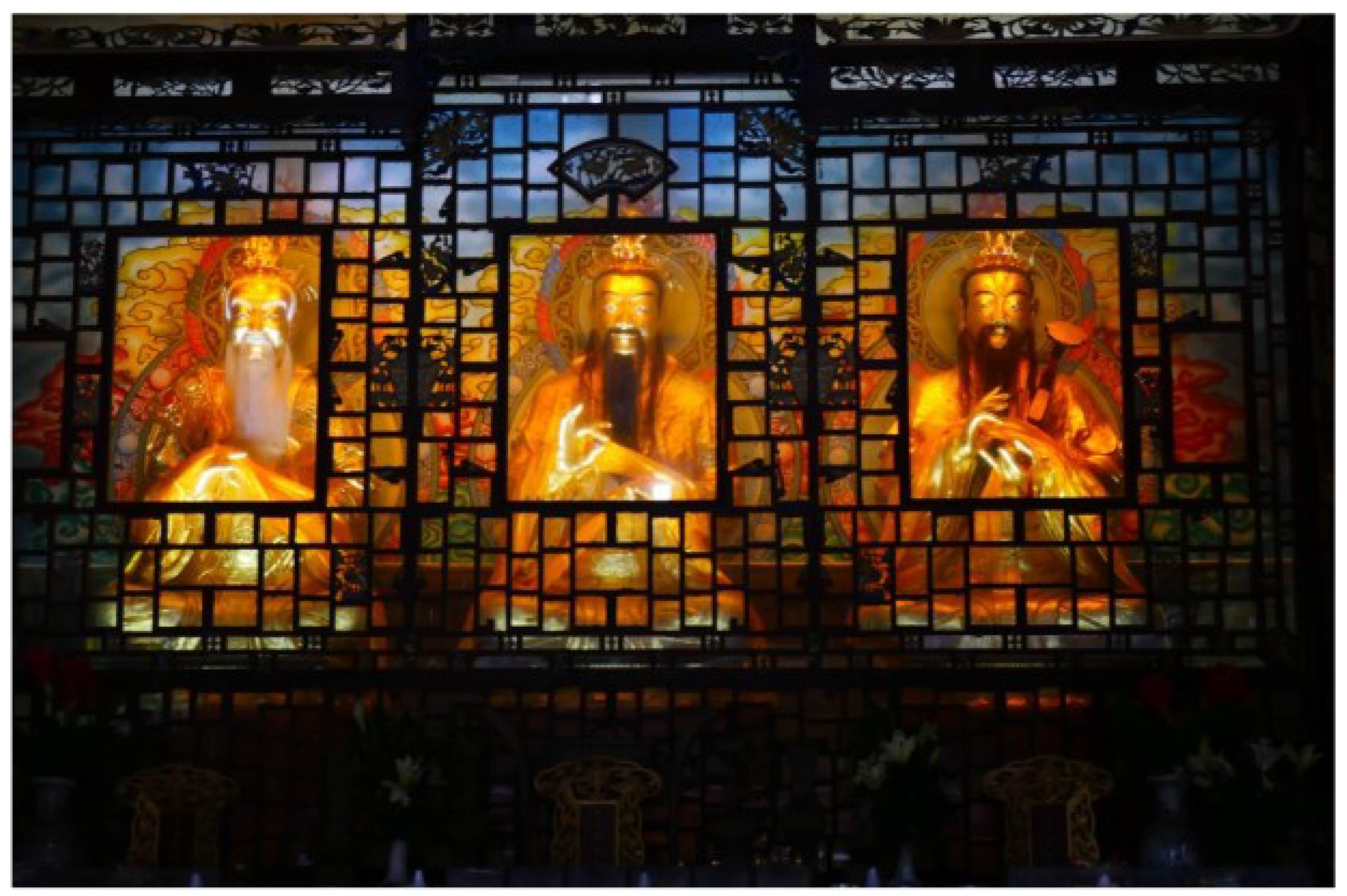
Mount Qingcheng, one of the most sacred Daoist mountains, covered with lush trees and known as “the most peaceful and secluded mountain under heaven,” is the home of an abundance of cultural relics and Daoist sites. Among these, the Hall of the Three Purities (
sanqingdian 三清殿) houses the statues of three deities (see
Figure 1).
Most Striking Is the Description of the Three Deities Displayed in Front of the Altar:
The Three Clear Ones are the highest-ranking gods in Daoism. Heavenly Lord Yu Qing Yuan Shi lives in the Heaven of Qing Wei. In his hand he holds a mystic pearl, symbolizing the chaos1 before creation, and the formless Dao in the time of primordial unity. Heavenly Lord Shang Ling Bao lives in the Heaven of Yu Yu. He holds the Taiji Symbol, denoting the division into the world of form. Heavenly Lord Tai Qing Dao De lives in the Heaven of Da Chi. He holds a feathered fan, symbolizing the Great Beginning of the 10,000 things and their receiving of the spirit of the five elements.
The first author, during his visit to the mountain in 2023, was astonished by the high resonance between the description of the Three Clear Ones, hereafter referred to by the more common English translation the “Three Purities,” with the Islamic philosopher Ibn-i-‘Arabí’s (d. 1240 CE) conceptualization of the process of creation of the world: the manifestation (
tajallí) of the Absolute in three realms of being. Despite differences in the specific symbolisms and terms employed in the Islamic and Daoist texts, Ibn-i-‘Arabí’s philosophy and the Daoist tradition share a common structure and comparable conceptualizations of the process of creation.
Tajallí is the term used for this process by Ibn-i-‘Arabí and
sheng 生 (‘produces’ or ‘brings into existence’) by Laozi and Zhuangzi. Zhuangzi also uses universal Transmutation (
wu hua 物化) meaning ‘things transforming’ for this process (
Izutsu 1983, p. 473).
In this article, we develop and explore the implications of this insight, extending the comparison to include Platonic and Baháʼí philosophies. One might question our choice of cases: the latter two as well as Sufism are historically connected, notably through Neoplatonic ideas which have been pervasive within Islamic theology and philosophy. This has provided an ontological language that, to some degree, is shared in Sufi (
Corbin 1998;
W. C. Chittick 1989) and Baháʼí formulations, in spite of some key differences. In the case of Daoism, on the other hand, we are in the presence of a Chinese tradition with an entirely distinct historical origin, and a basic understanding of reality that seems to be so different that some scholars have questioned whether it can even be described as an “ontology.” Roger Ames, for example, has argued that the cosmological assumptions of Chinese thought present a “stark alternative” to the “substance ontology” of Greek thought, which is “grounded in ‘being qua being’ or ‘being per se’ (τὸ ὂν ᾗ ὂν) that guarantees a permanent and unchanging subject as the substratum for the human experience.” (
Ames 2023, p. 81) In the relational world of the Chinese classics, there are no “beings” with unchanging “essences,” only “becomings” engaged in relational processes. Thus he proposes a Chinese alternative to ontology:
zoetology, based on
zoe (ζωή), the Greek term for life. Drawing on the
I Ching, this formulation assigns centrality to life-force and its vitality”, to “the way of living” (
shengshenglun 生生論) (
Ames 2023, p. 199).
The comparative approach followed by scholars such as Ames, by highlighting stark contrasts between systems of thought, has the advantage of drawing out the unique characteristics of a particular system and avoiding distorting it by fitting it into pre-existing Western conceptual frames. This approach, which is highly attentive to cultural distinctions, enriches the dialogue between philosophical schools, religions, or civilizations (
Watt 1973). On the other hand, it carries the risk of positing an unbridgeable gulf between worldviews, in spite of evident potential points of convergence.
In this article, we propose to transcend this conundrum by outlining a framework within which a common underlying structure can be identified, even while preserving the distinctive ontological conceptions of each of the four systems we have studied. We use the term “ontology” for all four, despite the potential objection in the case of Daoism, by using an extended definition of ontology—understood as a discourse on the basic components that make up the world and the relationships between them—rather than the narrow definition, based on “being,” used within the Greek and Western philosophical traditions.
The common framework is what we call a “three-stage ontological structure,” inspired by a meditation on the meaning of the three highest deities in the Daoist pantheon, known as the Three Purities. This framework identifies a parallel structural progression—from an unknowable source (Stage 1), through an intermediary realm of forms or attributes (Stage 2), to the manifest world (Stage 3)—across all four traditions. However, it is crucial to recognize that this comparative framework highlights a common structural pattern while acknowledging significant differences, particularly in the nature of the three stages (e.g., dynamic patterns vs. static forms, impersonal source vs. personal God) and the mechanisms of manifestation across traditions.
After elaborating on the three-stage structure embodied by the Three Purities, we found resonances with the Sufi metaphysics of Ibn-i-‘Arabí, and, through a comparison of Sufi and Daoist thought, we refined the three stages. This comparison builds on the seminal work of Toshihiko Izutsu (
Izutsu 1983; see also
W. C. Chittick 1989). However, the three-stage structure is not unique to Ibn-i-‘Arabí. Given the influence of Neoplatonism on Islamic philosophy, including its Sufi expressions, we investigated whether the three-stage structure could apply to Platonic thought, prior to its fusion with Christian and Islamic theology. Here, we find that the Platonic ontology based on the Form of the Good also fits the three-stage structure, notwithstanding its differences with the vitalism of Daoism and the ongoing, active process of divine creation in Islamic philosophy.
Finally, we extend our investigation to the present through the case of the Baháʼí Faith, which emerged in 19th-century Persia, a region where Sufism had long been a strong spiritual force. The Báb (1819–1850), the forerunner of Bahá’u’lláh (1917–1892), and Bahá’u’lláh himself were born into this Sufi-influenced culture. The Báb’s writings, such as the Seven Proofs, and those of Baháʼu’lláh such as the Seven Valleys, exhibit a clear engagement with Sufi metaphysics and terminology, using mystical language to articulate the nature of divine revelation, even as they strongly reject the pantheism present in some Sufi visions. While the Bahá’í Faith retains Sufism’s focus on inner transformation and divine love, it emphasizes their social expression, not only emphasizing the unity of all religions, but also the establishment of a new pattern of social relations as the foundation for world peace. Our discussion of the Baháʼí case, with its emphasis on social action, allows us to reflect on the relevance of the three-stage ontological structure for the phenomenological experience of living and acting in this world.
This article is structured as follows:
Section 2,
Section 3,
Section 4 and
Section 5 delineate the three-stage structure as it applies to Daoism, Platonism, Sufism, and the Baháʼí Faith, respectively.
Section 6 then explores the concept of the “mystical return to unity” found in all four traditions. We draw insights from a discussion of the cosmological diagrams of Chen Tuan and Zhou Dunyi to address the simultaneous experience of transcendence and immanence, concluding with a phenomenological lens. Finally,
Section 7 and
Section 8 examine the ethical principles that logically arise from this shared ontological understanding, focusing on humility, harmony, and tolerance.
2. Daoist Ontology: The Three Purities
In Daoism, the Dao is the ultimate reality—nameless, formless, and the source of all existence. It is both the origin and the underlying principle that permeates the cosmos. Within this framework, the Three Purities (Sanqing 三清)—the highest deities in the Daoist pantheon—embody the unfolding of the Dao through three distinct ontological stages: Primordial Unity, Differentiating Patterns, and the Ten Thousand Things. These stages illustrate the process by which the Dao manifests from an undifferentiated unity into the multiplicity of the world.
The Three Purities,
Sanqing, is a very important and widely known concept in Daoism. There is much written about it in the literature and any major Daoist temple will include a shrine to the Three Purities. Daoist scriptures also include a variety of related concepts and explanations. Scriptures mentioning the Three Purities as a formalized triad can be traced back to the Tang dynasty (7th–9th Century AD), though there are mentions, sometimes with different combinations and meanings, in texts of the Six Dynasties (220–589 AD) (
Kohn 2008). The concept was then enriched by Buddhist thought and expanded and developed to become an extensive metaphysical structure with many associated details in Daoist texts and rituals. For instance, Schipper mentions that the “Three Energies” in the ritual of the “Great Master,” correspond to the Three Purities (
Schipper 2011, p. 141).
The Dao is often described as ineffable, transcending all distinctions and categories. Yet, it is also dynamic, giving rise to the cosmos through a process of transformation. The Three Purities represent key aspects of this process: the first of the Purities, Yuanshi Tianzun 元始天尊 (The Celestial Worthy of the Primordial Beginning) symbolizes the initial state of chaos, the unmanifest Dao in its primordial unity. Second, Lingbao Tianzun 靈寶天尊 (The Celestial Worthy of the Numinous Treasure) represents the emergence of forms and principles as the Dao begins to differentiate. Finally, Daode Tianzun 道德天尊 (The Celestial Worthy of the Dao and Its Virtue) embodies the Dao’s manifestation in the diverse phenomena of the world (
Schipper 2011, p. 141).
These stages—Chaos, Emerging Forms, and the Ten Thousand Things—provide a structured understanding of how the Dao, in its boundless potential, gives rise to all existence. The first stage, Primordial Chaos, the realm of Yuanshi Tianzun, is the state of hundun 混沌—a primordial, undifferentiated condition where no distinctions exist, not even yin and yang. Yuanshi Tianzun is often depicted holding a pearl or disk, symbolizing this boundless, chaotic wholeness. This stage represents the Great Dao in its most abstract and infinite aspect, before the process of differentiation and manifestation begins.
The transcendent Dao, however, possesses an immanent aspect as well. As described by Schipper, the real Daoist pantheon, that of the true gods, belongs to ‘Anterior Heaven’ (
xiantian, the universe before creation). This true pantheon reveals itself to us as the One and its different permutations, and as different manifestations of the original cosmic energy. This point is essential to Daoist thought: “Huang! Hu! (Vague! Ungraspable!)…. This unnamable stands for the original cosmic energy (yuanqi) which is said ‘to give birth to the gods.’” (
Schipper 2011, p. 147).
The well-known opening passage in the Daodejing points out the existence of two simultaneous aspects of the Dao, the nameless and the named:
The way that can be spoken of
Is not the constant way;
The name that can be named
Is not the constant name.
The nameless is the beginning of heaven and earth;
The named is the mother of the Ten Thousand Things.
The second stage, of differentiating patterns, is associated with Lingbao Tianzun. Here, the Dao transitions from undifferentiated Chaos into a state of differentiation. This is the stage when, out of Dao in its pure, unmanifest form, containing all potentialities within a seamless unity, emerges the Supreme Polarity (
Taiji 太極), giving rise to yin and yang 陰陽, the dual forces that structure reality.
Taiji manifests as opposing and complementary patterns or forms that shape the physical world. The Supreme Polarity emerges from the “Unpolarized” (
Wuji 無極)—a term which can be also translated as the “Limitless” or the “Boundless”. This stage reflects the shift from unity to differentiation, as the creative process begins to articulate itself through the interplay of complementary forces.
3 These patterns are dynamic, operating through the fluid, relational interplay of forces like yin and yang, a conception that contrasts sharply with the static, fixed Forms or Archetypes presented in Platonism and Sufism.
The final stage, the Ten Thousand Things, is the domain of Daode Tianzun. The “Ten Thousand Things,” a common Chinese expression, refers to the myriad phenomena of the world—all the diverse, tangible expressions of the Dao. From the interaction of yin and yang emerge the “five phases” (wood, fire, earth, metal, water), which further differentiate into the countless entities and processes of the cosmos. Daode Tianzun, often identified with Laozi, the author of the
Daodejing, represents the Dao’s presence in this manifest world and offers guidance on living in harmony with it (
Schipper 2011, pp. 141–47). The personification of the three stages in the form of the Three Purities belies widespread conceptions of the “impersonal” nature of the Dao. That said, the final stage does not emerge from the explicitly willful action of a divine craftsman (Demiurge) or the much more highly personalized Abrahamic God, but rather through a spontaneous, natural flow.
This stage embodies the Great Dao’s full expression in the complexity and diversity of existence, completing the cosmological unfolding. The whole process is encapsulated by the following passage from the Daodejing:
The ten thousand things emerge from form. And form emerges from the formless.
(Laozi, Daodejing, 57)
The Three Purities thus personify the Dao’s manifestation through the stages of Primordial Unity, Patterns, and the Ten Thousand Things. From the undifferentiated unity of Wuji, through the emerging duality of Taiji and yin-yang, to the multiplicity of the manifest world, these stages encapsulate Daoist ontology.
3. Platonic Ontology
Platonic philosophy offers a vision of reality that invites comparison with the three-stage ontological model observed in Daoism. This model traces existence from an ultimate, transcendent source, through an intermediary realm of ideas or forms, to the manifest world of physical phenomena. In Plato’s framework, these stages are embodied in the Form of the Good, the Realm of Forms, and the Physical World.
The first stage is the Form of the Good (Transcendent Source). At the pinnacle of Plato’s ontology is the Form of the Good, the ultimate source of all being, truth, and value. In the
Republic (Book VI), Plato describes it as “the cause of all that is correct and beautiful in anything” (517b–c), comparing it to the sun, which illuminates and nurtures the visible world. Unlike other Forms, the Good transcends them all, existing beyond essence itself. Plato writes, “The Good itself is not essence but still transcends essence in dignity and surpassing power” (
Republic 509b). This ineffable, foundational reality is beyond human comprehension, much like the Daoist “nameless Dao,” which precedes all naming and differentiation. For Plato, the Form of the Good is not merely a concept but the origin of all existence, radiating reality downward to the lower stages (
Annas 1981, p. 246). It is essential to note, however, that the Form of the Good is an impersonal source of intelligibility and existence, lacking the prophetic or conscious Will attributes of the personal God found in Sufism and the Baháʼí Faith.
The second stage is the Realm of Forms (Intermediary Realm). Emerging from the Form of the Good is the Realm of Forms, an eternal, unchanging domain of perfect ideas or archetypes. These Forms—such as Beauty and Justice—are not physical but abstract realities, accessible only through intellect and reason. They serve as the blueprints for everything in the physical world. In the Phaedo, Plato explains, “If there is anything beautiful besides absolute beauty, it is beautiful for no other reason than because it participates in that absolute beauty” (100c). This “participation” suggests a dynamic relationship where the Forms mediate between the transcendent Good and the material world. This concept of static, perfect Forms contrasts with the dynamic, relational yin-yang patterns of the Daoist second stage, and crucially, there is no direct prophetic Manifestation (like those in the Baháʼí tradition) who actively embodies these Forms perfectly for humanity.
The third stage, the Physical World, is the realm of sensory experience, where material objects reflect the eternal Forms imperfectly. Characterized by change, decay, and multiplicity, this world is a shadow of the higher reality. In the
Timaeus, Plato describes its creation by a divine Demiurge, who molds it according to the Forms, making every tree, person, or city a flawed imitation of its ideal archetype. The Allegory of the Cave (
Republic Book VII) vividly illustrates this: prisoners chained in a cave see only shadows on a wall, mistaking them for reality, unaware of the true objects casting them, the sun (the Good) illuminating all. This aligns with the Daoist “Ten Thousand Things,” the diverse manifestations of the Dao. However, the Platonic system introduces the Demiurge as an intermediary craftsman for the physical world, a figure who lacks a direct analogue in the Daoist cosmological scheme. For Plato, the Physical World is real but derivative, its existence and meaning rooted in the higher stages (
Kraut 1997, pp. 109–15).
This brief excursion into Platonic philosophy shows how it aligns with the three-stage ontological structure. But while we can speak of “forms” in both the Daoist and Platonic conceptions of the second ontological stage, they are understood differently. Yin-yang in the Daoist scheme is a dynamic process of emerging patterns arising from the interplay of polarized forces such as assertiveness and receptivity, expansion and retraction, rigidity and flexibility, and so on. These patterns are symbolized as the five forces or phases (
xing 行) of earth, water, fire, metal, and wood. Given that the names assigned to each imply fixed characters, they have often been translated as “elements” possessing permanent functions and static attributes. As similar tension also appears in interpretations of the Platonic forms. They are commonly understood as perfect ideals, static in their perfection; and while forms such as Justice and Beauty are derived from the ultimate Form of the Good, it is not clear how they relate to each other in a dynamic way. Finally, while both the Daoist and Platonic forms are not immediately accessible to ordinary perception, the means of understanding and aligning to them are different: Daoism favours an embodied approach through meditation practices that start with the training of breathing—an embodiment of yin-yang polarities of internalization and externalization—or exercises such as
taijiquan (“Tai Chi”); meanwhile, Platonic practice advocates gaining access to the forms through reason, moving from sensual perception to intellectual understanding through contemplation (
Fine 1993, pp. 120–26;
Robinet 1993).
4. Sufi Ontology: Ibn-i-Arabi’s Three Realms
In Sufi metaphysics, the 12th-century Andalusian mystic Ibn-i-‘Arabí presents a profound ontological framework consisting of three realms: the Absolute, the Realm of Archetypes, and the Sensible World (
Izutsu 1983, p. 67). Ibn-i-‘Arabí‘s ontology begins with the Absolute (
Ḥaqq حقّ)
4, the unmanifest divine essence that transcends all names, attributes, and comprehension. This is the pure, limitless reality of God, existing beyond human understanding or limitation. This first stage, while structurally similar to the Dao and the Form of the Good, fundamentally differs by being the ultimate source of a personal, conscious, and willful God (
Ḥaqq,
حقّ), in contrast to the more impersonal nature of the Daoist and Platonic ultimate realities.
From this Absolute emerges the second stage—the Realm of Archetypes (a‘yán-i-thábitih اعیان ثابته), the domain of eternal, fixed forms or divine ideas within God’s knowledge. These archetypes represent the potentialities of all that will come into being, not yet materialized but prefigured in the divine mind. Like the Platonic Forms, these Archetypes are fixed and eternal, offering a clear contrast to the dynamic, constantly shifting yin-yang patterns of the Daoist second stage.
Finally, the Sensible World (álam-i-shahádat عالم شهادت) is the physical, tangible realm where these archetypes are actualized, manifesting as the diverse entities of the created universe. For Ibn-i-‘Arabí, this progression reflects the process of tajallí (تجّلی) —divine self-disclosure—whereby the Absolute reveals itself through successive stages of manifestation.
Building on the Platonic ontology explored above—where Plato’s forms serve as eternal, universal blueprints for the material world—Sufi metaphysics, particularly through the philosophy of Ibn-i-‘Arabí, offers a distinct yet resonant perspective with the concept of fixed archetypes. While Plato’s forms derive from Greek philosophical traditions, Ibn-i-‘Arabí relates his notion to Qur’ánic revelation, notably verse 7:172, which alludes to a primordial covenant between God and humanity. Despite such scriptural association, the influence of Neoplatonism on Ibn Arabi’s philosophical construction is well researched and documented. The Sufi tradition of Ibn ‘Arabí “developed and integrated Neoplatonic concepts, ideas, and arguments into Islamic mysticism” (
Saer El-Jaichi 2018, p. 8) As such, Islamic philosophers have long noted striking parallels between Ibn ‘Arabí’s fixed archetypes and Platonic forms (
Lawson 2016, p. 817).
In Sufism, all existence emerges as the realization of ideas within God’s Mind, a realm Ibn ‘Arabí identifies as the Universal Intellect (
‘aql-i-kullí عقل کلّی) (
Ibn al-‘Arabí 1980, Part II, p. 109). These ideas, or fixed archetypes, exist as “potentialities” (
mumkinát ممکنات), awaiting manifestation in the created world. Unlike Plato’s static universals tied to species, Ibn-i-‘Arabí’s archetypes are individualized, representing the latent essence of each unique entity (
Lawson 2016). Central to this view is the Islamic theological principle that these archetypes express God’s “names” (
asmá’
اسماء) and “attributes” (
ṣifát صفات)—qualities like mercy or beauty that define divine self-disclosure. This resonates with Bahá’í scriptures, which similarly emphasize “names and attributes” over Ibn ‘Arabí’s specific term, highlighting a shared focus on divine qualities manifesting in creation. In this second realm of existence, God manifests as “intelligible realities”—abstract entities yet to take material form.
Ibn-i-‘Arabí’s philosophy introduces a hierarchy among fixed archetypes, where higher archetypes—possessing greater spiritual significance—act as “lords” over lower ones, guiding and sustaining them (
Qurbání 2014, p. 133). This hierarchical structure finds an echo in the work of the later Islamic philosopher Mullá Ṣadrá (d. 1640), who, influenced by both Ibn-i-‘Arabí and Plato, posited a similar order within the Platonic realm of forms. For Ṣadrá, higher forms perfect the lower, mirrored by a corresponding hierarchy in the material world. The pinnacle of this order is the archetype of the “Perfect Man,” the first and most exalted form to be realized, serving as an intermediary for divine grace to other archetypes (
Nawrúzí 2010, p. 5)
The Sufi ontology has many similarities with the Platonic view: notably, the archetypes, like the Platonic forms, are fixed, eternal, and perfect, in contrast with the dynamic understanding of yin-yang patterns in the Daoist scheme. On the other hand, unlike the Platonic forms, Ibn-i-‘Arabí’s archetypes are understood within a conception of the creative action and manifestation of God in the world: an active and conscious process, which can be apprehended mystically, in a fashion that may be contrasted with the purely intellectual contemplation of abstract forms, as most scholars understand the classical Platonic approach (
Izutsu 1983, pp. 142–43).
5. Bahá’í Ontology: Manifestation of God’s Attributes
The Bahá’í Faith, founded in the 19th century by Bahá’u’lláh, presents a conception of the manifestation of God’s attributes that resonates with the three-stage ontological model observed in Daoism, Platonism and Sufism. At its core, Bahá’í theology asserts that God’s attributes—such as mercy, justice, and wisdom—are revealed to humanity through divine figures known as Manifestations of God, including Moses, Jesus, Muhammad, and Bahá’u’lláh, and even figures from non-Abrahamic traditions including Zoroaster, Krishna and Buddha. These Manifestations act as perfect mirrors reflecting God’s qualities, bridging the gap between the divine and the human. This process of manifestation, unfolding from God’s unknowable essence to the tangible world (
‘Abdu’l-Bahá 1981, p. 203), parallels the triadic structures of Daoist and Sufi metaphysics.
In the first stage, God is an unknowable, transcendent essence, wholly beyond human comprehension. Bahá’u’lláh writes: “To every discerning and illuminated heart it is evident that God, the unknowable Essence, the Divine Being, is immensely exalted beyond every human attribute” (
Bahá’u’lláh 1976, p. 46). This stage called the World of God (‘álam-i-ḥaqq,
عالم حقّ) corresponds to the Daoist “nameless Dao,” the Platonic transcendental Good, or the Sufi Absolute as described by Ibn ‘Arabí—a primal unity and unmanifest source from which all existence originates (
aḥadíyyah احدیّه) (
Ibn al-‘Arabí 1980, Part II, p. 86;
Momen 1988, p. 185). As with the Sufi conception, this ultimate reality is the source of a personal God, contrasting with the impersonal sources of the Platonic ontology.
The second stage involves the divine attributes as they exist in God’s knowledge, prior to their manifestation in the physical world. In Bahá’í terms, this is often linked to the “Primal Will” (
mashíyyat-i-avvalíyyih,
مشیّت اوّلیّه) or the “World of Cause” (‘
alám-i-amrعالم امر), an intermediary realm where God’s will and potentialities reside. In the Bahá’í scriptures the Báb (‘Alí-Muḥammad Shirazi [1819–1850]) explains that the creation of the universe by God took place through the intermediary of the Primal Will, a Reality which unites both the character of the eternal God (in relation to the created things) and of the temporal creation (in relation to God)—thus being in an intermediate position between the unknowable God and the phenomenal world. This is also known as the Primal Point, which “possesses two stations, the station of recounting God, and the station of recounting all other than God.” (provisional translation from
Persian Bayán 4:1). The notion of “the emergence of plurality out of the absolute One” is observed in the Báb’s Tablet to Mírzá Sa‘íd (
The Báb 1987, 4:1;
Saiedi 2008, p. 34).
5This resonates with the Daoist concept of forms emerging from Chaos through the
taiji which possesses, on the one hand, the transcendent quality of the
wuji and on the other hand, the “forms” of the Ten Thousand things. In that sense,
taiji is the intermediary between the
wuji and the Ten Thousand Things. This also parallels with Ibn Arabi’s “fixed archetypes” (
a‘yán-i-thábitih, اعیان ثابته), which represent the divine possibilities that shape creation (
Ibn al-‘Arabí 1980, Part II, p. 86). Unlike the general, often static Forms of Platonism, the Baháʼí perspective is distinguished by the explicit doctrine of the Manifestation of God—specific prophetic figures who serve as the perfect, yet temporal, embodiment of the divine attributes in the third stage. For Bahá’ís, these attributes are eternal and perfect, awaiting expression through the Manifestations of God (
Momen 1988, p. 187)
The third stage in the Baháʼí conception is the physical universe, or the “World of Creation” (‘
álam-i-khalq عالم خلق), where God’s attributes become manifest. This occurs most fully through the Manifestations of God, who embody divine qualities in human form, but it also extends to all of creation, as every being reflects some aspect of God’s attributes. In Sufism, the idea of the “Perfect Man” (
insán-i-kámil انسان کامل), as articulated by Ibn ‘Arabí (1980, Part I, p. 37), describes an individual who fully reflects God’s qualities, serving as a link between the divine and the human (
W. C. Chittick 1989, p. 46). The Bahá’í Faith reinterprets this through the Manifestations of God, who are seen as the ultimate exemplars of divine attributes and guides for humanity’s spiritual journey. Through this triadic progression—from God’s unknowable essence, through the realm of divine attributes, to their manifestation in the created world—Bahá’í ontology also follows a three-stage model. It reflects a movement from transcendent unity to divine potentiality to tangible expression.
The four traditions we have surveyed all offer an ontological structure in which the unfolding of reality takes place through three stages (See
Table 1).
6. The Mystical Return to Unity
Across diverse spiritual traditions, we find a recurring theme: the mystical return to the origin, a journey back to the source of all existence. In Daoism, Platonism, Sufism, and the Bahá’í Faith, this return transcends philosophical speculation, reshaping how individuals perceive reality and their role within it (
Momen 1988, p. 187). By examining how each tradition conceptualizes this return, we uncover a vision of unity that not only defines metaphysical perspectives but also lays the groundwork for ethical implications for action.
In Daoism, the Dao represents the primal source and ultimate destination of all things. Laozi encapsulates this in the Daodejing, stating, “Returning is the motion of the Dao” (Chapter 40), suggesting a natural cycle from unity to multiplicity and back to unity. This return is vividly symbolized by the notion of “returning to the uncarved block” (pu 樸), a state of pure, undifferentiated potential before the world of forms emerges.
In Platonic philosophy, the return to unity is envisioned as the soul’s ascent to the realm of Forms, particularly to contemplate the Form of the Good, which is the source of all reality and knowledge. In
Phaedo 114c–d, Socrates states: “But those who are found to have lived an extremely holy life—these are they who are released and set free from these regions within the earth, as from prisons, and reaching the pure abode above, make their dwelling upon the earth. And among these, those who have sufficiently purified themselves by philosophy live thereafter altogether without bodies, and reach habitations even more beautiful, which it is not easy to describe.” Furthermore, Plato’s theory of anamnesis, or learning as recollection, implies the soul’s pre-existence in a realm of Forms, where it had direct knowledge of eternal truths. This journey back to remembering and contemplating these Forms, particularly the Form of the Good, can be seen as a return to unity, as it reconnects the soul with its divine origin. Plato’s
Symposium further illustrates this journey through the ladder of love, where one progresses from appreciating physical beauty to understanding the universal Form of Beauty (
Plato 1977,
1989).
Sufism frames the return to unity as the soul’s ardent journey back to God, inspired by Qur’ánic verses such as 64:3: “He has created the heavens and earth in truth; and He has fashioned you and given you goodly forms; and to Him must ye all return” (
Rodwell 1909, p. 365). This journey is often depicted as a lover’s pursuit of the divine beloved. This path requires purifying the heart and progressing through spiritual stations (
maqámát مقامات), leading to
faná (
فنا) —the annihilation of the self in God—which entails
baqáa (
بقا)—eternal subsistence in divine presence. Ibn ‘Arabí deepens this vision, asserting that all existence is a manifestation of the Absolute, with the world’s multiplicity merely reflecting the one divine reality. The mystic’s goal is to see beyond these illusions, achieving a union with God that dissolves all separation and reveals the unity underlying all things (
W. C. Chittick 1989, p. 92;
Izutsu 1983, p. 142).
In Sufi cosmology these concepts are often referred to as “Arc of Descent” (Qaws-i- -Nuzúlí قوس ّنزولی)” and “Arc of Ascent” (Qaws-i-Ṣu’udí قوس صعودی). The Arc of Descent describes the process by which God brings forth His creation. The Arc of Ascent, conversely, represents the return journey, where creation—particularly human beings—ascends back to God through spiritual practices, purification, and mystical realization. This dual process is central to Sufi thought, emphasizing the dynamic interplay between divine immanence (the Arc of Descent) and transcendence (the Arc of Ascent).
In the Bahá’í Faith, the return to unity operates on both individual and collective levels. Individually, the soul journeys through various realms drawing closer to God, as taught by Bahá’u’lláh, often through the metaphors of the “Four Valleys” or the “Seven Valleys” of the spiritual journey. Yet, in the Baháʼí teachings, this return is more than a subjective mystical experience: it is meant to manifest in the social and institutional life of humanity.
The oneness of humanity, as the core principle around which all the Baháʼí teachings revolve, represents more than a dream of world peace and harmony—rather, it represents the manifestation of the return to the ontological source of oneness through social relationships and the design of social institutions. Social and political institutions and ideologies that divide people by geography, race, nationality, religion, sex, or social class violate the ontological reality of the human being. While other beings cannot have consciousness of a unity that transcends the limitations of their bodies and immediate environments, humans are uniquely capable of a consciousness that transcends not only the needs of their own bodies but even those of their specific families, communities, and nations, encompassing care for the unity and well-being of the entire human race. Baháʼí teachings on the structure of the family, on community building, on the equality of women and men, on religious institutions based on consultation and non-competitive elections, and on advocacy of a future world commonwealth, represent the mission of building patterns of social relationships and institutions that align with humanity’s collective “return” to its primordial unity—not in a temporal sense of a return to a primordial past golden age, but in an ontological sense, at a higher level of collective consciousness and integration. This return is not a distant ideal but a call to action in the here and now through Baháʼí initiatives to contribute to a unified world in domains ranging from grassroots communities to international discourses, embodying the oneness that defines ultimate reality (
Saiedi 2000).
Despite their unique cultural and historical roots, Daoism, Platonism, Sufism, and the Bahá’í Faith converge on a shared vision of returning to unity. Each tradition emphasizes transcending the ego, releasing attachments, and embracing the interconnectedness of all existence. Whether it is the Daoist sage merging with the Dao, the Platonist contemplating the One, the Sufi mystic uniting with God, or the Bahá’í adherent fostering the Oneness of humanity, the essence remains consistent: a realization of a higher, unified reality that surpasses the apparent divisions of the world.
6.1. The Simultaneous Experience of Transcendence and Immanence
To the mystic, the transformative process is the experience of returning to the spiritual source of creation. But while the notion of “return” implies a consecutive process of, first, “departing” to be followed by “returning”—a temporal sequence that is meaningful to describe the journey of a spiritual seeker—the enlightened individual simultaneously experiences two realities: on the one hand, the differentiation inherent to the phenomenal world, and on the other hand, the original undifferentiated realm of one primordial reality. In Zhuangzi’s tale of the butterfly dream, Chou recounts his dream, “I was indeed a butterfly. Happy and cheerful, I had not consciousness of being Chou.” After awakening, Chou becomes confused asking himself: “Did Chou dream that he was a butterfly? Or did the butterfly dream that it was Chou?” In this situation, Chou and the butterfly had lost their individual identities. But at the same time, there is a difference between them. At the level of the physical world the two are different, but at certain level of consciousness “they go into the state of undifferentiation—Chaos,” (
Izutsu 1983, p. 311) a state Zhuangzi calls
hundun 混沌, stating “There are no opposing pairs among the Ten Thousand Things” (
wanwu wuou 萬物无耦) (Zhuangzi,
Qiwulun).
Achieving this level of consciousness is in fact the purpose of the mystic in life. In this state of awareness, the Three Purities simultaneously exist and are at work, engaged in the single process of ongoing and perpetual creation. This level of awareness of the simultaneous existence of multiple realities and of the original divine unity of existence, accommodates a degree of detachment from the self and the unavoidable misfortunes faced in the physical realm. After all, opposites and multiplicities are manifestations of the same Reality. Zhuangzi calls this attitude the Heavenly Leveling,
tianni 天倪, or Heavenly Equalization,
tianjun 天均, leading to “abandoning all discriminatory judgments that one can make on the level of everyday Reason” (
Izutsu 1983, p. 325). The ultimate goal is for the sage to “understand how all things are interconnected and unified” (唯达者知通为一) as Zhuangzi puts it (
Qiwu lun). (
Izutsu 1983, pp. 311–25).
This can be better understood if, when considering the three ontological stages, we take the terms “process,” “creation,” or “stages” as designating not a mere temporal sequential development. In other words, in the Three Purities paradigm the Three are always at work. Each is a permanent aspect of the eternal Dao—one of the Purities does not complete its work and then hand it over to the other. Rather, the Dao itself appears in different states, so that “one and the same Reality variously articulates and determines itself and appears immediately in the form of different things” (
Izutsu 1983, p. 154).
In other words, the process of creation is not time-bound but an ongoing manifestation of the Dao. Such is also Ibn ‘Arabí’s point of view: “To use the Aristotelian terminology, things are constantly turning from the state of potentiality to that of actuality. It is a constant and everlasting process of a universal overflow of the Being of the Absolute into Being of the creatures” (
Izutsu 1983, p. 133). In that sense, the process of creation is a dynamic perpetual change, as natural as breathing (pp. 147–8). (
W. C. Chittick 1989, p. 102;
Izutsu 1983, pp. 147–48).
Yet, ontologically, there is a differentiation between the Dao and the three Purities, and among the Purities themselves. The Dao gives birth to the three realms (Purities) below it. Furthermore, the stage of primordial unity gives birth to the stage of differentiation of patterned forms, which in turn gives birth to the multiplicities in the realm of existence. The differences between the three are ontological and not temporal. Although there is no temporal distinction, there is a relationship of dependency. This is equally the case with the realms defined by Ibn ‘Arabí (
Izutsu 1983, p. 392). There is a metaphysical hierarchy of levels between the three states of the manifestation of the Absolute (
Izutsu 1983, pp. 392, 399).
In the Islamic literature, in relation to the simultaneous existence of the three aspects of God’s manifestation, there is a reference to the hadí
th “There was [a time when] there was God and no [other thing] with Him,” meaning that there was the Creator but nothing had yet been created. Some students brought this hadí
th to the attention of the great Sufi Master
Shay
kh Junayd Baghdádí (835–910 CE). He responded “at this time is the same as it was” meaning that, at the present time there is also God with no creation. In other words, the two realms of the transcendent creator with no creation and the creation manifested from the creator exist simultaneously and eternally. In that sense, creation does not follow the existence of the Absolute in a temporal sense (
Izutsu 1983, p. 392).
This insight aligns with Ibn Arabí’s framework: the Absolute stands apart as the eternal, unmanifest reality, while the Realm of Archetypes and the Sensible World represent its immanent expressions. Junayd’s view underscores that the divine is both beyond the world (transcendent) and present within it (immanent), a paradox that resonates with the Daoist distinction between the “nameless Dao” (transcendent) and the “named Dao” (immanent in the Ten Thousand Things).
Shay
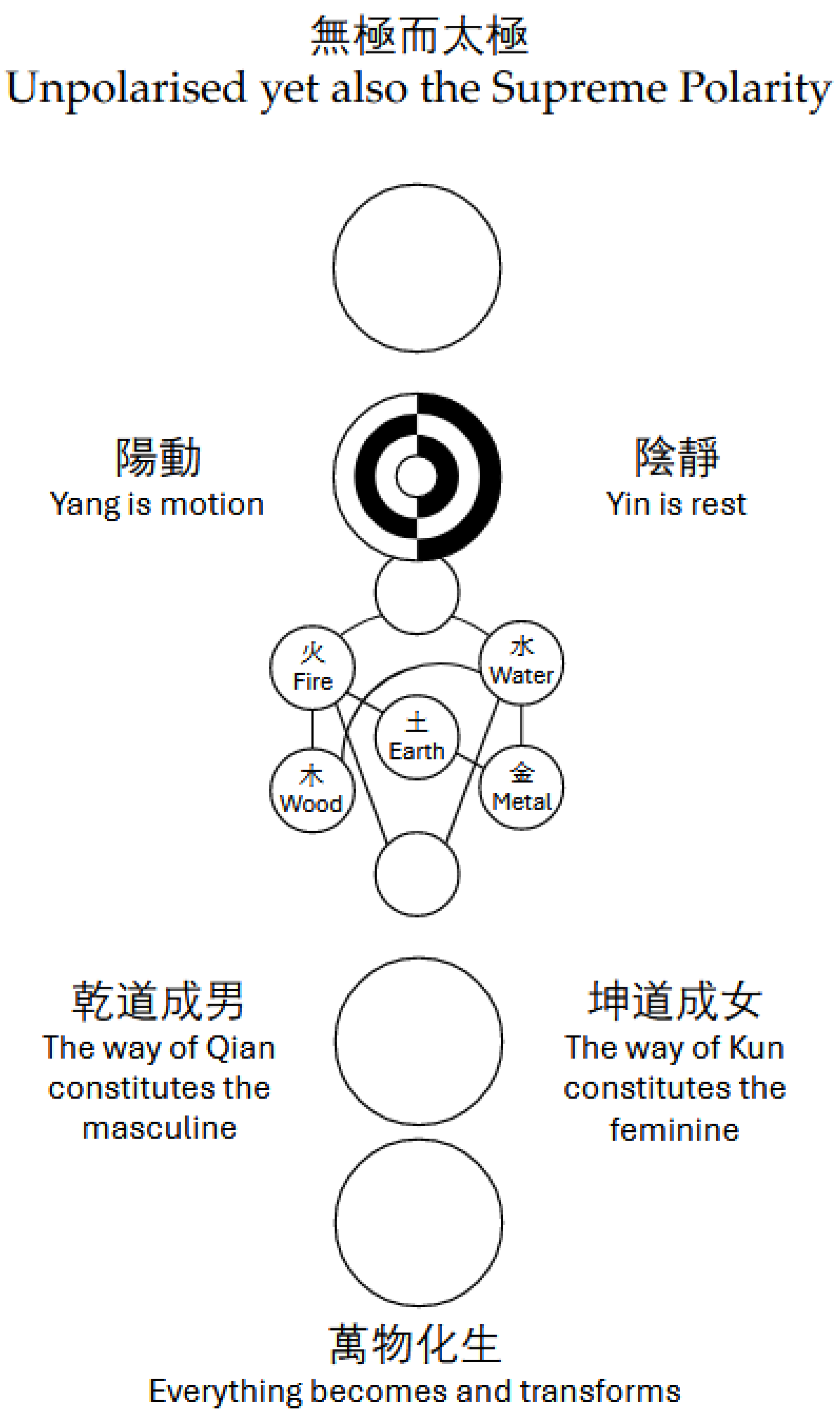
kh Junayd has a counterpart in Chinese philosophy, the highly revered Zhou Dunyi 周敦頤 (1017–1073 CE), who makes a similar puzzling statement about the process of creation. Zhou’s great contribution has been the development of the Taiji diagram, the “Diagram of the Supreme Polarity” (
taijitu 太極圖) which depicts the process of creation, and his explanation of the diagram, “The Diagram of the Supreme Polarity Explained” (
Taijitu shuo 太極圖說) (
Fung 1953, pp. 435–36;
Adler 1999, p. 672) (See
Figure 2).
At the onset of his enigmatic and puzzling explanation of the diagram, Zhou Dunyi refers to two key terms wuji and taiji, which we have discussed above. He linked up the two terms, the former appearing for the first time in the Daodejing (chapter 28) as the limitless state (wuji 無極).
With regard to the terminologies Zhou Dunyi used in his explanations, Adler writes: “Scholars to the present day have attempted to interpret what Zhou Dunyi meant by them” (
Adler 1999, p. 672). Both the terms
wuji and
taiji have been used since antiquity.
Wuji denotes the primordial unpolarised stage of chaos when no conceptual distinction was made between things. In contrast,
taiji denotes the stage when yin and yang are separated leading to the coming into existence of distinctions and multiplicities, the forms of things. In that sense, there is a difference between
taiji and
wuji, i.e.,
wuji is not
taiji. But in Zhou Dunyi we read that “wuji er taiji” (無極而太極) understood as
wuji is
taiji, or literally as: “Unpolarised and yet also the Supreme Polarity.” Zhou continues later on saying: “the Supreme Polarity is fundamentally the Unpolarized.” (
Fung 1953, p. 437).
Zhou Dunyi’s paradoxical statements resonate with the aforementioned Sufi Master’s statement that the Absolute is, at the present time, still in the state of absoluteness, in the state of having no creation, being out of time. This can be interpreted in light of Zhou’s notion that the realm of the primordial unity, and the realm of multiplicities of forms which leads to their actualizations as existing things, exist simultaneously and eternally. This juxtaposition with the words of the Sufi Shaykh sheds light on Zhou Dunyi’s enigmatic and apparently contradictory statements. The relationship between
wuji and
taiji is not temporal; it rather is a hierarchical relationship of dependency. They exist simultaneously, with
wuji as the source and origin of
taiji and the Ten Thousand Things that appear from
taiji. We read in Zhou Dunyi’s
Diagram of the Supreme Polarity Explained: “The Five Elements are the one yin and yang; the yin and yang are the one Supreme Polarity; and the Supreme Polarity is fundamentally the Unpolarized.” (
Fung 1953, p. 437). We see that Zhou is referring to the ultimate unity of all of creation while asserting the differences between created things.
In the Chinese ontology, reading Zhou Dunyi’s
Taiji Diagram (see
Figure 1) from the top to the bottom assigns more weight to the metaphysical primordial chaos, while reading it from the bottom up the ten thousand things in existence assume priority. Zhou Dunyi’s focus was on “the top-down differentiation of the cosmos from the primordial unity to the ‘myriad things.’” (
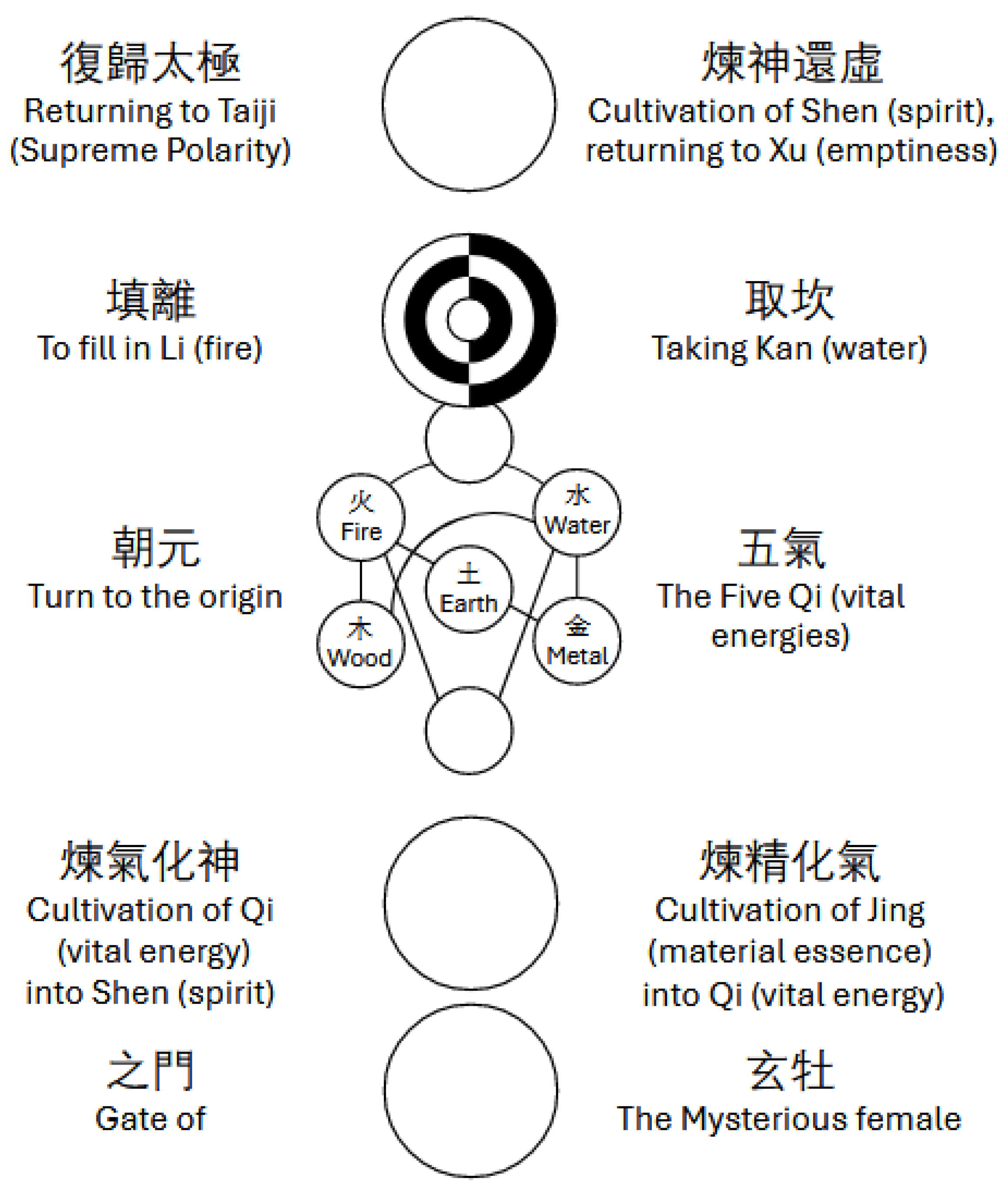
Adler 1999, p. 673). This can be compared with the very similar diagram with different inscriptions, first attributed to the Daoist hermit Chen Tuan 陳摶 (906–89 CE), named the “Diagram of the Unpolarized” (
wujitu 無極圖) (See
Figure 3), which is typically read from the bottom up. This reading has a mystical Daoist nature related to the meditative practice of inner alchemy (
neidan 內丹). The diagram and its short explanations are found in a cave near the city of Xi’an on Mount Hua. Over the centuries there has been a debate about which of the two, Zhou Dunyi or Chen Tuan, developed this diagram first. The dominant view has been that it was the Daoist Chen Tuan who developed the diagram while Zhou Dunyi provided a Confucian interpretation of it (
Wang 2005).
6 The Chen Tuan diagram, reading from the bottom up, depicts various stages of self-refinement and returning to the origin, reaching its peak on the top called “Refining the Spirit to Return to Emptiness” (
lianshen huanxu 煉神還虛), which is a return to the “Infinite” or the “Void” (
Wang 2005;
Komjathy 2024).
While Zhou Dunyi’s reading of the diagram focuses on the metaphysical and ontological process of creation from the primordial chaos and void to the Ten Thousand Things, Chen Tuan’s focuses on the process of the return of human beings to the original unity and void. It is about the return to the origin, a process of spiritual transformation. If we do not read the diagram as depicting a sequential and temporal process, both realms of the primordial origin and the Ten Thousand Things can be understood to exist simultaneously, and either reading is valid: one describes the process of creation from the origin, while the other describes the process of return to the origin.
Zhou Dunyi and Chen Tuan thus provide complementary perspectives that deepen our understanding of the three ontological stages. Zhou’s Taiji Diagram offers a visual and conceptual map: starting with wuji (Chaos), progressing to taiji and yin-yang (emerging patterns), and culminating in the Ten Thousand Things. Chen Tuan’s Wuji Diagram emphasizes the transformative process and its spiritual significance in Daoist practice, where the adept seeks to retrace the ontological stages back to the primordial Dao.
Together, their insights allow us to understand the dynamic relationships between the Three Purities, and bridge cosmological theory with spiritual practice. This insight reminds us of the Qur’ánic verse “He is the First and the Last, the Manifest and the Hidden: and He has full knowledge of all things,” which is, perhaps, alluded to by Baháʼu’lláh in his mystical treatise The Seven Valleys: “seeing the First in the Last and the Last in the First” (
Saiedi 2008, p. 33).
This perspective allows us to shed light on another puzzling and controversial concept in Islamic philosophical thought. A quotation which Islamic philosophers, including Mullá Ṣadrá, have attributed to Aristotle, says: “The primordial [simple] Reality is all things”
7, in some versions followed by “and none of the things.” (
Ṣadr al-Din Shirazi 1981, p. 145). A Daoist equivalent of this concept would be to say that the primordial chaos is in the ten thousand things, and yet, not in any of them.
In the Baháʼí writings, the Báb states that eternally and forever there has been the “Worshiped One” (God) and no worshipers for Him (no created things). Baháʼu’lláh, in relation to this problem, says that in one sense only the Absolute (God) exists since all things compared to God are as nothingness. But on the other hand, all created things manifest the attributes of God. He asserts that dispute on such metaphysical discourses should be avoided as there are reasons for both perspectives (
Ra’fatí 2002, pp. 30–31).
6.2. Linking Transcendence and Immanence Through Phenomenology
In the previous section, we have seen how the four traditions offer formulations of the paradoxical state of being simultaneously in the transcendent realm of oneness—corresponding to the first ontological stage—and the immanent world of multiplicity, corresponding to the third ontological stage. The first stage points to the ultimate source, existing beyond the material and intellectual realms. Transcendence here is the foundation of the ontological model, the infinite wellspring from which all else emerges, yet it remains veiled from direct human experience. In the third stage, on the other hand, immanence reveals the Dao, the Good, the Absolute, or the Divine as intimately accessible—visible in nature, human actions, and the diversity of life. It contrasts with transcendence by bringing the ultimate reality into the realm of experience, affirming its nearness rather than its distance.
Phenomenology, the study of conscious experience and how things appear to us, can serve as a bridge between transcendence and immanence, connecting the unknowable source to the manifest world through lived engagement (
Spiegelberg 1960, p. 7). It can be tied to the second stage—the realm of forms or attributes—where the transcendent begins to manifest in ways that can be apprehended, and it extends into the third stage as a means of experiencing the immanent divine.
In Daoism, Taiji, as the interplay of yin and yang, marks the transition from the transcendent Dao to the immanent world. Daoist practices like wuwei (effortless action) and embodied meditation reflect a phenomenological approach, encouraging direct experience of the Dao’s presence in nature and the body. Zhuangzi’s butterfly dream further exemplifies this, probing the fluidity of perception and reality.
In Platonic philosophy, phenomenology links transcendence and immanence through the process of recollection and philosophical contemplation. According to Plato’s theory of anamnesis, our souls have innate knowledge of eternal Forms from before birth, and encounters with beautiful or just things in the physical world trigger memories of these Forms. For example, in Phaedo 73c-d, Socrates explains that seeing something beautiful leads one to remember Beauty itself. This conscious experience of immanence allows individuals to access the transcendent realm of Forms, bridging the gap between the two. Additionally, through dialectic and reflection, as seen in the Republic’s allegory of the cave, one can ascend from sensory perceptions to understanding higher truths, uniting all three stages in a cohesive philosophical journey.
In Sufism, the realm of archetypes or divine attributes bridges the Absolute and the sensible world. Sufi practices such as
dhikr (
ذکر remembrance of God) and mystical poetry, such as Rumi’s verse “The Beloved is all, the lover but a veil” (from
Mathnaví,
Rumi 2004) employ phenomenological approaches to experience God’s immanence, transcending the ego to perceive divine unity).
In the Bahá’í Faith, the divine attributes, manifested through the Manifestations of God, mediate between the unknowable essence and creation. Bahá’u’lláh urges a phenomenological approach: “Every created thing in the whole universe is but a door leading into His knowledge” (
Bahá’u’lláh 2003, p. 142), inviting believers to attain the phenomenological experience of observing the world as a reflection of the divine.
Phenomenology transforms abstract metaphysical stages into a lived encounter with the divine. By focusing on subjective experience, it enables individuals to perceive the transcendent source through its immanent expressions, uniting the three stages into a cohesive spiritual journey.
The connection of transcendence, immanence, and phenomenology to the three-stage model allows us to appreciate their complementarity, enriching both the metaphysical framework and its practical implications. Rather than disconnected realities or opposing forces, transcendence and immanence form a dynamic whole. The unknowable source (Stage 1) is the transcendent root, while the manifest world (Stage 3) is its immanent fruit. The realm of patterns, forms, or attributes (Stage 2) acts as the pivot through which the transcendent begins to reveal itself. In Daoism, the Dao’s transcendence flows into the immanence of nature; in Platonism, the shadows in the cave point to the light beyond; in Sufism, God’s essence shines through His attributes in creation; in the Bahá’í Faith, God’s unknowable nature is expressed through the personages of Manifestations and the world. This interplay ensures the divine is both beyond and within, infinite yet intimate.
In this process, phenomenology is the experiential link, bridging the stages by offering a method to experience the complementarity between transcendence and immanence. It connects the intellectual apprehension of the second stage (forms/attributes) with the sensory and material engagement of the third (manifest world), providing a pathway to glimpse spiritual transcendence (Stage 1) through the immanent. Across the traditions, it transforms metaphysical concepts into personal realization—whether through Daoist intuition, Platonic contemplation, Sufi mysticism, or Bahá’í social action.
In this scheme, the stages are not static but dynamic, with transcendence setting the source or foundation, immanence grounding it in experience, and phenomenology enabling active participation in the divine process.
7. Ethical Implications of the Three-Stage Ontological Structure
This mystical return to unity is not an abstract ideal—it carries significant ethical weight. The triple ontological structure’s focus on the common source of all phenomena provides a ground and inspiration for ethical behavior: ethics, within this frame, is ultimately neither a set of externally imposed rules or norms, nor a set of abstract principles—rather, it is the natural, inner expression of a soul’s essential connection to the ultimate Unity).
Thus the Daodejing (chap. 38) states: “When the Dao is lost, there is virtue; when virtue is lost, there is benevolence; when benevolence is lost, there is righteousness; when righteousness is lost, there are the rites”) (based on D. C. Lau 1963 translation). This passage emphasizes a hierarchy of sources of ethical behaviour, privileging a spontaneous alignment with Dao that transcends the increasingly differentiating, formalized, and artificial expressions of virtue, benevolence, righteousness, and ritual. The Daodejing advocates an inherent and spontaneous simplicity, humility, and selflessness as natural outcomes of aligning with the Dao rather than a competitive striving for social recognition through virtuous conduct. Laozi states, “The sage… does not contend, so no one in the world can contend with him” (Chapter 22), highlighting non-competition and detachment.
In Platonic philosophy, the mystical return to unity through the ascent to the Form of the Good fosters ethical behavior rooted in the soul’s connection to the ultimate reality. In the Phaedo (114c-d), Plato describes how souls purified through philosophy escape reincarnation to dwell in a divine, unified realm, suggesting that aligning with the Forms—particularly the Good—shapes moral conduct. This alignment manifests as virtues such as justice and wisdom, not as external rules but as natural expressions of the soul’s recollection of eternal truths (Meno 81c-d). The philosopher, having glimpsed the Good, acts selflessly, as seen in the Republic’s allegory of the cave, where the enlightened return to guide others despite personal cost (517a-c). Ethical living thus flows from an inner harmony with the transcendent unity, prioritizing the common good over individual gain.
Sufism emphasizes purifying the heart (
tazkíy-i-qalb تزکیه قلب) and acting with integrity, viewing ethical living as a reflection of divine will. The saying “Die before you die” urges ego transcendence for selfless service. Rabí‘a al-‘Adawiyya, an 8th-century Sufi saint, embodies this through her life of devotion and charity. Her prayer—“O God! If I worship You for fear of Hell, burn me in Hell… But if I worship You for Your Own sake, grudge me not Your everlasting Beauty”—illustrates a commitment to ethical purity driven by love, not reward or punishment (
Schimmel 1975, p. 98;
Smith 1984, p. 55).
In the Seven Valleys, Baháʼu’lláh recounts how,
After scaling the high summits of wonderment, the wayfarer cometh to the Valley of True Poverty and Absolute Nothingness. This station is that of dying to the self and living in God, of being poor in self and rich in the Desired One. Poverty, as here referred to, signifieth being poor in that which pertaineth to the world of creation and rich in what belongeth to the realms of God.”
Elsewhere, in the Hidden Words (
Bahá’u’lláh 1985, p. 52), Baháʼu’lláh links the annihilation of the self to principles of social relations:
O CHILDREN OF MEN!
Know ye not why We created you all from the same dust? That no one should exalt himself over the other. Ponder at all times in your hearts how ye were created. Since We have created you all from one same substance it is incumbent on you to be even as one soul, to walk with the same feet, eat with the same mouth and dwell in the same land, that from your inmost being, by your deeds and actions, the signs of oneness and the essence of detachment may be made manifest.
8. Harmony and Tolerance: Living in Balance and Embracing Diversity
The triple ontological structure’s emphasis on interconnectedness and a single transcendent source manifesting in diverse forms inspires both harmony—balancing the natural world and human relationships—and tolerance, encouraging openness to differing perspectives and beliefs. These principles, rooted in the recognition of the shared ontological origin of all phenomena, create a cohesive ethical framework across Daoism, Platonism, Sufism, and the Bahá’í Faith, where living in alignment with the cosmos and embracing diversity are mutually reinforcing expressions of unity.
In Daoism, the yin-yang principle illustrates the ideal of balance, where opposites complement rather than oppose each other, fostering cosmic harmony that extends to human conduct. The
Daodejing advises, “Know the masculine, but keep to the feminine… Know the white, but keep to the black” (Chapter 28), advocating moderation, softness, and humility. The Classic of the Supreme Peace (
Taiping jing) outlines an ideal society where both the expansive
yang life energies and the receptive
yin nurturing energies (second ontological phase) are harmonized through humans living among the Ten Thousand Beings (third phase), creating a state of Supreme Peace aligned with the Dao (first phase) (
Palmer n.d.).
This same recognition of all things as expressions of the Dao underpins tolerance. The principle of wuwei (non-action or effortless action) promotes acceptance of the natural flow of life, including others’ varied paths. Zhuangzi’s butterfly dream highlights the subjective, fluid nature of experience, suggesting no single perspective holds absolute truth, encouraging Daoists to refrain from judgment and embrace diversity as a natural aspect of the Dao’s expression.
In Platonic philosophy, harmony arises from aligning the soul with the transcendent order of the Forms, particularly the Form of the Good, ensuring balance in cosmic and social spheres. In the Timaeus (47b–c), Plato describes the universe as a harmonious whole crafted by the Demiurge, where the soul’s attunement to this divine order fosters inner and outer balance. The Republic (443d–e) defines justice as the soul’s parts—reason, passion, and appetite—working in concord, mirroring the ideal state’s balance of three classes of Guardians, Auxiliaries, and Workers. This pursuit of harmony encourages virtues like moderation and wisdom, contributing to social cohesion. Tolerance, while often implied, emerges from the recognition of a common transcendental source. In the Symposium (210a–212a), the ascent to the Form of Beauty reveals diverse beauties as reflections of one truth, suggesting acceptance of varied perspectives. Neoplatonism, however, makes this explicit. For example, Plotinus, in the Enneads (V.8.4), states: “The gods are many in their names and powers, yet all proceed from the One, which is beyond all form and multiplicity; in their diversity, they reflect the single source, like rays from the sun.” Here, Plato’s implicit tolerance is transformed into a clear mandate for respecting diversity as a reflection of divine unity.
Sufism fosters harmony and tolerance through its doctrine of
vaḥdat-i-vujúd (Unity of Being
وحدت وجود), articulated by Ibn ‘Arabí, positing that all creation is a manifestation of the Absolute. This understanding inspires teachings on cultivating virtues like humility, compassion, and forbearance—reflections of God’s names, such as Raḥmán (Merciful
رحمن) and vadúd (The Loving
ودود)—to promote social cohesion. Rumi teaches in his
Mathnaví (Book I), “Love is the astrolabe of God’s mysteries,” urging harmonious relationships through selfless love that transcends ego (
Rumi 2004). The practice of
tazkíy-i--qalb (heart purification) removes prejudice, aligning individuals with the divine order and fostering peace. This same ontology encourages tolerance, framing diverse beliefs as unique reflections of the divine reality. Rumi’s poetry exemplifies this: “I am neither Christian, nor Jew, nor Muslim… My place is the placeless, my trace is the traceless” (
Rumi 2004). Qur’ánic verses such as “O mankind, We created you from a single male and female, and made you into nations and tribes that you may know one another” (49:13) advocate mutual respect across communities, creating a society where differences are harmonized through mutual knowledge and understanding.
The Bahá’í vision of harmony and tolerance derives from its core principle of the oneness of humanity, grounded in the idea that all religions make the Unknowable Essence known to humans through the Manifestations of God, while all human souls are mirrors of God’s attributes. This ontological unity translates into an explicit ethical mandate for tolerance, championing the unity of all religions as phases in progressive revelation from a single divine source. “There is but one faith of God, eternal in the past, eternal in the future,” said Bahá’u’lláh, who instructs, “Consort with the followers of all religions in a spirit of friendliness and fellowship” (
Bahá’u’lláh 1988, p. 87).
‘Abdu’l-Bahá (1844–1921) emphasized the abolition of religious prejudice and forbidding conflict in the name of religion: “The divine religions must be the cause of oneness among men, and the means of unity and love; they must promulgate universal peace, free man from every prejudice, and make him a citizen of the world.” The oneness of humanity is understood through the lens of unity in diversity, as stressed by
‘Abdu’l-Bahá (
1917): “Consider the flowers of a garden. Though differing in kind, color, form and shape, yet, inasmuch as they are refreshed by the waters of one spring, revived by the breath of one wind, invigorated by the rays of one sun, this diversity increaseth their charm and addeth unto their beauty”. In Baháʼu’lláh’s words, “The utterance of God is a lamp, whose light is these words: Ye are the fruits of one tree, and the leaves of one branch. Deal ye one with another with the utmost love and harmony, with friendliness and fellowship.” (Baháʼu’lláh 1983, CXXXI). Thus, while harmony and tolerance were, in earlier traditions, often mystical notions not promoted by orthodox institutions and common believers, the Baháʼí Faith elevates the oneness of humanity to the guiding principle of the entire religious community, in its internal operations, in its relationships with the broader society, in its social action, and in its vision of a future world commonwealth.
9. Conclusions
Owing to limitations of space, this essay has only scratched the surface of the rich philosophical thought of the four traditions we have considered. Taking inspiration from the Daoist Three Purities, we have outlined a three-stage ontological framework that unveils a striking convergence in their understanding of existence. This model traces the journey from an unknowable source—termed the Dao in Daoism, the Form of the Good in Platonism, the Absolute in Sufism, and the Unknowable Essence in the Bahá’í Faith—through an intermediary realm of patterns, forms, archetypes, or divine attributes, to the manifest world of the Ten Thousand Things, the physical world, the sensible realm, or creation. This parallel structure reveals a universal metaphysical pattern, illustrating how the transcendent divine becomes immanent in the world we experience.
At the same time, this framework recognises the sometimes profound differences between how the ontological formulations are conventionally understood in each of the four traditions. These differences are especially pronounced in the understanding of the second stage: Daoist patterns derived from dynamic
yin-yang interactions are different from the fixed and perfect forms, archetypes, and attributes of God described in the other three traditions. However, it should be pointed out that a dynamic relationship between God’s attributes and the world of creation is not fully absent in the Sufi and Baha’í discourses. Certain of God’s attributes, in the Sufi and Bahá’í traditions, imply a dynamic relationship between God and creation. For example, God’s attributes of the All-Merciful and the Forgiver (See
W. C. Chittick 1989, p. 130) take their meaning only in terms of a perpetual, dynamic relationship between the Absolute and the world of existence. Furthermore, interpretation of Platonic Forms in Islamic philosophy at times assumes the guardianship of the Forms, directing their realization in the world (
Qurbání 2014, p. 131). Despite such resonances, while the ultimate reality is impersonal or abstract in the Daoist and Platonic philosophies, the Sufi and Baháʼí traditions postulate an active, conscious, absolutely transcendent God.
But these conceptual differences become relativised when considered within the framework of the three-phase ontology. After all, the first phase in all traditions is ultimately unknowable and beyond words—a fundamental insight common to all four traditions, which suggests the futility of intellectual disputes on human formulations of the ultimate reality: “The Way that can be spoken of is not the eternal Way,” said Laozi of the first ontological stage. And the third stage—the world of phenomenal existence—is shared by all humans, regardless of their cultural, philosophical, or religious affiliations or preferences. In the radical sense evoked by Ames in his discussion of Dewey,
Immediate empiricism postulates that things—anything, everything, in the ordinary or non-technical use of the term ‘thing’—are what they are experienced as. […] If you wish to find out what subjective, objective, physical, mental, cosmic, psychic, cause, substance, purpose, activity, evil, being, quality—any philosophic term, in short—means, go to experience and see what the thing is experienced as.
This suggests that we ultimately know the world of phenomenal existence through experience rather than through intellectual concepts. Ultimately, abstract concepts and theories are as impotent to capture the thick immanence of phenomenal existence—the third ontological stage—as they are in capturing the transcendence of the first stage, the ultimate reality. It is in between the two, in the second stage, that we use concepts to try to capture the elusive relationship between oneness and multiplicity, transcendence and immanence—and these concepts will, inevitably, differ between traditions to the extent that they focus on different dimensions of these relationships. As Chittick explains, for Ibn ‘Arabí, “Everything without exception is both God’s face (
vajh وجه), revealing certain divine names, and God’s veil (
ḥijâb, حجاب), concealing other names” (
W. Chittick 2020). This notion can also be applied to human theories and conceptual systems, each of which reveals some aspects of reality while concealing others.
The three-stage ontological framework thus provides a dynamic structure that transcends the comparison of second-stage conceptual systems. The latter are mere bridges or tools to facilitate processes of creation—from the first to the third stage—or return, from the third to the first. These processes concern our action in the world, participating in the creative process, endeavoring to return to the primal unity. Thus, the triple ontological framework found in Daoism, Platonism, Sufism, and the Bahá’í Faith naturally gives rise to ethical principles of tolerance, harmony, and virtuous living. Through Daoist acceptance of diverse paths, Platonic contemplation of universal Forms reflected in the multiplicity of beings, Sufi love transcending boundaries, and Bahá’í efforts toward global unity, these traditions have each developed paths for translating metaphysical oneness into practical ethics and action.
By drawing insights from concepts of transcendence, immanence, and phenomenology, we uncover a deeper unity in the three-stage ontological model. Transcendence establishes the ultimate mystery, immanence brings it into the world, and phenomenology offers a bridge to experience this unity directly. Together, these concepts reveal a complementary framework that not only enriches metaphysical understanding but also inspires social harmony and ethical living, offering insights on navigating the relationship between the ultimate and the everyday.
The significance of this shared framework indeed extends beyond mere philosophical curiosity. It underscores a profound unity beneath the diversity of these traditions, fostering ethical principles that resonate across cultures. By constructing a common ontological framework and exploring ethical foundations, the shared framework offers wisdom for addressing contemporary global challenges—often characterised by division, conflict, and disconnection—through mutual understanding and a renewed sense of universal purpose through the notion of “return” to the One. In a world yearning for unity, this convergence invites us to see beyond differences and embrace the shared essence that binds humanity to the cosmos.