3.1. Problem Description
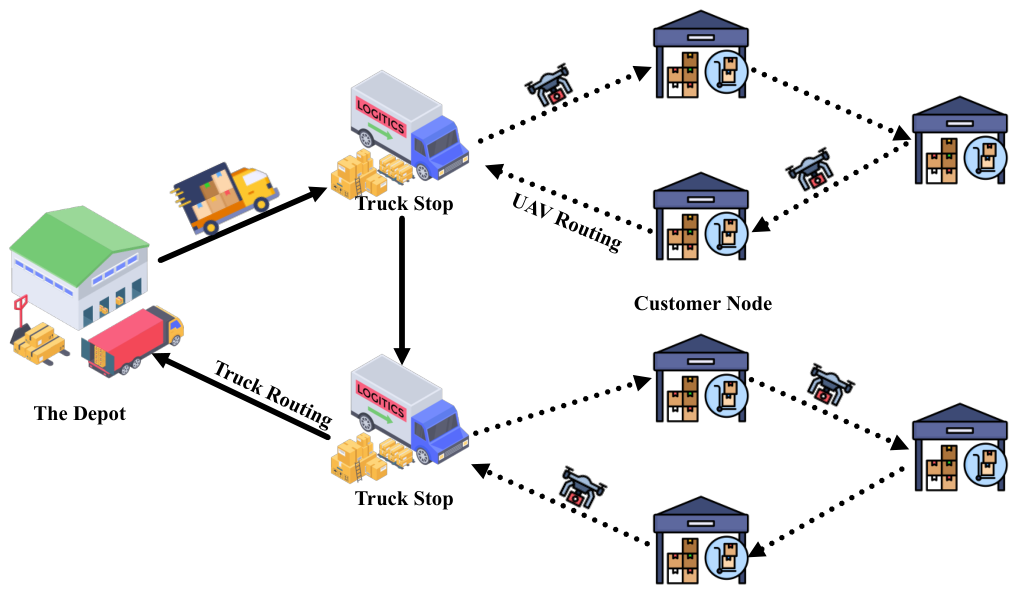
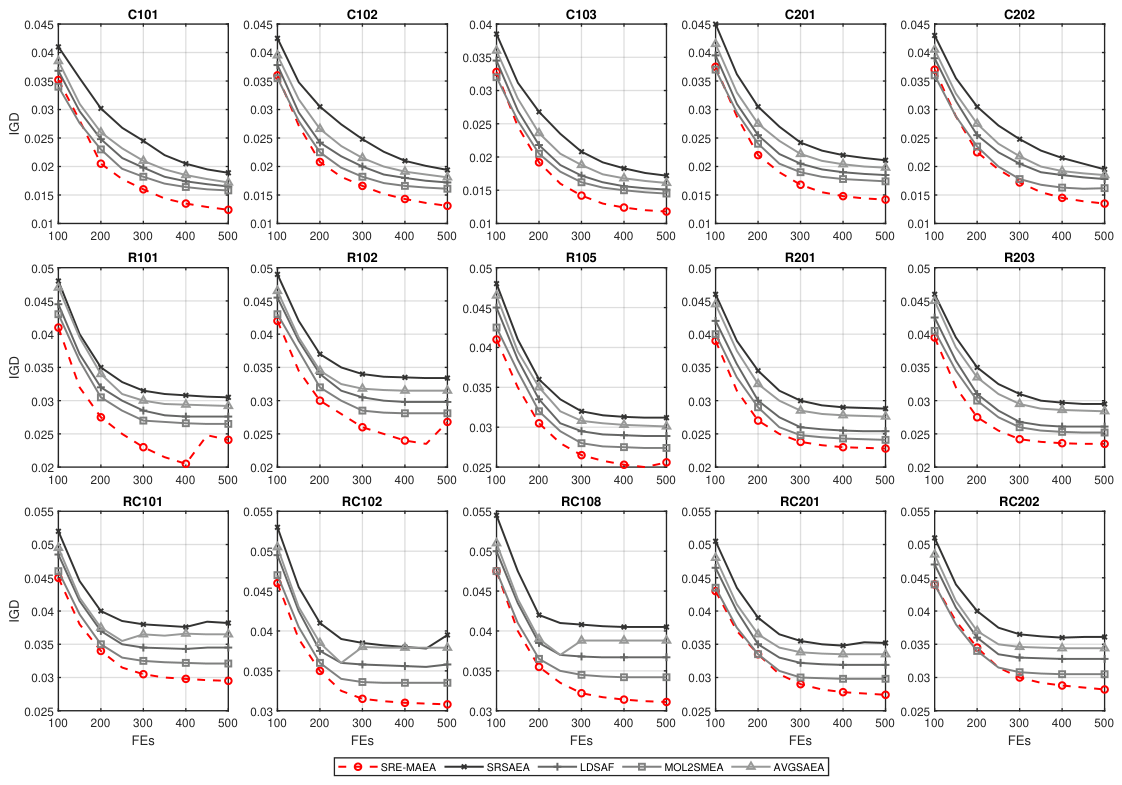
The multi-objective routing optimization problem for truck–UAV coordinated delivery investigated in this study aims to construct a complex logistics system that integrates economic efficiency, service perception, environmental sustainability, and technical resilience within the context of the low-altitude economy. The system comprises a truck equipped with multiple landing platforms and a fleet of heterogeneous UAVs, tasked with serving customer nodes within a defined geographical area. In the operational workflow, the truck departs from a central depot carrying both parcels and UAVs. Functioning as a mobile base station, the truck deploys UAVs at designated launch points to execute last-mile delivery tasks while simultaneously proceeding to subsequent service nodes. Upon task completion, the UAVs synchronize with the truck at downstream rendezvous points, according to a predefined trajectory, for energy replenishment or cargo reloading. A schematic representation of this coordinated truck–UAV routing problem is illustrated in
Figure 1.
Within the optimization of the coordinated delivery system, the economic, social, environmental, and resilience dimensions are not isolated; rather, they exhibit complex trade-offs and conflicting interdependencies. The economic dimension serves as the operational baseline, focusing on minimizing fuel costs, UAV power consumption, and equipment depreciation through route optimization. However, a singular pursuit of economic efficiency often compromises delivery timeliness, thereby adversely affecting the social dimension. The latter incorporates a customer satisfaction model based on utility theory, capturing the non-linear psychological expectations regarding UAV delivery promptness, which necessitates a strategic balance between operational costs and service quality. Simultaneously, the environmental dimension monitors carbon footprints under heterogeneous power sources, where fuel emissions from trucks and implicit emissions from UAV electricity usage are significantly influenced by real-time payloads and trajectory characteristics. A pivotal innovation of this study is the integration of a resilience dimension to reflect long-term system robustness, specifically examining UAV battery cycle life and mechanical wear. In coordinated scheduling, over-utilizing UAVs for long-distance missions to maximize satisfaction can lead to excessive depths of discharge, thereby accelerating the degradation of the State of Health (SoH) and undermining technical resilience. Consequently, the essence of this problem lies in identifying and decoupling the non-linear coupling mechanisms among these four conflicting objectives within dynamic decision boundaries to derive globally optimal scheduling solutions.
From the perspective of computational complexity, this problem is classified as a strongly NP-hard combinatorial optimization problem characterized by intricate time windows and multiple resource constraints. During the modeling and solution process, the system must operate within a rigorous spatiotemporal synchronization framework. First, synchronization constraints dictate that UAVs must complete the “launch-delivery-rendezvous” closed-loop cycle within limited power endurance boundaries; any suboptimal decision regarding rendezvous points may lead to mission failure or hardware damage. Second, payload constraints require that the real-time load of both the truck and UAVs remains below rated thresholds throughout the dynamically alternating delivery chain, directly limiting the coverage and operational flexibility of individual coordinated missions. Furthermore, airspace safety and environmental dynamics constitute external hard constraints. Consequently, UAV trajectory planning must strictly adhere to low-altitude management policies, avoid no-fly zones, and comply with specific operational risk assessment metrics.
To ensure conceptual rigor, it is necessary to clarify the scope and boundaries of “resilience” as defined in this study. From an engineering and operational perspective, we define resilience as the system’s ability to maintain a high level of mission fulfillment and recovery performance in the face of energy-related perturbations (e.g., unexpected battery depletion or power fluctuations). Specifically, this study focuses on operational resilience, which is quantified by the drone’s capacity to adjust its routing and recharging strategy to prevent mission failure under constrained energy budgets. The boundaries of this definition exclude the structural/mechanical resilience of the UAV hardware or the macroeconomic resilience of the logistics supply chain. By narrowing the scope to the interplay between energy dynamics and scheduling flexibility, we provide a precise metric for evaluating the reliability of the truck–UAV system in uncertain environments.
3.4. Objective Functions
The multi-objective optimization model developed in this study is designed to quantify and balance the inherent conflicts among the economic, social, environmental, and resilience dimensions of the coordinated delivery system.
(1) Minimization of Total Delivery Cost ()
The economic objective function,
, evaluates the total resource investment required by the truck–UAV system to fulfill all delivery tasks. This objective is formulated as the weighted sum of fixed depreciation costs and energy consumption costs:
. Specifically, the fixed depreciation cost (
) characterizes the capital loss of equipment relative to its operational intensity. The truck’s depreciation is proportional to its travel distance, while the UAV depreciation is determined by the number of mission launches and the total operational duration:
where
denotes the depreciation coefficient per unit distance for the truck,
represents the distance between nodes
i and
j, and
is the binary decision variable for the truck’s route. Regarding the UAV components,
signifies the fixed wear-and-tear cost per launch–recovery cycle,
is the depreciation rate per unit of flight time,
denotes the total duration for the UAV to complete a coordinated triplet
, and
is the corresponding route decision variable.
The energy consumption cost (
) encompasses the fuel consumption of the truck and the electricity consumption of the UAVs. To enhance the predictive accuracy of the model, payload factors are integrated into the energy functions to characterize the significant impact of dynamic loading on energy efficiency:
where
and
denote the unit prices of fuel and electricity, respectively. The truck’s fuel cost is intrinsically linked to the energy efficiency curve formed by travel distance and real-time payload, whereas the UAV electricity cost depends on the operational power and mission duration. Specifically,
represents the fuel consumption per unit distance for the truck under a real-time payload
Q. Given the dynamic load variations of the truck serving as a mobile base station, this function is defined as
, where
is the baseline fuel consumption in an unloaded state and
is the payload correction factor reflecting the marginal contribution of cargo weight to fuel consumption. Regarding the UAVs,
signifies the power consumption per unit time when carrying a payload
q. In low-altitude operational environments, UAV energy consumption is governed by the interplay of gravity, aerodynamic drag, and rotor lift. Consequently, the output power exhibits a pronounced non-linear positive correlation with the instantaneous load, and the cumulative energy consumption is evaluated across the duration of each coordinated mission,
.
(2) Maximization of Perceived Customer Satisfaction ()
The social objective function,
, is designed to evaluate the service quality of the logistics system in terms of meeting customer temporal requirements. Given that customer perception of delivery timing exhibits pronounced non-linearity and asymmetry, this study incorporates a psychological utility function based on time windows to quantify perceived satisfaction:
where
denotes the perceived satisfaction of customer
i at arrival time
. To accurately capture the psychological expectations regarding “immediacy” in the context of low-altitude distribution, the function is defined as follows:
Equation (
4) characterizes the dynamic evolution of customer expectations. Specifically, when delivery occurs before the desired time window
, the customer remains in a state of full satisfaction (utility value of 1). If the delivery time exceeds
but remains within the maximum tolerable threshold
, the satisfaction level undergoes an exponential decay relative to the delay. Within the coordinated truck–UAV paradigm, the parameter
serves as a sensitivity coefficient to calibrate the varying degrees of delay tolerance among different customer segments, thereby reflecting potential perceptual differences across diverse delivery modes.
(3) Minimization of Total Multi-source Carbon Emissions ()
The environmental objective function,
, quantifies the ecological impact of the delivery system throughout its operational cycle. Given the heterogeneous power sources utilized by trucks and UAVs, this study establishes a comprehensive carbon footprint model that integrates direct emissions from fossil fuel combustion and indirect emissions associated with electricity consumption:
Truck Carbon Emissions (
): Direct emissions originate from the internal combustion process of fossil fuels. Building upon the aforementioned load-dependent energy model, the total carbon emissions of the truck are proportional to its fuel consumption and the specific fuel emission factor:
where
denotes the CO
2 emission factor per unit volume of fuel (kg/CO
2/L). Since the consumption function
dynamically accounts for the real-time payload
Q, the model effectively characterizes the marginal environmental pressure exerted by heavy-load transportation.
UAV Indirect Carbon Emissions (
): Although UAVs produce zero tailpipe emissions during flight, their electricity consumption entails a carbon footprint at the power generation stage. The indirect emissions are formulated as
where
represents the average carbon intensity factor of the electricity grid (kg/CO
2/kWh), and
is the real-time power consumption function. This component allows the optimization framework to evaluate the contribution of low-altitude delivery missions to the overall carbon burden of the energy grid.
(4) Minimization of System Equipment Health Degradation ()
The resilience objective function,
, is designed to mitigate the performance degradation of core delivery equipment through optimized routing decisions, thereby ensuring the long-term operational reliability of the logistics network. This model specifically accounts for the cycle life loss of UAV power batteries and the mechanical fatigue of the truck:
UAV Battery Cycle Life Loss (
): For high-frequency operational equipment, the essence of UAV resilience lies in its battery SoH. Empirical studies indicate that cycle life degradation exhibits a non-linear exponential relationship with the DoD per mission; frequent deep discharges drastically accelerate electrochemical deterioration. The degradation model is formulated as
where
denotes the baseline degradation coefficient,
is the sensitivity parameter for DoD impact, and
represents the instantaneous discharge depth. This formulation imposes a computational penalty: as energy consumption approaches the battery capacity threshold, the degradation value increases exponentially, guiding the algorithm to select more robust launch/rendezvous points to preserve battery integrity.
Truck Mechanical Lifetime Loss (
): Truck resilience degradation primarily stems from mechanical fatigue and drivetrain wear caused by sustained, high-load operations. This study defines it as a cumulative function of travel distance and operational intensity:
where
represents the lifetime degradation coefficient per unit distance under standard loading, and
is the acceleration factor for mechanical wear under heavy-load conditions. This component enables the model to balance the interplay between travel distance and loading intensity on the long-term reliability of the vehicle.
3.5. Constraint Functions
(1) Flow Balance Constraints: Flow balance constraints are fundamental to ensuring the physical feasibility of the coordinated truck–UAV delivery scheme. By enforcing conservation of flow for delivery vehicles across the node set
V, these constraints construct a closed-loop operational trajectory. It is mandated that all participating trucks
and UAVs
must depart from the starting depot (node 0) and ultimately converge at the terminal depot (node
) after traversing their prescribed routes. This logic ensures the integrity of the logistics mission, formulated as follows:
For any intermediate node
within the delivery network, the conservation principle of in-degree and out-degree must be satisfied. Specifically, if a truck or UAV enters a customer site or transshipment point, a corresponding departure arc must exist directed toward the subsequent target node:
These constraints guarantee both geographical continuity and the state-transition logic inherent in the air–ground coordination. For UAVs, as their collaborative path encompasses three distinct stages—launch, service, and rendezvous—the flow balance further dictates that upon completing service at a specific customer node, a physical reunion with the mother truck at the predefined rendezvous node k is mandatory to achieve flow closure.
(2) Service Coverage Constraints: Service coverage constraints serve as the foundational criteria for ensuring operational efficiency and contractual fulfillment within the logistics system. These constraints enforce the mutual exclusivity and exhaustiveness of delivery tasks in the spatial dimension, stipulating that each customer node
must be assigned to exactly one service entity. Under the coordinated truck–UAV architecture, a customer’s service request can be fulfilled through two competing modes: direct truck visitation for delivery, or end-to-end dispatch via a UAV launched from the mobile truck platform. To eliminate operational redundancy and optimize resource allocation, the model mandates a uniqueness constraint, strictly prohibiting duplicated services or omissions for any single customer site. The mathematical formulation is as follows:
The first term on the left side represents the aggregate of all truck arcs entering customer i, while the second term signifies the summation of all coordinated UAV paths designated to serve node i. The sum of these terms is strictly equal to unity, thereby ensuring the isolation and determinacy of each task within the decision space.
(3) Spatiotemporal Coupling and Synchronization Constraints: Spatiotemporal coupling constraints constitute the logical core of the coordinated delivery system, as they enforce state consistency between heterogeneous delivery agents during dynamic operations. By strictly interlinking the truck’s trajectory with the UAV operational range, these constraints ensure the precise alignment of delivery tasks across multi-dimensional space and a continuous timeline. Within this collaborative framework, UAV operations are not isolated but function as mobile extensions of the truck-based supply side. The model mandates that for any coordinated UAV path
, both the launch node
i and the rendezvous node
k must strictly belong to the operational sequence of the same truck
. Consequently, if a UAV departs at node
i and is scheduled for recovery at node
k, the truck’s routing variables must reflect the corresponding physical connectivity at these nodes. The mathematical formulation is given by
These constraints guarantee that UAV launch and recovery actions are spatially aligned with the truck’s coordinate trajectory in real time, eliminating the risk of task failure due to path disconnection. Furthermore, since the travel speeds and payloads of trucks and UAVs differ significantly, their arrival times at the rendezvous node
k are often non-synchronous. The system enforces synchronization logic by incorporating arrival time variables and the Big-M method:
where
represents the arrival time of truck
t at rendezvous node
k,
is the departure time of UAV
d after serving customer
j,
denotes the return flight duration, and
M is a sufficiently large positive constant. This constraint ensures that the truck waits for the UAV at the rendezvous point, thereby maintaining the integrity of the delivery chain.
(4) Node Sequencing Constraints: Node sequencing constraints serve as rigid criteria to ensure the temporal irreversibility of coordinated delivery tasks. Within the typical tripartite operational chain of “launch–service–rendezvous”, the model must enforce a strict linear temporal logic to eliminate spatiotemporal paradoxes and guarantee the unidirectional flow of the delivery process. For any coordinated UAV path
, the operational sequence consists of three mutually exclusive and successive stages: first, the UAV is loaded and released at launch node
i; subsequently, it traverses to customer node
j to perform delivery; finally, it proceeds to rendezvous node
k for recovery by the truck. This causal chain necessitates that the timestamps of each stage satisfy a strictly increasing relationship:
where
denotes the release time of the UAV at node
i,
represents the arrival time at the customer site,
is the departure time after service completion, and
signifies the moment of arrival at the rendezvous point. These constraints ensure a unidirectional progression of the delivery mission along the timeline, effectively preventing any logical temporal overlaps or crossovers.
(5) Payload Capacity Constraints: Payload capacity constraints define the critical physical boundaries for ensuring the operational safety and energy efficiency of delivery missions. Both the truck, serving as a mobile base station, and the UAVs, performing last-mile delivery, must maintain real-time cumulative payloads that do not exceed their respective maximum rated capacities across any given arc. For UAVs, specifically, the rotor lift is fundamentally constrained by the propulsion system’s output, leading to high sensitivity toward payload variations. Consequently, this constraint directly dictates the distribution of deliverable cargo types among the set of customers
N. The mathematical formulation is as follows:
where
denotes the instantaneous payload of truck
t on arc
,
represents the cargo demand weight at customer node
j, and
signifies the rated payload capacity of the UAV. This restriction compels the optimization system to filter high-load tasks during the routing decision phase, ensuring that all flight operations remain strictly within the prescribed safety envelope.
(6) Energy and Power Constraints: Energy and power constraints aim to mitigate the risk of UAV crashes resulting from power exhaustion by imposing a mandatory upper bound on the energy consumption of each coordinated mission, while simultaneously addressing the resilience requirements for long-term battery service. During the execution of a coordinated path
—encompassing departure from launch node
i, delivery at customer node
j, and recovery at rendezvous node
k—the cumulative energy consumption
must not exceed the effective operational capacity of the onboard battery. To align with the resilience objectives, a SoC safety margin is incorporated into the model to prevent irreversible damage to battery health caused by deep discharge cycles. The mathematical formulation is as follows:
where
denotes the total rated capacity of the battery and
represents the predefined safety threshold of the remaining energy percentage. These constraints not only define the physical operational radius of the UAVs but also ensure the sustainability of energy scheduling within a secure safety envelope.
(7) Arrival Time Constraints: Arrival time constraints define the arrival moments of delivery vehicles at each node through a recursive formulation, incorporating critical temporal factors such as operational preparation, cargo delivery, and task synchronization. The arrival time of a truck at a subsequent node
j is contingent upon its departure time from the preceding node
i and the travel duration across arc
. To accurately characterize the collaborative nature of the delivery process, if node
i involves the launch or recovery of a UAV, a marginal setup time for equipment deployment and payload loading must be added to the baseline service duration. The mathematical formulation is as follows:
where
and
denote the arrival times of truck
t at nodes
j and
i, respectively;
is the service duration at node
i;
represents the fixed setup time required for UAV launch or recovery; and
signifies the travel time of the truck on arc
. The Big-M term ensures that this constraint is activated only when the truck actually traverses arc
. This logic quantifies the time erosion effect of collaborative operations on the truck’s primary route, thereby ensuring the temporal reliability of the scheduling scheme in real-world scenarios.
(8) Variable Definitions and Domain Constraints: Domain constraints are established to demarcate the decision space and ensure that auxiliary variables adhere to the underlying physical logic of the real-world delivery system. To characterize the discrete selection behavior of delivery agents within the network topology, the routing decision variables are defined as binary. This formulation transforms the complex combinatorial optimization into a structured integer programming framework:
In contrast to the discrete routing variables, the auxiliary variables representing operational processes exhibit continuous physical characteristics. To maintain consistency with physical causality, these variables—encompassing arrival times, real-time payloads, energy consumption, and degradation metrics—must take values within the non-negative real domain:
These non-negativity constraints guarantee that all physical quantities remain meaningful throughout the computational process, effectively precluding any counter-intuitive negative outputs and ensuring the practical feasibility of the optimization results.