Article

Anxiety Trait as a Potential Endophenotype in First-Degree Relatives of Bipolar Disorder Type I Patients


1
CSM-1 Mental Health Department, Badalona Serveis Assistencials, 08911 Badalona, Spain
2
Mental Health Department, Corporació Sanitària Parc Taulí, 08208 Sabadell, Spain
3
Departament de Psiquiatria i Medicina Legal, Universitat Autònoma de Barcelona (UAB), 08193 Bellaterra, Spain
4
Associació de Salut Mental Horta-Guinardó, 08035 Barcelona, Spain
5
Mental Health Department, Corporació Sanitària Parc Taulí-CIBERSAM-I3PT-ICREA, 08208 Sabadell, Spain
*
Author to whom correspondence should be addressed.
Prim. Hosp. Care 2026, 25(2), 12; https://doi.org/10.3390/phc25020012
Submission received: 27 April 2026 / Revised: 30 June 2026 / Accepted: 14 July 2026 / Published: 4 August 2026

Abstract

Background: Primary care providers are increasingly using screening programs to identify patients at risk of mental disorders. Early diagnosis of bipolar disorder type I (BDI) is essential for a better outcome. Endophenotypes are an important subtype of biomarkers. Furthermore, previous studies show anxiety trait as a possible BDI endophenotype, but there is a lack of replication. Objective: Our study evaluates the presence of anxiety trait and bipolarity risk in bipolar disorder type I first-degree relatives (FDR). Methods: We evaluated 219 participants (119 healthy controls, 68 healthy FDR and 32 affective unipolar FDR), including sociodemographic data, psychiatric history, Spielberg’s State and Trait Anxiety Inventory (STAI), General Health Questionnaire, Beck Depression Inventory, and Mood Disorder Questionnaire (MDQ) scores as a measure of bipolarity risk. Results: In our sample, affective unipolar BDI’s first-degree relatives showed the highest scores in STAI anxiety trait compared to healthy controls and BDI’s healthy first-degree relatives. STAI-Trait only correlated significantly with bipolarity risk (MDQ) in the unipolar affective first-degree relatives subgroup. Conclusions: Although further investigation is warranted, trait anxiety is a potential endophenotype for BDI. It exhibits high heritability and confers an increased lifetime risk for unipolar affective disorder and a predisposition toward bipolarity.

1. Introduction

Bipolar disorder (BD) has a lifetime prevalence of approximately 2–2.5% of the world population [1,2] and is associated with a significant mortality due to suicide and medical comorbidities. Recent analysis has revealed the heterogeneity of the spatial and temporal distribution of BD and its evolutionary trends [3]. Adequate early diagnosis and treatment are difficult to implement in daily clinical practice [2]. Primary care providers (PCP) are increasingly using screening programs to identify patients at risk of mental disorders [4], and PCP will work closely with psychiatric consultants in order to deliver coordinated and comprehensive community-based care for patients with mental health conditions, including BD [4]. In addition, there is a great interest in including PCP in the prevention of suicide [5,6,7].
There is also a higher risk of developing mood disorders among the biological relatives of patients with bipolar disorder, indicating a strong genetic component with high heritability rates (59–93%) [8]. Concordance rates increase from 6% in dizygotic twins to 43% in monozygotic twins [9]. First-degree relatives, such as parents, offspring, and siblings of patients with bipolar disorder, have a higher risk of developing bipolar disorder and other major psychiatric disorders [10].
The onset of BD is present, in most patients, with a major depressive episode. A great proportion of these initial patients are often wrongly diagnosed as an unipolar depression [3,11], taking several years to have the correct diagnosis and leading to a higher risk of antidepressant-induced manic episodes, rapid cycling, suicide, hospitalization and social maladjustment [12]. Therefore, earlier identification of emergent bipolar disorder in at-risk populations should be a key research priority.
Despite evidence for substantial genetic load in the etiology of bipolar disorder, clinical practice still suffers from a lack of biological markers that could support earlier diagnosis. However, over the past few years, emerging research has identified promising biomarkers (including genetic, neuroimaging, and peripheral biomarkers, as well as cognitive endophenotypes) that indicate genetic risk and may serve as predictive, prognostic, or treatment response markers [13,14,15].
Endophenotypes represent an important subtype of biomarkers [16,17,18]; however, to date, relatively few have been identified in psychiatry. A continued search for endophenotypes is crucial for a better comprehension of etiological mechanisms and for the discovery of heritable trait markers in bipolar disorder [13,14,15,19].
Several previous studies have attempted to analyze the presence of significant levels of trait anxiety in first-degree relatives of individuals suffering from bipolar disorder, using various measures and methodologies [9,12,16,20,21].
An initial study by Contreras et al. [22] attempted to determine whether quantitative anxiety symptomatology is a candidate endophenotype for bipolar disorder type I (BDI) by testing the heritability of both anxiety state—defined as the level of anxiety an individual is currently experiencing that may change over time—and anxiety trait—representing a stable level of anxiety experienced over the lifetime—in a sample of patients and their extended pedigrees from the Central Valley of Costa Rica. Regarding trait anxiety, individuals with bipolar disorder showed the highest scores, followed by relatives with other psychiatric disorders, healthy relatives, and healthy unrelated controls, who showed the lowest scores.
Moreover, the same research team proposed an analysis to establish quantitative trait anxiety as a potential endophenotype [23]. They studied 619 individuals, including 568 participants from 61 extended families and 51 unrelated healthy controls (55% female; mean age = 43.25 years, SD = 13.90, range 18–78). According to the authors, trait anxiety, as measured by the STAI, meets the criteria for an endophenotype of bipolar disorder type I: (1) association with bipolar disorder type I (individuals with bipolar disorder type I showed the highest trait scores), (2) state independence confirmed through a test–retest analysis in 321 subjects, (3) co-segregation within families, (4) heritability, and (5) a genetic correlation with bipolar disorder type I.
To our knowledge, these preliminary studies have not been replicated in new samples. The aim of our study is to evaluate the presence of a potential anxiety trait endophenotype in a different independent sample of bipolar disorder type I first-degree relatives’ population. These determinations allow PCP to detect systematically bipolar risk between BDI relatives, and, eventually, suicide risk populations.

2. Materials and Methods

2.1. Design and Setting

This is a cross-sectional, case–control study with a parallel analysis of first-degree relatives (parents, offspring, and siblings; n = 100) of individuals diagnosed with bipolar disorder type I. Among them, we identified a healthy subgroup of first-degree relatives (n = 68) without any past or current history of affective (unipolar or bipolar) or other psychiatric disorders, as well as an affective subgroup with a past or current history of a unipolar major depressive episode (n = 32). Additionally, a control sample of healthy unrelated individuals (n = 119) without any past or current history of affective or psychiatric disorders was selected; these individuals also had no first- or second-degree relatives with bipolar or psychotic disorders.
Recruitment was carried out as part of a larger, ongoing longitudinal study on the immunological, endocrine, clinical, and outcome factors associated with bipolar disorder type I, which has been published elsewhere [24]. The cohort of relatives was recruited from our Mental Health Department, while the control group was recruited from working staff and casual visitors found in the waiting rooms of non-psychiatric departments. All participants resided in the same geographic area (Vallès Occidental, Barcelona, Spain). The study was approved by our Institutional Research Ethics Committee and followed standard international ethical and legal criteria.

2.2. Subject Selection and Inclusion Criteria

All participants were aged 18 years or older, with no upper age limit. An exhaustive psychiatric and psychopathological evaluation—utilizing the SCID-I based on the American Psychiatric Association DSM-IV-TR criteria [25,26]—confirmed the presence or absence of any psychiatric history to classify participants into three distinct subgroups: healthy first-degree relatives, unipolar affective first-degree relatives, and healthy controls. Inclusion criteria for the healthy control group also required no history of bipolar disorder or any other severe psychiatric condition among their first- and second-degree relatives.

2.3. Scales and Analysis Material

All subjects filled a form with basic sociodemographic and clinical variables with the Spanish version of the following tests: the 28-item General Health Questionnaire (GHQ-28) [27], Beck Depression Scale [28], Spielberg’s State and Trait Anxiety Inventory (STAI) [29] and the Mood Disorder Questionnaire (MDQ) as a measure of bipolarity risk [20].

2.4. Statistical Analysis

The sample was described using the arithmetic mean, standard deviation, and percentages. The relationship between variables was assessed using the Chi-square test, Student-t test, ANOVA and Pearson correlation coefficient. Significance levels were established at p < 0.01. We model bipolarity risk (MDQ scores) using linear regression with the backward method. Analyses were carried out using the SPSS 21 program.

3. Results

3.1. Sample Characteristics

The total sample included 219 participants: 119 healthy controls, 68 healthy first-degree relatives, and 32 affective unipolar first-degree relatives. The mean age of the overall sample was 40.1 years (SD = 14.7; 67.6% female). Significant statistical differences were found between the subgroups across sociodemographic variables (Table 1). Specifically, the healthy control group was younger, comprised a higher proportion of single individuals, and exhibited higher rates of university degrees and active employment. Conversely, the affective first-degree relatives subgroup showed a significantly higher proportion of women.

3.2. Analysis Between Groups

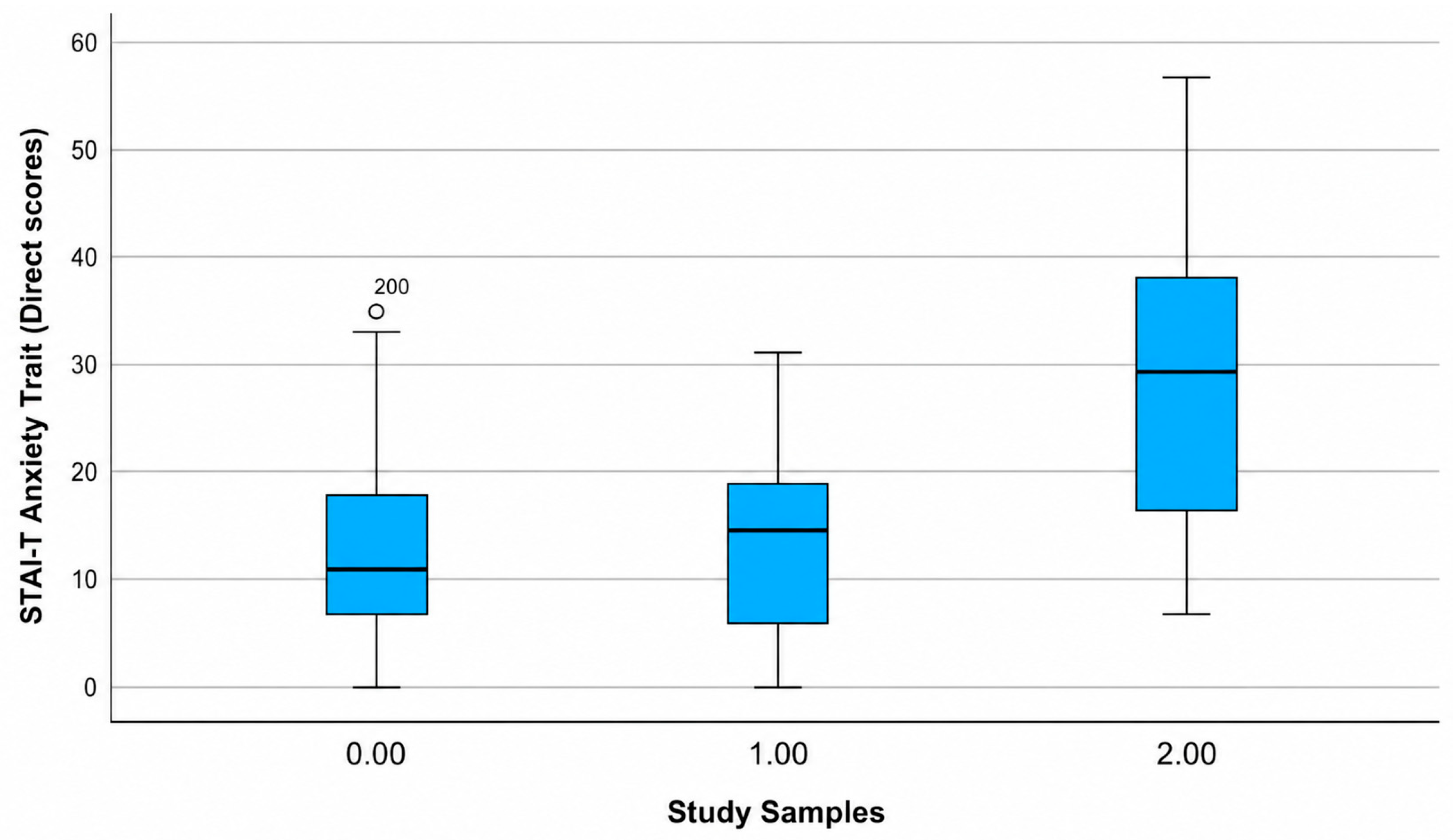
Regarding the comparative analysis of GHQ, STAI-Trait, and STAI-State scores, the affective first-degree relatives sample showed significantly higher scores in comparison with both healthy first-degree relatives—with a very large effect size—and healthy controls. Conversely, no statistically significant differences were observed between healthy controls and healthy first-degree relatives (Figure 1; Table 1).
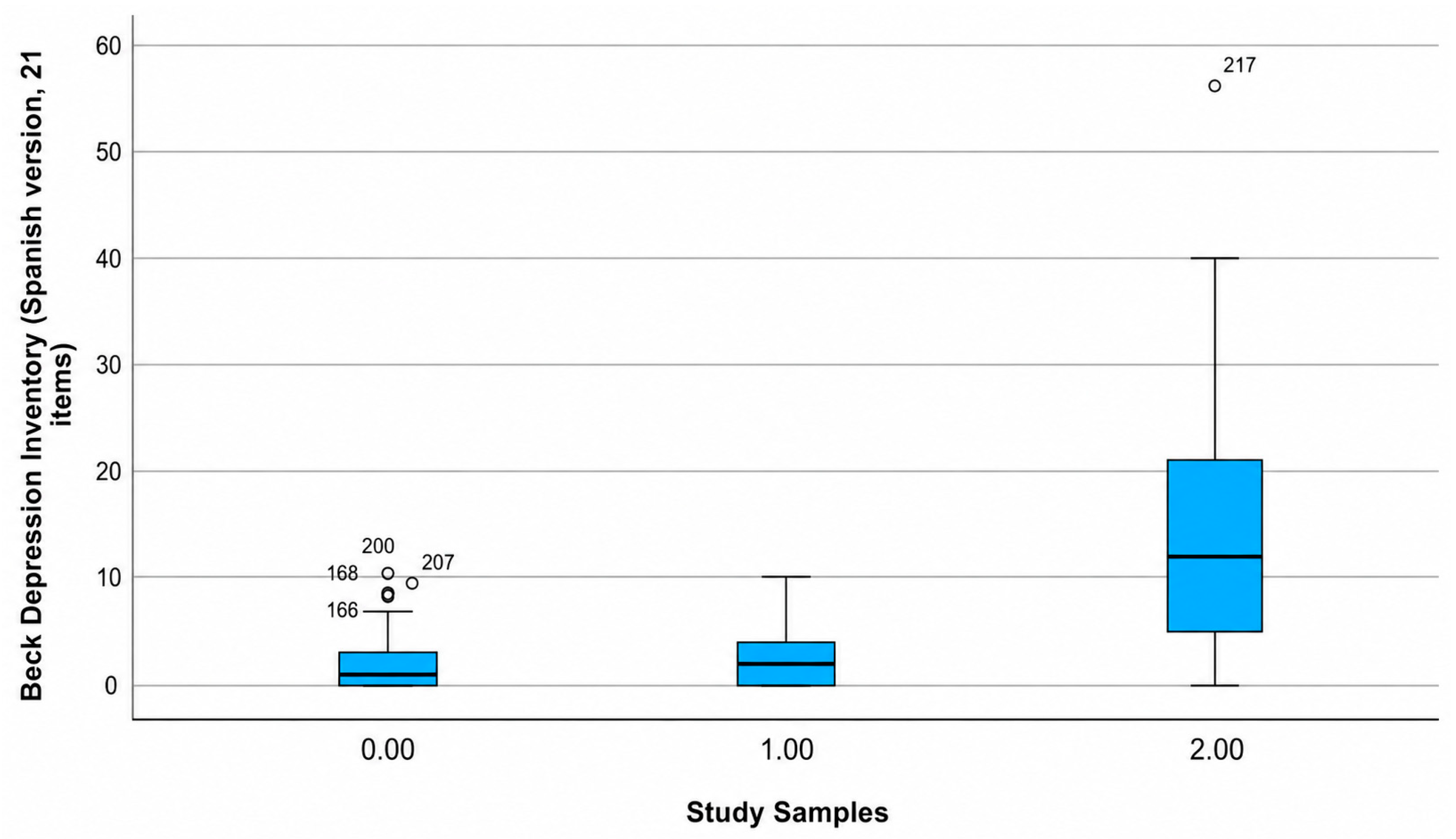
Regarding the Beck Depression Inventory, the affective first-degree relatives showed significantly higher scores than both the healthy first-degree relatives—with a very large effect size—and the healthy control subgroups (Table 1). Conversely, the healthy first-degree relatives subgroup only showed a slight tendency toward higher Beck Depression Inventory scores compared to healthy controls, with a small effect size (Table 1, Figure 2).
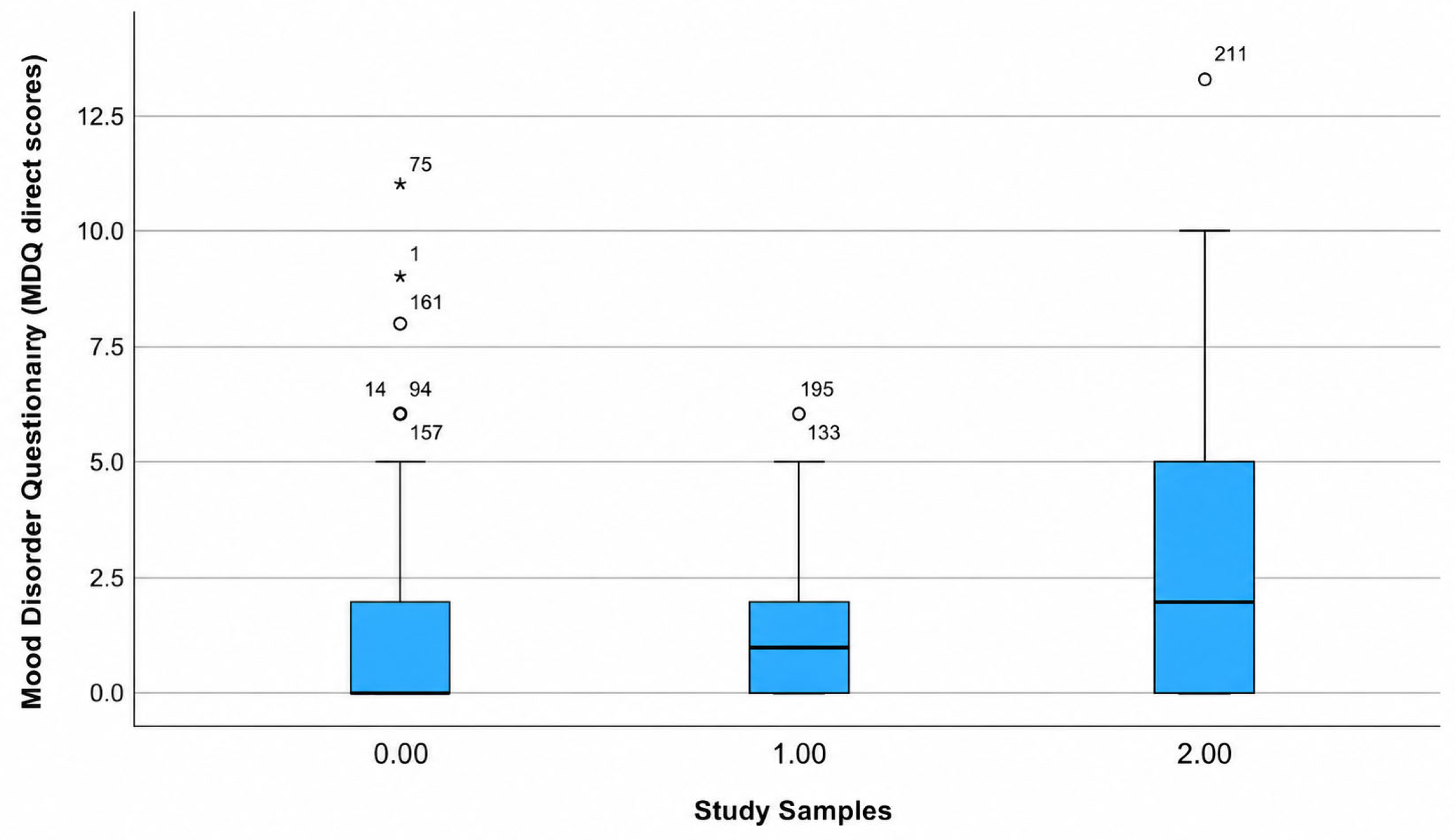
Regarding the bipolarity risk measured by the MDQ, the affective first-degree relatives subgroup showed significantly higher MDQ scores compared to both healthy controls and healthy first-degree relatives, with a medium effect size. Conversely, no statistically significant differences were observed between the healthy control and healthy first-degree relatives subgroups (Table 1, Figure 3).
Considering the total sample (n = 219), significant correlations were obtained between bipolarity risk (MDQ scores) and the Beck Depression Inventory, GHQ-28 Total scores, STAI-State, and STAI-Trait (all Pearson p < 0.001, two-tailed), but not with age or educational level. Nevertheless, we considered these two confounding factors in the final models.
Among healthy controls, significant correlations were obtained between bipolarity risk (MDQ scores) and the Beck Depression Inventory (Pearson p < 0.05, two-tailed) as well as the GHQ-28 Total scores (Pearson p < 0.001, two-tailed), but not with STAI-State, STAI-Trait, age, or educational level.
Conversely, no correlation was detected between bipolarity risk (MDQ scores) and STAI-Trait, STAI-State, GHQ-28, Beck Depression Inventory scores, age, or educational level in the healthy first-degree relatives subgroup.
In the affective first-degree relatives subgroup, there were significant correlations between bipolarity risk (MDQ scores) and both STAI-Trait and Beck Depression Inventory scores (both Pearson p < 0.001, two-tailed). Significant correlations were also found with GHQ-28 Total scores (Pearson p < 0.05, two-tailed), STAI-State (Pearson p < 0.05, two-tailed), and age (Pearson p < 0.05, two-tailed), while no correlation was found between bipolarity risk (MDQ scores) and educational level.

3.3. Modeling Bipolarity Risk

When modeling bipolarity risk (MDQ scores) in the total sample—including predictor variables such as GHQ-28 Total, STAI-State, age, STAI-Trait, the Beck Depression Inventory, educational level, and sex—a final model including the Beck Depression Inventory (beta = 0.495, p < 0.001), sex (beta = 0.175, p = 0.008), and age (beta = −0.124, p = 0.062) was obtained (adjusted R2 = 0.242).
Among healthy controls, when modeling bipolarity risk (MDQ scores), the final model included only the GHQ-28 Total scores (beta = 0.197, p < 0.001; adjusted R2 = 0.030).
Among the healthy first-degree relatives, when modeling bipolarity risk (MDQ scores), the final model included only sex (beta = 0.263, p = 0.007; adjusted R2 = 0.050).
Finally, among the affective unipolar first-degree relatives, when modeling bipolarity risk (MDQ scores), the final model included STAI-Trait (beta = 0.739, p = 0.003), STAI-State (beta = −0.459, p = 0.052), GHQ-28 Total scores (beta = 0.348, p = 0.093), sex (beta = 0.466, p = 0.003), and age (beta = −0.280, p = 0.050), yielding an adjusted R2 of 0.655.

4. Discussion

To our knowledge, this is the first study in a Spanish population to quantify the influence of trait anxiety in a sample of relatives of individuals affected by bipolar I disorder. Our results confirm a significantly higher prevalence of trait anxiety in these relatives, but only in those with a current or history of unipolar affective disorder. In this specific subgroup, STAI-Trait anxiety scores were associated with greater bipolar risk as measured by the MDQ, together with other factors.
Despite notable differences in sample characteristics and methodological aspects, our results appear partially consistent with those reported by Contreras et al. [22,23], and align with previous studies that utilized alternative scales and methodologies [21,30].
The study by Vázquez et al. [30] in Argentina included 114 first-degree relatives (parents, children, and siblings) of patients undergoing treatment for bipolar disorder, and a comparison sample of 115 individuals without a history of psychiatric or affective illness, including among their first-degree relatives. They utilized the MDQ to measure bipolarity risk and the Temperament Evaluation of Memphis, Pisa, Paris, and San Diego (TEMPS-A) to assess traits. First-degree relatives of bipolar patients exhibited a higher prevalence of cyclothymic and anxious temperaments, with odds ratios of 18.44 (95% CI: 1.05–323) and 9.78 (95% CI: 1.22–78.51), respectively.
The study by Evans et al. [21] evaluated a US population of “bipolar families” using the TEMPS-A and Cloninger’s TCI-125 in a sample of 383 subjects. Control participants with no personal or family history of psychiatric disorders were recruited. A two-way ANOVA revealed significant differences across groups on all five TEMPS-A scales (dysthymic, cyclothymic, hyperthymic, irritable, and anxious; F = 53.4, p < 0.00001). Notably, females scored significantly higher than males on the dysthymic and anxious scales.
Other family studies employing diverse methodologies and samples have also demonstrated robust relationships between BD and anxiety disorders [31,32], particularly panic disorder [33].
Additionally, the meta-analysis by Solmi and colleagues [34] included 26 studies involving patients with bipolar disorder (n = 2025), major depressive disorder (n = 1283), ADHD (n = 56), borderline personality disorder (n = 43), and healthy controls (n = 1757). Based on TEMPS scores, cyclothymic (p < 0.001), irritable (p < 0.001), and anxious (p = 0.03) temperament scores were higher in patients with bipolar disorder than in their relatives, who in turn scored higher than healthy controls. The authors proposed a continuum for affective temperaments: cyclothymic and irritable scores increased progressively from healthy controls to major depressive disorder and bipolar disorder. Regarding hyperthymic temperament, scores ranged from major depressive disorder to bipolar disorder and healthy controls. Depressive and anxious temperaments did not differ significantly between bipolar and major depressive disorder, though both groups consistently displayed higher scores than healthy controls.
Anxiety in individuals at high risk for bipolar disorder increases the salience of stressful events and sensitization to stress [35]. In a controlled study involving 22 high-risk subjects with a bipolar parent, Zahn et al. [35] found significant correlations between anxiety and autonomic nervous system arousal at rest and under stress, which were absent in controls. Other studies in youth have confirmed potential associations between anxiety and bipolar diagnosis [36,37].
Finally, a community study of 602 patients evaluating predictors of bipolar disorder risk among individuals currently treated for major depression using the MDQ [38] found an 18.6% positivity rate. Stepwise logistic regression identified five variables associated with bipolar disorder risk: the CES-D item “people were unfriendly” (a 20-item instrument measuring depressive symptomatology), a significant score for comorbid anxiety, an initial depression diagnosis within five years, a family history of bipolar disorder, and a history of legal problems.
A pertinent methodological and conceptual question raised in the evaluation of our findings is whether the observed elevated trait anxiety truly functions as an endophenotypic marker or if it merely reflects residual depressive symptomatology. Given the high rates of comorbidity and shared genetic liability between anxiety and depressive disorders, distinguishing between a stable trait vulnerability and persistent subclinical symptoms is complex.
However, our data argue against the latter interpretation. The association between trait anxiety and MDQ (bipolarity risk) remained robust and statistically significant even after controlling for residual depressive symptom severity using the Beck Depression Inventory. On the other hand, our results must always be taken into account and interpreted with caution due to the cross-sectional nature of our findings.
This stability aligns with the conceptual framework of trait anxiety as a time-invariant, underlying endophenotype that predisposes individuals to affective dysregulation, rather than a transient, scar-like manifestation of a past depressive state. From a clinical perspective in primary and hospital care, recognizing trait anxiety as an independent endophenotype is crucial, as it identifies a distinct therapeutic target and a marker of vulnerability that persists even during periods of depressive remission. But we need to replicate our findings using other samples and longitudinal studies.
Diagnosing BD in primary care remains a significant challenge, particularly in low-resource settings [39,40,41], among young populations [42,43], and in veterans [44]. Nevertheless, primary care practitioners are uniquely positioned to contribute to suicide prevention, as several programs have demonstrated substantial reductions in suicide attempt rates following primary care interventions [45,46]. The implementation of early intervention strategies and screening programs by primary care physicians (PCPs) represents a valuable and cost-effective approach, although their deployment may be particularly challenging in resource-limited settings [47,48,49,50,51]. Notably, Menzin et al. [50] reported that administering the Mood Disorder Questionnaire during initial consultations, followed by psychiatric referral for individuals screening positive, was associated with an estimated total budgetary saving of $1.94 million over a 5-year period.
Genetically transmitted risk is relevant in this relationship, as several studies have shown [52]. Moreover, the presence of anxiety in the offspring of individuals affected by bipolar disorder is one of the markers for a later onset of the illness. In the meta-analysis by Raouna et al. [53], childhood anxiety disorders in offspring were also associated with a later onset of bipolar disorder.
Taken together, these findings support the possibility that trait anxiety may be a genetically influenced vulnerability marker associated with an increased risk of bipolar I disorder and other affective disorders in first-degree relatives of individuals with bipolar I disorder, warranting further investigation as a potential endophenotypic trait.

5. Limitations and Strengths

The primary limitation of our study is its cross-sectional design, which precludes causal inferences. Additional limitations affecting the generalizability of our findings include the post hoc analysis, recruitment from a single center, potential selection bias, and a moderate sample size. Specifically, the relatively small subgroup of first-degree relatives with affective disorders and baseline gender imbalances represents relevant constraints. Furthermore, we did not include other affective or temperamental dimensions that could act as competing endophenotypes. The observational design and the novelty of the analysis constitute the primary strengths of this study.

6. Conclusions

In conclusion, our findings are compatible with the hypothesis that trait anxiety may reflect an underlying vulnerability factor for affective disorders and may be associated with an increased risk of bipolar I disorder. This raises the possibility that trait anxiety could serve as a candidate endophenotype for bipolar I disorder. Given the exploratory nature of these observations, replication in large-scale prospective longitudinal studies is warranted to determine the robustness and clinical relevance of this potential relationship.
  • Key points:
  • Early diagnosis of bipolar disorder type I (BDI) is essential for a better outcome.
  • To date, there are still no specific biomarkers and endophenotypes easy to determine.
  • Previous studies linked BDI and BDI risk in relatives to specific personality traits.
  • Anxiety traits have high heritability and confer a higher lifetime risk of bipolarity.
  • Anxiety trait could be a possible endophenotype candidate in BDI.

Author Contributions

Conceptualization, J.C. and I.F.; methodology, J.C.; software, J.C.; validation, J.C. and I.F.; formal analysis, J.C. and I.F.; investigation, J.C., E.P., L.V., N.O., M.M. and Y.M.; resources, J.C.; data curation, J.C.; writing—original draft preparation, J.C., N.O., T.B. and I.F.; writing—review and editing, J.C., I.F., E.P., T.B., L.V., N.O., M.M. and Y.M.; visualization, J.C., I.F., E.P., L.V., N.O., M.M. and Y.M.; supervision, J.C. and I.F.; project administration, J.C. All authors have read and agreed to the published version of the manuscript.

Funding

This research received no external funding.

Institutional Review Board Statement

The study was conducted in accordance with the Declaration of Helsinki and approved by the Ethics Committee of the Corporació Sanitària Parc Taulí, protocol Code 2007/525, date of approval 19 June 2007.

Informed Consent Statement

Written informed consent was obtained from all subjects involved in the study.

Data Availability Statement

The original contributions presented in this study are included in the article. Further inquiries can be directed to the corresponding author.

Acknowledgments

The authors are grateful to the “Associació de Bipolars i Depressius del Vallés” (Bipolars and Depressive Association of the Vallés County) and the rest of the patients and volunteers for their unconditional participation in the study. Special acknowledgements are also given to the Administrative team and the Nurse staff of the Parc Taulí Mental Health Department.

Conflicts of Interest

The authors declare no conflicts of interest.

References

  1. Calabrese, J.R.; Shelton, M.D.; Bowden, C.L.; Rapport, D.J.; Suppes, T.; Shirley, E.R.; Kimmel, S.E.; Caba, S.J. Bipolar rapid cycling: Focus on depression as its hallmark. J. Clin. Psychiatry 2001, 62, 4–41. [Google Scholar]
  2. Grande, I.; Berk, M.; Birmaher, B.; Vieta, E. Bipolar disorder. Lancet 2016, 387, 1561–1572. [Google Scholar] [CrossRef] [Scilit] [PubMed]
  3. Liu, X.; Huang, Q.; Chen, Y.; Wang, F.; Xie, Y.; Chen, N.; He, S.; Yang, P.; Hong, W. Global, regional and national burden of bipolar disorder: An analysis of trends from 1990 to 2021. J. Affect. Disord. 2026, 393, 120393. [Google Scholar] [CrossRef] [Scilit] [PubMed]
  4. Baron, D.; Koh, E.; Ramalho, R.; Coskun, B. The role of psychiatry in primary care: WPA Section contributions. World Psychiatry 2025, 24, 289–290. [Google Scholar] [CrossRef] [Scilit] [PubMed]
  5. Lake, C.R.; Baumer, J. Academic psychiatry’s responsibility for increasing the recognition of mood disorders and risk for suicide in primary care. Curr. Opin. Psychiatry 2010, 23, 157–166. [Google Scholar] [CrossRef] [Scilit] [PubMed]
  6. Zoltan Rihmer, Z.; Xenia Gonda, X. Prevention of depression-related suicides in primary care. Psychiatr. Hung. 2012, 27, 72–81. [Google Scholar]
  7. Bostwick, J.M.; Rackley, S. Addressing suicidality in primary care settings. Curr. Psychiatry Rep. 2012, 14, 353–359. [Google Scholar] [CrossRef] [Scilit] [PubMed]
  8. Lichtenstein, P.; Yip, B.H.; Björk, C.; Pawitan, Y.; Cannon, T.D.; Sullivan, P.F.; Hultman, C.M. Common genetic determinants of schizophrenia and bipolar disorder in Swedish families: A population-based study. Lancet 2009, 373, 234–239. [Google Scholar] [CrossRef] [Scilit] [PubMed]
  9. Kieseppä, T.; Partonen, T.; Haukka, J.; Kaprio, J.; Lönnqvist, J. High concordance of bipolar I disorder in a nationwide sample of twins. Am. J. Psychiatry 2004, 161, 1814–1821. [Google Scholar] [CrossRef] [PubMed]
  10. Chen, M.H.; Hsu, J.W.; Huang, K.L.; Su, T.P.; Li, C.T.; Lin, W.C.; Tsai, S.J.; Cheng, C.M.; Chang, W.H.; Pan, T.L.; et al. Risk and coaggregation of major psychiatric disorders among first-degree relatives of patients with bipolar disorder: A nationwide population-based study. Psychol. Med. 2019, 49, 2397–2404. [Google Scholar] [CrossRef] [Scilit] [PubMed]
  11. Akiskal, H.S.; Bourgeois, M.L.; Angst, J.; Post, R.; Möller, H.; Hirschfeld, R. Re-evaluating the prevalence of and diagnostic composition within the broad clinical spectrum of bipolar disorders. J. Affect. Disord. 2000, 59, S5–S30. [Google Scholar] [CrossRef] [Scilit] [PubMed]
  12. Keck, P.E., Jr.; Kessler, R.C.; Ross, R. Clinical and economic effects of unrecognized or inadequately treated bipolar disorder. J. Psychiatr. Pract. 2008, 14, 31–38. [Google Scholar] [CrossRef] [Scilit] [PubMed]
  13. Sagar, R.; Pattanayak, R. Potential biomarkers for bipolar disorder: Where do we stand? Indian J. Med. Res. 2017, 145, 7–16. [Google Scholar] [CrossRef] [Scilit] [PubMed]
  14. Budiarto, M.; Green, M.J.; Cignarella, C.; Mitchell, P.B.; Roberts, G. Longitudinal changes in neurocognitive functioning over two years in young people at increased genetic risk of bipolar disorder. J. Affect. Disord. 2025, 391, 119910. [Google Scholar] [CrossRef] [Scilit] [PubMed]
  15. Kravariti, E.; Fragkaki, A.M.; Georgiades, A.; Cardno, A.G.; Kane, F.; Kalidindi, S.; Schulze, K.K.; McDonald, C.; Picchioni, M.M.; Hall, M.H.; et al. Transdiagnostic Neurocognitive Endophenotypes for Schizophrenia, Bipolar I Disorder and a Broad Psychosis/Bipolar I Disorder Phenotype: A Mega-Analysis of Twin and Sibling Data. Schizophr. Bull. 2026, 52, sbaf050. [Google Scholar] [CrossRef] [Scilit] [PubMed]
  16. Gottesman, I.; Gould, T. The endophenotype concept in psychiatry: Etymology and strategic intentions. Am. J. Psychiatry 2003, 160, 636–645. [Google Scholar] [CrossRef] [Scilit] [PubMed]
  17. Sigitova, E.; Fišar, Z.; Hroudová, J.; Cikánková, T.; Raboch, J. Biological hypotheses and biomarkers of bipolar disorder. Psychiatry Clin. Neurosci. 2017, 71, 77–103. [Google Scholar] [CrossRef] [Scilit] [PubMed]
  18. Villegas-García, L.; Patró, E.; Barbero, J.D.; Esteve-Valverde, E.; Palao, D.J.; Soria, V.; Labad, J.; Cobo, J. Lymphocyte-derived and lipoprotein-derived inflammatory ratios as biomarkers in bipolar disorder type I: Characteristics, predictive values, and influence of current psychopharmacological treatments. Psychoneuroendocrinology 2025, 171, 107209. [Google Scholar] [CrossRef] [Scilit] [PubMed]
  19. Balanzá-Martínez, V.; Rubio, C.; Selva-Vera, G.; Martinez-Aran, A.; Sánchez-Moreno, J.; Salazar-Fraile, J.; Vieta, E.; Tabarés-Seisdedos, R. Neurocognitive endophenotypes (endophenocognitypes) from studies of relatives of bipolar disorder subjects: A systematic review. Neurosci. Biobehav. Rev. 2008, 32, 1426–1438. [Google Scholar] [CrossRef] [Scilit] [PubMed]
  20. Hirschfeld, R.M.; Holzer, C.; Calabrese, J.R.; Weissman, M.; Reed, M.; Davies, M.; Frye, M.A.; Keck, P.; McElroy, S.; Lewis, L.; et al. Validity of the mood disorder questionnaire: A general population study. Am. J. Psychiatry 2003, 160, 178–180. [Google Scholar] [CrossRef] [Scilit] [PubMed]
  21. Evans, L.; Akiskal, H.S.; Keck, P.E., Jr.; McElroy, S.L.; Sadovnick, A.D.; Remick, R.A.; Kelsoe, J.K. Familiality of temperament in bipolar disorder: Support for a genetic spectrum. J. Affect. Disord. 2005, 85, 153–168. [Google Scholar] [CrossRef] [Scilit] [PubMed]
  22. Contreras, J.; Hare, E.; Pacheco, A.; Escamilla, M.; Raventos, H. Is subclinical anxiety an endophenotype for bipolar I patients? A study from a Costa Rican sample. J. Affect. Disord. 2020, 122, 267–272. [Google Scholar] [CrossRef] [Scilit] [PubMed]
  23. Contreras, J.; Hare, E.; Chavarría, G.; Raventós, H. Quantitative genetic analysis of anxiety trait in bipolar disorder. J. Affect. Disord. 2018, 225, 395–398. [Google Scholar] [CrossRef] [Scilit] [PubMed]
  24. Cobo, J.; Giménez-Palop, O.; Patró, E.; Pérez, M.; Bleda, F.; Barbero, J.D.; Oliva, J.C.; Serrano, R.; Berlanga, E.; García-Parés, G.; et al. Lack of confirmation of thyroid endophenotype in Bipolar Disorder Type I and their first-degree relatives. Psychoneuroendocrinology 2015, 51, 351–364. [Google Scholar] [CrossRef] [Scilit] [PubMed]
  25. First, M.B.; Spitzer, R.L.; Gibbon, M.; Williams, J.B.W. Structured Clinical Interview for DSM-IV (SCID) Axis I Disorders; American Psychiatric Press: Washington, DC, USA, 1997. [Google Scholar]
  26. American Psychiatric Association. Diagnostic and Statistical Manual of Mental Disorders, 4th ed.; Revised text; Masson: Barcelona, Spain, 2002. (In Spanish) [Google Scholar]
  27. Lobo, A.; Pérez-Echeverría, M.J.; Jiménez-Aznárez, A.; Sancho, M.A. Emotional disturbances in endocrine patients. Validity of the scaled version of the General Health Questionnaire (GHQ-28). Br. J. Psychiatry 1988, 152, 807–812. [Google Scholar] [CrossRef] [Scilit] [PubMed]
  28. Beck, A.T.; Ward, C.H.; Mendelson, M.; Mock, J.; Erbaugh, J. An inventory for measuring depression. Arch. Gen. Psychiatry 1961, 4, 561–571. [Google Scholar] [CrossRef] [Scilit] [PubMed]
  29. Seisdedos, N. STAI: State-Trait Anxiety Inventory; TEA Ediciones: Madrid, Spain, 1982. [Google Scholar]
  30. Vázquez, G.H.; Kahn, C.; Schiavo, C.E.; Goldchluk, A.; Herbst, L.; Piccione, M.; Saidman, N.; Ruggeri, H.; Silva, A.; Leal, J.; et al. Bipolar disorders and affective temperaments: A national family study testing the “endophenotype” and “subaffective” theses using the TEMPS-A Buenos Aires. J. Affect. Disord. 2008, 108, 25–32. [Google Scholar] [CrossRef] [Scilit] [PubMed]
  31. Wozniak, J.; Biederman, J.; Monuteaux, M.C.; Richards, J.; Faraone, S.V. Parsing the comorbidity between bipolar disorder and anxiety disorders: A familial risk analysis. J. Child. Adolesc. Psychopharmacol. 2002, 12, 101–111. [Google Scholar] [CrossRef] [Scilit] [PubMed]
  32. Du, N.; Zhou, Y.L.; Zhang, X.; Guo, J.; Sun, X.L. Do some anxiety disorders belong to the prodrome of bipolar disorder? BMC Psychiatry 2017, 17, 351. [Google Scholar] [CrossRef] [Scilit] [PubMed]
  33. Oh, D.H.; Park, D.H.; Ryu, S.H.; Ha, J.H.; Jeon, H.J. Psychological predictors of bipolarity in panic disorder. World J. Psychiatry 2021, 11, 242–252. [Google Scholar] [CrossRef] [Scilit] [PubMed]
  34. Solmi, M.; Zaninotto, L.; Toffanin, T.; Veronese, N.; Lin, K.; Stubbs, B.; Fornaro, M.; Correll, C.U. A comparative meta-analysis of TEMPS scores across mood disorder patients, their first-degree relatives, healthy controls, and other psychiatric disorders. J. Affect. Disord. 2016, 196, 32–46. [Google Scholar] [CrossRef] [Scilit] [PubMed]
  35. Zahn, T.P.; Nurnberger, J.I., Jr.; Berrettini, W.H.; Robinson, T.N., Jr. Concordance between anxiety and autonomic nervous system activity in subjects at genetic risk for affective disorder. Psychiatry Res. 1991, 36, 99–110. [Google Scholar] [CrossRef] [Scilit] [PubMed]
  36. Birmaher, B.; Kennah, A.; Brent, D.; Ehmann, M.; Bridge, J.; Axelson, D. Is bipolar disorder specifically associated with panic disorder in youths? J. Clin. Psychiatry 2002, 63, 414–419. [Google Scholar] [CrossRef] [Scilit] [PubMed]
  37. Goldstein, B.I.; Levitt, A.J. Prevalence and correlates of bipolar I disorder among adults with primary youth-onset anxiety disorders. J. Affect. Disord. 2007, 103, 187–195. [Google Scholar] [CrossRef] [Scilit] [PubMed]
  38. Calabrese, J.R.; Muzina, D.J.; Kemp, D.E.; Sachs, G.S.; Frye, M.A.; Thompson, T.R.; Klingman, D.; Reed, M.L.; Hirschfeld, R.M.A. Predictors of bipolar disorder risk among patients currently treated for major depression. MedGenMed 2006, 8, 38. [Google Scholar] [PubMed]
  39. Brenner, C.J.; Shyn, S.I. Diagnosis and management of bipolar disorder in primary care: A DSM-5 update. Med. Clin. N. Am. 2014, 98, 1025–1048. [Google Scholar] [CrossRef] [Scilit] [PubMed]
  40. Awaluddin, A.; Jali, N.; Bahari, R.; Jamil, Z.Z.; Haron, N.N. Roles of primary care physicians in managing bipolar disorders in adults. Malays. Fam. Physician 2015, 10, 27–31. [Google Scholar] [PubMed]
  41. Culpepper, L. Misdiagnosis of bipolar depression in primary care practices. J. Clin. Psychiatry 2014, 75, e05. [Google Scholar] [CrossRef] [Scilit] [PubMed]
  42. Neves, M.G.; Leanza, F. Mood disorders in adolescents: Diagnosis, treatment, and suicide assessment in the primary care setting. Prim. Care 2014, 41, 587–606. [Google Scholar] [CrossRef] [Scilit] [PubMed]
  43. Faust, D.S.; Walker, D.; Sands, M. Diagnosis and management of childhood bipolar disorder in the primary care setting. Clin. Pediatr. 2006, 45, 801–808. [Google Scholar] [CrossRef] [Scilit] [PubMed]
  44. Shepherd-Banigan, M.; Drake, C.; Dietch, J.R.; Shapiro, A.; Alishahi Tabriz, A.; Van Voorhees, E.; Uthappa, D.M.; Wang, T.W.; Lusk, J.; Salcedo Rossitch, S.; et al. Primary Care Engagement Among Veterans with Housing Insecurity and Serious Mental Illness. Washington, DC: Evidence Synthesis Program, Health Services Research and Development Service, Office of Research and Development, Department of Veterans Affairs. VA ESP Project #09-010. 2021; Available online: https://www.hsrd.research.va.gov/publications/esp/reports.cfm.; https://www.hsrd.research.va.gov/publications/esp/pc-engagement.pdf.; (accessed on 13 July 2026). [Google Scholar]
  45. Richards, J.A.; Cruz, M.; Stewart, C.; Lee, A.K.; Ryan, T.C.; Ahmedani, B.K.; Simon, G.E. Effectiveness of integrating suicide care in primary care: Secondary analysis of a stepped-wedge, cluster randomized implementation trial. Ann. Intern. Med. 2024, 177, 1471–1482. [Google Scholar] [CrossRef] [Scilit] [PubMed]
  46. Marshall, J.; Oliver, P.; Hulin, J.; Huddy, V.; Mitchell, C. PRECIPICE: PREventing Suicide In PrImary CarE. Br. J. Gen. Pract. 2025, 75, bjgp25X741801. [Google Scholar] [CrossRef] [Scilit]
  47. Chia, M.F.; Cotton, S.; Filia, K.; Phelan, M.; Conus, P.; Jauhar, S.; Marwaha, S.; McGorry, P.D.; Davey, C.; Berk, M.; et al. Early intervention for bipolar disorder—Do current treatment guidelines provide recommendations for the early stages of the disorder? J. Affect. Disord. 2019, 257, 669–677. [Google Scholar] [CrossRef] [Scilit] [PubMed]
  48. Hoyle, S.; Elliott, L.; Comer, L. Available screening tools for adults suffering from bipolar affective disorder in primary care: An integrative literature review. J. Am. Assoc. Nurse Pract. 2015, 27, 280–289. [Google Scholar] [CrossRef] [Scilit] [PubMed]
  49. Mulvaney-Day, N.; Marshall, T.; Piscopo, K.D.; Korsen, N.; Lynch, S.; Karnell, L.H.; Moran, G.E.; Daniels, A.S.; Ghose, S.S. Screening for Behavioral Health Conditions in Primary Care Settings: A Systematic Review of the Literature. J. Gen. Intern. Med. 2018, 33, 335–346. [Google Scholar] [CrossRef] [Scilit] [PubMed]
  50. Menzin, J.; Sussman, M.; Tafesse, E.; Duczakowski, C.; Neumann, P.; Friedman, M. A model of the economic impact of a bipolar disorder screening program in primary care. J. Clin. Psychiatry 2009, 70, 1230–1236. [Google Scholar] [CrossRef] [Scilit] [PubMed]
  51. Vöhringer, P.A.; Jimenez, M.I.; Igor, M.A.; Fores, G.A.; Correa, M.O.; Sullivan, M.C.; Holtzman, N.S.; Whitham, E.A.; Barroilhet, S.A.; Alvear, K.; et al. Detecting mood disorder in resource-limited primary care settings: Comparison of a self-administered screening tool to general practitioner assessment. J. Med. Screen. 2013, 20, 118–124. [Google Scholar] [CrossRef] [Scilit] [PubMed]
  52. Maki, H.; Sakai, N.; Kataoka, M.; Fujii, K.; Kageyama, Y.; Hayama, T.; Matsuo, K.; Nishioka, M.; Kato, T. Family study of bipolar disorder with comorbid anxiety disorder points to THSD7A with possible role of parent-of-origin effect. Psychiatry Clin. Neurosci. Rep. 2025, 4, e70071. [Google Scholar] [CrossRef] [Scilit] [PubMed]
  53. Raouna, A.; Osam, C.S.; MacBeth, A. Clinical staging model in offspring of parents with bipolar disorder: A systematic review. Bipolar Disord. 2018, 20, 313–333. [Google Scholar] [CrossRef] [Scilit] [PubMed]
Figure 1. Differential STAI-Trait (centils) by group: healthy controls: 0.00; healthy first-degree relatives: 1.00; affective unipolar first-degree relatives: 2.00. Note: Open circles (○) represent outliers (1.5–3 × IQR from Q1 or Q3). The numbers displayed next to these symbols correspond to the SPSS case numbers of the respective observations.
Phc 25 00012 g001
Figure 2. Differential Beck Depression Inventory (Spanish version, 21 items) by group: healthy controls: 0.00; healthy first-degree relatives: 1.00; affective unipolar first-degree relatives: 2.00. Note: Open circles (○) represent outliers (1.5–3 × IQR from Q1 or Q3). The numbers displayed next to these symbols correspond to the SPSS case numbers of the respective observations.
Phc 25 00012 g002
Figure 3. Differential MDQ direct scores by group: healthy controls: 0.00; healthy first-degree relatives: 1.00; affective unipolar first-degree relatives: 2.00. Note. Open circles (○) represent outliers (1.5–3 × IQR from Q1 or Q3), whereas asterisks (*) represent extreme outliers (>3 × IQR from Q1 or Q3). The numbers displayed next to these symbols correspond to the SPSS case numbers of the respective observations.
Phc 25 00012 g003
Table 1. Sociodemographic and clinical description of the sample.

Total Sample
(N = 219)
HCo
(n = 119, 54.3%)
HF-DR
(n = 68, 31.1%)
AF-DR
(n = 32, 14.6%)
Significances
X2/t (df); p, d
Age: mean (s.d.)40.1 (14.7)35.1 (12.0)45.9 (15.3)46.4 (16.4)p < 0.001
Sex: p = 0.024
male-n (%)71 (32.4)37 (31.1)29 (42.6)5 (15.6)
female-n (%)148 (67.6)82 (68.9)39 (57.4)27 (84.4)
Actual marital status *: n (%) p < 0.001
Single/separated/widow69 (32.1)50 (42.0)10 (15.2)9 (30.0)
Married/with partner146 (67.9)69 (58.0)56 (84.8)21 (70.0)
Educational level *: n (%) p < 0.001
Elemental or no studies53 (25.4)12 (10.1)24 (40.0)17 (56.6)
Secondary studies40 (19.5)19 (16.0)17 (28.3)4 (13.3)
Superior studies116 (55.5)88 (73.9)19 (31.7)9 (30.0)
Employment situation *: n (%) p < 0.001
Active/student/housework182 (85.5)114 (95.8)49 (76.6)19 (64.3)
On pension22 (10.3)3 (2.5)13 (20.3)6 (20.0)
Unemployed/disabled9 (4.2)2 (1.7)2 (3.2)5 (16.6)
Grade of relationship: n (%) p = 0.756
Parents39 (39.0)-28 (41.2)11 (34.4)
Offspring30 (30.0)-19 (27.9)11 (34.4)
Siblings31 (31.0)-21 (30.9)10 (31.3)
Depressive Diagnosis: n (%) -
Major Depressive (Recurrent)8 (3.6)--8 (25.0)
Major Depressive (Single Ep.)9 (4.1)--9 (28.1)
NOS Depressive Disorder15 (6.8)--15 (46.9)
Pharmacological Treat.: n (%) -
No pharmacol. treatment9 (4.1)--9 (28.1)
Only Antidepressant9 (4.1)--9 (28.1)
Only benzodiazepines2 (0.9)--2 (6.2)
Antidepressant + BZD5 (2.3)--5 (15.6)
ATD + BZD + LDA1 (0.4)--1 (3.1)
LDA1 (0.4)--1 (3.1)
No data available5 (2,3)--5 (15.6)
STAI-S, Anxiety State (a) t(184) = −1.244, p = 0.215, d = −1.189
(b) t(146) = −7.483, p < 0.001, d = −1.530
(c) t(96) = −5.561, p < 0.001, d = −1.219
(direct scores)-mean (s.d.)15.0 (9.9)12.6 (7.5)14.1 (8.2)26.5 (13.8)
STAI-S, Anxiety State (a) t(184) = −1.425, p = 0.156, d = −0.217
(b) t(146) = −6.579, p < 0.001, d = −1.345
(c) t(95) = −4.709, p < 0.001, d = −1.032
(centils)-mean (s.d.)29.2 (26.5)23.2 (21.8)28.1 (24.1)55.9 (32.6)
STAI-T, Anxiety Trait (a) t(178) = −0.586, p = 0.559, d = −0.091
(b) t(141) = −8.369, p < 0.001, d = −1.764
(c) t(91) = −6.812, p < 0.001, d = −1.540
(direct scores)-mean (s.d.)15.4 (10.4)13.0 (7.9)13.7 (8.2)29.3 (13.5)
STAI-T, Anxiety Trait (a) t(178) = −1.243, p = 0.216, d = −0.193
(b) t(141) = −7.424, p < 0.001, d = −1.564
(c) t(91) = −5.929, p < 0.001, d = −1.340
(centils)-mean (s.d.)27.2 (27.5)20.6 (22.9)25.0 (22.6)59.9 (32.7)
GHQ (Spanish version, 28 items) (a) t(181) = 0.120, p = 0.905, d = 0.019
(b) t(145) = −7.315, p < 0.001, d = −1.516
(c) t(92) = −6.017, p < 0.001, d = −1.344
total score (Method 0-0-1-1)-mean (s.d.)3.0 (5.0)2.0 (3.1)1.9 (2.8)9.5 (9.2)
Beck Depression Inventory (a) t(176) = −2.061, p = 0.041, d = −0.323
(b) t(142) = −9.889, p < 0.001, d = −2.055
(c) t(90) = −6.977, p < 0.001, d = −1.566
(Spanish version, 21 items)
total score- mean (s.d.)
4.0 (6.9)2.0 (2.5)2.8 (2.7)14.8 (13.1)
MDQ direct scores (a) t(181) = 0.299, p = 0.766, d = 0.046
(b) t(148) = −3.556, p = 0.001, d = −0.709
(c) t(95) = −3.476, p = 0.001, d = −0.751
(direct scores)-mean (s.d.)1.6 (2.3)1.4 (2.1)1.3 (1.7)3.2 (3.6)
HCo: Healthy Controls. HF-DR: Healthy First-Degree Relatives. AF-DR: Affective Unipolar First-Degree Relatives. STAI-s: State and Trait Anxiety Inventory-State. STAI-t: State and Trait Anxiety Inventory-Trait. GHQ: General Health Questionnaire. MDQ: Mood Disorder Questionnaire. X2: chi-square test. t(df): Student t test (df, degrees of freedom). d: Cohen’s d. s.d.: Standard deviation. * The sum of the n categories may be different due to missing values. (a) Healthy controls vs. healthy first-degree relatives. (b) Healthy controls vs. affective first-degree relatives. (c) Healthy first-degree relatives vs. affective first-degree relatives. Single Ep.: Single Episode. NOS: Not Specified Disorder. ATD: Antidepressant. BZD: Benzodiazepines. LDA: Low-dose antipsychotic.
Disclaimer/Publisher’s Note: The statements, opinions and data contained in all publications are solely those of the individual author(s) and contributor(s) and not of MDPI and/or the editor(s). MDPI and/or the editor(s) disclaim responsibility for any injury to people or property resulting from any ideas, methods, instructions or products referred to in the content.