Prospects for Harnessing the Rich Diversity of Phytochemical Anti-Tick Agents in Africa for the Development of Natural Acaricides



Abstract
1. Introduction
2. Materials and Methods
3. Results
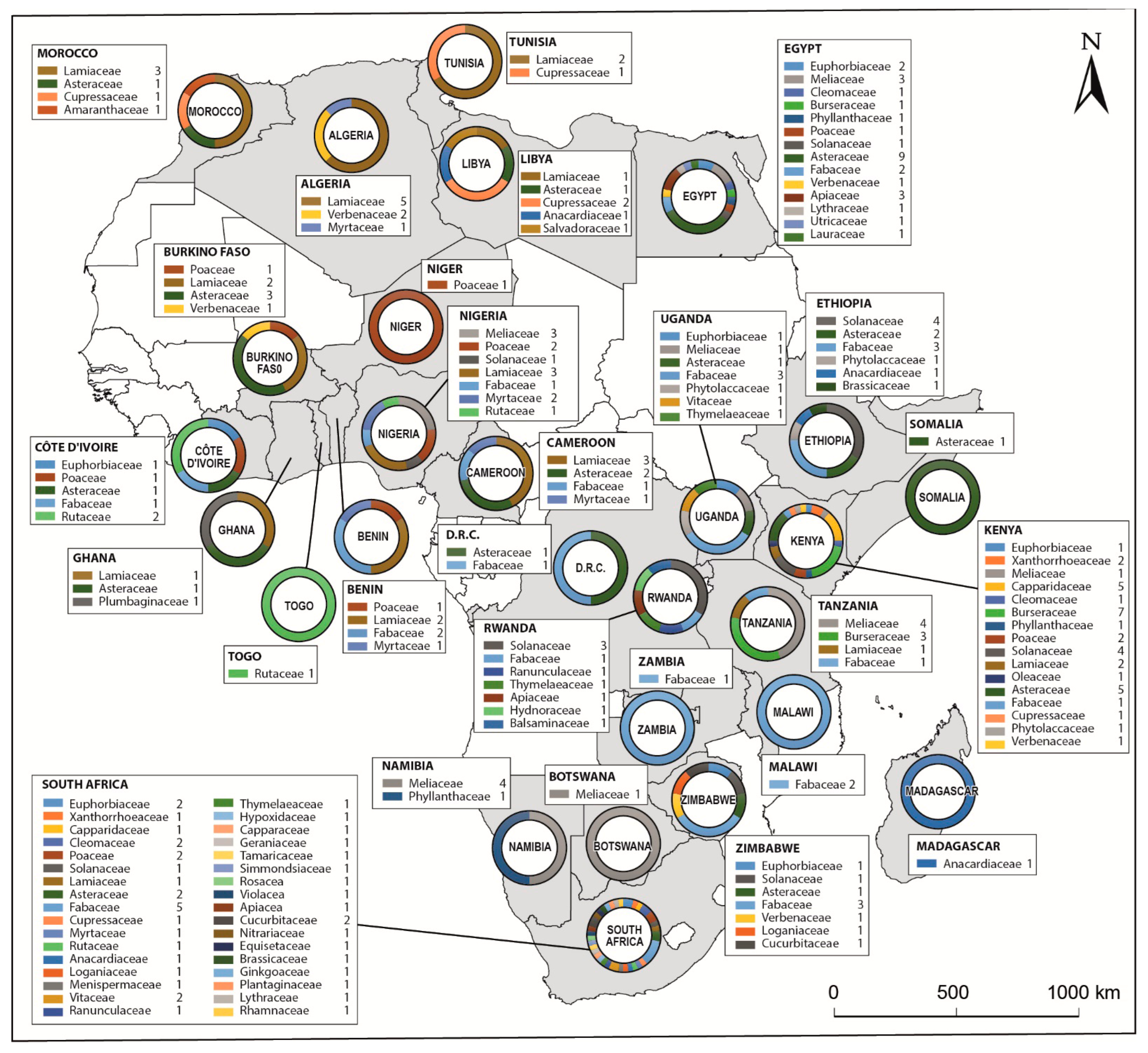
4. The Use of Ethno-Botanical Acaricide in Africa

| Family | Plant Species | Plant Part(s) Used | Active Ingredient(s) | Tick Species Investigated | References |
|---|---|---|---|---|---|
| 1. Astereceae | Psiadia punctulata | Whole plant | NA | R. appendiculatus, R. evertsii, R. decoloratus, A. variegatum | [37] |
| Tagetes minuta | Aerial parts | Essential oils such as cis-ocimene, dihydrotagetone, piperitonone, trans-tagetone, β-ocimene, 2-methyl-2-butenyl | R. appendiculatus H. rufipes | [38,39] | |
| Tithonia diversifolia | Aerial parts | α-pipene, β-pipene, isocaryophyllene, nerolidol | R. appendiculatus | [39] | |
| Francoeuria crispa | Aerial part | Essential oils | H. dromedarii | [40] | |
| Solanecio manii | NA | R. appendiculatus | [39] | ||
| Ageratum houstonianum | flowers | Essential oils | R. lunulatus | [41] | |
| Chromolaena odorata | Aerial parts | Essential oil (bicyclogermacrene) | R. lunulatus | [42] | |
| Artemisia herba-alba | Fruits/Aerial part | Essential oils, alcohol extracts | H. dromedarii | [40,43] | |
| Artemisia herba-alba | Aerial part | Essential oils such as oxygenated monoterpenes, camphor, cis-thujone, monoterpene hydrocarbons | H. eagyptium | [9] | |
| Artemisia monosperma | Aerial part | Essential oils | H. dromedarii, A. persicus | [40] | |
| Artemisia herba-alba | Leaves | Piperitone, ethylcinnamate, camphor, hexadecanoic acid | I. ricinus | [44,45] | |
| Artemisia judaica | Leaves, flowers, fruit, seed | Terpenoids, steroids, flavonoids, phenylpropanoids, benzenoids | H. longicornis | [46] | |
| Calendula officinalis | flowers | α-cardinol, carvone | I. ricinus | [44] | |
| Conyza dioscoridis | leaves | α-cardinol, hexadecanoic acid | I. ricinus | [44] | |
| Matricaria recutita | flower | NA | I. ricinus | [44] | |
| Silybum marianum | Aerial part | Essential oils | B. annulatus | [40] | |
| Vernonia amygdalina | Fresh leaf | Saponin, tannin, flavonoids | B. decoloratus, R. pulchellus | [27,47] | |
| Vernonia amygdalina | Fresh leaf | Saponin, tannin, alkaloids | R. appendiculatus | [11] | |
| Kleinia sp. | Leaf/tuber | Aqueous extract plus surfactants | R. decoloratus | [48] | |
| Ageratum conizoides | NA | Essential oils | A. variegatum | [49] | |
| Laggera aurita | NA | Essential oils | A. variegatum | [49] | |
| Leggera oloptera | aerial parts | tannins, coumarins, alkaloids, flavonoids, terpenes and sterols. | R. microplus | [50] | |
| Tithonia diversifolia | leaves | NA | R. microplus | [51] | |
| Chromolaena odorata | Fresh leaves | NA | R. microplus | [52] | |
| 2. Fabaceae | Senna didymobotrya | Aerial parts | NA | R. appendiculatus | [39] |
| Senna italica | Root, leaves, fruits | alkaloids, cardiac glycosides, flavonoids, phenols, saponins, steroids, tannins, and terpenoids | R. microplus, H. marginatum | [28,53] | |
| Tephrosia vogelii | Leaf, root, pod, seed | Tannins, alkaloids, terpenoids, flavonoids, catechol, polyterpenes, sterol, leuco-anthocyanes, saponosides, rotenone | R. lunulatus, R. appendiculatus, R. sanguineus, R. microplus | [11,29,54,55,56,57,58,59,60,61,62] | |
| Calpurina aurea | Leaves, flowers | alkaloids, cardiac glycosides, flavonoids, phenols, saponins, steroids, tannins, and terpenoids | R. turanicus | [28,63,64] | |
| Acacia nilotica | seeds | phenols, flavonoids | H. dromedarii | [26] | |
| Ceratonia siliqua | pods | NA | H. dromedarii | [26] | |
| Neorautanenia mitis | root | Neoraudiol | R. appendiculatus | [65,66] | |
| Calpurina aurea | Fresh leaves | Saponin, tannins, flavonoids, glycosides, alkaloids | B. decoloratus, R. pulchellus, A. variegatum | [27,67] | |
| Cassia didymobotrya | Whole plant | NA | R. appendiculatus | [68] | |
| Cassia abbreviata | leaves | NA | R. decoloratus | [48] | |
| Bobgunnia madagascariensis | pods | A. variegatum | [57] | ||
| 3. Lamiaceae | Ocimum suave | leaves | NA | R. appendiculatus, A. variegatum | [69,70] |
| Ocimum basilicum | Leaves | Phenol, flavonoid, tannin, estragole, linalool | H. dromedarii, H. scupense | [71] | |
| Ocimun grastissimum | Leaves | EO such as thymol, gamma terpinene, anthocyanin, tannins, coumarins, alkaloids, flavonoids, terpenes and sterols. | R. microplus, A. variegatum | [25,49,50,72] | |
| Ocimum urticaefolium | Eugenol, 1-8-cineole | R. microplus | [29,72] | ||
| Ocimum americanum | Hexane, ethanol | Tannin, alkaloids, coumarins | [50] | ||
| Clerodendrum glabrum | leaves | R. appendiculatus | [73] | ||
| Hoslundia opposita | leaves | Ursolic acid | A. variegatum | [39] | |
| Hyptis suaveolens | leaves | Tannin, flavonoid, anthocyanins | R. sanguineus, A. variegatum, R. microplus | [25,29,74] | |
| Hoslundia opposita | leaves | Ursolic acid | A. variegatum | [75] | |
| Menthe suaveolen subsp. timija | Aerial parts | Oxygenated monoterpene, pulegone, methanone | H. aegypticum | [9] | |
| Satureja calamintha | Aerial parts | Menthone, Oxygenated monoterpene, pulegone, menthol | H. aegypticum | [9] | |
| Lavandula pendunculata subsp. atlantica | Aerial parts | Alpha-pinene, camphene, camphor, 1.10-di-epi-cubenol, Oxygenated monoterpene, monoterpene hydrocarbona | H. aegypticum | [9] | |
| Origanum majorana | leaves | 4-terpineol, cis-Thujan 4-ol, delta-terpinene, linalool | H. scupense, I. ricinus | [45,76] | |
| Rosmarius officinalis | NA | Camphor, eucalyptol, camphene, 1,8-cineole, 1-camphor, alpha-pinene | R. sanguineus, H. dromedarii | [24,77] | |
| Lavandula stoechas | NA | Alpha-thujone, camphor, camphene | R. sanguineus | [77] | |
| Origanum floribundum | NA | Oregano, carvacrol, p-cymene, gamma-terpinene | R. sanguineus | [77] | |
| Thymus capitatus | Leaves | Carvacrol, p-cymene, delta-pinene, gamma-terpinene | R. sanguineus | [77] | |
| 4. Solanaceae | Solanum incanum | Whole plant/fruit juice in water | Solasonine, nitrosamines, solamargine | R. appendiculatus, R. everstsi, R. decoloratus, Hyalomma spp./A. hebraum | [78,79] |
| Nicotiana tabacum | Fresh leaves, root methanol extract | Tannin, phenolic compounds, steroids, flavonoids, phlobotannins, alkaloids | R. appendiculatus, R. everstsi, R. decoloratus, H. marginatum rufipes, R. sanguineus, R. pulchellus | [37,66,80,81,82] | |
| Capsicum annuum | fruits | H. dromedarii | [26] | ||
| Solanum dasyphyllum | Fruits, leaf, stem | NA | R. appendiculatus | [66] | |
| 5. Meliaceae | Azadirachta indica | Whole plant, leaves, fruits, root bark | Tannins, alkaloids, phlobatannins, anthraquinons, saponins, cardiaglycosides, terpenoids | R. microplus, H. dromedarii, H. antolicum, A. variegatum, B. decoloratus, R. appendiculatus, A. hebreaum, H. truncatum | [11,51,83,84,85,86,87,88] |
| Turraea abyssinica | Root bark | NA | R. appendiculatus | [89] | |
| Melia volkensii | Ripe fruit | NA | R. appendiculatus | [89] | |
| Melia azedarach | Ripe fruit | Azadirachtin, triterpenoids, steroids, alkaloids and tannins. | H. dromedarii | [43] | |
| 6. Burseraceae | Commiphora swynnertonii | Gum, resin | Linaloolacetete, terpenes | R. appendiculatus, A. variegatum | [89,90,91] |
| Commiphora erythraea | Oil | NA | NA | [92,93] | |
| Commiphora myrrh | Gum, resin, oil | NA | NA | [92] | |
| Commiphora molmol | myrrh | NA | A. persicus | [94] | |
| 7. Poaceae | Melinis minutiflora | Whole plant | NA | R. appendiculatus, R. microplus | [95] |
| Sorghum bicolor | Whole plant | NA | B. annulatus | [96] | |
| Cymbopogon citratus | leaves | Essential oils, saponin, tannin, flavonoids | A. variegatum, H. longicornis, R. microplus | [25,51,97,98] | |
| Cymbopogon giganteus | leaves | Essential oils | A. variegatum | [49] | |
| 8. Myrtaceae | Eucalyptus globoidea | H.m.rufipes | [81] | ||
| Eucalyptus camaldulensis | Red gum | p-cymene, spathulenol, farnesol | R. sanguineus | [77] | |
| Eucalyptus saligna | Aerial parts | Essential oils (alpha-pinene) | R. lunulatus | [42] | |
| Eucalyptus globulus | Leaves, blue gum | Eucalyptol, mentol, menthone, 1,8-cineole, alpha pinene, viridiflorol, | B. annulatus, A. variegatum | [12,25,77] | |
| Syzgium aromaticum | Flower buds | Essential oils | R.microplus | [97] | |
| 9. Euphorbiaceae | Ricinus communis | Leaves, seeds | saponin, tannin, flavonoids, glycosides, phlobatanin | Ixodes ricinus, R. appendiculatus, B. decoloratus, R. pulchellus, R. microplus | [27,44,51] |
| Euphorbia aegyptiaca | Aerial part | Essential oil | H. dromedarii | [40] | |
| Euphorbia hirta | Whole plant | NA | R. appendiculatus | [68] | |
| Euphorbia abovalifolia | latex | NA | Ixodidae | [47] | |
| Croton macrostachyus | leaves | tannin, flavonoids, glycosides, phlobatanin | B. decoloratus, R. pulchellus | [27] | |
| Monadenium lurgadae | leaves | B. decoloratus | [48] | ||
| 10. Verbenaceae | Lantana camara | Aerial parts, leaves | NA | Ixodes ricinus, R. appendiculatus | [39,44] |
| Lappia javanica | leaves | Apigenin, luteolin, diosmetin, isothymusin, eupatorin, genkwanin, salvigenin, xanthine | R. evertsi, appendiculatus, Hyalomma and Amblyomma spp. | [99] | |
| 11. Capparidaceae | Cleome gynandra | leaves | NA | R. turanicus | [63,100] |
| Thylachium africanum | Aerial parts | NA | R. appendiculatus | [69] | |
| Gynandropsis gynandra | Whole plant | Essential oils | R. appendiculatus, A. variegatum | [100,101,102] | |
| Boscia angustifolia | Aerial parts | NA | B. decoloratus Amblyomma spp. | [103] | |
| Boscia mossambicensis | Aerial parts | NA | B. decoloratus Amblyomma spp. | [103] | |
| Cadaba farinnosa | Aerial parts | NA | B. decoloratus Amblyomma spp. | [103] | |
| Maerua edulis | Leaves, root, tuber | NA | R. decoloratus | [48] | |
| 12. Cupressaceae | Junipeus procera | NA | R. appendiculatus | [39] | |
| Juniperus thurifera | Aerial parts | Sabinene, monoterpene hydrocarbon, oxygenated monoterpene, limonene | H. aegyptiacum | [9] | |
| Juniperus communis | Leaves, berries | Alpha-pinene, delta-3-carene, beta-phellandrene | H. scupense | [76] | |
| Juniperus phoenicea | Alpha-pinene, beta-myrcene, beta-phellandrene. Alpha-terpinyl-acetate, germacrene | I. ricinus | [45,104] | ||
| Cupressus sempervirens | leaves | Essential oils (Eicosapentaenoic acid, 10,12-Docosadiynedioic acid, 10-Undecynoic acid, Palmitic and flavonoids, tannins, and carbohydrates | R. annulatus | [13] | |
| 13. Rutaceae | Haplophyllum tuberculatum | Aerial parts | Essential oils | H. dromedarii, A. persicus | [40] |
| Citrus limon | Fruit peels | Essential oils | A. variegatum | [25] | |
| Clausena anisata | Leaves | Estragol, c-cymene, alpha-pinene, transanethole, anisaldehyde | A. variegtum, R. decoloratus, R. microplus | [10] | |
| Zanthoxylum zanthoxyloides | Stem bark | NA | R. microplus | [61] | |
| Zanthoxylum rubescens | leaves | NA | R. microplus | [61] | |
| 14. Apiaceae | Ammi majus | seed | NA | Ixodes ricinus | [44] |
| Ammi visnaga | seed | NA | Ixodes ricinus | [44] | |
| Foeniculum vulgare | seed | NA | Ixodes ricinus | [44] | |
| Apium graveolens | seed | NA | H. dromedarii | [26] | |
| Carum carvi | seed | Phenol, flavonoids, tannins | H. dromedarii | [26] | |
| Peucedannum angolense | leaves | NA | R. appendiculatus | [66] | |
| 15. Anacardiaceae | Pistacia atlantica | Terpinene-4-ol, alpha pinene, beta-myrcene | I. ricinus | [104] | |
| 16. Cleomaceae | Cleome droserifolia | Leaves, flowers, fruit, seed | NA | H. longicornis | [46] |
| 17. Xanthorrhoeceae | Aloe secundiflora | Whole plant | NA | R. evertsi, R. decolratus, Amblyomma spp. | [105] |
| 18. Phytolaccaceae | Phytolacca dodecandra | leaves | Saponin, steroids, flavonoids, terpenoids | R. appendiculatus | [11,106] |
| 19. Phylanthaceace | Phyllanthus emblica | seed | NA | H. dromedarii | [26] |
| Margaritaria discoidea | latex | NA | R. appendiculatus, A. variegatum | [107] | |
| 20. Thymelaeaceae | Gnidia deserticola | Whole plant | NA | R. turanicus | [63] |
| 21. Vitaceae | Cissus quadrangularis | stem | NA | R. turanicus | [63] |
| Cissus adenocucaulis | Whole plant | NA | R. appendiculatus | [68] | |
| 22. Cucurbitaceae | Cucurbita pepo | Seed/peel | Phenol, flavonoids | H. dromedarii | [26] |
| 23. Loganiaceae | Strychnos madagascariensis | leaves | NA | R. appendiculatus | [73] |
| Strychnos spinosa | Seeds/inner soft pod | Secoiridoids, kingiside, flavonoid | R. appendiculatus, R. decoloratus, R. evertsi, A. hebreum | [79] | |
| 24. Zygophyllaceae | Peganum harmala | Aerial parts | Essential oils | B annulatus | [40] |
| Balanites aegyptiaca | seeds | NA | A variegatum | [25] | |
| 25. Ranunculaceae | Climatis villosa | roots | NA | R. turanicus | [63,100] |
| Ranunculus multifidus | fruits | NA | R. appendiculatus | [66] | |
| 26. Brassicaceae | Eruca sativa | Seeds | NA | H dromedarii | [26] |
| Lepidium sativum | seeds | NA | Ixodidae | [47] | |
| 27. Lythraceae | Lawsonia inermis | leaves | NA | Ixodes ricinus | [44] |
| Punica granatum | Peel | NA | H. dromedarii | [26] | |
| 28. Menispermaceae | Antizoma angustifolia | roots | NA | R. turanicus | [63] |
| 29. Hypoxidaceae | Hypoxis rigidula | bulbs | NA | R. turanicus | [63] |
| 30. Capparaceae | Maerua angolensis | Leaves | NA | R. turanicus | [63,64] |
| Maerua edulis | Leaves, tuber | NA | Ixodidae | [48,108,109] | |
| 31. Geraniaceae | Mansonia angustifolia | Whole plant | NA | R. turanicus | [63,64] |
| 32. Tamaricaceae | Reaumuria hirtella | Aerial parts | Essential oils | H. dromedarii | [40] |
| 33. Simmondsiaceae | Simmondsia chinesis | Aerial parts | NA | B. annulatus | [96] |
| 34. Rosaceae | Mespilus germanica | leaves | Phenols, flavonoids, tannins | H. dromedarii | [26] |
| 35. Violaceae | Viola alpine | Flowers | Phenols, flavonoids, anthocyanins | H. dromedarii | [26] |
| 36. Oleaceae | Olea europaea subsp. cuspidata | Whole plant | R. appendiculatus, R. decoloratus, R. evertsi, and Amblyomma spp. | [37] | |
| 37. Nitrariaceae | Peganum harmala | seeds | Phenols, flavonoids, tannins | H. dromedarii | [26] |
| 38. Equisetaceae | Equisetum arvense | Leaves | NA | H. dromedarii | [26] |
| 39. Ginkgoaceae | Ginkgo biloba | leaves | NA | H. dromedarii | [26] |
| 40. Plantaginaceae | Plantago psyllium | seeds | NA | H. dromedarii | [26] |
| 41. Rhamnaceae | Ziziphus spinachristi | leaves | NA | H. dromedarii | [26] |
| 42. Utricaceae | Forsskaolea tenacissima | Leaves, flowers, seeds | NA | H. longicornis | [46] |
| 43. Hydnoraceae | Hydnora johannis | Whole plant | NA | R. appendiculatus | [66] |
| 44. Balsaminaceae | Impatiens stuhmannii | leaves | NA | R. appendiculatus | [66] |
| 45. Plumbaginaceae | Plumbago zeylanica | root | Plumbagin, beta sitosterol, stigmasterol | A. variegatum | [75] |
| 46. Amaranthaceae | Dysphania ambrosioides | Aerial parts | Delta-3-carene, p-cymene, 1.4-epoxy-p-menth-2-ene, monoterpene hydrocarbon, oxygenated monoterpenes | H. aegyptium | [9] |
| 47. Lauraceae | Laurus nobilis | leaves | 1.8-cineole, alpha-terpinyl, sabinene | H. scupense | [110] |
| 48. Salvadoraceae | Salvadora persica | Hexenal, eucalyptol, beta-pinene | I. ricinus | [104] |
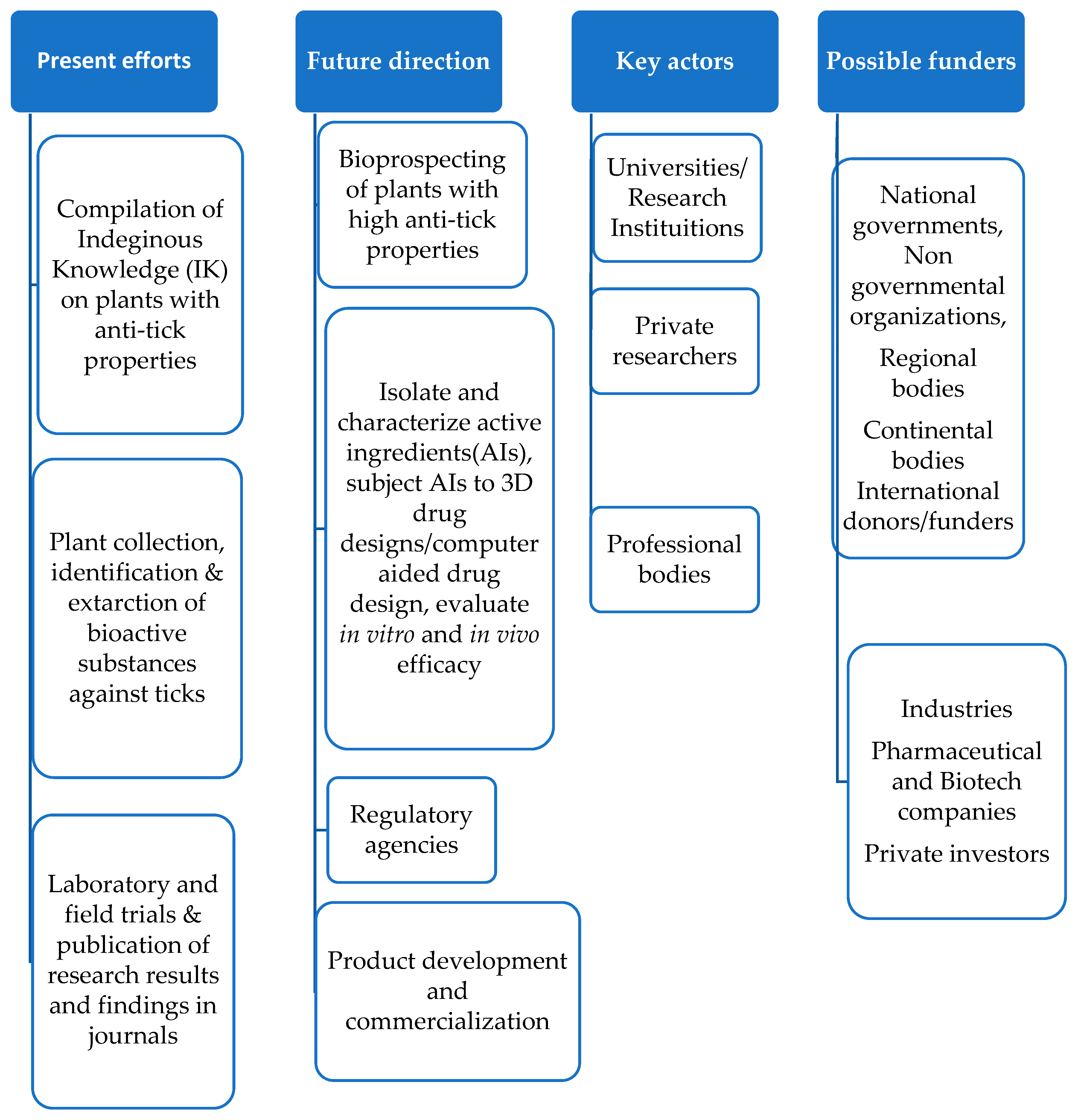
5. Prospects for the Development of Phytochemical Acaricide in Africa
6. Conclusions
Author Contributions
Funding
Institutional Review Board Statement
Informed Consent Statement
Data Availability Statement
Conflicts of Interest
References
- Sparks, T.C.; Hahn, D.R.; Garizi, N.V. Natural products, their derivatives, mimics and synthetic equivalents: Role in agrochemical discovery. Pest Manag. Sci. 2017, 73, 700–715. [Google Scholar] [CrossRef] [PubMed]
- Bisht, N.; Fular, A.; Ghosh, S.; Nanyiti, S. Systematic review and meta-analysis of acaricidal properties of plant derived products against Ixodid ticks population. Discov. Appl. Sci. 2025, 7, 189. [Google Scholar] [CrossRef]
- Obaid, M.K.; Islam, N.; Alouffi, A.; Khan, A.Z.; da Silva Vaz, I., Jr.; Tanaka, T.; Ali, A. Acaricides resistance in ticks: Selection, Diagnosis, Mechanisms, and Mitigation. Front. Cell. Infect. Microbiol. 2022, 12, 941831. [Google Scholar] [CrossRef] [PubMed]
- United Nations. Sustainable Development Goals: Take Action for the Sustainable Development Goals 2015. Available online: https://www.un.org/sustainabledevelopment/sustainable-development-goals (accessed on 10 October 2025).
- Molina-Flores, B.; Manzano-Baena, P.; Coulibaly, M.D. The Role of Livestock in Food Security, Poverty Reduction and Wealth Creation in West Africa; FAO: Accra, Ghana, 2020. [Google Scholar] [CrossRef]
- Mvumi, B.M.; Nyahangare, E.T.; Eloff, J.N.; Belmain, S.R.; Stevenson, P.C. Cattle tick control in Africa: Potential of ethnoveterinary plants. CAB Rev. 2021, 16. [Google Scholar] [CrossRef]
- Karim, S.; Zenzal, T.J., Jr.; Beati, L.; Sen, R.; Adegoke, A.; Kumar, D.; Downs, L.P.; Keko, M.; Nussbaum, A.; Becker, D.J.; et al. Ticks without borders: Microbiome of immature neotropical tick species parasitizing migratory songbirds along northern Gulf of Mexico. Front. Cell. Infect. Microbiol. 2024, 14, 1472598. [Google Scholar] [CrossRef] [PubMed]
- Wang, N.; Lu, S.; Ye, R.-Z.; Li, C.; Huang, J.-H.; Ye, G.; Li, Y.-Y.; Shen, S.-J.; Shi, X.-Y.; Zhu, D.-Y.; et al. Virome of Hyalomma and Rhipicephalus ticks from desert of Northwestern China. Virus Evol. 2025, 11, veaf022. [Google Scholar] [CrossRef] [PubMed]
- Laghzaoui, E.M.; Kasrati, A.; Abbad, A.; Leach, D.; Spooner-Hart, R.; El Mouden, E.H. Acaricidal properties of essential oils from Moriccan plants against immature ticks of Hyalomma aegyptium (Linnaeus, 1758); an external parasite of the spur-thighed tortoise (Testudo graeca). Int. J. Acarol. 2018, 44, 315–321. [Google Scholar] [CrossRef]
- Mollong, E.; Nuto, Y.; Bawa, R.; Kasseney, D.B.; Gomina, M. Acaricidal effect of essential oil of Clausena anisata (Rutaceae) on larvae of three tick species: Amblyomma variegatum, Rhipicephalus (Boophilus) decoloratus and Rhipicephalus (Boophilus) microplus. J. Entomol. Nematol. 2018, 10, 23–32. [Google Scholar] [CrossRef]
- Kiconco, C.; Muhumuza, A.; Kamatenesi, M.M. Effectiveness of selected medicinal plants used for management of ticks in cattle in Western Uganda. Adv. Med. Plant Res. 2020, 8, 75–80. [Google Scholar]
- Adenubi, O.T.; Abolaji, A.O.; Salihu, T.; Akande, F.A.; Lawal, H. Chemical composition and acaricidal activity of Eucalyptus globulus essential oil against the vector of tropical bovine piroplasmosis, Rhipicephalus (Boophilus) annulatus. Exp. Appl. Acarol. 2021, 83, 301–312. [Google Scholar] [CrossRef] [PubMed]
- Taha, M.A.; Ali, M.M.B. Evaluation of phytochemicals and essential oils of Cupressus semprevirens in controlling cattle tick Rhipicephalus annulatus (Acari: Ixodidae). Plant Biol. 2025, 25, 307. [Google Scholar] [CrossRef] [PubMed]
- Carroll, J.F.; Benante, J.; Klun, J.; White, C.; Debboun, M.; Pound, J.M.; Dheranetra, W. Twelve-hour duration testing of cream formulations of three repellents against Amblyomma americanum. Med. Vet. Entomol. 2008, 22, 144–151. [Google Scholar] [PubMed]
- Ma, J.K.-C.; Chikwamba, R.; Sparrow, P.; Fischer, R.; Mahoney, R.; Twyman, R.M. Plant-derived pharmaceuticals—The road forward. Trends Plant Sci. 2005, 10, 580–585. [Google Scholar] [PubMed]
- Githaka, N.W.; Kanduma, E.G.; Wieland, B.; Darghouth, M.A.; Bishop, R.P. Acaricide resistance in livestock ticks infesting cattle in Africa: Current status and potential mitigation strategies. Curr. Res. Parasitol. Vector Borne Dis. 2022, 2, 100090. [Google Scholar] [CrossRef] [PubMed]
- Isman, M.B. Botanical insecticides in the twenty-first century-fulfilling their promise? Annu. Rev. Entomol. 2020, 65, 233–249. [Google Scholar] [CrossRef]
- Isman, M.B. Bridging the gap: Moving botanical insecticides from the laboratory to the farm. Ind. Crop. Prod. 2017, 110, 10–14. [Google Scholar] [CrossRef]
- Walker, A.R.; Bouattour, A.; Camicas, J.L.; Estrada-Peña, A.; Horak, I.G.; Latif, A.A.; Pegram, R.G.; Preston, P.M. Ticks of Domestic Animals in Africa. A Guide to Identification of Species; Bioscience Reports: Edinburgh, Scotland, 2003. [Google Scholar]
- Jongejan, F.; Uilenberg, G. The global importance of ticks. Parasitology 2004, 129, S3–S14. [Google Scholar] [CrossRef] [PubMed]
- Pavela, R. History, presence and perspective of using plant extracts as commercial botanical insecticides and farm products for protection against insects—A review. Plant Prot. Sci. 2016, 52, 229–241. [Google Scholar] [CrossRef]
- Ujihara, K. The history of extensive structural modifications of pyrethroids. J. Pestic. Sci. 2019, 44, 215–224. [Google Scholar] [CrossRef] [PubMed]
- Wanzala, W.; Zessin, K.H.; Kyule, N.M.; Baumann, M.P.O.; Mathias, E.; Hassanali, A. Ethnoveterinary medicine: A critical review of its evolution, perception, understanding and the way forward. Livest. Res. Rural. Dev. 2005, 17, 119. Available online: https://www.lrrd.org/lrrd17/11/wanz17119.htm (accessed on 20 June 2025).
- Abdelali, S.; Kacimi-Elhassani, M.; Souttou, K.; Aissaoui, L. Assessment of the acaricidal efficacy of Rosmarinus officinalis essential oil against dogs’ ticks, Rhipicephalus sanguineus (Acari: Ixodidae), and its chemical composition. Rev. Ciênc. Agroveterinárias 2024, 23, 544–553. [Google Scholar] [CrossRef]
- Adenubi, O.T.; Salihu, T.; Akande, F.A.; Adekoya, O.A.; Mshelbwala, F.M.; Afolabi, T.A.; Odulate, D.O.; Olukunle, J.O. Acaricidal activities of the essential oils of six ethnoveterinary plants used by Fulani herdsmen in Nigeria. Egypt. J. Vet. Sci. 2024, 55, 1007–1019. [Google Scholar] [CrossRef]
- Khater, H.F.; Bazh, E.K.A.; Abdel Gawad, S.; Selim, A.; Taie, H.A.A.; Radwan, I.T.; Moustafa, S.A.; Megahed, A.A.; Baz, M.M.; Kandeel, S.A. Acaricidal efficacy of thirty-five Egyptian plants against the camel tick, Hyalomma dromedarii. Acta Parasitol. 2024, 69, 1231–1243. [Google Scholar] [CrossRef] [PubMed]
- Kemal, J.; Zerihun, T.; Alemu, S.; Sali, K.; Nasir, M.; Abraha, A.; Feyera, T. In vitro acaricidal activity of selected medicinal plants traditionally used against ticks in Eastern Ethiopia. J. Parasitol. Res. 2020, 2020, 7834026. [Google Scholar] [CrossRef] [PubMed]
- Wellington, K.W.; Leboho, T.; Sakong, B.M.; Adenubi, O.T.; Eloff, J.N.; Fouche, G. Further studies on South African plants: Acaricidal activity of organic plant extracts against Rhipicephalus (Boophilus) microplus (Acari: Ixodidae). Vet. Parasitol. 2017, 234, 10–20. [Google Scholar] [CrossRef] [PubMed][Green Version]
- Adehan, S.B.; Biguezoton, A.; Adakal, H.; Dossa, F.; Dougnon, T.J.; Youssao, E.; Sessou, P.; Aboh, A.; Youssao, A.; Assogba, N.; et al. Acaricidal activity of ethanolic and volatile extracts of the leaves of selected plants used in veterinary pharmacopeia on the larvae of Rhipicephalus microplus in Benin. Alex. J. Vet. Sci. 2016, 49, 1–11. [Google Scholar] [CrossRef]
- Coatney, G.R. Pitfalls in a discovery: The chronicle of chloroquine. In Proceedings of the Presidential Addres Before the American Society of Tropical Medicine and Hygiene at Its Annual Meeting, Atlanta, Georgia, 2 November 1961. [Google Scholar]
- Zhang, J.F. A Detailed Chronological Record of Project 523 and the Discovery and Development of Qinghaosu (Artemisinin); Yangcheng Evening News Publishing Company: Guangzhou, China, 2005; p. 193. [Google Scholar]
- Chen, C. Development of antimalarial drugs and their application in China: A historical review. Infect. Dis. Poverty 2014, 3, 9. [Google Scholar] [CrossRef]
- Coipel, Y.R.; Odio, A.D.; Alvares, O.M.; Proenza, R.T.; Marrero, I.G.; Delgado, D.L.C. Global market for veterinary herbal products during the 2018–2019 period. Braz. J. Vet. Res. Anim. Sci. 2021, 58, e181002. [Google Scholar] [CrossRef]
- Isman, M.B.; Grieneisen, M.L. Botanical insecticide research: Many publications, limited useful data. Trends Plant Sci. 2014, 19, 140–145. [Google Scholar] [CrossRef] [PubMed]
- Malak, N.; Niaz, S.; Miranda-Miranda, E.; Cossío-Bayúgar, R.; Duque, J.E.; Amaro-Estrada, I.; Nasreen, N.; Khan, A.; Kulisz, J.; Zając, Z. Current perspectives and difficulties in the design of acaricides and repellents from plant-derived compounds for tick control. Exp. Appl. Acarol. 2024, 93, 1–16. [Google Scholar] [CrossRef] [PubMed]
- Wanzala, W. Potential of traditional knowledge of plants in the management of arthropods in livestock industry with focus on (Acari) ticks. Evid.-Based Complement. Altern. Med. 2017, 2017, 8647919. [Google Scholar] [CrossRef] [PubMed]
- Akall, G. Herbs known only to pastoralists. In Technology Development Group-East Africa (ITDG-EA); Intermediate Technology Publication: Nairobi, Kenya, 2009. [Google Scholar]
- Nchu, F.; Magano, S.R.; Eloff, S.R. In vitro anti-tick prop erties of the essential oil of Tagetes minuta L. (Asteraceae) on Hyalomma rufipes (Acari: Ixodidae). Onderstepoort J. Vet. Res. 2012, 79, 1–5. [Google Scholar]
- Wanzala, W.; Hassanali, A.; Mukabana, W.R.; Takken, W. Repellent activities of essential oils of some plants used traditionally to control the brown ear tick, Rhipicephalus appendiculatus. J. Parasitol. Res. 2014, 2014, 434506. [Google Scholar] [CrossRef]
- Abdel-Shafy, S.; Soliman, M.M.M.; Habeeb, S.M. In vitro acaricidal effect of some crude extracts and essential oils of wild plants against certain tick species. Acarologia 2007, 47, 33–42. [Google Scholar]
- Pamo, T.E.; Tendonkeng, F.; Kana, J.R.; Tenekeu, G.; Tapondjou, L.A.; Payne, V.K. The acaricidal effect of the essential oil of Ageratum houstonianum Mill. flowers on ticks (Rhipicephalus lunulatus) in Cameroon. S. Afr. J. Anim. Sci. 2005, 34, 244–247. [Google Scholar]
- Tedonkeng, E.P.; Zollo, A.P.H.; Tedonkeng, F.; Kana, J.R.; Fongang, M.D.; Tapondjou, L.A. Chemical composition and acaricide effect of the essential oils from the leaves of Chromolaena odorata (L.) King and Robinson and Eucalyptus saligna Smith on ticks (Rhipicephalus lunulatus Neumann) of West African Dwarf goat in West Cameroon. Livest. Res. Rural. Dev. 2004, 16, 71. Available online: http://www.lrrd.org/lrrd16/9/tedo16071.htm (accessed on 20 June 2025).
- Abdel-Ghany, H.S.M.; Fahmy, M.M.; Abuowarda, M.M.; Abdel-Shafy, S.; El-Khateeb, R.M.; Hoballah, E.M. In vitro acaricidal effect of Melia azedarach and Artemisia herba-alba extracts on Hyalomma dromedarii (Acari: Ixodidae): Embryonated eggs and engorged nymphs. J. Parasit. Dis. 2019, 43, 696–710. [Google Scholar] [CrossRef] [PubMed]
- El-Seedi, H.R.; Azeem, M.; Khalil, N.S.; Sakr, H.H.; Shaden, A.; Awang, K.; Saeed, A.; Farag, M.A.; AlAjmi, M.F.; Pålsson, K.; et al. Essential oils of aromatic Egyptian plants repel nymphs of the tick Ixodes ricinus (Acari: Ixodidae). Exp. Appl. Acarol. 2017, 73, 139–157. [Google Scholar] [CrossRef] [PubMed]
- Elmhalli, F.; Garboui, S.S.; Karlson, A.K.B.; Mozūraitis, R.; Baldauf, S.L.; Grandi, G. Acaricidal activity against Ixodes ricinus nymphs of essential oils from the Libyan plants Artemi sia herba alba, Origanum majorana and Juniperus phoenicea. Vet. Parasitol. Reg. Stud. Rep. 2021, 24, 100575. [Google Scholar] [CrossRef] [PubMed]
- Abdou, A.M.; Arifeta, N.R.; Seddek, A.-l.S.; Morad, S.A.-R.F.; Abdelmageed, N.; Badry, M.O.; Umemiya-Shirafuji, R.; Nishikawa, Y. Acaricidal activity of Egyptian crude plant extracts against Haemaphysalis longicornis ticks. PLoS ONE 2024, 19, e0307297. [Google Scholar] [CrossRef] [PubMed]
- Regassa, A. The use of herbal preparations for tick control in western Ethiopia. J. S. Afr. Vet. Assoc. 2000, 71, 240–243. [Google Scholar] [CrossRef] [PubMed]
- Nyahangare, E.T.; Mvumi, B.M.; Mcgaw, L.J.; Eloff, J.N. Addition of a surfactant to water increases the acaricidal activity of extracts of some plant species used to control ticks by Zimbabwean smallholder farmers. BMC Vet. Res. 2019, 3, 3–9. [Google Scholar]
- Hema, D.M.; Biguezoton, A.S.; Coulibaly, A.; Compaore, M.; Sawadogo, I.; Bationo, R.K.; Dah, F.F.; Kiendrebeogo, M.; Nebié, R.C. Efficacy of local essential oils against Amblyomma variegatum tick from Burkina Faso. Vet. Parasitol. 2023, 324, 110059. [Google Scholar] [CrossRef] [PubMed]
- Coulibaly, A.; Bationo, R.K.; Koala, M.; Bazie, V.B.; Biguezoton, A.S.; Toure, A.; Zoungrana, S.; Ouedraogo, J.C.W.; Kone, M.; Nebie, R.C. Acaricidal activity of three plants extracts from the central region of Burkina Faso on adult Rhipicephalus (Boophilus) microplus cattle ticks. Int. J. Biol. Chem. Sci. 2020, 14, 1511–1519. [Google Scholar] [CrossRef]
- Aimée, D.A.C.; Patrick, Y.K.; Christian, T.D.K.; Alain, A.; Koffi, K. Evaluation of acaricide activity in the leaves extracts of four medicinal local plants on Rhipicephalus (Boophilus) microplus (Canestrini, 1888). Pharma Innov. J. 2017, 6, 78–85. [Google Scholar]
- Aboagye, I.F.; Asamoah, I.; Owusu-Bediako, M.; Baffoe-Ansah, J.; Abankwah, J.; Dankyi, E. Chromolaena odorata (L.) R.M. King & H. Rob. Leaf Extract as Potential Control Agent for Rhipicephalus microplus Canestrini, 1888. Sci. Dev. 2021, 5, 9–15. [Google Scholar]
- Magano, S.R.; Thembo, K.M.; Ndlovu, S.M.; Makhubela, N.F.H. The anti-tick properties of the root extracts of Senna italica subsp. Arachoides. Afr. J. Biotechnol. 2008, 7, 476–481. [Google Scholar]
- Matovu, H.; Olila, D. Acaricidal activity of Tephrosia vogelii extracts on nymph and adult ticks. Int. J. Trop. Med. 2007, 2, 83–88. [Google Scholar]
- Dougnon, T.J.; Farougou, S.; Kpodekon, T.M.; Hounmanou, G.; Hounnnonkpe, D. Comparative study of the effect of Tephrosia vogelii leaves ethanol extract and Alfapor (Alpha-cypermethrin) on Amblyomma variegatum Borgou cattle. Int. J. Biosci. 2014, 5, 1–7. [Google Scholar]
- Dougnon, T.J.; Adéhan, S.; Anago, E.; Houessionon, J.; Farougou, S. In vitro effect of the ethanolic extract of Tephrosia vogelii on Rhipicephalus sanguineus in Abomey-Calavi. Avicenna J. Phytomed. 2015, 5, 247–259. [Google Scholar]
- Muyobela, J.; Nkunika, P.O.; Mwase, E.T. In vitro acaricidal activity of Bobgunnia madagascariensis Desv. against Amblyomma variegatum (Fabricius) (Acari: Ixodidae). Trop. Anim. Health Prod. 2016, 48, 625–631. [Google Scholar] [CrossRef] [PubMed]
- Gadzirayi, C.T.; Mutandwa, E.; Mwale, M.; Chindundu, T. Utilization of Tephrosia vogelii in controlling ticks in dairy cows by small-scale commercial farmers in Zimbabwe. Afr. J. Biotech. 2009, 8, 4134–4136. [Google Scholar]
- Ndava, J.; Mapuwei, T.W.; Madoma, C. A comparative assessment of the acaricidal activity of Tephrosia vogelii on Rhipicephalus appendiculatus and Amblyomma variegatum in Makoni district, Manicaland province, Zimbabwe. J. Entomol. Zool. Stud. 2018, 6, 145–1150. [Google Scholar]
- Siame, C.P.; Chitambo, H.; Muma, J.B.; Choongo, K.; Moonga, E. Field assessment of the efficacy of Tephrosia vogelii leaf extracts for control of ticks on naturally infested cattle in the field condition. J. Parasit. Dis. 2019, 43, 624–632. [Google Scholar] [CrossRef] [PubMed]
- Alain, A.; Hamidou, C.F.; Louise, A.; Aimée, D.A.C.; Witabouna, K.M. Plants used in Côte d’Ivoire (West Africa) against ticks: Evaluation for acaricidal activity against Rhipicephalus (Boophilus) microplus. Vet. Parasitol. Reg. Stud. Rep. 2022, 35, 100780. [Google Scholar] [CrossRef] [PubMed]
- Kalume, M.K.; Losson, B.; Angenot, L.; Tits, M.; Wauters, J.N.; Saegerman, C. Rotenoid contents and in vitro acaricidal activity of Tephrosia vogelii leaf extract on the tick R. appendiculatus. Vet. Parasitol. 2012, 190, 204–209. [Google Scholar] [PubMed]
- Fouche, G.; Eloff, J.N.; Wellington, K.W. Evaluation of South African plants with acaricidal activity against ticks. Int. J. Pharmacol. Pharm. Sci. 2017, 11, 386–390. [Google Scholar]
- Fouche, G.; Adenubi, O.T.; Leboho, T.; McGaw, L.J.; Naidoo, V.; Wellington, K.W.; Eloff, J.N. Acaricidal activity of the aqueous and hydroethanolic extracts of 15 South African plants against Rhipicephalus turanicus and their toxicity on human liver and kidney cells. Onderstepoort J. Vet. Res. 2019, 86, e1–e7. [Google Scholar] [CrossRef] [PubMed]
- Lasisi, A.A.; Adesomoju, A. Neoraudiol, a new isoflavonoid and other antimicrobial constituents from the tuberous root of Neorautanenia mitis (A. Rich) Verdcourt. J. Saudi Chem. Soc. 2015, 19, 404–409. [Google Scholar] [CrossRef]
- Van Puyvelde, L.; Geysen, D.; Ayobangira, F.; Hakizamungu, E.; Nshimiyimana, A.; Kalisa, A. Screening of Medicinal Plants of Rwanda for Acaricidal Activity. J. Ethnopharmacol. 1985, 13, 209–215. [Google Scholar] [CrossRef] [PubMed]
- Amante, M.; Hailu, Y.; Terefe, G.; Asres, K. In vitro louscidal and acaricidal activities of alkaloid Calpurnia aurea extracts against Ligonathus ovillus and Amblyomma variegatum. Int. J. Pharm. Sci. Res. 2019, 10, 431–437. [Google Scholar]
- Opiro, R.; Osinde, C.; Okello-Onen, J.; Akol, A.M. Tick-repellent properties of four plant species against Rhipicephalus appendiculatus Neumann (Acarina: Ixodidae) tick species. J. Agric. Res. Dev. 2012, 3, 17–21. [Google Scholar]
- Mwangi, E.N.; Hassanali, A.; Essuman, S.; Myandat, E.; Moreka, L.; Kimondo, M. Repellent and acaricidal properties of Ocimum suave against Rhipicephalus appendiculatus ticks. Exp. Appl. Acarol. 1995, 19, 11–18. [Google Scholar] [CrossRef] [PubMed][Green Version]
- Kaaya, G.P. Prospects for innovative tick control methods in Africa. Insect Sci. Appl. 2003, 23, 59–67. [Google Scholar] [CrossRef]
- Alimi, D.; Hajri, A.; Jallouli, S.; Sebai, H. Valorization of volatile oils and some crude extracts from the Tunisian plants Juniperus communis and Origanum majorana for the control of Hyalomma scupense (Acari: Ixodidae). Waste Biomass Valorization 2022, 13, 4165–4177. [Google Scholar] [CrossRef]
- Hüe, T.; Cauquil, L.; Fokou, J.B.H.; Dongmo, P.M.J.; Bakarnga-Via, I.; Menut, C. Acaricidal activity of five essential oils of Ocimum species on Rhipicephalus (Boophilus) microplus. Parasitol. Res. 2015, 114, 91–99. [Google Scholar] [PubMed]
- Mawela, K.G. The Toxicity and Repellent Properties of Plant Extracts Used in Ethnoveterinary Medicine to Control Ticks. Master’s Thesis, University of Pretoria, Pretoria, South Africa, 2008. [Google Scholar]
- Ohimain, E.I.; Angaye, T.C.; Bassey, S.E.; Izah, S.C. Acaricidal activities of Hyptis suaveolens and Ocimum sanctum against African dog tick (Rhipicephalus sanguinneus). Eur. J. Med. Plants 2015, 30, 149–156. [Google Scholar] [CrossRef]
- Annan, K.; Jackson, N.; Dickson, R.A.; Sam, G.H.; Komlaga, G. Acaricidal effect of an isolate from Hoslundia opposita vahl against Amblyomma variegatum (Acari: Ixodidae). Pharmacogn. Res. 2011, 3, 185–188. [Google Scholar] [CrossRef]
- Alimi, D.; Hajri, A.; Jallouli, S.; Sebai, H. Acaricidal and anthelmintic efficacy of Ocimum basilicum essential oil and its major constituents estragole and linalool, with insights on acetylcholinesterase inhibition. Vet. Parasitol. 2022, 309, 109743. [Google Scholar] [CrossRef] [PubMed]
- Djebir, S.; Ksouri, S.; Trigui, M.; Tounsi, S.; Boumaaza, A.; Hadef, Y.; Benakhla, A. Chemical composition and acaricidal activity of the essential oils of some plant species of Lamiaceae and Myrtaceae against the vector of tropical bovine theileriosis: Hyalomma scupense (syn. Hyalomma detritum). BioMed Res. Int. 2019, 2019, 7805467. [Google Scholar] [CrossRef] [PubMed]
- Obed, M. In-vitro efficacy of solanum incanum on Rhipicephalus appendiculatus. J. Vet. Med. Anim. Health 2023, 15, 43–51. [Google Scholar] [CrossRef]
- Madzimure, J.; Nyahangare, E.T.; Hamudikuwanda, H.; Hove, T.; Stevenson, P.C.; Mvumi, B.M. Efficacy of Strychnos spinosa (Lam.) and Solanum incanum L. aqueous fruit extracts against cattle ticks. Trop. Anim. Health Prod. 2013, 45, 1341–1347. [Google Scholar] [CrossRef] [PubMed]
- Dipeolu, O.O.; Ndungu, J.N. Acaricidal activity of kupetaba ground-mixture of natural products against Rhipicephalus appendiculatus. Vet. Parasitol. 1991, 38, 327–338. [Google Scholar] [PubMed]
- Magano, S.R.; Mkolo, M.N.; Shai, L.J. Repellent properties of Nicotiana tabacum and Eucalyptus globoidea against adults of Hyalomma marginatum rufipes. Int. J. Microbiol. Res. Rev. 2020, 9, 4508–4512. [Google Scholar]
- Oyagbemi, T.O.; Ashafa, A.; Adejinmi, J.O.; Oguntibeju, O.O. Preliminary investigation of acaricidal activity of leaf extract of Nicotiana tabacum on dog tick Rhipicephalus sanguineus. Vet. World. 2019, 12, 1624–1629. [Google Scholar] [CrossRef] [PubMed]
- Gareh, A.; Hassan, D.; Essa, A.; Kotb, S.; Karmi, M.; Mohamed, A.E.-H.H.; Alkhaibari, A.M.; Elbaz, E.; Elhawary, N.M.; Hassanen, E.A.A.; et al. Acaricidal properties of four neem seed extracts (Azadirachta indica) on the camel tick Hyalomma dromedarii (Acari: Ixodidae). Front. Vet. Sci. 2022, 9, 946702. [Google Scholar] [CrossRef] [PubMed]
- Abdel-Shafy, S.; Zayed, A.A. In vitro acaricidal effect of plant extract of neem seed oil (Azadirachta indica) on egg, immature, and adult stages of Hyalomma anatolicum excavatum (Ixodoidea: Ixodidae). Vet. Parasitol. 2002, 106, 89–96. [Google Scholar] [CrossRef] [PubMed]
- Ndumu, P.A.; George, J.B.; Choudhury, M.K. Toxicity of neem seed oil (Azadiracta indica) against the larvae of Amblyomma variegatum a three host tick in cattle. Phytother. Res. 1999, 13, 532–534. [Google Scholar] [CrossRef]
- Okwudili, N.C.; Emmanuel, U.C.; Albert, M.; Clifford, M.H.C.; Ngozi, O.A.; Bulama, Y.A. The Effects of aqueous root bark and seed extracts of Azadirachta indica in the treatment of ticks (Hyalomma spp) in vitro. Int. J. Biochem. Res. Rev. 2016, 10, 1–8. [Google Scholar] [CrossRef]
- Choudhury, M.K. Toxicity of neem seed oil against the larvae of Boophilus decoloratus, a one host cattle tick. Indian J. Pharm. Sci. 2009, 71, 562–563. [Google Scholar] [PubMed]
- Webb, E.C.; David, M. The efficacy of neem seed extract (Azadirachta indica) to control tick infestation in Tswana, Simmentaler and Brahman cattle. S. Afr. J. Anim. Sci. 2002, 32, 1–6. [Google Scholar] [CrossRef]
- Kaoneka, B.; Mollel, M.M. Acaricidal activities of extracts of Commiphora swynertonii Burrt (Burseraceae), Melia volkensii Gurke, Turraea abyssinica Hotchst, Turraea floribunda Hochst and Turraea cornucopia Styles and F. White (Meliaceae) against the brown ear tick Rhipicephalus appendiculatus Neumann. J. Open Univ. Tanzan. 2012, 10, 25–34. [Google Scholar]
- Kalala, W.; Magadula, J.; Mdegela, H. Evaluating Acaricidal Activity of Commiphora swynertonii (Burrt.) bark exudate against common ticks in Tanzania. Int. J. Herb. Med. 2014, 2, 19–25. [Google Scholar]
- Kaoneka, B.; Mollel, M.M.; Lyatuu, F. Leaf essential oil composition and tick repellency activity of Commiphora swynnertonii Burrt. J. Biol. Res.-Thessalon. 2007, 8, 213–216. [Google Scholar]
- Maradufu, A. Furanosesquiterpenoids of Commiphora erythraea and C. myrrh. Phytochemistry 1982, 21, 677–680. [Google Scholar] [CrossRef]
- Carrol, J.F.; Maradufu, A.; Warthen, J.D. An extract of Commiphora erythraea, a repellant and toxicant against ticks. Entomol. Exp. Appl. 1989, 53, 111–116. [Google Scholar] [CrossRef]
- Massoud, A.M.; Kutkat, M.A.; Abdel-Shafy, S.; El-Khateeb, R.M.; Labib, I.M. Acaricidal efficacy of Myrrh (Commiphora molmol) on the fowl tick Argas persicus (Acari: Argasidae). J. Egypt. Soc. Parasitol. 2005, 35, 667–686. [Google Scholar] [PubMed]
- Mwangi, E.N.; Essuman, S.; Kaaya, G.P.; Kimondo, M.G. Repellence of the tick R. appendiculatus by the grass Melinis minutiflora. Trop. Anim. Health Prod. 1995, 27, 211–216. [Google Scholar] [PubMed]
- Kandil, O.; Habeeb, M.S.; Nasser, I.M.M. Adverse effect of Sorghum bicolour, Sea anemone, Cynobacteria spp. and Simmondsia chiinensis (Hohoba) extracts on reproductive physiology of the adult female tick, Boophilus annulatus annulatus. Assiut Vet. Med. J. 1999, 42, 29–37. [Google Scholar]
- Yessinou, E.R.; Adincia, J.; Sessoua, P.; Adehan, B.; Tonouweha, A.; Akpoa, Y.; Adoligbea, C.; Assogbaa, N.M.; Koutinhouina, B.; Youssaoa, A.K.I.; et al. In vitro acaricidal effect of Syzygium aromaticum and Cymbopogon citratus essential oil on engorged female of cattle tick Rhipicephalus microplus in Benin. Sci. J. Vet. Adv. 2016, 5, 80–86. [Google Scholar]
- Agwunobi, D.O.; Pei, T.; Wang, K.; Yu, Z.; Liu, J. Effects of the essential oil from Cymbopogon citratus on mortality and morphology of the tick Haemaphysalis longicornis (Acari: Ixodidae). Exp. Appl. Acarol. 2020, 81, 37–50. [Google Scholar] [CrossRef] [PubMed]
- Madzimure, J.; Nyahangare, E.T.; Hamudikuwanda, H.; Hove, T.; Stevenson, P.C.; Belmain, S.R.; Mvumi, B.M. Acaricidal efficacy against cattle ticks and acute oral toxicity of Lippia javanica (Burm F.) Spreng. Trop. Anim. Health Prod. 2011, 43, 481–489. [Google Scholar] [PubMed]
- Fouche, G.; Ramafuthula, M.; Maselela, V.; Mokoena, M.; Senabe, J.; Leboho, T.; Sakong, B.M.; Adenubi, O.T.; Eloff, J.N.; Wellington, K.W. Acaricidal activity of the organic extracts of thirteen South African plants against Rhipicephalus (Boophilus) decoloratus (Acari: Ixodidae). Vet. Parasitol. 2016, 224, 39–43. [Google Scholar] [CrossRef] [PubMed]
- Lwande, W.; Ndakala, A.J.; Hassanali, A.; Moreka, L.; Nyandat, E.; Ndungu, M.; Amiani, H.; Gitu, P.; Malonza, M.; Punyua, D. Gynandropsis gynandra essential oil and its constituents as tick (Rhipicephalus appendiculatus) repellents. Phytochemistry 1998, 50, 401–405. [Google Scholar]
- Malonza, M.M.; Dipeolu, O.O.; Amoo, A.O.; Hassan, S.M. Laboratory and field observations on anti-tick properties of the plant Gynandropsis gynandra (L.) Brig. Vet. Parasitol. 1992, 42, 123–136. [Google Scholar] [CrossRef] [PubMed]
- Torto, B.; Hassanali, A. Progress in the search for anti-arthropod botanicals. Recent Res. Dev. Phytochem. 1997, 1, 475–488. [Google Scholar]
- Garboui, S.S.; Borg-Karlson, A.-K.; Pålsson, K. Tick repellent properties of three Libyan plants. J. Med. Entomol. 2009, 46, 1415–1419. [Google Scholar] [CrossRef] [PubMed]
- Frisch, J.E. Towards a permanent solution for controlling cattle ticks. Int. J. Parasitol. 1999, 29, 57–71. [Google Scholar] [CrossRef] [PubMed]
- Kosgei, C.J.; Mwendia, C.M.; Matasyoh, J.C.; Ngoci, N.S. Phytochemical analysis, cytotoxicity activity and acaricidal activity of aqueous crude extract of Phytolacca dodecandra against larvae of Rhipicephalus appendiculatus. IOSR J. Pharm. Biol. Sci. 2017, 12, 54–58. [Google Scholar]
- Kaaya, G.P.; Mwangi, E.N.; Malonza, M.M. Acaricidal activity of Margaritaria discoidea (Euphorbiaceae) plant extracts against the ticks Rhipicephalus appendiculatus and Amblyomma variegatum (Ixodidae). Int. J. Acarol. 1995, 21, 123–129. [Google Scholar]
- Nyahangare, E.T.; Mvumi, B.M.; Maramba, T. Acute oral mammalian toxicity and effect of solvents on efficacy of Maerua edulis (Gilg. & Ben.) de Wolf against Rhipicephalus (Boophilus) decoloratus Koch, 1844 (Acarina: Ixodidae), Tick Larvae. BioMed Res. Int. 2016, 2016, 7078029. [Google Scholar] [CrossRef] [PubMed]
- Nyahangare, E.T.; Mvumi, B.M.; Magona, C.; Eloff, J.N. An aqueous extract of Maerua edulis (Gilg & Ben) DeWolf tuber is as effective as a commercial synthetic acaricide in controlling ticks on cattle in vivo. Ind. Crop. Prod. 2017, 110, 88–93. [Google Scholar] [CrossRef]
- Alimi, D.; Hajri, A.; Jallouli, S.; Sebai, H. In vitro acaricidal activity of essential oil and crude extracts of Laurus nobilis, (Lauraceae) grown in Tunisia, against arthropod ectoparasites of livestock and poultry: Hyalomma scupense and Dermanyssus gallinae. Vet. Parasitol. 2021, 298, 109507. [Google Scholar] [CrossRef] [PubMed]
- Mazuecos, L.; Contreras, M.; Kasaija, P.D.; Manandhar, P.; Grą’zlewska, W.; Guisantes-Batan, E.; Gomez-Alonso, S.; Deulofeu, K.; Fernandez-Moratalla, I.; Rajbhandari, R.M.; et al. Natural Clerodendrum-derived tick repellent: Learning from Nepali culture. Exp. Appl. Acarol. 2023, 90, 83–98. [Google Scholar] [CrossRef] [PubMed]
- Graf, J.F.; Gogolewski, R.; Leach-Bing, N.; Sabatini, G.A.; Molento, M.B.; Bordin, E.L.; Arantes, G.J. Tick control: An industry point of view. Parasitology 2004, 129, S427–S442. [Google Scholar] [CrossRef] [PubMed]
- Sola, P.; Mvumi, B.M.; Ogendo, J.O.; Mponda, O.; Kamanula, J.F.; Nyirenda, S.P.; Belmain, S.R.; Stevenson, P.C. Botanical pesticide production, trade and regulatory mechanisms in sub-Saharan Africa: Making a case for plant-based pesticidal products. Food Secur. 2014, 6, 369–384. [Google Scholar]


Disclaimer/Publisher’s Note: The statements, opinions and data contained in all publications are solely those of the individual author(s) and contributor(s) and not of MDPI and/or the editor(s). MDPI and/or the editor(s) disclaim responsibility for any injury to people or property resulting from any ideas, methods, instructions or products referred to in the content. |
© 2026 by the authors. Licensee MDPI, Basel, Switzerland. This article is an open access article distributed under the terms and conditions of the Creative Commons Attribution (CC BY) license.
Share and Cite
Kamani, J.; Shand, M.; Harrus, S. Prospects for Harnessing the Rich Diversity of Phytochemical Anti-Tick Agents in Africa for the Development of Natural Acaricides. J. Phytomed. 2026, 1, 8. https://doi.org/10.3390/jphytomed1020008
Kamani J, Shand M, Harrus S. Prospects for Harnessing the Rich Diversity of Phytochemical Anti-Tick Agents in Africa for the Development of Natural Acaricides. Journal of Phytomedicine. 2026; 1(2):8. https://doi.org/10.3390/jphytomed1020008
Chicago/Turabian StyleKamani, Joshua, Mike Shand, and Shimon Harrus. 2026. "Prospects for Harnessing the Rich Diversity of Phytochemical Anti-Tick Agents in Africa for the Development of Natural Acaricides" Journal of Phytomedicine 1, no. 2: 8. https://doi.org/10.3390/jphytomed1020008
APA StyleKamani, J., Shand, M., & Harrus, S. (2026). Prospects for Harnessing the Rich Diversity of Phytochemical Anti-Tick Agents in Africa for the Development of Natural Acaricides. Journal of Phytomedicine, 1(2), 8. https://doi.org/10.3390/jphytomed1020008