
Article

Mental Health Disclosure and Employability Perceptions: An Evaluation of Trustworthiness, Job Suitability, and Value

1
School of Social Sciences, University of the West of England (UWE), Bristol BS16 1QY, UK
2
Department of Applied Psychology, Cardiff Metropolitan University, Cardiff CF5 2YB, UK
3
Department of Psychology, King’s College London, London SE5 8AF, UK
4
School of Criminology and Criminal Justice, University of Portsmouth, Portsmouth PO1 2UP, UK
*
Author to whom correspondence should be addressed.
Occup. Health 2026, 1(3), 39; https://doi.org/10.3390/occuphealth1030039
Submission received: 7 April 2026 / Revised: 27 June 2026 / Accepted: 14 July 2026 / Published: 19 August 2026

Abstract

Employment is an important determinant of psychological, social, and economic wellbeing, yet individuals with mental health disorders often face barriers to workforce participation. This study examined the impact of mental health disclosure on perceptions of trustworthiness, job suitability, and value to the company, focusing on Major Depressive Disorder (MDD), Emotionally Unstable Personality Disorder (EUPD), and schizophrenia. Using experimental vignette methodology, 330 participants evaluated a job candidate before and after a simulated HR background check, which revealed either no diagnosed mental disorder (control condition) or a diagnosis of MDD, EUPD, or schizophrenia. Quantitative analyses indicated that disclosure of mental disorders was associated with declines in perceived trustworthiness, suitability, and value. Qualitative thematic analysis revealed that hiring decisions were guided by concerns about emotional stability, absenteeism, and reputational risk, tempered by considerations of fairness, support, and reasonable workplace adjustments. Across the mental health disorder conditions, rejection rates were relatively low (6–16%). The findings highlight the nuanced role of HR background checks (which can include social media checks) in shaping employability evaluations. The study contributes to understanding how disclosure of mental disorders influences employability perceptions and provides practical implications for fostering inclusive employment practices.

1. Introduction

Employment is a central component of adult life, offering financial stability, social engagement, personal development, and improved mental health [1]. Beyond individual benefits, employment supports societal functioning by reducing social exclusion, fostering collective growth, and contributing to economic stability [2,3]. Paradoxically, individuals with mental health disorders often face systemic barriers to accessing these benefits, despite their importance for well-being and social inclusion.
The latent deprivation model [4] provides a theoretical lens for understanding the role of employment in mental health. Employment fulfils both manifest functions, such as earning a living, and latent functions, including time structure, social contact, collective purpose, a sense of identity, and meaningful activity. In contrast, unemployment deprives individuals of these latent benefits, often leading to heightened psychological distress, reduced self-esteem, and social isolation [5]. These latent benefits are particularly crucial for individuals with mental disorders, as structured work and social engagement can buffer against symptom exacerbation and support recovery.
Empirical evidence demonstrates that employment improves mental health outcomes for individuals with severe psychiatric conditions. Those with schizophrenia, for example, experience reductions in negative symptoms and improvements in quality of life when engaged in structured work [6,7]. Similarly, employment provides individuals with Emotionally Unstable Personality Disorder (EUPD) with routine, purpose, and social contact, despite the challenges posed by emotional dysregulation and interpersonal difficulties [8,9]. For individuals with Major Depressive Disorder (MDD), work engagement supports self-esteem, social interaction, and symptom management, although barriers such as fatigue or fluctuating motivation may interfere with sustained employment [10].
Beyond psychological benefits, employment promotes social and economic well-being. Financial independence reduces reliance on social welfare, and participation in the workforce contributes to broader societal productivity. Thus, the exclusion of individuals with mental health disorders from employment represents not only a personal disadvantage but also a societal loss. Nirmala and colleagues [11], citing a World Health Organization report, suggest that severe mental health conditions are associated with some of the highest unemployment rates among people with disabilities, highlighting the systemic barriers these individuals face.

1.1. Barriers to Employment

Despite the benefits of work, people with mental health disorders encounter considerable obstacles in securing and maintaining employment. Unemployment rates among this population are consistently high: estimates range from 70% to 90% for general psychiatric conditions [12], with schizophrenia-specific employment rates as low as 10–20% [13,14]. EUPD is associated with difficulties sustaining employment, with only 20% of those who obtain work maintaining it long-term [15], while MDD-related employment barriers yield unemployment rates ranging from 30% to 89% [10,16].
Workplace discrimination and stigma are central contributors to these employment disparities. Stigma Theory [17,18] suggests that societal labelling of mental health conditions as abnormal or dangerous fosters both overt and subtle forms of discrimination, leading to social exclusion. Employers may consciously or unconsciously adopt these labels, which can bias evaluations of competence, reliability, and overall suitability. The stereotype content model [19] further explains how perceptions of warmth and competence shape hiring judgments, with individuals perceived as unpredictable or less capable being evaluated less favourably.
Complementing these perspectives, the Theory of Planned Behaviour [20] provides insight into employer decision-making. Hiring intentions are shaped by attitudes toward mental health, subjective norms regarding acceptable workplace behaviour, and perceived control over employment decisions. Employers who hold negative attitudes or perceive workplace norms as unsupportive of disclosure may be less likely to hire candidates with psychiatric diagnoses, even when the candidates are fully qualified. In the modern era, these attitudes are increasingly shaped not only by direct interactions but also by information available online. As employers frequently review candidates’ social media profiles, personal disclosures about mental health can inadvertently influence hiring decisions, making the decision to disclose even more complex and potentially risky.

1.2. Mental Health Disclosures

The disclosure of a mental health condition represents a critical juncture in employment. Revealing a diagnosis can allow candidates to access workplace accommodations and support, but it also carries risks, including social exclusion, reputational damage, and discriminatory treatment [21,22]. Many employees avoid disclosure to protect their careers; in one study, 33% of employees with psychiatric conditions reported withholding information from managers due to fear of negative consequences [23]. However, nondisclosure may increase psychological distress and limit access to necessary workplace adjustments [24,25].
It is also important to distinguish between proactive self-disclosure and passive discovery of mental health information. Proactive self-disclosure refers to situations in which a candidate or employee deliberately reveals a mental health condition in a controlled context, such as during an interview, in discussion with a manager, or when requesting workplace adjustments. In such cases, disclosure may be accompanied by explanation, reassurance, and information about current functioning or support needs. By contrast, passive discovery occurs when mental health information is identified indirectly, for example through social media, references, or other background checks, without the individual actively choosing that point or mode of disclosure. Passive discovery may be more vulnerable to negative interpretation because the information is encountered outside a supportive context and without an opportunity for the individual to frame its relevance to work.
Social media further complicates disclosure dynamics by increasing the likelihood of passive discovery. Employers increasingly screen candidates’ online profiles, with surveys indicating that 70% consider social media in hiring decisions [26]. Online content can amplify stigma: posts discussing mental health show higher rates of trivialisation and negative stereotyping than those about physical disabilities, with schizophrenia disproportionately misrepresented [27,28]. Exposure to such portrayals may reinforce pre-existing stereotypes among employers and influence perceptions of employability, particularly when mental health information is encountered outside a structured or supportive disclosure context.
The Contact Hypothesis [29,30] offers a moderating perspective: positive prior experience or contact with individuals with mental health disorders reduces prejudice and can improve hiring decisions. Empirical evidence suggests that participants with personal experience of mental health challenges are more likely to hire candidates with disclosed diagnoses, highlighting the role of familiarity in mitigating stigma.

1.3. Integrating Theoretical Perspectives

To fully understand employment decision-making, it is necessary to integrate these perspectives into a cohesive framework. The Latent Deprivation Model [4] establishes that exclusion from employment deprives individuals of important psychological, social, and functional benefits, highlighting the importance of employability for individuals with diagnosed mental disorders. However, exclusion is not simply a reflection of ability; it is shaped by social attitudes and cognitive evaluations. Stigma Theory [17,18] explains how societal labelling and stereotyping create barriers, while the Stereotype Content Model [19] clarifies that judgments about warmth and competence underlie employer assessments.
The Theory of Planned Behaviour [20] complements this understanding by demonstrating how attitudes, perceived norms, and behavioural control shape intentions to hire, highlighting why organisational culture and policy are critical to fair decision-making. Social media amplifies these dynamics, as public disclosures of mental health may be interpreted through the lens of stigma and stereotype-based heuristics, influencing perceptions of trustworthiness and suitability.
Importantly, these biases are not immutable. The Contact Hypothesis [29,30] suggests that prior positive exposure to individuals with diagnosed mental disorders can reduce prejudice, and Attribution Theory shows that employment assumptions about the stability or controllability of a condition influence evaluations of reliability and performance. Together, these theories illustrate that hiring decisions are shaped by an interplay of social, cognitive, and experiential factors, providing a rationale for why empirical investigation into disclosure and employability perceptions is essential.
Collectively, these theories suggest that hiring decisions following mental health disclosure are influenced by both broader societal attitudes (e.g., stigma and stereotyping) and individual-level cognitive evaluations concerning reliability, competence, and anticipated workplace functioning.

1.4. The Current Study

Although extensive research examines employee experiences with disclosure and workplace accommodations, relatively little is known about employment decision-making, particularly in the context of different psychiatric conditions. Understanding these attitudes is important, as hiring decisions represent a primary barrier or facilitator to workforce participation for individuals with mental health disorders.
This study addresses this gap using an experimental vignette methodology, presenting candidates with EUPD, MDD, or schizophrenia to participants, with diagnostic information being passively discovered during a simulated HR background check. These three conditions were selected to reflect diagnostically distinct forms of mental ill-health that differ in public familiarity and in the stereotypes commonly associated with workplace functioning. The purpose of the present study was to examine employability perceptions following mental health disclosure, rather than to directly compare diagnostic conditions against one another. The study therefore focused on whether disclosure influenced perceptions of trustworthiness, suitability for the role, and overall value to the company.
For clarity, the term mental health condition is used when referring broadly to mental health in employment and disclosure contexts, whereas mental disorder refers specifically to the diagnosed psychiatric disorders examined experimentally (MDD, EUPD, and schizophrenia).
Drawing on the integrated theoretical framework, the following hypotheses were proposed: disclosure of a mental disorder would reduce perceptions of trustworthiness (Hypothesis 1), job suitability (Hypothesis 2), and value to the company (Hypothesis 3).

2. Materials and Methods

This study used a mixed methodology, collecting both quantitative and qualitative data to help us gain insight into employability decisions. The quantitative aspect of this project focused on hiring decision-making and allowed us to determine the causal inference before and after the simulated HR background check, providing an empirical measure of the effect. The qualitative aspect focused on the interpretative reasoning of their judgements and allowed us to gain more insight into the decision-making process participants use when hiring or rejecting a candidate.

2.1. Ethics

Ethical approval was obtained from the Psychology Ethics Committee at the University of the West of England (Ref: BKATV, 11.2021).

2.2. Design

A 4 (mental health diagnosis: EUPD, MDD, schizophrenia, no mental health disorder) × 2 (rating: before and after disclosure of mental health disorder) mixed-factor design was used. EUPD is broadly equivalent to Borderline Personality Disorder [BPD] within DSM-based classification systems.
The between-subjects factor was the mental health condition, and the within-subjects factor was the rating. The dependent variables were ratings of trustworthiness, suitability, and value. Trustworthiness, suitability, and perceived organisational value were assessed using separate single-item measures. These variables were treated as conceptually distinct outcomes, consistent with previous vignette-based disclosure research, and were analysed separately because each reflected a different theoretical aspect of candidate evaluation.
To examine the hiring decision-making process, participants were asked a series of qualitative questions regarding their reasons for choosing a specific candidate before and after the disclosure of a mental health disorder (or no disorder). Qualitative research is important for capturing rich data, as it provides a person-centred and holistic perspective. A thematic analysis was conducted as recommended by Braun and Clarke [31].

2.3. Participants

A total of 388 participants completed this study; participants who were not exposed to the stimuli (n = 55), or who did not complete the qualitative aspects (n = 3) were excluded.
Data from 330 participants were analysed (64 males, 257 females, 3 non-binary individuals, 1 transgender male, 1 identifying as all genders, 4 did not state a gender), aged between 18 and 72 (M = 26.85, SD = 12.01). The sample included 254 students, 13 individuals working in academic fields, 11 who preferred not to state their occupation, 4 who were either retired or unemployed, and 48 individuals employed in various public and private sector roles. Among the participants, 35 were current or former employers. See Supplementary Information for more details.

2.4. Procedure

Participants were recruited via advertisements placed on social media platforms (i.e., Facebook, Twitter, LinkedIn), and through the psychology department’s participant pool. Students who participated through the pool received course credit. Interested participants followed a link to a Qualtrics page, where they read an information sheet outlining the study and reminding them of the inclusion criteria (ages 18+ and British citizenship). Participants who consented to participate were directed to the first page of the experiment, where demographic information (e.g., age, gender, occupation) was collected.
Each participant was provided with the supermarket assistant job advertisement and asked to imagine they were the manager of a large supermarket, responsible for hiring a new supermarket assistant based on the top candidate’s application forms and HR interview notes. They were informed that the person hired would primarily operate the tills at the front of the store.
Participants were invited to read the job description and then review information about three candidates. They were asked to evaluate whether the candidates’ relevance for the role differed based on their educational background, skills, availability, and enthusiasm for the work. Participants initially selected their preferred candidate from three broadly equivalent applications. Following candidate selection, the experimental disclosure condition was randomly assigned to the selected candidate, irrespective of which candidate had been chosen.
After selecting a candidate, participants were asked to provide a rationale for their decision. They then rated the candidate’s (i) trustworthiness, (ii) suitability for the role, and (iii) value they had to the supermarket. The questions were as follows: ‘How trustworthy is the candidate?’ (7-point Likert-type scale, 1 = extremely untrustworthy, 7 = extremely trustworthy), ‘How suitable is the candidate?’ (7-point Likert-type scale, 1 = extremely unsuitable, 7 = extremely suitable), and ‘Imagining you are the manager of this team, how valued will the candidate be?’ (7-point Likert-type scale, 1 = extremely undervalued, 7 = extremely valued).
Next, participants were informed that, as part of standard staffing checks, the HR team explores social media, seeks information from references, and investigates the public domain. Participants were then randomly assigned to receive information indicating that the candidate they selected had been diagnosed with either EUPD (n = 81), MDD (n = 82), schizophrenia (n = 84), or no mental health disorder (n = 83). For example, for the first mental health condition, participants read the following information:
As part of all new staffing checks the HR team explore social media, seek information from references and investigate the public domain. It appears that the candidate you selected has been diagnosed with Emotionally Unstable Personality Disorder.
In the control condition, the following information was provided to participants:
As part of all new staffing checks the HR team explore social media, seek information from references and investigate the public domain. It appears that the candidate you selected has no diagnosed mental health disorders.
Participants were then asked to provide a second rating for trustworthiness, suitability, and value to the company based on this new information. Participants were also given the opportunity to reject the candidate at this stage. Finally, participants were debriefed and thanked for their participation in the study.

2.5. Vignettes

Three candidate vignettes were presented, containing notes from their application form and interview. Participants were informed that HR had selected these notes based on the most optimal candidates. A supermarket assistant role was used because it represented a familiar entry-level position that could be readily understood by participants from different backgrounds, thereby reducing ambiguity regarding role expectations. Candidate gender was held constant across profiles to minimise potential confounding effects associated with gender stereotypes and differential employability judgments [32]. The within-subject design focused on employability perceptions and the decision to hire or reject a candidate rather than the specific candidate choice. The vignettes and experimental paradigm for this study were adapted from Porter et al. [33,34] and are not uncommon for assessing decision-making [35].

3. Results

The Results Section utilises a mixed-method approach to explore decision-making in employability. The first part presents a quantitative analysis, focusing on participants’ ratings of trustworthiness, role suitability, and perceived value to the company. This is followed by examining the rejection and hiring rates associated with each simulated HR background check condition. This allows us to determine the causal inference of the HR check and provides an empirical measure of the effect. The second part presents a qualitative section examining participants’ reasoning behind their decisions, providing insights into their thought processes when rejecting or accepting candidates.

3.1. Quantitative Analysis

All analyses were conducted in R version 4.6.1 using the brms package, which fits Bayesian regression models via Stan using Markov Chain Monte Carlo (MCMC) estimation. Models were estimated using the default sampling (i.e., 4 chains, and 4000 iterations per chain, 2000 post-warm-up). For the probit models, weakly informative priors were specified for the ordinal thresholds, centred on the probit-transformed cumulative probabilities of an approximately uniform category distribution, intended to provide modest regularisation while remaining only weakly informative. Model convergence and sampling quality were assessed using standard diagnostic criteria. Across all fitted models, R-hat values were <1.01, and effective sample size (ESS) values were sufficiently high for all key parameters (all > 400). Posterior predictive checks were also conducted to assess model fit, and these indicated that the models provided an adequate representation of the observed data.
Bayesian cumulative probit models [36,37] were used to estimate differences in trustworthiness, suitability, and value ratings before and after the Mental Health reveal. This analysis has been used previously in similar research examining employability perceptions after the disclosure of a violent offence [38]. The rating outcomes (trustworthiness, suitability, and value) were modelled as a function of time (pre-disclosure vs. post-disclosure), condition (i.e., mental health diagnosis), and their interaction, with a random intercept for participant ID to account for the repeated pre–post ratings provided by each individual. This allowed us to test whether candidate evaluations changed following disclosure and whether the magnitude of change differed across diagnostic conditions.
Results are presented as model-estimated expected ratings and probits. Inferences are based on the mean of the posterior distribution, the 95% credible interval (here, equal-tailed intervals), the probability of direction (pd), and the region of practical equivalence (ROPE). Inferences were based on the overall posterior distribution, including the estimated effect direction, magnitude, uncertainty, and the extent to which plausible values fell within versus outside the ROPE. Effect size estimates are interpreted as posterior mean estimates on the ratings scale (i.e., Likert-type responses) and on the probit (z-value), which can be taken as latent measures of the respective dimensions. Effect uncertainty in the estimate is inferred from the credible intervals, which, unlike frequentist interpretations, can be seen as suggesting a range of most probable effects. PD can be taken as an effect existence metric, akin to a frequentist p-value, but reflecting the proportion of the posterior density that falls within the same direction as the sign of the effect; higher values indicate stronger evidence of existence. The ROPE metric reflects a range of values that can be taken as “no effect/difference”, where estimates falling within this range are taken as not sufficiently large to warrant scientific interest. For detailed explanations regarding such metrics, see [39].

3.1.1. Trustworthiness

A model was used to estimate differences in before and after trustworthiness ratings for each MH condition.
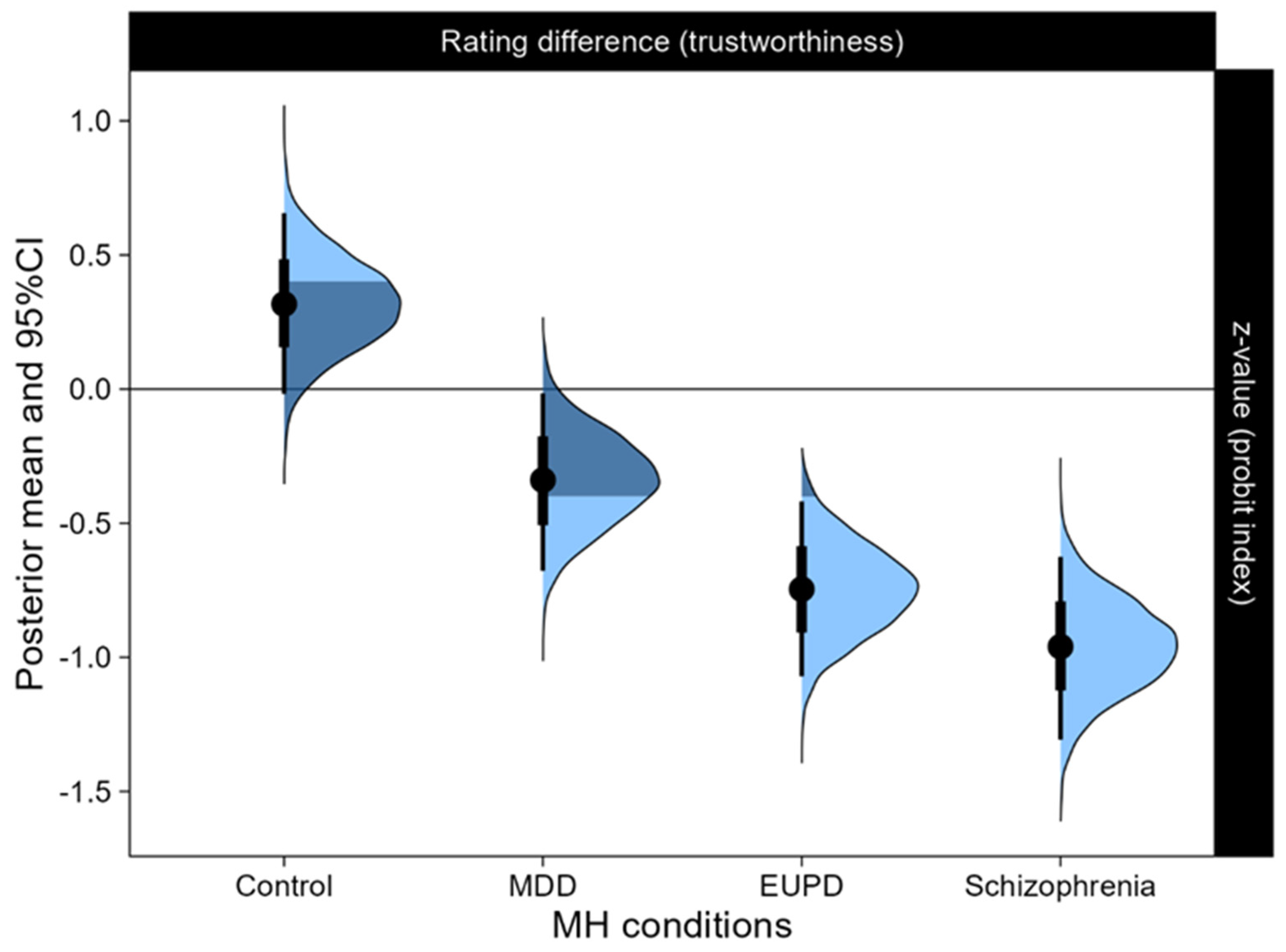
The Control condition showed slightly higher estimated trustworthiness ratings post-MH (M = 5.56, 95% CrI [5.32, 5.79]) compared to pre-MH (M = 5.33, 95% CrI [5.04, 5.58]). There is weak evidence for the difference being positive (i.e., increase); however, the effect magnitude mainly lies within the negligible values region, z = 0.32, 95% CrI [−0.02, 0.66], pd = 96.96%, ROPE[±0.40] = 68.92%.
The MDD condition showed lower estimated ratings post-MH (M = 5.18, 95% CrI [4.88, 5.46]) compared to pre-MH (M = 5.46, 95% CrI [5.19, 5.69]). There is weak evidence for a moderate decrease; however, the effect magnitude mainly lies within the negligible values region, z = −0.34, 95% CrI [−0.68, −0.02], pd = 97.96%, ROPE[±0.40] = 64.83%.
The EUPD condition showed much lower estimated ratings post-MH (M = 4.82, 95% CrI [4.49, 5.14]) compared to pre-MH (M = 5.47, 95% CrI [5.22, 5.70]). There is evidence for a large decrease, z = −0.75, 95% CrI [−1.07, −0.42], pd = 100%, ROPE[±0.40] = 0%.
Similarly, the Schizophrenia condition showed the lowest estimated ratings post-MH (M = 4.96, 95% CrI [4.65, 5.29]) compared to pre-MH (M = 5.71, 95% CrI [5.49, 5.90]). There is evidence for a large decrease, z = −0.96, 95% CrI [−1.31, −0.63], pd = 100%, ROPE[±0.40] = 0%. See Figure 1 for details.

3.1.2. Suitability

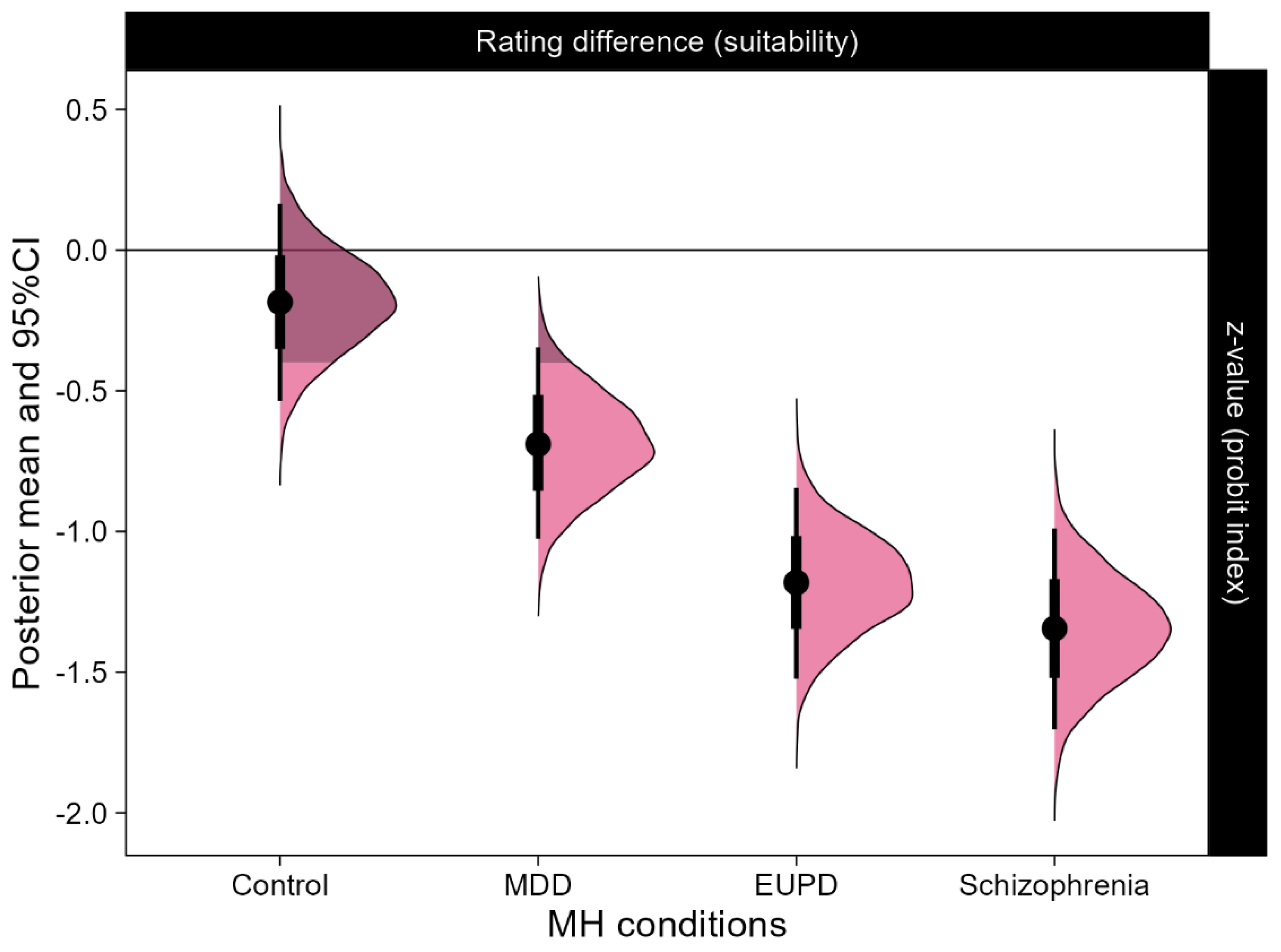
A model was used to estimate differences in before and after suitability ratings for the Mental health conditions. The Control condition showed no meaningful difference in suitability ratings following the HR reveal. Model-estimated ratings were very similar post-reveal (M = 6.01, 95% CrI [5.79, 6.21]) and pre-reveal (M = 5.89, 95% CrI [5.65, 6.11]). The corresponding latent probit contrast was small and uncertain, z = −0.18, 95% CrI [−0.54, 0.16], pd = 85.67%, ROPE[±0.40] = 90.66%. The difference in direction between the model-estimated ratings and latent contrast reflects the non-linear transformation between the ordinal response scale and the probit scale, and is common for values near zero; it does not alter the substantive conclusion of no meaningful change.
The MDD condition showed lower estimated ratings post-MH (M = 5.45, 95% CrI [5.10, 5.74]) compared to pre-MH (M = 6.00, 95% CrI [5.78, 6.20]). There is evidence for a large decrease, z = −0.69, 95% CrI [−1.03, −0.35], pd = 100%, ROPE[±0.40] = 2.83%.
The EUPD condition showed much lower estimated ratings post-MH (M = 4.72, 95% CrI [4.27, 5.12]) compared to pre-MH (M = 5.93, 95% CrI [5.71, 6.14]). There is evidence for a very large decrease, z = −1.18, 95% CrI [−1.52, −0.84], pd = 100%, ROPE[±0.40] = 0%.
As with trustworthiness, the Schizophrenia condition showed lower estimated ratings post-MH (M = 4.85, 95% CrI [4.44, 5.29]) compared to pre-MH (M = 6.10, 95% CrI [5.89, 6.28]). There is evidence for a very large decrease, z = −1.34, 95% CrI [−1.70, −0.99], pd = 100%, ROPE[±0.40] = 0%. See Figure 2 for details.

3.1.3. Value

A model was used to estimate differences in value ratings from before the MH was revealed to after for each condition. The results show a comparable pattern to trustworthiness and suitability.
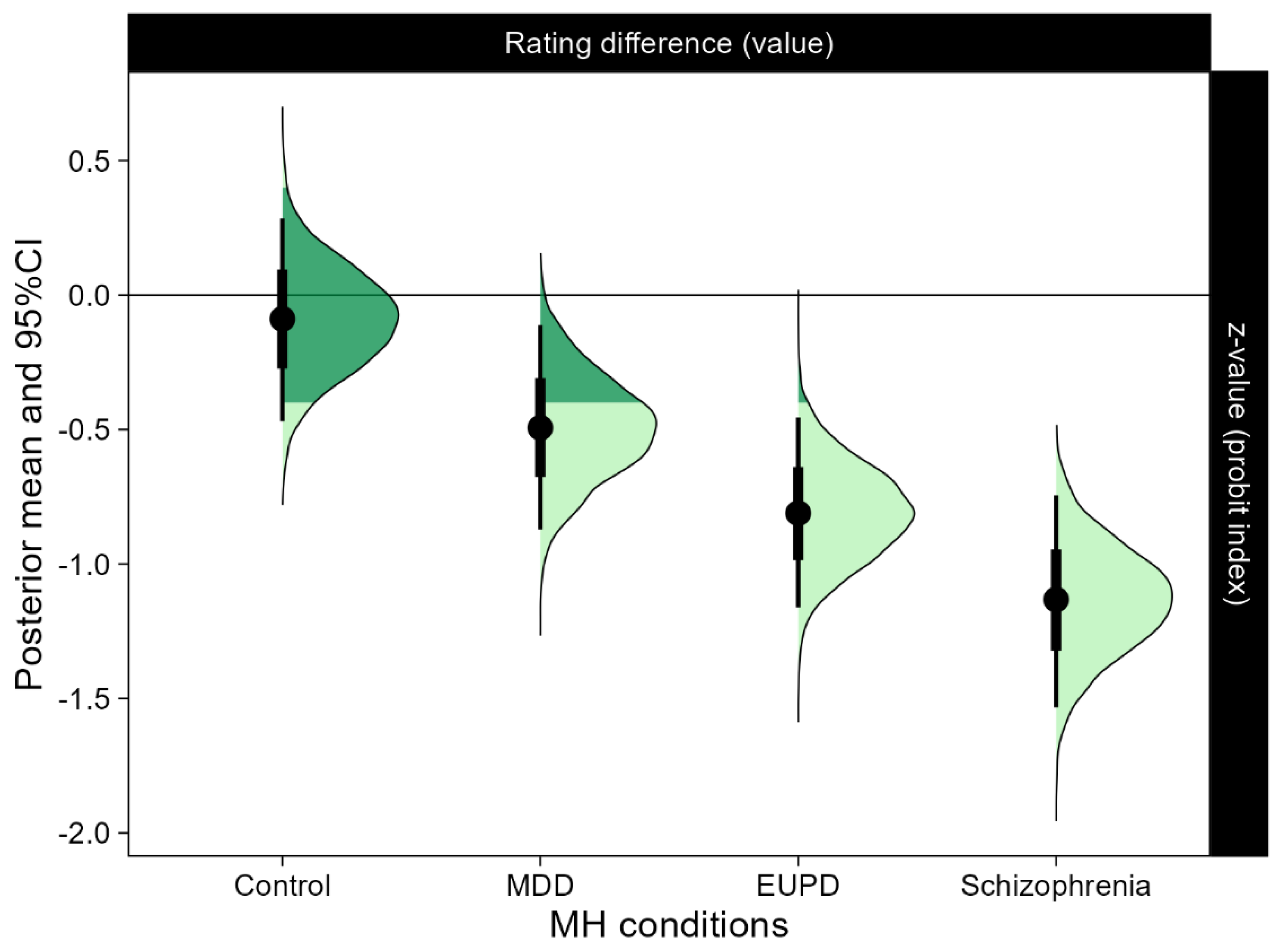
The Control condition showed no difference in value ratings post-MH reveal (M = 5.99, 95% CrI [5.82, 6.14]) compared to pre-MH (M = 6.02, 95% CrI [5.87, 6.18]), z = −0.09, 95% CrI [−0.54, 0.16], pd = 68.04%, ROPE[±0.40] = 96.99%.
The MDD condition showed lower estimated ratings post-MH (M = 5.90, 95% CrI [5.71, 6.06]) compared to pre-MH (M = 6.09, 95% CrI [5.93, 6.24]). There is weak evidence for a moderate decrease; however, the effect magnitude includes values within the negligible region, z = −0.49, 95% CrI [−0.87, −0.11], pd = 99.52%, ROPE[±0.40] = 29.79%.
The EUPD condition showed much lower estimated ratings post-MH (M = 5.77, 95% CrI [5.56, 5.95]) compared to pre-MH (M = 6.10, 95% CrI [5.96, 6.25]). There is evidence for a large decrease, z = −0.81, 95% CrI [−1.16, −0.45], pd = 99.99%, ROPE[±0.40] = 0%.
As with trustworthiness and suitability, the Schizophrenia condition showed the largest difference between estimated ratings post-MH (M = 5.71, 95% CrI [5.47, 5.90]) and pre-MH (M = 6.18, 95% CrI [6.03, 6.33]). There is evidence for a very large decrease, z = −1.13, 95% CrI [−1.53, −0.74], pd = 100%, ROPE[±0.40] = 0%. See Figure 3 for details.

3.1.4. Exploratory Analyses

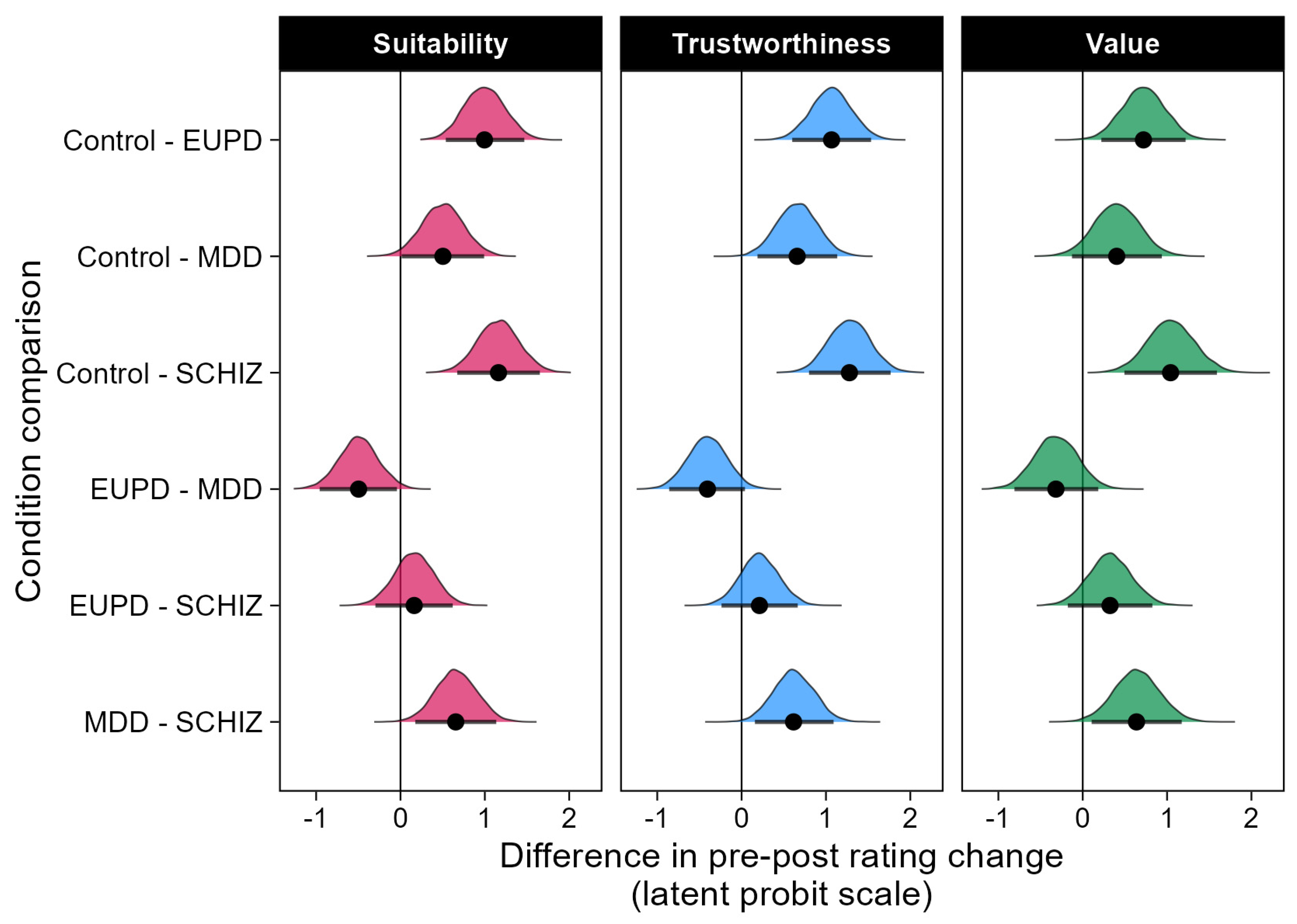
To address differences in the magnitude of pre–post change between conditions, we estimated exploratory difference-in-differences contrasts for suitability, trustworthiness, and value ratings (see Figure 4). These contrasts compare the model-implied pre–post change in one condition with the corresponding change in another condition. Positive values indicate a less negative drop in the first condition relative to the second (on the latent probit scale).
Across the three outcomes, the results suggested a broadly consistent pattern (see Table 1). Contrasts involving the Control condition were generally shifted in a positive direction, indicating that the pre–post change in ratings tended to be more adverse for the mental disorder conditions than for the Control condition. This pattern was most apparent for comparisons between Control and EUPD, and between Control and SCHIZ, where the posterior distributions were strongly displaced away from zero across all outcomes. The Control–MDD contrasts were also generally positive, although the magnitude of these differences is smaller.
Comparisons among the mental disorder conditions were less clearly separated, given our sample. The EUPD–MDD contrasts tended to be negative, suggesting that ratings may have changed less favourably (i.e., larger drop) for EUPD than for MDD, whereas the MDD–SCHIZ contrasts tended to be positive, suggesting less adverse change (i.e., smaller drop) for MDD than for SCHIZ. However, these mental disorder-condition contrasts showed greater uncertainty and, in several cases, retained non-negligible posterior mass near zero. The EUPD–SCHIZ contrasts were especially small and uncertain, consistent with the expectation that differences between some medical diagnostic labels may be modest.
These analyses should be interpreted as exploratory and descriptive. Our study was not designed to estimate precise between-condition differences. The contrasts shown here involve second-order quantities: differences between differences; they are expected to be less precise than the primary within-condition pre–post effects. Our results are nevertheless informative in showing that the main pattern of rating change was not uniform across conditions. Future work with larger samples would be required to estimate these smaller between-condition differences with greater precision.

3.1.5. Summary of Quantitative Findings

Overall, disclosure of a mental disorder influenced perceptions of trustworthiness, suitability, and value. Within-condition analyses showed negligible changes in the control condition, whereas reductions were observed following disclosure of MDD, EUPD, and schizophrenia. The exploratory difference-in-differences analyses further suggested that the magnitude of these changes may differ across diagnostic conditions, although these comparisons should be interpreted cautiously because they were exploratory and not the primary focus of the study.
Overall, the results highlight the role of mental health disclosure in shaping hiring judgments, with implications for employability, workplace inclusion, and the need for interventions to reduce stigma and bias.

3.2. Qualitative Analysis

Participants were given the opportunity to either keep or reject a candidate after the disclosure of a mental health condition. All participants were asked to provide a rationale for their decision, generating rich qualitative data for analysis. This data was analysed using thematic analysis. Thematic analysis has been successfully applied to large datasets, including mixed-method studies examining employability and discrimination [33,38,40].

3.2.1. Thematic Analysis Procedure

Two researchers conducted the thematic analysis collaboratively to enhance the depth and reliability of the coding process. As noted by Braun and Clarke [41], working together and comparing analytic observations facilitates richer, more reflective interpretations.
The analysis followed Braun and Clarke’s six-stage process: familiarisation with the data, generating initial codes, searching for themes, reviewing themes, defining and naming themes, and producing a final report [31]. During familiarisation, the researchers independently read participants’ responses multiple times, taking reflective notes to capture emerging interpretations. Initial codes were derived from these notes and subsequently discussed to identify potential themes.
Subthemes were developed iteratively, with both researchers collaborating to agree upon terminology, definitions, and meaning. These subthemes were then clustered to form overarching themes, which were visually represented in a thematic map. Throughout the process, coding was conducted collaboratively, as joint analysis and comparison of observations can improve analytic richness and ensure robust interpretations.
This method provided a structured and transparent way to capture patterns in participants’ reasoning, highlighting both the considerations that influenced decisions to retain candidates and the concerns that led to rejection following mental health disclosure.

3.2.2. Employability Decision Making

Participants were asked to explain their decision after the new information was presented. A thematic analysis was conducted on the participants’ decision-making explanations. Most participants decided to keep the candidate after the HR information was provided: EUPD (84%), MDD (94%), and schizophrenia (86%). In the control condition, only 1 person decided not to hire the candidate.

3.2.3. Keeping the Candidate

Many participants acknowledged that as hypothetical employers, they should not discriminate against candidates who have a mental health disorder.
As a manager it is your duty to support staff, you should not discriminate against a disorder. He still has all the desirable qualities and came across good in interview, so should be given the same chance as others.
It was clear that some participants, although concerned, wanted to support the candidate.
They still have the same experience and knowledge and are still very suitable for the position. It may just be that as their manager I have to have a talk with them about their major depressive disorder and how the company and I can help and support them.
Interestingly, one participant with a diagnosed mental health disorder appeared more open to keeping the candidate.
As someone who suffers from depression myself, I’d find it hypocritical of myself to assume without evidence that his mental health issues will noticeably affect his work. Having a routine and the opportunity to meet new people may also improve his current mental health. The obvious possible concerns of missed shifts and poor performance are just as possible from any potential employee.

3.2.4. Supporting the Candidate

Participants who chose to hire the candidate frequently highlighted a moral and professional responsibility to avoid discrimination against individuals with mental health disorders. Many emphasised that the candidate’s qualifications, experience, and performance in the interview remained strong despite the HR revelation. Some participants noted that as managers, they would actively support the candidate in the workplace, reflecting a focus on employee wellbeing and inclusivity.
Participants with personal experience of mental health challenges were particularly empathetic, often framing their decisions in terms of fairness and lived understanding. They emphasised that assumptions about potential work difficulties should not be made without evidence and suggested that structured routines and social engagement could even benefit the candidate’s mental health.

3.2.5. Concerns About Hiring

A small proportion of participants (6–16%) changed their decision to reject the candidate following disclosure. Concerns primarily revolved around potential impacts on customer service, workplace reliability, and reputational risk. Participants frequently expressed worries that mental health conditions could lead to unpredictable behaviour, emotional instability, or reduced reliability, which could disrupt team dynamics or negatively affect customers.
For both EUPD and schizophrenia, some participants specifically cited fears of extreme behavioural episodes or detachment from reality as reasons for not hiring. In cases of MDD, concerns focused more on absenteeism or managing potential periods of ill health, rather than assumptions about competence.
Having an EUPD personality disorder could lead to serious implications when it comes to customer service as part of this job. The candidate might not be able to control when this EUPD is taking effect which could also affect team morale and performance.
A risk to the company’s reputation due to negative customer experiences was also a concern for many participants.
If they have a low day. They could be very disruptive, rude, towards work colleagues and can cause problems like not being reliable and turning up for shifts. They could also be a risk to a customer’s experience. So could give the supermarket a reputation of having bad-mannered staff.
Some participants assumed that a diagnosed mental health condition could lead to extreme outbursts, presumably referring to negative or challenging behaviour.
The role of a cashier is to have excellent communication skills, patience and the ability to maintain customer service. Although the candidate seems suitable, his diagnosis means that he may have an outburst during a busy and demanding shift which may alter his customer service slightly or majorly, depending on the extremity of the outburst.
The belief that the candidate could become emotionally unstable or detached from reality was cited as a reason not to hire in both the EUPD and schizophrenia conditions.
Schizophrenia is a serious mental health disorder in which people interpret reality abnormally. Since the candidate will be handling customers as well as the payments, it would be very unfortunate if he were to have an episode in the supermarket.
Some participants felt that the candidate would be less reliable than those without a diagnosed mental health disorder.
From a manager’s point of view, knowing someone has depression, it means they are potentially more likely to miss shifts due to personal health, making them slightly less reliable. This doesn’t take away from the fact that they are still well qualified.
This is problematic for those with openly diagnosed mental health problems who are trying to gain access to employment. This also raises concerns about employers’ potential willingness to use social media and other methods for searching for candidates’ information.

3.2.6. Managing Risk

Many participants cited the risk of staff sickness as a reason for rejecting the candidate. Similarly, those who wanted to hire the candidate typically felt that this risk would need to be managed, particularly for those with a MDD diagnosis.
Having major depressive disorder would not stop me from wanting to hire them, it would only effect my wariness towards the employee’s wellbeing. There is the chance that the employee would have a large amount of sick days due to struggling, but that would only be a problem for me if it was an excessive amount of days off which would affect my business.
Some participants suggested reasonable adjustments as a method for supporting the candidate in their work. However, no information was provided to participants to indicate that the candidate would need these adjustments.
Major Depression can affect people’s ability to work; however, there is always the possibility of making reasonable adjustments in order to support them with work.
Even among participants who chose to hire the candidate, there was an acknowledgement that mental health conditions might require proactive management. This included monitoring wellbeing, considering sick leave, and implementing reasonable workplace adjustments. Importantly, participants often noted that these strategies were precautionary rather than indicative of anticipated performance deficits.

3.2.7. Summary of Qualitative Findings

Overall, the qualitative data reveal a strong tendency toward inclusivity and non-discrimination, tempered by concerns about practical workplace risks. Decisions to hire were often framed around support and reasonable adjustments, whereas decisions to reject were justified with assumptions about customer service, reliability, and potential behavioural challenges. Participants’ personal experiences with mental health appeared to increase empathy and openness to hiring, highlighting the influence of lived experience on managerial decision-making.

4. Discussion

The current study investigated the impact of mental health disclosure on employment decision-making, focusing on perceptions of trustworthiness, job suitability, and value to the company. Using an experimental vignette methodology, participants were presented with candidates with a diagnosis of either MDD, EUPD, or Schizophrenia via a simulated HR background check that included publicly available social media content.
The study provides evidence that disclosure of a mental health disorder can influence evaluative judgments, with rejection rates ranging from 6% to 16% across the three mental disorder conditions. These findings are broadly consistent with previous research demonstrating that individuals with mental health disorders face systematic barriers to employment [12,42,43]. Critically, the study extends prior work by examining hiring perceptions in a contemporary context where social media disclosures are increasingly visible and may inform hiring decisions. This extends broader employability research suggesting that disclosure itself may become a central focus of hiring decisions, with employers often responding to perceived risk associated with disclosed information rather than objective evidence of workplace capability. Recent policy work has similarly argued that disclosure practices should move toward evidence-led evaluations that distinguish between diagnostic labels and demonstrated occupational competence [44].

4.1. Perceptions of Trustworthiness

Trustworthiness is a key factor in employment decisions, particularly in roles requiring interpersonal interaction and accountability [33,34,45]. The quantitative results demonstrated that candidates with EUPD or Schizophrenia were perceived as less trustworthy after the disclosure of their mental health condition. Candidates with MDD showed a moderate reduction in perceived trustworthiness, although the estimated effect was more uncertain and included a greater proportion of values within the ROPE. In contrast, trustworthiness ratings for candidates in the control condition remained largely unchanged, suggesting that the act of disclosure alone, without a diagnosable condition, does not meaningfully affect trust evaluations.
One possible explanation for this pattern is that participants may have perceived candidates with mental disorders as less trustworthy due to non-disclosure prior to the HR check. Previous research indicates that employers value transparency and honesty, particularly regarding health or behavioural information that could affect job performance [45]. In this context, candidates who had not self-disclosed their condition may have been seen as withholding important information, even when disclosure occurred through social media. Moreover, media portrayals of mental illness often emphasise unpredictability, danger, or unreliability [46], which may reinforce negative stereotypes and influence perceptions of trustworthiness.
The qualitative analysis supports the broader interpretation that diagnostic information altered participants’ perceptions of workplace risk. Some participants explicitly acknowledged that while candidates had the requisite skills and experience, disclosure of EUPD or Schizophrenia heightened concerns about potential risks, including emotional instability, interpersonal difficulties, and workplace disruption. Participants discussing MDD more frequently focused on workplace support, reasonable adjustments, and symptom management than on concerns regarding danger or unpredictability. This meant they were more focused on candidate skills rather than diagnosis. This pattern aligns with Stigma Theory [17,18] and the Stereotype Content Model [19], suggesting that societal labelling and assumptions regarding warmth and competence shape hiring evaluations. Individuals whose diagnoses are perceived as more unpredictable or severe may therefore be more vulnerable to negative bias, even when their actual competencies remain unchanged.

4.2. Job Suitability and Perceived Value

In addition to trustworthiness, disclosure of mental health conditions substantially affected perceptions of candidates’ job suitability and overall value to the company. Evidence of reduced job suitability and perceived value following disclosure was observed within the EUPD and schizophrenia conditions. MDD also showed evidence of reductions following disclosure, although the posterior distributions indicated greater uncertainty and a larger proportion of values within the ROPE. Control participants showed negligible changes across these measures.
These descriptive patterns are broadly consistent with the exploratory between-condition analyses, which suggested that the magnitude of rating change may differ across diagnostic conditions. However, these comparisons should be interpreted cautiously, as the primary analyses were designed to estimate within-condition change rather than definitive differences between diagnostic groups.
Qualitative findings provide insight into the reasoning behind these judgments. Participants frequently cited concerns about emotional instability, potential absenteeism, and negative effects on team performance or customer interactions. Many indicated that candidates with EUPD or Schizophrenia might be disruptive or unreliable, whereas MDD was often viewed as manageable with workplace support or reasonable adjustments. These findings are consistent with prior research highlighting employer fears about control and recovery periods among employees with mental health disorders [47]. Furthermore, they reflect elements of Attribution Theory, wherein employers may attribute mental health diagnoses to stable or internal traits, leading to assumptions about performance, reliability, and suitability for employment.
The consistency between the quantitative and qualitative results reinforces the robustness of the observed patterns. For example, the reductions in suitability and value following disclosure of EUPD and Schizophrenia corresponded with participants’ written explanations, in which anticipated workplace disruption and reputational risk were frequently cited. The qualitative findings further suggested that participants expressed different concerns depending on the diagnostic label disclosed. Specifically, EUPD and schizophrenia were more frequently associated with concerns regarding workplace disruption and risk, whereas MDD was more often discussed in the context of support and workplace adjustments. However, the present analyses were designed to estimate within-condition changes rather than directly compare diagnostic conditions quantitatively.

4.3. Comparison with Previous Research

Despite evidence of bias, the rates of rejection observed in the current study were lower than those reported in some previous research. In the EUPD condition, 84% of participants chose to hire the candidate, which contrasts sharply with employment rates reported in earlier studies (20–28%; [9,15]). Similarly, 86% of participants were willing to employ a candidate with Schizophrenia, substantially higher than prior estimates of 10–20% employment for this population [13,14]. These figures are not directly comparable, however, as population employment rates reflect multiple structural, occupational, and individual factors beyond employer willingness to hire.
Several factors may explain this discrepancy. First, participants were asked to select a candidate before the mental health disclosure occurred, which may have reduced the likelihood of overtly negative evaluations. This design likely encouraged participants to focus on qualifications and skills before learning about potential risks. Second, there is some evidence of shifting societal attitudes toward mental health, with increasing awareness and destigmatisation, particularly among younger populations. However, more recent data suggests that this positive trend has started to stall, with public attitudes and the willingness to support those with mental health problems remaining largely unchanged or even slightly declining compared with previous years [48].
Indeed, the majority of the sample consisted of university students, many of whom were studying psychology or related disciplines. These students may possess greater knowledge of mental health, leading to more informed and less biased evaluations than the general public.
The findings for MDD align with prior research by Rizvi et al. [10], which reported employment rates of 60–70% among individuals with MDD. Participants in the current study demonstrated moderate reductions in trustworthiness and suitability but generally maintained positive evaluations, suggesting that MDD may be perceived as more manageable or less risky in workplace settings. This contrasts with conditions like EUPD and Schizophrenia, where anticipated behavioural or emotional challenges elicited stronger negative bias.

4.4. Role of Social Media in Disclosure

A novel contribution of this study is the inclusion of publicly available social media disclosures in the HR check scenario. Increasingly, employers use social media to gather information about candidates, and disclosures made on these platforms can shape hiring decisions, often without the candidate’s awareness [26]. The current findings suggest that social media-based disclosures may exacerbate bias, particularly for conditions that are more visible in stigmatising portrayals. Robinson et al. [27] and Battaglia et al. [28] note that online content often exaggerates or trivialises severe mental health conditions, which may reinforce employer stereotypes and shape perceptions of trustworthiness, suitability, and value.
Although disclosure can be protective—allowing candidates to access reasonable adjustments—this study indicates that uncontrolled or public disclosures carry potential risks. Participants occasionally noted that candidates might require support, but concerns about absenteeism, emotional instability, and team disruption often outweighed the recognition of skills and experience. These findings emphasise the importance of considering context and mode of disclosure when evaluating employability outcomes. Future research should investigate whether proactive self-disclosure in controlled professional settings mitigates bias and improves hiring outcomes, compared with passive public disclosure via social media or job references.

4.5. Educational and Policy Implications

The results have some implications for policy and education. First, interventions targeting employer attitudes could help reduce bias associated with mental health disclosure. Training programmes that emphasise skill-based evaluation, the benefits of workplace accommodations, and the variability of symptom presentation may help decision-makers avoid overly risk-averse judgments. Second, university and professional programmes could integrate modules addressing mental health stigma, disclosure strategies, and supportive employment practices, thereby equipping future employers with evidence-based knowledge.
The qualitative data also highlighted participants’ perceptions that low-level roles may be less risky, suggesting that employment discrimination may be more pronounced in higher-skilled positions. However, Marwaha et al. [49] note that more highly educated individuals with schizophrenia are more likely to gain employment, indicating that skillset and qualifications can mitigate perceived risk. Policy and practice should therefore focus on aligning employability support with both job level and candidate capability, ensuring that discrimination is minimised across occupational contexts.

4.6. Limitations and Future Research

Several limitations of the current study should be acknowledged. The sample primarily consisted of students rather than individuals with formal hiring responsibilities, which may limit the generalisability of the findings to actual employer decision-making. Although participants were asked to assume the role of a hiring manager and evaluate candidates within a realistic recruitment scenario, real-world hiring decisions are influenced by additional organisational, legal, and financial considerations that were not captured within the present design. It is also possible that participants were reluctant to explicitly reject a candidate following disclosure of a mental health condition, given the socially sensitive nature of the decision. Although the study was completed anonymously online and the hiring decision was embedded within a broader vignette-based task rather than a direct measure of stigma, social desirability was not directly assessed and therefore its contribution to the observed pattern of findings cannot be determined.
Furthermore, the study did not assess participants’ prior hiring experience, managerial experience, or the extent to which they perceived the scenario as realistic. Although previous research suggests that student and manager samples can produce similar substantive conclusions in experimental decision-making research [50], future research should replicate the present findings using HR professionals, managers, and individuals with direct hiring responsibilities to establish the robustness and generalisability of the observed effects.
The study examined employability within a single occupational context: a supermarket assistant role involving customer service, cash handling, and regular interpersonal interaction. Participants’ evaluations may therefore have been influenced by assumptions regarding the demands and responsibilities associated with this specific position. It is possible that disclosure of a mental disorder would be viewed differently in occupations that are non-customer-facing, highly specialised, primarily remote, or involve different levels of responsibility, teamwork, or perceived risk. Consequently, caution is warranted when generalising the present findings beyond the occupational context examined here. Future research should investigate whether the effects observed in the present study vary across job types, including comparisons between customer-facing and non-customer-facing roles, high- and low-responsibility positions, and occupations requiring different levels of interpersonal interaction.
It is also possible that other diagnosed mental disorders may lead to different employability perceptions. This study focused on three specific mental health conditions. While these were selected for their prevalence, severity, and societal salience, there are numerous other conditions that may elicit different patterns of bias. Expanding the scope to include anxiety disorders, bipolar disorder, or less well-known conditions could provide a more comprehensive understanding of mental health-related employability bias. We should also note that our paper did not directly compare the quantitative differences between the MDD, EUPD and Schizophrenia conditions.
Additionally, the HR check scenario included social media disclosures, which, while realistic, may have amplified the salience of diagnosis and associated stigma. Future research should explore the impact of controlled self-disclosure, such as during job interviews or on application forms, to determine whether structured disclosure mitigates bias compared to public or passive disclosure.
Finally, while the study integrated both quantitative ratings and qualitative explanations, the relationship between vignette-based hiring judgments and real-world hiring behaviour was not directly measured. Longitudinal or field studies that track real-world employment outcomes following disclosure would provide critical evidence on how bias translates into tangible workplace disadvantage.

5. Conclusions

The present study demonstrates that disclosure of a mental health disorder can influence perceptions of trustworthiness, job suitability, and value to an organisation. The pattern of within-condition effects varied: EUPD and schizophrenia showed larger reductions across the measures, while MDD showed smaller and more uncertain reductions. Importantly, these effects occurred even when participants initially selected the candidate based on qualifications alone, suggesting that disclosure introduces an additional evaluative lens through which candidates are judged.
While rejection rates were relatively low (6–16%), the findings highlight ongoing challenges in achieving equitable employment perceptions when information about a mental disorder is found. The study also highlights the potential implications of social media-based disclosures, which may inadvertently influence hiring perceptions. Future research should explore strategies to mitigate bias, including structured self-disclosure, employer training, and educational interventions targeting both students and professionals.
Ultimately, employers are encouraged to prioritise skills, experience, and competency over assumptions related to mental health, and policymakers and practitioners should continue developing initiatives to reduce stigma and improve workplace inclusivity. By integrating evidence from quantitative and qualitative data, this study provides a nuanced understanding of how mental health disclosure affects employability and offers a foundation for interventions aimed at fostering fairer hiring practices.

Supplementary Materials

The following supporting information can be downloaded at https://www.mdpi.com/article/10.3390/occuphealth1030039/s1. File S1: Demographics per condition.

Author Contributions

Conceptualization, C.N.P. and D.L.; methodology, C.N.P. and M.Z.; software, C.N.P. and M.Z.; formal analysis, C.N.P., B.J. and M.Z.; investigation, C.N.P. and B.J.; data curation, B.J.; writing—original draft preparation, C.N.P., D.L., A.S. and M.Z.; writing—review and editing, C.N.P., A.S. and M.Z.; visualization, M.Z.; supervision, C.N.P. All authors have read and agreed to the published version of the manuscript.

Funding

This research received no external funding.

Institutional Review Board Statement

The study was conducted in accordance with the Declaration of Helsinki, and approved by the Psychology Ethics Committee of the University of the West of England (UWE) Bristol (Ref: BKATV 11.2021, 17 November 2021).

Informed Consent Statement

Informed consent was obtained from all subjects involved in the study.

Data Availability Statement

Data can be made available on reasonable request.

Conflicts of Interest

The authors declare no conflicts of interest.

Abbreviations

The following abbreviations are used in this manuscript:
MDDMajor Depressive Disorder
EUPDEmotionally Unstable Personality Disorder
HRHuman Resources

References

  1. Modini, M.; Joyce, S.; Mykletun, A.; Christensen, H.; Bryant, R.A.; Mitchell, P.B.; Harvey, S.B. The Mental Health Benefits of Employment: Results of a Systematic Meta-Review. Australas. Psychiatry 2016, 24, 331–336. [Google Scholar] [CrossRef] [Scilit] [PubMed]
  2. Paul, K.I.; Moser, K. Unemployment Impairs Mental Health: Meta-Analyses. J. Vocat. Behav. 2009, 74, 264–282. [Google Scholar] [CrossRef] [Scilit]
  3. Stuart, H. Mental Illness and Employment Discrimination. Curr. Opin. Psychiatry 2006, 19, 522–526. [Google Scholar] [CrossRef] [Scilit] [PubMed]
  4. Jahoda, M. Work, Employment, and Unemployment: Values, Theories, and Approaches in Social Research. Am. Psychol. 1981, 36, 184–191. [Google Scholar] [CrossRef]
  5. Selenko, E.; Batinic, B.; Paul, K. Does Latent Deprivation Lead to Psychological Distress? Investigating Jahoda’s Model in a Four-wave Study. J. Occup. Organ. Psychol. 2011, 84, 723–740. [Google Scholar] [CrossRef] [Scilit]
  6. Slade, E.; Salkever, D. Symptom Effects on Employment in a Structural Model of Mental Illness and Treatment: Analysis of Patients with Schizophrenia. J. Ment. Health Policy Econ. 2001, 4, 25–34. [Google Scholar] [PubMed]
  7. Luciano, A.; Bond, G.R.; Drake, R.E. Does Employment Alter the Course and Outcome of Schizophrenia and Other Severe Mental Illnesses? A Systematic Review of Longitudinal Research. Schizophr. Res. 2014, 159, 312–321. [Google Scholar] [CrossRef] [Scilit] [PubMed]
  8. Cruitt, P.J.; Boudreaux, M.J.; Jackson, J.J.; Oltmanns, T.F. Borderline Personality Pathology and Physical Health: The Role of Employment. Personal. Disord. Theory Res. Treat. 2018, 9, 73–80. [Google Scholar] [CrossRef] [Scilit] [PubMed]
  9. Touhami, M.; Ouriaghli, F.; Manoudi, F.; Asri, F. Borderline Personality and Quality of Life. Eur. Psychiatr. 2011, 26, 1044. [Google Scholar] [CrossRef] [Scilit]
  10. Rizvi, S.J.; Cyriac, A.; Grima, E.; Tan, M.; Lin, P.; Gallaugher, L.A.; McIntyre, R.S.; Kennedy, S.H. Depression and Employment Status in Primary and Tertiary Care Settings. Can. J. Psychiatry 2015, 60, 14–22. [Google Scholar] [CrossRef] [Scilit] [PubMed]
  11. Nirmala, B.; Roy, T.; Naik, V.; Srikanth, P. Employability of People with Mental Illness and Substance Use Problems: Field Realities. J. Fam. Med. Prim. Care 2020, 9, 3405. [Google Scholar] [CrossRef] [Scilit] [PubMed]
  12. Ciampa, M.A.; Roca, M.; Lysaght, R. Work Patterns and Support Needs of People with Serious Mental Illness. Community Ment. Health J. 2022, 58, 1207–1213. [Google Scholar] [CrossRef] [Scilit] [PubMed]
  13. Evensen, S.; Wisløff, T.; Lystad, J.U.; Bull, H.; Ueland, T.; Falkum, E. Prevalence, Employment Rate, and Cost of Schizophrenia in a High-Income Welfare Society: A Population-Based Study Using Comprehensive Health and Welfare Registers. Schizophr. Bull. 2016, 42, 476–483. [Google Scholar] [CrossRef] [Scilit] [PubMed]
  14. Marwaha, S.; Johnson, S. Schizophrenia and Employment. Soc. Psychiatry Psychiatr. Epidemiol. 2004, 39, 337–349. [Google Scholar] [CrossRef] [Scilit] [PubMed]
  15. Juurlink, T.T.; Vukadin, M.; Stringer, B.; Westerman, M.J.; Lamers, F.; Anema, J.R.; Beekman, A.T.F.; Van Marle, H.J.F. Barriers and Facilitators to Employment in Borderline Personality Disorder: A Qualitative Study among Patients, Mental Health Practitioners and Insurance Physicians. PLoS ONE 2019, 14, e0220233. [Google Scholar] [CrossRef] [Scilit] [PubMed]
  16. McIntyre, R.S.; Wilkins, K.; Gilmour, H.; Soczynska, J.K.; Konarksi, J.Z.; Miranda, A.; Woldeyohannes, H.O.; Vagic, D.; Alsuwaidan, M.; Kennedy, S.H. The Effect of Bipolar I Disorder and Major Depressive Disorder on Workforce Function. Chronic Dis. Can. 2008, 28, 84–91. [Google Scholar] [CrossRef] [Scilit]
  17. Goffman, E. Stigma: Notes on the Management of Spoiled Identity; Penguin Modern Classics; Penguin Books: Dublin, Ireland, 2022; ISBN 978-0-241-54801-1. [Google Scholar]
  18. Link, B.G.; Phelan, J.C. Labeling and Stigma. In A Handbook for the Study of Mental Health; Scheid, T.L., Brown, T.N., Eds.; Cambridge University Press: Cambridge, UK, 2009; pp. 571–588. ISBN 978-0-511-98494-5. [Google Scholar]
  19. Fiske, S.T.; Cuddy, A.J.C.; Glick, P.; Xu, J. A Model of (Often Mixed) Stereotype Content: Competence and Warmth Respectively Follow from Perceived Status and Competition. J. Pers. Soc. Psychol. 2002, 82, 878–902. [Google Scholar] [CrossRef] [Scilit]
  20. Ajzen, I. The Theory of Planned Behavior. Organ. Behav. Hum. Decis. Process. 1991, 50, 179–211. [Google Scholar] [CrossRef] [Scilit]
  21. Brohan, E.; Evans-Lacko, S.; Henderson, C.; Murray, J.; Slade, M.; Thornicroft, G. Disclosure of a Mental Health Problem in the Employment Context: Qualitative Study of Beliefs and Experiences. Epidemiol. Psychiatr. Sci. 2014, 23, 289–300. [Google Scholar] [CrossRef] [Scilit] [PubMed]
  22. Porter, C.N.; Lee, R. The Policing Culture: An Exploration into the Mental Health of Former British Police Officers. Curr. Psychol. 2024, 43, 2214–2228. [Google Scholar] [CrossRef] [Scilit]
  23. Dewa, C.S. Worker Attitudes towards Mental Health Problems and Disclosure. Int. J. Occup. Environ. Med. 2014, 5, 175–186. [Google Scholar] [PubMed]
  24. Pachankis, J.E. The Psychological Implications of Concealing a Stigma: A Cognitive-Affective-Behavioral Model. Psychol. Bull. 2007, 133, 328–345. [Google Scholar] [CrossRef] [Scilit] [PubMed]
  25. Toth, K.E.; Dewa, C.S. Employee Decision-Making About Disclosure of a Mental Disorder at Work. J. Occup. Rehabil. 2014, 24, 732–746. [Google Scholar] [CrossRef] [Scilit] [PubMed]
  26. Lam, H. Social Media Dilemmas in the Employment Context. Empl. Relat. 2016, 38, 420–437. [Google Scholar] [CrossRef] [Scilit]
  27. Robinson, P.; Turk, D.; Jilka, S.; Cella, M. Measuring Attitudes towards Mental Health Using Social Media: Investigating Stigma and Trivialisation. Soc. Psychiatry Psychiatr. Epidemiol. 2019, 54, 51–58. [Google Scholar] [CrossRef] [Scilit] [PubMed]
  28. Battaglia, A.M.; Mamak, M.; Goldberg, J.O. The Impact of Social Media Coverage on Attitudes towards Mental Illness and Violent Offending. J. Community Psychol. 2022, 50, 2938–2949. [Google Scholar] [CrossRef] [Scilit] [PubMed]
  29. Allport, G.W. The Nature of Prejudice; Nachdr.; Addison-Wesley: Reading, MA, USA, 1985; ISBN 978-0-201-00175-4. [Google Scholar]
  30. Pettigrew, T.F. Intergroup Contact Theory. Annu. Rev. Psychol. 1998, 49, 65–85. [Google Scholar] [CrossRef] [Scilit] [PubMed]
  31. Braun, V.; Clarke, V. Using Thematic Analysis in Psychology. Qual. Res. Psychol. 2006, 3, 77–101. [Google Scholar] [CrossRef] [Scilit]
  32. Cifre, E.; Vera, M.; Sánchez-Cardona, I.; De Cuyper, N. Sex, Gender Identity, and Perceived Employability Among Spanish Employed and Unemployed Youngsters. Front. Psychol. 2018, 9, 2467. [Google Scholar] [CrossRef] [Scilit] [PubMed]
  33. Porter, C.N.; Haggar, L.; Harvey, A.C. Sexual Offending and Barriers to Employability: Public Perceptions of Who to Hire. Curr. Psychol. 2023, 42, 28799–28811. [Google Scholar] [CrossRef] [Scilit]
  34. Porter, C.N.; Haggar, L.; Harvey, A.C.; Gavin, P. Sexual Misconduct and Evaluation of Candidate Appropriateness for Employment within a Nonpublic-Facing Role. Int. J. Law Crime Justice 2025, 80, 100721. [Google Scholar] [CrossRef] [Scilit]
  35. Porter, C.N.; Gavin, P.; Merdian, H.; Zloteanu, M. Exploring Social Perceptions of Hiring Individuals Convicted of Sexual Offences in the United Kingdom: A Methodological Review. J. Crim. Psychol. 2025, 15, 495–508. [Google Scholar] [CrossRef] [Scilit]
  36. Bürkner, P.-C.; Vuorre, M. Ordinal Regression Models in Psychology: A Tutorial. Adv. Methods Pract. Psychol. Sci. 2019, 2, 77–101. [Google Scholar] [CrossRef] [Scilit]
  37. Kurz, A.S. Notes on the Bayesian Cumulative Probit 2021. Available online: https://solomonkurz.netlify.app/blog/2021-12-29-notes-on-the-bayesian-cumulative-probit/ (accessed on 27 June 2026).
  38. Porter, C.N.; Zloteanu, M. Employability Perceptions and the Disclosure of a Violent Offence. Leg. Criminol. Psychol. 2026, 31, 138–157. [Google Scholar] [CrossRef]
  39. Makowski, D.; Ben-Shachar, M.S.; Lüdecke, D. bayestestR: Describing Effects and Their Uncertainty, Existence and Significance within the Bayesian Framework. J. Open Source Softw. 2019, 4, 1541. [Google Scholar] [CrossRef] [Scilit]
  40. Lewis, M.; Gavin, P.; Porter, C.N. Employability Perceptions: Does a Reference from Probation Reduce Rejection Rates? Int. J. Law Crime Justice 2025, 83, 100785. [Google Scholar] [CrossRef] [Scilit]
  41. Braun, V.; Clarke, V. One Size Fits All? What Counts as Quality Practice in (Reflexive) Thematic Analysis? Qual. Res. Psychol. 2021, 18, 328–352. [Google Scholar] [CrossRef] [Scilit]
  42. Brouwers, E.P.M. Social Stigma Is an Underestimated Contributing Factor to Unemployment in People with Mental Illness or Mental Health Issues: Position Paper and Future Directions. BMC Psychol. 2020, 8, 36. [Google Scholar] [CrossRef] [Scilit] [PubMed]
  43. Harnois, G.; Gabriel, P. Mental Health and Work: Impact, Issues and Good Practices; World Health Organization: Geneva, Switzerland; International Labour Organization: Geneva, Switzerland, 2000.
  44. Porter, C.N.; Gavin, P.; McCartan, K.; Zloteanu, M. Beyond the record: Aligning policy intentions with employment outcomes. Front. Psychol. 2026, 17, 1785990. [Google Scholar] [CrossRef] [Scilit] [PubMed]
  45. Brouwers, E.P.M.; Joosen, M.C.W.; Van Zelst, C.; Van Weeghel, J. To Disclose or Not to Disclose: A Multi-Stakeholder Focus Group Study on Mental Health Issues in the Work Environment. J. Occup. Rehabil. 2020, 30, 84–92. [Google Scholar] [CrossRef] [Scilit] [PubMed]
  46. Ross, A.M.; Morgan, A.J.; Jorm, A.F.; Reavley, N.J. A Systematic Review of the Impact of Media Reports of Severe Mental Illness on Stigma and Discrimination, and Interventions That Aim to Mitigate Any Adverse Impact. Soc. Psychiatry Psychiatr. Epidemiol. 2019, 54, 11–31. [Google Scholar] [CrossRef] [Scilit] [PubMed]
  47. Biggs, D.; Hovey, N.; Tyson, P.J.; MacDonald, S. Employer and Employment Agency Attitudes towards Employing Individuals with Mental Health Needs. J. Ment. Health 2010, 19, 505–516. [Google Scholar] [CrossRef] [Scilit] [PubMed]
  48. Mind. The Big Mental Health Report; Mind: London, UK, 2024. [Google Scholar]
  49. Marwaha, S.; Johnson, S.; Bebbington, P.; Stafford, M.; Angermeyer, M.C.; Brugha, T.; Azorin, J.-M.; Kilian, R.; Hansen, K.; Toumi, M. Rates and Correlates of Employment in People with Schizophrenia in the UK, France and Germany. Br. J. Psychiatry 2007, 191, 30–37. [Google Scholar] [CrossRef] [Scilit] [PubMed]
  50. Trottier, K.; Gordon, I.M. Students as surrogates for managers: Evidence from a replicated experiment. Can. J. Adm. Sci./Rev. Can. Sci. L’Adm. 2018, 35, 146–161. [Google Scholar] [CrossRef] [Scilit]
Figure 1. Posterior distributions of the pre–post difference (change) with 66% (thick) and 95% CrIs (thin lines) of trustworthiness across mental health conditions. The point estimate represents the posterior mean for each condition. The densities are coloured according to whether values lie within (dark shading) or outside (light shading) the ROPE range (−0.4 to 0.4). Values are plotted on the latent probit scale, such that negative values indicate lower trustworthiness following disclosure and positive values indicate higher trustworthiness following disclosure. The horizontal reference line at 0 represents no pre–post change.
Occuphealth 01 00039 g001
Figure 2. Posterior distributions of the pre–post difference (change) with 66% (thick) and 95% CrIs (thin lines) of suitability across mental health conditions. The point estimate represents the posterior mean for each condition. The densities are coloured according to whether values lie within (dark shading) or outside (light shading) the ROPE range (−0.4 to 0.4). Values are plotted on the latent probit scale, such that negative values indicate lower suitability following disclosure and positive values indicate higher suitability following disclosure. The horizontal reference line at 0 represents no pre–post change.
Occuphealth 01 00039 g002
Figure 3. Posterior distributions of the pre–post difference (change) with 66% (thick) and 95% CrIs (thin lines) of value to the company across mental health conditions. The point estimate represents the posterior mean for each condition. The densities are coloured according to whether values lie within (dark shading) or outside (light shading) the ROPE range (−0.4 to 0.4). Values are plotted on the latent probit scale, such that negative values indicate lower perceived value following disclosure and positive values indicate higher perceived value following disclosure. The horizontal reference line at 0 represents no pre–post change.
Occuphealth 01 00039 g003
Figure 4. Exploratory difference-in-differences contrasts for suitability, trustworthiness, and value ratings. Each panel shows posterior distributions for contrasts comparing the pre–post change between mental health conditions, computed as (After − Before) in the first condition minus (After − Before) in the second condition. Positive values indicate that the first condition showed a smaller decrease (or larger increase) from before to after than the second condition; negative values indicate the reverse. Points and intervals summarise the posterior estimates and uncertainty, while the shaded densities show the full posterior distributions. The vertical reference line at zero corresponds to no difference in pre–post change between the two conditions. Estimates are presented on the latent probit scale from the cumulative ordinal models. EUPD = emotionally unstable personality disorder; MDD = major depressive disorder; SCHIZ = schizophrenia.
Occuphealth 01 00039 g004
Table 1. Exploratory difference-in-differences contrasts. Pre–post rating change compared between mental health conditions.
Condition ComparisonM95% CrIpd
Suitability
Control−EUPD1.00[0.54, 1.47]>0.99
Control−MDD0.50[0.01, 0.99]0.98
Control−SCHIZ1.16[0.67, 1.65]>0.99
EUPD−MDD−0.50[−0.96, −0.04]0.98
EUPD−SCHIZ0.16[−0.30, 0.62]0.76
MDD−SCHIZ0.66[0.18, 1.14]>0.99
Trustworthiness
Control−EUPD1.06[0.60, 1.53]>0.99
Control−MDD0.66[0.19, 1.13]>0.99
Control−SCHIZ1.28[0.80, 1.77]>0.99
EUPD−MDD−0.41[−0.86, 0.04]0.96
EUPD−SCHIZ0.21[−0.24, 0.67]0.83
MDD−SCHIZ0.62[0.16, 1.09]>0.99
Value
Control−EUPD0.72[0.22, 1.22]>0.99
Control−MDD0.40[−0.13, 0.94]0.93
Control−SCHIZ1.04[0.49, 1.59]>0.99
EUPD−MDD−0.32[−0.81, 0.18]0.89
EUPD−SCHIZ0.32[−0.18, 0.83]0.90
MDD−SCHIZ0.64[0.11, 1.17]0.99
Note. Estimates are difference-in-differences contrasts from cumulative probit ordinal models. Each contrast is computed as (After − Before) in the first condition minus (After − Before) in the second condition. Estimates are on the latent probit scale. CrI = credible interval; pd = posterior probability of direction.
Disclaimer/Publisher’s Note: The statements, opinions and data contained in all publications are solely those of the individual author(s) and contributor(s) and not of MDPI and/or the editor(s). MDPI and/or the editor(s) disclaim responsibility for any injury to people or property resulting from any ideas, methods, instructions or products referred to in the content.