
Article

A Pilot Randomized Controlled Trial of a Mindful Attention Training Workshop for Firefighters
1
Department of Psychiatry and Behavioral Sciences, University of Washington, Seattle, WA 98195, USA
2
Department of Psychiatry, Massachusetts General Hospital, Harvard Medical School, Boston, MA 02129, USA
3
Private Practice, Houston, TX 77002, USA
4
Department of Psychological and Brain Sciences, Texas A&M University, College Station, TX 77843, USA
*
Author to whom correspondence should be addressed.
Occup. Health 2026, 1(2), 17; https://doi.org/10.3390/occuphealth1020017
Submission received: 31 January 2026 / Revised: 13 April 2026 / Accepted: 17 April 2026 / Published: 23 April 2026

Abstract

Firefighters are regularly exposed to occupational stress and potentially traumatic events. However, few evidence-based, fire service-specific interventions exist. Brief, mindfulness-based interventions may help address these challenges by improving regulation skills and reducing psychological distress. This pilot randomized controlled trial primarily evaluated the feasibility and acceptability of a one-session, group-based, virtual mindful attention training workshop developed specifically for firefighters, with secondary evaluation of preliminary efficacy. Firefighters (N = 82) were recruited from multiple fire departments across a large U.S. Southwestern metropolitan area and randomized to the mindful attention workshop (n = 45) or a waitlist control condition (n = 37). Feasibility outcomes were mixed, with strong enrollment among eligible participants (74.5%) but relatively low workshop attendance among those randomized to the intervention (53.3%). A total of 24 firefighters completed the workshop and found it to be helpful, informative, and relevant to the challenges faced in the fire service, with group processes characterized by high comfort, understanding, and low conflict. However, no significant between-group differences were observed in reductions in symptom severity or increases in mindfulness-based outcomes. Post hoc descriptive analyses revealed that most firefighters expressed strong interest in digitally delivered mental health content and the vast majority perceived online or app-based firefighter-specific mental health resources as helpful. Findings indicate mixed feasibility, strong acceptability among attendees, and a lack of preliminary efficacy, and highlight directions for refining intervention delivery of this pilot workshop and evaluating clinical impact in future trials.

1. Introduction

Firefighters routinely encounter high-intensity occupational stressors and potentially traumatic events as part of their professional duties, placing them at elevated risk for a range of adverse mental health outcomes [1]. Repeated exposure to traumatic incidents and chronic operational stress has been associated with substantial rates of posttraumatic stress symptomatology in this population, with estimates suggesting that 7% to 32.4% of firefighters meet diagnostic criteria for posttraumatic stress disorder (PTSD), and an even larger proportion reporting clinically meaningful subthreshold PTSD symptoms [2,3,4]. In addition to trauma-related symptoms, firefighters are also at increased risk for depressive and anxiety disorders [5] and report alarmingly high rates of suicidal ideation and behaviors, with 15.5% of firefighters reporting having made a suicide attempt during their firefighter tenure [6]. Substance-related concerns are likewise prevalent [7], with high rates of alcohol-related problems and a prevalence of alcohol use disorder (AUD) among firefighters [8]. Taken together, the cumulative burden of occupational stress, trauma exposure, and elevated psychiatric risk underscores the need for targeted mental health programming and symptom prevention interventions tailored specifically to the fire service.
Mindfulness, conceptualized as bringing one’s full attention to present-moment experiences with an attitude of openness and nonjudgmental acceptance towards bodily sensations, thoughts, and/or emotional states [9,10,11], is a transdiagnostic construct with broad clinical relevance to the prevention and treatment of various psychological conditions. Across clinical and non-clinical populations, higher levels of mindfulness have been associated with a lower severity of numerous psychological symptoms. Indeed, within firefighter and first responder samples specifically, mindfulness has demonstrated consistent inverse associations with PTSD symptom severity, depressive symptoms, suicidal ideation, and alcohol-related problems [12,13,14]. More broadly, mindfulness-based interventions have shown efficacy across a range of psychiatric outcomes, including posttraumatic stress, depression, and substance use [15,16]. Among military veterans, a population that shares meaningful occupational parallels with firefighters, mindfulness-based interventions have been shown to improve PTSD symptoms, depressive symptoms, and overall quality of life [17,18]. However, recent systematic and meta-analytic reviews suggest that these effects of mindfulness-based interventions are often small-to-moderate and may vary in their durability over time, although many studies lack the long-term follow-up needed to capture distal intervention effects and face high rates of attrition [19,20,21].
Relatively few empirical studies have examined mindfulness-based interventions specifically within firefighter populations. In a randomized clinical trial (RCT) evaluating a Mindfulness-Based Attention Training (MBAT) program among 121 firefighters, MBAT (n = 42) was compared to a relaxation program (n = 31) and a no-training control (n = 48) condition [22]. The MBAT intervention consisted of four 2 h sessions delivered over a four-week period and emphasized attentional control, body awareness, open monitoring, and interpersonal connection. Relative to comparison conditions, firefighters assigned to MBAT demonstrated significant increases in psychological resilience from pre- to post-intervention. Participants in the MBAT condition also demonstrated gains in positive affect and attentional task performance and reported greater engagement in mindfulness practice outside of formal sessions compared to those in the relaxation condition [22]. However, the study did not include follow-up assessments, limiting conclusions regarding the durability of intervention effects over time.
In addition to MBAT, two smaller-scale, uncontrolled trials have explored mindfulness-based resilience interventions for firefighters and related first responder populations. First, Pace et al. [23] conducted a one-group pilot study evaluating the feasibility, acceptability, and preliminary efficacy of a smartphone app-based meditation intervention among 35 career firefighters. The intervention consisted of a 10-day, self-guided program delivered via a mobile application and included daily 10 min modules focused on mindfulness (awareness), social connection, insight, and purpose. Findings indicated that the intervention was feasible and acceptable, with high rates of completion of self-report assessments and intervention engagement [23]. Participants demonstrated significant pre- to post-intervention reductions in anxiety, burnout, and negative affect. Despite methodological limitations, including the absence of a control condition, a small sample size, and no long-term follow-up, the study provides preliminary evidence supporting the feasibility of digitally delivered mindfulness-based programming for firefighters’ psychological well-being. Second, a small-scale pilot study evaluated the efficacy of a 2.5-day, condensed residential format of Mindfulness-Based Resilience Training among first responders (N = 31), including firefighters who comprised approximately 22% of the sample [24]. Follow-up assessments were conducted up to 90 days post-training; however, the study did not include a randomized controlled design or a comparison condition. Collectively, these studies highlight both the promise of mindfulness-based interventions for the fire service and the need for rigorously designed RCTs to evaluate their feasibility, acceptability, and potential impact on psychological outcomes and mindfulness constructs over time.
Given the substantial mental health burden found among firefighters and the encouraging, yet methodologically limited, mindfulness-based intervention research in this population, there is a clear need for the development and evaluation of brief, scalable, and empirically rigorous programs tailored to the operational realities of the fire service. Importantly, many existing mindfulness-based interventions require extended time commitments, in-person attendance, or multi-session formats, which may constrain feasibility and engagement within this workforce. Thus, there remains a need to evaluate brief, low-burden interventions that can be feasibly integrated into the fire service. Notably, it is unclear whether single-session, skills-based mindfulness approaches can achieve sufficient engagement and acceptability to serve as meaningful entry points for mental health support in this population. In addition, relatively few studies have employed randomized designs with longitudinal follow-up to evaluate clinical outcomes over time [19]. Thus, the present investigation [25] was designed to extend the literature by testing whether a pilot, single-session (90 min), virtually delivered, group-based mindful attention training program could potentially serve as a feasible and acceptable low-burden intervention model for firefighters. The workshop was designed as a brief, skills-based intervention focused on introducing and providing initial practice in mindful attention skills.
The primary aim of this pilot RCT was to evaluate the feasibility and acceptability of the “Healthy Action Zone Mindful Attention Training” (HAZMAT) workshop, relative to a waitlist comparison condition, as measured by recruitment and retention rates and firefighters’ self-reported satisfaction, perceived utility, and relevance of the workshop. Specifically, feasibility and acceptability were evaluated using prespecified benchmarks, including recruitment, enrollment, and attendance rates, as well as post-workshop ratings of satisfaction, perceived utility, and group experience. Secondary aims included examining the preliminary efficacy of the HAZMAT workshop, compared to the waitlist, on psychological symptom outcomes among firefighters, hypothesizing that participants randomized to HAZMAT would exhibit greater reductions in self-reported PTSD symptoms, anxiety symptoms, depressive symptoms, suicidal ideation, and alcohol use across follow-up time points (i.e., 1-week, 1-month, 3-month, and 6-month follow-up). Tertiary aims included examining the impact of the HAZMAT workshop, relative to the waitlist, on treatment targets, hypothesizing that HAZMAT participants would demonstrate greater improvements in present-moment attention and awareness and broader mindfulness facets, including observing, describing, acting with awareness, non-judging of inner experience, and nonreactivity to inner experience. Post hoc descriptive analyses further examined firefighters’ general interest in web-based mental health interventions within the fire service, including perceived relevance and willingness to engage with digitally delivered mental health programming (e.g., online or mobile phone app-based programs).

2. Materials and Methods

2.1. Participants

The pilot RCT included 82 firefighters (87.8% male, Mage = 41.7, SD = 8.3) recruited from fire departments across a large Southwestern metropolitan area in the U.S. Participants were included in the study if they met the following inclusion criteria: (1) current firefighter (e.g., employee or volunteer) in any of the participating fire departments, (2) at least 18 years of age at the time of enrollment. Exclusion criteria included: (1) not actively working in a fire department as a career or volunteer responder (e.g., former or retired firefighters), (2) endorsement of current (i.e., past-month) suicidal or homicidal ideation with intent and plan, and (3) being unable or unwilling to provide verbal or written informed consent. Baseline sample characteristics and sociodemographic information for the overall sample and by condition are described in Table 1.

2.2. Procedures

The study was registered on clinicaltrials.gov (Clinical Trials Identifier: NCT04909216; see Vujanovic et al. [25] for additional procedural information). Participants were recruited through online and posted advertisements from May 2021 to November 2022, facilitated by fire department support (e.g., printing and displaying study flyers; emailing study flyers and information via listservs and fire department-specific email lists). All study procedures were administered remotely in response to the COVID-19 pandemic at the time of recruitment and to increase the dissemination and implementation potential of this workshop. Interested individuals accessed an online eligibility screening survey prior to enrollment via Qualtrics, which facilitated automatic routing to electronic consent procedures and the online baseline survey for individuals who met study eligibility criteria. Following baseline survey completion, participants were randomized to either the HAZMAT workshop (i.e., “active” condition) or a waitlist comparison condition using a simple randomization design given the scope of this pilot RCT.
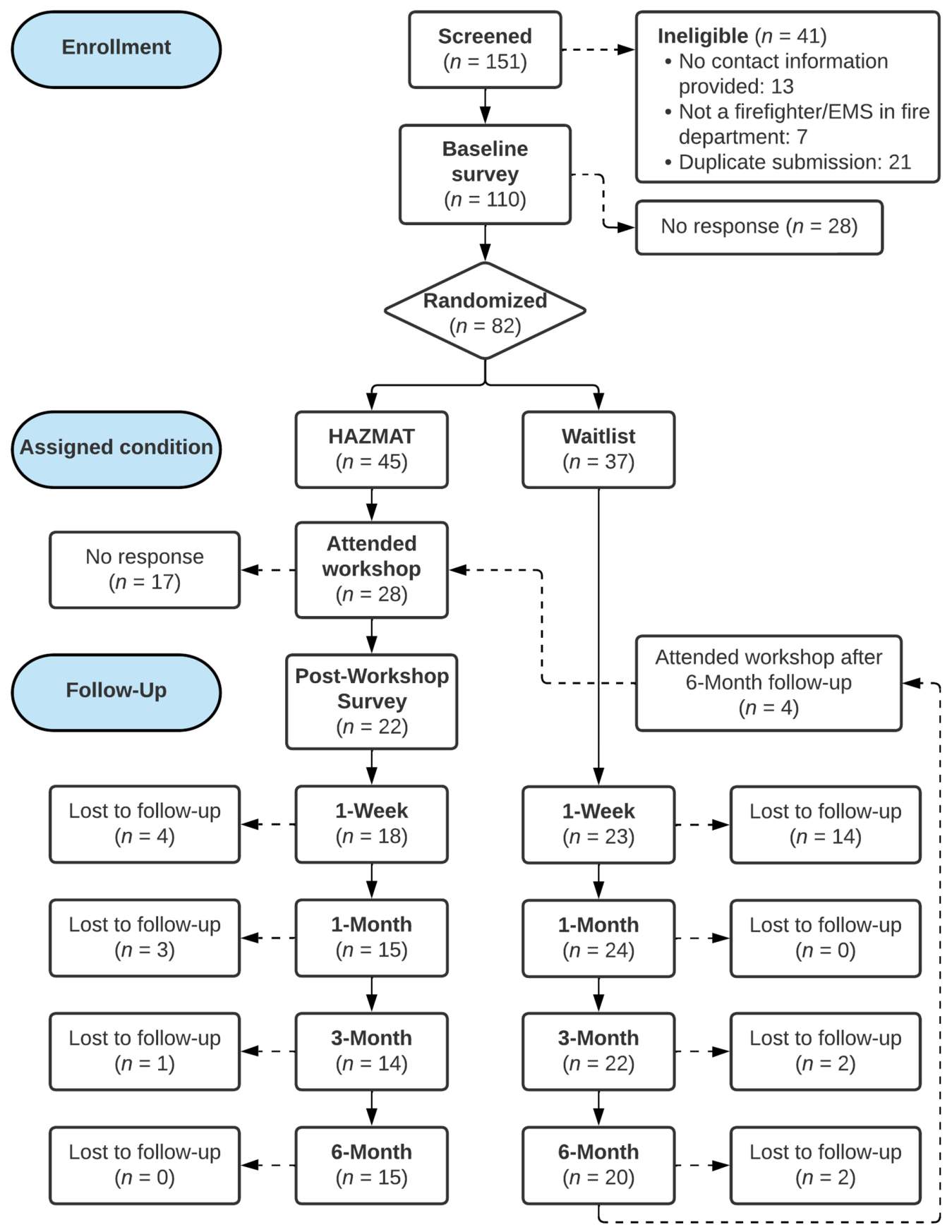
Participants randomized to HAZMAT (n = 45) were contacted by study staff within four weeks of completing the baseline assessment to schedule their virtual workshop date, delivered via online video-conference software. Immediately following the conclusion of the workshop, participants completed a brief, online post-workshop assessment and were then scheduled for six online self-report follow-up assessments administered at 1 week, 1 month, 3 months, and 6 months post-workshop (see Figure 1). Participants randomized to the waitlist condition (n = 37) followed the same assessment schedule but did not participate in the workshop during the study period in order to account for time-varying factors in symptom severity. All participants who missed a given assessment time point continued to receive reminders for subsequent assessments. Participants were compensated with a $10 e-gift card after completing each assessment and received a $25 e-gift card after completing the 6-month follow-up assessment. Participants were free to discontinue participation at any time without penalty and those randomized to the waitlist condition were given the option of enrolling in the workshop after the end of the waitlist timeline (i.e., after the 6-month follow-up). All study procedures were approved by the affiliated university’s institutional review board.

2.3. Intervention Design and Fidelity

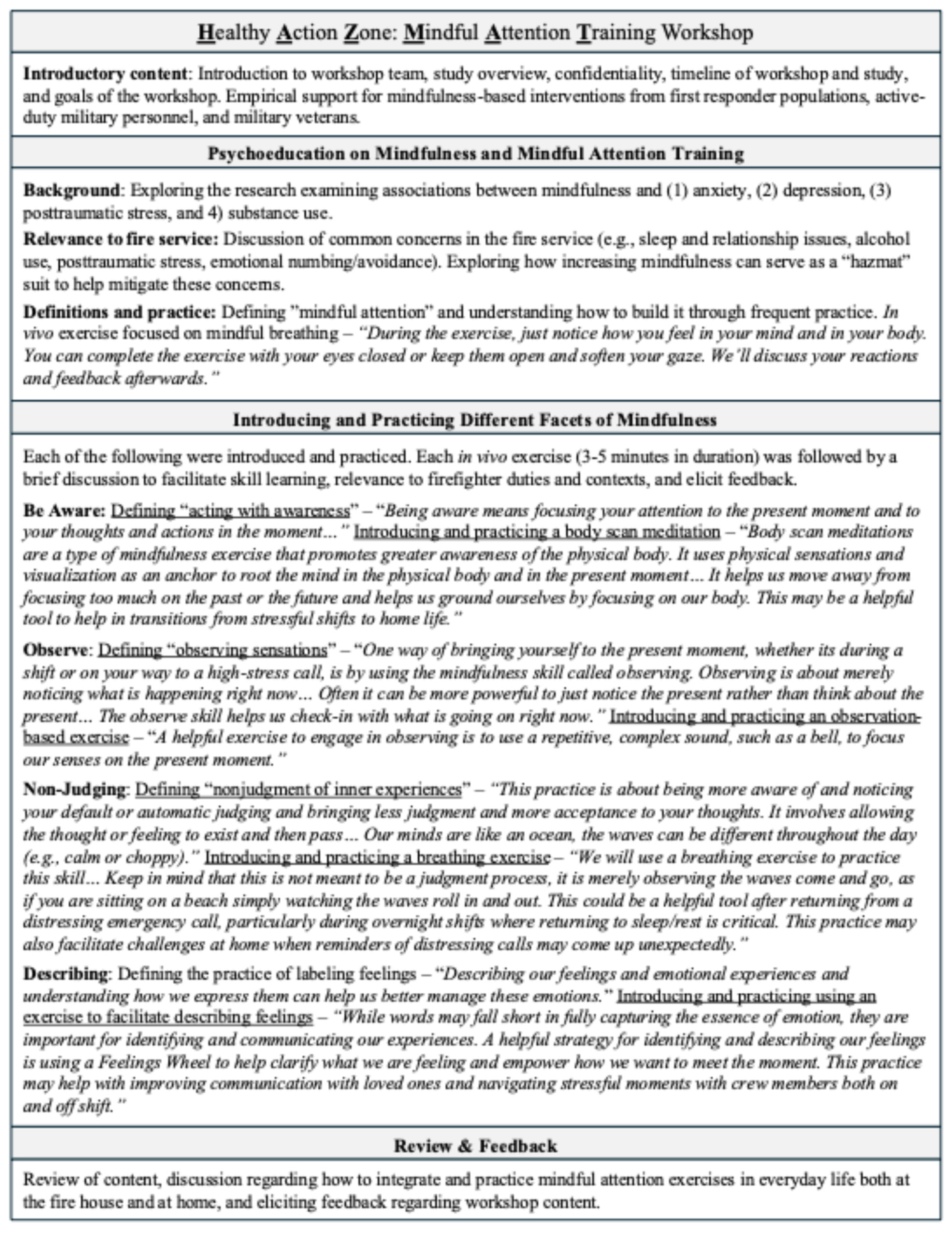
Mindful attention training workshop. The 90 min, online, video-conference-based workshop included a 15 min break and allowed for up to 15 participants to join. The workshop was designed to be highly interactive and included a combination of psychoeducation, guided experiential exercises, and facilitated group discussion. Participants engaged in in-session practice of mindful attention exercises, followed by structured opportunities to reflect on their experiences and discuss how these skills could be applied in firefighter-specific contexts (e.g., during calls, starting/ending shifts, or post-incident recovery). The 90 min, single-session format was intentionally selected to maximize feasibility, scalability, and accessibility within the fire service, where variable shift schedules, overtime demands, and competing responsibilities may limit engagement in multi-session interventions and to provide a low-burden entry point. The workshop was led and facilitated by a rotation of doctoral-level clinical psychology students, all of whom completed required training in workshop delivery and good clinical practice for RCT delivery, data collection, and safety (see below for additional information). The HAZMAT workshop was developed by the authors in consultation with fire service psychologists to ensure compatibility with fire service culture (see Figure 2). The workshop was modified and tailored specifically to the fire service through (a) firefighter-specific terminology and framing, (b) integration of occupationally relevant scenarios (e.g., transitioning on and off shift), and (c) discussion prompts grounded in shared fire service experiences (e.g., regulating distress after a critical incident and/or high-stress calls). Notably, terminology was intentionally tailored to fire culture to enhance relatability and rapport [26] as per feedback from fire service clinicians (e.g., “workshop” versus “therapy”; “mindful attention training” versus “mindfulness”; “skillset” or “toolbox” versus “therapeutic strategies”).
The HAZMAT workshop provided: (1) psychoeducation regarding common mental health concerns among firefighters, (2) introduction to the concept of mindful attention, its relevance to firefighters and first responders, generally, and examples of how mindful attention can prevent or decrease the severity of mental health symptoms, (3) introduction and in vivo practice of five experiential mindful attention training exercises, and (4) discussion of mindful attention exercises, their utility both on- and off-duty, and strategies to integrate mindful attention exercises in everyday life in the fire service. Mindful attention was described as a “hazmat” suit that can serve to mitigate the impact and severity of mental health concerns, an analogy that is highly relevant to fire service personnel given their familiarity with safety protocols related to chemical, biological, and/or radioactive hazards. Each mindful attention exercise was discussed in relation to the various mindfulness facets (i.e., observing, describing, acting with awareness, non-judging of inner experience, and nonreactivity to inner experience) [9]. In vivo exercises, derived from techniques commonly administered across various mindfulness-based interventions [10,11,27], were practiced by participants and facilitators during the workshop session and facilitators created space for participants to discuss their experiences and provide feedback regarding the utility of the exercise for them personally and for firefighters, generally.
Intervention fidelity. Workshop facilitators were doctoral students in clinical psychology and received direct training in the HAZMAT workshop. Specifically, training was conducted by the PI and manual development team and included 2–3 h of manual review in addition to approximately 2 h of role-play practice of workshop material. Continued training and group supervision for the HAZMAT workshop were provided by the PI, a licensed clinical psychologist, on a biweekly basis throughout the course of the trial. Workshop-related issues were discussed during group supervision meetings, and additional role-plays were conducted as needed. Intervention adherence checklists, based on manual content, were completed by facilitators before, during, and after each workshop.

2.4. Measures

Measures were selected and utilized for distinct phases of the study, including baseline, post-workshop, and longitudinal follow-up assessments. The timing of these assessments is illustrated in Figure 1 and is further detailed below.
Screening Questionnaire. A brief, online questionnaire was administered to potential participants to determine study eligibility prior to baseline assessment. Questions included the assessment of current employment status with a fire department as a first responder (i.e., in a firefighter and/or EMS position with the department) and age confirmation (i.e., 18 years of age or older). Eligible participants were then asked to provide contact information to facilitate online data collection and workshop scheduling, pending their randomization to the workshop condition.
Demographic Questionnaire. Participants were asked to self-report sociodemographic factors and health and medical information during the baseline assessment. The questionnaire was used to describe the sample and specific sociodemographic variables (e.g., age, race/ethnicity, sex assigned at birth, relationship status, education, and employment history) were used to assess group differences between RCT conditions.
Five Facet Mindfulness Questionnaire (FFMQ) [9]. The FFMQ is a 39-item measure that assesses five mindfulness facets: observing (i.e., attention to internal and external experiences), describing (i.e., ability to label internal experiences), acting with awareness (i.e., attention to activities in the moment), non-judging of inner experience (i.e., ability to remain non-evaluative about internal experiences), and nonreactivity to inner experience (i.e., ability to allow internal experiences to come and go) [9]. Items were rated on a 5-point Likert-type scale (1 = Never or very rarely true to 5 = Very often or always true) and specific items were reverse-scored (e.g., a score of 5 is reversed to a 1). The FFMQ has good construct validity and reliability [28] and has demonstrated good internal consistency in past work among firefighters [29]. In the current study, the FFMQ’s internal consistency at each time point for the full scale ranged from good to excellent (α = 0.89–0.95) and the average scores of each FFMQ facet were used as outcome variables. The FFMQ was administered at all study time points, with the exception of the screening assessment.
Mindful Attention Awareness Scale (MAAS) [30]. The MAAS is a 15-item self-report scale assessing an individual’s capacity for mindful attention and their level of dispositional mindfulness. Items are rated on a 6-point Likert-type scale (1 = Almost always to 6 = Almost never), with higher total scores indicating greater levels of dispositional mindfulness. Participants were instructed to indicate how frequently or infrequently they experience specific items on an everyday basis. The MAAS has evinced strong psychometric properties across various populations [31,32]. In the current study, the MAAS’s internal consistency at each time point ranged from good to excellent (α = 0.85–0.94) and the average score of the MAAS was used as an outcome variable. The MAAS was administered at all study time points, with the exception of the screening assessment.
Life Events Checklist for DSM-5 (LEC-5) [33]. The LEC-5 is a 17-item self-report measure designed to screen for potentially traumatic events in a respondent’s lifetime. Participants were asked to indicate whether they were exposed to any of the 16 potentially traumatic events listed. Exposure to a potentially traumatic event type was coded as ‘positive’ if participants indicated the event happened to them, they witnessed it, or if it was part of their job. The total number of positive exposure event types was summed to produce an overall trauma load (i.e., the number of potentially traumatic event types) variable. Trauma load was used to describe the sample and to evaluate group differences between RCT conditions. The LEC-5 was only administered during the baseline assessment.
Posttraumatic Stress Disorder Checklist for DSM-5 (PCL-5) [34] is a 20-item self-report measure that assesses the severity of DSM-5 PTSD symptoms over a specific timeframe, which varied by time point, with higher total scores indicating elevated symptom severity. Participants who endorsed exposure to a potentially traumatic event type on the LEC-5 were instructed to complete the PCL-5 with reference to the “worst” traumatic event endorsed. The PCL-5 employs a 5-point Likert scale (0 = Not at all to 4 = Extremely) to examine the presence and severity of DSM-5 PTSD symptoms, with higher total scores indicating elevated symptom severity. Guidelines for a probable PTSD diagnosis recommend a cut-off score of 33 or higher [35]. The measure has excellent psychometric properties [34] and the internal consistency of the PCL-5 at each time point was excellent (α = 0.94–0.97). The PCL-5 total score was utilized as an outcome variable in this study. The PCL-5 was administered at all study time points, with the exception of the screening assessment.
Overall Depression Severity and Impairment Scale (ODSIS) [36]. The ODSIS is a 5-item self-report measure that assesses past-week depression-related symptoms, particularly symptom severity and functional impairment. Items were rated on a 5-point Likert scale (0 to 4), with higher scoring indicating greater severity of depressive symptoms. The recommended cut-off score for the ODSIS total score for clinical depression is >7 [37]. The ODSIS has shown strong psychometric properties, including good convergent and discriminate validity [37] and excellent internal consistency across clinical and non-clinical populations [36]. In the current study, the internal consistency of the ODSIS at each time point was excellent (α = 0.94–0.96) and the total score was evaluated as an outcome variable. The ODSIS was administered at all study time points, with the exception of the screening assessment.
Overall Anxiety Severity and Impairment Scale (OASIS) [38]. The OASIS is a 5-item measure assessing for past-week anxiety-related symptoms and is scored on a 5-point Likert-type scale ranging from 0 to 4. The recommended cut-off score for the OASIS total score for clinical anxiety is >8 [38]. The OASIS has demonstrated good reliability and validity [39]. In the current study, the internal consistency of the OASIS at each time point was excellent (α = 0.94–0.97) and the total score was evaluated as an outcome variable. The OASIS was administered at all study time points, with the exception of the screening assessment.
Beck Scale for Suicide Ideation-5 (BSS-5) [40]. BSS-5 is a 5-item self-report measure, derived from the long-form version of the Beck Scale for Suicide Ideation, designed to identify individuals at risk for suicide by assessing the intensity of past-week suicide ideation. Higher total scores on the BSS-5 indicate more severe suicide ideation. The BSS has demonstrated strong psychometric properties [41,42] and the internal consistency of the BSS-5 at each time point in the current study ranged from fair to good (α = 0.71–0.84). The total score of the BSS-5 was used as an outcome variable in the present study. The BSS-5 was administered at all study time points, with the exception of the screening assessment.
Alcohol Use Disorders Identification Test (AUDIT) [43]. The AUDIT is a 10-item self-report measure that assesses alcohol-related problems and alcohol consumption over a specific timeframe. Higher scores on the AUDIT reflect greater problematic alcohol use, with scores ranging from 0 to 40. For the current study, participants completed the full AUDIT at baseline to assess past-year alcohol use and capture group difference in alcohol use severity, while the first three items of the AUDIT (i.e., AUDIT-C) [44] were administered at all other time points to evaluate alcohol use severity over time [45]. The timeframe was modified for each time point to assess alcohol use since the previous time point. The current guidelines for a probable AUD diagnosis recommend an AUDIT total score cut-off of 8 or greater [46]. The AUDIT has been found to have good psychometric properties [43,47], and good internal consistency among firefighter populations [48]. The full AUDIT demonstrated good internal consistency at baseline (α = 0.89), and the AUDIT-C showed fair-to-good internal consistency across baseline and follow-up (α = 0.76–0.82), with lower internal consistency observed at the 6-month follow-up (α = 0.65). The AUDIT total score was utilized to describe the sample and assess baseline difference between condition, and the AUDIT-C total score was used as an outcome variable. The AUDIT was administered at all study time points, with the exception of the screening assessment.
Post-HAZMAT Workshop Questionnaire. This investigator-generated questionnaire is a 10-item self-report measure designed to assess participants’ subjective evaluation of the workshop across multiple domains, including enjoyment, perceived learning, understanding of mindful attention, intention to use skills, perceived usefulness, organization, relevance to firefighters, likelihood of recommending the workshop, and comfort within the group setting. Items included statements such as “I enjoyed the workshop,” “I learned about mental health in this workshop,” “I understand mindful attention as a result of the workshop,” “I will try to practice mindful attention going forward,” “The workshop was useful,” “The workshop was well-organized,” “The workshop will be helpful for other firefighters,” “I would recommend this workshop to a friend,” “The workshop is relevant to firefighters,” and “I felt comfortable in the workshop.” Participants were asked to rate each statement on a 10-point Likert scale from (0 = Strong disagree to 10 = Strongly agree). Item responses were summed to produce a total acceptability score, with higher scores indicating greater perceived acceptability of the workshop. The measure was exclusively completed by participants randomized to the workshop and was administered during the post-workshop time point.
Group Evaluation Scale (GES) [49]. The GES is a 7-item self-report measure assessing how the participant felt while participating in the group, particularly level of comfort and sense of being understood by other group members and facilitators. Items assess domains such as comfort within the group, emotional stability during the session, ability to communicate with other members, perceived support from the group, and interpersonal experiences (e.g., feeling understood, independent, and responsible within the group). Statements (e.g., “Within the group I felt well understood”) were rated using a 7-point Likert scale (1 to 7; anchors vary by item—“uncomfortable to very comfortable,” “misunderstood to well understood,” and “with great difficulty to easily”), with higher scores indicating favorable group evaluations. Items were summed to produce a total group evaluation score, with higher scores reflecting more positive perceived group experience. Similar to the post-workshop questionnaire, the GES was only administered to participants randomized to the workshop during the post-workshop time point.
The Group Climate Questionnaire (GCQ) [50]. The GCQ is a 12-item self-report measure assessing participants’ perceptions of group climate and group dynamics. Items assess domains such as group cohesion, mutual support, interpersonal tension, avoidance of important issues, and overall engagement within the group and with facilitators. Items (e.g., “The members liked and cared about each other”; “Members revealed sensitive personal information or feelings”) are rated on a 7-point Likert scale ranging from 0 (Not at all) to 6 (Extremely). The GCQ yields three subscale scores reflecting distinct dimensions of group cohesion: Engagement (i.e., participant involvement, openness, and mutual support within the group), Conflict (i.e., tension or disagreement in the group), and Avoidance (i.e., avoiding group interaction and disengaging). Subscale scores (i.e., Engagement, Conflict, and Avoidance) were calculated as the mean of the relevant items, with higher scores indicating greater levels of engagement, conflict, or avoidance within the group. The GCQ was only administered to participants randomized to the workshop during the post-workshop time point.
Web-Based Mental Health Resources Questionnaire. This investigator-generated self-report questionnaire was developed to assess firefighters’ interest in web-based or app-delivered mental health resources tailored for the fire service. The measure included items assessing perceived helpfulness of online mental health information and interest in learning more about specific content areas (e.g., alcohol use among firefighters, suicide prevention, and firefighter mental health) delivered via online platforms or mobile applications. For content-specific domains, participants first indicated interest (“Yes” or “No”) and then rated their level of interest on a 5-point Likert scale (1 = Not at all interested to 5 = Very interested). Additional items assessed technology access and feasibility, including smartphone ownership, internet access, and frequency of internet use. Responses were examined descriptively to characterize perceived acceptability and interest in web-based mental health resources for the fire service, and the measure was administered at baseline to all participants.
Table 1. Participant baseline sociodemographic characteristics.
VariableMean ± SD/n (%)
Total
(N = 82)
Active
(n = 45)
Waitlist
(n = 37)
Age41.37 ± 8.2642.31 ± 8.2640.22 ± 8.24
Sex
     Male72 (87.8%)42 (93.3%)30 (81.1%)
     Female10 (12.2%)3 (6.7%)7 (18.9%)
Race
     American Indian or Alaskan Native2 (2.4%)1 (2.2%)1 (2.7%)
     Asian or Asian American2 (2.4%)0 (0.0%)2 (5.4%)
     Black or African American9 (11.0%)4 (8.9%)5 (13.5%)
     Multiracial1 (1.2%)0 (6.0%)0 (0.0%)
     White49 (59.8%)29 (64.4%)20 (54.1%)
Ethnicity (Hispanic and/or Latinx)25 (30.5%)12 (52.0%)13 (35.1%)
Education
     Partial completion of high school/GED equiv.1 (1.2%)0 (0.0%)1 (2.7%)
     High school graduate2 (2.4%)0 (14.0%)2 (5.4%)
     Some college31 (37.8%)21 (46.7%)10 (27.0%)
     College graduate48 (58.5%)24 (53.3%)24 (64.9%)
Fire service role
     Firefighter75 (91.5%)44 (97.8%)31 (83.8%)
     EMS7 (8.5%)1 (2.2%)6 (16.2%)
Employment status
     Full-time paid81 (98.8%)45 (100.0%)36 (97.3%)
     Part-time volunteer1 (1.2%)0 (0.0%)1 (2.7%)
Additional fire service information
     Firefighter/EMS is primary occupation79 (96.3%)44 (97.8%)35 (94.6%)
     Years in fire service15.42 ± 7.8316.39 ± 8.0314.24 ± 7.52
Currently in relationship65 (79.3%)37 (82.2%)28 (75.7%)
History of military service16 (19.5%)11 (24.4%)5 (13.5%)
Mental health
     Trauma load13.22 ± 2.0113.32 ± 2.0813.08 ± 1.95
     Probable PTSD12 (14.6%)3 (6.7%)9 (24.3%)
     Probable AUD19 (23.2%)10 (22.2%)9 (24.3%)
     Probable clinical anxiety7 (8.5%)3 (6.7%)4 (10.8%)
     Probable clinical depression9 (11.0%)4 (8.9%)5 (13.5%)
Note. All items were collected using screening and demographic questionnaires, with the exception of items listed under ‘Mental health’. Categories with low frequencies are retained for completeness. Trauma load = the total number of positive exposure event types endorsed on the Life Events Checklist for DSM-5 [33]; Probable PTSD = a total score > 32 on the Posttraumatic Stress Disorder Checklist for DSM-5 [34]; Probable AUD = a total score > 7 on the Alcohol Use Disorders Identification Test [43]; Probable clinical anxiety = a total score > 8 on the Overall Anxiety Severity and Impairment Scale [38]; Probable clinical depression = a total score > 7 on the Overall Depression Severity and Impairment Scale [36].

2.5. Data Analytic Plan

The primary aim of this pilot RCT was to examine the feasibility and acceptability of the HAZMAT workshop. Secondary aims included examining preliminary effects of the HAZMAT workshop on improving mindfulness and reducing the severity of mental health correlates over time, including self-reported symptom severity of PTSD, depression, suicidal ideation, and alcohol use, compared to the waitlist control condition. The study initially aimed to enroll 100 firefighters (50 per condition); however, recruitment was discontinued after a six-month period with no additional enrollments, resulting in a smaller pilot sample. Data were first evaluated for patterns of missing data, multivariate outliers, and normality for all variables. Bivariate associations among primary study variables were examined at baseline. Overall, less than 5% of data were missing across time points, and Little’s Test for Missing Completely at Random (MCAR) was not significant, suggesting that missing data was consistent with MCAR. Missing data were handled using restricted maximum likelihood (REML) estimation as per guidelines for mixed effects modeling [51]. Distributions for all study variables approximated normality (skewness < |2.25|; kurtosis < |7|) [52,53]. Differences between RCT conditions were examined using chi-square tests of independence and independent-samples t tests to identify potential covariates for subsequent analyses.
Feasibility was operationalized using objective indicators of study engagement and implementation, including recruitment rates, enrollment rates, and workshop attendance relative to prespecified benchmarks. Specifically, it was determined by calculating the proportion of eligible individuals who meet the inclusion criteria and agree to enroll in the study. Retention was assessed by tracking the percentage of participants randomized to HAZMAT who successfully completed baseline assessments and then attended the workshop. We anticipated that at least 70% of eligible individuals would enroll in the study and that no fewer than 80% of participants randomized to HAZMAT would remain engaged through the workshop.
Acceptability was operationalized as participants’ subjective evaluation of the workshop and assessed among attendees using self-reported ratings on the Post-Workshop Questionnaire (e.g., perceived usefulness, relevance, and satisfaction), as well as standardized measures of group experience (GES) and group climate (GCQ). These measures were selected to capture complementary dimensions of acceptability, including perceived usefulness and relevance, individual-level group experience, and group-level dynamics. Acceptability was evaluated descriptively as the proportion of participants meeting prespecified thresholds across each measure. Specifically, acceptability was determined if at least 80% of responses on each measure achieved a rating of 6 or higher on the 7-point scale for the GES, mean ratings on the Engagement subscale score ≥ 3 and mean Conflict and Avoidance subscale scores < 3 for the GCQ, and a rating of 9 or higher on the 10-point Likert scale for the post-workshop questionnaire.
The preliminary efficacy of the HAZMAT workshop was examined using linear mixed-effects growth models, under an intent-to-treat framework, to evaluate changes in key outcomes over time as a function of intervention condition. Mixed-effects models included fixed effects for time, condition, and their interaction to test whether rates of change across follow-up differed between the workshop and waitlist conditions. Time was modeled as a continuous predictor to estimate linear change across follow-up assessments, excluding the post-workshop assessment time point. Random intercepts and random slopes for time were specified at the participant level to account for individual differences in baseline levels and rates of change. Models were estimated using REML and statistical analyses primarily focused on the interaction between time point and condition, with estimated marginal means used to describe group differences at follow-up assessments. Effect sizes and 95% confidence intervals were reported to support interpretation of findings. Aligned with pilot trial guidelines [54,55] and given the study’s primary focus on feasibility and acceptability rather than intervention efficacy, formal power analyses were not conducted. Post hoc descriptive analyses were also conducted to evaluate firefighters’ general interest in web-based mental health programming within the fire service.

3. Results

3.1. Feasibility Outcomes

Feasibility benchmarks were partially met. A total of 151 individuals completed the screening survey and only 28 respondents were deemed ineligible, including seven who were not currently employed as firefighters and/or EMS personnel within a fire department and 21 cases reflecting duplicate submissions to the screening survey. An additional 13 individuals did not provide contact information and were therefore considered ineligible. Among the 110 eligible firefighters, 82 firefighters enrolled in the study, yielding an enrollment rate of 74.5%, which exceeded the prespecified threshold of 70%. Participants were randomized to either the HAZMAT workshop condition (n = 45) or a waitlist comparison condition (n = 37). Among participants randomized to the HAZMAT condition, 53.3% attended the workshop (n = 24). Workshops were delivered across multiple sessions to accommodate participant availability, with each participant attending a single session. A total of 21 workshop sessions were conducted, with session sizes ranging from one to three participants (average number of participants per workshop = 2.1 [range = 1–3]), indicating that most sessions were conducted in very small groups or individually, which fell well below the prespecified engagement criterion of 80%. Independent-samples t tests indicated that there were no statistically significant baseline differences in sociodemographic or psychiatric variables between participants who attended the workshop and those who did not (n = 21). Notably, participants randomized to HAZMAT who did not attend the workshop did not complete any subsequent follow-up assessments, resulting in substantial attrition within the intervention arm. Four participants randomized to the waitlist condition attended and completed the workshop after the 6-month follow-up. Slight variations in sample size across follow-up time points reflect the study design, in which participants were contacted for subsequent assessments regardless of prior completion; thus, some participants who missed earlier assessments completed later follow-up assessments. See Figure 1 for additional information on enrollment and retention rates throughout the pilot RCT.

3.2. Acceptability Outcomes

Acceptability of the HAZMAT workshop was evaluated at the post-workshop assessment using prespecified thresholds across three measures. Among participants who attended the workshop and completed the post-workshop questionnaire (n = 22), acceptability criteria were met for the post-workshop questionnaire (i.e., overall satisfaction and perceived usefulness of HAZMAT) and the GES (i.e., participants’ individual experiences of comfort, understanding, and engagement within the group), with 100% of respondents reporting ratings at or above the defined thresholds (i.e., ≥9 for the post-workshop questionnaire and ≥6 for the GES). Regarding group climate, 81.8% of participants met the criterion for the GCQ Engagement subscale (mean score ≥ 3, reflecting active participation and group involvement), 100% met the criterion for the GCQ Conflict subscale (mean score < 3, reflecting low levels of interpersonal tension), and 81.8% of participants met the criterion for the GCQ Avoidance subscale (mean score < 3, reflecting low levels of disengagement). Together, these findings indicate strong acceptability of the workshop across individual-level satisfaction and engagement, as well as favorable group-level climate characterized by high engagement, low conflict, and low avoidance. However, the interpretation of group-level climate findings is limited by the small group sizes observed in this pilot study, with some workshop sessions including only a single participant, which constrains the ability to meaningfully evaluate group processes.

3.3. Examination of Baseline Data

Baseline differences between conditions were evaluated using chi-square tests for categorical variables and independent-samples t tests for continuous variables. No significant differences were observed between participants randomized to the HAZMAT workshop and the waitlist condition on sociodemographic characteristics, including age, sex, race, ethnicity, educational attainment, years of service as a first responder, employment status (full- vs. part-time), occupational role (firefighter vs. EMS), military veteran status, or relationship status. Similarly, participants randomized to either condition did not significantly differ on baseline self-report measures, including trauma load, PTSD symptom severity, anxiety and depressive symptoms, suicidal ideation, present-moment attention and awareness, or any mindfulness facets assessed by the FFMQ. However, participants in the HAZMAT condition reported significantly higher baseline alcohol use severity compared to those in the waitlist condition. Bivariate correlations among primary study variables at baseline are presented in Table 2.

3.4. Preliminary Efficacy

Using an intent-to-treat approach, linear mixed-effects models assessing the main and interactive effects of time and condition (i.e., HAZMAT workshop vs. waitlist control) on primary study outcomes revealed nonsignificant findings for all outcomes. For PTSD symptom severity (PCL-5), there were no significant main or interactive effects between time and condition, indicating that changes in PTSD symptoms over time did not differ between conditions. Estimated marginal means favored the HAZMAT condition across time (e.g., baseline mean difference = −2.39 points), with similarly small differences (−2.4 to −4.6 points) observed at subsequent time points; however, all comparisons were nonsignificant with overlapping confidence intervals. For alcohol use severity, there was a significant main effect of condition, F(1, 75.9) = 5.8, p = 0.019, indicating higher overall scores in the HAZMAT workshop condition relative to the waitlist control; however, there was no significant main effect of time and no significant interaction. Regarding anxiety symptoms, depressive symptoms, and suicidal ideation, there were no significant main or interactive effects of time and condition, indicating that changes in these primary outcome variables over time did not differ between conditions, with estimated marginal means remaining comparable across assessments. Similar results were observed for present-moment attention and awareness and all five mindfulness facets, with no significant main or interactive effects and comparable estimated marginal means between conditions over time. Given baseline differences in alcohol use severity between conditions, all primary analyses were re-run including baseline alcohol use severity as a covariate, with no change in the pattern or significance of results. Primary outcome scores for the overall sample and between conditions at baseline and follow-up are described in Table 3.

3.5. Post Hoc Analyses

Post hoc descriptive analyses were used to examine interest in digitally delivered mental health programming in the fire service. Among participants with available data (n = 36), most expressed interest in learning more about firefighter mental health if information were available online or via an app, with 83.3% endorsing interest (i.e., “Yes”) and 72.2% reporting they were somewhat or very interested. Interest in content related to alcohol use delivered digitally among firefighters was more mixed, with 50.0% endorsing interest and 47.2% reporting being somewhat or very interested. A majority of participants also expressed interest in learning more about suicide prevention among firefighters via digital platforms, with 69.4% endorsing interest and 55.6% reporting being somewhat or very interested. The perceived helpfulness of digital mental health resources was high, with 86.1% of participants rating online or app-based mental health information for firefighters as somewhat or very helpful and 83.3% reporting similar ratings for firefighter-specific coping skills or strategies delivered digitally.

4. Discussion

The present pilot RCT primarily evaluated the feasibility and acceptability of a one-session, virtually delivered mindful attention training workshop (HAZMAT), with secondary examination of its preliminary efficacy. Findings provide strong support for the acceptability of this brief, group-based intervention, while feasibility outcomes were mixed. Hypotheses regarding HAZMAT’s preliminary efficacy were not supported as no statistically significant between-group effects were observed for psychological symptoms or mindfulness outcomes over time. Taken together, the results suggest that although the mindful attention workshop was well-received and perceived as highly relevant by firefighters, additional refinement and/or augmentation is necessary to produce measurable changes in clinical outcomes. Relatedly, the small sample size in this pilot study underscores the need to conduct replications and extensions among larger samples.
Consistent with study feasibility benchmarks, recruitment was successful, and enrollment exceeded prespecified feasibility thresholds (i.e., at least 70% of eligible individuals would enroll in the study), indicating substantial interest in mindfulness-informed programming within the fire service. However, overall feasibility was mixed, as workshop attendance among those randomized to HAZMAT did not meet the prespecified engagement criterion (i.e., at least 80% of participants randomized to HAZMAT would attend the workshop), despite the single-session, virtual format of the workshop, which was intended to reduce barriers to participation. These findings suggest that initial interest in participation may not readily translate into intervention engagement in this context, particularly if the intervention is delivered outside of routine training. Attendance may have been constrained by unpredictable shift schedules, overtime demands, and competing off-duty responsibilities common in the fire service. Future work may benefit from strategies to enhance participation, such as increased scheduling flexibility, integration of training into existing departmental programming (e.g., shift-based or mandatory trainings, continued education credit opportunities, paid time, and/or overtime compensation) [56], and greater use of scheduling reminders.
Recruitment and attendance rates are comparable to those observed in other voluntary, off-duty mental health interventions for first responders [57,58,59], underscoring the challenges of conducting empirical research in this population, as well as the need for innovative engagement strategies. Importantly, among firefighters who attended the workshop (n = 24), acceptability ratings were uniformly high. Participants reported strong satisfaction, perceived utility, and relevance of the material, and endorsed favorable group processes, including high engagement and low conflict. However, these findings should be interpreted in the context of attendance rates, as nearly half of those randomized to the intervention did not attend the workshop, and small group sizes (e.g., some workshop sessions included only a single participant) limit conclusions regarding group processes and the generalizability of findings. Although group sizes were smaller than anticipated, this format allowed for individualized engagement and facilitated discussion tailored to participants’ experiences. Moreover, acceptability was assessed using post-session self-report measures and reflects participants’ immediate subjective evaluation of the workshop, which may not capture longer-term engagement. In light of these limitations, findings coincide well with prior work suggesting that mindfulness-based content is acceptable to first responders when culturally adapted and framed in skills-based, first responder-specific, non-clinical language [59]. Future research would benefit from user-centered design approaches as well as the involvement of community advisory boards and/or firefighter stakeholder input, all of which were not formally included in the present study, to guide intervention refinement and study implementation.
Despite strong acceptability, the HAZMAT workshop did not demonstrate preliminary efficacy relative to the waitlist control condition across PTSD symptoms, depression, anxiety, suicidal ideation, alcohol use, or mindfulness-related outcomes. While variability in outcome trajectories was observed across both conditions, in the absence of significant between-group differences, these fluctuations suggest that changes are unlikely to be related to the intervention and may instead reflect natural symptom variability or external influences over time. The intervention consisted of a single 90 min workshop session, which may have been insufficient to produce durable changes in symptom severity or levels of mindfulness, particularly in a chronically stressed and trauma-exposed population. Prior mindfulness-based interventions that have demonstrated efficacy among firefighters and other first responder groups have typically involved multi-session formats with repeated practice for skill consolidation [22,58]. Thus, while brief interventions may serve as valuable entry points for engagement, skills acquisition, and prevention, symptom-level change may require a greater intervention “dose” (e.g., a longer session) or structured opportunities for continued practice beyond the single session [60]. For example, a brief multi-session format (e.g., an initial workshop followed by a booster session) may allow participants to practice skills, troubleshoot barriers to implementation, and refine technique use over time. Alternatively, prior work demonstrates that longer, single-session resilience-focused interventions can yield meaningful benefits among firefighters and other disaster-exposed workers. Notably, a four-hour, single-session Disaster Working Resiliency Training Program for disaster workers, including firefighters, demonstrated efficacy in an RCT, with participants showing improvements in healthy lifestyle behaviors, spiritual growth, and stress management at three-month follow-up [57]. Also, it is important to revisit that the study was not designed or powered to detect small effects, as the study’s primary aim as a pilot trial focused on feasibility rather than efficacy. Additionally, baseline symptom levels in the sample were variable, as the study intentionally recruited firefighters across a range of clinical severity rather than focusing exclusively on a clinically elevated sample, which may have further reduced sensitivity to change. Together, these findings highlight not only the potential of well-designed, brief interventions to address mental health concerns in the fire service but also indicate that additional work is needed to maximize their impact.
Post hoc exploratory findings further contextualize these results and offer descriptive insight into firefighters’ preferences for mental health programming. Firefighters expressed interest in and perceived relevance of digitally delivered mental health resources, particularly those focused on general mental health and suicide prevention, which is notable given the elevated prevalence of suicidal ideation and behaviors documented within the fire service [6]. The perceived helpfulness of online and app-based mental health information was high, suggesting that digital platforms may represent acceptable avenues for mental health support in this population [56]. Firefighter interest in digitally delivered content focused on alcohol use was more mixed, despite well-documented rates of hazardous drinking among this population [8]. This discrepancy may reflect stigma, ambivalence, or differing perceptions of need related to alcohol-focused interventions, even within a population at elevated risk. It is important to note that these post hoc findings are preliminary and warrant further investigation using study designs specifically intended to evaluate digital mental health preferences (e.g., user-centered approaches).
Several limitations of the present study should be noted. First, data collection relied exclusively on online self-report measures across all measures, which facilitated longitudinal data collection and retention but limited our ability to rule out method variance and reporting bias. Second, given that this study was a pilot RCT, recruitment focused on firefighters from primarily urban and suburban fire departments. Future studies might extend this work to geographically diverse firefighters (e.g., rural) and predominately volunteer firefighters in light of the potential for greater mental health symptoms among volunteer firefighters relative to career firefighters [61]. Similarly, the sample was predominantly male (87.8%) and identified as White (59.8%), and the use of convenience sampling may have resulted in a less representative sample, limiting the generalizability of findings to other firefighter populations. Third, participants were not selected on the basis of psychiatric symptom severity, the severity of trauma exposure, or years of service, as the study was designed to evaluate feasibility and preliminary efficacy across a broad range of clinical presentations. As a result, effects within specific subgroups (e.g., new academy recruits or firefighters with clinically elevated symptoms or recent trauma exposure) could not be examined and warrant focused investigation in future work. Fourth, the use of a waitlist control condition may not have fully accounted for non-specific factors, including the potential effects of repeated assessment or the opportunity for participants to take time away from work, both of which may have influenced outcomes. Future work should consider alternative active comparison conditions where appropriate to further isolate intervention-specific effects. Fifth, and as previously noted, the single-session format of the workshop represents a relatively low intervention dose, which may have limited opportunities for skill learning and use. Extant work suggests that multi-session mindfulness-based interventions may yield stronger effects on mental health outcomes [60], highlighting the value of integrating higher-dose formats in future research. Sixth, cultural factors within the fire service (e.g., stigma surrounding mental health, norms regarding self-reliance and distress overtolerance, and concerns about peer perception) may have influenced engagement with the intervention and self-report surveys [62,63]. Finally, exposure to potentially traumatic events during the follow-up period was not assessed, and trauma exposure occurring during study enrollment may have influenced outcomes. Thus, future studies with larger samples would benefit from a systematic assessment of stressor exposure over time.
Overall, findings from this pilot RCT suggest that a brief mindful attention training workshop tailored to the fire service may serve as a potentially acceptable entry point to learning more about mindfulness and its role in promoting better mental health care for firefighters, even when delivered in a single-session, virtual group format. Feasibility was limited by relatively low workshop attendance, although participants who attended reported high satisfaction and perceived relevance. These findings suggest that firefighter-specific and skills-based interventions may be engaging for those who participate, while also highlighting challenges in promoting initial and sustained participation. Although the HAZMAT workshop did not yield measurable symptom change, its acceptability supports its potential role as an adjunctive or introductory intervention that can be integrated into existing mental health programming (e.g., peer support or wellness initiatives) to promote skill acquisition and readiness for additional intervention. Future work should evaluate whether modifications to the intervention dose (e.g., longer or multi-session formats, or inclusion of booster sessions) and delivery context (e.g., integration into routine training) improve engagement and clinical impact. Taken together, this study contributes to the growing literature testing mindfulness-based interventions for firefighters [22,23], specifically, and first responders [64,65], broadly. Future research should continue to empirically evaluate the feasibility and acceptability of virtual and web-based mental health programming as this line of inquiry has potential to inform implementation efforts for mental health care in the fire service.

Author Contributions

Conceptualization, A.L. and A.A.V.; methodology, A.L., A.A.V. and M.Z.; formal analysis, A.L. and A.A.V.; investigation, A.L. and A.A.V.; data curation, A.L.; writing—original draft preparation, A.L., A.A.V. and M.Z.; writing—review and editing, A.L., A.A.V., M.Z. and S.J.B.; visualization, A.L. and M.Z.; supervision, A.A.V.; project administration, A.L. and A.A.V.; funding acquisition, A.A.V. All authors have read and agreed to the published version of the manuscript.

Funding

Research reported in this publication was supported by a Judy E. Hall Award from the National Register of Health Service Psychologists awarded to the corresponding author. The second and third authors acknowledge funding support from the National Institute on Alcohol Abuse and Alcoholism (NIAAA) of the National Institutes of Health (NIH): (Lebeaut: F31AA029600; Zegel: F31AA029022). The content is solely the responsibility of the authors and does not necessarily represent the official views of the National Institutes of Health or the National Register of Health Service Psychologists.

Institutional Review Board Statement

The study was conducted in accordance with the Declaration of Helsinki and was approved by the Institutional Review Board of the University of Houston (STUDY00002213; approved May 2020).

Informed Consent Statement

Informed consent was obtained from all subjects involved in the study.

Data Availability Statement

The data supporting the findings of this study are available from the corresponding author upon reasonable request.

Conflicts of Interest

The authors declare no conflicts of interest. The funders had no role in the design of the study; in the collection, analyses, or interpretation of data; in the writing of the manuscript; or in the decision to publish the results.

Abbreviations

The following abbreviations are used in this manuscript:
COVID-19Coronavirus Disease 2019
PTSDPosttraumatic Stress Disorder
AUDAlcohol Use Disorder
RCTRandomized Controlled Trial
RAWResilience@Work
HAZMATHealthy Action Zone Mindful Attention Training
DSM-5Diagnostic and Statistical Manual of Mental Disorders, Fifth Edition
PCL-5PTSD Checklist for DSM-5
FFMQFive Facet Mindfulness Questionnaire
MAASMindful Attention Awareness Scale
LEC-5Life Events Checklist for DSM-5
ODSISOverall Depression Severity and Impairment Scale
OASISOverall Anxiety Severity and Impairment Scale
BSS-5Brief Symptom Scale-5
AUDITAlcohol Use Disorders Identification Test
AUDIT-CAlcohol Use Disorders Identification Test—Concise
GESGroup Evaluation Scale
GCQGroup Climate Questionnaire
REMLRestricted Maximum Likelihood

References

  1. Jahnke, S.A.; Poston, W.S.; Haddock, C.K.; Murphy, B. Firefighting and mental health: Experiences of repeated exposure to trauma. Work 2016, 53, 737–744. [Google Scholar] [CrossRef]
  2. Meyer, E.C.; Zimering, R.; Daly, E.; Knight, J.; Kamholz, B.W.; Gulliver, S.B. Predictors of posttraumatic stress disorder and other psychological symptoms in trauma-exposed firefighters. Psychol. Serv. 2012, 9, 1–15. [Google Scholar] [CrossRef]
  3. Tomaka, J.; Magoc, D.; Morales-Monks, S.M.; Reyes, A.C. Posttraumatic stress symptoms and alcohol-related outcomes among municipal firefighters. J. Trauma. Stress 2017, 30, 416–424. [Google Scholar] [CrossRef]
  4. Jitnarin, N.; Jahnke, S.A.; Poston, W.S.C.; Haddock, C.K.; Kaipust, C.M. Posttraumatic stress disorder (PTSD) and mental health comorbidity in firefighters. J. Workplace Behav. Health 2022, 37, 147–168. [Google Scholar] [CrossRef]
  5. Bonita, I.; Halabicky, O.M.; Liu, J. Exposure to Wildfires Exposures and Mental Health Problems among Firefighters: A Systematic Review. Atmosphere 2024, 15, 78. [Google Scholar] [CrossRef]
  6. Stanley, I.H.; Hom, M.A.; Hagan, C.R.; Joiner, T.E. Career prevalence and correlates of suicidal thoughts and behaviors among firefighters. J. Affect. Disord. 2015, 187, 163–171. [Google Scholar] [CrossRef] [PubMed]
  7. Kim, J.I.; Min, B.; Lee, J.H.; Park, H.; Kim, J.H. Patterns of comorbid PTSD, depression, alcohol use disorder, and insomnia symptoms in firefighters: A latent profile analysis. J. Affect. Disord. 2024, 356, 338–345. [Google Scholar] [CrossRef] [PubMed]
  8. Haddock, C.K.; Jitnarin, N.; Caetano, R.; Jahnke, S.A.; Hollerbach, B.S.; Kaipust, C.M.; Poston, W.S.C. Norms about Alcohol Use among US Firefighters. Saf. Health Work. 2022, 13, 387–393. [Google Scholar] [CrossRef]
  9. Baer, R.A.; Smith, G.T.; Hopkins, J.; Krietemeyer, J.; Toney, L. Using Self-Report Assessment Methods to Explore Facets of Mindfulness. Assessment 2006, 13, 27–45. [Google Scholar] [CrossRef]
  10. Vujanovic, A.A.; Niles, B.; Pietrefesa, A.; Schmertz, S.K.; Potter, C.M. Mindfulness in the treatment of posttraumatic stress disorder among military veterans. Prof. Psychol. Res. Pract. 2011, 42, 24–31. [Google Scholar] [CrossRef]
  11. Vujanovic, A.A.; Niles, B.L.; Abrams, J.L. Mindfulness and meditation in the conceptualization and treatment of posttraumatic stress disorder. In Mindfulness and Buddhist-Derived Approaches in Mental Health and Addiction; Springer International Publishing: Cham, Switzerland, 2016; pp. 225–245. [Google Scholar]
  12. Yan, V.X.; Vujanovic, A.A.; Ponder, W.N.; Carbajal, J.; Medvedev, O.N. Network Analysis of Mindfulness and Mental Health Symptoms among Firefighters: A Transdiagnostic Lens. Mindfulness 2024, 15, 1060–1069. [Google Scholar] [CrossRef]
  13. Parker, B.; Ashton, A.; Eccles, F. The relationship between mindfulness and wellbeing in first responders: A systematic review. Curr. Psychol. 2025, 44, 1933–1949. [Google Scholar] [CrossRef]
  14. Tavakoli, N.; Correa-Fernandez, V.; Lebeaut, A.; Vujanovic, A.A. Mindfulness as a moderator of the association between anxiety and alcohol Use severity and drinking motives in professional firefighters. Subst. Use Misuse 2024, 59, 1886–1894. [Google Scholar] [CrossRef] [PubMed]
  15. Somohano, V.C.; Kaplan, J.; Newman, A.G.; O’Neil, M.; Lovejoy, T. Formal mindfulness practice predicts reductions in PTSD symptom severity following a mindfulness-based intervention for women with co-occurring PTSD and substance use disorder. Addict. Sci. Clin. Pract. 2022, 17, 51. [Google Scholar] [CrossRef] [PubMed]
  16. Barcaccia, B.; Medvedev, O.N.; Pallini, S.; Mastandrea, S.; Fagioli, S. Examining Mental Health Benefits of a Brief Online Mindfulness Intervention: A Randomised Controlled Trial. Mindfulness 2024, 15, 835–843. [Google Scholar] [CrossRef]
  17. Goldberg, S.B.; Riordan, K.M.; Sun, S.; Kearney, D.J.; Simpson, T.L. Efficacy and acceptability of mindfulness-based interventions for military veterans: A systematic review and meta-analysis. J. Psychosom. Res. 2020, 138, 110232. [Google Scholar] [CrossRef]
  18. Marchand, W.R.; Sandoval, K.; Lackner, R.; Parker, S.C.; Herrmann, T.; Yabko, B.; Velasquez, T.; Lewis, L.; Butler, J. Mindfulness-based interventions for military veterans: A systematic review and analysis of the literature. Complement. Ther. Clin. Pract. 2021, 42, 101274. [Google Scholar] [CrossRef]
  19. Wang, Q.; Wang, F.; Zhang, S.; Liu, C.; Feng, Y.; Chen, J. Effects of a mindfulness-based interventions on stress, burnout in nurses: A systematic review and meta-analysis. Front. Psychiatry 2023, 14, 1218340. [Google Scholar] [CrossRef] [PubMed]
  20. Goldberg, S.B.; Riordan, K.M.; Sun, S.; Davidson, R.J. The Empirical Status of Mindfulness-Based Interventions: A Systematic Review of 44 Meta-Analyses of Randomized Controlled Trials. Perspect. Psychol. Sci. 2022, 17, 108–130. [Google Scholar] [CrossRef]
  21. Ong, N.Y.; Teo, F.J.J.; Ee, J.Z.Y.; Yau, C.E.; Thumboo, J.; Tan, H.K.; Ng, Q.X. Effectiveness of mindfulness-based interventions on the well-being of healthcare workers: A systematic review and meta-analysis. Gen. Psychiatr. 2024, 37, e101115. [Google Scholar] [CrossRef]
  22. Denkova, E.; Zanesco, A.P.; Rogers, S.L.; Jha, A.P. Is resilience trainable? An initial study comparing mindfulness and relaxation training in firefighters. Psychiatry Res. 2020, 285, 112794. [Google Scholar] [CrossRef]
  23. Pace, T.W.W.; Zeiders, K.H.; Cook, S.H.; Sarsar, E.D.; Hoyt, L.T.; Mirin, N.L.; Wood, E.P.; Tatar, R.; Davidson, R.J. Feasibility, Acceptability, and Preliminary Efficacy of an App-Based Meditation Intervention to Decrease Firefighter Psychological Distress and Burnout: A One-Group Pilot Study. JMIR Form. Res. 2022, 6, e34951. [Google Scholar] [CrossRef]
  24. Canady, B.E.; Zullig, K.J.; Brumage, M.R.; Goerling, R.J. Intensive mindfulness-based resilience training in first responders: A pilot study. Health Behav. Policy Rev. 2021, 8, 60–70. [Google Scholar] [CrossRef]
  25. Vujanovic, A.A.; Lebeaut, A.; Zegel, M.; Buser, S.J. Mindful attention training workshop for firefighters: Design and methodology of a pilot randomized clinical trial. Contemp. Clin. Trials Commun. 2022, 27, 100905. [Google Scholar] [CrossRef] [PubMed]
  26. Vujanovic, A.A.; Tran, J.K. Providing psychological services to firefighters. J. Health Serv. Psychol. 2021, 47, 137–148. [Google Scholar] [CrossRef]
  27. Chopko, B.A.; Papazoglou, K.; Schwartz, R.C. Mindfulness-based psychotherapy approaches for first responders: From research to clinical practice. Am. J. Psychother. 2018, 71, 55–64. [Google Scholar] [CrossRef]
  28. Baer, R.A.; Smith, G.T.; Lykins, E.; Button, D.; Krietemeyer, J.; Sauer, S.; Walsh, E.; Duggan, D.; Williams, J.M. Construct validity of the five facet mindfulness questionnaire in meditating and nonmeditating samples. Assessment 2008, 15, 329–342. [Google Scholar] [CrossRef]
  29. Lebeaut, A.; Zegel, M.; Leonard, S.J.; Bartlett, B.A.; Vujanovic, A.A. Examining transdiagnostic factors among firefighters in relation to trauma exposure, probable PTSD, and probable alcohol use disorder. J. Dual Diagn. 2020, 17, 52–63. [Google Scholar] [CrossRef]
  30. Brown, K.W.; Ryan, R.M. The benefits of being present: Mindfulness and its role in psychological well-being. J. Pers. Soc. Psychol. 2003, 84, 822–848. [Google Scholar] [CrossRef]
  31. Osman, A.; Lamis, D.A.; Bagge, C.L.; Freedenthal, S.; Barnes, S.M. The Mindful Attention Awareness Scale: Further examination of dimensionality, reliability, and concurrent validity estimates. J. Personal. Assess. 2016, 98, 189–199. [Google Scholar] [CrossRef]
  32. Van Dam, N.T.; Earleywine, M.; Borders, A. Measuring mindfulness? An Item Response Theory analysis of the Mindful Attention Awareness Scale. Personal. Individ. Differ. 2010, 49, 805–810. [Google Scholar] [CrossRef]
  33. Weathers, F.W.; Blake, D.D.; Schnurr, P.P.; Kaloupek, D.G.; Marx, B.P.; Keane, T.M. The Life Events Checklist for DSM-5 (LEC-5). Instrument available from the National Center for PTSD. 2013. Available online: https://www.ptsd.va.gov/professional/assessment/te-measures/life_events_checklist.asp (accessed on 2 February 2026).
  34. Blevins, C.A.; Weathers, F.W.; Davis, M.T.; Witte, T.K.; Domino, J.L. The posttraumatic stress disorder checklist for DSM-5 (PCL-5): Development and initial psychometric evaluation. J. Trauma. Stress 2015, 28, 489–498. [Google Scholar] [CrossRef]
  35. Bovin, M.J.; Marx, B.P.; Weathers, F.W.; Gallagher, M.W.; Rodriguez, P.; Schnurr, P.P.; Keane, T.M. Psychometric properties of the PTSD Checklist for Diagnostic and Statistical Manual of Mental Disorders—Fifth Edition (PCL-5) in veterans. Psychol. Assess. 2016, 28, 1379–1391. [Google Scholar] [CrossRef]
  36. Ito, M.; Bentley, K.H.; Oe, Y.; Nakajima, S.; Fujisato, H.; Kato, N.; Miyamae, M.; Kanie, A.; Horikoshi, M.; Barlow, D.H. Assessing depression related severity and functional impairment: The Overall Depression Severity and Impairment Scale (ODSIS). PLoS ONE 2015, 10, e0122969. [Google Scholar] [CrossRef]
  37. Bentley, K.H.; Gallagher, M.W.; Carl, J.R.; Barlow, D.H. Development and validation of the Overall Depression Severity and Impairment Scale. Psychol. Assess. 2014, 26, 815–830. [Google Scholar] [CrossRef]
  38. Norman, S.B.; Cissell, S.H.; Means-Christensen, A.J.; Stein, M.B. Development and validation of an Overall Anxiety Severity And Impairment Scale (OASIS). Depress. Anxiety 2006, 23, 245–249. [Google Scholar] [CrossRef] [PubMed]
  39. Campbell-Sills, L.; Norman, S.B.; Craske, M.G.; Sullivan, G.; Lang, A.J.; Chavira, D.A.; Bystritsky, A.; Sherbourne, C.; Roy-Byrne, P.; Stein, M.B. Validation of a brief measure of anxiety-related severity and impairment: The Overall Anxiety Severity and Impairment Scale (OASIS). J. Affect. Disord. 2009, 112, 92–101. [Google Scholar] [CrossRef] [PubMed]
  40. Beck, A.T.; Steer, R.A. Manual for the Beck Scale for Suicide Ideation; Scientific Research Publishing: Wuhan, China, 1991. [Google Scholar]
  41. Batterham, P.J.; Ftanou, M.; Pirkis, J.; Brewer, J.L.; Mackinnon, A.J.; Beautrais, A.; Fairweather-Schmidt, A.K.; Christensen, H. A systematic review and evaluation of measures for suicidal ideation and behaviors in population-based research. Psychol. Assess. 2015, 27, 501–512. [Google Scholar] [CrossRef] [PubMed]
  42. Beck, A.T.; Steer, R.A.; Ranieri, W.F. Scale for Suicide Ideation: Psychometric properties of a self-report version. J. Clin. Psychol. 1988, 44, 499–505. [Google Scholar] [CrossRef]
  43. Saunders, J.B.; Aasland, O.G.; Babor, T.F.; de la Fuente, J.R.; Grant, M. Development of the Alcohol Use Disorders Identification Test (AUDIT): WHO Collaborative Project on Early Detection of Persons with Harmful Alcohol Consumption-II. Addiction 1993, 88, 791–804. [Google Scholar] [CrossRef]
  44. Bush, K.; Kivlahan, D.R.; McDonell, M.B.; Fihn, S.D.; Bradley, K.A. The AUDIT alcohol consumption questions (AUDIT-C): An effective brief screening test for problem drinking. Arch. Intern. Med. 1998, 158, 1789–1795. [Google Scholar] [CrossRef]
  45. Reinert, D.F.; Allen, J.P. The Alcohol Use Disorders Identification Test: An update of research findings. Alcohol. Clin. Exp. Res. 2007, 31, 185–199. [Google Scholar] [CrossRef]
  46. Babor, T.F.; De La Fuente, J.; Saunders, J.; Grant, M. AUDIT: The Alcohol Use Disorders Identification Test: Guidelines for Use in Primary Health Care; World Health Organization: Geneva, Switzerland, 1992. [Google Scholar]
  47. Hildebrand, M.; Noteborn, M.G. Exploration of the (interrater) reliability and latent factor structure of the alcohol use disorders identification test (AUDIT) and the drug use disorders identification test (DUDIT) in a sample of Dutch probationers. Subst. Use Misuse 2015, 50, 1294–1306. [Google Scholar] [CrossRef]
  48. Lebeaut, A.; Tran, J.; Vujanovic, A.A. Posttraumatic stress, alcohol use severity, and alcohol use motives among firefighters: The role of anxiety sensitivity. Addict. Behav. 2020, 106, 106353. [Google Scholar] [CrossRef]
  49. Joyce, A.S. The Revised CORE Battery: Assessment of Group Therapy Process: (716482007-007); FAQ: Raleigh, NC, USA, 2005. [Google Scholar]
  50. MacKenzie, K.R. The clinical application of a Group Climate measure. In Advances in Group Psychotherapy: Integrating Research and Practice; Dies, R.R., MacKenzie, K.R., Eds.; International Universities Press: New York, NY, USA, 1983; pp. 159–170. [Google Scholar]
  51. Twisk, J.W.R. Applied Longitudinal Data Analysis for Medical Science: A Practical Guide, 3rd ed.; Cambridge University Press: Cambridge, UK, 2023. [Google Scholar]
  52. George, D.; Mallery, P. SPSS for Windows Step by Step: A Simple Guide and Reference 11.0 Update, 4th ed.; Allyn & Bacon: Boston, MA, USA, 2003. [Google Scholar]
  53. Hair, J.; Black, W.C.; Babin, B.J.; Anderson, R.E. Multivariate Data Analysis, 7th ed.; Pearson Educational International: Upper Saddle River, NJ, USA, 2010. [Google Scholar]
  54. Leon, A.C.; Davis, L.L.; Kraemer, H.C. The role and interpretation of pilot studies in clinical research. J. Psychiatr. Res. 2011, 45, 626–629. [Google Scholar] [CrossRef]
  55. Teresi, J.A.; Yu, X.; Stewart, A.L.; Hays, R.D. Guidelines for Designing and Evaluating Feasibility Pilot Studies. Med. Care 2022, 60, 95–103. [Google Scholar] [CrossRef]
  56. Steinberg, B.; Mulugeta, Y.; Quatman-Yates, C.; Williams, M.; Gogineni, A.; Klatt, M. Barriers and Facilitators to Implementation of Mindfulness in Motion for Firefighters and Emergency Medical Service Providers. Int. J. Ment. Health Promot. 2025, 27, 1237–1264. [Google Scholar] [CrossRef]
  57. Mahaffey, B.L.; Mackin, D.M.; Rosen, J.; Schwartz, R.M.; Taioli, E.; Gonzalez, A. The disaster worker resiliency training program: A randomized clinical trial. Int. Arch. Occup. Environ. Health 2021, 94, 9–21. [Google Scholar] [CrossRef] [PubMed]
  58. Joyce, S.; Shand, F.; Bryant, R.A.; Lal, T.J.; Harvey, S.B. Mindfulness-based resilience training in the workplace: Pilot study of the internet-based resilience@work (RAW) mindfulness program. J. Med. Internet Res. 2018, 20, e10326. [Google Scholar] [CrossRef] [PubMed]
  59. Tan, L.; Deady, M.; Mead, O.; Foright, R.M.; Brenneman, E.M.; Yeager, J.R.; Bryant, R.A.; Harvey, S.B. Web-Based Mind-Body Tactical Resilience Training Program for First Responders: Pre-Post Study Assessing Feasibility, Acceptability, and Usability. JMIR Form. Res. 2023, 7, e40145. [Google Scholar] [CrossRef] [PubMed]
  60. Witarto, B.S.; Visuddho, V.; Witarto, A.P.; Bestari, D.; Sawitri, B.; Melapi, T.A.S.; Wungu, C.D.K. Effectiveness of online mindfulness-based interventions in improving mental health during the COVID-19 pandemic: A systematic review and meta-analysis of randomized controlled trials. PLoS ONE 2022, 17, e0274177. [Google Scholar] [CrossRef]
  61. Stanley, I.H.; Boffa, J.W.; Hom, M.A.; Kimbrel, N.A.; Joiner, T.E. Differences in psychiatric symptoms and barriers to mental health care between volunteer and career firefighters. Psychiatry Res. 2017, 247, 236–242. [Google Scholar] [CrossRef] [PubMed]
  62. Jones, S.; Agud, K.; McSweeney, J. Barriers and Facilitators to Seeking Mental Health Care Among First Responders: “Removing the Darkness”. J. Am. Psychiatr. Nurses Assoc. 2020, 26, 43–54. [Google Scholar] [CrossRef]
  63. Johnson, C.C.; Vega, L.; Kohalmi, A.L.; Roth, J.C.; Howell, B.R.; Van Hasselt, V.B. Enhancing mental health treatment for the firefighter population: Understanding fire culture, treatment barriers, practice implications, and research directions. Prof. Psychol. Res. Pract. 2020, 51, 304–311. [Google Scholar] [CrossRef]
  64. Christopher, M.S.; Hunsinger, M.; Goerling, L.R.J.; Bowen, S.; Rogers, B.S.; Gross, C.R.; Dapolonia, E.; Pruessner, J.C. Mindfulness-based resilience training to reduce health risk, stress reactivity, and aggression among law enforcement officers: A feasibility and preliminary efficacy trial. Psychiatry Res. 2018, 264, 104–115. [Google Scholar] [CrossRef]
  65. Hoeve, M.; de Bruin, E.I.; van Rooij, F.; Bögels, S.M. Effects of a Mindfulness-Based Intervention for Police Officers. Mindfulness 2021, 12, 1672–1684. [Google Scholar] [CrossRef]
Figure 1. CONSORT diagram of screening, participant enrollment, allocation, and follow-up.
Occuphealth 01 00017 g001
Figure 2. Summary and selected excerpts from the mindful attention training workshop.
Occuphealth 01 00017 g002
Table 2. Baseline bivariate correlations of primary study variables.
1234567891011
1. PCL-5--
2. BSS-50.37 **--
3. AUDIT-C0.31 **0.03--
4. OASIS0.69 **0.180.31 **--
5. ODSIS 0.77 **0.42 **0.23 *0.66 **--
6. Observing0.060.09−0.09−0.05−0.07--
7. Describing−0.19−0.170.004−0.24 *−0.29 **0.32 **--
8. Awareness−0.50 **−0.20−0.16−0.51 **−0.39 **−0.070.46 **--
9. Nonjudge−0.63 **−0.32 **−0.21−0.49 **−0.58 **−0.23 *0.23 *0.49 **--
10. Nonreactive−0.030.04−0.14−0.17−0.050.40 **0.30 **0.020.01--
11. MAAS−0.59 **−0.19−0.22−0.61 **−0.49 **0.070.49 **0.79 **0.48 **0.19--
Mean18.40.284.103.222.6023.33.353.343.523.213.93
SD16.60.852.623.883.987.170.840.850.870.640.90
Range0–800–50–110–200–208–391–51–51–51–51–6
Note. N = 82. * p < 0.05, ** p < 0.01. PCL-5 = PTSD Checklist for DSM-5 total score [34]; BSS-5 = Beck Scale for Suicide Ideation-5 total score [40]; AUDIT-C = Alcohol Use Disorders Identification Test—Concise total score [44]; OASIS = Overall Anxiety Severity and Impairment Scale total score [38]; ODSIS = Overall Depression Severity and Impairment Scale total score [36]; Observing = Five Facet Mindfulness Questionnaire (FFMQ) Observing subscale mean score; Describing = FFMQ Describing subscale mean score; Awareness = FFMQ Acting with Awareness subscale mean score; Nonjudge = FFMQ Nonjudgement subscale mean score; Nonreactive = FFMQ Nonreactivity subscale mean score [28]; MAAS = Mindful Attention Awareness Scale mean score [30].
Table 3. Comparison of mean primary outcomes between conditions across study time points.
M (SD)
Full Sample (n = 82)BL (n = 82)1W (n = 41)1M (n = 39)3M (n = 36)6M (n = 35)
 PTSD symptom severity18.40 (16.61)12.66 (12.12)14.18 (13.94)14.92 (14.93)17.00 (17.01)
 Alcohol use severity4.10 (2.62)3.40 (2.56)3.71 (2.51)3.63 (2.59)3.78 (2.00)
 Suicidal ideation0.28 (0.85)0.38 (0.90)0.26 (0.69)0.37 (0.94)0.35 (1.01)
 Depressive symptoms2.60 (3.98)3.30 (3.77)3.66 (4.53)3.34 (4.13)3.03 (4.27)
 Anxiety symptoms3.22 (3.88)3.48 (3.81)3.47 (4.47)3.20 (4.15)3.06 (4.68)
 Mindful attention3.93 (0.90)3.99 (0.65)3.82 (0.96)3.92 (0.76)3.97 (0.94)
 FFMQ Observing2.92 (0.90)2.99 (0.79)2.94 (0.71)3.09 (0.67)3.03 (0.80)
 FFMQ Describing3.35 (0.84)3.20 (0.82)3.22 (0.85)3.20 (0.87)3.32 (0.79)
 FFMQ Awareness3.34 (0.85)3.39 (0.67)3.41 (0.76)3.40 (0.71)3.32 (0.67)
 FFMQ Nonjudgement3.52 (0.87)3.71 (0.84)3.83 (0.87)3.84 (0.85)3.69 (0.77)
 FFMQ Nonreactivity3.21 (0.64)3.20 (0.75)3.20 (0.74)3.29 (0.67)3.19 (0.64)
Active (n = 45)BL (n = 45)1W (n = 18)1M (n = 15)3M (n = 14)6M (n = 15)
 PTSD symptom severity16.87 (17.22)12.56 (11.62)11.53 (10.27)12.43 (12.55)14.00 (13.30)
 Alcohol use severity4.67 (2.61)4.33 (2.40)4.53 (1.73)4.50 (2.10)4.50 (1.83)
 Suicidal ideation0.29 (0.97)0.39 (0.98)0.13 (0.35)0.21 (0.43)0.21 (0.43)
 Depressive symptoms2.53 (3.83)3.39 (3.29)3.60 (3.85)3.36 (3.77)3.07 (3.71)
 Anxiety symptoms3.09 (3.79)3.61 (3.07)3.07 (2.22)2.57 (2.38)2.29 (2.05)
 Mindful attention4.02 (0.95)3.85 (0.48)3.86 (0.90)3.97 (0.64)3.93 (0.99)
 FFMQ Observing2.94 (0.85)3.12 (0.61)3.01 (0.50)3.11 (0.54)3.16 (0.55)
 FFMQ Describing3.36 (0.91)3.19 (0.76)3.36 (0.93)3.19 (0.92)3.46 (0.87)
 FFMQ Awareness3.37 (0.92)3.33 (0.5)3.45 (0.74)3.38 (0.66)3.40 (0.57)
 FFMQ Nonjudgement3.51 (0.91)3.64 (0.84)3.88 (0.66)4.00 (0.74)3.78 (0.7)
 FFMQ Nonreactivity3.19 (0.70)3.30 (0.70)3.39 (0.49)3.46 (0.77)3.36 (0.62)
Waitlist (n = 37)BL (n = 37)1W (n = 23)1M (n = 24)3M (n = 22)6M (n = 20)
 PTSD symptom severity20.27 (15.86)12.74 (12.76)15.83 (15.8)16.5 (16.34)19.25 (19.36)
 Alcohol use severity3.38 (2.49)2.64 (2.48)3.17 (2.82)3.05 (2.77)3.22 (1.99)
 Suicidal ideation0.27 (0.69)0.36 (0.85)0.35 (0.83)0.48 (1.17)0.45 (1.28)
 Depressive symptoms2.68 (4.22)3.23 (4.20)3.70 (5.01)3.33 (4.44)3.00 (4.72)
 Anxiety symptoms3.38 (4.04)3.36 (4.39)3.74 (5.5)3.62 (5.01)3.60 (5.87)
 Mindful attention3.83 (0.83)4.09 (0.76)3.79 (1.01)3.89 (0.84)3.99 (0.92)
 FFMQ Observing2.89 (0.96)2.90 (0.90)2.90 (0.82)3.08 (0.75)2.93 (0.94)
 FFMQ Describing3.33 (0.75)3.21 (0.88)3.13 (0.8)3.21 (0.86)3.22 (0.73)
 FFMQ Awareness3.31 (0.76)3.43 (0.79)3.39 (0.79)3.41 (0.76)3.27 (0.74)
 FFMQ Nonjudgement3.52 (0.84)3.77 (0.85)3.80 (1.0)3.74 (0.91)3.63 (0.83)
 FFMQ Nonreactivity3.24 (0.57)3.11 (0.80)3.08 (0.85)3.18 (0.60)3.08 (0.63)
Note. Baseline assessments were administered prior to the workshop. PTSD symptom severity = Posttraumatic Stress Disorder Checklist for DSM-5 total score [34]; BSS-5 = Beck Scale for Suicide Ideation-5 total score [40]; Alcohol use severity = Alcohol Use Disorders Identification Test—Concise total score [44]; Anxiety symptoms = Overall Anxiety Severity and Impairment Scale total score [38]; Depressive symptoms = Overall Depression Severity and Impairment Scale total score [36]; Mindful attention = Mindful Attention Awareness Scale mean score [30]; FFMQ Observing = Five Facet Mindfulness Questionnaire (FFMQ) Observing subscale mean score; FFMQ Describing = FFMQ Describing subscale mean score; FFMQ Awareness = FFMQ Acting with Awareness subscale mean score; FFMQ Nonjudge = FFMQ Nonjudgement subscale mean score; and FFMQ Nonreactive = FFMQ Nonreactivity subscale mean score [28].
Disclaimer/Publisher’s Note: The statements, opinions and data contained in all publications are solely those of the individual author(s) and contributor(s) and not of MDPI and/or the editor(s). MDPI and/or the editor(s) disclaim responsibility for any injury to people or property resulting from any ideas, methods, instructions or products referred to in the content.