1. Introduction
Decent Work (DW), introduced by the International Labour Organization in 1999 [
1], is built on dignity, security, equity, and social protection at work. Over time, it has become central to global labor policy, grounded in standards and milestones such as the Treaty of Versailles (1919) and the Declaration of Philadelphia (1944). In 2015, DW became the eighth Sustainable Development Goal in the United Nations 2030 Agenda [
2], focusing on inclusive growth, employment, and dignified work (United Nations, 2015). This study treats DW as a multidimensional concept, covering conditions for dignity, equity, security, meaningful participation, and development across both structural and psychosocial domains [
3,
4,
5].
Operationally, DW has seven dimensions that reflect workers’ aims for fair and meaningful employment: work–life balance, professional growth, workplace safety, fair pay, and participation in decision-making [
4]. Recent theory aligns these with the Job Demands–Resources (JD-R) model, treating them as demands or resources depending on context [
6]. These dimensions help meet basic needs and contribute to autonomy, competence, relatedness, social justice, and well-being through work [
7]. DW is built on universal values of dignity, equity, security, and social justice, but its specific form is always contextual. As emphasized by dos Santos, Pais, and Taveira [
8], DW blends a universal vision of rights with varied institutional, cultural, and organizational realities. This contextual element is especially clear in higher education, where autonomy, collegial governance, and bureaucracy intersect to shape DW’s daily expression.
Leadership helps create the conditions that enable or hinder DW experiences. Modern leadership frameworks focus not only on performance but also on ethical, developmental, and relational foundations. Empowering Leadership (EL) enhances autonomy, responsibility, and participation by encouraging employees to voice ideas, participate in decision-making, and join collaborative efforts [
9,
10,
11]. Responsible Leadership (RL), arising from concerns about corporate social responsibility, stresses accountability to stakeholders and ethical, inclusive practices [
12,
13]. Ethical Leadership (EtL) emphasizes integrity, fairness, and respect through values-driven behavior and communication [
14,
15]. In theory, these leadership styles provide specific ways for leaders to influence DW conditions. For example, within the JD-R framework, EL may provide job resources such as autonomy and competence; RL connects organizational goals with broader societal well-being; and EtL may foster trust and psychological safety through principled actions. These links clarify how leadership can adjust the balance between job demands and resources, thereby shaping employees’ perceptions of different DW dimensions [
6]. Rather than determining working conditions outright, leadership functions as a relational and organizational lever that shapes how resources are accessed and how demands are negotiated, thereby influencing employees’ experiences of dignity, equity, and participation [
16]. This study conceptualizes EL, RL, and EtL as interconnected leadership styles that directly influence employees’ access to resources such as autonomy, fairness, recognition, and participation, thereby affecting DW experiences.
Despite DW’s rising role in education policy and governance, research on how leadership shapes DW perceptions in higher education is scarce. Most studies treat leadership and working conditions separately or examine only one leadership style. This limits our understanding of the link between leadership and different dimensions of DW in complex organizations such as universities [
17]. Few studies explore how these links differ by role, such as between academic and administrative staff.
Given the fragmented evidence and unique higher education context, this study uses an exploratory approach. Instead of testing hypothesized relationships, it examines links among EL, RL, EtL, and employees’ DW perceptions, guided by the JD-R framework [
6,
7].
The study explores this research question: How do EL, RL, and EtL relate to employees’ perceptions of DW in higher education? It takes place at a Portuguese public university known for academic excellence, social responsibility, and sustainable development. As a mid-sized public institution under national governance and global pressures, including accountability, internationalization, and labor precarity, it offers a fitting context for studying the relationship between leadership and DW. By exploring roles across the university, the study seeks context-aware insights into whether leadership promotes or fails to achieve equitable and sustainable work conditions.
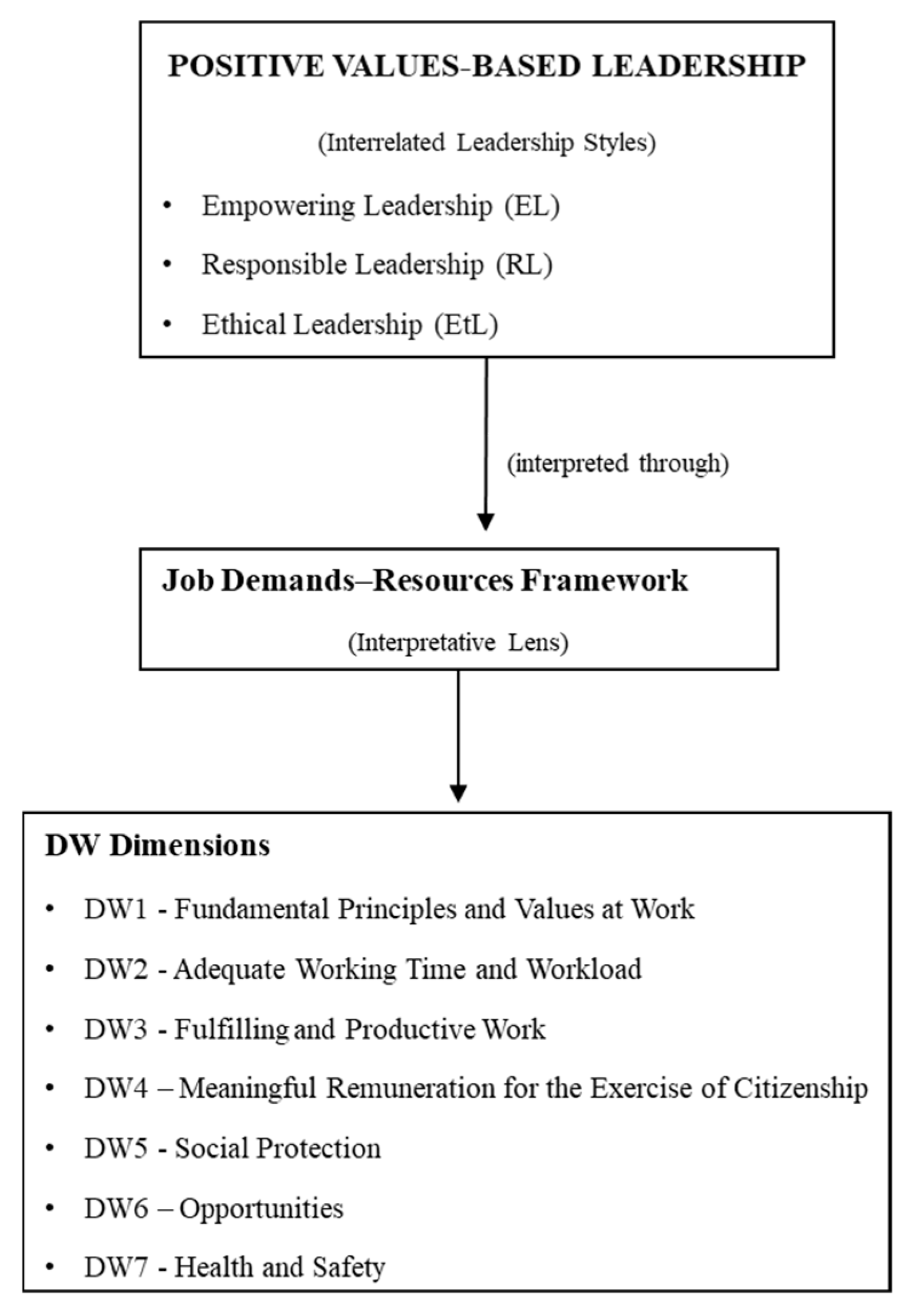
Figure 1 presents the conceptual framework guiding this exploratory study, in which EL, RL, and EtL are conceptualized as interrelated, positive values-based leadership behaviors that may function as psychosocial job resources. The JD-R framework serves as an interpretive lens to examine patterns of association between leadership styles and employees’ perceptions of the multidimensional construct of DW. Leadership is expected to be more strongly associated with psychosocial dimensions of DW, such as fundamental principles and values, fulfilling and productive work, opportunities, and health and safety, than with structural dimensions, including workload, remuneration, and social protection, which are more dependent on institutional and policy-level factors [
4,
6,
7].
2. Literature Review and Conceptual Framework
2.1. DW as a Multidimensional Construct
DW has emerged as a central concept in contemporary labor research, integrating economic, social, and psychological perspectives on the quality of work. Recent scholarship has focused on refining the conceptual and empirical operationalization of DW as a multidimensional construct that captures both objective and subjective aspects of work quality, including the work content, conditions, and context. In this sense, DW is understood as a set of dimensions that operationalize the construct by specifying the key domains through which it is experienced and evaluated [
4]. The dimensions are as follows:
DW1—Fundamental Principles and Values in Work: Emphasizes the content of the work itself. It addresses relational aspects such as justice, trust, freedom of expression, non-discrimination, and the opportunity to voice concerns about decisions that impact workers’ lives.
DW2—Adequate Working Time and Workload: Addresses the efforts expended, work hours, and the possibility of balancing professional responsibilities with other life facets.
DW3—Fulfilling and Productive Work: Relates to the feeling of participating in collective life through meaningful and contributive work to society.
DW4—Meaningful Remuneration for the Exercise of Citizenship: Emphasizes the necessity for fair wages that allow workers to exercise their citizenship rights and responsibilities fully. This dimension is directly related to all human needs, as money is the most flexible resource, enabling individuals to meet diverse needs across various situations.
DW5—Social Protection: Concerns workers’ psychological security, including feelings about potential vulnerabilities (e.g., health issues or unemployment) and anticipatory concerns about retirement.
DW6—Opportunities: Refers to employment opportunities and possibilities for personal and professional development, entrepreneurship, self-employment, and having choices among various work options.
DW7—Health and Safety: Relates to the risks to health and injuries that need to be prevented through the application of available technology and knowledge.
Together, these dimensions form a comprehensive framework for DW, emphasizing the ethical and social imperatives of labor relations and the practical conditions necessary for a fulfilling and sustainable professional life.
Recent theoretical developments have further integrated DW into the JD-R model, conceptualizing its dimensions as dynamic elements that may function as either job resources or job demands, depending on context [
7]. From this perspective, DW is not a static outcome, but a lived experience shaped by the balance between the demands placed on workers and the resources available to meet them. Importantly, DW is also closely aligned with the satisfaction of basic psychological needs, autonomy, competence, and relatedness, linking it to broader frameworks of well-being, motivation, and social justice at work [
7].
2.2. Leadership Styles as Primary Job Resources or Job Demands
Leadership is widely recognized as a central organizational factor shaping employees’ access to job resources and their experience of work demands. Within the JD-R framework, high-quality leadership behaviors can be interpreted as primary psychosocial job resources that influence motivation, engagement, and well-being by structuring autonomy, feedback, social support, and perceptions of fairness in the work environment [
6,
7]. On the other hand, when leadership is of low quality, it may create a demand that undermines employee well-being, motivation, and engagement [
6,
7].
Empowering Leadership (EL) emphasizes the distribution of power, participation in decision-making, coaching, showing concern, and information sharing [
9,
11]. Empirical research consistently associates EL with increased psychological empowerment, work engagement, self-efficacy, and innovative behavior [
10,
11]. By fostering autonomy, competence, and shared responsibility, EL aligns closely with the principles underlying DW.
Responsible Leadership (RL) extends the leadership construct beyond the immediate leader–follower relationship by emphasizing accountability, ethical reflection, and consideration of multiple stakeholders [
12,
13]. Research links RL to perceptions of organizational justice, trust, legitimacy, and social inclusion, suggesting its relevance for multiple dimensions of DW. RL may be particularly salient in contemporary organizational contexts due to heightened expectations regarding transparency, social responsibility, and ethical governance.
Ethical Leadership (EtL) focuses on normatively appropriate conduct, integrity, and moral role modelling, reinforcing ethical standards through communication and behavior [
14]. Meta-analytic evidence indicates that EtL is associated with higher levels of trust and psychological safety, as well as reduced deviant behavior [
15]. These outcomes align closely with key dimensions of DW.
Although conceptually distinct, EL, RL, and EtL share a strong normative and relational foundation. This convergence supports the analytical relevance of examining these leadership styles jointly rather than in isolation, particularly in complex organizational settings characterized by multiple, and sometimes competing, demands, such as higher education institutions (HEIs).
Recent reviews highlight the importance of leadership in fostering inclusive learning environments [
18] and supporting staff and faculty well-being [
19], both of which are central to sustainable academic development. As HEIs face increasing complexity and societal demands for equity, accountability, and participation, leadership models that integrate empowerment, ethical integrity, and stakeholder responsibility become particularly relevant.
EL, RL, and EtL frameworks have therefore gained prominence in higher education research as responses to these challenges. Rather than representing competing approaches, these leadership models collectively emphasize participation, shared values, transparency, and principled decision-making, offering an integrated perspective on leadership suited to contemporary academic environments. Leadership in HEIs has been shown to promote academic freedom, institutional trust, and collaborative knowledge production when it supports autonomy while maintaining ethical accountability [
16,
17].
From an integrative perspective, the convergence and complementarity of EL, RL, and EtL can be understood as a positive values-based leadership pattern that operates through multiple psychosocial mechanisms, including the promotion of autonomy, psychological safety, moral consistency, and social inclusion. These mechanisms are central to employees’ experiences of work quality and dignity. Such an integrated approach does not assume uniform or causal effects but highlights leadership’s potential role as a primary psychosocial resource within the JD-R framework.
Analyzing leadership through the lenses of DW and the JD-R model provides a theoretically robust foundation for examining how leadership behaviors relate to dimensions of work quality in higher education. Within this perspective, leadership may function simultaneously as a primary resource that supports engagement, well-being, and development, and as a relational demand that requires ethical reflection, responsibility, and sustained commitment [
6,
7]. This alignment underscores the need for an exploratory approach to examine how positive values-based leadership behaviors are associated with employees’ perceptions of DW across diverse professional groups within HEIs.
2.3. Leadership and DW in Higher Education
HEIs represent distinctive organizational contexts characterized by professional autonomy, complex governance structures, and diverse occupational groups. Unlike many other organizational settings, HEIs combine collegial traditions with managerial and bureaucratic logics, creating environments in which leadership is often distributed across formal and informal roles [
16]. These structural and cultural characteristics shape how leadership is enacted and perceived, potentially influencing employees’ experiences of DW in uneven and context-specific ways [
16,
17].
Leadership is widely regarded as a crucial component of organizational success due to its role in shaping institutional values, stakeholder engagement, and long-term sustainability. Within HEIs, leadership is central not only in academic performance and innovation but also in promoting social legitimacy, ethical governance, and public trust [
19]. Recent systematic reviews emphasize leadership’s critical role in fostering inclusive learning and work environments [
18] and in supporting staff and faculty well-being, both of which are foundational to sustainable academic development [
20].
As HEIs face increasing organizational complexity and growing societal demands for equity, transparency, and accountability, educational leaders are required to reconcile adaptability with ethical consistency. In this context, the EL, RL, and EtL frameworks are particularly relevant, as they prioritize participation, shared values, and principled decision-making [
12,
13]. Rather than representing isolated approaches, these leadership models offer complementary responses to contemporary challenges by aligning institutional effectiveness with broader social and civic purposes.
Leadership in HEIs also plays a strategic role in promoting academic freedom, institutional trust, and the collaborative production of knowledge. Effective academic leadership supports professional autonomy while ensuring ethical accountability and fostering transparent, inclusive organizational cultures [
16,
17]. These leadership functions are especially salient in universities, where authority is often negotiated rather than hierarchically imposed.
Despite the recognized importance of leadership in higher education, empirical research examining leadership and working conditions in HEIs remains fragmented. Many studies focus predominantly on academic staff, systematically overlooking administrative, technical, and support personnel, despite their central contribution to institutional functioning. Moreover, leadership and work quality are frequently examined as separate domains, limiting understanding of how leadership behaviors relate to the multidimensional experience of DW within universities.
Recent studies highlight the role of leadership in fostering knowledge sharing, collaboration, and innovative behavior in HEIs, particularly through empowering and ethical practices [
21]. These relational and developmental processes are directly relevant to dimensions of DW, as they enhance meaning, participation, and opportunities for professional [
3]. At the same time, structural constraints related to workload, remuneration, and employment security are often shaped by institutional or policy-level factors, falling beyond the direct influence of individual leaders.
Taken together, the literature reveals a clear research gap: the absence of integrative, context-sensitive studies examining how positive values-based leadership styles are associated with the multidimensional construct of DW across diverse professional groups within HEIs. Addressing this gap requires exploratory approaches that capture complex patterns of association rather than narrowly testing predefined causal hypotheses and that account for the unique organizational features of HEIs.
3. Method
3.1. Participants
The study employed an institution-wide invitation resulting in a voluntary, self-selected sample, as all 4300 employees with a formal contractual relationship with the university, including faculty members, researchers, technicians, administrative staff, and support personnel, were individually invited to participate via institutional email. An exhaustive data collection technique was used, as the questionnaire was sent to all employees of the organization. Despite this, the response rate obtained indicates that the results reflect only the participants who responded.
Eligibility criteria included having an active contractual relationship with the university at the time of data collection and being at least 18 years old. No exclusion criteria were applied beyond these conditions. Participation was entirely voluntary and anonymous.
Of the employees contacted, 731 accessed the online questionnaire, but only 226 completed it in full, yielding an effective response rate of 5.25%. Although low, this response rate is comparable to those reported in large-scale online surveys in organizational contexts and public institutions. Nevertheless, the possibility of self-selection and nonresponse bias must be acknowledged. Employees who chose to participate may differ systematically from those who did not, for example, with respect to work engagement, satisfaction, or perceptions of leadership, which may limit the generalizability of the findings. Given the exploratory nature of the study, the results are interpreted as indicative patterns rather than representative estimates of the institutional population. These limitations are addressed in
Section 5. No incentives were offered.
The final sample reflects a diverse group of employees across professional roles and demographic characteristics. The largest age group comprised individuals aged 40–49 years, representing a substantial proportion of mid-career professionals. Most participants reported holding advanced educational qualifications (e.g., university or postgraduate degrees), and a significant proportion indicated having a permanent public contract. This profile suggests a sample characterized by relatively high educational attainment and employment stability, which should be considered when interpreting the findings.
Further details on the respondents’ sociodemographic characteristics are presented in
Table 1.
3.2. Instruments
3.2.1. Decent Work Questionnaire (DWQ)
The assessment of DW was based on the DWQ developed by Ferraro et al. [
4], which has been validated across multiple cultural contexts, including Portuguese samples.
In the present study, the DWQ demonstrated good overall internal consistency (Cronbach’s α = 0.92). The questionnaire comprises 31 items yielding a global DW score and seven subscales corresponding to distinct dimensions of DW. Internal consistency estimates for the subscales were as follows: Fundamental Principles and Values at Work (DW1; α = 0.89), Adequate Working Time and Workload (DW2; α = 0.85), Fulfilling and Productive Work (DW3; α = 0.82), Meaningful Remuneration for the Exercise of Citizenship (DW4; α = 0.92), Social Protection (DW5; α = 0.78), Opportunities (DW6; α = 0.67), and Health and Safety (DW7; α = 0.67).
Although the internal consistency values for DW6 and DW7 were lower than those observed for the remaining dimensions, they fall within acceptable ranges for exploratory research [
22]. All subscales were therefore retained for analysis, in line with the study’s exploratory aims and the multidimensional conceptualization of DW.
Responses were recorded on a 5-point Likert scale ranging from 1 (“I do not agree”) to 5 (“I agree completely”). Mean scores were computed for each subscale and for the global DW index, with higher scores indicating more favorable perceptions of DW.
3.2.2. Empowering Leadership Questionnaire (ELQ)
EL was assessed using the ELQ, developed by Arnold et al. [
23] and validated for the Portuguese context by Mónico et al. [
24]. We implemented this scale in this study, achieving a Cronbach’s alpha of 0.96 for the overall measure. The ELQ consists of 38 items across five subscales, with Cronbach’s alpha values for each subscale as follows: (EL1)
Leading by Example (α = 0.96), with sample item: “My supervisor works as hard as possible”; (EL2)
Coaching (α = 0.94), with sample item: “My supervisor is attentive to the efforts made by the team”; (EL3)
Participation in Decision-Making (α = 0.96), with sample item: “My supervisor listens to the ideas and suggestions of the whole team”; (EL4)
Information Sharing (α = 0.94), with sample item: “My supervisor explains the company’s goals”; and finally, (EL5)
Showing Concern (α = 0.95), with sample item: “My supervisor is always in contact with the team.” Responses were collected using a 5-point Likert scale, where one corresponded to “Never” and 5 to “Always.” This scale includes a reverse-scored item in factor 2 (item 11).
Responses were recorded on a 5-point Likert scale ranging from 1 (“Never”) to 5 (“Always”). One item in the Coaching subscale was reverse-scored prior to analysis. Mean scores were computed for each subscale and for the overall EL index, with higher scores indicating stronger perceptions of EL behaviors.
3.2.3. Responsible Leadership Questionnaire (RLQ)
RL was measured using the RLQ originally developed by Voegtlin [
25] and translated into Portuguese by Neves [
26]. The original instrument comprises two subscales. The first subscale, consisting of 10 items, serves a contextual and conceptual clarification function by familiarizing respondents with the concept of stakeholders and their leaders’ interactions with different stakeholder groups; this subscale is not intended for inferential statistical analysis.
The second subscale, used in the present study, comprises five items assessing leaders’ responsible behaviors, including awareness of stakeholder claims, dialogical engagement, and consideration of the consequences of decisions for affected parties (e.g., “Shows awareness of the claims of the most relevant stakeholder groups”). Responses were collected using a 5-point Likert scale ranging from 1 (“Not at all”) to 5 (“Frequently, if not always”).
Consistent with the original validation study and with previous empirical applications, only the behavioral subscale was retained for data analysis. In the present sample, this subscale demonstrated excellent internal consistency (Cronbach’s α = 0.96). Mean scores were computed, with higher values indicating stronger perceptions of RL behaviors.
3.2.4. Ethical Leadership Questionnaire (EtLQ)
EtL was assessed using the EtLQ developed by Brown et al. [
14], which was validated in the Portuguese context by Silva and Duarte [
27]. The scale comprises 10 items designed to assess leaders’ ethical conduct, integrity, fairness, and role-modelling behaviors (e.g., “My supervisor listens to what employees have to say”; “My supervisor disciplines employees who violate ethical standards”).
In the present study, the EtLQ demonstrated excellent internal consistency (Cronbach’s α = 0.95), indicating high reliability across items. Responses were recorded on a 5-point Likert scale ranging from 1 (“Strongly disagree”) to 5 (“Strongly agree”). Mean scores were calculated, with higher scores reflecting stronger perceptions of EtL.
3.3. Procedure
Prior to data collection, the research project was submitted to and approved by the Public Institution’s Ethics and Research Deontology Committee and the institutional Data Protection Officer, ensuring compliance with ethical standards and data protection regulations. Data were collected using an online questionnaire administered through the LimeSurvey platform, with an average completion time of approximately 20 min.
Participants were recruited through an institution-wide email invitation sent to all employees with an active contractual relationship with the university (approximately 4300 individuals). The invitation included detailed information on the study’s objectives, procedures, and ethical safeguards, along with a link to the questionnaire. Data collection took place between 10 October and 6 December 2023.
Upon accessing the questionnaire, participants received comprehensive information regarding the voluntary nature of participation, data confidentiality, and the right to withdraw at any time without consequences. Only participants who provided informed consent were allowed to proceed with the questionnaire, in accordance with ethical and legal requirements. Participants were also provided with an institutional email address to contact the research team for additional information or clarification.
The questionnaire began with leadership and DW measures, followed by sociodemographic questions. Although 731 employees accessed the survey, only 226 participants provided informed consent and completed the questionnaire in full, constituting the final sample used for data analysis.
3.4. Data Analysis
Data analyses were conducted using R (R Core Team, version 4.3.2) [
22] and RStudio (Posit Team, version 4.3.2) [
28]. Given the exploratory nature of the study, analyses focused on descriptive statistics, group comparisons, and bivariate associations rather than on testing causal models. Internal consistency of the measurement instruments was assessed using Cronbach’s alpha, in accordance with established psychometric guidelines. Descriptive statistics, including means, standard deviations, medians, quartiles, minimums, and maximums, were computed for all study variables. To explore patterns of association between leadership styles and the dimensions of DW, Pearson correlation coefficients were calculated. Group differences across sociodemographic variables (e.g., professional role, education level) were examined using analysis of variance (ANOVA) where appropriate. The power analysis was made using the software G*Power 3.1 [
29]. A significance level of
p < 0.05 was adopted for inferential analyses.
4. Results
4.1. Internal Consistency of the Measures
The DWQ demonstrated strong internal consistency in the present sample, with a Cronbach’s alpha of 0.92 for the total scale. Internal consistency coefficients for the seven dimensions ranged from 0.67 (DW6—Opportunities; DW7—Health and Safety) to 0.92 (DW4—Meaningful Remuneration for the Exercise of Citizenship). Although DW6 and DW7 yielded lower alpha coefficients, these values are considered acceptable in exploratory research [
30].
All leadership measures showed excellent internal consistency. The ELQ presented an overall alpha of 0.99, with all five subdimensions exceeding 0.90. The RL behavioral subscale had an alpha of 0.96, and the EtLQ demonstrated an alpha of 0.95, indicating high reliability across leadership constructs.
4.2. Descriptive Statistics for DW
Descriptive statistics for the global DW score and its seven dimensions are presented in
Table 2. Overall, the results indicate moderate levels of perceived DW within the institution. The global DW score ranged from 1.94 to 4.61 (M = 3.18; Md = 3.19), suggesting a relatively balanced and symmetrical distribution of responses.
Among the DW dimensions, the highest mean was observed for DW3—Fulfilling and Productive Work (M = 3.81), followed by DW1—Fundamental Principles and Values at Work (M = 3.38) and DW7—Health and Safety (M = 3.28). These results indicate relatively positive perceptions regarding meaningful work, ethical principles, and perceived safety.
Lower mean values were observed for DW4—Meaningful Remuneration for the Exercise of Citizenship (M = 2.79) and DW2—Adequate Working Time and Workload (M = 3.03), pointing to less favorable evaluations of remuneration and workload balance. DW5—Social Protection (M = 2.84) and DW6—Opportunities (M = 2.92) also showed moderate scores and greater dispersion, suggesting variability in how these dimensions are experienced across respondents.
4.3. Descriptive Statistics for Leadership Variables
Descriptive statistics for EL, RL, and EtL are presented in
Table 3. Overall, leadership was evaluated positively across the three constructs. The mean score for EL (EL_global) was 3.54 (Md = 3.68). Among its subdimensions, Leading by Example had the highest mean (M = 3.85), followed by Showing Concern (M = 3.65) and Coaching (M = 3.54). Lower mean values were observed for Information Sharing (M = 3.34) and Participation in Decision-Making (M = 3.41).
RL also showed a relatively high mean (M = 3.54; Md = 3.80), indicating that leaders were generally perceived as attentive to stakeholder considerations. EtL had the highest overall mean (M = 3.72; Md = 3.90) and a narrow interquartile range, indicating consistent perceptions of ethical conduct across respondents.
4.4. Associations Between Leadership and DW
Bivariate Pearson correlation coefficients were calculated to explore associations between leadership variables and DW (
Table 4). The power analysis suggested a minimum sample size of 138 for a significance level α = 5%, a power 1 − β = 95%, and a correlation of 0.3 in H
1.
All correlations between global DW and the three leadership constructs were positive and statistically significant (p < 0.001). The correlation between DW and EL was moderate (r = 0.50), followed by RL (r = 0.49) and EtL (r = 0.48).
The leadership constructs were highly intercorrelated, with correlations of r = 0.90 between EL and RL, r = 0.90 between empowering and EtL, and r = 0.87 between RL and EtL. These results indicate substantial overlap in how respondents perceive different leadership behaviors.
4.5. Associations Between Leadership Dimensions and DW Dimensions
Table 5 presents correlations between the seven DW dimensions and the leadership measures. The strongest associations were observed for DW1—Fundamental Principles and Values at Work, with correlations ranging from r = 0.59 (Information Sharing) to r = 0.67 (EtL), indicating a robust relationship between leadership behaviors and employees’ perceptions of fairness, dignity, and value alignment in the workplace. DW3—Fulfilling and Productive Work, DW6—Opportunities, and DW7—Health and Safety showed moderate correlations with leadership dimensions, suggesting meaningful but less pronounced associations. In contrast, DW5—Social Protection exhibited the weakest correlations (r = 0.08 to r = 0.15), indicating a limited association with leadership perceptions. Overall, the pattern of correlations suggests that leadership behaviors are more strongly associated with several dimensions of DW.
4.6. Sociodemographic Comparisons
Exploratory analyses examined differences in DW and leadership perceptions across sociodemographic groups. The power analysis suggested that for a significance level α = 5% and a power 1 − β = 80%, medium Cohen’s f effects size of 0.25 were able to be determined for age group (n = 200), educational qualification (n = 180), employment type (n = 128), and on the borderline for professional categories (n = 231) and tenure (n = 240). Worth noting that by raising the power to 95%, medium Cohen’s effect size f of 0.25 were still able to be determined with a minimum sample size required of 208 for employment type, and large effects of 0.4 for the variables age group, educational qualification, professional categories, and tenure with a minimum sample size of 125, 112, 140, 144, respectively.
No statistically significant differences were found across age groups for either DW or leadership variables (all p-values > 0.05). Differences by educational level indicated that participants with higher educational qualifications (bachelor’s, master’s, or doctoral degrees) reported higher mean scores across several DW and leadership dimensions than participants with secondary education. Participants with high school education reported the lowest mean scores for global DW (M = 2.80) and leadership variables.
Comparisons by employment type revealed no substantial differences between employees with permanent public contracts and those with temporary or scholarship-based contracts. More pronounced differences emerged across professional categories. Participants in leadership positions reported the highest levels of perceived DW (DW_global M = 3.50) and leadership behaviors. In contrast, administrative, technical, and operational staff reported lower mean scores across both DW and leadership measures. Differences related to tenure were generally minor. Employees with shorter tenure in the organization (less than three years) reported slightly higher perceptions of DW and leadership, whereas employees with longer tenure reported lower scores.
4.7. Gender Differences
Independent-samples T-tests were conducted to examine potential gender differences in perceptions of DW and leadership. The power analysis for a significance level α = 5%, a power 1 − β = 95% and 80%, suggested a minimum sample size of 238 and 146, respectively.
The results indicated no statistically significant differences between male and female participants in DW_Global, t (214) = 0.17, p = 0.865, EL, t (214) = −0.41, p = 0.683, RL, t (214) = −0.30, p = 0.767, or EtL, t (214) = 0.18, p = 0.0861. Mean differences were minimal, and confidence intervals included zero in all cases, indicating negligible practical differences between genders.
5. Discussion
This exploratory study examined how EL, RL, and EtL are associated with employees’ perceptions of DW in a public Portuguese university. Guided by the JD-R framework, leadership is conceptualized as a proximal psychosocial factor that may operate dually: as a primary job resource when it facilitates access to motivational and relational resources (e.g., autonomy, voice, trust, fairness, and support), and as a primary job demand when leadership is perceived as deficient, inconsistent, unclear, or abusive thereby requiring additional cognitive and emotional effort from employees [
7].
This dual role is consistent with recent theoretical advances that conceptualize DW dimensions as dynamic configurations of resources and demands, rather than as static working conditions. From this perspective, DW dimensions function as resources when adequately provided. However, they may be experienced as demands when deficits are significant or when maintaining them requires sustained effort, even at high levels [
7]. Leadership is therefore not understood as a direct determinant of DW, but as a key mechanism shaping how employees experience, regulate, and cope with the demands and resources embedded in their work context [
7].
The results indicate that perceptions of positive values-based leadership are moderately associated with overall DW and, more importantly, are differentially associated with specific DW dimensions. The strongest associations were consistently observed for DW1—Fundamental Principles and Values at Work, followed by DW7—Health and Safety, and subsequently by DW3—Fulfilling and Productive Work and DW6—Opportunities. In contrast, weaker associations emerged for DW2—Adequate Working Time and Workload, DW4—Meaningful Remuneration for the Exercise of Citizenship, and, in particular, DW5—Social Protection.
These findings support the notion that specific DW dimensions are less dependent on proximal leadership quality than others. Dimensions such as social protection, remuneration, and working time are primarily determined by statutory and regulatory frameworks enacted at the governmental level, which constrain the extent to which day-to-day leadership practices can directly shape employees’ experiences in these domains. By contrast, dimensions such as Fundamental Principles and Values at Work, Fulfilling and Productive Work, and Opportunities are more strongly rooted in psychosocial and relational processes and therefore appear to be more sensitive to the quality of proximal leadership.
Concerning the health and safety dimension, although there are general regulatory frameworks in place, several ergonomic and environmental aspects depend on leadership decisions at the organizational level, such as the provision of adequate equipment for task performance, appropriate workspace design, and environmental conditions, including air conditioning and ventilation.
5.1. Leadership as a Primary Resource: Which DW Dimensions Does It Most Clearly Support?
Consistent with the JD-R lens, the strongest associations with DW1—Fundamental Principles and Values at Work suggest that positive values-based leadership acts as a primary psychosocial resource by shaping the relational climate through justice, dignity, non-discrimination, trust, and voice [
6]. In the dos Santos and Pais [
7] framework, DW1 at high levels constitutes a supportive and trustworthy social climate that fosters psychological safety, while simultaneously requiring ongoing relational effort to maintain [
7].
Leadership styles grounded in empowerment, responsibility, and ethical integrity plausibly contribute to this dimension by reinforcing fair treatment, modelling principled behavior, encouraging participation, and legitimizing employee concerns, core elements of DW1.
Moderate correlations with DW3 (Fulfilling and Productive Work) and DW6 (Opportunities) also support the interpretation of positive values-based leadership as a resource. In the JD-R framework, meaningful and fulfilling work and opportunities for development function as motivational resources [
6]. However, Dos Santos and Pais [
7] emphasize that even when these resources are present, they can entail developmental demands (e.g., effort, responsibility, investment in learning) to capitalize on them. Thus, leadership may contribute to DW3 and DW6 not only by enabling meaning-making and growth pathways (e.g., resource provision) but also by structuring the conditions under which the associated developmental demands remain sustainable (e.g., coaching, feedback, support, recognition). In practice, leaders influence safety climate through communication, prioritization, procedural reinforcement, and responsiveness to risk reporting, mechanisms that are proximal and behavioral even in regulated environments [
6].
5.2. Leadership as a Primary Demand: How Do the Weaker Associations Help Interpret the Boundaries of Leadership Influence?
The weak correlations for DW2 (Working Time and Workload), DW4 (Remuneration), and DW5 (Social Protection) suggest that positive values-based leadership is less directly linked to DW domains that are primarily shaped by institutional design and government policy. This is consistent with the argument that DW deficits give rise to demand. When standards are not met, such deficits are not always reducible by leader behavior alone.
In Portuguese public universities, remuneration structures are substantially shaped by governmental frameworks, workload and working-time rules are typically constrained by regulation, staffing levels, and organizational arrangements, and social protection is anchored in national welfare systems. In these domains, leadership may still be experienced as a demand when leaders cannot buffer structural constraints (e.g., limited autonomy in workload distribution, perceived lack of transparency, or limited voice in decisions affecting schedules). However, the data suggests that such leadership-related variance is relatively minor compared with the structural determinants of these DW dimensions.
The results reinforce a key implication of the JD-R reading of DW: leadership appears particularly consequential for the psychosocial-intensive and relational architecture of work quality (especially DW1, and to a meaningful extent DW3, DW6, DW7), whereas structural-intensive dimensions (DW2, DW4, DW5) likely require coordinated institutional and policy-level interventions. This does not diminish the importance of leadership, somewhat, it clarifies the scope of its influence and supports the idea that promoting DW in HEIs requires multi-level action that combines positive values-based leadership with institutional governance reforms.
5.3. Sociodemographic and Professional Asymmetries
Exploratory analyses revealed largely stable perceptions of DW and leadership across age, gender, tenure, and employment type. Notably, no statistically significant gender differences were observed, suggesting that leadership practices and work experiences are perceived in broadly similar ways by male and female employees within this institutional context.
In contrast, educational qualifications and professional roles emerged as meaningful differentiators. Employees with higher academic qualifications reported more favorable perceptions of both leadership and DW. These differences were particularly evident in DW dimensions related to Fulfilling and Productive Work (DW3) and Opportunities (DW6), as well as in the coaching dimension of empowering leadership (EL2). Conversely, employees with lower levels of formal education reported less positive perceptions across these domains.
5.4. Leadership, Institutional Context, and Implications for DW in Higher Education
Interpreting these findings requires attention to the organizational and cultural context of public higher education. As long-established institutions with strong civic missions, public HEIs operate within formalized governance structures that emphasize accountability, ethical stewardship, and public responsibility. These characteristics may contribute to relatively positive perceptions of RL and EtL.
At the same time, bureaucratic traditions and hierarchical arrangements may constrain the enactment of empowering leadership behaviors. Lower scores on Participation in Decision-Making (EL3) and Information Sharing (EL4) suggest persistent tensions between empowerment-oriented leadership models and entrenched organizational norms. In higher education, these tensions are structurally embedded, as middle leaders are positioned between managerial accountability imperatives and collegial governance norms. Academic middle leaders, such as department heads, frequently navigate tensions between managerial responsibilities and collegial expectations [
31].
The strong intercorrelations among EL, RL, and EtL suggest that employees perceive these leadership styles as interconnected expressions of a broader positive values-based leadership orientation. Rather than undermining their conceptual distinctiveness, this convergence reinforces the analytical value of examining leadership as an integrated resource–demand configuration that operates through convergent psychosocial mechanisms that promote values such as autonomy, trust, justice, development, and moral consistency and inclusion.
The findings underscore both the potential and the limits of leadership in promoting DW. While leadership behaviors appear crucial for enhancing psychosocial dimensions of work quality, they are insufficient to address structurally embedded issues such as workload intensity, remuneration, and social protection. Promoting DW in higher education, therefore, requires multilevel action, combining positive values-based leadership with institutional governance reforms and policy commitments aligned with the principles of university social responsibility.
5.5. Limitations and Future Research
Several limitations should be acknowledged. First, despite an institution-wide invitation, the study achieved a low response rate, raising concerns about nonresponse and self-selection bias. Second, the single-institution research design limits the generalizability of the findings to other HEIs or national contexts. Third, the exclusive reliance on self-reported measures introduces the potential for common-method bias. These limitations should be considered: The JD-R framework emphasizes the dynamic and context-dependent nature of the relationships among job demands, job resources, and employee perceptions.
Future research could adopt longitudinal designs to examine how leadership practices and perceptions of DW evolve, and conduct comparative studies across institutions, sectors, and cultural contexts. Qualitative and mixed-methods approaches may further illuminate how employees experience leadership as both a resource and a demand in their everyday work.