
Future Prospects for Omics Sciences: Expanding the Boundaries of Systems Biology


Abstract
1. Introduction
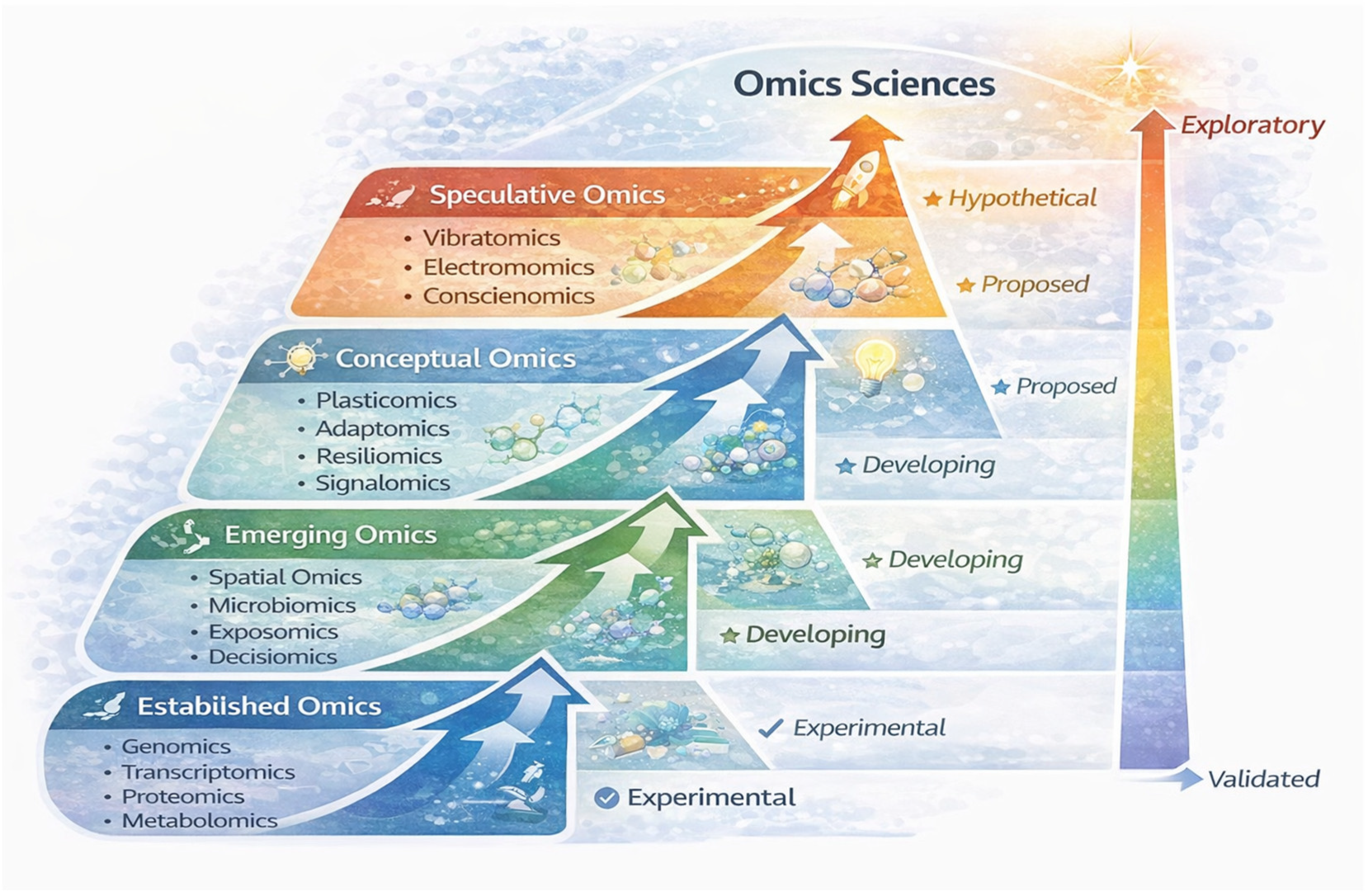
2. Conceptual vs. Experimental Omics: Scope and Classification
- (i)
- Established omics (experimentally mature),
- (ii)
- Emerging omics (technologically advancing),
- (iii)
- Conceptual omics (frameworks describing system-level processes), and
- (iv)
- Speculative omics (long-term perspectives).
3. Fundamental Omics (Core of Life Sciences)
3.1. Genomics
3.2. Transcriptomics
3.3. Proteomics
3.4. Metabolomics
4. Functional and Structural Omics
4.1. Interactomics
4.2. Phosphoproteomics & Glycomics
4.3. Lipidomics
4.4. Structural Omics
4.4.1. Conformomics
4.4.2. Vibratomics (Speculative)
4.4.3. Electromomics (Speculative)
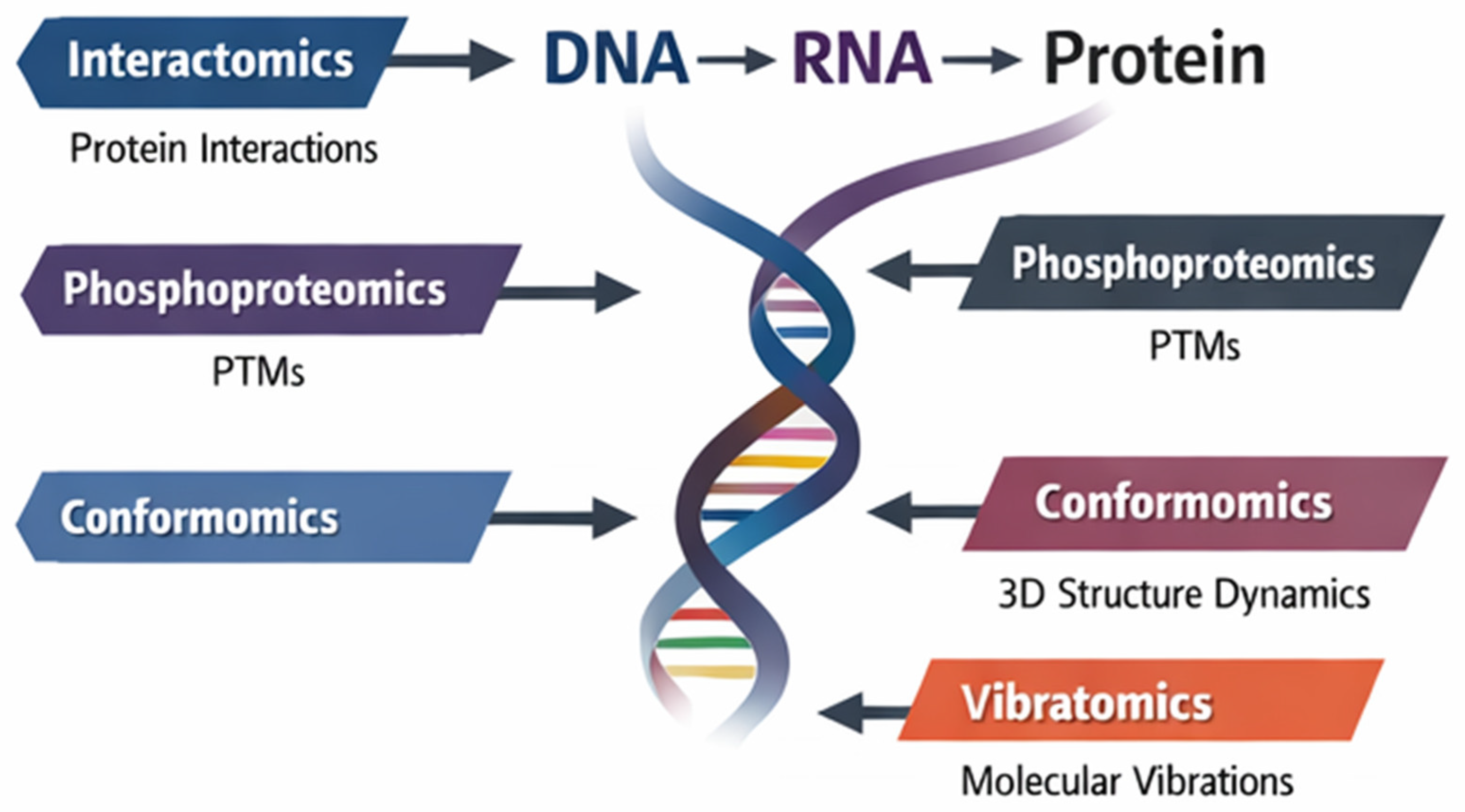
- Interactomics:
- Phosphoproteomics/Glycomics:
- Lipidomics:
- Structural Omics:
- —
- Cryo-EM and AlphaFold2 expand conformational landscape analysis [80].
5. Regulatory and Control Omics
5.1. Epigenomics
5.2. Signalomics (Emerging)
5.3. Decisiomics
5.4. Adaptomics
- What it measures:
- Experimental approaches:
- Scientific value:
5.5. Resiliomics
- What it measures:
- Data sources:
- Applications:
5.6. Chrono-Adaptomics
- What it measures:
5.7. Plasticomics
- Importance:
5.8. Stochastomics
5.9. Integration of Regulatory Omics into Multi-Omics Frameworks
- Time-series modeling: capturing dynamic trajectories of molecular responses.
- Network inference: reconstructing regulatory and signaling interactions.
- Trajectory analysis: identifying adaptive pathways and system transitions.
- Machine learning approaches: integrating heterogeneous datasets across scales.
6. Environmental and Ecological Omics
6.1. Eco-Interactomics
6.2. Climatonomics
6.3. Anthropomics
7. System-Specific Omics
7.1. Neuro-Omics
7.2. Immunomics
7.3. Microbiomics and Viromics
7.4. Mycomics
8. Advanced Molecular Omics
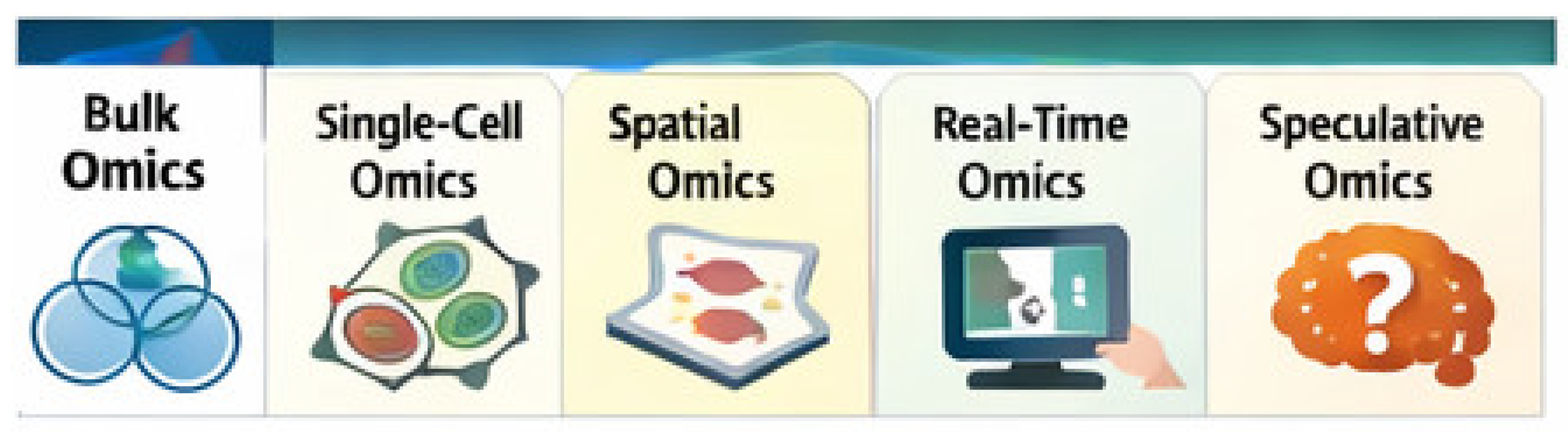
8.1. Single-Cell Omics
8.2. Spatial Omics
8.3. Fluxomics
8.4. Phenomics
8.5. Energomics, Thermomics, Pressiomics and Bioenergetic Omics (Emerging)
8.6. Information-Based Omics
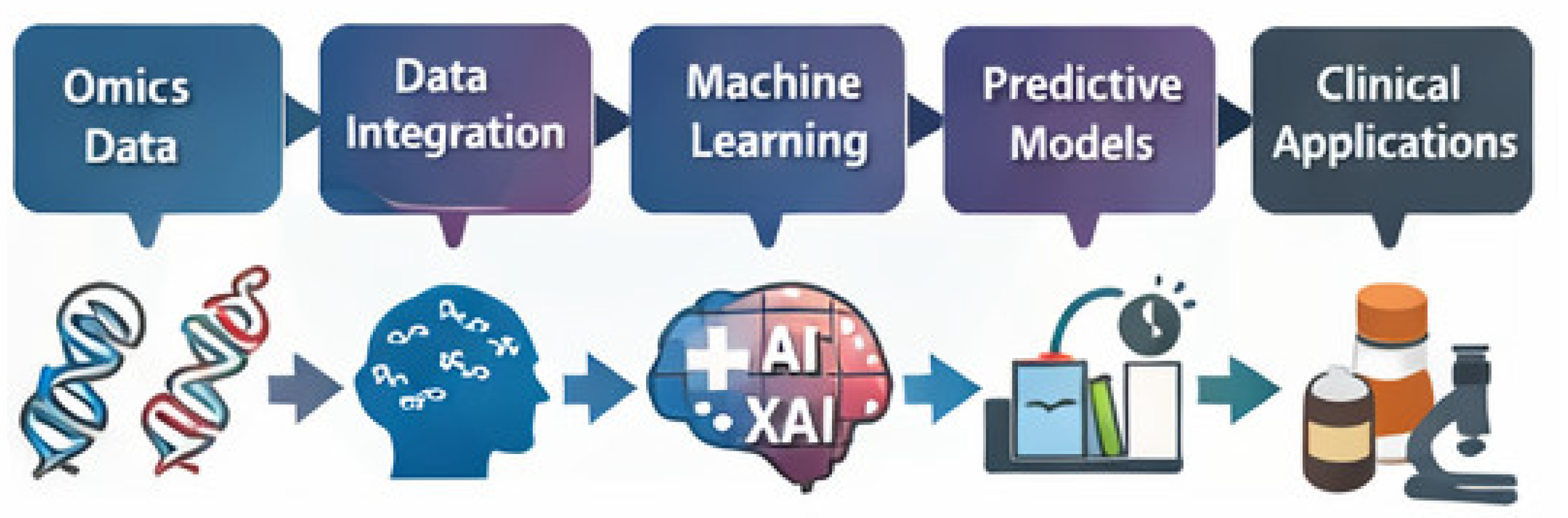
9. Integrative Omics
- (i)
- network-based approaches linking molecular interactions,
- (ii)
- statistical models integrating heterogeneous datasets, and
- (iii)
- machine learning frameworks capable of capturing nonlinear relationships across omics layers.
10. Limitations and Future Directions
11. Conclusions
Funding
Data Availability Statement
Acknowledgments
Conflicts of Interest
Abbreviations
| AI | Artificial Intelligence |
| ATP | Adenosine Triphosphate |
| ChIP-seq | Chromatin Immunoprecipitation Sequencing |
| CO2 | Carbon Dioxide |
| DNA | Deoxyribonucleic Acid |
| GC-MS | Gas Chromatography–Mass Spectrometry |
| LC-MS | Liquid Chromatography–Mass Spectrometry |
| mRNA | Messenger RNA |
| NGS | Next-Generation Sequencing |
| NMR | Nuclear Magnetic Resonance |
| PTMs | Post-Translational Modifications |
| RNA | Ribonucleic Acid |
| RNA-seq | RNA Sequencing |
| scRNA-seq | Single-Cell RNA Sequencing |
| Adaptomics (ADP) | Study of dynamic biological adaptation |
| Anthropomics (ANT) | Impact of human activities on biological systems |
| Chrono-adaptomics (CAD) | Temporal dynamics of adaptation |
| Climatonomics (CLM) | Biological responses to climate variables |
| Conformomics (CNF) | Biomolecular conformational dynamics |
| Decisiomics (DEC) | Cellular decision-making processes |
| Electromomics (ELM) | Intracellular electromagnetic fields (hypothetical) |
| Energomics (ENG) | Cellular energy fluxes (conceptual) |
| Fluxomics (FLX) | Metabolic flux analysis |
| Genomics (GEN) | Study of genomes |
| Interactomics (INT) | Molecular interaction networks |
| Metabolomics (MET) | Small molecule/metabolite profiling |
| Microbiomics (MIC) | Microbial community analysis |
| Plasticomics (PLA) | Molecular plasticity and cellular memory |
| Proteomics (PRO) | Protein profiling |
| Resiliomics (RES) | Biological resilience and recovery |
| Signalomics (SIG) | Cellular signaling dynamics |
| Spatial omics (SPO) | Spatially resolved molecular profiling |
| Stochastomics (STO) | Biological variability and noise |
| Transcriptomics (TRA) | RNA expression profiling |
| Vibratomics (VIB) | Molecular vibration analysis (speculative) |
References
- Reon, B.J.; Dutta, A. Biological processes discovered by high-throughput sequencing. Am. J. Pathol. 2016, 186, 722–732. [Google Scholar] [CrossRef]
- Zarid, M. Integrated omics reveal genetic and environmental regulation of texture and aroma in melon fruit. J. Genome Biotechnol. Genet. 2026, 1, 2. [Google Scholar] [CrossRef]
- Song, D.; Zhang, J.; Zhou, J.; Yuan, X.; Tang, L.; Sun, K.; Shi, Q.; Sun, H.; Zhao, W. The progress and prospects of single-cell sequencing, multi-omics integration analysis, and immunotherapy targeting strategies in lung cancer research. Curr. Proteom. 2025, 22, 100060. [Google Scholar] [CrossRef]
- Vitorino, R. Transforming clinical research: The power of high-throughput omics integration. Proteomes 2024, 12, 25. [Google Scholar] [CrossRef]
- Kumar, R.; Kumar, M.; Chaudhary, V.; Teotia, S.; Singh, D. Exploring recent advances, limitations, and future prospects of OMICS-based technologies in plant–pathogen interaction studies: A systematic review. Discov. Plants 2025, 2, 284. [Google Scholar] [CrossRef]
- Liu, Y.; Molchanov, V.; Brass, D.; Yang, T. Recent advances in omics and the integration of multi-omics in osteoarthritis research. Arthritis Res. Ther. 2025, 27, 100. [Google Scholar] [CrossRef] [PubMed]
- Zarid, M. Introgression and environmental effects on gene expression and aroma volatiles as biomarkers in a melon near-isogenic line. J. Biotechnol. Biores. 2023, 4, 596. [Google Scholar] [CrossRef]
- Canales, I.; Fernández-Trujillo, J.P.; Bueso, M.C.; Zarid, M. Volatile changes in non-climacteric melons with introgression in linkage group X at three stages of maturity. Acta Hortic. 2016, 1194, 351–356. [Google Scholar] [CrossRef]
- Escudero, A.A.; Zarid, M.; Bueso, M.C.; Fernández-Trujillo, J.P. Aroma volatiles during non-climacteric melon ripening and potential association with flesh firmness. Acta Hortic. 2016, 1194, 363–366. [Google Scholar] [CrossRef]
- Inayatullah, M.; Dwivedi, A.K.; Tiwari, V.K. Advances in single-cell omics: Transformative applications in basic and clinical research. Curr. Opin. Cell Biol. 2025, 95, 102548. [Google Scholar] [CrossRef] [PubMed]
- Liu, X.; Peng, T.; Xu, M.; Lin, S.; Hu, B.; Chu, T.; Liu, B.; Xu, Y.; Ding, W.; Li, L.; et al. Spatial multi-omics: Deciphering technological landscape of integration of multi-omics and its applications. J. Hematol. Oncol. 2024, 17, 72. [Google Scholar] [CrossRef]
- Morabito, A.; De Simone, G.; Pastorelli, R.; Brunelli, L.; Ferrario, M. Algorithms and tools for data-driven omics integration to achieve multilayer biological insights: A narrative review. J. Transl. Med. 2025, 23, 425. [Google Scholar] [CrossRef]
- Dai, X.; Shen, L. Advances and trends in omics technology development. Front. Med. 2022, 9, 911861. [Google Scholar] [CrossRef]
- Zarid, M. Postharvest physiology, genome sequencing and QTL mapping of melon: A review. J. Agric. Sci. Technol. A 2017, 7, 441–455. [Google Scholar] [CrossRef]
- Manzoni, C.; Kia, D.A.; Vandrovcova, J.; Hardy, J.; Wood, N.W.; Lewis, P.A.; Ferrari, R. Genome, transcriptome and proteome: The rise of omics data and their integration in biomedical sciences. Brief. Bioinform. 2018, 19, 286–302. [Google Scholar] [CrossRef]
- Liu, Y.; Dai, Y.; Wang, L. Spatial omics at the forefront: Emerging technologies, analytical innovations, and clinical applications. Cancer Cell 2026, 44, 24–49. [Google Scholar] [CrossRef]
- Sibilio, P.; De Smaele, E.; Paci, P.; Conte, F. Integrating multi-omics data: Methods and applications in human complex diseases. Biotechnol. Rep. 2025, 48, e00938. [Google Scholar] [CrossRef] [PubMed]
- Zarid, M.; García-Carpintero, V.; Esteras, C.; Esteva, J.; Bueso, M.C.; Cañizares, J.; Picó, M.B.; Monforte, A.J.; Fernández-Trujillo, J.P. Transcriptomic analysis of a near-isogenic line of melon with higher fruit flesh firmness during ripening. J. Sci. Food Agric. 2021, 101, 754–777. [Google Scholar] [CrossRef] [PubMed]
- Hardy, B.J.; Khan, S.E.A.; Daar, A.S. Genomics. In Encyclopedia of Global Bioethics; ten Have, H., Ed.; Springer: Cham, Switzerland, 2015. [Google Scholar] [CrossRef]
- Zarid, M. A multi-omics perspective on the environmental and genetic regulation of melon. In Plants2025: From Seeds to Food Security; MDPI: Basel, Switzerland, 2025. [Google Scholar]
- Auton, A.; Brooks, L.D.; Durbin, R.M.; Garrison, E.P.; Kang, H.M.; Korbel, J.O.; Marchini, J.L.; McCarthy, S.; McVean, G.A.; Abecasis, G.R. A global reference for human genetic variation. Nature 2015, 526, 68–74. [Google Scholar] [CrossRef] [PubMed]
- Zhang, F.; Gu, W.; Hurles, M.E.; Lupski, J.R. Copy number variation in human health, disease, and evolution. Annu. Rev. Genom. Hum. Genet. 2009, 10, 451–481. [Google Scholar] [CrossRef]
- Song, X.; Fan, B.L.; Hong, X.; Su, P.; Sun, M. Unveiling plant metabolic diversity: Integrating metabolomics with multi-omics approaches for crop improvement. Plants 2026, 15, 846. [Google Scholar] [CrossRef] [PubMed]
- Cao, Y.; Yan, J.; Ross-Ibarra, J.; Yang, N. Plant domestication revisited: Genomic insights into origins, mechanisms, and convergent evolution. iScience 2026, 29, 114062. [Google Scholar] [CrossRef] [PubMed]
- Sarfraz, Z.; Zarlashat, Y.; Ambreen, A.; Mujahid, M.; Iqbal, M.; Fatima, S.; Iqbal, M.; Iqbal, R.; Fiaz, S. Plant biochemistry in the era of omics: Integrated omics approaches to unravel the genetic basis of plant stress tolerance. Plant Breed. 2025, 1–23. [Google Scholar] [CrossRef]
- Zarid, M. Association Among Aroma Volatiles and Other Traits in One Near-Isogenic Line with Firm Flesh Texture. Ph.D. Thesis, Universidad Politécnica de Cartagena, Cartagena, Spain, 2020. [Google Scholar] [CrossRef]
- Li, X.; Li, Y.; Sun, Y.; Li, S.; Cai, Q.; Li, S.; Sun, M.; Yu, T.; Meng, X.; Zhang, J. Integrating genetic diversity and agronomic innovations for climate-resilient maize systems. Plants 2025, 14, 1552. [Google Scholar] [CrossRef]
- Mishra, A.; Singh, R.K. Crop genomics: A tool for crop improvement. In Crop Genomics: A Tool for Crop Improvement; CABI: Wallingford, UK, 2025; pp. 32–43. [Google Scholar] [CrossRef]
- Kong, W.; Kong, X.; Xia, Z.; Li, X.; Wang, F.; Shan, R.; Chen, Z.; You, X.; Zhao, Y.; Hu, Y.; et al. Genomic analysis of 1325 Camellia accessions sheds light on agronomic and metabolic traits for tea plant improvement. Nat. Genet. 2025, 57, 997–1007. [Google Scholar] [CrossRef]
- Zarid, M.; Esteras, C.; Sifres, A.G.; Cañizares, X.; Esteva, J.; Bueso, M.C.; Picó, M.B.; Monforte, A.J.; Fernández-Trujillo, J.P. Lower relative differential expression of two genes is associated with delayed ripening in melon. In Proceedings of the 8th Workshop on Agri-Food Research for Young Researchers; Universidad Politécnica de Cartagena: Cartagena, Spain, 2020. [Google Scholar] [CrossRef]
- Zarid, M.; Esteras, C.; Sifres, A.G.; Cañizares, X.; Esteva, J.; Picó, M.B.; Monforte, A.J.; Fernández-Trujillo, J.P. High relative expression of two genes of a melon near-isogenic line versus its parental during ripening. In Proceedings of the 7th Workshop on Agri-Food Research; Universidad Politécnica de Cartagena: Cartagena, Spain, 2019. [Google Scholar] [CrossRef]
- Zarid, M.; Esteras, C.; Sifres, A.G.; Cañizares, X.; Esteva, J.; Picó, M.B.; Monforte, A.J.; Fernández-Trujillo, J.P. Gene expression and volatile production during melon ripening. In Proceedings of the 6th Workshop on Agri-Food Research; Universidad Politécnica de Cartagena: Murcia, Spain, 2017; pp. 27–30. [Google Scholar] [CrossRef]
- Jain, A.; Sarsaiya, S.; Singh, R.; Gong, Q.; Wu, Q.; Shi, J. Omics approaches in understanding the benefits of plant–microbe interactions. Front. Microbiol. 2024, 15, 1391059. [Google Scholar] [CrossRef]
- Martínez-Campos, C.; Lanz-Mendoza, H.; Cime-Castillo, J.A.; Peralta-Zaragoza, Ó.; Madrid-Marina, V. RNA through time: From the origin of life to therapeutic frontiers in transcriptomics and epitranscriptional medicine. Int. J. Mol. Sci. 2025, 26, 4964. [Google Scholar] [CrossRef]
- Lowe, R.; Shirley, N.; Bleackley, M.; Dolan, S.; Shafee, T. Transcriptomics technologies. PLoS Comput. Biol. 2017, 13, e1005457. [Google Scholar] [CrossRef]
- Kalantari-Dehaghi, M.; Ghohabi-Esfahani, N.; Emadi-Baygi, M. From bulk RNA sequencing to spatial transcriptomics: A comparative review of differential gene expression analysis methods. Hum. Genom. 2025, 20, 9. [Google Scholar] [CrossRef]
- Getnet, M.D.; Godana, B.A. Advancements in single-cell RNA sequencing and spatial transcriptomics: Transforming biomedical research. Acta Biochim. Pol. 2025, 72, 13922. [Google Scholar] [CrossRef]
- Wang, H.; Cheng, P.; Wang, J.; Lv, H.; Han, J.; Hou, Z.; Xu, R.; Chen, W. Advances in spatial transcriptomics and its application in the musculoskeletal system. Bone Res. 2025, 13, 54. [Google Scholar] [CrossRef]
- Anderson, A.C.; Yanai, I.; Yates, L.R.; Wang, L.; Swarbrick, A.; Sorger, P.; Santagata, S.; Fridman, W.H.; Gao, Q.; Jerby, L.; et al. Spatial transcriptomics. Cancer Cell 2022, 40, 895–900. [Google Scholar] [CrossRef]
- Yousef, N.; Wu, W.; Alajaji, S.; Mahadevan, A.; Sultan, A.S.; Molloy, E.K.; Nguyen, J.T. Spatial transcriptomics and artificial intelligence: A scoping review of emerging applications in head and neck pathology. Head Neck Pathol. 2026, 20, 26. [Google Scholar] [CrossRef] [PubMed]
- Hatoum, F.; Fazili, A.; Miller, J.W.; Wang, X.; Yu, X.; Lu, X.; Johnson, J.S.; Spiess, P.E.; Chahoud, J. Current role and future frontiers of spatial transcriptomics in genitourinary cancers. Cancers 2025, 17, 2774. [Google Scholar] [CrossRef] [PubMed]
- Zarid, M. The dilemma of food genetics and improvement. Open Life Sci. 2025, 20, 20251150. [Google Scholar] [CrossRef]
- Delos Santos, K.; Rockel, J.S.; Kapoor, M. Spatial transcriptomics: Challenges and future directions in musculoskeletal diseases. Curr. Opin. Rheumatol. 2026, 38, 143–153. [Google Scholar] [CrossRef]
- Fu, L.; Wang, P.; Xu, G.; Lu, J.; Peng, Q.; Wu, D.; Sun, H. S3RL: Enhancing spatial single-cell transcriptomics with separable representation learning. Adv. Sci. 2026, 13, e16178. [Google Scholar] [CrossRef] [PubMed]
- Yang, J.; Zheng, Z.; Jiao, Y.; Yu, K.; Bhatara, S.; Yang, X.; Natarajan, S.; Zhang, J.; Pan, Q.; Easton, J.; et al. Spotiphy enables single-cell spatial whole transcriptomics across an entire section. Nat. Methods 2025, 22, 724–736. [Google Scholar] [CrossRef]
- Xie, M.; Wang, J.; Wang, F.; Wang, J.; Yan, Y.; Feng, K.; Chen, B. A review of genomic, transcriptomic, and proteomic applications in edible fungi biology: Current status and future directions. J. Fungi 2025, 11, 422. [Google Scholar] [CrossRef]
- Fang, Z.; Zhang, Y.; Feng, X.; Li, N.; Chen, L.; Zhan, X. Proteoformics: Current status and future perspectives. J. Proteom. 2025, 321, 105524. [Google Scholar] [CrossRef]
- Dogiparthi, L.K.; Bukke, S.P.N.; Thalluri, C.; Thalamanchi, B.; Vidya, K.P.; Sree, G.N.; Tatiparthi, H.; Uppicherla, D.; Thummaginjala, K.P. The role of genomics and proteomics in drug discovery and its application in pharmacy. Discov. Appl. Sci. 2025, 7, 552. [Google Scholar] [CrossRef]
- Xu, Z.; Wang, C.; Zhang, Z.; Wang, H.; Gao, P.; Weng, L. Engineered protein modification: A new paradigm for enhancing biosensing sensitivity and diagnostic accuracy. Biosensors 2025, 16, 21. [Google Scholar] [CrossRef] [PubMed]
- Lehe, M.D.; Almofeez, R.; Jeffery, E.D.; Sheynkman, G.M. Advances in mass spectrometry instrumentation and methodology for analysis of alternative protein isoforms. J. Mass Spectrom. 2026, 61, e70024. [Google Scholar] [CrossRef]
- Qiu, S.; Cai, Y.; Yao, H.; Lin, C.; Xie, Y.; Tang, S.; Zhang, A. Small molecule metabolites: Discovery of biomarkers and therapeutic targets. Signal Transduct. Target. Ther. 2023, 8, 132. [Google Scholar] [CrossRef]
- Patti, G.J.; Yanes, O.; Siuzdak, G. Innovation: Metabolomics: The apogee of the omics trilogy. Nat. Rev. Mol. Cell Biol. 2012, 13, 263–269. [Google Scholar] [CrossRef] [PubMed]
- Gallart-Ayala, H.; Teav, T.; Ivanisevic, J. Metabolomics meets lipidomics: Assessing the small molecule component of metabolism. BioEssays 2020, 42, e2000052. [Google Scholar] [CrossRef] [PubMed]
- Zarid, M.; Bueso, M.C.; Fernández-Trujillo, J.P. Seasonal effects on flesh volatile concentrations and texture at harvest in a near-isogenic line of melon with introgression in LG X. Sci. Hortic. 2020, 266, 109244. [Google Scholar] [CrossRef]
- Emwas, A.H.; Roy, R.; McKay, R.T.; Tenori, L.; Saccenti, E.; Gowda, G.A.N.; Raftery, D.; Alahmari, F.; Jaremko, L.; Jaremko, M.; et al. NMR spectroscopy for metabolomics research. Metabolites 2019, 9, 123. [Google Scholar] [CrossRef]
- Homobono Brito de Moura, P.; Leleu, G.; Da Costa, G.; Marti, G.; Pétriacq, P.; Valls Fonayet, J.; Richard, T. Integrating NMR and MS for improved metabolomic analysis: From methodologies to applications. Molecules 2025, 30, 2624. [Google Scholar] [CrossRef]
- Stark, C.; Jenison, S.E.; Ngo, M.T. Omics approaches to study and model cell–cell interactions in engineered tissues. Front. Chem. Eng. 2025, 7, 1629455. [Google Scholar] [CrossRef]
- Gutierrez Reyes, C.D.; Alejo-Jacuinde, G.; Perez Sanchez, B.; Chavez Reyes, J.; Onigbinde, S.; Mogut, D.; Hernández-Jasso, I.; Calderón-Vallejo, D.; Quintanar, J.L.; Mechref, Y. Multi-omics applications in biological systems. Curr. Issues Mol. Biol. 2024, 46, 5777–5793. [Google Scholar] [CrossRef]
- Rao, G.H.R. Embracing the multifaceted roles of biomolecules in biology and medicine. Biomolecules 2025, 15, 1636. [Google Scholar] [CrossRef]
- Liu, X.; Abad, L.; Chatterjee, L.; Cristea, I.M.; Varjosalo, M. Mapping protein–protein interactions by mass spectrometry. Mass Spectrom. Rev. 2026, 45, 69–106. [Google Scholar] [CrossRef]
- Yang, X.; Cui, W.; Wang, L.; Zheng, Y. A brief progress in methods for deciphering protein–protein interaction networks. Int. J. Mol. Sci. 2026, 27, 1844. [Google Scholar] [CrossRef]
- Vidal, M.; Cusick, M.E.; Barabási, A.-L. Interactome networks and human disease. Cell 2011, 144, 986–998. [Google Scholar] [CrossRef] [PubMed]
- Wang, Q.; Dong, A.; Jiang, L.; Griffin, C.; Wu, R. A single-cell omics network model of cell crosstalk during the formation of primordial follicles. Cells 2022, 11, 332. [Google Scholar] [CrossRef] [PubMed]
- Shahzaib, M.; Aprile, D.; Squillaro, T.; Alessio, N.; Peluso, G.; Di Bernardo, G.; Galderisi, U. The interactome era: Integrating RNA-seq, proteomics, and network biology to decode cellular senescence. Ageing Res. Rev. 2026, 113, 102916. [Google Scholar] [CrossRef] [PubMed]
- Bouhaddou, M.; Eckhardt, M.; Chi Naing, Z.Z.; Kim, M.; Ideker, T.; Krogan, N.J. Mapping the protein–protein and genetic interactions of cancer to guide precision medicine. Curr. Opin. Genet. Dev. 2019, 54, 110–117. [Google Scholar] [CrossRef]
- Kuzu, O.F.; Granerud, L.J.T.; Saatcioglu, F. Navigating the landscape of protein folding and proteostasis: From molecular chaperones to therapeutic innovations. Signal Transduct. Target. Ther. 2025, 10, 358. [Google Scholar] [CrossRef]
- Gerritsen, J.S.; White, F.M. Phosphoproteomics: A valuable tool for uncovering molecular signaling in cancer cells. Expert Rev. Proteom. 2021, 18, 661–674. [Google Scholar] [CrossRef]
- Dakup, P.P.; Feng, S.; Shi, T.; Jacobs, J.M.; Wiley, H.S.; Qian, W.-J. Targeted quantification of protein phosphorylation and its contributions towards mathematical modeling of signaling pathways. Molecules 2023, 28, 1143. [Google Scholar] [CrossRef] [PubMed]
- Xiao, D.; Chen, C.; Yang, P. Computational systems approach towards phosphoproteomics and their downstream regulation. Proteomics 2023, 23, e2200068. [Google Scholar] [CrossRef] [PubMed]
- Onigbinde, S.; Adeniyi, M.; Daramola, O.; Chukwubueze, F.; Bhuiyan, M.M.A.A.; Nwaiwu, J.; Bhattacharjee, T.; Mechref, Y. Glycomics in human diseases and its emerging role in biomarker discovery. Biomedicines 2025, 13, 2034. [Google Scholar] [CrossRef]
- Fu, B.; Chen, J.; Liu, X.; Li, J.; Feng, X.; Wang, J.; Li, Y.; Zhang, Y.; Ma, J.; Wang, Y.; et al. Large-scale serum N-glycomics tracks N-glycosylation dynamics in hepatocellular carcinoma progression and enables early diagnosis. Nat. Commun. 2026, 17, 1885. [Google Scholar] [CrossRef] [PubMed]
- Miao, X.; Deng, J.; Cai, F.; Ling, Y.; Li, L.; Zhang, Y.; Yang, S. Beyond the genome: GlycoRNAs as a nexus of glycobiology and RNA biology. Glycosci. Ther. 2026, 2, 100038. [Google Scholar] [CrossRef]
- Hornemann, T. Lipidomics in biomarker research. In Prevention and Treatment of Atherosclerosis; von Eckardstein, A., Binder, C.J., Eds.; Springer: Cham, Switzerland, 2021; Volume 270. [Google Scholar] [CrossRef]
- Shevchenko, A.; Simons, K. Lipidomics: Coming to grips with lipid diversity. Nat. Rev. Mol. Cell Biol. 2010, 11, 593–598. [Google Scholar] [CrossRef]
- Wu, Z.; Bagarolo, G.I.; Thoröe-Boveleth, S.; Jankowski, J. Lipidomics: Mass spectrometric and chemometric analyses of lipids. Adv. Drug Deliv. Rev. 2020, 159, 294–307. [Google Scholar] [CrossRef]
- Cho, Y.K.; Lee, S.; Lee, J.; Doh, J.; Park, J.H.; Jung, Y.S.; Lee, Y.H. Lipid remodeling of adipose tissue in metabolic health and disease. Exp. Mol. Med. 2023, 55, 1955–1973. [Google Scholar] [CrossRef]
- Fu, B.; Chen, J.; Liu, X.; Li, J.; Feng, X.; Wang, J.; Li, Y.; Zhang, Y.; Ma, J.; Wang, Y.; et al. Lipid metabolism in homeostasis and disease. Signal Transduct. Target. Ther. 2026, 11, 55. [Google Scholar] [CrossRef]
- Pashay Ahi, E.; House, A.H. Signaling pathways shaping the field of lipidomics. Prostaglandins Other Lipid Mediat. 2026, 182, 107053. [Google Scholar] [CrossRef]
- Mazhibiyeva, A.; Pham, T.T.; Pats, K.; Lukac, M.; Molnár, F. Bridging prediction and reality: Comprehensive analysis of experimental and AlphaFold2 full-length nuclear receptor structures. Comput. Struct. Biotechnol. J. 2025, 27, 1998–2013. [Google Scholar] [CrossRef]
- Wu, T.; Stein, R.A.; Kao, T.Y.; Brown, B.; Mchaourab, H.S. Modeling protein conformational ensembles by guiding AlphaFold2 with double electron–electron resonance (DEER) distance distributions. Nat. Commun. 2025, 16, 7107. [Google Scholar] [CrossRef]
- Borkakoti, N.; Thornton, J.M. AlphaFold2 protein structure prediction: Implications for drug discovery. Curr. Opin. Struct. Biol. 2023, 78, 102526. [Google Scholar] [CrossRef] [PubMed]
- Bertoline, L.M.F.; Lima, A.N.; Krieger, J.E.; Teixeira, S.K. Before and after AlphaFold2: An overview of protein structure prediction. Front. Bioinform. 2023, 3, 1120370. [Google Scholar] [CrossRef] [PubMed]
- Lesovoy, D.; Roshchin, K.; Sala, B.M.; Sandalova, T.; Achour, A.; Agback, T.; Agback, P.; Orekhov, V. Accurate protein dynamic conformational ensembles: Combining AlphaFold, MD, and amide 15N(1H) NMR relaxation. Int. J. Mol. Sci. 2025, 26, 8917. [Google Scholar] [CrossRef] [PubMed]
- Maiti, K.S. Two-dimensional infrared spectroscopy reveals better insights of structure and dynamics of protein. Molecules 2021, 26, 6893. [Google Scholar] [CrossRef]
- Luyet, C.; Elvati, P.; Vinh, J.; Violi, A. Low-THz vibrations of biological membranes. Membranes 2023, 13, 139. [Google Scholar] [CrossRef]
- Fels, D. The possible functions of electromagnetic cell communication. In Ultra-Weak Photon Emission from Biological Systems; Volodyaev, I., van Wijk, E., Cifra, M., Vladimirov, Y.A., Eds.; Springer: Cham, Switzerland, 2023. [Google Scholar] [CrossRef]
- Akabuogu, E.; Carneiro da Cunha Martorelli, V.; Krašovec, R.; Roberts, I.S.; Waigh, T.A. Emergence of ion-channel-mediated electrical oscillations in Escherichia coli biofilms. eLife 2025, 13, RP92525. [Google Scholar] [CrossRef]
- Ban, K.Y.; Na, Y.W.; Song, J.; Kim, J.S.; Kim, J. Protein–RNA interaction dynamics reveal key regulators of oncogenic KRAS-driven cancers. Sci. Rep. 2024, 14, 27119. [Google Scholar] [CrossRef]
- Yi, W.; Yan, J. Decoding RNA–protein interactions: Methodological advances and emerging challenges. Adv. Genet. 2025, 6, 2500011. [Google Scholar] [CrossRef]
- Ushakumary, M.G.; Sontag, R.L.; Posso, C.; Fillmore, T.L.; Topping, M.E.; Olson, H.M.; De Jager, P.L.; Bennett, D.A.; Arvanitakis, Z.; Petyuk, V.A. Phosphoproteomics unveils the signaling dynamics in neuronal cells stimulated with insulin and insulin-like growth factors. Cell Commun. Signal. 2025, 24, 27. [Google Scholar] [CrossRef] [PubMed]
- Gaizley, E.J.; Surinova, S. The pursuit of ultrasensitive phosphoproteomics to unravel signalling in rare cells. Commun. Biol. 2025, 8, 1738. [Google Scholar] [CrossRef] [PubMed]
- Muneer, G.; Chen, C.-S.; Chen, Y.-J. Advancements in global phosphoproteomics profiling: Overcoming challenges in sensitivity and quantification. Proteomics 2025, 25, e202400087. [Google Scholar] [CrossRef] [PubMed]
- Wu, Y.; Yang, M.; Xu, Y.; Jia, L.; Li, J.; Wang, X.; Zhao, J.; Cai, Y.; Zhang, Y.; Sun, S. A comprehensive N-glycoproteome atlas reveals tissue-specific glycan remodeling but non-random structural microheterogeneities. Nat. Commun. 2026, 17, 1448. [Google Scholar] [CrossRef]
- Onigbinde, S.; Solomon, J.; Gutierrez-Reyes, C.D.; Daramola, O.; Fowowe, M.; Adeniyi, M.; DuBois, K.N.; Bakulski, K.M.; Kanaan, N.M.; Lubman, D.M.; et al. Serum N-glycan profiling identifies candidate glycan biomarkers for early detection and prediction of Alzheimer’s disease. J. Proteome Res. 2025, 24, 4417–4436. [Google Scholar] [CrossRef]
- Hu, C.; Shi, X.; Liu, X. New analytical techniques and applications of metabolomics and lipidomics. Metabolites 2026, 16, 63. [Google Scholar] [CrossRef]
- Song, P.; Wu, Y.; Zhang, C.; Zhou, F.; Bai, L.; Su, J. Materiobiology in the omics era. Mater. Today Bio 2025, 35, 102539. [Google Scholar] [CrossRef]
- Yang, X.; Xie, B.; Shen, P.; Chen, Y.; Li, C.; Tan, F.; Yang, Y.; Yang, Y.; Song, R.; Mi, P.; et al. Integrated multi-omic atlas reveals the hierarchy of spatiotemporal regulatory networks of mouse gastrulation. Nat. Commun. 2026, 17, 1572. [Google Scholar] [CrossRef]
- Lindtner, R.; Kampik, L.; Putzer, D.; Klosterhuber, M.; Pallua, A.K.; Streif, W.; Schirmer, M.; Degenhart, G.; Arora, R.; Pallua, J.D. Advancements in high-resolution computed tomography: Revolutionising bone health micro-research. Bioengineering 2025, 12, 1189. [Google Scholar] [CrossRef]
- Moradi Kashkooli, F.; Zhan, W.; Bhandari, A.; Yusufaly, T.I.; Kolios, M.C.; Rahmim, A.; Soltani, M. From images to physics-based computational models to digital twins: A framework for personalized cancer therapies. Front. Radiol. 2026, 6, 1737577. [Google Scholar] [CrossRef]
- Wang, K.C.; Chang, H.Y. Epigenomics: Technologies and applications. Circ. Res. 2018, 122, 1191–1199. [Google Scholar] [CrossRef]
- Kundaje, A.; Meuleman, W.; Roadmap Epigenomics Consortium. Integrative analysis of 111 reference human epigenomes. Nature 2015, 518, 317–330. [Google Scholar] [CrossRef]
- Ma, S.; Zhang, Y. Profiling chromatin regulatory landscape: Insights into the development of ChIP-seq and ATAC-seq. Mol. Biomed. 2020, 1, 9. [Google Scholar] [CrossRef]
- Wagner, W. Epigenetic networks coordinate DNA methylation across the genome. Mol. Ther. 2025, 33, 4699–4713. [Google Scholar] [CrossRef]
- Gopi, L.K.; Kidder, B.L. Integrative pan-cancer analysis reveals epigenomic variation in cancer type and cell-specific chromatin domains. Nat. Commun. 2021, 12, 1419. [Google Scholar] [CrossRef]
- Maher, N.; Maiellaro, F.; Ghanej, J.; Rasi, S.; Moia, R.; Gaidano, G. Unraveling the epigenetic landscape of mature B cell neoplasia: Mechanisms, biomarkers, and therapeutic opportunities. Int. J. Mol. Sci. 2025, 26, 8132. [Google Scholar] [CrossRef]
- Gonzales, L.I.S.A.; Qiao, J.W.; Buffier, A.W.; Rogers, L.J.; Suchowerska, N.; McKenzie, D.R.; Kwan, A.H. An omics approach to delineating the molecular mechanisms that underlie the biological effects of physical plasma. Biophys. Rev. 2023, 4, 011312. [Google Scholar] [CrossRef]
- Guan, A.; Quek, C. Single-cell multi-omics: Insights into therapeutic innovations to advance treatment in cancer. Int. J. Mol. Sci. 2025, 26, 2447. [Google Scholar] [CrossRef]
- Landry, B.D.; Clarke, D.C.; Lee, M.J. Studying cellular signal transduction with omic technologies. J. Mol. Biol. 2015, 427, 3416–3440. [Google Scholar] [CrossRef]
- Wu, G.; Liang, Y.; Xi, Q.; Zuo, Y. New insights and implications of cell–cell interactions in developmental biology. Int. J. Mol. Sci. 2025, 26, 3997. [Google Scholar] [CrossRef]
- Bonsignore, F.; Pozzi, S.; Aloi, E.; Mazza, D.; Zambrano, S. Linking signaling dynamics and cell fate decisions through single-cell imaging: Evidence and challenges. Front. Cell Dev. Biol. 2025, 13, 1656051. [Google Scholar] [CrossRef]
- Haghverdi, L.; Ludwig, L.S. Single-cell multi-omics and lineage tracing to dissect cell fate decision-making. Stem Cell Rep. 2023, 18, 13–25. [Google Scholar] [CrossRef]
- Huang, B.; Lu, M.; Galbraith, M.; Levine, H.; Onuchic, J.N.; Jia, D. Decoding the mechanisms underlying cell-fate decision-making during stem cell differentiation by random circuit perturbation. J. R. Soc. Interface 2020, 17, 20200500. [Google Scholar] [CrossRef]
- Kucinski, I.; Wilson, N.K.; Hannah, R.; Kinston, S.J.; Cauchy, P.; Lenaerts, A.; Grosschedl, R.; Göttgens, B. Interactions between lineage-associated transcription factors govern haematopoietic progenitor states. EMBO J. 2020, 39, e104983. [Google Scholar] [CrossRef]
- Brown, G.; Sánchez, L.; Sánchez-García, I. Lineage decision-making within normal haematopoietic and leukemic stem cells. Int. J. Mol. Sci. 2020, 21, 2247. [Google Scholar] [CrossRef]
- Roeder, I.; Glauche, I. Towards an understanding of lineage specification in hematopoietic stem cells: A mathematical model for the interaction of transcription factors GATA-1 and PU.1. J. Theor. Biol. 2006, 241, 852–865. [Google Scholar] [CrossRef]
- Heffel, M.G.; Zhou, J.; Zhang, Y.; Lee, D.S.; Hou, K.; Pastor-Alonso, O.; Abuhanna, K.D.; Galasso, J.; Kern, C.; Tai, C.Y.; et al. Temporally distinct 3D multi-omic dynamics in the developing human brain. Nature 2024, 635, 481–489. [Google Scholar] [CrossRef]
- Reed, J.M.; Wolfe, B.E.; Romero, L.M. Is resilience a unifying concept for the biological sciences? iScience 2024, 27, 109478. [Google Scholar] [CrossRef]
- Yamada, H. Epigenetic clocks, resilience, and multi-omics ageing: A review and the EpiAge-R conceptual framework. Int. J. Mol. Sci. 2026, 27, 1908. [Google Scholar] [CrossRef]
- del Olmo, M.; Ector, C.; Herzel, H. Time after time—Circadian clocks through the lens of oscillator theory. FEBS Lett. 2026, 600, 808–836. [Google Scholar] [CrossRef]
- Williams, R., Jr.; Van Den Oord, C.; Lee, E.N.; Fedde, S.C.; Oscherwitz, G.L.; Ribic, A. Critical period plasticity is associated with resilience to short unpredictable stress. Front. Behav. Neurosci. 2025, 19, 1584240. [Google Scholar] [CrossRef]
- Del Giudice, M. Plasticity as a developing trait: Exploring the implications. Front. Zool. 2015, 12, S4. [Google Scholar] [CrossRef]
- Raj, A.; van Oudenaarden, A. Nature, nurture, or chance: Stochastic gene expression and its consequences. Cell 2008, 135, 216–226. [Google Scholar] [CrossRef]
- Zhang, Q.; Cao, W.; Wang, J.; Yin, Y.; Sun, R.; Tian, Z.; Hu, Y.; Tan, Y.; Zhang, B. Transcriptional bursting dynamics in gene expression. Front. Genet. 2024, 15, 1451461. [Google Scholar] [CrossRef]
- Narayan, A.; Berger, B.; Cho, H. Assessing single-cell transcriptomic variability through density-preserving data visualization. Nat. Biotechnol. 2021, 39, 765–774. [Google Scholar] [CrossRef]
- Smith, K.F.; Pochon, X.; Melvin, S.D.; Wheeler, T.T.; Tremblay, L.A. Integration of “omics”-based approaches in environmental risk assessment to establish cause-and-effect relationships: A review. Toxics 2025, 13, 714. [Google Scholar] [CrossRef]
- Zhan, A. Multi-omics-driven adaptive management of biological invasions: Toward a proactive, predictive, and integrative framework. Biol. Divers. 2025, 2, 163–192. [Google Scholar] [CrossRef]
- Ebner, J.N. Trends in the application of “omics” to ecotoxicology and stress ecology. Genes 2021, 12, 1481. [Google Scholar] [CrossRef]
- Varadharajan, V.; Rajendran, R.; Muthuramalingam, P.; Runthala, A.; Madhesh, V.; Swaminathan, G.; Murugan, P.; Srinivasan, H.; Park, Y.; Shin, H.; et al. Multi-omics approaches against abiotic and biotic stress: A review. Plants 2025, 14, 865. [Google Scholar] [CrossRef]
- Derbyshire, M.C.; Batley, J.; Edwards, D. Use of multiple omics techniques to accelerate the breeding of abiotic stress tolerant crops. Curr. Plant Biol. 2022, 32, 100262. [Google Scholar] [CrossRef]
- Roychowdhury, R.; Das, S.P.; Gupta, A.; Parihar, P.; Chandrasekhar, K.; Sarker, U.; Kumar, A.; Ramrao, D.P.; Sudhakar, C. Multi-omics pipeline and omics-integration approach to decipher plant’s abiotic stress tolerance responses. Genes 2023, 14, 1281. [Google Scholar] [CrossRef]
- Dutta, S.; Das, S.; Gorain, S.; Kundu, S.; Bera, M.; Roy Choudhury, M.; Bag, S.; Paswan Das, D. Unraveling anthropogenic and climate stressors in the Sundarbans and their ripple effects on livelihoods and ecosystems, and adaptation strategies for a sustainable future: A systematic review. Environ. Dev. 2026, 58, 101410. [Google Scholar] [CrossRef]
- Anderson, J.T.; Panetta, A.M.; Mitchell-Olds, T. Evolutionary and ecological responses to anthropogenic climate change. Plant Physiol. 2012, 160, 1728–1740. [Google Scholar] [CrossRef]
- Flores, C.; Millard, S.; Seekatz, A.M. Bridging ecology and microbiomes: Applying ecological theories in host-associated microbial ecosystems. Curr. Clin. Microbiol. Rep. 2025, 12, 9. [Google Scholar] [CrossRef]
- Li, S.; Chiodi, C.; Maucieri, C.; Della Lucia, M.C.; Zardinoni, G.; Ravi, S.; Squartini, A.; Concheri, G.; Geng, G.; Wang, Y.; et al. Profiling soil–plant–microbial communities: DNA and multi-omics techniques. Genes 2026, 17, 303. [Google Scholar] [CrossRef]
- Younas, M.U.; Zuo, S.; Qasim, M.; Ahmad, I.; Feng, Z.; Korai, S.K.; Zulfiqar, U.; Tukhtaboeva, F.; Ismoilov, I.; Malik, T. Multi-omics approaches in plant biology: Decoding agronomic traits for sustainable agriculture. Plant Stress 2025, 18, 101118. [Google Scholar] [CrossRef]
- Ossowicki, A.; Raaijmakers, J.M.; Garbeva, P. Disentangling soil microbiome functions by perturbation. Environ. Microbiol. Rep. 2021, 13, 582–590. [Google Scholar] [CrossRef]
- Qi, S.; Wang, J.; Zhang, Y.; Naz, M.; Afzal, M.R.; Du, D.; Dai, Z. Omics approaches in invasion biology: Understanding mechanisms and impacts on ecological health. Plants 2023, 12, 1860. [Google Scholar] [CrossRef]
- Weiskopf, S.R.; Rubenstein, M.A.; Crozier, L.G.; Gaichas, S.; Griffis, R.; Halofsky, J.E.; Hyde, K.J.W.; Morelli, T.L.; Morisette, J.T.; Muñoz, R.C.; et al. Climate change effects on biodiversity, ecosystems, ecosystem services, and natural resource management in the United States. Sci. Total Environ. 2020, 733, 137782. [Google Scholar] [CrossRef]
- Zeng, Q.; Hu, H.W.; Ge, A.H.; Xiong, C.; Zhai, C.C.; Duan, G.L.; Han, L.L.; Huang, S.Y.; Zhang, L.M. Plant–microbiome interactions and their impacts on plant adaptation to climate change. J. Integr. Plant Biol. 2025, 67, 826–844. [Google Scholar] [CrossRef]
- Fadiji, A.E.; Adeniji, A.; Lanrewaju, A.A.; Adedayo, A.A.; Chukwuneme, C.F.; Nwachukwu, B.C.; Aderibigbe, J.; Omomowo, I.O. Key challenges in plant microbiome research in the next decade. Microorganisms 2025, 13, 2546. [Google Scholar] [CrossRef]
- Thangaraj, S.; Sun, J. Omics insights into ocean health: Molecular adaptations and ecosystem resilience under climate stress. Adv. Clim. Change Res. 2026, 17, 199–217. [Google Scholar] [CrossRef]
- Senizza, B.; Araniti, F.; Lewin, S.; Wende, S.; Kolb, S.; Lucini, L. A multi-omics approach to unravel the interaction between heat and drought stress in Arabidopsis thaliana holobiont. Front. Plant Sci. 2024, 15, 1484251. [Google Scholar] [CrossRef] [PubMed]
- Amin, A.; Zaman, W.; Park, S. Harnessing multi-omics and predictive modeling for climate-resilient crop breeding: From genomes to fields. Genes 2025, 16, 809. [Google Scholar] [CrossRef]
- Nicotra, A.B.; Atkin, O.K.; Bonser, S.P.; Davidson, A.M.; Finnegan, E.J.; Mathesius, U.; Poot, P.; Purugganan, M.D.; Richards, C.L.; Valladares, F.; et al. Plant phenotypic plasticity in a changing climate. Trends Plant Sci. 2010, 15, 684–692. [Google Scholar] [CrossRef]
- Miryeganeh, M.; Armitage, D.W. Epigenetic responses of trees to environmental stress in the context of climate change. Biol. Rev. 2025, 100, 131–148. [Google Scholar] [CrossRef]
- Pazzaglia, J.; Reusch, T.B.H.; Terlizzi, A.; Marín-Guirao, L.; Procaccini, G. Phenotypic plasticity under rapid global changes: The intrinsic force for future seagrasses survival. Evol. Appl. 2021, 14, 1181–1201. [Google Scholar] [CrossRef]
- Mori, E.; Di Lorenzo, T.; Viviano, A.; Jakovljević, T.; Marra, E.; Moura, B.B.; Garosi, C.; Manzini, J.; Ancillotto, L.; Hoshika, Y.; et al. Under pressure: Environmental stressors in urban ecosystems and their ecological and social consequences on biodiversity and human well-being. Stresses 2025, 5, 66. [Google Scholar] [CrossRef]
- Zhang, X.; Wan, W.; Estoque, R.C. Impacts of urban and cropland expansions on natural habitats in Southeast Asia. Nat. Commun. 2025, 16, 8479. [Google Scholar] [CrossRef] [PubMed]
- Khan, S.; Ince-Dunn, G.; Suomalainen, A.; Elo, L.L. Integrative omics approaches provide biological and clinical insights: Examples from mitochondrial diseases. J. Clin. Investig. 2020, 130, 20–28. [Google Scholar] [CrossRef]
- Liu, X.; Li, F.; Czosnyka, M.; Czosnyka, Z.; Yu, H.; Tong, X.; Xing, Y.; Li, H.; Pu, K.; Feng, K.; et al. Multi-omics and high-spatial-resolution omics: Deciphering complexity in neurological disorders. Gigascience 2025, 14, giaf137. [Google Scholar] [CrossRef]
- Coppola, G. (Ed.) The OMICs: Applications in Neuroscience; Oxford University Press: New York, NY, USA, 2013. [Google Scholar] [CrossRef]
- Chen, C.; Wang, J.; Pan, D.; Wang, X.; Xu, Y.; Yan, J.; Wang, L.; Yang, X.; Yang, M.; Liu, G.P. Applications of multi-omics analysis in human diseases. MedComm 2023, 4, e315. [Google Scholar] [CrossRef]
- Yoon, J.H.; Lee, H.; Kwon, D.; Lee, D.; Lee, S.; Cho, E.; Kim, J.; Kim, D. Integrative approach of omics and imaging data to discover new insights for understanding brain diseases. Brain Commun. 2024, 6, fcae265. [Google Scholar] [CrossRef]
- Gao, J.; Zhang, C.; Wheelock, Å.M.; Xin, S.; Cai, H.; Xu, L.; Wang, X.J. Immunomics in one health: Understanding the human, animal, and environmental aspects of COVID-19. Front. Immunol. 2024, 15, 1450380. [Google Scholar] [CrossRef]
- Calis, J.J.; Rosenberg, B.R. Characterizing immune repertoires by high-throughput sequencing: Strategies and applications. Trends Immunol. 2014, 35, 581–590. [Google Scholar] [CrossRef]
- Wang, X.; Fan, D.; Yang, Y.; Gimple, R.C.; Zhou, S. Integrative multi-omics approaches to explore immune cell functions: Challenges and opportunities. iScience 2023, 26, 106359. [Google Scholar] [CrossRef] [PubMed]
- Morgan, E.W.; Perdew, G.H.; Patterson, A.D. Multi-omics strategies for investigating the microbiome in toxicology research. Toxicol. Sci. 2022, 187, 189–213. [Google Scholar] [CrossRef] [PubMed]
- Roux, S.; Coclet, C. Viromics approaches for the study of viral diversity and ecology in microbiomes. Nat. Rev. Genet. 2026, 27, 32–46. [Google Scholar] [CrossRef]
- Aguiar-Pulido, V.; Huang, W.; Suarez-Ulloa, V.; Cickovski, T.; Mathee, K.; Narasimhan, G. Metagenomics, metatranscriptomics, and metabolomics approaches for microbiome analysis. Evol. Bioinform. 2016, 12, 5–16. [Google Scholar] [CrossRef] [PubMed]
- Shaffer, J.P.; Nothias, L.F.; Thompson, L.R.; Sanders, J.G.; Salido, R.A.; Couvillion, S.P.; Brejnrod, A.D.; Lejzerowicz, F.; Haiminen, N.; Huang, S.; et al. Standardized multi-omics of Earth’s microbiomes reveals microbial and metabolite diversity. Nat. Microbiol. 2022, 7, 2128–2150. [Google Scholar] [CrossRef]
- Pita-Galeana, M.A.; Ruhle, M.; López-Vázquez, L.; de Anda-Jáuregui, G.; Hernández-Lemus, E. Computational metagenomics: State of the art. Int. J. Mol. Sci. 2025, 26, 9206. [Google Scholar] [CrossRef] [PubMed]
- Arıkan, M.; Muth, T. Integrated multi-omics analyses of microbial communities: A review of the current state and future directions. Mol. Omics 2023, 19, 607–623. [Google Scholar] [CrossRef] [PubMed]
- Elrashedy, A.; Mousa, W.; Nayel, M.; Salama, A.; Zaghawa, A.; Elsify, A.; Hasan, M.E. Advances in bioinformatics and multi-omics integration: Transforming viral infectious disease research in veterinary medicine. Virol. J. 2025, 22, 22. [Google Scholar] [CrossRef] [PubMed]
- Wijayawardene, N.N.; Boonyuen, N.; Ranaweera, C.B.; de Zoysa, H.K.S.; Padmathilake, R.E.; Nifla, F.; Dai, D.-Q.; Liu, Y.; Suwannarach, N.; Kumla, J.; et al. OMICS and other advanced technologies in mycological applications. J. Fungi 2023, 9, 688. [Google Scholar] [CrossRef]
- Case, N.T.; Berman, J.; Blehert, D.S.; Cramer, R.A.; Cuomo, C.; Currie, C.R.; Ene, I.V.; Fisher, M.C.; Fritz-Laylin, L.K.; Gerstein, A.C.; et al. The future of fungi: Threats and opportunities. G3 2022, 12, jkac224. [Google Scholar] [CrossRef]
- Corrêa-Junior, D.; Zamith-Miranda, D.; Frases, S.; Nosanchuk, J.D. From the ground to the clinic: The evolution and adaptation of fungi. J. Fungi 2026, 12, 8. [Google Scholar] [CrossRef]
- Tayou, S.; Selmaoui, K.; Zarid, M.; El Alaoui, M.A.; Ouazzani Touhami, A.; El Modafar, C.; Douira, A. Fungal diseases of grapevine in Morocco: Current knowledge, limitations, and future perspectives. Not. Sci. Biol. 2026, 18, 112763. [Google Scholar] [CrossRef]
- Alves, V.; Zamith-Miranda, D.; Frases, S.; Nosanchuk, J.D. Fungal metabolomics: A comprehensive approach to understanding pathogenesis in humans and identifying potential therapeutics. J. Fungi 2025, 11, 93. [Google Scholar] [CrossRef]
- Ijoma, G.N.; Heri, S.M.; Matambo, T.S.; Tekere, M. Trends and applications of omics technologies to functional characterisation of enzymes and protein metabolites produced by fungi. J. Fungi 2021, 7, 700. [Google Scholar] [CrossRef]
- Chetty, A.; Blekhman, R. Multi-omic approaches for host–microbiome data integration. Gut Microbes 2024, 16, 2297860. [Google Scholar] [CrossRef]
- Scanu, M.; Toto, F.; Petito, V.; Masi, L.; Fidaleo, M.; Puca, P.; Baldelli, V.; Reddel, S.; Vernocchi, P.; Pani, G.; et al. An integrative multi-omic analysis defines gut microbiota, mycobiota, and metabolic fingerprints in ulcerative colitis patients. Front. Cell. Infect. Microbiol. 2024, 14, 1366192. [Google Scholar] [CrossRef]
- Licht, P.; Mailänder, V. Multi-omic data integration suggests putative microbial drivers of aetiopathogenesis in mycosis fungoides. Cancers 2024, 16, 3947. [Google Scholar] [CrossRef]
- Ortega-Batista, A.; Jaén-Alvarado, Y.; Moreno-Labrador, D.; Gómez, N.; García, G.; Guerrero, E.N. Single-cell sequencing: Genomic and transcriptomic approaches in cancer cell biology. Int. J. Mol. Sci. 2025, 26, 2074. [Google Scholar] [CrossRef] [PubMed]
- Lim, J.; Park, C.; Kim, M.; Kim, H.; Kim, J.; Lee, D.S. Advances in single-cell omics and multiomics for high-resolution molecular profiling. Exp. Mol. Med. 2024, 56, 515–526. [Google Scholar] [CrossRef] [PubMed]
- Mincarelli, L.; Lister, A.; Lipscombe, J.; Macaulay, I.C. Advances in proteomics. Proteomics 2018, 18, 1700312. [Google Scholar] [CrossRef]
- Zhu, T.; Li, T.; Lü, P.; Li, C. Single-cell omics in plant biology: Mechanistic insights and applications for crop improvement. Adv. Biotechnol. 2025, 3, 20. [Google Scholar] [CrossRef]
- Jolasun, Y.; Song, K.; Zheng, Y.; Wang, J.; Fonseca, G.J.; Eidelman, D.H.; Ding, J. SIDISH integrates single-cell and bulk transcriptomics to identify high-risk cells and guide precision therapeutics through in silico perturbation. Nat. Commun. 2025, 16, 11271. [Google Scholar] [CrossRef]
- Luo, H.; Hussain, A.; Abbas, M.; Yuan, L.; Shen, Y.; Zhang, Z.; Sun, G.; Yin, X.; Huang, S. Droplet-based single-cell RNA sequencing: Decoding cellular heterogeneity for breakthroughs in cancer, reproduction, and beyond. J. Transl. Med. 2025, 23, 1091. [Google Scholar] [CrossRef]
- Chow, A.; Lareau, C.A. Concepts and new developments in droplet-based single-cell multi-omics. Trends Biotechnol. 2024, 42, 1379–1395. [Google Scholar] [CrossRef]
- Heimberg, G.; Kuo, T.; DePianto, D.J.; Salem, O.; Heigl, T.; Diamant, N.; Scalia, G.; Biancalani, T.; Turley, S.J.; Rock, J.R.; et al. A cell atlas foundation model for scalable search of similar human cells. Nature 2025, 638, 1085–1094. [Google Scholar] [CrossRef] [PubMed]
- Acera-Mateos, M.; Adiconis, X.; Li, J.K.; Marchese, D.; Caratù, G.; Hon, C.C.; Tiwari, P.; Kojima, M.; Vieth, B.; Murphy, M.A.; et al. Systematic evaluation of single-cell multimodal data integration enhances cell type resolution and discovery of clinically relevant states in complex tissues. Genome Biol. 2026, 27, 64. [Google Scholar] [CrossRef]
- Wilson, P.C.; Muto, Y.; Wu, H.; Karihaloo, A.; Waikar, S.S.; Humphreys, B.D. Multimodal single-cell sequencing implicates chromatin accessibility and genetic background in diabetic kidney disease progression. Nat. Commun. 2022, 13, 5253. [Google Scholar] [CrossRef] [PubMed]
- Lee, Y.; Lee, M.; Shin, Y.; Kim, K.; Kim, T. Spatial omics in clinical research: A comprehensive review of technologies and guidelines for applications. Int. J. Mol. Sci. 2025, 26, 3949. [Google Scholar] [CrossRef] [PubMed]
- Chen, T.Y.; You, L.; Hardillo, J.A.U.; Chien, M.P. Spatial transcriptomic technologies. Cells 2023, 12, 2042. [Google Scholar] [CrossRef]
- Cervilla, S.; Grases, D.; Perez, E.; Real, F.X.; Musulen, E.; Aprea, J.; Esteller, M.; Porta-Pardo, E. A technical comparison of spatial transcriptomics platforms across six cancer types. Genome Biol. 2026, 27, 22. [Google Scholar] [CrossRef] [PubMed]
- Cervettini, D.; Tang, S.; Fried, S.D.; Willis, J.C.; Funke, L.F.; Colwell, L.J.; Chin, J.W. Rapid discovery and evolution of orthogonal aminoacyl-tRNA synthetase–tRNA pairs. Nat. Biotechnol. 2020, 38, 989–999. [Google Scholar] [CrossRef]
- Emwas, A.H.; Szczepski, K.; Al-Younis, I.; Lachowicz, J.I.; Jaremko, M. Fluxomics—New metabolomics approaches to monitor metabolic pathways. Front. Pharmacol. 2022, 13, 805782. [Google Scholar] [CrossRef]
- Lane, A.N.; Higashi, R.M.; Fan, T.W. NMR- and MS-based stable isotope-resolved metabolomics and applications in cancer metabolism. TrAC Trends Anal. Chem. 2019, 120, 115322. [Google Scholar] [CrossRef]
- Hilovsky, D.; Hartsell, J.; Young, J.D.; Liu, X. Stable isotope tracing analysis in cancer research: Advancements and challenges in identifying dysregulated cancer metabolism and treatment strategies. Metabolites 2024, 14, 318. [Google Scholar] [CrossRef]
- Danzi, F.; Pacchiana, R.; Mafficini, A.; Scupoli, M.T.; Scarpa, A.; Donadelli, M.; Fiore, A. To metabolomics and beyond: A technological portfolio to investigate cancer metabolism. Signal Transduct. Target. Ther. 2023, 8, 137. [Google Scholar] [CrossRef]
- Lagziel, S.; Lee, W.D.; Shlomi, T. Studying metabolic flux adaptations in cancer through integrated experimental–computational approaches. BMC Biol. 2019, 17, 51. [Google Scholar] [CrossRef]
- Bilder, R.M.; Sabb, F.W.; Cannon, T.D.; London, E.D.; Jentsch, J.D.; Parker, D.S.; Poldrack, R.A.; Evans, C.; Freimer, N.B. Phenomics: The systematic study of phenotypes on a genome-wide scale. Neuroscience 2009, 164, 30–42. [Google Scholar] [CrossRef]
- Jangra, S.; Chaudhary, V.; Yadav, R.C.; Yadav, N.R. High-throughput phenotyping: A platform to accelerate crop improvement. Phenomics 2021, 1, 31–53. [Google Scholar] [CrossRef]
- Angidi, S.; Madankar, K.; Tehseen, M.M.; Bhatla, A. Advanced high-throughput phenotyping techniques for managing abiotic stress in agricultural crops—A comprehensive review. Crops 2025, 5, 8. [Google Scholar] [CrossRef]
- Koch, L. Single-cell transcriptomes in space. Nat. Rev. Genet. 2018, 19, 64–65. [Google Scholar] [CrossRef]
- Glancy, B.; Balaban, R.S. Energy metabolism design of the striated muscle cell. Physiol. Rev. 2021, 101, 1561–1607. [Google Scholar] [CrossRef]
- Grigorean, V.T.; Dumitru, A.V.; Tataru, C.I.; Serban, M.; Ciurea, A.V.; Munteanu, O.; Radoi, M.P.; Covache-Busuioc, R.A.; Cosac, A.S.; Pariza, G. Thermodynamic biomarkers of neuroinflammation: Nanothermometry, energy-stress dynamics, and predictive entropy in glial–vascular networks. Int. J. Mol. Sci. 2025, 26, 11022. [Google Scholar] [CrossRef]
- Kruglov, A.G.; Romshin, A.M.; Nikiforova, A.B.; Plotnikova, A.; Vlasov, I.I. Warm cells, hot mitochondria: Achievements and problems of ultralocal thermometry. Int. J. Mol. Sci. 2023, 24, 16955. [Google Scholar] [CrossRef]
- Dharan, R.; Barnoy, A.; Tsaturyan, A.K.; Grossman, A.; Goren, S.; Yosibash, I.; Nachmias, D.; Elia, N.; Sorkin, R.; Kozlov, M.M. Intracellular pressure controls the propagation of tension in crumpled cell membranes. Nat. Commun. 2025, 16, 91. [Google Scholar] [CrossRef]
- Ochsner, S.A.; Abraham, D.; Martin, K.; Ding, W.; McOwiti, A.; Kankanamge, W.; Wang, Z.; Andreano, K.; Hamilton, R.A.; Chen, Y.; et al. The signaling pathways project, an integrated ’omics knowledgebase for mammalian cellular signaling pathways. Sci. Data 2019, 6, 252. [Google Scholar] [CrossRef]
- Yao, W.; Hu, X.; Wang, X. Crossing epigenetic frontiers: The intersection of novel histone modifications and diseases. Signal Transduct. Target. Ther. 2024, 9, 232. [Google Scholar] [CrossRef]
- Sudakow, I.; Reinitz, J.; Vakulenko, S.A.; Grigoriev, D. Evolution of biological cooperation: An algorithmic approach. Sci. Rep. 2024, 14, 1468. [Google Scholar] [CrossRef]
- Sanches, P.H.G.; de Melo, N.C.; Porcari, A.M.; de Carvalho, L.M. Integrating molecular perspectives: Strategies for comprehensive multi-omics integrative data analysis and machine learning applications in transcriptomics, proteomics, and metabolomics. Biology 2024, 13, 848. [Google Scholar] [CrossRef]
- Wörheide, M.A.; Krumsiek, J.; Kastenmüller, G.; Arnold, M. Multi-omics integration in biomedical research—A metabolomics-centric review. Anal. Chim. Acta 2021, 1141, 144–162. [Google Scholar] [CrossRef]
- Liu, X.; Shi, J.; Jiao, Y.; An, J.; Tian, J.; Yang, Y.; Zhuo, L. Integrated multi-omics with machine learning to uncover the intricacies of kidney disease. Brief. Bioinform. 2024, 25, bbae364. [Google Scholar] [CrossRef]
- Hemme, C.L.; Atoyan, J.; Cai, A.; Liu, C. Challenges and opportunities in multi-omics data acquisition and analysis: Toward integrative solutions. Biomolecules 2026, 16, 271. [Google Scholar] [CrossRef]
- Hussein, A.; Prasad, M.; Braytee, A. Explainable AI methods for multi-omics analysis: A survey. arXiv 2024, arXiv:2410.11910. [Google Scholar] [CrossRef]
- Dixon, D.; Sattar, H.; Moros, N.; Kesireddy, S.R.; Ahsan, H.; Lakkimsetti, M.; Fatima, M.; Doshi, D.; Sadhu, K.; Hassan, M.J. Unveiling the influence of AI predictive analytics on patient outcomes: A comprehensive narrative review. Cureus 2024, 16, e59954. [Google Scholar] [CrossRef]
- Patharkar, A.; Cai, F.; Al-Hindawi, F.; Wu, T. Predictive modeling of biomedical temporal data in healthcare applications: Review and future directions. Front. Physiol. 2024, 15, 1386760. [Google Scholar] [CrossRef]
- Hounye, A.H.; Xiong, L.; Hou, M. Integrated explainable machine learning and multi-omics analysis for survival prediction in cancer with immunotherapy response. Apoptosis 2025, 30, 364–388. [Google Scholar] [CrossRef]
- Kumar, R.; Ruhel, R.; van Wijnen, A.J. Unlocking biological complexity: The role of machine learning in integrative multi-omics. Acad. Biol. 2024, 2, 1–3. [Google Scholar] [CrossRef]
- Chen, J.; Wang, Y.; Ko, J. Single-cell and spatially resolved omics: Advances and limitations. J. Pharm. Anal. 2023, 13, 833–835. [Google Scholar] [CrossRef]
- Alyatimi, A.; Iqbal, M.A.; Chung, V.; Zandavi, S.M.; Anaissi, A. Transforming multi-omics data into images for disease classification: A review of techniques and tools. J. Pathol. Inform. 2026, 20, 100543. [Google Scholar] [CrossRef]
- Wu, Y.; Xie, L. AI-driven multi-omics integration for multi-scale predictive modeling of genotype–environment–phenotype relationships. Comput. Struct. Biotechnol. J. 2025, 27, 265–277. [Google Scholar] [CrossRef]
- Kim, D.-H.; Kim, Y.-S.; Son, N.-I.; Kang, C.-K.; Kim, A.-R. Recent omics technologies and their emerging applications for personalised medicine. IET Syst. Biol. 2017, 11, 87–98. [Google Scholar] [CrossRef]
- Ivanisevic, T.; Sewduth, R.N. Multi-omics integration for the design of novel therapies and the identification of novel biomarkers. Proteomes 2023, 11, 34. [Google Scholar] [CrossRef]



| Omics | Target Molecule | Technology | Output | Applications |
|---|---|---|---|---|
| Genomics | DNA | NGS | Variants | Evolution, breeding |
| Transcriptomics | RNA | RNA-seq | Expression | Regulation |
| Proteomics | Proteins | MS | Abundance/PTMs | Function |
| Metabolomics | Metabolites | LC-MS/NMR | Metabolic profile | Phenotype |
| Category | Omics | Measured Feature | Status |
|---|---|---|---|
| Functional | Interactomics | Networks | Established |
| Functional | Phosphoproteomics | PTMs | Advanced |
| Structural | Conformomic | 3D dynamics | Emerging |
| Speculative | Vibratomics | Vibrations | Hypothetical |
| Omics | Measures | Type | Maturity | Key Application |
|---|---|---|---|---|
| Adaptomics | Trajectories | Dynamic | Emerging | Stress biology |
| Resiliomics | Recovery | System | Emerging | Robustness |
| Chrono-adaptomics | Time | Temporal | Emerging | Circadian |
| Plasticomics | Memory | Adaptive | Conceptual | Priming |
| Field | Biological System | Key Technologies | Applications |
|---|---|---|---|
| Neuro-omics | Brain | Spatial omics | Neurodegeneration |
| Immunomics | Immune system | RepSeq | Vaccines |
| Microbiomics | Microbiota | Metagenomics | Health |
| Mycomics | Fungi | Multi-omics | Biotechnology |
| Omics | Dimension | Measurable Today? | Technology |
|---|---|---|---|
| Single-cell | Cellular | Yes | scRNA-seq |
| Spatial | Tissue | Yes | Visium |
| Fluxomics | Dynamic | Yes | Isotope tracing |
| Energomics | Energy | No | Future |
| Thermomics | Heat | No | Emerging |
| Bioenergetic omics | Energy integration | No (Emerging) | Future biosensors |
Disclaimer/Publisher’s Note: The statements, opinions and data contained in all publications are solely those of the individual author(s) and contributor(s) and not of MDPI and/or the editor(s). MDPI and/or the editor(s) disclaim responsibility for any injury to people or property resulting from any ideas, methods, instructions or products referred to in the content. |
© 2026 by the author. Licensee MDPI, Basel, Switzerland. This article is an open access article distributed under the terms and conditions of the Creative Commons Attribution (CC BY) license.
Share and Cite
Zarid, M. Future Prospects for Omics Sciences: Expanding the Boundaries of Systems Biology. J. Genome Biotechnol. Genet. 2026, 1, 8. https://doi.org/10.3390/jgbg1020008
Zarid M. Future Prospects for Omics Sciences: Expanding the Boundaries of Systems Biology. Journal of Genome Biotechnology and Genetics. 2026; 1(2):8. https://doi.org/10.3390/jgbg1020008
Chicago/Turabian StyleZarid, Mohamed. 2026. "Future Prospects for Omics Sciences: Expanding the Boundaries of Systems Biology" Journal of Genome Biotechnology and Genetics 1, no. 2: 8. https://doi.org/10.3390/jgbg1020008
APA StyleZarid, M. (2026). Future Prospects for Omics Sciences: Expanding the Boundaries of Systems Biology. Journal of Genome Biotechnology and Genetics, 1(2), 8. https://doi.org/10.3390/jgbg1020008