
Review

Bioinspired Improvement of Lignocellulosic Bio-Based Materials Against Fire and Fungi—A Comprehensive Review


by
Jovale Vincent Tongco
and
Armando G. McDonald
*
Department of Forest, Rangeland and Fire Sciences, University of Idaho, 875 Perimeter Dr, Moscow, ID 83844, USA
*
Author to whom correspondence should be addressed.
Bioresour. Bioprod. 2026, 2(1), 3; https://doi.org/10.3390/bioresourbioprod2010003
Submission received: 17 December 2025 / Revised: 9 January 2026 / Accepted: 14 January 2026 / Published: 16 January 2026

Abstract

Lignocellulosic bio-based materials, such as wood, biocomposites, and natural fibers, exhibit desirable structural properties. This comprehensive review emphasizes the foundational and latest advancements in bioinspired improvement strategies, such as direct mineralization, biomineralization, lignocellulosic nanomaterials, protein-based treatments, and metal-chelating processes. Significant focus was placed on biomimetics, emulating natural protective mechanisms, with discussions on relevant topics including hierarchical mineral deposition, free-radical formation and quenching, and selective metal ion binding, and relating them to lignocellulosic bio-based material property improvements, particularly against fire and fungi. This review evaluates the effectiveness of different bioinspired processes: mineralized and biomineralized composites improve thermal stability, nanocellulose and lignin nanoparticles provide physical, thermal, and chemical barriers, proteins offer biochemical inhibition and mineral templating, and chelators interfere with fungal oxidative pathways while simultaneously improving fire retardancy through selective binding with metal ions. Synergistic approaches integrating various mechanisms could potentially lead to long-lasting and multifunctional protection. This review also highlights the research gaps, challenges, and potential for future applications.

1. Introduction

Lignocellulose, which constitutes the structural backbone of all land plants, is the most abundant and renewable source of organic biomass on Earth [1]. The effective use of lignocellulosic biomass feedstock, including forestry and agricultural residues, could facilitate a global shift from a fossil fuel-dependent economy to a more sustainable future [2,3,4,5]. The structure of lignocellulosic biomass consists mainly of crystalline cellulose fibrils (40–50%) embedded in an amorphous matrix of hemicellulose (20–30%) and cross-linked by aromatic lignin polymers (15–30%). This provides a combination of physical, chemical, and thermal properties [6]. For many years, wood and other lignocellulosic materials have been used as functional building materials in the construction, furniture-making, and packaging industries due to their high strength-to-weight ratio, low density, flexibility, and good thermal insulation [7,8]. However, the organic components of lignocellulosic materials render them susceptible to environmental degradation. The two most significant vulnerabilities limiting their service life, performance, and application range are their high flammability and susceptibility to biodeterioration by wood-decay fungi [9,10,11,12,13]. The standard method in mitigating these vulnerabilities has been to impregnate wood with broad-spectrum biocidal chemicals and fire retardants (FR). Traditional wood preservation strategies rely on chemical treatments containing heavy metals, such as chromated copper arsenate (CCA), and toxic organic pollutants, such as creosote and pentachlorophenol [14,15,16]. While effective in the prevention of fungal and insect attacks, these treatments have come under scrutiny due to their serious environmental and human health risks. The leaching of toxic components like arsenic, copper, and chromium from treated wood into soil and groundwater, their subsequent bioaccumulation in food chains, and the generation of hazardous waste at the end of the product’s life lead to severe ecological issues [17]. Similarly, traditional fire retardants, such as halogenated compounds, can release toxic and corrosive gases during combustion [18]. Others, particularly acidic inorganic salts, promote the acid hydrolysis of wood, leading to a significant loss of structural integrity and mechanical strength, which is a problem exacerbated by elevated temperature [19,20]. In response to these hazards, strict regulatory pressures and a growing global demand for sustainable building materials are driving an urgent search for effective, non-toxic, and environmentally friendly alternatives [14].
Bioinspired methods through biomimetics offer a new model for materials designed or engineered by mimicking the strategies perfected by nature through evolution, building upon the presence of extractives in wood and the use of naturally durable minerals against biodegradation [21,22,23,24]. A good example of this approach is biomineralization, the process by which living organisms construct highly organized organic–inorganic hybrid materials such as bone, teeth, and mollusk shells [25,26]. These natural composites exhibit exceptional strength, hardness, and toughness by exerting precise, nanoscale control over the nucleation, growth, and hierarchical assembly of mineral crystals, a process guided by an organic matrix of proteins and polysaccharides [27,28]. Bioinspired methods do not rely on introducing exogenous and toxic chemicals to inhibit decay organisms and combustion. Instead, the strategy leverages the intrinsic porosity of the wood cell wall and lumen network as a natural scaffold and the presence of functional groups on the surface of the material, wherein it is possible to induce an in situ formation or deposition of a mineral phase onto the material’s structure or lignocellulosic modifications using renewable and environmentally friendly resources [29,30,31,32]. These processes do not merely preserve wood; they facilitate transforming it into a functional, bio-inorganic, hybrid composite. The resulting material derives its protection not from toxicity, but from engineered properties, such as the thermal stability and non-combustibility inherent in minerals leading to reduced heat transfer, the formation of physical barriers that impede fungal growth, and the alteration of degradation pathways during combustion to favor the formation of stable, insulating char. This artificial petrification through mineralization offers a path to improve the performance of lignocellulosic bio-based materials, such as wood, natural fibers, biopolymers, and other polymeric composites. This review provides a comprehensive investigation of bioinspired and bio-based strategies for enhancing the thermal properties (specifically thermal degradation and fire retardancy) and fungal durability of lignocellulosic biomaterials. The review was structured to establish the degradation mechanisms of wood and other lignocellulosic materials, followed by a detailed discussion of enhancement strategies. The scope will encompass (1) direct mineralization; (2) in situ biomineralization through the use of bacterium; (3) the application of nanostructured biopolymers, including lignin nanoparticles (LNPs) and cellulose nanocrystals (CNCs); (4) the studies involving proteins for property improvements; (5) the use of metal chelation to improve the thermal properties of lignocellulosic materials; and lastly, (6) the use of chitosan as a multifunctional bio-based polysaccharide to improve both the fungal and fire resistance of lignocellulosic materials.
This review was developed using a structured literature search and narrative synthesis approach. Peer-reviewed journal articles and relevant conference papers, published primarily between 2010 and 2025 and with emphasis on the last three years, were identified using major scientific databases (Google Scholar, Web of Science, and Scopus). Keyword combinations, such as lignocellulosic materials (wood, natural fibers, biocomposites, and biopolymers), biodeterioration (fungal decay, mold, brown-rot, white-rot, and soft-rot fungi), and thermal degradation (fire retardancy, combustion, cone calorimetry, char formation, etc.), along with bioinspired strategies (biomineralization, mineralization, sol–gel silicification, CaCO3 precipitation, cellulosic nanoparticles, lignin nanoparticles, proteins, chelation, and chitosan) were utilized during the literature search process. The search results were screened to prioritize (1) studies reporting quantitative thermal, fire, and fungal durability performance parameters; (2) treatments with pathways to longevity and permanence (mineral precipitation, chemical bonding, cell wall deposition, leach resistance); and (3) strategies aligned with green chemistry principles and reduced toxicity compared to conventional heavy-metal preservatives and halogenated flame retardants. The selected studies were organized into the strategy classes (sections) used as the main section structure of this review.

2. Degradation Types

2.1. Biological Degradation

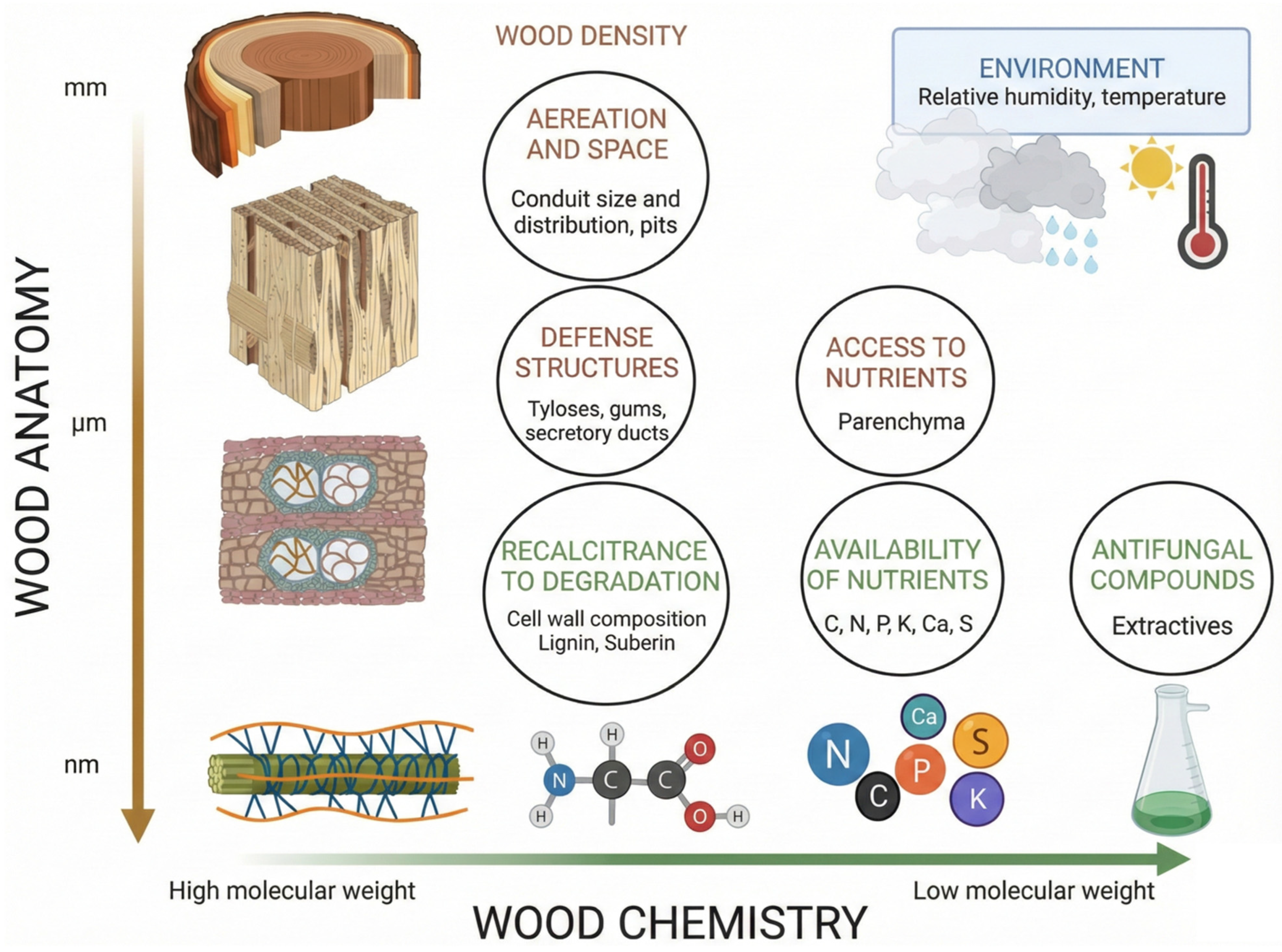
An understanding of the mechanisms of degradation in wood and other lignocellulosic materials is fundamental to designing effective protective strategies. Degradation can be broadly categorized into two primary pathways: biological decay by microorganisms and thermochemical degradation due to heat and fire. The primary wood properties affecting durability involve the quantity and composition of extractives, such as low-molar-mass organic compounds generated during heartwood formation. However, additional factors such as wood anatomy, density, lignin content, and moisture content also play a role (Figure 1). Wood-decay fungi are the principal cause of biodeterioration in terrestrial ecosystems and building structures. Their biological activity is dependent on the most favorable of environmental conditions, particularly wood moisture content above the fiber saturation point (approximately 30%) and temperatures generally ranging from 10 °C to 35 °C [33,34,35]. These fungi are classified into three main groups (brown-rot, white-rot and soft-rot) based on their mechanisms of degradation.
Brown-rot fungi, such as Gloeophyllum trabeum and Rhodonia placenta, are destructive to softwood structures, particularly the selective depolymerization of the carbohydrate components of the cell wall (cellulose and hemicellulose), leaving behind a brittle, brown, and cubically cracked lignin structure [36,37,38]. Their specific degradation strategy involves an initial, non-enzymatic stage driven by a Chelator-mediated Fenton (CMF) system. The fungus secretes low-molar-mass compounds, such as oxalic acid, which chelate iron ions present in the wood. These chelators then facilitate a redox cycle that reduces Fe3+ to Fe2+. The Fe2+ subsequently reacts with hydrogen peroxide (H2O2), also produced by the fungus, via the Fenton reaction to generate highly reactive and diffusible hydroxyl radicals. These radicals initiate a rapid, oxidative depolymerization of cellulose and hemicellulose, breaking them into smaller fragments that can then be assimilated by the hydrolytic enzymes of the fungi [39].
White-rot fungi, including organisms like Trametes versicolor and Irpex lacteum, are distinguished by their ability to degrade all major wood polymers, including the highly recalcitrant and complex lignin structure. The fungi achieve this by utilizing extracellular oxidative enzymes, primarily laccases and peroxidases (lignin peroxidase and manganese peroxidase), which work in tandem with hydrolytic enzymes to deconstruct and degrade the entire lignocellulose matrix [40,41,42,43]. On the other hand, soft-rot fungi, such as Chaetomium thermophilum, are typically active in environments with very high moisture content or in preservative-treated wood that is resistant to other fungi. They degrade cellulose and hemicellulose by growing within the secondary (S2) layer of the wood cell wall, where they secrete cellulolytic enzymes that can erode the wood from the inside, forming characteristic microscopic cavities [44,45,46].

2.2. Thermal Degradation

The combustion of wood is a complex thermochemical process requiring three important components: fuel, or the wood itself, oxygen, and a heat source [47,48]. When wood is heated, it undergoes pyrolysis, an endothermic thermal degradation process that occurs in the absence of oxygen. This process occurs in stages, directed through the thermal stability of constituent polymers. Hemicelluloses are the least stable and begin to degrade first (180–300 °C). Cellulose, with its highly crystalline structure, degrades in a narrower and higher temperature range (325–400 °C). Lignin, an amorphous and highly cross-linked aromatic polymer, is the most thermally stable component, degrading gradually over a wide temperature range that extends beyond that of the polysaccharides (>470 °C) [49,50,51]. The pyrolysis of these biopolymers generates three classes of products: (1) non-flammable gases, such as carbon dioxide (CO2) and water vapor (H2O); (2) a solid, carbon-rich residue known as char; and (3) a mixture of flammable volatile gases, with levoglucosan from cellulose being a primary component [52,53,54]. The visible flame associated with burning wood is the result of the exothermic gas-phase combustion of these volatile products. This combustion is a self-sustaining free-radical chain reaction, propagated by highly reactive species such as hydrogen and hydroxyl radicals [55].
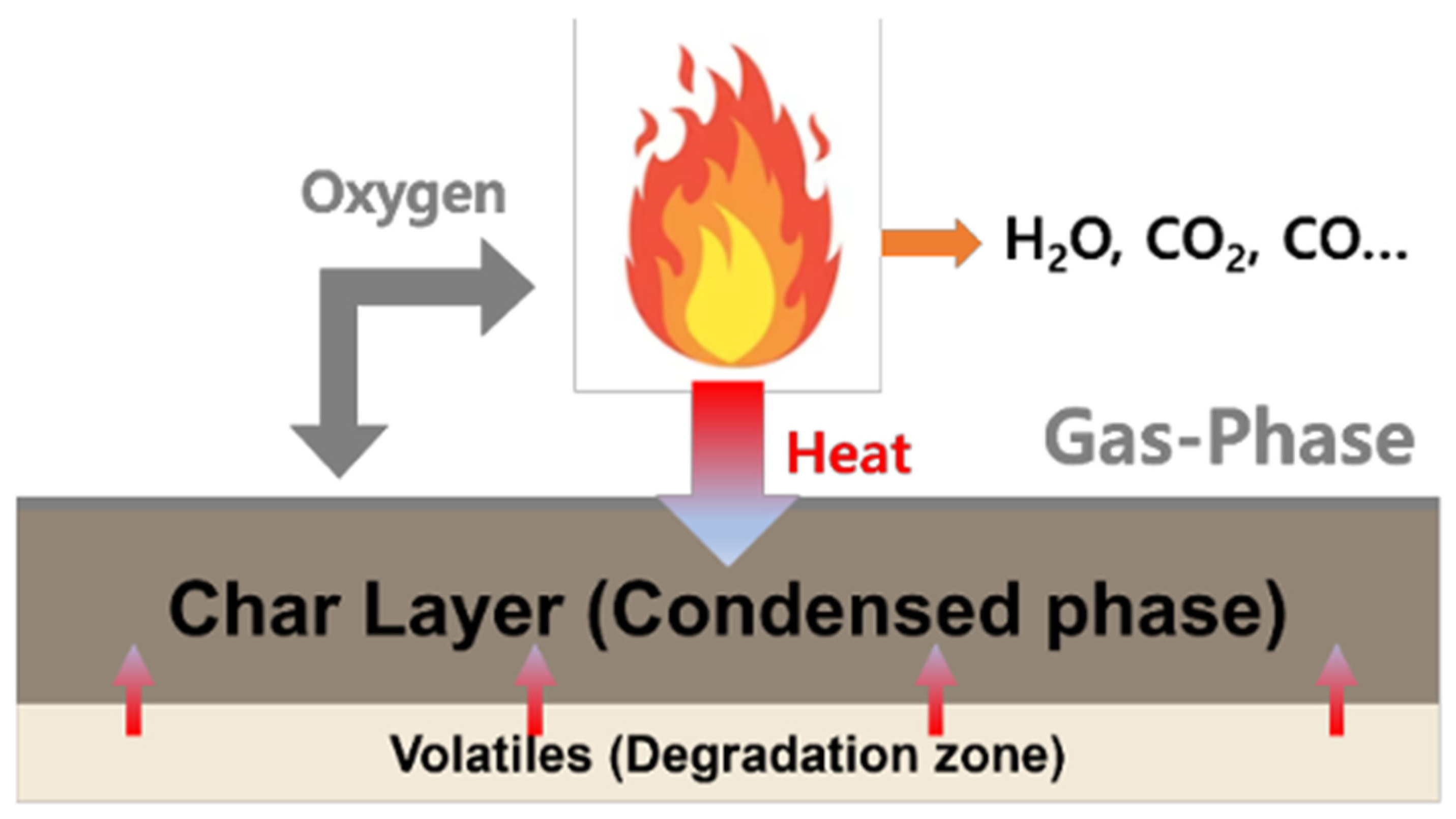
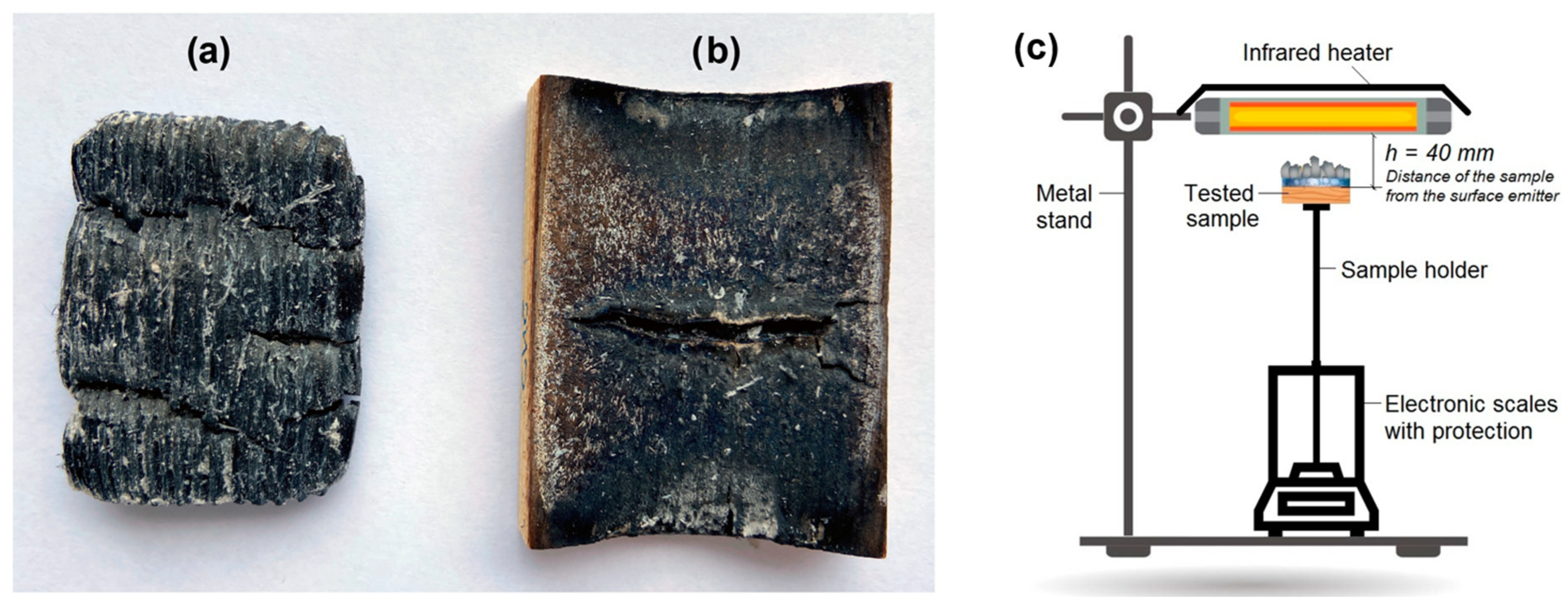
The main goal of any fire-retardant strategy is the disruption of this combustion cycle. This can be achieved through several mechanisms, which can act in the condensed phase (wood) or the gas phase (flame) [56,57]. Condensed-phase mechanisms aim to alter the pyrolysis pathway to favor the formation of a stable, insulating char layer instead of flammable volatiles. This char layer acts as a physical barrier, insulating the underlying wood from heat and limiting the diffusion of oxygen to the surface [58]. Gas-phase mechanisms involve the release of non-combustible gases that dilute the fuel–oxygen mixture or the release of radical scavengers that inhibit the combustion chain reaction in the flame [59,60]. Figure 2 shows the combustion model of an FR material. The degradation pathways of brown-rot fungi and fire share a similar mechanism through their reliance on free-radical chemistry. The CMF system employed by brown-rot fungi is initiated by highly reactive hydroxyl radicals generated via the Fenton reaction, as discussed in the previous section, while the gas-phase combustion of wood is propagated by a free-radical chain reaction involving both hydrogen and hydroxyl radicals. This similarity suggests that a single protective strategy could confer dual resistance against both fungi and fire. For instance, treatments that introduce antioxidants or radical scavengers into the wood matrix could simultaneously interfere with the initial oxidative attack of brown-rot fungi and extinguish the chain reactions that sustain a flame. The structure of lignin, with its characteristic phenolic groups, already provides this function to a degree, contributing to the innate durability of wood [61]. Therefore, strategies that enhance or mimic this radical-scavenging capability, such as the application of lignin nanoparticle coatings or the introduction of other antioxidants, can lead to the development of multifunctional and bioinspired lignocellulosic bio-based materials protection treatments.

3. Mineralization

3.1. Calcification

Calcification of wood is a promising technique for improving its fire retardancy. The process typically involves a two-step impregnation of wood with soluble precursors, such as an aqueous or alcoholic solution of calcium chloride (CaCl2) followed by a solution of sodium bicarbonate (NaHCO3) or sodium carbonate (Na2CO3), which react deep within the porous network of wood (after pressure treatment) to precipitate insoluble calcium carbonate (CaCO3) [62]. More advanced methods utilize single-component precursors like calcium acetoacetate, which decomposes to form CaCO3 under controlled humidity and temperature [63], or employ the alkaline hydrolysis of dimethyl carbonate (DMC) in the presence of calcium ions [64]. The idea behind this process is the targeting of the nanoporous cell wall structure in addition to the larger, micron-sized cell lumina. This can be achieved by controlling the reaction kinetics to promote diffusion deep into the cell wall prior to precipitation. This strategy avoids the rapid formation of a mineral layer on the surface or inside large voids, which could potentially block further penetration of the precursors and result in a less effective and non-uniform treatment [21]. The fire-retardant mechanism of calcified wood involves both condensed-phase and gas-phase pathways, as discussed in the previous section. This represents an active chemical fire retardancy, where the mineral phase directly participates in hindering combustion. When heated, CaCO3 undergoes an endothermic decomposition reaction, which absorbs a significant amount of thermal energy from the surroundings. This effect serves as a heat sink, cooling the wood surface and delaying pyrolysis and ignition [65]. The decomposition also releases a large volume of non-flammable carbon dioxide gas. This gas dilutes the mixture of flammable volatile gases produced by wood pyrolysis and the ambient oxygen, effectively raising the energy threshold required to sustain combustion [30]. The solid product of the decomposition, calcium oxide (CaO), is a thermally stable material. As it remains on the wood surface, it contributes to the formation of a dense, insulating char-mineral layer. This layer then acts as a physical barrier that impedes the transfer of heat to the underlying wood and restricts the outward diffusion of flammable volatiles and the inward diffusion of oxygen, further inhibiting the combustion process [62,66]. While highly effective for fire retardancy, the treatment has a relatively limited impact on the mechanical properties or water resistance of treated wood [62].
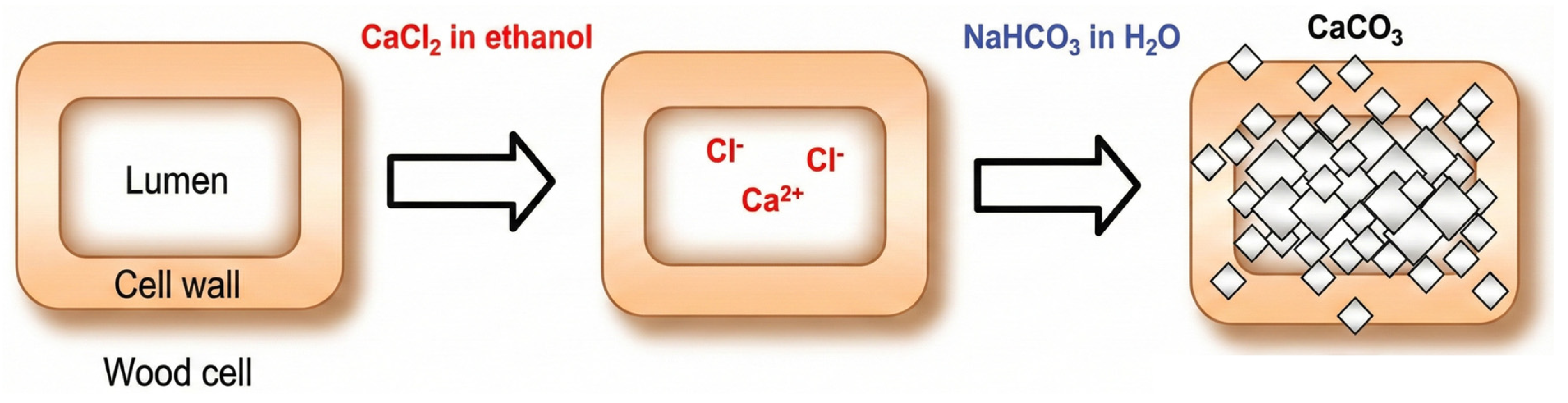
Wood is a three-dimensional, anisotropic, and highly porous organic material that can act as a scaffold for mineralization. Most of the studies in the literature deal with the direct mineralization of wood, which is the incorporation of inorganic compounds in the wood structure [67,68]. Calcium carbonate can be introduced and deposited to produce highly ordered and hierarchically structured materials with enhanced durability and mechanical properties. Calcium carbonate can be introduced into the wood structure by utilizing solution exchange cycles of concentrated electrolyte solutions with calcium chloride in ethanol and sodium bicarbonate in water [29]. The ionic precursors instantaneously react to form calcium carbonate polymorph structures inside the wood cells. Figure 3 shows the schematic of direct calcium carbonate mineralization in wood cells via liquid exchange of supersaturated electrolyte solutions.
Mineralized wood is known to exhibit increased durability and mechanical properties, resistance against fungal attack, and improved fire retardancy. A study focusing on the performance enhancement of poplar wood mineralized by calcium carbonate successfully determined the increase in compressive (15.65%) and flexural (37.66%) strengths [69]. The same study also reported reductions in maximum heat release rate (HRR), total heat release (THR), and total smoke production (TSP) as determined by microcalorimetry and cone calorimetry analyses, at 59.5%, 48.5%, and 51.7%, respectively. Another study combined mineralization and thermal modifications to improve durability against fungal attacks [70]. They studied the effects of single or combined treatments of European beechwood (Fagus sylvatica) and Norway spruce (Picea abies) against four different fungi: Gloeophyllum trabeum, Rhodonia placenta, Trametes versicolor, and Pleurotus ostreatus. There was an observed improvement in durability against R. placenta, T. versicolor, and P. ostreatus through thermal modification. Meanwhile, combined mineralization and thermal treatment produced a synergistic effect against G. trabeum decay. Lastly, another study utilized spruce mineralized by calcium carbonate and tested it in terms of fire retardancy [30]. The researchers found that mineralized spruce exhibited improved physical and thermal stability after prolonged heat treatment at 250 °C for 20 min. The researchers highlighted that the introduction of calcium carbonate into the wood structure affected cellulose thermal decomposition via volatile formation reduction. The heat of combustion of the calcium carbonate/wood composite they produced as measured by pyrolysis combustion flow calorimetry decreased by 32–38% relative to unmodified wood. Biomineralization of wood, specifically MICP, remains an unexplored frontier in terms of developing organic–inorganic materials with improved thermal and mechanical properties.

3.2. Silicification

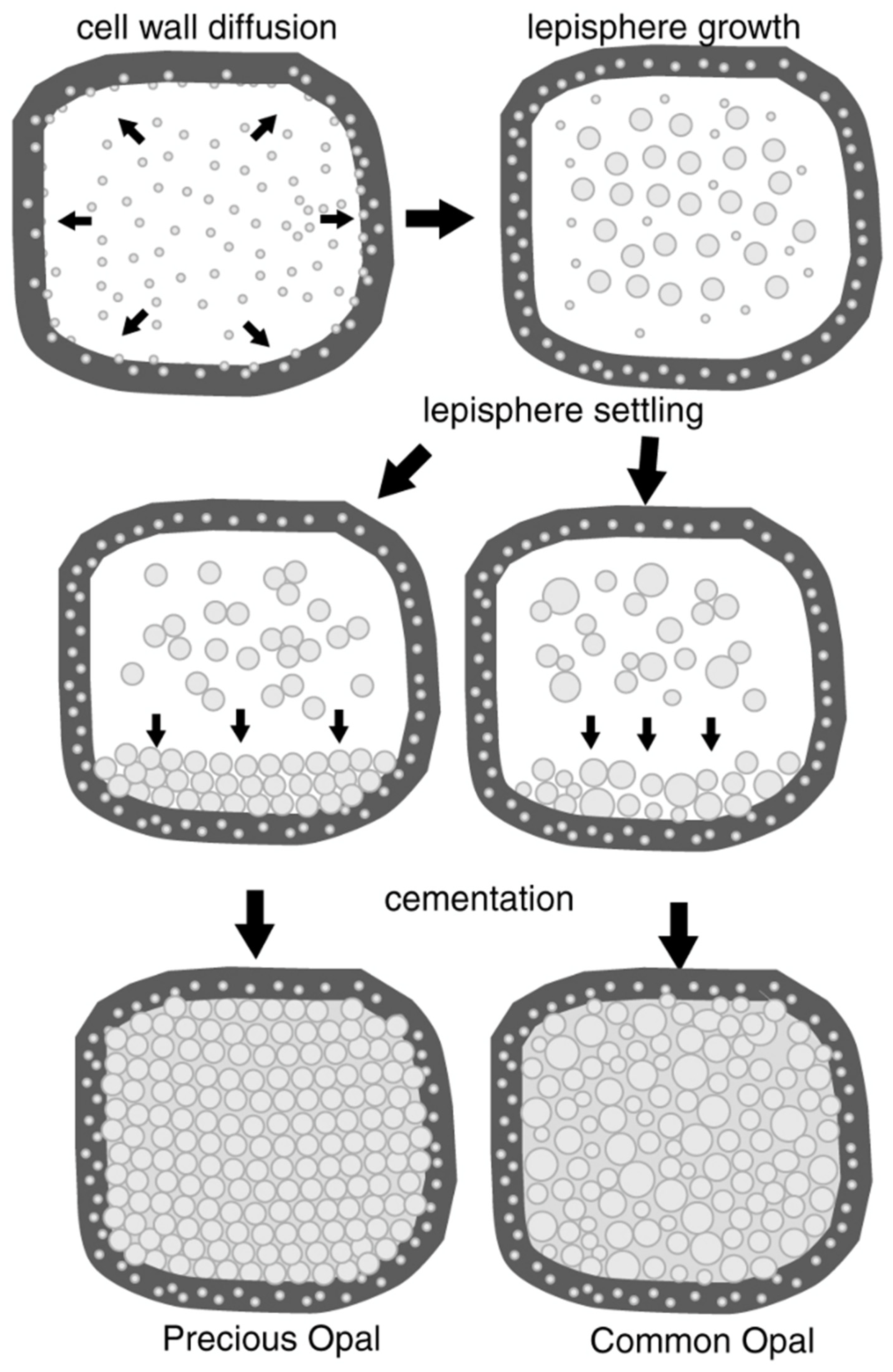
Silicification is a process that mimics natural petrification, where silica-rich groundwater gradually permineralizes wood over time, replacing organic matter with silica-based minerals [71]. Reported processes in the literature include impregnating wood with silica precursors such as aqueous colloidal silica suspensions or organosilanes like tetraethoxysilane (TEOS). TEOS undergoes hydrolysis and condensation via a sol–gel process within the wood structure to form a network of amorphous silica (SiO2), often referred to as opal-A. To ensure deep and uniform penetration of these precursors, vacuum-pressure impregnation is a commonly employed and effective technique. In contrast to the active role of CaCO3, the protective mechanism of silicification is primarily “passive” and physical. The deposited SiO2 forms an inert, stable, and hard mineral phase that fills the cell lumina and coats the cell walls. This vitreous barrier imparts several property improvements. The silica network physically obstructs the pathways for water ingress into the hygroscopic wood cell walls, leading to a reduction in water absorption by up to 40%. The intrinsic hardness of the silica mineral phase (Mohs hardness of around 7 for quartz) improves the surface hardness of the treated wood. The same research has also shown that the Brinell hardness can be nearly doubled compared to untreated samples, enhancing resistance to abrasion and mechanical wear [72]. The non-combustible and thermally stable SiO2 layer acts as an excellent thermal insulator, as it protects the underlying wood structure from heat, delaying ignition time from 15 s for native wood to 50 s for silicified wood and reducing the overall thermal conductivity of the material [73]. The inert silica barrier provides improved weathering resistance and biological attack. However, its protection capability can be limited by the bond quality between the silica and the wood polymers. The process does not typically form extensive covalent bonds, which can affect long-term durability and, in some cases, lead to a decrease in the strength and stiffness of treated wood [74]. The reaction mechanisms of calcification and silicification highlight a trade-off in mineralization strategies. The active, chemical fire retardancy offered by CaCO3 versus the passive, physical durability and hydrophobicity provided by SiO2. A treatment focused solely on calcification may produce a highly fire-retardant material that remains susceptible to moisture-induced degradation and mechanical failures. Conversely, silicified wood might be hard and water-resistant but possess a less potent fire-retardant capability. This suggests that the most effective and multifunctional protection could be achieved through a hybrid mineralization approach. Bioinspired design involves a sequential or co-precipitation process to create a composite mineral phase. For instance, a durable and hydrophobic layer of SiO2 could be formed in the outer sections and larger pores of wood to protect it against weathering, while a more reactive phase of CaCO3 could be precipitated deeper within the nanoporous cell wall to provide the active fire-retardant functionality. Figure 4 shows the schematic of wood cell silicification.

3.3. Other Mineralization Types

Besides calcification and silicification, other mineralization types exist, such as apatite, struvite, and zinc borate mineralization, among others. Performance evaluations have demonstrated the effectiveness of mineralization using other types of minerals. Wood mineralized with carbonated apatite has shown improvements, with limiting oxygen index (LOI) values over 60.4% and achieving a rating of UL-94 V-0 [75]. A related study indicated that struvite-mineralized wood exhibited a mass gain of 80.36% after treatment and was hardly ignited in a normal atmosphere, as the LOI of the mineralized wood was observed to be 58.25%, which was about three times higher than that of the natural spruce wood [76]. Another recent study reported successful development of nanostructured wood hybrids with improved flame retardancy, smoke suppression, mold resistance, and anti-termite activity via in situ mineralization of nanosized zinc borate (ZnB) particles in wood. There was an observed increase in LOI from 22.6% to 41.2%, reductions in CO2 yields and smoke production, and reductions in peak heat release rate (PHRR) and total heat release (THR) by 46.9% and 47.9% after treatment, respectively [77]. Of the different inorganic minerals found in nature, only a few have been used in wood research through chemical treatments and strategies. Examples of these minerals are silica and titania prepared by the sol–gel process [78,79], aluminosilicates as zeolites prepared by the seeded templating process [80], calcium phosphate as hydroxyapatite prepared by thermal and hydrothermal processes [81], and iron oxide in nanocrystalline form synthesized by in situ precipitation [29].

4. Biomineralization

4.1. Background

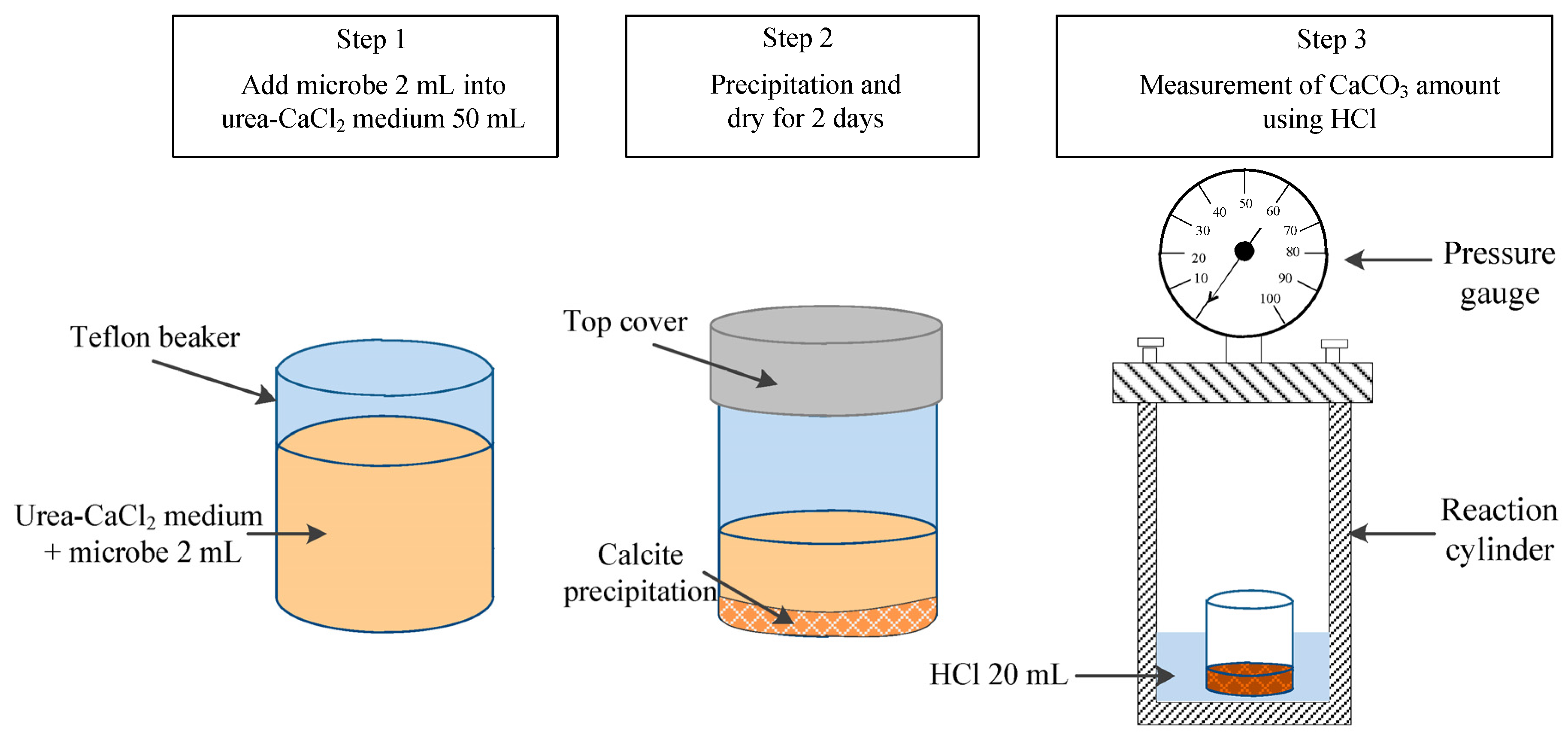
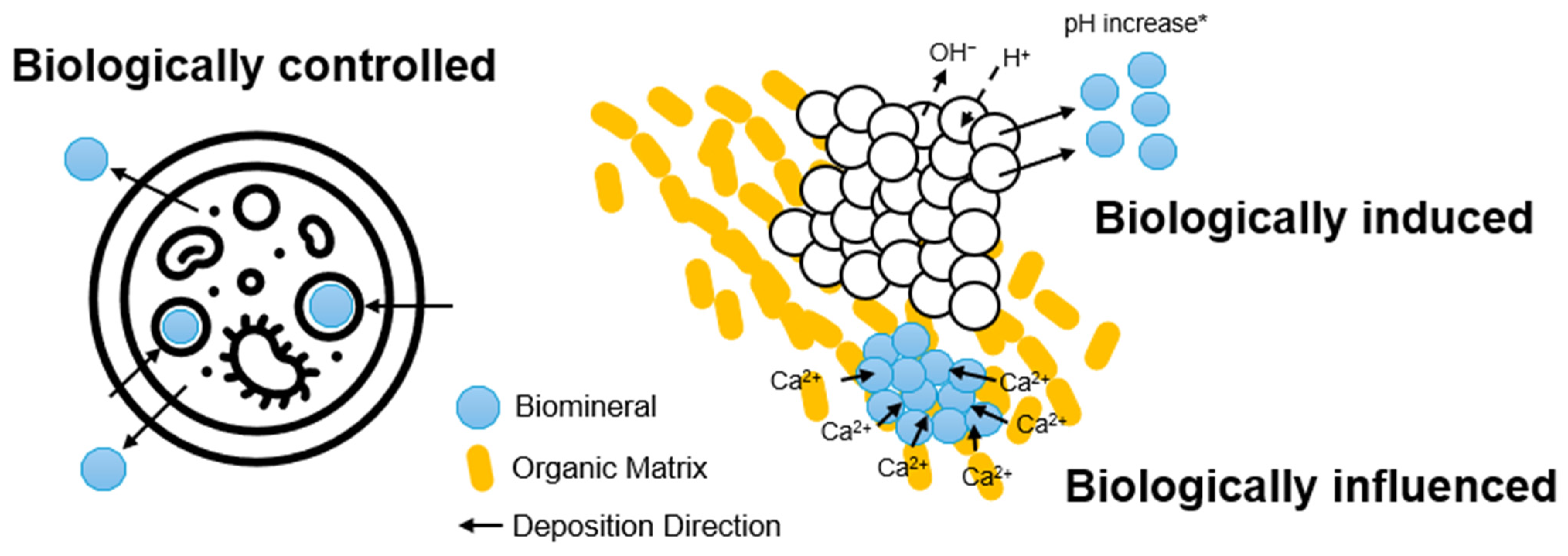
Biomineralization is the process by which living organisms produce and deposit minerals (carbonates, silicates, sulfates, oxides) [82,83,84]. The biomineralization process involves a complex interplay of biological and chemical processes, which result in the formation of structures with unique properties and functionalities, such as organic–inorganic (organism–matrix) interactions. The process is employed to incorporate specific characteristics into organic materials, specifically the calcification of wood or other biomaterials for increased durability by using bacteria through “Microbially Induced Calcium Precipitation (MICP)” (Figure 5). MICP has been a focus of recent research and extensively used to repair cracks and enhance the structural integrity of concrete materials [85,86,87]. Biomineralization in terms of lignocellulosic bio-based material improvement and protection is a novel approach to designing green building materials with environmentally friendly methods. Therefore, it is important to understand the underlying processes concerning the optimal biomineralization conditions to enhance the efficiency of the mineralization process and simultaneously improve the mineral product precipitation and yield. In nature, biomineralization processes exist in a variety of ways. Biologically controlled mineralization is a process where cells apply specific spatial, structural, and chemical control over mineral formation. This typically occurs within specialized, isolated compartments where an organic matrix composed of proteins and polysaccharides initiates crystal nucleation following a template forming mineral phases, such as calcite and aragonite [88]. On the other hand, biologically induced mineralization is more passive. It occurs when the metabolic activities of microorganisms, such as respiration or photosynthesis, alter the immediate chemical environment by changing pH or increasing carbonate ion concentration. This ultimately leads to the secondary precipitation of minerals on or near the cell surfaces [89]. The artificial mineralization processes applied to wood are biomimetic of these processes, treating the inherent structure of wood as a pre-existing organic matrix and template, introducing precursors under controlled conditions to induce the precipitation of the mineral [30].

4.2. Biomineral Formation

4.2.1. Intracellular Biomineralization

Cyanobacteria have played a significant role in forming calcium carbonate deposits for millions of years and are considered to biomineralize carbonates extracellularly. This is due to the purpose of calcium carbonate for microorganisms as a metabolic byproduct or structural support, which is useful if produced extracellularly. The mechanisms of cyanobacterial carbonate production are not fully understood. However, some species of cyanobacteria are capable of producing calcium carbonate outside the cell. A cyanobacterial species, Candidatus Gloeomargarita lithophora, was recently discovered to form intracellular calcium carbonates [90]. These particular cyanobacteria have received a great deal of attention from scientists due to their role in carbonate deposits all around the world, specifically stromatolites, which are almost 3 billion years old [91,92]. Another notable cyanobacterium to feature intracellular biomineralization is Chroococcidiopsis thermalis PCC 7203 which is capable of forming calcium carbonate and dispersing it throughout its cytoplasm [90,93,94]. The size distribution and spatial location of the intracellular carbonates in different cyanobacterial strains have been discovered to be dependent on specific nucleation sites, such as carboxysomes and cytoskeletal proteins in cyanobacteria [95]. This does not come without disadvantages, as intracellular dissolved Ca2+, though essential for metabolic functions, cell signaling, and structure maintenance, may be detrimental to the cyanobacteria at very high cytosolic concentrations, so it should be tightly regulated and maintained at very low concentrations [96]. This also means that intracellular calcium carbonate production in terms of yield will be limited to the cells of the bacteria. Alternatively, the formed intracellular calcium carbonate is transported outside of the cell through vesicles after a certain limit to prevent the accumulation of the rigid mineral inside the cell.

4.2.2. Extracellular Biomineralization

MICP is mostly due to bacterial extracellular biomineralization and is the result of bacterial metabolic activity interacting with organic or inorganic materials in their environment. In extracellular mineralization, the bacterial cell produces a matrix around the cell that acts as a nucleation site for calcium carbonate deposition. The bacteria actively transport ions through the cell membrane to the destination nucleation site or store them in vesicles inside the cell, forming the mineral, which is subsequently transported outside the cell and deposited [97]. The cell also produces a macromolecular matrix outside the cell that will serve as a nucleation site. Matrix is loosely defined as organic macromolecules composed of carbohydrates and proteins that lead to the assembly of a higher-order 3D framework [98]. The structure of these resulting matrices is essential in the control and regulation of biological functions dictating the growth and development of the biominerals. There are two known pathways involved in extracellular biomineralization. The first one involves the cellular transport of cations through a membrane pump into the area surrounding the cell. Outside the cell, the concentration of pumped ions increases and reaches supersaturation levels; this is gradually maintained by diffusion over long distances into an organic matrix. For the second pathway, the cations are not pumped out of the cell but instead collected and stored inside a vesicle until the whole unit is transported outside the cell. Afterward, the loaded vesicle will interact with the organic matrix, unloading the cations and forming the biomineral deposits. This pathway is the process exploited by many researchers in conducting biomineralization studies, such as cartilage and bone regeneration [99,100]. It is also the process in which animals, such as sea urchins, produce carbonates and transport them through spicule vesicles, ultimately depositing crystallized calcite [101]. Both of the biomineralization pathways mentioned require the active supply of cations to an external organic matrix for mineral nucleation.
Bacterial cells are known to exhibit extracellular biomineralization, and there are a variety of bacterial species capable of producing calcium carbonate deposits outside of their cells. One study focused on the use of Bacillus licheniformis DB1-9 to induce carbonate precipitation utilizing different magnesium/calcium molar ratios in a lab setting [102]. Another study highlighted the influence of medium components on the induction of biomineral precipitation by Bacillus cereus and the subsequent analysis of the formed extracellular matrix and deposited calcium carbonate [103]. Another important bacterial species, Sporosarcina pasteurii, has been utilized in countless research studies throughout the years due to its unique and easily controllable calcium carbonate precipitation through extracellular MICP that is even capable of producing nanoscale biomineralized crystals [104].

4.3. Biomineralization Types

4.3.1. Biologically Controlled

Biologically controlled mineralization enables microorganisms to direct their energies into cellular activities deemed necessary for nucleation, morphology, mineral growth, and deposition site. The degree of control varies widely among and across species, but the majority of controlled mineralization processes occur in an isolated environment [98]. This leads to a complicated series of species-controlled products that gives biological function to the microorganism. Prokaryotes of both Bacteria and Archaea mediate the production and deposition of a large variety of minerals through biologically controlled mineralization. This type of mineralization is known to be organic matrix-mediated or boundary-organized mineralization [105]. The previous section described both intracellular and extracellular biomineralization, and both are also mediated by the organic matrix as a nucleation site. Thus, it is generally accepted that biologically controlled mineralization can be either intracellularly or extracellularly processed.

4.3.2. Biologically Influenced

Biologically influenced mineralization is a passive process in terms of mineralizing the organic matrix. The organic matrix, such as microbial cell wall or extracellular polymeric substances (EPS), act as nucleation sites, inducing mineral deposition in supersaturated solutions. The organic matrix characteristics and properties help influence the morphology, structure, and composition of the minerals precipitated and deposited [106]. The carbohydrate and protein components of the organic matrix directly influence the biomineralization process and the subsequent formation of high-order 3D crystalline mineral structures [98]. The process specifically takes place in conditions affected by abiotic factors such as the removal of excess moisture (evaporation) or gases (degassing) that can hinder the amount and quality of biominerals deposited on the organic matrix. This also contributes to the differences between biominerals and their inorganic counterparts (minerals produced through abiotic means) in terms of crystallinity, shape, size, and composition [107]. Individual biomineralization pathways (phylogeny and metabolic activities) of the microorganisms and biotic/abiotic factors and stresses they experience influence the properties of minerals precipitated [108].

4.3.3. Biologically Induced

Lastly, biologically induced mineralization is the result of modifying (controlling) the chemistry of the immediate environment of the microorganism, thereby affecting its biological activity. Unlike biologically controlled mineralization, the microorganism is induced to produce minerals and has no control over the shape, size, and structure of the resulting mineral deposits. It is treated as secondary precipitation of minerals, occurring due to interactions between the modified biological activity of the microorganism and the controlled immediate environment. In this process, the surfaces of the microorganisms act as initiators for nucleation and further mineral growth. The biological activity of microorganisms has no significant control over the properties of the minerals deposited. The biological activity of the microorganisms is still capable of basic functions, and the metabolic processes involved in mineral production are still within the conditions set by pH, carbon source, and product compositions [98]. Heterogeneous crystal structures are the signature products of biologically induced mineralization. The relative composition of minerals produced from induced processes exhibited variations corresponding to the environment in which they were formed [109]. The variations observed are related to external morphology, moisture content, elemental composition, particle size, and mineral structure. MICP is a specific example of biologically induced mineralization. MICP is a process found everywhere in nature, predominantly where moisture meets microorganisms capable of utilizing calcium ions in their metabolism, such as caves, sediments (freshwater and marine), soils, and saline environments [86]. This process is a result of metabolic interactions between different microbial species with the organic and inorganic substrates present in their environments. Because of this reason, MICP is widely known in the literature as a process that can be easily employed in terms of availability, controllability, reproducibility, and calcium carbonate product quality, most notably in research concerning repair and self-healing of concrete structures [86,87,110,111,112]. Figure 6 shows the schematic differentiation of the mechanisms involved in the biomineralization types discussed.

4.4. Factors Affecting Biomineralization

4.4.1. pH

Changes in pH play an important role in biomineralization since it determines the ionic forms of the substrates required by microorganisms for their mineral production. pH also contributes to the solubility of the mineral product, and a slight change in pH might lead to abrupt changes in solubility. In the case of carbonate mineral formation, a decrease in pH increases its solubility. Besides disrupting the metabolic processes in microorganisms due to the drop in pH, it also affects the nucleation and growth of minerals, leading to lower yield or mineral quality. pH also plays a role in the activities of enzymes required by microorganisms in producing minerals. For MICP, an important enzyme needed to hydrolyze urea for calcium carbonate mineralization called urease is known to have optimal activity at pH values between 7.0 and 8.0 [113,114]. Urease activity peaks at pH levels close to 8.0 and decreases as the pH increases. A study focusing on the effects of different pH (6, 7, 8, 9, and 10) on two microbial species, Staphylococcus saprophyticus and Sporosarcina pasteurii, found that the maximum calcite produced was at pH 7 and most of the precipitation happened within 3 days [85]. Under the same conditions, they also found that S. saprophyticus produced five times the amount of calcite that S. pasteurii produced. S. saprophyticus was also discovered to be less sensitive to pH change than S. pasteurii. The optimal pH reported for S. pasteurii urease activity is 8.0, and the precipitated calcium carbonate amount increases with pH and reaches optimal mineral yields at pH of 8.7–9.5 [114,115,116].

4.4.2. Temperature

Temperature also affects the enzyme required for biomineralization. For MICP, both the solubility of calcium carbonate and urease activity are temperature dependent. Calcium carbonate solubility increases with temperature, and as such, the changes in calcium carbonate solubility affect the overall crystal size and morphology of mineral deposits [117]. Meanwhile, urease is known to be active at temperatures ranging from 10–60 °C [118]. The optimum temperature for different ureases ranges from 20–37 °C [119]. The kinetics of calcium carbonate precipitation induced by S. pasteurii was determined, and it was found that urease activity increased 5 times when the temperature was increased from 15–20 °C and increased 10 times when the temperature was increased from 10–20 °C [120]. The stability of urease was determined to be optimal at 35 °C, but a subsequent increase in temperature to 55 °C decreased the urease activity by almost 50% [121]. Two bacterial species, S. saprophyticus and S. pasteurii, were tested against different temperatures at 10 °C intervals (20, 30, 40, and 50 °C) to determine the maximum calcium carbonate precipitation, which was observed at 30 °C [85].

4.4.3. Substrate Concentrations

Urease activity that leads to urea hydrolysis increases pH and uses the resulting ammonia as a source of nitrogen and energy. The production of ammonia is beneficial to the metabolism of some microorganisms for the creation of an alkaline environment, making the system more suitable for calcium carbonate precipitation due to decreased solubility [114]. Calcium ion (Ca2+) is not directly used as a precursor in bacterial metabolism. They accumulate outside the cell, where the negatively charged surface of bacterial cells acts as absorbers of this cation. The binding of calcium ions on the surface renders them more accessible for subsequent mineral growth. Thus, a calcium source is important for biomineralization, and calcium ion concentrations are one of the important steps in initiating mineral deposition on the surface of cells acting as nucleation sites. There is an optimal concentration of calcium ions needed for the cells to efficiently undergo biomineralization processes, which was determined to be at relatively low concentrations of 0.05–0.25 M [122]. The same study also reported that higher concentrations (higher than 0.5 M) of calcium chloride and urea decrease calcium carbonate precipitation. The researchers also concluded that biomineralization is more dependent on calcium ion concentration than urea.

4.5. Biomineralization Applications

Biomineralization imparts great significance not just in scientific research but also in industrial and commercial applications [26,123,124]. Some of the notable applications of biomineralization include pharmaceutical and drug development, tumor and cancer targeting, bone and tissue regeneration, 3D printing of natural and synthetic materials, fabrication of biological scaffolds, environmental engineering (fillers for filters and membranes), and geological applications [106]. Notable recent applications of biomineralization include remediation research, focusing on heavy metals and radionuclide capture and recovery [125,126,127], removal of calcium and copper from wastewater effluent [128,129,130], and repair of concrete materials (pavements and buildings) through self-healing technologies [110,131,132]. Biomineralization is also produced by the human body, as evidenced by mineralized tissues or organs such as the skeleton, teeth, and otoconia [133]. This is advantageous since the controlled formation of calcium carbonate will not affect the immune response of the human body [134], and dysregulation of the biomineralization processes often leads to diseases [135]. The majority of the natural calcium carbonate in the human body is found in bones and teeth, and their formation shares several biochemical pathways and mechanisms regulating the concentrations of calcium and phosphate ions in the human body [136]. Calcium carbonate is also naturally produced by animals, by bivalve mollusks, and as a protective coating in avian eggshells [137,138].

5. Lignocellulosic Modifications

5.1. Cellulosic Nanoparticles

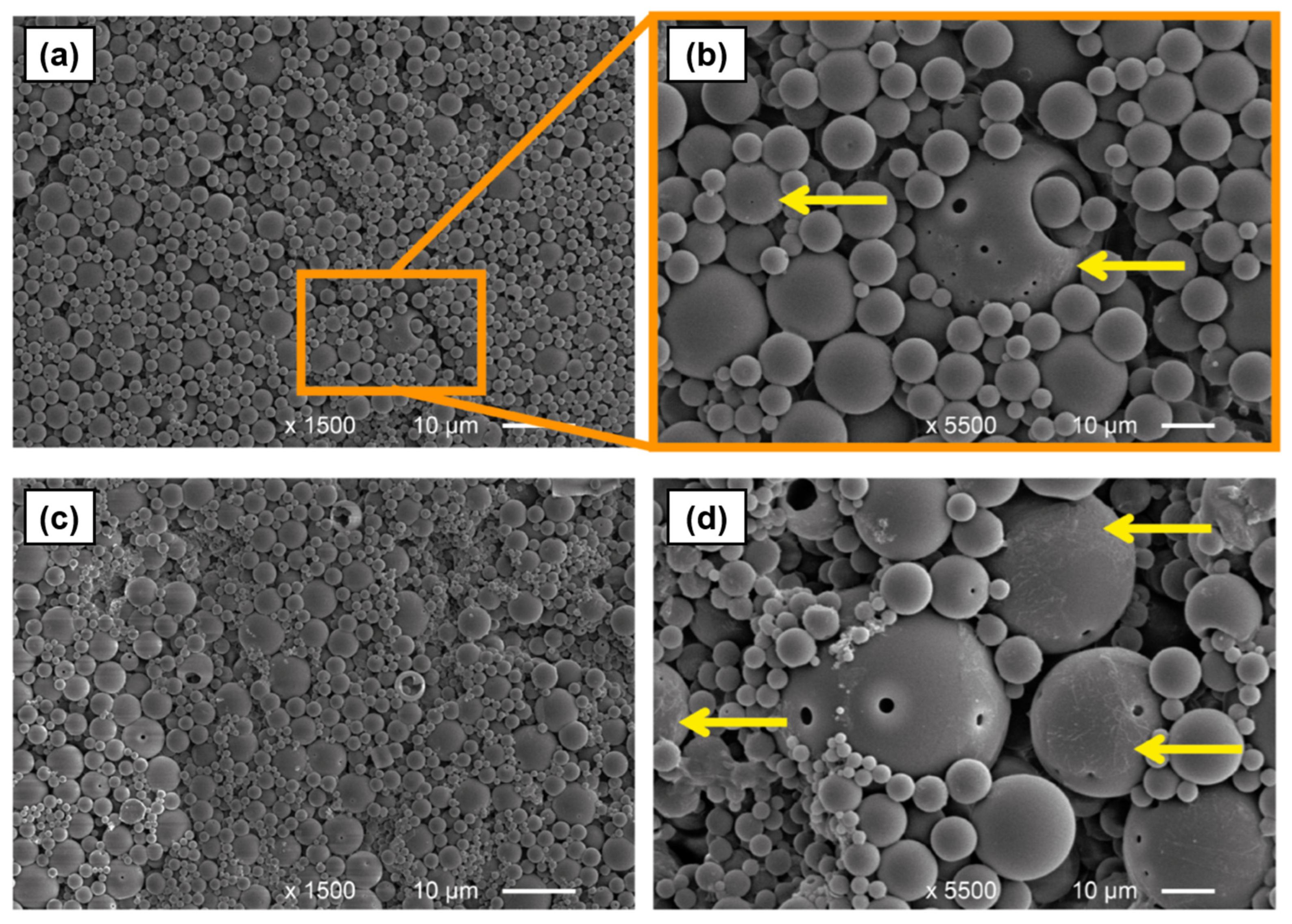
The breaking down of lignocellulosic biomass into its constituent polymeric components, such as cellulose, hemicellulose, and lignin, and also their subsequent reassembly into nanostructured materials offers another bioinspired route to functionalization. Cellulose nanocrystals (CNCs) and cellulose nanofibrils (CNFs) leverage the inherent properties of the lignocellulosic biomass source at the nanoscale, making them suitable for various applications such as high-performance additives and coatings for wood protection. Nanocellulose, extracted from wood pulp or other cellulosic materials, exists in two primary forms: highly crystalline, rod-like nanoparticles known as CNCs, and longer, more flexible, and semi-crystalline CNFs [139,140,141,142,143]. Both materials are characterized by their high mechanical strength, large surface area, and presence of surficial hydroxyl groups, with applications ranging from reinforced polymer composites, functional films, and coatings [144,145,146]. When applied to a wood surface as a coating, cellulose nanomaterials form a dense and interconnected network [147], acting as a starting material for the formation of a continuous and highly insulating char layer upon exposure to heat and also as a scaffold for incorporating other FR agents, such as through borylation [148] and graphitization [143]. The stable char functions as a physical barrier that effectively limits heat transfer to the underlying wood structure and can restrict the outward diffusion of flammable volatile gases, starving the fire of fuel and heat. The thermal properties of cellulose nanomaterials can be improved when used in synergistic combination with other FR agents. First, with expandable graphite (EG), CNCs can serve as a renewable and biocompatible surfactant and binder for EG particles. CNCs facilitate the dispersion of EG in water and ensure its adhesion to the wood surface. When exposed to fire, the EG intumesces to form a thick, porous char, while the CNCs pyrolyze to form a cohesive layer that binds the expanded graphite structure together, resulting in a highly effective and stable insulating barrier that can decrease burning rate (Figure 7) [143]. Meanwhile, with mineral fillers, CNCs can improve the dispersion of inorganic FRs, such as magnesium hydroxide (Mg(OH)2), within the polymer matrix. The dispersion prevents the agglomeration of mineral particles and ensures a more uniform protective effect, leading to a synergistic reduction in the PHRR from 350 w/g to 121 w/g [149]. Lastly, through chemical modifications, the surface hydroxyl groups of cellulose nanomaterials can be chemically modified to incorporate flame-retardant elements. For example, phosphorylation of CNFs, followed by ionic bonding with a nitrogen-rich compound like melamine, creates a potent phosphorus-nitrogen synergistic FR system [150]. The study reported that the limiting oxygen index for the 30 wt.% retardant-loaded paper was 30%, and the PHRR was reduced by 62.8% compared to the control, and the treated paper exhibited self-extinguishing behavior. Furthermore, the highly crystalline nature of nanocellulose makes it inherently more resistant to enzymatic degradation than the amorphous regions of wood [151]. By improving surface water resistance and reducing moisture absorption, these coatings can also create a microenvironment that is less conducive to fungal growth [152].

5.2. Lignin Nanoparticles

Lignin, the second most abundant natural polymer, is a complex, three-dimensional aromatic polyphenol that provides functional and mechanical support in plants, protection against microbial attack, and serves as UV absorbents due to its oxidation resistance [153]. Large amounts of technical lignin are produced annually as a byproduct of the pulp and paper industry and have been underutilized, typically being burned for low-value energy recovery [154,155,156]. However, by transforming this complex and recalcitrant macromolecule into uniform, colloidal nanoparticles (LNPs), it is possible to overcome its poor miscibility by exposing the functional groups and increasing its surface area at the nanoscale [157,158]. The molecular structure of lignin, which is rich in phenolic hydroxyl, methoxyl, and other functional groups arranged in a complex aromatic network, provides LNPs with several protective properties that can be applied in wood coatings [159]. Lignin is a natural absorber of ultraviolet radiation, so naturally, LNP-based coatings are effective UV blockers, due to their UV-absorbing functional groups, such as phenols, ketones, and chromophores, minimizing the effects of weathering and color change in outdoor applications [61,160,161]. LNPs have been demonstrated to improve the Sun Protection Factor (SPF) of sunscreen formulations due to the free radical scavenging property of the phenolic groups in lignin [162,163]. This antioxidant capacity allows LNP coating to inhibit oxidative degradation processes initiated by UV exposure or even by decay fungi. Due to this similarity in oxidative processes, lignin and its derivatives have demonstrated effective and broad-spectrum antimicrobial and antifungal activity [61]. LNPs are typically applied to wood as surface treatments via simple methods like dip-coating or spraying [164,165]. In addition to their direct protective functions, their colloidal nature and surface chemistry enable them to be ideal nanocarriers for other active agents. Volatile antimicrobial agents, such as essential oils, can be encapsulated within LNPs (Figure 8). This protects the active ingredient from evaporation and degradation while allowing controlled and sustained release, making it possible to prolong the protective effects against fungal degradation [166]. In terms of fire retardancy, studies demonstrated the potential use of LNPs in materials development with FR properties due to their surface functionality and aromatic structure [167]. Modified LNPs, such as those coupled with nitrogen- and phosphorus-containing compounds, have shown improved char formation and flame suppression when applied to lignocellulosic materials, as evidenced by reductions in after-flame characteristics (flame height and combustion time reduction) in treated cotton fabrics [168]. Similarly, phosphonate and phosphate functionalization of LNPs and incorporating them into polymeric materials, such as polylactide, exhibit improved thermal stability and reduced combustibility at relatively low loading levels [169]. These effects are attributed to the combined action of condensed-phase char promotion and the size effect, in which uniform dispersion and high specific surface area enhance the effectiveness of the FR components.

6. Proteins

6.1. Protein-Templated Mineralization

Recent bioinspired strategies involve higher degrees of molecular control to produce multiple protective mechanisms. These strategies include protein-templated mineralization and targeted biochemical inhibition utilizing protein specificity, improving lignocellulosic material properties. During biomineralization, proteins could direct the process of mineral formation with high degrees of precision. Proteins create confined reaction spaces, transport and concentrate ions, and act as templates for crystal nucleation, growth, polymorph selection, and hierarchical organization [28]. Specific domains in proteins rich in acidic amino acids, such as aspartate and glutamate, exhibit negative charges that selectively bind cations from solution, subsequently lowering the activation energy required for nucleation and improving crystal growth [170,171]. This mineralization strategy through protein templating can be applied in developing bio-inorganic composites. A good example is the development of biomimetic wood adhesives using soy protein. By itself, commercially available soy protein adhesive deteriorates due to poor water resistance and low glue strength, limiting its use as a replacement for formaldehyde-based resins, such as urea-formaldehyde (UF) and phenol-formaldehyde (PF). But research has shown that soy protein can be used as a matrix for an in situ precipitation of calcium carbonate. The protein acted as a template, guiding the formation of organized crystalline arrays of the mineral within the adhesive layer, while the rigid mineral phase acted as a reinforcement. The presence of the water-insoluble mineral phase through the ionic crosslinking between calcium ions and carboxyl groups on the protein chains improved the glue strength and water resistance properties of the soy-based adhesive [172].

6.2. ε-Poly-L-Lysine

ε-poly-L-lysine (ε-PL) is another protein, which is a polycationic peptide metabolite produced by microbial fermentation and considered for protecting wood and natural fibers against fungal degradation. Research studies reported the broad-spectrum antimicrobial properties of ε-PL against bacteria and molds [173,174,175]. For wood protection, a recent study reported that ε-PL can be utilized as a bio-based preservative against wood-decay fungi, particularly brown-rot species (Gloeophyllum trabeum, Rhodonia placenta) and white-rot species (Trametes versicolor, Irpex lacteus) [176]. For three of the fungi (G. trabeum, T. versicolor, and I. lacteus), the minimal inhibitory concentration (MIC) was approximately 3 mg/mL, while for R. placenta, the MIC was higher (~5 mg/mL). Even at lower concentrations, ε-PL treatment notably altered the morphology of fungal hyphae, compromising their ability to grow and degrade wood. The same study treated sapwood samples from softwood pine and hardwood poplar with varying ε-PL concentrations (1%, 10%, 15% w/v) while applying vacuum-assisted treatment to promote penetration. Characterization tests (Fourier-transform infrared spectroscopy and fluorescence microscopy) confirmed that ε-PL was uniformly distributed across wood cross-sections and interacted with the hydroxyl groups in wood through hydrogen bonding. After leaching tests, treated wood samples were inoculated with R. placenta, T. versicolor, or I. lacteus. Control samples typically experienced mass losses over 15% after fungal attack. In contrast, wood treated with as little as 1% ε-PL exhibited very low mass loss (<8%), indicating decay resistance. In terms of thermal properties, thermogravimetric analysis showed that ε-PL-treated wood exhibited improved thermal stability by 50%, with the principal decomposition peak temperature shifting from 380 °C in untreated wood to 352 °C in treated wood [176].

7. Metal Chelation

7.1. Chelation Mechanism

Another bioinspired strategy involves the targeting of specific biochemical pathways in decay organisms. The natural durability of many wood species is partly attributed to the presence of heartwood extractives that function as potential metal-chelating agents [177]. Chelation is a chemical process in which a molecule (the chelator) forms multiple coordination bonds with a single central metal ion, trapping it within a stable ring-like complex [178]. This strategy can be utilized to provide dual protection against both fungal degradation and fire. As discussed in previous sections, the destructiveness of brown-rot fungi comes from their capability to generate hydroxyl radicals via the Fenton reaction, a process that is dependent on the availability of metal ions, such as ferrous iron (Fe2+). By impregnating wood with a strong metal chelator, these essential catalytic ions can be sequestered and rendered unavailable to the fungus, shutting down the Fenton reaction and halting the decay process at its initial, non-enzymatic stage. Propyl gallate, a derivative of natural tannins, is a good example of a powerful chelator that has shown efficacy in protecting wood through this process [39].

7.2. Phytic Acid

Phytic acid (PA), a molecule containing six phosphate groups, is another intriguing multifunctional agent. Besides being a chelator, this particular structure makes PA a substantial source of elemental phosphorus and a good FR agent [179,180,181]. During combustion, PA and its metal-chelated salts (phytates) provide a multifunctional FR effect. In the condensed phase, PA decomposes to form phosphoric and polyphosphoric acids, which can act as catalysts to promote the dehydration of wood polymers, leading to the formation of a thick, protective char layer. Simultaneously, in the gas phase, PA releases phosphorus-containing radicals, which are highly effective at trapping the hydrogen and hydroxyl radicals that propagate the flame, terminating the chain reaction responsible for combustion [182].

7.3. Polycarboxylic Acids

Polycarboxylic acids, such as citric acid (CA) and tartaric acid (TA), are organic acids utilized as environmentally friendly chelating agents with metal cation binding capability, particularly in environmental remediation [183,184,185]. This process influences metal ion solubility and bioavailability in soils and aqueous environments. A soil remediation study showed that citric acid sequesters heavy metals, such as Cd, Pb, Zn, and Cu, from contaminated soils, with metal speciation shifting toward more extractable forms [186]. Another study reported that CA removed 45.55% of Zn, 31.04% of Pb, 35.64% of Ni, 48.7% of Cu, and 37.2% of Cd from contaminated soil [187]. Similarly, TA has been shown to be effective in remediating metals from soil, with removal efficiencies of 62.5% for As, 3.42% for Zn, 16.15% for Pb, 26.34% for Ni, 28.93% for Cu, and 18.76% for Cd [187,188]. These findings confirm that in a medium where metal ions are accessible, CA and TA act as chelating agents. Applying this process to solid wood or natural-fiber structures suggests the introduction of organic acid and minerals (CaCO3) into the wood/fiber network through surface treatment, impregnation, or chemical modification; then these chelating acids could serve as binding sites for Ca2+ ions [189], potentially improving its thermal properties and fungal durability. Recent advances in bio-based wood protection strategies emphasize not only protective coatings but also modification of the wood itself through bio-based and renewable chemicals (organic acids) to improve durability, structural integrity, and resistance to environmental stressors [190]. Recent research involving wood and other plant-based fiber treatment confirmed that CA reacts with the hydroxyl groups in cellulose, hemicellulose, and lignin. The reaction forms crosslinked structures, which in turn lead to reduced hydrophilicity, improved mechanical properties, increased dimensional stability, and degradation resistance [191,192,193]. In biocomposite materials (fiber-reinforced plastics), CA-treated natural fibers have demonstrated improved interfacial adhesion, crystallinity, thermal stability, and mechanical properties [194,195,196]. However, the transition from solution-phase metal chelation to solid-matrix metal binding is imperative. In soil or water treatment, the metal ions are often accessible and dissolved in aqueous systems [197]. But in wood or natural fibers, the application of organic acids to chelate metals is often through immobilized salts, which might limit their mobility and make chelation kinetically and thermodynamically less favorable.

8. Chitosan

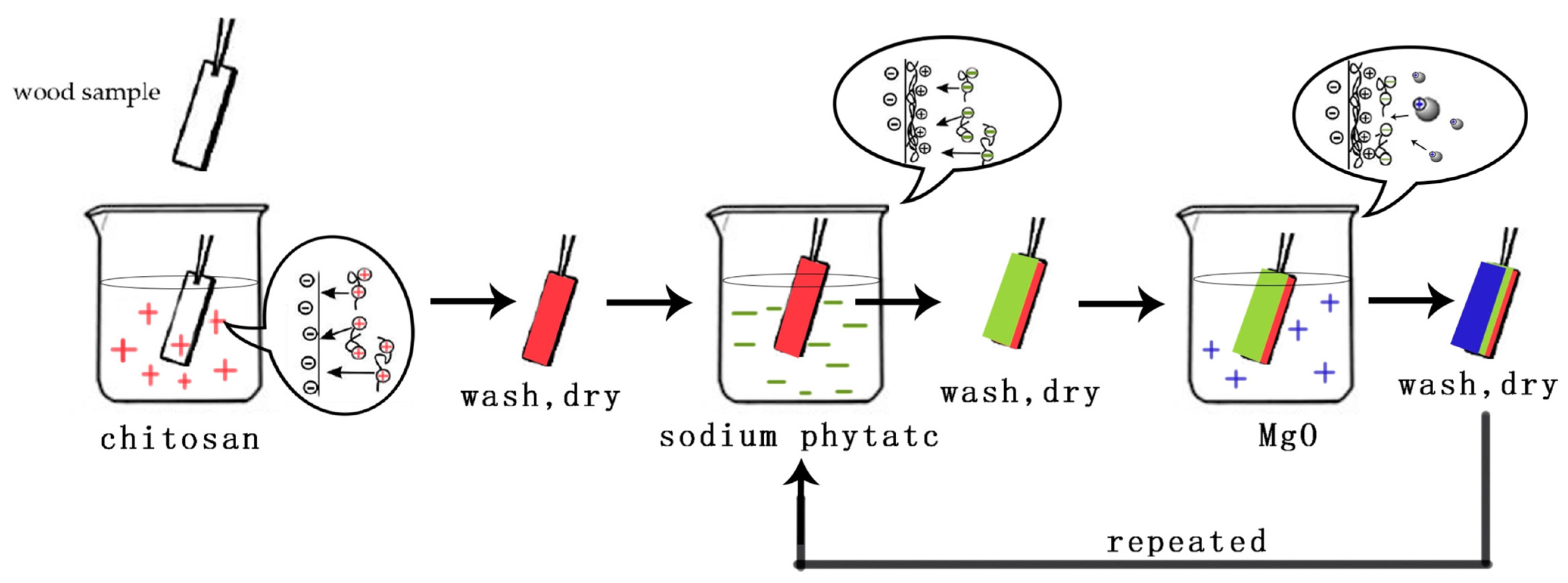
Chitosan is a bio-based polysaccharide derived from chitin (fibrous polysaccharide derived from the exoskeleton of arthropods) that exhibits potential as a lignocellulosic material protectant in terms of both fire retardancy and resistance against fungal degradation. Its multifunctional protective properties arise from its chemical structure and ability to interact with different functional groups present in biomaterials. As a fire retardant, chitosan serves as a carbon source in intumescent systems, facilitating the formation of a thermally stable char layer upon exposure to heat or flame. The formed char acts as a physical barrier, impeding the transfer of heat and oxygen to the underlying structure, leading to delayed ignition and reduced flammability. For example, chitosan-based coatings modified with phytic acid or combined with nanoparticles such as MgO or metal phosphates have shown improvements in fire protection for textiles, wood, and polymeric foams by elevating the LOI and prolonging the self-extinguishing properties in combustion tests. Recent studies reported LOI values of over 30% for multilayered chitosan/sodium phytate/MgO-coated wood exhibiting uniform coating morphology and notable char formation [198]. Chitosan-phytic acid composites are also used in self-powered fire safety technologies, such as active components in triboelectric nanogenerators for fire alarm systems [199]. Apart from fire protection, the role of chitosan as an antifungal agent is supported by its biocidal activity, which disrupts fungal cell wall synthesis and membrane integrity through polycationic interactions, particularly if combined with other components [200]. These properties are further improved when chitosan is applied as a bioactive surface coating or integrated into composites, making it an effective barrier against a wide variety of microorganisms, not just fungi but also bacteria [201]. The fungicidal mechanisms, while complex, rely on the ability of amine groups present in chitosan to interact electrostatically with negatively charged components of fungal cell walls, thereby inhibiting spore germination and mycelial proliferation. Moreover, layer-by-layer (LbL) assembly techniques and chemical cross-linking strategies involving PA can stabilize chitosan on different material surfaces (Figure 9), further enhancing durability against biological attack [198,202]. In comparison, other bio-based protectants, such as sodium alginate, phytic acid, and proteins like casein, are advantageous in forming protective films or chars under heat exposure, but chitosan is distinguished by its strong film-forming ability, high cationic charge, and lower toxicity profile. Composite systems, such as ternary complexes combining chitosan, graphene oxide, and ammonium polyphosphate, resulted in improvements in fire retardancy of lignocellulosic materials [203]. Table 1 shows a summary of the bioinspired modification strategies discussed in this review, highlighting their primary functions, current applications, property improvements, and limitations.

9. Synergistic Approaches and Treatment Permanence

Synergistic bioinspired strategies combine multiple protective mechanisms to create materials with dual protection against biotic and abiotic factors. A good example of this synergy is an in situ formation of insoluble metal phytates within the wood structure. This can be achieved via a two-step process. First, the wood is impregnated with a solution of a multivalent metal salt, such as CuCl2 and FeCl3, followed by impregnation with a phytic acid solution. The two precursors react within the wood to form a stable, water-insoluble metal phytate precipitate [182]. This approach simultaneously utilizes the fungal inhibition of chelation, the condensed-phase and gas-phase fire retardancy of the phosphate groups, and the charring and graphitization effects of the trapped metal ions, resulting in a biomaterial with high fire resistance and durability. Next, the LbL self-assembly strategy allows for the formation of highly ordered, multifunctional nanocoating on wood surfaces. By alternately exposing the wood to solutions of positively and negatively charged molecules, a multilayered film coating can be produced. For example, a coating can be assembled using positively charged chitosan (a biopolymer derived from chitin) and negatively charged sodium phytate. This creates a system consisting of P-N charring agents, which can be further improved by incorporating a layer of negatively charged inorganic nanoparticles, such as a mixture of TiO2 and ZnO [204]. Lastly, the protein–mineral–biocide systems approach combines protein-based fixation with the biocidal activity of metal ions. For example, proteins from organic waste streams like okara, a byproduct of tofu production, can be utilized to chelate metal ions like copper and boron within the wood matrix. The protein acts as a natural binder, forming water-insoluble complexes that reduce the leaching of the copper and boron biocides; therefore, it creates a more durable and environmentally stable wood preservative [205]. The durable heartwood does not rely on a single protective compound but rather on a natural defense system, including physical barriers like tyloses that block vessels and a cocktail of extractives, metal chelators, and antioxidants, to combat stressors. Biomimicking the ability of heartwood chemical components to resist both biotic and abiotic stress is a good starting point in developing research focusing on the production of sustainable biomaterials with fire and fungal resistance [22].
There is also an opportunity to develop a wood protection system that works well with both cellulose- and lignin-based nanomaterials. CNCs and CNFs enhance structural integrity and establish thermal barriers by charring in the condensed phase. LNPs possess aromatic rings that offer stability against chemicals and light. A coating composed only of cellulose nanoparticles may exhibit some form of fire resistance, but it will remain susceptible to prolonged UV degradation, compromising the char-forming layer prior to any fire occurrence. On the other hand, a coating composed solely of LNP would protect the surface from UV and microbial activity. However, it would lack the much better insulating capabilities of nanocellulose char. A strategy mimicking nature involves the development of a hybrid nanocoating that integrates both CNC, CNF, and LNP. The LNPs might be incorporated into the outermost layer, functioning as a barrier that absorbs UV radiation and quenches free radicals. This would help protect the CNC polymeric network. In the event of a fire, the LNPs would facilitate char formation, while the protected and intact CNC polymeric network would subsequently serve as the primary, high-performance insulating thermal barrier. This strategy resembles the functional synergy present in wood, wherein lignin primarily serves to protect the cellulose structures from both biotic and abiotic threats.
Beyond in situ precipitation and LbL assembly, the idea of permanence in outdoor, real world wood protection is increasingly being pursued through covalently attaching active components to the cell wall, creating hydrophobic, crosslinked networks within the near surface wood structure, and designing coatings that can self-replenish (self-healing) under weathering [206,207]. First, covalent attachment is being explored to reduce leaching and keep functionality after wet-dry cycling, which is a major failure mode for many bio-based protectants. Specific examples include enzyme-enabled grafting through oxidative enzymes to graft phenolics/lignin-like moieties to wood components as a way to build more permanent bonds [208]. A related study utilizes catechol-inspired chemistry (dopamine/polydopamine as an adhesive primer) as a reactive interlayer to subsequently bind or grow additional functional coatings more effectively than physical adsorption [209]. Second, organic–inorganic hybrid strategies, such as silane coupling and silica-like sol–gel networks, are explored to create moisture-resistant, abrasion-tolerant interphases that are difficult to leach out. These approaches aim to create a mineral (organosilicon) network that is attached to hydroxyl groups in wood polymers. Next, instead of relying on surface treatments, researchers explore impregnation approaches that place precursors into the lumina and the cell wall, followed by polymerization/crosslinking to lock the treatment in place. This internalized coating strategy improves durability because weathering removes material from the outside inward. If the functionality extends into the subsurface, then protection can persist even after surface erosion [207]. Another distinct bioinspired route is to design coatings that can recover from cracking and erosion. A good example of this is described in a research study utilizing a biofinish coating system with proposed dual self-healing mechanisms: (1) migration of non-polymerized oil that later polymerizes in cracks and (2) localized growth that covers the damaged spots [206]. Lastly, there is growing interest in using heartwood extractives (or analogous natural products) as protectants, but a recurring limitation is that protection may not be permanent because some extractives are water-soluble and can be leached, and UV can degrade lignin. As a result, recent experiments pairs active components in extractives through fixation, such as covalent binding, microencapsulation, or integration into a more durable matrix, so that bioactivity is retained after leaching and weathering [210].

10. Research Gaps, Challenges, Recommendations, and Future Outlook

Despite the promise of bioinspired and nanomaterial-based strategies for improving the fire and fungal properties of lignocellulosic biomaterials, challenges remain in translating laboratory findings into commercially viable products and widespread adoption. One such challenge that lies in the development of advanced materials is the difficulty of scaling up. Many of the bio-based treatments described in this review have been demonstrated with success at the laboratory scale, but their transition to industrial production faces several challenges, such as manufacturing process limitations and overall cost [211,212]. Traditional wood treatment often involves simple, high-throughput processes, such as dip-treating or single-cycle pressure impregnation. In contrast, most bioinspired strategies, such as multi-cycle mineralization or layer-by-layer assembly, involve complicated and mostly time-consuming stages that require specialized equipment, such as high-pressure reactors and vacuum systems, and precise control over reaction conditions (temperature and pH). This complexity leads to higher capital and operational costs, making the final product less competitive than traditionally treated wood. However, bioinspired processing methods are being explored. A good example is the development of a “self-flowing” treatment process that mimics the natural capillary transport of liquids in trees, exhibiting highly uniform chemical distribution without the need for costly pressure equipment and offering a low-cost and scalable alternative [213]. While many of the base materials are derived from abundant and low-cost lignocellulosic biomass feedstocks like wood/forestry waste (for CNC/CNF and LNP), agricultural byproducts (for proteins), and minerals (for CaCO3), the extraction, purification, and processing required to produce high-performance and advanced materials can be expensive. The cost of purified enzymes, specialty proteins, or high-purity, monodisperse nanoparticles can be prohibitive for bulk applications like construction materials [214,215,216].
Long-term performance under real-world scenarios is an important consideration, and several challenges require further investigation, including leaching, toxicity, and environmental fate. Leaching is arguably the single greatest concern when it comes to the widespread adoption of many waterborne bioinspired treatments. Unlike traditional chemical preservatives like CCA, which undergo fixation reactions to render them insoluble, many bio-based compounds (polyphenols, tannins, and caffeine) and even some mineral precursors are water-soluble and readily leach out when the wood is exposed to moisture [22]. This reduces the protective effect of treatment over time and also leads to the release of these chemicals into the environment. This highlights an important consideration for addressing research gaps: bio-inspired treatments must be engineered and designed for permanence and longevity. The most successful strategies are those facilitating in situ solubilization reactions, wherein the soluble precursors are first impregnated deep into the wood structure and then triggered by a second chemical, a change in pH, or heat to form stable and insoluble precipitates that are physically and chemically locked within the wood matrix [62]. The ecotoxicity of any new treatment must also be rigorously evaluated. Studies have shown that some natural compounds, such as tannins, exhibit toxicity to aquatic organisms [217]. A comprehensive life-cycle assessment (LCA) is necessary to ensure that a new treatment strategy offers environmental benefit over its lifespan, from raw material sourcing to disposal. Lastly, the increasing use of nanomaterials technology in wood preservation introduces a new set of environmental and health considerations. While nanoparticles offer key advantages in terms of penetration and reactivity (particle size, porosity, surface area), their long-term fate in the environment and even in humans is not yet fully understood [218,219,220]. There are concerns that nanoparticles could be released from treated wood during its service life through mechanical abrasion or at its end-of-life during sawing, sanding, or combustion [221,222,223]. The released nanoparticles could pose as inhalation particulates that could be detrimental to humans or accumulate in the environment. Insufficient research exists on the nanotoxicity of many of these materials and their behavior during disposal, representing a research gap that must be addressed [224]. In addition to performance improvements, nanomaterial-treated wood and wood-based products, along with bioinspired hybrid treatments need to be carefully thought out in terms of product protection and maintenance. Some of the most important unknowns are whether nanoparticles will be released during machining or weathering, what will happen to treatment components during service life and end-of-life stages of the treated products, and how these exposures will affect changing nanomaterial risk assessment practices and regulatory expectations. Life cycle assessments, risk assessments, technical tools, and biological models are some of the strategies and initiatives that can be used to create regulatory frameworks [225]. Despite the presence of a regulatory framework and legislation in numerous countries, there remains a necessity for more stringent and explicit standards for the management of hazardous materials [226].
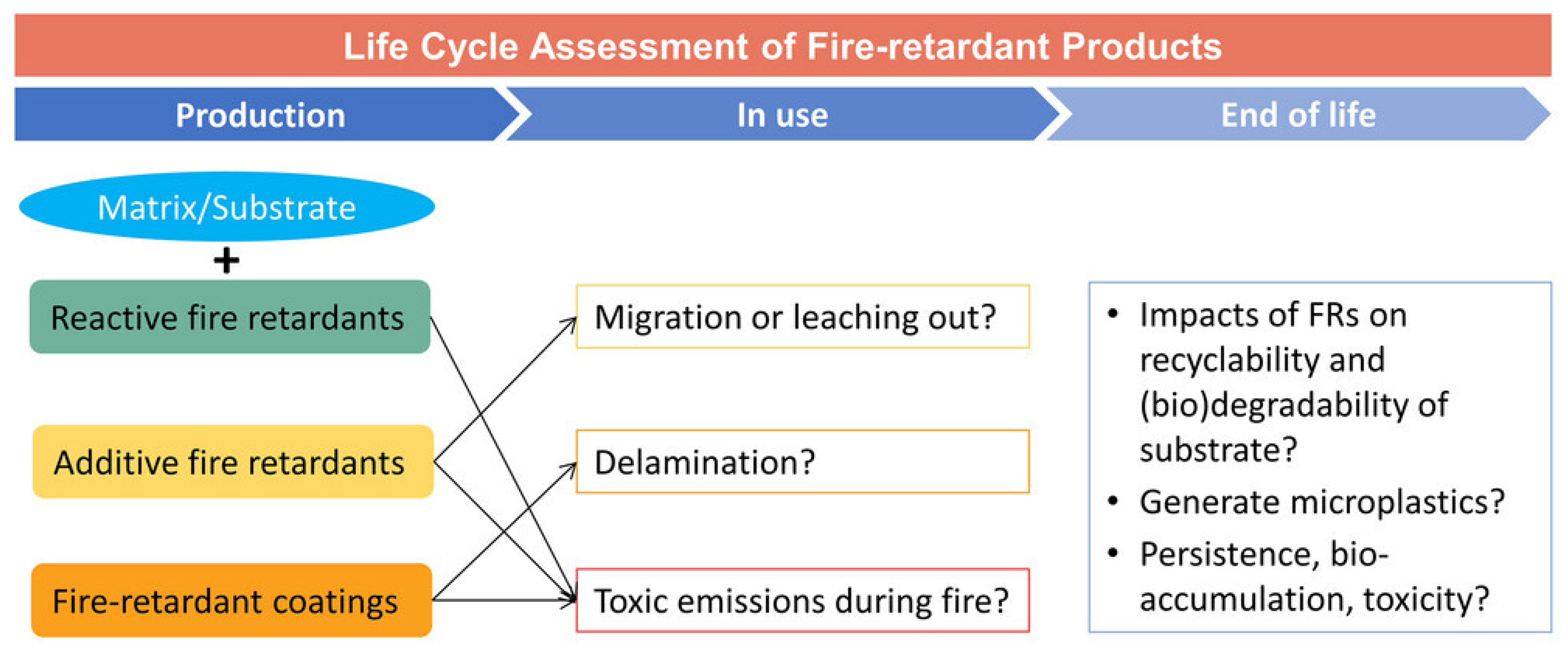
In order to support credible sustainability claims and guide scale-up processes, future studies should integrate LCA using a functional unit linked to the improvements guaranteed by the treatment, such as unit area of treated wood achieving a defined and acceptable fire and fungal durability performance over its service life, rather than reporting impacts only per unit mass of treatment chemical. This is particularly important for fire-retardant and durability treatments where loading, retreatment frequency, and outdoor exposure can dominate life-cycle impacts. For comparing different treatment strategies, an LCA reporting template should state: (1) cradle-to-grave lifecycle (precursors, treatment application, energy/water/solvent inputs, maintenance or retreatment, and end-of-life); (2) allocation (for biologically derived minerals or industrial waste/byproducts as precursor materials); and (3) impact categories (human health and environmental impacts, particularly for treatments intended to replace traditional leachable biocides or halogenated flame retardants) [227]. While available LCA studies directly on in-wood mineralization/silicification remain limited, related LCA evidence from research studies on mineral substitution with flame-retardant properties shows that replacing chemical and industrial mineral fillers with bio-based and waste-derived biomineral resources can reduce environmental impacts under the studied assumptions. A good example for this is a study employing LCA to compare stabilized municipal solid waste fly ash against conventional alternatives reported impact reductions of 24.1% vs. calcite in epoxy and 49.5% vs. a commercial flame retardant in polypropylene, indicating a favorable route for circular mineral sourcing [228]. Figure 10 shows the LCA of hypothetical FR products, focusing on their production, issues during use, and end-of-life human health and environmental impacts.
The future outlook for bioinspired lignocellulosic bio-based material improvement lies in addressing the limitations outlined in Table 1. Primary focus should be on the design and development of treatment methods that combine multifunctional protective mechanisms. Research into hybrid mineralization, composite nanocoating, and organic acid chelation can be conducted. In the case of biomineralization, the use of proteins, peptides, or synthetic polymeric templates to guide the growth of specific crystal polymorphs and hierarchical structures could lead to materials with excellent mechanical and thermal barrier properties [229]. The development of lignocellulosic bio-based materials with “smart” functionalities also represents an exciting future direction [5,230,231,232]. This could include materials with self-healing properties, such as microencapsulated active ingredients for healing that could be released upon damage or following a specific physiological condition; self-cleaning superhydrophobic surfaces; and stimuli-responsive materials that adapt to environmental changes, like coatings that change their porosity or hydrophobicity in response to humidity [233,234].
The strategies discussed in this review demonstrate laboratory-scale effectiveness but their commercial viability varies significantly. Direct mineralization strategies, such as calcification and silicification, present the most immediate path to industrial adoption. These strategies utilize abundant, low-cost inorganic precursors and can be implemented using the existing vacuum-pressure impregnation facilities existing in the wood preservation industry. In contrast, nanotechnology-based strategies face economic challenges, particularly the development of cellulosic nanomaterials and lignin nanoparticles. Although the nanomaterials provide higher specific surface area, reactivity, and performance improvements, the energy-intensive processes required for extraction and purification result in high overall material costs. Therefore, these nanomaterials are currently best suited for high-value surface coatings rather than bulk impregnation. The development of self-flowing treatments that mimic natural capillary transport offers a promising strategy to reduce processing costs by eliminating the need for costly high-pressure equipment. The utilization of lignocellulosic biomass, agricultural waste, and wood industry byproducts could also lead to lower costs, overcoming the economic challenges of scalability for industrial production. Lastly, flame-retardant surface treatments are attractive for near-term adoption because they can be applied late in the material development process. This treatment strategy can be optimized for application-specific performance, although long-term outdoor durability remains an important limitation that needs to be addressed.

11. Conclusions

This review comprehensively explored the potential of bioinspired strategies in developing lignocellulosic bio-based materials that are more sustainable, durable, and thermally stable. Traditional chemical preservatives, especially those that employ heavy metals, halogenated fire retardants, or potent biocides, have been in use for many years, but they raise serious environmental and human health concerns due to their toxicity and leachability. The strategies presented in this review are inspired by naturally mineralized structures, plant chemical defenses, and hierarchical biopolymer assemblies in improving the properties of lignocellulosic bio-based materials. This was partly due to the increasing interest in materials research toward bioinspired design and intrinsic functionality.
Mineralization and biomineralization processes demonstrate the potential for developing hybrid organic–inorganic structures that enhance fire resistance and mechanical properties. They also provide active FR effects in both the condensed and gas phases, while silicification adds hydrophobicity and leads to rigid structures. Even though there are differences in the processes involved, both strategies utilize the cell wall to act as a scaffold for the nucleation and growth of protective minerals. Biomineralization is still a new idea in the context of wood protection, but it could lead to low-energy and biologically guided processing that could benefit the materials industry. CNC, CNF, and LNP are examples of nanostructured lignocellulosic materials that demonstrate the potential of biopolymers to make coatings or biocomposites with tunable properties. CNC and CNF facilitate char formation and serve as thermal insulators, while LNP exhibit antioxidative properties that could protect against UV and weathering. Protein-based strategies demonstrate that biochemical specificity can be leveraged to impart antimicrobial properties. Protein-templated mineralization and ε-poly-L-lysine treatments reveal that biological macromolecules have the ability to specifically guide crystal growth and inhibit metabolism. Chelators halt the Fenton-based oxidative pathway that cause brown-rot decay by trapping metal ions required in their metabolism. Organic acids like citric and tartaric acid can also facilitate chelation through crosslinking, imparting bio-based materials with increased water resistance, mechanical properties, thermal stability, and resistance to decay.
Developing strategies with synergistic effects must be employed. This can be achieved through the combination of the different bio-based strategies, such as hybrid (organic–inorganic) mineralization, CNC, CNF, and LNP-based coatings, protein–mineral biocomposites, or chelated metal treatments. These methods are similar to the multifunctional defense mechanisms found in nature, where chemical, physical, and oxidative barriers work together. LCA, risk assessments, and biological models are strategies that could be employed in the future to facilitate the development of regulatory frameworks and more environmentally friendly treatment alternatives. Overall, bioinspired strategies to improve lignocellulosic bio-based materials are a groundbreaking research area and full of potential. These strategies could change the way wood, biocomposites, and natural fibers are protected against fire and fungi as research studies continue to improve their performance and compatibility.

Author Contributions

Conceptualization, J.V.T.; methodology, J.V.T.; validation, J.V.T. and A.G.M.; writing—original draft preparation, J.V.T. and A.G.M.; writing—review and editing, J.V.T. and A.G.M.; visualization, J.V.T.; supervision, A.G.M.; project administration, A.G.M. All authors have read and agreed to the published version of the manuscript.

Funding

This research was funded by University of Idaho P3R1 matching grant.

Institutional Review Board Statement

Not applicable.

Informed Consent Statement

Not applicable.

Data Availability Statement

No new data created in this review. All information is included in the review paper.

Conflicts of Interest

The authors declare no conflicts of interest.

Abbreviations

The following abbreviations are used in this manuscript:
CACitric acid
CCAChromated copper arsenate
CNCCellulose nanocrystal
CNFCellulose nanofibril
CMFChelator-mediated Fenton
DMCDimethyl carbonate
EGExpanded graphite
ε-PLε-poly-L-lysine
EPSExtracellular polymeric substances
FRFlame retardant
HRRHeat release rate
LbLLayer-by-layer (assembly)
LCALife cycle assessment
LNPLignin nanoparticle
LOILimiting oxygen index
MICMinimal inhibitory concentration
MICPMicrobially induced calcium precipitation
PAPhytic acid
PFPhenol-formaldehyde
PHRRPeak heat release rate
P-NPhosphorus–Nitrogen
SEMScanning electron microscopy
SPFSun protection factor
TATartaric acid
TEOSTetraethoxysilane
THRTotal heat release
TSPTotal smoke production
UFUrea-Formaldehyde
UL-94Underwriters Laboratories-94 Burning Test
UVUltraviolet

References

  1. Dong, J.; Kim, D.; Yoo, C.G. Editorial: Biochemical/Biomaterial Production from Lignocellulosic Biomass. Front. Chem. Eng. 2023, 5, 1266904. [Google Scholar] [CrossRef]
  2. Borrero-López, A.M.; Valencia, C.; Franco, J.M. Lignocellulosic Materials for the Production of Biofuels, Biochemicals and Biomaterials and Applications of Lignocellulose-Based Polyurethanes: A Review. Polymers 2022, 14, 881. [Google Scholar] [CrossRef]
  3. Tongco, J.V. Lignocellulosic Biomass as Feedstock for Paper and Packaging Applications. In Polymers and Composite Materials for Packaging: Smart Food Packaging and Solutions; Verma, A., Gupta, H.S., Sethi, S.K., Eds.; Springer Nature: Singapore, 2025; pp. 323–335. ISBN 978-981-95-0677-4. [Google Scholar]
  4. Aguda, R.; Pamplona, R.; Jeuck, B.; Tongco, J.V. Circular Bioeconomy in the Packaging Industry Utilizing Coconut Processing Waste and By-Products. In Polymers and Composite Materials for Packaging: Smart Food Packaging and Solutions; Verma, A., Gupta, H.S., Sethi, S.K., Eds.; Springer Nature: Singapore, 2025; pp. 355–373. ISBN 978-981-95-0677-4. [Google Scholar]
  5. Ewurum, N.; Yusuf, S.B.; Appiah, H.; Tongco, J.V. Lignin-Based Biocomposites for Smart and Sustainable Food Packaging. In Polymers and Composite Materials for Packaging: Smart Food Packaging and Solutions; Verma, A., Gupta, H.S., Sethi, S.K., Eds.; Springer Nature: Singapore, 2025; pp. 273–296. ISBN 978-981-95-0677-4. [Google Scholar]
  6. Woźniak, A.; Kuligowski, K.; Świerczek, L.; Cenian, A. Review of Lignocellulosic Biomass Pretreatment Using Physical, Thermal and Chemical Methods for Higher Yields in Bioethanol Production. Sustainability 2025, 17, 287. [Google Scholar] [CrossRef]
  7. Tripathi, N.; Hills, C.D.; Singh, R.S.; Atkinson, C.J. Biomass Waste Utilisation in Low-Carbon Products: Harnessing a Major Potential Resource. NPJ Clim. Atmos. Sci. 2019, 2, 35. [Google Scholar] [CrossRef]
  8. Kamdem Tamo, A.; Doench, I.; Deffo, G.; Zambou Jiokeng, S.L.; Doungmo, G.; Fotsop, C.G.; Tonleu Temgoua, R.C.; Montembault, A.; Serghei, A.; Njanja, E.; et al. Lignocellulosic Biomass and Its Main Structural Polymers as Sustainable Materials for (Bio)Sensing Applications. J. Mater. Chem. A Mater. 2025, 13, 24185–24253. [Google Scholar] [CrossRef]
  9. Dey, N.; Bhardwaj, S.; Maji, P.K. Recent Breakthroughs in the Valorization of Lignocellulosic Biomass for Advancements in the Construction Industry: A Review. RSC Sustain. 2025, 3, 3307–3357. [Google Scholar] [CrossRef]
  10. Xu, Y.J.; Zhang, K.T.; Wang, J.R.; Wang, Y.Z. Biopolymer-Based Flame Retardants and Flame-Retardant Materials. Adv. Mater. 2025, 37, 2414880. [Google Scholar] [CrossRef] [PubMed]
  11. Wan, C.; Li, Y. Fungal Pretreatment of Lignocellulosic Biomass. Biotechnol. Adv. 2012, 30, 1447–1457. [Google Scholar] [CrossRef]
  12. Schrader, L.; Brischke, C.; Trautner, J.; Tebbe, C.C. Microbial Decay of Wooden Structures: Actors, Activities and Means of Protection. Appl. Microbiol. Biotechnol. 2025, 109, 59. [Google Scholar] [CrossRef]
  13. Yin, K.; Liu, M.; Shao, Z.; Chen, C.; Wu, W.; Tan, Y.; Wei, C.; Ma, X.; Dang, B.; Sun, Q. Enhancing Flame Retardancy and Smoke Suppression of Lignocellulose through Modification with Green Aqueous Flame Retardants. Ind. Crops Prod. 2025, 225, 120493. [Google Scholar] [CrossRef]
  14. Khademibami, L.; Bobadilha, G.S. Recent Developments Studies on Wood Protection Research in Academia: A Review. Front. For. Glob. Change 2022, 5, 793177. [Google Scholar] [CrossRef]
  15. Rajput, H.; Rajan, P.; Li, S.; Stratton, G.W.; Murray, G.; He, Q. Development of Wood Preservatives to Prevent Biodeterioration. J. Wood Chem. Technol. 2023, 43, 371–389. [Google Scholar] [CrossRef]
  16. Miranji, E.K.; Kipkemboi, P.K.; Kibet, J.K. A Review of Toxic Metals and Hazardous Organics in Wood Treatment Sites and Their Etiological Implications. J. Chem. Rev. 2022, 4, 40–66. [Google Scholar] [CrossRef]
  17. Townsend, T.; Solo-Gabriele, H.; Tolaymat, T.; Stook, K.; Hosein, N. Chromium, Copper, and Arsenic Concentrations in Soil Underneath CCA-Treated Wood Structures. Soil Sediment Contam. 2003, 12, 779–798. [Google Scholar] [CrossRef]
  18. Shaw, S.D.; Blum, A.; Weber, R.; Kannan, K.; Rich, D.; Lucas, D.; Koshland, C.P.; Dobraca, D.; Hanson, S.; Birnbaum, L.S. Halogenated Flame Retardants: Do the Fire Safety Benefits Justify the Risks? Rev. Environ. Health 2010, 25, 261–305. [Google Scholar] [CrossRef] [PubMed]
  19. Li, Y.; Li, T.; Zhao, M.; Meng, X. The Degradation Mechanism Induced by Synergistic Salt Accumulation and Acid Hydrolysis on the Ancient Wood of Feiyun Pavilion. Int. J. Archit. Herit. 2025, 1–14. [Google Scholar] [CrossRef]
  20. Zhou, J.; Tian, Q.; Nie, J.; Cao, P.; Tan, Z. Mechanical Properties and Damage Mechanisms of Woods under Extreme Environmental Conditions. Case Stud. Constr. Mater. 2024, 20, e03146. [Google Scholar] [CrossRef]
  21. Hernandez, V.A.; Ovalle, C.; Fuentes, S.; Núñez-Decap, M. CaCO3 Radiata Pine Wood Mineralization: Weathering and Mold Resistance, and Effect on Mechanical and Adhesion Properties. Forests 2025, 16, 233. [Google Scholar] [CrossRef]
  22. González-Laredo, R.F.; Rosales-Castro, M.; Rocha-Guzmán, N.E.; Gallegos-Infante, J.A.; Moreno-Jiménez, M.R.; Karchesy, J. Wood Preservation Using Natural Products. Madera Bosques 2015, 21, 63–76. [Google Scholar]
  23. Barthlott, W.; Mail, M.; Neinhuis, C. Superhydrophobic Hierarchically Structured Surfaces in Biology: Evolution, Structural Principles and Biomimetic Applications. Philos. Trans. R. Soc. A Math. Phys. Eng. Sci. 2016, 374, 20160191. [Google Scholar] [CrossRef]
  24. Bhushan, B. Bioinspired Materials and Surfaces for Green Science and Technology. Philos. Trans. R. Soc. A Math. Phys. Eng. Sci. 2019, 377, 20180336. [Google Scholar] [CrossRef]
  25. Ma, Z.; Li, B.; Tang, R. Biomineralization: Biomimetic Synthesis of Materials and Biomimetic Regulation of Organisms. Chin. J. Chem. 2021, 39, 2071–2082. [Google Scholar] [CrossRef]
  26. Nudelman, F.; Sommerdijk, N.A.J.M. Biomineralization as an Inspiration for Materials Chemistry. Angew. Chem. 2012, 51, 6582–6596. [Google Scholar] [CrossRef]
  27. Yao, S.; Jin, B.; Liu, Z.; Shao, C.; Zhao, R.; Wang, X.; Tang, R. Biomineralization: From Material Tactics to Biological Strategy. Adv. Mater. 2017, 29, 1605903. [Google Scholar] [CrossRef] [PubMed]
  28. Guo, J.; Gao, F.; Zhang, F.; Zhao, X.; Zhao, R. Biomineralization-Driven Advances in Materials Science and Biomedical Engineering. JACS Au 2025, 5, 4134–4154. [Google Scholar] [CrossRef] [PubMed]
  29. Merk, V.; Chanana, M.; Gierlinger, N.; Hirt, A.M.; Burgert, I. Hybrid Wood Materials with Magnetic Anisotropy Dictated by the Hierarchical Cell Structure. ACS Appl. Mater. Interfaces 2014, 6, 9760–9767. [Google Scholar] [CrossRef]
  30. Merk, V.; Chanana, M.; Keplinger, T.; Gaan, S.; Burgert, I. Hybrid Wood Materials with Improved Fire Retardance by Bio-Inspired Mineralisation on the Nano- and Submicron Level. Green Chem. 2015, 17, 1423–1428. [Google Scholar] [CrossRef]
  31. Kalia, S.; Thakur, K.; Kumar, A.; Celli, A. Laccase-Assisted Surface Functionalization of Lignocellulosics. J. Mol. Catal. B Enzym. 2014, 102, 48–58. [Google Scholar] [CrossRef]
  32. Chauhan, P.S. Lignin Nanoparticles: Eco-Friendly and Versatile Tool for New Era. Bioresour. Technol. Rep. 2020, 9, 100374. [Google Scholar] [CrossRef]
  33. Sienkiewicz, N.; Buultjens, T.E.J.; White, N.A.; Palfreyman, J.W. Serpula Lacrymans and the Heat-Shock Response. Int. Biodeterior. Biodegrad. 1997, 39, 217–224. [Google Scholar] [CrossRef]
  34. Martín, J.A.; López, R. Biological Deterioration and Natural Durability of Wood in Europe. Forests 2023, 14, 283. [Google Scholar] [CrossRef]
  35. Brischke, C.; Alfredsen, G. Wood-Water Relationships and Their Role for Wood Susceptibility to Fungal Decay. Appl. Microbiol. Biotechnol. 2020, 104, 3781–3795. [Google Scholar] [CrossRef] [PubMed]
  36. Tongco, J.V.; Cai, L. Durability and Thermal Properties of Biomineralized Southern Yellow Pine (SYP) via Bacterium Sporosarcina Pasteurii. In 120th Annual Meeting of the American Wood Protection Association, Portland, ME, USA, 1 May 2024; American Wood Protection Association: Clermont, FL, USA, 2024; pp. 1–8. [Google Scholar]
  37. Karthäuser, J.; Treu, A.; Larnøy, E.; Militz, H.; Alfredsen, G. Fungal Decay Resistance, Formaldehyde Emission and Weathering Resistance of Plywood Modified with Phenol-Formaldehyde Resin with Partial Substitution of Phenol by Pyrolysis Cleavage Products of Softwood Kraft Lignin. Eur. J. Wood Wood Prod. 2025, 83, 138. [Google Scholar] [CrossRef]
  38. Altgen, M.; Kyyrö, S.; Paajanen, O.; Rautkari, L. Resistance of Thermally Modified and Pressurized Hot Water Extracted Scots Pine Sapwood against Decay by the Brown-Rot Fungus Rhodonia Placenta. Eur. J. Wood Wood Prod. 2019, 78, 161–171. [Google Scholar] [CrossRef]
  39. Binbuga, N.; Chambers, K.; Henry, W.P.; Schultz, T.P. Metal Chelation Studies Relevant to Wood Preservation. 1. Complexation of Propyl Gallate with Fe2+. Holzforschung 2005, 59, 205–209. [Google Scholar] [CrossRef]
  40. Karim, M.; Daryaei, M.G.; Torkaman, J.; Oladi, R.; Ghanbary, M.A.T.; Bari, E.; Yilgor, N. Natural Decomposition of Hornbeam Wood Decayed by the White Rot Fungus Trametes Versicolor. Acad. Bras. Cienc. 2017, 89, 2647–2655. [Google Scholar] [CrossRef]
  41. Bari, E.; Nazarnezhad, N.; Kazemi, S.M.; Tajick Ghanbary, M.A.; Mohebby, B.; Schmidt, O.; Clausen, C.A. Comparison between Degradation Capabilities of the White Rot Fungi Pleurotus Ostreatus and Trametes Versicolor in Beech Wood. Int. Biodeterior. Biodegrad. 2015, 104, 231–237. [Google Scholar] [CrossRef]
  42. Qin, X.; Su, X.; Luo, H.; Ma, R.; Yao, B.; Ma, F. Deciphering Lignocellulose Deconstruction by the White Rot Fungus Irpex Lacteus Based on Genomic and Transcriptomic Analyses. Biotechnol. Biofuels 2018, 11, 58. [Google Scholar] [CrossRef]
  43. Bao, M.; Zhang, W.; He, L.; Bao, Y.; Wu, Z.; Yu, W.; Chen, Y.; Li, N. Changes in Chemical Composition, Crystallinity, and Microstructure of Wood Fiber Mat-Reinforced Composite Caused by White-Rot Fungus Trametes Versicolor and Brown-Rot Fungus Gloeophyllum Trabeum. Wood Mater. Sci. Eng. 2023, 18, 1715–1723. [Google Scholar] [CrossRef]
  44. Li, X.; Han, C.; Li, W.; Chen, G.; Wang, L. Insights into the Cellulose Degradation Mechanism of the Thermophilic Fungus Chaetomium Thermophilum Based on Integrated Functional Omics. Biotechnol. Biofuels 2020, 13, 143. [Google Scholar] [CrossRef] [PubMed]
  45. Popescu, C.-M.; Tibirna, C.M.; Manoliu, A.L.; Gradinariu, P.; Vasile, C. Microscopic Study of Lime Wood Decayed by Chaetomium Globosum. Cellul. Chem. Technol. 2011, 45, 565–569. [Google Scholar]
  46. Caizán Juanarena, L.; Ter Heijne, A.; Buisman, C.J.N.; Van der Wal, A. Wood Degradation by Thermotolerant and Thermophilic Fungi for Sustainable Heat Production. ACS Sustain. Chem. Eng. 2016, 4, 6355–6361. [Google Scholar] [CrossRef]
  47. Dietenberger, M. Update for Combustion Properties of Wood Components. Fire Mater. 2002, 26, 255–267. [Google Scholar] [CrossRef]
  48. Laoutid, F.; Bonnaud, L.; Alexandre, M.; Lopez-Cuesta, J.M.; Dubois, P. New Prospects in Flame Retardant Polymer Materials: From Fundamentals to Nanocomposites. Mater. Sci. Eng. R Rep. 2009, 63, 100–125. [Google Scholar] [CrossRef]
  49. Bouhamida, B.; Merzoug, A.; Sereir, Z.; Kilic, A.; Candan, Z. Chemical, Thermal, and Morphological Properties of Sustainable Lignocellulosic Biomaterial. Drv. Ind. 2024, 75, 431–440. [Google Scholar] [CrossRef]
  50. Jin, W.; Singh, K.; Zondlo, J. Pyrolysis Kinetics of Physical Components of Wood and Wood-Polymers Using Isoconversion Method. Agriculture 2013, 3, 12–32. [Google Scholar] [CrossRef]
  51. Sotoudehnia, F.; McDonald, A.G. Upgrading Mixed Agricultural Plastic and Lignocellulosic Waste to Liquid Fuels by Catalytic Pyrolysis. Catalysts 2022, 12, 1381. [Google Scholar] [CrossRef]
  52. Bonjour, P.V.B.; Alijó, P.H.R.; Paredes, M.L.L. Valorization of Lignocellulosic Biomass via Pyrolysis: Techno-Economic Analysis of Guaiacol and Levoglucosan Co-Production. Biomass Bioenergy 2025, 203, 108227. [Google Scholar] [CrossRef]
  53. Wang, S.; Liu, Q.; Luo, Z.; Wen, L.; Cen, K. Mechanism Study on Cellulose Pyrolysis Using Thermogravimetric Analysis Coupled with Infrared Spectroscopy. Front. Energy Power Eng. China 2007, 1, 413–419. [Google Scholar] [CrossRef]
  54. Recio-Ruiz, M.d.C.; Ruiz-Rosas, R.; García-Mateos, F.J.; Valero-Romero, M.J.; Rosas, J.M.; Rodríguez-Mirasol, J.; Cordero, T. An Integrated Approach to the Valorization of Pyrolysis Products from Lignocellulosic Residues and By-Products. Biomass Bioenergy 2025, 196, 107676. [Google Scholar] [CrossRef]
  55. Cui, C.; Li, Y.; Wang, S.; Ren, M.; Yang, C.; Jiang, Z.; Zhang, J. Review on an Advanced Combustion Technology: Supercritical Hydrothermal Combustion. Appl. Sci. 2020, 10, 1645. [Google Scholar] [CrossRef]
  56. Jerzak, W.; Kuźnia, M. Examination of Inorganic Gaseous Species and Condensed Phases during Coconut Husk Combustion Based on Thermodynamic Equilibrium Predictions. Renew. Energy 2021, 167, 497–507. [Google Scholar] [CrossRef]
  57. Kuznetsov, G.V.; Syrodoy, S.V.; Kostoreva, Z.A.; Kostoreva, A.A.; Purin, M.V.; Nigay, N.A.; Zamaltdinov, R.R. Features of the Mechanism of Gas-Phase Ignition of Wood Biomass Particles. Combust. Sci. Technol. 2025, 197, 2927–2954. [Google Scholar] [CrossRef]
  58. Kweon, S.W.; Lee, Y.J.; Lee, T.J.; Kim, H.J. Preparation of Flame-Retardant Cellulose Paper via Spray Coating with Lignin, Phytic Acid, and Sodium Silicate. BioResources 2025, 20, 3808–3825. [Google Scholar] [CrossRef]
  59. Lazar, S.T.; Kolibaba, T.J.; Grunlan, J.C. Flame-Retardant Surface Treatments. Nat. Rev. Mater. 2020, 5, 259–275. [Google Scholar] [CrossRef]
  60. Patel, R.; Chaudhary, M.L.; Patel, Y.N.; Chaudhari, K.; Gupta, R.K. Fire-Resistant Coatings: Advances in Flame-Retardant Technologies, Sustainable Approaches, and Industrial Implementation. Polymers 2025, 17, 1814. [Google Scholar] [CrossRef]
  61. Goliszek-Chabros, M.; Xu, T.; Bocho-Janiszewska, A.; Podkościelna, B.; Sevastyanova, O. Lignin Nanoparticles from Softwood and Hardwood as Sustainable Additives for Broad-Spectrum Protection and Enhanced Sunscreen Performance. Wood Sci. Technol. 2025, 59, 60. [Google Scholar] [CrossRef]
  62. Moya, R.; Gaitán-Álvarez, J.; Berrocal, A.; Araya, F. Effect of CaCO3 on the Wood Properties of Tropical Hardwood Species from Fast-Growth Plantation in Costa Rica. Bioresources 2020, 15, 4802–4822. [Google Scholar] [CrossRef]
  63. Pondelak, A.; Rosi, F.; Maurich, C.; Miliani, C.; Škapin, S.D.; Sever Škapin, A. The Role of Relative Humidity on Crystallization of Calcium Carbonate from Calcium Acetoacetate Precursor. Appl. Surf. Sci. 2020, 506, 144768. [Google Scholar] [CrossRef]
  64. Vilela, C.; Freire, C.S.R.; Marques, P.A.A.P.; Trindade, T.; Pascoal Neto, C.; Fardim, P. Synthesis and Characterization of New CaCO3/Cellulose Nanocomposites Prepared by Controlled Hydrolysis of Dimethylcarbonate. Carbohydr. Polym. 2010, 79, 1150–1156. [Google Scholar] [CrossRef]
  65. Pondelak, A.; Škapin, A.S.; Knez, N.; Knez, F.; Pazlar, T. Improving the Flame Retardancy of Wood Using an Eco-Friendly Mineralisation Process. Green Chem. 2021, 23, 1130–1135. [Google Scholar] [CrossRef]
  66. Singh, N.B.; Singh, N.P. Formation of CaO from Thermal Decomposition of Calcium Carbonate in the Presence of Carboxylic Acids. J. Therm. Anal. Calorim. 2007, 89, 159–162. [Google Scholar] [CrossRef]
  67. Berglund, L.A.; Burgert, I.; Berglund, L.A.; Burgert ETH Zürich, I.; Burgert, I. Bioinspired Wood Nanotechnology for Functional Materials. Adv. Mater. 2018, 30, 1704285. [Google Scholar] [CrossRef]
  68. Merk, V.; Chanana, M.; Gaan, S.; Burgert, I. Mineralization of Wood by Calcium Carbonate Insertion for Improved Flame Retardancy. Holzforschung 2016, 70, 867–876. [Google Scholar] [CrossRef]
  69. Zhang, M.; Li, H.; Wang, C.; Wang, Z.; Liu, D.; Yang, T.; Deng, Z.; Yuan, G. Performance Enhancement of the Poplar Wood Composites Mineralized by CaCO3. ACS Omega 2022, 7, 29465. [Google Scholar] [CrossRef]
  70. Repič, R.; Pondelak, A.; Kržišnik, D.; Humar, M.; Škapin, A.S. Combining Mineralisation and Thermal Modification to Improve the Fungal Durability of Selected Wood Species. J. Clean. Prod. 2022, 351, 131530. [Google Scholar] [CrossRef]
  71. Mustoe, G.E. Silicification of Wood: An Overview. Minerals 2023, 13, 206. [Google Scholar] [CrossRef]
  72. Goetze, J.; Möckel, R.; Langhof, N.; Hengst, M.; Klinger, M. Silicification of Wood in the Laboratory. Ceram. Silik. 2008, 52, 268–277. [Google Scholar]
  73. Tu, K.; Liu, J.; Li, J.; Li, S.; Zhang, X.; Li, S. Silicified Wood with Dual Fire Retardancy and Thermal Management Functionalities. Polymers 2025, 17, 2293. [Google Scholar] [CrossRef]
  74. Doubek, S.; Borůvka, V.; Zeidler, A.; Reinprecht, L. Effect of the Passive Chemical Modification of Wood with Silicon Dioxide (Silica) on Its Properties and Inhibition of Moulds. Wood Res. 2018, 63, 599–616. [Google Scholar]
  75. Meng, D.; Wang, K.; Wang, S.; Qiu, Y.; Gu, X.; Sun, J.; Li, H.; Zhang, S. Preparation of Ultra-Flame Retardant Wood Materials with Mechanical Reinforcement and Water Resistance through Biomimetic Mineralization of Carbonated Apatite. Cellulose 2022, 30, 525–537. [Google Scholar] [CrossRef]
  76. Guo, H.; Luković, M.; Mendoza, M.; Schlepütz, C.M.; Griffa, M.; Xu, B.; Gaan, S.; Herrmann, H.; Burgert, I. Bioinspired Struvite Mineralization for Fire-Resistant Wood. ACS Appl. Mater. Interfaces 2019, 11, 5427–5434. [Google Scholar] [CrossRef]
  77. Zhou, H.; Wen, D.; Hao, X.; Chen, C.; Zhao, N.; Ou, R.; Wang, Q. Nanostructured Multifunctional Wood Hybrids Fabricated via in Situ Mineralization of Zinc Borate in Hierarchical Wood Structures. Chem. Eng. J. 2023, 451, 138308. [Google Scholar] [CrossRef]
  78. Saka, S.; Ueno, T. Several SiO2 Wood-Inorganic Composites and Their Fire-Resisting Properties. Wood Sci. Technol. 1997, 31, 457–466. [Google Scholar] [CrossRef]
  79. Hübert, T.; Unger, B.; Bücker, M. Sol-Gel Derived TiO2 Wood Composites. J. Solgel Sci. Technol. 2010, 53, 384–389. [Google Scholar] [CrossRef]
  80. Dong, A.; Wang, Y.; Tang, Y.; Ren, N.; Zhang, Y.; Yue, Y.; Gao, Z. Zeolitic Tissue Through Wood Cell Templating. Adv. Mater. 2002, 14, 926–929. [Google Scholar] [CrossRef]
  81. Tampieri, A.; Sprio, S.; Ruffini, A.; Celotti, G.; Lesci, I.G.; Roveri, N. From Wood to Bone: Multi-Step Process to Convert Wood Hierarchical Structures into Biomimetic Hydroxyapatite Scaffolds for Bone Tissue Engineering. J. Mater. Chem. 2009, 19, 4973–4980. [Google Scholar] [CrossRef]
  82. Ojha, A.; Bandyopadhyay, T.K.; Das, D.; Dey, P. Microbial Carbonate Mineralization: A Comprehensive Review of Mechanisms, Applications, and Recent Advancements. Mol. Biotechnol. 2025, 1–27. [Google Scholar] [CrossRef]
  83. Brindavathy, R. Silicate Minerals Induced by Microorganisms. In Mineral Formation by Microorganisms; Berenjian, A., Seifan, M., Eds.; Springer Nature: London, UK, 2022; pp. 125–159. ISBN 978-3-030-80807-5. [Google Scholar]
  84. Jantschke, A. Non-Silicate Minerals (Carbonates, Oxides, Phosphates, Sulfur-Containing, Oxalates, and Other Organic Crystals) Induced by Microorganisms. In Mineral Formation by Microorganisms; Berenjian, A., Seifan, M., Eds.; Springer Nature: London, UK, 2022; pp. 161–241. ISBN 978-3-030-80807-5. [Google Scholar]
  85. Kim, G.; Kim, J.; Youn, H. Effect of Temperature, PH, and Reaction Duration on Microbially Induced Calcite Precipitation. Appl. Sci. 2018, 8, 1277. [Google Scholar] [CrossRef]
  86. Castro-Alonso, M.J.; Montañez-Hernandez, L.E.; Sanchez-Muñoz, M.A.; Macias Franco, M.R.; Narayanasamy, R.; Balagurusamy, N. Microbially Induced Calcium Carbonate Precipitation (MICP) and Its Potential in Bioconcrete: Microbiological and Molecular Concepts. Front. Mater. 2019, 6, 126. [Google Scholar] [CrossRef]
  87. Han, P.P.; Geng, W.J.; Li, M.N.; Jia, S.R.; Yin, J.L.; Xue, R.Z. Improvement of Biomineralization of Sporosarcina Pasteurii as Biocementing Material for Concrete Repair by Atmospheric and Room Temperature Plasma Mutagenesis and Response Surface Methodology. J. Microbiol. Biotechnol. 2021, 31, 1311–1322. [Google Scholar] [CrossRef]
  88. Han, Z.; Wang, J.; Zhao, H.; Tucker, M.E.; Zhao, Y.; Wu, G.; Zhou, J.; Yin, J.; Zhang, H.; Zhang, X.; et al. Mechanism of Biomineralization Induced by Bacillus Subtilis J2 and Characteristics of the Biominerals. Minerals 2019, 9, 218. [Google Scholar] [CrossRef]
  89. Chen, Y.; Feng, Y.; Deveaux, J.G.; Masoud, M.A.; Chandra, F.S.; Chen, H.; Zhang, D.; Feng, L. Biomineralization Forming Process and Bio-Inspired Nanomaterials for Biomedical Application: A Review. Minerals 2019, 9, 68. [Google Scholar] [CrossRef]
  90. Benzerara, K.; Skouri-Panet, F.; Li, J.; Férard, C.; Gugger, M.; Laurent, T.; Couradeau, E.; Ragon, M.; Cosmidis, J.; Menguy, N.; et al. Intracellular Ca-Carbonate Biomineralization Is Widespread in Cyanobacteria. Proc. Natl. Acad. Sci. USA 2014, 111, 10933–10938. [Google Scholar] [CrossRef] [PubMed]
  91. Bosak, T.; Knoll, A.H.; Petroff, A.P. The Meaning of Stromatolites. Annu. Rev. Earth Planet. Sci. 2013, 41, 21–44. [Google Scholar] [CrossRef]
  92. Golubic, S.; Seong-Joo, L. Early Cyanobacterial Fossil Record: Preservation, Palaeoenvironments and Identification. Eur. J. Phycol. 2010, 34, 339–348. [Google Scholar] [CrossRef]
  93. De Wever, A.; Benzerara, K.; Coutaud, M.; Caumes, G.; Poinsot, M.; Skouri-Panet, F.; Laurent, T.; Duprat, E.; Gugger, M. Evidence of High Ca Uptake by Cyanobacteria Forming Intracellular CaCO3 and Impact on Their Growth. Geobiology 2019, 17, 676–690. [Google Scholar] [CrossRef]
  94. Benzerara, K.; Duprat, E.; Bitard-Feildel, T.; Caumes, G.; Cassier-Chauvat, C. A New Gene Family Diagnostic for Intracellular Biomineralization of Amorphous Ca Carbonates by Cyanobacteria. Genome Biol. Evol. 2022, 14, evac026. [Google Scholar] [CrossRef]
  95. Li, J.; Oliver, I.M.; Cam, N.; Boudier, T.; Blondeau, M.; Leroy, E.; Cosmidis, J.; Skouri-Panet, F.; Guigner, J.M.; Férard, C.; et al. Biomineralization Patterns of Intracellular Carbonatogenesis in Cyanobacteria: Molecular Hypotheses. Minerals 2016, 6, 10. [Google Scholar] [CrossRef]
  96. Clapham, D.E. Calcium Signaling. Cell 2007, 131, 1047–1058. [Google Scholar] [CrossRef]
  97. Qin, W.; Wang, C.Y.; Ma, Y.-X.; Shen, M.J.; Li, J.; Jiao, K.; Tay, F.R.; Niu, L.-N. Microbe-Mediated Extracellular and Intracellular Mineralization: Environmental, Industrial, and Biotechnological Applications. Adv. Mater. 2022, 34, 2109924. [Google Scholar] [CrossRef]
  98. Weiner, S.; Dove, P.M. An Overview of Biomineralization Processes and the Problem of the Vital Effect. Rev. Miner. Geochem. 2003, 54, 1–29. [Google Scholar] [CrossRef]
  99. Tang, S.; Dong, Z.; Ke, X.; Luo, J.; Li, J. Advances in Biomineralization-Inspired Materials for Hard Tissue Repair. Int. J. Oral Sci. 2021, 13, 42. [Google Scholar] [CrossRef] [PubMed]
  100. Wen, B.; Dai, Y.; Han, X.; Huo, F.; Xie, L.; Yu, M.; Wang, Y.; An, N.; Li, Z.; Guo, W. Biomineralization-Inspired Mineralized Hydrogel Promotes the Repair and Regeneration of Dentin/Bone Hard Tissue. npj Regen. Med. 2023, 8, 11. [Google Scholar] [CrossRef]
  101. Beniash, E.; Aizenberg, J.; Addadi, L.; Weiner, S. Amorphous Calcium Carbonate Transforms into Calcite during Sea Urchin Larval Spicule Growth. Proc. R. Soc. B Biol. Sci. 1997, 264, 461. [Google Scholar] [CrossRef]
  102. Han, Z.; Gao, X.; Zhao, H.; Tucker, M.E.; Zhao, Y.; Yan, H. The Extracellular and Intracellular Biomineralization Induced by Bacillus Licheniformis DB1-9 at Different Mg/Ca Molar Ratios. Minerals 2018, 8, 585. [Google Scholar] [CrossRef]
  103. Ivanova, L.A.; Egorov, V.V.; Zabrodskaya, Y.A.; Shaldzhyan, A.A.; Baranchikov, A.Y.; Tsvigun, N.V.; Lykholay, A.N.; Yapryntsev, A.D.; Lebedev, D.V.; Kulminskaya, A.A. Matrix Is Everywhere: Extracellular DNA Is a Link between Biofilm and Mineralization in Bacillus Cereus Planktonic Lifestyle. npj Biofilms Microbiomes 2023, 9, 9. [Google Scholar] [CrossRef] [PubMed]
  104. Bhaduri, S.; Ghosh, T.; Montemagno, C.; Kumar, A. Sporosarcina Pasteurii Can Form Nanoscale Crystals on Cell Surface. bioRxiv 2017, 184184. [Google Scholar] [CrossRef]
  105. Bazylinski, D.A.; Frankel, R.B. Biologically Controlled Mineralization in Prokaryotes. Rev. Miner. Geochem. 2003, 54, 217–247. [Google Scholar] [CrossRef]
  106. Srivastava, V.K. Biomineralization from Nature to Applications. Saudi J. Med. Pharm. Sci. 2022, 8, 1–5. [Google Scholar] [CrossRef]
  107. Heim, C. Microbial Biomineralization. In Encyclopedia of Earth Sciences Series; Springer: Dordrecht, The Netherlands, 2011; pp. 586–592. [Google Scholar]
  108. Minsky, A.; Shimoni, E.; Frenkiel-Krispin, D. Stress, Order and Survival. Nat. Rev. Mol. Cell Biol. 2002, 3, 50–60. [Google Scholar] [CrossRef]
  109. Frankel, R.B.; Bazylinski, D.A. Biologically Induced Mineralization by Bacteria. Rev. Miner. Geochem. 2003, 54, 95–114. [Google Scholar] [CrossRef]
  110. Stanaszek-Tomal, E. Bacterial Concrete as a Sustainable Building Material? Sustainability 2020, 12, 696. [Google Scholar] [CrossRef]
  111. Khushnood, R.A.; Qureshi, Z.A.; Shaheen, N.; Ali, S. Bio-Mineralized Self-Healing Recycled Aggregate Concrete for Sustainable Infrastructure. Sci. Total Environ. 2020, 703, 135007. [Google Scholar] [CrossRef] [PubMed]
  112. Sohail, M.G.; Al Disi, Z.; Zouari, N.; Al Nuaimi, N.; Kahraman, R.; Gencturk, B.; Rodrigues, D.F.; Yildirim, Y. Bio Self-Healing Concrete Using MICP by an Indigenous Bacillus Cereus Strain Isolated from Qatari Soil. Constr. Build. Mater. 2022, 328, 126943. [Google Scholar] [CrossRef]
  113. Arunachalam, K.D.; Sathyanarayanan, K.S.; Darshan, B.S.; Raja, R.B. Studies on the Characterisation of Biosealant Properties of Bacillus Sphaericus. Int. J. Eng. Sci. Technol. 2010, 2, 270–277. [Google Scholar]
  114. Stocks-Fischer, S.; Galinat, J.K.; Bang, S.S. Microbiological Precipitation of CaCO3. Soil. Biol. Biochem. 1999, 31, 1563–1571. [Google Scholar] [CrossRef]
  115. Fujita, Y.; Redden, G.D.; Ingram, J.C.; Cortez, M.M.; Ferris, F.G.; Smith, R.W. Strontium Incorporation into Calcite Generated by Bacterial Ureolysis. Geochim. Cosmochim. Acta 2004, 68, 3261–3270. [Google Scholar] [CrossRef]
  116. Ciurli, S.; Marzadori, C.; Benini, S.; Deiana, S.; Gessa, C. Urease from the Soil Bacterium Bacillus Pasteurii: Immobilization on Ca-Polygalacturonate. Soil. Biol. Biochem. 1996, 28, 811–817. [Google Scholar] [CrossRef]
  117. Coto, B.; Martos, C.; Peña, J.L.; Rodríguez, R.; Pastor, G. Effects in the Solubility of CaCO3: Experimental Study and Model Description. Fluid. Phase Equilib. 2012, 324, 1–7. [Google Scholar] [CrossRef]
  118. Sahrawat, K.L. Effects of Temperature and Moisture on Urease Activity in Semi-Arid Tropical Soils. Plant Soil. 1984, 78, 401–408. [Google Scholar] [CrossRef]
  119. Anbu, P.; Kang, C.H.; Shin, Y.J.; So, J.S. Formations of Calcium Carbonate Minerals by Bacteria and Its Multiple Applications. Springerplus 2016, 5, 250. [Google Scholar] [CrossRef] [PubMed]
  120. Ferris, F.G.; Phoenix, V.; Fujita, Y.; Smith, R.W. Kinetics of Calcite Precipitation Induced by Ureolytic Bacteria at 10 to 20 °C in Artificial Groundwater. Geochim. Cosmochim. Acta 2004, 68, 1701–1710. [Google Scholar] [CrossRef]
  121. Dhami, N.K.; Reddy, M.S.; Mukherjee, A. Synergistic Role of Bacterial Urease and Carbonic Anhydrase in Carbonate Mineralization. Appl. Biochem. Biotechnol. 2014, 172, 2552–2561. [Google Scholar] [CrossRef]
  122. Okwadha, G.D.O.; Li, J. Optimum Conditions for Microbial Carbonate Precipitation. Chemosphere 2010, 81, 1143–1148. [Google Scholar] [CrossRef]
  123. Yoshida, N. Bacterial Mineralization and Its Potential for Industrial Applications. Curr. Biotechnol. E 2012, 1, 125–134. [Google Scholar] [CrossRef]
  124. Achal, V.; Mukherjee, A.; Kumari, D.; Zhang, Q. Biomineralization for Sustainable Construction—A Review of Processes and Applications. Earth Sci. Rev. 2015, 148, 1–17. [Google Scholar] [CrossRef]
  125. Lawter, A.; Qafoku, N. Calcium Carbonate Minerals as Scavengers of Metals and Radionuclides for Natural Attenuation and Remediation. Available online: https://www.pnnl.gov/projects/remplex/calcium-carbonate-minerals-scavengers-metals-and-radionuclides-natural-attenuation-and-remediation (accessed on 2 May 2023).
  126. Wierzba, S.; Makuchowska-Fryc, J.; Kłos, A.; Ziembik, Z.; Ochędzan-Siodłak, W. Role of Calcium Carbonate in the Process of Heavy Metal Biosorption from Solutions: Synergy of Metal Removal Mechanisms. Sci. Rep. 2022, 12, 17668. [Google Scholar] [CrossRef]
  127. Kim, Y.; Kwon, S.; Roh, Y. Effect of Divalent Cations (Cu, Zn, Pb, Cd, and Sr) on Microbially Induced Calcium Carbonate Precipitation and Mineralogical Properties. Front. Microbiol. 2021, 12, 646748. [Google Scholar] [CrossRef]
  128. Liu, Y.; Wang, H.; Cui, Y.; Chen, N. Removal of Copper Ions from Wastewater: A Review. Int. J. Environ. Res. Public Health 2023, 20, 3885. [Google Scholar] [CrossRef]
  129. Li, D.; Zhao, H.; Li, G.; Yan, H.; Han, Z.; Chi, X.; Meng, L.; Wang, J.; Xu, Y.; Tucker, M.E. Calcium Ion Biorecovery from Industrial Wastewater by Bacillus Amyloliquefaciens DMS6. Chemosphere 2022, 298, 134328. [Google Scholar] [CrossRef]
  130. Rajasekar, A.; Wilkinson, S.; Moy, C.K.S. MICP as a Potential Sustainable Technique to Treat or Entrap Contaminants in the Natural Environment: A Review. Environ. Sci. Ecotechnol. 2021, 6, 100096. [Google Scholar] [CrossRef]
  131. Omar, O.; Mousa, M.R.; Hassan, M.; Hungria, R.; Gavilanes, A.; Arce, G.; Milla, J.; Rupnow, T. Optimization of the Self-Healing Efficiency of Bacterial Concrete Using Impregnation of Three Different Precursors into Lightweight Aggregate. Transp. Res. Rec. J. Transp. Res. Board 2022, 2677, 1611–1624. [Google Scholar] [CrossRef]
  132. Rahman, M.M.; Hora, R.N.; Ahenkorah, I.; Beecham, S.; Karim, M.R.; Iqbal, A. State-of-the-Art Review of Microbial-Induced Calcite Precipitation and Its Sustainability in Engineering Applications. Sustainability 2020, 12, 6281. [Google Scholar] [CrossRef]
  133. Kawasaki, K.; Buchanan, A.V.; Weiss, K.M. Biomineralization in Humans: Making the Hard Choices in Life. Annu. Rev. Genet. 2009, 43, 119–142. [Google Scholar] [CrossRef] [PubMed]
  134. Wang, X.; Xiao, Y.; Hao, H.; Zhang, Y.; Xu, X.; Tang, R. Therapeutic Potential of Biomineralization-Based Engineering. Adv. Ther. 2018, 1, 1800079. [Google Scholar] [CrossRef]
  135. Collins, M.T.; Marcucci, G.; Anders, H.J.; Beltrami, G.; Cauley, J.A.; Ebeling, P.R.; Kumar, R.; Linglart, A.; Sangiorgi, L.; Towler, D.A.; et al. Skeletal and Extraskeletal Disorders of Biomineralization. Nat. Rev. Endocrinol. 2022, 18, 473–489. [Google Scholar] [CrossRef] [PubMed]
  136. Kovacs, C.S.; Chaussain, C.; Osdoby, P.; Brandi, M.L.; Clarke, B.; Thakker, R.V. The Role of Biomineralization in Disorders of Skeletal Development and Tooth Formation. Nat. Rev. Endocrinol. 2021, 17, 336–349. [Google Scholar] [CrossRef] [PubMed]
  137. Gautron, J.; Stapane, L.; Le Roy, N.; Nys, Y.; Rodriguez-Navarro, A.B.; Hincke, M.T. Avian Eggshell Biomineralization: An Update on Its Structure, Mineralogy and Protein Tool Kit. BMC Mol. Cell Biol. 2021, 22, 11. [Google Scholar] [CrossRef]
  138. Huang, J.; Zhang, R. The Mineralization of Molluscan Shells: Some Unsolved Problems and Special Considerations. Front. Mar. Sci. 2022, 9, 981. [Google Scholar] [CrossRef]
  139. Yang, H.; Yue, X.; Liu, Z.; Guan, Q.; Yu, S. Emerging Sustainable Structural Materials by Assembling Cellulose Nanofibers. Adv. Mater. 2025, 37, 2413564. [Google Scholar] [CrossRef] [PubMed]
  140. Raghuwanshi, V.S.; Garnier, G. Nanoparticle Decorated Cellulose Nanocrystals (CNC) Composites for Energy, Catalysis, and Biomedical Applications. Adv. Funct. Mater. 2025, 35, 2412869. [Google Scholar] [CrossRef]
  141. Gond, R.K.; Gupta, M.K.; Jawaid, M. Extraction of Nanocellulose from Sugarcane Bagasse and Its Characterization for Potential Applications. Polym. Compos. 2021, 42, 5400–5412. [Google Scholar] [CrossRef]
  142. Zhang, X.; Ni, H.; Xu, X.; Li, L.; Kang, H.; Li, D. Recent Advancements in the Synthesis, Functionalization, and Utilization of Cellulose Nanocrystals. Resour. Chem. Mater. 2025, 4, 100073. [Google Scholar] [CrossRef]
  143. Jurczyková, T.; Kmeťová, E.; Kačík, F.; Lexa, M.; Ťoupal, J. An Innovative Wood Fire-Retardant Coating Based on Biocompatible Nanocellulose Surfactant and Expandable Graphite. Coatings 2024, 14, 1036. [Google Scholar] [CrossRef]
  144. Aziz, T.; Farid, A.; Haq, F.; Kiran, M.; Ullah, A.; Zhang, K.; Li, C.; Ghazanfar, S.; Sun, H.; Ullah, R.; et al. A Review on the Modification of Cellulose and Its Applications. Polymers 2022, 14, 3206. [Google Scholar] [CrossRef]
  145. Wang, L.; Kelly, P.V.; Ozveren, N.; Zhang, X.; Korey, M.; Chen, C.; Li, K.; Bhandari, S.; Tekinalp, H.; Zhao, X.; et al. Multifunctional Polymer Composite Coatings and Adhesives by Incorporating Cellulose Nanomaterials. Matter 2023, 6, 344–372. [Google Scholar] [CrossRef]
  146. García-Ramón, J.A.; Carmona-García, R.; Valera-Zaragoza, M.; Aparicio-Saguilán, A.; Bello-Pérez, L.A.; Aguirre-Cruz, A.; Alvarez-Ramirez, J. Morphological, Barrier, and Mechanical Properties of Banana Starch Films Reinforced with Cellulose Nanoparticles from Plantain Rachis. Int. J. Biol. Macromol. 2021, 187, 35–42. [Google Scholar] [CrossRef]
  147. Spagnuolo, L.; D’Orsi, R.; Operamolla, A. Nanocellulose for Paper and Textile Coating: The Importance of Surface Chemistry. Chempluschem 2022, 87, e202200204. [Google Scholar] [CrossRef]
  148. Tong, C.; Zhang, S.; Zhong, T.; Fang, Z.; Liu, H. Highly Fibrillated and Intrinsically Flame-Retardant Nanofibrillated Cellulose for Transparent Mineral Filler-Free Fire-Protective Coatings. Chem. Eng. J. 2021, 419, 129440. [Google Scholar] [CrossRef]
  149. Cheng, L.; Ren, S.; Brosse, N.; Ju, Z.; Li, S.; Lu, X. Synergic Flame-Retardant Effect of Cellulose Nanocrystals and Magnesium Hydroxide in Polyurethane Wood Coating. J. Wood Chem. Technol. 2022, 42, 297–304. [Google Scholar] [CrossRef]
  150. Wu, M.; Huang, Y.; Zhang, T.; Kuga, S.; Ewulonu, C.M. Cellulose Nanofibril-Based Flame Retardant and Its Application to Paper. ACS Sustain. Chem. Eng. 2020, 8, 10222–10229. [Google Scholar] [CrossRef]
  151. Mishra, R.K.; Sabu, A.; Tiwari, S.K. Materials Chemistry and the Futurist Eco-Friendly Applications of Nanocellulose: Status and Prospect. J. Saudi Chem. Soc. 2018, 22, 949–978. [Google Scholar] [CrossRef]
  152. Woźniak, M.; Majka, J.; Krystofiak, T.; Lis, B.; Roszyk, E.; Ratajczak, I. Physico-Mechanical and Sorption Properties of Wood Treated with Cellulose Nanofibers. Materials 2025, 18, 2762. [Google Scholar] [CrossRef] [PubMed]
  153. Tang, Q.; Qian, Y.; Yang, D.; Qiu, X.; Qin, Y.; Zhou, M. Lignin-Based Nanoparticles: A Review on Their Preparations and Applications. Polymers 2020, 12, 2471. [Google Scholar] [CrossRef] [PubMed]
  154. Balakshin, M.Y.; Capanema, E.A.; Sulaeva, I.; Schlee, P.; Huang, Z.; Feng, M.; Borghei, M.; Rojas, O.J.; Potthast, A.; Rosenau, T. New Opportunities in the Valorization of Technical Lignins. ChemSusChem 2021, 14, 1016–1036. [Google Scholar] [CrossRef]
  155. Haile, A.; Gelebo, G.G.; Tesfaye, T.; Mengie, W.; Mebrate, M.A.; Abuhay, A.; Limeneh, D.Y. Pulp and Paper Mill Wastes: Utilizations and Prospects for High Value-Added Biomaterials. Bioresour. Bioprocess. 2021, 8, 35. [Google Scholar] [CrossRef] [PubMed]
  156. Mandal, D.D.; Singh, G.; Majumdar, S.; Chanda, P. Challenges in Developing Strategies for the Valorization of Lignin—A Major Pollutant of the Paper Mill Industry. Environ. Sci. Pollut. Res. 2022, 30, 11119–11140. [Google Scholar] [CrossRef]
  157. Moreno, A.; Sipponen, M.H. Overcoming Challenges of Lignin Nanoparticles: Expanding Opportunities for Scalable and Multifunctional Nanomaterials. Acc. Chem. Res. 2024, 57, 1918–1930. [Google Scholar] [CrossRef]
  158. Morsali, M.; Moreno, A.; Loukovitou, A.; Pylypchuk, I.; Sipponen, M.H. Stabilized Lignin Nanoparticles for Versatile Hybrid and Functional Nanomaterials. Biomacromolecules 2022, 23, 4597–4606. [Google Scholar] [CrossRef]
  159. Zikeli, F.; Romagnoli, M.; Mugnozza, G.S. Lignin Nanoparticles in Coatings for Wood Preservation. In Micro and Nanolignin in Aqueous Dispersions and Polymers: Interactions, Properties, and Applications; Elsevier: Amsterdam, The Netherlands, 2022; pp. 357–384. ISBN 9780128237021. [Google Scholar]
  160. Camargos, C.H.M.; Poggi, G.; Chelazzi, D.; Baglioni, P.; Rezende, C.A. Protective Coatings Based on Cellulose Nanofibrils, Cellulose Nanocrystals, and Lignin Nanoparticles for the Conservation of Cellulosic Artifacts. ACS Appl. Nano Mater. 2022, 5, 13245–13259. [Google Scholar] [CrossRef]
  161. Kaur, R.; Bhardwaj, S.K.; Chandna, S.; Kim, K.H.; Bhaumik, J. Lignin-Based Metal Oxide Nanocomposites for UV Protection Applications: A Review. J. Clean. Prod. 2021, 317, 128300. [Google Scholar] [CrossRef]
  162. Wang, H.; Wang, J.; Ding, J.; Zhang, J.W.; Wang, B.W.; Yang, R.T.; Wang, W.S.; Cui, X.J.; Luo, F.X. Peanut Hull Lignin/Ecamsule·2Na Hollow Nanoparticles (P/E LNPs): A Natural Light-Coloured, Broad-Spectrum, Highly Antioxidant, and Safe Lignin-Based Sunscreen. Int. J. Biol. Macromol. 2024, 283, 137586. [Google Scholar] [CrossRef]
  163. Piccinino, D.; Capecchi, E.; Tomaino, E.; Gabellone, S.; Gigli, V.; Avitabile, D.; Saladino, R. Nano-Structured Lignin as Green Antioxidant and UV Shielding Ingredient for Sunscreen Applications. Antioxidants 2021, 10, 274. [Google Scholar] [CrossRef]
  164. Zikeli, F.; Vinciguerra, V.; D’Annibale, A.; Capitani, D.; Romagnoli, M.; Mugnozza, G.S. Preparation of Lignin Nanoparticles from Wood Waste for Wood Surface Treatment. Nanomaterials 2019, 9, 281. [Google Scholar] [CrossRef]
  165. Ren, C.; Li, M.; Huang, W.; Zhang, Y.; Huang, J. Superhydrophobic Coating with Excellent Robustness and UV Resistance Fabricated Using Hydrothermal Treated Lignin Nanoparticles by One-Step Spray. J. Mater. Sci. 2022, 57, 18356–18369. [Google Scholar] [CrossRef]
  166. Zikeli, F.; Vettraino, A.M.; Biscontri, M.; Bergamasco, S.; Palocci, C.; Humar, M.; Romagnoli, M. Lignin Nanoparticles with Entrapped Thymus Spp. Essential Oils for the Control of Wood-Rot Fungi. Polymers 2023, 15, 2713. [Google Scholar] [CrossRef]
  167. Yu, H.; Zhan, W.; Liu, Y. Engineering Lignin Nanoparticles Deposition on Melamine Sponge Skeleton for Absorbent and Flame Retardant Materials. Waste Biomass Valorization 2020, 11, 4561–4569. [Google Scholar] [CrossRef]
  168. Won, S.; Jung, M.; Bang, J.; Cho, S.Y.; Choi, I.G.; Kwak, H.W. Lignin-Based Flame Retardant via Sequential Purification-Nanoparticle Formation, and N-P Coupled Chemical Modification. Int. J. Biol. Macromol. 2024, 281, 136499. [Google Scholar] [CrossRef]
  169. Chollet, B.; Lopez-Cuesta, J.M.; Laoutid, F.; Ferry, L. Lignin Nanoparticles as A Promising Way for Enhancing Lignin Flame Retardant Effect in Polylactide. Materials 2019, 12, 2132. [Google Scholar] [CrossRef] [PubMed]
  170. Liu, X.C.; Liu, J.; Skibsted, L.H. Temperature Effect on Calcium Binding to Aspartate and Glutamate. Food Res. Int. 2022, 159, 111625. [Google Scholar] [CrossRef]
  171. Vavrusova, M.; Skibsted, L.H. Calcium Binding to Dipeptides of Aspartate and Glutamate in Comparison with Orthophosphoserine. J. Agric. Food Chem. 2013, 61, 5380–5384. [Google Scholar] [CrossRef]
  172. Liu, D.; Chen, H.; Chang, P.R.; Wu, Q.; Li, K.; Guan, L. Biomimetic Soy Protein Nanocomposites with Calcium Carbonate Crystalline Arrays for Use as Wood Adhesive. Bioresour. Technol. 2010, 101, 6235–6241. [Google Scholar] [CrossRef] [PubMed]
  173. Shu, C.; Cui, K.; Li, Q.; Cao, J.; Jiang, W. Epsilon-Poly-l-Lysine (ε-PL) Exhibits Multifaceted Antifungal Mechanisms of Action That Control Postharvest Alternaria Rot. Int. J. Food Microbiol. 2021, 348, 109224. [Google Scholar] [CrossRef] [PubMed]
  174. Chang, S.-S.; Lu, W.-Y.W.; Park, S.-H.; Kang, D.-H. Control of Foodborne Pathogens on Ready-to-Eat Roast Beef Slurry by ε-Polylysine. Int. J. Food Microbiol. 2010, 141, 236–241. [Google Scholar] [CrossRef]
  175. Jiao, W.; Liu, X.; Chen, Q.; Du, Y.; Li, Y.; Yue, F.; Dong, X.; Fu, M. Epsilon-Poly-l-Lysine (ε-PL) Exhibits Antifungal Activity in Vivo and in Vitro against Botrytis Cinerea and Mechanism Involved. Postharvest Biol. Technol. 2020, 168, 111270. [Google Scholar] [CrossRef]
  176. Cai, L.; Kuo, C.J. Epsilon Poly-L-Lysine as a Novel Antifungal Agent for Sustainable Wood Protection. Front. Microbiol. 2022, 13, 908541. [Google Scholar] [CrossRef] [PubMed]
  177. Schultz, T.P.; Nicholas, D.D. Development of environmentally-benign wood preservatives based on the combination of organic biocides with antioxidants and metal chelators. Phytochemistry 2002, 61, 555–560. [Google Scholar] [CrossRef]
  178. Gulcin, İ.; Alwasel, S.H. Metal Ions, Metal Chelators and Metal Chelating Assay as Antioxidant Method. Processes 2022, 10, 132. [Google Scholar] [CrossRef]
  179. Wang, D.; Wang, Y.; Li, T.; Zhang, S.; Ma, P.; Shi, D.; Chen, M.; Dong, W. A Bio-Based Flame-Retardant Starch Based On Phytic Acid. ACS Sustain. Chem. Eng. 2020, 8, 10265–10274. [Google Scholar] [CrossRef]
  180. Patra, A.; Kjellin, S.; Larsson, A.C. Phytic Acid-Based Flame Retardants for Cotton. Green Mater. 2020, 8, 123–130. [Google Scholar] [CrossRef]
  181. Mokhena, T.C.; Sadiku, E.R.; Ray, S.S.; Mochane, M.J.; Matabola, K.P.; Motloung, M. Flame Retardancy Efficacy of Phytic Acid: An Overview. J. Appl. Polym. Sci. 2022, 139, e52495. [Google Scholar] [CrossRef]
  182. Shen, H.; Liu, Y.; Wang, P.; Qin, S.; Shi, X.; Chu, D.; Liu, S. Preparation of Multifunctional Flame Retardant Composite Wood by Doping Poplar Cell Walls with Metal Phytates. Cellulose 2024, 31, 9435–9454. [Google Scholar] [CrossRef]
  183. Rizwan, M.; Riaz, U.; Aziz, H.; Anum, W.; Rizwan, M.; Murtaza, G.; Yong, J.W.H.; Chen, H. Extenuating Lead Toxicity in Chinese Cabbage Using Organic Acids: Comparative Efficacy of Acetic, Citric, and Tartaric Acids. Ecotoxicol. Environ. Saf. 2025, 300, 118447. [Google Scholar] [CrossRef]
  184. Wang, L.; Liu, S.; Yudaev, P.; Chistyakov, E. Chelating Extractants for Metals. Metals 2022, 12, 1275. [Google Scholar] [CrossRef]
  185. Sun, Q.; Lin, S.; Liu, G.; Xuan, Y.; Gao, L.; Li, P. Functionalized Moso Bamboo Powder Adsorbent for Cd(II) Complexes with Citric Acid/Tartrate Acid: Characterization, Adsorptive Performance, and Mechanism. Environ. Eng. Res. 2022, 27, 210321. [Google Scholar] [CrossRef]
  186. Ke, X.; Zhang, F.J.; Zhou, Y.; Zhang, H.J.; Guo, G.L.; Tian, Y. Removal of Cd, Pb, Zn, Cu in Smelter Soil by Citric Acid Leaching. Chemosphere 2020, 255, 126690. [Google Scholar] [CrossRef]
  187. Gitipour, S.; Akbarpour, F.; Baghdadi, M.; Mehrdadi, N. Influence of the Organic Acids on the Heavy Metals Mobility and Distribution in the Contaminated Soils. Appl. Soil Res. 2022, 9, 62–73. [Google Scholar]
  188. He, J.; Lin, Q.; Luo, Y.; Liu, Y.; Fan, X.; Zheng, J.; Xu, K.; Ma, Y. Removal of Arsenic from Contaminated Soils by Combining Tartaric Acid with Dithionite: An Efficient Composite Washing Agent. J. Environ. Chem. Eng. 2023, 11, 109877. [Google Scholar] [CrossRef]
  189. Al-Khaldi, M.H.; Nasr-El-Din, H.A.; Mehta, S.; Al-Aamri, A.D. Reaction of Citric Acid with Calcite. Chem. Eng. Sci. 2007, 62, 5880–5896. [Google Scholar] [CrossRef]
  190. Calovi, M.; Zanardi, A.; Rossi, S. Recent Advances in Bio-Based Wood Protective Systems: A Comprehensive Review. Appl. Sci. 2024, 14, 736. [Google Scholar] [CrossRef]
  191. DE Castro, D.P.; Santana, R.M.C. Influence of Chemical Nature of Citric and Tartaric Acids on Reaction Time of the Crosslinking of Polyvinyl Alcohol Hydrogels. Acad. Bras. Cienc. 2024, 96, e20230092. [Google Scholar] [CrossRef] [PubMed]
  192. Agede, O.R.; Thies, M.C. Interlinking Lignin Molecules with Citric Acid: The Effect of Reaction Conditions on Lignin Properties. ChemSusChem 2025, 18, e202500311. [Google Scholar] [CrossRef]
  193. Itkor, P.; Singh, A.K.; Lee, M.; Boonsiriwit, A.; Lee, Y.S. Effects of Starch–Citric Acid Cross-Linking on the Fibrous Composites Using Waste Paper Pulp Material for Eco-Friendly Packaging. Biomass Convers. Biorefin. 2022, 14, 14693–14705. [Google Scholar] [CrossRef]
  194. Jin, Q.; Zhang, W.; Yao, W.; De, J.; Baxi, D.R.N. Experimental Investigation and Analysis of Mercerized and Citric Acid Surface Treated Bamboo Fiber Reinforced Composite. IOP Conf. Ser. Mater. Sci. Eng. 2017, 225, 012154. [Google Scholar] [CrossRef]
  195. Xu, L.; Fang, L.; Zheng, Z.; Zhou, J.; Zheng, X.; Gao, Q.; Xu, Z.; Lian, H.; Xu, C. Advances in Investigating the Interfacial Compatibility of Treated Bamboo Fibers with Non-Polar Polymer Matrices. Compos. Interfaces 2025, 1–27. [Google Scholar] [CrossRef]
  196. Kharchi, N.; Barka, B.; Rouabah, F.; Mourad, A.H.I.; Dadache, D.; Magali, F.; Houicha, H.; Bencid, A. Citric Acid Treatment: A New Approach to Improving Ampelodesma Mauritanica Fibers-Poly-Lactic Acid Composites. Ind. Crops Prod. 2025, 223, 120143. [Google Scholar] [CrossRef]
  197. Pérez-Esteban, J.; Escolástico, C.; Moliner, A.; Masaguer, A. Chemical Speciation and Mobilization of Copper and Zinc in Naturally Contaminated Mine Soils with Citric and Tartaric Acids. Chemosphere 2013, 90, 276–283. [Google Scholar] [CrossRef]
  198. Zhao, F.; Tang, T.; Hou, S.; Fu, Y. Preparation and Synergistic Effect of Chitosan/Sodium Phytate/MgO Nanoparticle Fire-Retardant Coatings on Wood Substrate through Layer-By-Layer Self-Assembly. Coatings 2020, 10, 848. [Google Scholar] [CrossRef]
  199. Jeong, B.J.; Seo, J.; Panda, S.; Hajra, S.; Kim, H.; Lee, I.; Kaja, K.R.; Belal, M.; Dubal, D.; Kim, H.J. Chitosan-Phytic Acid-Based Flame-Retardant Triboelectric Nanogenerator for Fire Safety Applications. Adv. Sustain. Syst. 2025, 9, e00212. [Google Scholar] [CrossRef]
  200. Xu, C.; Cao, L.; Bilal, M.; Cao, C.; Zhao, P.; Zhang, H.; Huang, Q. Multifunctional Manganese-Based Carboxymethyl Chitosan Hydrogels for PH-Triggered Pesticide Release and Enhanced Fungicidal Activity. Carbohydr. Polym. 2021, 262, 117933. [Google Scholar] [CrossRef]
  201. Badawy, M.E.I.; Ahmed, S.M.; Rabea, E.I. Bactericidal and Fungicidal Activities of Different Molecular Weight Chitosan Samples. J. Pest. Control Environ. Sci. 2025, 14, 19–34. [Google Scholar] [CrossRef]
  202. Li, P.; Wang, B.; Liu, Y.Y.; Xu, Y.J.; Jiang, Z.M.; Dong, C.H.; Zhang, L.; Liu, Y.; Zhu, P. Fully Bio-Based Coating from Chitosan and Phytate for Fire-Safety and Antibacterial Cotton Fabrics. Carbohydr. Polym. 2020, 237, 116173. [Google Scholar] [CrossRef] [PubMed]
  203. Yan, Y.; Dong, S.; Jiang, H.; Hou, B.; Wang, Z.; Jin, C. Efficient and Durable Flame-Retardant Coatings on Wood Fabricated by Chitosan, Graphene Oxide, and Ammonium Polyphosphate Ternary Complexes via a Layer-by-Layer Self-Assembly Approach. ACS Omega 2022, 7, 29369–29379. [Google Scholar] [CrossRef]
  204. Zhou, L.; Fu, Y. Flame-Retardant Wood Composites Based on Immobilizing with Chitosan/Sodium Phytate/Nano-TiO2-ZnO Coatings via Layer-by-Layer Self-Assembly. Coatings 2020, 10, 296. [Google Scholar] [CrossRef]
  205. Ahn, S.H.; Oh, S.C.; Choi, I.-G.; Kim, H.-Y.; Yang, I. Efficacy of Wood Preservatives Formulated from Okara with Copper and/or Boron Salts. J. Wood Sci. 2008, 54, 495–501. [Google Scholar] [CrossRef]
  206. Poohphajai, F.; Sandak, J.; Sailer, M.; Rautkari, L.; Belt, T.; Sandak, A. Bioinspired Living Coating System in Service: Evaluation of the Wood Protected with Biofinish during One-Year Natural Weathering. Coatings 2021, 11, 701. [Google Scholar] [CrossRef]
  207. Bi, W.; Li, H.; Hui, D.; Gaff, M.; Lorenzo, R.; Corbi, I.; Corbi, O.; Ashraf, M. Effects of Chemical Modification and Nanotechnology on Wood Properties. Nanotechnol. Rev. 2021, 10, 978–1008. [Google Scholar] [CrossRef]
  208. Bolaño, C.; Palanti, S.; Benni, L.; Moldes, D. Enhancement of Wood Biological Resistance and Fire Retardant Properties after Laccase Assisted Enzymatic Grafting. Forests 2021, 12, 1102. [Google Scholar] [CrossRef]
  209. Saraf, M.; Prateek; Ranjan, R.; Balasubramaniam, B.; Thakur, V.K.; Gupta, R.K. Polydopamine-Enabled Biomimetic Surface Engineering of Materials: New Insights and Promising Applications. Adv. Mater. Interfaces 2024, 11, 2300670. [Google Scholar] [CrossRef]
  210. Kirker, G.T.; Hassan, B.; Mankowski, M.E.; Eller, F.J. Critical Review on the Use of Extractives of Naturally Durable Woods as Natural Wood Protectants. Insects 2024, 15, 69. [Google Scholar] [CrossRef] [PubMed]
  211. Rüggeberg, M.; Burgert, I. Bio-Inspired Wooden Actuators for Large Scale Applications. PLoS ONE 2015, 10, e0120718. [Google Scholar] [CrossRef] [PubMed]
  212. Bennich, T.; Belyazid, S. The Route to Sustainability—Prospects and Challenges of the Bio-Based Economy. Sustainability 2017, 9, 887. [Google Scholar] [CrossRef]
  213. Wang, X.; Shi, S.Q. Bioinspired Self-Flowing Wood Chemical Treatment. Nat. Commun. 2025, 16, 542. [Google Scholar] [CrossRef]
  214. Stark, W.J.; Stoessel, P.R.; Wohlleben, W.; Hafner, A. Industrial Applications of Nanoparticles. Chem. Soc. Rev. 2015, 44, 5793–5805. [Google Scholar] [CrossRef] [PubMed]
  215. Eskandari, A.; Leow, T.C.; Rahman, M.B.A.; Oslan, S.N. Utilization and Prospect of Purification Technologies in Natural Proteins, Peptides and Recombinant Proteins. J. Proteins Proteom. 2024, 15, 233–257. [Google Scholar] [CrossRef]
  216. Jurczyková, T.; Kmeťová, E.; Kačík, F.; Lexa, M.; Dědič, D. Evaluating the Effectiveness of Cellulose-Based Surfactants in Expandable Graphite Wood Coatings. Polymers 2024, 16, 2832. [Google Scholar] [CrossRef]
  217. Barbero-López, A.; Akkanen, J.; Lappalainen, R.; Peräniemi, S.; Haapala, A. Bio-Based Wood Preservatives: Their Efficiency, Leaching and Ecotoxicity Compared to a Commercial Wood Preservative. Sci. Total Environ. 2021, 753, 142013. [Google Scholar] [CrossRef]
  218. Singh, S.; Prasad, S.M.; Bashri, G. Fate and Toxicity of Nanoparticles in Aquatic Systems. Acta Geochim. 2022, 42, 63–76. [Google Scholar] [CrossRef]
  219. Islam, S. Toxicity and Transport of Nanoparticles in Agriculture: Effects of Size, Coating, and Aging. Front. Nanotechnol. 2025, 7, 1622228. [Google Scholar] [CrossRef]
  220. Bhardwaj, L.K.; Rath, P.; Choudhury, M. A Comprehensive Review on the Classification, Uses, Sources of Nanoparticles (NPs) and Their Toxicity on Health. Aerosol Sci. Eng. 2022, 7, 69–86. [Google Scholar] [CrossRef]
  221. He, Y.; Li, Y.; Li, Q.; Xiao, W.; Xie, G. Research Progress of Nanotechnology on Efficient and Green Technologies for Wood Preservation: A Review. J. Renew. Mater. 2025, 13, 699–718. [Google Scholar] [CrossRef]
  222. Paul, D.; Gaff, M.; Tesařová, D.; Hui, D.; Li, H. Recent Advancements in Nanotechnology Application on Wood and Bamboo Materials: A Review. Nanotechnol. Rev. 2023, 12, 20220528. [Google Scholar] [CrossRef]
  223. Mitrano, D.M.; Nowack, B. The Need for a Life-Cycle Based Aging Paradigm for Nanomaterials: Importance of Real-World Test Systems to Identify Realistic Particle Transformations. Nanotechnology 2017, 28, 072001. [Google Scholar] [CrossRef]
  224. Sajid, M.; Ilyas, M.; Basheer, C.; Tariq, M.; Daud, M.; Baig, N.; Shehzad, F. Impact of Nanoparticles on Human and Environment: Review of Toxicity Factors, Exposures, Control Strategies, and Future Prospects. Environ. Sci. Pollut. Res. 2014, 22, 4122–4143. [Google Scholar] [CrossRef]
  225. Chávez-Hernández, J.A.; Velarde-Salcedo, A.J.; Navarro-Tovar, G.; Gonzalez, C. Safe Nanomaterials: From Their Use, Application, and Disposal to Regulations. Nanoscale Adv. 2024, 6, 1583–1610. [Google Scholar] [CrossRef] [PubMed]
  226. Dhall, S.; Nigam, A.; Harshavardhan, M.; Mukherjee, A.; Srivastava, P. A Comprehensive Overview of Methods Involved in Nanomaterial Production and Waste Disposal from Research Labs and Industries and Existing Regulatory Guidelines for Handling Engineered Nanomaterials. Environ. Chem. Ecotoxicol. 2024, 6, 269–282. [Google Scholar] [CrossRef]
  227. Feng, J.; Liu, L.; Zhang, Y.; Wang, Q.; Liang, H.; Wang, H.; Song, P. Rethinking the Pathway to Sustainable Fire Retardants. Exploration 2023, 3, 20220088. [Google Scholar] [CrossRef] [PubMed]
  228. Zanoletti, A.; Ciacci, L. The Reuse of Municipal Solid Waste Fly Ash as Flame Retardant Filler: A Preliminary Study. Sustainability 2022, 14, 2038. [Google Scholar] [CrossRef]
  229. Sandak, A.; Butina Ogorelec, K. Bioinspired Building Materials—Lessons from Nature. Front. Mater. 2023, 10, 1283163. [Google Scholar] [CrossRef]
  230. Chaudhary, B.; Winnard, T.; Oladipo, B.; Das, S.; Matos, H. Review of Fiber-Reinforced Composite Structures with Multifunctional Capabilities through Smart Textiles. Textiles 2024, 4, 391–416. [Google Scholar] [CrossRef]
  231. Patil, M.; Boraste, S.; Minde, P. A Comprehensive Review on Emerging Trends in Smart Green Building Technologies and Sustainable Materials. Mater. Today Proc. 2022, 65, 1813–1822. [Google Scholar] [CrossRef]
  232. Nath, P.C.; Sharma, R.; Debnath, S.; Sharma, M.; Inbaraj, B.S.; Dikkala, P.K.; Nayak, P.K.; Sridhar, K. Recent Trends in Polysaccharide-Based Biodegradable Polymers for Smart Food Packaging Industry. Int. J. Biol. Macromol. 2023, 253, 127524. [Google Scholar] [CrossRef] [PubMed]
  233. dos Santos, V.L.S.; Araújo, R.C.; Lisboa, E.S.; Lopes, A.M.; de Albuquerque-Júnior, R.L.; Cardoso, J.C.; Blanco-Llamero, C.; Deshpande, T.A.; Anderson, H.O.W.; Priefer, R.; et al. Layer-by-Layer Assembly: A Versatile Approach for Tailored Biomedical Films and Drug Delivery. J. Drug Deliv. Sci. Technol. 2024, 91, 105243. [Google Scholar] [CrossRef]
  234. Tongco, J.V.; Sethi, S.K.; Kumar, A.; Verma, A.; Shankar, U. Introduction to Coatings: Types and Their Synthesis. In Materials Horizons: From Nature to Nanomaterials; Springer Nature: Singapore, 2023; Volume Part F1086, pp. 1–15. [Google Scholar]
Figure 1. Natural durability of wood. Adapted from an open-access reference [34].
Bioresourbioprod 02 00003 g001
Figure 2. Combustion model highlighting the condensed and gas phases of a fire-retardant material. Adapted from an open-access reference [58].
Bioresourbioprod 02 00003 g002
Figure 3. Schematic of wood cell mineralization via liquid exchange of alternating treatments with calcium chloride (CaCl2) in ethanol and sodium bicarbonate (NaHCO3) in water. Calcium carbonate (CaCO3) mineral formation is due to supersaturation. Adapted from an open-access reference [68].
Bioresourbioprod 02 00003 g003
Figure 4. Schematic of wood cell silicification via lepisphere growth, settling, and cementation. Depending on the lepisphere stacking order, the product could either be precious opal or a common opal. Adapted from an open-access reference [71].
Bioresourbioprod 02 00003 g004
Figure 5. Process for quantifying biomineralization (MICP). Adapted from an open-access reference [85].
Bioresourbioprod 02 00003 g005
Figure 6. Schematic diagram visualizing the differences between biologically controlled, biologically influenced, and biologically induced biomineralization.
Bioresourbioprod 02 00003 g006
Figure 7. (a) Untreated and (b) treated (CNC) spruce wood samples after exposure to a (c) radiant heat source. Adapted from an open-access reference [143].
Bioresourbioprod 02 00003 g007
Figure 8. SEM micrographs of LNPs encapsulating essential oils from (a,b) Thymus capitatus and (c,d) Thymus vulgaris. Yellow arrows denote the formation of film-like structures. Adapted from an open-access reference [166].
Bioresourbioprod 02 00003 g008
Figure 9. Schematic of fabricating chitosan/sodium phytate/MgO nanoparticle FR coatings on wood through LbL. Adapted from an open-access reference [198].
Bioresourbioprod 02 00003 g009
Figure 10. LCA of FR products, focusing on their production, issues during use, and end-of-life impacts. Adapted from an open-access reference [227].
Bioresourbioprod 02 00003 g010
Table 1. Summary of Bioinspired Lignocellulosic Modification Strategies.
StrategyComponentsPrimary
Functions
Current
Applications
Property
Improvements
LimitationsReferences
Mineralization (Calcification)CaCl2, NaHCO3, CaCO3, Dimethyl Carbonate, Calcium AcetoacetateFire retardancy, Thermal stabilityFire-retardant hybrid wood materials, Wood conservationPeak heat release rate (PHRR) decrease, Total heat release (THR) decrease, Limiting oxygen index (LOI) increaseLimited effect on mechanical properties, Potential for leaching if reaction is incomplete[62,65,66,67,68]
Mineralization (Silicification)Colloidal Silica, Tetraethoxysilane (TEOS)Durability, Hydrophobicity, Fire retardancyWear-resistant surfaces, Thermal insulatorsImproved water resistance, Brinell hardness increase, Ignition delayLimited covalent bonding to wood matrix, Potential strength/stiffness decrease, High pH of some precursors can damage wood[71,72,73,74]
Mineralization (Other minerals)Apatite, hydroxyapatite, struvite, zinc borate, silica-titania, aluminosilicate, iron oxideFire retardancy, Thermal stabilityFire-resistant construction materialsPHRR decrease, THR decrease, LOI increase, Inhibited ignition, increased mold and termite resistanceCan be a complex, multi-step treatment process[75,76,77,78,79,80,81]
BiomineralizationMicrobial CaCO3Fire retardancy, Thermal stabilitySelf-healing concrete and cement crack repair, Heavy metal and radionuclide soil remediation, Wastewater treatmentPresumably similar to calcification, limited literature availabilityInvolves bacteria cultivation, Urea usage[85,86,87,88,89,90,91,92,93,94,95,96,97,98,99,100,101,102,103,104,105,106,107,108,109,110,111,112,113,114,115,116,117,118,119,120,121,122,123,124,125,126,127,128,129,130,131,132,133,134,135,136,137,138]
Cellulose nanocrystals (CNC)/Cellulose nanofibrils (CNF)CNCs/CNFs, often with co-additives (EG, minerals)Fire retardancy, ReinforcementFire-retardant coatings and paper, Reinforced polymer composites, Functional barrier filmsPHRR decrease, LOI increase, Burning rate decreaseIntrinsic flammability requires combination with other FRs, Cost and scalability of high-purity nanocellulose[139,140,141,142,143,144,145,146,147,148,149,150,151,152]
Lignin nanoparticles (LNP)Lignin Nanoparticles (from various sources)Ultraviolet (UV) protection, Fungal durability, AntioxidantSunscreens, Nanocarriers for controlled biocide release, Fire-retardant fillers for plastic compositesSun Protection Factor (SPF) increase, Improved resistance to weathering and color change, Delay in encapsulated biocide releaseLignin itself contributes to photodegradation, Performance is highly dependent on lignin source and extraction method, Potential for leaching[153,154,155,156,157,158,159,160,161,162,163,164,165,166,167,168,169]
ProteinsProteins rich in aspartate and glutamate (protein-templated mineralization), Soy protein (adhesive in composites), and ε-poly-L-lysine (antifungal preservative)Fire retardancy, Thermal stability, Antimicrobial properties against bacteria, fungi, and moldBio-based wood adhesives, Food preservatives, Wood preservativesReinforcement, Improved thermal stability, Mass loss decrease against fungiPotential for leaching, particularly for lower molecular weight proteins (ε-poly-L-lysine), possible UV degradation[170,171,172,173,174,175,176]
Metal ChelationPhytic Acid (PA) and multivalent metal salts (Cu2+, Fe3+), Organic acids (citric acid and tartaric acid) and Ca2+Fire retardancy, Fungal durabilityHeavy metal remediation from contaminated soils, Fire-retardant textile finishing, Compatibilizers for fiber-reinforced plasticsPHRR decrease, THR decrease, LOI increase, Mass loss decrease against fungi, Improved water resistance, Improved mechanical propertiesPotential for leaching if phytate salts are not fully insoluble, Can be a complex, multi-step treatment process[177,178,179,180,181,182,183,184,185,186,187,188,189,190,191,192,193,194,195,196,197]
ChitosanChitosan with additives (MgO, PA, graphene oxide)Fire retardancy, Antimicrobial properties against bacteria and fungiFire-retardant coatings, Fungicidal hydrogels for agriculture, Fire safety sensorsLOI increase, Self-extinguishing properties, Disrupts fungal and bacterial cell wallPotential for leaching if not used with additives[198,199,200,201,202,203]
Disclaimer/Publisher’s Note: The statements, opinions and data contained in all publications are solely those of the individual author(s) and contributor(s) and not of MDPI and/or the editor(s). MDPI and/or the editor(s) disclaim responsibility for any injury to people or property resulting from any ideas, methods, instructions or products referred to in the content.