1. Introduction
For most of the Space Age, human spaceflight was the exclusive domain of government programmes. Astronauts were selected as elite, highly screened professionals whose role was to execute technically demanding missions in unforgiving environments with very limited rescue options [
1]. Early selection programmes in the United States and the Soviet Union focused on military test pilots with exceptional physical robustness and psychological resilience, reflecting Cold War priorities and the experimental nature of space systems [
2]. Over time, the astronaut corps diversified to include scientists, physicians, and engineers, but the underlying philosophy of stringent, mission-driven selection has remained [
3].
In parallel, agency-level standards have become increasingly codified. NASA’s Space Flight Human System Standards (NASA-STD-3001) articulate comprehensive requirements for crew health, performance, training, and medical care, alongside detailed vehicle and environmental design criteria [
1,
4]. ESA and other agencies have developed multi-phase psychological and medical selection processes that extend over many weeks and integrate cognitive testing, personality assessment, medical imaging, and high-fidelity operational simulations [
3,
5,
6].
The emergence of commercial human spaceflight (encompassing suborbital tourism, commercial orbital flights, and planned commercial space stations) introduces a new paradigm. Operators such as Blue Origin, Virgin Galactic, and SpaceX seek to fly large numbers of customers, many of whom are older and have stable chronic conditions, for short-duration (hours/days) and in-due-course longer missions (days/weeks) [
7,
8]. The centre of gravity for human spaceflight globally remains the USA. The current US regulatory framework for commercial spaceflight participants emphasises informed consent, with limited prescriptive medical standards for passengers and no single, universally accepted set of industry guidelines for medical screening [
8,
9,
10,
11].
This creates a tension: How can the proven benefits of rigorous astronaut selection be translated into a commercial environment that must not “select away” the majority of its potential customers? This paper examines that conflict by (i) summarising traditional astronaut selection objectives and methods; (ii) describing the emerging landscape of commercial spaceflight participant screening; and (iii) proposing a risk-stratified framework that reframes “selection” as “screening and certification” for diverse participant populations. The objective of the paper, therefore, is to examine the limitations of applying traditional astronaut selection paradigms to commercial human spaceflight, and to propose a risk-informed framework that reframes selection as mission- and role-specific screening and certification for a heterogeneous population of spaceflight participants.
2. Traditional Astronaut Selection: Objectives and Architecture
Government astronaut selection has always been intimately linked to mission risk and national prestige. Early US programmes (Mercury, Gemini, Apollo) recruited almost exclusively from high-performance military aviators [
2,
12]. Later, the Shuttle and ISS eras introduced mission specialists and “payload specialists”, but all astronauts were still subject to highly restrictive medical and psychological criteria and long training pipelines.
Today, NASA, ESA, JAXA and other agencies maintain structured, multi-stage selection processes. ESA’s recent campaigns, for example, involve an initial paper and eligibility screen, followed by cognitive testing, group exercises, technical interviews, and extensive psychological and medical evaluations conducted over a number of months [
3,
6]. These processes are designed not just to identify medically robust individuals, but to select people able to perform reliably under isolated, heavy workload, extreme-environment missions, with higher-than-normal risks, that last six months or longer [
5,
13].
Medical selection standards for career astronauts are fundamentally mission-driven and risk-averse. NASA-STD-3001 (Volume 1) defines health and medical care standards to minimise the probability that medical events compromise mission objectives or crew safety and is complemented by specific astronaut medical standards and recertification requirements [
1,
14]. ESA uses comparable criteria, emphasising cardiovascular fitness, absence of serious chronic disease, normal imaging and laboratory findings, and the ability to tolerate altered gravity, confinement, and high-stress circumstances [
2,
3].
Key features of traditional medical selection include:
Low tolerance for risk of acute incapacitation (e.g., stringent cardiac evaluations; exclusion or strict control of epilepsy, insulin-dependent diabetes, and significant pulmonary disease) [
1,
14].
Screening for conditions that may be exacerbated by spaceflight (e.g., ophthalmic pathologies in the context of Spaceflight-Associated Neuro-ocular Syndrome; renal stone risk; susceptibility to decompression sickness) [
15,
16,
17,
18].
Emphasis on long-term health and cumulative exposure, given repeated missions and extended stays in microgravity environments [
1,
13].
The ESA “Parastronaut Feasibility Project” marks a notable evolution, exploring how astronauts with certain physical disabilities might be accommodated without compromising safety, using a rigorous, data-driven approach to redefining medical disqualifiers [
19,
20].
Psychological selection is equally central. The leading space agencies incorporate batteries of cognitive tests (e.g., spatial reasoning, memory, attention, multi-tasking) and personality assessments to identify candidates who can function effectively in small teams, under time pressure, and in confinement [
5,
6,
21]. Desired profiles emphasise emotional stability, low aggression, cooperative mindsets, and the ability to manage stress and ambiguity [
5,
21].
Empirical work in European cohorts shows that cognitive aptitudes relevant to mission tasks such as spatial orientation, psychomotor coordination and multiple-task capacity are predictive of performance and are therefore emphasised in selection batteries [
5,
6]. High-fidelity simulations and analogue environments (e.g., isolation missions, underwater training) are used not only for training but also as extended selection tools, providing insight into interpersonal dynamics and operational behaviour [
2,
13].
Underlying these processes is a consistent risk philosophy:
Small Numbers, High Investment: Astronaut corps are small, and each individual represents a major investment in training and mission planning [
1].
High Consequence of Failure: In-flight incapacitation, serious behavioural issues, or poor performance can jeopardise multi-billion-dollar missions and international partnerships [
1,
2].
Long-Duration, High-Demand Missions: ISS and exploration missions demand sustained performance under physiological and psychological stressors that far exceed those of brief commercial suborbital experiences [
13,
17].
As a result, traditional astronaut selection is exclusive by design. The majority of otherwise healthy and capable applicants are rejected on medical, psychological, or operational grounds in order to minimise rare but high-impact failure modes [
2,
3].
3. The Emerging Commercial Human Spaceflight Landscape
Commercial human spaceflight is broadening both mission profiles and participant populations. Suborbital vehicles (e.g., New Shepard, SpaceShipTwo) provide several minutes of microgravity and expose participants to short, high-magnitude G-loads and G-transitions [
8]. Orbital missions using vehicles such as Crew Dragon and Starliner can range from a few days to multi-week private missions and will likely feed into commercial space station operations [
7], exposing spaceflight participants to extended microgravity and other stressors.
Crucially, most spaceflight participants are not career astronauts. They may be older, have well-managed chronic conditions (e.g., hypertension, prior coronary interventions, diabetes), and have very heterogeneous levels of physical fitness and psychological readiness. Case reports of spaceflight participants on ISS already illustrate the challenge of accommodating individuals with significant pre-existing conditions through intensive pre-flight evaluation and mitigation strategies [
22].
Evidence from early commercial operations supports the assertion that flight rates are increasing and that participant diversity is accumulating. Between 2021 and 2024, multiple commercial suborbital providers transitioned from demonstration flights to repeated commercial missions, resulting in dozens of non-government individuals flying to space within a short period [
7,
9]. Publicly available mission data indicate that these participants span a wide age range (from early adulthood to individuals in their 80s), include both sexes, and encompass individuals with prior cardiac interventions, pulmonary disease, and other chronic conditions that would have been disqualifying under traditional astronaut selection criteria [
7,
22].
First-hand reports from space tourists consistently highlight the physical and cognitive demands of launch and re-entry, including pronounced G-loads, spatial disorientation, motion sickness, and transient anxiety or sensory overload, even in individuals who were medically cleared and highly motivated. These experiential accounts reinforce the importance of preparation and screening that targets functional tolerance and behavioural response, rather than relying solely on baseline health status [
7].
As commercial flight cadence increases and cumulative participant numbers grow, these heterogeneous experiences collectively form an empirical foundation that did not previously exist, strengthening the case for deferring rigid selection criteria until sufficient longitudinal data are available to support proportionate, evidence-based standards [
9].
An example of commercial spaceflight participant screening can be found in Russia’s long-standing practice of flying privately funded participants on Soyuz missions to the ISS. During early commercial missions brokered by Space Adventures, spaceflight participants were not selected as professional cosmonauts, but were nevertheless required to undergo comprehensive medical screening and certification conducted by Russian aerospace medicine institutions such as the Institute of Biomedical Problems (IBMP). These assessments applied modified cosmonaut medical standards, with particular emphasis on cardiovascular fitness, vestibular tolerance, and the ability to withstand launch and re-entry loads, while accepting a higher baseline medical risk than would be permitted for career cosmonauts. This approach represents an early operational model of “screening rather than selection”, in which medically acceptable risk was determined on a mission-specific basis within a government-led human spaceflight system, rather than through a civil aviation-style regulatory framework.
In the United States, the Federal Aviation Administration’s Office of Commercial Space Transportation (FAA-AST) regulates commercial launches and re-entries. However, under the current “learning period” approach, FAA-AST primarily requires operators to inform participants of the risks and obtain written informed consent, rather than enforcing detailed medical standards for passengers [
9,
11]. Flight crew with safety-critical responsibilities must hold at least a second-class FAA aeromedical certificate, but there is no equivalent licensure for passengers [
8,
23].
In Europe, there is no single regulatory analogue to the FAA-AST framework for commercial human spaceflight participants. Human spaceflight activities remain primarily governed through national authorisation regimes and intergovernmental arrangements, with the European Space Agency (ESA) maintaining stringent medical and psychological standards for professional astronauts, while commercial human spaceflight is addressed through a combination of general product safety law, occupational health requirements, and informed-consent principles. To date, the European Union Aviation Safety Agency (EASA) has not established a dedicated medical certification framework for spaceflight participants comparable to civil aviation medical licensing. This reflects a policy norm in which participant health suitability is largely delegated to operators and mission sponsors rather than being prescriptively regulated at the European level, resulting in a fragmented but risk-informed regulatory environment similar in intent, though not in structure, to that of the United States.
Multiple expert groups and FAA-sponsored studies have proposed medical acceptance guidelines for commercial spaceflight participants and commercial flight crew, but these remain non-binding, and there is no single, consensus standard adopted across industry [
8,
24,
25].
Recent reviews have outlined candidate frameworks for suborbital and orbital participant screening. Existing guidance has been synthesised into mission-specific screening protocols that consider cardiovascular risk, pulmonary disease, musculoskeletal limitations, and neuropsychiatric stability in the context of expected G-loads and cabin environment profiles [
8]. Other work from the FAA Centers of Excellence and NASA explores how terrestrial cardiovascular and occupational standards might be adapted to commercial spaceflight [
24,
25].
Common themes include:
Recognition that baseline risk in the commercial population will be higher than in the professional astronaut corps [
7,
8].
Emphasis on structured screening by physicians with aerospace medicine expertise, often in partnership with local clinicians [
8,
24].
The need for ongoing data collection to refine risk estimates, as large-scale commercial operations are still nascent and empirical data is limited [
9,
24].
4. From Selection to Screening and Certification
It is helpful to distinguish three related but distinct processes:
Selection—Choosing a small subset of candidates to form a professional astronaut corps, based on stringent, multi-dimensional criteria aimed at minimising mission risk and maximising long-term performance.
Screening—Identifying individuals in a larger population who meet minimum thresholds of safety and capability for a specified mission profile.
Certification—Formally attesting that an individual has completed the required screening and training and is acceptable to fly, given a defined risk envelope.
Traditional agency astronaut processes encompass all three but are dominated by selection. Commercial operators, by contrast, primarily engage in screening and certification of paying customers. Rejecting large fractions of applicants on stringent criteria is economically and reputationally unattractive, yet failing to screen adequately could result in catastrophic in-flight events that threaten company survival and the wider industry [
9,
25].
A further and often underappreciated downside of establishing prescriptive astronaut-style selection criteria at the present time is that the commercial human spaceflight sector remains in an early empirical phase, with limited operational data on participant health outcomes, in-flight medical events, and post-flight sequelae [
25]. Premature codification of rigid selection thresholds risks locking in assumptions derived from government astronaut populations that are not representative of emerging commercial cohorts.
This concern is reflected in the imposition of explicit regulatory “learning period” moratoria in the United States, during which the FAA is restricted from introducing new occupant safety regulations for spaceflight participants [
9]. The intent of this moratorium is not deregulatory neglect, but rather to allow flight experience, medical data, and operational evidence to accumulate before binding standards are set, thereby reducing the risk of inappropriate, overly conservative, or misaligned requirements being imposed too early [
9,
11].
The expected outcome of the learning-period approach is the progressive transition from principle-based oversight (e.g., informed consent, operator duty of care, general safety obligations) toward data-driven, proportionate standards that reflect real-world participant diversity, mission classes, and demonstrated risk profiles, rather than extrapolated astronaut norms [
25].
Commercial spaceflight introduces several specific risk trade-offs:
Higher Baseline Medical Risk: Participants may have controlled coronary artery disease, prior thoracic surgery, vestibular disorders, or psychiatric histories that would disqualify them from agency astronaut selection. Yet many can likely fly suborbital or short-duration orbital missions with acceptable risk if properly evaluated and mitigated [
22] and where ‘acceptable risk’ is the level of residual risk that is consciously tolerated after mitigation, because further reduction would be impractical, disproportionate, or would undermine the purpose of the activity.
Short Training Duration: Spaceflight participants typically undergo days to weeks of training, not years. Screening must therefore account for limited time to develop operational competence, emergency skills, and team cohesion [
8,
26].
Mixed Crews: Vehicles may carry both professional crew and passengers, with complex interactions between crew workload, emergency procedures, and passenger behaviour under stress [
11,
25]. The role of the spaceflight participant is therefore not operationally neutral. Even when designated as “passengers” with no formal flight duties, their actions, reactions, and compliance directly influence system safety. During dynamic phases of flight and off-nominal events, inappropriate passenger behaviour (e.g., failure to maintain posture, delayed response to commands, panic reactions, or impaired mobility during egress) can increase crew workload, slow emergency response timelines, and exacerbate risk for all occupants [
11,
25].
These safety implications are magnified as participant diversity increases, particularly where individuals may have reduced mobility, sensory impairments, anxiety disorders, or limited tolerance to acceleration and disorientation. In such cases, the hazard is not the presence of the condition per se, but the interaction between individual capability, vehicle design, crew workload, and time-critical procedures [
7,
8].
Commercial screening currently seeks to be risk-informed (decision-making that explicitly uses the best available evidence about hazards, probabilities, consequences, and uncertainties) rather than risk-eliminating, accepting a higher probability of medical events than traditional astronaut corps while avoiding predictable, preventable incidents [
8,
24].
Appropriately designed screening and certification procedures directly mitigate these challenges by shifting the focus from exclusion to preparedness. Medical screening identifies conditions that require targeted mitigations; functional screening assesses whether individuals can physically execute required safety behaviours; and psychological screening evaluates stress response, compliance, and situational awareness under time pressure [
8,
25].
When integrated with training, screening enables graded outcomes such as “acceptable with mitigations” rather than binary disqualification. Examples include assigning seating positions that facilitate egress, tailoring restraint systems, providing additional rehearsal for emergency procedures, or restricting individuals to mission classes with lower operational demands. In this way, screening improves safety not by narrowing participation, but by aligning individual capability with mission demands [
8].
There is growing societal and agency pressure for inclusion in human spaceflight, as exemplified by ESA’s Parastronaut Feasibility Project [
19,
20]. Commercial spaceflight could, in principle, democratise access; yet overly conservative screening may perpetuate exclusion of people with disabilities or chronic conditions despite manageable risks [
27].
Ethically robust screening must therefore:
5. Behavioural and Psychological Risk in Commercial Spaceflight
Behavioural and psychological risk represents a critical, and increasingly salient, component of safety in commercial human spaceflight, particularly in short-duration but high-stress missions involving mixed crews. Unlike traditional government astronauts, spaceflight participants are not selected for long-term psychological robustness, team compatibility, or sustained performance under chronic stress. Instead, they represent a heterogeneous population with wide variability in stress tolerance, emotional regulation, prior exposure to extreme environments, and behavioural response to novelty and risk [
28,
29].
Evidence from early commercial space tourism experience indicates that even psychologically healthy individuals may experience pronounced stress responses during launch and re-entry, including heightened anxiety, sensory overload, motion sickness-related distress, and transient cognitive impairment [
7]. These responses are particularly relevant in suborbital and short orbital missions, where acceleration profiles, unfamiliar vestibular cues, and compressed timelines concentrate psychological demands into a narrow operational window [
28].
In mixed crews, passenger behaviour is not operationally neutral. Professional crew may be required to monitor, cue, or physically assist participants during safety-critical phases, increasing workload at precisely the time when cognitive and temporal margins are smallest. Non-compliance with posture or restraint requirements, delayed response to commands, panic reactions, or impaired mobility during contingency procedures can therefore propagate individual psychological responses into system-level safety risks [
25].
By contrast, traditional astronaut psychological selection has placed strong emphasis on behavioural predictability, stress tolerance, authority gradient management, and interpersonal compatibility, recognising that maladaptive psychological responses can have disproportionate safety consequences in confined, high-risk environments. European Space Agency (ESA) astronaut selection campaigns, for example, have incorporated structured psychological interviews, cognitive testing, and group exercises specifically designed to assess emotional regulation, cooperation, and performance under pressure [
2,
5].
While such comprehensive psychological selection processes are neither practical nor appropriate for commercial spaceflight participants, their underlying principles remain highly relevant. In the commercial context, psychological screening should be reframed from long-term optimisation toward identification of acute behavioural risk. This includes screening for susceptibility to panic, impaired judgement under stress, poor impulse control, difficulty processing instructions in high-arousal situations, or resistance to authority and procedural compliance, factors that are particularly consequential during ascent, re-entry, and emergency scenarios [
28,
29].
Risk-informed psychological screening does not require replication of agency-level assessment batteries. Instead, short, validated instruments, structured interviews, and observation during training can be used to identify individuals whose behavioural responses are likely to be compatible with the demands of a given mission class. Importantly, training-embedded evaluation (e.g., observation during high-fidelity simulations, centrifuge exposure, or emergency rehearsals) provides behavioural evidence that cannot be reliably captured through questionnaires alone, and allows for graded outcomes such as additional preparation, role restriction, or mission-class limitation rather than binary exclusion [
7,
25].
As commercial flight rates increase and participant diversity continues to accumulate, behavioural and psychological risk should therefore be treated as a core component of system safety, alongside medical and engineering considerations. Screening and preparation that explicitly address acute stress response and behavioural reliability offer a pragmatic means of mitigating risk while preserving accessibility, inclusion, and commercial viability in the evolving human spaceflight ecosystem [
9,
25].
6. Toward a Risk-Informed Framework for Commercial Astronaut and Customer Screening
Drawing on agency practice, commercial guidance, and experience from other high-risk industries, a pragmatic framework for commercial human spaceflight could involve three main elements.
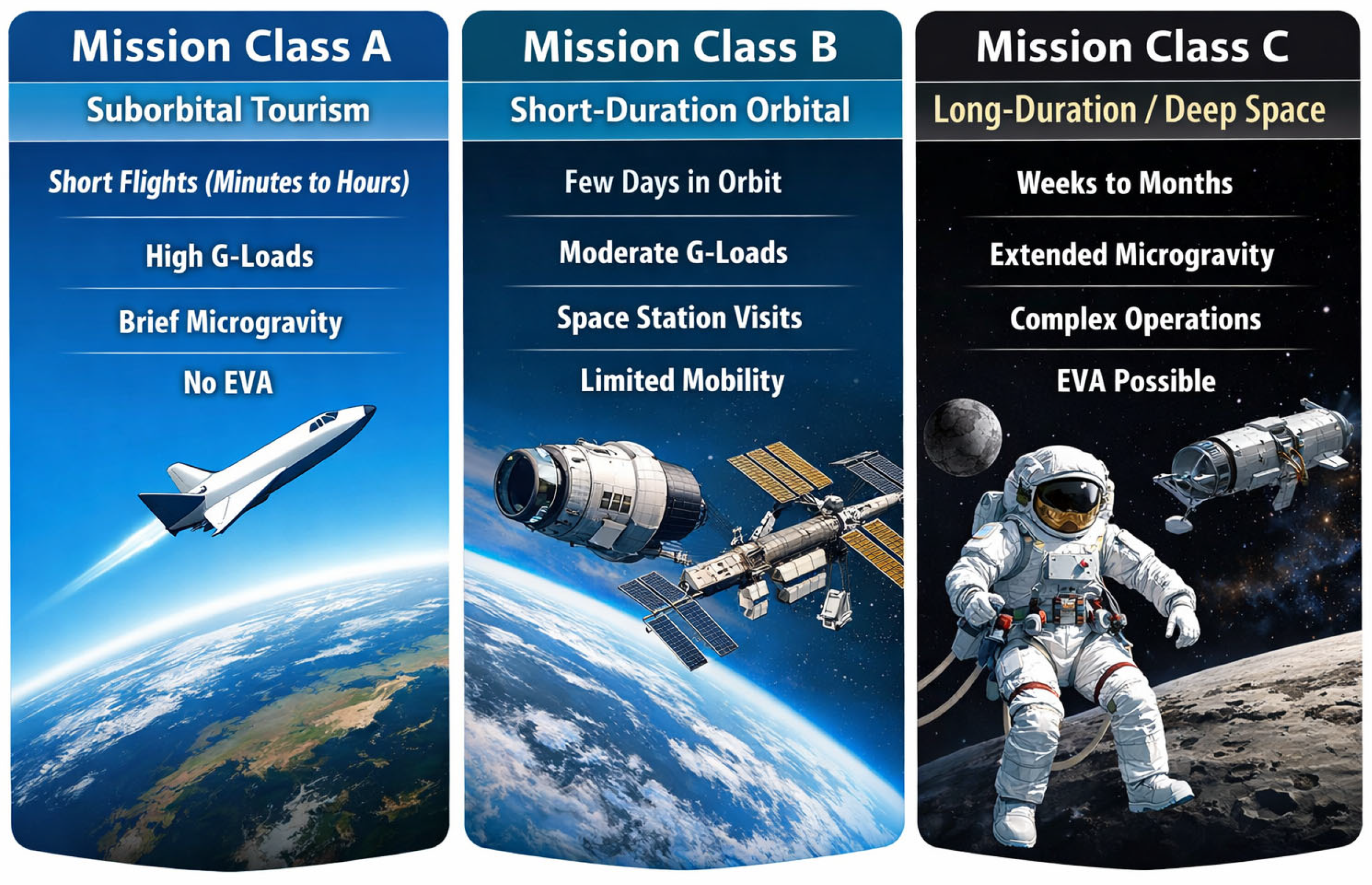
First, screening and certification should be explicitly mission- and role-specific, rather than generic. For example, as shown in
Figure 1:
Mission Class A—Suborbital Tourism: Short (<1 h) flights with high ascent/descent G-loads, minimal cabin mobility, short-duration microgravity and no EVA.
Mission Class B—Short-Duration Orbital: Multi-day free-flyer or space station visits without EVA, with moderate ascent/descent G-loads and moderate duration microgravity and cabin mobility.
Mission Class C—Long-Duration Orbital or Deep Space: Weeks to months, more complex operations, with moderate ascent/descent G-loads, long duration microgravity exposure and possibly including EVA.
Suggested Mission Categories for Selection and Screening
Within each mission class, roles can be defined as follows:
Professional Crew (Operators/Pilots): Safety-critical, requiring standards closer to traditional astronaut or commercial pilot criteria.
Mission Specialists/Private Astronauts: Non-pilot roles with operational tasks.
Spaceflight Participants (Tourists): Minimal operational responsibility.
In addition to duration and mission demands, each class should be parameterised by crew-to-participant ratio and cabin occupancy/mix, as these affect workload, communication complexity, and behavioural risk in contingencies.
Medical and psychological thresholds can be tuned by class and role, for instance, accepting higher cardiovascular risk for moderate-G, short-duration Class B tourist missions than for Class A flights where slightly higher return G-loads are possible, or for crew with safety-critical duties [
8,
23,
24].
Second, screening can be structured as a layered process, progressing from low-cost pre-screening to more intensive evaluation:
Pre-Screening (Remote):
Structured questionnaires covering cardiovascular, pulmonary, neurological, metabolic and psychiatric history, medications, prior surgeries, and functional limitations.
Automated rules to flag clear contraindications (e.g., unstable angina, recent myocardial infarction, severe COPD, uncontrolled epilepsy, current substance misuse) based on consensus guidelines [
8,
11,
23,
24].
Targeted Medical Examination:
Conducted by physicians with aerospace medicine training or under their guidance.
Includes, for example, focused physical examination, ECG, basic laboratory tests, and, where indicated, stress testing, pulmonary function tests, imaging, and ophthalmic evaluation (especially for orbital missions).
Psychological and Cognitive Screening:
Short, validated tools assessing mood, anxiety, and major psychiatric history.
Cognitive tasks targeting situational awareness, decision-making under stress, and the ability to follow complex instructions, scaled to role (more extensive for private astronauts than for tourists) [
5,
6,
21].
Assessment of functional reserve (e.g., ability to tolerate emergency egress, donning of safety equipment, brief high-workload tasks) [
8,
26].
Training-Embedded Evaluation:
Use of centrifuge profiles, high-fidelity cabin simulations, and emergency drills not only for training but to observe participant tolerance and behaviour [
8,
26].
Opportunity to withdraw or postpone participants whose response to G-loads, or psychological stress, indicates unacceptable risk, even if baseline medical tests were reassuring.
At each layer, decisions can be framed in terms of mission-specific risk categories (e.g., “acceptable”, “acceptable with restrictions/mitigations”, “not acceptable for this mission class but potentially suitable for lower-risk missions”).
Third, the outcome of screening should be formalised as certified, with clear assumptions about:
Mission class and role for which the certification is valid.
Time validity (e.g., 6–12 months, shorter for higher-risk profiles).
Required mitigations (e.g., additional in-flight medical monitoring, seating near access routes, supplemental oxygen availability).
Longitudinal data collection (pre-, in- and post-flight) should be embedded to refine screening criteria:
Systematic recording of in-flight medical events, near-misses, and performance issues.
Post-flight health follow-up for participants with notable pre-existing conditions.
Non-clinical psychological interview covering in-flight emotional and group-dynamic issues.
Pooled, de-identified datasets shared across operators and regulators to enable more robust risk modelling, analogous to safety-reporting systems in commercial aviation [
9,
24,
25].
Over time, a feedback loop such as that proposed can narrow the current gap between traditional astronaut standards (well codified but tailored to elite professionals) and commercial guidelines (fragmented and largely consensus-based).