1. Introduction
Artificial intelligence (AI) tools, integrated into platforms such as Figma, Canva, and UX Pilot, can generate high-fidelity user interface (UI) screens in seconds. This rapid generation of design artifacts fundamentally reconfigures creative workflows by democratising access to advanced design capabilities and enhancing production efficiency [
1]. While such acceleration offers clear benefits, it also introduces potential drawbacks, particularly for novice users. Specifically, the immediate availability of sophisticated AI-generated exemplars may inadvertently foster dependency among novices; rather than expanding their conceptual space, these users risk reduced engagement in exploratory processes essential for developing creative competence [
2,
3].
This dynamic transcends mere tool adoption, implicating foundational aspects of creative development. When novice designers encounter AI-generated interfaces that significantly exceed their current skill level, they may experience what contemporary research identifies as a “reverse artificial confidence effect.” In this psychological state, the pronounced disparity between AI and human-generated outputs can inhibit, rather than inspire, creative engagement [
4]. These inhibitory effects are especially salient in educational settings, where iterative design thinking is critical for cultivating both technical proficiency and creative self-efficacy [
5].
The implications of this phenomenon extend beyond individual learning outcomes, presenting a fundamental paradox for design education: How can AI be harnessed to accelerate ideation and skill acquisition without compromising the developmental trajectories that foster confident and autonomous designers? As AI technologies become increasingly pervasive, a parallel concern emerges within industry discourses: organisations risk producing designers who, while technically adept, exhibit creative dependency constrained by the stylistic and conceptual limitations of their AI tools [
6,
7]
From a human–computer interaction perspective, the concept of explainability has traditionally been associated with promoting transparency and fostering user trust in AI models [
8]. However, explainability also holds significant, yet underutilised, potential as a creative scaffold [
9]. Rather than solely presenting finalised AI outputs, interfaces that elucidate design rationales, clarify decision trade-offs, and allow users to manipulate underlying parameters can facilitate a shift from passive consumption to active, exploratory engagement [
10]. Such human-centred XAI approaches align with participatory design traditions, emphasising user agency, progressive disclosure, and contextual relevance [
11].
This research addresses a critical gap in the current understanding of human–AI collaboration within creative domains. While extant literature demonstrates that AI can enhance individual creativity [
7], it simultaneously highlights risks of homogenisation [
7] and diminished creative self-efficacy. Notably, the moderating influence of different AI presentation modes, particularly through explainable AI interfaces, on these dynamics among novice users remains underexplored.
This work extends HCI research by conceptualising AI overperformance as a mechanism that shapes novice creative behaviour, building upon recent investigations into artificial confidence [
4]. We posit that negative outcomes are most likely to arise under three conditions: (1) when disparities between AI and human performance are pronounced, (2) when creative self-efficacy is diminished, and (3) when users lack transparency regarding the generative processes underpinning AI outputs [
3]. Empirical results indicate that human-centred XAI interfaces can counteract these effects by providing cognitive scaffolding that facilitates exploratory learning while preserving user agency [
3].
Accordingly, we investigate: RQ1: How do superior AI design exemplars affect novice creative self-efficacy and ideation? RQ2: Can XAI interfaces reduce the effects of AI overperformance on novice creativity? RQ3: Which psychological mechanisms mediate the relationship between AI exposure and creative outcomes?
It is important to clarify the conceptual distinction between the two AI-exposed conditions in this study. The AI Overmatch condition presents participants with superior AI-generated designs without any explanation or contextual support, creating a passive comparison experience in which the gap between AI and novice output is made salient but unaddressed. In contrast, the XAI Enhanced condition embeds the same AI outputs within a human-centred explainable interface that actively supports the novice designer. Specifically, the XAI Enhanced interface provides three functional components: (1) design rationale annotations, which explain why particular visual choices were made; (2) interactive parameter controls, which allow participants to adjust AI design elements and observe outcomes; and (3) principle-linked feedback, which connects AI outputs to accessible design principles. These two conditions are therefore not overlapping, while both expose participants to high-quality AI designs, only the XAI Enhanced condition provides the cognitive scaffolding necessary to re-engage the novice as an active participant rather than a passive observer.
Ethical Issues
The study received approval from the NZQRI Ethics Committee (Ref: NZQRI-ETH-2025-061). All participants provided informed consent in accordance with local and university regulations. To minimise potential adverse effects following exposure to advanced AI designs, each session concluded with a structured debrief and the provision of optional resources to support ongoing creative engagement. Participant privacy was ensured from the outset by assigning a random UUID to each data entry and storing all information in an encrypted database. No personally identifiable information was retained.
To ensure fairness, all participants received NZD 25 and an identical set of post-study educational materials.
2. Background and Related Work
2.1. AI Overperformance Effects in Creative Domains
Recent work shows that generative AI systems can serve as social referents, shaping how individuals evaluate their own abilities relative to machine outputs [
4,
12]. When AI outputs substantially exceed novice performance, these comparisons may undermine confidence rather than motivate improvement. This aligns with self-efficacy theory, which demonstrates that perceived capability strongly determines motivation, effort, and persistence [
13].
Empirical studies reinforce these concerns. Doshi and Hauser [
7] demonstrated that, while AI tools can improve individual creative performance, they simultaneously reduce idea diversity, suggesting a homogenisation effect that is especially consequential for novices. Similarly, research has shown that exposure to AI-generated artefacts can diminish users’ perceived ownership and creative agency [
14] underscoring the need for support systems that preserve autonomy when AI is used as a creative benchmark.
2.2. Human-Centred Explainable AI
Traditional explainable AI (XAI) has focused on technical interpretability, aiming to make model behaviour comprehensible to expert users engaged in validation, debugging, or auditing [
11,
15]. In contrast, human-centred XAI shifts emphasis toward user needs, contextual relevance, and actionable understanding [
16]. This perspective recognises that explanations should ultimately support human goals, rather than merely expose internal mechanisms.
In creative domains, this shift is particularly significant. Explanations must not only clarify how AI systems operate, but also help sustain creative agency, enabling users to explore, adapt, and question system outputs rather than passively accept them. Recent work on interactive explanation and participatory XAI demonstrates that explanations can function as creative scaffolds, supporting exploration, reflection, and learning [
17].
Designing effective XAI interfaces for creativity support, therefore, requires principles that balance transparency with cognitive load, promote interactivity, and preserve user autonomy throughout the creative process [
18]. These principles align with broader creativity-support frameworks that advocate tools that facilitate exploration, reflection, and iterative refinement across all stages of creative work.
3. Theoretical Framework
This study integrates Expectancy Disconfirmation Theory (EDT), Creative Self-Efficacy (CSE), and human-centred XAI design principles into a unified conceptual framework explaining how AI overperformance shapes novice creative behaviour and how explainable interfaces may mitigate these effects. When novices encounter AI outputs that substantially exceed their expectations, they experience expectancy disconfirmation, a psychological state that arises when perceived outcomes diverge sharply from prior expectations. Expectancy Disconfirmation Theory was originally developed in consumer behaviour contexts to explain satisfaction and dissatisfaction responses [
19]; in the present study, we apply the underlying disconfirmation mechanism, rather than the consumer satisfaction framing, to the context of creative self-appraisal in the context of AI exposure. Specifically, the perception that AI outputs far surpass one’s own capability functions as a negative disconfirmation event with implications for creative confidence. This disconfirmation can reduce creative self-efficacy. Self-efficacy theory [
13,
20] holds that individuals’ beliefs about their own capabilities are foundational to their motivation, persistence, and willingness to take on challenging tasks; in creative domains specifically, Tierney and Farmer [
20] demonstrated that creative self-efficacy directly predicts creative performance and engagement. Accordingly, when a novice’s self-appraisal is undermined by comparison with a vastly superior AI output, the resulting decline in creative confidence may manifest as reduced ideation, diminished exploratory behaviour, and avoidance of creative risk—a pattern consistent with self-regulatory disengagement under conditions of perceived unattainability [
21]. Lowered self-efficacy increases the likelihood of cognitive withdrawal, manifesting as reduced ideation, diminished exploratory behaviour, and avoidance of creative risk.
Human-centred XAI offers a potential counter-mechanism. By providing intelligible, actionable, and user-oriented explanations, XAI can support metacognitive understanding, reduce uncertainty, and restore a sense of creative agency [
11,
22]. In this way, explanatory interfaces may disrupt the negative EDT–CSE cascade and promote sustained engagement with creative tasks, even in the presence of superior AI exemplars.
To address this issue, the framework introduces human-centred XAI interfaces as an intervention mechanism, drawing on design research [
9,
11].
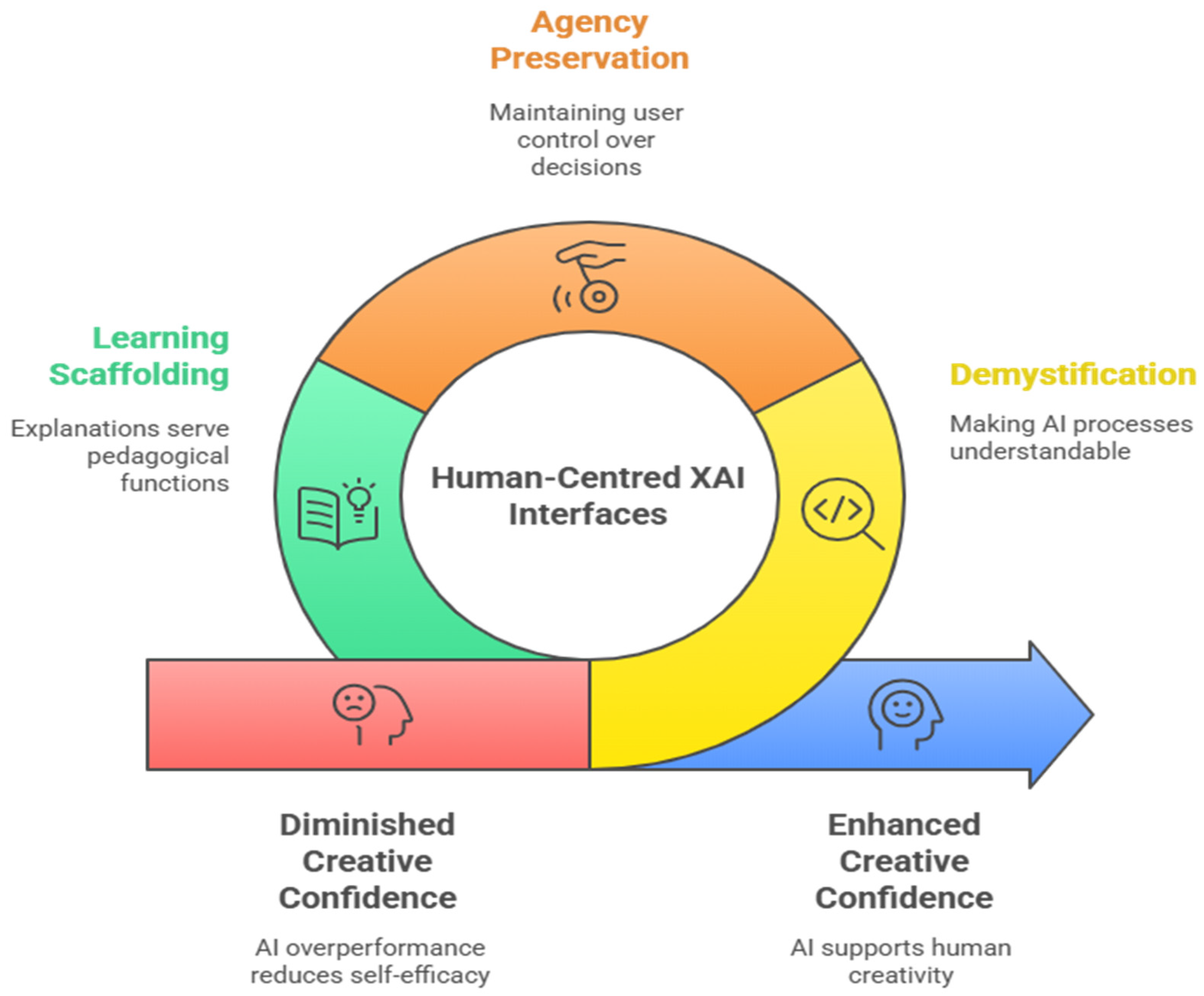
As shown in
Figure 1, human-centred XAI functions through three complementary intervention principles [
9,
11]: (1) Demystification, which makes AI processes understandable; (2) Agency Preservation, which maintains user control over creative decisions; and (3) Learning Scaffolding, through which explanations fulfil pedagogical functions that support novice designers as they interpret and build upon AI outputs. Together, these mechanisms generate testable hypotheses about the relationships among AI exposure, psychological mediators, and creative outcomes, and inform the design of XAI interfaces that support rather than supplant human creativity. The circular spiral form of the framework diagram in
Figure 1 is intentional: it represents the iterative and recursive nature of the three intervention principles. Novice designers may cycle through Demystification, Agency Preservation, and Learning Scaffolding multiple times within a single design session, with each iteration deepening their engagement and creative confidence.
4. Methodology
4.1. Research Design and Platform
We built a web-based research tool that ties together three main pieces: an Experiments Interface where people work on mobile app design tasks. An Expert Reviews System that uses the Consensual Assessment Technique, and a Researcher Dashboard for live stats and easy data export.
Every participant went through the same three setups—but in random order; Human-Only (no AI help), AI-Overmatch (seeing top-tier AI designs), and XAI-Enhanced (AI designs with clear explanations).
The platform shuffled the order automatically and tracked every click and move in real time.
We picked a within-subjects design for a few solid reasons: as people vary a lot in creativity and comfort with AI, we wanted to see how their confidence shifted across rounds; furthermore, honestly, recruiting enough novices for separate groups would have been a nightmare. The system used a Latin square to balance order effects and ensure that the results were not skewed.
4.2. Participants
Seventy-five novice designers were recruited through social media platforms, including LinkedIn, Facebook, and X (formerly Twitter), following a public announcement about the research project conducted with the research team. Interested participants registered through the research platform’s web interface, selecting their role as participant, expert evaluator, or researcher. Inclusion criteria required less than one year of formal, assessed UI design experience in an educational or professional setting. Informal or hobby-based exposure to design tools was not considered sufficient for exclusion, as this reflects the typical profile of students entering design programmes who may have some self-directed tool familiarity but lack structured creative development. Participants ranged in age from 18 to 26 years (M = 21.3, SD = 2.1), with 58% identifying as female, 40% as male, and 2% as non-binary or other gender identities. In terms of ethnicity, 48% identified as Pākehā/New Zealand European, 20% as Asian, 16% as Māori or Pasifika, 10% as Middle Eastern or African, and 6% as other or mixed ethnic backgrounds.
Whilst most participants (69.3%) had previous experience with general AI tools in consulting or academic contexts, only 30.7% had used specialised AI design tools. The low mean score on specialised AI tool experience (M = 1.8, SD = 0.9) reflects this distinction between general AI familiarity and design-specific AI tool usage. The sample size was determined through a power analysis targeting medium to large effect sizes (f = 0.35) with 80% power and α = 0.05 for the primary ANOVA analyses. This yielded a minimum requirement of 66 participants; We recruited 75 participants to account for potential attrition. Additionally, five expert designers, three from industry and two academics (M = 8.3 years of experience, SD = 3.2) served as evaluators using the Consensual Assessment Technique ratings.
4.3. Procedure
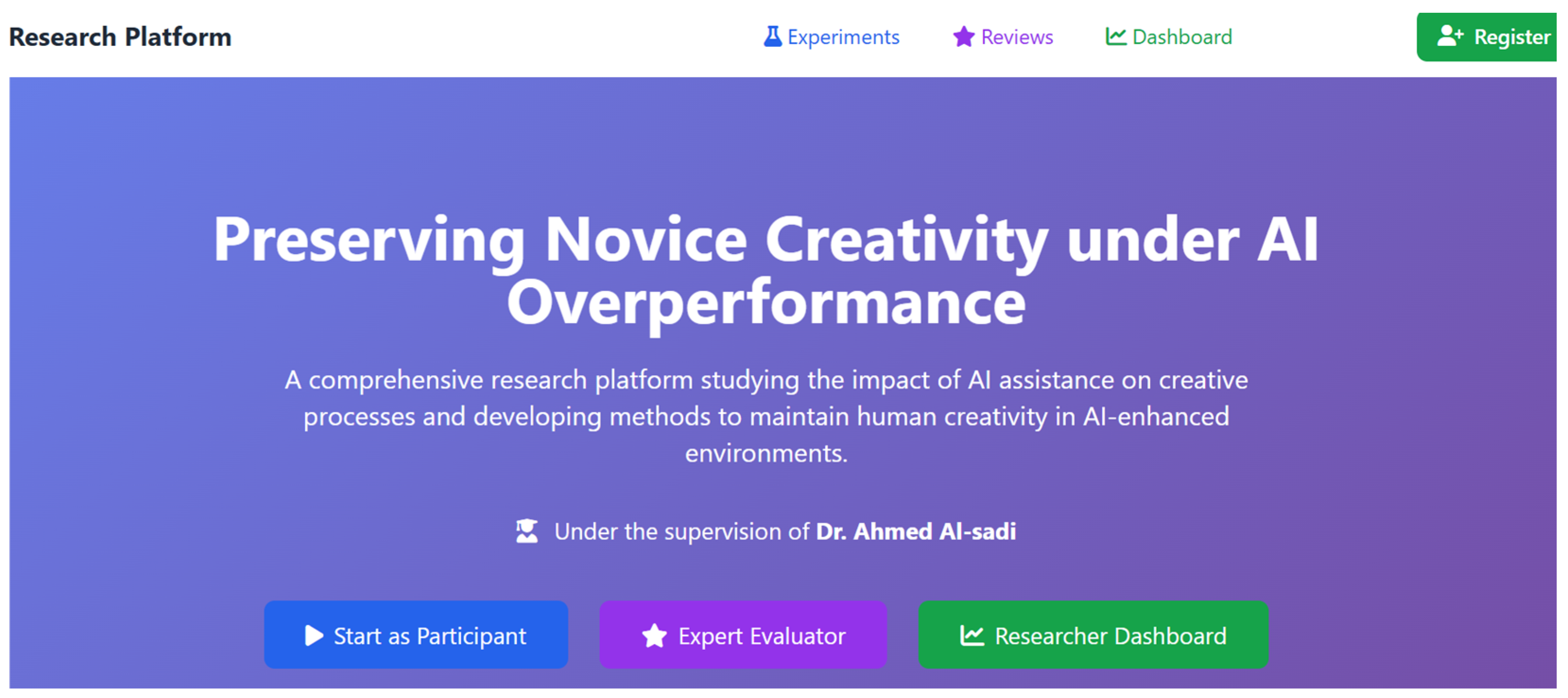
The study was conducted through a custom web-based research platform that enabled the creation of mobile interface designs in a simplified, accessible environment, as shown in
Figure 2. Participants completed the design task on a standard smartphone-sized canvas and worked with basic interface elements such as shapes, text, and colour settings.
All interactions with the design environment were automatically recorded by the platform, including design actions, tool selections, timestamps, and final outputs. The platform also managed participant registration, informed consent, condition assignment, and administration of the pre- and post-task questionnaires.
It should be noted that the research platform’s landing page, as shown in
Figure 2, prominently displays the study title “Preserving Novice Creativity under AI Overperformance”. This raises a potential demand-characteristic concern: participants who read this framing before beginning the tasks may have adjusted their responses or creative behaviour in line with perceived researcher expectations. We note, however, that the within-subjects design and automated behavioural telemetry (recording actions rather than only self-report) partially mitigate this risk, as overt performance on the design canvas is less susceptible to conscious bias than questionnaire responses alone. Nonetheless, the potential influence of title framing on participant expectations is a limitation of this study, and future research should consider neutral or blinded platform interfaces or employ cover stories that do not disclose the specific research focus prior to task completion.
Participants completed design tasks under three conditions: Human Only (independent use of platform tools), AI Overmatch (AI suggestions validated by experts), and XAI Enhanced (AI suggestions with explanatory annotations and interactive elements). All interactions were automatically recorded. Participants registered, consented, and completed questionnaires before being assigned randomly to a condition. Designs were then evaluated post-task, and session data were collected for analysis. Seventy-five novice designers contributed, resulting in 150 valid observations after screening.
4.3.1. Creative Self-Efficacy
Creative self-efficacy was measured using the Creative Self-Efficacy Scale developed by Tierney and Farmer in 2002 and adapted for design contexts in this study. The scale consisted of eight items, rated on a seven-point agreement scale ranging from “strongly disagree” to “strongly agree,” with higher scores indicating greater confidence in one’s ability to generate original and effective design ideas. Example items included statements such as “I am confident in my ability to solve design problems creatively”. Internal consistency in this sample was high, with a Cronbach’s alpha of 0.91. The scale was administered immediately before and after the design task, allowing calculation of the change in perceived creative confidence. The corresponding results are reported in
Section 5.1.
4.3.2. Ideation Behaviours
Ideation and exploratory design behaviours were recorded continuously through the platform’s telemetry system. The system captured information about the creation of new design elements, revisions to existing elements, the order and frequency of tool selections, the density of interactions over time, and total session duration. These behavioural measures provided an objective representation of design process engagement without interrupting the creative workflow. Analyses of these measures are presented in
Section 5.2.
4.3.3. Creative Self-Efficacy Measure
The creative quality of final interface designs was assessed using the Consensual Assessment Technique originally introduced by [
23]. An expert panel of experienced designers independently evaluated each final design using a nine-point scale to assess creativity, originality, technical execution, and overall aesthetic coherence. Ratings were conducted through the platform’s review interface and evaluators were blind to both participant identity and experimental condition. Inter-rater reliability was acceptable, with an intraclass correlation coefficient of 0.78. Results of these evaluations are presented in
Section 5.3.
5. Results
Analysis of the behavioural, self-report, and expert-evaluation data collected through the research platform revealed systematic differences across conditions, providing support for the hypothesised effects of AI overperformance and for the moderating influence of explainable AI. The platform recorded more than 15,000 design actions across all sessions, enabling a fine-grained examination of creative engagement and output.
5.1. Creative Self-Efficacy
A repeated measures ANOVA identified significant differences in changes in creative self-efficacy across conditions, F(2148) = 24.67, p < 0.001, η2 = 0.18. The Human Only condition produced a negligible change in self-efficacy (M = 0.08, SD = 0.15), while participants in the AI Overmatch condition experienced a clear reduction (M = −1.18, SD = 0.32). In contrast, the XAI Enhanced condition increased self-efficacy (M = 0.42, SD = 0.18). Post hoc Tukey comparisons confirmed that all condition differences were statistically significant (all p < 0.001). The magnitude of the difference between the AI Overmatch and XAI Enhanced conditions was large (Cohen d = 1.35, 95% CI [1.01, 1.69]). These results indicate that exposure to superior AI output can undermine creative confidence, but that explainable interfaces can preserve and improve it.
As shown in
Table 1, these findings demonstrate that creative confidence is sensitive to perceived performance gaps and can be strengthened when AI systems provide interpretable reasoning and design rationale.
5.2. Ideation and Creative Behaviour
Significant condition effects were also observed across all ideation measures. Ideation count differed significantly by condition, F(2148) = 31.78, p < 0.001, η2 = 0.30, with the AI Overmatch condition resulting in lower ideation (M = 4.3, SD = 1.2) compared to both the Human Only condition (M = 8.2, SD = 1.8) and the XAI Enhanced condition (M = 9.6, SD = 2.1). This pattern was mirrored for iteration count, F(2148) = 28.45, p < 0.001, η2 = 0.28, and branching behaviours, F(2148) = 25.93, p < 0.001, η2 = 0.26. These results indicate that exposure to unattainable AI exemplars can constrain exploratory action. At the same time, explainable AI encourages experimentation and sustained engagement.
5.3. Effects on Creative Self-Efficacy
Expert evaluations of final design outputs revealed significant condition differences in overall creativity, F(2148) = 15.82, p < 0.001, η2 = 0.18. Designs produced in the AI Overmatch condition received lower creativity ratings (M = 5.30, SD = 0.89) than those in the Human Only condition (M = 6.20, SD = 0.76) and the XAI Enhanced condition (M = 6.73, SD = 0.82). The XAI Enhanced condition produced the highest-quality outputs, demonstrating that interpretable support can scaffold rather than replace creative decision-making.
5.4. Mediation Analysis
A mediation analysis using Hayes’s PROCESS Model 4 examined whether expectancy disconfirmation mediated the relationship between condition and change in creative self-efficacy. A significant indirect effect was identified (indirect effect = 0.34, 95% CI [0.18, 0.50]). Condition significantly predicted expectancy disconfirmation (β = −1.12, SE = 0.15, p < 0.001), and expectancy disconfirmation predicted self-efficacy change (β = 0.67, SE = 0.09, p < 0.001). The model accounted for 41 per cent of the variance in self-efficacy change, supporting the theorised role of expectancy processes in shaping creative confidence under AI-assisted conditions.
6. Discussion
6.1. Theoretical Implications for Understanding AI and Creativity
The findings provide strong empirical support for the AI overperformance effect as a psychological mechanism shaping novice creativity. The marked decline in creative self-efficacy following exposure to highly superior AI outputs highlights that AI does not function merely as a neutral tool, but as a psychological environment that shapes how novices see themselves as designers [
24]. Creative identity in early design learning is especially vulnerable because novice designers are still forming self-schemas about what they can create, how they solve problems, and what counts as “good design” [
25]. When AI outputs appear effortless, immediate, and superior, novices compare themselves against these outputs in ways consistent with upward social comparison processes [
26]. However, unlike comparison with more advanced peers, AI does not provide developmental cues or narrative explanations that support growth, leading to withdrawal rather than motivation [
27].
The mediation analysis further demonstrates that expectancy disconfirmation plays a central role in this process. When novices find that the internal expectations of their own ability are sharply violated, the dissonance produces psychological tension that is resolved not by increased effort, but by lowering self-evaluations [
28]. This aligns with established models of self-regulatory behaviour in achievement contexts, where perceived gaps that feel unbridgeable lead to disengagement rather than perseverance [
21]. Thus, rather than accelerating creative growth, AI overperformance can interrupt the development of divergent thinking [
29] narrowing exploration and reducing willingness to take creative risks, which are foundational to creativity.
6.2. Implications for Human Centred XAI Design
The enhanced performance in the XAI Enhanced condition demonstrates that explainability can serve a developmental scaffolding function, supporting rather than undermining creative identity. In this context, explanation did not simply transmit additional information; rather, it mediated the psychological relationship between the novice and the AI. By revealing reasoning, highlighting key visual principles, and offering modifiable parameters, the interface enabled learners to see themselves as participants in the design process rather than passive recipients of solutions [
11].
This aligns closely with Vygotskian accounts of learning, where scaffolding supports learners within their zone of proximal development by making invisible processes visible [
30]. It also reduces extraneous cognitive load, allowing novices to focus cognitive resources on meaningful creative reasoning rather than grappling with opaque outputs [
31]. Importantly, the interface preserved agency, preventing motivational collapse and protecting intrinsic motivation. Thus, effective XAI should be understood as a psychological design intervention rather than merely a technical transparency feature.
6.3. Practical Implications for Design Education
These results have significant implications for design education. Traditional studio learning relies on progressive challenges and iterative feedback that support the gradual development of creative identity. In contrast, AI introduces abrupt performance jumps, which can overwhelm developmental processes and induce avoidance behaviours. This phenomenon resembles what developmental psychology describes as environmental press: conditions that exceed an individual’s capacity to integrate new knowledge [
32].
To respond, design education must move beyond teaching how to use AI tools and instead cultivate meta-creative literacy: awareness of how AI influences confidence, identity, judgement, and creative autonomy. We propose that curricula integrate AI literacy for creative agency, including: strategies for critically interrogating AI outputs, reflective practices to maintain self-authored design judgement and structured scaffolding to prevent dependency and fixation patterns.
The future of creative practice belongs to designers who can co-create with AI, not merely consume AI outputs. This requires pedagogies that explicitly protect and grow the psychological foundations of creativity: confidence, curiosity, risk tolerance, and a sense of agency.
7. Conclusions
This study introduces and empirically validates the concept of AI overperformance effects as a significant challenge to novice creativity in generative AI-assisted design [
4]. The findings indicate that exposure to AI outputs that substantially exceed novice performance can impair creativity by reducing self-efficacy, constraining ideation, and diminishing creative outcomes.
The study further identifies strategies to address these challenges. Human-centred, explainable AI interfaces that enhance transparency, maintain user agency, and provide pedagogical guidance can mitigate AI overperformance effects and promote novice creativity beyond baseline levels [
11]. These results challenge the perspective that AI will inevitably replace human creativity and question the assumption that all AI exposure benefits creative development.
In addition to its implications for creativity studies, this research advances the broader understanding of human–AI interaction. Building on recent work that positions AI as an emerging social referent [
4], the AI overperformance effects framework demonstrates that technological capabilities can create psychological barriers if not carefully managed. The mediating role of expectancy disconfirmation offers critical insight into the mechanisms by which AI overperformance influences human confidence and engagement.
As AI capabilities continue to advance, the importance of human-centred design will increase. This study demonstrates that the central issue is not whether AI will augment or replace human creativity, but rather how to design AI systems that empower human creative potential. Effective approaches will position AI as both a teacher and collaborator, supporting the unique value of human creative expression.
8. Limitations and Future Work
While this study offers valuable insights into the influence of generative AI on the development of creative confidence in novice designers, several limitations should be acknowledged. The investigation focused exclusively on early-stage designers engaged in a constrained mobile interface design task. Novice designers are psychologically distinct from their more experienced counterparts, as their creative identities are still developing and they are more susceptible to changes in self-concept and agency. It remains uncertain whether similar effects would be observed in intermediate or expert designers, whose creative schemas are more established. Future research should examine how overperformance and explainable AI (XAI) scaffolding function across different stages of creative development to elucidate developmental trajectories in human–AI co-creation.
Furthermore, while this study measured creative output quality holistically, creativity is a multi-dimensional construct encompassing distinct components such as originality, elaboration, fluency, and sophistication. The current analyses do not disaggregate these dimensions. Future research should examine which specific facets of creativity are most susceptible to AI overperformance effects, and whether XAI scaffolding differentially supports, for example, originality versus technical refinement. This remains an important direction for subsequent work.
Additionally, this research assessed immediate psychological and behavioural responses following a single design session. Creative identity and confidence are dynamic constructs that evolve through cumulative experiences rather than remaining static traits. A single exposure to AI may foster habituation, resilience, or, conversely, deeper dependency. Longitudinal studies are necessary to determine whether initial reductions in confidence persist, diminish, or intensify over time, and to assess whether sustained exposure to explainable AI fosters enduring creative agency rather than providing only temporary reassurance.
Furthermore, although the XAI interface in this study supported creative confidence, it constitutes only one approach to psychological scaffolding. The mechanisms underlying sense-making, reflection, and agency preservation likely depend on how explanations are framed, their timing, and the degree of interpretive space afforded to the learner. Future research should investigate adaptive, context-sensitive explanation designs in which levels of transparency dynamically adjust in response to indicators such as frustration, hesitation, reduced exploration, or perceived disengagement. Such approaches would help ensure that explainability remains supportive of learner autonomy rather than becoming didactic or overly directive.
Moreover, this study did not address the cultural and interpersonal dimensions of creative identity. Creative confidence is shaped not only by individual cognition but also by broader cultural narratives concerning talent, technology, authorship, and originality. In certain contexts, exposure to superhuman AI outputs may elicit admiration or curiosity, while in others, it may provoke fear of replacement or a diminished sense of human value. Cross-cultural research could clarify how societal beliefs about creativity and agency either mitigate or amplify the effects of AI overperformance.
Finally, the relational dimension of human–AI interaction warrants further exploration. AI systems are increasingly perceived not merely as tools, but as collaborators, advisors, and benchmarks of competence. Future research should investigate how novices emotionally interpret the presence of AI, considering whether it is experienced as a supportive companion, a silent tutor, an authoritative judge, or a competitive rival. Understanding these relational metaphors is essential for designing AI systems that support, rather than undermine, creative identities. Overall, future studies should employ longitudinal, developmental, cross-cultural, and adaptive human-centred frameworks to better understand how AI interfaces with the psychological processes underlying creative growth. Ultimately, designing AI for creativity is less about producing aesthetically refined outputs and more about fostering individuals who are confident, exploratory, reflective, and capable of sustaining creative agency in partnership with technology.
Author Contributions
A.A.-s.: Conceptualisation, Methodology, Software, Formal Analysis, Investigation, Data Curation, Writing—Original Draft, Visualisation, Project Administration. D.M.: Conceptualisation, Methodology, Resources, Writing—Review and Editing, Supervision, Funding Acquisition. All authors have read and agreed to the published version of the manuscript.
Funding
Special thanks are extended to the New Zealand Quality Research and Innovation (NZQRI) team for providing research infrastructure and for funding this project (Grant No. NZQRI-2025-RIF-008).
Data Availability Statement
The data presented in this study are available on request from the corresponding author. The data are not publicly available due to institutional and ethical restrictions, including the requirement for permission from NZQRI and all contributing authors.
Acknowledgments
We thank the participants who generously contributed their time and creative efforts to this research. We also acknowledge the expert designers who provided thoughtful evaluations of the creative outputs. We also thank the broader design community for facilitating participant recruitment through social media platforms. The authors used an AI-based language model solely for proofreading and language refinement. The authors take full responsibility for the content, interpretation, and originality of the manuscript.
Conflicts of Interest
Ahmed Al-sa’di is affiliated with WelTec, New Zealand. Dave Miller is employed by New Zealand Quality Research and Innovation (NZQRI) and received funding from NZQRI, which supported participant recruitment. QRINexus was previously known as NZQRI (New Zealand Quality Research and Innovation). The funder had no role in the design of the study; in the analysis or interpretation of data; in the writing of the manuscript; or in the decision to publish the results. The authors declare no other conflicts of interest.
References
- Hemraj, S. AI and the future of creative development: Redefining digital media production. AI Ethics 2025, 5, 5105–5119. [Google Scholar]
- Hersch, C.R. AI: Embracing the new frontier in your practice. Trusts Estates 2024, 163, 11–15. Available online: https://www.wealthmanagement.com/estate-planning/ai-embracing-the-new-frontier-in-your-practice (accessed on 22 November 2025).
- Krakowski, S. Human-AI agency in the age of generative AI. Inf. Organ. 2025, 35, 100560. [Google Scholar] [CrossRef]
- Reich, T.; Teeny, J.D. Does artificial intelligence cause artificial confidence? Generative artificial intelligence as an emerging social referent. J. Pers. Soc. Psychol. 2025, 130, 452–464. [Google Scholar]
- Alvarado, L.F. Design thinking as an active teaching methodology in higher education: A systematic review. Front. Educ. 2025, 10, 1462938. [Google Scholar] [CrossRef]
- Tang, X.; Windham, J.; Bush, B. Pre-AI and post-AI design: Balancing human creativity and AI tools in the industrial design process. In Proceedings of the 2024 International Conference on Artificial Intelligence and Future Education, Valencia, Spain, 4–6 March 2024; pp. 100–108. [Google Scholar]
- Doshi, A.R.; Hauser, O.P. Generative AI enhances individual creativity but reduces the collective diversity of novel content. Sci. Adv. 2024, 10, eadn5290. [Google Scholar] [CrossRef]
- Liao, J.J.; Farooqui, M.Z.; Marinello, P.; Hartzel, J.; Anderson, K.; Ma, J.; Gause, C.K. Using artificial intelligence tools in answering important clinical questions: The KEYNOTE-183 multiple myeloma experience. Contemp. Clin. Trials 2020, 99, 106179. [Google Scholar] [CrossRef] [PubMed]
- Schoonderwoerd, T.A.; Jorritsma, W.; Neerincx, M.A.; Van Den Bosch, K. Human-centered XAI: Developing design patterns for explanations of clinical decision support systems. Int. J. Hum.-Comput. Stud. 2021, 154, 102684. [Google Scholar] [CrossRef]
- Rong, Y.; Leemann, T.; Nguyen, T.-T.; Fiedler, L.; Qian, P.; Unhelkar, V.; Seidel, T.; Kasneci, G.; Kasneci, E. Towards human-centered explainable AI: A survey of user studies for model explanations. IEEE Trans. Pattern Anal. Mach. Intell. 2023, 46, 2104–2122. [Google Scholar] [CrossRef]
- Liao, Q.V.; Varshney, K.R. Human-centered explainable AI (XAI): From algorithms to user experiences. arXiv 2021, arXiv:2110.10790. [Google Scholar]
- Logg, J.M.; Minson, J.A.; Moore, D.A. Algorithm appreciation: People prefer algorithmic to human judgment. Organ. Behav. Hum. Decis. Process. 2019, 151, 90–103. [Google Scholar] [CrossRef]
- Bandura, A. Social Foundations of Thought and Action; Prentice-Hall: Englewood Cliffs, NJ, USA, 1986. [Google Scholar]
- Glăveanu, V.P.; Ness, I.J.; de Saint Laurent, C. Creative learning in digital and virtual environments. In Opportunities and Challenges of Technology-Enabled Learning and Creativity; Routledge: New York, NY, USA; London, UK, 2021. [Google Scholar]
- Gao, L.; Guan, L. Interpretability of machine learning: Recent advances and future prospects. IEEE MultiMedia 2023, 30, 105–118. [Google Scholar] [CrossRef]
- Eiband, M.; Schneider, H.; Bilandzic, M.; Fazekas-Con, J.; Haug, M.; Hussmann, H. Bringing transparency design into practice. In Proceedings of the 23rd International Conference on Intelligent User Interfaces, Tokyo, Japan, 7–11 March 2018; pp. 211–223. [Google Scholar]
- Kulesza, T.; Burnett, M.; Wong, W.-K.; Stumpf, S. Principles of explanatory debugging to personalize interactive machine learning. In Proceedings of the 20th International Conference on Intelligent User Interfaces, Atlanta, GA, USA, 29 March–1 April 2015; pp. 126–137. [Google Scholar]
- Virvou, M. Artificial intelligence and user experience in reciprocity: Contributions and state of the art. Intell. Decis. Technol. 2023, 17, 73–125. [Google Scholar] [CrossRef]
- Oliver, R.L. A cognitive model of the antecedents and consequences of satisfaction decisions. J. Mark. Res. 1980, 17, 460–469. [Google Scholar] [CrossRef]
- Tierney, P.; Farmer, S.M. Creative self-efficacy: Its potential antecedents and relationship to creative performance. Acad. Manag. J. 2002, 45, 1137–1148. [Google Scholar] [CrossRef]
- Brandstätter, V.; Bernecker, K. Persistence and disengagement in personal goal pursuit. Annu. Rev. Psychol. 2022, 73, 271–299. [Google Scholar] [CrossRef]
- Chamola, V.; Hassija, V.; Sulthana, A.R.; Ghosh, D.; Dhingra, D.; Sikdar, B. A review of trustworthy and explainable artificial intelligence (XAI). IEEE Access 2023, 11, 78994–79015. [Google Scholar] [CrossRef]
- Amabile, T.M. Social psychology of creativity: A consensual assessment technique. J. Pers. Soc. Psychol. 1982, 43, 997–1013. [Google Scholar] [CrossRef]
- Markus, H.; Wurf, E. The dynamic self-concept: A social psychological perspective. Annu. Rev. Psychol. 1987, 38, 299–337. [Google Scholar] [CrossRef]
- Karwowski, M. Creative mindsets: Measurement, correlates, consequences. Psychol. Aesthet. Creat. Arts 2014, 8, 62–70. [Google Scholar] [CrossRef]
- Festinger, L. A theory of social comparison processes. Hum. Relat. 1954, 7, 117–140. [Google Scholar] [CrossRef]
- Ferguson, C.; van den Broek, E.L.; van Oostendorp, H. AI-induced guidance: Preserving the optimal zone of proximal development. Comput. Educ. Artif. Intell. 2022, 3, 100089. [Google Scholar] [CrossRef]
- Whitby, M.A.; Iacovides, I.; Deterding, S. “Conversations with pigeons”: Capturing players’ lived experience of perspective challenging games. Proc. ACM Hum.-Comput. Interact. 2023, 7, 833–855. [Google Scholar] [CrossRef]
- Jung, S.; Nah, K. Limits of Computational Selection and Their Implications for Human–AI Divergence in Convergent Creativity. Information 2026, 17, 243. [Google Scholar] [CrossRef]
- Vygotsky, L.S. Mind in Society: The Development of Higher Psychological Processes; Harvard University Press: Cambridge, MA, USA, 1978; Volume 86. [Google Scholar]
- Sweller, J. Cognitive load during problem solving: Effects on learning. Cogn. Sci. 1988, 12, 257–285. [Google Scholar] [CrossRef]
- Taylor, L.; Watkins, S.L.; Marshall, H.; Dascombe, B.J.; Foster, J. The impact of different environmental conditions on cognitive function: A focused review. Front. Physiol. 2016, 6, 372. [Google Scholar] [CrossRef] [PubMed]
| Disclaimer/Publisher’s Note: The statements, opinions and data contained in all publications are solely those of the individual author(s) and contributor(s) and not of MDPI and/or the editor(s). MDPI and/or the editor(s) disclaim responsibility for any injury to people or property resulting from any ideas, methods, instructions or products referred to in the content. |