Review

Beyond Spectral Attribution: A Validation Framework for Explainable AI in Biomedical Spectroscopy


1
2nd Department of Radiology, Medical School, National and Kapodistrian University of Athens, 12462 Athens, Greece
2
School of Science and Technology, Hellenic Open University, 26335 Patras, Greece
3
National Hellenic Research Foundation, Institute of Chemical Biology, 48 Vassileos Constantinou Avenue, 11635 Athens, Greece
*
Author to whom correspondence should be addressed.
AI Med. 2026, 1(3), 25; https://doi.org/10.3390/aimed1030025 (registering DOI)
Submission received: 23 June 2026 / Revised: 4 September 2026 / Accepted: 14 September 2026 / Published: 18 September 2026

Abstract

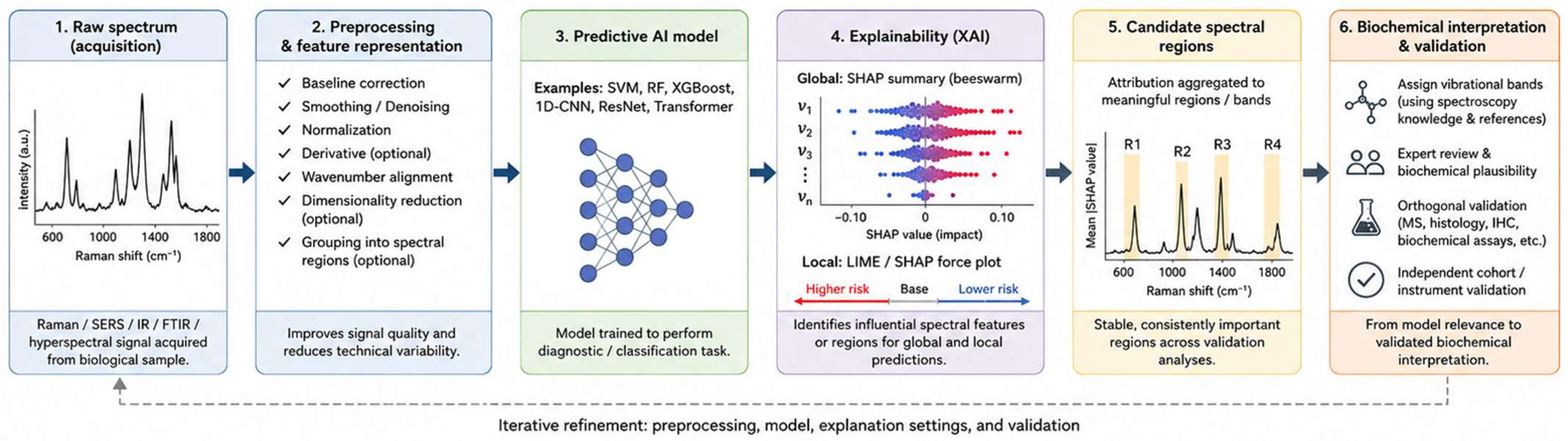
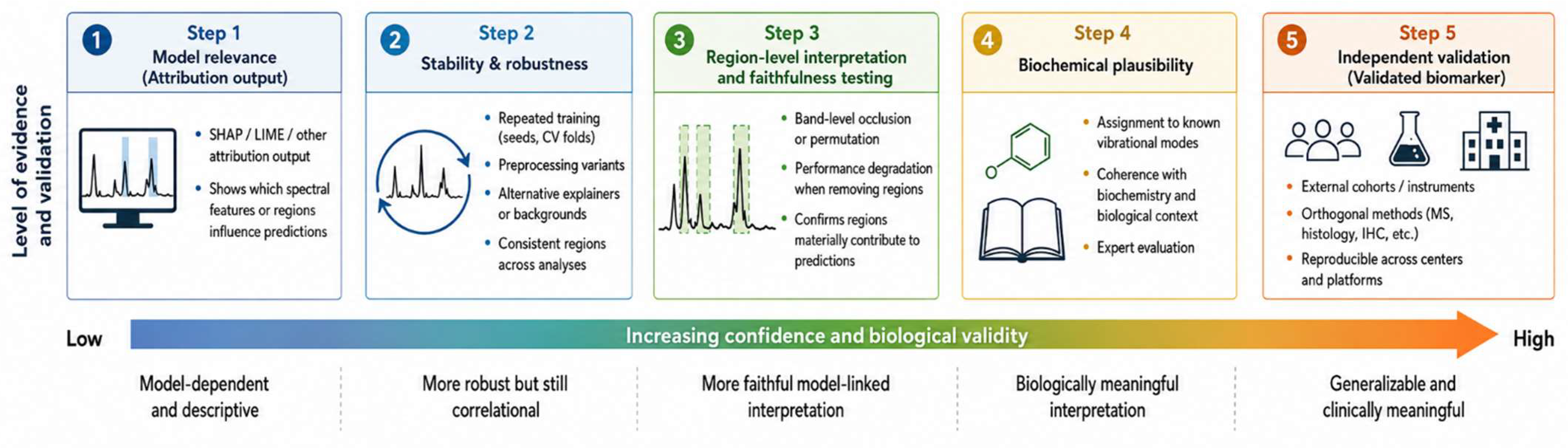
Biomedical spectroscopy, including Raman, surface-enhanced Raman spectroscopy (SERS), infrared spectroscopy, and hyperspectral imaging, is increasingly combined with machine learning for disease classification, sample characterization, and biomarker-oriented analysis. However, high predictive performance does not establish whether model-relevant spectral features are biologically meaningful or whether highlighted regions can support reliable biochemical interpretation. Explainable artificial intelligence (XAI) methods, particularly SHAP and LIME, are increasingly used to identify influential wavenumbers, spectral bands, and wavelength intervals; yet feature importance is often interpreted too directly as biochemical or clinical evidence. This focused narrative review synthesizes SHAP, LIME, and related XAI methods across biomedical spectroscopy applications in cancer diagnostics, microbial identification, pharmaceutical analysis, and tissue or biofluid characterization. We examine key challenges, including correlated variables, peak overlap, preprocessing dependence, background choice, model dependence, and explanation instability. Beyond spectral attribution, we propose a five-step validation framework linking valid model development, explanation stability, region-level interpretation, biochemical plausibility, and independent analytical, biological, or clinical validation. The framework is intended to distinguish candidate spectral evidence from unstable or technically confounded explanations and to support reproducible, transparent, and clinically meaningful use of XAI in biomedical spectroscopy.
Keywords: explainable artificial intelligence; SHAP; LIME; Raman spectroscopy; surface-enhanced Raman spectroscopy; infrared spectroscopy; hyperspectral imaging; spectral attribution; explanation stability; biomarker validation explainable artificial intelligence; SHAP; LIME; Raman spectroscopy; surface-enhanced Raman spectroscopy; infrared spectroscopy; hyperspectral imaging; spectral attribution; explanation stability; biomarker validation