
Exploratory Image-Level Classification of a Public Chest Radiograph Dataset Using a Lightweight SqueezeNet-Based Pipeline



Abstract
1. Introduction
2. Materials and Methods
2.1. Dataset and Ethical Considerations
2.2. Data Preprocessing and Feature Extraction
2.3. Classification Model and Training
2.4. Cross-Validation and Evaluation Metrics
2.5. Dimensionality Reduction and Visualization
2.6. Inference and Reporting
3. Results
3.1. Distribution of Images by Class
3.2. Classification Performance
3.3. Dimensionality Reduction and Visualization
4. Discussion
4.1. Internal Classification Performance Within the Evaluated Dataset
4.2. Comparison with Prior Work
4.3. Strengths of the Approach
- High Internal Classification Performance: The model’s cross-validated accuracy of 98.83% is at the upper end of what has been reported for chest X-ray classification. This performance, achieved on a dataset of 6743 images spanning eight disease categories plus normal, underscores a robust pattern recognition that in some cases demonstrates strong performance within the evaluated dataset [77,78,79,80]. Such high accuracy across multiple classes is uncommon, as multi-class CXR studies often report greater difficulty with increasing classes [50].
- Broad Disease Coverage: Unlike many studies focusing on a single pathology, our model distinguishes nine different conditions. This breadth increases the methodological relevance of the dataset-level classification task, while not establishing clinical utility. Covering a spectrum from chronic obstructive changes to acute infections and neoplasms (encapsulated lesions), the tool aligns with the need for AI systems to detect “multiple abnormalities” for comprehensive decision support [81,82,83].
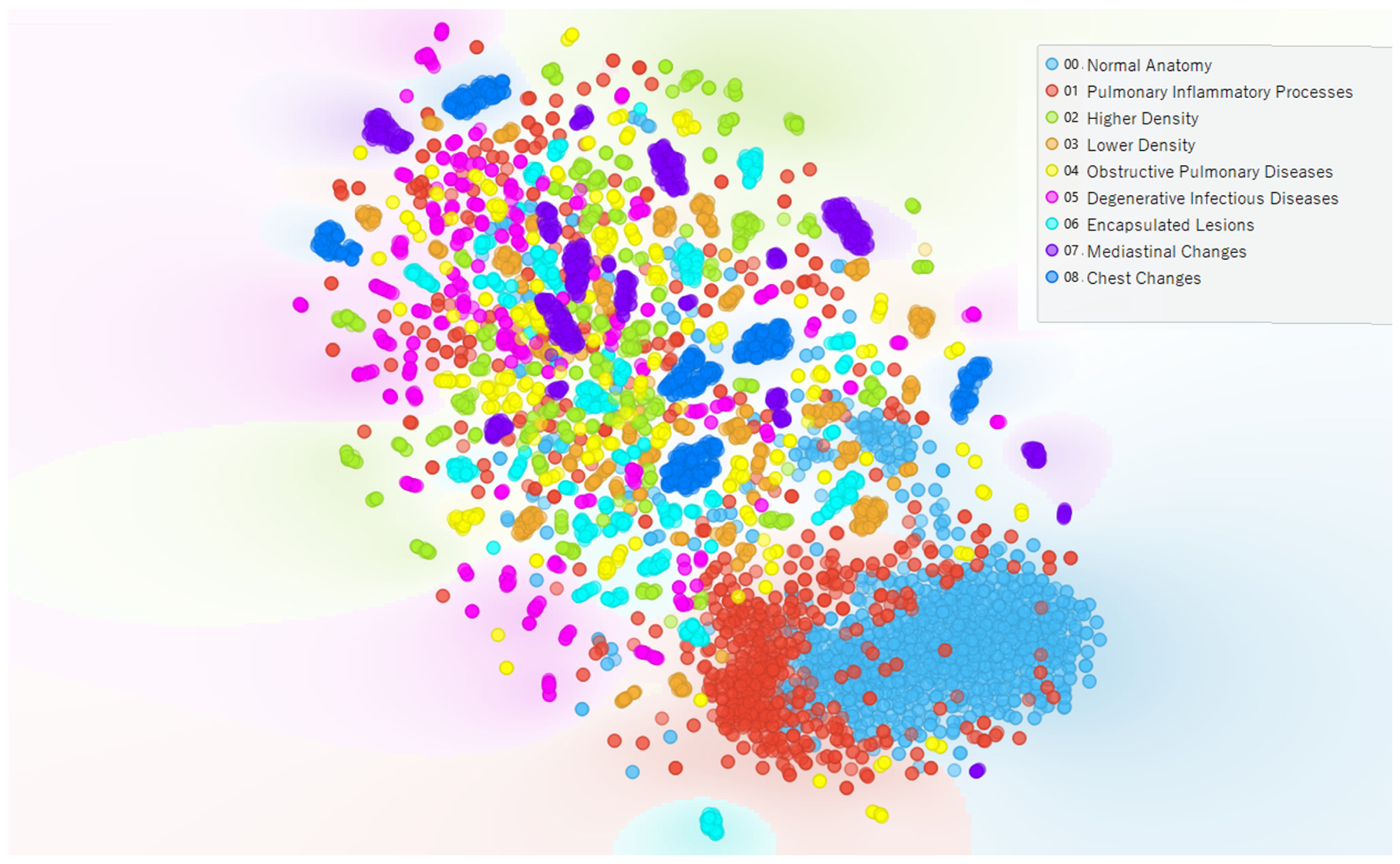
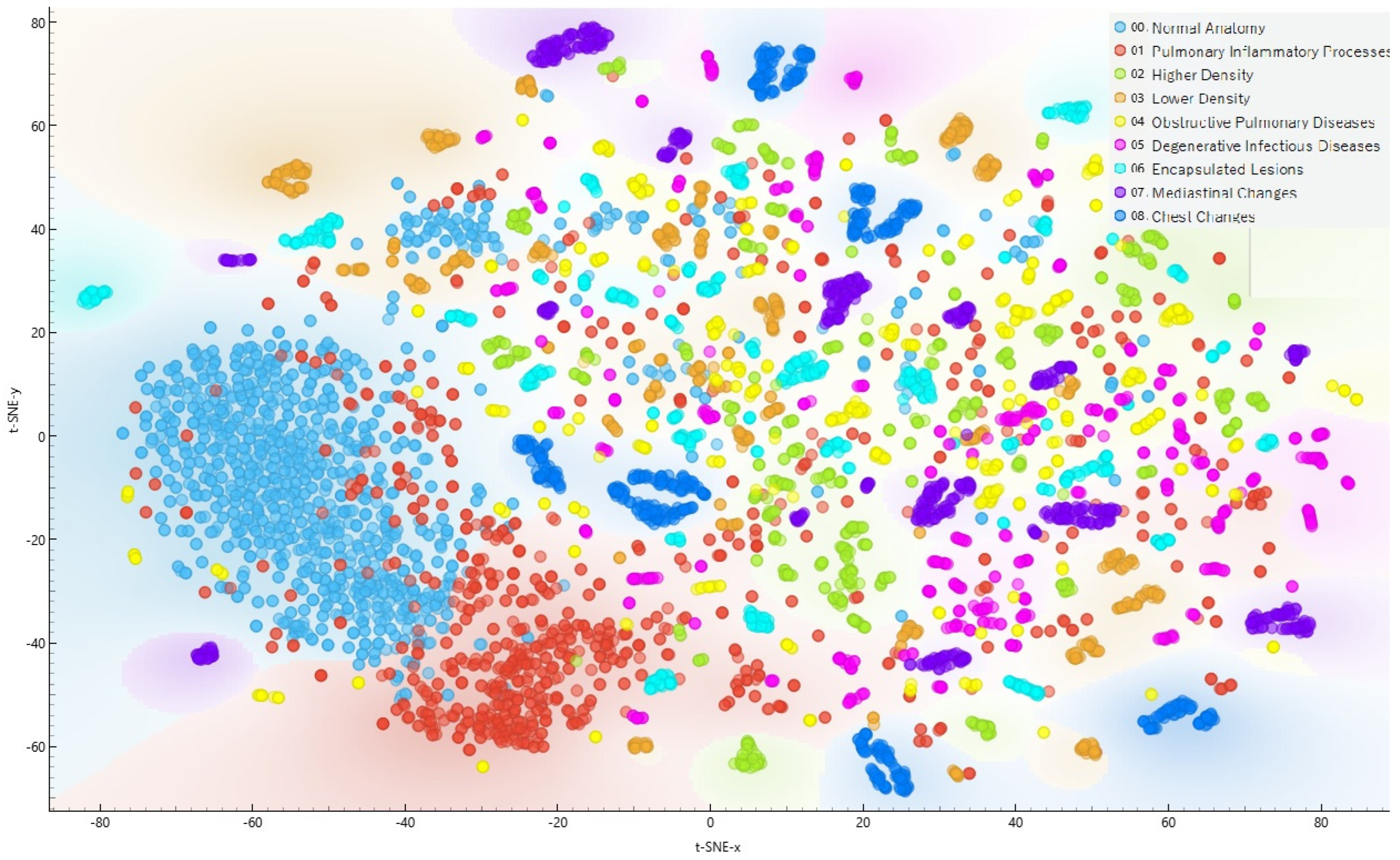
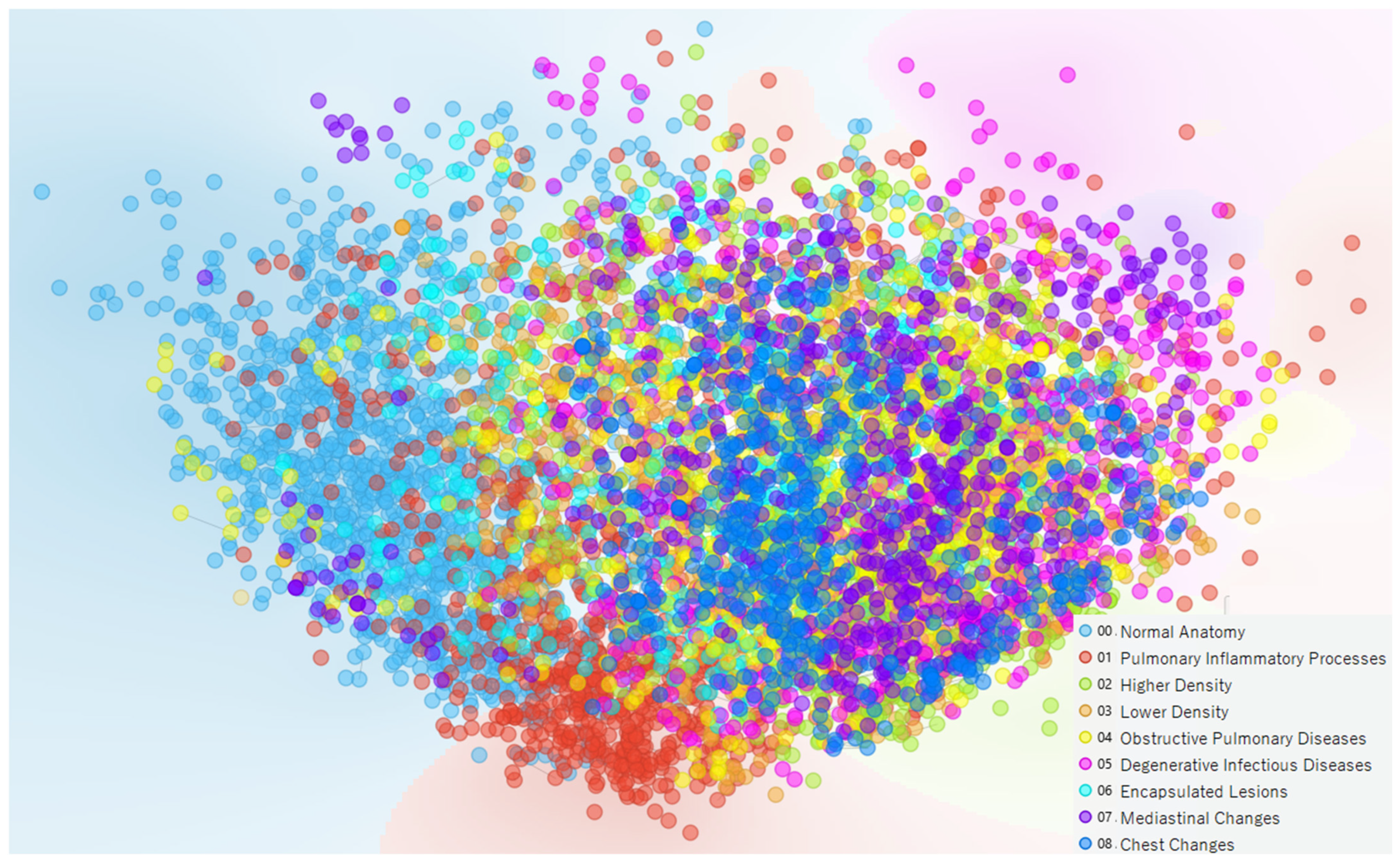
- Feature Separability and Interpretability: Dimensionality reduction analyses (t-SNE, MDS) of the learned feature vectors revealed well-separated clusters corresponding to the different disease categories. This indicates that the network’s latent representations form distinct groupings for each condition, providing a qualitative visualization of how feature representations are spatially organized. The relative separation of the “normal” cluster from the disease-associated clusters, for example, suggests that the model captures the clear radiographic differences between healthy lungs and pathological findings. Even disease classes with superficially similar radiographic appearances formed mostly discrete clusters, reflecting the model’s ability to tease apart subtle radiological distinctions. Such visualization offers a degree of interpretability, giving clinicians insight [84].
- Computational Efficiency: A key strength of using SqueezeNet as the CNN backbone is its low computational and memory footprint [83,85]. SqueezeNet is a highly compact architecture, and our pipeline leverages this efficiency in a way that may be relevant for future research implementations in resource-constrained computational environments [86,87]. Prior work has noted that SqueezeNet-based models can achieve accuracy comparable to much larger networks while using fewer parameters [65]. This low computational footprint supports offline experimentation on commodity hardware, but the present study does not evaluate real-world point-of-care deployment.
4.4. Limitations and Considerations
- Dataset and Generalization: The study used a relatively modestly sized dataset (on the order of 6–7k images), which, although augmented synthetically, is small compared to large public CXR databases (e.g., 100k+ images in NIH ChestX-ray14) [88]. The inclusion of synthetically augmented images raises the concern that the model may partially learn artificial features or repetitive patterns not present in real-world data. This could inflate cross-validation performance while limiting true generalization. As with many medical imaging AI studies based on public datasets, shortcut learning and dataset-specific bias cannot be excluded. No independent external test was reported, so it remains unverified how the model would perform on completely unseen data from different hospitals or patient populations. Robust generalization is crucial, as models can otherwise falter when confronted with shifts in imaging protocols, disease prevalence, or patient demographics [89,90,91]. A major limitation of the present study is the absence of independent external validation using datasets acquired under different institutional and technical conditions. Therefore, the reported performance should not be interpreted as evidence of broad clinical generalizability or deployment readiness. Calibration analysis was not performed, and predicted probabilities should therefore not be interpreted as calibrated estimates of disease likelihood. Future work should prioritize multicenter validation using heterogeneous datasets such as NIH ChestX-ray14 or CheXpert.
- Class Definitions and Overlap: The nine classes in our dataset are broad categories (e.g., “obstructive pulmonary diseases” or “mediastinal changes”) that encompass various specific diagnoses. In practice, patients often have overlapping conditions, for instance, an obstructive disease (like COPD) with a superimposed infection could show features of both categories. Our model, being trained in a multi-class single-label setup based on the available dataset structure, assigns each image to one category and may not handle multi-label scenarios where multiple pathologies coexist. This constraint limits the realism of the present dataset-level classification task, since real chest X-rays frequently exhibit more than one abnormality [1]. A related point is that some categories have similar radiographic manifestations (for example, an “encapsulated lesion” vs. a certain type of density change), which could confuse the model in borderline cases. Indeed, the dimensionality reduction plots hinted at a degree of proximity between certain clusters, likely reflecting these overlaps. Although overall separability was high, a few misclassifications may have occurred between conceptually related diseases. Addressing multi-label classification and refining class definitions (perhaps aligning them with standard radiologic categories) would improve the model’s realism.
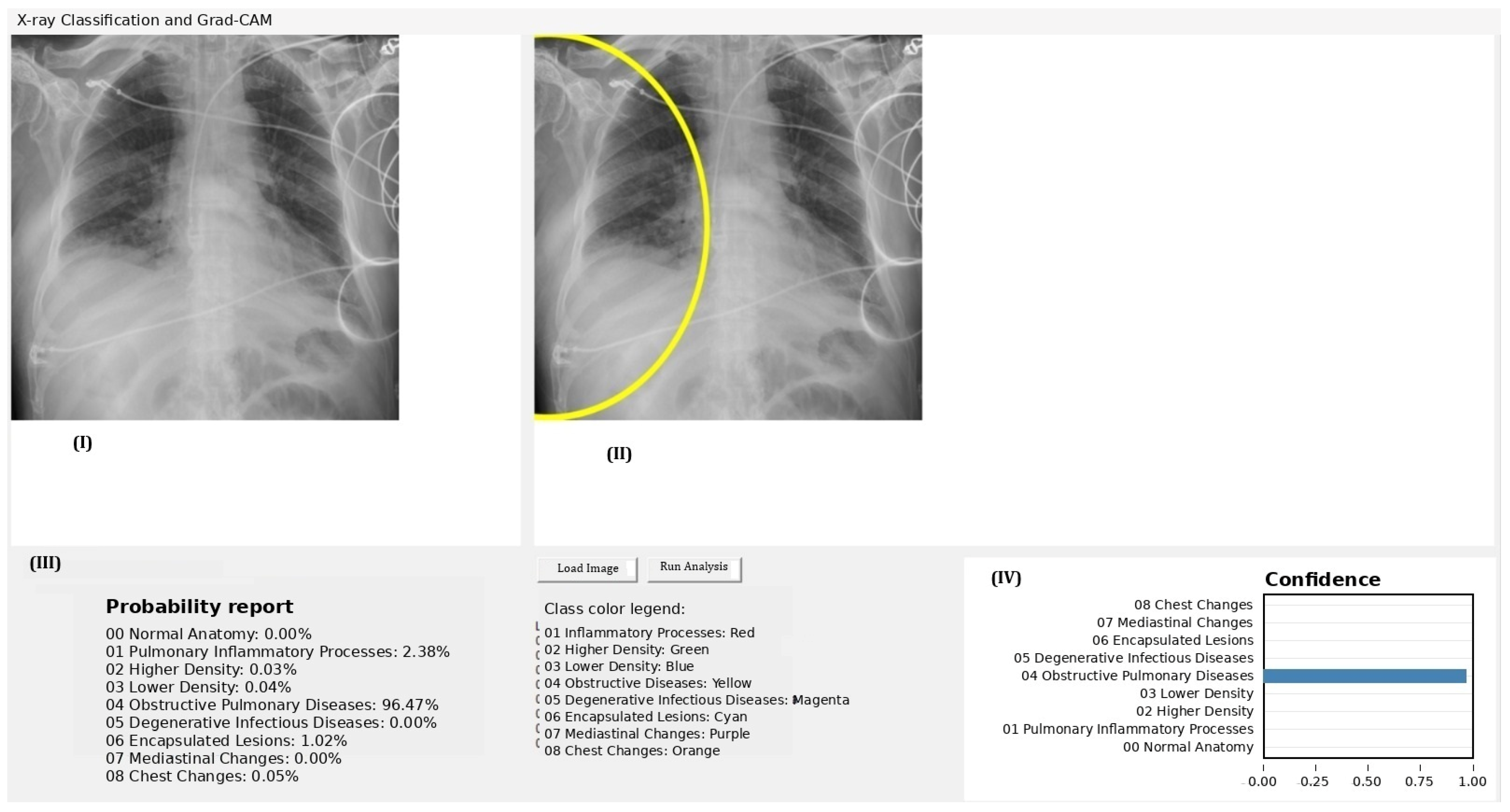
- Explainability Scope: While the pipeline provides Grad-CAM overlays at the final convolutional layer, these saliency maps remain post hoc and qualitative. They do not guarantee causal faithfulness and can be sensitive to preprocessing and class priors. This “black boxes” nature means a clinician sees the output (e.g., “encapsulated lesion”) without a clear rationale or visualization of the evidence [92]. Such opacity can hinder trust and adoption, as clinicians may be reluctant to act on AI output without understanding the basis for the decision. As noted in the recent literature, a lack of transparency in deep learning models makes it difficult to predict failure, or generalize to different imaging hardware, or patient populations [93,94]. Explainability methods like saliency maps or Grad-CAM should be explored so that the model can point out, for instance, the region of a nodule or opacity that led to a particular classification [95]. Prospective reader-study evaluation and failure-mode analysis are needed to verify that highlighted regions consistently correspond to clinically meaningful findings across scanners and sites; exploring concept-based and counterfactual explanations would further strengthen trust and auditability.
- Potential Bias and Spectrum of Disease: The dataset’s composition and synthetic augmentation could introduce bias. If certain classes (say, “normal” or common diseases) dominate, the model might be overly attuned to those at the expense of rarer conditions [96]. Moreover, synthetic augmentation (e.g., rotations, flips, etc.) may not fully capture the diversity of how diseases appear; important variations (different patient positions, image noise patterns, etc.) might still be underrepresented. These factors could limit the model’s performance on atypical presentations. Ongoing evaluation against a wide range of cases, including edge cases and subtle presentations, is necessary. Additionally, the model currently focuses only on detection/classification of the given categories; it does not quantify disease extent or severity, which could be important for clinical decision-making (for example, mild vs. severe cases of a disease are treated differently). This granularity is another possible extension in future studies.
4.5. Feature-Space Visualization and Separability
4.6. Implications for Future Methodological Development
5. Conclusions
Author Contributions
Funding
Institutional Review Board Statement
Informed Consent Statement
Data Availability Statement
Conflicts of Interest
Abbreviations
| Chest X-ray, CXR | Chest radiography |
| CAD | Computer-aided diagnosis |
| TB | Tuberculosis |
| AI | Artificial intelligence |
| ML | Machine learning |
| CNN | Convolutional neural networks |
| AUC | Area under the curve |
| COPD | Chronic obstructive pulmonary disease |
| MLP | Multi-layer perceptron |
| ReLu | Rectified linear unit |
| t-SNE | t-distributed stochastic neighbor embedding |
| MDS | Multidimensional scaling |
References
- Anderson, P.G.; Tarder-Stoll, H.; Alpaslan, M.; Keathley, N.; Levin, D.L.; Venkatesh, S.; Bartel, E.; Sicular, S.; Howell, S.; Lindsey, R.V.; et al. Deep Learning Improves Physician Accuracy in the Comprehensive Detection of Abnormalities on Chest X-Rays. Sci. Rep. 2024, 14, 25151. [Google Scholar] [CrossRef]
- Jones, C.M.; Buchlak, Q.D.; Oakden-Rayner, L.; Milne, M.; Seah, J.; Esmaili, N.; Hachey, B. Chest Radiographs and Machine Learning—Past, Present and Future. J. Med. Imaging Radiat. Oncol. 2021, 65, 538–544. [Google Scholar] [CrossRef]
- Tárnoki, D.L.; Karlinger, K.; Ridge, C.A.; Kiss, F.J.; Györke, T.; Grabczak, E.M.; Tárnoki, Á.D. Lung Imaging Methods: Indications, Strengths and Limitations. Breathe 2024, 20, 230127. [Google Scholar] [CrossRef]
- Kumar, S.; Kumar, H.; Kumar, G.; Singh, S.P.; Bijalwan, A.; Diwakar, M. A Methodical Exploration of Imaging Modalities from Dataset to Detection through Machine Learning Paradigms in Prominent Lung Disease Diagnosis: A Review. BMC Med. Imaging 2024, 24, 30. [Google Scholar] [CrossRef]
- Ait Nasser, A.; Akhloufi, M.A. A Review of Recent Advances in Deep Learning Models for Chest Disease Detection Using Radiography. Diagnostics 2023, 13, 159. [Google Scholar] [CrossRef] [PubMed]
- WHO. Pneumonia in Children. Available online: https://www.who.int/news-room/fact-sheets/detail/pneumonia (accessed on 11 August 2025).
- Alapat, D.J.; Menon, M.V.; Ashok, S. A Review on Detection of Pneumonia in Chest X-Ray Images Using Neural Networks. J. Biomed. Phys. Eng. 2022, 12, 551–558. [Google Scholar] [CrossRef]
- Qin, Z.Z.; Ahmed, S.; Sarker, M.S.; Paul, K.; Adel, A.S.S.; Naheyan, T.; Barrett, R.; Banu, S.; Creswell, J. Tuberculosis Detection from Chest X-Rays for Triaging in a High Tuberculosis-Burden Setting: An Evaluation of Five Artificial Intelligence Algorithms. Lancet Digit. Health 2021, 3, e543–e554. [Google Scholar] [CrossRef]
- Sathitratanacheewin, S.; Sunanta, P.; Pongpirul, K. Deep Learning for Automated Classification of Tuberculosis-Related Chest X-Ray: Dataset Distribution Shift Limits Diagnostic Performance Generalizability. Heliyon 2020, 6, e04614. [Google Scholar] [CrossRef] [PubMed]
- Malvezzi, M.; Carioli, G.; Bertuccio, P.; Boffetta, P.; Levi, F.; La Vecchia, C.; Negri, E. European Cancer Mortality Predictions for the Year 2017, with Focus on Lung Cancer. Ann. Oncol. 2017, 28, 1117–1123. [Google Scholar] [CrossRef] [PubMed]
- Simba, J.M.; Irungu, A.; Otido, S.; Tumwa, D.; Mugane, S.; Musigula, R.; Andai, D.; Atieno, F.; Nyambura, M.; Mburugu, P. Preventable Deaths from Respiratory Diseases in Children in Low- and Middle-Income Countries. In Inequalities in Respiratory Health; Simba, J.M., Irungu, A., Otido, S., Tumwa, D., Mugane, S., Musigula, R., Andai, D., Atieno, F., Nyambura, M., Mburugu, P., Eds.; European Respiratory Society: Lausanne, Switzerland, 2023. [Google Scholar]
- Gefter, W.B.; Post, B.A.; Hatabu, H. Commonly Missed Findings on Chest Radiographs. Chest 2023, 163, 650–661. [Google Scholar] [CrossRef]
- Irmici, G.; Cè, M.; Caloro, E.; Khenkina, N.; Della Pepa, G.; Ascenti, V.; Martinenghi, C.; Papa, S.; Oliva, G.; Cellina, M. Chest X-Ray in Emergency Radiology: What Artificial Intelligence Applications Are Available? Diagnostics 2023, 13, 216. [Google Scholar] [CrossRef]
- Pesapane, F.; Gnocchi, G.; Quarrella, C.; Sorce, A.; Nicosia, L.; Mariano, L.; Bozzini, A.C.; Marinucci, I.; Priolo, F.; Abbate, F.; et al. Errors in Radiology: A Standard Review. J. Clin. Med. 2024, 13, 4306. [Google Scholar] [CrossRef] [PubMed]
- Krupinski, E.A.; Berbaum, K.S.; Caldwell, R.T.; Schartz, K.M.; Kim, J. Long Radiology Workdays Reduce Detection and Accommodation Accuracy. J. Am. Coll. Radiol. 2010, 7, 698–704. [Google Scholar] [CrossRef]
- Siewert, B.; Bruno, M.A.; Bourland, J.D.; Slanetz, P.J.; Guillerman, P.; Schwartz, E.S.; Paltiel, H.J.; Hublall, R.; Brook, O.R.; Scanlon, M.H.; et al. Seven Challenges in Radiology Practice: From Declining Reimbursement to Inadequate Labor Force: Summary of the 2023 ACR Intersociety Meeting. J. Am. Coll. Radiol. 2025, 22, 129–138. [Google Scholar] [CrossRef]
- Do, K.-H.; Beck, K.S.; Lee, J.M. The Growing Problem of Radiologist Shortages: Korean Perspective. Korean J. Radiol. 2023, 24, 1173. [Google Scholar] [CrossRef]
- Hinrichs-Krapels, S.; Tombo, L.; Boulding, H.; Majonga, E.D.; Cummins, C.; Manaseki-Holland, S. Barriers and Facilitators for the Provision of Radiology Services in Zimbabwe: A Qualitative Study Based on Staff Experiences and Observations. PLoS Glob. Public Health 2023, 3, e0001796. [Google Scholar] [CrossRef]
- Kaviani, P.; Digumarthy, S.R.; Bizzo, B.C.; Reddy, B.; Tadepalli, M.; Putha, P.; Jagirdar, A.; Ebrahimian, S.; Kalra, M.K.; Dreyer, K.J. Performance of a Chest Radiography AI Algorithm for Detection of Missed or Mislabeled Findings: A Multicenter Study. Diagnostics 2022, 12, 2086. [Google Scholar] [CrossRef]
- Gefter, W.B.; Hatabu, H. Reducing Errors Resulting From Commonly Missed Chest Radiography Findings. Chest 2023, 163, 634–649. [Google Scholar] [CrossRef] [PubMed]
- Neeraja, R.; Anbarasi, L.J. A Critical Review of Artificial Intelligence Based Techniques for Automatic Prediction of Cephalometric Landmarks. Artif. Intell. Rev. 2025, 58, 148. [Google Scholar] [CrossRef]
- Zhang, L.; Wen, X.; Li, J.-W.; Jiang, X.; Yang, X.-F.; Li, M. Diagnostic Error and Bias in the Department of Radiology: A Pictorial Essay. Insights Imaging 2023, 14, 163. [Google Scholar] [CrossRef]
- Turkington, P.M.; Kennan, N.; Greenstone, M.A. Misinterpretation of the Chest x Ray as a Factor in the Delayed Diagnosis of Lung Cancer. Postgrad. Med. J. 2002, 78, 158–160. [Google Scholar] [CrossRef]
- Raffel, K.E.; Kantor, M.A.; Barish, P.; Esmaili, A.; Lim, H.; Xue, F.; Ranji, S.R. Prevalence and Characterisation of Diagnostic Error among 7-Day All-Cause Hospital Medicine Readmissions: A Retrospective Cohort Study. BMJ Qual. Saf. 2020, 29, 971–979. [Google Scholar] [CrossRef]
- Zwaan, L.; Singh, H. Diagnostic Error in Hospitals: Finding Forests Not Just the Big Trees. BMJ Qual. Saf. 2020, 29, 961–964. [Google Scholar] [CrossRef]
- Hames, K.; Patlas, M.N.; Mellnick, V.M.; Katz, D.S. Errors in Emergency and Trauma Radiology: General Principles. In Errors in Emergency and Trauma Radiology; Patlas, M.N., Katz, D.S., Scaglione, M., Eds.; Springer International Publishing: Cham, Switzerland, 2019; pp. 1–16. [Google Scholar]
- Avni, U.; Greenspan, H.; Konen, E.; Sharon, M.; Goldberger, J. X-Ray Categorization and Retrieval on the Organ and Pathology Level, Using Patch-Based Visual Words. IEEE Trans. Med. Imaging 2011, 30, 733–746. [Google Scholar] [CrossRef] [PubMed]
- Jaeger, S.; Karargyris, A.; Candemir, S.; Folio, L.; Siegelman, J.; Callaghan, F.; Xue, Z.; Palaniappan, K.; Singh, R.K.; Antani, S.; et al. Automatic Tuberculosis Screening Using Chest Radiographs. IEEE Trans. Med. Imaging 2014, 33, 233–245. [Google Scholar] [CrossRef] [PubMed]
- Sethy, P.K.; Behera, S.K.; Anitha, K.; Pandey, C.; Khan, M.R. Computer Aid Screening of COVID-19 Using X-Ray and CT Scan Images: An Inner Comparison. J. X-Ray Sci. Technol. 2021, 29, 197–210. [Google Scholar] [CrossRef] [PubMed]
- Parthasarathy, V.; Saravanan, S. Computer Aided Diagnosis Using Harris Hawks Optimizer with Deep Learning for Pneumonia Detection on Chest X-Ray Images. Int. J. Inf. Technol. 2024, 16, 1677–1683. [Google Scholar] [CrossRef]
- Crowder, R.; Thangakunam, B.; Andama, A.; Christopher, D.J.; Dalay, V.; Nwamba, W.; Kik, S.V.; Van Nguyen, D.; Nguyen, N.V.; Phillips, P.P.J.; et al. Diagnostic Accuracy of Tuberculosis Screening Tests in a Prospective Multinational Cohort: Chest Radiography With Computer-Aided Detection, Xpert Tuberculosis Host Response, and C-Reactive Protein. Clin. Infect. Dis. 2024, 82, e239–e247. [Google Scholar] [CrossRef]
- Guesmi, T. Detecting Pneumonia with a Deep Learning Model and Random Data Augmentation Techniques. Int. J. Adv. Comput. Sci. Appl. 2023, 14, 1187–1196. [Google Scholar] [CrossRef]
- Moses, D.A. Deep Learning Applied to Automatic Disease Detection Using Chest X-rays. J. Med. Imaging Radiat. Oncol. 2021, 65, 498–517. [Google Scholar] [CrossRef]
- Urooj, S.; Suchitra, S.; Krishnasamy, L.; Sharma, N.; Pathak, N. Stochastic Learning-Based Artificial Neural Network Model for an Automatic Tuberculosis Detection System Using Chest X-Ray Images. IEEE Access 2022, 10, 103632–103643. [Google Scholar] [CrossRef]
- Sasikaladevi, N.; Revathi, A. Hypergraph Convolutional Neural Network for Fast and Accurate Diagnosis (FAT) of COVID From X-Ray Images. Int. J. Pattern Recognit. Artif. Intell. 2022, 36, 2257005. [Google Scholar] [CrossRef]
- Albahli, S.; Yar, G.N.A.H. Fast and Accurate Detection of COVID-19 Along With 14 Other Chest Pathologies Using a Multi-Level Classification: Algorithm Development and Validation Study. J. Med. Internet Res. 2021, 23, e23693. [Google Scholar] [CrossRef]
- Rajpurkar, P.; Irvin, J.; Zhu, K.; Yang, B.; Mehta, H.; Duan, T.; Ding, D.; Bagul, A.; Langlotz, C.; Shpanskaya, K.; et al. CheXNet: Radiologist-Level Pneumonia Detection on Chest X-Rays with Deep Learning. arXiv 2017, arXiv:1711.05225. [Google Scholar] [CrossRef]
- Kundu, R.; Das, R.; Geem, Z.W.; Han, G.-T.; Sarkar, R. Pneumonia Detection in Chest X-Ray Images Using an Ensemble of Deep Learning Models. PLoS ONE 2021, 16, e0256630. [Google Scholar] [CrossRef] [PubMed]
- Cha, M.J.; Chung, M.J.; Lee, J.H.; Lee, K.S. Performance of Deep Learning Model in Detecting Operable Lung Cancer With Chest Radiographs. J. Thorac. Imaging 2019, 34, 86–91. [Google Scholar] [CrossRef]
- Thamilarasi, V.; Roselin, R. Automatic Classification and Accuracy by Deep Learning Using CNN Methods in Lung Chest X-Ray Images. IOP Conf. Ser. Mater. Sci. Eng. 2021, 1055, 012099. [Google Scholar] [CrossRef]
- Pesce, E.; Joseph Withey, S.; Ypsilantis, P.-P.; Bakewell, R.; Goh, V.; Montana, G. Learning to Detect Chest Radiographs Containing Pulmonary Lesions Using Visual Attention Networks. Med. Image Anal. 2019, 53, 26–38. [Google Scholar] [CrossRef]
- Iqbal, A.; Usman, M.; Ahmed, Z. An Efficient Deep Learning-Based Framework for Tuberculosis Detection Using Chest X-Ray Images. Tuberculosis 2022, 136, 102234. [Google Scholar] [CrossRef]
- Cicero, M.; Bilbily, A.; Colak, E.; Dowdell, T.; Gray, B.; Perampaladas, K.; Barfett, J. Training and Validating a Deep Convolutional Neural Network for Computer-Aided Detection and Classification of Abnormalities on Frontal Chest Radiographs. Investig. Radiol. 2017, 52, 281–287. [Google Scholar] [CrossRef]
- Rajpurkar, P.; Irvin, J.; Ball, R.L.; Zhu, K.; Yang, B.; Mehta, H.; Duan, T.; Ding, D.; Bagul, A.; Langlotz, C.P.; et al. Deep Learning for Chest Radiograph Diagnosis: A Retrospective Comparison of the CheXNeXt Algorithm to Practicing Radiologists. PLoS Med. 2018, 15, e1002686. [Google Scholar] [CrossRef] [PubMed]
- Song, L.; Sun, H.; Xiao, H.; Lam, S.K.; Zhan, Y.; Ren, G.; Cai, J. Artificial Intelligence for Chest X-Ray Image Enhancement. Radiat. Med. Prot. 2025, 6, 61–68. [Google Scholar] [CrossRef]
- Geric, C.; Qin, Z.Z.; Denkinger, C.M.; Kik, S.V.; Marais, B.; Anjos, A.; David, P.-M.; Ahmad Khan, F.; Trajman, A. The Rise of Artificial Intelligence Reading of Chest X-Rays for Enhanced TB Diagnosis and Elimination. Int. J. Tuberc. Lung Dis. 2023, 27, 367–372. [Google Scholar] [CrossRef]
- Najjar, R. Redefining Radiology: A Review of Artificial Intelligence Integration in Medical Imaging. Diagnostics 2023, 13, 2760. [Google Scholar] [CrossRef]
- Islam, M.T.; Aowal, M.A.; Minhaz, A.T.; Ashraf, K. Abnormality Detection and Localization in Chest X-Rays Using Deep Convolutional Neural Networks. arXiv 2017, arXiv:1705.09850. [Google Scholar] [CrossRef]
- Kvak, D.; Chromcová, A.; Biroš, M.; Hrubý, R.; Kvaková, K.; Pajdaković, M.; Ovesná, P. Chest X-Ray Abnormality Detection by Using Artificial Intelligence: A Single-Site Retrospective Study of Deep Learning Model Performance. BioMedInformatics 2023, 3, 82–101. [Google Scholar] [CrossRef]
- Aldamani, R.; Abuhani, D.A.; Shanableh, T. LungVision: X-Ray Imagery Classification for On-Edge Diagnosis Applications. Algorithms 2024, 17, 280. [Google Scholar] [CrossRef]
- Lusiana; Kurniasari, A.A.; Kusumawati, I.F. Enhancing Accuracy in the Detection of Pneumonia in Adult Patients: An Approach by Using Convolutional Neural Networks. In 2020 International Conference on E-Health and Bioengineering (EHB); IEEE: Piscataway, NJ, USA, 2024; pp. 593–609. [Google Scholar]
- Cococi, A.; Felea, I.; Armanda, D.; Dogaru, R. Pneumonia Detection on Chest X-Ray Images Using Convolutional Neural Networks Designed for Resource Constrained Environments. In Proceedings of the 2020 International Conference on E-Health and Bioengineering (EHB), Iasi, Romania, 29–30 October 2020; IEEE: Piscataway, NJ, USA, 2020; pp. 1–4. [Google Scholar]
- Guan, Q.; Huang, Y. Multi-Label Chest X-Ray Image Classification via Category-Wise Residual Attention Learning. Pattern Recognit. Lett. 2020, 130, 259–266. [Google Scholar] [CrossRef]
- Chen, Y.; Wan, Y.; Pan, F. Enhancing Multi-Disease Diagnosis of Chest X-Rays with Advanced Deep-Learning Networks in Real-World Data. J. Digit. Imaging 2023, 36, 1332–1347. [Google Scholar] [CrossRef]
- Ahmad, H.K.; Milne, M.R.; Buchlak, Q.D.; Ektas, N.; Sanderson, G.; Chamtie, H.; Karunasena, S.; Chiang, J.; Holt, X.; Tang, C.H.M.; et al. Machine Learning Augmented Interpretation of Chest X-Rays: A Systematic Review. Diagnostics 2023, 13, 743. [Google Scholar] [CrossRef]
- Ajmera, P.; Onkar, P.; Desai, S.; Pant, R.; Seth, J.; Gupte, T.; Kulkarni, V.; Kharat, A.; Passi, N.; Khaladkar, S.; et al. Validation of a Deep Learning Model for Detecting Chest Pathologies from Digital Chest Radiographs. Diagnostics 2023, 13, 557. [Google Scholar] [CrossRef]
- Feltrin, F. X-Ray Lung Diseases Images (9 Classes). Available online: https://www.kaggle.com/datasets/fernando2rad/x-ray-lung-diseases-images-9-classes (accessed on 11 August 2025).
- Kumar, R.; Pan, C.-T.; Lin, Y.-M.; Yow-Ling, S.; Chung, T.-S.; Janesha, U.G.S. Enhanced Multi-Model Deep Learning for Rapid and Precise Diagnosis of Pulmonary Diseases Using Chest X-Ray Imaging. Diagnostics 2025, 15, 248. [Google Scholar] [CrossRef]
- Sanida, M.V.; Sanida, T.; Sideris, A.; Dasygenis, M. An Advanced Deep Learning Framework for Multi-Class Diagnosis from Chest X-Ray Images. J 2024, 7, 48–71. [Google Scholar] [CrossRef]
- Sufian, M.A.; Hamzi, W.; Sharifi, T.; Zaman, S.; Alsadder, L.; Lee, E.; Hakim, A.; Hamzi, B. AI-Driven Thoracic X-Ray Diagnostics: Transformative Transfer Learning for Clinical Validation in Pulmonary Radiography. J. Pers. Med. 2024, 14, 856. [Google Scholar] [CrossRef]
- Garrity, E.R.; Boettcher, H.; Gabbay, E. Donor Infection: An Opinion on Lung Donor Utilization. J. Heart Lung Transplant. 2005, 24, 791–797. [Google Scholar] [CrossRef]
- Ram, S.; Verleden, S.E.; Kumar, M.; Bell, A.J.; Pal, R.; Ordies, S.; Vanstapel, A.; Dubbeldam, A.; Vos, R.; Galban, S.; et al. CT-Based Machine Learning for Donor Lung Screening Prior to Transplantation. medRxiv 2023. [Google Scholar] [CrossRef]
- Karalis, V.D. The Integration of Artificial Intelligence into Clinical Practice. Appl. Biosci. 2024, 3, 14–44. [Google Scholar] [CrossRef]
- Lakhani, P.; Sundaram, B. Deep Learning at Chest Radiography: Automated Classification of Pulmonary Tuberculosis by Using Convolutional Neural Networks. Radiology 2017, 284, 574–582. [Google Scholar] [CrossRef]
- Maiti, A.; Abarda, A.; Hanini, M.; Oussous, A. An Optimal Model Combining SqueezeNet and Machine Learning Methods for Lung Disease Diagnosis. Curr. Med. Imaging 2024, 20, e15734056258742. [Google Scholar] [CrossRef]
- Baltruschat, I.M.; Nickisch, H.; Grass, M.; Knopp, T.; Saalbach, A. Comparison of Deep Learning Approaches for Multi-Label Chest X-Ray Classification. Sci. Rep. 2019, 9, 6381. [Google Scholar] [CrossRef]
- Chouhan, V.; Singh, S.K.; Khamparia, A.; Gupta, D.; Tiwari, P.; Moreira, C.; Damaševičius, R.; de Albuquerque, V.H.C. A Novel Transfer Learning Based Approach for Pneumonia Detection in Chest X-Ray Images. Appl. Sci. 2020, 10, 559. [Google Scholar] [CrossRef]
- Kim, C.; Yang, Z.; Park, S.H.; Hwang, S.H.; Oh, Y.-W.; Kang, E.-Y.; Yong, H.S. Multicentre External Validation of a Commercial Artificial Intelligence Software to Analyse Chest Radiographs in Health Screening Environments with Low Disease Prevalence. Eur. Radiol. 2023, 33, 3501–3509. [Google Scholar] [CrossRef]
- Nam, J.G.; Park, S.; Hwang, E.J.; Lee, J.H.; Jin, K.-N.; Lim, K.Y.; Vu, T.H.; Sohn, J.H.; Hwang, S.; Goo, J.M.; et al. Development and Validation of Deep Learning–Based Automatic Detection Algorithm for Malignant Pulmonary Nodules on Chest Radiographs. Radiology 2019, 290, 218–228. [Google Scholar] [CrossRef]
- Hwang, E.J.; Nam, J.G.; Lim, W.H.; Park, S.J.; Jeong, Y.S.; Kang, J.H.; Hong, E.K.; Kim, T.M.; Goo, J.M.; Park, S.; et al. Deep Learning for Chest Radiograph Diagnosis in the Emergency Department. Radiology 2019, 293, 573–580. [Google Scholar] [CrossRef]
- Homayounieh, F.; Digumarthy, S.; Ebrahimian, S.; Rueckel, J.; Hoppe, B.F.; Sabel, B.O.; Conjeti, S.; Ridder, K.; Sistermanns, M.; Wang, L.; et al. An Artificial Intelligence–Based Chest X-Ray Model on Human Nodule Detection Accuracy From a Multicenter Study. JAMA Netw. Open 2021, 4, e2141096. [Google Scholar] [CrossRef]
- Seah, J.C.Y.; Tang, C.H.M.; Buchlak, Q.D.; Holt, X.G.; Wardman, J.B.; Aimoldin, A.; Esmaili, N.; Ahmad, H.; Pham, H.; Lambert, J.F.; et al. Effect of a Comprehensive Deep-Learning Model on the Accuracy of Chest x-Ray Interpretation by Radiologists: A Retrospective, Multireader Multicase Study. Lancet Digit. Health 2021, 3, e496–e506. [Google Scholar] [CrossRef]
- Mahamud, E.; Fahad, N.; Assaduzzaman, M.; Zain, S.M.; Goh, K.O.M.; Morol, M.K. An Explainable Artificial Intelligence Model for Multiple Lung Diseases Classification from Chest X-Ray Images Using Fine-Tuned Transfer Learning. Decis. Anal. J. 2024, 12, 100499. [Google Scholar] [CrossRef]
- Javed, H.; El-Sappagh, S.; Abuhmed, T. Robustness in Deep Learning Models for Medical Diagnostics: Security and Adversarial Challenges towards Robust AI Applications. Artif. Intell. Rev. 2024, 58, 12. [Google Scholar] [CrossRef]
- Koçak, B.; Ponsiglione, A.; Stanzione, A.; Bluethgen, C.; Santinha, J.; Ugga, L.; Huisman, M.; Klontzas, M.E.; Cannella, R.; Cuocolo, R. Bias in Artificial Intelligence for Medical Imaging: Fundamentals, Detection, Avoidance, Mitigation, Challenges, Ethics, and Prospects. Diagn. Interv. Radiol. 2024, 31, 75–88. [Google Scholar] [CrossRef]
- Sadeghi, Z.; Alizadehsani, R.; Cifci, M.A.; Kausar, S.; Rehman, R.; Mahanta, P.; Bora, P.K.; Almasri, A.; Alkhawaldeh, R.S.; Hussain, S.; et al. A Review of Explainable Artificial Intelligence in Healthcare. Comput. Electr. Eng. 2024, 118, 109370. [Google Scholar] [CrossRef]
- Erickson, B.J.; Korfiatis, P.; Akkus, Z.; Kline, T.L. Machine Learning for Medical Imaging. RadioGraphics 2017, 37, 505–515. [Google Scholar] [CrossRef]
- Çallı, E.; Sogancioglu, E.; van Ginneken, B.; van Leeuwen, K.G.; Murphy, K. Deep Learning for Chest X-Ray Analysis: A Survey. Med. Image Anal. 2021, 72, 102125. [Google Scholar] [CrossRef]
- Brady, A.P. Error and Discrepancy in Radiology: Inevitable or Avoidable? Insights Imaging 2017, 8, 171–182. [Google Scholar] [CrossRef]
- McLauchlan, C.A.J.; Jones, K.; Guly, H.R. Interpretation of Trauma Radiographs by Junior Doctors in Accident and Emergency Departments: A Cause for Concern? Emerg. Med. J. 1997, 14, 295–298. [Google Scholar] [CrossRef]
- Jiang, Y.; Ebrahimpour, L.; Després, P.; Manem, V.S.K. A Benchmark of Deep Learning Approaches to Predict Lung Cancer Risk Using National Lung Screening Trial Cohort. Sci. Rep. 2025, 15, 1736. [Google Scholar] [CrossRef]
- Ward, B.; Koziar Vašáková, M.; Robalo Cordeiro, C.; Yorgancioğlu, A.; Chorostowska-Wynimko, J.; Blum, T.G.; Kauczor, H.-U.; Samarzija, M.; Henschke, C.; Wheelock, C.; et al. Important Steps towards a Big Change for Lung Health: A Joint Approach by the European Respiratory Society, the European Society of Radiology and Their Partners to Facilitate Implementation of the European Union’s New Recommendations on Lung Cancer Screen. ERJ Open Res. 2023, 9, 00026–02023. [Google Scholar] [CrossRef]
- Yang, X. Application and Prospects of Artificial Intelligence Technology in Early Screening of Chronic Obstructive Pulmonary Disease at Primary Healthcare Institutions in China. Int. J. Chronic Obstr. Pulm. Dis. 2024, 19, 1061–1067. [Google Scholar] [CrossRef]
- Oliveira, F.H.M.; Machado, A.R.P.; Andrade, A.O. On the Use of t-Distributed Stochastic Neighbor Embedding for Data Visualization and Classification of Individuals with Parkinson’s Disease. Comput. Math. Methods Med. 2018, 2018, 8019232. [Google Scholar] [CrossRef]
- Rodriguez-Conde, I.; Campos, C.; Fdez-Riverola, F. Optimized Convolutional Neural Network Architectures for Efficient On-Device Vision-Based Object Detection. Neural Comput. Appl. 2022, 34, 10469–10501. [Google Scholar] [CrossRef]
- Beheshti, N.; Johnsson, L. Squeeze U-Net: A Memory and Energy Efficient Image Segmentation Network. In Proceedings of the 2020 IEEE/CVF Conference on Computer Vision and Pattern Recognition Workshops (CVPRW), Seattle, WA, USA, 14–19 June 2020; IEEE: Piscataway, NJ, USA, 2020; pp. 1495–1504. [Google Scholar]
- Kordnoori, S.; Sabeti, M.; Mostafaei, H.; Seyed Agha Banihashemi, S. Advances in Medical Image Analysis: A Comprehensive Survey of Lung Infection Detection. IET Image Process. 2024, 18, 3750–3800. [Google Scholar] [CrossRef]
- National Institutes of Health Chest X-Ray Dataset. Available online: https://www.kaggle.com/datasets/nih-chest-xrays/data (accessed on 11 August 2025).
- Hengstler, M.; Enkel, E.; Duelli, S. Applied Artificial Intelligence and Trust—The Case of Autonomous Vehicles and Medical Assistance Devices. Technol. Forecast. Soc. Change 2016, 105, 105–120. [Google Scholar] [CrossRef]
- Nundy, S.; Montgomery, T.; Wachter, R.M. Promoting Trust Between Patients and Physicians in the Era of Artificial Intelligence. JAMA 2019, 322, 497. [Google Scholar] [CrossRef]
- Hosny, A.; Parmar, C.; Quackenbush, J.; Schwartz, L.H.; Aerts, H.J.W.L. Artificial Intelligence in Radiology. Nat. Rev. Cancer 2018, 18, 500–510. [Google Scholar] [CrossRef]
- Kamakshi, V.; Krishnan, N.C. Explainable Image Classification: The Journey So Far and the Road Ahead. AI 2023, 4, 620–651. [Google Scholar] [CrossRef]
- Dhar, T.; Dey, N.; Borra, S.; Sherratt, R.S. Challenges of Deep Learning in Medical Image Analysis—Improving Explainability and Trust. IEEE Trans. Technol. Soc. 2023, 4, 68–75. [Google Scholar] [CrossRef]
- Marey, A.; Arjmand, P.; Alerab, A.D.S.; Eslami, M.J.; Saad, A.M.; Sanchez, N.; Umair, M. Explainability, Transparency and Black Box Challenges of AI in Radiology: Impact on Patient Care in Cardiovascular Radiology. Egypt. J. Radiol. Nucl. Med. 2024, 55, 183. [Google Scholar] [CrossRef]
- Muhammad, D.; Bendechache, M. Unveiling the Black Box: A Systematic Review of Explainable Artificial Intelligence in Medical Image Analysis. Comput. Struct. Biotechnol. J. 2024, 24, 542–560. [Google Scholar] [CrossRef]
- Pelosi, D.; Cacciagrano, D.; Piangerelli, M. Explainability and Interpretability in Concept and Data Drift: A Systematic Literature Review. Algorithms 2025, 18, 443. [Google Scholar] [CrossRef]
- Pennestrì, F.; Cabitza, F.; Picerno, N.; Banfi, G. Sharing Reliable Information Worldwide: Healthcare Strategies Based on Artificial Intelligence Need External Validation. Position Paper. BMC Med. Inform. Decis. Mak. 2025, 25, 56. [Google Scholar] [CrossRef]
- Sperrin, M.; Riley, R.D.; Collins, G.S.; Martin, G.P. Targeted Validation: Validating Clinical Prediction Models in Their Intended Population and Setting. Diagn. Progn. Res. 2022, 6, 24. [Google Scholar] [CrossRef]
- Muralidharan, V.; Adewale, B.A.; Huang, C.J.; Nta, M.T.; Ademiju, P.O.; Pathmarajah, P.; Hang, M.K.; Adesanya, O.; Abdullateef, R.O.; Babatunde, A.O.; et al. A Scoping Review of Reporting Gaps in FDA-Approved AI Medical Devices. NPJ Digit. Med. 2024, 7, 273. [Google Scholar] [CrossRef]
- Borys, K.; Schmitt, Y.A.; Nauta, M.; Seifert, C.; Krämer, N.; Friedrich, C.M.; Nensa, F. Explainable AI in Medical Imaging: An Overview for Clinical Practitioners—Beyond Saliency-Based XAI Approaches. Eur. J. Radiol. 2023, 162, 110786. [Google Scholar] [CrossRef]
- Saarela, M.; Podgorelec, V. Recent Applications of Explainable AI (XAI): A Systematic Literature Review. Appl. Sci. 2024, 14, 8884. [Google Scholar] [CrossRef]



| Class Number | Class Name | Number of Cases |
|---|---|---|
| 00 | Normal Anatomy | 1340 |
| 01 | Pulmonary Inflammatory Processes (Pneumonia) | 1060 |
| 02 | Higher Density (Pleural Effusion, Atelectatic Consolidation, Hydrothorax, Empyema) | 678 |
| 03 | Lower Density (Pneumothorax, Pneumomediastinum, Pneumoperitoneum) | 629 |
| 04 | Obstructive Pulmonary Diseases (Emphysema, Bronchopneumonia, Bronchiectasis, Embolism) | 644 |
| 05 | Degenerative Infectious Diseases (Tuberculosis, Sarcoidosis, Proteinosis, Fibrosis) | 594 |
| 06 | Encapsulated Lesions (Abscesses, Nodules, Cysts, Tumor Masses, Metastases) | 658 |
| 07 | Mediastinal Changes (Pericarditis, Arteriovenous Malformations, Lymph Node Enlargement) | 596 |
| 08 | Chest Changes (Atelectasis, Malformations, Agenesis, Hypoplasia) | 544 |
| Total | 6743 |
| Fold | Accuracy |
|---|---|
| 1 | 0.98813936 |
| 2 | 0.99110452 |
| 3 | 0.98888065 |
| 4 | 0.98293769 |
| 5 | 0.99035608 |
| Mean | 0.98828366 |
| Class | 00 | 01 | 02 | 03 | 04 | 05 | 06 | 07 | 08 | Total | % Misclassified |
|---|---|---|---|---|---|---|---|---|---|---|---|
| 00 | 1316 | 17 | 0 | 3 | 0 | 0 | 4 | 0 | 0 | 1340 | 1.791045 |
| 01 | 10 | 1015 | 4 | 4 | 11 | 12 | 4 | 0 | 0 | 1060 | 4.245283 |
| 02 | 0 | 0 | 678 | 0 | 0 | 0 | 0 | 0 | 0 | 678 | 0 |
| 03 | 0 | 2 | 0 | 626 | 1 | 0 | 0 | 0 | 0 | 629 | 0.476948 |
| 04 | 0 | 4 | 1 | 0 | 639 | 0 | 0 | 0 | 0 | 644 | 0.776398 |
| 05 | 0 | 1 | 0 | 0 | 0 | 593 | 0 | 0 | 0 | 594 | 0.16835 |
| 06 | 0 | 0 | 0 | 1 | 0 | 0 | 657 | 0 | 0 | 658 | 0.151976 |
| 07 | 0 | 0 | 0 | 0 | 0 | 0 | 0 | 596 | 0 | 596 | 0 |
| 08 | 0 | 0 | 0 | 0 | 0 | 0 | 0 | 0 | 544 | 544 | 0 |
| Total | 1326 | 1039 | 683 | 634 | 651 | 605 | 665 | 596 | 544 | 6743 |
| Class Number | Class Name | Precision | Recall | F1-Score | Support |
|---|---|---|---|---|---|
| 00 | Normal Anatomy | 0.99 | 0.98 | 0.99 | 1340 |
| 01 | Pulmonary Inflammatory Processes | 0.98 | 0.96 | 0.97 | 1060 |
| 02 | Higher Density | 0.99 | 1.00 | 1.00 | 678 |
| 03 | Lower Density | 0.99 | 1.00 | 0.99 | 629 |
| 04 | Obstructive Pulmonary Diseases | 0.98 | 0.99 | 0.99 | 644 |
| 05 | Degenerative Infectious Diseases | 0.98 | 1.00 | 0.99 | 594 |
| 06 | Encapsulated Lesions | 0.99 | 1.00 | 0.99 | 658 |
| 07 | Mediastinal Changes | 1.00 | 1.00 | 1.00 | 596 |
| 08 | Chest Changes | 1.00 | 1.00 | 1.00 | 544 |
Disclaimer/Publisher’s Note: The statements, opinions and data contained in all publications are solely those of the individual author(s) and contributor(s) and not of MDPI and/or the editor(s). MDPI and/or the editor(s) disclaim responsibility for any injury to people or property resulting from any ideas, methods, instructions or products referred to in the content. |
© 2026 by the authors. Licensee MDPI, Basel, Switzerland. This article is an open access article distributed under the terms and conditions of the Creative Commons Attribution (CC BY) license.
Share and Cite
Ramalhete, L.; Oliveira, V.; Quintas, R.; Araújo, R. Exploratory Image-Level Classification of a Public Chest Radiograph Dataset Using a Lightweight SqueezeNet-Based Pipeline. AI Med. 2026, 1, 15. https://doi.org/10.3390/aimed1020015
Ramalhete L, Oliveira V, Quintas R, Araújo R. Exploratory Image-Level Classification of a Public Chest Radiograph Dataset Using a Lightweight SqueezeNet-Based Pipeline. AI in Medicine. 2026; 1(2):15. https://doi.org/10.3390/aimed1020015
Chicago/Turabian StyleRamalhete, Luis, Vitor Oliveira, Rui Quintas, and Rúben Araújo. 2026. "Exploratory Image-Level Classification of a Public Chest Radiograph Dataset Using a Lightweight SqueezeNet-Based Pipeline" AI in Medicine 1, no. 2: 15. https://doi.org/10.3390/aimed1020015
APA StyleRamalhete, L., Oliveira, V., Quintas, R., & Araújo, R. (2026). Exploratory Image-Level Classification of a Public Chest Radiograph Dataset Using a Lightweight SqueezeNet-Based Pipeline. AI in Medicine, 1(2), 15. https://doi.org/10.3390/aimed1020015