1. Introduction
A growing number of American families are experiencing economic challenges that threaten individual and family well-being. For example, according to the
United States Census Bureau (
2024), approximately 36.8 million Americans (11.1%) were living in poverty in 2023. Among families raising young children, existing economic challenges are often exacerbated by the added needs of children. Such families face unique economic challenges, including child-specific expenses (e.g., childcare) and decreased earning capacity (e.g., missed workdays for parental leave and caring for sick children;
Sano et al., 2021). Although some families adapt and thrive within a context of economic insecurity (
Jamison et al., 2017;
LeBaron et al., 2020), for others, these practical challenges often lead to high levels of financial stress (
Friedline et al., 2020).
Financial stress, also referred to as financial or economic strain, describes the physical and psychological symptoms of economic hardship (
Friedline et al., 2020). In general, research shows that financial stress has an adverse effect on individuals (
Friedline et al., 2020) and disrupts important family processes (
Jamison et al., 2017). One family process that may be negatively influenced by financial stress is the coparenting relationship (i.e., the partnership between those working together to raise a child;
Feinberg, 2003). Financial strain may escalate conflicts between coparents, create tension that undermines cooperative parenting efforts, and reduce the emotional energy available to invest in positive coparenting interactions. Given that couples experience heightened financial stress around the arrival of a baby (
Marcil et al., 2020), and that coparenting quality is particularly impactful at this time as well (
Kim et al., 2021), the present study applies an actor–partner interdependence model to investigate the association between financial stress and coparenting alliance quality among lower-income, economically marginalized parents with or expecting a baby. We further address whether these associations differ for mothers and fathers, cohabiting and married parents, and those in different parenting contexts. This study moves beyond existing research on this topic by (a) studying these processes during the time period when the family is welcoming a new baby and (b) specifically comparing couples in different parenting contexts (i.e., prior to vs. after birth, first-time vs. experienced parents). Understanding whether and how financial stress impacts coparenting at this important family transition can help identify strategies to mitigate these effects and improve overall family functioning and important child outcomes in economically marginalized families.
1.1. Theoretical Foundations
The present study is informed by Conger and colleagues’ (
Conger et al., 2000;
Masarik & Conger, 2017) family stress model (FSM), which describes how economic hardship affects family functioning and children’s outcomes through a series of stress-related processes. According to FSM, financial hardship (e.g., unemployment, low income, excess debt) creates economic pressure on families that leads to individual-level outcomes, such as parental anxiety and depression, as well as couple-level outcomes such as increased conflict and decreased relationship quality. These individual and couple-level changes, in turn, lead to parenting that is less engaged, less nurturing, and harsher. In the end, children’s social-emotional and school-related outcomes are (indirectly) negatively impacted by the economic hardship.
This study also makes use of
Bowen’s (
1978) family systems theory (FST). According to FST, families are considered complex, inextricably linked units that operate within larger societal systems of influence. A fundamental principle of this perspective posits that family systems are composed of subsystems that can be individual, dyadic, systemic, and multigenerational. Within a family system, subsystems are interconnected and yet distinct, with each subsystem playing a unique role within the family system and exerting mutual influence on one another. One example of a commonly studied dyadic subsystem is the coparenting relationship (
Campbell, 2023). Within couple-led households, the coparenting subsystem organizes the collective parenting efforts of the couple and therefore differentiates itself from the couple’s romantic relationship and the parent–child relationship. Together, these theories suggest that (a) economic hardship and financial stress negatively affect a range of individual and couple-level variables and that (b) the coparenting subsystem is distinct from other family subsystems and warrants independent consideration as a potential mechanism through which financial stress may function.
1.2. Financial Stress Among Lower-Income Parents
Financial stress is an increasingly studied concept closely tied to individual and family well-being (for a review, see
Friedline et al., 2020). Research on financial stress often operationalizes this construct as the subjective symptoms that emerge within individuals who are having trouble meeting present and ongoing financial obligations (e.g., persistent thoughts or worry over specific economic events;
Friedline et al., 2020;
Northern et al., 2010). Of note, financial stress can be experienced acutely and chronically, with greater detrimental outcomes for those who continually experience financial stress. Additionally, although people across all socioeconomic statuses can experience financial stress, it is generally experienced at higher rates, longer duration, and with greater negative implications among people with lower socioeconomic status (
Friedline et al., 2020). Financial stress around the time of a baby’s birth is particularly common; a nationally representative cross-sectional study found that among peripartum women, 54% reported general financial stress, 60% reported healthcare unaffordability, and 24% had unmet healthcare needs due to cost (
Taylor et al., 2021).
Empirical evidence indicates that financial stress influences numerous individual and dyadic family systems, leading to less favorable individual, couple, and parenting outcomes (
Falconier & Jackson, 2020;
Huang et al., 2020). Among individuals, financial stress is inversely associated with physical health, quality of life, and life satisfaction (
Huang et al., 2020). Similarly, couples facing financial stress reported increased negative interactions, decreased positive interactions, and decreased relationship satisfaction and stability (
Falconier & Jackson, 2020). Financial distress was also associated with less positive couple conflict management behaviors (
Dai et al., 2022) and may be detrimental to parental well-being and parents’ ability to provide sensitive care (
Marcil et al., 2020). Specifically, Marcil and colleagues found that among low-income mothers of young children, financial stress resulted in forced cost-driven tradeoffs (e.g., mothers went without enough food to provide for children’s basic needs), compromised parenting practices, and self-blame. Moreover, these adverse effects contributed to mothers’ mental health problems (i.e., suicidality, anxiety, and depression).
Economic hardship also heightens the risk of involvement with child protection systems. Studies show that material hardship—such as instability in earnings, inability to meet basic needs, or housing stress—significantly increases the likelihood of Child Protective Services investigations, especially in cases of abuse. Experiencing a drop of 30% or more in earnings increases the risk of CPS involvement by approximately 18%, though this risk is mitigated when families receive adequate benefits (
Cai, 2022). Moreover, economic hardship can exacerbate risks of intimate partner and domestic violence (
Schwab-Reese et al., 2016). Given the prevalence of financial stress among low-income coparents (
Friedline et al., 2020) and the adverse influence of financial stress on the individual, romantic, and parent–child subsystems (
Falconier & Jackson, 2020;
Marcil et al., 2020), it is important to consider a related subsystem—the coparenting system—that may be similarly influenced (
Bowen, 1978).
1.3. The Coparenting Relationship
Feinberg (
2003, p. 96) defines coparenting as a “conceptual term for how parents and/or parental figures interact in their parenting roles.” It includes the ways individuals share responsibilities, support each other, and coordinate activities. The coparenting system is closely tied to the individual subsystem (
Schoppe-Sullivan & Fagan, 2020), the romantic subsystem (
Reimnitz et al., 2024), and the parent–child subsystem (
McCaig et al., 2022), yet is a distinct, multi-faceted family subsystem wherein partners work collectively to raise their children (
Feinberg, 2003). Associated with healthy family functioning (
Teubert & Pinquart, 2010), high-quality coparenting relationships are characterized by mutual investment, a shared desire for healthy communication, respect for partner’s parenting judgment, and support for partner’s parent–child relationship (
Abidin & Brunner, 1995;
Kopystynska et al., 2020). Conversely, low-quality coparenting relationships show an adverse impact on families (
Teubert & Pinquart, 2010) and are marked by undermining behavior, high conflict, and disengaged interactions (
Jamison et al., 2017).
Intentional study of the coparenting relationship is important given its broad influence on parenting and child outcomes, especially among lower-income families (
Sano et al., 2021;
Teubert & Pinquart, 2010). Within strong coparenting partnerships, mothers tend to engage in less negative gatekeeping behaviors and feel less day-to-day stress (
Sano et al., 2021). Additionally, the coparenting relationship is a “guiding force” for the father–child relationship (
Schoppe-Sullivan & Fagan, 2020, p. 183) and is associated with paternal engagement among low-income married, cohabiting, and non-residential fathers (
McCaig et al., 2022). Child outcomes associated with positive coparenting relationships include fewer behavioral problems and greater prosocial behaviors (
Teubert & Pinquart, 2010). Further, the coparenting relationship may be particularly salient for lower-income families (
Curran et al., 2021) and has been described as both “a potential source of resilience” (
Perez-Brena et al., 2021, p. 802) and “a protective factor” (
Perez-Brena et al., 2021, p. 797).
1.4. Financial Stress and the Coparenting Relationship
Despite the salience of the coparenting relationship (
Curran et al., 2021) and the toxicity of financial stress for individuals and families (
Friedline et al., 2020), the link between the two remains understudied. Extant research demonstrates that socioeconomic context plays a key role in coparenting processes among low-income couples (
Jamison et al., 2017;
LeBaron et al., 2020) and that family processes generally improve when financial stress is alleviated (
West & Castro, 2023). Jamison and colleagues found that despite a universal desire among economically marginalized parents to engage in supportive coparenting, over half of the families experienced a decreased ability to coparent as a result of their financial stress. One recent study specifically explored the association between financial distress and couple-related outcomes. They reported that financial distress was negatively related to coparenting support, and this pathway was mediated by parents’ conflict management (
Dai et al., 2022). Taken together, these studies support an association between financial stress and the quality of the coparenting relationship, but do not fully explore the nature and context of that association, particularly as it pertains to couples welcoming a new baby.
1.4.1. Mothers Versus Fathers
FST suggests that stress originating from external sources, as is the case for financial stress, may be experienced differently among family members within the same family system, and these differing experiences may be a result of cultural influences tied to individual identities and interactions with the larger societal system (
Bowen, 1978). Socialized gender is one identity that strongly influences individual experiences through cultural influences, such as gendered roles and expectations (
Risman & Davis, 2013).
Supporting this claim, results from a handful of studies on financial strain suggest differences at the individual level related to socialized gender. Some research suggests that economic strain and hardship are more impactful for men than women. For example,
Falconier and Epstein (
2010) reported that men’s, but not women’s, economic strain was negatively related to relationship satisfaction. Similarly,
Williams et al. (
2015) found that economic hardship was associated with fathers’ coparenting but not mothers’ coparenting. The authors posited that this discrepancy might be a result of “contradictions to men’s masculine identity, particularly, the economic provider role” (
Williams et al., 2015, p. 941). In a related study, men’s perceived instrumental support (the extent to which they have someone to turn to for economic and practical needs) was positively related to their perceptions of the couple’s relationship quality, but this path was not significant for women (
Reimnitz et al., 2024). Overall, there is some evidence that financial stress might impact fathers’ coparenting more than mothers’, but this has not been investigated across the parenting contexts considered in the present study.
1.4.2. Married Versus Cohabiting Coparents
A growing body of literature suggests that relationship processes are becoming more similar between cohabiting and married couples (
Renegar et al., 2023;
Jamison et al., 2017;
Sassler & Lichter, 2020). Along this line,
Coontz (
2015) warned of the “pitfalls of averages,” noting that the differences within various family structures (e.g., married, cohabiting) are often greater than the differences between them. One explanation for this is that marriage “now occupies a less central place in American society and unmarried cohabitation has become more widely accepted—even normative” (
Sassler & Lichter, 2020, p. 38). From a family systems perspective, couples who share a household (i.e., married and cohabiting couples) are more likely to experience similar relational processes compared to couples who do not share a household (i.e., non-residential couples). Indeed,
Dai et al. (
2022) reported that the association of financial distress with coparenting support was not different for married and cohabiting parents.
However, an alternative perspective suggests that marriage comes with financial gains that cohabiting does not offer, and these gains may be particularly salient for parents of a new baby. Specifically,
Allison (
2023) reported that financial incentives, such as continued familial financial support, military benefits, and government grants, encouraged participants to marry. Additionally, men’s entry into marriage is associated with increased work hours and wage gain (
Ahituv & Lerman, 2007). Beyond the tangible financial benefits of marriage, there may also be a selection effect, whereby more financially stable couples tend to marry. For example, Gibson-Davis and colleagues (2005) reported that their interviewees believed “getting married should signal that the couple has ‘arrived’ in a financial sense” (
Gibson-Davis et al., 2005, p. 1308). This is corroborated by
Harris’ (
2021) finding that participants indicated they would marry once they took care of their debt, education, and job security.
1.4.3. Parenting Context
The transition to parenthood or birth of a new baby may be disruptive to the couple (
Belsky & Pensky, 1988), causing relationship strain (
Delicate et al., 2018), a decrease in sexual satisfaction and desire (
Schwenck et al., 2020), and an increase in conflict and stress (
Doss et al., 2009). On the other hand, one study recently reported that couple relationship quality and conflict were stable for lower-income parents transitioning to parenthood (
Renegar et al., 2023). Regarding finances, the birth of a baby may increase parents’ concerns about money and may tangibly reduce income. For example,
Karimi et al. (
2021) reported that new parents worried about how they would financially support their baby and noted that financial support for the baby might be hindered by the loss of income due to the baby’s birth. These enhanced financial challenges might lead to increased financial stress and/or a stronger association between financial stress and other family process measures as couples transition to parenthood or welcome another baby.
1.5. The Present Study
For lower-income married and cohabiting couples with children, financial stress has the potential to negatively impact relationship processes (
Dai et al., 2022). Thus, it is important to further explore this process, focusing specifically on the financially stressful window of time when a baby is added to the family. Using survey data, the present study explored the association between financial stress and reports of coparenting alliance among lower-income married and cohabiting romantic couples with (or expecting) a baby. Given the interdependence between dyadic partners (
Bowen, 1978), an actor–partner interdependence model (APIM;
Kenny et al., 2006) was used to examine whether the financial stress of each parent related to their own and their partner’s reported coparenting alliance. We also tested for differences between mothers and fathers, married and cohabiting couples, and two different parenting context distinctions—couples whose babies had been born versus those who were still expecting, and first-time parents versus those who had one or more previous children. Given the theory and reviewed research, we anticipated identifying actor effects for both mothers and fathers of financial stress with coparenting alliance. We further expect those effects to be stronger for fathers than mothers. Although Williams and colleagues (
Williams et al., 2015) reported a partner effect wherein fathers’ financial strain impacted mothers’ perspective of the relationship, other research has failed to find partner effects (
Dai et al., 2022;
Kelley et al., 2018); thus, we do not hypothesize partner effects. Additionally, given the limited and contradictory findings to date, we do not advance hypotheses related to differences between married and cohabiting couples or differences between parenting contexts.
2. Materials and Methods
2.1. Sample and Instrument
The sample for the current study was drawn from a larger federally funded program, Tennessee Dad (TD). TD sought to enhance lower-income fathers’ participation in early home visiting services by offering father-centered learning modules during regular home visitation (for a full description of the project, see
Stolz et al., 2020). The study was conducted in accordance with the Declaration of Helsinki, and approved by the Institutional Review Board of the University of Tennessee (UTK IRB-16-02963-FB) on 9 May 2019. The goals of the voluntary home visiting program, Healthy Families America, are to prevent child abuse and neglect and to promote healthy child development by fostering nurturing parent–child relationships. Over a 13-month enrollment window, all families in Tennessee who began receiving services through agencies implementing the Healthy Families America model (representing about 80% of home visiting programs statewide) were screened for potential inclusion in the TD study. Families qualified if the mother receiving services was the infant’s biological mother, spoke English, and an English-speaking father figure could also be identified. Eligible fathers included (a) the infant’s co-residential biological father, (b) a co-residential partner of the mother, or (c) the infant’s biological father who resided within a 30-minute drive and had interacted with the mother at least twice within the past month. Only one father per family was invited to participate, following the order of criteria (a) through (c).
When both the mother and the identified father met these criteria, the research team reached out to request their consent. For minor participants, legal guardian consent was obtained in advance of assent. Participants who agreed completed a 45-minute baseline telephone survey, followed by two additional surveys at four and six months. Each survey was administered by a trained interviewer who read questions aloud from the Qualtrics platform. Respondents received a USD 40 gift card after completing each survey.
The analyses for the present paper draw on data from the baseline survey (before the intervention began), pooling respondents assigned to treatment and control conditions. Across the recruitment period, 696 families were screened, 424 were found eligible, and 282 provided consent. For this study, we further restricted the sample to couples in which both partners completed baseline data collection and were either married (n = 78) or cohabiting (n = 136), yielding a final analytic sample of 214 couples.
The racial makeup of the sample was as follows: 76.6% of mothers and 68.2% of fathers identified as White/Caucasian, 16.8% of mothers and 22% of fathers identified as Black/African American, and the remaining 6.6% of mothers and 9.8% of fathers identified as other races. This racial profile is similar to the demographic profile of the state (i.e., 70.9% White, 15.7% Black/African American, 13.3% other races;
U.S. Census Bureau, 2021). Fathers were on average 26.32 years old (
SD = 6.93, range = 16–54), and mothers were on average 23.41 years old (
SD = 5.04, range = 15–42). All participating families qualified for home visiting, which had an income threshold of 250% or more below the poverty level (approximately USD 60,000 for a family of three). Regarding education, 80% of fathers and 81.3% of mothers had at least a High School diploma or GED, and 22% had attended some college or earned a college degree. A majority of fathers (71%) reported working a job for pay, while only 26.5% of mothers reported working a job for pay (an additional 8.4% were on parental leave). Within our sample, 93 couples (43.5%) were classified as first-time parents (meaning neither had a previous child, see measures section for details), and two-thirds of couples (67.8%) had recently given birth, whereas 32.2% were expecting their baby soon. Nearly all (96.7%) fathers were biological fathers of the new or expected child. Given that, in this state, the client of record is always the mother of the baby, and our broad project goals necessitated enrolling families with fathers, this study comprised only opposite-sex couples.
2.2. Measures
Relationship structure. The relationship structure variable was constructed from mothers’ responses to two items. Participants were first asked to respond yes or no to the question, “Are you currently married to (participating partner)?” Those who responded yes were coded as “married”, and participants who responded no were then asked to respond “yes” or “no” to the question, “Are you and (participating partner) living together now?” Those who responded yes were coded as “cohabiting”, and participants who responded no were not included in the final sample. A relationship structure variable was effect coded as follows: 1 (married) and −1 (cohabiting).
Parenting status. The parenting status variable was constructed from mothers’ and fathers’ responses to several questions. Mothers were asked, “Do you have any other biological children?” Those who answered “no” were considered to be first-time mothers. Fathers were asked, “Do you have any other children with (participating mother)?” Additionally, fathers were asked, “Do you have any children with another woman?” Fathers who answered “no” to both questions were considered first-time fathers. Couples in which both parents were first-time parents were considered first-time parenting couples. This variable was effect-coded as −1 (first-time parenting couples) and 1 (experienced parents).
Baby’s birth status. Mothers were asked at the start of the survey, “Has your baby been born?” Mothers who responded “no” were coded -1 (baby not born), and those who answered “yes” were coded 1 (baby born). Whether or not the baby was born was considered a couple-level variable.
Financial stress. Financial stress was measured using 10 items from the Financial Stress Scale (
Northern et al., 2010). Both mothers and fathers were asked, “Over the past month, how often did you think or worry about each of the following financial events?” Sample items included “Living paycheck to paycheck” and “Being behind on payments.” Although the scale was developed with a sample of undergraduates, it was designed to have a broader scope than existing measures, so it can be used in a wide range of populations (
Northern et al., 2010). Given the time and fatigue constraints of a phone survey, the scale response options were adapted from a 5-point Likert-type scale to a 4-point Likert-type scale. Response options ranged from 1 (never) to 4 (almost always). Reducing the response options from five to four could potentially negatively affect the scale’s construct validity by reducing the precision and information captured; however,
Lozano et al. (
2008) reported that in general, four to seven is the optimal number of response options, with a reduction in validity occurring with fewer than four options. Items were averaged, with higher scores indicating higher financial stress. Principal axis factor analyses demonstrated that this scale was unidimensional for both fathers and mothers and showed good reliability for mothers (α = 0.84) and fathers (α = 0.88).
Coparenting alliance quality. Coparenting alliance quality was measured using a scale adapted from the Parenting Alliance Inventory (
Abidin & Brunner, 1995). Men and women responded to 12 items related to the quality of their coparenting. Sample items are “(S)he and I communicate well about our child,” and “I believe (s)he is a good parent.” Response options ranged from 1 (strongly disagree) to 4 (strongly agree). Items were averaged, with higher scores indicating higher coparenting alliance quality. This scale showed adequate reliability for men (α = 0.80) and women (α = 0.87) and has been used in other studies (e.g.,
Reimnitz et al., 2024). The items in this scale are attitudinal rather than practical and, thus, are appropriate for couples expecting a child, as well as those who are actively parenting. Descriptive statistics for study variables are included in
Table 1.
2.3. Analysis
To estimate associations between financial stress and coparenting alliance quality among married and cohabiting couples, an actor–partner interdependence model (APIM;
Kenny et al., 2006) was fit in R using the lavaan package (
Rosseel, 2012) with the full information maximum likelihood option. The following pathways were included: mothers’ and fathers’ reports of financial stress predicting their own reports of coparenting alliance quality (i.e., actor effects), and mothers’ and fathers’ reports of financial stress predicting their partners’ reports of coparenting alliance quality (i.e., partner effects). Model fit was examined using the comparative fit index (CFI), the root mean squared error of approximation (RMSEA), and standard root mean squared residual (SRMR;
Hu & Bentler, 1999). CFI values near 0.95, RMSEA values less than 0.06, and a SRMR less than 0.08 indicate acceptable model fit (
Hu & Bentler, 1999;
McIver & Carmines, 1981).
Next, to determine if the actor and partner effects of financial stress on coparenting alliance quality differed between mothers and fathers, we fit two additional models. First, we constrained mothers’ and fathers’ actor effects to be equal and compared this with a model where mother and father effects were freely estimated. Second, we constrained mothers’ and fathers’ partner effects to be equal and compared this to the base model. We used a chi-square difference test for model comparison, with a significant p-value indicating significantly different model fit.
To test if the actor and partner effects of financial stress on coparenting alliance quality differed across groups (i.e., relationship structure, parenting status, baby’s birth status), we considered the grouping variable to be a between-dyad moderator and added this to the model as an interaction term (
Garcia et al., 2015). Next, we evaluated model fit; a decrease in model fit suggests that the grouping variable does not moderate the actor effects of mothers or fathers, whereas no statistically significant decrease in model fit suggests that the grouping variable (i.e., relationship structure, parenting status, baby’s birth status) is a moderator for this model (
Garcia et al., 2015).
3. Results
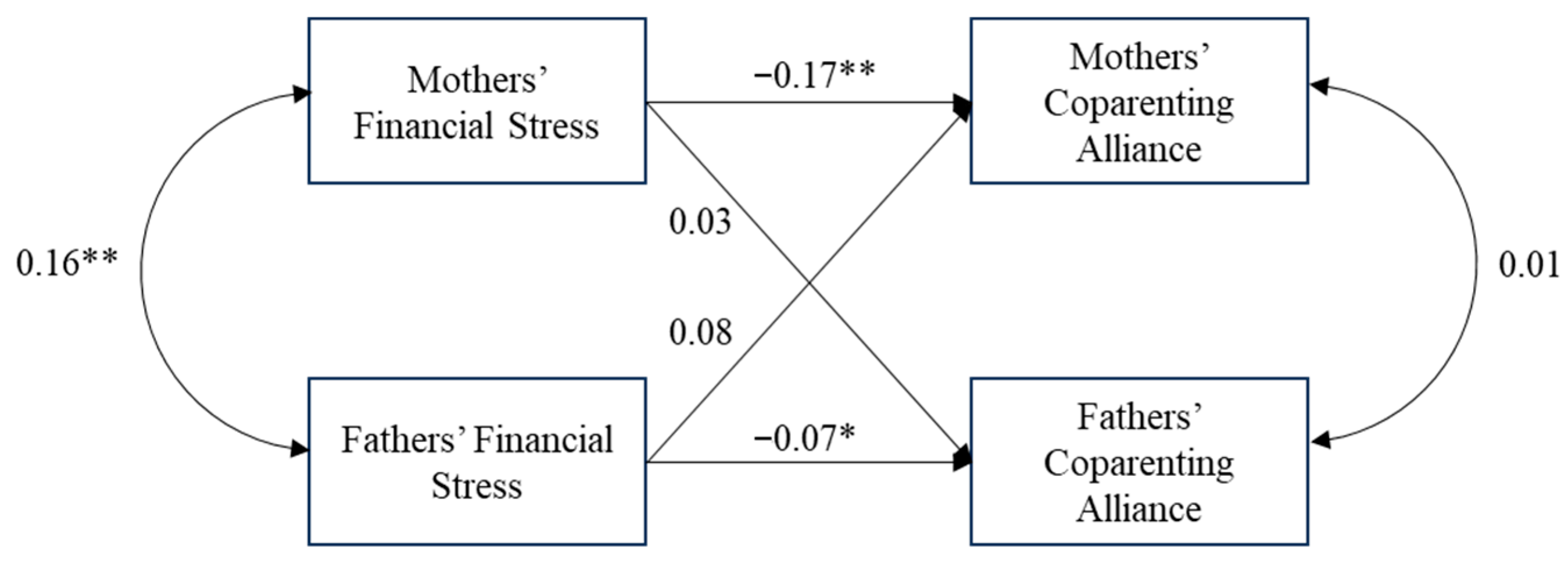
Results showed significant actor effects for mothers and fathers (See
Figure 1). There were no significant partner effects for mothers or fathers. Our results indicate that mothers’ and fathers’ perceptions of financial stress relate to their own report of coparenting alliance but do not relate to their partner’s report of coparenting alliance.
To test if the association between financial stress and coparenting alliance was different for fathers and mothers, we constrained mothers’ and fathers’ actor effects to be equal and compared this model with the previous freely estimated model. Next, we constrained mothers’ and fathers’ partner effects to be equal and compared this model to the base model. The chi-square difference test was non-significant for actor effects (p = 0.06) and partner effects (p = 0.44), meaning actor and partner effects for mothers and fathers were not different.
Next, we examined if associations between financial stress and coparenting alliance were different between dyads based on the characteristics of the relationship (i.e., cohabiting or married) and parenting context (i.e., parenting status and baby’s birth status). Three additional models were fit, each including an interaction term to test for moderation. Each moderated model showed decreased fit compared to the base model, indicating that none of the grouping variables moderated the association of financial stress with coparenting alliance.
4. Discussion
The purpose of this study was to explore whether financial stress relates to coparenting alliance quality among lower-income parents with or expecting a new baby and whether the strength of the association differed across several individual and contextual factors. Given that financial stress can strain family relationships (
Dai et al., 2022;
Marcil et al., 2020) and effective coparenting has been linked to a host of important child outcomes (
Teubert & Pinquart, 2010), this study addresses an issue of importance to parents, children, and home visitors and other family service providers who work to establish and maintain positive coparenting alliances. The strengths of the present investigation include a relatively large and racially/ethnically diverse sample of lower-income couples and the explicit focus on the window of time around the birth of a new baby. Regarding our primary research question, both men’s and women’s financial stress was negatively related to their own reported coparenting alliance quality. This was expected given that family systems theory suggests external stressors cause changes in the family and its subsystems (
Bowen, 1978), and the family stress model further suggests economic pressures lead to parental emotional distress, which then strains the quality of coparenting (
Conger et al., 2000;
Masarik & Conger, 2017). Our results are in keeping with
Dai et al. (
2022) and suggest that mothers and fathers may reorganize their coparenting behaviors or interpret the coparenting relationship differently in the presence of financial stressors. It could be that coparenting alliance is one of the mechanisms explaining the reported link between familial financial worry and children’s social and emotional well-being (
McGill et al., 2022). Given that children from economically marginalized families face challenges related to food security, housing stability, and health (
Neckerman et al., 2016), the additional impact of financial strain on coparenting is concerning. Although reviewed research documents the negative association between financial stress and other family processes, this is the first study to focus on financial stress and coparenting quality at this important family transition point as a new baby is welcomed into the family.
Mothers’ and fathers’ reported financial stress was not related to their partner’s report of the coparenting alliance, indicating no significant partner effects. It seems reasonable to expect that the experience of financial stress may lead a person to engage in less supportive and more conflict-related interactions with their partner, which may, in turn, lead to their partner viewing the coparenting alliance as less strong. However, we found no support for that mechanism in the present study. Other researchers have also failed to detect direct partner effects of one parent’s financial stress on the other parent’s report of coparenting support (
Dai et al., 2022). Overall, it could be that financial strain may affect concrete coparenting behaviors expressed in interactions between partners, but global, attitudinal assessments of the quality of the coparenting alliance are not affected. Future research should employ behavioral measures of coparenting (e.g., Coparenting Behavior Coding Scales [CBCS];
McConnell & Kerig, 2002) for a fuller picture.
With regard to mother–father differences, we anticipated a stronger association between financial stress and coparenting alliance for men than women, aligned with traditional gender differences. Contrary to our expectations and the reviewed literature, the relation between financial stress and coparenting alliance was not different for men and women. When interpreting this result, we questioned whether there might still be differences in the level of financial strain reported by men and women. However, a post hoc test suggested that, too, was not the case, as men’s (
M = 1.63;
SD = 0.59) and women’s (
M = 1.58;
SD = 0.55) financial strains did not differ (
t(426) = 0.94,
p = 0.34). Instead, our results suggest that, perhaps, modern heterosexual couples may be undoing those traditional roles (
Risman, 2009), and gendered expectations related to breadwinning and caretaking may be waning. It is also important to acknowledge that the present study measured perceived financial stress rather than objective financial status, which may attenuate the associations between gender, financial stress, and coparenting alliance. Additionally, the relative homogeneity of our sample with regard to both income and family functioning may have limited our ability to detect differences that may be present in a more diverse sample. Overall, our results suggest that mothers and fathers who are welcoming a baby to the family react similarly in the context of financial stress, specifically that greater financial stress relates to lower coparenting alliance quality for both mothers and fathers.
In the present study, the relation between financial stress and coparenting alliance was not different for married and cohabiting couples.
Dai et al. (
2022) similarly found that marital status (i.e., married versus cohabiting) did not moderate the relations between financial distress, conflict management, and coparenting support in their model. This result is also in keeping with the results of a prior study from our data (
Renegar et al., 2023), indicating no significant differences in couple conflict or relationship quality between married and cohabiting couples. Although a growing body of literature suggests similar processes among married and cohabiting couples (
Sassler & Lichter, 2020), we still wondered whether marriage may offer financial, legal, and social support that is not afforded cohabiting couples and might, therefore, provide a different context for financial stress, particularly with a new baby; however, we did not find evidence for that supposition. Many American adults now view cohabitation as a pathway to marriage (
Pew Research Center, 2019); thus, family processes may play out similarly within cohabiting and married couples. Additionally, when differences are detected between married and cohabiting couples’ parenting decisions (cf.,
Hastings & Schneider, 2021), it is possible these differences reflect a selection effect whereby higher-income couples have more access to the institution of marriage (
Sassler & Lichter, 2020). In our homogenous, lower-income sample, this selection effect would be mitigated. As was the case with the lack of gender differences, the lack of marital status differences may be, in part, a function of the homogeneity of our sample and/or the restricted variability of our coparenting alliance measure.
Regarding the parenting context, we found that the relation between financial stress and coparenting alliance was similar for couples who were pregnant and those who had recently given birth. Similarly, no differences were found between first-time parents and experienced parents. It could be that financial strain confers ubiquitous, deleterious effects regardless of parenting context. However, there is more complexity in the parenting context than we were able to capture in this study. We initially preferred to study financial stress and coparenting alliance for couples transitioning to parenting compared to others; however, limitations in our data, as well as family structure complexities (many couples included one parent who had children with a previous partner), led us to instead study two alternative parenting context distinctions. Even so, our study provides limited evidence that couples in various parenting contexts may experience the financial strain’s effect on coparenting alliance similarly.
This study is limited in several ways. First, although a primary strength of our sample is the availability of dyadic data from lower-income couples, the lack of income variability in our sample left us unable to explore the role of objective financial constraints in concert with perceived financial strain. Second, the results of this study may not generalize to lower-income families in Tennessee or to families receiving home visiting in Tennessee. The process of recruiting participating fathers through the home-visited mother resulted in a population in which mothers and fathers were generally married, cohabiting, or coparenting collaboratively. The experience of financial stress and its association with coparenting may be different in lower-income families who are not enrolled in home visiting or who are not on good enough terms that the mother would extend the offer to participate in the program to the father. Third, this study used cross-sectional data to avoid restricting the sample to control condition participants only, given that those in the treatment condition received financial literacy and coparenting education. Thus, the results of this study should not be interpreted as strong evidence of a causal mechanism. Fourth, we were not able to model many of the complexities of the parenting context. Future research should seek to capture various aspects of diversity with regard to identity and context that we were unable to model with the present data. Fifth, although this study employed a reasonably sized sample, the restricted variability in the dependent variable (coparenting alliance), coupled with group splits (married vs. cohabiting; first-time vs. experienced parents), may have left the analyses underpowered to detect subtle moderation effects. Last, it is possible that our detected actor effects were inflated due to the same source bias, given that this study relies exclusively on self-report measures.
Implications for Policy and Practice
A healthy coparenting relationship is important for family functioning (
Teubert & Pinquart, 2010); thus, public policy and family life education, including home visitation services, should address known risks to positive coparenting, such as financial stress. One policy approach involves reducing financial stress for lower-income families via direct distribution of cash benefits, which have been found to allow parents to act and spend in their children’s best interest (for a review, see
Gennetian & Magnuson, 2022). For example, in a randomized controlled trial,
West and Castro (
2023) found that a guaranteed income of USD 500 per month resulted in improved financial and physical well-being for the participants. It is likely that having additional money to direct as needed would reduce financial strain, which may, therefore, improve the quality of the coparenting alliance. Future research should examine whether policies that alleviate financial stress, such as guaranteed income, tax credits, or child allowances, produce measurable improvements not only in individual well-being but also in relational outcomes like coparenting quality. Beyond documenting associations, longitudinal and experimental designs could clarify the mechanisms through which financial supports strengthen coparenting, such as reductions in parental conflict or enhanced shared decision-making. In practice, this line of inquiry could inform the integration of financial supports with family-based interventions, creating a two-pronged approach that addresses both economic and relational dimensions of family life.
In addition to increasing parents’ income through public policies, family service professionals can increase parents’ financial literacy (
Friedline & West, 2016), which may also lead to reduced financial stress. This kind of education could help parents better direct existing resources and also feel less overwhelmed by money management challenges, resulting in more positive perspectives on coparenting support and quality. Financial education may be particularly important during pregnancy and when parenting young infants, given the enhanced financial stressors of this time period (
Taylor et al., 2021). Lastly, the present study demonstrated that financial stress is related to reduced quality of the coparenting alliance for both mothers and fathers in all kinds of family structures and parenting contexts, suggesting that family life educators may not need to tailor their programming for specific audiences but can, instead, move forward with broad educational materials to improve financial literacy, reduce financial stress, improve coparenting, and improve related child outcomes in economically marginalized families. Addressing financial literacy, financial stress, and coparenting quality together acknowledges the interconnected nature of these issues. It supports a more holistic approach to family support, recognizing that financial well-being and coparenting quality are mutually influential.