Article

Extended Gauss Iterative Map: Bistability and Chimera States

by
Derik W. Gryczak
1,*,
Ervin K. Lenzi
1,2 and
Antonio M. Batista
1,3
1
Graduate Program in Science, State University of Ponta Grossa, Ponta Grossa 84030-900, Brazil
2
Department of Physics, State University of Maringá, Maringá 87020-900, Brazil
3
Department of Mathematics and Statistics, State University of Ponta Grossa, Ponta Grossa 84030-900, Brazil
*
Author to whom correspondence should be addressed.
Complexities 2025, 1(1), 4; https://doi.org/10.3390/complexities1010004
Submission received: 21 September 2025 / Revised: 31 October 2025 / Accepted: 7 November 2025 / Published: 13 November 2025

Abstract

We investigate an extended Gauss iterative map by incorporating the q-exponential function, a key component of the Tsallis framework. This extension enables us to investigate the non-linear dynamics of the Gauss iterative map across a broader range of scenarios, encompassing periodic, chaotic, and bistable behaviors. Regular and chaotic phenomena have been observed in coupled systems. In this context, we propose a network of coupled extended Gauss iterative maps. In our network, we found the emergence of chimera states, characterized by the coexistence of coherent and incoherent behaviors. These states are identified within specific parameter regimes using Gopal’s metric. In this work, we show the interplay between chaos and emergent collective dynamics in coupled extended Gauss iterative maps.

1. Introduction

Discrete maps are among the simplest and most fundamental systems that exhibit chaotic behavior, in which even slight variations in initial conditions can lead to significantly different outcomes during simulations. This sensitivity to initial conditions, a hallmark of chaos, introduces high unpredictability, making chaos a key focus in numerous fields, including physics, biology, and mathematics.
In the broader context of dynamical systems, a wide array of phenomena can be observed across various fields of physics. Classical examples include pendulums [1], harmonic oscillators [2], attractors [3], and fluid dynamics, each exhibiting unique and intricate behaviors that highlight the depth of dynamical systems theory. Moreover, many systems exhibit co-dependencies through networks that emerge from long-range [4] and short-range [5] interactions. The dynamics of such interconnected systems are of significant interest, particularly in the study of chaos and its underlying mechanisms.
Due to their simplicity and versatility, chaotic maps are often employed as model systems to investigate the properties of emergent networks [6,7]. They provide a tractable framework for exploring complex behaviors, such as clustering and synchronization [8], pattern formation [9], and phase transitions [10], among others. Such properties are central to understanding the collective dynamics of interconnected systems.
Networks of coupled non-linear systems can exhibit a spatiotemporal coexistence of chaotic and regular structures [11], known as chimera states. Chimeras challenge the conventional expectation of uniformity in coupled systems and have been observed in a diverse range of networked systems. Examples include coupled chaotic oscillators, neuronal networks [12,13], and chaotic map networks [14]. Their discovery has significantly advanced our understanding of the interplay between coherence and incoherence in complex dynamical systems. From a biological perspective, chimera states have been associated with functional asymmetries in neural activity and other crucial physiological processes. The relevance of chimera states underscores the importance of understanding hybrid dynamical regimes in real-world systems, where localized synchronization coexists with desynchronized behavior.
The description of complex systems presents a challenge, motivating the development of many formal aspects. One is the Tsallis framework, which generalizes the Boltzmann–Gibbs entropy by introducing a parameter q that quantifies the degree of nonextensivity. This formulation is especially suitable for systems with long-range interactions [15,16,17], multifractal structures [18] or memory effects, features commonly encountered in chaotic [19,20,21,22,23] and networked dynamical systems [24]. Applications of Tsallis statistics have shed light on anomalous diffusion, fractal basins, and transitions to chaos in low-dimensional maps. It provides a framework for modeling the emergence of order and complexity in systems that deviate from the classical assumptions of extensivity and ergodicity.
In this work, we demonstrate that the parameter q plays a crucial role in the dynamics of the extended Gauss iterative map and in its dynamics when coupled through nonlocal interactions. The map exhibits rich dynamical behavior, including periodic and chaotic attractors and period-doubling routes to chaos. Depending on the parameters and initial conditions, we identify that the map solution can switch between periodic and chaotic attractors, i.e., bistability. Regarding the network, we observe the emergence of chimera states as we vary the coupling strength and the number of coupled neighbors.
The paper is structured as follows. In Section 2, we provide an overview of the key characteristics of the Tsallis framework, which serves as the foundation for our study. We extend the classical Gauss map (often referred to as the mouse map) by incorporating the q-exponential derived from the Tsallis formalism. In this section, we also calculate the Lyapunov exponent and present our results in relation to the map. In Section 3, we present the coupling scheme and its results, and in Section 4, we discuss the implications of our results and present our concluding remarks.

2. Extended Gauss Iterative Map

In Section 2.1, we present key aspects of the Tsallis formalism and extend the standard mouse map by incorporating the q-exponential. The results of this analysis are discussed in Section 2.2.

2.1. Map Dynamics

One of the primary challenges in statistical mechanics is describing macroscopic behavior in terms of microscopic dynamics. This point has always promoted intense discussion in many aspects, connecting statistical mechanics with thermodynamics, which resulted in the well-known Boltzmann–Gibbs statistical mechanics based on the entropy:
S B G = k B i p i ln p i ,
where p i represents the probability of a microstate and k B is the Boltzmann constant. It has been successfully applied to various phenomena, including both classical and quantum contexts. On the other hand, in the case of long-range interactions, such as self-gravitating systems and anomalous correlated diffusion, which constitute a large class of systems, difficulties have been found with the standard approach. To overcome the difficulties inherent to the nature of the system, Tsallis’ formalisms introduced the Tsallis entropy [25,26]:
S q = k 1 i p i q q 1 ,
where q is the entropic index that characterizes the degree of nonextensivity. For instance, for two independent systems A and B , the entropy satisfies the pseudo-additivity rule [27]: S q A B = S q A + S q B + ( 1 q ) / k S q A S q B which accounts for correlations between subsystems. In the limit q 1 , the Tsallis entropy is reduced to the Boltzmann–Gibbs entropy, recovering classical statistical mechanics. By applying the maximum principle in Equation (2) subjected to the constraints
U q = i E i p i q i p i q and i p i = 1 ,
yields
p i = 1 Z q exp q β ˜ E i U q ,
with β ˜ = β / i p i q and the partition function
Z q = i exp q β ˜ E i U q .
In the previous equation, we have the function exp q ( x ) , which is defined as follows:
exp q ( x ) = ( 1 + ( 1 q ) x ) 1 1 q x 1 / ( q 1 ) 0 x < 1 / ( q 1 ) .
Note that we have a cut-off point to retain the probabilistic interpretation of the distributions that emerge from the maximum principle of entropy. The Tsallis framework has been successfully applied in diverse fields, demonstrating its versatility in modeling complex and correlated systems. For instance, it has been successfully applied in econophysics [28], plasma physics [29], biological systems [30], astrophysics [31], system with long-range interactions [32]. For discrete maps, such as the logistic and Henon maps and their unimodal generalizations, transitions from regular to chaotic regimes occur, as well as critical regions where Tsallis entropy may offer a more suitable characterization of the dynamics than Shannon entropy. At the transition point to chaos, known as the Feigenbaum edges, the Tsallis entropy with an index q 1 can effectively capture the anomalous sensitivity to initial conditions and the non-Gaussian distribution of the states visited, revealing connections between discrete chaotic dynamics and the theoretical framework of non-extensive statistical mechanics. Additionally, the Gauss iterative map,
x n + 1 = exp ( α x n 2 ) + β ,
can be used as an alternative to the logistic map to study transitions to chaos (period doubling, Feigenbaum route), investigate sensitivity to initial conditions, and fractal structures in time series. It can also generate non-Gaussian probability distributions connected to the Tsallis approach, providing a suitable context for analysis.
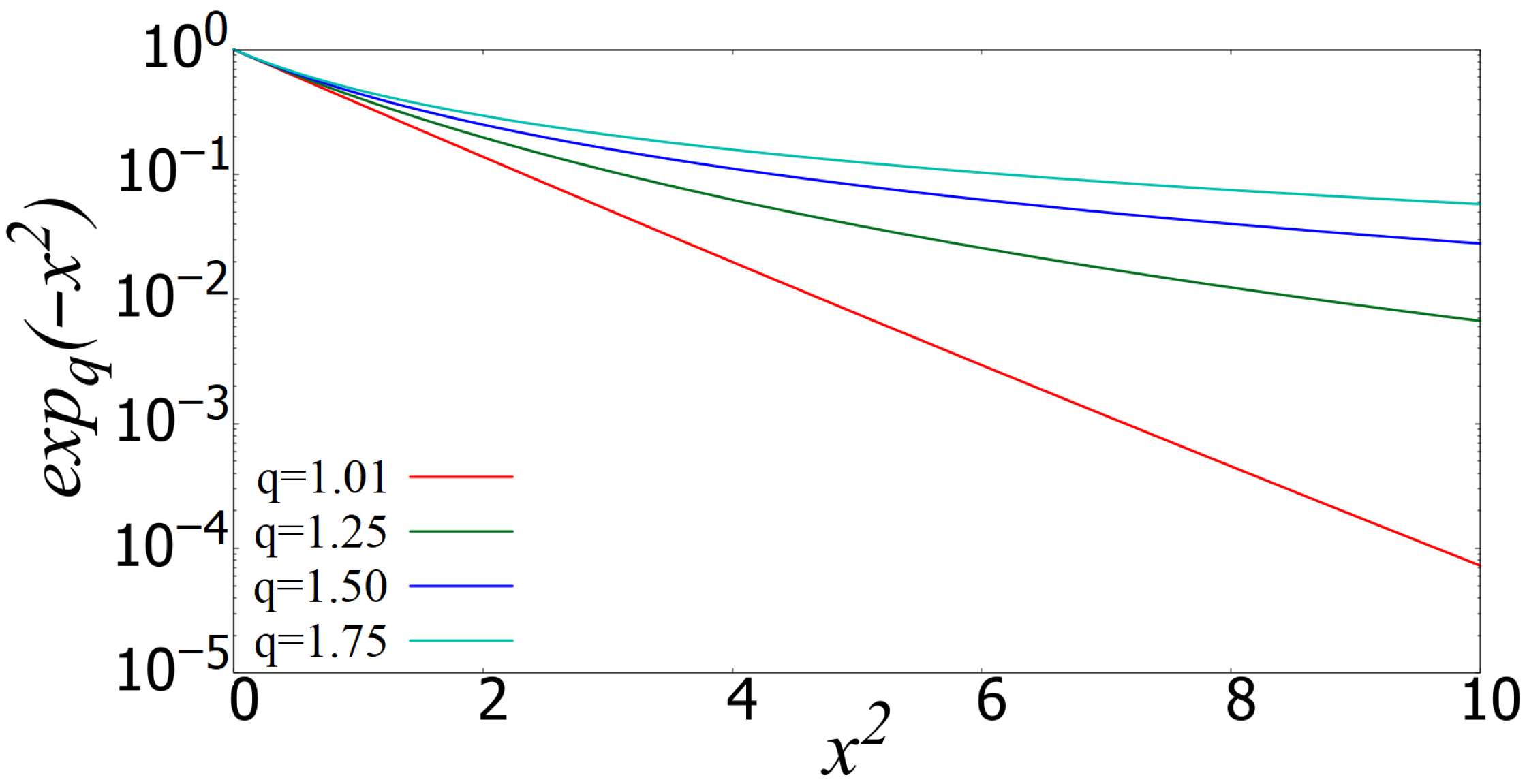
Motivated by the rich class of behaviors manifested by the q-Gaussian, i.e., short and long tailed behaviors (see Figure 1), which can be related to different distributions such as the Lévy distributions in the asymptotic limit [33], we extend the exponential of Equation (7) to the q-exponential, resulting in a q-Gaussian in Equation (8), i.e.,
x n + 1 = exp q α x n 2 + β = f ( x n ) ,
which opens up new possibilities for the application of the Gauss iterative map by incorporating the class of behaviors present in the q-Gaussian. In fact, the extended Gauss iterative map can provide a unifying discrete framework for studying how nonextensive effects, encoded by the parameter q, control the transition between periodic, chaotic, and chimera-like regimes. Since the parameter q can modulate the degree of correlation and non-Gaussianity, this approach can also enable parallels with systems exhibiting long-range interactions, memory effects, or collective synchronization. Specifically, in the study of chaos, the Lyapunov exponent is a fundamental concept for analyzing its behavior, measuring how much an infinitesimal increment in position affects future measurements. For a time discrete equation, it is defined as follows:
λ = lim N 1 N n = 0 n = N 1 ln ( f ( x n ) ) .
For Equation (8), in our simulations, λ becomes:
λ = lim N 1 N n = 0 n = N 1 ln 2 α x n exp q α x n 2 q .
By using logarithm properties, Equation (10) can be written as
λ = ln 2 α + lim N 1 N n = 0 n = N 1 ln x n + q q 1 ln 1 + ( q 1 ) α x n 2 .
We may develop Equation (11) further considering the case where q 1 :
F ( q ) = q q 1 ln 1 + ( q 1 ) α x n 2 , let γ = α x n 2 , then F ( 1 ) = lim q 1 q q 1 ln 1 + ( q 1 ) γ .
Since both the numerator and denominator go to zero as q goes to one, we may use L’Hôpital’s rule:
F ( 1 ) = lim q 1 d d q q ln 1 + ( q 1 ) γ d d q q 1 , = lim q 1 ln 1 + ( q 1 ) γ + q γ γ ( q 1 ) + 1 , = ln 1 + γ = α x n 2 .
Therefore, λ ( q = 1 ) can be written as:
λ ( q = 1 ) = ln 2 α + lim N 1 N n = 0 n = N 1 ln x n + α x n 2 .
It is worth mentioning that transient steps must not be included in the averaging process for the Lyapunov exponent. In this work, the first 2 × 10 3 steps were discarded, and 10 4 were used to compute λ .
Regarding Equation (8), we can also compute k-periodic orbits by considering the equations:
f ( x ) = exp q α x n 2 ; f 2 ( x ) = f ( f ( x ) ) , f k ( x ) = f ( f ( . . . ) ) .
And for f k ( x ) = x , the solution is a fixed point for k = 1 or a k-periodic orbit for k 1 . For some q, we can find fixed points analytically, for example, let us consider q = 2 :
f ( x ) = x x = ( 1 + ( q 1 ) α x 2 ) 1 q 1 + β = ( 1 + α x 2 ) 1 + β x ( 1 + α x 2 ) = 1 + β ( 1 + α x 2 ) 0 = α x 3 β α x 2 + x ( β + 1 )
Fixed points can be tested for stability by considering it’s derivative, let x ^ be a fixed point, if | f ( x ^ ) | < 1 then x ^ is a sink (stable), if | f ( x ^ ) | > 1 then it is a source (unstable) and if | f ( x ^ ) | = 1 then the result is inconclusive and must be tested.

2.2. Extended Gauss Iterative Map Dynamics

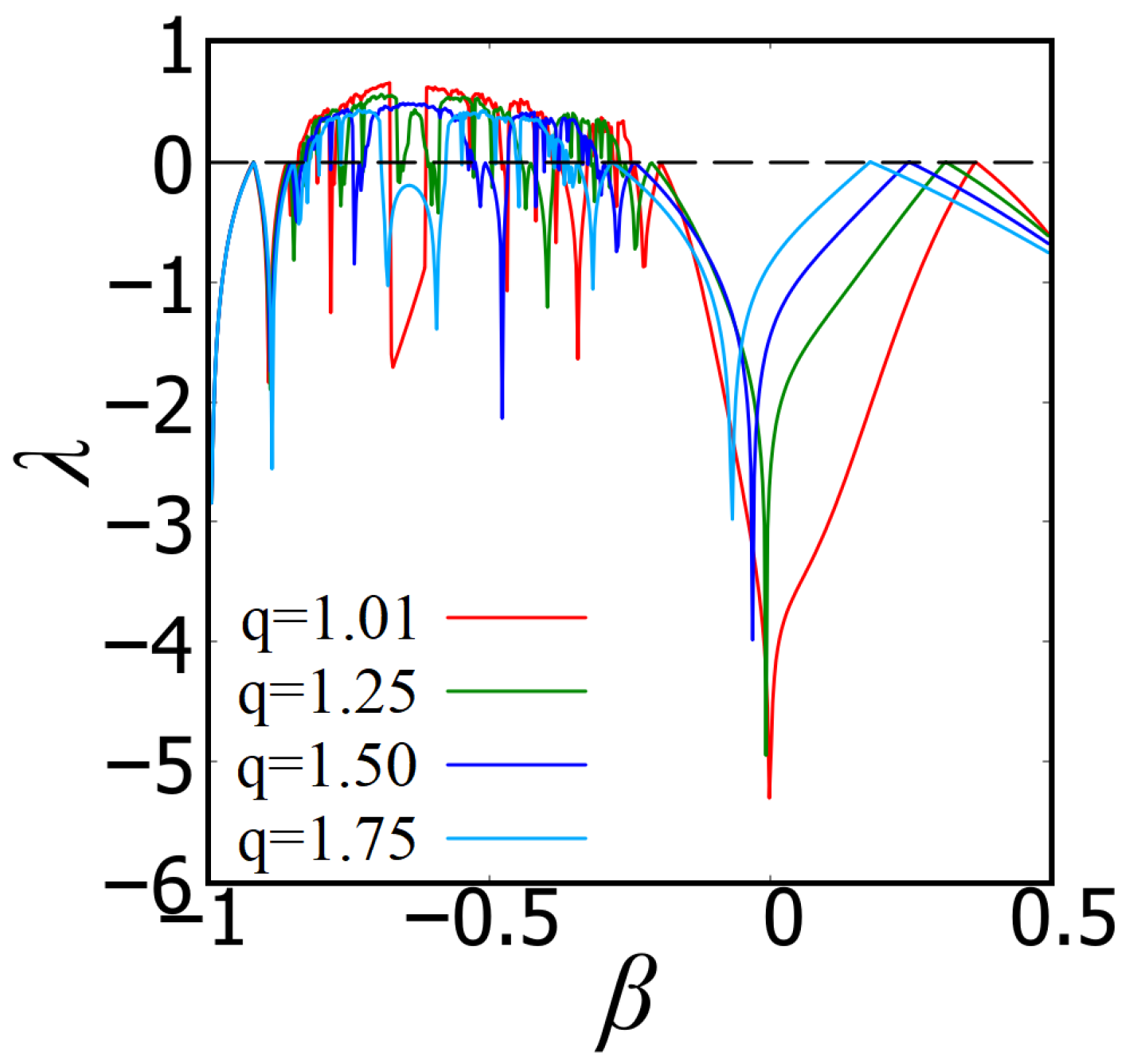
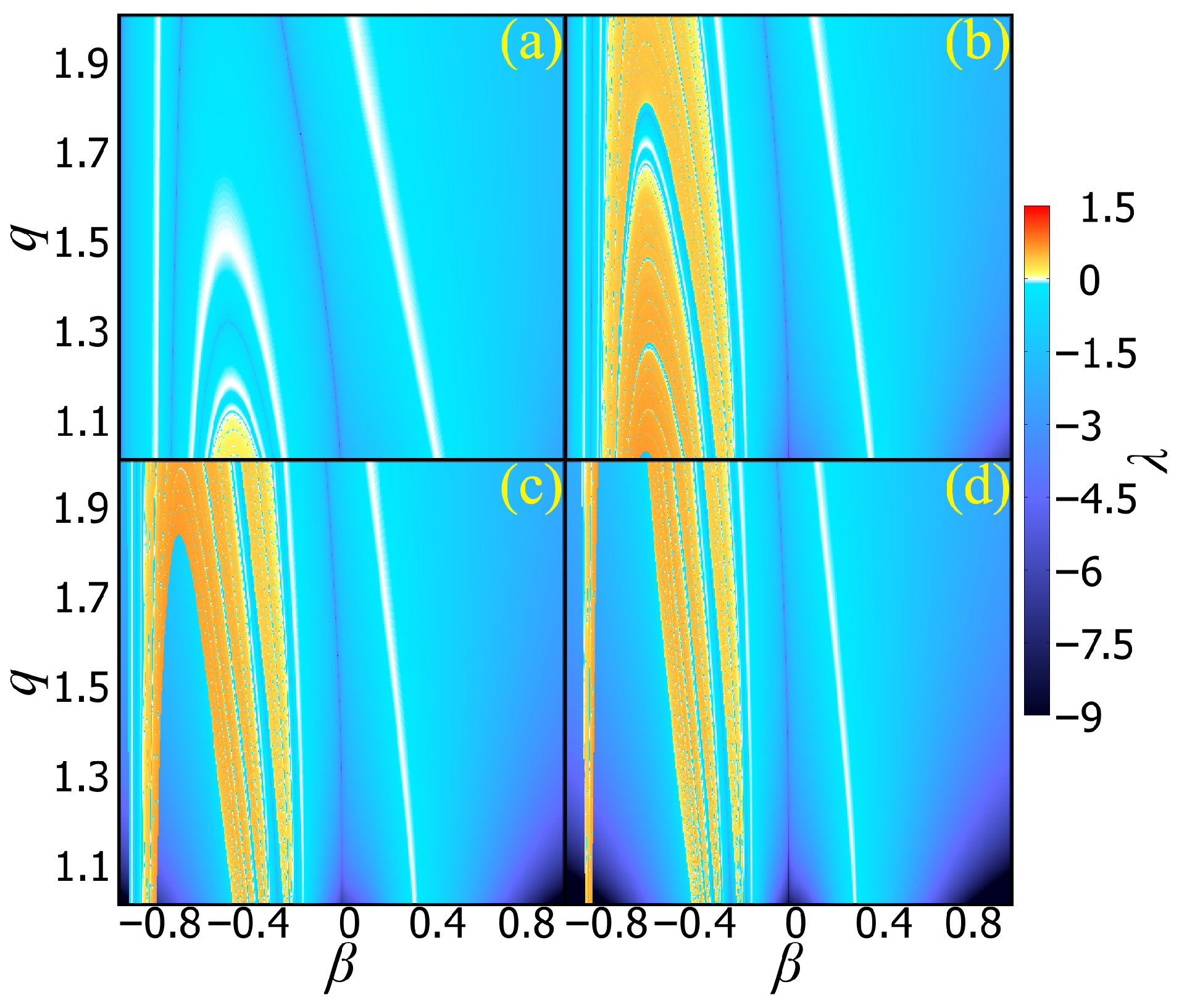
A complex dynamical behavior arises in both standard and extended Gauss iterative maps, characterized by the presence of chaotic and stable regions. As illustrated in Figure 2, the interplay between stable and chaotic regimes exhibits significant diversity as a function of q. In Figure 3 we compute the Lyapunov exponent λ by varying q and β for α equal to 5, 10, 15, and 20, as shown in panels (a), (b), (c), and (d), respectively. We observe that an increase in q requires higher values of α for the emergence of a chaotic regime. Faster tail decay is an important factor in the existence of chaos.
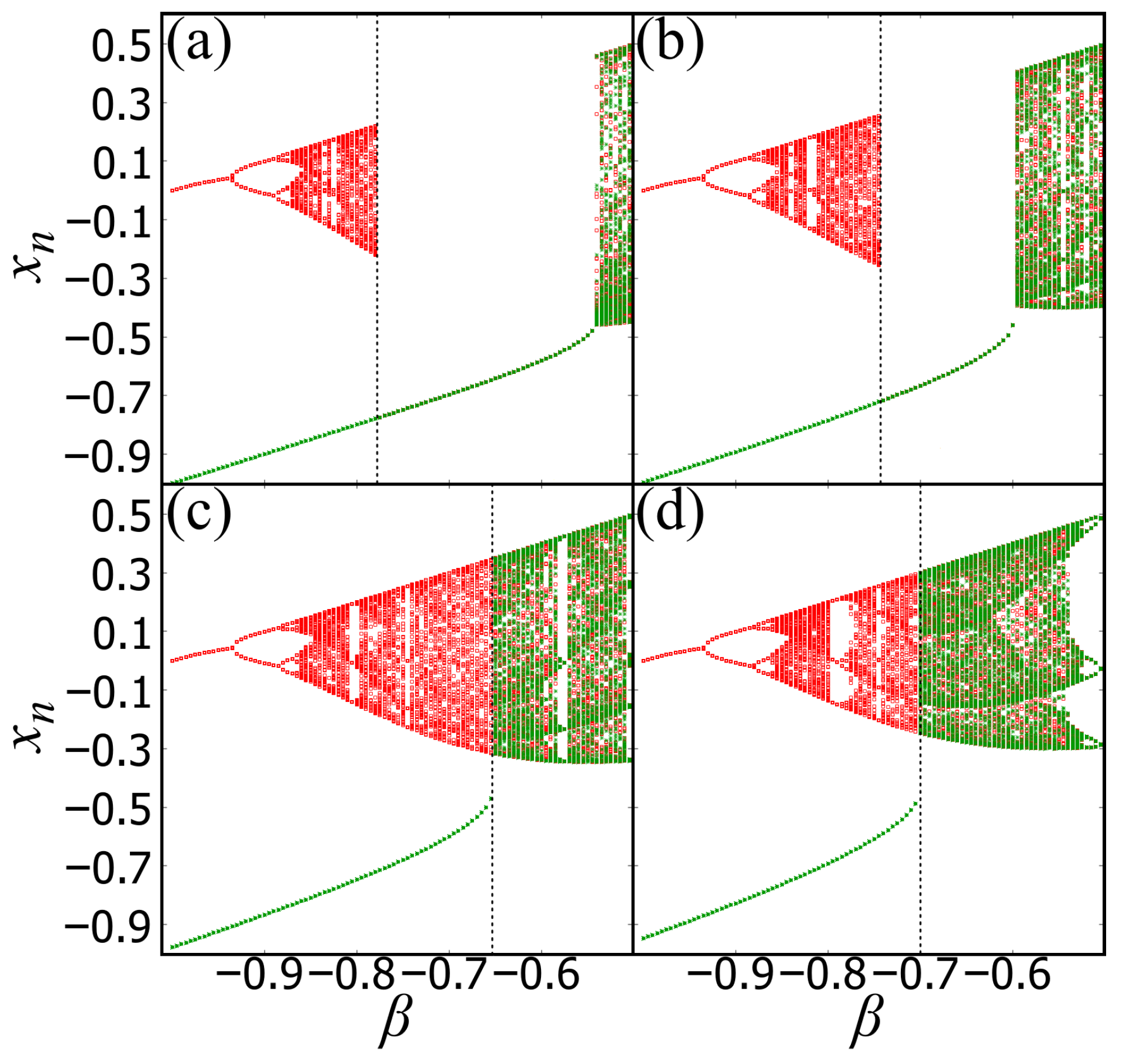
In Figure 4, we compute the bifurcation diagram by varying β for α = 12 , (a) q = 1.01 , (b) q = 1.25 , (c) q = 1.50 , and (d) q = 1.75 . The diagram shows a period-doubling bifurcation cascade, periodic orbits, and chaotic attractors. It is possible to observe the presence of bistability, which is the existence of two distinct attractors. Due to this fact, there are two distinct Lyapunov exponents for small values of β . We find a threshold or critical point (black dashed line), known as the tipping point, in which the system switches between a fixed point and a chaotic attractor with small changes in β .

3. Network of Coupled Maps and Chimera States

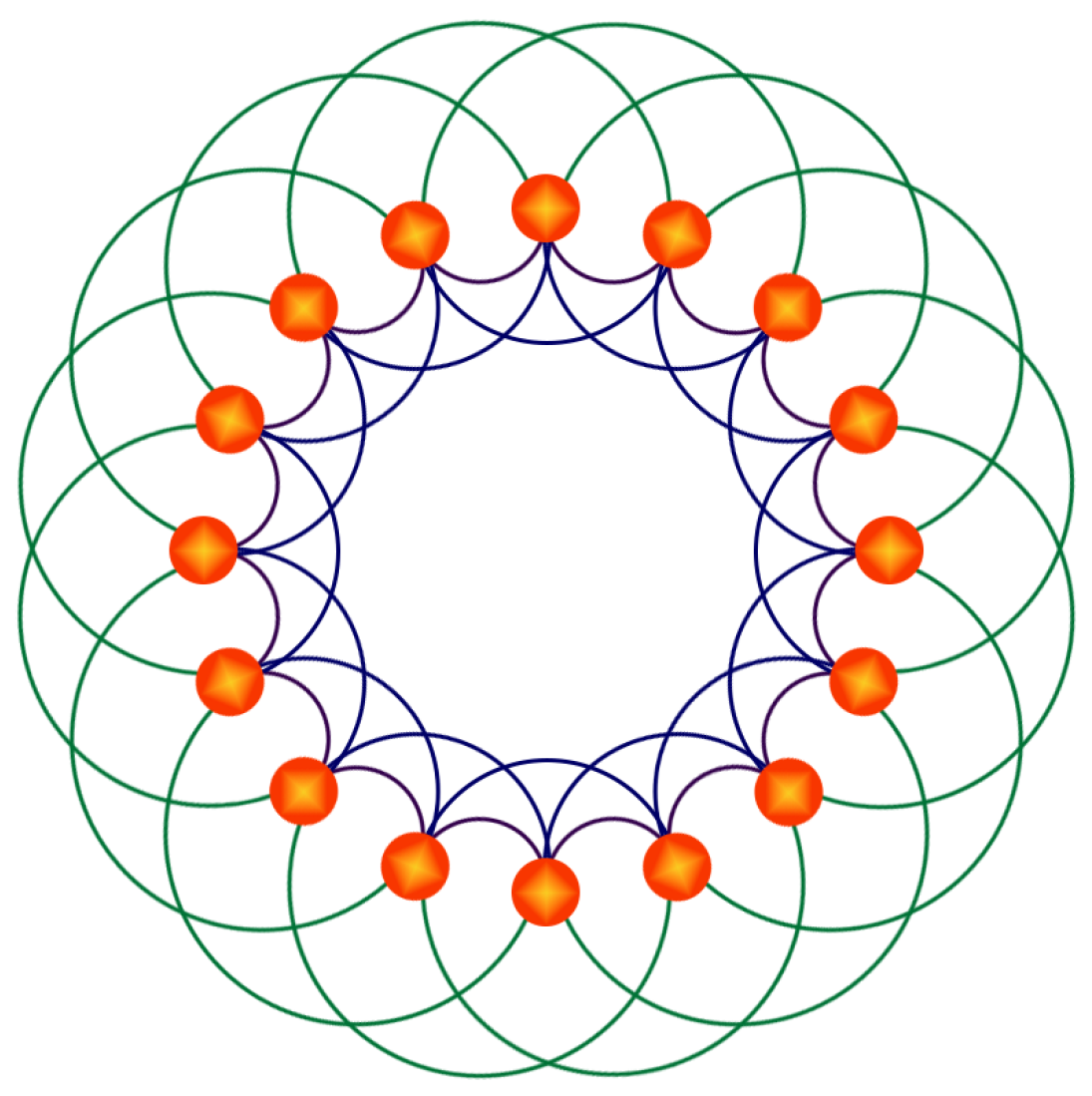
We study a periodic network of coupled extended Gauss iterative maps, as displayed in Figure 5. The coupled map network equation is given by:
x i , n + 1 = ( 1 ϵ ) f i , n + ϵ 2 R j = R R ( f i + j , n ) ,
where
f i , n = [ 1 + ( q 1 ) α x i , n 2 ] 1 1 q + β ,
x i , n is the variable at time n, i is the map index ( j 0 ) and ϵ is the coupling strength between the map and its R neighbors.
We investigate the coexistence of incoherent and coherent states using the incoherence metric introduced by Gopal [34,35]. It involves the partition of the network with G s nodes into M slices containing w = G s / M elements. By partitioning the system into slices, we see the interplay of its elements, a necessary step in evaluating the existence of chimera states. To do that, we compute the local standard deviation χ m , n :
χ m , n = 1 w j = m w ( m + 1 ) w 1 z j , n z m 2 , χ m = χ m , n t .
where m is the slice index and z j , n = x i , n x i + 1 , n and z m is the space average of z j , n m . We continue with the local coherence state, which is given by:
S m = H { δ χ m } ,
where δ is a cutoff and H is the Heaviside step function:
H { δ χ m } = 1 , δ χ m > 0 0 , δ χ m 0 .
Then, the incoherence metric is calculated as follows:
S I = 1 1 M m = 0 m < M S m .
The S I metric provides a quantitative measure of the coherence or incoherence of coupled oscillator systems. When S I = 0 , the system achieves perfect synchronization, indicating that all oscillators share the same phase or state, resulting in fully coherent and uniform dynamics. On the other hand, when S I = 1 , the system is in a state of complete incoherence, where each oscillator operates independently. For values of S I between 0 and 1, coherence coexists with incoherence. The oscillators with identical coupling conditions spontaneously divide into coherent and incoherent subpopulations.
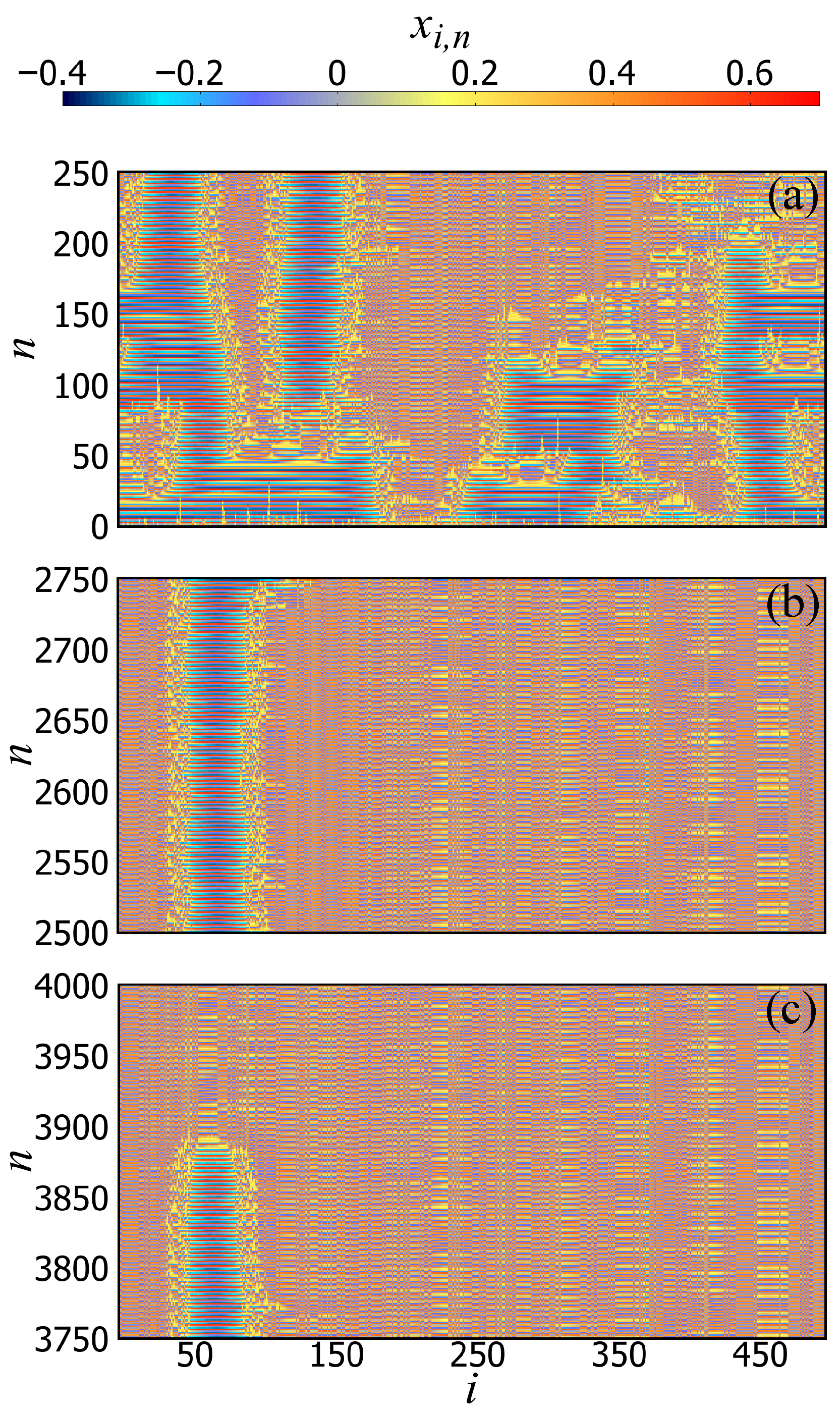
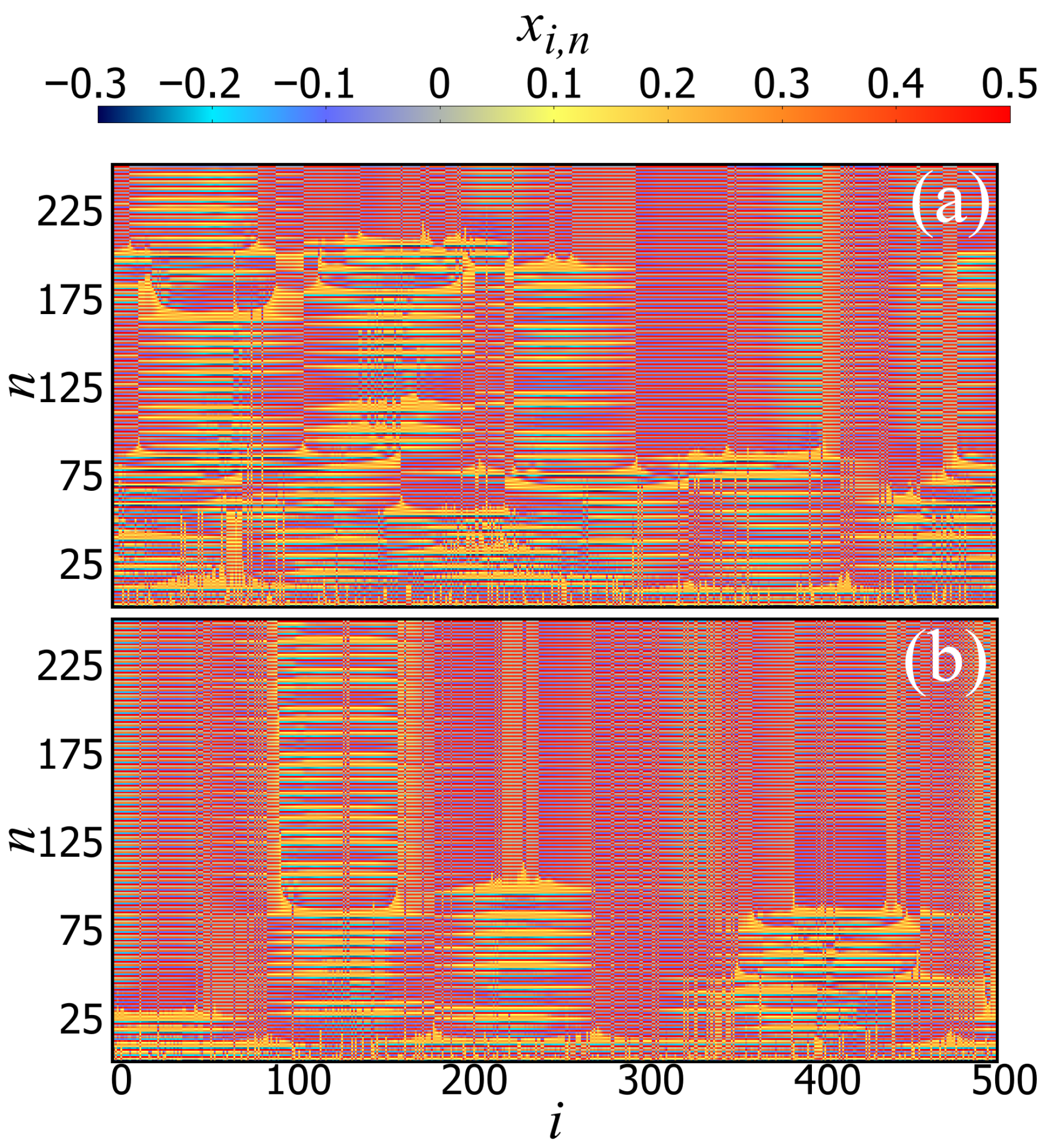
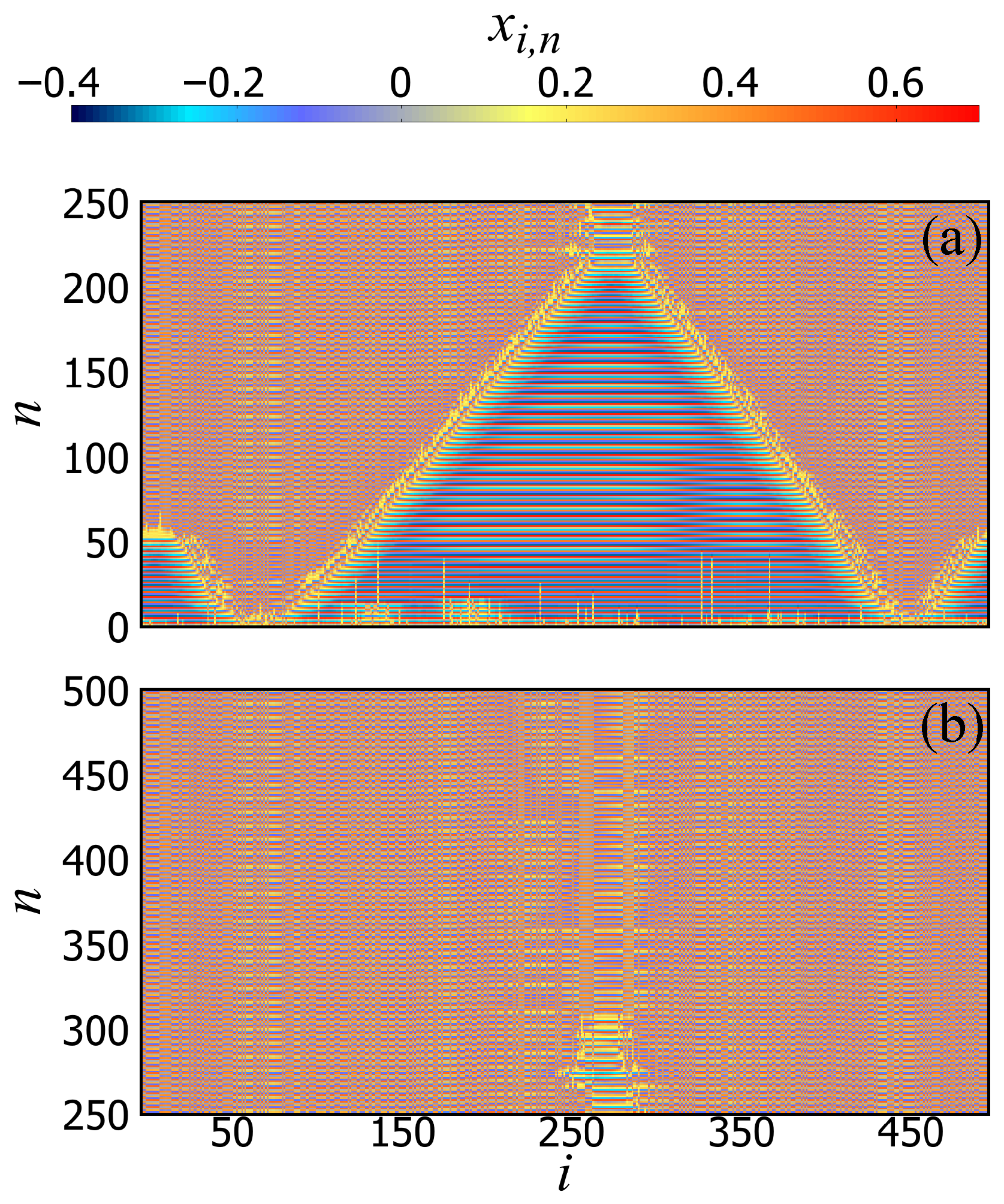
Chimera states are inherently unstable phenomena that often emerge as transient dynamics over time. We investigate the diversity of chimera states considering the S I metric. Figure 6 displays the time series of two simulations for identical parameters and different initial conditions, resulting in S I = 0.30 and S I = 0.70 . These simulations reveal different dynamical behaviors. For S I = 0.30 , the network exhibits a prolonged transient, taking approximately 225 steps to reach equilibrium, while for S I = 0.70 , it achieves equilibrium significantly faster, requiring only 60 steps. A lower value S I (closer to synchronization) corresponds to a slower convergence to equilibrium, reflecting the persistence of coherent structures. In contrast, a higher S I value (closer to incoherence) leads to a faster equilibration, indicative of weaker coherence and stronger disorder. Other simulations with different parameters can be seen in Appendix A.
Chimera states are observed most readily in simulations where S I is approximately 0.5, indicating a balanced coexistence of coherence and incoherence. However, our findings reveal that no universal combination of parameters R (coupling distance) and ϵ (coupling strength) consistently produces such states. This is due to a variation in the distribution of S I , which is highly sensitive to other parameters such as q, α , and β .
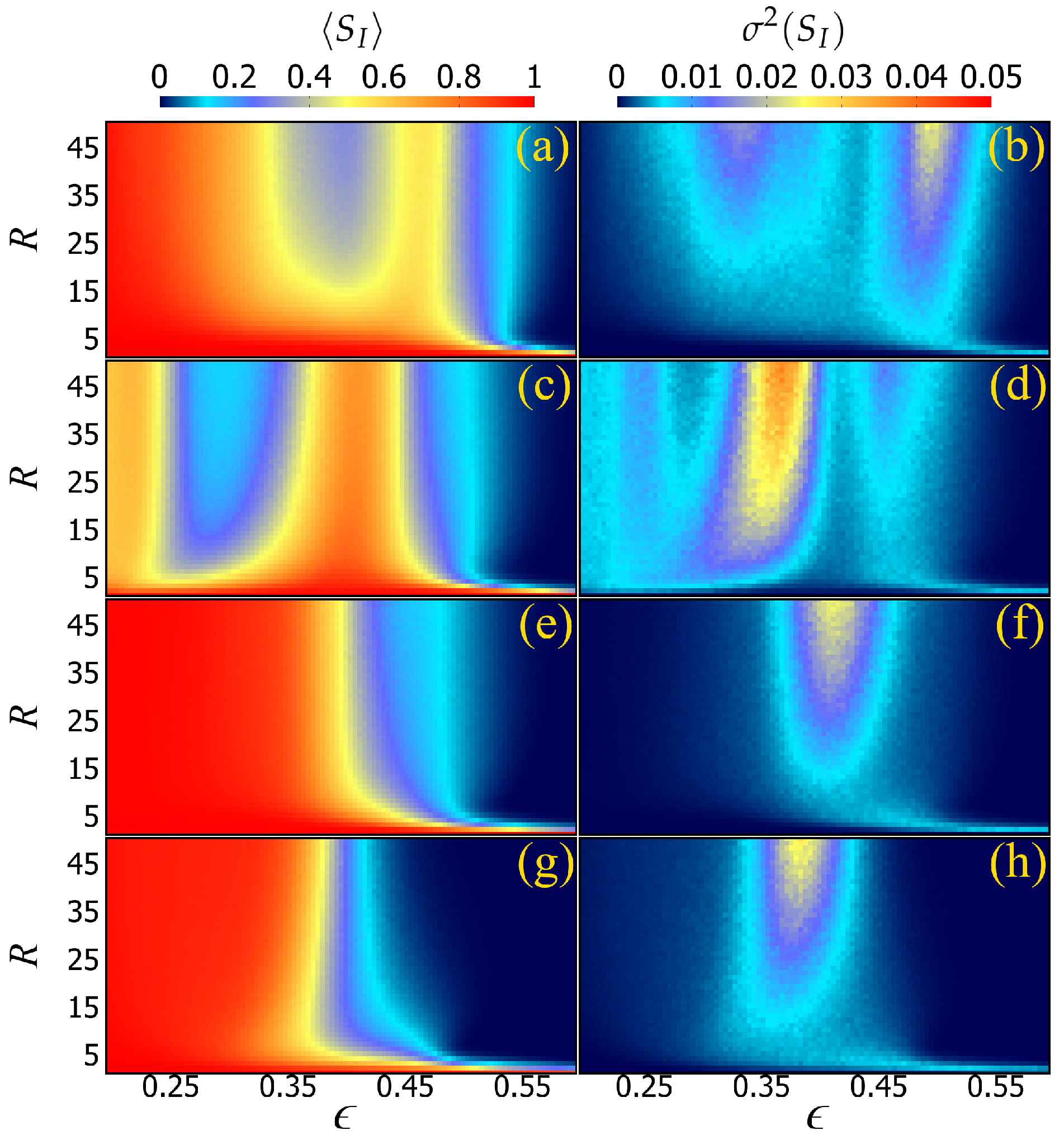
We observe two distinct patterns in the transition between chaotic and stable regions for the parameter space of ( ϵ , R ). The first pattern is characterized by a single interface between coherent and incoherent domains, which is evident for q = 1.5 (Figure 7). The second pattern, featuring a double interface structure, emerges for q = 1.01 (Figure 7). Another important observation is the role of the coupling distance R. Although R has a lower influence on the mean S I when it is sufficiently large, it can significantly affect the quadratic deviation of S I . Specifically, larger values of R tend to produce a broader range of S I values, indicating greater variability in the balance between coherence and incoherence in our simulations.
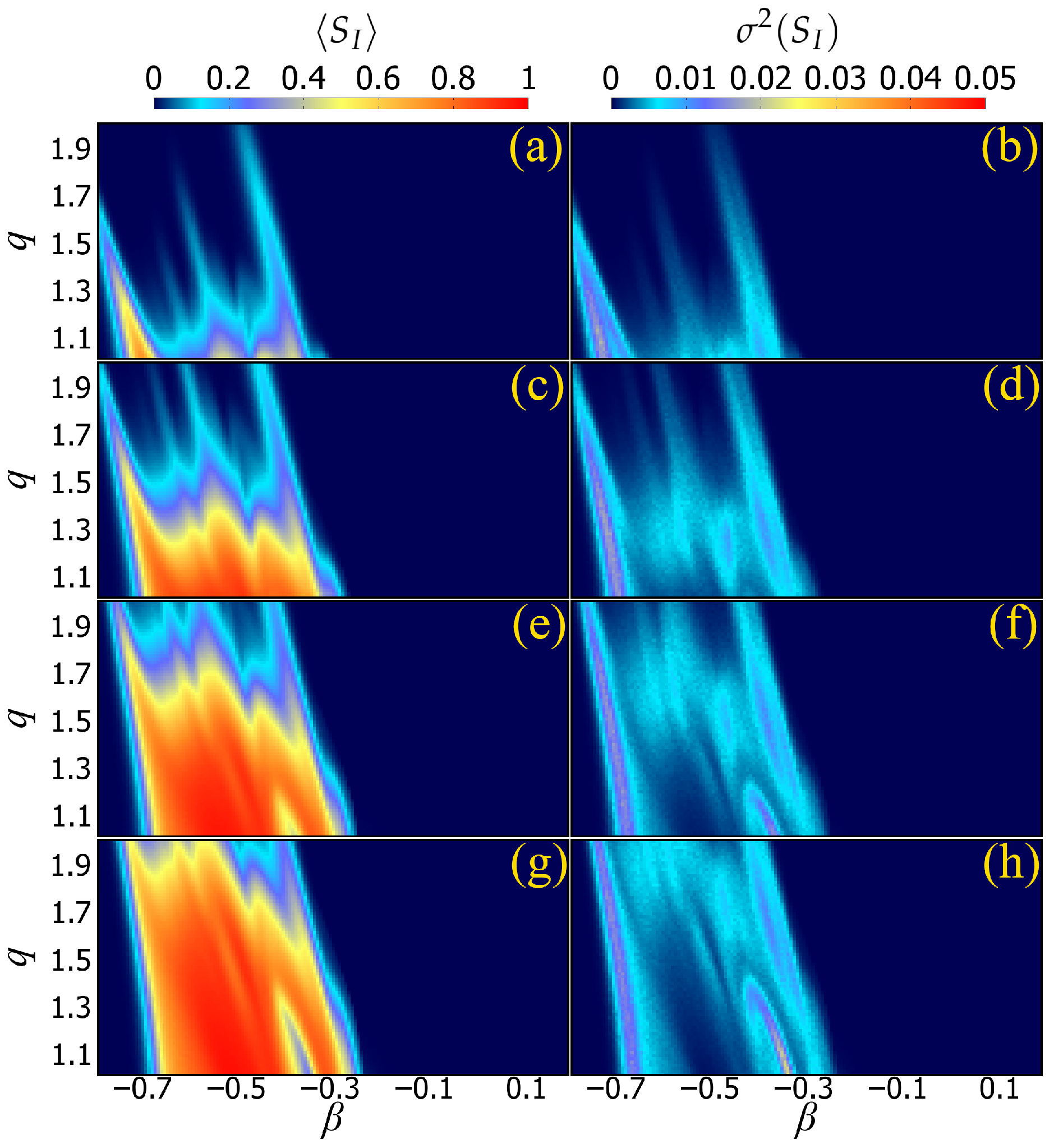
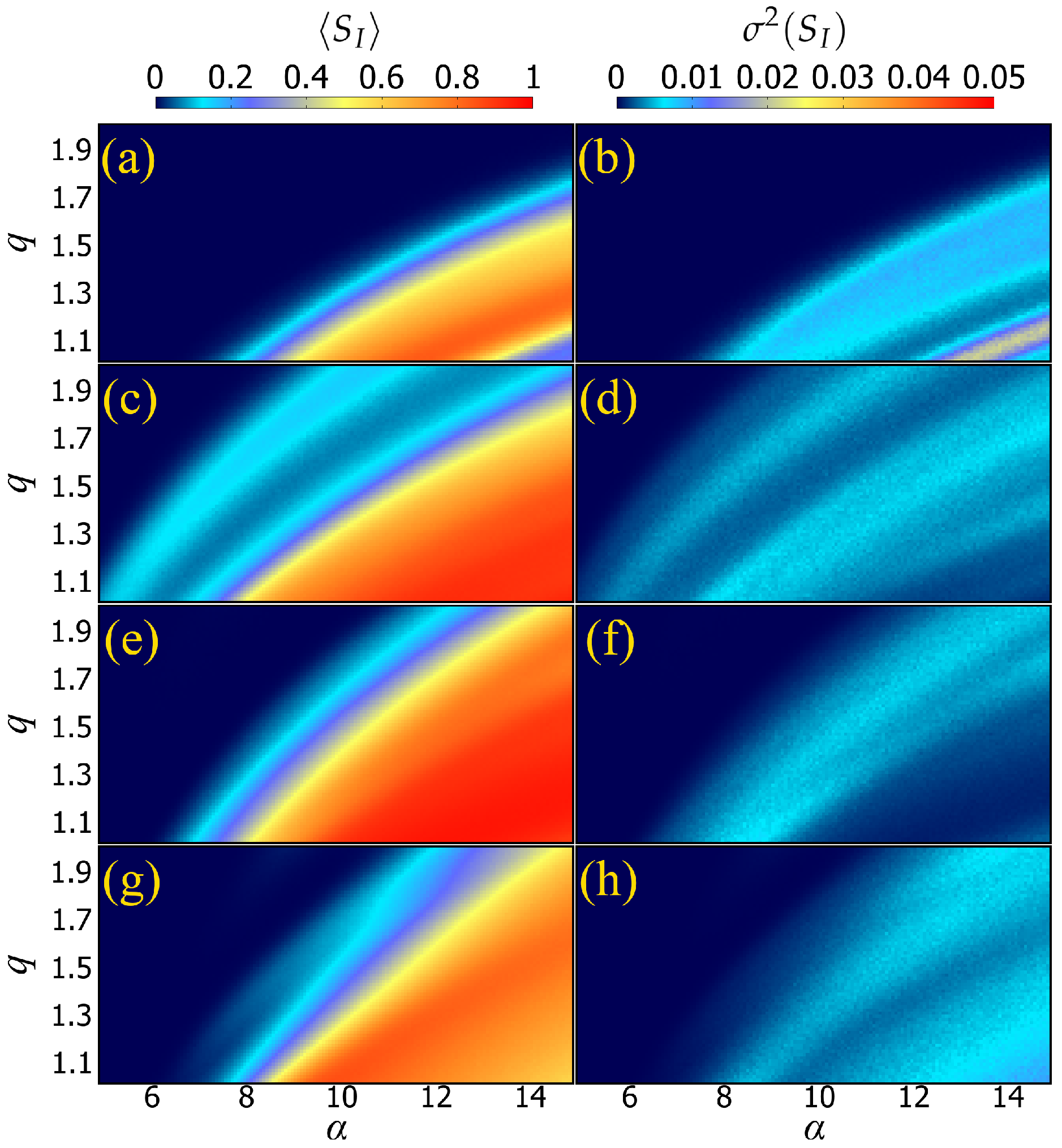
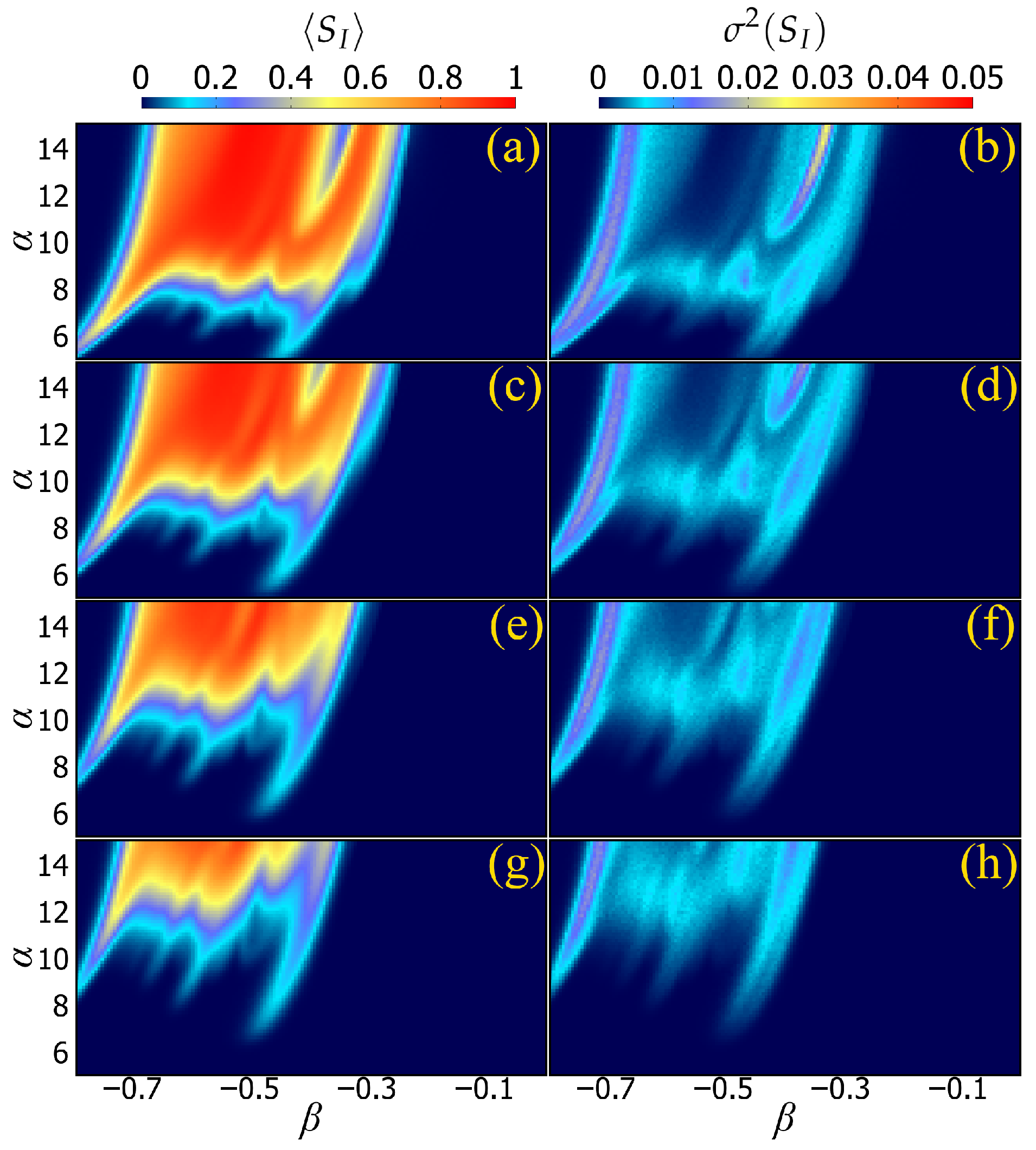
Our analysis of chimera states in the parameter space α , β , and q reveals that the most complex patterns are generated in β × α (Figure 8) and β × q (Figure 9). In contrast, the simplest patterns are found in α × q , as shown in Figure 10. These results suggest that the mechanisms governing the coexistence of chaotic and stable domains are highly sensitive, with minor parameter variations capable of triggering transitions between fully stable and fully chaotic regimes. It is worth mentioning that stable, fully synchronized domains are represented in blue, chaotic, fully desynchronized domains are shown in red, and intermediate values, indicating the coexistence of coherent and incoherent elements (chimera states), are depicted in yellow.
The parameter space of ( α , β ) shows that the distribution of chimera states remains largely consistent with the variability of q. The primary effect is an upward shift as q increases. This consistent behavior reinforces the hypothesis that the system’s properties are governed by the tail-decay rate of the q-exponential. The parameter α can modulate this effect, effectively counteracting the influence of the heavy tail to preserve the stability and structure of the chimera states, as seen in Figure 8:
Figure 9 displays the parameter space ( q , β ) for S I and σ 2 ( S I ) in color bars. We verify that the system dynamics are governed by the tail decay of the q-exponential. Furthermore, the distribution of chimera states exhibits more pronounced and spiky features in Figure 9 compared to the broader structures observed in Figure 8.
In Figure 10, we calculated the parameter space ( q , α ) for different values of β . The panels demonstrate similar behavior; however, a detailed examination reveals that the system’s properties depend sensitively and often unpredictably on small changes in β , we also may see an animation in the Supplementary Materials or at https://youtu.be/DgIvOlTjEzA (accessed 22 October 2025) where we cover S I in smaller increments of β . We also note a region of high deviation in panel (b).

4. Conclusions

We have explored the Tsallis entropic framework and utilized it to extend the Gauss iterative map by incorporating the q-exponential function. This extension has enabled us to uncover a richer spectrum of dynamical behaviors within the chaotic map, including the computation of Lyapunov exponents and the analysis of both pristine and coupled states.
For the extended Gauss iterative map, our results revealed the presence of bistability. In particular, the critical value of β at which the two stable regions merge into a single stable state, known as the tipping point, varies significantly depending on the parameters of the system. This variability underscores the system’s sensitivity to changes in β and highlights the complex interplay between the parameters and their dynamic behavior. Furthermore, we computed the Lyapunov exponents, demonstrating that the Tsallis parameter q plays a crucial role in shaping the map’s dynamics. Specifically, variations in q can lead to different bifurcation patterns and stability regimes. In the context of coupled states, we performed simulations with identical parameter values but different initial conditions, resulting in distinct values of the incoherence metric S I . Our simulations demonstrated that changes in initial conditions can yield a diverse range of dynamical outcomes, underscoring the system’s sensitivity to its initial state. Furthermore, we have shown that chimera states—regions of coexisting coherence and incoherence—are achievable across all the parameters we tested. This finding suggests that the extended Gauss map, enriched by the q-exponential, provides a fertile ground for exploring the emergence and stability of chimera states in non-linear systems.
Our findings contribute to a deeper understanding of the Tsallis entropic framework and its application to chaotic maps. By extending the Gauss iterative map using the q-exponential, we unveiled a diverse range of dynamical behaviors that are highly sensitive to both system parameters and initial conditions. The presence of bistability, tipping points, and the emergence of chimera states underscore the richness of the extended map and its potential as a model for studying complex systems. For example, in neuroscience, chimera states have been associated with functional brain asymmetries and sleep–wake transitions, where localized synchronization coexists with incoherent neural activity [12,13]. The parameter q introduced by the presence of the q-Gaussian can serve as a measure of long-range neuronal correlations, memory effects, or deviations from Gaussian activity patterns. Bistability and partial synchronization can occur in coupled lasers and in plasma turbulence [10,29], where fluctuations are often associated with non-Gaussian distributions and, consequently, with Tsallis statistics. Another scenario can be found in social systems, where clusters of coherent opinions can coexist with incoherent fluctuations, resembling chimera-like dynamics. The parameter q can be used to capture the patterns [27,28].
We hope that these results will be useful for future research into the Tsallis framework and its applications to non-linear dynamics.

Supplementary Materials

Video S1: S I in the ( α , q ) plane can be downloaded at: https://www.mdpi.com/article/10.3390/complexities1010004/s1.

Author Contributions

Conceptualization, D.W.G., E.K.L. and A.M.B.; methodology, D.W.G., E.K.L. and A.M.B.; validation, D.W.G., E.K.L. and A.M.B.; formal analysis, D.W.G., E.K.L. and A.M.B.; investigation, D.W.G., E.K.L. and A.M.B.; writing—original draft preparation, D.W.G., E.K.L. and A.M.B.; writing—review and editing, D.W.G., E.K.L. and A.M.B. All authors have read and agreed to the published version of the manuscript.

Funding

E.K.L. thanks the partial financial support of the CNPq under Grant No. 301715/2022-0 and the National Institute of Science and Technology Complex Systems. We also thank the partial financial support from the following Brazilian government agencies: CAPES, and Fundação Araucária.

Institutional Review Board Statement

Not applicable.

Informed Consent Statement

Not applicable.

Data Availability Statement

No new data were created or analyzed in this study. Data sharing is not applicable to this article.

Conflicts of Interest

The authors declare no conflicts of interest.

Appendix A. Time Series Plots

In this appendix, we present in more detail some of the chimera types that were observed in our simulations.
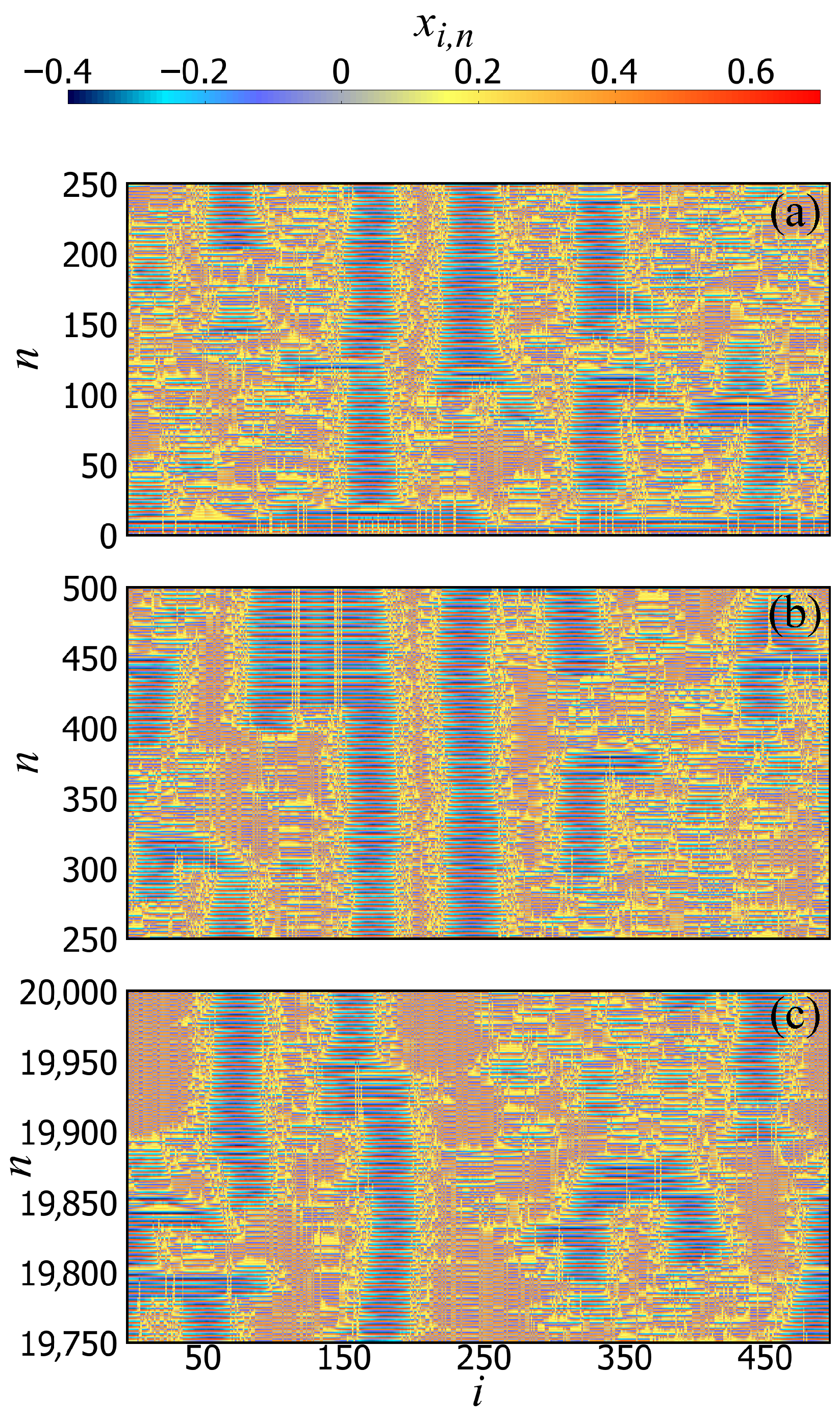
The interplay of the elements in our simulations is diverse and sometimes sensitive to parameter changes, as evidenced by the divergent behavior between Figure A1 and Figure A2. Despite a minimal difference in parameters ( q = 1.01 vs. q = 1.082 ), the systems display fundamentally different coherence manifestations. Figure A1 exemplifies a metastable regime in which coherent domains are persistent, often surviving for thousands of iterations (up to 20k+ steps), far beyond the initial transient phase, and sometimes more than one stability region appears. Figure A2 demonstrates a transient regime in which coherence is short-lived, the distinct triangular stability region collapses after only ≈300 steps. A small difference of 0.072 in q displays a considerable change in the system’s dynamics.
In Figure A3, we show another set of parameters in which the coherent structures are unstable, being created, and destroyed during the simulation.
Figure A1. Spatial temporal patterns of chimera state for parameters α = 14.0 , β = 0.37 , q = 1.01 , R = 20 , and ϵ = 0.40 . The color bar shows the value of the node i at time n. Panels (a,b) show the time evolution of chimera states, and panel (c) their dissipation.
Complexities 01 00004 g0a1
Figure A2. Spatial temporal patterns of chimera state for parameters α = 14.0 , β = 0.37 , q = 1.082 , R = 20 , and ϵ = 0.40 . The color bar shows the value of the node i at time n. Panel (a) shows the time evolution of chimera states, and panel (b) their dissipation.
Complexities 01 00004 g0a2
Figure A3. Spatial temporal patterns of chimera state for parameters α = 14.0 , β = 0.39 , q = 1.08 , R = 20 , and ϵ = 0.45 . The color bar shows the value of the node i at time n. Panels (ac) show the time evolution of chimera states, where stability regions are short-lived and are often recreated.
Complexities 01 00004 g0a3

References

  1. Szumiński, W.; Maciejewski, A.J. Dynamics and non-integrability of the double spring pendulum. J. Sound Vib. 2024, 589, 118550. [Google Scholar] [CrossRef]
  2. Gitterman, M. Classical harmonic oscillator with multiplicative noise. Phys. A Stat. Mech. Its Appl. 2005, 352, 309–334. [Google Scholar] [CrossRef]
  3. Qiu, H.; Xu, X.; Jiang, Z.; Sun, K.; Cao, C. Dynamical behaviors, circuit design, and synchronization of a novel symmetric chaotic system with coexisting attractors. Sci. Rep. 2023, 13, 1893. [Google Scholar] [CrossRef] [PubMed]
  4. Dai, Q. Coexisting multi-period and chaotic attractor in fully connected system via adaptive multi-body interaction control. Nonlinear Dyn. 2023, 112, 681–692. [Google Scholar] [CrossRef]
  5. Ribeiro, F.L.; Li, Y.; Born, S.; Rybski, D. Analytical solution for the long- and short-range every-pair-interactions system. Chaos Solitons Fractals 2024, 183, 114771. [Google Scholar] [CrossRef]
  6. Li, Z.; Ravela, S. Neural Networks as Geometric Chaotic Maps. IEEE Trans. Neural Netw. Learn. Syst. 2023, 34, 527–533. [Google Scholar] [CrossRef] [PubMed]
  7. Qiao, J.; Chen, Y. Stochastic configuration networks with chaotic maps and hierarchical learning strategy. Inf. Sci. 2023, 629, 96–108. [Google Scholar] [CrossRef]
  8. Montalbán, A.; Corder, R.M. The spark of synchronization in heterogeneous networks of chaotic maps. Chaos 2024, 34, 021101. [Google Scholar] [CrossRef]
  9. Batista, C.A.; Viana, R.L. Chaotic maps with nonlocal coupling: Lyapunov exponents, synchronization of chaos, and characterization of chimeras. Chaos Solitons Fractals 2020, 131, 109501. [Google Scholar] [CrossRef]
  10. Wang, W.; Liu, Z.; Hu, B. Phase Order in Chaotic Maps and in Coupled Map Lattices. Phys. Rev. Lett. 2000, 84, 2610–2613. [Google Scholar] [CrossRef]
  11. Davidsen, J.; Maistrenko, Y.; Showalter, K. Introduction to Focus Issue: Chimera states: From theory and experiments to technology and living systems. Chaos Interdiscip. J. Nonlinear Sci. 2024, 34, 120402. [Google Scholar] [CrossRef]
  12. Majhi, S.; Bera, B.K.; Ghosh, D.; Perc, M. Chimera states in neuronal networks: A review. Phys. Life Rev. 2019, 28, 100–121. [Google Scholar] [CrossRef]
  13. Feng, P.; Yang, J.; Wu, Y. Chimera state in a feed-forward neuronal network. Cogn. Neurodyn. 2023, 17, 1119–1130. [Google Scholar] [CrossRef] [PubMed]
  14. Rybalova, E.; Nechaev, V.; Schöll, E.; Strelkova, G. Chimera resonance in networks of chaotic maps. Chaos Interdiscip. J. Nonlinear Sci. 2023, 33, 093138. [Google Scholar] [CrossRef] [PubMed]
  15. Salazar, R.; Toral, R. Scaling laws for a system with long-range interactions within Tsallis statistics. Phys. Rev. Lett. 1999, 83, 4233. [Google Scholar] [CrossRef]
  16. Lima, H.S.; Tsallis, C.; Eroglu, D.; Tirnakli, U. Fourier’s law breakdown for the planar-rotor chain with long-range coupling. arXiv 2024, arXiv:2407.13843. [Google Scholar]
  17. Rodríguez, A.; Tsallis, C. Diffusion crossover between q statistics and Boltzmann-Gibbs statistics in the classical inertial α-XY ferromagnet. Phys. Rev. E 2025, 111, 024143. [Google Scholar] [CrossRef]
  18. Ogunjo, S.; Rabiu, B.; Fuwape, I.; Atikekeresola, O. Multifractal and chaotic characteristics of geomagnetic inter-storm interval over eight solar cycles. Adv. Space Res. 2024, 73, 5406–5413. [Google Scholar] [CrossRef]
  19. Tsallis, C.; Borges, E.P. Nonlinear dynamical systems: Time reversibility versus sensitivity to the initial conditions. Chaos Solitons Fractals 2024, 182, 114743. [Google Scholar] [CrossRef]
  20. Kalogeropoulos, N. Weak chaos from Tsallis entropy. QSci. Connect 2013, 2012, 12. [Google Scholar] [CrossRef]
  21. Duarte Queirós, S.M.; Tsallis, C. Edge of chaos of the classical kicked top map: Sensitivity to initial conditions. In Complexity, Metastability and Nonextensivity; World Scientific: Singapore, 2005; pp. 135–139. [Google Scholar]
  22. Pires, M.A.; Tsallis, C.; Curado, E.M. Composing α-Gauss and logistic maps: Gradual and sudden transitions to chaos. Phys. Rev. E 2025, 112, 034209. [Google Scholar] [CrossRef]
  23. Beck, C.; Tirnakli, U.; Tsallis, C. Generalization of the Gauss map: A jump into chaos with universal features. Phys. Rev. E 2024, 110, 064213. [Google Scholar] [CrossRef]
  24. Oliveira, R.; da Silva, L.R.; Tsallis, C. Energy distribution in long-range-interacting weighted geographic networks. Eur. Phys. J. Plus 2024, 139, 975. [Google Scholar] [CrossRef]
  25. Tsallis, C. Possible generalization of Boltzmann-Gibbs statistics. J. Stat. Phys. 1988, 52, 479–487. [Google Scholar] [CrossRef]
  26. Tsallis, C.; Mendes, R. The role of constraints within generalized nonextensive statistics. Phys. A Stat. Mech. Its Appl. 1998, 261, 534–554. [Google Scholar] [CrossRef]
  27. Tsallis, C. Non-additive entropies and statistical mechanics at the edge of chaos: A bridge between natural and social sciences. Philos. Trans. R. Soc. A 2023, 381, 20220293. [Google Scholar] [CrossRef]
  28. Rosser, J.B., Jr. Econophysics and the entropic foundations of economics. Entropy 2021, 23, 1286. [Google Scholar] [CrossRef]
  29. Chian, A.L.; Borotto, F.; Hada, T.; Miranda, R.; Muñoz, P.; Rempel, E. Nonlinear dynamics in space plasma turbulence: Temporal stochastic chaos. Rev. Mod. Plasma Phys. 2022, 6, 34. [Google Scholar] [CrossRef]
  30. Kaniadakis, G.; Matteo, T.D.; Scarfone, A.M.; Gervino, G. New trends in statistical physics of complex systems: Theoretical and experimental approaches. Eur. Phys. J. B 2024, 97, 203. [Google Scholar] [CrossRef]
  31. Jizba, P.; Lambiase, G. Constraints on Tsallis cosmology from Big Bang nucleosynthesis and the relic abundance of cold dark matter particles. Entropy 2023, 25, 1495. [Google Scholar] [CrossRef]
  32. Chavanis, P.H. Kinetic theory of collisionless relaxation for systems with long-range interactions. Phys. A Stat. Mech. Its Appl. 2022, 606, 128089. [Google Scholar] [CrossRef]
  33. Tsallis, C. Introduction to Nonextensive Statistical Mechanics: Approaching a Complex World; Springer: Berlin/Heidelberg, Germany, 2009; Volume 1. [Google Scholar]
  34. Gopal, R.; Chandrasekar, V.K.; Venkatesan, A.; Lakshmanan, M. Observation and characterization of chimera states in coupled dynamical systems with nonlocal coupling. Phys. Rev. E 2014, 89, 052914. [Google Scholar] [CrossRef] [PubMed]
  35. Chandran, P.; Gopal, R.; Chandrasekar, V.K.; Athavan, N. Chimera states in coupled logistic maps with additional weak nonlocal topology. Chaos Interdiscip. J. Nonlinear Sci. 2019, 29, 053125. [Google Scholar] [CrossRef]
Figure 1. This figure shows the behavior of the q-Gaussian for different values of q.
Complexities 01 00004 g001
Figure 2. Lyapunov exponents for different values of q and α = 10 . The dashed line corresponds to λ = 0 . There are no chaotic regimes for β > 0 .
Complexities 01 00004 g002
Figure 3. Parameter space ( q , β ) for the Lyapunov exponent λ in color bar, where the hot and cold colors represent the chaotic and stable regimes, respectively. The panels (ad) correspond to α equal to 5, 10, 15, and 20.
Complexities 01 00004 g003
Figure 4. Bifurcation diagram for α = 12 , (a) q = 1.01 , (b) q = 1.25 , (c) q = 1.50 , and (d) q = 1.75 . The green and red points represent the two different stabilities, and the dashed black line indicates a tipping point.
Complexities 01 00004 g004
Figure 5. Schematic representation of a periodic network of coupled systems. The purple, blue, and green represent the coupling between the first, second, and third neighbors, respectively.
Complexities 01 00004 g005
Figure 6. Spatial temporal patterns of chimera state for different initial conditions and parameters α = 14.0 , β = 0.37 , q = 1.5 , R = 50 , and ϵ = 0.37 . In the panels (a,b), S I = 0.30 and S I = 0.70 respectively. In this figure, i represents the nodes and n the timestep, the color bar shows the value of the node i at time n.
Complexities 01 00004 g006
Figure 7. Average S I and σ 2 ( S I ) with parameters α = 14 , β = 0.37 for 1024 simulations per ( ϵ , R ). Panels (a,c,e,g) show the average S I for q = 1.01 , q = 1.25 , q = 1.50 , and q = 1.75 , respectively, while panels (b,d,f,h) display their corresponding deviations.
Complexities 01 00004 g007
Figure 8. Average S I and σ 2 ( S I ) for ϵ = 0.40 , and R = 20 , considering 1024 simulations per ( β , α ). The panels (a,c,e,g) show the average S I for q = 1.01 , q = 1.25 , q = 1.50 , and q = 1.75 , respectively, while the panels (b,d,f,h) display their corresponding deviations.
Complexities 01 00004 g008
Figure 9. Average S I and σ 2 ( S I ) with parameters ϵ = 0.40 , and R = 20 for 1024 simulations per ( β , q ). Panels (a,c,e,g) show the average S I for α = 8 , α = 10 , α = 12 , and α = 14 , respectively, while panels (b,d,f,h) display their corresponding deviations.
Complexities 01 00004 g009
Figure 10. Average S I and σ 2 ( S I ) for ϵ = 0.40 and R = 20 , considering 1024 simulations per ( q , α ). Panels (a,c,e,g) show the average S I for β = 0.35 , β = 0.45 , β = 0.55 , and β = 0.65 , respectively, while panels (b,d,f,h) display their corresponding deviations.
Complexities 01 00004 g010
Disclaimer/Publisher’s Note: The statements, opinions and data contained in all publications are solely those of the individual author(s) and contributor(s) and not of MDPI and/or the editor(s). MDPI and/or the editor(s) disclaim responsibility for any injury to people or property resulting from any ideas, methods, instructions or products referred to in the content.