Skin plays an important role in biological organisms perceiving and mediating our interactions with the world [
1,
2]. Unlike vision and audition, tactile perception is inherently embodied, emerging from the direct mechanical coupling between the body and the surrounding environment. The sense of touch represents the most fundamental function for humans to distinguish between a light breeze, a rough fabric and a smooth, hard surface. Such capabilities not only enable object manipulation and environmental awareness but also support social communication, emotional interaction, and protective reflexes [
3,
4]. The richness of tactile perception stems from the extensive distribution of various mechanoreceptors within the skin. These receptors operate in a complementary manner, enabling the nervous system to capture continuous contact information and instantaneous mechanical changes, thereby forming a high-fidelity sensory representation.
From a neurophysiological perspective, tactile encoding primarily involves four types of mechanoreceptors: SA-I and SA-II (slow-adapting receptors) and FA-I and FA-II (fast-adapting receptors), which measure forces on different time scales and with different receptive field sizes [
5,
6]. A receptive field refers to the area of skin that elicits a mechanoreceptor response. SA-I receptors are in high densities in sensitive areas of the skin and consequently provide high-resolution force information useful for discriminating object shape and texture. SA-II receptors are located deeper within the skin and are primarily responsible for measuring skin stretch, which is important for proprioception. FA-I receptors measure low-frequency (5–50 Hz) stimuli as the function of object manipulation and texture discrimination. FA-II receptors measure high-frequency vibrations (up to 400 Hz) over large areas, and are important for texture discrimination and slip detection. These receptors translate mechanical deformation into neural spike patterns [
7,
8]. The ensemble output of information from these four receptors is interpreted by the brain to give complex information about body position and object size, shape, texture and hardness. The integration of these complementary encoding pathways enables bio-tactile systems to simultaneously achieve sensitivity, temporal resolution, and noise robustness. Importantly, tactile perception is not merely a sensory process, but a hierarchical computation that begins with peripheral transduction and ultimately forms distributed neural processing across ascending pathways. The interaction between distributed sensing and neural computation provides a blueprint for the development of artificial tactile systems aimed at replicating biological sensory capabilities.
The skin’s ability can adapt to body movement by bending and stretching, a stark contrast to the rigidity and brittleness of traditional silicon electronics. Flexible electronics allow devices to be bent over curved surfaces such as fingers, offering an additional degree of movement compared to rigid devices while maintaining compliance with curved and deformable surfaces [
9,
10,
11]. This mechanical compliance is essential for achieving biomimetic sensing characteristics, as it allows electronic skins to approximate the spatial distribution and receptive field organization of biological skin. Advances in materials science, micro/nano fabrication, and soft electronics have emerged, leading to the development of E-skins with high sensitivity, wide dynamic range, and large-area coverage. Such systems have demonstrated great capabilities in detecting contact forces, textures, vibrations, and object morphology for the application of prosthetics, robotic manipulation and human–machine interfaces. However, traditional E-skin is limited by signal acquisition circuitry, often requiring the interpretation of tactile information to be transmitted to external computing units for processing. This separation between sensing and computation introduces significant latency and energy overhead. Considering that skin is the largest organ in the human body, minimizing the per-area cost of artificial E-skin will be a priority.
To overcome these limitations, recent research has increasingly focused on neuromorphic mechanoreceptors that mimic biological tactile afferent neural coding strategies. Unlike traditional biosensors that produce continuous analogue outputs, neuromorphic mechanoreceptors generate spike-based signals that reflect the temporal dynamics of mechanical stimuli. Such an approach inherently compresses sensory information, enhances noise resistance, and achieves direct compatibility with neural computing framework [
12,
13,
14]. By reproducing slow and fast adaptive response characteristics at the device level, artificial mechanoreceptors can capture persistent and transient tactile features in a biologically meaningful manner. Furthermore, integrating memory elements and adaptive dynamic characteristics into sensing devices enables synaptic-like behaviour, allowing tactile systems to exhibit short-term adaptability, historical dependence, and learning capabilities. Within tactile systems, spiking neural networks can convert distributed pulse patterns into spatial representations, facilitating temporal integration across multiple mechanoreceptors and supporting learning through synaptic plasticity mechanisms. Importantly, the neuromorphic spiking neural network computation enables in-memory and in-sensor processing, reducing data transmission and alleviating the von Neumann bottleneck that constrains conventional tactile perception pipelines. This integration allows tactile systems to transition from passive sensing modules to adaptive perceptual entities.
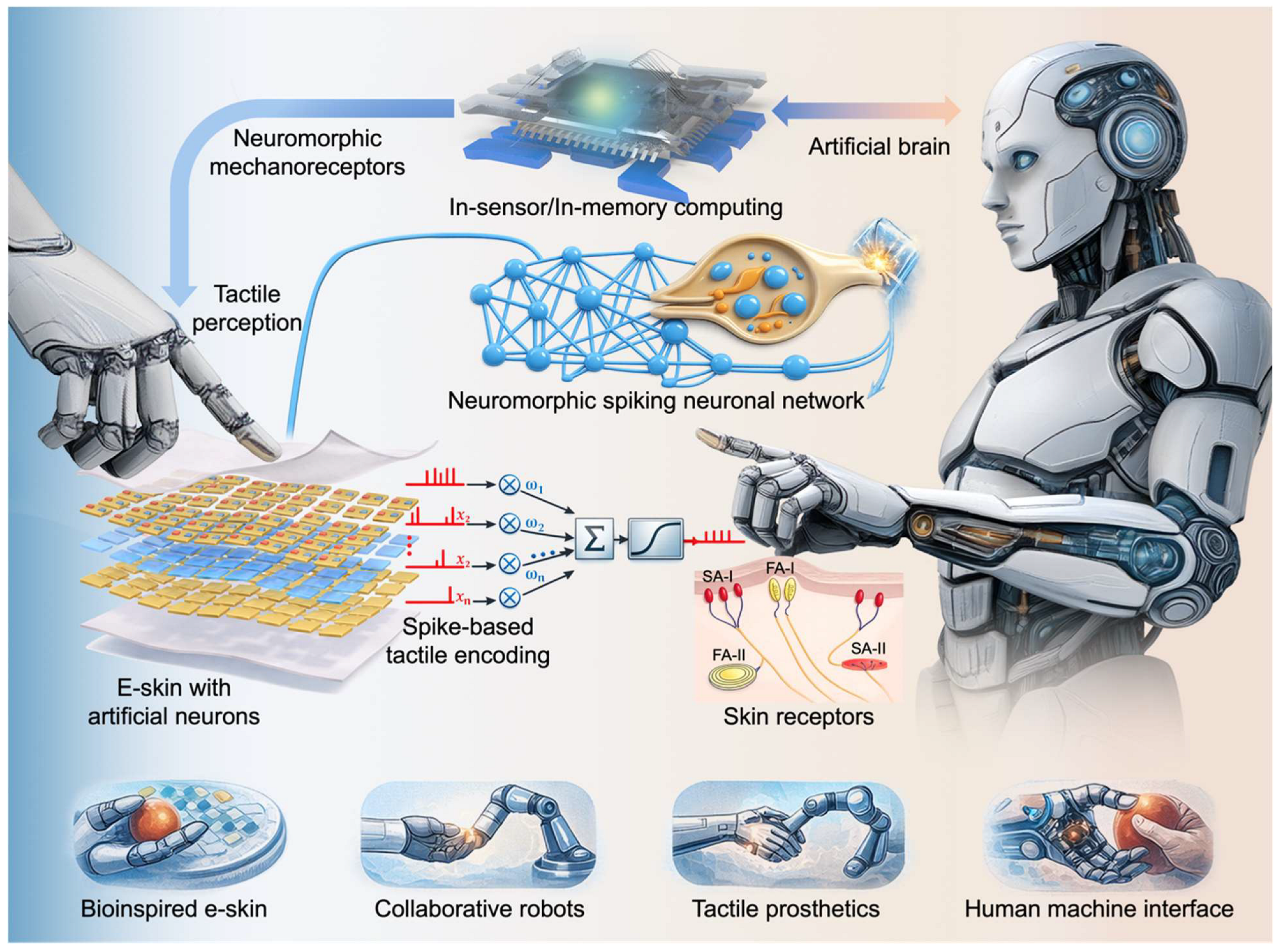
Integrating neuromorphic mechanoreceptors and spiking neural networks into electronic skin offers a better solution for artificial tactile perception in embodied systems, as shown in
Figure 1. For example, in robotic hands, distributed tactile sensing combined with neural decoding can detect initial slippage, estimate object compliance, and adjust grip strength, improving operational robustness. In prosthetic devices, neuromorphic tactile feedback can enhance embodiment and restore sensory awareness, enabling users to perform fine tasks with greater confidence and precision. Furthermore, tactile cognition plays a critical role in human–machine interaction, where the interpretation of contact patterns can help identify intentions, facilitate emotional communication, and promote collaborative behaviour. Despite significant progress, achieving biologically realistic tactile perception remains challenging due to the complexity of integrating perception, encoding, learning, and decision-making into a unified framework. Mimic tactile systems possess overlapping receptive fields, adaptive response characteristics, and hierarchical processing structures, which collectively enable robust perception under uncertain and dynamic conditions. Replicating these features in artificial systems requires the co-design of flexible sensing platforms, neuromorphic encoding mechanisms, and spiking-based learning architectures. In particular, the incorporation of overlapping receptive field organization and temporally dependent plasticity is essential for enabling spatial localization and stimulus generalization across large-area electronic skins.
In future, combining distributed photonic or electrical transducers with bio-inspired neural network architectures will enable the simulation of early somatosensory processing and achieve efficient tactile decoding. The use of large-area electronic skins with embedded sensing nodes enables the formation of spatially overlapping receptive fields, while spiking neural networks can transform temporal spike activity into spatial maps through convergent connectivity. Furthermore, synaptic plasticity mechanisms enable unsupervised learning of stimulus localization, allowing tactile systems to achieve robust tactile perception on complex surfaces through a fusion of temporal precision and spatial organization, without requiring large amounts of labelled data. Ultimately, by bridging the gap between peripheral perception and cognitive processing, neuromorphic tactile systems can help robots and wearable devices interpret the physical environment and achieve interactive perception in a way that more closely resembles biological perception. With ongoing advancements in materials, devices, and neural computing, neuromorphic tactile perception is expected to play a central role in the development of adaptive robotics, intuitive human–machine interfaces, and next-generation assistive technologies.
We are pleased to present these research trends to the readers of AI Sensors and encourage further exploration in this exciting field.