
Review

A Review of Non-Invasive Continuous Blood Pressure Measurement: From Flexible Sensing to Intelligent Modeling


by
Zhan Shen
1,†,
Jian Li
1,†,
Hao Hu
1,
Chentao Du
1,2,
Xiaorong Ding
3,4,*,
Tingrui Pan
2,5,6,* and
Xinge Yu
1,7,8,*
1
Department of Biomedical Engineering, City University of Hong Kong, Hong Kong, China
2
School of Biomedical Engineering, Division of Life Sciences and Medicine, University of Science and Technology of China, Hefei 230026, China
3
School of Life Science and Technology, University of Electronic Science and Technology of China, Chengdu 611731, China
4
Yangtze Delta Region Institute (Huzhou), University of Electronic Science and Technology of China, Chengdu 611731, China
5
Center for Intelligent Medical Equipment and Devices, Institute for Innovative Medical Devices, Suzhou Institute for Advanced Research, University of Science and Technology of China, Suzhou 215123, China
6
Department of Precision Machinery and Precision Instrumentation, University of Science and Technology of China, Hefei 230026, China
7
Institute of Digital Medicine, City University of Hong Kong, Hong Kong, China
8
Hong Kong Centre for Cerebro-Cardiovascular Health Engineering (COCHE), Hong Kong, China
*
Authors to whom correspondence should be addressed.
These authors contributed equally to this work.
AI Sens. 2025, 1(2), 8; https://doi.org/10.3390/aisens1020008
Submission received: 23 September 2025 / Revised: 30 October 2025 / Accepted: 3 November 2025 / Published: 7 November 2025
(This article belongs to the Topic AI Sensors and Transducers)

Abstract

Accurate and continuous, non-invasive blood pressure (BP) monitoring plays a vital role in the long-term management of cardiovascular diseases. Advances in wearable and flexible sensing technologies have facilitated the transition of non-invasive BP monitoring from clinical settings to ambulatory home environments. However, the measurement consistency and algorithm adaptability of existing devices have not yet reached the level required for routine clinical practice. To address these limitations, comprehensive innovations have been made in material development, sensor design, and algorithm optimization. This review examines the evolution of non-invasive continuous BP measurement, highlighting cutting-edge advances in flexible electronic devices and BP estimation algorithms. First, we introduce measurement principles, sensing devices and limitations of traditional non-invasive BP measurement, including arterial tonometry, arterial volume clamp, and ultrasound-based methods. Subsequently, we review the pulse wave analysis-based BP estimation methods from two perspectives: flexible sensors based on optical, mechanical, and electrical principles, and estimation models that use physiological features or raw waveforms as input. Finally, we conclude the existing challenges and future development directions of flexible electronic technology and intelligent estimation algorithms for non-invasive continuous BP measurement.

1. Introduction

High blood pressure (BP), also known as hypertension, is a leading risk factor for disability and premature mortality within the spectrum of cardiovascular diseases (CVDs) [1]. Currently, approximately 1.28 billion adults (aged 30 to 79) worldwide suffer from hypertension [2]. However, only 54% of those individuals receive an accurate diagnosis, and among those diagnosed, merely half achieve effective BP control [3]. Therefore, low-cost, reliable, and continuous BP monitoring is crucial for improving the diagnosis and treatment of hypertension and mitigating its associated risks.
Compared with intermittent BP measurement, continuous BP monitoring technology can effectively capture hidden hypertension and BP fluctuation patterns, which has important clinical significance for improving the diagnosis and control rates of hypertension and promoting personalized treatment. Continuous BP measurement traces its origins to the kymograph designed by Carl Ludwig in 1847 [4], which was the first continuous recording of BP fluctuations. Subsequently, arterial catheterization was developed and established as the gold standard for BP measurement [5]. However, this invasive method carries risks of infection and bleeding [6], limiting its use to specialized medical settings such as intensive care units. To overcome the limitations of invasive measurement, arterial tonometry [7] and arterial volume clamp [8] emerged in the 1960s and 1970s, enabling continuous BP measurement non-invasively. Nevertheless, both technologies still rely on an inflatable cuff or clamp-type device to compress the artery and maintain an “unloaded state”. Prolonged use of such devices can cause physical discomfort, leading to poor user compliance. Ultrasound technology, developed around the same period [9,10], infers BP by observing arterial morphology and blood flow, offering a new technical approach for continuous BP measurement. However, it requires operation by specialized medical personnel and suffers from low measurement efficiency.
Since the 2000s, advances in sensing and data processing technologies have led to the emergence of wearable BP measurement devices [11]. These devices can continuously and non-intrusively measure physiological signals reflecting arterial pulsation characteristics and then indirectly infer BP. They have overcome the limitations of traditional cuff-based BP measurement, enabling non-invasive, portable and continuous BP monitoring in ambulatory home settings. The further evolution of flexible electronics technology is accelerating the miniaturization and integration of wearable devices [12]. The flexible form factor significantly enhances wearer comfort, effectively addressing the key drawbacks of previous technologies and making these devices suitable for long-term BP monitoring [13].
Initially, flexible polymers notably polyimide (PI) [14] and polydimethylsiloxane (PDMS) [15] incorporated with metal thin films as conductive traces were introduced as substrate alternatives to traditional rigid printed circuit boards [16]. Functional sensors including electrocardiogram (ECG) electrode and photoplethysmogram (PPG) sensors were integrated onto flexible substrates, facilitating the development of soft patch-type or wristband-style wearable devices. While flexible substrates enhance wearing comfort, they still suffer from insufficient sensitivity and poor measurement stability in ambulatory scenarios. With the development of new flexible functional materials, conductive materials (e.g., graphene [17], carbon nanotubes [18], MXene [19]), and piezoelectric materials (e.g., piezoelectric crystals, ceramic [20]) has facilitated the emergence of flexible sensors. These next-generation sensors exhibit a sensitivity that is 1–2 orders of magnitude higher than that of traditional sensors [21]. The optimization of the flexible structural design further improves the robustness of the device, such as serpentine wiring [22] and pleated structure [23], which enables the sensor system to adaptively stretch or deform in response to human motion (e.g., wrist bending and limb movement). The effectively prevents sensor displacement or signal interruption caused by movement, ensuring stable acquisition of high-quality physiological signals in ambulatory scenes [24].
The development of non-invasive continuous blood pressure estimation models has undergone three key stages. Initially, research primarily relied on the pulse wave propagation mechanism to establish physiological models. These models typically use signals such as ECG and PPG to measure pulse wave velocity (PWV) or pulse transit time (PTT) and then construct a mathematical relationship model for BP estimation. However, due to their foundation on generalized hemodynamic assumptions, such physiological models struggled to adapt to individual differences in vascular elasticity and blood viscosity. Significant errors occurred when these models were applied to specific populations such as the elderly or patients with CVDs. With the rise in machine learning (ML) techniques, BP estimation models gradually shifted toward data-driven paradigms. Researchers extracted complex features from physiological signals such as ECG and PPG and used ML to learn the nonlinear relationships between these features and BP, thereby improving the adaptability and accuracy of the models. The emergence of deep learning (DL) technology further promoted the development of end-to-end arterial BP (ABP) waveform estimation models. These models take raw physiological waveforms as input and automatically extract BP-related features through deep neural networks, eliminating the need for manual feature engineering and significantly enhancing the models’ generalization performance. Nowadays, with the deep integration of flexible electronics with the Internet of Things (IoT) and artificial intelligence (AI) has given rise to bio-integrated intelligent sensing system (BISS) [25]. These systems typically incorporate flexible sensing modules, signal processing modules, and intelligent BP modeling modules. The signal processing modules perform noise reduction and filtering on signals collected by the flexible sensing modules; the BP modeling modules are then combined to perform intelligent BP estimation.
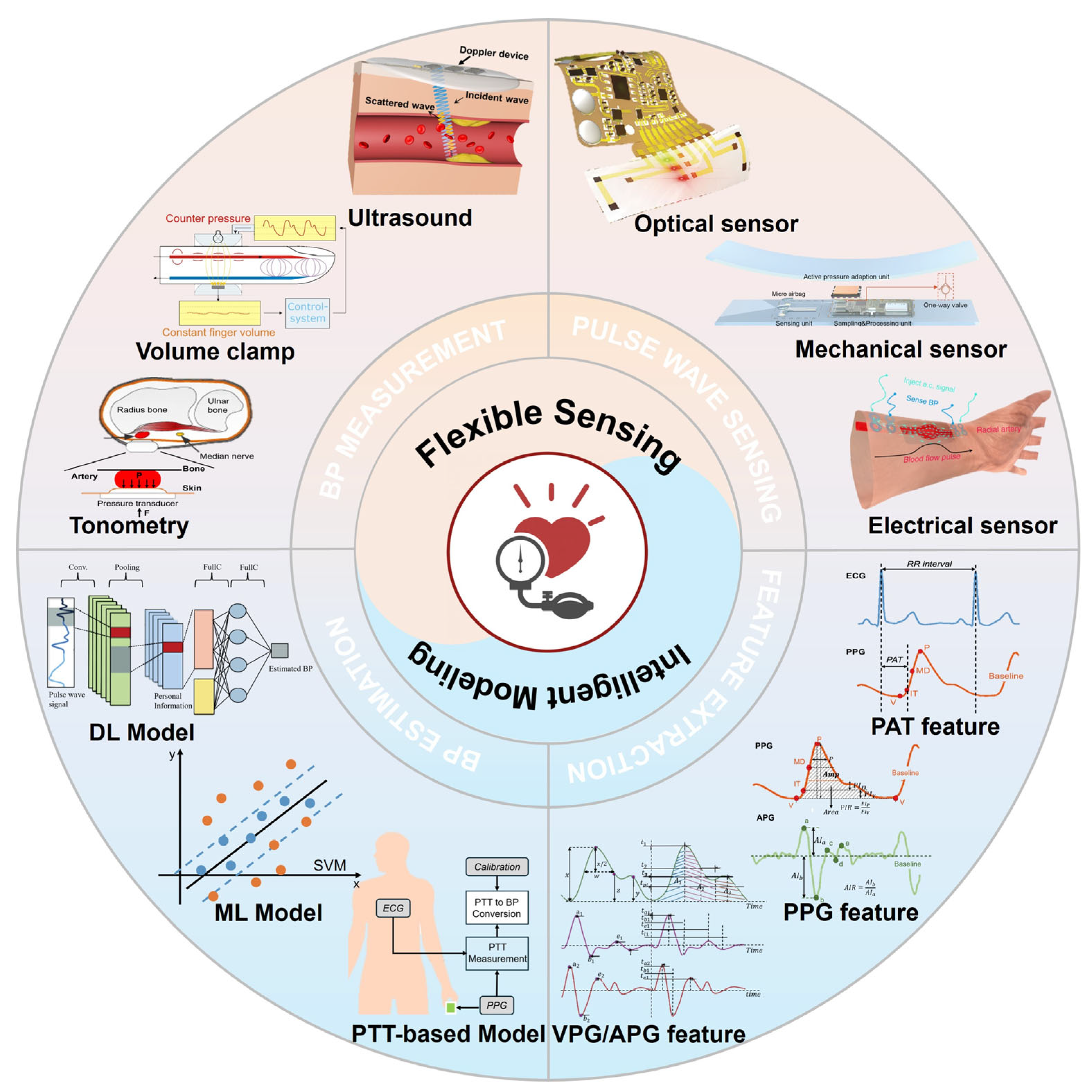
This review focuses on the field of non-invasive continuous BP monitoring, spanning from traditional BP measurement to emerging BP estimation (Figure 1). We first review the development of traditional BP measurement devices, then summarize recent advances in flexible sensing technologies toward pulse wave acquisition and modeling strategies for pulse wave-based BP estimation. Finally, we outline the current challenges in sensing devices and estimation algorithms and propose potential solutions and future research directions. This review adopts a multi-database joint search strategy, with the specific search scope covering four major databases: Google Scholar, IEEE Xplore, PubMed, and Science Direct. The search process is conducted based on the thematic keywords listed in Table 1, and a specific time range is limited to ensure the timeliness of the research. After the search is completed, duplicate literature is removed, and the remaining literature is then screened according to the following criteria to finally determine the studies included in the review:
(1)
The research content must clearly focus on the application of flexible sensors in non-invasive BP measurement or continuous pulse wave monitoring, excluding literature focusing on arterial elasticity detection or vascular wall stiffness assessment.
(2)
The research must include complete content on the design and verification of flexible sensors (such as material design, structural optimization, and performance testing), excluding studies that do not clearly specify the core parameters of the sensors (such as flexibility, sensitivity, biocompatibility, etc.).
(3)
Studies implementing non-invasive continuous BP measurement are included, excluding those only involving intermittent BP measurement (such as oscillometric method) or invasive BP measurement (such as arterial catheterization method).
(4)
Studies without any experimental data verification or with a verification sample size of less than 10 cases are excluded to avoid conclusion bias caused by small-sample data and ensure the reliability and statistical validity of the included studies.
Figure 1. Overview of non-invasive continuous blood pressure measurement from sensing to modeling. PAT: pulse arrival time, PPG: photoplethysmogram, VPG: velocity PPG, APG: acceleration PPG, PTT: pulse transit time, ML: machine learning, SVM: support vector machines, DL: deep learning.
Aisens 01 00008 g001
Table 1. Searched keywords and screening counts.
QueriesDate (Year)Screening Counts
‘blood pressure’ AND (‘arterial tonometry’ OR ‘volume clamp’)1971–202519
‘blood pressure’ AND (‘ultrasound’ OR ‘Doppler’)2000–20258
‘flexible sensor‘ AND (‘pulse wave’ OR ‘blood pressure’)2010–202552
‘blood pressure’ AND (‘pulse transit time’ OR ‘pulse arrival time’)2000–20256
‘blood pressure’ AND (‘machine learning’ OR ‘deep learning’)2010–202560

2. Non-Invasive and Continuous BP Measurement

Traditional non-invasive continuous BP measurement methods rely on capturing dynamic changes in arterial pressure, volume, or diameter during pulsation to derive continuous ABP waveforms. This chapter systematically reviews the core working principles and measurement mechanisms of three mainstream non-invasive continuous BP measurement techniques: arterial tonometry, arterial volume clamp, and ultrasound-based methods. Traditional technical solutions have limitations in terms of sensor rigidity, device size, and adaptability to measurement scenarios. Innovations in technologies such as flexible electronics, new materials, and intelligent control have driven performance upgrades in various measurement methods, but challenges still exist in practical applications, such as calibration dependence, insufficient device flexibility, and signal interference. Table 2 provides a systematic comparative analysis between traditional commercial devices and flexible wearable devices across various sensing modes.

2.1. Arterial Tonometry

Arterial tonometry, first proposed by Pressman and Newgard in 1963, is a non-invasive method for BP measurement [7]. Its working principle is based on using a sensor to compress a superficial artery against the underlying bone, thereby flattening the arterial wall. Under this condition, intravascular pressure can be directly transmitted to the external pressure sensor, enabling the acquisition of ABP waveforms [30].
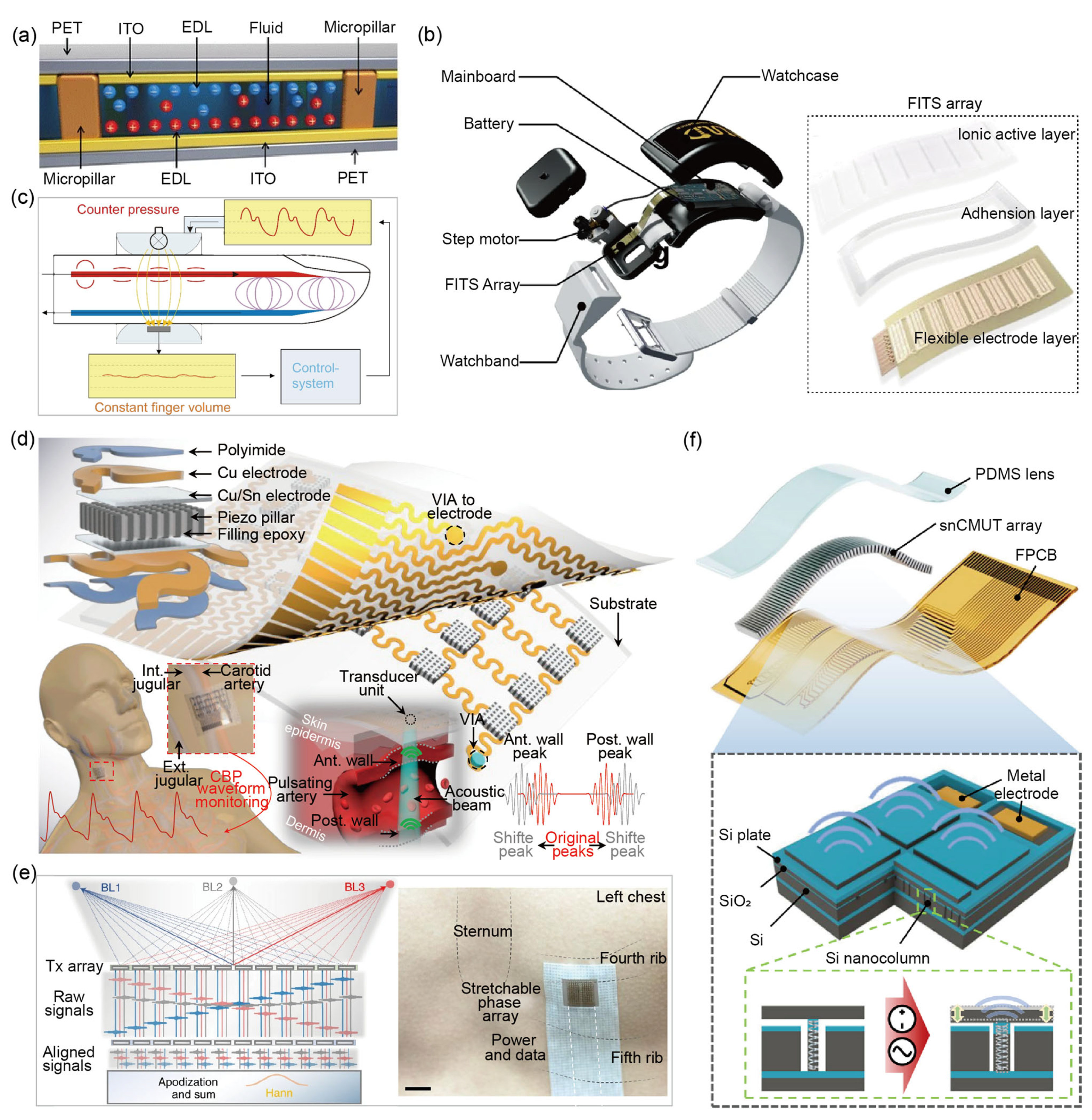
Traditional tonometry typically employs rigid sensors combined with complex mechanical assemblies or relies on manual positioning to achieve accurate vascular localization [26,31]. However, such designs suffer from structural rigidity and poor conformity with skin tissues, which inevitably introduces measurement errors. In addition, the bulky mechanical structure severely hinders the development of wearable applications [32,33]. To address these limitations, various flexible sensors have been developed for tonometry-based BP monitoring. Digiglio et al. [34] constructed a 3 × 3 sensor array with a sandwich structure using ethylene glycol as a microfluidic layer and a flexible PET film as the substrate (Figure 2a). The designed pressure sensor, which is based on arterial tension measurement and combined with external calibration, can obtain complete BP waveform. The dynamic microfluidic layer, serving as the sensing element, integrates high sensitivity and fast response characteristics. Furthermore, its high transparency facilitates the alignment of the sensor with the artery, thereby reducing positioning errors.
However, ABP waveform calibration using this flexible sensing device still requires manual maintenance of the artery in an appropriately flattened state. To overcome the above limitations, a flexible adaptive sensing tonometry (FAST) system has been developed for medical-grade continuous multi-parameter monitoring [28]. At its core lies are a 1 × 8 flexible iontronic sensing (FITS) array integrated with a closed-loop motion control system (Figure 2b). With a spatial resolution of 1 mm, FITS achieves precise localization of the radial artery without the need for additional motors, while its flexibility ensures intimate sensor–skin contact. Moreover, the FITS array provides real-time feedback to the closed-loop motion control system, dynamically adjusting the artery to the optimal applanation state and effectively suppressing signal distortion. The system also performs self-calibration during the applanation process, enabling real-time calculation of key hemodynamic parameters such as BP and cardiac output. However, the integration of rigid stepper motors and control circuits still limits the overall flexibility and comfort of the device.

2.2. Arterial Volume Clamp

The arterial volume clamp method for continuous BP measurement was first proposed by Czech physiologist Peňáz in 1973 [8]. Its theoretical basis is as follows: when the transmural pressure is zero, that is, when the pressure inside the artery is equal to the external pressure, the arterial wall is in a relatively relaxed state, and its compliance reaches a maximum [37]. At this point, fluctuations in blood flow pressure are more efficiently amplified into vascular expansion and contraction, thereby yielding the maximum pulse fluctuation amplitude [38]. Arterial volume clamp technology typically comprises a volume sensor and a pressure cuff, with its measurement principle illustrated in Figure 2c.
The volume clamp method involves two measurement phases. The first is the calibration stage, during which the volume sensor (usually a PPG sensor) sets the target volume by measuring the arterial volume fluctuation during systole and diastole to maximize the pulse fluctuation. During the calibration phase, the volume sensor (often a photoelectric capacitance sensor) can establish the target volume by detecting arterial volume changes between systole and diastole, thereby ensuring transmural pressure is zero [39]. The second phase is the operation phase, in which the pressure cuff dynamically applies pressure to the finger artery to maintain the artery at the target volume. Specifically, when the heart contracts, the artery expands, leading to an increase in the blood volume. The cuff then inflates rapidly to raise pressure, restoring the arterial volume to the target value. Conversely, when the heart relaxes, the artery constricts, causing a decrease in volume, the cuff deflates quickly to reduce the pressure, returning the arterial volume to the target value. The continuous cuff pressure adjustment curve recorded by the system can reflect the BP changes, allowing for the extraction of parameters such as systolic BP (SBP), diastolic BP (DBP) and Pulse Pressure (PP).
Several commercial BP measurement devices based on the volume clamp method have been developed. The most widely used is the Finapres system (Ohmeda, Louisville, CO, USA) system [40], developed by Dutch researchers in 1986). Numerous studies have compared the accuracy of the Finapres device with that of invasive arterial cannulation [40,41]. However, the consistency of its accuracy across different scenarios remains controversial, as it is influenced by factors such as vasomotor status and displacement of the finger at the measurement site. Furthermore, the CNAP monitor has gained attention [42]. This system, which is more complex than Finapres, consists of a brachial artery cuff, two finger sensors, and a wrist sensor [43]. The CNAP system utilizes the VERIFI algorithm [44] to correct for vasomotor tone via rapid PW analysis, thereby optimizing BP measurement accuracy. CNAP is considered to have accuracy comparable to clinical standards [27,45,46] and has been used in numerous non-invasive continuous BP studies as a reference device for BP estimation modeling [47,48]. However, both Finapres and CNAP suffer from limitations such as bulkiness and reliance on an inflatable finger cuff, which restrict their application in ambulatory measurement settings [48]. Furthermore, the inherent rigid structural characteristics of the inflatable finger cuff are incompatible with the tight skin fit and dynamic adaptability pursued by flexible devices, thereby restricting the technical transformation and application development of the arterial volume clamp method in flexible wearable BP monitoring devices.

2.3. Ultrasound-Based Method

As we all know, BP refers to the lateral pressure exerted on the walls of blood vessels as blood flows through them. This pressure is primarily determined by three key factors: the heart’s pumping function, vascular resistance and circulating blood volume. Ultrasound, defined as a high-frequency sound wave with strong directionality and penetrability, exhibits distinct propagation characteristics when traveling through media with different acoustic impedances. Clinically, ultrasound technology is widely employed to detect anatomical structures and physiological information of deep human tissues. The theory of ultrasonic BP measurement originated from the research of Meinders and Hoeks [49], who proposed that the diameter waveform of the carotid artery can be acquired using ultrasound. Specifically, when ultrasound waves penetrate skin tissue and enter blood vessels, they are reflected by the anterior and posterior walls of the vessels, generating echo signals. By calculating the flight time difference in the echo signal, the real-time change in the arterial diameter d ( t ) can be obtained. The exponential relationship between pressure p t and arterial cross-sectional area A t can be expressed as:
p ( t ) =   p d e α A ( t ) A d 1
where p d is the diastolic pressure (calibrated by an arm cuff), A d is the cross-sectional area of the artery at end-diastole, and α is the stiffness coefficient of the vessel. When assuming rotational symmetry of the artery, the cross-sectional area can be derived from the arterial diameter:
A ( t ) =   π 4 d 2 ( t )
Traditional ultrasound-based BP measurement faces two technical bottlenecks. On the one hand, the contact pressure exerted by rigid probes alters the natural tension state of the blood vessels, causing pressure artifact effects and result in significant errors in diameter measurement [50]. On the other hand, conventional equipment such as tension meters and ultrasonic wall trackers rely on high-speed imaging probes and are extremely susceptible to interference from motion artifacts [51].
Current flexible ultrasound technology mainly breaks through the above bottlenecks by using new materials, including piezoelectric composite materials, silicon nanopillars [36] and innovative structures to achieve common fit between sensors and skin. For example, Wang et al. [29] constructed a 4 × 5 transducer (240 μ m thick, 60% stretchable) using piezoelectric composite materials and flexible stretchable electrodes (PI/Cu composite electrodes). This transducer employs silicone elastomer encapsulation instead of ultrasound gel, while also having waterproof and sweat-proof properties (Figure 2d). However, the design of a single transducer limits measurement to the area directly beneath the device and prevents active targeting of specific deep blood vessels or organs. Additionally, the signal-to-noise ratio (SNR) in Doppler mode is generally less than 10 dB. The design of the stretchable phased array enables the transducer array to achieve active focusing and steering of the ultrasonic beam [35], enabling precise positioning within complex anatomical structures. By optimizing the operating frequency and excitation pulse, a penetration depth of 14 cm and a high SNR (SNR > 18 dB) can be achieved (Figure 2e). Furthermore, the adoption of novel silicon nanopillars [36] can replace traditional piezoelectric materials, resolving lead pollution problem, enhancing environmental protection and reduce costs (Figure 2f).

3. Flexible Sensing Technologies Toward Pulse Wave Acquisition

Although the traditional continuous BP measurement devices introduced in Section 2 have established a solid foundation in clinical practice, they still have significant limitations. For example, their rigid sensor structure and intrusive measurement methods result in limited portability and poor user comfort. Additionally, ultrasound devices require precise operation and calibration by specialized medical personnel, limiting their promotion in universal health management. To overcome this dilemma, emerging non-invasive continuous BP estimation methods have emerged. Based on flexible wearable technology, these methods collect physiological signals strongly correlated with changes in arterial BP (among which pulse wave signal have become the core monitoring target as they can directly reflect dynamic changes such as vascular volume and elasticity). By combining BP modeling algorithms, they establish a mapping relationship between the signals and arterial BP to achieve accurate and convenient BP monitoring. Compared to traditional rigid devices, flexible sensing systems structurally address the key pain points of wearable complexity and user discomfort, making them more suitable for long-term BP monitoring. Based on their fundamental sensing principles, flexible sensors used for pulse wave acquisition can be broadly categorized into four types: optical, mechanical, electrical, and acoustic; each offering distinct advantages in terms of sensitivity, integration, power consumption, and suitability for wearable applications. This section focuses on the three categories of flexible sensors: optical, mechanical, and electrical, systematically explaining their core structural design and operating principles, and conducting a comparative analysis of key performance parameters (Table 3). A dedicated discussion of acoustic flexible sensors, mainly flexible ultrasound devices, is provided in Section 2.3.

3.1. Optical-Based Sensors

Optical sensors used for continuous pulse wave measurement mainly refer to PPG sensors, typically consisting of one or more light-emitting diodes (LEDs) and a photodetector. The LED acts as a light source to emit light of a certain wavelength (usually red light or near-infrared light) to reach human tissue, which is then absorbed by the human tissue and then transmitted or reflected to the photodetector [52]. In biological tissue studies, hemoglobin exhibits significantly stronger light absorption compared to muscles, bones and veins, making it the primary cause of optical signal attenuation [53]. Therefore, the variation in light intensity captured by the photodetector can reflect changes in arterial blood volume. In each cardiac cycle, arterial blood volume changes periodically with the contraction and relaxation of the heart. The blood volume changes measured by the PPG sensor can be converted into a continuous PW signal. Continuous PW signals can reflect information reflecting cardiovascular status, such as heart rate (HR) [54,55,56], blood oxygen saturation (SpO2) [57,58], and BP [59,60,61].
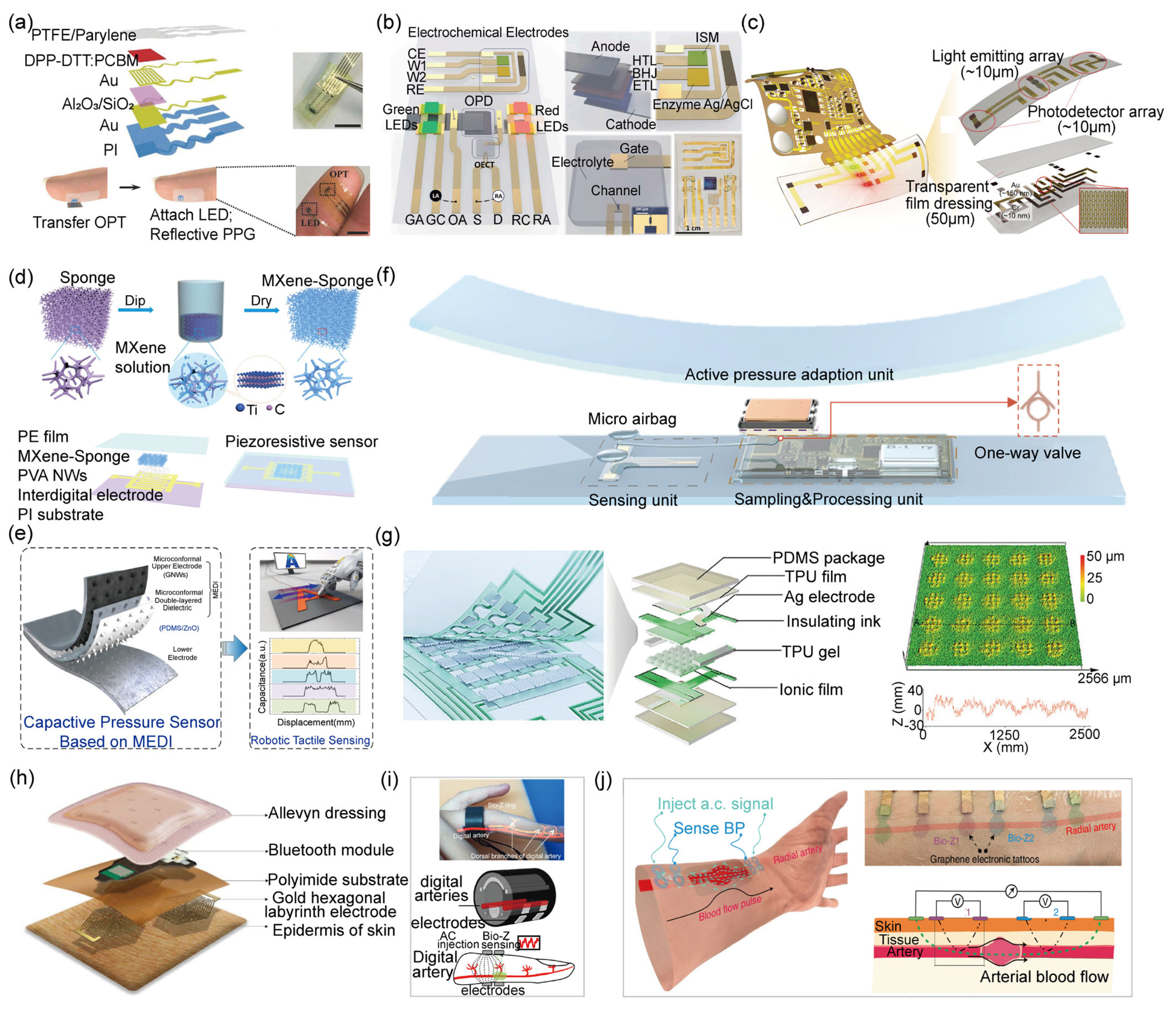
Wearable PPG-based PW measurement devices often use red (680 nm) or green (565 nm) light as a light source, enabling them to detect PW signals from the capillaries of the human epidermis. Therefore, wearable PPG devices are often placed on superficial arteries, such as the fingertips [62,63], wrists [64,65], earlobes [66,67], or foreheads [68,69], to measure pulse waves. The wrist is the most common application due to its accuracy and ease of wear. However, traditional rigid PPG sensors suffer from a conflict between power consumption and sensitivity. The use of high-power LEDs to enhance the signal-to-noise ratio also results in high power consumption. Xu et al. [70] developed a flexible PPG sensor that incorporates a highly sensitive organic phototransistor and an inorganic near-infrared (NIR) LED (Figure 3a). This sensor, combined with conventional ECG signals, extracts the PTT metric, enabling real-time estimation of HR, heart rate variability (HRV), and BP. The use of NIR light allows for deeper penetration than visible light, enabling the capture of blood flow information in dermal arteries. However, combining this with an ECG sensor to obtain the PTT metric requires multiple sensing nodes, limiting hardware integration. Zhong et al. [71] designed a flexible optoelectronic patch containing an organic electrochemical transistor (OECT) to integrate ECG and PPG signals into a single mixed signal (EC-PPG) for BP estimation, solving the problem of multi-node measurement and signal synchronization (Figure 3b). In addition, the attached electrochemical sensor can monitor sweat and glucose with high sensitivity, and combined with a DL algorithm, it realizes physiological-biochemical multimodal monitoring. In addition, the multi-wavelength PPG [72] sensor separates the PW signals of capillaries, arterioles, and arteries, and extracts the arteriolar PTT from them to estimate BP, demonstrating the advantages of single-node sensors in measuring BP.
In addition to the challenges of system power consumption and penetration depth, PPG sensors also face the challenge of motion artifacts. Although most flexible PPG sensors have been reported to be able to conform to the skin, the relative displacement between the sensor and the skin during motion, optical/electrical parameter drift caused by device deformation, and optical path instability in dynamic scenes all introduce motion artifacts into the PW signal. Motion artifacts can be eliminated through structural design and algorithm enhancement. Array LED design [73] is an effective way to compensate for optical path shifts caused by motion (Figure 3c). The multi-channel PPG design is combined with the frequency domain optical differentiation algorithm to eliminate the spectral portion of motion artifacts. However, PPG-based measurement systems still have many limitations. The low penetration of light and the detector’s high sensitivity to skin color, temperature, etc., will affect the quality of the PW signal.

3.2. Mechanical-Based Sensors

Mechanical sensors are used in pulse wave monitoring for their ability to convert mechanical changes, such as strain, pressure or displacement from the skin or arterial blood vessels, into measurable electrical signals for data acquisition circuits. Based on their fundamental material sensing mechanisms, these sensors can be categorized into four types: piezoelectric, piezoresistive, piezocapacitive and triboelectric. The material selection of flexible mechanical sensors directly affects their sensitivity. Some polymer materials such as PDMS, PI and Ecoflex are often used as substrates for flexible mechanical sensors due to their excellent flexibility and biocompatibility. Combining fillers such as carbon nanotubes (CNTs) [18] or graphene with PDMS substrates to improve conductivity and using plasma treatment to enhance adhesion to the skin interface has become an effective way to prepare high-sensitivity resistive or capacitive sensors. Sponges offer a promising alternative to these flexible substrates due to their high porosity (>97%), high elasticity, and low cost (Figure 3d). A simple soak-and-dry coating method can create a 3D porous network structure of MXene-sponge [19]. The fabricated piezoresistive sensor exhibits a sensitivity of 147 kPa−1 (<5.37 kPa) and 442 kPa−1 (5.37–18.56 kPa) at an input voltage of 0.1 V. Applying it to the radial artery can measure PW with clear waveform characteristics (P wave, T wave, and D wave). In addition, sensor microstructure design (pyramid type [80], cone type [74,81,82], porous planar type [83,84], etc.) is also a key link to improve sensitivity. For example, microstructured graphene nanowalls (GNWs) electrodes are prepared by photolithography and KOH etching technology [74]. The pyramid tip is used to reduce elastic resistance, achieve amplified deformation under small pressure, and improve sensor sensitivity (Figure 3e).
Conformal contact between flexible mechanical sensors and the skin interface is crucial for the stability of long-term PW monitoring. Li et al. [75] designed a flexible piezoelectric array sensor placed in the radial artery to continuously measure PW for BP estimation. They innovatively designed an active pressure adaptation unit, placing a micro airbag array beneath the sensor (Figure 3f). This, combined with a micropump and a one-way valve, creates controllable back pressure to maintain stable contact between the sensor and the artery. However, they still faced the challenge of manually positioning the radial artery. A 6 × 9 high-density sensor array was used to cover the radial artery area [76] (Figure 3g). This design effectively offsets the influence of arterial positioning deviation through multi-unit signal screening and is a practical solution. Combined with a wristband-type adaptive pressurization system, the airbag pressure closed-loop feedback is used to obtain the optimal pulse collection pressure (OPCP) and achieve high-precision PW monitoring.

3.3. Electrical-Based Sensors

Electrical sensors designed for physiological monitoring are primarily based on the electrical properties of biological tissue. For example, electrodes can collect electrocardiographic signals generated by heartbeats, as well as electrical impedance information from biological tissue under external power stimulation. High-precision non-invasive BP monitoring relies on high-quality acquisition of electrophysiological signals, and reliable, durable, low-impedance interface contact between electrodes and skin is a prerequisite for high signal quality. Commonly used electrodes in clinical practice are Ag/AgCl-based wet electrodes, which rely entirely on conductive gel. Drying of the gel after prolonged use will lead to increased impedance at the skin-electrode interface [85] and may also cause skin irritation (such as erythema and edema) [86]. To address the shortcomings of traditional wet electrodes, researchers have developed numerous innovative designs for ECG dry electrodes. Gold thin films are often used as a dry electrode material due to its high conductivity and biocompatibility. Elango et al. [77] combined gold thin film electrodes with a flexible PI substrate, achieving low electrode impedance at high frequencies (Figure 3h). Their proposed dense hexagonal maze-like geometry exhibits high hydrophobicity, making it suitable for daily wear. Additionally, novel material designs, such as CNT/PDMS-combined dry electrodes [87] and ion gel-encapsulated liquid metal electrodes [88], have demonstrated comparable measurement performance to commercial electrodes.
Electrical impedance measurement, which also relies on electrical sensors, has become a recent hot topic in pulse wave measurement research due to its deep tissue penetration and unaffected by skin color [89,90]. Electrical impedance technology injects high frequency alternating current into the body via electrodes. By exploiting the difference in electrical conductivity between blood and surrounding tissue (blood has higher conductivity than muscle and bone [91]), it captures the tiny impedance changes caused by changes in vascular volume during cardiac activity, thereby obtaining a factor that reflects BP fluctuations. Sel et al. [78] integrated ultra-small silver dry electrodes (3 mm * 3 mm) into a semi-flexible silicon ring to meet the needs of miniaturized finger artery detection (Figure 3i). Although the ring structure can ensure close contact between the electrode and the skin, the contact impedance of the dry silver electrode and the skin interface is still higher than the ideal value (about 1–10 kΩ). Graphene electronic tattoo sensors utilize atomic-scale materials and a self-adhesive design to overcome the high impedance and susceptibility of dry electrodes, making them breakthrough in bioimpedance sensing [79]. The sensor is transferred to the radial or ulnar artery via tattoo paper, capturing subtle changes in arterial bioimpedance (Figure 3j). Physiological features are extracted from the impedance signal and combined with ML algorithms to create a BP estimation model.

4. Modeling Strategies for Pulse Wave-Based BP Estimation

For indirect non-invasive continuous BP estimation, developing an accurate algorithm to translate pulse wave signals into BP values is essential. The model’s performance critically influences the system’s accuracy, reliability, and clinical viability, independent of the quality of the sensing hardware. Based on modeling mechanisms, PW-based non-invasive BP estimation methods can be categorized into two main classes: feature engineering-driven modeling and raw waveform-driven modeling. Feature engineering-driven modeling includes two subcategories: mechanistic models based on pulse wave propagation theory (Table 4) and ML or DL models based on pulse wave analysis (Table 5). In contrast, raw waveform-driven modeling relies primarily on feature representation learning of DL algorithms, which enables directly learning complex mapping relationships from raw physiological waveforms. This section systematically reviews both categories of models, providing an overview of their development history and summarizing the latest model algorithms.

4.1. Feature Engineering-Driven Modeling

4.1.1. Pulse Wave Propagation-Based Modeling

The physiological mechanisms of vascular response to BP are primarily described by the following two basic equations:
Moens Korteweg (M-K) equation: P W V =   E h ρ D
Hughes equation: E =   E 0 · e γ P
The M-K equation describes the relationship between PWV and arterial physiological parameters, where E represents the elastic modulus of the artery, h represents the arterial wall thickness, D represents the arterial diameter, and ρ represents the blood density. According to the Hughes equation, the arterial elastic modulus is exponentially related to the mean dilation pressure P , where E 0 is the elastic modulus at zero pressure and γ is a constant. Combining the above two models, we can obtain the relationship model between PWV and BP:
P W V =   E 0 h · e γ P ρ D
The above formula reveals the inherent connection between PWV and BP. When the heart fluctuates periodically, a pressure pulse signal is emitted from the heart and propagates along the arterial system. PWV is related to arterial compliance. When BP rises, arterial compliance decreases, and PWV increases; conversely, PWV decreases.
PWV can be characterized by the PTT: P W V = L / P T T , where L represents the distance between two measurement points in the arterial system. This is because time PTT is more easily observed and measured from continuous physiological signals. PTT is defined as the propagation interval of the PW between two points in the arterial system and is usually calculated as the time between the R wave of the ECG signal and a characteristic point of the PW signal (also defined as Pulse Arrival Time (PAT) in this case), or the transit time between two PW measurement points. Substituting P W V = L / P T T into Equation (3), the relationship model between BP and PTT can be obtained:
P =   1 γ 2 ln P T T + ln ρ L 2 D h E 0
PTT-based BP estimation modeling has received widespread attention since 2000 [122]. Based on Equation (4), Chen et al. [92] assumed that the arterial characteristic parameters are constant in the short term, that is, ρ ,     L ,     D ,     h and E 0 are constants. They differentiated Equation (4) with respect to PTT:
d P d P T T = 2 γ P T T
Thus, deriving that the change in PTT is linearly correlated with the change in BP. In this case, the change in PTT is linearly related to the change in BP:
P = 2 γ P T T P T T
Combined with the initial calibration value, the relationship model between SBP and PTT can be obtained:
S B P = S B P 0 2 γ P T T 0 P T T
Among them, S B P 0 and P T T 0 are the initial calibration values of the BP estimation model, which need to be calibrated at intervals of 5 min. Their study demonstrated a high correlation between PTT and SBP, but a poor correlation between PTT and DBP. Poon et al. [93] subsequently used the definition of Young’s modulus to represent the elastic modulus: E = P P / ε , where P P is the pulse pressure (the difference between SBP and DBP), representing the stress on the arteries, and ε is the tensile strain of the arteries. Combining the elastic modulus with the M-K equation, they demonstrated an inverse relationship between pulse pressure and the square of PTT:
P P = P P 0 · P T T 0 P T T 2
Then, combining the relationship between MBP, PP, SBP and DBP, the estimation model of SBP and DBP can be derived:
S B P = D B P + P P 0 · P T T 0 P T T 2
D B P = M B P 1 3 P P 0 · P T T 0 P T T 2
Both studies were validated by human subjects, and the Poon algorithm’s accuracy in estimating SBP and DBP was longer than that of the Chen et al. model. However, the accuracy of BP estimation remained relatively low, possibly because both models introduced idealized assumptions such as constant arterial diameter and wall thickness.
New indicators reflecting arterial characteristics have been studied. Ding et al. [123] combined the Beer-Lambert law to infer the relationship between arterial diameter and PPG intensity ratio (PIR):
P I R = e α · d
where α is a constant. Combining this with the Windkessel model, they proposed the DBP estimation model [94]:
D B P = D B P 0 · P I R P I R 0
Combined with Equation (8), SBP can be estimated as:
S B P = D B P 0 · P I R P I R 0 + P P 0 · P T T 0 P T T 2
Experiments have shown that PIR can reflect the changes in the low-frequency part of BP and can complement PTT, which reflects the high-frequency changes in BP [124], thus showing better estimation performance than the model that only includes PTT.
Beyond the ECG and PPG signals that the above physiological mechanism models rely on, other wearable signals have also been introduced to further explore the physiological mechanisms of the BP changes. Huynh et al. [95] considered that arterial diameter and cross-sectional area are related to BP changes. They derived a relationship model between arterial pressure, PWV, and cross-sectional area based on the B-H equation. Then, they employed an impedance plethysmography (IPG) sensor to measure changes in cross-sectional arterial area, and combined with the PTT measured by the fingertip PPG sensor, to establish the following BP estimation model:
S B P = D B P 0 + ρ · D P T T 2 l n 1 + K Z m a x 0 Z m a x
D B P = D B P 0 + ρ · D P T T 2 ln 1 + K Z m a x 0 Z m i n
where PTT is defined as the time difference between the peaks of the first derivatives of the IPG and PPG waveforms. Of note, the proposed model includes both SBP and DBP estimation, with Z m i n used for SBP and Z m a x for DBP. This addresses the limitation of the PTT-based physiological models, which rely on a single PTT to simultaneously determine two BP levels.
Nevertheless, the above-mentioned BP estimation model based on the pulse wave propagation mechanism still exhibits several limitations. First, it incorporates numerous idealized modeling assumptions, which introduce confounding factors that may compromise model accuracy. Second, the model depends on initial calibration values for modeling, requires frequent recalibration, posing challenges to the effectiveness of long-term monitoring. Third, it is unable to establish a universal model that accounts for individual differences. For populations with large inter-individual variability, the performance of BP estimation varies greatly.

4.1.2. Pulse Wave Analysis-Based Modeling

BP modeling based on pulse wave analysis is centered on ML or DL models. Endowed with powerful feature learning and nonlinear fitting capabilities, ML and DL models can automatically excavate deep correlative features contained in pulse wave signals that are difficult to capture by traditional mechanistic models. Moreover, they can adapt to individual physiological differences in a data-driven manner, significantly improving the accuracy and robustness of estimation while reducing reliance on complex prior physiological knowledge. This section will be elaborated on from two aspects: feature extraction and estimation models.
(1)
Feature extraction
Feature engineering-driven ML models aim to map multiple physiological features extracted from wearable signals (such as ECG, PPG, and ICG) to BP. This mapping relationship can characterize the complex changes in the cardiovascular system, yielding more reliable estimation performance compared to mechanistic models. When applied to BP estimation, the input features of ML models can be derived from diverse sources, based on unimodal, bimodal, or multimodal wearable signals.
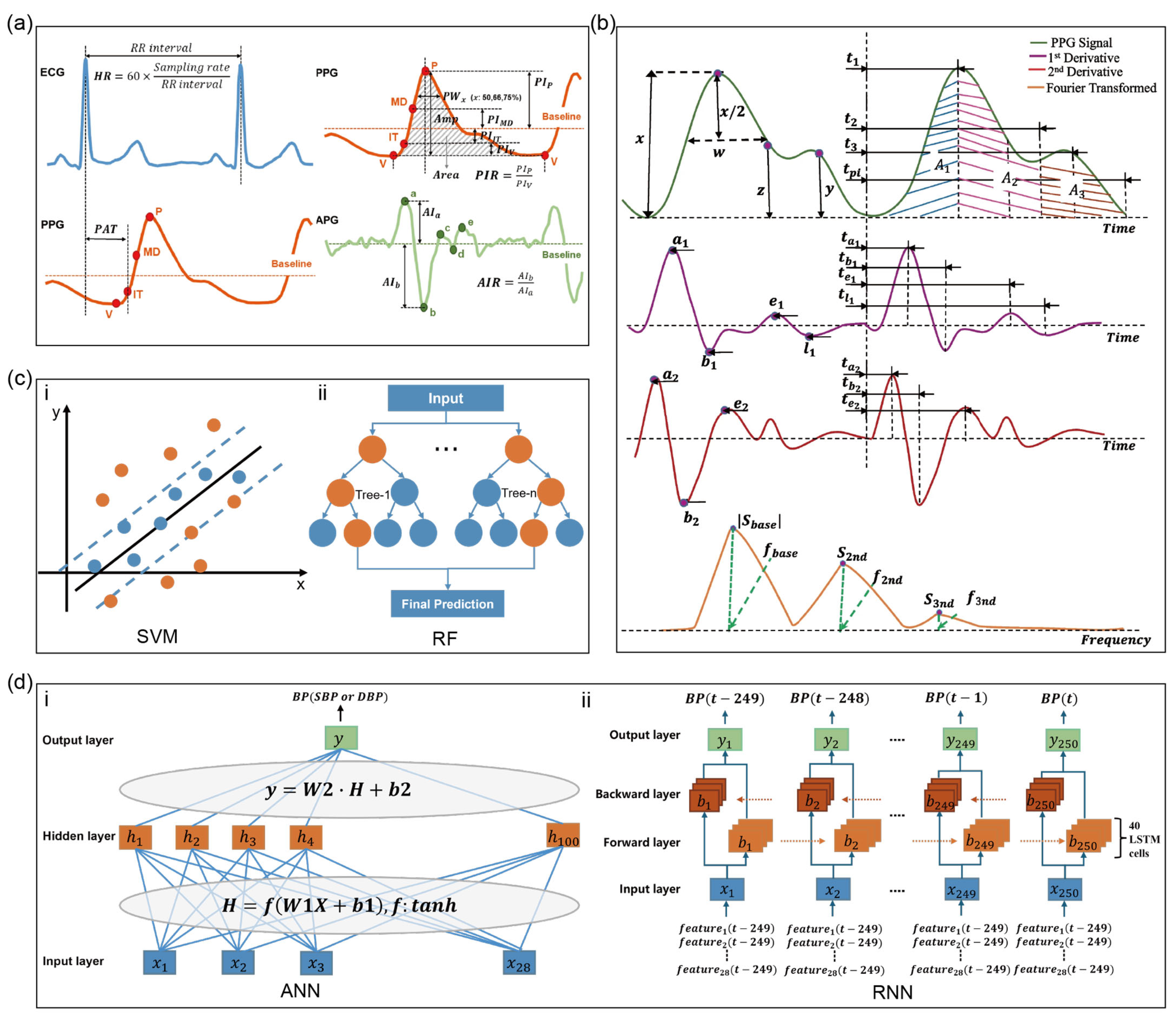
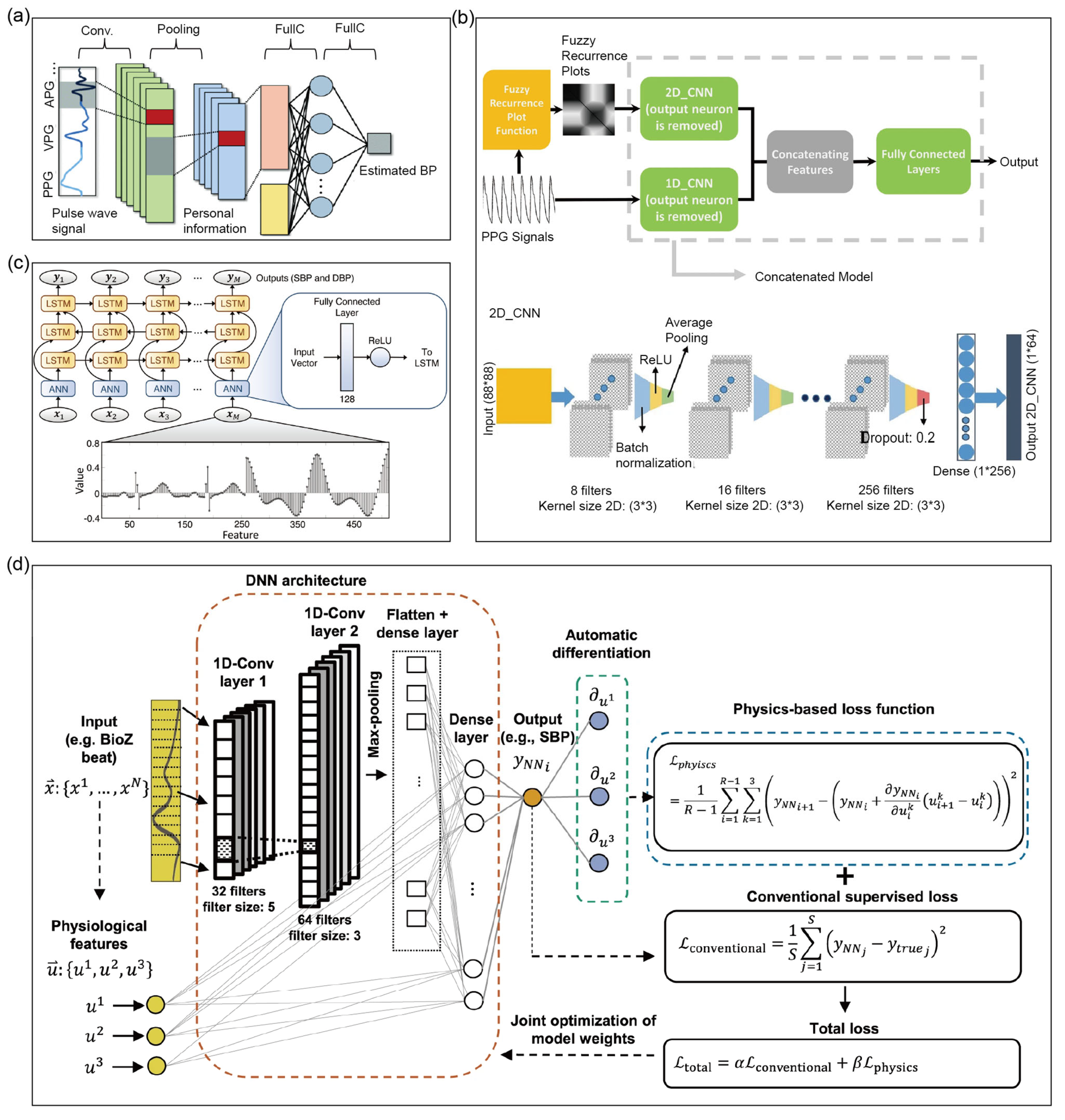
The PTT-based mechanistic model studies outlined in the previous section initially employed a bimodal combination of ECG and PPG signals. The development of bimodal signals has trended towards using physiological signals that are easier to acquire and do not require complex electrodes, gradually replacing traditional ECG signals, such as IPG-PPG signals and Ballistocardiogram (BCG)-PPG signals [125]. Figure 4a illustrates an example of combining PAT with HR features from ECG signals and time domain and waveform features from PPG signals to estimate BP [126]. PPG features complement PTT by providing valuable information on vascular elasticity and peripheral resistance. This information helps to mitigate interference from individual physiological differences and diverse measurement conditions, thereby enhancing both the accuracy and stability of BP estimation. Consequently, they have become a common input for ML models. Furthermore, the combination of dual-channel PPG signals has become another innovative approach to dual-modal signal acquisition. Pribil et al. [127] designed a dual-channel PPG sensor, placed over the wrist artery and finger artery, respectively, to simultaneously acquire PW signals. They extracted PTT, PWV, and PPG waveform features from these signals and established a linear regression model for BP estimation.
In addition, multimodal signal fusion has become a new direction in current BP estimation research. Xiang et al. [129] used wearable devices to simultaneously collect ECG, PPG, IPG, and skin temperature (ST) signals to establish a ML model based on learning BP estimation from the combined features of multimodal signals. They compared the estimation performance of input feature combinations from different modalities and found that when multimodal signals were used as input, the model’s estimation performance was generally superior to that of bimodal and unimodal signals. However, bimodal and multimodal signals pose new challenges to the miniaturization and integration of wearable devices. In the future, the balance between estimation accuracy and device integration still requires further exploration.
Wearable devices driven by unimodal signals have become the current research focus of non-invasive BP monitoring. Unimodal features are derived exclusively from a single physiological signal, such as a single ECG signal, PPG signal, or IPG signal. ECG signals are used to measure electrical activity during heart beats, contain information related to BP. Time parameter features extracted from ECG signals, such as ejection time (ET), relaxation time (RT), and QT interval, etc., have been shown to have correlation coefficients with BP exceeding 0.7 [130]. Additionally, frequency domain features [131] or waveform complexity features of ECG signals (signal activity, entropy, autocorrelation, etc.) [132] are also used to input into ML models such as Support Vector Machines (SVM) and K-Nearest Neighbors (KNN) in BP estimation modeling. However, since ECG signals do not contain physiological information about peripheral blood vessels, most ECG-based estimation models exhibit low accuracy.
PPG signals are widely used in non-invasive BP estimation due to their ease of acquisition and miniaturization potential of their sensors. Current pulse wave analysis techniques aim to identify various PPG signal features related to BP fluctuations, including PPG time-domain characteristics (e.g., peak intensity, trough intensity, contraction area, etc.) [133], waveform characteristics (e.g., skewness, angularity, etc.), and frequency-domain characteristics (e.g., fundamental frequency amplitude, second harmonics, third harmonics, etc.) [134]. Furthermore, the first- and second-order derivatives of the PPG signal can be used to locate characteristic points in the PPG signal [135]. For example, the peak amplitude and peak time of the first-order derivative (velocity PPG, VPG) correspond to the maximum slope and the time of occurrence of the maximum slope, while the amplitude ratio of the second-order derivative (acceleration PPG, APG) is also correlated with BP fluctuations [136]. The time domain and waveform features of PPG, VPG, and APG combined with the frequency domain features as input to the BP estimation model have been shown to have good performance (Figure 4b) [128]. Moreover, demographic information such as age and body mass index (BMI) [137], as well as behavioral information such as smoking and alcohol consumption, are incorporated into BP estimation models, with age and BMI being particularly dominant in influencing BP levels.
(2)
Estimation model
Models used for BP estimation have evolved from simple ML models to complex DL models. Initially, linear regression (LR) was used to derive the relationship between PTT or PWV and BP. Based on PTT, proportional models [96], inverse proportional models [97], inverse square models [98], and logarithmic models [99] have been established. However, the single metric of PTT is insufficient to represent the complex information of the cardiovascular system. To enhance prediction accuracy, additional physiological features derived from ECG and PPG, such as HR [138] and PIR [100], have been introduced into multivariate linear regression models to improve performance. Nevertheless, due to their relatively simplistic structure, LR models cannot fully learn the relationship between features and BP and have therefore been gradually replaced by complex ML models.
SVM is utilized for cuffless BP estimation, aiming to find the optimal hyperplane or regression plane to model the relationship between input features and BP (Figure 4c(i)). Time-domain features of PPG signals can be fed into a support vector regression (SVR) for BP estimation. Comparisons based on public datasets have demonstrated that SVM achieve superior prediction performance compared to LR [101]. SVM can also be used for classification tasks, achieving precise classification of BP ranges [102]. As a lightweight model, SVM can be integrated into smartphones, facilitating real-time monitoring in mobile health scenarios.
KNN is an unsupervised ML model that primarily predicts the target category or value by identifying the closest K training samples (neighbors) to the test sample. KNN has been shown to outperform traditional ML models (including LR, LASSO regression, and regression trees (RT)) in BP estimation [103,139]. Furthermore, Mejía-Mejía et al. [104] explored the extraction of indicators from PPG-derived pulse rate variability (PRV) signals for BP classification. KNN achieved higher accuracy for hypertension classification than both SVM and Artificial Neural Networks (ANN). However, the predictive performance of the KNN model is highly dependent on the choice of K and is not suitable for processing large datasets.
Random Forest (RF) is an ensemble learning method composed of multiple decision trees. It constructs multiple decision trees by randomly sampling the training dataset and aggregates their outputs to obtain the final prediction (Figure 4c(ii)). RF can be used to screen the time-domain and waveform features from ECG and PPG signals. The BP prediction performance has been shown to be better than the PTT-based method and the LR method without feature screening [105]. In addition, has demonstrated higher accuracy in BP classification than SVM and decision tree (DT) models [140]. While RF can process high-dimensional data and resist overfitting, it is relatively sensitive to outlier data.
Boosting is another new ensemble learning method that primarily iterates multiple weak learners over multiple rounds, continuously reducing the prediction error to ultimately form a strong ensemble model. Different boosting variants improve upon previous models’ errors in distinct ways: for example, Adaptive Boosting (AdaBoost) enhances performance by adjusting the weights of misclassified samples, while eXtreme Gradient Boosting (XGBoost) combines gradient boosting with regularization and linearly combines weak learners to achieve high-precision predictions. Hu et al. [106] compared the BP prediction performance of multiple ensemble learning models, including RF, AdaBoost, and XGBoost, using single-channel PPG features as input and based on a public database. The results showed that XGBoost achieved the best prediction performance for SBP and DBP.
ANN, inspired by biological neural network structures, represents a foundational DL model. Unlike previously mentioned ML models (e.g., SVM or KNN) that rely on manually designed features, ANN consists of multiple neurons connected by weights and automatically learn abstract data features through multiple layers of nonlinear transformations (Figure 4d(i)). For BP estimation, the input layer of the ANN typically comprises physiological features from an ECG [107] or PPG [108], while the output layer corresponds to the target BP value. The weights of intermediate layers are optimized using a backpropagation algorithm to optimize the loss function. ANN has excellent nonlinear mapping capabilities, enabling them to learn the complex relationship between features and BP. However, compared to these ML models, ANN requires a large amount of data for training and parameter tuning, and is also prone to getting stuck in local minimum during training.
A Recurrent Neural Network (RNN) is a specialized neural network designed for sequential data processing (Figure 4d(ii)). Their core innovation lies in the introduction of hidden states, which enables the memory of historical information. At each time step, an RNN receives both the current input and the hidden state from the previous time step [141]. The calculated hidden state is then passed to the next step for continued computation. Yang et al. [109] constructed a feature matrix with 250 time steps from filtered 28-dimensional high-frequency features from ECG and PPG signals, which was then fed into an RNN model composed of bidirectional long short-term memory (LSTM) cells. By combining the RNN’s prediction output with that of an ANN model trained on low-frequency features, they achieved continuous BP monitoring that met international standards and outperformed the comparative LR and RF models. However, RNN still rely on longer time steps to effectively extract sequential features, making them more suitable for direct processing of time series signals.

4.2. Raw Waveform-Driven Modeling

The BP estimation model with physiological signal waveform as input represents an advancement over the above feature engineering driven modeling. It avoids the problem that complex feature extraction procedures may result in the loss of valuable information. It fully utilizes the powerful automatic feature learning and nonlinear mapping capabilities of DL models to directly process raw or pre-processed physiological waveforms (such as PPG, ECG, or their combination). Waveform-driven BP estimation model can be categorized into two types based on the form of output. The first is beat-to-beat BP estimation, where the model outputs discrete heartbeat BP values—typically including SBP, DBP, and MBP. The second is end-to-end BP estimation, which takes physiological waveforms of one or multiple cardiac cycles as input and directly outputs the corresponding ABP waveform. The ABP waveform preserves the complete temporal details of arterial pressure fluctuations, making it crucial for evaluating hemodynamic parameters such as cardiac output and peripheral vascular resistance.

4.2.1. Beat-to-Beat BP Estimation

CNN is a model specifically designed to process multidimensional grid-like data. Convolutional kernels are used to extract local features from the data, which are then down sampled via pooling layers. Finally, fully connected layers are employed to extract key information and generate predictions. In BP estimation modeling, a one-dimensional (1-D) CNN kernel is typically adopted [112]. The input consists of a continuous waveform constructed by concatenating the PPG, VPG, and APG signals. This allows the model to effectively extract the characteristic information embedded within the PPG signal (Figure 5a). Furthermore, nonlinear features (e.g., recurrence rate (RR), determinism (DET)) can be concatenated with the PPG sequence as model input [114]. Alternatively, demographic information (e.g., age, height, weight, medication history) [112] may be fed into the fully connected layers to further enhance the model’s capability to capture BP fluctuations. To fully leverage the learning potential of CNN convolution kernels on grid data, Malayeri et al. [111] employed the Fuzzy C-Means (FCM) algorithm to transform 1-D PPG signals into two-dimensional (2-D) grayscale images. A 2-D CNN was then used to extract spatially recursive features, which were combined with the sequential temporal features learned by a 1-D CNN from the original PPG signal for BP estimation (Figure 5b). This approach has been demonstrated to outperform a single 1-D CNN model in prediction performance. Additionally, the parallel computing capability of CNNs can reduce computational complexity and improve training and inference efficiency.
RNN has a recursive structure and is therefore suitable for learning temporal dependencies in sequence signals. Traditional RNN architectures are subject to the risk of vanishing or exploding gradients. Improved variants such as Long Short-Term Memory (LSTM) and Gated Recurrent Unit (GRU) have been widely adopted in recent studies. For instance, Fan et al. [142] employed a lightweight two-layer Bidirectional LSTM (BiLSTM) architecture to extract forward and backward temporal dependencies from ECG waveforms. The outputs were then integrated via fully connected layers for multi-task prediction of SBP, DBP, and mean arterial pressure (MAP). The addition of an attention mechanism further allows adaptive weighting of features from the BiLSTM layer, which not only shortens training time but also improves prediction performance [113]. Furthermore, the fusing ECG and PPG signals can simultaneously capture information about cardiac electrical activity and peripheral arterial blood flow. Tanveer et al. [110] used the fused signal as input to an ANN-LSTM network, using a low-level ANN architecture to automatically ex-tract waveform morphological features. This was then combined with a high-level LSTM architecture to learn long-term variations in the time series (Figure 5c).
Transformer models integrate a self-attention mechanism to capture correlations across distant positions in long sequences and extract global contextual features. Transformers are independent of sequence order and can perform parallel learning across multiple sequences, resulting in higher training efficiency than RNN and CNN models. Huang et al. [143] extracted multi-source features from ECG and PPG signals. Using a parallel input strategy, they fed PPG, ECG, and PAT features into the model as three independent channels. Subsequently, parallel Transformer encoders were used to independently process and extract high-order features from long temporal sequences, thereby avoiding cross-source feature interference. Finally, a GRU layer was integrated to interactively fuse these multi-source features and output a BP estimate. This Transformer-GRU hybrid model can balance long-term temporal dependencies and temporal memory, providing a high-precision solution for non-invasive continuous BP monitoring. Additionally, hybrid models based on CNN-LSTM [116,144,145] and CNN-Transformer [146,147] have been developed. Specifically, CNNs are used to extract local waveform features, while LSTM and Transformer capture global temporal dependencies of the signal. Combined with attention mechanisms or fully connected layers, these features are mapped to BP estimates, demonstrating superior performance compared to single temporal models.
Physics-informed neural networks (PINNs), which integrate domain-specific physiological knowledge into DL frameworks, offer enhanced interpretability and reduced reliance on labeled data compared to conventional black-box models [148]. Kaan et al. [119] employed a 1D-CNN to extract temporal features from continuous bioimpedance waveforms. These features were combined with three key physiological features that reflect cardiovascular dynamics (bioimpedance amplitude change, the inverse time difference between the systolic and reflected waves, and beat-to-beat HR) to output BP predictions through a fully connected layer (Figure 5d). To train the neural network, a composite loss function was utilized, combining a traditional supervised loss with a physics-based loss term. The design of the physics-based loss originates from the gradually changing physiological states between adjacent heartbeats. A first-order Taylor polynomial is constructed using the i -th heartbeat as the expansion point to predict the BP value at the ( i + 1 ) -th heartbeat. The residual between the neural network’s actual prediction for this heartbeat and the Taylor approximation is then defined as the physics-based loss. The physics-based loss was derived from unlabeled data, reducing the cost of labeling and achieving low data dependency, high estimation accuracy, and strong interpretability for non-invasive BP estimation. The PINNs model provides an important reference for advancing DL applications in wearable physiological monitoring, especially in scenarios where labeled data is scarce.

4.2.2. End-to-End BP Estimation

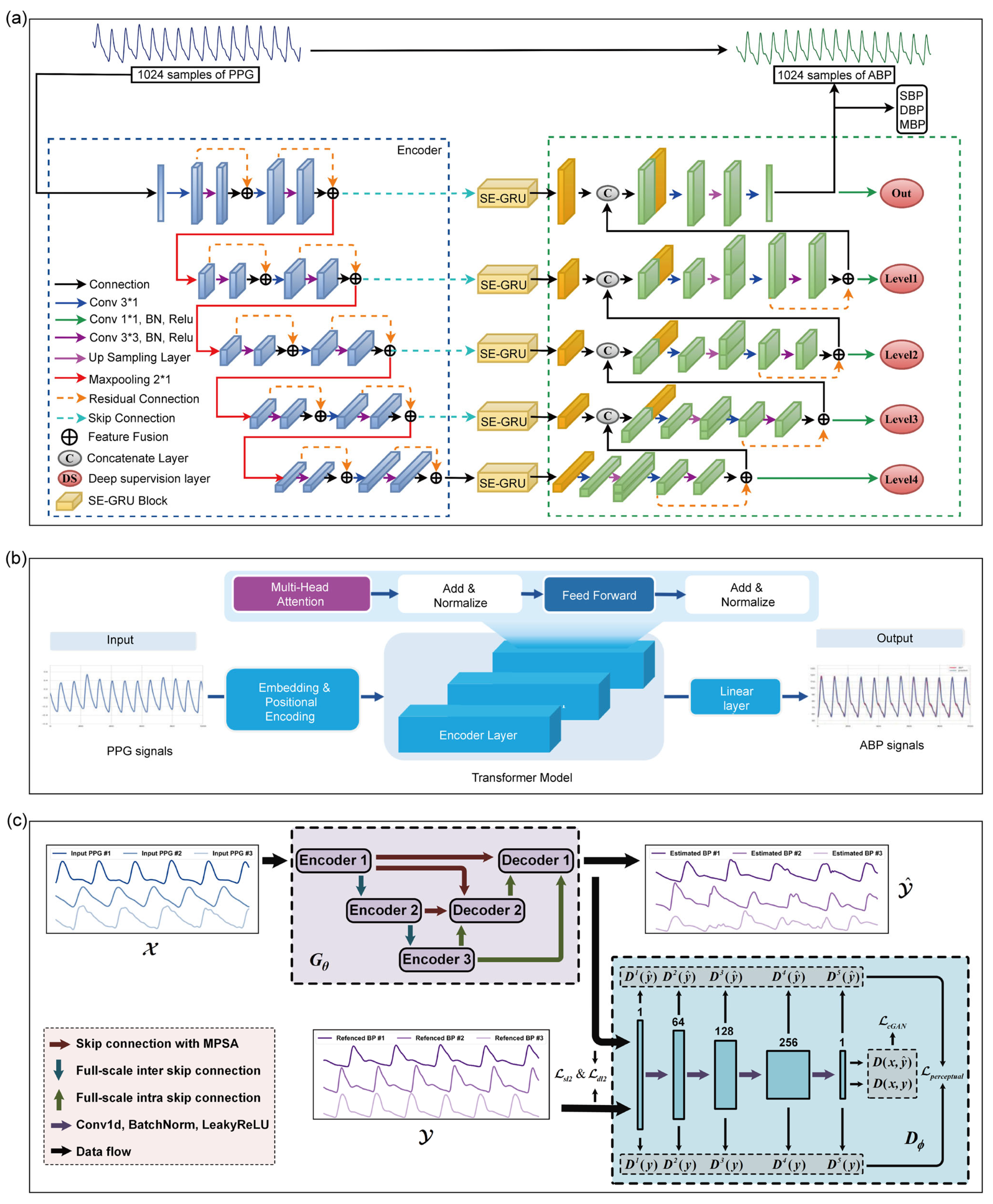
U-shaped Network (U-Net) model, a variant of the CNN model, consists of a left-right symmetrical encoder-decoder architecture. The left-hand encoder extracts high-level features from the input sequence through convolution and pooling layers, while the right-hand decoder reconstructs the waveform signal using upsampling and skip connections. PPG signals are widely adopted as input for the U-Net model. For example, Lai et al. [115] proposed an improved U-Net architecture, designing a convolution-batch normalization (BN)-residual stacking structure to directly transfer input information to the output layer, avoiding information loss and reducing parameter redundancy. The skipping module based on the Structure Embedded Gated Recurrent Unit (SE-GRU) demonstrates superior capability in capturing the dynamic variations in the PPG signal compared to the traditional SE, improving the model’s feature extraction capabilities (Figure 6a). Similar improved models have been used in integrated with flexible piezoelectric sensors to model continuous BP waveforms from acquired PW signals [149]. Furthermore, the combination of PPG signal and its derived signals, VPG and APG, is widely recognized to contain valuable information related to BP. In addition, the Residual U-Net (ResUNet) architecture, which fuses the residual neural networks with the U-Net framework, has been proven effective in alleviating the gradient vanishing problem and accelerating network convergence during training [150].
Transformer architecture has also been proposed for end-to-end ABP waveform estimation. Lee et al. [117] innovatively employed an encoder layer composed of a multi-head attention mechanism and a feedforward neural network to extract temporal information and internal dependencies from the PPG signal (Figure 6b). These extracted features were then fed into a subsequent feedforward layer to generate the target ABP waveform. Validation experiments conducted on public datasets demonstrated that the Transformer-based model achieves fast inference speed and exhibits strong generalization ability and robustness. Furthermore, improved models based on the Transformer architecture, such as the KD-Informer, incorporate a knowledge distillation strategy to construct a teacher-student network framework, enabling accurate estimation of continuous ABP waveform solely based on the morphological features of PPG signals [118]. Another notable approach is a multi-stage cascaded network architecture, which combines BiLSTM, the Transformer, and the Multi-Resolution Convolutional Attention Module U-Net (MCBAMU-Net). This cascaded design realizes ABP waveform estimation through a two-step process: initial approximation followed by refined reconstruction. However, such models are relatively high structural complex and have high deployment costs [151].
Generative Adversarial Networks (GANs) have also been introduced and combined with the U-Net architecture for ABP waveform estimation. Ma et al. [120] used the improved U-Net network enhanced by a multi-scale polarized self-attention (MPSA) mechanism as a generator. This generator is designed to synthesize continuous ABP waveforms using PPG signals and random noise as dual inputs (Figure 6c). Corresponding to the generator, a PatchGAN-based discriminator was employed, which verifies the authenticity of the generated ABP waveforms through a series of convolutional operations and provides real-time feedback to the generator. Notably, the PatchGAN discriminator evaluates the authenticity of each local segment of the ABP waveform and computes the average of these segment-wise judgments as the final authenticity score. In contrast, the CycleGAN framework achieves bidirectional and accurate mapping between PPG and ABP waveforms by enforcing cyclic consistency checks on the input and output [121]. Combined with the generator containing the convolution kernel, the CycleGAN-based ABP estimation model has excellent estimation performance and strong generalization ability.

5. Conclusions and Outlooks

Non-invasive, continuous BP measurement has emerged as a critical tool for home-based hypertension monitoring and remote, personalized cardiovascular disease management. This review highlights the latest advances in flexible measurement devices and BP estimation algorithms. New flexible arterial tonometry and ultrasound devices offer innovative approaches for continuous BP waveform measurement. The tonometry devices precisely adhere to the artery to sense pressure, while the ultrasound systems utilize flexible transducers to collect blood flow signals from multiple locations. However, indirect BP estimation based on pulse wave analysis remains the most mainstream technology owing to its calibration-free, ease of use and cost-effectiveness. We outline three types of flexible sensing devices for PW measurement: optical, mechanical, and electrical sensors. These devices leverage the blood flow, pulsatility, and electrical activity characteristics of arteries to establish the hardware architecture for PW measurement. For indirect BP estimation, early mechanistic models were derived from hemodynamic theory, extracting physiological characteristics such as PTT to model their relationship with BP. Subsequent ML models were further classified into simplified models (using physiological characteristics as input) and full-information models (using raw waveforms as input). Innovations in DL technology have enabled end-to-end direct estimation from PPG signals to continuous ABP signals, significantly enhancing the adaptability of BP measurement under complex conditions.
Although advances in flexible electronics and AI models have significantly improved the performance of non-invasive continuous BP measurement, numerous technical challenges persist, impeding its widespread adoption and compliance with clinical standards. A key challenge is achieving and maintaining conformal contact between flexible sensors and the skin: the dynamic nature of human skin poses obstacles to reliable signal acquisition. For instance, sweat secretion on the skin surface alters the electrical properties of the sensor-skin interface [152], while hair and the stratum corneum can create contact gaps, thereby increasing impedance [153]. Furthermore, daily activities cause relative displacement between the sensor and the skin [154]. These interfering factors can introduce noise and motion artifacts into the collected physiological signals, reducing the SNR of the raw data and introducing errors into subsequent BP measurements. To address these issues, biomimetic designs [155] or microfluidic channel structures [156] enable maintain interface stability and enable real-time sweat removal. Meanwhile, motion sensors such as accelerometers and gyroscopes [157] can utilize motion data to construct motion artifact compensation models, mitigating the impact of motion interference on raw signals.
The limited generalization capability of BP estimation algorithms poses another key challenge impeding the accuracy of BP measurement. Mechanistic models, which rely on generalized hemodynamic assumptions, often fail to account for individual variations in vascular elasticity, blood viscosity, and other parameters. As a result, these models exhibit significantly increased measurement errors when applied to special populations, such as the elderly and individuals with cardiovascular diseases. Secondly, the training datasets used for most current ML models struggle to cover the full spectrum of heterogeneous populations. These datasets are also predominantly based on static measurements, which limit the model’s ability to accurately track ambulatory BP fluctuations in dynamic real-world settings. Physics-informed neural network models have demonstrated considerable promise, as they integrate domain-specific physiological knowledge with the powerful correlation capabilities of neural networks, thereby enhancing both interpretability and generalization.
In summary, the widespread adoption of non-invasive continuous BP measurement devices for daily home health monitoring and achieving clinically acceptable accuracy requires collaborative efforts across multiple domains, including materials, flexible devices and estimation algorithms. By addressing these challenges, continuous, accurate, and stable BP measurement can play an indispensable role in the future of hypertension management. Specifically, future developments should focus on the following aspects:
(1)
Enhancing the stability and biocompatibility of the sensor–skin interface to reduce interfacial impedance, thereby improving signal quality.
(2)
Improving the motion artifact resistance of flexible sensors to enhance the reliability of physiological signal acquisition in dynamic environments.
(3)
Enriching BP estimation model training datasets to cover broader heterogeneous populations and more diverse ambulatory scenarios, thereby mitigating measurement errors caused by data bias.
(4)
Promoting the co-design and optimization of flexible sensors and intelligent algorithms. For example, develop low-power, highly integrated system-on-chip (SoC) solutions to enable real-time signal collection, processing, and BP estimation. Alternatively, design lightweight estimation models based on the dynamic characteristics of flexible sensors or optimize sensor layouts through model feedback.

Author Contributions

Conceptualization, Z.S.; writing—original draft preparation, Z.S., H.H. and C.D.; writing—review and editing, J.L. and X.D.; supervision, X.D., T.P. and X.Y.; project administration, Z.S.; funding acquisition, X.Y. All authors have read and agreed to the published version of the manuscript.

Funding

This work was supported by the Research Grants Council of the Hong Kong Special Administrative Region (Grant Nos. RFS2324-1S03, R1017-24F, C7005-23Y, T43-518/24-N, 11215722, and 11211523), City University of Hong Kong (Grants Nos. 9200138 and 9200143), the Nano & Material Technology Development Program through the National Research Foundation of Korea (NRF) funded by the Ministry of Science and ICT (No. RS-2024-00411904), in part by the InnoHK Project on Project 2.2—AI-based 3D ultrasound imaging algorithm at the Hong Kong Centre for Cerebro-Cardiovascular Health Engineering (COCHE).

Institutional Review Board Statement

Not applicable.

Informed Consent Statement

Not applicable.

Data Availability Statement

No new data were created or analyzed in this study. Data sharing is not applicable to this article.

Acknowledgments

During the preparation of this manuscript, the authors used OpenAI GPT-5 Mini for the purposes of language polishing. The authors have reviewed and edited the output and take full responsibility for the content of this publication.

Conflicts of Interest

The authors declare no conflicts of interest.

Abbreviations

The following abbreviations are used in this manuscript:
BPBlood Pressure
CVDsCardiovascular Diseases
ECGElectrocardiogram
PPGPhotoplethysmogram
MLMachine Learning
DLDeep Learning
PWPulse Wave
PWAPulse Wave Analysis
ABPArterial Blood Pressure
SBPSystolic Blood Pressure
DBPDiastolic Blood Pressure
SNRSignal-Noise-Ratio
HRHeart Rate
HRVHeart Rate Variability
PTTPulse Transit Time
PATPulse Arrival Time
IPGImpedance Plethysmography
BCGBallistocardiogram
PIRPPG Intensity Ratio
LRLinear Regression
SVMSupport Vector Machines
KNNK-Nearest Neighbors
RFRandom Forest
ANNArtificial Neural Networks
RNNRecurrent Neural Network
CNNConvolutional Neural Network
LSTMLong Short-Term Memory
GRUGated Recurrent Unit
PINNsPhysics-Informed Neural Networks
GANsGenerative Adversarial Networks

References

  1. Romero, T.; Nazal, C.N.; Lanas, F. Global Challenges in Cardiovascular Prevention in Populations with Low Socioeconomic Status; Springer Nature: Cham, Switzerland, 2025. [Google Scholar]
  2. WHO. Hypertension. Available online: https://www.who.int/news-room/fact-sheets/detail/hypertension (accessed on 15 August 2025).
  3. WHO. Cardiovascular Diseases (CVDs). Available online: https://www.who.int/health-topics/cardiovascular-diseases#tab=tab_1 (accessed on 15 August 2025).
  4. Valentinuzzi, M.E.; Beneke, K.; Gonzalez, G.E. Ludwig: The bioengineer. IEEE Pulse 2012, 3, 68–69. [Google Scholar] [CrossRef] [PubMed]
  5. Peterson, L.H.; Dripps, R.D.; Risman, G.C. A method for recording the arterial pressure pulse and blood pressure in man. Am. Heart J. 1949, 37, 771–782. [Google Scholar] [CrossRef] [PubMed]
  6. Keville, M.P.; Gelmann, D.; Hollis, G.; Beher, R.; Raffman, A.; Tanveer, S.; Jones, K.; Parker, B.M.; Haase, D.J.; Tran, Q.K. Arterial or cuff pressure: Clinical predictors among patients in shock in a critical care resuscitation unit. Am. J. Emerg. Med. 2021, 46, 109–115. [Google Scholar] [CrossRef] [PubMed]
  7. Pressman, G.L.; Newgard, P.M. A Transducer for the Continuous External Measurement of Arterial Blood Pressure. IEEE Trans. Bio. Med. Electron. 1963, 10, 73–81. [Google Scholar] [CrossRef]
  8. Penaz, J. Photoelectric measurement of blood pressure, volume and flow in the finger. In Proceedings of the Digest of the 10th International Conference on Medical and Biological Engineering, Dresden, Germany, 6–10 August 1973; pp. 2–7. [Google Scholar]
  9. Arndt, J.O.; Klauske, J.; Mersch, F. The diameter of the intact carotid artery in man and its change with pulse pressure. Pflügers Arch. Gesamte Physiol. Menschen Tiere 1968, 301, 230–240. [Google Scholar] [CrossRef]
  10. Stegall, H.F.; Kardon, M.B.; Kemamerer, W.T. Indirect measurement of arterial blood pressure by Doppler ultrasonic sphygmomanometry. J. Appl. Physiol. 1968, 25, 793–798. [Google Scholar] [CrossRef]
  11. Arakawa, T. Recent Research and Developing Trends of Wearable Sensors for Detecting Blood Pressure. Sensors 2018, 18, 2772. [Google Scholar] [CrossRef]
  12. Kim, M.S.; Almuslem, A.S.; Babatain, W.; Bahabry, R.R.; Das, U.K.; El-Atab, N.; Ghoneim, M.; Hussain, A.M.; Kutbee, A.T.; Nassar, J.; et al. Beyond Flexible: Unveiling the Next Era of Flexible Electronic Systems. Adv. Mater. 2024, 36, e2406424. [Google Scholar] [CrossRef]
  13. Parati, G.; Lombardi, C.; Pengo, M.; Bilo, G.; Ochoa, J.E. Current challenges for hypertension management: From better hypertension diagnosis to improved patients’ adherence and blood pressure control. Int. J. Cardiol. 2021, 331, 262–269. [Google Scholar] [CrossRef]
  14. Yi, C.; Li, W.; Shi, S.; He, K.; Ma, P.; Chen, M.; Yang, C. High-temperature-resistant and colorless polyimide: Preparations, properties, and applications. Sol. Energy 2020, 195, 340–354. [Google Scholar] [CrossRef]
  15. Amjadi, M.; Pichitpajongkit, A.; Lee, S.; Ryu, S.; Park, I. Highly Stretchable and Sensitive Strain Sensor Based on Silver Nanowire–Elastomer Nanocomposite. ACS Nano 2014, 8, 5154–5163. [Google Scholar] [CrossRef] [PubMed]
  16. Vanfleteren, J.; Loeher, T.; Gonzalez, M.; Bossuyt, F.; Vervust, T.; de Wolf, I.; Jablonski, M. SCB and SMI: Two stretchable circuit technologies, based on standard printed circuit board processes. Circuit World 2012, 38, 232–242. [Google Scholar] [CrossRef]
  17. Chen, Z.; Wang, Z.; Li, X.; Lin, Y.; Luo, N.; Long, M.; Zhao, N.; Xu, J.-B. Flexible piezoelectric-induced pressure sensors for static measurements based on nanowires/graphene heterostructures. ACS Nano 2017, 11, 4507–4513. [Google Scholar] [CrossRef]
  18. Wang, X.; Gu, Y.; Xiong, Z.; Cui, Z.; Zhang, T. Silk-molded flexible, ultrasensitive, and highly stable electronic skin for monitoring human physiological signals. Adv. Mater. 2013, 26, 1336–1342. [Google Scholar] [CrossRef]
  19. Yue, Y.; Liu, N.; Liu, W.; Li, M.; Ma, Y.; Luo, C.; Wang, S.; Rao, J.; Hu, X.; Su, J. 3D hybrid porous Mxene-sponge network and its application in piezoresistive sensor. Nano Energy 2018, 50, 79–87. [Google Scholar] [CrossRef]
  20. Habib, M.; Lantgios, I.; Hornbostel, K. A review of ceramic, polymer and composite piezoelectric materials. J. Phys. D Appl. Phys. 2022, 55, 423002. [Google Scholar] [CrossRef]
  21. Bai, Y.; Zhou, Y.; Wu, X.; Yin, M.; Yin, L.; Qu, S.; Zhang, F.; Li, K.; Huang, Y. Flexible strain sensors with ultra-high sensitivity and wide range enabled by crack-modulated electrical pathways. Nano Micro Lett. 2025, 17, 64. [Google Scholar] [CrossRef]
  22. Ye, C.; Ume, C.I.; Sitaraman, S.K. Mechanical characterization of embedded serpentine conductors in wearable electronics. J. Electron. Packag. 2020, 142, 021007. [Google Scholar] [CrossRef]
  23. Chen, H.; Sun, G.; Yang, Z.; Wang, T.; Bai, G.; Wang, J.; Chen, R.; Han, S. Ultra-sensitive, lightweight, and flexible composite sponges for stress sensors based combining of “through-hole” polyimide sponge and “pleated stacked” reduced graphene oxide. Compos. Sci. Technol. 2022, 218, 109179. [Google Scholar] [CrossRef]
  24. Li, J.; Chu, H.; Chen, Z.; Yiu, C.K.; Qu, Q.a.; Li, Z.; Yu, X. Recent advances in materials, devices and algorithms toward wearable continuous blood pressure monitoring. ACS Nano 2024, 18, 17407–17438. [Google Scholar] [CrossRef] [PubMed]
  25. Liu, M.; Zhang, Y.; Tao, T.H. Recent progress in bio-integrated intelligent sensing system. Adv. Intell. Syst. 2022, 4, 2100280. [Google Scholar] [CrossRef]
  26. Dueck, R.; Goedje, O.; Clopton, P. Noninvasive continuous beat-to-beat radial artery pressure via TL-200 applanation tonometry. J. Clin. Monit. Comput. 2012, 26, 75–83. [Google Scholar] [CrossRef] [PubMed]
  27. Kumar, G.A.; Jagadeesh, A.; Singh, N.G.; Prasad, S. Evaluation of continuous non-invasive arterial pressure monitoring during induction of general anaesthesia in patients undergoing cardiac surgery. Indian J. Anaesth. 2015, 59, 21–25. [Google Scholar] [CrossRef] [PubMed]
  28. Deng, M.; Du, C.; Fang, J.; Xu, C.; Guo, C.; Huang, J.; Li, K.; Chen, L.; Zhang, Y.-T.; Chang, Y.; et al. Flexible adaptive sensing tonometry for medical-grade multi-parametric hemodynamic monitoring. Npj Flex. Electron. 2024, 8, 45. [Google Scholar] [CrossRef]
  29. Wang, C.; Li, X.; Hu, H.; Zhang, L.; Huang, Z.; Lin, M.; Zhang, Z.; Yin, Z.; Huang, B.; Gong, H.; et al. Monitoring of the central blood pressure waveform via a conformal ultrasonic device. Nat. Biomed. Eng. 2018, 2, 687–695. [Google Scholar] [CrossRef]
  30. Eckerle, J.S. Tonometry, arterial. In Encyclopedia of Medical Devices and Instrumentation; John Wiley & Sons: Hoboken, NJ, USA, 2006. [Google Scholar]
  31. Salvi, P.; Grillo, A.; Parati, G. Noninvasive estimation of central blood pressure and analysis of pulse waves by applanation tonometry. Hypertens Res. 2015, 38, 646–648. [Google Scholar] [CrossRef]
  32. Kim, J.; Chou, E.F.; Le, J.; Wong, S.; Chu, M.; Khine, M. Soft Wearable Pressure Sensors for Beat-to-Beat Blood Pressure Monitoring. Adv. Healthc. Mater. 2019, 8, e1900109. [Google Scholar] [CrossRef]
  33. Sayer, G.; Piper, G.; Vorovich, E.; Raikhelkar, J.; Kim, G.H.; Rodgers, D.; Shimbo, D.; Uriel, N. Continuous Monitoring of Blood Pressure Using a Wrist-Worn Cuffless Device. Am. J. Hypertens. 2022, 35, 407–413. [Google Scholar] [CrossRef]
  34. Digiglio, P.; Li, R.; Wang, W.; Pan, T. Microflotronic arterial tonometry for continuous wearable non-invasive hemodynamic monitoring. Ann. Biomed. Eng. 2014, 42, 2278–2288. [Google Scholar] [CrossRef]
  35. Wang, C.; Qi, B.; Lin, M.; Zhang, Z.; Makihata, M.; Liu, B.; Zhou, S.; Huang, Y.-H.; Hu, H.; Gu, Y.; et al. Continuous monitoring of deep-tissue haemodynamics with stretchable ultrasonic phased arrays. Nat. Biomed. Eng. 2021, 5, 749–758. [Google Scholar] [CrossRef]
  36. Kang, D.-H.; Cho, S.; Kim, H.Y.; Shim, S.; Kim, D.H.; Jeong, B.; Lee, Y.S.; Park, E.-A.; Lee, W.; Kim, H.; et al. Silicon nanocolumn-based disposable and flexible ultrasound patches. Nat. Commun. 2025, 16, 6609. [Google Scholar] [CrossRef] [PubMed]
  37. Langewouters, G.; Zwart, A.; Busse, R.; Wesseling, K. Pressure-diameter relationships of segments of human finger arteries. Clin. Phys. Physiol. Meas. 1986, 7, 43. [Google Scholar] [CrossRef] [PubMed]
  38. Laing, C. Human Spaceflight Countermeasures: Cerebral Hemodynamics During Short-Arm Human Centrifugation and the Role of Peripheral Fluid Shifts and Jugular Venous Congestion. Ph.D. Thesis, King’s College London, London, UK, 2017. [Google Scholar]
  39. Penaz, J. Criteria for set point estimation in the volume clamp method of blood pressure measurement. Physiol. Res. 1992, 41, 5–10. [Google Scholar] [PubMed]
  40. Parati, G.; Casadei, R.; Groppelli, A.; di Rienzo, M.; Mancia, G. Comparison of finger and intra-arterial blood pressure monitoring at rest and during laboratory testing. Hypertension 1989, 13, 647–655. [Google Scholar] [CrossRef]
  41. Stokes, D.; Clutton-Brock, T.; Patil, C.; Thompson, J.; Hutton, P. Comparison of invasive and non-invasive measurement of continuous arterial pressure using the Finapres. Br. J. Anaesth. 1991, 67, 26–35. [Google Scholar] [CrossRef][Green Version]
  42. Fortin, J.; Marte, W.; Grüllenberger, R.; Hacker, A.; Habenbacher, W.; Heller, A.; Wagner, C.; Wach, P.; Skrabal, F. Continuous non-invasive blood pressure monitoring using concentrically interlocking control loops. Comput. Biol. Med. 2006, 36, 941–957. [Google Scholar] [CrossRef]
  43. Saugel, B.; Dueck, R.; Wagner, J.Y. Measurement of blood pressure. Best Pract. Res. Clin. Anaesthesiol. 2014, 28, 309–322. [Google Scholar] [CrossRef]
  44. Fortin, J.; Wellisch, A.; Maier, K. CNAP–evolution of continuous non-invasive arterial blood pressure monitoring. Biomed. Eng. Biomed. Tech. 2013, 58, 000010151520134179. [Google Scholar] [CrossRef]
  45. Jagadeesh, A.; Singh, N.G.; Mahankali, S. A comparison of a continuous noninvasive arterial pressure (CNAP™) monitor with an invasive arterial blood pressure monitor in the cardiac surgical ICU. Ann. Card. Anaesth. 2012, 15, 180–184. [Google Scholar] [CrossRef]
  46. Wagner, J.Y.; Prantner, J.S.; Meidert, A.S.; Hapfelmeier, A.; Schmid, R.M.; Saugel, B. Noninvasive continuous versus intermittent arterial pressure monitoring: Evaluation of the vascular unloading technique (CNAP device) in the emergency department. Scand. J. Trauma Resusc. Emerg. Med. 2014, 22, 8. [Google Scholar] [CrossRef]
  47. Panula, T.; Sirkiä, J.-P.; Kaisti, M. Control method for continuous non-invasive arterial pressure monitoring using the non-pulsatile component of the PPG signal. In Proceedings of the 2021 Computing in Cardiology (CinC), Brno, Czech Republic, 12–15 September 2021; pp. 1–4. [Google Scholar]
  48. Panula, T.; Sirkiä, J.-P.; Kaisti, M. Continuous blood pressure monitoring using nonpulsatile photoplethysmographic components for low-frequency vascular unloading. IEEE Trans. Instrum. Meas. 2023, 72, 4004910. [Google Scholar] [CrossRef]
  49. Meinders, J.M.; Hoeks, A.P. Simultaneous assessment of diameter and pressure waveforms in the carotid artery. Ultrasound Med. Biol. 2004, 30, 147–154. [Google Scholar] [CrossRef]
  50. Tan, J.; Xu, L.; Sun, H.; Xu, B.; Li, Y.; Yao, Y. Quantitative analysis of the effect of contact pressure on the reflection characteristics of radial pressure wave. J. Biomed. Eng. 2022, 39, 1127–1132. [Google Scholar]
  51. Huang, C.; Song, P.; Trzasko, J.D.; Gong, P.; Lok, U.-W.; Tang, S.; Manduca, A.; Chen, S. Simultaneous noise suppression and incoherent artifact reduction in ultrafast ultrasound vascular imaging. IEEE Trans. Ultrason. Ferroelectr. Freq. Control 2021, 68, 2075–2085. [Google Scholar] [CrossRef]
  52. Tamura, T.; Maeda, Y.; Sekine, M.; Yoshida, M. Wearable Photoplethysmographic Sensors—Past and Present. Electronics 2014, 3, 282–302. [Google Scholar] [CrossRef]
  53. Saiko, G.; Sadrzadeh-Afsharazar, F.; Burton, T.; Prahl, S.; Douplik, A. Absorption, scattering, and refractive index of blood and its components: A review. Front. Photon. 2025, 6, 1636398. [Google Scholar] [CrossRef]
  54. Temko, A. Accurate heart rate monitoring during physical exercises using PPG. IEEE Trans. Biomed. Eng. 2017, 64, 2016–2024. [Google Scholar] [CrossRef]
  55. Burrello, A.; Pagliari, D.J.; Risso, M.; Benatti, S.; Macii, E.; Benini, L.; Poncino, M. Q-ppg: Energy-efficient ppg-based heart rate monitoring on wearable devices. IEEE Trans. Biomed. Circuits Syst. 2021, 15, 1196–1209. [Google Scholar] [CrossRef]
  56. Chang, X.; Li, G.; Xing, G.; Zhu, K.; Tu, L. DeepHeart: A deep learning approach for accurate heart rate estimation from PPG signals. ACM Trans. Sens. Netw. (TOSN) 2021, 17, 1–18. [Google Scholar] [CrossRef]
  57. Ma, G.; Zhu, W.; Zhong, J.; Tong, T.; Zhang, J.; Wang, L. Wearable ear blood oxygen saturation and pulse measurement system based on PPG. In Proceedings of the 2018 IEEE SmartWorld, Ubiquitous Intelligence & Computing, Advanced & Trusted Computing, Scalable Computing & Communications, Cloud & Big Data Computing, Internet of People and Smart City Innovation (SmartWorld/SCALCOM/UIC/ATC/CBDCom/IOP/SCI), Hangzhou, China, 8–12 October 2018; pp. 111–116. [Google Scholar]
  58. Haque, C.A.; Hossain, S.; Kwon, T.-H.; Kim, K.-D. Comparison of different methods to estimate blood oxygen saturation using PPG. In Proceedings of the 2021 International Conference on Information and Communication Technology Convergence (ICTC), Jeju Island, Republic of Korea, 20–22 October 2021; pp. 792–794. [Google Scholar]
  59. Slapničar, G.; Luštrek, M.; Marinko, M. Continuous blood pressure estimation from PPG signal. Informatica 2018, 42, 33–42. [Google Scholar]
  60. Panwar, M.; Gautam, A.; Biswas, D.; Acharyya, A. PP-Net: A deep learning framework for PPG-based blood pressure and heart rate estimation. IEEE Sens. J. 2020, 20, 10000–10011. [Google Scholar] [CrossRef]
  61. Haddad, S.; Boukhayma, A.; Caizzone, A. Continuous PPG-based blood pressure monitoring using multi-linear regression. IEEE J. Biomed. Health Inform. 2021, 26, 2096–2105. [Google Scholar] [CrossRef] [PubMed]
  62. Lee, K.M.; Qian, Z.; Yabuki, R.; Du, B.; Kino, H.; Fukushima, T.; Kiyovama, K.; Tanaka, T. Continuous peripheral blood pressure measurement with ECG and PPG signals at fingertips. In Proceedings of the 2018 IEEE Biomedical Circuits and Systems Conference (BioCAS), Cleveland, OH, USA, 17–19 October 2018; pp. 1–4. [Google Scholar]
  63. Mansourinezhad, P.; Ahmadi, M.M.; Mohammadzade, H. Blood pressure estimation using a PPG signal recorded from the fingertip of a hand moving in the sagittal plane. IEEE Sens. J. 2023, 23, 17751–17760. [Google Scholar] [CrossRef]
  64. Attarpour, A.; Mahnam, A.; Aminitabar, A.; Samani, H. Cuff-less continuous measurement of blood pressure using wrist and fingertip photo-plethysmograms: Evaluation and feature analysis. Biomed. Signal Process. Control 2019, 49, 212–220. [Google Scholar] [CrossRef]
  65. Cao, Y.; Chen, H.; Li, F.; Wang, Y. Crisp-BP: Continuous wrist PPG-based blood pressure measurement. In Proceedings of the 27th Annual International Conference on Mobile Computing and Networking, New Orleans, LA, USA, 25–29 October 2021; pp. 378–391. [Google Scholar]
  66. Park, J.-U.; Kang, D.-W.; Erdenebayar, U.; Kim, Y.-J.; Cha, K.-C.; Lee, K.-J. Estimation of arterial blood pressure based on artificial intelligence using single earlobe photoplethysmography during cardiopulmonary resuscitation. J. Med. Syst. 2020, 44, 18. [Google Scholar] [CrossRef]
  67. Xue, Q.; Nissanka, D.; Yan, J.T.; Wang, R.; Patel, S.; Iyer, V. PPG Earring: Wireless Smart Earring for Heart Health Monitoring. In Proceedings of the 2025 CHI Conference on Human Factors in Computing Systems, Yokohama, Japan, 26 April–1 May 2025; pp. 1–16. [Google Scholar]
  68. Li, Y.; Wei, M.; Chen, Q.; Zhu, X.; Li, H.; Wang, H.; Luo, J. Hybrid D1DCnet using forehead iPPG for continuous and noncontact blood pressure measurement. IEEE Sens. J. 2022, 23, 2727–2736. [Google Scholar] [CrossRef]
  69. Du, Y.H.; Sun, C.; Zhang, M.; Mai, S. Design of a two-channel forehead PPG sensor. In Proceedings of the 2023 IEEE Biomedical Circuits and Systems Conference (BioCAS), Toronto, ON, Canada, 19–21 October 2023; pp. 1–5. [Google Scholar]
  70. Xu, H.; Liu, J.; Zhang, J.; Zhou, G.; Luo, N.; Zhao, N. Flexible Organic/Inorganic Hybrid Near-Infrared Photoplethysmogram Sensor for Cardiovascular Monitoring. Adv. Mater. 2017, 29, 1700975. [Google Scholar] [CrossRef]
  71. Zhong, Y.; Zhang, Y.; Pu, J.; Wustoni, S.; Uribe, J.; Lopez-Larrea, N.; Marks, A.; McCulloch, I.; Mecerreyes, D.; Baran, D.; et al. Monitoring blood pressure through a single hybrid hemodynamic signal with a flexible optoelectronic patch. Device 2025, 3, 100778. [Google Scholar] [CrossRef]
  72. Liu, J.; Yan, B.P.; Zhang, Y.T.; Ding, X.R.; Su, P.; Zhao, N. Multi-Wavelength Photoplethysmography Enabling Continuous Blood Pressure Measurement with Compact Wearable Electronics. IEEE Trans. Biomed. Eng. 2019, 66, 1514–1525. [Google Scholar] [CrossRef]
  73. Li, H.; Ma, Y.; Liang, Z.; Wang, Z.; Cao, Y.; Xu, Y.; Zhou, H.; Lu, B.; Chen, Y.; Han, Z.; et al. Wearable skin-like optoelectronic systems with suppression of motion artifacts for cuff-less continuous blood pressure monitor. Natl. Sci. Rev. 2020, 7, 849–862. [Google Scholar] [CrossRef]
  74. Luo, S.; Zhou, X.; Tang, X.; Li, J.; Wei, D.; Tai, G.; Chen, Z.; Liao, T.; Fu, J.; Wei, D.; et al. Microconformal electrode-dielectric integration for flexible ultrasensitive robotic tactile sensing. Nano Energy 2021, 80, 105580. [Google Scholar] [CrossRef]
  75. Li, J.; Jia, H.; Zhou, J.; Huang, X.; Xu, L.; Jia, S.; Gao, Z.; Yao, K.; Li, D.; Zhang, B. Thin, soft, wearable system for continuous wireless monitoring of artery blood pressure. Nat. Commun. 2023, 14, 5009. [Google Scholar] [CrossRef] [PubMed]
  76. Wang, X.; Wu, G.; Zhang, X.; Lv, F.; Yang, Z.; Nan, X.; Zhang, Z.; Xue, C.; Cheng, H.; Gao, L. Traditional Chinese Medicine (TCM)-Inspired Fully Printed Soft Pressure Sensor Array with Self-Adaptive Pressurization for Highly Reliable Individualized Long-Term Pulse Diagnostics. Adv. Mater. 2025, 37, e2410312. [Google Scholar] [CrossRef] [PubMed]
  77. Elango, P.F.M.; Dhanabalan, S.S.; Robel, M.R.; Elango, S.P.; Walia, S.; Sriram, S.; Bhaskaran, M. Dry electrode geometry optimization for wearable ECG devices. Appl. Phys. Rev. 2023, 10, 041408. [Google Scholar] [CrossRef]
  78. Sel, K.; Osman, D.; Huerta, N.; Edgar, A.; Pettigrew, R.I.; Jafari, R. Continuous cuffless blood pressure monitoring with a wearable ring bioimpedance device. NPJ Digit. Med. 2023, 6, 59. [Google Scholar] [CrossRef]
  79. Kireev, D.; Sel, K.; Ibrahim, B.; Kumar, N.; Akbari, A.; Jafari, R.; Akinwande, D. Continuous cuffless monitoring of arterial blood pressure via graphene bioimpedance tattoos. Nat. Nanotechnol. 2022, 17, 864–870. [Google Scholar] [CrossRef]
  80. Choong, C.L.; Shim, M.B.; Lee, B.S.; Jeon, S.; Ko, D.S.; Kang, T.H.; Bae, J.; Lee, S.H.; Byun, K.E.; Im, J. Highly stretchable resistive pressure sensors using a conductive elastomeric composite on a micropyramid array. Adv. Mater. 2014, 26, 3451–3458. [Google Scholar] [CrossRef]
  81. Li, T.; Pan, P.; Yang, Z.; Wei, J.; Yang, X.; Liu, J.; Zhou, J.; Zhang, X.; Liu, G. 3D printing of a flexible inclined-tip cone array-based pressure sensor. Adv. Mater. Technol. 2022, 7, 2101135. [Google Scholar] [CrossRef]
  82. Chen, L.; Zheng, B.; Ye, J.; Wu, H. Cone-Shaped Electrodes for Capacitive Tactile Sensors with High Sensitivity and Broad Linearity Range. Adv. Mater. Technol. 2023, 8, 2300901. [Google Scholar] [CrossRef]
  83. Zhang, Y.; Zhang, T.; Huang, Z.; Yang, J. A new class of electronic devices based on flexible porous substrates. Adv. Sci. 2022, 9, 2105084. [Google Scholar] [CrossRef]
  84. Tang, Y.-D.; Wang, P.; Li, G.-X.; Wang, G.-Y.; Yu, W.; Meng, C.-Z.; Guo, S.-J. Flexible and ultra-sensitive planar supercapacitive pressure sensor based on porous ionic foam. Adv. Eng. Mater. 2023, 25, 2200814. [Google Scholar] [CrossRef]
  85. Wang, T.; Yao, S.; Shao, L.-H.; Zhu, Y. Stretchable Ag/AgCl Nanowire Dry Electrodes for High-Quality Multimodal Bioelectronic Sensing. Sensors 2024, 24, 6670. [Google Scholar] [CrossRef]
  86. Kim, H.; Rho, S.; Han, S.; Lim, D.; Jeong, W. Fabrication of textile-based dry electrode and analysis of its surface EMG signal for applying smart wear. Polymers 2022, 14, 3641. [Google Scholar] [CrossRef] [PubMed]
  87. Jung, H.-C.; Moon, J.-H.; Baek, D.-H.; Lee, J.-H.; Choi, Y.-Y.; Hong, J.-S.; Lee, S.-H. CNT/PDMS composite flexible dry electrodesfor long-term ECG monitoring. IEEE Trans. Biomed. Eng. 2012, 59, 1472–1479. [Google Scholar] [CrossRef] [PubMed]
  88. Jiang, N.; Chen, G.; Zhou, F.; Ma, B.; Zhao, C.; Liu, H. A dual-mode wearable sensor with electrophysiological and pressure sensing for cuffless blood pressure monitoring. J. Mater. Chem. C 2024, 12, 15915–15923. [Google Scholar] [CrossRef]
  89. Ibrahim, B.; Jafari, R. Cuffless Blood Pressure Monitoring from an Array of Wrist Bio-Impedance Sensors Using Subject-Specific Regression Models: Proof of Concept. IEEE Trans. Biomed. Circuits Syst. 2019, 13, 1723–1735. [Google Scholar] [CrossRef]
  90. Wang, T.-W.; Chen, W.-X.; Chu, H.-W.; Lin, S.-F. Single-channel bioimpedance measurement for wearable continuous blood pressure monitoring. IEEE Trans. Instrum. Meas. 2020, 70, 1–9. [Google Scholar] [CrossRef]
  91. Philips, G.R.; Gleich, B.; Paredes-Juarez, G.A.; Antonelli, A.; Magnani, M.; Bulte, J.W.M. Magnetic Manipulation of Blood Conductivity with Superparamagnetic Iron Oxide-Loaded Erythrocytes. ACS Appl. Mater. Interfaces 2019, 11, 11194–11201. [Google Scholar] [CrossRef]
  92. Chen, W.; Kobayashi, T.; Ichikawa, S.; Takeuchi, Y.; Togawa, T. Continuous estimation of systolic blood pressure using the pulse arrival time and intermittent calibration. Med. Biol. Eng. Comput. 2000, 38, 569–574. [Google Scholar] [CrossRef]
  93. Poon, C.C.; Zhang, Y.T. Cuff-less and noninvasive measurements of arterial blood pressure by pulse transit time. In Proceedings of the 2005 IEEE Engineering in Medicine and Biology 27th Annual Conference, Shanghai, China, 1–4 September 2005; pp. 5877–5880. [Google Scholar] [CrossRef]
  94. Ding, X.R.; Zhang, Y.T.; Liu, J.; Dai, W.X.; Tsang, H.K. Continuous Cuffless Blood Pressure Estimation Using Pulse Transit Time and Photoplethysmogram Intensity Ratio. IEEE Trans. Biomed. Eng. 2016, 63, 964–972. [Google Scholar] [CrossRef]
  95. Huynh, T.H.; Jafari, R.; Chung, W.Y. Noninvasive Cuffless Blood Pressure Estimation Using Pulse Transit Time and Impedance Plethysmography. IEEE Trans. Biomed. Eng. 2019, 66, 967–976. [Google Scholar] [CrossRef] [PubMed]
  96. Wong, M.Y.; Poon, C.C.; Zhang, Y.T. An evaluation of the cuffless blood pressure estimation based on pulse transit time technique: A half year study on normotensive subjects. Cardiovasc. Eng. 2009, 9, 32–38. [Google Scholar] [CrossRef] [PubMed]
  97. Young, C.C.; Mark, J.B.; White, W.; DeBree, A.; Vende, J.S.; Fleming, A. Clinical Evaluation of Continuous Noninvasive Blood Pressure Monitoring: Accuracy and Tracking Capabilities. J. Clin. Monit. Comput. 1995, 11, 245–252. [Google Scholar] [CrossRef] [PubMed]
  98. Fung, P.; Dumont, G.; Ries, C.; Mott, C.; Ansermino, M. Continuous Noninvasive Blood Pressure Measurement by Pulse Transit Time. In Proceedings of the the 26th Annual International Conference of the IEEE Engineering in Medicine and Biology Society, San Francisco, CA, USA, 1–5 September 2004; pp. 738–741. [Google Scholar]
  99. Muehlsteff, J.; Aubert, X.L.; Schuett, M. Cuffless Estimation of Systolic Blood Pressure for Short Effort Bicycle Tests: The Prominent Role of the Pre-Ejection Per-ejection period. In Proceedings of the 2006 International Conference of the IEEE Engineering in Medicine and Biology Society, New York, NY, USA, 30 August–3 September 2006; pp. 5088–5092. [Google Scholar]
  100. Miao, F.; Fu, N.; Zhang, Y.T.; Ding, X.R.; Hong, X.; He, Q.; Li, Y. A Novel Continuous Blood Pressure Estimation Approach Based on Data Mining Techniques. IEEE J. Biomed. Health. Inform. 2017, 21, 1730–1740. [Google Scholar] [CrossRef]
  101. Zhang, Y.; Feng, Z. A SVM Method for Continuous Blood Pressure Estimation from a PPG Signal. In Proceedings of the 9th International Conference on Machine Learning and Computing, Singapore, 24–26 February 2017; pp. 128–132. [Google Scholar]
  102. Visvanathan, A.; Banerjee, R.; Dutta Choudhury, A.; Sinha, A.; Kundu, S. Smart phone based blood pressure indicator. In Proceedings of the 4th ACM MobiHoc Workshop on Pervasive Wireless Healthcare, Philadelphia, PA, USA, 11 August 2014; pp. 19–24. [Google Scholar]
  103. Yi, C.; Jian, C.; Wenqiang, J. Continuous blood pressure measurement based on photoplethysmography. In Proceedings of the 2019 14th IEEE International Conference on Electronic Measurement & Instruments, Changsha, China, 1–3 November 2019; pp. 1656–1663. [Google Scholar]
  104. Mejia-Mejia, E.; May, J.M.; Elgendi, M.; Kyriacou, P.A. Classification of blood pressure in critically ill patients using photoplethysmography and machine learning. Comput. Methods Programs Biomed. 2021, 208, 106222. [Google Scholar] [CrossRef]
  105. He, R.; Huang, Z.-P.; Ji, L.-Y.; Wu, J.-K.; Li, H.; Zhang, Z.-Q. Beat-to-beat ambulatory blood pressure estimation based on random forest. In Proceedings of the 2016 IEEE 13th International Conference on Wearable and Implantable Body Sensor Networks (BSN), San Francisco, CA, USA, 14–17 June 2016; pp. 194–198. [Google Scholar]
  106. Hu, Q.; Deng, X.; Wang, A.; Yang, C. A novel method for continuous blood pressure estimation based on a single-channel photoplethysmogram signal. Physiol. Meas. 2021, 41, 125009. [Google Scholar] [CrossRef]
  107. Sima, J.; Keivan, M.; HeraviMohammadAmin, Y. A New Approach for Blood Pressure Monitoring based on ECG and PPG Signals by using Arti?cial Neural Networks. Int. J. Comput. Appl. 2014, 103, 36–40. [Google Scholar] [CrossRef]
  108. Casadei, B.C.; Gumiero, A.; Tantillo, G.; Della Torre, L.; Olmo, G. Systolic Blood Pressure Estimation from PPG Signal Using ANN. Electronics 2022, 11, 2909. [Google Scholar] [CrossRef]
  109. Yang, S.; Sohn, J.; Lee, S.; Lee, J.; Kim, H.C. Estimation and Validation of Arterial Blood Pressure Using Photoplethysmogram Morphology Features in Conjunction with Pulse Arrival Time in Large Open Databases. IEEE J. Biomed. Health Inform. 2021, 25, 1018–1030. [Google Scholar] [CrossRef]
  110. Tanveer, M.S.; Hasan, M.K. Cuffless blood pressure estimation from electrocardiogram and photoplethysmogram using waveform based ANN-LSTM network. Biomed. Signal Process. Control 2019, 51, 382–392. [Google Scholar] [CrossRef]
  111. Malayeri, A.B.; Khodabakhshi, M.B. Concatenated convolutional neural network model for cuffless blood pressure estimation using fuzzy recurrence properties of photoplethysmogram signals. Sci. Rep. 2022, 12, 6633. [Google Scholar] [CrossRef] [PubMed]
  112. Shimazaki, S.; Kawanaka, H.; Ishikawa, H.; Inoue, K.; Oguri, K. Cuffless Blood Pressure Estimation from only the Waveform of Photoplethysmography using CNN. In Proceedings of the 2019 41st Annual International Conference of the IEEE Engineering in Medicine and Biology Society (EMBC), Berlin, Germany, 23–27 July 2019; pp. 5042–5045. [Google Scholar]
  113. El-Hajj, C.; Kyriacou, P.A. Deep learning models for cuffless blood pressure monitoring from PPG signals using attention mechanism. Biomed. Signal Process. Control 2021, 65, 102301. [Google Scholar] [CrossRef]
  114. Hamedani, N.E.; Sadredini, S.Z.; Khodabakhshi, M.B. A CNN Model for cuffless Blood Pressure Estimation from Nonlinear Characteristics of PPG Signals. In Proceedings of the 2021 28th National and 6th International Iranian Conference on Biomedical Engineering (ICBME), Berlin, Germany, 23–27 July 2021; pp. 228–235. [Google Scholar]
  115. Lai, K.; Wang, X.; Cao, C. A Continuous Non-Invasive Blood Pressure Prediction Method Based on Deep Sparse Residual U-Net Combined with Improved Squeeze and Excitation Skip Connections. Sensors 2024, 24, 2721. [Google Scholar] [CrossRef] [PubMed]
  116. Mohammadi, H.; Tarvirdizadeh, B.; Alipour, K.; Ghamari, M. Cuff-less blood pressure monitoring via PPG signals using a hybrid CNN-BiLSTM deep learning model with attention mechanism. Sci. Rep. 2025, 15, 22229. [Google Scholar] [CrossRef]
  117. Lee, N.; Kim, S.-H.; Lee, M.; Woo, J. Advancing Continuous Blood Pressure Estimation with Transformer on Photoplethysmography in Operation Room. IEEE Access 2024, 12, 90486–90500. [Google Scholar] [CrossRef]
  118. Ma, C.; Zhang, P.; Song, F.; Sun, Y.; Fan, G.; Zhang, T.; Feng, Y.; Zhang, G. KD-Informer: A Cuff-Less Continuous Blood Pressure Waveform Estimation Approach Based on Single Photoplethysmography. IEEE J. Biomed. Health Inform. 2023, 27, 2219–2230. [Google Scholar] [CrossRef]
  119. Sel, K.; Mohammadi, A.; Pettigrew, R.I.; Jafari, R. Physics-informed neural networks for modeling physiological time series for cuffless blood pressure estimation. NPJ Digit. Med. 2023, 6, 110. [Google Scholar] [CrossRef]
  120. Ma, C.; Xu, Y.; Zhang, P.; Song, F.; Sun, Y.; Feng, Y.; He, Y.; Zhang, G. PPG-Based Continuous BP Waveform Estimation Using Polarized Attention-Guided Conditional Adversarial Learning Model. IEEE J. Biomed. Health Inform. 2025, 29, 3918–3929. [Google Scholar] [CrossRef]
  121. Mehrabadi, M.A.; Aqajari, S.A.H.; Zargari, A.H.A.; Dutt, N.; Rahmani, A.M. Novel Blood Pressure Waveform Reconstruction from Photoplethysmography using Cycle Generative Adversarial Networks. In Proceedings of the 2022 44th Annual International Conference of the IEEE Engineering in Medicine & Biology Society (EMBC), Glasgow, UK, 11–15 July 2022; pp. 1906–1909. [Google Scholar] [CrossRef]
  122. Zheng, Y.L.; Ding, X.R.; Poon, C.C.; Lo, B.P.; Zhang, H.; Zhou, X.L.; Yang, G.Z.; Zhao, N.; Zhang, Y.T. Unobtrusive sensing and wearable devices for health informatics. IEEE Trans. Biomed. Eng. 2014, 61, 1538–1554. [Google Scholar] [CrossRef]
  123. Ding, X.-R.; Zhang, Y.-T. Photoplethysmogram Intensity Ratio: A Potential Indicator for Improving the Accuracy of PTT-Based Cuffless Blood Pressure Estimation. In Proceedings of the 2015 37th Annual International Conference of the IEEE Engineering in Medicine and Biology Society (EMBC), Milan, Italy, 25–29 August 2015; pp. 398–401. [Google Scholar]
  124. Ma, H.T.; Zhang, Y.T. Spectral Analysis of Pulse Transit Time Variability and Its Coherence with Other Cardiovascular Variabilities. In Proceedings of the 2006 International Conference of the IEEE Engineering in Medicine and Biology Society, New York, NY, USA, 30 August–3 September 2006; pp. 6442–6445. [Google Scholar]
  125. Winokur, E.S. Single-site, noninvasive, blood pressure measurements at the ear using ballistocardiogram (BCG), and photoplethysmogram (PPG), and a low-power, reflectance-mode PPG SoC. Ph.D. Thesis, Massachusetts Institute of Technology, Cambridge, MA, USA, 2014. [Google Scholar]
  126. Park, S.; Lee, S.; Park, E.; Lee, J.; Kim, I.Y. Quantitative analysis of pulse arrival time and PPG morphological features based cuffless blood pressure estimation: A comparative study between diabetic and non-diabetic groups. Biomed. Eng. Lett. 2023, 13, 625–636. [Google Scholar] [CrossRef]
  127. Přibil, J.; Přibilová, A.; Frollo, I. Heart Pulse Transmission Parameters of Multi-Channel PPG Signals for Cuffless Estimation of Arterial Blood Pressure: Preliminary Study. Electronics 2024, 13, 3297. [Google Scholar] [CrossRef]
  128. Raju, S.; Dipto, S.A.; Hossain, M.I.; Chowdhury, M.A.S.; Haque, F.; Nashrah, A.T.; Nishan, A.; Khan, M.M.H.; Hashem, M.M.A. DNN-BP: A novel framework for cuffless blood pressure measurement from optimal PPG features using deep learning model. Med. Biol. Eng. Comput. 2024, 62, 3687–3708. [Google Scholar] [CrossRef]
  129. Xiang, T.; Jin, Y.; Liu, Z.; Clifton, L.; Clifton, D.A.; Zhang, Y.; Zhang, Q.; Ji, N.; Zhang, Y. Dynamic Beat-to-Beat Measurements of Blood Pressure Using Multimodal Physiological Signals and a Hybrid CNN-LSTM Model. IEEE J. Biomed. Health. Inform. 2025, 29, 5438–5451. [Google Scholar] [CrossRef]
  130. Wu, C.-M.; Chuang, C.Y.; Chen, Y.-J.; Chen, S.-C. A new estimate technology of non-invasive continuous blood pressure measurement based on electrocardiograph. Adv. Mech. Eng. 2016, 8, 1687814016653689. [Google Scholar] [CrossRef]
  131. Mousavi, S.S.; Hemmati, M.; Charmi, M.; Moghadam, M.; Firouzmand, M.; Ghorbani, Y. Cuff-less blood pressure estimation using only the ecg signal in frequency domain. In Proceedings of the 2018 8th international conference on computer and knowledge engineering (ICCKE), Mashhad, Iran, 25–26 October 2018; pp. 147–152. [Google Scholar]
  132. Simjanoska, M.; Gjoreski, M.; Gams, M.; Madevska Bogdanova, A. Non-Invasive Blood Pressure Estimation from ECG Using Machine Learning Techniques. Sensors 2018, 18, 1160. [Google Scholar] [CrossRef] [PubMed]
  133. Shimazaki, S.; Bhuiyan, S.; Kawanaka, H.; Oguri, K. Features extraction for cuffless blood pressure estimation by autoencoder from photoplethysmography. In Proceedings of the 2018 40th Annual International Conference of the IEEE Engineering in Medicine and Biology Society (EMBC), Honolulu, HI, USA, 17–21 July 2018; pp. 2857–2860. [Google Scholar]
  134. Nishan, A.; Raju, S.T.U.; Hossain, M.I.; Dipto, S.A.; Uddin, S.T.; Sijan, A.; Chowdhury, M.A.S.; Ahmad, A.; Khan, M.M.H. A continuous cuffless blood pressure measurement from optimal PPG characteristic features using machine learning algorithms. Heliyon 2024, 10, e27779. [Google Scholar] [CrossRef] [PubMed]
  135. El-Hajj, C.; Kyriacou, P.A. Cuffless blood pressure estimation from PPG signals and its derivatives using deep learning models. Biomed. Signal Process. Control 2021, 70, 102984. [Google Scholar] [CrossRef]
  136. Elgendi, M.; Jost, E.; Alian, A.; Fletcher, R.R.; Bomberg, H.; Eichenberger, U.; Menon, C. Photoplethysmography Features Correlated with Blood Pressure Changes. Diagnostics 2024, 14, 2309. [Google Scholar] [CrossRef]
  137. Yao, P.; Xue, N.; Yin, S.; You, C.; Guo, Y.; Shi, Y.; Liu, T.; Yao, L.; Zhou, J.; Sun, J. Multi-dimensional feature combination method for continuous blood pressure measurement based on wrist PPG sensor. IEEE J. Biomed. Health Inform. 2022, 26, 3708–3719. [Google Scholar] [CrossRef]
  138. Cattivelli, F.S.; Garudadri, H. Noninvasive Cuffless Estimation of Blood Pressure from Pulse Arrival Time and Heart Rate with Adaptive Calibration. In Proceedings of the 2009 6th International Workshop on Wearable and Implantable Body Sensor Networks, Berkeley, CA, USA, 3–5 June 2009; pp. 114–119. [Google Scholar]
  139. Alghamdi, A.S.; Polat, K.; Alghoson, A.; Alshdadi, A.A.; Abd El-Latif, A.A. A novel blood pressure estimation method based on the classification of oscillometric waveforms using machine-learning methods. Appl. Acoust. 2020, 164, 107279. [Google Scholar] [CrossRef]
  140. Dwaish, H.; Firas, M.S. Beyond Cuffs and Needles: Exploring Photoplethysmography-Based Machine Learning for Blood Pressure Estimation. J. Educ. Pure Sci. 2025, 15, 2. [Google Scholar] [CrossRef]
  141. Williams, R.J.; Zipser, D. A Learning Algorithm for Continually Running Fully Recurrent Neural Networks. Neural Comput. 1989, 1, 270–280. [Google Scholar] [CrossRef]
  142. Fan, X.; Wang, H.; Zhao, Y.; Li, Y.; Tsui, K.L. An Adaptive Weight Learning-Based Multitask Deep Network for Continuous Blood Pressure Estimation Using Electrocardiogram Signals. Sensors 2021, 21, 1595. [Google Scholar] [CrossRef] [PubMed]
  143. Huang, Z.; Shao, J.; Zhou, P.; Liu, B.; Zhu, J.; Fang, D. Continuous blood pressure monitoring based on transformer encoders and stacked attention gated recurrent units. Biomed. Signal Process. Control 2025, 99, 106860. [Google Scholar] [CrossRef]
  144. Kamanditya, B.; Fuadah, Y.N.; Mahardika, T.N.; Lim, K.M. Continuous blood pressure prediction system using Conv-LSTM network on hybrid latent features of photoplethysmogram (PPG) and electrocardiogram (ECG) signals. Sci. Rep. 2024, 14, 16450. [Google Scholar] [CrossRef]
  145. Shaikh, M.R.; Forouzanfar, M. Dual-Stream CNN-LSTM Architecture for Cuffless Blood Pressure Estimation from PPG and ECG Signals: A PulseDB Study. IEEE Sens. J. 2025, 25, 4006–4014. [Google Scholar] [CrossRef]
  146. Tian, Z.; Liu, A.; Zhu, G.; Chen, X. A paralleled CNN and Transformer network for PPG-based cuff-less blood pressure estimation. Biomed. Signal Process. Control 2025, 99, 106741. [Google Scholar] [CrossRef]
  147. Liu, Z.D.; Li, Y.; Zhang, Y.T.; Zeng, J.; Chen, Z.X.; Liu, J.K.; Miao, F. HGCTNet: Handcrafted Feature-Guided CNN and Transformer Network for Wearable Cuffless Blood Pressure Measurement. IEEE J. Biomed. Health Inform. 2024, 28, 3882–3894. [Google Scholar] [CrossRef]
  148. Raissi, M.; Perdikaris, P.; Karniadakis, G.E. Physics-informed neural networks: A deep learning framework for solving forward and inverse problems involving nonlinear partial differential equations. J. Comput. Phys. 2019, 378, 686–707. [Google Scholar] [CrossRef]
  149. Huang, P.; Wei, Q.; Wang, B.; Li, B.; Wu, Z.; Xing, Y. Continuous blood pressure monitoring based on improved multi-scale U-net assisted with piezoelectric polymer nanocomposite sensors. Biomed. Signal Process. Control 2025, 105, 107598. [Google Scholar] [CrossRef]
  150. Kim, D.K.; Kim, Y.T.; Kim, H.; Kim, D.J. DeepCNAP: A Deep Learning Approach for Continuous Noninvasive Arterial Blood Pressure Monitoring Using Photoplethysmography. IEEE J. Biomed. Health Inform. 2022, 26, 3697–3707. [Google Scholar] [CrossRef]
  151. Duanmu, Z.; Gong, H.; Lv, S.; Yan, W.; Cheng, Q.; Sang, J.; Yang, X.; Zhang, L. Multi-Stage BiSTU Network Combining BiLSTM and Transformer for ABP Waveform Prediction from PPG Signals. Ann. Biomed. Eng. 2025, 53, 2562–2579. [Google Scholar] [CrossRef]
  152. Wu, H.; Yang, G.; Zhu, K.; Liu, S.; Guo, W.; Jiang, Z.; Li, Z. Materials, devices, and systems of on-skin electrodes for electrophysiological monitoring and human–machine interfaces. Adv. Sci. 2021, 8, 2001938. [Google Scholar] [CrossRef]
  153. Polachan, K.; Chatterjee, B.; Weigand, S.; Sen, S. Human body–electrode interfaces for wide-frequency sensing and communication: A review. Nanomaterials 2021, 11, 2152. [Google Scholar] [CrossRef]
  154. Banos, O.; Toth, M.A.; Damas, M.; Pomares, H.; Rojas, I. Dealing with the effects of sensor displacement in wearable activity recognition. Sensors 2014, 14, 9995–10023. [Google Scholar] [CrossRef] [PubMed]
  155. Wu, X.; Ye, Y.; Sun, M.; Mei, Y.; Ji, B.; Wang, M.; Song, E. Recent progress of soft and bioactive materials in flexible bioelectronics. Cyborg Bionic Syst. 2025, 6, 0192. [Google Scholar] [CrossRef] [PubMed]
  156. Zhang, T.; Ratajczak, A.M.; Chen, H.; Terrell, J.A.; Chen, C. A Step Forward for Smart Clothes–Fabric-Based Microfluidic Sensors for Wearable Health Monitoring. ACS Sens. 2022, 7, 3857–3866. [Google Scholar] [CrossRef] [PubMed]
  157. Kunze, K.; Lukowicz, P. Dealing with sensor displacement in motion-based onbody activity recognition systems. In Proceedings of the Proceedings of the 10th International Conference on Ubiquitous Computing, Seoul, Korea, 21–24 September 2008; pp. 20–29. [Google Scholar]
Figure 2. Direct BP waveform calibration technologies. (a) Ethylene glycol as a pressure sensor in microfluidic layers for measuring arterial tension [34]. (b) Flexible adaptive sensing tonometer (FAST) and flexible iontronic sensing (FITS) array for arterial BP measurement [28]. (c) Principle of arterial volume clamp method for BP measurement [8]. (d) A flexible ultrasound transducer array that conforms to the skin can capture BP waveforms in deep arterial and venous sites [29]. (e) A prototype skin-conformal ultrasound phased array for monitoring hemodynamic signals in deep subcutaneous tissue [35]. (f) Silicon nanopillar capacitive micromachined ultrasound transducer (snCMUT) array for real-time wearable ultrasound imaging in a disposable patch [36].
Aisens 01 00008 g002
Figure 3. Flexible pulse wave sensing technology. (a) Organic/inorganic near-infrared flexible PPG sensor structure design and measurement example [70]. (b) Organic optoelectronic thin film patch (ePatch) with integrated ECG and PPG sensors [71]. (c) Ultra-thin flexible PPG system with integrated array LEDs [73]. (d) Piezoresistive sensor with MXene-sponge 3D porous structure [19]. (e) Piezocalytic sensors fabricated using pyramid-shaped graphene nanowall (GNWs) electrodes [74]. (f) Flexible piezoelectric array sensor with integrated active pressure adaptation unit [75]. (g) Adaptive pressure sensor designed with high-density sensor array (6 × 9) [76]. (h) Gold thin film flexible electrode with dense hexagonal maze-like geometric structure [77]. (i) Semi-flexible silicon ring with integrated ultra-small silver dry electrodes (3 mm × 3 mm) for finger artery impedance measurement [78]. (j) Graphene electronic tattoo for radial and ulnar artery impedance measurement, and schematic diagram of bioimpedance measurement [79].
Aisens 01 00008 g003
Figure 4. Feature engineering-driven BP estimation modeling. (a) Example of extracting PAT, HR, features from ECG and PPG signals, and extracting waveform features (e.g., PIR, AIR) from PPG and APG signals [126]. (b) Examples of extracting time domain, waveform, and frequency domain features from PPG and its first and second order derivative signals [128]. (c) Two traditional machine learning model architectures, (i) SVM and (ii) RF. (d) Two traditional deep learning model architectures, (i) ANN and (ii) RNN [109].
Aisens 01 00008 g004
Figure 5. Raw waveform-driven beat-to-beat BP estimation model. (a) A CNN model with PPG, VPG, and APG waveforms as input and consists of multiple convolutional and pooling layers and a fully connected layer. The fully connected layer combines the pooled features with personal information to output estimated BP [112]. (b) The PPG signal and the processed fuzzy recurrence plots are used to extract features by 1D_CNN and 2D_CNN. The concatenating features are then output to a fully connected layer to output BP estimation. The 2D_CNN contains multiple convolutional with a kernel size of 3*3 and pooling layers, as well as a Dropout structure [111]. (c) LSTM model with ECG and PPG spliced waveforms as input [110]. (d) Physics-informed neural networks (PINNs) model with impedance waveform and impedance characteristics as input [119].
Aisens 01 00008 g005
Figure 6. Raw waveform-driven end-to-end BP estimation model. (a) SE-GRU improved U-Net model includes multiple convolutions (kernel size: 3*1, 1*1, and 3*3), pooling (kernel size: 2*1), and up sampling layers, etc. [115]. (b) Transformer model with multi-head attention layer [117]. (c) Generative BP estimation model based on PatchGAN [120].
Aisens 01 00008 g006
Table 2. Comparison of non-invasive and continuous blood pressure measurement devices.
MethodsTypesCalibration NeedsComfortExemplary Accuracy
(ME ± SD mmHg)
AdvantagesDisadvantages
Traditional
method
TonometryFrequent
calibration
LowSBP: 2.3 ± 7.81 [26]
DBP: 1.7 ± 6.28 [26]
High measurement
accuracy and reliability
Relies on calibration, poor portability
Volume ClampInitial
calibration
LowSBP: 5.98 ± 10.36 [27]
DBP: −3.72 ± 6.10 [27]
UltrasoundInitial
calibration
LowSBP: 0.1 ± 2.2 [10]
DBP: −0.3 ± 2.1 [10]
Flexible sensingTonometryFrequent
calibration
HighSBP: 4.98 ± 6.10 [28]
DBP: 2.93 ± 6.20 [28]
High wearing comfort, no calibration requiredLow structural stability and long-term performance
UltrasoundCalibration
-free
High SBP: <5 ± 2 [29]
DBP: <5 ± 2 [29]
Table 3. Comparison of flexible sensors for continuous pulse wave monitoring.
TypeSensitivityPower
Consumption
AdvantagesDisadvantages
OpticalMediumHighSimple structure and easy integration, multiple physiological parameter monitoring (HR, SpO2)Trade-off between power consumption and sensitivity, limited penetration depth, susceptible to skin color interference
PiezoresistiveHighMediumLarge signal amplitude, easy to acquire; microstructure optimization improves sensitivitySusceptible to temperature drift and humidity, require external bias voltage
PiezoelectricMedium/HighLowFast dynamic response, no external bias voltage requiredSusceptible to mechanical vibration interference, low biocompatibility of piezoelectric materials
PiezocapacitiveMedium/HighLowSensitive to weak pulse signals, low-power characteristicSusceptible to electromagnetic interference, performance degradation due to aging of dielectric materials
TriboelectricMediumLowLow system complexity, sensitive to low-frequency pulse motionSensitive to contact pressure and skin moisture, performance degradation due to aging of dielectric materials
Impedance-basedMediumMediumDeep tissue penetration depth, easy to fabricate high-integration electronic tattoo electrodesSusceptible to interference from electrode-skin contact impedance, high circuit design requirements
Table 4. Summary of pulse wave propagation-based modeling methods.
ModalitiesInputModelRef.
ECG + PPGPTT S B P = S B P 0 2 γ P T T 0 P T T [92]
ECG + PPGPTT S B P = D B P + P P 0 · P T T 0 P T T 2
D B P = M B P 1 3 P P 0 · P T T 0 P T T 2
[93]
ECG + PPGPTT, PIR S B P = D B P 0 · P I R P I R 0 + P P 0 · P T T 0 P T T 2
D B P = D B P 0 ·   P I R P I R 0
[94]
PPG + IPG PTT ,   Z m a x ,   Z m i n S B P = D B P 0 + ρ · D P T T 2 l n 1 + K Z m a x 0 Z m a x
D B P = D B P 0 + ρ · D P T T 2 ln 1 + K Z m a x 0 Z m i n
[95]
Table 5. Summary of machine learning and deep learning models for blood pressure estimation.
TypeModelModalitiesFeaturesRef.
MLLRECG + PPG P T T [96]
ECG + PPG 1 P T T [97]
ECG + PPG 1 P T T 2 [98]
ECG + PPG l n ( P T T ) [99]
ECG + PPGPTT, HR[96]
ECG + PPGPTT, PIR[100]
SVMPPG9 or 15 PPG waveform features[101]
PPG12 PPG time-domain features, 7 frequency-domain features[102]
KNNPPG9 PPG morphological features[103]
PPGPRV time-domain, frequency-domain and nonlinear indices[104]
RFECG + PPG18 time-domain and waveform features of ECG and PPG[105]
BoostingPPGHR, hemodynamic information, PPG frequency and statistical information[106]
DLANNECG + PPGPTT[107]
PPGOne-cycle PPG waveform signal[108]
RNNECG + PPG28-dimensional high-frequency ECG and PPG features[109]
ECGECG waveform [110]
ECG + PPGConcatenated ECG and PPG waveforms[111]
CNNPPGPPG, VPG, APG waveforms, demographic information[112]
PPGPPG waveform, nonlinear features (recurrence, determinism)[113]
PPGPPG waveform, 2D grayscale image[114]
U-NetPPGPPG waveform[115]
TransformerECG + PPGECG PPG waveform, PAT[116]
PPGPPG waveform[117,118]
PINNsBioimpedanceBioimpedance waveform, impedance amplitude, HR, etc.[119]
GANsPPGPPG waveform, random noise[120,121]
Abbreviations: ML: machine learning, DL: deep learning, LR: linear regression, SVM: support vector machines, KNN: K-nearest neighbors, RF: random forest, ANN: artificial neural networks, RNN: recurrent neural networks, CNN: convolutional neural networks, U-Net: U-shaped network, PINNs: physics-informed neural networks, GANs: generative adversarial networks, ECG: electrocardiogram, PPG: photoplethysmogram, PTT: pulse arrival time, HR: heart rate, PIR: PPG intensity ratio, PRV: pulse rate variability, VPG: velocity PPG, APG: acceleration PPG, PAT: pulse arrival time.
Disclaimer/Publisher’s Note: The statements, opinions and data contained in all publications are solely those of the individual author(s) and contributor(s) and not of MDPI and/or the editor(s). MDPI and/or the editor(s) disclaim responsibility for any injury to people or property resulting from any ideas, methods, instructions or products referred to in the content.