
Fostering Cross-Border Trail Tourism Between Windsor, Ontario, Canada and Detroit, Michigan, USA

 ,
,  , ,
, ,
Abstract
1. Introduction
2. The Study Area
3. Conference Organization and Format
4. The Windsor–Detroit Region and a Brief History of Cycling
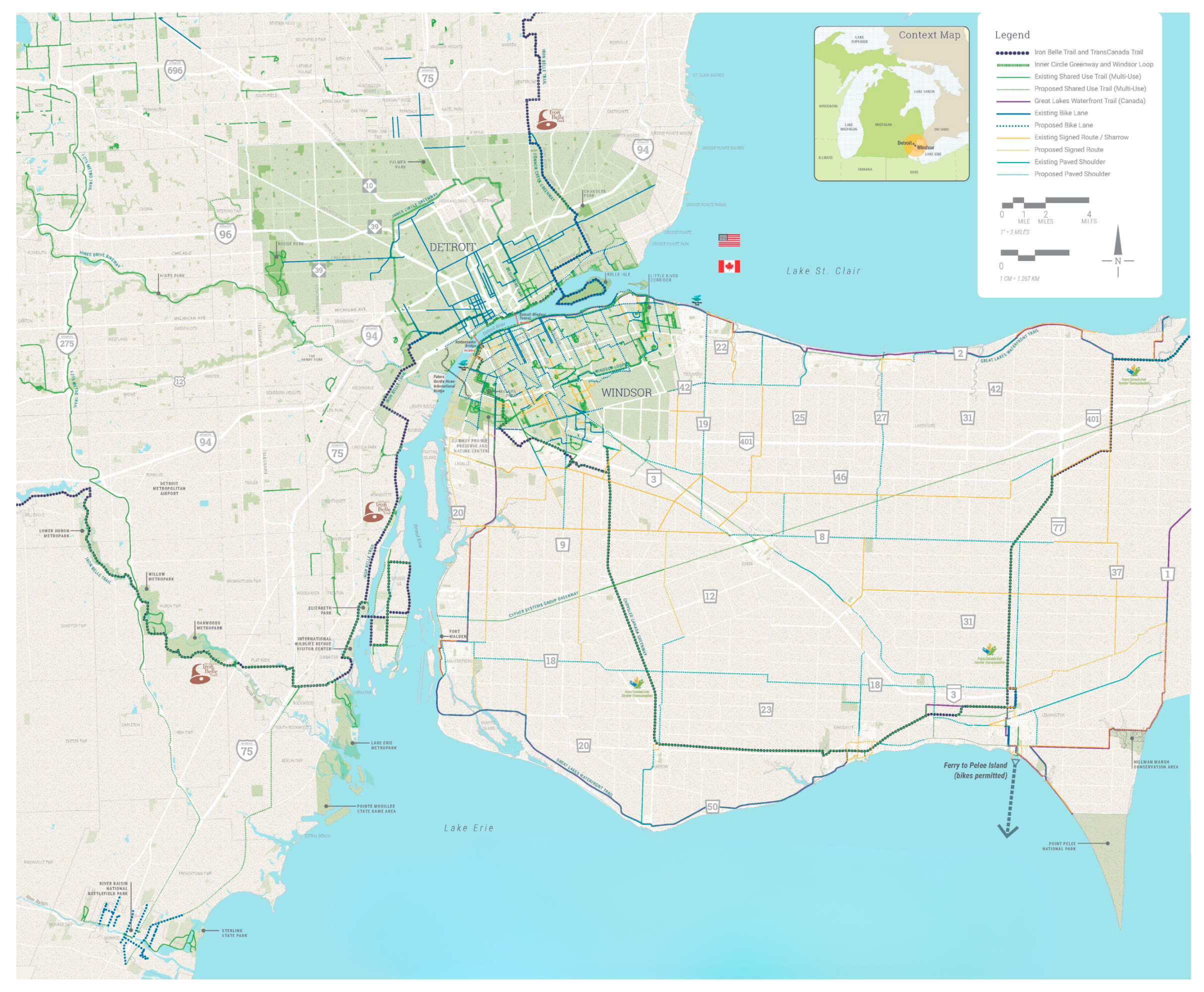
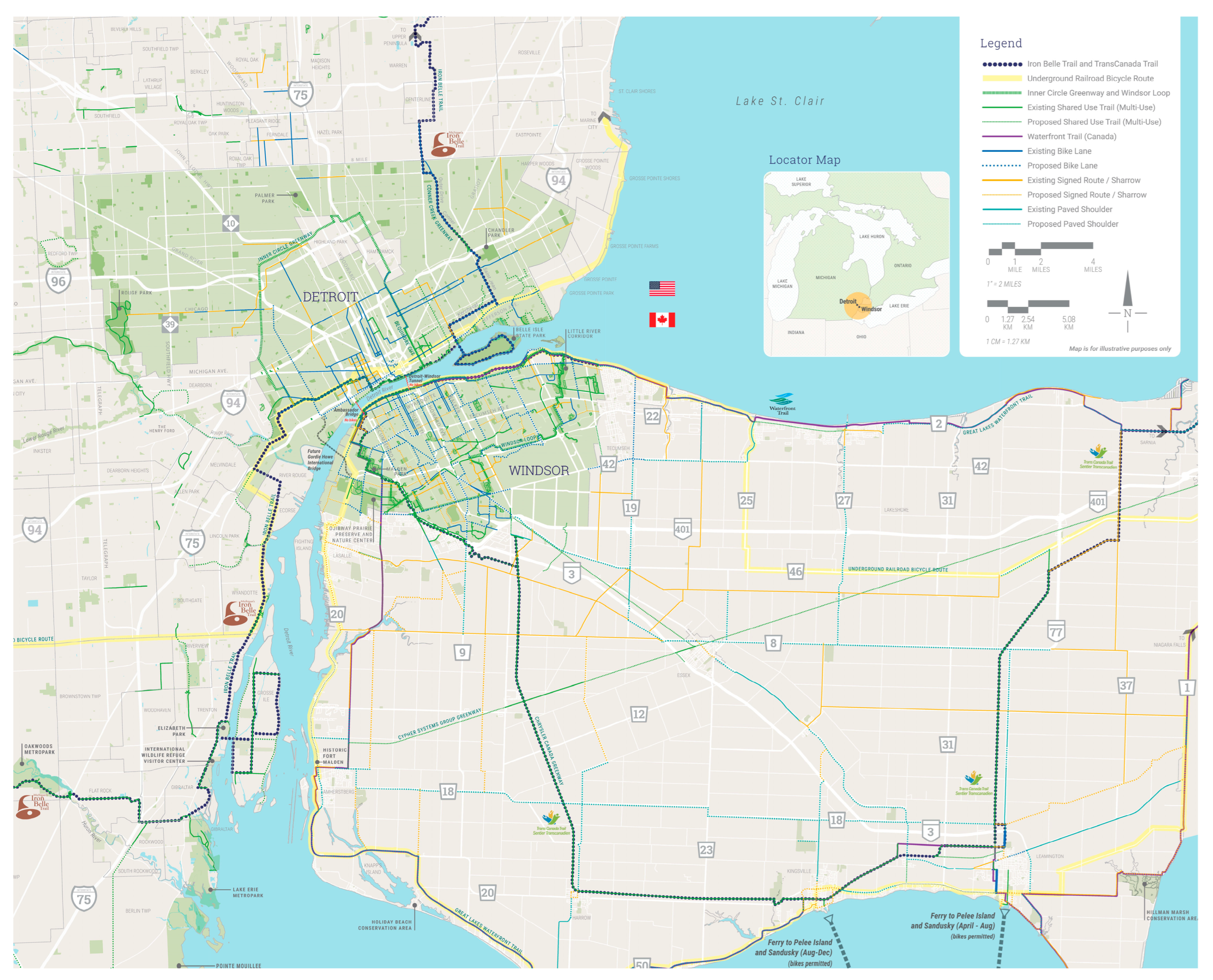
5. Connecting Greenways
- The Community Foundation for Southeast Michigan, which is championing the Great Lakes Way (https://cfsem.org/initiative/greatlakesway (accessed on 5 November 2025));
- The Michigan Department of Natural Resources, which is championing the Iron Belle Trail stretching more than 3200 km from Ironwood in Michigan’s Upper Peninsula to Belle Isle State Park in Detroit (https://michigan.gov/dnr/places/state-trails/iron-belle (accessed on 5 November 2025));
- The Waterfront Regeneration Trust, which is championing the 3600-km Great Lakes Waterfront Trail stretching from the St. Lawrence River in Quebec to Sault Ste. Marie, Ontario (https://waterfronttrail.org (accessed on 5 November 2025)); and
- The nonprofit organization called the Trans Canada Trail, which stewards the over 28,200-km trail called The Trans Canada Trail stretching from the Atlantic to the Pacific to the Arctic oceans (https://tctrail.ca (accessed on 5 November 2025)).
6. Local Perspectives
- Establish partnerships with Detroit and Windsor cycling groups and tourism organizations to create joint tourism offerings;
- Increase community outreach to engage more local businesses and other trail stakeholders in trail planning and programming;
- Develop strategies for community engagement and storytelling to enhance cultural connections between regions; and
- Promote and market e-bikes, making long-distance cycling accessible to a broader demographic.
7. Trail Tourism Marketing and Business Benefits
8. Concluding Thoughts and Major Conference Steering Committee Recommendations
- Community engagement and storytelling are effective tools in cultivating cultural connections by fostering empathy through shared narratives, building bridges between different groups by making complex issues relatable, and preserving cultural heritage by passing down traditions and values. Therefore, it is recommended that strategies be developed for strengthening community engagement and storytelling to enhance cultural connections between regions.
- Individuals involved in trail groups and environmental organizations have a common appreciation of the outdoors. However, these groups are not always closely connected. It is recommended that ties between these two stakeholder groups be strengthened by providing trail experiences that reconnect people with the river and other natural resources.
- UNESCO World Heritage Sites and national parks are recognized for their universal value, including serving as major tourist attractions. Therefore, it is recommended that all stakeholder groups support the binational efforts to obtain a UNESCO World Heritage Site designation for the Underground Railroad and support the Canadian federal designation of Windsor’s Ojibway National Urban Park.
- Working relationships between the travel industry and cycling organizations in the Windsor–Detroit region are at an early stage of development. Therefore, it is recommended that a priority be placed on strengthening collaborations between these stakeholder groups to promote and market cross-border trail tourism.
- Greenway trail systems are being continuously improved in both the Windsor and Detroit metropolitan areas. Therefore, it is recommended that greenway assessments be institutionalized (every 5–10 years) to evaluate trail segment completions, gaps, potential route improvements, safety improvements, equity considerations, etc., and to keep greenways in the public consciousness and to help practice adaptive management.
- While sustainable development promotes balanced and continuous economic, social, and environmental progress, economic benefits often garner considerable attention, particularly when making the case for a new initiative. To help make the case for expanding cross-border trail tourism in the Windsor–Detroit metropolitan region, it is recommended that a concerted effort be made to measure and broadly communicate the economic impact of cross-border trail tourism resulting from the Gordie Howe International Bridge.
Author Contributions
Funding
Institutional Review Board Statement
Informed Consent Statement
Data Availability Statement
Acknowledgments
Conflicts of Interest
References
- Richardson, M. Modelling nature connectedness within environmental systems: Human-nature relationships from 1800 to 2020 and beyond. Earth 2025, 6, 82. [Google Scholar] [CrossRef]
- Bryant, M.M. Urban landscape conservation and the role of ecological greenways at local and metropolitan scales. Landsc. Urban Plan. 2006, 76, 23–44. [Google Scholar] [CrossRef]
- Hutson, G.; Baird, J.; Ives, C.D.; Dale, G.; Holzer, J.M.; Plummer, R. Outdoor adventure education as a platform for developing environmental leadership. People Nat. 2024, 6, 1974–1986. [Google Scholar] [CrossRef]
- Mumaw, L. Transforming urban gardeners into land stewards. J. Environ. Psychol. 2017, 52, 92–103. [Google Scholar] [CrossRef]
- Sharma, A. Rethinking greenways design in the context of sustainable development: Towards landscape synergism. In Fábos Conference on Landscape and Greenway Planning; University of Massachusetts Amherst Libraries: Amherst, MA, USA, 2010; Volume 3. [Google Scholar] [CrossRef]
- Xu, B.; Shi, Q.; Zhang, Y. Evaluation of the health promotion capabilities of greenway trails: A case study in Hangzhou, China. Land 2022, 11, 547. [Google Scholar] [CrossRef]
- Little, C.E. Greenways for America; The John Hopkins University Press: Baltimore, MA, USA, 1990. [Google Scholar]
- Stoffelen, A. Tourism trails as tools for cross-border integration: A best practice case study of the Vennbahn cycling route. Ann. Tour. Res. 2018, 73, 91–102. [Google Scholar] [CrossRef]
- Duda, T. Cross-border heritage routes and areas: An important element of regional sustainable tourism. In Managing Natural and Cultural Heritage for a Durable Tourism; Trono, A., Castronuovo, V., Kosmas, P., Eds.; Springer: Cham, Switzerland, 2024. [Google Scholar] [CrossRef]
- Mayr, B.; Beck, M.; Eisenberger, L.; Venek, V.; Kranzinger, C.; Menzl, A.; Reich, B.; Hornung-Prähauser, V.; Oberhoffer-Fritz, R.; Böhm, B.; et al. Valorization of natural cardio trekking trails through open innovation for the promotion of sustainable cross-generational health-oriented tourism in the Connect2Move Project: Protocol for a cross-sectional study. JMIR Res. Protoc. 2022, 11, e39038. [Google Scholar] [CrossRef] [PubMed]
- Timothy, D.J.; Boyd, S.W. Tourism and Trails: Cultural, Ecological and Management Issues; Channel View Publications: Bristol, UK, 2015; Volume 64. [Google Scholar]
- Makkonen, T.; Williams, A.M. Cross-border tourism and innovation system failures. Ann. Tour. Res. 2024, 105, 103735. [Google Scholar] [CrossRef]
- Timothy, D.J.; Saarinen, J.; Viken, A. Tourism issues and international borders in the Nordic Region. Scand. J. Hosp. Tour. 2016, 16 (Suppl. S1), 1–13. [Google Scholar] [CrossRef]
- Statistica. Detroit-Warren-Dearborn Metro Area Population in the U.S. 2010–2023. 2024. Available online: https://www.statista.com/statistics/815262/detroit-metro-area-population/?srsltid=AfmBOoo3EsWATqMpD3NrK-yK4DSGM962iYUwaMJNHi9MDpmqMYnbrgjd (accessed on 15 October 2025).
- City of Windsor. 2021. Available online: https://www.citywindsor.ca/residents/planning/plans-and-community-information/about-windsor/demographics (accessed on 15 October 2025).
- Klepper, S. Disagreements, spinoffs, and the evolution of Detroit as the capital of the U.S. automobile industry. Manag. Sci. 2007, 53, 616–631. [Google Scholar] [CrossRef]
- Detroit Regional Chamber. A Look Back at the Detroit Regional Chamber’s Advocacy for the Gordie Howe International Bridge; Detroit Regional Chamber: Detroit, MI, USA, 2024. [Google Scholar]
- Invest Windsor Essex. The Busiest Canada-U.S. Border Crossing; Invest Windsor Essex: Windsor, ON, Canada, 2025; Available online: https://www.investwindsoressex.com/site-selection-and-data/location-and-proximity-to-markets/#:~:text=The%20Windsor%2DDetroit%20crossing%20is,about%20%241%20billion%20per%20day (accessed on 18 July 2025).
- Hartig, J.H.; Newton, L.; Scott, T.; Koehler, M.; Gannon, J.E.; Lovall, S.; Woiwode, T.; Greene, A.; Hillier, W.; Antolak, E. Fostering cross-border trail tourism between the Windsor, Ontario and Detroit, Michigan metropolitan areas. In Great Lakes Institute for Environmental Research Occasional Publication No. 13; University of Windsor: Windsor, ON, Canada, 2025; ISSN 1715–3980. [Google Scholar]
- Heuton, R. Windsor: An international border city in Detroit’s shadow. In Collaborative Governance for Local Economic Development: Lessons from Countries Around the World; Cepiku, D., Jeon, S.H., Jesuit, D.K., Eds.; Routledge: London, UK, 2019; pp. 30–48. [Google Scholar]
- Waters, C. Windsor’s Cycling History; Centre for Cities, University of Windsor: Windsor, ON, Canada, 2021; Available online: https://windsorlawcities.ca/wp-content/uploads/2021/09/UWLW003-cycling_history-v8-single.pdf (accessed on 17 January 2025).
- The Canadian Transit Company. Restoring the Ambassador Bridge. 2025. Available online: https://www.ambassadorbridge.com/restoring-the-ambassador-bridge/ (accessed on 16 October 2025).
- Plunk, A.; Gehlert, S. What’s trust got to do with it? Ensuring meaningful community engagement. Am. J. Bioeth. 2018, 18, 53–55. [Google Scholar] [CrossRef]
- Smith, S. A sense of place: Place, culture and tourism. Tour. Recreat. Res. 2015, 40, 220–233. [Google Scholar] [CrossRef]
- Hemming, B. The Detroit Riverfront Conservancy: A public-private partnership striving to reclaim the Detroit River. Gold. Gate Univ. Law Rev. 2005, 35, 395. [Google Scholar]
- Benson, E. Rivers as urban landscapes: Renaissance of the waterfront. Water Sci. Technol. 2002, 45, 65–70. [Google Scholar] [CrossRef]
- Koth, S.; Power, J.; Zhang, S. Joe Louis Greenway as a Strategy for Community Empowerment: Multidisciplinary Methods for Ensuring Positive Impacts; University of Michigan, School of Environment and Sustainability: Ann Arbor, MI, USA, 2023. [Google Scholar]
- Wang, S.; Wang, Y. Trans Canada Trail: A shared-use network of pathways from coast to coast to coast. J. Outdoor Recreat. Tour. 2022, 39, 100517. [Google Scholar] [CrossRef]
- Brownson, R.C.; Housemann, R.A.; Brown, D.R.; Jackson-Thompson, J.; King, A.C.; Malone, B.R.; Sallis, J.F. Promoting physical activity in rural communities: Walking trail access, use, and effects. Am. J. Prev. Med. 2000, 18, 235–241. [Google Scholar] [CrossRef] [PubMed]
- The Community Foundation for Southeast Michigan. Five-Year Progress Report: The Great Lakes Way, 2019–2024; The Community Foundation for Southeast Michigan: Detroit, MI, USA, 2024. [Google Scholar]
- Gustafsson, K.M.; Lidskog, R. Boundary organizations and environmental governance: Performance, institutional design, and conceptual development. Clim. Risk Manag. 2018, 19, 1–11. [Google Scholar] [CrossRef]
- Sattler, C.; Schroter, B. Collective action across boundaries: Collaborative network initiatives as boundary organizations to improve ecosystem services governance. Ecosyst. Serv. 2022, 56, 101452. [Google Scholar] [CrossRef]
- Cleave, E.; Arku, G.; Sadler, R.; Gilliland, J. The role of place branding in local and regional economic development: Bridging the gap between policy and practicality. Reg. Stud. Reg. Sci. 2016, 3, 207–228. [Google Scholar] [CrossRef]
- Rinaldi, C.; Cavicchi, A. Cooperative behavior and place branding: A longitudinal case study in Italy. Qual. Mark. Res. 2016, 19, 156–172. [Google Scholar] [CrossRef]
- Zuniga-Teran, A.A.; Fisher, L.A.; Meixner, T.; Le Tourneau, F.-M.; Postillion, F. Stakeholder participation, indicators, assessment, and decision-making: Applying adaptive management at the watershed scale. Environ. Monit. Assess. 2022, 194, 156. [Google Scholar] [CrossRef] [PubMed]
- Pollock-Ellwand, N. Travelling the route from designation to local action: The case of the underground railroad settlement in Buxton, Ontario, Canada. Int. J. Herit. Stud. 2006, 12, 372–388. [Google Scholar] [CrossRef]
- UNESCO. Convention Concerning the Protection of World Cultural and Natural Heritage; UNESCO: Paris, France, 1972. [Google Scholar]
- United Kingdom Commission for UNESCO. The National Value of UNESCO Designations to the United Kingdom; United Kingdom Commission for UNESCO: London, UK, 2020; ISBN 978-0-904608-08-3. [Google Scholar]
- Job, H.; Majewski, L.; Woltering, M.; Engels, B. Economic Analysis of Visitation in UNESCO Biosphere Reserves; Bundesamt für Naturschutz: Bonn, Germany, 2024. [CrossRef]
- Meacci, L.; Liberatore, G. A senses-based model for experiential tourism. Tour. Manag. Stud. 2018, 14, 7–14. [Google Scholar] [CrossRef]
- Mekawy, M.A. Smart tourism investment: Planning pathways to break the poverty cycle. Tour. Rev. Int. 2015, 18, 253–268. [Google Scholar] [CrossRef]
- Ontario by Bike. Cycle Tourism Product, Innovations, and Opportunities; Ontario by Bike: Toronto, ON, Canada, 2024. [Google Scholar]
- Ontario by Bike. Ontario Cycle Tourism and Cycling Activity Report; Ontario by Bike: Toronto, ON, Canada, 2023. [Google Scholar]
- Timothy, D.J. Cross-border partnership in tourism resource management: International parks along the U.S.-Canada Border. J. Sustain. Tour. 1999, 7, 182–205. [Google Scholar] [CrossRef]

| Cross-Border Service | Description |
|---|---|
| Ferries | Cross-border ferries historically operated on the Detroit River between Detroit, Michigan, and Windsor, Ontario for over a century, starting in the early 1800s. These ferries transported people, goods, and later, vehicles, playing a vital role in connecting the communities on both sides of the river. With the opening of the Ambassador Bridge in 1929 and the opening of the Detroit–Windsor Tunnel in 1930, demand for ferry services declined significantly. The last passenger and car ferry service between Detroit and Windsor ceased operations in 1938. |
| Ambassador Bridge | This bridge was constructed in 1929 with a 2.4-m-wide sidewalk for pedestrians and cyclists. It was closed to pedestrians and cyclists in 2001 to increase security measures following the September 11th terrorist attack in New York and Pennsylvania. A new main span deck was placed on the bridge in 2010–2013, permanently eliminating the sidewalks [22]. |
| Detroit–Windsor Tunnel | The Detroit–Windsor Tunnel has never allowed pedestrians or cyclists; however, the company did add bike rack service on buses starting in 2017. Regular tunnel bus service for commuters ended in August 2025 due to rising costs associated with the service. A private company started commuter service in October 2025. |
| Gordie Howe International Bridge | The new Gordie Howe International Bridge will open in 2026 with a multi-use path for pedestrians and cyclists. This bridge is toll-free for pedestrians and cyclists. |
| Border City/Region | Local Trails (Date of Establishment) | Larger Trail Systems That Local Trails are Part of (Date of Establishment) |
|---|---|---|
| Windsor Metropolitan Area |
|
|
| Detroit Metropolitan Area |
|
|
| Project (Location) | Description |
|---|---|
| Outdoor fitness initiatives, Windsor, Ontario | The City of Windsor offers various recreational facilities and programs to encourage residents to be physically active. Good examples include the outdoor fitness equipment at Walker Homesite Park in Devonshire Heights and a new outdoor fitness park in Nevers Park in South Windsor. Additionally, the County-Wide Active Transportation System aims to connect people to active transportation facilities and places of interest. |
| Outdoor fitness initiatives, Detroit, Michigan | The City of Detroit’s Recreation Department manages over 300 parks, many with walking paths and fitness stations, and organizes a variety of activities that promote health. One good example is the Kemeny Recreation Center located on the Iron Belle Trail and The Great Lakes Way in Southwest Detroit. It reopened in 2018 following a $9.5 million USD renovation that included a new gymnasium and permanently installed outdoor fitness equipment. In addition, Detroit is actively working to enhance cycling infrastructure and promote cycling as a viable transportation option, aiming to create a more bike-friendly city. |
| Cycling initiatives, Bike Windsor Essex, Windsor/Essex County, Ontario | Bike Windsor Essex provides a variety of programs for anyone interested in biking from beginner’s cycling classes (ages 16+ and over), to do-it-yourself bike repair classes and resources and community rides to explore your community. Its Cycle Smart School Program teaches health and safety (e.g., traffic rules, importance of wearing a helmet); physical activity (e.g., healthy lifestyle benefits, cycling as a life-long activity, physical literacy); sustainability (e.g., environmental benefits, including reduced carbon footprint); and technology (e.g., use of online mapping tools). |
| Cycling initiatives, Detroit Greenways Coalition, Detroit, Michigan |
This nonprofit organization works to promote and build a network of greenways, Complete Streets (i.e., a multimodal approach to roadway design and safety that considers all users of transportation infrastructure), and bike lanes connecting all of Detroit. Its vision is a strong, healthy, vibrant city of Detroit and surrounding region, where a seamless network of greenways, green spaces, water trails, and Complete Streets is an integral part of people’s active lifestyle, day-to-day transportation, and recreation. To help achieve this vision, the organization advocates for non-motorized infrastructure investments and road safety public policies, while supporting and sharing community-led events that promote health, including bike rides, group runs, and more. |
| Nature-Prescription Program—PaRx, Ontario | Through PaRx, a nationwide nature-prescription program, doctors can prescribe patient visits to local natural areas to improve their health. Any licensed health care professional can register with PaRx and receive a toolkit that makes nature prescribing easy, fun, and effective. This program aims to encourage patients to incorporate outdoor experiences in their local communities into their daily routines. |
| Free day passes to Ontario Provincial Parks, Windsor, Ontario | All branches of Windsor Public Library are loaning out free day-use vehicle permits for Ontario Provincial Parks to spend time in nature, participate in outdoor recreation, and encourage health and wellness. These “park passes” cannot be reserved in advance and are non-renewable. |
| Fit Park, Dequindre Cut, Detroit, Michigan | In 2015, Blue Cross Blue Shield Michigan (BCBSM) and the Detroit Riverfront Conservancy opened a free Fit Park on the Dequindre Cut extension of the Detroit Riverwalk. The park is an outdoor public workout space with permanently installed, stationary equipment. It is part of Live the Riverfront, a multi-year partnership between BCBSM and the Detroit Riverfront Conservancy, promoting physical fitness and healthy living initiatives through a series of free or low-cost activities along the riverfront. The Fit Park is another opportunity to encourage physical activity on the riverfront. |
| Outdoor initiatives, Windsor-Essex County Health Unit (WECHU) | WECHU promotes health through outdoor initiatives by providing information and resources to help residents enjoy the outdoors safely and actively. It actively engages with the community to create opportunities for physical activity and outdoor recreation, including exploring local trails. |
| Outdoor yoga in the Detroit metropolitan area |
|
| Outdoor yoga in Windsor metropolitan area |
|
| Outdoor recreation, Wayne County Parks, Wayne County, Michigan | To promote outdoor recreation and healthful living, Wayne County Parks offers a variety of parks and outdoor recreation areas with trails for hiking, biking, and other outdoor activities, including Elizabeth Park, Rouge Park, Hines Park, the William P. Holliday Forest & Wildlife Preserve, and Crosswinds Marsh. |
| Wellness on the Riverfront, Detroit Riverwalk, Detroit, Michigan |
|
| Trail Town Program, Trenton, Michigan | In 2021, Trenton was recognized by the Michigan Department of Natural Resources as a Trail Town for having some of the best hiking and biking trail experiences in the state, while also promoting healthy lifestyles and local businesses (https://www.trentonmi.org/843/Trail-Town (accessed on 5 November 2025)). Trenton has actively developed its trail system and bicycle network that is part of Downriver Linked Greenways, the Iron Belle Trail, and The Great Lakes Way. A Trail Town Advisory Committee oversees the implementation of a Trail Town Master Plan. |
| Healthy living program, Healthy Downriver Coalition, 21 Downriver communities, Michigan | The mission of this coalition is to build collaboration, improve health equity, and be the creator of positive change to support the health and wellness of Downriver residents (https://healthydownriver.org/ (accessed on 5 November 2025)). Its vision is to have a culturally inclusive Downriver community that engages in healthy living, has equal access to care, and makes informed choices that strengthen mind, body, and spirit. Outdoor recreation on greenways is an important part of the coalition’s work. |
| Outdoor recreation, Lake Erie Metropark, Brownstown, Michigan | This 650-ha metropark, located at the mouth of the Detroit River, offers 6.9 km of hiking and biking trails, a swimming pool with a wave pool and splash pad, and a marshland museum with sensory-friendly backpacks—all providing spaces for relaxation and enjoying nature, contributing to overall well-being. |
| Outdoor recreation, Belle Isle, Detroit, Michigan | Managed by the Michigan Department of Natural Resources and hosting the trailhead for the Iron Belle Trail, this historic, 398-ha, Detroit River island park offers biking and walking on a 9.3-km loop trail, kayaking, swimming, fishing, and other forms of outdoor recreation that promote health and wellness. |
| Theme | Description |
|---|---|
| Automobile heritage | Metropolitan Detroit and Windsor are well known as the automobile capitals of the United States and Canada, respectively. These two interconnected regions offer the world’s largest collection of cultural and labor organizations, museums, archives, factories, auto collections, and events to preserve the story of putting the world on wheels and building the middle class. An easy cross-border cycling experience could be Detroit’s Ford Piquette Avenue Plant Museum and Windsor’s Ford City in Walkerville. For more information, contact MotorCities National Heritage Areas (https://motorcities.org (accessed on 5 November 2025)). |
| First Nations | The lands and waters of this region are on Anishinaabe and Huron territories. Local tribes include Caldwell First Nation, Walpole First Nation, the Nottawaseppi Huron Band of the Potawatomi, and the Wyandot of Anderdon Nation. Cross-border cycling experiences could include stops at the burial mounds at historic Fort Wayne in Detroit and Six Points, sacred grounds of the Wyandot of Anderdon Nation in Gibraltar, Michigan, and the proposed Ojibway National Urban Park in Windsor that will be co-managed by Parks Canada and Caldwell First Nation, with operational assistance from Point Pelee National Park in Leamington, Ontario. |
| Rum-running | During Prohibition (1920–1933), Detroit, Michigan and Windsor, Ontario were centers of alcohol smuggling, known as rum-running. The Detroit River’s many islands made it difficult to detect illegal activity. In 1929, illegal liquor was second only to the auto industry in Detroit in terms of revenue. Stories from this era abound, including blind pigs, the Purple Gang, and Panther Sweat. Bus tours currently exist, but cycling tours will be an important extension of cross-border trail tourism. |
| Architecture | Both Detroit and Windsor are known for their architecture. Preservation Wayne (https://preservationdetroit.org (accessed on 5 November 2025)) and The City Institute (https://www.thecityinstitute.com/ (accessed on 5 November 2025)) offer architectural tours of Detroit. Self-guided architectural tours in Windsor are offered by Windsor-Essex Jane’s Walk (https://www.windsorjaneswalk.ca/about (accessed on 5 November 2025)). |
| Albert Kahn architecture | Albert Kahn (1869–1942) is a well-known innovative architect of industrial plant complexes and other prominent buildings in Detroit and Windsor. For more information, contact the City Institute (https://thecityinstitute.com (accessed on 5 November 2025)), Detroit History Tours (https://www.detroithistorytours.com/ (accessed on 5 November 2025)), or the Albert Kahn Legacy Foundation (https://albertkahnlegacyfoundation-bloom.kindful.com/e/walking-tour-of-windsors-walkerville- (accessed on 5 November 2025)). |
| American and Canadian Heritage Rivers | The Detroit River is the only river system in North America to be designated as both American and Canadian Heritage Rivers. These designations celebrate natural heritage, cultural heritage, and recreational heritage. Binational heritage river tours could be set up by partners. |
| Transboundary conservation | One of the primary objectives of both the Detroit River International Wildlife Refuge and the proposed Ojibway National Urban Park is to bring conservation to cities. A cross-border cycling event could be set up with stops at both visitor centers that could showcase making nature part of everyday urban life and how they are working together to achieve transboundary conservation. |
| National parks | The region is fortunate to have two existing national parks (i.e., Point Pelee National Park in Leamington, Ontario—https://parks.canada.ca/pn-np/on/pelee (accessed on 5 November 2025) and River Raisin National Battlefield Park in Monroe, Michigan—https://www.nps.gov/rira/learn/historyculture/index.htm (accessed on 5 November 2025)) and one proposed (i.e., Ojibway National Urban Park—https://www.citywindsor.ca/residents/building-windsors-future/national-urban-park (accessed on 5 November 2025)). Such national parks are a magnet for people because of their scenic beauty, opportunities for recreation and learning about history, and a chance to reconnect with nature. |
| Underground Railroad | Detroit is well known as a terminus of the Underground Railroad where more than 40,000 people crossed the Detroit River and gained their freedom in Canada. Rich Underground Railroad history exists on both sides of the border. For more information about the Underground Railroad in the region and efforts to secure a UNESCO World Heritage Site designation, visit https://detroitriverproject.com (accessed on 5 November 2025). Both the Adventure Cycling Underground Railroad Bicycle Route and the Detroit Greenways Coalition Underground Railroad bike tour (https://ridewithgps.com/routes/36280126 (accessed on 5 November 2025)) are good ways to experience this history by bicycle. |
| Farm fresh | Detroit’s Eastern Market (https://easternmarket.org/ (accessed on 5 November 2025)) is the largest open-air market in the United States and the Downtown Windsor Farmers’ Market is a major attraction throughout southwestern Ontario. It was named the 2024 “Farmers’ Market of the Year” by Farmers’ Markets Ontario (https://www.downtownwindsor.ca/farmers-market/ (accessed on 5 November 2025)). Coupling cross-border cycling with farm-fresh food experiences would be appealing to many. |
| Shipbuilding | Because of Detroit and Windsor’s strategic location in the heart of the Great Lakes, their position as centers of commerce, and the demand for transportation of people and goods, these border cities became leading ship-building centers in the United States and Canada. Shipbuilding provided jobs, but also furthered billions of dollars of commerce and trade regionally and globally. A shipbuilding cross-border cycling adventure could feature stops at Detroit and Windsor port authorities and historical museums like the Dossin Great Lakes Museum (https://detroithistorical.org/dossin-great-lakes-museum/plan-your-visit/general-information (accessed on 5 November 2025)) on Belle Isle and the River Rouge Historical Museum (https://cityofriverrouge.com/historical-museum/ (accessed on 5 November 2025)). |
| ByWays to FlyWays | The Detroit River is situated at the intersection of the Atlantic and Mississippi Flyways, with more than 350 species of birds identified in the corridor. Partners have developed a ByWays to FlyWays Bird Driving Tour Map that features 27 unique birding sites in southwest Ontario and southeast Michigan. Cross-border trail birding experiences would appeal to many bird watchers. |
| Binational cycling adventures | The Waterfront Regeneration Trust, Tourism Windsor Essex Pelee Island, and Ontario by Bike have already developed binational and regional itineraries and complementary resources to inspire such adventures. Metro 313 Cyclones organizes “Pedals to Passports” cycling adventures. |
| Nationally and globally recognized days that celebrate conservation and the environment | Numerous celebratory days have been established to raise awareness of conservation and environmental protection, including World Wetlands Day (February 2nd), World Water Day (March 22nd), Earth Day (April 22nd), International Bird Day (second Saturday in May), International Biodiversity Day (May 22nd), and World Environment Day (June 5th). As a result of the Gordie Howe International Bridge, the border cities of Windsor and Detroit are now uniquely positioned to host binational cycling celebrations of such days. |
| Binational open streets | Both Windsor and Detroit participate in open street events to encourage active transportation and physical activity, enhance community building, promote community-led active living initiatives, showcase recently improved streetscapes, and provide an opportunity for local businesses and organizations to participate along the route. An annual binational open streets event could be established to create synergy. |
Disclaimer/Publisher’s Note: The statements, opinions and data contained in all publications are solely those of the individual author(s) and contributor(s) and not of MDPI and/or the editor(s). MDPI and/or the editor(s) disclaim responsibility for any injury to people or property resulting from any ideas, methods, instructions or products referred to in the content. |
© 2025 by the authors. Licensee MDPI, Basel, Switzerland. This article is an open access article distributed under the terms and conditions of the Creative Commons Attribution (CC BY) license (https://creativecommons.org/licenses/by/4.0/).
Share and Cite
Hartig, J.H.; Newton, L.; Scott, T.; Koehler, M.; Gannon, J.E.; Lovall, S.; Woiwode, T.; Greene, A.; Hillier, W.; Antolak, E. Fostering Cross-Border Trail Tourism Between Windsor, Ontario, Canada and Detroit, Michigan, USA. Green Health 2025, 1, 20. https://doi.org/10.3390/greenhealth1030020
Hartig JH, Newton L, Scott T, Koehler M, Gannon JE, Lovall S, Woiwode T, Greene A, Hillier W, Antolak E. Fostering Cross-Border Trail Tourism Between Windsor, Ontario, Canada and Detroit, Michigan, USA. Green Health. 2025; 1(3):20. https://doi.org/10.3390/greenhealth1030020
Chicago/Turabian StyleHartig, John H., Lori Newton, Todd Scott, Marlaine Koehler, John E. Gannon, Sam Lovall, Tom Woiwode, Amy Greene, Weston Hillier, and Eric Antolak. 2025. "Fostering Cross-Border Trail Tourism Between Windsor, Ontario, Canada and Detroit, Michigan, USA" Green Health 1, no. 3: 20. https://doi.org/10.3390/greenhealth1030020
APA StyleHartig, J. H., Newton, L., Scott, T., Koehler, M., Gannon, J. E., Lovall, S., Woiwode, T., Greene, A., Hillier, W., & Antolak, E. (2025). Fostering Cross-Border Trail Tourism Between Windsor, Ontario, Canada and Detroit, Michigan, USA. Green Health, 1(3), 20. https://doi.org/10.3390/greenhealth1030020