Proceeding Paper

Old Tool, New Purpose: Rock-Eval Analysis for CO2 Mineralization Screening in Basalts †

by
Stéphanie Carvalho da Silva
*,
Mellanye F. Graf
,
João Pedro T. Zielinski
,
Erico A. dos Santos
,
William J. Fucks
,
Natália S. Wouters
,
Antônio R. G. Oliveira
,
Victor H. J. M. dos Santos
and
Felipe D. Vecchia
Institute of Petroleum and Natural Resources (IPR), Pontifical Catholic University of Rio Grande do Sul (PUC-RS), Porto Alegre 90619-900, Brazil
*
Author to whom correspondence should be addressed.
Presented at the 3rd International Online Conference on Mineral Science (IOCMS 2026), 10–12 March 2026; Available online: https://sciforum.net/event/IOCMS2026.
Environ. Earth Sci. Proc. 2026, 43(1), 1; https://doi.org/10.3390/eesp2026043001
Published: 2 June 2026

Abstract

Rock-Eval® (RE) analysis, traditionally used in the oil and gas sector, was evaluated as a rapid screening tool for detecting and quantifying CO2 mineralization in basaltic systems. After a two-step experimental approach, powdered basalt samples from the Serra Geral Group were analyzed for total mineral carbon content (MinC wt. %) to detect and estimate CO2-to-carbonate conversion during CO2 mineralization experiments using an integrated analytical workflow based on a personalized calibration approach. The results demonstrate that RE analysis is a rapid and effective screening tool for detecting carbonate formation and identifying the most carbonated samples, providing a first-order estimate of carbonate abundance. Carbonate content was estimated from CO2 peak intensity using a calibration curve, enabling classification into three groups, supported by SEM/EDS analyses.

1. Introduction

With the growing global interest in CO2 mineralization in basaltic rocks, numerous studies have been conducted focusing on carbon capture and storage [1,2,3]. In this context, detecting and quantifying carbonate formation is critical for assessing carbonation efficiency. However, conventional mineralogical and geochemical approaches are often time-intensive and may have limited sensitivity to detect subtle changes in carbonate content. Rock-Eval® (RE) analysis monitors CO2 release during thermal decomposition, providing a rapid and indirect proxy for mineral carbon content in solid samples. Using an integrated, calibration-based RE analytical workflow, this study evaluates its applicability for detecting and estimating CO2-to-carbonate conversion during CO2 mineralization experiments in basalts.
For this purpose, a two-step experiment comprising (i) dissolution and (ii) precipitation phases was performed using powdered basalt samples from the Serra Geral Group, South American portion of the Paraná-Etendeka Large Igneous Province (PE-LIP). After the experiments, the rock samples were analyzed for total mineral carbon content (MinC wt. %) using Rock-Eval® 7. To establish a quantitative relationship between RE signal and carbonate content, a calibration curve was developed using calcite-dosed basalt samples, enabling the conversion of CO2 peak intensity into equivalent calcite mass. Based on signal intensity, the samples were classified into three groups: G1 (<500 mV), G2 (500–3000 mV), and G3 (>3000 mV). As a final step in the workflow, SEM/EDS analyses confirmed the presence of carbonate precipitates, supporting the use of Rock-Eval® for detecting and quantifying mineralized CO2 in basaltic rocks.

2. Geological Setting

The Paraná–Etendeka is one of the major Large Igneous Provinces (LIPs) in the world, covering an area of ~1.50 × 10⁶ km2 in South America [4]. The volcanic rocks of this province date from ~136 to 132 Ma [5] and consist predominantly of basalts and basaltic andesites (97.5%) with subordinate occurrences of dacites and rhyolites (2.5%) [6]. It is estimated that the CO2 storage capacity of basaltic rocks from this province is on the order of 2840 Gt [1]. In Brazil, these volcanic rocks are referred to as the Serra Geral Group (SGG), which comprises ten geological formations [7] and covers an area of ~917,000 km2, with an estimated volume of at least 600,000 km3 [8]. The SGG is mainly composed of rubbly pāhoehoe and pāhoehoe lava flows of basalts and basaltic andesites, with minor domes, lava lobes, and tabular lava flows of dacites and rhyolites [7].

3. Materials and Methods

3.1. Rock-Eval

All analyses were performed using a Rock-Eval® 7 at the Rock Characterization Laboratory (LCR) from the Institute of Petroleum and Natural Resources (IPR), Brazil. The Bulk-Rock Basic method was applied to all six samples using a heating rate of 20 °C/min. Although RE analysis has been traditionally used in the oil and gas sector to characterize organic matter, its application in this study is focused on inorganic carbon, in order to evaluate the carbonate formation on the basaltic samples. Therefore, only parameters related to CO2 release and mineral carbon (MinC) were considered.
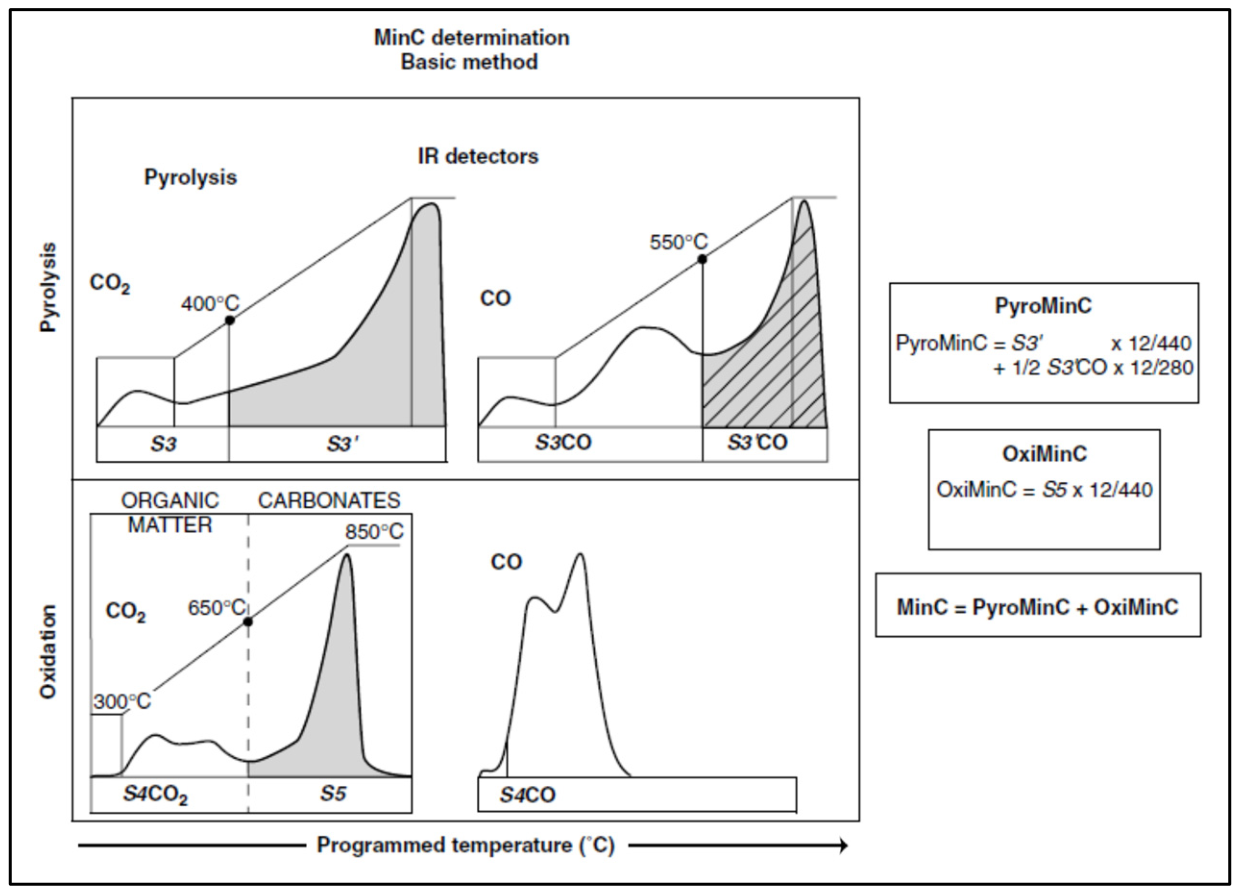
The RE is an analysis based on the thermal decomposition of samples during progressive heating (under controlled conditions), in which released gases are continuously monitored. It comprises two programmed heating stages (Figure 1): pyrolysis, conducted under an inert atmosphere (N2), followed by an oxidation stage carried out under an oxidizing atmosphere. During heating, the CO and CO2 are released and detected by an infrared (IR) spectrometer, generating profiles recorded as a signal (mV) over time. CO2 released during the pyrolysis is recorded as the S3 signal, which is background-corrected (S3′), whereas CO2 released during the oxidation stage is represented by the S5 peak.
Based on these parameters, the total mineral carbon content (MinC %wt) is calculated from the CO and CO2 signals generated across both heating stages. In the pyrolysis stage, mineral carbon (PyroMinC) is derived from the corrected CO2 signal S3′ and CO signal (S3′CO), whereas the mineral carbon (OxiMinC) for the oxidation is derived from the CO2 signal (S5) (Table 1). The total mineral carbon content (MinC) corresponds to the sum PyroMinC and OxiMinC, following the approach of [9]. High-temperature CO2 release (typically above 650 °C) is associated with the thermal decomposition of carbonate phases [9,10].

3.2. Application of Rock-Eval® for Carbonate Minerals and Calibration Sample of Volcanic Rock

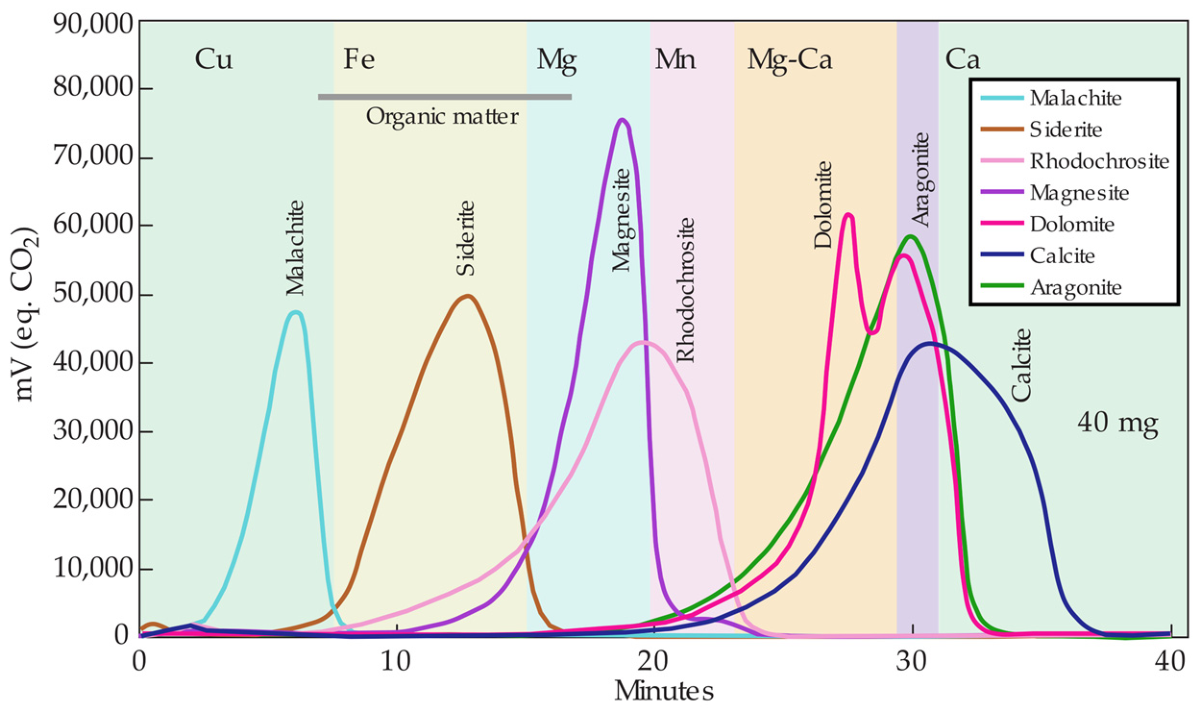
The application of RE analysis to characterize carbonate-bearing phases in solid samples, as proposed by Pillot et al. [9], is based on the thermal decomposition of carbonate minerals and the release of CO2 during heating. According to these authors, distinct carbonate species produce characteristic thermal decomposition signals and peak shapes that can be considered as a unique fingerprint for each carbonate type. This allows RE to be used as a rapid method for carbonate detection and semi-quantification in powdered solid materials [9]. The interpretation of carbonate-related RE signals in natural samples is not direct and may be affected by multiple factors [9,11]. According to [11], the position and shape of carbonate decomposition peaks (Figure 2) are influenced not only by carbonate type, but also by heating rate, sample mass, kinetic behavior, and peak overlap, particularly in polymineralic samples.
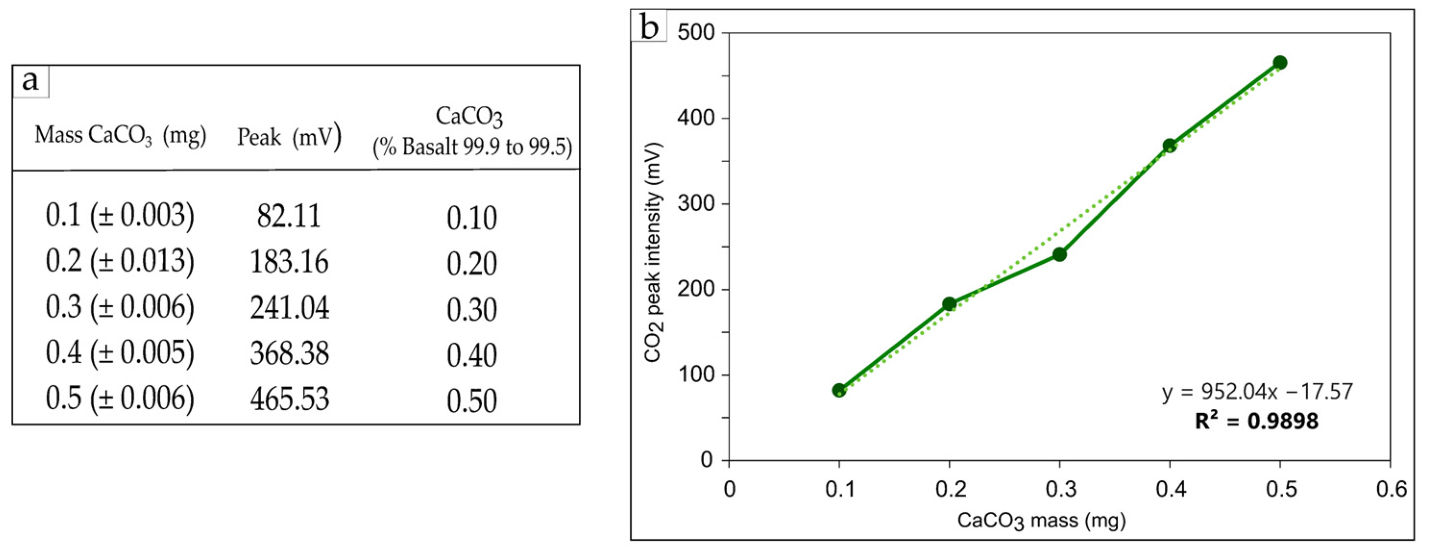
For calcite, for example, the temperature of maximum CO2 release may shift significantly depending on the analytical conditions, even though the onset of decomposition remains comparatively stable [9,11]. These factors limit the use of decomposition temperature alone for carbonate species identification. Considering these limitations, a calibration approach was developed to quantitatively relate CO2 signal intensity to carbonate content. To establish a direct relationship between RE carbonate signals and carbonate abundance in basaltic samples, a calibration dataset was generated using a fresh massive basalt flow core sample (named SC05CA) from the study area, to which known precise amounts of pure calcite (optical calcite) were added to the powdered aliquots, producing sub-samples with progressively increasing carbonate contents (see Figure 5a).

3.3. Basaltic Sample Characterization

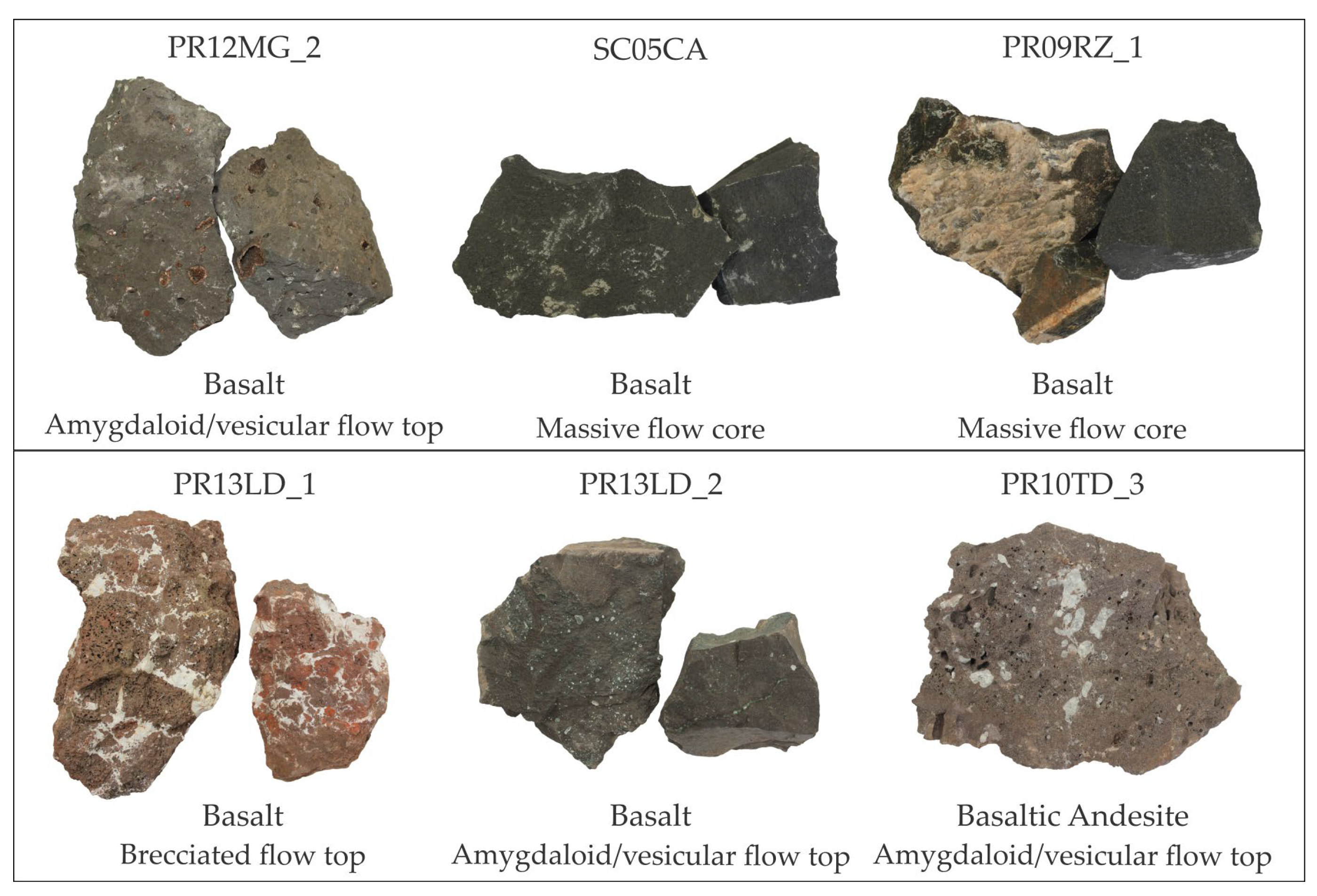
Six powdered volcanic rock samples from the SGG, representing distinct lava flow morphologies (Figure 3), were selected from the two-step (dissolution and precipitation) experiments to evaluate CO2 mineralization potential across different basaltic facies. The mineralogical composition of the pre-experimental samples was determined by petrographic characterization. Whole-rock chemical composition was obtained by X-Ray Fluorescence (XRF) using a Bruker S2 PUMA A35X1 spectrometer (data were processed with Spectra.Elements software, 3.4.5.0).
According to the TAS classification diagram [12], the samples are classified as basalts and basaltic andesite. SiO2 contents range from 47.03 to 54.54 wt.%, with CaO ranging from 7.98 to 13.75 wt.%, MgO from 3.98 to 7.27 wt.%, and FeOt from 10.72 to 17.13 wt.%. All samples are predominantly composed of labradorite, augite, occurring both as phenocrysts and in the groundmass, and opaque minerals (ilmenite and magnetite). Volcanic glass is also present in flow top samples, occurring in brecciated and amygdaloidal/vesicular rocks. Amygdales are mainly filled by zeolites and calcite, with minor celadonite and chalcedony. Other secondary minerals include clay minerals (smectite group), palagonite, and iddingsite (a product of olivine alteration).

3.4. Scanning Electron Microscopy (SEM) and Energy-Dispersive X-Ray Spectroscopy (EDS)

To characterize and confirm the presence of Ca-bearing phases formed during the experiments, Scanning Electron Microscopy (SEM) coupled with Energy-Dispersive X-Ray Spectroscopy (EDS) analyses were performed at the Central Laboratory of Microscopy and Microanalysis from Pontifical Catholic University of Rio Grande do Sul (Brazil), using a Quanta FEG250. The SEM/EDS analyses were carried out to provide complementary mineralogical constraints for the interpretation of CO2 release signals related to carbonate decomposition in Rock-Eval®.

4. Results

4.1. Calibration Approach: Rock-Eval® Analyses and Calibration Curve

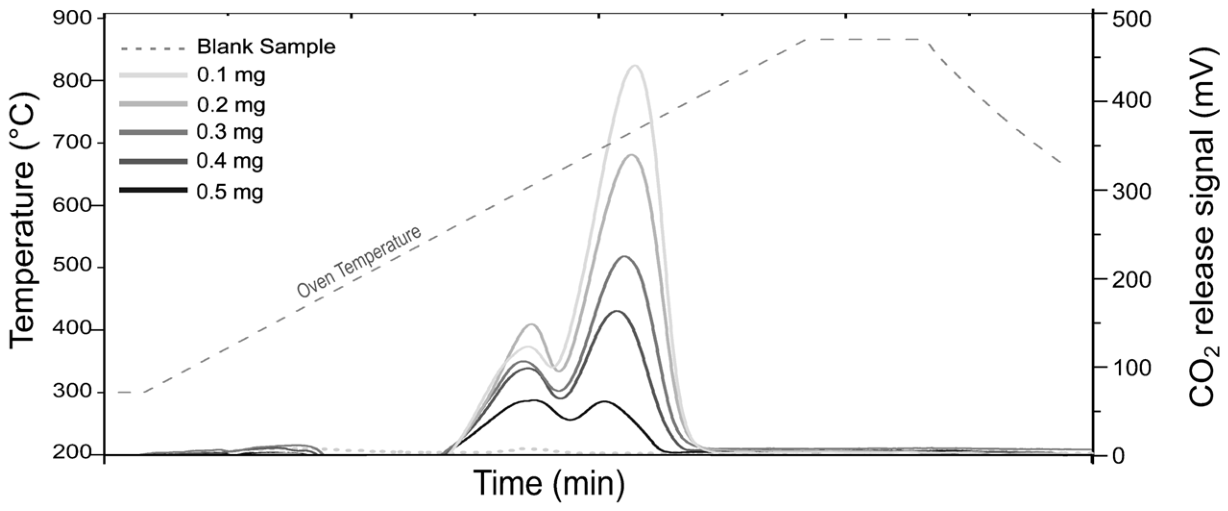
The dataset of CO2 release peaks (Figure 4), obtained from the calibration sub-samples, shows that CO2 signal intensity increases with increasing calcite mass. This relationship allows the direct correlation between the RE peak intensity and known amounts of calcite, resulting in a calibration curve (Figure 5b) with a strong positive linear relationship (R2 = 0.99) between CO2 signal intensity and calcite mass, indicating that this method is suitable for semi-quantitative carbonate estimation. The CO2 release profiles display a bimodal pattern (Figure 4), characterized by two partially overlapping peaks, and may reflect complex thermal decomposition processes influenced by sample heterogeneity, including variations in particle size or matrix effects [9,11].

4.2. Rock-Eval® Analyses and CaCO3 (eq) Conversion of Reacted Samples

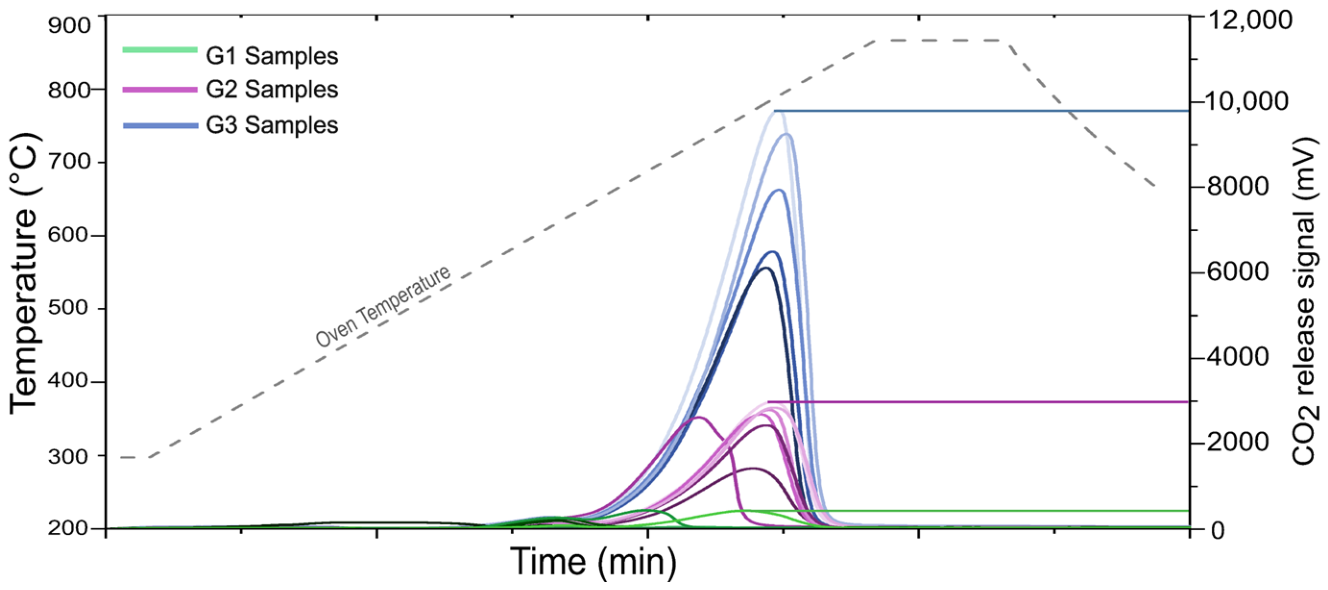
The results for the reacted samples reveal clear differences in CO2 release profiles, allowing classification into three distinct groups (G1, G2, and G3) based on signal intensity (Figure 6), reflecting variable degrees of mineral carbonation and reactivity. All samples showed CO2 release peaks above ~600–650 °C, consistent with the thermal decomposition behavior of Ca- and Mg-bearing carbonate phases [11]. Group G1 comprises experiment samples with low CO2 signal intensity <500 mV, suggesting limited carbonate formation. G2 includes experiment samples with moderate signal intensity between 500 and 3000 mV, while G3 consists of samples with high CO2 signal intensity >3000 mV, reflecting a significantly greater extent of carbonate precipitation.
The amount of carbonate formed during the experiments was estimated by converting the CO2 peak into equivalent calcite mass using the calibration curve. Estimated values range from <0.5 mg CaCO3 for G1 samples, approximately 0.5 to 3.0 mg for G2, and >3.0 mg for G3, with the highest signals (~10,000 mV) corresponding to ~10.7 mg of CaCO3 equivalent.

4.3. SEM/EDS Analyses

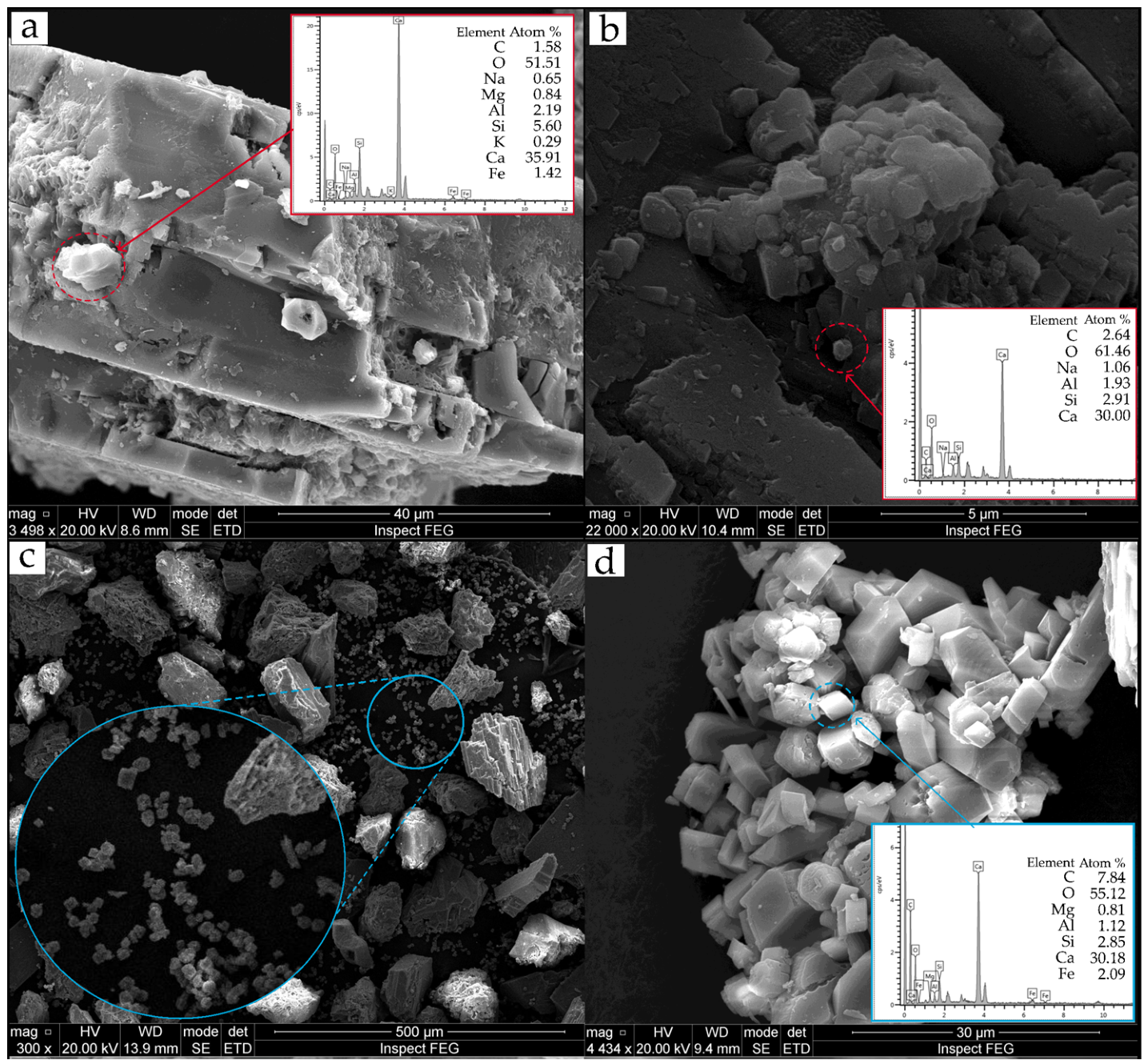
SEM/EDS analyses confirmed the presence of precipitates with morphologies and compositions consistent with newly Ca-rich mineral formations and clay minerals. Dissolution features affecting the matrix basaltic minerals were also observed. Representative samples from each group were selected and are described below.
For the G1 sample (PR12MG_2, Figure 7a), the analyses showed dissolution features affecting primary minerals such as plagioclase grains and the presence of clay precipitates and Ca-rich phases, with rhombohedral morphology, as well as amorphous Ca-rich precipitates. G2 sample (PR13LD_2, Figure 7b) was characterized by the presence of Ca-rich precipitates on the grain surfaces, occurring mainly as small amorphous aggregates. Precipitates of clay minerals were also observed. As expected, G3 samples (PR13LD_1B, Figure 7c,d) reveal the largest volume of precipitates. These consist of abundant rhombohedral calcite crystals that commonly occur as aggregates and exhibit locally overgrown amorphous secondary phases, indicating successive precipitation stages during the experiments.

5. Discussion and Conclusions

Despite its applicability, RE also presents important limitations as discussed by [11]. These limitations are relevant in polymineralic and texturally heterogeneous samples, where decomposition temperature should not be used as a unique criterion for carbonate identification. Instead, integrated approaches should be considered.
The results obtained in this study demonstrate that RE analysis is a rapid and effective screening tool for detecting carbonate formation in basaltic rocks when applied with an integrated analytical workflow based on a calibration approach, combining interpretation of thermal CO2 release, a calibration method to convert the peak intensity (mV) into an equivalent CaCO3 mass, and SEM/EDS analyses to confirm the presence of carbonate precipitates. The increase in CO2 signal intensity from G1 to G3 reflects carbonate formation, which is supported by the SEM/EDS analyses. Samples identified with a low CO2 signal correspond to samples with minimal carbonate precipitates. The higher signal intensity observed in G3 samples was consistent with the greater extent of carbonate precipitation evidenced by the greater abundance of precipitated Ca-rich phases relative to G1 and G2 samples.
The calibration approach enables semi-quantitative estimation of mineralized CO2 through the conversion of CO2 release signals (mV) into equivalent CaCO3 mass. These results are complemented by SEM/EDS analyses, which provide visual and compositional confirmation for the presence of carbonate and Ca-rich precipitates. Overall, the combined use of the MinC parameter and calibration strategy establishes a reliable and scalable framework for assessing carbonation efficiency based on the carbonate precipitates (rather than on fluid composition), highlighting the applicability of the approach as a valuable tool in mineral carbonation research. RE offers a relatively fast and standardized procedure that can identify the most carbonated samples and provide a first-order estimate of carbonate abundance.

Author Contributions

Conceptualization, J.P.T.Z., S.C.d.S. and M.F.G.; methodology, S.C.d.S., J.P.T.Z. and M.F.G.; validation, E.A.d.S., W.J.F., N.S.W. and A.R.G.O.; formal analysis, S.C.d.S., J.P.T.Z. and M.F.G.; investigation, S.C.d.S., M.F.G., J.P.T.Z., E.A.d.S., W.J.F., N.S.W. and A.R.G.O.; resources, J.P.T.Z., V.H.J.M.d.S. and F.D.V.; data curation, S.C.d.S., J.P.T.Z. and M.F.G.; writing—original draft preparation, S.C.d.S., E.A.d.S. and M.F.G.; writing—review and editing, S.C.d.S., J.P.T.Z., M.F.G., E.A.d.S., W.J.F. and A.R.G.O.; visualization, S.C.d.S., M.F.G., W.J.F. and N.S.W.; supervision, J.P.T.Z.; project administration, V.H.J.M.d.S. and F.D.V.; funding acquisition, J.P.T.Z., V.H.J.M.d.S. and F.D.V. All authors have read and agreed to the published version of the manuscript.

Funding

This research was funded by Repsol Sinopec Brasil, grant number ANP 23277-7, in accordance with the regulations of the Brazilian National Agency of Petroleum, Natural Gas and Biofuels (ANP) RD&I levy fund.

Data Availability Statement

The datasets presented in this article are not readily available because they are currently part of an ongoing paper manuscript consolidation process. Requests to access the datasets should be directed to ipr@pucrs.br and will be considered upon analysis.

Acknowledgments

The authors would like to express their special gratitude to the research team of the Institute of Petroleum and Natural Resources (IPR) at the Pontifical Catholic University of Rio Grande do Sul (PUCRS), especially all those involved in the “DAC.SI” project and the laboratory personnel responsible for carrying out the analyses. The authors also gratefully acknowledge the Repsol Sinopec Brasil (RSB) team for their technical and financial support, which made this research possible, with special thanks to Cassiane M. F. Nunes and Leonildes S. de M. Filho.

Conflicts of Interest

The authors declare that they have no known competing financial interests or personal relationships that could have appeared to influence the work reported in this paper.

References

  1. Oelkers, E.H.; Gislason, S.R.; Kelemen, P.B. Moving subsurface carbon mineral storage forward. Carbon Capture Sci. Technol. 2003, 6, 100098. [Google Scholar] [CrossRef]
  2. McGrail, P.B.; Schaef, H.T.; Spane, F.A.; Cliff, J.B.; Qafoku, O.; Horner, J.A.; Thompson, C.J.; Owen, A.T.; Sullivan, C.E. Field Validation of Supercritical CO2 Reactivity with Basalts. Environ. Sci. Technol. Lett. 2016, 4, 6–10. [Google Scholar] [CrossRef]
  3. Matter, J.M.; Broecker, W.S.; Gislason, S.R.; Gunnlaugsson, E.; Oelkers, E.H.; Stute, M.; Sigurdardóttir, H.; Stefansson, A.; Alfreðsson, H.A.; Aradóttir, E.S.; et al. The CarbFix Pilot Project—Storing carbon dioxide in basalt. Energy Procedia 2011, 4, 5579–5585. [Google Scholar] [CrossRef]
  4. Courtillot, V.E.; Renne, P.R. On the ages of flood basalt events. C. R. Géosci. 2003, 335, 113–140. [Google Scholar] [CrossRef]
  5. Gomes, A.S.; Vasconcelos, P.M. Geochronology of the Paraná-Etendeka Large Igneous Province. Earth-Sci. Rev. 2021, 220, 103716. [Google Scholar] [CrossRef]
  6. Rossetti, L.; Lima, E.F.; Waichel, B.L.; Hole, M.J.; Simões, M.S.; Scherer, C.M.S. Lithostratigraphy and Volcanology of the Serra Geral Group, Paraná-Etendeka Igneous Province in Southern Brazil: Towards a Formal Stratigraphical Framework. J. Volcanol. Geotherm. Res. 2018, 355, 98–114. [Google Scholar] [CrossRef]
  7. Serviço Geológico do Brasil (SGB). Mapa Geológico da Bacia do Paraná. Porto Alegre: CPRM. Escala 1:1.000.000. 2022. Available online: https://rigeo.sgb.gov.br/items/90259164-248f-4c39-9198-8e720a45d86b (accessed on 31 March 2026).
  8. Frank, H.T.; Gomes, M.E.B.; Formoso, M.L.L. Review of the areal extent and the volume of the Serra Geral Formation, Paraná Basin, South America. Pesqui. Geociênc. 2009, 36, 49–57. [Google Scholar] [CrossRef]
  9. Pillot, D.; Deville, E.; Prinzhofer, A. Identification and quantification of carbonate species using Rock-Eval pyrolysis. Oil Gas Sci. Technol. 2014, 69, 341–349. [Google Scholar] [CrossRef]
  10. Behar, F.; Beaumont, V.; Penteado, H. Rock-Eval 6 technology: Performances and developments. Oil Gas Sci. Technol. 2001, 56, 111–134. [Google Scholar] [CrossRef]
  11. Baudin, F.; Bouton, N.; Wattripont, A.; Carrier, X. Carbonates thermal decomposition kinetics and their implications in using Rock-Eval® analysis for carbonates identification and quantification. Sci. Technol. Energy Transit. 2023, 78, 38. [Google Scholar] [CrossRef]
  12. Le Bas, M.J.L.; Maitre, R.W.L.; Streckeisen, A.; Zanettin, B. A Chemical Classification of Volcanic Rocks Based on the Total Alkali-Silica Diagram. J. Petrol. 1986, 27, 745–750. [Google Scholar] [CrossRef]
  13. Pan, Y.; Liu, Y.; Hou, Z.; Sun, Q.; Jiao, N.; Dong, G.; Liu, J.; Yang, G.; Zhang, H.; Jia, H.; et al. Laboratory experiments of carbon mineralization potential of the main terrestrial basalt reservoirs in China. Geosci. Front. 2025, 16, 101961. [Google Scholar] [CrossRef]
  14. Wolff-Boenisch, D.; Galeczka, I.M. Flow-through reactor experiments on basalt-(sea)water-CO2 reactions at 90 °C and neutral pH: What happens to the basalt pore space under post-injection conditions? Int. J. Greenh. Gas Control 2018, 68, 176–190. [Google Scholar] [CrossRef]
Figure 1. Schematic diagram of the basic method used for mineral carbon (MinC) determination using Rock-Eval. Shaded areas correspond to the signal regions integrated for MinC calculation (S3, S3′, S3CO and S5). Dots indicate key programmed temperature setpoints. Modified from [9].
Eesp 43 00001 g001
Figure 2. Characteristic peaks obtained with 40 mg of different pure mineral standards (malachite, siderite, magnesite, rhodochrosite, dolomite, aragonite, and calcite). The colored regions indicate the different mineral phases (aragonite and calcite correspond to CaCO3 polymorphs). Reproduced from [9].
Eesp 43 00001 g002
Figure 3. Selected volcanic rock samples from the SGG that represent distinct lava flow morphologies. Source: elaborated by the authors.
Eesp 43 00001 g003
Figure 4. Rock-Eval® result for the (calibration) sub-samples produced with incremental additions of pure calcite mass (0.1 to 0.5 mg).
Eesp 43 00001 g004
Figure 5. (a) Calcite masses added to basaltic matrix with corresponding CO2 peak signal, and calcite percentages for each dosing increment; (b) linear calibration curve showing the relationship between calcite mass and the CO2 peak signal (dashed: linear regression; solid: experimental data).
Eesp 43 00001 g005
Figure 6. Rock-Eval® CO2 release profiles for the reacted basalt samples, grouped into G1(green lines), G2 (purple lines), and G3 (blue lines) according to signal intensity.
Eesp 43 00001 g006
Figure 7. SEM images of representative reacted samples from each group: (a) G1 sample (PR12MG_2) showing a Ca-bearing precipitate (red circle) with corresponding EDS spectrum; (b) G2 sample (PR13LD_2) displaying a Ca-bearing precipitate (red circle) with corresponding EDS spectrum; (c) overview of the G3 sample (PR13LD_1B), with an inset (blue circle) highlighting the aggregates of carbonate precipitates; and (d) detail of a typical aggregate of calcite grains [13,14] precipitated in sample PR13LD_1B (G3) and show in (c), with the corresponding EDS spectrum obtained from a representative grain of the aggregate (deshed blue circle indicating the EDS spot analysis).
Eesp 43 00001 g007
Table 1. Calculated parameters for the determination of total mineral carbon. Modified from [9].
Parameters/UnitFormulaName
PyroMinC (wt%) S 3 × 12 44 + S 3 C O 2 × 12 28 10 Pyrolysis mineral carbon
OxiMinC(wt%) S 5 × 12 44 10 Oxidation mineral carbon
MinC(wt%)PyroMinC + OxiMinCMineral carbon
Disclaimer/Publisher’s Note: The statements, opinions and data contained in all publications are solely those of the individual author(s) and contributor(s) and not of MDPI and/or the editor(s). MDPI and/or the editor(s) disclaim responsibility for any injury to people or property resulting from any ideas, methods, instructions or products referred to in the content.