
Evidences of Tropicalization of Infralittoral Communities in the Balearic Islands (Western Mediterranean) †

 , , , , , , , and
Abstract
1. Introduction
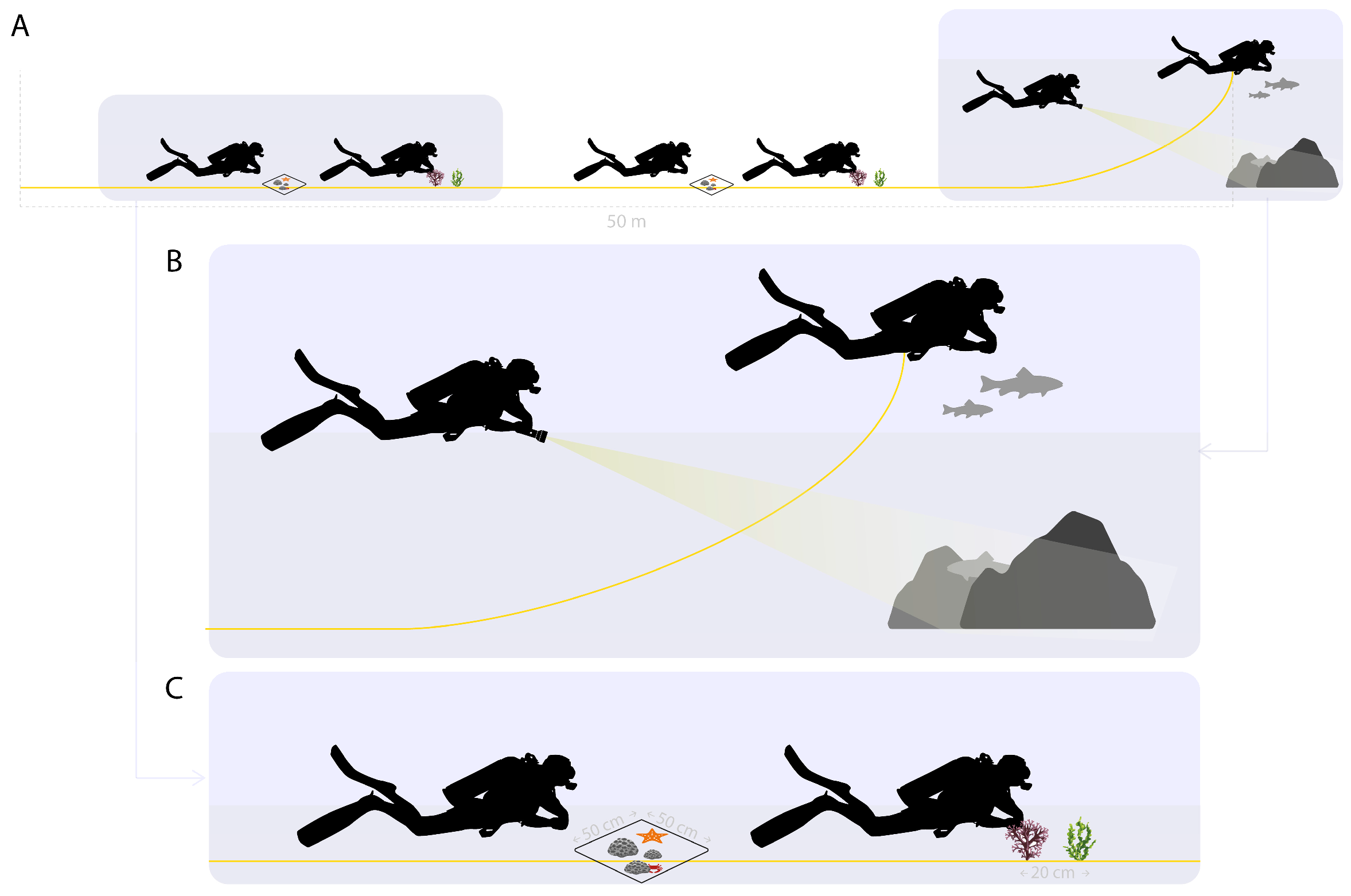
2. Materials and Methods
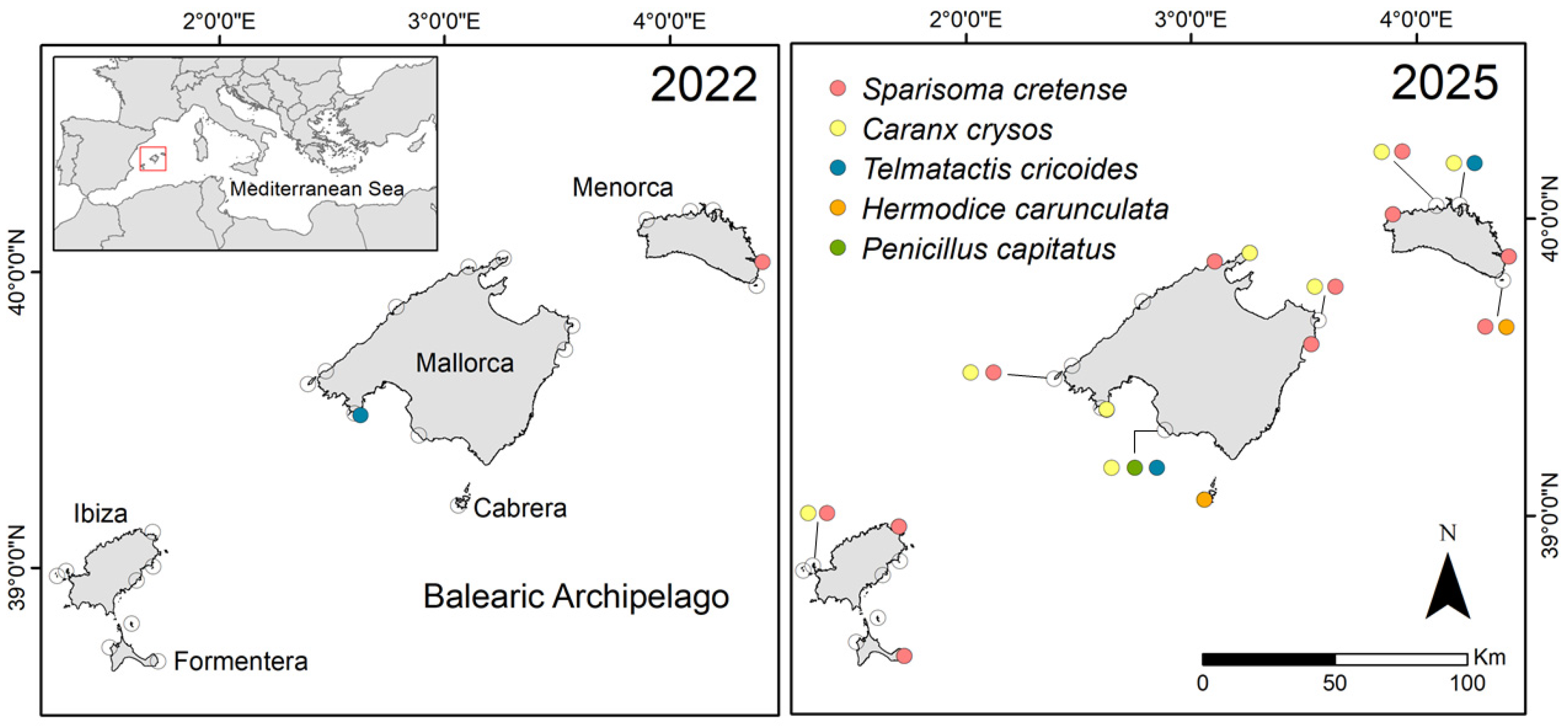
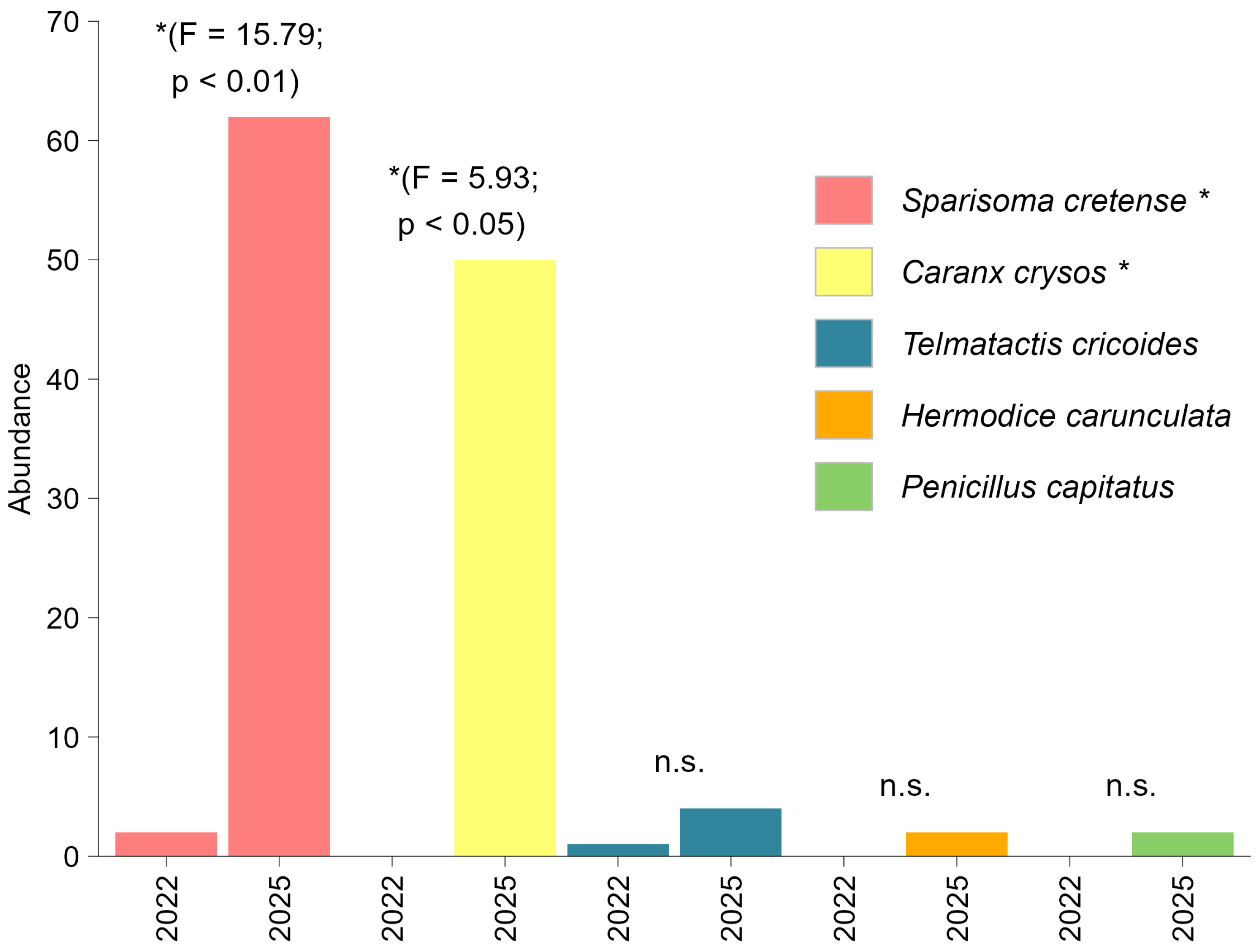
3. Results
4. Discussion
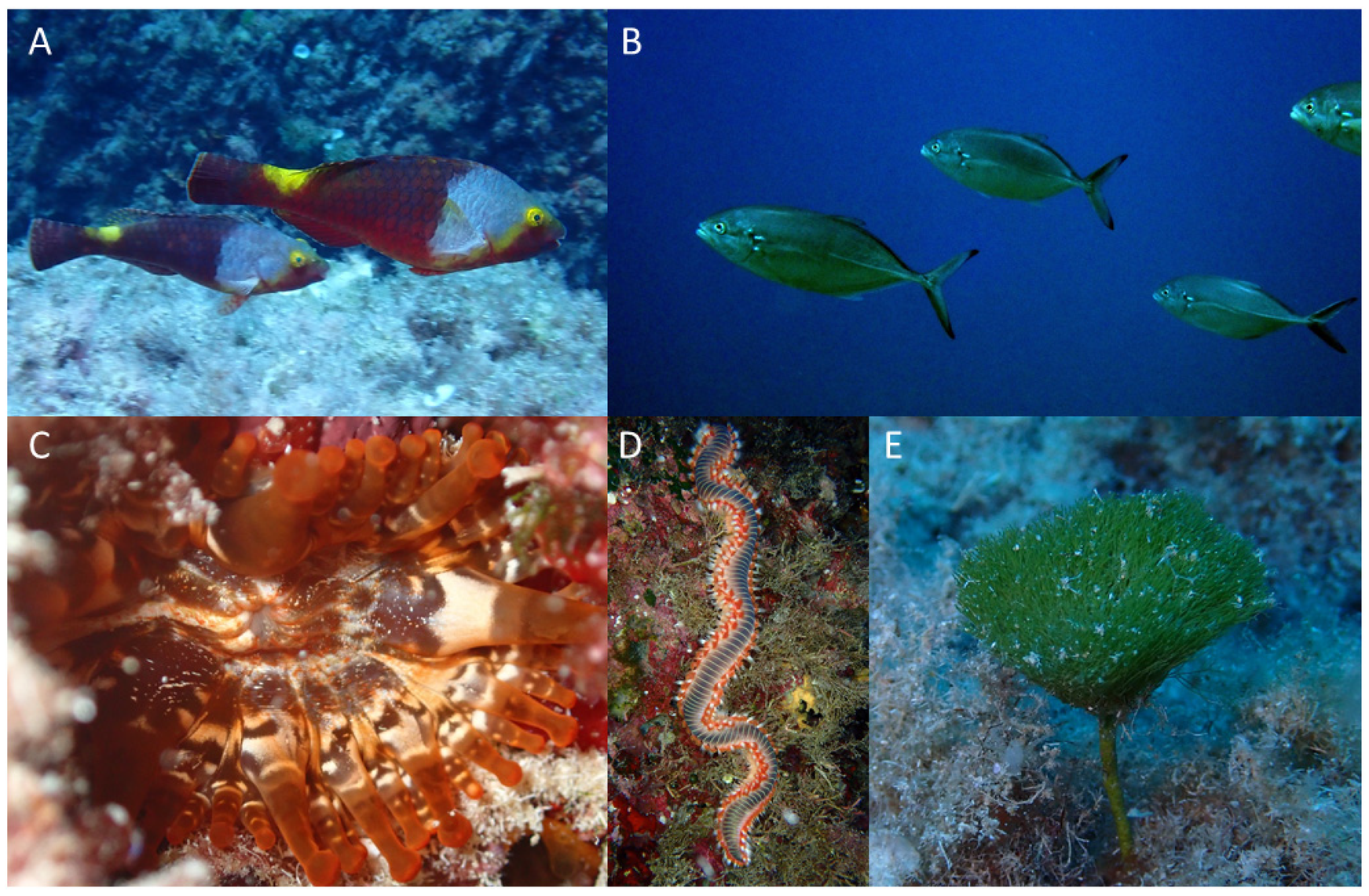
4.1. Sparisoma cretense (Linnaeus, 1758) (Teleostea, Scaridae)
4.2. Caranx crysos (Mitchill, 1815) (Teleostea, Carangidae)
4.3. Telmatactis cricoides (Duchassaing, 1850) (Cnidaria, Anthozoa, Actiniaria)
4.4. Hermodice carunculata (Pallas, 1766) (Annelida, Polychaeta, Amphinomidae)
4.5. Penicillus capitatus (Lamarck, 1813) (Chlorophyta, Ulvophyceae, Bryopsidales)
Author Contributions
Funding
Institutional Review Board Statement
Informed Consent Statement
Data Availability Statement
Acknowledgments
Conflicts of Interest
Abbreviations
| MSFD | Marine Strategy Framework Directive |
| MHWs | Marine Heatwaves |
| WM | Western Mediterranean |
| UVC | Underwater Visual Censuses |
References
- Bianchi, C.N.; Morri, C. Marine Biodiversity of the Mediterranean Sea: Situation, Problems and Prospects for Future Research. Mar. Pollut. Bull. 2000, 40, 367–376. [Google Scholar] [CrossRef]
- Coll, M.; Piroddi, C.; Steenbeek, J.; Kaschner, K.; Lasram, F.B.R.; Aguzzi, J.; Ballesteros, E.; Bianchi, C.N.; Corbera, J.; Dailianis, T.; et al. The Biodiversity of the Mediterranean Sea: Estimates, Patterns, and Threats. PLoS ONE 2010, 5, e11842. [Google Scholar] [CrossRef]
- Lejeusne, C.; Chevaldonné, P.; Pergent-Martini, C.; Boudouresque, C.F.; Pérez, T. Climate Change Effects on a Miniature Ocean: The Highly Diverse, Highly Impacted Mediterranean Sea. Trends Ecol. Evol. 2010, 25, 250–260. [Google Scholar] [CrossRef] [PubMed]
- Vargas-Yáñez, M.; Moya, F.; Serra, M.; Juza, M.; Jordà, G.; Ballesteros, E.; Alonso, C.; Pascual, J.; Salat, J.; Moltó, V.; et al. Observations in the Spanish Mediterranean Waters: A Review and Update of Results of 30-Year Monitoring. J. Mar. Sci. Eng. 2023, 11, 1284. [Google Scholar] [CrossRef]
- Lima, F.P.; Wethey, D.S. Three Decades of High-Resolution Coastal Sea Surface Temperatures Reveal More than Warming. Nat. Commun. 2012, 3, 704. [Google Scholar] [CrossRef]
- Martínez, J.; Leonelli, F.E.; García-Ladona, E.; Garrabou, J.; Kersting, D.K.; Bensoussan, N.; Pisano, A. Evolution of Marine Heatwaves in Warming Seas: The Mediterranean Sea Case Study. Front. Mar. Sci. 2023, 10, 1193164. [Google Scholar] [CrossRef]
- Konsta, K.; Katsanevakis, S.; Stranga, Y.; Mazaris, A.D. Increasing Bottom Marine Heatwaves Pose a Critical Risk to Mediterranean Benthic Species. Cell Rep. Sustain. 2026, 3, 100610. [Google Scholar] [CrossRef]
- Poloczanska, E.S.; Burrows, M.T.; Brown, C.J.; Molinos, J.G.; Halpern, B.S.; Hoegh-Guldberg, O.; Kappel, C.V.; Moore, P.J.; Richardson, A.J.; Schoeman, D.S.; et al. Responses of Marine Organisms to Climate Change across Oceans. Front. Mar. Sci. 2016, 3, 62. [Google Scholar] [CrossRef]
- Bianchi, C.N.; Morri, C. Global Sea Warming and “Tropicalization” of the Mediterranean Sea: Biogeographic and Ecological Aspects. Biogeogr.–J. Integr. Biogeogr. 2003, 24, 319–327. [Google Scholar] [CrossRef]
- Chust, G.; Villarino, E.; McLean, M.; Mieszkowska, N.; Benedetti-Cecchi, L.; Bulleri, F.; Ravaglioli, C.; Borja, A.; Muxika, I.; Fernandes-Salvador, J.A.; et al. Cross-Basin and Cross-Taxa Patterns of Marine Community Tropicalization and Deborealization in Warming European Seas. Nat. Commun. 2024, 15, 2126. [Google Scholar] [CrossRef]
- Templado, J. Future Trends of Mediterranean Biodiversity. In The Mediterranean Sea; Springer Netherlands: Dordrecht, The Netherlands, 2014; pp. 479–498. [Google Scholar]
- Canning-Clode, J.; Carlton, J.T. Refining and Expanding Global Climate Change Scenarios in the Sea: Poleward Creep Complexities, Range Termini, and Setbacks and Surges. Divers. Distrib. 2017, 23, 463–473. [Google Scholar] [CrossRef]
- Bianchi, C.N.; Caroli, F.; Guidetti, P.; Morri, C. Seawater Warming at the Northern Reach for Southern Species: Gulf of Genoa, NW Mediterranean. J. Mar. Biol. Assoc. UK 2018, 98, 1–12. [Google Scholar] [CrossRef]
- Azzurro, E. The Advance of Thermophilic Fishes in the Mediterranean Sea: Overview and Methodological Questions; ICRAM: Milazzo, Italy, 2008; pp. 27–31. [Google Scholar]
- Marullo, S.; Serva, F.; Iacono, R.; Napolitano, E.; di Sarra, A.; Meloni, D.; Monteleone, F.; Sferlazzo, D.; De Silvestri, L.; de Toma, V.; et al. Record-Breaking Persistence of the 2022/23 Marine Heatwave in the Mediterranean Sea. Environ. Res. Lett. 2023, 18, 114041. [Google Scholar] [CrossRef]
- Serva, F.; Marullo, S.; Iacono, R.; Napolitano, E.; Santoleri, R. Drivers of Persistent Marine Heatwaves in the Mediterranean in Recent Years. Il Nuovo C. C 2024, 47, 312. [Google Scholar] [CrossRef]
- Bianchi, C.N.; Azzola, A.; Bertolino, M.; Betti, F.; Bo, M.; Cattaneo-Vietti, R.; Cocito, S.; Montefalcone, M.; Morri, C.; Oprandi, A.; et al. Consequences of the Marine Climate and Ecosystem Shift of the 1980-90s on the Ligurian Sea Biodiversity (NW Mediterranean). Eur. Zool. J. 2019, 86, 458–487. [Google Scholar] [CrossRef]
- Santana-Garcon, J.; Bennett, S.; Marbà, N.; Vergés, A.; Arthur, R.; Alcoverro, T.; Santana-garcon, J. Tropicalization Shifts Herbivore Pressure from Seagrass to Rocky Reef Communities. Proc. Biol. Sci. 2023, 290, 20221744. [Google Scholar] [CrossRef]
- Azzola, A.; Bianchi, C.N.; Merotto, L.; Nota, A.; Tiralongo, F.; Morri, C.; Oprandi, A. The Changing Biogeography of the Ligurian Sea: Seawater Warming and Further Records of Southern Species. Diversity 2024, 16, 159. [Google Scholar] [CrossRef]
- Martín-Arjona, A.; Muñoz-Caballero, A.; Serrano, A.; Díaz-Viñolas, D.; Urra, J. The Thermophilic Sea Anemone Telmatactis Cricoides (Cnidaria, Hexacorallia) in the Western Mediterranean: Filling Gaps in the Knowledge of the Distribution. J. Mar. Biol. Assoc. UK 2024, 104, e9. [Google Scholar] [CrossRef]
- Vargas-Yáñez, M.; Lofthouse, J.W.; Chevalier, C.; Vargas-García, E.; González, M.; García-Martínez, M.C.; Ballesteros, E.; Alonso, C.; Báez, J.C.; Torreblanca, D.; et al. About the Tropicalization of the Spanish Mediterranean Waters: Effects on Fish Communities. J. Mar. Sci. Eng. 2025, 13, 2325. [Google Scholar] [CrossRef]
- de Carvalho-Souza, G.F.; Lobato, C.; Arana Mesa, D.; González-Ortegón, E. Ongoing Tropicalization of Marine Fishes: Is Range Expansion and Establishment Occurring in the Gulf of Cadiz (Southernmost Europe)? J. Mar. Biol. Assoc. UK 2025, 105, e61. [Google Scholar] [CrossRef]
- de la Ballina, N.R.; Maresca, F.; Real, E.; Baen-Vega, I.; Diez, S.; Martín-Arjona, A.; Mallol, S.; Díaz, D. Signs of Northward Expansion of the Fireworm Hermodice Carunculata in the Spanish Western Mediterranean Sea. Mediterr. Mar. Sci. 2025, 26, 515–532. [Google Scholar] [CrossRef]
- Cerrato, M.; Mir-Rosselló, P.; Ferriol, P.; Gil, L.; Monserrat-Mesquida, M.; Tejada, S.; Pinya, S.; Sureda, A. Oxidative Stress Response in the Seaweed Padina pavonica Associated with the Invasive Halimeda incrassata and Penicillus capitatus. Water 2023, 15, 557. [Google Scholar] [CrossRef]
- Simon, A.; Pires, C.; Frölicher, T.L.; Russo, A. Long-Term Warming and Interannual Variability Contributions’ to Marine Heatwaves in the Mediterranean. Weather Clim. Extrem. 2023, 42, 100619. [Google Scholar] [CrossRef]
- Juza, M.; de Alfonso, M.; Fernández-Mora, Á. Coastal Ocean Response during the Unprecedented Marine Heatwaves in the Western Mediterranean in 2022. State Planet 2024, 4-osr8, 14. [Google Scholar] [CrossRef]
- Fernández-Álvarez, B.; Barceló-Llull, B.; Pascual, A. Tracking Marine Heatwaves in the Balearic Sea: Temperature Trends and the Role of Detection Methods. Ocean Sci. 2025, 21, 1987–1999. [Google Scholar] [CrossRef]
- Sarda, R. Polychaete Communities Related to Plant Covering in the Médiolittoral and Infralittoral Zones of the Balearic Islands (Western Méditerranean). Mar. Ecol. 1991, 12, 341–360. [Google Scholar] [CrossRef]
- Ballesteros, E.; Zabala, M. The Bentos: The Physical Framework (El Bentos: El Marc Fisic). In Historia Natural de Arxipelag de Cabrera; Alcover, Ed.; Universidad de las Islas Baleares: Palma, Spain, 1993; pp. 663–685. (In Catalan) [Google Scholar]
- Reviriego, B.; Moranta, J.; Coll, J. Bionomic Cartography of the Seabeds Adjacent to the Islands of Del Toro and es Malgrat (SW of Mallorca, Balearic Islands) (Cartografia Bionomica Dels Fons Marins Adjacents a Les Illes Del Toro i d’es Malgrat (SW de Mallorca, Illes Balears)). Bolletí Soc. d’Història Nat. Balear. 1996, 39, 187–203. (In Catalan) [Google Scholar]
- del Valle, L.; Pons, G.X. Cartographic Compilation of the Marine Habitats of Mallorca (Compilació Cartogràfica Dels Hábitats Marins de Mallorca). Bolletí Soc. d’Història Nat. Balear. 2019, 62, 73–101. (In Catalan) [Google Scholar]
- Stobart, B.; García-Charton, J.A.; Espejo, C.; Rochel, E.; Goñi, R.; Reñones, O.; Herrero, A.; Crec’hriou, R.; Polti, S.; Marcos, C.; et al. A Baited Underwater Video Technique to Assess Shallow-Water Mediterranean Fish Assemblages: Methodological Evaluation. J. Exp. Mar. Biol. Ecol. 2007, 345, 158–174. [Google Scholar] [CrossRef]
- Grane-feliu, X.; Bennett, S.; Hereu, B.; Aspillaga, E.; Santana-garcon, J. Comparison of Diver Operated Stereo-Video and Visual Census to Assess Targeted Fish Species in Mediterranean Marine Protected Areas. J. Exp. Mar. Biol. Ecol. 2019, 520, 151205. [Google Scholar] [CrossRef]
- Follana-Berná, G.; Palmer, M.; Campos-Candela, A.; Arechavala-Lopez, P.; Diaz-Gil, C.; Alós, J.; Catalan, I.A.; Balle, S.; Coll, J.; Morey, G.; et al. Estimating the Density of Resident Coastal Fish Using Underwater Cameras: Accounting for Individual Detectability. Mar. Ecol. Prog. Ser. 2019, 615, 177–188. [Google Scholar] [CrossRef]
- Cardona, L.; Reñones, O.; Gouraguine, A.; Saporiti, F.; Borrell, A.; Aguilar, A.; Moranta, J. Effects of Fishing on the Trophic Structure of Carnivorous Fish Assemblages from Shallow Rocky Bottoms of the Mediterranean Sea and the Temperate Atlantic Ocean. ICES J. Mar. Sci. 2023, 80, 751–765. [Google Scholar] [CrossRef]
- Anderson, M.J. A New Method for Non-Parametric Multivariate Analysis of Variance. Austral Ecol. 2001, 26, 32–46. [Google Scholar] [CrossRef]
- Doney, S.C.; Ruckelshaus, M.; Emmett Duffy, J.; Barry, J.P.; Chan, F.; English, C.A.; Galindo, H.M.; Grebmeier, J.M.; Hollowed, A.B.; Knowlton, N.; et al. Climate Change Impacts on Marine Ecosystems. Ann. Rev. Mar. Sci. 2012, 4, 11–37. [Google Scholar] [CrossRef]
- Simon, A. Main Features of Summer 2023 MHWs and Trends in Air-Sea Interactions Related to the Long-Term Evolution of MHWs in the Mediterranean. In Proceedings of the CIESM Workshop Monographs n°51; CIESM Publisher: Paris, France, 2024; pp. 77–84. [Google Scholar]
- Favoretto, F.; Sánchez, C.; Aburto-Oropeza, O. Warming and Marine Heatwaves Tropicalize Rocky Reefs Communities in the Gulf of California. Prog. Oceanogr. 2022, 206, 102838. [Google Scholar] [CrossRef]
- Boudouresque, C.F.; Astruch, P.; André, S.; Belloni, B.; Blanfuné, A.; Charbonnel, É.; Cheminée, A.; Cottalorda, J.M.; Dupuy de la Grandrive, R.; Marengo, M.; et al. The Heatwave of Summer 2022 in the North-Western Mediterranean Sea: Some Species Were Winners. Water 2024, 16, 219. [Google Scholar] [CrossRef]
- Ventura, D. Settlement Evidence of the Mediterranean Parrotfish Sparisoma Cretense (Teleostei: Scaridae) in the Central Tyrrhenian Sea (Giglio Island, Italy). BioInvasions Rec. 2019, 8, 413–418. [Google Scholar] [CrossRef]
- Hoey, A.S.; Bonaldo, R.M. (Eds.) Biology of Parrotfishes; CRC Press: Boca Raton, FL, USA; Taylor & Francis Group: Boca Raton, FL, USA, 2018. [Google Scholar]
- Nicolaidou, A.; Alongi, G.; Aydogan, O.; Catra, M.; Cavas, L.; Cevik, C.; Dosi, A.; Circosta, V.; Giakoumi, S.; Gimenez-Casalduero, F.; et al. New Mediterranean Biodiversity Records (June 2012). Mediterr. Mar. Sci. 2012, 13, 162. [Google Scholar] [CrossRef]
- Astruch, P.; Bonhomme, P.; Goujard, A.; Rouanet, E.; Boudouresque, C.; Harmelin, J.; Posidonie, G.I.S.; Pytheas, O.S.U.; Valad, P.; Paradou, I.; et al. Provence and Mediterranean Warming: The Parrotfish Sparisoma Cretense Is Coming. Rapp. Comm. Int. Mer Méditerranée 2016, 41, 13288. [Google Scholar]
- Kampouris, T.E.; Batjakas, I.E. The Northernmost Record of the Thermophilic Mediterranean Parrotfish Sparisoma Cretense (Linnaeus, 1758) (Perciformes, Scaridae) in the Eastern Mediterranean Sea (Northwestern Aegean Sea). Ann. Ser. Hist. Nat. 2018, 28, 111–116. [Google Scholar] [CrossRef]
- Cengiz, Ö.; Paruğ, Ş. The Northernmost Confirmation of the Occurrence of Parrotfish (Sparisoma Cretense Linnaeus, 1758) in the Eastern Mediterranean with Its First Record from Saros Bay (Northern Aegean Sea, Turkey). Acta Nat. Sci. 2020, 1, 61–68. [Google Scholar] [CrossRef]
- Tuncer, S.; Torcu Koç, H.; Kanat, R.E. Occurence of the Thermophilic Mediterranean Parrotfish Sparisoma Cretense (Linneaus, 1758) (Teleostei: Scaridae) in Dikili Bay, Northern Aegean Sea, Turkey. J. Anatol. Environ. Anim. Sci. 2020, 5, 759–764. [Google Scholar] [CrossRef]
- Esposito, G.; Prearo, M.; Menconi, V.; Mugetti, D.; Meloni, D.; Tomasoni, M.; Pizzul, E.; Piras, P.; Renzi, M.; Gaspa, D.; et al. Northward Spread of the Parrotfish Sparisoma Cretense (Teleostei: Scaridae) in the Mediterranean Sea: An Update on Current Distribution with Two New Records from Sardinia. J. Mar. Sci. Eng. 2021, 9, 536. [Google Scholar] [CrossRef]
- Nota, A.; Santovito, A.; Tiralongo, F. Northern Refuge or New Thermophilic Hotspot? Citizen Science Evidence of Rare, Thermophilic, and Alien Fishes in the Ligurian Sea (NW Mediterranean). Oceans 2025, 6, 25. [Google Scholar] [CrossRef]
- Alkhalili, H.; Taleb Bendiab, A.A.; Seret, B.; Bensahla-Talet, L.; Benaissa, N.; Bouderbala, M. Bony Fish of Algerian Marine Fauna: A Historical Review with an Updated Checklist and New Records. Appl. Ecol. Environ. Res. 2025, 23, 7957–7995. [Google Scholar] [CrossRef]
- Sley, A.; Jarboui, O.; Ghorbel, M.; Bouain, A. Food and Feeding Habits of Caranx Crysos from the Gulf of Gabès (Tunisia). J. Mar. Biol. Assoc. UK 2009, 89, 1375–1380. [Google Scholar] [CrossRef]
- Smith-Vaniz, W.F. Carangidae. In Fishes of the North Eastern atlantic and the Mediterranean Volume II; Whitehead, P.J.P., Bauchot, M.L., Hurreau, J.C., Neilsen, J., Tortonese, E., Eds.; UNESCO: Paris, France, 1986; pp. 815–844. [Google Scholar]
- Brito, A.; Falcón, J.M.; Herrera, R. About the Recent Tropicalisation of the Littoral Ichthyofauna of the Canary Islands and Its Relationship with Environmental Changes and Human Activities. Vieraea 2005, 33, 515–525. [Google Scholar]
- Fischer, W.; Schneider, M.; Bauchot, M.-L. FAO Species Identification Sheets for Fisheries Use (Fiches FAO d’identification Des Especes Pour Les Besoins de La Pêche). In Méditerranée et Mer Noire. Zone de Pêche 37; FAO: Rome, Italy, 1987. (In French) [Google Scholar]
- Tortonese, E. Fauna of Italy: Vol. XI, Osteichthyes (Bonty Fishes). Part Two (Fauna d’Italia: Vol. XI, Osteichthyes (Pesci Ossei)). Parte Seconda; Calderini: Bologna, Italy, 1975. (In Italian) [Google Scholar]
- Psomadakis, P.N.; Bentivegna, F.; Giustino, S.; Travaglini, A.; Vacchi, M. Northward Spread of Tropical Affinity Fishes: Caranx Crysos (Teleostea: Carangidae), a Case Study from the Mediterranean Sea. Ital. J. Zool. 2011, 78, 113–123. [Google Scholar] [CrossRef][Green Version]
- Dulčić, J.; Pallaoro, A.; Dragičević, B. First Record of the Blue Runner, Caranx Crysos (Mitchill, 1815), in the Adriatic Sea. J. Appl. Ichthyol. 2009, 25, 481–482. [Google Scholar] [CrossRef]
- Sley, A.; Jarboui, O.; Ghorbel, M.; Bouain, A. Annual Reproductive Cycle, Spawning Periodicity and Sexual Maturity of Blue Runner Caranx Crysos (Pisces, Carangidae) from the Gulf of Gabes (Tunisia, Eastern Mediterranean). J. Appl. Ichthyol. 2012, 28, 785–790. [Google Scholar] [CrossRef]
- Sinopoli, M.; Lauria, V.; Garofalo, G.; Maggio, T.; Cillari, T. Extensive Use of Fish Aggregating Devices Together with Environmental Change Influenced the Spatial Distribution of a Tropical Affinity Fish. Sci. Rep. 2019, 9, 4934. [Google Scholar] [CrossRef] [PubMed]
- Tiralongo, F.; Crocetta, F.; Riginella, E.; Lillo, A.O.; Tondo, E.; Macali, A.; Mancini, E.; Russo, F.; Coco, S.; Paolillo, G.; et al. Snapshot of Rare, Exotic and Overlooked Fish Species in the Italian Seas: A Citizen Science Survey. J. Sea Res. 2020, 164, 101930. [Google Scholar] [CrossRef]
- Di Blasi, D.; Bava, S.; Desiderà, E.; Merotto, L.; Poli, F.; Guidetti, P. The Northernmost Records of Caranx Crysos (Osteichthyes: Carangidae) in the NW Mediterranean Sea. Thalass. Int. J. Mar. Sci. 2024, 40, 7–11. [Google Scholar] [CrossRef]
- Grau, A.M.; Riera, F. Faunistical and Demographical Observations in the Balearic Ichthyofauna: A Meridionalization Phenomena (Observacions faunístiques i demogràfiques a la ictiofauna de les Illes Balears un fenomen de meridionalització). In El Canvi Climàtic Passat Present i Futur; Pons Buades, G.X., Guijarro Pastor, J.A., Eds.; Consell de Mallorca: Palma, Spain, 2001; pp. 53–67. (In Catalan) [Google Scholar]
- Félix-Hackradt, F.C.; Hackradt, C.W.; Treviño-Otón, J.; Segovia-Viadero, M.; Pérez-Ruzafa, A.; García-Charton, J.A. Environmental Determinants on Fish Post-Larval Distribution in Coastal Areas of South-Western Mediterranean Sea. Estuar. Coast. Shelf Sci. 2013, 129, 59–72. [Google Scholar] [CrossRef]
- Raya, V.; Sabatés, A. Diversity and Distribution of Early Life Stages of Carangid Fishes in the Northwestern Mediterranean: Responses to Environmental Drivers. Fish. Oceanogr. 2015, 24, 118–134. [Google Scholar] [CrossRef]
- Ocaña, V. Anemones (Actiniaria and Corallimorpharia) of Central Macaronesia: Canary Islands and Madeira (Taxonomic, Comparative Anatomical Study and Some Biogeographical Considerations) (Anemonas (Actiniaria y Corallimorpharia) de La Macaronesia Central: Canarias y Madeira (Estudio Taxonomico, Anatomico Comparado y Algunas Consideraciones Biogeograficas); Universidad de La Laguna: San Cristóbal de La Laguna, Spain, 1995. (In Spanish) [Google Scholar]
- den Hartog, D. The Genus Telmatactis Gravier, 1916 (Actiniaria: Acontiaria: Isophelliidae) in Greece and the Eastern Mediterranean. Zool. Meded. 1995, 69, 153–176. [Google Scholar]
- Sánchez-Tocino, L.; Tierno de Figueroa, J.; de la Linde Rubio, A. First Record of Telmatactis Cricoides (Duchassaing, 1850) (Actiniaria) in the Western Mediterranean. Zool. Baetica 2016, 27, 3–5. [Google Scholar]
- Krželj, M.; Cerrano, C.; Di Camillo, C.G. Enhancing Diversity Knowledge through Marine Citizen Science and Social Platforms: The Case of Hermodice Carunculata (Annelida, Polycheta). Diversity 2020, 12, 311. [Google Scholar] [CrossRef]
- Righi, S.; Prevedelli, D.; Simonini, R. Ecology, Distribution and Expansion of a Mediterranean Native Invader, the Fireworm Hermodice Carunculata (Annelida). Mediterr. Mar. Sci. 2020, 17, 608–626. [Google Scholar] [CrossRef]
- Schulze, A.; Grimes, C.J.; Rudek, T.E. Tough, Armed and Omnivorous: Hermodice Carunculata (Annelida: Amphinomidae) Is Prepared for Ecological Challenges. J. Mar. Biol. Assoc. UK 2017, 97, 1075–1080. [Google Scholar] [CrossRef]
- Grimes, C.J.; Petersen, L.H.; Schulze, A. Differential Gene Expression Indicates Modulated Responses to Chronic and Intermittent Hypoxia in Corallivorous Fireworms (Hermodice Carunculata). Sci. Rep. 2021, 11, 11110. [Google Scholar] [CrossRef]
- Cenni, E.; Gioia, C.; Camillo, D.; Righi, S.; Fermo, R.; Bozzoli, C.; Prevedelli, D.; Simonini, R. Winning in the Era of Global Change: New Findings on the Invasive Fireworm Hermodice Carunculata (Annelida) along the Italian Coasts Obtained Using Citizen Science. Mediterr. Mar. Sci. 2025, 26, 860–876. [Google Scholar] [CrossRef]
- Pagana, I.; Puglia, G.D.; Marletta, G.; Alongi, G. Is the Typical Stage of Penicillus capitatus Lamarck (Bryopsidales, Halimedaceae) a Possible Indicator of Climate Warming? Mediterr. Mar. Sci. 2024, 25, 548–555. [Google Scholar] [CrossRef]
- Hierro, A.; Ballesteros, E.; Mañez-Crespo, J.; Reynés, X.; Tomas, F. On the Presence of an Unexpected Meadow of Penicillus capitatus Lamarck (Bryopsidales: Chlorophyta) in Mallorca, Balearic Islands, Western Mediterranean. Mediterr. Mar. Sci. 2024, 25, 279–286. [Google Scholar] [CrossRef]
- Bianchi, C.N.; Morri, C.; Chiantore, M.; Montefalcone, M.; Parravicini, V.; Rovere, A. Mediterranean Sea Biodiversity between the Legacy from the Past and a Future of Change. In Mediterranean Sea Biodiversity Between the Legacy from the Past and a Future of Change; Nova Science Publishers: New York, NY, USA, 2012; pp. 1–55. [Google Scholar]
- Sbragaglia, V.; Cerri, J.; Bolognini, L.; Dragičević, B.; Dulčić, J.; Grati, F.; Azzurro, E. Local Ecological Knowledge of Recreational Fishers Reveals Different Meridionalization Dynamics of Two Mediterranean Subregions. Mar. Ecol. Prog. Ser. 2020, 634, 147–157. [Google Scholar] [CrossRef]
- Bianchi, C.N. Biodiversity Issues for the Forthcoming Tropical Mediterranean Sea. Hydrobiologia 2007, 580, 7–21. [Google Scholar] [CrossRef]
- Encarnação, J.; Morais, P.; Baptista, V.; Cruz, J.; Teodósio, M.A. New Evidence of Marine Fauna Tropicalization off the Southwestern Iberian Peninsula (Southwest Europe). Diversity 2019, 11, 48. [Google Scholar] [CrossRef]
- Bonacolta, A.M.; Weiler, B.A.; Grimes, C.J.; Trznadel, M.; Vermeij, M.J.A.; Keeling, P.J.; del Campo, J. Fireworms Are a Reservoir and Potential Vector for Coral-Infecting Apicomplexans. ISME J. 2025, 19, wraf078. [Google Scholar] [CrossRef] [PubMed]
- Trainito, E.; Doneddu, M.; Furfaro, G. Aliens in Changing Seascapes: A Newly Reported Non-Native Sacoglossan (Mollusca, Heterobranchia) in the Western Mediterranean Sea. Check List 2022, 18, 545–551. [Google Scholar] [CrossRef]
- Givan, O.; Edelist, D.; Sonin, O.; Belmaker, J. Thermal Affinity as the Dominant Factor Changing Mediterranean Fish Abundances. Glob. Change Biol. 2018, 24, e80–e89. [Google Scholar] [CrossRef]
- Torreblanca, D.; Báez, J.C. Tropicalization of the Mediterranean Sea Reflected in Fish Diversity Changes: A Case Study from Spanish Waters. J. Mar. Sci. Eng. 2025, 13, 1119. [Google Scholar] [CrossRef]
- Wirtz, P.; Debelius, H. Mediterranean and Atlantic Invertebrate Guide; ConchBooks: Hackenheim, Germany, 2003. [Google Scholar]




| 2022 | 2025 | |||||
|---|---|---|---|---|---|---|
| Species | Nº | Island | Coordinates | Nº | Island | Coordinates |
| Sparisoma cretense | 2 | Menorca | 39.8768° N 4.3282° E | 3 | Formentera | 38.6637° N 1.5847° E |
| Sparisoma cretense | 1 | Ibiza | 39.1022° N 1.5906° E | |||
| Sparisoma cretense | 1 | Ibiza | 38.9843° N 1.2067° E | |||
| Sparisoma cretense | 1 | Mallorca | 39.9354° N 3.0389° E | |||
| Sparisoma cretense | 5 | Mallorca | 39.5728° N 2.3032° E | |||
| Sparisoma cretense | 2 | Mallorca | 39.7113° N 3.4755° E | |||
| Sparisoma cretense | 6 | Mallorca | 39.6335° N 3.4355° E | |||
| Sparisoma cretense | 4 | Menorca | 40.0682° N 4.0305° E | |||
| Sparisoma cretense | 22 | Menorca | 39.8768° N 4.3282° E | |||
| Sparisoma cretense | 16 | Menorca | 39.7992° N 4.2941° E | |||
| Sparisoma cretense | 1 | Menorca | 40.0499° N 3.8358° E | |||
| Caranx crysos | 18 | Ibiza | 38.9843° N 1.2067° E | |||
| Caranx crysos | 1 | Mallorca | 39.5728° N 2.3032° E | |||
| Caranx crysos | 4 | Mallorca | 39.4580° N 2.5234° E | |||
| Caranx crysos | 22 | Mallorca | 39.9550° N 3.1954° E | |||
| Caranx crysos | 1 | Mallorca | 39.7113° N 3.4755° E | |||
| Caranx crysos | 2 | Mallorca | 39.3772° N 2.7733° E | |||
| Caranx crysos | 1 | Menorca | 40.0682° N 4.0305° E | |||
| Caranx crysos | 1 | Menorca | 40.0639° N 4.1309° E | |||
| Telmatactis cricoides | 1 | Mallorca | 39.4580° N 2.5234° E | 1 | Mallorca | 39.3772° N 2.7733° E |
| Telmatactis cricoides | 3 | Menorca | 40.0639° N 4.1309° E | |||
| Hermodice carunculata | 1 | Cabrera | 39.1328° N 2.9239° E | |||
| Hermodice carunculata | 1 | Menorca | 39.7992° N 4.2941° E | |||
| Penicillus capitatus | 2 | Mallorca | 39.3772° N 2.7733° E | |||
Disclaimer/Publisher’s Note: The statements, opinions and data contained in all publications are solely those of the individual author(s) and contributor(s) and not of MDPI and/or the editor(s). MDPI and/or the editor(s) disclaim responsibility for any injury to people or property resulting from any ideas, methods, instructions or products referred to in the content. |
© 2026 by the authors. Licensee MDPI, Basel, Switzerland. This article is an open access article distributed under the terms and conditions of the Creative Commons Attribution (CC BY) license.
Share and Cite
de la Ballina, N.R.; Caballero-Herrera, J.A.; González-Rodríguez, Y.; Maresca, F.; Martín-Arjona, A.; Moreno-Borges, S.; Rodríguez-Riesco, J.E.; Baena-Vega, I.; Díaz, D.; Díez, S.; et al. Evidences of Tropicalization of Infralittoral Communities in the Balearic Islands (Western Mediterranean). Environ. Earth Sci. Proc. 2026, 41, 3. https://doi.org/10.3390/eesp2026041003
de la Ballina NR, Caballero-Herrera JA, González-Rodríguez Y, Maresca F, Martín-Arjona A, Moreno-Borges S, Rodríguez-Riesco JE, Baena-Vega I, Díaz D, Díez S, et al. Evidences of Tropicalization of Infralittoral Communities in the Balearic Islands (Western Mediterranean). Environmental and Earth Sciences Proceedings. 2026; 41(1):3. https://doi.org/10.3390/eesp2026041003
Chicago/Turabian Stylede la Ballina, Nuria R., José Antonio Caballero-Herrera, Yulimar González-Rodríguez, Francesco Maresca, Alejandro Martín-Arjona, Sergio Moreno-Borges, Jaime Ezequiel Rodríguez-Riesco, Ignacio Baena-Vega, David Díaz, Susana Díez, and et al. 2026. "Evidences of Tropicalization of Infralittoral Communities in the Balearic Islands (Western Mediterranean)" Environmental and Earth Sciences Proceedings 41, no. 1: 3. https://doi.org/10.3390/eesp2026041003
APA Stylede la Ballina, N. R., Caballero-Herrera, J. A., González-Rodríguez, Y., Maresca, F., Martín-Arjona, A., Moreno-Borges, S., Rodríguez-Riesco, J. E., Baena-Vega, I., Díaz, D., Díez, S., & Mallol, S. (2026). Evidences of Tropicalization of Infralittoral Communities in the Balearic Islands (Western Mediterranean). Environmental and Earth Sciences Proceedings, 41(1), 3. https://doi.org/10.3390/eesp2026041003