Proceeding Paper

Unraveling the Effects of Ion Exchange Membranes on the Performance of Real Wastewater Treatment in Microbial Fuel Cells †

by
Khin Thandar Tun
1,2 and
Veera Gnaneswar Gude
1,2,3,*
1
Purdue University Northwest Water Institute, Purdue University Northwest, Hammond, IN 46323, USA
2
Department of Mechanical and Civil Engineering, Purdue University Northwest, Hammond, IN 46323, USA
3
School of Sustainability Engineering and Environmental Engineering, Purdue University, West Lafayette, IN 47907, USA
*
Author to whom correspondence should be addressed.
Presented at the 9th International Electronic Conference on Water Sciences, 11–14 November 2025; Available online: https://sciforum.net/event/ECWS-9.
Environ. Earth Sci. Proc. 2026, 40(1), 5; https://doi.org/10.3390/eesp2026040005
Published: 19 February 2026
(This article belongs to the Proceedings of The 9th International Electronic Conference on Water Sciences)

Abstract

This study investigated the comparative performance of anion exchange membranes (AEMs), cation exchange membranes (CEMs), and bipolar membranes (BPMs) in dual-chamber microbial fuel cells (MFCs) operated under fed-batch real wastewater conditions. The experimental studies focused on electrical output; pH shifts; and changes in chemical oxygen demand (COD), total nitrogen, total phosphorus, and ammonia concentrations. The results revealed distinct performance profiles for each membrane type. The CEM system supported high removal of COD, TN, and ammonia (≈75–85% ± 2%). In contrast, the AEM achieved excellent phosphorus removal (≈95% ± 2%) alongside strong COD reduction, although nitrogen and ammonia removal were comparatively lower. BPM systems exhibited lower COD removal (typically <65%) but achieved moderate and stable reductions in TN, ammonia, and phosphorus while producing electrical output consistently higher than AEMs and at intermediate levels relative to CEMs. Quantitative analysis of power generation further confirmed this trend, with CEM delivering the highest output (8.93 mW/m2), BPM providing moderate performance (3.38 mW/m2), and AEM producing the lowest (1.5 mW/m2). The results emphasize that membranes influence the balance between nutrient removal and energy recovery and that aligning membrane selection with specific treatment objectives may advance MFCs from laboratory demonstrations toward practical applications.

1. Introduction

Microbial fuel cells (MFCs) are bioelectrochemical systems that exploit the metabolic activity of electroactive microorganisms to oxidize organic matter in wastewater and convert part of the chemical energy directly into electrical energy [1]. In a typical configuration, microbes in the anode chamber oxidize biodegradable substrates and transfer electrons to the anode, while protons and other ions migrate through a separator to the cathode, where a reduction reaction completes the circuit and generates an electrical current. Within this context, membrane selection critically governs both pollutant removal and bioelectrochemical performance in microbial fuel cells (MFCs) designed for wastewater treatment [2]. Over the past two decades, MFCs have emerged as a promising technology for simultaneous energy recovery and nutrient removal; however, their translation from laboratory-scale demonstrations to practical applications remains constrained by low power densities, operational instability, and material costs [3]. Among various system components, the membrane separating anodic and cathodic chambers plays a central role in defining the internal resistance, ionic transport pathways, pH stratification, and cross-chamber migration of substrates and nutrients, thereby exerting a decisive in fluence on reactor efficiency and long-term performance [4].
Proton exchange membranes (PEMs), particularly perfluorosulfonic acid polymers, have traditionally been adopted as the standard separator in dual-chamber MFC configurations due to their high proton conductivity and acceptable mechanical robustness [5]. However, their widespread implementation in municipal and industrial wastewater treatment is challenged by several factors, including high material costs, susceptibility to fouling and scaling, and non-ideal selectivity that can facilitate oxygen and cation crossover [6], ultimately depressing coulombic efficiency and power output. These limitations have stimulated growing interest in alternative ion-selective membranes, especially anion exchange membranes (AEMs), cation exchange membranes (CEMs), and more recently, bipolar membranes (BPMs), which offer distinct ion transport mechanisms and the potential to better match the complex ionic matrix of real wastewater.
Ion exchange and bipolar membranes can substantially reshape the electrochemical environment in MFCs by modulating the direction and magnitude of ion fluxes between the anodic and cathodic chambers [6]. AEMs predominantly facilitate anion transport and can favor the migration and capture of anionic nutrient species, such as phosphate, thereby affecting phosphorus removal and pH profiles across the cell. In contrast, CEMs promote cation transport, which can enhance charge balance through ammonium and other cation migration, with implications for nitrogen removal, conductivity, and internal resistance, while BPMs introduce an internal junction that can split water into protons and hydroxide ions [7], providing in situ pH regulation and potentially stabilizing performance under variable wastewater compositions. Despite these mechanistic advantages, systematic comparative evaluations of AEM, CEM, and BPM performance in dual-chamber MFCs fed with real wastewater remain limited, particularly with respect to the coupled behavior of organic removal, nutrient transformation, and power generation.
Addressing this knowledge gap, this research investigates dual-chamber MFCs equipped with AEM, CEM, or BPM separators operated under fed-batch conditions using real wastewater as the substrate. This work focuses on quantifying membrane-driven differences in electrochemical output and treatment performance, including temporal shifts in pH and changes in chemical oxygen demand (COD), total nitrogen (TN), phosphorus, and ammonia concentrations. By elucidating the distinct performance profiles and trade-offs associated with each membrane type, this study aims to clarify how membrane selection can be strategically aligned with specific treatment objectives such as maximizing organic and nitrogen removal, enhancing phosphorus recovery, or optimizing energy recovery, thereby contributing to the rational design of MFC systems progressing toward practical, application-oriented deployment.

2. Materials and Methods

2.1. Configuration and Analyses

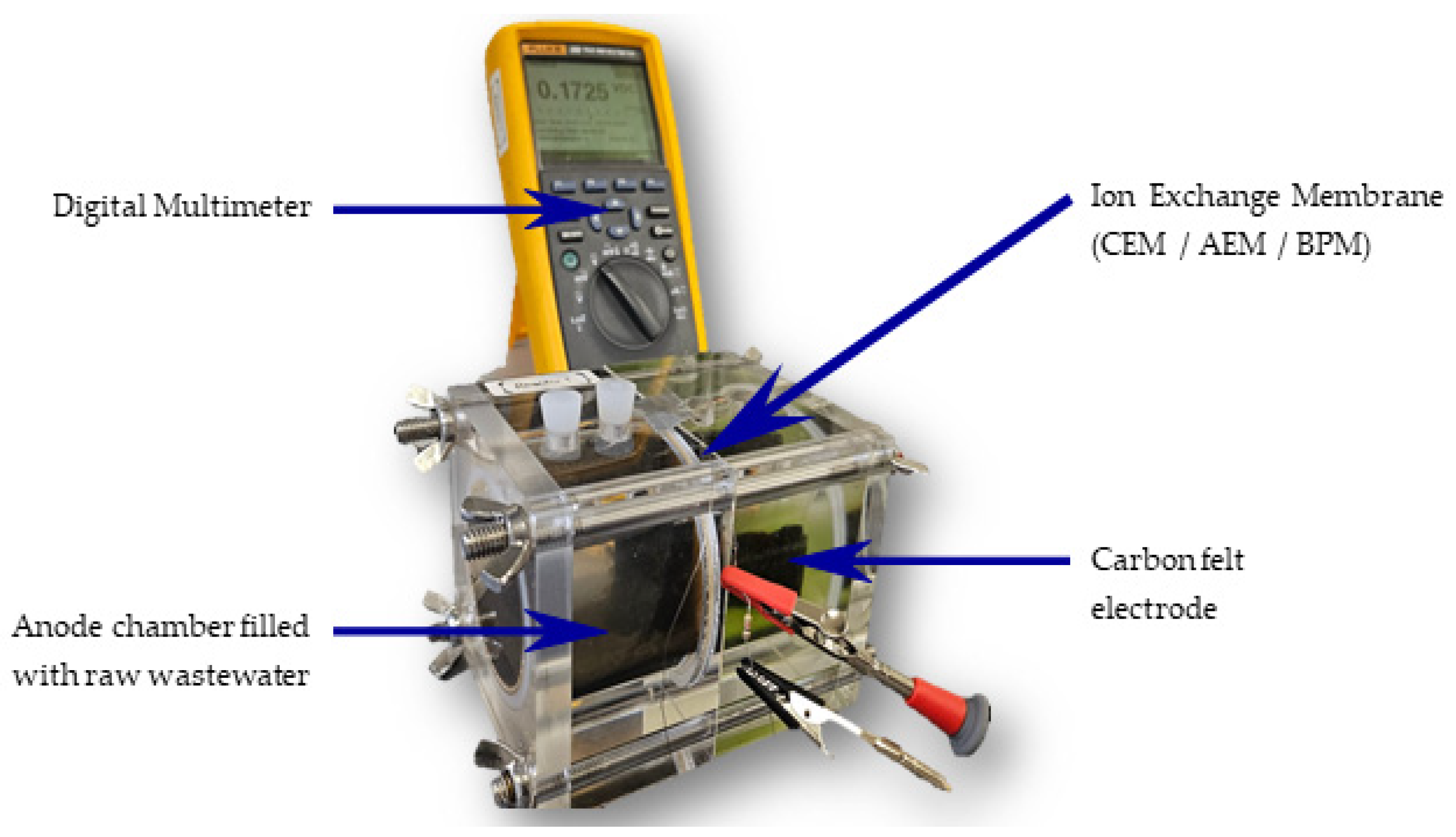
This study utilized three units of dual-chamber MFC reactors, each with an effective working volume of 100 mL and constructed from Plexiglass (see Figure 1). The anode chambers were filled with municipal wastewater collected from the preliminary tank of the Portage wastewater treatment plant (Portage, IN, USA). To establish the electroactive biofilm, 20 mL of activated sludge from the oxidation ditch of the same facility was added during the start-up phase, and the reactors were operated for approximately two months. In subsequent experimental runs, no additional sludge was added, and the established biofilm served as the microbial inoculum. Each run typically lasted up to 48 h, and the influent was replaced when the voltage profile indicated a decline in microbial activity. Carbon felt electrodes measuring 5 × 3 × 1 cm were installed in each reactor and connected via a titanium wire through a fixed external resistance of 1000 Ω to a digital multimeter (Fluke TrueView Forms 289, Everett, WA, USA) for continuous voltage monitoring. Each reactor employed a different membrane type with each type having an effective area of 5 cm2 diameter to separate the anodic and cathodic chambers, including an anion exchange membrane (AEM, AXM-100S/AMI-7001S, Membrane International Inc., Ringwood, NJ, USA), a cation exchange membrane (CEM, CXM-200S/CMI-7000S, Membrane International Inc., Ringwood, NJ, USA), and a bipolar membrane (Fumasep® FBM, Fumatech, Fuel cell store, Bryan, TX, USA). The AEM and CEM had nominal thicknesses of 450 µm ± 25 and ion exchange capacities in the range of 1.3–1.6± 0.1 meq g−1, while the BPM had a thickness of approximately 130–160 µm and a higher area-specific resistance due to its laminated cation and anion exchange layers designed to promote water dissociation at the interfacial junction. The AEM and CEM were preconditioned in 5% NaCl solution for 12 h before installation, whereas the BPM was used as supplied. All reactors were operated under identical operating conditions in batch mode to enable direct comparison.
Nutrient analyses including COD and total nitrogen, ammonia, and total phosphorus were conducted with a spectrophotometer (HACH DR 6000, Loveland, CO, USA), and physicochemical parameters such as pH, electricity conductivity, total dissolved solids, salinity, and temperature were measured using a benchtop multi-parameter instrument (HACH HQ440D, Loveland, CO, USA).

2.2. Calculations

The system efficiency for nutrient recovery was determined using Equation (1). Electrochemical performance was assessed by calculating current (I = Voltage/External resistance) and power (P = Voltage × Current) based on Ohm’s law [8,9]. Power density was obtained by normalizing the power to the anode surface area, while current density (J) was determined by dividing the current by the electrode area.
N u t r i e n t   R e c o v e r y   E f f i c i e n c y   % = I n f l u e n t E f f l u e n t   I n f l u e n t × 100

3. Results

The nutrient removal performance of each MFC was evaluated by analyzing the concentrations of samples before and after. Influent COD and nutrient concentrations were measured on the same day of sample collection and used to categorize wastewater as low or high strength, reflecting natural day-to-day variability in municipal wastewater composition. These differences were not induced experimentally, and no chemical amendments or external substrates were added to the wastewater. Effluent concentrations were analyzed within 48 h over the course of each treatment cycle.

3.1. Chemical Oxygen Demand

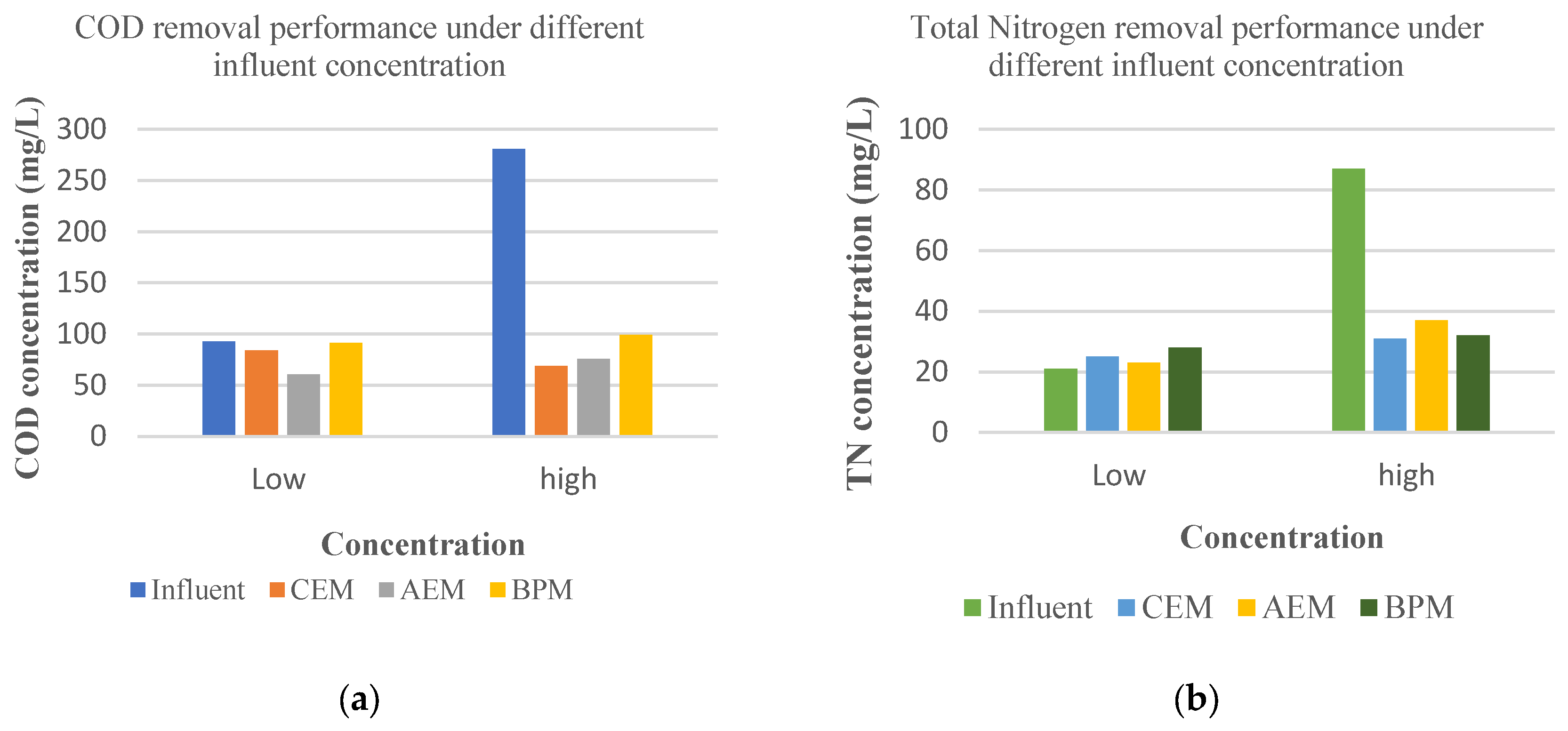
For COD, as shown in Figure 2a, the low-concentration influent averaged 92.7 mg/L, with removal efficiencies of 9.6%, 34.7%, and 1.7% in the CEM, AEM, and BPM reactors, respectively, indicating that only AEM configuration provided appreciable COD removal at low load. In contrast, with the higher COD influent of 281 mg/L, all reactors showed markedly improved performance, with removals of 75.5% (CEM), 73% (AEM), and 64.8% (BPM), demonstrating that organic removal was strongly enhanced at higher loading and that the CEM and AEM cells performed comparably in this range.

3.2. Total Nitrogen

Total nitrogen (Figure 2b) removal showed a distinct dependence on influent concentration and membrane type. With a low influent TN of 21 mg/L, all systems exhibited negative apparent removal, suggesting net TN accumulation in the effluent, likely due to organic nitrogen mineralization or internal nitrogen transformations under low loading. When the influent TN increased to 87 mg/L, the same reactors achieved substantial positive removals of 64.4% (CEM), 57.5% (AEM), and 63.2% (BPM), indicating that all membrane types supported effective nitrogen removal under higher influent strength, with CEM and BPM showing slightly higher TN removal than AEM.

3.3. Total Phosphorus

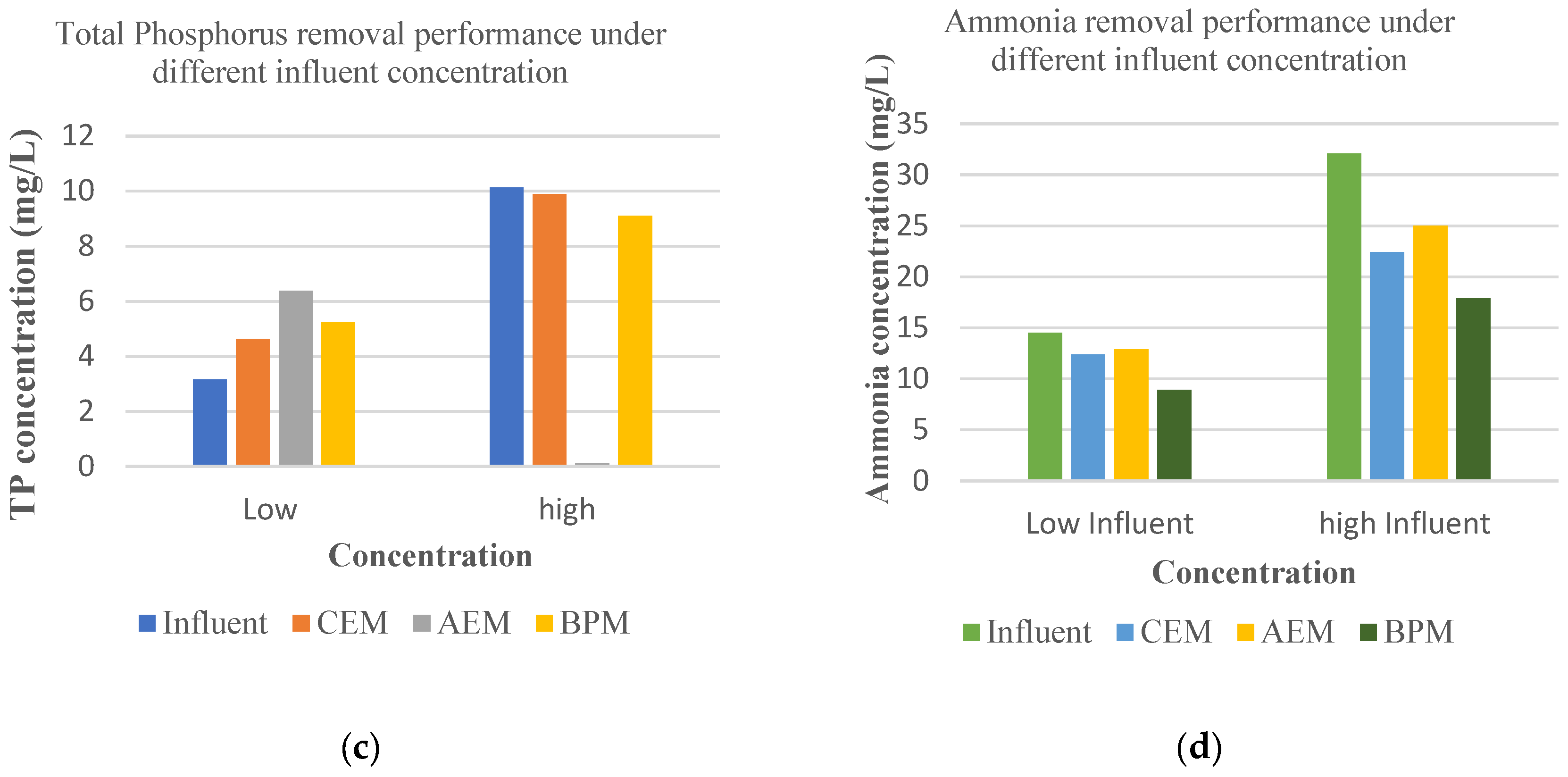
Total phosphorus removal was limited or negative at the low influent concentration but improved modestly at the higher influent concentration (Figure 2c). With an influent TP of 3.15 mg/L, the CEM, AEM, and BPM reactors exhibited apparent negative removal efficiencies, indicating strong net release or desorption of phosphorus back into the liquid phase at low concentrations, which is consistent with reports that P removal in bioelectrochemical systems is often constrained at low loading. At a higher influent TP of 10.13 mg/L, TP removal became slightly positive in all reactors, reaching 2.5% in CEM, 98% in AEM, and 10% in the BPM cell, suggesting that phosphorus capture in this configuration was modest overall and much less efficient than COD and TN removal.

3.4. Ammonia

In contrast to the trends observed for total nitrogen and total phosphorus, ammonia concentrations were consistently reduced under both low- and high-influent conditions, although removal efficiency varied substantially with membrane type (Figure 2d). Under low influent loading (14.5 mg/L), the CEM and AEM exhibited limited ammonia removal, yielding effluent concentrations of 14.5% and 11% respectively. In comparison, the BPM achieved markedly higher ammonia removal, reducing the effluent concentration to 39%. At higher influent concentrations, removal performance improved across all membrane configurations. The CEM and AEM achieved removal efficiencies of 30% and 22% respectively, while BPM maintained superior performance with 44% removal.

3.5. Electrochemical Performance

Electrochemical performance was evaluated based on steady-state voltage measurements recorded across a fixed external resistance of 1000 Ω for all reactors. Maximum voltage values obtained from the voltage–time profiles were used to estimate current, power output, and power density for each membrane configuration. Peak voltages reached 0.1157 V for CEM, 0.0712 V for BPM, and 0.0474 V for AEM, corresponding to maximum power densities of 8.93 mW.m−2, 3.38 mW.m−2, and 1.5 mW.m−2, respectively, when normalized to the projected anode surface area (Table 1).

4. Discussion

The results produced distinct treatment and electrochemical performance profiles for each membrane type that can be rationalized by their ion transport properties and power output. In general, the CEM configuration favored simultaneous removal of COD, total nitrogen, and ammonia; the AEM favored phosphorus removal; and the BPM had more balanced but moderate nutrient removal while delivering intermediate power density.

4.1. Cation Exchange Membrane (CEM)

The superior COD, TN, and ammonia removal observed with the CEM under high load is matched with the major role of cation transport in maintaining charge balance and supporting anodic oxidation. Cation exchange membranes selectively transport protons and ammonium ions from the anode to the cathode, which helps to preserve electroneutrality, sustain current flow, and mitigate pH inhibition in the anode chamber. A similar result has been reported in MFC-based nitrogen removal systems, where CEMs facilitated effective carbon and nitrogen conversion by coupling anodic oxidation with cathodic nitrification–denitrification or ammonium transport and stripping [10]. This ion transport regime also explains why the CEM reactor produced the highest power density, as lower internal resistance and efficient proton transfer [11] are known to enhance power output in wastewater-fed MFCs. However, under low influent strength, the CEM reactor shows an increase in TN and TP (see Figure 2b,c). The reason might be because the absolute mass of nitrogen and phosphorus feeding the system is small, such that release processes such as the hydrolysis of particulate or organically bound constituents into soluble ammonium and phosphate could outweigh net removal [1]. An increase in dissolved oxygen levels in both the anode and cathode is observed during experiments and likely further promotes aerobic mineralization, contributing to elevated dissolved TN and TP concentrations [12]. In addition, the cation-selective nature of CEM favors retention of ammonium in the anodic compartment while limiting transport of anionic nutrient species [13], which can amplify TN accumulation under low-strength conditions. In contrast, at higher strength, the same release processes represent a smaller fraction of the total nutrient mass, allowing overall removal to dominate.

4.2. Anion Exchange Membrane (AEM)

The AEM configuration achieves the highest phosphorus removal under high influent strength but comparatively lower total nitrogen and ammonia removal and power density. The observed behavior is likely associated with the anion-selective properties of AEMs, which favor the migration of negatively charged species such as phosphate, nitrate, and bicarbonate across the membrane while restricting proton and cation transport. Such selective ion transfer supports phosphate accumulation in the opposite chamber, consistent with previous nutrient-recovery MFC studies employing AEMs for phosphorus capture [14]. Although several investigations using synthetic media or optimized zero-gap systems have achieved higher power density [15], those systems benefit from lower internal resistance and controlled substrates. Under real wastewater operations with low concentration, the reduced power output and nitrogen removal observed in this study are likely related to limitations in charge carrier availability and higher solution complexity, which collectively inhibit efficient electron transfer and overall energy conversion. Apparent accumulation of both TN and TP might be because of the back-diffusion of anions that can offset biological uptake. Nevertheless, the strong total phosphorus removal proves that AEMs can effectively facilitate phosphate transport and nutrient separation within MFCs treating real wastewater.

4.3. Bipolar Exchange Membrane (AEM)

The BPM reactor showed lower COD removal but moderate and stable total nitrogen, ammonia, and phosphorus removal under high strength and showed a power density between that of the CEM and AEM systems. These results can be interpreted considering the unique structure of bipolar membranes, which combine cation and anion exchange layers separated by a water-dissociation interface. Under an applied potential, water at this interface splits into protons and hydroxide ions, which migrate into the adjoining layers and help buffer pH in both chambers [16]. Nevertheless, at low influent load, the pH changes solubilize particulate or loosely bound nutrients, elevating effluent TN and TP concentration. Higher influent strength diminishes these interfacial effects relative to enhanced biological removal. Recent studies [7,17] on BPM-based electrochemical systems indicate that this controlled water splitting enables simultaneous transport of both cations and anions and stabilizes long-term operation in variable wastewater, but at the cost of increased interfacial resistance and reduced energy efficiency. The intermediate power density in the BPM-MFC thus reflects a balance between improved pH control and additional voltage losses across the bipolar junction. The more uniform yet moderate removal of nitrogen and phosphorus suggests that BPMs promote a more distributed ion-migration regime, without favoring either cationic or anionic nutrients as strongly as CEMs or AEMs, which aligns with observations from BPM-based nutrient recovery and electrodialysis systems.

4.4. Influence of Influent Strength on MFC Performance

MFC performance for COD and nutrient removal was consistently higher under high influent concentrations compared to low concentrations across all membrane types. This is because of the fundamental microbial fuel cell operation principles, where higher substrate or pollutant loads provide greater availability of organic carbon and nutrients for electroactive microbial metabolism and electron transfer [1]. Under low-influent conditions, microbial activity and electron generation rates become substrate-limited, leading to reduced current production, lower biomass activity, and incomplete substrate utilization. In contrast, high concentrations sustain higher metabolic rates and microbial populations, enhancing both organic oxidation and ion transport across membranes, which ultimately improves removal efficiencies. This substrate concentration dependence is well-documented in the literature and highlights the technology’s greater suitability for treating high-strength wastewater rather than dilute streams [1,18].

5. Conclusions

When compared with previous MFC studies, our dual-chamber systems operated with untreated real municipal wastewater produced power densities that fell at the lower end of the wide range reported for glucose- or acetate-fed synthetic/real wastewater MFCs, which often span from a few mW.m−2 in unoptimized bench-scale reactors to several hundred mW.m−2 in advanced designs. This comparison underscores that, despite modest power densities, the reactors achieved substantial nutrient and COD removal, like other treatment-oriented MFCs and constructed wetland–MFC systems that emphasize contaminant removal rather than maximum power generation potential. Moreover, the side-by-side comparison under identical operating conditions with three membrane types highlighted how membrane selection shifted the balance between energy recovery and selective nutrient removal. All membrane configurations exhibited load-dependent nutrient dynamics, underscoring the importance of influent strength and operating conditions in controlling nutrient release and removal in MFC systems.

Author Contributions

Conceptualization, K.T.T. and V.G.G.; methodology, K.T.T. and V.G.G.; validation, K.T.T. and V.G.G.; formal analysis, K.T.T. and V.G.G.; investigation, K.T.T. and V.G.G.; resources, V.G.G.; data curation, K.T.T.; writing—original draft preparation, K.T.T.; writing—review and editing, K.T.T. and V.G.G.; visualization, K.T.T.; supervision, V.G.G.; project administration, V.G.G.; funding acquisition, V.G.G. All authors have read and agreed to the published version of the manuscript.

Funding

This work is supported by the grants: REEU program [grant no. 2023-68018-40325], WAMS program [grant no. 2023-38503-41313], and HSI program [2024-77040-43780] from the U.S. Department of Agriculture, National Institute of Food and Agriculture. Any opinions, findings, conclusions, or recommendations expressed in this publication are those of the author(s) and should not be construed to represent any official USDA or U.S. Government determination or policy.

Institutional Review Board Statement

Not applicable.

Informed Consent Statement

Not applicable.

Data Availability Statement

The original contributions presented in this study are included in the article. Further inquiries can be directed to the corresponding author.

Acknowledgments

The authors acknowledge support from the NiSource–Meyer Foundation Professor of Energy and the Environment Professorship and the Purdue University Northwest Water Institute.

Conflicts of Interest

The authors declare no conflicts of interest. The funders had no role in the design of the study; in the collection, analyses, or interpretation of data; in the writing of the manuscript; or in the decision to publish the results.

References

  1. Gude, V.G. Wastewater treatment in microbial fuel cells—An overview. J. Clean. Prod. 2016, 122, 287–307. [Google Scholar] [CrossRef]
  2. Kokabian, B.; Gude, V.G. Role of membranes in bioelectrochemical systems. Membr. Water Treat. 2015, 6, 53–75. [Google Scholar] [CrossRef]
  3. Jalili, P.; Ala, A.; Nazari, P.; Jalili, B.; Ganji, D.D. A comprehensive review of microbial fuel cells considering materials, methods, structures, and microorganisms. Heliyon 2024, 10, e25439. [Google Scholar] [CrossRef] [PubMed]
  4. Chakma, R.; Hossain, M.K.; Paramasivam, P.; Bousbih, R.; Amami, M.; Toki, G.F.I.; Haldhar, R.; Karmaker, A.K. Recent Applications, Challenges, and Future Prospects of Microbial Fuel Cells: A Review. Glob. Challenges 2025, 9, 2500004. [Google Scholar] [CrossRef] [PubMed]
  5. Sharma, A.; Đelević, L.; Herkendell, K. Next-Generation Proton-Exchange Membranes in Microbial Fuel Cells: Overcoming Nafion’s Limitations. Energy Technol. 2024, 12, 2301346. [Google Scholar] [CrossRef]
  6. Mahendiravarman, E.; Rajamohan, N.; Rajasimman, M.; Rameshwar, S.S.; Abrar, I. Advancements in tailored polymeric membranes for microbial fuel cells: A comprehensive review of recent developments and challenges. RSC Adv. 2025, 15, 15842–15869. [Google Scholar] [CrossRef] [PubMed]
  7. Chen, W.; Grimberg, S.; Rogers, S.; Kim, T. Bipolar membrane electrodialysis for nutrient recovery from anaerobic digestion dewatering sidestream. Chem. Eng. J. 2024, 488, 150834. [Google Scholar] [CrossRef]
  8. Kokabian, B.; Gude, V.G. Sustainable photosynthetic biocathode in microbial desalination cells. Chem. Eng. J. 2015, 262, 958–965. [Google Scholar] [CrossRef]
  9. Ghimire, U.; Gude, V.G.; Magbanua, B.S. Energy and nutrient recovery from dairy and municipal wastewater sources in a terracotta-biochar bioelectrochemical system. Clean Technol. Environ. Policy 2022, 24, 3225–3236. [Google Scholar] [CrossRef]
  10. Virdis, B.; Rabaey, K.; Yuan, Z.; Keller, J. Microbial fuel cells for simultaneous carbon and nitrogen removal. Water Res. 2008, 42, 3013–3024. [Google Scholar] [CrossRef] [PubMed]
  11. Roy, H.; Rahman, T.U.; Tasnim, N.; Arju, J.; Rafid, M.; Islam, R.; Pervez, N.; Cai, Y.; Naddeo, V.; Islam, S. Microbial Fuel Cell Construction Features and Application for Sustainable Wastewater Treatment. Membranes 2023, 13, 490. [Google Scholar] [CrossRef] [PubMed]
  12. Yang, K.; Qin, M. The Application of Cation Exchange Membranes in Electrochemical Systems for Ammonia Recovery from Wastewater. Membranes 2021, 11, 494. [Google Scholar] [CrossRef] [PubMed]
  13. Rozendal, R.A.; Hamelers, H.V.M.; Buisman, C.J.N. Effects of Membrane Cation Transport on pH and Microbial Fuel Cell Performance. Environ. Sci. Technol. 2006, 40, 5206–5211. [Google Scholar] [CrossRef] [PubMed]
  14. Shahid, K.; Ramasamy, D.L.; Kaur, P.; Sillanpää, M.; Pihlajamäki, A. Enhanced bioenergy and nutrients recovery from wastewater using hybrid anodes in microbial nutrient recovery system. Biotechnol. Biofuels Bioprod. 2022, 15, 1–12. [Google Scholar] [CrossRef] [PubMed]
  15. Rostami, K.; Ghasemi, M.; Sedighi, M.; Ismail, A.F.; Rezk, H.; Kuo, J.-K. Benchmarking anion vs. cation exchange membranes in microbial fuel cells: A comparative study of PTFE and Nafion 117. Bioelectrochemistry 2025, 167, 109083. [Google Scholar] [CrossRef] [PubMed]
  16. Gurreri, L.; Tamburini, A.; Cipollina, A.; Micale, G. Electrodialysis Applications in Wastewater Treatment for Environmental Protection and Resources Recovery: A Systematic Review on Progress and Perspectives. Membranes 2020, 10, 146. [Google Scholar] [CrossRef] [PubMed]
  17. Pärnamäe, R.; Mareev, S.; Nikonenko, V.; Melnikov, S.; Sheldeshov, N.; Zabolotskii, V.; Hamelers, H.V.M.; Tedesco, M. Bipolar membranes: A review on principles, latest developments, and applications. J. Membr. Sci. 2021, 617, 118538. [Google Scholar] [CrossRef]
  18. Sriwichai, N.; Sangcharoen, R.; Saithong, T.; Simpson, D.; Goryanin, I.; Boonapatcharoen, N.; Kalapanulak, S.; Panichnumsin, P. Optimization of microbial fuel cell performance application to high sulfide industrial wastewater treatment by modulating microbial function. PLoS ONE 2024, 19, e0305673. [Google Scholar] [CrossRef] [PubMed]
Figure 1. Two-chamber microbial fuel cell showing the anodic and cathodic compartments separated by ion exchange membranes. The setup illustrates the assembled reactor during operation.
Eesp 40 00005 g001
Figure 2. Nutrient removal performance under different influent concentrations. (a) Chemical oxygen demand; (b) total nitrogen; (c) total phosphorus; (d) ammonia.
Eesp 40 00005 g002aEesp 40 00005 g002b
Table 1. Maximum electrochemical performance under 1000 Ω external load 1.
MembranePeak Voltage (V)Current (mA)Power (µW)Power Density (mW.m−2)
CEM0.11570.1160.01348.93
AEM0.04740.0470.00221.50
BPM0.07120.0710.00513.38
1 Calculations performed as described in Section 2.2.
Disclaimer/Publisher’s Note: The statements, opinions and data contained in all publications are solely those of the individual author(s) and contributor(s) and not of MDPI and/or the editor(s). MDPI and/or the editor(s) disclaim responsibility for any injury to people or property resulting from any ideas, methods, instructions or products referred to in the content.