Proceeding Paper

Future Drought Variability in Greece: A Regional Assessment Based on PCA-Derived Spatial Patterns †

by
Theodoros Karampatakis
1,*,
Effie Kostopoulou
1 and
Christos Giannakopoulos
2
1
Department of Geography, University of the Aegean, University Hill, 81100 Mytilene, Greece
2
Institute for Environmental Research and Sustainable Development, National Observatory of Athens, 15236 Athens, Greece
*
Author to whom correspondence should be addressed.
Presented at the 9th International Electronic Conference on Water Sciences, 11–14 November 2025; Available online: https://sciforum.net/event/ECWS-9.
Environ. Earth Sci. Proc. 2026, 40(1), 11; https://doi.org/10.3390/eesp2026040011
Published: 30 March 2026
(This article belongs to the Proceedings of The 9th International Electronic Conference on Water Sciences)

Abstract

In recent years, the Mediterranean basin has been characterized as a climate change hotspot due to its rapid transition to warmer conditions and the strong agreement among most climate models predicting a significant decrease in precipitation by the end of the 21st century. These robust signals of climate change highlight the region’s high susceptibility to hydrometeorological extremes, such as droughts, which are expected to become more frequent, prolonged, and intense. In this context, the study focuses on Greece, where rising water scarcity threatens critical sectors such as food security, energy production, public health, and, more broadly, the resilience of ecosystems. Future drought conditions were assessed using the 12-month Standardized Precipitation Index (SPI-12) for 58 meteorological stations during 2071–2100, based on high-resolution regional climate simulations under RCP4.5 and RCP8.5. Spatial drought variability was examined using Principal Component Analysis, while drought severity and duration were quantified through Run Theory. The results indicate increasingly prolonged and severe droughts by the late 21st century, particularly in eastern Crete and southeastern Peloponnese, highlighting the urgent need for targeted adaptation measures.

1. Introduction

In recent years, anthropogenic climate change has intensified extreme weather events, including heavy rainfall and heatwaves. The IPCC Special Report on Managing the Risks of Extreme Events [1] highlights that changes in duration, frequency, and intensity of such events will likely increase extreme hydroclimatic phenomena, including floods and droughts. Even cumulative, non-extreme events can disrupt the normal functioning of the hydrological system, causing significant societal and environmental impacts [1]. Droughts are among the most complex and least understood natural hazards, developing gradually and affecting all stages of the hydrological cycle [2]. Their spatial and temporal patterns are often unpredictable, complicating detection and severity assessment. Unlike other hazards, droughts primarily cause non-structural impacts, leading to prolonged effects on water resources, agriculture, and more broadly, on natural ecosystems, making them among the costliest natural disasters globally and emphasizing the need for improved understanding, monitoring, and mitigation strategies [3].
The Mediterranean basin is among the most climate-vulnerable regions, with temperatures rising ~20% faster than the global average. Regional surface temperatures have increased by 1.5 °C above pre-industrial levels and 0.4 °C above the current global mean [4,5]. Projections for the 21st century indicate a clear trend toward drier conditions, as most global climate models show stronger agreement on precipitation declines in the Mediterranean than in any other region [6]. Specifically, mean annual precipitation is expected to decrease by 4% per degree of global warming, while temperature increases above 1.5 °C are expected to extend dry periods by 7% [4,7]. Spatial variability is pronounced, with southern and eastern regions being more susceptible to reduced rainfall and recurrent droughts, whereas northern areas experience higher precipitation and more extreme rainfall events, often resulting in flash floods [8,9,10,11]. Climate change affects multiple sectors, with regional vulnerability shaped by each country’s adaptive capacity and socioeconomic development. Factors such as population growth, rapid urbanization, concentrated coastal populations, unsustainable tourism, land-use changes, intensified agriculture, and pollution are expected to further increase exposure and sensitivity to climate-related pressures, particularly in the southern and eastern Mediterranean, thereby enhancing the risk of water scarcity and instability in crop production [12,13]. Understanding how drought patterns may evolve under stronger climate forcing by the end of the century is therefore essential for assessing potential long-term risks to water resources and climate-sensitive sectors, especially in these regions.
Greece, as part of the Eastern Mediterranean, is highly sensitive to the impacts of climate change due to its climatic, hydrological, and socio-economic characteristics. Historical trends indicate a decline in mean annual precipitation by 10–20% during the 20th century and a consistent rise in air temperature [14]. Several major drought episodes have affected regions such as Thessaly, eastern Crete, and urban centers like Athens and Thessaloniki, highlighting the vulnerability of water resources [15,16,17]. Key economic sectors, including agriculture—which consumes 85% of available water for irrigation [18] and accounts for one-third of national exports [19]—and tourism, which contributes significantly to GDP and employment [14], are highly exposed to climate-induced stresses and are likely to experience substantial impacts. For instance, intensive and widespread farming activity in the Thessalian plain leads to groundwater overexploitation during prolonged droughts [20], while Crete faces water scarcity during summer due to the increased influx of tourists and substantial irrigation demands [21,22]. Future projections indicate further precipitation reductions, longer dry periods, and more frequent heatwaves, exacerbating drought and wildfire risks, particularly in southern and southeastern regions, threatening both ecosystems and critical economic sectors [23,24,25,26,27,28].
The differential influence of hydroclimatic parameters across regions, combined with the multidimensional analysis of extreme climatic conditions in terms of intensity, duration, and frequency, highlights the complexity of understanding and assessing climate change. Moreover, the non-linear response of the climate system to global warming increases uncertainty in future predictions and amplifies the vulnerability of ecosystems. In this context, late-century assessments (2071–2100) remain standard practice in climate impact studies, as they allow the climate change signal to emerge more clearly relative to natural variability [29]. By focusing on this period, drought patterns associated with anthropogenic climate change can be identified with higher confidence [30,31], providing a more robust basis for evaluating the potential effectiveness of mitigation measures. In contrast, short-term projections, despite their relatively lower uncertainty, may provide ambiguous insights into the factors shaping hydroclimatic conditions due to the high interannual variability of precipitation and, consequently, the inherently recurring manifestation of droughts. Therefore, the present study aims to evaluate future drought variability across Greece for the late 21st century (2071–2100), using Principal Component Analysis combined with Run Theory as an alternative approach for the spatial characterization of droughts. Additionally, by emphasizing spatial variability patterns instead of deterministic precipitation forecasts, the sensitivity to absolute projection uncertainty is further reduced. The findings are expected to provide critical insights for effective water management and adaptation strategies under a warmer and drier climate, enhancing resilience to future droughts in highly susceptible regions of Greece.

2. Materials and Methods

2.1. Study Region

The study area of the present research is Greece, located in southeastern Europe on the Balkan Peninsula, covering approximately 132,000 km2. About 80% of the area corresponds to the mainland, while the remaining 20% consists of more than 3000 islands distributed across the Aegean and Ionian Seas [26]. Its topography is highly diverse, ranging from lowland areas (~25%) to high mountain regions, with a mean altitude of 498 m and a maximum of 2918 m (Mount Olympus). The largest mountain chain extends across the western mainland in a NW–SE orientation, reaching 230 km in length and up to 70 km in width, strongly influencing local precipitation patterns. Greece also possesses one of the longest coastlines in the Mediterranean, exceeding 15,000 km, where interactions between land and sea, combined with complex relief, create substantial spatial climatic variability and the development of localized microclimates. The prevailing climate is Mediterranean (Csa, Köppen classification), characterized by mild, wet winters and dry, hot summers. Precipitation exhibits strong seasonality, with most rainfall occurring during October–March and prolonged dry conditions during summer. Rainfall distribution is largely controlled by the country’s orographic configuration, with the northwestern regions receiving the highest precipitation amounts. Mean annual precipitation exceeds 2000 mm yr−1 on the windward side of the Pindus mountain range (northwestern Greece), decreasing to less than 300 mm yr−1 in Attica, the Cyclades, and the coastal areas of Crete in the southeastern part of the country.

2.2. Data and Model Performance

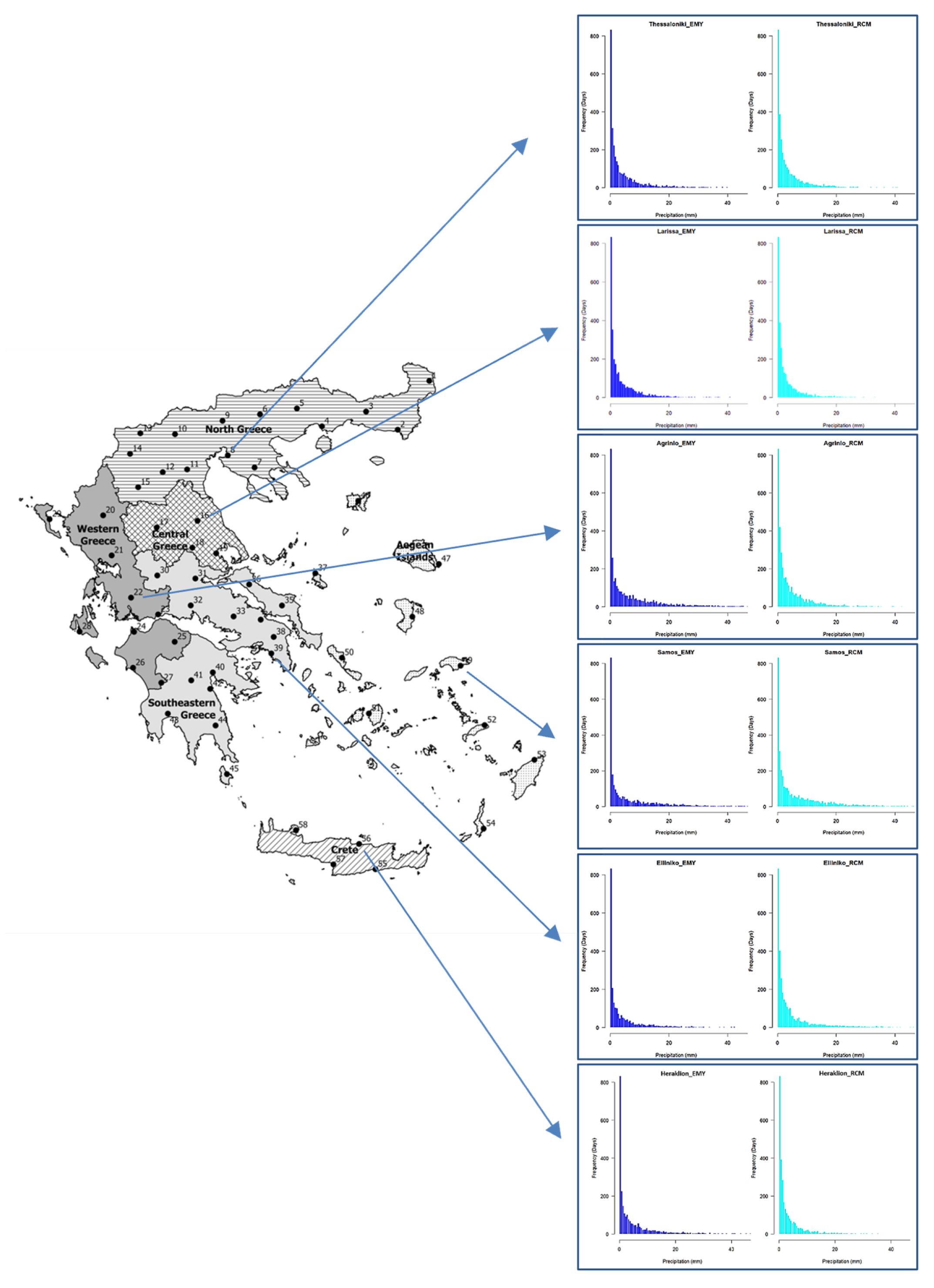
High-resolution (0.11°; ~12.5 km) projections from the RCA4 regional climate model within the EURO-CORDEX initiative [32,33] were used to assess future precipitation conditions in Greece for the late 21st century (2071–2100). This approach can improve the representation of local climate processes, especially in regions with heterogeneous and complex terrain, such as the study area. Daily precipitation data were extracted for fifty-eight meteorological stations, evenly distributed across the country to ensure comprehensive geographic coverage. To facilitate spatial analysis, the study area was divided into six subregions based on geographical and climatological characteristics as illustrated in Figure 1. For each station, the nearest RCA4 grid point was identified, enabling direct comparison between simulated and observed time series. Simulations were conducted under two IPCC Representative Concentration Pathways (RCPs): RCP4.5, representing a moderate greenhouse gas stabilization scenario, and RCP8.5, a high-emission “worst-case” scenario without mitigation measures. RCP4.5 assumes radiative forcing stabilizes at approximately 4.5 W/m2 by 2100 through moderate mitigation strategies, whereas RCP8.5 reflects continuously increasing greenhouse gas concentrations [34]. Lateral boundary conditions were provided by the MPI-ESM-LR global climate model, a coupled general circulation model that simulates both atmospheric and oceanic processes, along with terrestrial and marine biogeochemistry components, providing an integrated representation of the Earth’s climate system. The model components are coupled through the OASIS3 coupler, exchanging fluxes of water, energy, momentum, and CO2 at regular intervals, without the use of flux adjustment. This configuration was employed in the Coupled Model Intercomparison Project Phase 5 (CMIP5) to support long-term climate simulations [35].
Model predictive performance was evaluated for the reference period 1971–2000 using observed daily precipitation data obtained from the Hellenic National Meteorological Service (HNMS), providing a reliable baseline. The evaluation framework combined quantitative error metrics and qualitative distributional analysis. Quantitative assessment was conducted using four complementary error metrics: Mean Absolute Error (MAE), Mean Squared Error (MSE), Root Mean Squared Error (RMSE), and Weighted Absolute Percentage Error (WAPE). These metrics were selected to quantify the model’s predictive skill and identify potential biases [36]. MAE quantifies the average magnitude of deviations between observed and simulated values, providing a direct measure of typical errors, while MSE calculates the mean of squared deviations, placing greater emphasis on larger discrepancies. RMSE, as the square root of MSE, expresses errors in the original units of precipitation, facilitating direct physical interpretation. WAPE was used as a scale-independent metric to enable consistent comparison across stations with differing rainfall regimes.
The ensemble of performance metrics indicates an overall acceptable level of model accuracy, with improved performance in central lowland zones and comparatively higher discrepancies in western Greece and eastern insular areas. These differences are likely associated with complex topography and strong spatial gradients in precipitation, which are known to challenge regional climate simulations [37,38].
Because error-based metrics do not reflect bias direction or capture fully distributional behavior, a complementary qualitative assessment was performed by analyzing precipitation frequency distributions. Histograms of daily rainfall were constructed to examine distribution characteristics such as spread, shape, and representation of extreme values (Illustrative examples of observed and simulated precipitation distributions are shown in Figure 1). The model sufficiently reproduces the positively skewed distributions, which are typical of Mediterranean climates, enabling the use for hydroclimatic analyses. While some stations exhibit a tendency toward higher frequencies of light rainfall events, no systematic bias was detected in the representation of extreme precipitation occurrences.
Overall, the evaluation results are considered adequate, supporting the application of the RCA4 simulations for investigating future drought patterns in Greece.

2.3. Methodology

2.3.1. Standardized Precipitation Index (SPI)

In this study, the Standardized Precipitation Index (SPI) was employed to assess the impact of drought across the Greek territory for the period 2071–2100. The SPI constitutes a flexible index capable of identifying multiple drought types (meteorological, agricultural, and hydrological), considering that various hydrological subsystems respond to precipitation anomalies at different rates [39]. Due to its methodological simplicity—relying exclusively on precipitation data—its statistical robustness, and its temporal and spatial adaptability, the SPI is widely recommended by the World Meteorological Organization as a primary tool for drought monitoring [40].
The optimal period required for calculating the SPI is based on at least 30 consecutive years of precipitation data [41]. Its computation involves fitting precipitation data to a theoretical probability distribution, typically the gamma distribution [42], which has been shown to reliably capture precipitation variability over accumulation periods of 3–12 months [43,44]. The fitted distribution is then transformed into the standard normal variable Z with mean μ = 0 and standard deviation σ = 1 [45]. In practice, the SPI represents the number of standard deviations from the long-term mean, facilitating comparability across regions with different climatic characteristics over multiple temporal scales. Positive SPI values correspond to wetter-than-average conditions, while negative values correspond to drier-than-average conditions. Its standardization also allows probabilistic interpretation of hydrological events, making the SPI particularly suitable for decision-making and water resource management [40]. Regarding the calculation of the index, precipitation was modeled using the gamma distribution, which is defined by the probability density function:
g x = 1 β α Γ α x α 1 e x β ,     x > 0
where α and β are the shape and scale parameters, x is the precipitation amount in millimeters, and Γ(α) is the gamma function:
Γ α = 0 y α 1 e y d y
The parameters α and β are estimated using the maximum likelihood method:
α = 1 4 A ( 1 + 1 + 4 A 3 ) ,           β = x ˉ α ,
A = l n x ˉ l n x n
where n is the number of observations. The probability density function is integrated with respect to x to obtain the cumulative probability G x , which can be defined as:
G x = 0 Χ g x dx = 1 β α Γ α 0 x χ α 1 e χ / β   dx
Letting t = x β ^ , the last equation is reduced to:
G x = 1 Γ α 0 Χ t a 1 e 1 dt
To account for months with zero precipitation, the cumulative probability is modified as:
H x = q + 1 q G x ,           q = m n
where m is the number of zero-precipitation months. Finally, H(x) is transformed into the standard normal variable Z to obtain the SPI [46]. Subsequently, hydrological events can be classified based on SPI values, with drought episodes identified when SPI ≤ −1 and ending when SPI becomes positive, enabling the determination of independent event durations. Table 1 presents the classification of hydroclimatic events according to the SPI and their associated probabilities of occurrence.
The transition to a drier climate toward the end of the 21st century is expected to lead to prolonged drought events, affecting not only soil moisture but also the availability of surface and groundwater resources. Therefore, in this study, the SPI was calculated over a 12-month accumulation timescale (SPI-12) to capture medium-term drought conditions across Greece, providing a clear representation of drought persistence. According to Spinoni et al. [47], a 12-month accumulation period is generally more appropriate than shorter (SPI-3, SPI-6) or longer timescales (SPI-24, SPI-48), which may be overly sensitive to extremes or fail to detect all drought episodes.

2.3.2. Principal Component Analysis

The 12-month Standardized Precipitation Index was selected to identify homogeneous regions in terms of drought spatial variability for the period 2071–2100 under the high-emission scenario RCP8.5. The large volume of SPI values derived from 58 meteorological stations across Greece complicates direct spatial interpretation of droughts. To address this, Principal Component Analysis (PCA) was applied as a widely used statistical technique for reducing dimensionality in large, interrelated climatological datasets [48,49,50]. Specifically, Principal Component Analysis (PCA) was employed on the SPI timeseries generating uncorrelated principal components Z 1 , Z 2 , , Z p as linear combinations of the original variables X 1 , X 2 , , X p according to the following equations:
Z 1 = a 11 X 1 + a 12 X 2 + + a 1 p X p , j = 1 p a 1 j 2 = 1 Z p = a p 1 X 1 + a p 2 X 2 + + a p p X p , j = 1 p a p j 2 = 1
where coefficients a i j , or loadings, represent the contribution of each variable X j to the principal component Z i . Loadings near ±1 indicate a strong correlation, while values near 0 can be disregarded. The variance explained by each component is given by its eigenvalue λ i , ordered as:
λ 1 λ 2 λ p 0
ensuring that the first component captures the maximum variance and subsequent components account for progressively smaller proportions of the total variance. A fundamental property of PCA is that the sum of the variances of all components equals the sum of the variances of the original variables:
i = 1 p λ i = i = 1 p c i i
where c i i   represents the variance of the original variable X i . This property guarantees that the transformation preserves the total information content of the dataset. Components with eigenvalues λ i 1 were retained according to the Kaiser–Guttman criterion [51,52], ensuring that only the most meaningful components were considered.
Once an appropriate number of components is determined, their interpretability can be improved through geometric rotation of the component axes, producing a clearer conceptual structure. In this study, an orthogonal Varimax rotation [53] was applied to emphasize distinct spatial drought patterns. Varimax maximizes the variance of the squared loadings for each component, concentrating high loadings on a smaller subset of variables while reducing the remaining loadings toward zero. This approach decreases the number of variables with significant contributions, facilitating the interpretation of spatial patterns, without affecting the total variance (information).

2.3.3. Run Theory

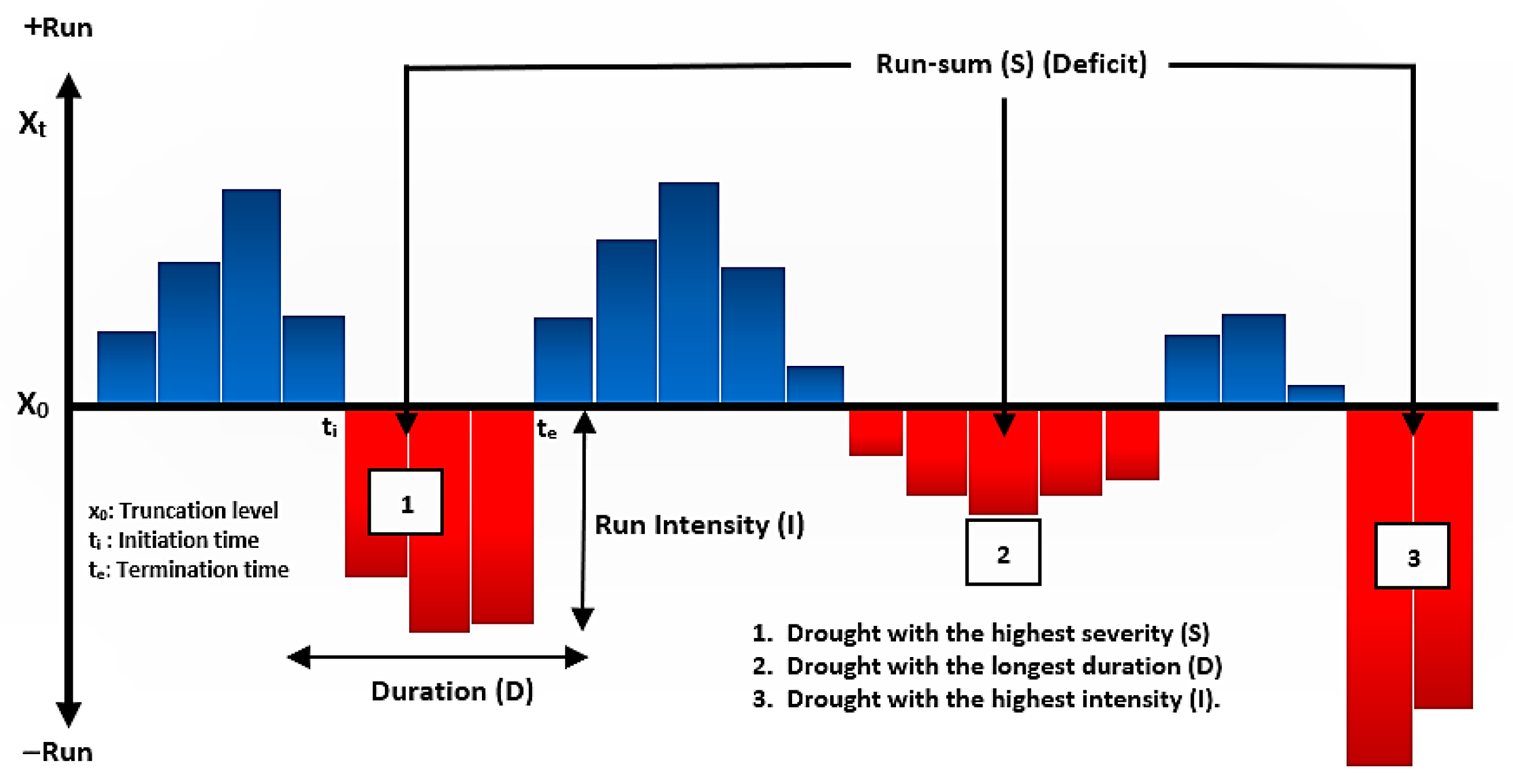
Drought is a multidimensional natural phenomenon, commonly characterized by its intensity, severity, and duration [54,55]. Its recurrent nature, combined with its gradual evolution, complicates the clear identification of the initiation and termination of drought episodes. For this reason, drought is frequently described in the literature as a “creeping phenomenon” [56]. To address these challenges, the Run Theory method was applied, representing one of the earliest and most effective approaches for the quantitative characterization of drought events. Run Theory is a probabilistic technique widely used in time-series analysis, originally introduced by Yevjevich [57] for the assessment of the statistical properties of hydrological droughts. According to this method, a drought event is defined as a sequence of consecutive time intervals during which a drought index ( X t ) remains below a predefined threshold or truncation level ( X 0 ) [58]. Intervals during which the index remains below the threshold constitute a negative run, while exceedance of the threshold marks the transition to a wet regime, defined as a positive run, allowing the clear identification and separation of drought episodes. This framework enables the extraction of the principal characteristics of drought events and allows the stochastic analysis of drought time series, providing insights into the frequency and return periods of hydrological events [59]. Based on Run Theory, drought characteristics are quantified through three key metrics: duration (D), defined as the continuous period during which X t remains below X 0 ; severity (S), expressed as the cumulative deficit of X t over the duration of a drought event; and intensity (I), calculated as the ratio of severity to duration, representing the average deficit per time unit (Figure 2).
In the present study, the duration and severity of future drought episodes were analyzed for the period 2071–2100, considering both the intermediate RCP4.5 and the extreme RCP8.5 climate scenarios. The SPI-12 index was selected for the application of Run Theory, with a threshold value of −1 adopted to define the onset of drought conditions, following the standard SPI classification [20,60,61]. The analysis focused on stations exhibiting high loading coefficients, as identified through Principal Component Analysis (PCA) under the pessimistic RCP8.5 scenario. These representative spatial patterns enable a robust comparison of drought characteristics between the two climate scenarios, emphasizing regions expected to exhibit the highest vulnerability to drought conditions toward the end of the 21st century.

3. Results and Discussion

3.1. Spatial Variability of Drought Using PCA

Principal Component Analysis (PCA) was applied to the complete set of SPI values, enabling the spatial characterization of droughts for the period 2071–2100 through a smaller and more manageable dataset. The spatial variability of drought was examined under the RCP8.5 scenario, highlighting regions most susceptible to the phenomenon in the absence of any mitigation measures. The focus on the late-century period followed the commonly adopted 30-year time-slice approach in climate impact studies, where the climate change signal becomes more clearly detectable relative to internal climate variability.
The analysis extracted six principal components based on the Kaiser–Guttman criterion, collectively accounting for 88% of the total variance. The first principal component explained 63% of the total variance, gathering numerically most of the stations with high loading coefficients compared to the remaining components. More precisely, 49 out of 58 regions displayed loadings greater than 0.7, suggesting that the temporal evolution of droughts across most of Greece is effectively represented by the first component. The remaining principal components accounted for less than 13% of the variance and exhibited low loadings, providing limited additional explanatory power.
Subsequently, the Varimax rotation was applied to redistribute the variance among the individual principal components, aiming for a clearer and more interpretable depiction of spatial drought patterns in the study area. Specifically, the six rotated principal components account for 37%, 21%, 12%, 11%, 5%, and 2% of the total variance, respectively, highlighting a more balanced distribution of the explained variance. The results of the PCA (eigenvalue > 1) are summarized in Table 2 and Table 3, where the orthogonal rotation of the axes did not alter the total percentage of variance explained (88%) by the original principal components, thereby preserving the level of desirable information required for further analysis.
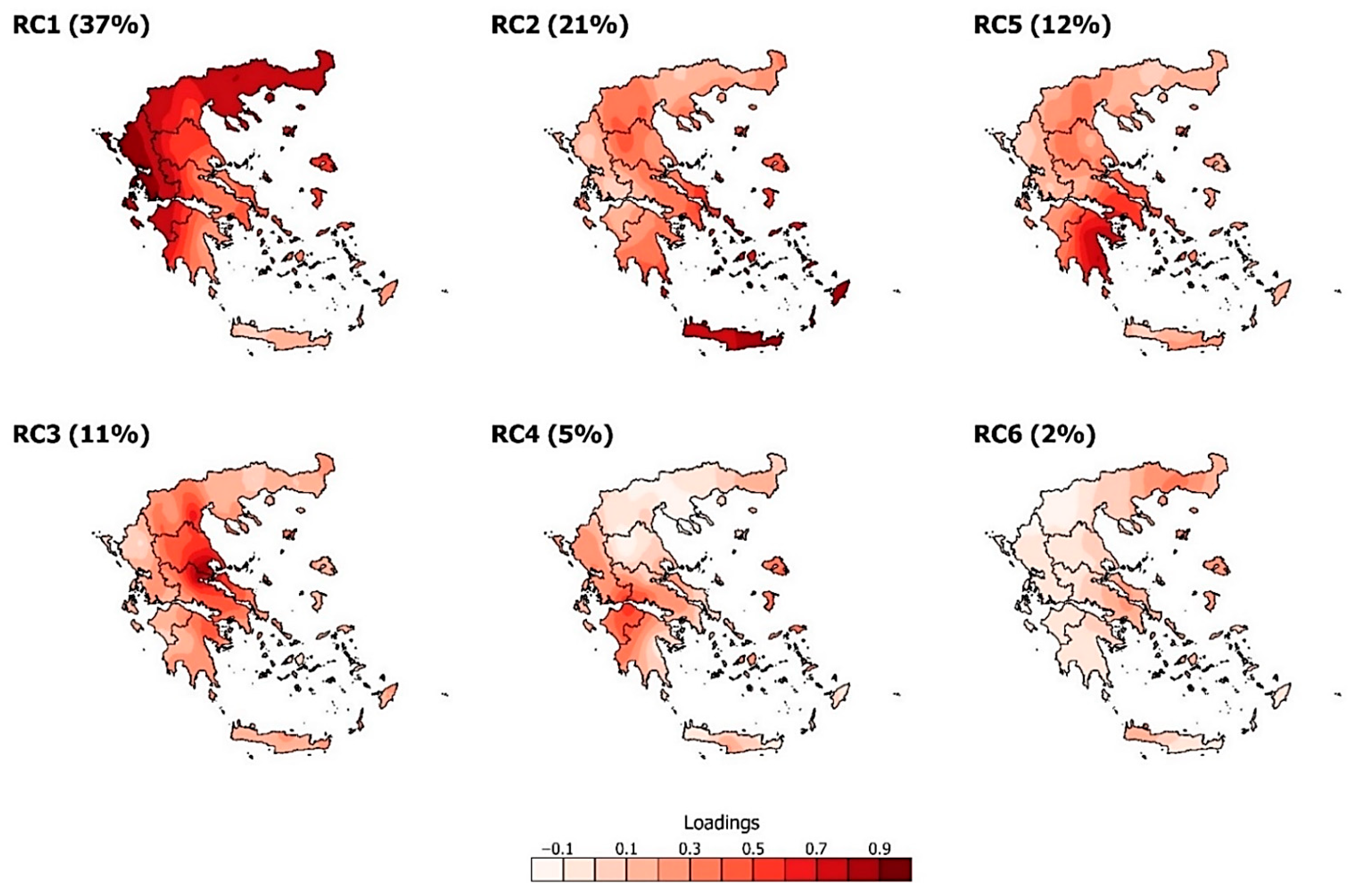
The spatial distribution of the correlation coefficients derived from the Varimax rotation is illustrated in Figure 3, revealing distinct spatial drought patterns for the far future under the extreme scenario RCP8.5. These patterns are consistent with regions projected to experience droughts of increased intensity and duration toward the end of the 21st century, in agreement with findings reported in the existing scientific literature.
In particular, the RC1 component is considered the most suitable for identifying future drought conditions in regions mainly located in western Greece, with strong correlation coefficients observed for the stations of Ioannina (0.91), Agrinio (0.89), Corfu (0.89), and Arta (0.88), and high correlations also evident in parts of northern Greece. This spatial structure is consistent with the dominant influence of westerly circulation and moisture advection from the Ionian Sea, which largely governs precipitation variability in western Greece. Projected reductions in winter precipitation and changes in storm-track activity over the Mediterranean are expected to disproportionately affect these regions, leading to longer and more severe drought episodes. According to Politi et al. [24], western regions of the country are expected to experience droughts of longer duration and increased severity in the future, particularly at the six-month timescale, reflecting the spatial pattern highlighted by RC1.
Regarding component RC2, the highest correlation coefficients are mainly distributed across eastern Crete and islands of the southeastern Aegean Sea. The stations of Ierapetra (0.89) and Rhodes (0.87) exhibit the strongest correlations, indicating a high degree of homogeneity in the temporal evolution of future drought conditions within the broader region. This pattern can be associated with the increasing dominance of subtropical high-pressure systems and enhanced evaporative demand over the southeastern Mediterranean, which contribute to reduced precipitation and increased drought severity. Future projections suggest a substantial intensification of severe and extreme drought episodes in eastern Crete, even under more moderate climate scenarios [62,63].
As for RC5, this component is more representative for the assessment of future drought conditions in regions located in the southeastern mainland part of the country. The highest correlations are recorded for the stations of Molaoi (0.81), Astros (0.76), Tripoli (0.74), and Argos (0.73). Especially, the formulated spatial pattern of RC5 encompasses a transition hydroclimatic zone between maritime and continental influences, where precipitation variability is modulated by both Aegean moisture inflow and regional thermal contrasts. These areas are particularly sensitive to circulation shifts associated with blocking conditions, often resulting in persistent heatwaves and extended dry spells. Previous studies report a significant increase in the number of days with extreme wildfire risk in Attica and eastern Peloponnese toward the end of the 21st century, indirectly suggesting a higher occurrence of prolonged drought episodes [25,64].
Concerning RC3, the component effectively captures the variability of future drought conditions in Thessaly and the northern part of Sterea Ellada. The strongest positive loadings are identified for the stations of Nea Agchialos (0.84), Lamia (0.80), Farsala (0.70), and Trikala (0.68). This pattern reflects a continental interior regime with limited maritime influence. The semi-enclosed topography of Thessaly restricts air mass penetration from the Aegean Sea, enhancing sensitivity to large-scale circulation anomalies that increase temperature-driven evapotranspiration and reduce summer precipitation, contributing to prolonged dry periods and heightened water stress. Loukas et al. [65] have highlighted that Thessaly is expected to experience more frequent and intense drought episodes in the future, while projections for northern Sterea Ellada, including the Spercheios River basin, indicate substantial reductions in water availability [66].
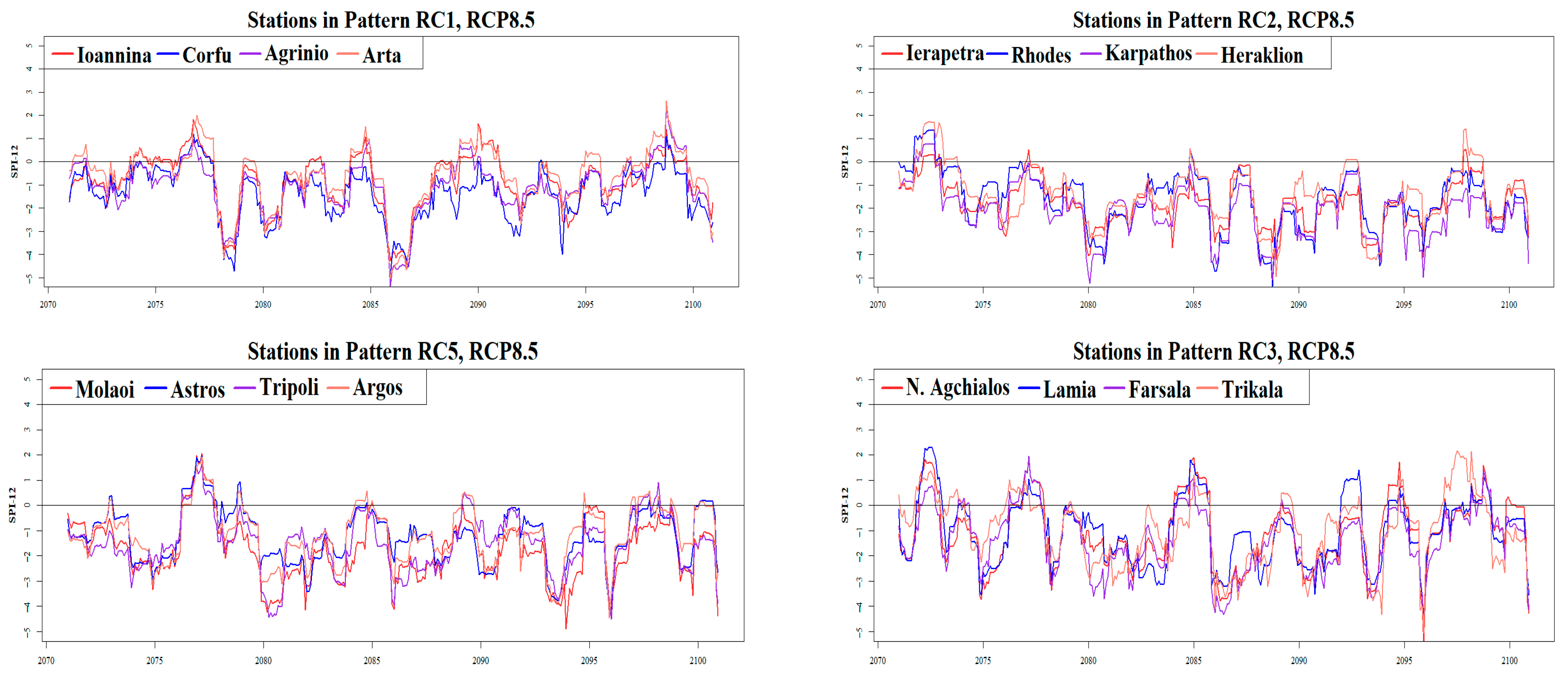
Finally, components RC4 and RC6 account for a small proportion of the total variance (<5%) and present low correlation coefficients across the entire study area (<0.6). These components correspond to spatial patterns of limited influence and are therefore considered of lower relevance with respect to the spatial variability of drought. The temporal evolution of the SPI-12 index for stations exhibiting high correlations in each of the most meaningful spatial patterns is presented in Figure 4.

3.2. Identification of Drought Episodes

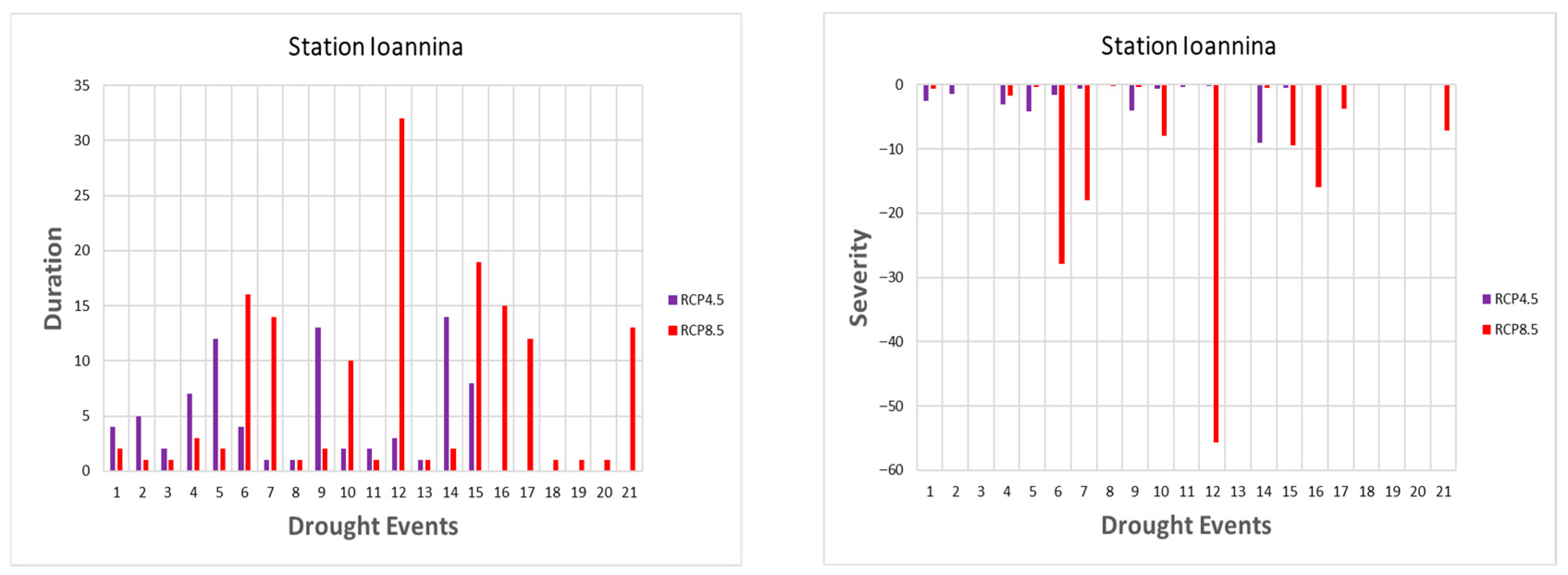
Drought characteristics—severity and duration—were analyzed using the Run Theory method at representative stations of the PCA-derived spatial patterns, enabling a comparative assessment between RCP4.5 and RCP8.5 for the future period 2071–2100. Specifically, in western Greece, as represented by the Ioannina station, overall drought conditions account for 22% and 42% of the analyzed period under the RCP4.5 and RCP8.5 scenarios, respectively. Severe and extreme drought conditions correspond to 6% of SPI-12 values under the intermediate scenario, increasing markedly to 25% under the extreme scenario. In terms of drought persistence, 15 independent events were identified under RCP4.5 and 21 events under RCP8.5, with mean durations of 5.3 and 7.1 months, respectively. The mean water deficit is substantially amplified under RCP8.5, being 3.8 times higher than under RCP4.5 (Mean severity, RCP4.5: −1.90; RCP8.5: −7.14) (Figure 5).
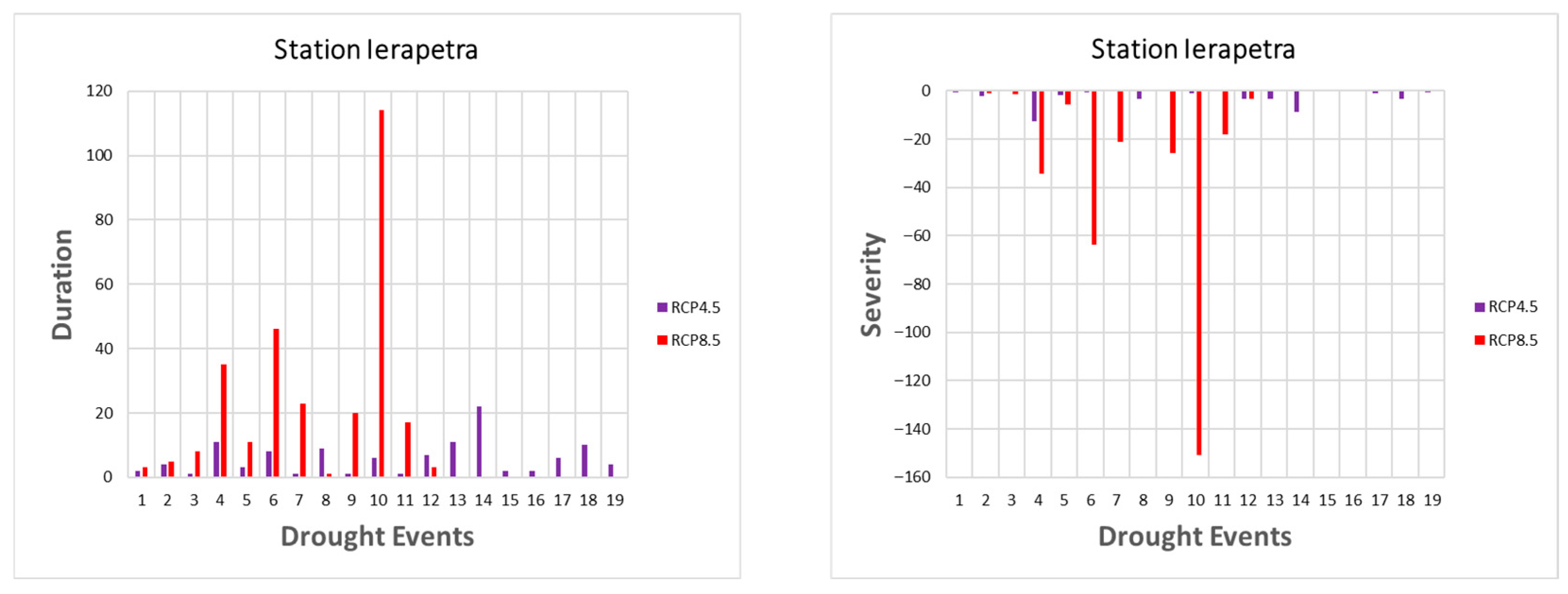
A pronounced intensification of drought conditions is further evident in the southeastern island region, represented by the Ierapetra station. Under RCP8.5, prolonged drought episodes dominate the future period, with wet to near-normal conditions (0 ≤ SPI ≤ 0.99) limited to only 4% of the analyzed months. By contrast, dry conditions account for 31% of the period under RCP4.5. Monthly SPI-12 values corresponding to severe and extreme drought events represent 9% under the intermediate scenario, increasing sharply to 62% under RCP8.5. Run Theory analysis identified 19 drought events with a mean duration of 5.8 months under RCP4.5, while fewer but substantially longer events (12 in total) occur under RCP8.5, with a mean duration of 23.8 months. Accordingly, the mean drought severity under the extreme scenario is 11.7 times higher than under RCP4.5 (Mean severity, RCP4.5: −2.32; RCP8.5: −27.14) (Figure 6).
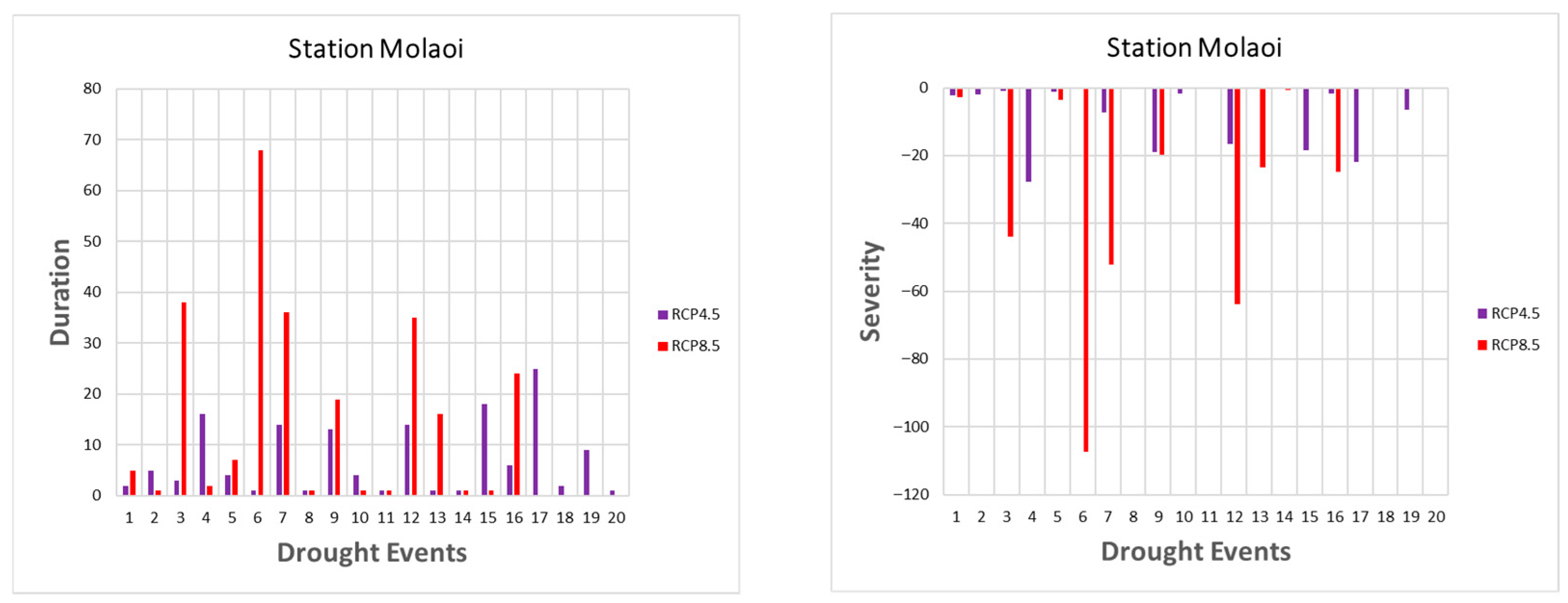
In the southeastern mainland of Greece, represented by the Molaoi station in the Peloponnese, drought conditions also intensify considerably under future climate projections. Under RCP4.5, dry conditions affect 39% of the analyzed period, with severe and extreme droughts accounting for 24% of monthly SPI values. Under the extreme scenario, droughts prevail over nearly three-quarters of the period (72%), while 58% of SPI-12 values indicate severe and extreme events. Consecutive drought months are classified into 20 discrete events under RCP4.5 and 16 events under RCP8.5, with the mean duration nearly doubling from 7 to 16 months. Mean drought severity increases by a factor of 3.4 under RCP8.5 compared to the intermediate scenario (Mean severity, RCP4.5: −6.37; RCP8.5: −21.43) (Figure 7).
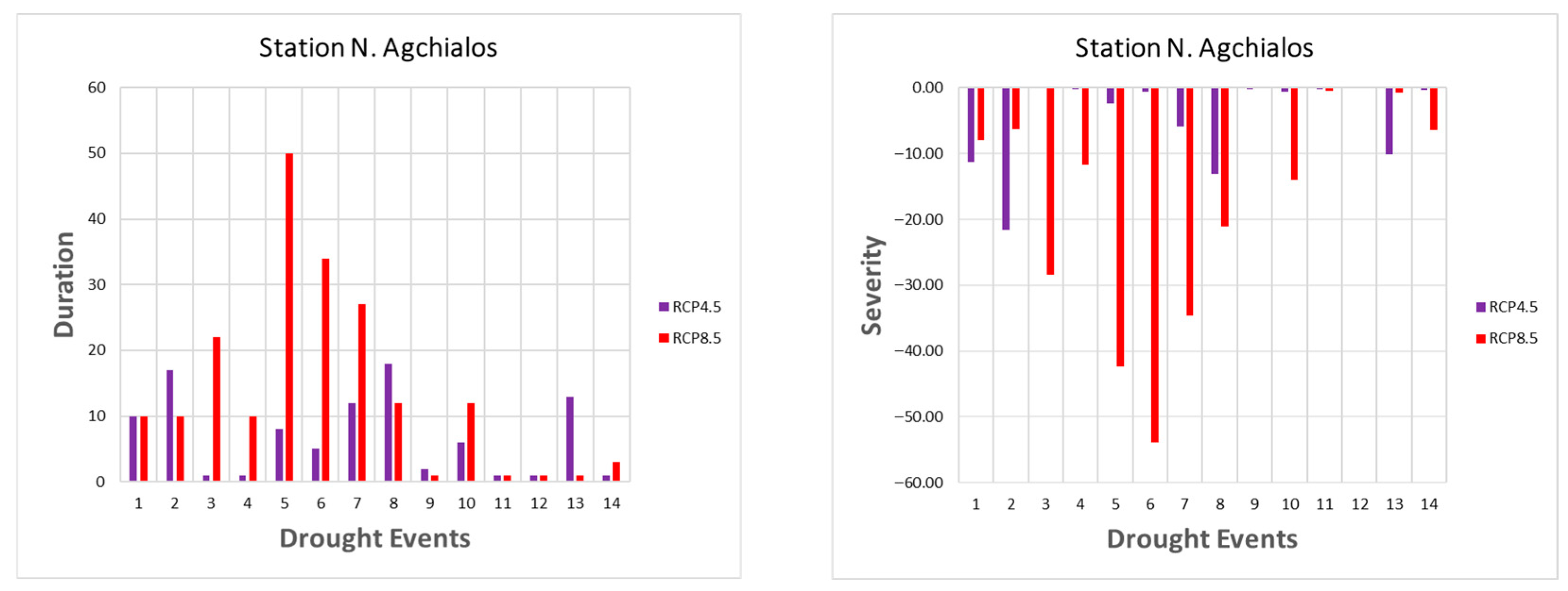
Finally, central mainland Greece, represented by the Nea Agchialos station, also exhibits a marked escalation of drought conditions under the more pessimistic climate scenario. Under RCP4.5, SPI-12 values ≤ −1 occur during 27% of the analyzed period, with 13% corresponding to severe and extreme drought conditions. Under RCP8.5, dry months account for 54% of the period, while severe and extreme droughts represent 41% of SPI values. A total of 14 drought events were identified across both scenarios, with the mean duration increasing from 6.9 months under RCP4.5 to 13.9 months under RCP8.5. Mean drought severity is 3.4 times higher under the extreme scenario, with cumulative SPI values averaging −4.78 and −16.29 for RCP4.5 and RCP8.5, respectively (Figure 8).

4. Conclusions

In this study, Principal Component Analysis (PCA) was applied to the SPI-12 index to identify distinct spatial drought patterns for the future period 2071–2100. By assessing this far-future period under stronger climate forcing, a clearer depiction of persistent spatial drought regimes is provided, as the climate change signal becomes increasingly distinguishable relative to internal variability, resulting in a higher signal-to-noise ratio and greater confidence in the detected patterns. The analysis delineated four spatially coherent regions associated with prolonged and more intense drought conditions, in agreement with findings reported in the existing literature. Specifically, western Greece, Thessaly, Crete, and southeastern Peloponnese are expected to face an increased risk of drought, especially under the extreme climate scenario. Time-series comparisons across climate scenarios showed consistently negative median SPI values, indicating an unavoidable shift toward drier conditions in the far future.
Run Theory further revealed persistent and severe drought events during 2071–2100, with southern regions (eastern Crete and southeastern Peloponnese) characterized by a near absence of wet conditions and a high proportion of severe to extreme drought months, corroborating projections of increased desertification risk. Eastern Crete exhibited the greatest mean drought duration and severity, while southeastern Peloponnese showed the highest cumulative water deficit. Conversely, Thessaly recorded the most extreme negative SPI values, whereas western Greece and Thessaly also experienced the highest number of wet episodes, partially moderating overall dryness. Collectively, these findings demonstrate a substantial alteration of the national hydrological regime, with critical implications for water availability.
Despite the inherent uncertainty associated with long-term climate projections [67], the results are consistent with the prevailing scientific consensus pointing to a warmer and drier Mediterranean future. The anticipated impacts on key sectors such as agriculture, tourism, energy demand, public health, and ecosystem integrity underscore the urgency of proactive and adaptive water management. Future research should incorporate the SPEI [68], which captures drought variability through the climatic water balance (precipitation minus potential evapotranspiration), indirectly reflecting temperature effects, and has been successfully applied to assess drought conditions in Greece, especially in lower-altitude areas [39]. In addition, exploring alternative clustering techniques, such as K-means, can enhance the identification of spatial drought patterns. Combining multiple drought indices with spatial classification methods can strengthen drought assessments and support evidence-based policymaking for mitigating climate change impacts and improving water resource management.

Author Contributions

Conceptualization, methodology, formal analysis, visualization, software, writing—original draft: T.K.; Resources, validation, writing—review and editing: E.K.; Data acquisition: C.G. All authors have read and agreed to the published version of the manuscript.

Funding

This research received no external funding.

Institutional Review Board Statement

Not applicable.

Informed Consent Statement

Not applicable.

Data Availability Statement

The original contributions presented in this study are included in the article. Further inquiries can be directed to the corresponding authors.

Conflicts of Interest

The authors declare no conflicts of interest.

References

  1. IPCC. Managing the Risks of Extreme Events and Disasters to Advance Climate Change Adaptation. A Special Report of Working Groups I and II of the Intergovernmental Panel on Climate Change; Field, C.B., Barros, V., Stocker, T.F., Qin, D., Dokken, D.J., Ebi, K.L., Mastrandrea, M.D., Mach, K.J., Plattner, G.-K., Allen, S.K., et al., Eds.; Cambridge University Press: Cambridge, UK; New York, NY, USA, 2012; p. 582. [Google Scholar] [CrossRef]
  2. Vogt, J.V.; Safriel, U.; von Maltitz, G.; Sokona, Y.; Zougmore, R.; Bastin, G.; Hill, J. Monitoring and assessment of land degradation and desertification: Towards new conceptual and integrated approaches. Land Degrad. Dev. 2011, 22, 150–165. [Google Scholar] [CrossRef]
  3. Wilhite, D.A.; Glantz, M.H. Understanding the drought phenomenon: The role of definitions. Water Int. 1985, 10, 111–120. [Google Scholar] [CrossRef]
  4. Lionello, P.; Scarascia, L. The relation between climate change in the Mediterranean region and global warming. Reg. Environ. Change 2018, 18, 1481–1493. [Google Scholar] [CrossRef]
  5. Ali, E.; Cramer, W.; Carnicer, J.; Georgopoulou, E.; Hilmi, N.J.M.; Le Cozannet, G.; Lionello, P. Cross-Chapter Paper 4: Mediterranean Region. In Climate Change 2022: Impacts, Adaptation and Vulnerability; Pörtner, H.-O., Roberts, D.C., Tignor, M., Poloczanska, E.S., Mintenbeck, K., Alegría, A., Craig, M., Langsdorf, S., Löschke, S., Möller, V., et al., Eds.; IPCC: Cambridge, UK; New York, NY, USA, 2022. [Google Scholar] [CrossRef]
  6. UNEP/MAP; Plan Bleu. State of the Environment and Development in the Mediterranean; UNEP: Nairobi, Kenya, 2020; Available online: https://planbleu.org/wp-content/uploads/2020/11/SoED-Full-Report.pdf (accessed on 27 September 2025).
  7. Schleussner, C.-F.; Lissner, T.K.; Fischer, E.M.; Wohland, J.; Perrette, M.; Golly, A.; Rogelj, J.; Childers, K.; Schewe, J.; Frieler, K. Differential climate impacts for policy relevant limits to global warming: The case of 1.5 °C and 2 °C. Earth Syst. Dyn. 2016, 7, 327–351. [Google Scholar] [CrossRef]
  8. Stagge, J.; Tallaksen, L.; Rizzi, J. Future Meteorological Drought: Projections of Regional Climate Models for Europe; Technical Report No. 25; European Commission (FP7); EGU: Vienna, Austria, 2015. [Google Scholar]
  9. Zittis, G.; Hadjinicolaou, P.; Klangidou, M.; Proestos, Y.; Lelieveld, J. A multi-model, multi-scenario, and multi-domain analysis of regional climate projections for the Mediterranean. Reg. Environ. Change 2019, 19, 2621–2635. [Google Scholar] [CrossRef]
  10. Tramblay, Y.; Somot, S. Future evolution of extreme precipitation in the Mediterranean. Clim. Change 2018, 151, 289–302. [Google Scholar] [CrossRef]
  11. Kostopoulou, E.; Giannakopoulos, C.; Hatzaki, M.; Karali, A.; Hadjinicolaou, P.; Lelieveld, J.; Lange, M.A. Spatio-temporal patterns of recent and future climate extremes in the eastern Mediterranean and Middle East region. Nat. Hazards Earth Syst. Sci. 2014, 14, 1565–1577. [Google Scholar] [CrossRef]
  12. Lange, M.A. Climate change in the Mediterranean: Environmental impacts and extreme events. In IEMed. Mediterranean Yearbook 2020; European Institute of the Mediterranean: Barcelona, Spain, 2020; pp. 30–45. Available online: https://www.iemed.org/publication/climate-change-in-the-mediterranean-environmental-impacts-and-extreme-events/ (accessed on 4 December 2025).
  13. Giannakopoulos, C.; Le Sager, P.; Bindi, M.; Moriondo, M.; Kostopoulou, E.; Goodess, C.M. Climatic changes and associated impacts in the Mediterranean resulting from a 2 °C global warming. Glob. Planet. Change 2009, 68, 209–224. [Google Scholar] [CrossRef]
  14. CCISC. The Environmental, Economic and Social Impacts of Climate Change in Greece; Bank of Greece: Athens, Greece, 2011; Available online: https://www.bankofgreece.gr/publications/ClimateChange_FullReport_bm.pdf (accessed on 12 October 2025).
  15. Tsakiris, G.; Tigkas, D.; Vangelis, H.; Pangalou, D. Regional drought identification and assessment: Case study in Crete. In Methods and Tools for Drought Analysis and Management; Springer: Dordrecht, The Netherlands, 2007; pp. 169–191. [Google Scholar] [CrossRef]
  16. Loukas, A.; Vasiliades, L.; Tzabiras, J. Climate change effects on drought severity. Adv. Geosci. 2008, 17, 23–29. [Google Scholar] [CrossRef]
  17. Anagnostopoulou, C. Drought episodes over Greece as simulated by dynamical and statistical downscaling approaches. Theor. Appl. Climatol. 2017, 129, 587–605. [Google Scholar] [CrossRef]
  18. UNEP FI. Water Sustainability of Agribusiness Activities in the Mediterranean Basin: Italy, Greece and Morocco; Chief Liquidity Series—Issue 1: Agribusiness; UNEP FI: Geneva, Switzerland, 2009; pp. 49–62. [Google Scholar]
  19. Kourgialas, N.N. A critical review of water resources in Greece: The key role of agricultural adaptation to climate-water effects. Sci. Total Environ. 2021, 775, 145857. [Google Scholar] [CrossRef]
  20. Vasiliades, L.; Loukas, A.; Liberis, N. A water balance derived drought index for Pinios River Basin, Greece. Water Resour. Manag. 2011, 25, 1087–1101. [Google Scholar] [CrossRef]
  21. Chartzoulakis, K.S.; Paranychianakis, N.V.; Angelakis, A.N. Water resources management in the island of Crete, Greece, with emphasis on the agricultural use. Water Policy 2001, 3, 193–205. [Google Scholar] [CrossRef]
  22. Kourgialas, N.N.; Karatzas, G.P.; Dokou, Z.; Kokorogiannis, A. Groundwater footprint methodology as policy tool for balancing water needs (agriculture & tourism) in water scarce islands—The case of Crete, Greece. Sci. Total Environ. 2018, 615, 381–389. [Google Scholar] [CrossRef]
  23. Founda, D.; Giannakopoulos, C. The exceptionally hot summer of 2007 in Athens, Greece—A typical summer in the future climate? Glob. Planet. Change 2009, 67, 227–236. [Google Scholar] [CrossRef]
  24. Politi, N.; Vlachogiannis, D.; Sfetsos, A.; Nastos, P.T.; Dalezios, N.R. High resolution future projections of drought characteristics in Greece based on SPI and SPEI indices. Atmosphere 2022, 13, 1468. [Google Scholar] [CrossRef]
  25. Karali, A.; Hatzaki, M.; Giannakopoulos, C.; Roussos, A.; Xanthopoulos, G.; Tenentes, V. Sensitivity and evaluation of current fire risk and future projections due to climate change: The case study of Greece. Nat. Hazards Earth Syst. Sci. 2014, 14, 143–153. [Google Scholar] [CrossRef]
  26. Giannakopoulos, C.; Kostopoulou, E.; Varotsos, K.V.; Tziotziou, K.; Plitharas, A. An integrated assessment of climate change impacts for Greece in the near future. Reg. Environ. Change 2011, 11, 829–843. [Google Scholar] [CrossRef]
  27. Ntinopoulos, N.; Spiliotopoulos, M.; Vasiliades, L.; Mylopoulos, N. Contribution to the study of forest fires in semi-arid regions with the use of Canadian Fire Weather Index application in Greece. Climate 2022, 10, 143. [Google Scholar] [CrossRef]
  28. Rovithakis, A.; Grillakis, M.G.; Seiradakis, K.D.; Giannakopoulos, C.; Karali, A.; Field, R.; Voulgarakis, A. Future climate change impact on wildfire danger over the Mediterranean: The case of Greece. Environ. Res. Lett. 2022, 17, 045022. [Google Scholar] [CrossRef]
  29. IPCC. Summary for Policymakers. In Climate Change 2021: The Physical Science Basis; Masson-Delmotte, V., Zhai, P., Pirani, A., Connors, S.L., Péan, C., Berger, S., Caud, N., Chen, Y., Goldfarb, L., Gomis, M.I., et al., Eds.; Cambridge University Press: Cambridge, UK; New York, NY, USA, 2021; pp. 3–32. [Google Scholar] [CrossRef]
  30. Tebaldi, C.; Friedlingstein, P. Delayed detection of climate mitigation benefits due to climate inertia and variability. Proc. Natl. Acad. Sci. USA 2013, 110, 17229–17234. [Google Scholar] [CrossRef]
  31. Faghih, M.; Brissette, F. The role of internal climate variability on future streamflow projections. J. Hydrol. 2023, 625, 130101. [Google Scholar] [CrossRef]
  32. Strandberg, G.; Bärring, L.; Hansson, U.; Jansson, C.; Jones, C.; Kjellström, E.; Ullerstig, A. CORDEX Scenarios for Europe from the Rossby Centre Regional Climate Model RCA4; SMHI: Norrköping, Sweden, 2014; Available online: https://www.smhi.se/en/publications-from-smhi/publications/2015-06-16-cordex-scenarios-for-europe-from-the-rossby-centre-regional-climate-model-rca4 (accessed on 7 December 2025).
  33. Jacob, D.; Petersen, J.; Eggert, B.; Alias, A.; Christensen, O.B.; Bouwer, L.M.; Yiou, P. EURO-CORDEX: New high-resolution climate change projections for European impact research. Reg. Environ. Change 2014, 14, 563–578. [Google Scholar] [CrossRef]
  34. IPCC. Climate Change 2014: Synthesis Report. Contribution of Working Groups I, II and III to the Fifth Assessment Report of the Intergovernmental Panel on Climate Change; Pachauri, R.K., Meyer, L.A., Eds.; IPCC: Geneva, Switzerland, 2014; p. 151. Available online: https://www.ipcc.ch/report/ar5/syr/ (accessed on 9 October 2025).
  35. Giorgetta, M.A.; Jungclaus, J.; Reick, C.H.; Legutke, S.; Bader, J.; Böttinger, M.; Stevens, B. Climate and carbon cycle changes from 1850 to 2100 in MPI-ESM simulations for CMIP5. J. Adv. Model. Earth Syst. 2013, 5, 572–597. [Google Scholar] [CrossRef]
  36. Morley, S.K.; Brito, T.V.; Welling, D.T. Measures of model performance based on the log accuracy ratio. Space Weather 2018, 16, 69–88. [Google Scholar] [CrossRef]
  37. Flato, G.; Marotzke, J.; Abiodun, B.; Braconnot, P.; Chou, S.C.; Collins, W.; Rummukainen, M. Evaluation of climate models. In Climate Change 2013: The Physical Science Basis; Cambridge University Press: Cambridge, UK, 2013; pp. 741–866. [Google Scholar]
  38. Maraun, D.; Wetterhall, F.; Ireson, A.M.; Chandler, R.E.; Kendon, E.J.; Widmann, M.; Thiele-Eich, I. Precipitation downscaling under climate change. Rev. Geophys. 2010, 48, RG3003. [Google Scholar] [CrossRef]
  39. Karampatakis, T.; Vasiliades, L.; Loukas, A. Comparison of meteorological drought indices in Thessaly water department, Greece. In Proceedings of the Protection and Restoration of the Environment XIV, Thessaloniki, Greece, 3–6 July 2018; pp. 545–554. [Google Scholar]
  40. Svoboda, M.; Fuchs, B. Handbook of Drought Indicators and Indices; World Meteorological Organization (WMO): Geneva, Switzerland, 2016; Available online: https://www.droughtmanagement.info/literature/GWP_Handbook_of_Drought_Indicators_and_Indices_2016.pdf (accessed on 2 November 2025).
  41. McKee, T.B.; Doesken, N.J.; Kleist, J. The relationship of drought frequency and duration to time scales. In Proceedings of the 8th Conference on Applied Climatology, Anaheim, CA, USA, 17–22 January 1993; pp. 179–183. [Google Scholar]
  42. Thom, H.C. A note on the gamma distribution. Mon. Weather Rev. 1958, 86, 117–122. [Google Scholar] [CrossRef]
  43. Angelidis, P.; Maris, F.; Kotsovinos, N.; Hrissanthou, V. Computation of drought index SPI with alternative distribution functions. Water Resour. Manag. 2012, 26, 2453–2473. [Google Scholar] [CrossRef]
  44. Stagge, J.H.; Tallaksen, L.M.; Gudmundsson, L.; van Loon, A.F.; Stahl, K. Candidate distributions for climatological drought indices (SPI and SPEI). Int. J. Climatol. 2015, 35, 4027–4040. [Google Scholar] [CrossRef]
  45. Edwards, D.C.; McKee, T.B. Characteristics of 20th Century Drought in the United States at Multiple Time Scales; Colorado State University: Fort Collins, CO, USA, 1997; Available online: https://mountainscholar.org/handle/10217/170176 (accessed on 2 November 2025).
  46. Abramowitz, M.; Stegun, I. Handbook of Mathematical Functions with Formulas, Graphs, and Mathematical Tables; Dover: New York, NY, USA, 1965. [Google Scholar] [CrossRef]
  47. Spinoni, J.; Naumann, G.; Carrao, H.; Barbosa, P.; Vogt, J. World drought frequency, duration, and severity for 1951–2010. Int. J. Climatol. 2014, 34, 2792–2804. [Google Scholar] [CrossRef]
  48. Bonaccorso, B.; Bordi, I.; Cancelliere, A.; Rossi, G.; Sutera, A. Spatial variability of drought: An analysis of the SPI in Sicily. Water Resour. Manag. 2003, 17, 273–296. [Google Scholar] [CrossRef]
  49. Vicente-Serrano, S.M.; González-Hidalgo, J.C.; de Luis, M.; Raventós, J. Drought patterns in the Mediterranean area: The Valencia region. Clim. Res. 2004, 26, 5–15. [Google Scholar] [CrossRef]
  50. Karampatakis, T.M. Drought analysis using meteorological drought indices in Thessaly region, Greece. Master’s Thesis, University of Thessaly, Volos, Greece, 2017. [Google Scholar]
  51. Guttman, L. Some necessary conditions for common-factor analysis. Psychometrika 1954, 19, 149–161. [Google Scholar] [CrossRef]
  52. Kaiser, H.F. The application of electronic computers to factor analysis. Educ. Psychol. Meas. 1960, 20, 141–151. [Google Scholar] [CrossRef]
  53. Kaiser, H.F. The varimax criterion for analytic rotation in factor analysis. Psychometrika 1958, 23, 187–200. [Google Scholar] [CrossRef]
  54. Dracup, J.A.; Lee, K.S.; Paulson, E.G. On the statistical characteristics of drought events. Water Resour. Res. 1980, 16, 289–296. [Google Scholar] [CrossRef]
  55. Tsakiris, G.; Loukas, A.; Pangalou, D.; Vangelis, H.; Tigkas, D.; Rossi, G.; Cancelliere, A. Drought characterization. Drought Manag. Guidel. Tech. Annex 2007, 58, 85–102. [Google Scholar]
  56. Wilhite, D.A. Drought as a natural hazard: Concepts and definitions. In Drought: A Global Assessment; Routledge: London, UK, 2000; pp. 3–18. [Google Scholar]
  57. Yevjevich, V.M. An Objective Approach to Definitions and Investigations of Continental Hydrologic Droughts; Hydrology Paper 23; Colorado State University: Fort Collins, CO, USA, 1967; Available online: https://mountainscholar.org/items/caa939a5-98a9-4ca3-8ea3-308c310cdad7 (accessed on 5 November 2025).
  58. Mishra, A.K.; Singh, V.P. A review of drought concepts. J. Hydrol. 2010, 391, 202–216. [Google Scholar] [CrossRef]
  59. Bonaccorso, B.; Cancelliere, A.; Rossi, G. An analytical formulation of return period of drought severity. Stoch. Environ. Res. Risk Assess. 2003, 17, 157–174. [Google Scholar] [CrossRef]
  60. Rahmat, S.N.; Jayasuriya, N.; Bhuiyan, M. Assessing droughts using meteorological drought indices in Victoria, Australia. Hydrol. Res. 2015, 46, 463–476. [Google Scholar] [CrossRef]
  61. Longobardi, A.; Boulariah, O.; Villani, P. Assessment of centennial (1918–2019) drought features in the Campania region by historical in situ measurements. Nat. Hazards Earth Syst. Sci. 2021, 21, 2181–2196. [Google Scholar] [CrossRef]
  62. Tigkas, D. Drought characterisation and monitoring in regions of Greece. Eur. Water 2008, 23, 29–39. Available online: https://www.ewra.net/ew/pdf/EW_2008_23-24_03.pdf (accessed on 17 December 2025).
  63. Vrochidou, A.; Grillakis, M.; Tsanis, I. Drought assessment based on multi-model precipitation projections for the Island of Crete. J. Earth Sci. Clim. Change 2013, 4, 158. [Google Scholar] [CrossRef]
  64. Giannakopoulos, C.; Karali, A.; Roussos, A.; Hatzaki, M.; Xanthopoulos, G.; Kaoukis, K. Evaluating present and future fire risk in Greece. In Proceedings of the 8th International EARSeL FF-SIG Workshop: Advances in Remote Sensing and GIS Applications in Forest Fire Management, Stresa, Italy, 20–21 October 2011; p. 181. [Google Scholar]
  65. Loukas, A.; Vasiliades, L.; Tzabiras, J. Evaluation of climate change on drought impulses in Thessaly, Greece. Eur. Water 2007, 17, 17–28. Available online: https://www.ewra.net/ew/pdf/EW_2007_17-18_02.pdf (accessed on 20 December 2025).
  66. Paparrizos, S.; Maris, F.; Weiler, M.; Matzarakis, A. Analysis and mapping of present and future drought conditions over Greek areas with different climate conditions. Theor. Appl. Climatol. 2018, 131, 259–270. [Google Scholar] [CrossRef]
  67. Vasiliades, L.; Loukas, A.; Patsonas, G. Evaluation of a statistical downscaling procedure for the estimation of climate change impacts on droughts. Nat. Hazards Earth Syst. Sci. 2009, 9, 879–894. [Google Scholar] [CrossRef]
  68. Vicente-Serrano, S.M.; Beguería, S.; López-Moreno, J.I. A multiscalar drought index sensitive to global warming: The standardized precipitation evapotranspiration index. J. Clim. 2010, 23, 1696–1718. [Google Scholar] [CrossRef]
Figure 1. Map of the study area with the hypothetical geographical sectors used for climate model evaluation. Black dots indicate the locations of analyzed meteorological stations (58). Histograms of observed (dark blue) and simulated (light blue) precipitation are also presented for selected stations.
Eesp 40 00011 g001
Figure 2. Representation of drought characteristics based on Run Theory for a given threshold Χ0.
Eesp 40 00011 g002
Figure 3. Spatial distribution of loadings (Varimax rotation) using the SPI-12 (2071–2100, RCP8.5).
Eesp 40 00011 g003
Figure 4. Time series of SPI-12 at stations exhibiting high loadings with components RC1, RC2, RC5, and RC3, (2071–2100, RCP8.5).
Eesp 40 00011 g004
Figure 5. Future drought characteristics (duration and severity) at a station in Epirus, northwestern Greece (2071–2100, RCP4.5 and RCP8.5).
Eesp 40 00011 g005
Figure 6. Future drought characteristics (duration and severity) at a station in eastern Crete (2071–2100, RCP4.5 and RCP8.5).
Eesp 40 00011 g006
Figure 7. Future drought characteristics (duration and severity) at a station in southeastern Peloponnese (2071–2100, RCP4.5 and RCP8.5).
Eesp 40 00011 g007
Figure 8. Future drought characteristics (duration and severity) at a station in Thessaly, central Greece (2071–2100, RCP4.5 and RCP8.5).
Eesp 40 00011 g008
Table 1. Drought classification by SPI value and corresponding event probabilities.
SPI ValueCategoryProbability (%)
2.00 or lessExtremely wet2.3
+1.50 to 1.99Very wet4.4
+1.00 to 1.49Moderately wet9.2
−0.99 to 0.99Normal precipitation68.2
−1.00 to −1.49Moderately dry9.2
−1.50 to −1.99Very dry4.4
−2.00 or lessExtremely dry2.3
Table 2. Eigenvalues, percentage of variance explained and cumulative variance for each component in unrotated case.
SPI-12 Unrotated Principal Components RCP8.5
IDEigenvalueVariance (%)Cumulative Variance (%)
PC1 37.376363
PC2 7.481376
PC3 2.64481
PC4 2.06384
PC51.25286
PC61.04288
Table 3. Eigenvalues, percentage of variance explained and cumulative variance for each component in rotated case (Varimax).
SPI-12 Rotated Principal Components RCP8.5
IDEigenvalueVariance (%)Cumulative Variance (%)
RC1 21.893737
RC2 12.472158
RC5 7.031270
RC3 6.361181
RC42.94586
RC61.16288
Disclaimer/Publisher’s Note: The statements, opinions and data contained in all publications are solely those of the individual author(s) and contributor(s) and not of MDPI and/or the editor(s). MDPI and/or the editor(s) disclaim responsibility for any injury to people or property resulting from any ideas, methods, instructions or products referred to in the content.