You are currently viewing a new version of our website. To view the old version click .
Microelectronics
  • Article
  • Open Access

8 December 2025

Simulation of the Effects of the Pillar Configurations on 1.2 kV 4H-SiC Superjunction DMOSFET

and
Department of Electrical Engineering, National Dong Hwa University, Hualien 97401, Taiwan
*
Author to whom correspondence should be addressed.

Abstract

4H-SiC has been studied and applied in power semiconductor devices due to its wider band gap and higher thermal conductivity than those of Si and hence has great potential for power devices operating at high powers and high temperatures. The introduction of the superjunction (SJ) structure for the power MOSFETs enables further reduction in the ON resistance while maintaining the breakdown voltage. In this work, we examined the dc and ac performance of the 1.2 kV 4H-SiC SJ double-implanted MOSFET (DMOSFET) with different configurations of pillars by the Atlas device simulator. The simulation results suggest the step-shape SJ DMOSFET can further reduce the specific ON resistance and the gate-drain capacitance while maintaining the breakdown voltage compared with the optimized conventional SJ DMOSFET. In addition, that the multi-pillar SJ DMOSFET demonstrates better performance than that of the optimized conventional SJ DMOSFET was also verified in this work.

1. Introduction

Silicon carbide (SiC) has been investigated and utilized for manufacturing power semiconductor devices in recent decades [1,2,3]. So far, SiC can replace silicon for some power semiconductor devices [3]. SiC has a wide band gap of 2.3–3.3 eV depending on its crystal structure. The most attractive SiC crystal structure is 4H-SiC because of its large band gap (about 3.2 eV). It exhibits about 10 times higher critical electric field and 3 times higher thermal conductivity than Si, making it promising for power devices operating at higher powers and higher temperatures. To improve the performance of 4H-SiC power MOSFETs, the so-called superjunction (SJ) structure has also been employed in the 4H-SiC power MOSFETs [4,5,6,7,8,9,10,11]. The SJ structure, in which the p-pillars were formed in the n-drift layer of the power MOSFETs, can reduce the ON resistance by increasing the doping of the drift layer without decreasing the breakdown voltage. This is because, if the charge balance condition can be attained between the p-pillars and the n-drift region, the depletion region will uniformly spread throughout the whole n-drift layer and will result in higher breakdown voltage than that of the n-drift layer without the p-pillars. In this work, we investigated the dc and ac performance of the 1.2 kV 4H-SiC SJ double-implanted MOSFET (DMOSFET) with different configurations of pillars by the device simulator, Atlas (Silvaco Inc., Santa Clara, CA, USA). We proposed a novel “step-shape” p-pillar structure which is different from the step-doping profile in the p-pillars [4,6] and evaluated its performance compared with the optimized conventional SJ DMOSFET. The main difference between the proposed step-shape p-pillars and the step-doping p-pillars in [4,6] is that, for the step-shape p-pillars, the geometric shapes of the p-pillars are step-like with the same doping concentration within the p-pillars. However, the geometric shapes of the step-doping p-pillars in [4,6] are column-like, with different doping concentrations within the p-pillars. In addition, the number of the p-pillars, i.e., the multi-pillar configuration, will affect the device performance, as indicated in [7]. Therefore, the performance of the multi-pillar SJ DMOSFET was also examined in this work.

2. Device Structures and Simulation Approach

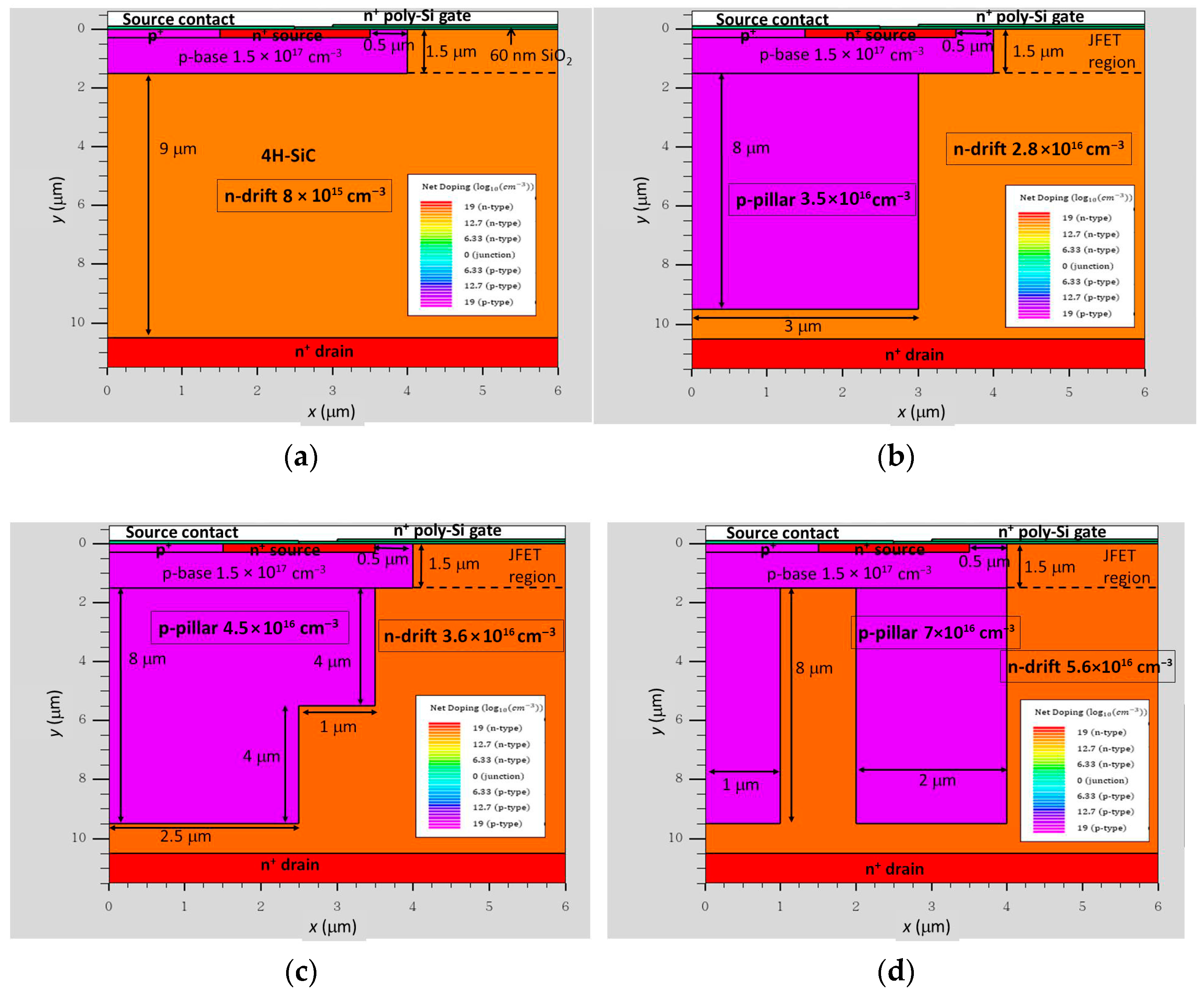
Figure 1a–d show the half-cell device structures of the four types of 1.2 kV 4H-SiC DMOSFETs examined in this work: Figure 1a is the conventional DMOSFET; Figure 1b is the conventional SJ DMOSFET; Figure 1c is the SJ DMOSFET with the “step-shape” p-pillar; and Figure 1d is the multi-pillar SJ DMOSFET. The complete unit cells of the four kinds of power DMOSFETs can be obtained by mirroring the half ones in Figure 1a–d at the left or right boundary. In our simulation, the band gap of 4H-SiC at room temperature is 3.23 eV and its relative dielectric constant is 9.7. For all four devices, the channel length is 0.5 μm and the gate oxide (SiO2) thickness is 60 nm. The gate material is n+ polysilicon with a work function of 3.95 eV. The thickness and the doping concentration of the p-base region are 1.5 μm and 1.5 × 1017 cm−3, respectively. The thickness and the doping concentration of the n+ source are 0.3 μm and 1 × 1019 cm−3, respectively. The thickness of the n-drift layer is 10.5 μm. The doping concentration of the n-drift layer is 8 × 1015 cm−3 for the conventional DMOSFET. The values of the conventional DMOSFET structural parameters are similar to those of the fabricated 1.2 kV 4H-SiC inversion-mode DMOSFET [12]. For the other three SJ devices, the doping concentration of the n-drift layer varies, as shown in Table 1, in order to attain the lower specific ON resistance with the breakdown voltage higher than 1400 V. In this work, we assumed the doping concentration of the p-pillar is 1.25 times that of the n-drift layer (or the doping concentration of the n-drift layer is 0.8 times that of the p-pillar). The purpose of this assumption is to facilitate achieving charge balance for the SJ devices. The charge balance condition here means
Npillar ×  Apillar = Ndrift ×  Adrift,
where Npillar and Apillar are the doping concentration and the area of the p-pillar regions, respectively; and Ndrift and Adrift are the doping concentration and the area of the remaining n-drift regions, respectively. Ideally, if Npillar equals Ndrift, then Apillar will be equal to Adrift. However, since the p-pillars were formed in the n-drift layer, it is easier to implement the p-pillars with the doping concentration higher than that of the n-drift layer by ion implantation. Therefore, that the doping concentration of the p-pillar is slightly higher than that of the n-drift layer was assumed, and a similar approach can be found in [7]. Figure 1b shows the optimized conventional SJ DMOSFET when the p-pillar width is 3 μm, which occupies half the width of the n-drift layer. In Figure 1b, the optimized doping concentrations of the p-pillar and the n-drift layer are 3.5 × 10¹⁶ and 2.8 × 1016 cm−3, respectively, and the optimized p-pillar thickness is 8 μm, which also achieved the charge balance condition between the p-pillar and the n-drift region (regardless of the JFET region). The optimized doping concentration and thickness of the p-pillar for the conventional SJ DMOSFET were determined by the massive TCAD simulation experiments. In the simulation experiments, the variables are the doping concentration and the thickness of the p-pillar. The p-pillar doping concentration varies from 1 × 10¹⁶ to 9 × 1016 cm−3 with an increment of 5 × 1015 cm−3 and the p-pillar thickness varies from 1 to 9 μm with an increment of 1 μm. The optimized p-pillar doping concentrations for the step-shape SJ DMOSFET in Figure 1c and the multi-pillar SJ DMOSFET in Figure 1d were determined using a similar approach, except that the p-pillar thickness was fixed at 8 μm and the p-pillar area was fixed at 24 μm2, as that of the optimized SJ DMOSFET (8 μm × 3 μm), for achieving the charge balance condition. Note that, since Figure 1b is a half unit cell, the actual p-pillar width is 6 μm. In Figure 1c, the doping concentrations of the p-pillar and the n-drift layer are 4.5 × 10¹⁶ and 3.6 × 1016 cm−3, respectively. The step height was tentatively set to 1 μm in Figure 1c, and the effect of step height variation will be investigated in future studies. In Figure 1d, the doping concentrations of the p-pillar and the n-drift layer are 7 × 10¹⁶ and 5.6 × 1016 cm−3, respectively. In the multi-pillar SJ configuration, the p-pillar width was assumed to be 2 μm, which is one-third of that of the conventional SJ DMOSFET in Figure 1b. The spacing between p-pillars in Figure 1d was consequently determined to be 1 μm, based on the p-base width, which is 8 μm. The effects of pillar width and spacing, together with the number of the p-pillars in the multi-pillar SJ configuration, will be simulated and analyzed further.
Figure 1. The half device structures for the simulation of the four types of 1.2 kV 4H-SiC DMOSFETs: (a) the conventional DMOSFET; (b) the conventional SJ DMOSFET; (c) the SJ DMOSFET with the “step-shape” p-pillar; and (d) the multi-pillar SJ DMOSFET.
Table 1. The doping concentrations of the n-drift layer and p-pillars for the four examined DMOSFETS *.
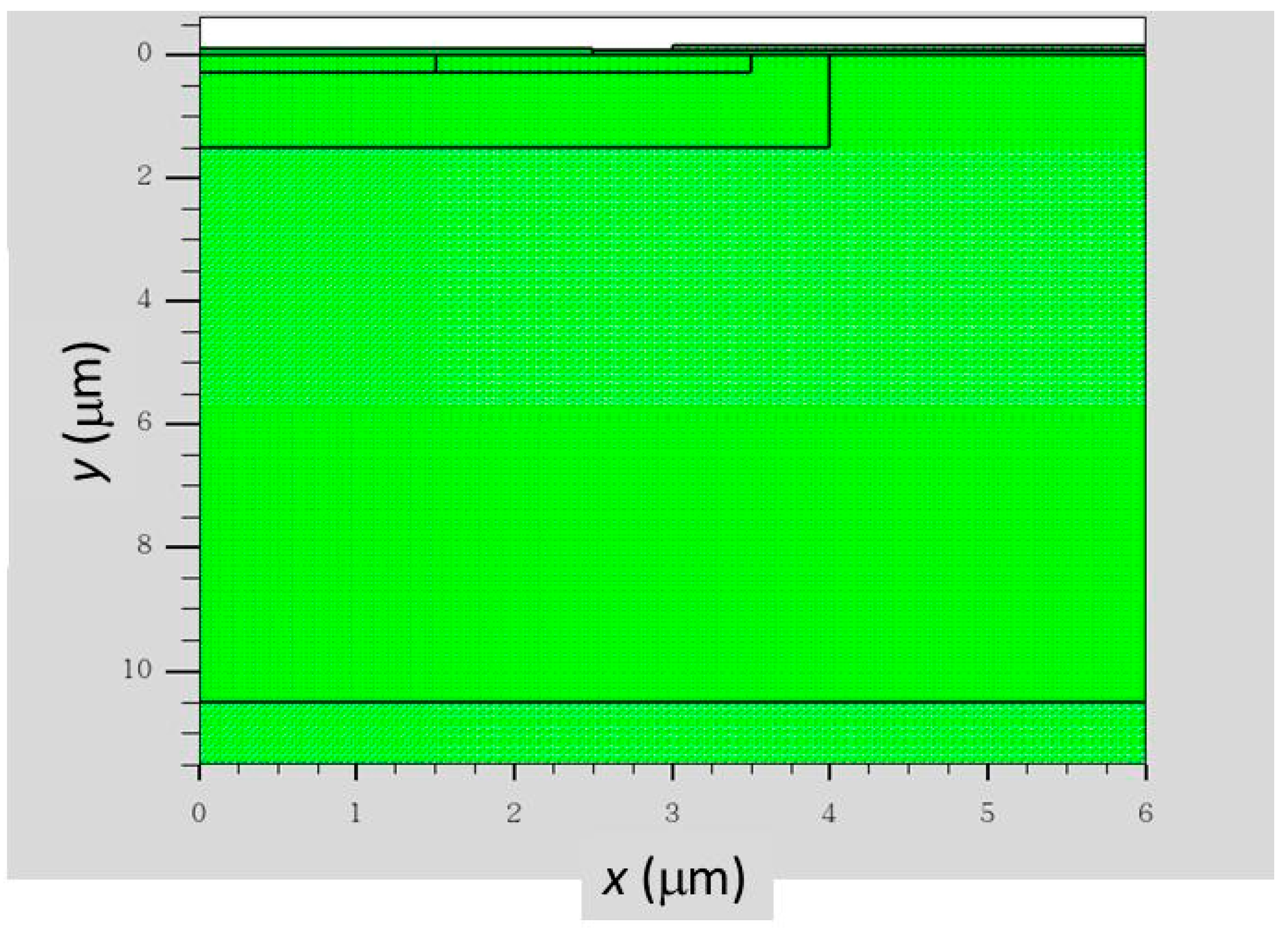
As for the simulation approach, the device simulator, Atlas, version 5.38.0.R, was used to evaluate the device performance. The anisotropic mobility model [13] was adopted to simulate the I-V characteristics. In this work, the y (vertical) direction is the <0001> direction, and the x (horizontal) direction is the <11 2 ¯ 0> direction. The mobility model considers the high-field velocity saturation due to the parallel electric field and the doping dependent mobility degradation. The incomplete ionization of the dopants was considered by the two-level incomplete ionization model [13]. The breakdown voltage is determined by the avalanche multiplication process and Selberherr’s impact ionization model was used [13]. Selberherr’s impact ionization model basically follows Chynoweth’s law, i.e., the impact ionization rates for electron and hole are determined by the magnitude of the electric field along the current direction [14]. Anisotropy of the impact ionization was not considered. The mesh size for the simulated devices varied from 0.01 to 0.05 μm for both x (horizontal) and y (vertical) directions. For the conventional DMOSFET, the number of mesh points is 26,831 and the mesh picture is shown in Figure 2.
Figure 2. The mesh picture of the simulated conventional DMOSFET. The number of mesh points is 26,831.

3. Simulation Results and Discussion

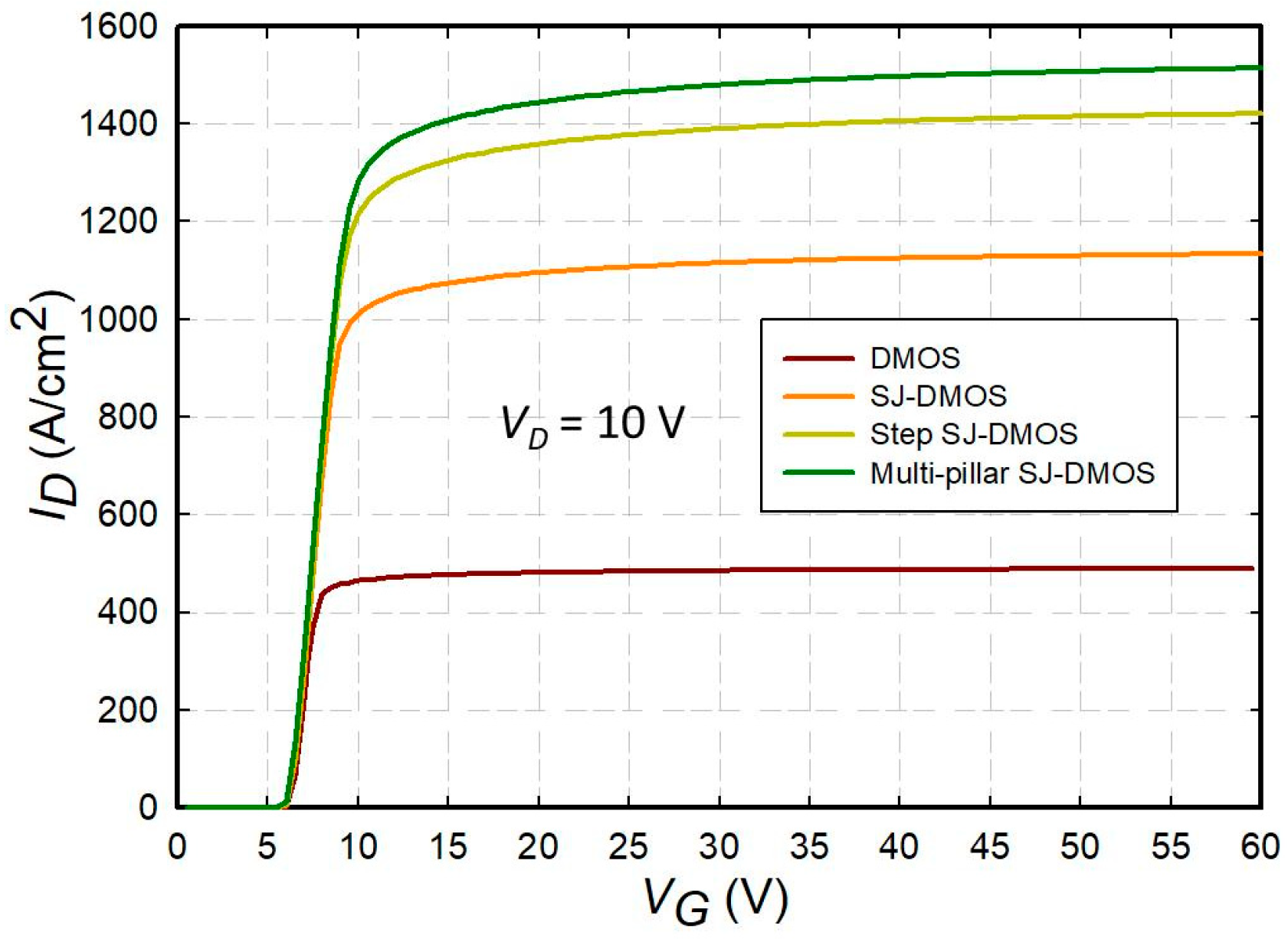
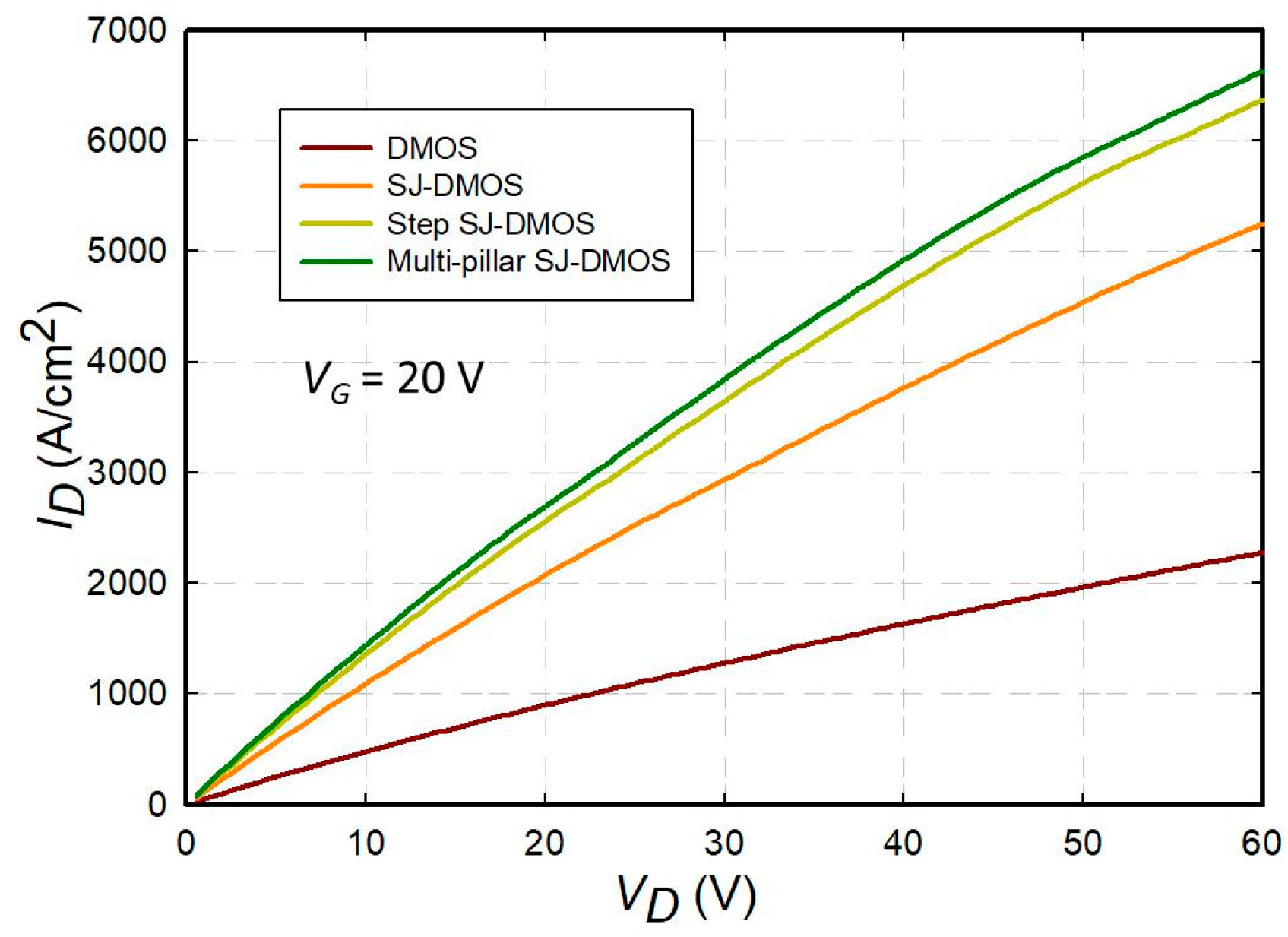
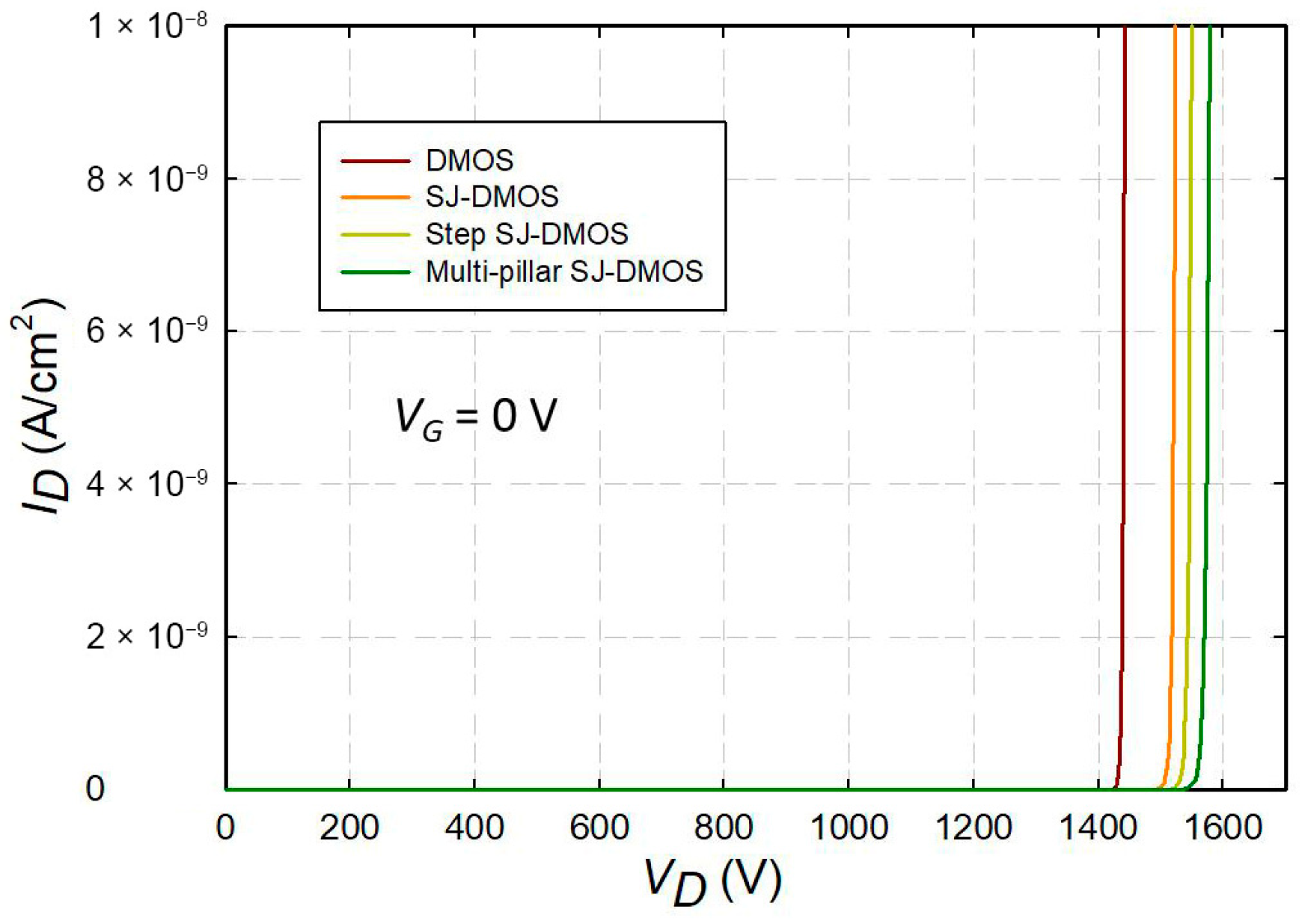
Based on the aforementioned four device structures in Figure 1 and the simulation approach, the simulation results are presented and discussed in this section. Figure 3 shows the ID–VG curves of the four devices shown in Figure 1 under VD = 10 V. The threshold voltages (VT) of the four devices are 6.0 V. Figure 4 shows the ID–VD curves of the four devices shown in Figure 1 under VG = 20 V. A significant reduction is observed in the specific ON resistance (Ron,sp) for the SJ devices compared with the conventional DMOSFET due to the increase in n-drift doping concentration. In addition, both the step-shape p-pillar SJ DMOSFET and the multi-pillar SJ DMOSFET demonstrated the lower specific ON resistance than that of the optimized conventional SJ DMOSFET, since the n-drift doping concentration can be further raised in these two devices without lessening the breakdown voltage. Figure 5 shows the breakdown characteristics of the four devices shown in Figure 1. The low reverse-bias current in Figure 5 is attributed to the low generation rate of carriers in the wide band gap semiconductor, like 4H-SiC. The breakdown voltage was set at 1.4 kV or above to ensure that the devices can be safely rated at 1.2 kV. The dc performance (e.g., Ron,sp and BV) for the four devices was shown in Table 2. The dcFoM in Table 2 is defined by the following:
dcFoM = BV2/Ron,sp.
Figure 3. The ID–VG curves of the four devices shown in Figure 1 under VD = 10 V. The threshold voltages (VT) of all four devices are 6.0 V.
Figure 4. The ID–VD curves of the four devices shown in Figure 1 under VG = 20 V. The specific ON resistance (Ron,sp) was obtained as the reciprocal of the slope of ID with respect to VD.
Figure 5. The breakdown characteristics of the four devices shown in Figure 1. The breakdown voltage (BV) is estimated by the drain voltage at which the reverse-bias current begins to increase significantly.
Table 2. The dc and ac performance of the four examined DMOSFETS.
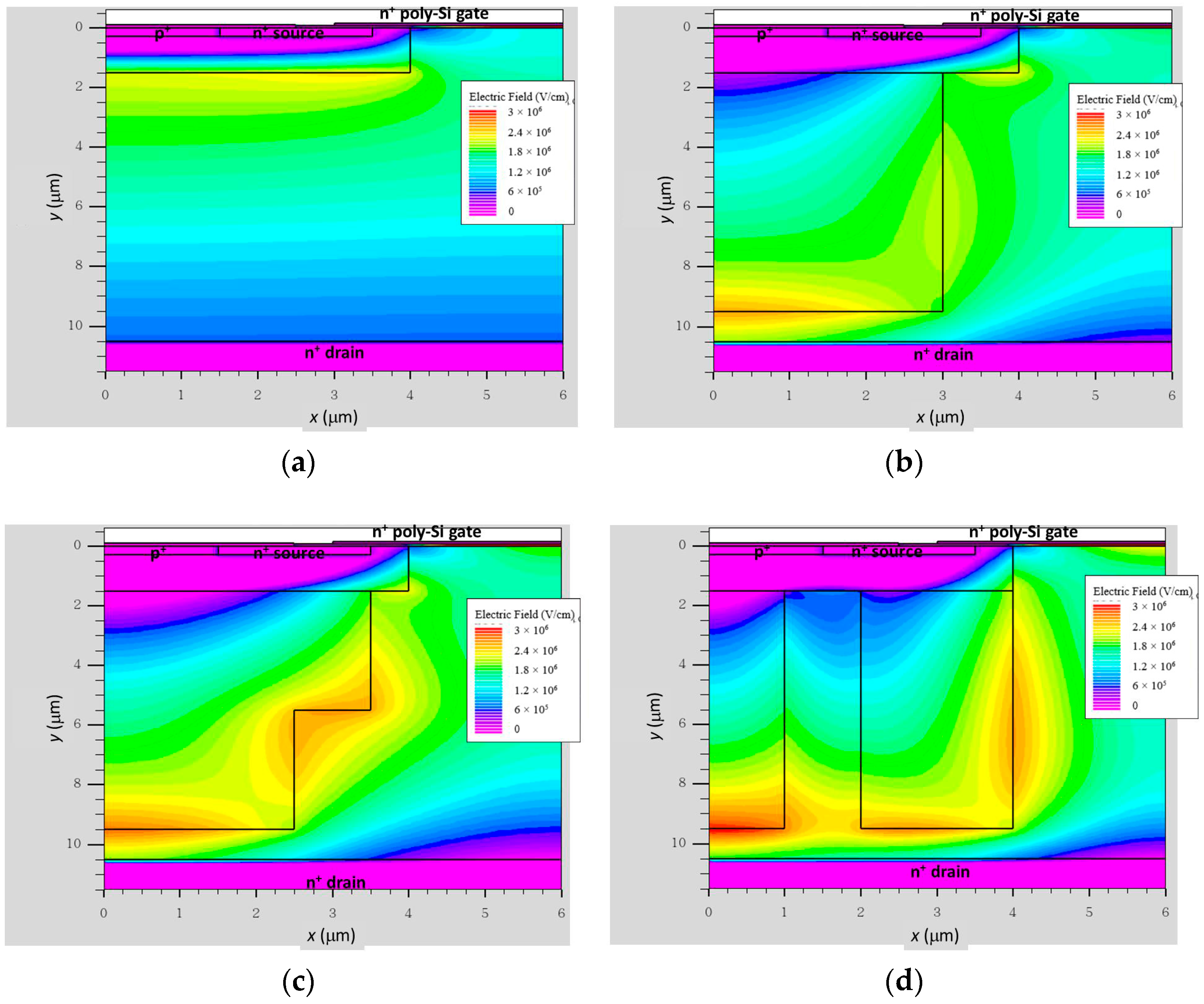
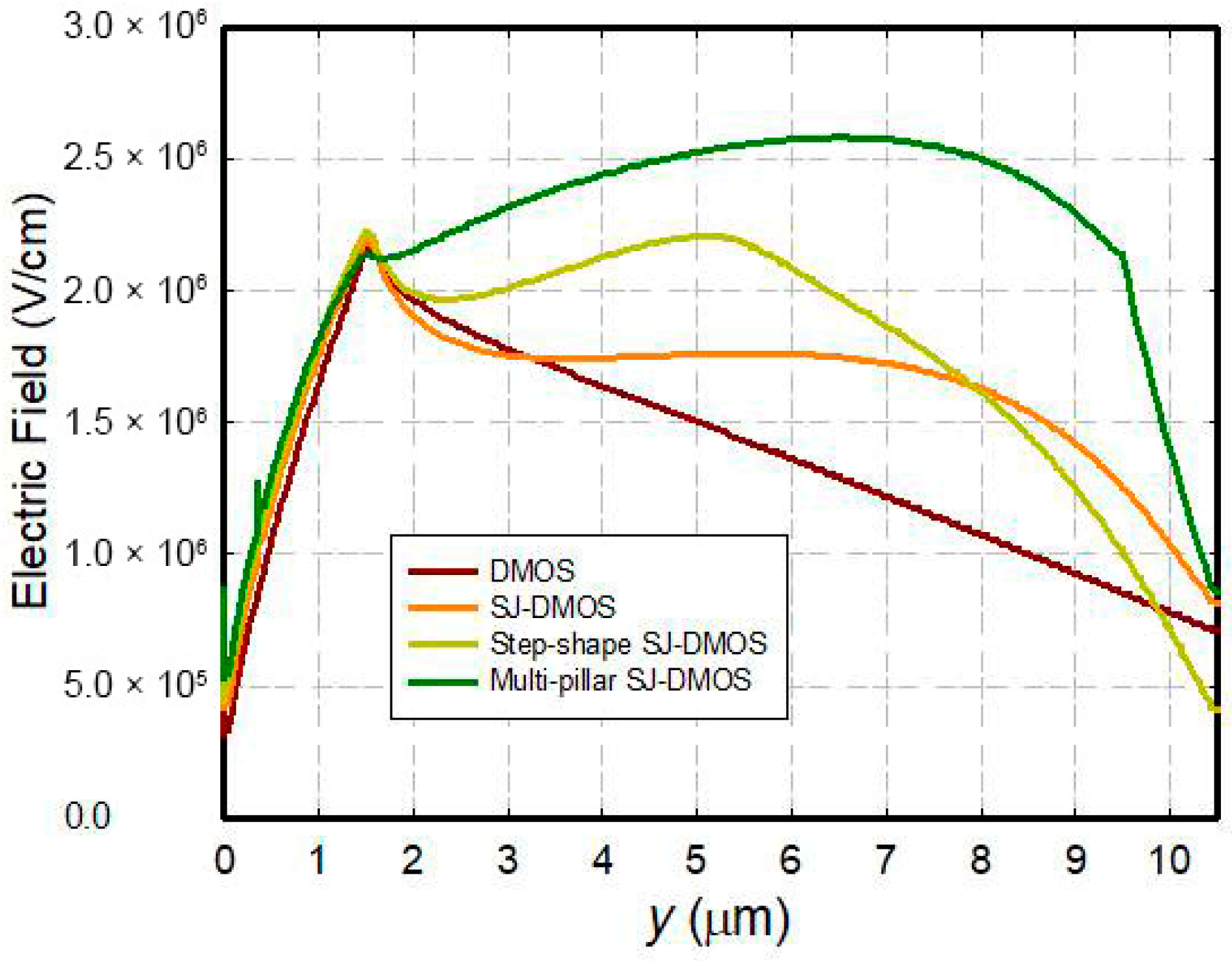
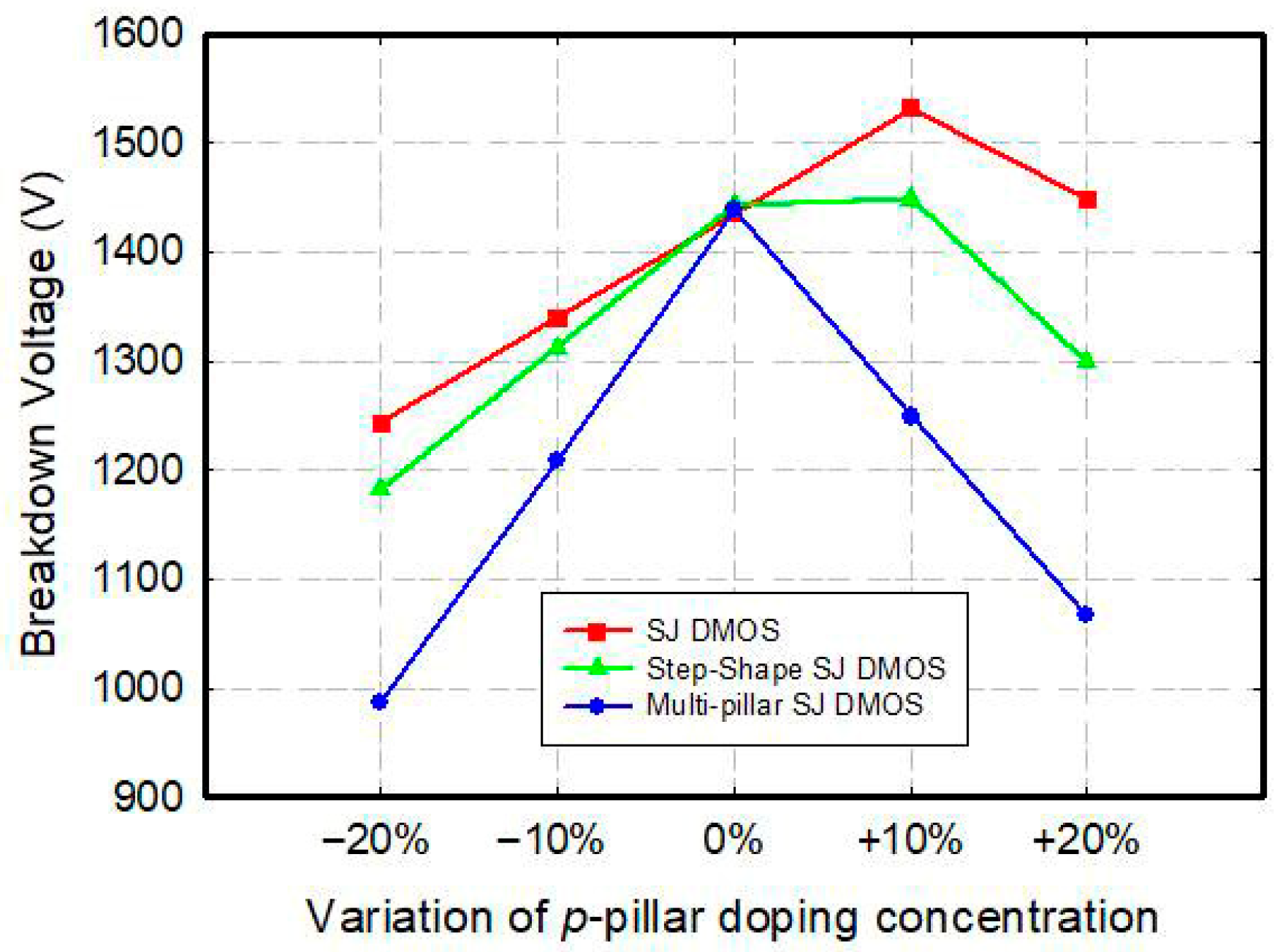
A higher dcFoM indicates better dc performance, i.e., higher breakdown voltage and lower ON resistance. In Table 2, the SJ devices show 2–3 times higher dcFoM than that of the conventional DMOSFET, especially the step-shape SJ DMOSFET and the multi-pillar SJ DMOSFET. This is because the SJ devices have the lower specific ON resistance than that of the conventional DMOSFET, but their breakdown voltage is even slightly larger than that of the conventional DMOSFET. Figure 6a–d show the electric-field distributions at the breakdown of the four devices shown in Figure 1. The high-field area of the SJ devices is obviously larger than that of the conventional DMOSFET, which means high electric field does not concentrate locally for the SJ devices. Therefore, the SJ devices can maintain their breakdown voltage under increased n-drift doping concentrations. Although the high-field region of the conventional DMOSFET (Figure 6a) is not prominent, the punch-through effect between the source and the n-drift region is more pronounced in the conventional DMOSFET than those in the SJ devices. Consequently, the conventional DMOSFET generates the same current for the breakdown criterion under a lower electric field. Figure 7 shows the one-dimensional electric-field distributions at breakdown along the y-axis at x = 4 μm (which is the edge of the p-base region) of the four devices shown in Figure 1. A local peak of electric field appears for each device structure at y = 1.5 μm, corresponding to the junction depth of the p-base region. For the SJ devices, the electric field continues to spread over several micrometers instead of decreasing linearly, as in the conventional DMOSFET. Therefore, the SJ devices can keep the breakdown voltage under the raised n-drift doping concentrations. We also conducted a preliminary examination on the sensitivity of the breakdown voltage to the p-pillar doping concentration for the SJ devices with different p-pillar configurations, as shown in Figure 8. In Figure 8, the conventional SJ DMOSFET and the step-shape SJ DMOSFET exhibit lower breakdown-voltage sensitivity than that of the multi-pillar SJ DMOSFET. The underlying reason is still under investigation, but may be related to the higher p-pillar doping concentration of the multi-pillar SJ DMOSFET.
Figure 6. Electric-field distributions at breakdown for the four 1.2 kV 4H-SiC DMOSFETs shown in Figure 1: (a) the conventional DMOSFET; (b) the conventional SJ DMOSFET; (c) the SJ DMOSFET with the “step-shape” p-pillar; and (d) the multi-pillar SJ DMOSFET.
Figure 7. The 1D electric-field distributions at breakdown along the y-axis at x = 4 μm (which is the edge of the p-base region) of the four devices shown in Figure 1. Local field peaks occur at y = 1.5 μm, corresponding to the junction depth of the p-base region.
Figure 8. Breakdown voltage versus p-pillar doping-concentration variation for the SJ devices with different p-pillar configurations.
We also evaluated the ac performance by extracting the capacitances between the terminals of the simulated devices at the frequency of 1 MHz under VD = 1 kV and VG = 0 V. The ac performance (e.g., Cgs,sp and Cgd,sp) for the four devices is also shown in Table 2. The simulated values of the conventional DMOSFET in Table 2 and the measurement data of the inversion-mode DMOSFETs in Table I of [12] are of the same order of magnitude, which confirms the validity of the simulation data. The SJ devices have lower Cgs,sp and Cgd,sp than those of the conventional DMOSFET. Since the p-pillars can be regarded as the lightly doped p-base extension, the p-pillars will reduce the capacitance between the gate and the p-base, which is a component of Cgs,sp. However, the gate oxide capacitance still dominates Cgs,sp, and the reduction in Cgs,sp by the p-pillars is less than 10%. The reduction of Cgd,sp by the p-pillars is attributed to the reduction in the n-drift region under the gate. When the p-pillar edge is closer to the p-base edge, as shown in Figure 1b–d, the n-drift depletion region controlled by the gate decreases; consequently, Cgd,sp decreases. The Cgd,sp of the multi-pillar SJ DMOSFET is approximately 75% of that of the conventional DMOSFET. However, the SJ devices have higher Cds,sp than that of the conventional DMOSFET because the area of the p–n junctions in the SJ devices are larger than that in the conventional DMOSFET. Note that the specific input capacitance Ciss,sp in Table 2 is defined by Cgs,sp plus Cgd,sp. The acFoM1 and acFoM2 in Table 2 are defined by the following:
acFoM1 = Ron,sp × Cgd,sp,
acFoM2 = Ciss,sp/Cgd,sp.
A lower acFoM1 indicates better switching capacity, i.e., higher switching speed and lower switching power losses. As shown in Table 2, the acFoM1 of the SJ devices is only 0.25–0.4 times that of the conventional DMOSFET. This is because both the Ron,sp and the Cgd,sp of the SJ devices are lower than those of the conventional DMOSFET. Another metric used to evaluate the switching performance is acFoM2. The Cgd,sp results in the Miller effect, which brings the so-called “Miller plateau” in the Qg–Vg curve and reduces the switching efficiency. Therefore, a higher acFoM2 indicates better switching capacity. In Table 2, the SJ devices show higher acFoM2 than the conventional DMOSFET, mainly due to their lower Cgd,sps. In summary, since the step-shape p-pillar SJ DMOSFET and the multi-pillar SJ DMOSFET have lower Cgd,sp and Ron,sp than those of the conventional DMOSFET and the optimized conventional SJ DMOSFET, the step-shape p-pillar SJ DMOSFET and the multi-pillar SJ DMOSFET showed the superior acFoM1 and acFoM2 than those of the other two devices.

4. Conclusions

In this work, we examined the dc and ac performance of the 1.2 kV 4H-SiC SJ DMOSFET with different configurations of pillars by the TCAD simulation. The simulation results indicate the SJ devices can have better dc and ac performance than that of the conventional DMOSFET. In addition, both the step-shape p-pillar SJ DMOSFET and the multi-pillar SJ DMOSFET can have better dc and ac performance than that of the optimized conventional SJ DMOSFET. The step-shape p-pillar SJ DMOSFET structure has a lower p-pillar aspect ratio than that of the multi-pillar SJ DMOSFET. Therefore, considering the difficulty of the manufacturing process, the step-shape p-pillar SJ DMOSFET structure is considerably promising according to our simulation results. A more comprehensive investigation with a detailed analysis of the sensitivities of the dc and ac performance to the doping concentrations of the SJ devices with different p-pillar configurations will be work for the future.

Author Contributions

Conceptualization, K.-M.L.; methodology, K.-M.L. and S.-C.O.; software, S.-C.O.; validation, K.-M.L.; formal analysis, K.-M.L.; investigation, K.-M.L. and S.-C.O.; resources, K.-M.L.; data curation, K.-M.L.; writing—original draft preparation, K.-M.L.; writing—review and editing, K.-M.L.; visualization, K.-M.L. and S.-C.O.; supervision, K.-M.L.; project administration, K.-M.L.; funding acquisition, K.-M.L. All authors have read and agreed to the published version of the manuscript.

Funding

This research was funded by Taiwan National Science and Technology Council (NSTC), grant number NSTC 113-2221-E-259-010.

Data Availability Statement

The datasets generated during and/or analyzed during the current study are available from the corresponding author on request.

Acknowledgments

We thank the National Center for High-performance Computing (NCHC) of National Applied Research Laboratories (NARLabs) in Taiwan for providing computational and storage resources.

Conflicts of Interest

The authors declare no conflicts of interest. The funders had no role in the design of the study; in the collection, analyses, or interpretation of data; in the writing of the manuscript; or in the decision to publish the results.

Abbreviations

The following abbreviations are used in this manuscript:
SiCSilicon carbide
SJSuperjunction
DMOSFETDouble-implanted MOSFET

References

  1. Mikamura, Y.; Hiratsuka, K.; Tsuno, T.; Michikoshi, H.; Tanaka, S.; Masuda, T.; Wada, K.; Horii, T.; Genba, J.; Hiyoshi, T.; et al. Novel designed SiC devices for high power and high efficiency systems. IEEE Trans. Electron. Devices 2015, 62, 382–389. [Google Scholar] [CrossRef]
  2. Mihaila, A.; Knoll, L.; Bianda, E.; Bellini, M.; Wirths, S.; Alfieri, G.; Kranz, L.; Canales, F.; Rahimo, M. The current status and future prospects of SiC high voltage technology. In Proceedings of the IEEE International Electron Devices Meeting (IEDM), San Francisco, CA, USA, 1–5 December 2018. [Google Scholar] [CrossRef]
  3. Ino, K.; Miura, M.; Nakano, Y.; Aketa, M.; Kawamoto, N. SiC power device evolution opening a new era in power electronics. In Proceedings of the International Conference on Electron Devices and Solid-State Circuits (EDSSC), Xi’an, China, 12–14 June 2019. [Google Scholar] [CrossRef]
  4. Huang, H.; Wang, Y.; Yu, C.-H.; Tang, Z.-H.; Li, X.-J.; Yang, J.-Q.; Cao, F. A high-performance SiC super-junction MOSFET with a step-doping profile. IEEE J. Electron. Devices Soc. 2021, 9, 1084–1092. [Google Scholar] [CrossRef]
  5. Kosugi, R.; Ji, S.; Mochizuki, K.; Adachi, K.; Segawa, S.; Kawada, Y.; Yonezawa, Y.; Okumura, H. Breaking the theoretical limit of 6.5 kV-class 4H-SiC super-junction (SJ) MOSFETs by trench-filling epitaxial growth. In Proceedings of the 31st International Symposium on Power Semiconductor Devices & ICs, Shanghai, China, 19–23 May 2019. [Google Scholar] [CrossRef]
  6. Vudumula, P.; Kotamraju, S. Design and optimization of SiC super-junction MOSFET using vertical variation doping profile. IEEE Trans. Electron. Devices 2019, 66, 1402–1408. [Google Scholar] [CrossRef]
  7. Guo, X.; Tian, X.; Bai, Y.; Lei, T.; Han, Z.; Song, G. Simulation study on super-junction SiC MOSFET with different PN pillar numbers. In Proceedings of the International Conference on Electron Devices and Solid-State Circuits (EDSSC), Xi’an, China, 12–14 June 2019. [Google Scholar] [CrossRef]
  8. Lee, Y.; Lin, K.; Lee, K. The impact of the p-pillar structure design on breakdown voltage for 1.2 kV 4H-SiC superjunction DMOSFET. In Proceedings of the IEEE International Future Energy Electronics Conference (IFEEC), Taipei, Taiwan, 16–19 November 2021. [Google Scholar] [CrossRef]
  9. Kobayashi, Y.; Kyogoku, S.; Morimoto, T.; Kumazawa, T.; Yamashiro, Y.; Takei, M.; Harada, S. High-temperature performance of 1.2 kV-class SiC super junction MOSFET. In Proceedings of the 31st International Symposium on Power Semiconductor Devices & ICs, Shanghai, China, 19–23 May 2019. [Google Scholar] [CrossRef]
  10. Sometani, M.; Oozono, K.; Ji, S.; Morimoto, T.; Kato, T.; Kojima, K.; Harada, S. Comparative study of performance of SiC SJ-MOSFETs formed by multi-epitaxial growth and trench-filling epitaxial growth. In Proceedings of the 34th International Symposium on Power Semiconductor Devices & ICs, Vancouver, BC, Canada, 22–25 May 2022. [Google Scholar] [CrossRef]
  11. Yin, S.; Cao, W.; Hu, X.; Ge, X.; Liu, D. A novel super-junction DT-MOS with floating p regions to improve short-circuit ruggedness. Micromachines 2023, 14, 1962. [Google Scholar] [CrossRef] [PubMed]
  12. Han, K.; Baliga, B.J. Comparison of four cell topologies for 1.2-kV accumulation- and inversion-channel 4H-SiC MOSFETs: Analysis and experimental results. IEEE Trans. Electron. Devices 2019, 66, 2321–2326. [Google Scholar] [CrossRef]
  13. Silvaco Inc. Atlas User Manual; Silvaco Inc.: Santa Clara, CA, USA, 2024; pp. 182–352. [Google Scholar]
  14. Baliga, B.J. Fundamentals of Power Semiconductor Devices; Springer: New York, NY, USA, 2019; pp. 32–35. [Google Scholar] [CrossRef]
Disclaimer/Publisher’s Note: The statements, opinions and data contained in all publications are solely those of the individual author(s) and contributor(s) and not of MDPI and/or the editor(s). MDPI and/or the editor(s) disclaim responsibility for any injury to people or property resulting from any ideas, methods, instructions or products referred to in the content.

Article Metrics

Citations

Article Access Statistics

Multiple requests from the same IP address are counted as one view.