
Systematic Review

Does Early or Timely Diagnosis Benefit People with Dementia and Their Carers? A Systematic Review

1
Institute of Mental Health, University of Nottingham, Nottingham NG8 1BB, UK
2
School for Business and Society, University of York, York YO10 5DD, UK
3
Brighton and Sussex Medical School, University of Sussex, Brighton BN1 9PX, UK
4
Sussex NHS Foundation Trust, Brighton BN11 2DH, UK
5
Faculty of Health, University of Plymouth, Plymouth PL4 8AA, UK
*
Author to whom correspondence should be addressed.
These authors contributed equally to this work.
J. Dement. Alzheimer's Dis. 2026, 3(1), 15; https://doi.org/10.3390/jdad3010015
Submission received: 28 November 2025 / Revised: 15 January 2026 / Accepted: 2 March 2026 / Published: 18 March 2026

Abstract

Background: Global dementia policies advocate for early or timely diagnosis, yet evidence on benefits or harms remains limited. This systematic review evaluates quantitative evidence comparing outcomes of early versus late and timely versus untimely dementia diagnoses. Methods: Following PRISMA guidelines, the protocol was registered on PROSPERO. Comprehensive searches of PsycINFO, Medline, Embase, SCOPUS, and CINAHL were conducted without date restrictions. Eligible studies defined diagnostic timing and examined associations with outcomes for people with dementia and/or carers. Quality was appraised using the QuADS tool, and data were narratively synthesised. Results: Four studies (2018–2021) met inclusion criteria, encompassing 37,341 individuals with dementia and 1409 carers across Europe and the United States. Three studies investigated early versus late diagnosis; one assessed perceived timeliness. Definitions varied. Evidence of benefit was limited: one study reported a 9–23% reduction in mortality risk for early diagnosis. Another found that carers perceiving the diagnosis as untimely experienced greater and more persistent emotional distress. No significant associations were observed for cognitive or functional decline, hospitalisation, or emergency department attendance. Conclusions: Despite strong policy endorsement, empirical evidence on benefits of early or timely dementia diagnosis remains scarce, geographically narrow, and methodologically constrained. Future longitudinal studies explicitly defining diagnostic timing and incorporating psychosocial and contextual factors are needed to clarify potential benefits or harms for people with dementia and their carers.

1. Introduction

Global dementia policy directives universally advocate for an early or timely diagnosis [1,2,3]. Typically, ‘early’ diagnosis is associated with receiving a diagnosis in the preliminary symptomatic stages of the condition (i.e., cognitively early), or close to when people first become aware of cognitive issues or other clinical manifestations (i.e., temporally early). More recently, some have argued for clinical efforts to focus on achieving a ‘timely’ diagnosis [4]. This person-centred concept is defined as the point when people living with the condition, including those around them, feel they are ready for the diagnosis and/or that they will benefit from it.
Embarking on the diagnostic journey in dementia is rarely an easy choice [5], partly reflected in figures suggesting that 75% of all cases of dementia go undiagnosed around the world [6]. Research has highlighted powerful psychological barriers (e.g., fear, denial, normalisation of symptoms) and systemic hurdles (e.g., ‘postcode lottery’ of access to specialist diagnostic services, fragmentation of health services, unclear referral pathways) that may have to be overcome to receive a diagnosis [7,8,9]. These challenges can be exacerbated in marginalised communities [10,11], and for those with rarer forms of dementia [12], giving rise to further delays and inequities. Furthermore, other studies show that the initial shock of a dementia diagnosis can take a psychological toll, adversely impacting, for a time at least, on the well-being of the person [13] and their family members [14]. Advocates for early diagnosis hold that it is a means for people to sustain their well-being, better manage the condition, plan for the future and safeguard their human rights [3,15]. The case for early diagnosis becomes more compelling with the introduction of new medications that are only appropriate, or of most use, in the earliest stages of conditions causing dementia, such as Alzheimer’s disease (AD) [2].
Exploratory qualitative work eliciting views on diagnostic timing from people with dementia (N = 2) and their family carers (N = 12) found that early diagnosis was seen as a chance for people to better understand the condition and so prevent crisis, involve the person with dementia when implementing care decisions, and access services and treatments to manage decline. Although, some carers warned that these benefits were unachievable without willingness from the person with dementia to accept the diagnosis or post-diagnostic support, or without adequate prognostic information and post-diagnostic care [16]. While expert opinions and small-scale qualitative work are important for informing the policy agenda, a more robust empirical evidence base is needed to weigh up the benefits and potential harms of an early vs. late diagnosis and to challenge harmful and fatalistic beliefs that ‘dementia is a normal part of ageing’ and ‘nothing can be done’ [7,17], which result in diagnostic delays.
A seminal 2011 Alzheimer’s Disease International (ADI) report set out to assess the quantitative evidence base for the benefits of an early diagnosis of dementia [15]. Reviewing literature up to March 2011, the authors found three population-based studies that informed their discussions, although none that formally operationalised and sought to directly compare ‘early’ or ‘late’ diagnosis. One large and well-conducted observational study reported an incidental finding from a survival analysis suggesting that the shorter the time between first symptoms and first visit to the memory clinic, the longer the patients survived [18]. Two other studies longitudinally examined the effects of the baseline cognitive performance of people on subsequent cognitive decline. Both had small sample sizes and found no association between the severity of cognitive function at the point of enrolment into memory services and subsequent progression of dementia [19,20]. The authors of the ADI report highlighted the absence of evidence on the impact of an early diagnosis and called for more routine and systematic data collection from memory clinics around the world. It is important to note that the ADI review employed a limited search strategy and only examined records from one literature database (PubMed); it is therefore possible that relevant studies were missed.
A subsequent review by Dubois and colleagues reassessed the evidence base on the benefits and challenges of a ‘timely’ diagnosis for AD (rather than dementia generally), reviewing studies conducted between 2000 and 2014 on two bibliographic databases [21]. They used the concept of ‘timely’ diagnosis to refer to the time when people first became aware of potential symptoms of dementia and sought help, thereby adopting a more biomedical, symptom-based definition where ‘timely’ is akin to ‘early’ diagnosis rather than the person-centred discourse more commonly associated with ‘timely’ diagnosis [22]. The review found no additional quantitative studies to those identified by the ADI 2011 report. Based on these findings the authors re-emphasised the lack of evidence within this field, suggesting that ideas still tended to be based on expert opinion and modelling studies, and advocated for further primary studies assessing the benefits to people with dementia and their family members.
Here, we seek to review the evidence base, critically considering the discourse between early and timely diagnosis. We chose to search a larger range of bibliographic databases than studies hitherto and to incorporate literature that has set out to conceptualise and operationalise ‘early’ and ‘late’ diagnosis as well as ‘timely’ vs. ‘untimely’ diagnosis, to better understand outcomes for people with dementia and their carers. Our review aimed to answer the question, What are the benefits and harms of an early vs. late or timely vs. untimely diagnosis for people with dementia and their family carers?

2. Materials and Methods

2.1. Protocol and Registration

The methods of this systematic review were developed in accordance with the recommendations from the Preferred Reporting Items for Systematic reviews and Meta-Analyses (PRISMA) Protocols statement [23]. The protocol was pre-registered on PROSPERO with reference number CRD42023467964.

2.2. Search Methodology

Our literature search was designed and undertaken by a qualified librarian (KB). Quantitative studies published in English were searched using an accepted systematic review methodology in multiple electronic bibliographic databases, including PsycINFO, Medline, Embase, Scopus and CINAHL. There were no restrictions on search dates. Our search strategy was designed to be broad and sensitive enough to capture all potentially relevant studies. In addition to our electronic search strategy, we undertook citation searches, which involved checking reference lists from primary studies and other reviews and lateral searches, which involved citation searches using the ‘Cited by’ option on Google Scholar. This comprehensive search strategy enabled us to capture any additional potentially relevant studies (see Appendix A).

2.3. Eligible Studies and Inclusion and Exclusion Criteria

The review included observational quantitative or mixed-method studies that explored the association between diagnostic timing and outcomes for people with dementia and/or their carers. These studies could be cross-sectional, longitudinal, prospective and retrospective cohort or survey designs where the outcomes were measured quantitatively. Only original articles written in English that included people with a formal diagnosis of dementia or their family carers were included. Studies employing exclusively qualitative methodologies, reviews, commentaries, conference proceedings and editorials were all excluded. Papers were only included if they had formally operationalised ‘early’ and ‘late’ or ‘timely’ and ‘untimely’ diagnosis and had set out to understand how and whether these concepts were associated with differences in outcome measures. Papers that examined cognition at the point of diagnosis/entry to the study (i.e., mild, moderate or severe dementia) but did not operationalise these into the diagnostic timing were excluded as this could introduce our own bias by inferring the diagnostic timing from the level of cognitive impairment.
All outcomes were considered in primary studies, including the following:
  • Cognitive decline;
  • Functional skills/activities of daily living;
  • Survival rates/mortality;
  • Access to and use of formal or informal services;
  • Quality of life and well-being;
  • Reduction in strain and burden;
  • Nursing/residential care home placement.

2.4. Study Selection

Results were largely de-duplicated in Endnote Desktop, with remaining duplicates manually removed. The remaining articles were transferred into Rayyan software (https://www.rayyan.ai/) [24], where four reviewers (MP, OP, PM and CD) screened the titles and abstracts independently against the predefined inclusion and exclusion criteria. All articles were reviewed by a minimum of two reviewers. Full articles were sought for all potentially relevant studies. All disagreements concerning inclusion were resolved by discussion between two researchers, group discussion or input by another researcher (BH and NF).

2.5. Quality Assessment

All studies were assessed using the Quality Assessment for Diverse Studies (QuADS) tool [25]. The assessments were conducted independently by two reviewers (BH and NF) who then met to discuss the scores for each study and resolve any disagreements based on the QuADS criteria. A median score was created across all studies in each of the 13 areas of the QuADS framework. This approach enabled us to gauge patterns across the existing studies in terms of quality and applicability and so shape our narrative synthesis.

2.6. Data Items and Extraction

Data were extracted independently by two reviewers (OP and BH) for all studies that met the inclusion criteria. Data were entered into a pre-designed form, which was piloted and pre-registered in the review protocol. The extracted data included the data source, study setting, sample characteristics, objectives, design, study authors’ definition/operationalisation of diagnostic timing, quantitative outcomes and results as related to associations/impact with diagnostic timing including correlations, beta co-efficient, or statistical significance on relevant tests as well as confounders controlled for as part of any analyses. If relevant information was not presented sufficiently in the identified studies, it was deemed ‘not reported’. We did not approach authors for clarification due to time constraints.

2.7. Synthesis

Due to the anticipated diverse nature of the study designs and outcome measures, we elected to undertake a narrative synthesis method to describe the results. The results section was divided into thematic headings that were constructed using an inductive approach and driven by the reported outcomes in the results sections of the included studies. Statistical coefficients describing the association between timely or early diagnosis and primary outcomes were reported to support the narrative, along with 95% confidence intervals or p-values. Coefficients adjusted for potential confounders were prioritised in the narrative synthesis. When available, we synthesised associations related to a timely diagnosis separately from those associations related to an early diagnosis.

3. Results

3.1. Identified and Included Studies

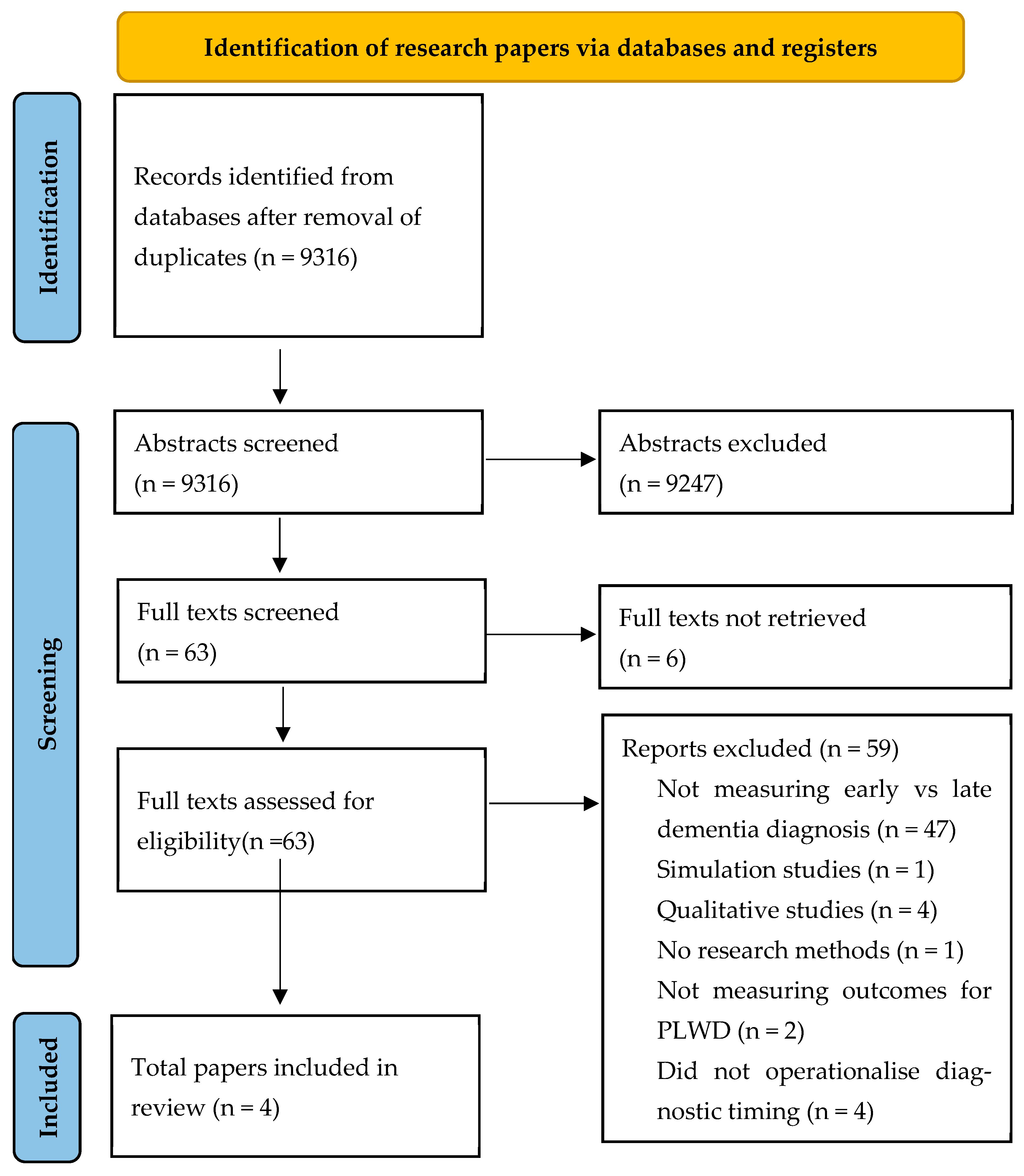
The initial search was conducted on 6 October 2023 and then updated on 24 March 2025 and on 6 May 2025 (Scopus database only, see Appendix B). A total of 20,549 articles were identified through our search strategy. After de-duplication, the titles and abstracts of 9316 articles were screened. From these, 69 articles were deemed potentially relevant and so full texts sought. A total of 63 articles could be obtained and the full texts read, with 4 articles found to meet the inclusion criteria. No additional articles were identified through citation searching. Figure 1 outlines the review process flowchart. Descriptive data were extracted from the four studies.

3.2. Participant and Study Characteristics

Table 1 provides an overview of the data extracted for all studies. The four studies elicited from our search spanned the period of 2018–2021 and consisted of two undertaken in England by the same lead author [26,27], one in the USA [28], and one study that conducted research across multiple European countries (Czech Republic, Finland, Italy, The Netherlands and Scotland) [29]. The four studies represented a total of 37,341 people diagnosed with dementia and 1409 family carers, the latter all derived from one study. Overall, 60% of the people with dementia and 83% of the carers were female. Only one study reported the type of dementia (AD) [28]. Of the three studies that reported ethnicity [26,27,28], 75% of people with dementia were white, 16% Black, 4% Asian and 4% ‘other’ for their ethnicity. The one study examining carer outcomes did not report on the ethnicity of the participants [29]. Across the three studies examining people with dementia [26,27,28], 9% received an ‘early’ diagnosis of dementia, and in the one study examining carers’ perceptions of timeliness [29], 42% felt the diagnosis was made at the right time.
Three studies used observational, retrospective longitudinal cohorts and examined outcomes associated with an early vs. late diagnosis of dementia [26,27,28]. To achieve this, one study constructed a temporal measure of ‘early’ vs. ‘late’ diagnosis by comparing those with shorter time periods between first noticing symptoms of dementia to receiving a diagnosis (≤3.5 years) and those with longer time periods between these two events (>5.7 years) [28]. The other two studies operationalised an ‘early’ diagnosis by comparing those with a diagnosis of MCI prior to receiving a diagnosis of dementia (early) with those who only received a diagnosis of dementia with no prior MCI diagnosis (not early/later) [26,27]. Only one study examined the subjective timeliness of the diagnosis by comparing carers who perceived the diagnosis to be made ‘at the right time’ (timely) with those who felt ‘it would have been better if the diagnosis had been made earlier’ (untimely) [10]. The outcome measures for studies examining early vs. late diagnosis were varied. One study explored the rate of cognitive and functional decline [28], one study assessed mortality/survival rates [27], and the final study examined hospitalisation and emergency department attendance [26]. The only study to look at timely vs. untimely diagnosis elicited multiple aspects of self-reported carer psychological well-being immediately after the diagnosis (retrospectively) and at the point of entry to the study [29].

3.3. Risk of Bias Across the Studies

Table 2 provides an overview of the final QuADS scores for each study. Generally, the review found most studies to be of reasonable quality, drawing on theoretical work to develop strong research designs that enabled the authors to examine the impacts of an early vs. late or timely vs. untimely diagnosis on a range of outcome measures. Where there were limitations noted across the studies, this was often in relation to the justification for sampling strategies to address the research questions, rationale for choice of data collection tools and description of the data collection procedure. It is interesting to note that rarely did studies discuss engaging with research stakeholders when designing or undertaking the research.

3.4. Narrative Synthesis

All four studies were included in the narrative synthesis. The inductive themes constructed from the analysis focused on the key outcome measures that were examined across the studies, which included cognitive and functional decline, survival rates, use of healthcare services, and psychological well-being.

3.4.1. Cognitive and Functional Decline

One longitudinal cohort study examined the impact of an earlier vs. later diagnosis of AD on cognitive and functional decline by comparing those with shorter time periods between first noticing symptoms of dementia to receiving a diagnosis (≤3.5 years) with those with longer time periods between these two events (>5.7 years) [28]. The research drew on participants with a diagnosis of AD on the National Alzheimer’s Coordinating Centre Uniform Data Set between September 2005 and June 2015. The study used Kaplan–Meier (K-M) survival analysis and multivariable Cox models to compare the time from the index visit to the development of outcomes between early and late cohorts. The authors reported that after adjusting for baseline differences (age, gender, race and years of education, year of initial visit, primary referral source, presence of psychiatric disorders, cognitive characteristics and functional characteristics), there was no difference in the median time from index visit to a decrease in ≥3 points in the Mini-Mental State Examination (MMSE) (adjusted HR: 1.04, 95% CI: (0.94, 1.15) or ≥2 points on the Global Clinical Dementia Rating Scale (adjusted HR: 1.02, 95% CI: (0.96, 1.17). Furthermore, there were no differences in the two cohorts in the K-M-based median time from index visit to an increase of ≥1 points on ≥4 items on the Functional Assessment Questionnaire (adjusted HR: 1.07, 95% CI: (0.96, 1.19). The authors report that while earlier diagnosis of AD is associated with higher cognitive function, greater independence and lower functional impairment at diagnosis, the progression overtime is similar for early vs. late diagnosis. However, people with an ‘early’ diagnosis continued to have relatively better cognitive abilities than those with a later diagnosis, although the functional capabilities for the two cohorts converged over time. The authors suggest that the findings are relevant for future disease-modifying therapies, as earlier diagnosed patients could be treated while cognitive and functional abilities are greater.
No studies exploring the impact of a timely vs. untimely diagnosis on cognitive and functional decline were identified.

3.4.2. Mortality/Survival Rates

One study examined survival times using data from the electronic healthcare records from South London and Maudsley NHS Trust (SLaM) collected between 2008 and 2018 [27]. The authors compared those with a prior diagnosis of MCI before a diagnosis of dementia (‘early diagnosis’) with those with a diagnosis of dementia without a previous MCI diagnosis (‘late diagnosis’) by employing Kaplan–Meier curves and Cox regression models to investigate variables associated with an early diagnosis. The analysis found a median survival time of 4.02 years, and there was an increase in survival times for people with an early vs. late diagnosis (Log-rank test: χ2 = 17.2, p < 0.01). When adjusting for a range of confounding factors, the hazard of mortality remained significantly lower in the early vs. late diagnosis cohorts (HR between 0.77 and 0.92), with the risk of mortality between 9 and 23% lower in participants with an early diagnosis. This significant finding was apparent in all but one of the models, which used the MMSE to account for cognition (HR = 0.92, CI = 0.83–1.04). The authors concluded that although their evidence suggested an association between an early diagnosis of MCI and a lower risk of mortality, it was unclear how the level of cognitive function (MMSE scores) at diagnosis affects the relationship.
No studies exploring the impact of a timely vs. untimely diagnosis on survival rates were identified.

3.4.3. Access and Use of Formal/Informal Services

A further study by the same research team also used data from the electronic healthcare records from SLaM, collected between 2008 and 2016, to compare the risk of hospitalisation or emergency department (ED) attendance between those with a prior diagnosis of MCI before a diagnosis of dementia (‘early diagnosis’) and those with a diagnosis of dementia without a previous MCI diagnosis (‘late diagnosis) [26]. This observational, longitudinal, retrospective cohort study found that the median time to first hospitalisation after a dementia diagnosis was 11.5 months. Adjusted Cox regression models (accounting for age, gender, ethnicity, marital status, MMSE scores at diagnosis, co-morbidities, prescription of AChEIs, activities of daily living, psychiatric symptoms and hospitalisation/ED attendance before dementia diagnosis) found no significant difference in the risk of hospitalisation between the groups (Adjusted HR: 0.99, CI: 0.91–1.08). Negative binomial regressions, adjusted for similar confounders and follow-up times, showed no significant difference in the number of days spent in hospital between the groups (IRR = 0.97, CI = 0.85–1.12). The study did find that of the over two-thirds of participants who attended ED after their dementia diagnosis (75.5%), the median time to first ED attendance was significantly shorter in the early compared to the late diagnosis groups (8.9 months compared with 10.6 months). However, adjusted Cox regression models found that those with an early diagnosis had a marginally increased risk of attending the ED (HR = 1.09, CI = 1.00–1.18, p = 0.04), but negative binomial regressions found no significant difference in the count of ED attendance (IRR = 1.04, CI = 0.95–1.13). The authors concluded that an early diagnosis alone is not sufficient to reduce the need for hospitalisation and ED attendance while identifying that their operationalisation of early vs. late diagnostic timing may be more reflective of people’s help-seeking behaviour rather than the impact of diagnostic timing.
No studies exploring the impact of perceived diagnostic timeliness on healthcare use were identified.

3.4.4. Quality of Life and Well-Being

One cross-sectional quantitative survey assessed the impact of the association between a perceived timely vs. untimely dementia diagnosis on informal carers’ retrospective reports of well-being immediately post-diagnosis and at the point of the survey (3–4 years later) [29]. A total of 1409 family carers were recruited via five Alzheimer’s Associations across Europe. Nearly half of the carers (47%) reported that a diagnosis would have been more useful if it had been earlier. Carers were given pre-defined psychological reactions (relief, reassurance, acceptance, worry about the future, sadness/depression, despair and anger) and asked to select whether they experienced them immediately after the diagnosis and at the time of interview (mean four years later). Carers who perceived the diagnosis could have been made earlier (i.e., where the diagnostic timing was untimely) were significantly more likely to report sadness and depression (χ2 = 12.78; p < 0.0001), despair (χ2 = 11.71; p = 0.001), anger (χ2 = 11.83, p = 0.001) and worry about the future (χ2 = 15.75, p < 0.0001) as well as a sense of relief (χ2 = 13.44, p < 0.0001) at the point of diagnosis than carers who felt the diagnosis had been made in a timely manner. Feelings of sadness and depression (χ2 = 15.99, p < 0.0001) and despair (χ2 = 7.27, p = 0.007) were more likely to persist to the interview time for those who felt the diagnosis was untimely versus timely. The authors concluded that the findings highlighted the importance of a timely diagnosis for enabling carers to adjust to the diagnosis in the short and longer term. In this study, however, untimeliness was defined as a diagnosis made too late, so the same conclusions might apply to early(er) versus late(er) diagnosis.
No studies examining the impact of a timely vs. untimely diagnosis of dementia on the well-being of people with dementia were identified. Furthermore, no studies exploring an early vs. late diagnosis of dementia examined its association with the psychological well-being of people with dementia or their carers.

3.4.5. Reduction in Strain and Burden

No studies were found reporting on these outcomes.

3.4.6. Time to Nursing/Residential Care Home Placement

No studies were found reporting on these outcomes.

4. Discussion

This systematic review provides an overview and interrogation of the existing quantitative literature that directly compares outcomes for an early vs. late and/or a timely vs. untimely diagnosis of dementia, however defined. Despite undertaking the most comprehensive review to date, spanning a longer period and more bibliographic databases than previous reviews, we found very little research in this area. This lack of evidence is striking given that academic consensus on the value of early or timely diagnosis over ones made late or in an untimely fashion, and supporting early or timely diagnosis, underpins most global policy directives concerned with positive dementia care [1,3]. We need more robust longitudinal observational studies that explicitly operationalise and directly aim to examine early vs. late diagnosis outcomes to generate a firmer evidence base to delineate the value, or potential harms, of early or timely diagnosis. These may help dispel the still common fatalistic myths and therapeutic nihilism that nothing can be done to help those with dementia, short of a “cure” [7]. Also, as the current evidence reviewed comes from the USA or Europe, we need evidence from other high-income countries as well as low-and middle-income countries, where 71% of people with dementia will live by 2050 [30,31].
It is perhaps unsurprising that given this evidence gap, a person-centred discourse around seeking a subjective ‘timely’ diagnosis is emerging [22]. However, our review shows that there is even less quantitative evidence for this diagnostic measure. We identified only one study aiming to explicitly address this: a cross-sectional survey eliciting the views of carers retrospectively reporting on how they felt at the time of diagnosis, 3–4 years later [29]. No data were found examining the impact of a timely vs. untimely diagnosis on outcomes for people with dementia. Further research directly correlating objective measures of diagnostic timing (cognitive and/or temporal) with subjective measures of timeliness and comparing outcomes associated with each approach (early and timely) would provide welcome evidence to inform policy and practice.
It is positive that the studies we elicited from our review were of reasonable quality, when appraised using the QuADS tool, and none reported adverse effects to people with dementia and their carers based on an early or timely diagnosis. However, there is limited evidence at present to suggest any benefits for either approach when confounding variables are accounted for. The most promising evidence supporting the benefits of early vs. late diagnosis is in survival rates, where there was an increase in survival times for people with an early vs. late diagnosis and the risk of mortality was between 9 and 23% lower in participants with an early diagnosis [27]. No evidence was found for the benefits of an early diagnosis on the maintenance of cognitive and functional abilities post-diagnosis or in the reduction in use of formal health services [26,28]. The validity of current findings is also arguably undermined by inconsistent operational definitions of diagnostic timing. For example, categorising those who were diagnosed with MCI prior to dementia as an ‘early’ diagnosis [26,28] might be too indirect to achieve sufficient specificity. As such, a standardised framework for defining and measuring ‘early’ or ‘timely’ diagnosis is required. In addition, studies only examine basic sociodemographic details and outcomes and so may not be nuanced enough to help us identify benefits or harms for people with dementia and their carers. Factors such as people’s psychological coping techniques, familial and non-familial support networks, and willingness and ability to remain mentally, physically and socially active and to put in place pharmacological and psychosocial interventions at the right time, all of which may be aided by an early diagnosis [3,15], are likely to play a role in whether people are able to realise any benefits associated with an early diagnosis. Future research, drawing on prospective cohorts that comprehensively assess the post-diagnostic experience of people with dementia and their carers, would help us to better understand in what circumstances, if any, an earlier or a timely diagnosis may provide benefits over time.
A fundamental goal of policy and practice encouraging people to seek an early diagnosis of dementia is to support people and their families to live well with the condition [2,3,15]. Therefore, it is surprising there is no quantitative evidence to date that examines the impact of an early vs. late diagnosis on well-being or quality of life outcomes. Our review found only one study concerned with this outcome [29], which was limited in the conclusions it could draw due to challenges with its study design. The cross-sectional survey compared the retrospective accounts of carers, using non-psychometrically robust measures of psychological well-being, following a perceived timely vs. untimely diagnosis of dementia. Research suggests that the quality of the dementia disclosure process can impact on people’s well-being both immediately post-diagnosis and moving forward as they live with the condition [32]. The study identified in our review highlights the importance of the diagnostic disclosure for self-reported well-being, as carers who perceived the disclosure meeting to be positive were also likely to report lower negative emotional well-being scores immediately after the diagnosis and at the time of the research [29]. Research is needed that incorporates measures of diagnostic timing (both early vs. late and timely vs. untimely) alongside psychometrically robust measures of diagnostic quality to explore their relationship and impact on short-, medium- and long-term well-being of people with dementia and their carers.
Our review found only one study that examined the impact of an early vs. late diagnosis on the use of healthcare services and found limited impact of diagnostic timing [26]. Studies that use either a cognitive or temporal measure of diagnostic timing may provide more useful findings. Modelling studies suggest that early diagnosis and intervention may delay a person’s time to institutionalisation, resulting in societal cost savings [21,33]; however, at present, there is no primary research that tests these hypotheses. Again, this is a gap in the evidence base that needs addressing.
What is clear is that this will be a rapidly changing landscape with the availability of new disease-modifiable treatments (e.g., Lecanemab and Donanemab). The fact that these medications require people to have early-stage Alzheimer’s disease provides added impetus to detect Alzheimer’s disease earlier [34]. While early intervention will open up opportunities to slow cognitive and functional decline, the potential for unforeseen harms (particularly for those diagnosed yet deemed ineligible for treatment) remains a critical concern.

Strengths and Limitations

We have undertaken the most comprehensive review to date exploring the quantitative evidence base on the impact of an early vs. late or timely vs. untimely diagnosis of dementia. We used a pre-defined protocol and systematic methods to examine a range of bibliographic databases, and multiple researchers worked independently to screen articles and extract relevant data. Unfortunately, there were few papers to draw on when seeking to understand the benefits or harms of an early vs. late and timely vs. untimely diagnosis. One explanation may be due to our inclusion criteria, as we sought to only include studies that had explicitly defined and operationalised early vs. late or timely vs. untimely diagnosis rather than more broadly including studies that implied diagnostic timing within their design (i.e., those that may have examined or controlled for cognitive scores at baseline/time of diagnosis as a proxy for early vs. late diagnosis) without explicitly stating so. This approach helped to ensure we did not over-interpret other researchers’ work within our review, but it narrowed the number of studies we were able to include. A further review with broader inclusion criteria to include cohort studies that have accounted for cognitive scores close to the point of diagnosis would be of value to build on the preliminary evidence we have outlined. Irrespective, we need to generate consensus on how diagnostic timing and cognitive scores equate to an early or timely diagnosis, and whether there are other more pertinent indices to consider (e.g., pathological load). Furthermore, we did not include papers that were not written in English or those with a qualitative design. The latter studies may have provided complementary insights into the value of an early or timely diagnosis and the mechanisms through which these benefits could be achieved [16,35].

5. Conclusions

This systematic review highlights a striking paradox between global policy directives pushing for early or timely diagnosis and the paucity of quantitative evidence substantiating their purported benefits. Despite limited findings suggesting modest improvements in survival rates for early diagnosis, the wider evidence base provides little clarity on whether diagnostic timing can benefit cognitive, functional, or well-being outcomes. While current evidence does not support the abandonment of early or timely diagnosis policies, it is critical to avoid the assumption that achieving these milestones holds universal value. Even with the emergence of disease-modifying treatments for Alzheimer’s disease, the personal utility of an early or timely diagnosis needs to be explored. Future research must adopt methodologically rigorous, prospective designs that explore the complex interactions between diagnostic timing and the psychosocial, behavioural, and contextual determinants that may influence outcomes for people with dementia and their carers. Only through addressing these evidence gaps can we determine whether current policy directives promoting early or timely diagnosis will truly advance the overarching goal of enabling individuals and their families to live well with dementia.

Author Contributions

Conceptualisation of this study, B.H., N.F. and S.B.; methodology, B.H., O.P., K.B. and N.F.; software, M.P., O.P., C.-A.D., K.B. and P.M.; validation, B.H.; formal analysis, B.H., O.P., M.P., C.-A.D. and P.M.; investigation, B.H., O.P., M.P., C.-A.D., P.M. and N.F.; data curation, B.H.; writing—original draft preparation, B.H. and O.P.; writing—review and editing, N.F., S.B., M.P., P.M. and C.-A.D.; visualisation, B.H. and O.P.; supervision, B.H., N.F. and S.B.; project administration, K.B. All authors have read and agreed to the published version of the manuscript.

Funding

No funding was received to carry out this work although BH, OP, MP and SB are funded by The DETERMIND programme (Economic and Social Research Council (UK) and the National Institute for Health Research (UK) through grant number ES/S010351/1). NF and his independent research is supported by the National Institute for Health Research Applied Research Collaboration South West Peninsula and SPIN Dementia Network Plus, grant reference: ES/Z502790/1. The views expressed in this publication are those of the author(s) and not necessarily those of the National Institute for Health Research or the Department of Health and Social Care.

Institutional Review Board Statement

Not applicable.

Informed Consent Statement

Not applicable.

Data Availability Statement

No new data were created or analysed in this study. Data sharing is not applicable to this article.

Conflicts of Interest

The authors declare no conflict of interest.

Abbreviations

The following abbreviations are used in this manuscript:
AChEIAcetylcholinesterase Inhibitor
ADAlzheimer’s Disease
ADIAlzheimer’s Disease International
CIConfidence Interval
EDEmergency Department
HRHazard Ratio
IRRIncidence Rate Ratio
MCIMild Cognitive Impairment
MMSEMini-Mental State Examination
NHSNational Health Service
PRISMAPreferred Reporting Items for Systematic reviews and Meta-Analyses
QuADSQuality Assessment for Diverse Studies
SLaMSouth London and Maudsley

Appendix A

Table A1. Search strategy.
#Syntax
S1TI (Dement* OR Alzheimer*) OR AB (Dement* OR Alzheimer*)
S2(MH “Dementia+”)
S3S1 OR S2
S4TI ((Time* or timing or missed or earl* or late* or delay*) N3 (diagnos* or screen* or detect* or assessment*)) OR AB ((Time* or timing or missed or earl* or late* or delay*) N3 (diagnos* or screen* or detect* or assessment*))
S5(MH “Early Diagnosis”) OR (MH “Diagnosis, Delayed”)
S6S4 OR S5
S7(MH “Prospective Studies+”) OR (MH “Cross Sectional Studies”) OR (MH “Correlational Studies”) OR (MH “Case Control Studies+”)
S8TI ((cohort or “follow up” or observational) N1 (study or studies)) OR AB ((cohort or “follow up” or observational) N1 (study or studies))
S9TI “Cohort analy*” OR AB “Cohort analy*”
S10TI (Longitudinal or Retrospective or “Cross sectional” or cross-sectional) OR AB (Longitudinal or Retrospective or “Cross sectional” or cross-sectional)
S11S7 OR S8 OR S9 OR S10
S12S3 AND S6 AND S11

Appendix B

Table A2. Search results.
Date of Searches
Hits
DatabasePlatform06.10.202324.03.202506.05.2025
MedlineOvid32443834
EmbaseOvid50036038
EmcareOvid13812290
AMEDOvid11
AMEDProQuest 10
CINAHLEBSCO14071504
PsycInfoProQuest9791135
BNIProQuest4452
Scopus 5686
Total:12,06914,86320,549
Total after de-duplication:667881799316

References

  1. World Health Organization. Towards a Dementia Plan: A WHO Guide; World Health Organization: Geneva, Switzerland, 2018. [Google Scholar]
  2. Gauthier, S.; Rosa-Neto, P.; Morais, J.; Webster, C. World Alzheimer’s Report 2021. Journey Through the Diagnosis of Dementia; Alzheimer’s Disease International: London, UK, 2021. [Google Scholar]
  3. Alzheimer’s Society. Improving Access to a Timely and Accurate Diagnosis of Dementia in England, Wales and Northern Ireland; Alzheimer’s Society: London, UK, 2023. [Google Scholar]
  4. Dhedhi, S.A.; Swinglehurst, D.; Russell, J. ‘Timely’diagnosis of dementia: What does it mean? A narrative analysis of GPs’ accounts. BMJ Open 2014, 4, e004439. [Google Scholar] [CrossRef]
  5. Linden, I.; Hevink, M.; Wolfs, C.; Perry, M.; Dirksen, C.; Ponds, R. Understanding patients’ and significant others’ preferences on starting a diagnostic trajectory for dementia: An integrative review. Aging Ment. Health 2023, 27, 862–875. [Google Scholar] [CrossRef] [PubMed]
  6. Gauthier, S.W.C.; Servaes, S.; Morais, J.A.; Rosa-Neto, P. World Alzheimer Report 2022: Life After Diagnosis: Navigating Treatment, Care and Support; Alzheimer’s Disease International: London, UK, 2022. [Google Scholar]
  7. Parker, M.; Barlow, S.; Hoe, J.; Aitken, L. Persistent barriers and facilitators to seeking help for a dementia diagnosis: A systematic review of 30 years of the perspectives of carers and people with dementia. Int. Psychogeriatr. 2020, 32, 611–634. [Google Scholar] [CrossRef]
  8. Giebel, C.; Harding, E.; Volkmer, A.; Chirico, I.; Hopper, L.; Szczesniak, D.; Talbot, C.V.; Diaz-Ponce, A.; Gove, D.; Knapp, M.; et al. The landscape of inequalities in dementia across Europe: First insights from the INTERDEM taskforce. Int. J. Geriatr. Psychiatry 2024, 39, e6096. [Google Scholar] [CrossRef] [PubMed]
  9. Novek, S.; Menec, V.H. Age, dementia, and diagnostic candidacy: Examining the diagnosis of young onset dementia using the candidacy framework. Qual. Health Res. 2021, 31, 498–511. [Google Scholar] [CrossRef]
  10. Hammond, J.; Hicks, B.; Daley, S.; Banerjee, S. An Exploration of the Peri-Diagnostic Experiences of Lesbian, Gay and Bisexual People with Dementia Using the Candidacy Framework. Int. J. Geriatr. Psychiatry 2024, 39, e6135. [Google Scholar] [CrossRef]
  11. Hazan, J.; Liu, K.Y.; Isaacs, J.D.; Mukadam, N. Dementia diagnosis rates and the impact of ethnicity, rurality and deprivation. Aging Ment. Health 2024, 29, 138–144. [Google Scholar] [CrossRef]
  12. Camic, P.M.; Sullivan, M.P.; Harding, E.; Gould, M.; Wilson, L.; Rossi-Harries, S.; Grillo, A.; McKee-Jackson, R.; Cox, S.M.; Stott, J.; et al. ‘Misdiagnosed and Misunderstood’: Insights into Rarer Forms of Dementia through a Stepwise Approach to Co-Constructed Research Poetry. Healthcare 2024, 12, 485. [Google Scholar] [CrossRef]
  13. Aldus, C.; Arthur, A.; Dennington-Price, A.; Millac, P.; Richmond, P.; Dening, T.; Fox, C.; Matthews, F.E.; Robinson, L.; Stephan, B.C.; et al. Undiagnosed dementia in primary care: A record linkage study. Health Serv. Deliv. Res. 2020, 8. [Google Scholar] [CrossRef]
  14. Burgdorf, J.G.; Amjad, H. Impact of diagnosed (vs undiagnosed) dementia on family caregiving experiences. J. Am. Geriatr. Soc. 2023, 71, 1236–1242. [Google Scholar] [CrossRef]
  15. Alzheimer’s Disease International. World Alzheimer Report 2011: The Benefits of Early Diagnosis and Intervention; Alzheimer’s Disease International: London, UK, 2011. [Google Scholar]
  16. Couch, E.; Co, M.; Albertyn, C.P.; Prina, M.; Lawrence, V. A qualitative study of informal caregiver perceptions of the benefits of an early dementia diagnosis. BMC Health Serv. Res. 2024, 24, 508. [Google Scholar] [CrossRef]
  17. Alzheimer’s Disease International. World Alzheimer Report 2024: Global Changes in Attitudes to Dementia; Alzheimer’s Disease International: London, UK, 2024. [Google Scholar]
  18. Bruandet, A.; Richard, F.; Bombois, S.; Maurage, C.A.; Deramecourt, V.; Lebert, F.; Amouyel, P.; Pasquier, F. Alzheimer disease with cerebrovascular disease and vascular dementia: Clinical features and course compared with Alzheimer disease. J. Neurol. Neurosurg. Psychiatry 2009, 80, 133–139. [Google Scholar] [CrossRef]
  19. Bowler, J.V.; Munoz, D.G.; Merskey, H.; Hachinski, V. Factors affecting the age of onset and rate of progression of Alzheimer’s disease. J. Neurol. Neurosurg. Psychiatry 1998, 65, 184–190. [Google Scholar] [CrossRef]
  20. Musicco, M.; Palmer, K.; Salamone, G.; Lupo, F.; Perri, R.; Mosti, S.; Spalletta, G.; di Iulio, F.; Pettenati, C.; Cravello, L.; et al. Predictors of progression of cognitive decline in Alzheimer’s disease: The role of vascular and sociodemographic factors. J. Neurol. 2009, 256, 1288–1295. [Google Scholar] [CrossRef] [PubMed]
  21. Dubois, B.; Padovani, A.; Scheltens, P.; Rossi, A.; Dell’Agnello, G. Timely diagnosis for Alzheimer’s disease: A literature review on benefits and challenges. J. Alzheimer’s Dis. 2015, 49, 617–631. [Google Scholar] [CrossRef]
  22. Brayne, C.; Kelly, S. Against the stream: Early diagnosis of dementia, is it so desirable? BJPsych Bull. 2019, 43, 123–125. [Google Scholar] [CrossRef]
  23. Page, M.J.; McKenzie, J.E.; Bossuyt, P.M.; Boutron, I.; Hoffmann, T.C.; Mulrow, C.D.; Shamseer, L.; Tetzlaff, J.M.; Akl, E.A.; Brennan, S.E.; et al. The PRISMA 2020 statement: An updated guideline for reporting systematic reviews. BMJ 2021, 372, 71. [Google Scholar] [CrossRef]
  24. Ouzzani, M.; Hammady, H.; Fedorowicz, Z.; Elmagarmid, A. Rayyan—A web and mobile app for systematic reviews. Syst. Rev. 2016, 5, 210. [Google Scholar] [CrossRef] [PubMed]
  25. Harrison, R.; Jones, B.; Gardner, P.; Lawton, R. Quality assessment with diverse studies (QuADS): An appraisal tool for methodological and reporting quality in systematic reviews of mixed-or multi-method studies. BMC Health Serv. Res. 2021, 21, 144. [Google Scholar]
  26. Couch, E.; Mueller, C.; Perera, G.; Lawrence, V.; Prina, M. The association between an early diagnosis of dementia and secondary health service use. Age Ageing 2021, 50, 1277–1282. [Google Scholar] [CrossRef]
  27. Couch, E.; Mueller, C.; Perera, G.; Lawrence, V.; Prina, M. The association between a previous diagnosis of mild cognitive impairment as a proxy for an early diagnosis of dementia and mortality: A Study of secondary care electronic health records. J. Alzheimer’s Dis. 2021, 79, 267–274. [Google Scholar] [CrossRef] [PubMed]
  28. Kirson, N.Y.; Scott Andrews, J.; Desai, U.; King, S.B.; Schonfeld, S.; Birnbaum, H.G.; Ball, D.E.; Kahle-Wrobleski, K. Patient characteristics and outcomes associated with receiving an earlier versus later diagnosis of probable Alzheimer’s disease. J. Alzheimer’s Dis. 2017, 61, 295–307. [Google Scholar] [CrossRef] [PubMed]
  29. Woods, B.; Arosio, F.; Diaz, A.; Gove, D.; Holmerová, I.; Kinnaird, L.; Mátlová, M.; Okkonen, E.; Possenti, M.; Roberts, J.; et al. Timely diagnosis of dementia? Family carers’ experiences in 5 European countries. Int. J. Geriatr. Psychiatry 2019, 34, 114–121. [Google Scholar] [CrossRef] [PubMed]
  30. Nichols, E.; Steinmetz, J.D.; Vollset, S.E.; Fukutaki, K.; Chalek, J.; Abd-Allah, F.; Abdoli, A.; Abualhasan, A.; Abu-Gharbieh, E.; Akram, T.T.; et al. Estimation of the global prevalence of dementia in 2019 and forecasted prevalence in 2050: An analysis for the Global Burden of Disease Study 2019. Lancet Public Health 2022, 7, e105–e125. [Google Scholar] [CrossRef] [PubMed]
  31. Mattap, S.M.; Mohan, D.; McGrattan, A.M.; Allotey, P.; Stephan, B.C.; Reidpath, D.D.; Siervo, M.; Robinson, L.; Chaiyakunapruk, N. The economic burden of dementia in low-and middle-income countries (LMICs): A systematic review. BMJ Glob. Health 2022, 7, e007409. [Google Scholar] [CrossRef]
  32. Yates, J.; Stanyon, M.; Samra, R.; Clare, L. Challenges in disclosing and receiving a diagnosis of dementia: A systematic review of practice from the perspectives of people with dementia, carers, and healthcare professionals. Int. Psychogeriatr. 2021, 33, 1161–1192. [Google Scholar] [CrossRef]
  33. Banerjee, S.; Wittenberg, R. Clinical and cost effectiveness of services for early diagnosis and intervention in dementia. Int. J. Geriatr. Psychiatry J. Psychiatry Late Life Allied Sci. 2009, 24, 748–754. [Google Scholar] [CrossRef]
  34. Foley, T.; Perry, M.; Robinson, D.L. Dementia, more than a diagnosis and drugs: Perspectives from primary care on the new therapeutic era for Alzheimer’s disease. Lancet Prim. Care 2025, 1, 100061. [Google Scholar] [CrossRef]
  35. Bunn, F.; Goodman, C.; Sworn, K.; Rait, G.; Brayne, C.; Robinson, L.; McNeilly, E.; Iliffe, S. Psychosocial factors that shape patient and carer experiences of dementia diagnosis and treatment: A systematic review of qualitative studies. PLoS Med. 2012, 9, e1001331. [Google Scholar] [CrossRef]
Figure 1. Review process flowchart.
Jdad 03 00015 g001
Table 1. Participant and study characteristics.
SourceAim(s)CountryStudy TypeParticipants (N)Gender (N)Age (Mean)Ethnicity (N)Type of DementiaDefinition of Diagnostic TimingEarly/Timely vs. Late/Untimely (N)Outcome Measure(s)Key Finding(s)
Kirson et al. [28] To compare characteristics and outcomes of people diagnosed with probable AD USARetrospective cohortPeople with dementia: 2950Female: 1590Total NRWhite = 2483, Black/African-American = 332,
Other = 137
ADTime between onset of noticing first symptoms and diagnosis: Early = equal or less than 3.5 years, Late = greater than 5.7 yearsEarly = 1476,
Late = 1474
(1) Rate of cognitive decline measured by median time for reduction of 3 points or more on MMSE and 2 points or more on CDR, (2) Rate of functional decline measured by an increase of 1 point or more on 4 or more items of the FAQ, (3) Mean time to initiating AD-related medication and antipsychoticsNo difference in time to reduced scores on MMSE or CDR between the groups. Longer mean time to initiating AD-related medications in earlier diagnosis and no difference in mean time for initiating antipsychotics
Woods et al. [29]Explore what factors are associated with a timely diagnosis and what is the impact on carers’ emotionsCzech Republic, Finland, Italy, the Netherlands, and ScotlandCross-sectional surveyFamily carers: 1409Female: 1159 (82.8%)57NRNRSelf-report of ‘timely’(diagnosis made at the right time) vs. delayed (would have been better if made earlier)Timely = 577, Untimely = 655Adjective checklist of emotions experienced immediately after diagnosis and at time of survey. Emotions included relief, reassurance, acceptance, worried about the future, sadness/depression, despair, angerTimely diagnosis associated with less negative emotional impact on carers immediately after the diagnosis and at follow-up (around 3–4 years later)
Couch et al. [27] Explore the impact of early diagnosis of dementia on mortality ratesEnglandRetrospective cohortPeople with dementia: 18,555Female: 11,130 (60%)80.79 (8.74)European = 13,730 (74%), Black = 3154 (17%),
Asian = 928 (5%),
Other = 742 (4%)
NRParticipants with a diagnosis of Mild Cognitive Impairment recorded before the index date were classified as ‘early’Early = 1030,
Late = 17,527
Association between early diagnosis and mortality, taking into account differences between the groupsEarly diagnosis reduced hazard of mortality compared to later, although when MMSE score was accounted for, then model was insignificant
Couch et al. [26] Examine differences in risk of hospitalisation or ED attendance for early vs. late diagnosisEnglandRetrospective cohortPeople with dementia: 15,836Female: 9631 (60.8%)80.84 (8.64)European = 11,824 (74%), Black = 2611 (16%),
Asian = 714 (4.5%),
Other = 685 (4.3%)
NRParticipants with a diagnosis of Mild Cognitive Impairment recorded before the index date were classified as ‘early’Early = 807, Late = 15,029(1) Time to first hospitalisation and first ED attendance after dementia diagnosis, (2) Cumulative number of hospital days and ED attendances after dementia diagnosisNo difference in risk of hospitalisation or length of stay between the groups, participants with earlier diagnosis at greater risk of attending ED compared with later diagnosis but no difference in number of ED attendances between the groups
AD = Alzheimer’s disease, ED = emergency department, MMSE = Mini-Mental State Examination, NR = not reported.
Table 2. QuADS assessment of included studies.
PaperConceptual Underpinning to WorkStatement of AimsResearch SettingStudy DesignSamplingRationale for Data CollectionFormat of Data Collection ToolDescription of Data CollectionRecruitment DataJustification for AnalysisMethod of AnalysisConsultation of Research StakeholdersStrengths and Limitations
Couch [27]2323113112303
Couch [26]2323113112302
Kirson [28]2113213230302
Woods [29]2312122200322
Median Scores2323113212302
Disclaimer/Publisher’s Note: The statements, opinions and data contained in all publications are solely those of the individual author(s) and contributor(s) and not of MDPI and/or the editor(s). MDPI and/or the editor(s) disclaim responsibility for any injury to people or property resulting from any ideas, methods, instructions or products referred to in the content.