Article

Dealing with Stress Through Social Resources: A Complex Approach to the Investigation of Social Antecedents and Distress Tolerance


1
Department of Education, Literatures, Intercultural Studies, Languages and Psychology, University of Florence, 50121 Florence, Italy
2
Department of Human and Social Sciences, Mercatorum University, 00186 Rome, Italy
*
Author to whom correspondence should be addressed.
Psychol. Int. 2026, 8(3), 44; https://doi.org/10.3390/psycholint8030044
Submission received: 11 May 2026 / Revised: 2 July 2026 / Accepted: 3 July 2026 / Published: 7 July 2026

Abstract

Every day, people are exposed to social stressors and environmental stimuli, both online and offline, that may contribute to psychological distress (PD), a phenomenon that may be further affected by the pervasive diffusion of the Internet and Information and Communication Technologies (ICTs). In keeping with this, the aim of the present study was to investigate the role of mattering and anti-mattering in both offline and online environments, as well as Social Media Capital on Distress Tolerance (DT). Data were collected through the administration of an online and anonymous survey among 252 participants (32.1% cisgender males; 63.1% cisgender females; 4.8% people belonging to the LGBTQIA+ community) aged 18 to 85 years (mean age: 40.5, SD = 17.0253). In line with the objective of the present study, correlation, multiple linear regression, and network analyses (NA) were performed. Overall, the results pointed out that offline mattering and anti-mattering and social media capital were associated with DT. Moreover, the NA suggested that offline relational experiences, particularly offline mattering and anti-mattering, were more consistently connected with DT within the overall network structure than online relational indicators. In conclusion, the study deepened the investigation of DT in relation to potential social antecedents (both offline and online), laying the groundwork for the development of further studies in this area.

1. Introduction

In everyday life, people are exposed to situations and environmental stimuli that may contribute to psychological distress (PD), namely “a state of emotional suffering characterized by symptoms of depression (e.g., lost interest; sadness; hopelessness) and anxiety (e.g., restlessness; feeling tense)” (Drapeau et al., 2012, p. 105; Mirowsky & Ross, 2002; Ridner, 2004). Given its potential impact on both physical and mental conditions, PD is a widely used construct for investigating mental health (Batty et al., 2017; Duradoni et al., 2022b; Gaffey et al., 2022; Jackson et al., 2018; Pehlivan et al., 2021). Psychologically, PD has been linked to poorer emotion regulation and strained social relationships (Nickerson et al., 2025; Raio et al., 2013), as well as to an increased frequency of depressive episodes and greater loneliness (Butterworth et al., 2020; Wolters et al., 2023). These processes may reinforce each other, contributing to adverse outcomes such as work absenteeism and suicidal ideation (Junus & Yip, 2023; Keramat et al., 2025).
Prior research suggests that individual resources can buffer PD, including adaptive coping strategies, resilience, and Distress Tolerance (DT) (Bacchi & Licinio, 2017; Leyro et al., 2010; Spătaru et al., 2024). While coping is typically described as a stressor-specific capacity to manage demands (Leslie-Miller et al., 2025; Woo et al., 2024), DT is a multidimensional construct that refers to the perceived ability to endure and remain exposed to adverse internal states (e.g., negative emotions, physical discomfort) without resorting to avoidance or other dysfunctional strategies (Leyro et al., 2010; Simons & Gaher, 2005; Zvolensky et al., 2010). Higher DT has consistently been linked to lower levels of distress (Leyro et al., 2010; Segal et al., 2025; A. D. Williams et al., 2013). Indeed, literature findings also highlighted the positive role of DT across several life domains. For example, higher DT has been linked to less severe depressive and anxiety symptoms (Laposa et al., 2015; A. D. Williams et al., 2013), as well as milder post-traumatic symptoms (Marshall-Berenz et al., 2010).
The relationship between DT and distress also appears to be closely linked to social resources. Specifically, higher levels of social support combined with greater DT may predict fewer internalizing symptoms over time (J. R. Cohen et al., 2016). Similarly, social capital has been identified as a protective factor in adverse conditions, being associated with lower distress and higher DT (Kobayashi et al., 2015).
To inform future prevention and intervention efforts, it is important to clarify the mechanisms and social factors associated with DT. In particular, greater attention should be given to examining social factors potentially associated with DT across offline and online contexts, given the relevance of the social environment in quality of life and well-being (Pronk et al., 2021; Walker & Van Der Maesen, 2004). The present study contributes to this line of research by underscoring the relevance of online and offline social factors in relation to DT, thereby providing a basis for future prevention and intervention research.

1.1. Distress Tolerance and Social Factors

Evidence highlights the important role of social determinants and potential social antecedents in relation to DT (J. R. Cohen et al., 2016; Karami et al., 2020; Veilleux et al., 2022). Potential social antecedents of DT refer to interpersonal conditions and relational contexts that may be associated with individuals’ ability to stay in contact with distress (García-Guillén et al., 2025; Kyron et al., 2022; Mushtaq et al., 2014; D. Williams, 2006). Experiences such as loneliness, social exclusion, ostracism, feeling like a burden, and frustration of the need to belong have been linked to reduced capacity to cope with distress (Kyron et al., 2022; Mushtaq et al., 2014; K. D. Williams, 2007). Conversely, group cohesion and identification have been associated with greater frustration tolerance, suggesting that integrated relational resources may be connected to higher DT (García-Guillén et al., 2025).
In this context, social capital (SC) provides a structural framework of networks, trust, and cooperative norms that may facilitate support, belonging, and opportunities for exchange. SC is defined as the resources (e.g., trust, participation) embedded in social networks that people can access through their connections with others (Bhandari & Yasunobu, 2009). It is also recognized as a factor related to better health outcomes, including mental health (Ehsan et al., 2019; Murayama et al., 2012). In particular, SC has been proposed as a protective factor against anxiety and depressive symptoms, partly due to its links with social support (Eriksson, 2011; Murayama et al., 2012).
Moreover, previous evidence has indicated that higher levels of SC are generally related to lower PD, whereas lower levels tend to correspond to greater psychological difficulties (Carrillo-Alvarez et al., 2022; Chan et al., 2023; Kobayashi et al., 2015; Song, 2011; Wu et al., 2024).
Subjective relational experiences, such as mattering, may be a way in which SC relates to DT. Mattering refers to the subjective perception of being important, noticed, and valued by others. On the other hand, anti-mattering reflects the feeling of being invisible or irrelevant, or of being deemed unworthy of others’ attention (Elliott et al., 2004; Flett, 2022; Flett et al., 2022). Previous studies have shown that a stronger sense of mattering is positively linked with lower levels of PD, anxiety and depression symptoms, as well as a higher life satisfaction (Ding et al., 2025; Giangrasso et al., 2022; Liu et al., 2023). Conversely, anti-mattering is associated with both higher PD and depressive symptoms (Flett et al., 2022; Melnyk et al., 2023).
Overall, this body of literature supports the idea that social factors may function as protective resources against distress and may be considered potential social antecedents associated with DT. However, given the steady growth in the use of ICTs, research should also examine how social determinants relate to DT in digital contexts, including online forms of mattering and anti-mattering enacted through ICT-mediated interactions.

1.2. Distress Tolerance in ICT Environments

To date, ICT use has become an integral part of daily life, shaping social connections and interpersonal interactions (Van Den Berg et al., 2012). This highlights the need to examine social factors potentially related to DT in digital contexts, as potential social antecedents can also be expressed online (Duradoni et al., 2024a). Prior research has documented the potential negative effects of social overload from social networking site use on mental health, particularly in terms of psychological distress (Cao et al., 2020; Hussenoeder, 2022). Despite this, evidence on online social factors associated with DT remains limited, representing an important gap that warrants further investigation.
Most studies on DT in digital contexts have treated it primarily as a mediating mechanism, whereby higher DT tends to be associated with reduced problematic use of the Internet, social media, and smartphones (El-Ashry et al., 2023; Gu, 2022). Given the increase in Internet use, and particularly its influence on people’s lives, investigating the potential role of social factors in digital contexts is crucial to better understand DT-related processes and to develop effective, targeted interventions. In this study, we aim to examine potential social antecedents of DT through the lens of the Digital Life Balance (DLB) model, which posits that both offline and online life contribute to a more or less balanced use of ICTs (Duradoni et al., 2022b). Accordingly, the present work considers both online and offline social factors.

1.3. Digital Life Balance and the Quality of Digital Experience

In a context in which digital technologies permeate everyday life, distinguishing problematic ICT use from intensive but functional use driven by daily demands has become increasingly challenging (Billieux et al., 2015; Vanden Abeele, 2021).
Recent literature has suggested that the quality of digital experience is better understood in terms of harmonic use rather than mere time spent online (Di Fabio & Tsuda, 2018; Duradoni et al., 2024a). Within this perspective, the construct of Digital Life Balance (DLB) has gained increasing relevance, as a core indicator of digital harmony.
DLB is defined as the perceived balance between online and offline life (Duradoni et al., 2022b; Kaloeti et al., 2026; Lima-Costa et al., 2024; Malas et al., 2025; Soysal et al., 2024). Along this continuum, such equilibrium may be disrupted by both excessive and insufficient ICT use (Duradoni et al., 2022b; Lima-Costa et al., 2024; Soysal et al., 2024). On one hand, excessive ICT use may lead to problematic behaviors or even exacerbate addictive patterns (Ko, 2014; Widyanto & Griffiths, 2006; Yıldız Durak, 2020). On the other hand, insufficient use may negatively affect quality of life and, in some cases, contribute to social exclusion (Adams & Kisler, 2013; Leung & Lee, 2005; Soysal et al., 2024). Conversely, when ICT use remains balanced, evidence indicates potential benefits such as higher life satisfaction and self-esteem, as well as lower dysfunctional use of social media and video games (Tosti et al., 2026).
According to the model, disruptions in DLB may be fueled by frustrated psychological and relational needs in offline life (Duradoni et al., 2023). Although online platforms can help satisfy social needs (Ellison et al., 2007; Nadkarni & Hofmann, 2012), attempts to compensate for unmet offline needs through online engagement may foster imbalance and more intense or potentially problematic ICT use (Duradoni et al., 2024a; Lima-Costa et al., 2024).

1.4. Aim of the Study

Building on the above, the aim of the present study was to investigate potential social antecedents associated with DT, considering both offline and online environments. Moreover, adopting a complex perspective on human behavior (Heino et al., 2021), a Network Analysis was carried out to explore the pattern and dynamic connections among the phenomena under study, while considering the balance between offline and online experiences (Duradoni et al., 2022b; Lima-Costa et al., 2024; Soysal et al., 2024; Tosti et al., 2026). In detail, we formulated the following hypotheses.

1.4.1. Mattering, Anti-Mattering and Distress Tolerance

Although the literature on DT has extensively explored its links with various social and relational factors, there remains a research gap regarding the direct relationship between DT and mattering and anti-mattering, which has been little investigated to date. Mattering, or the feeling of being important and relevant to others (Elliott et al., 2004; Marshall, 2001), has been associated with lower psychological distress (Liu et al., 2023; Tonini et al., 2025). Conversely, anti-mattering, or the perception of being insignificant to others (Flett et al., 2022), has been associated with higher distress and depressive symptoms and has been described as potentially involved in reciprocal relationships with distress (Krygsman et al., 2022; Tonini et al., 2025). Despite these findings, the potential link between mattering, anti-mattering, and DT remains largely unexplored. Based on this rationale, the following hypotheses were formulated:
H1. 
There is a positive link between mattering (both offline and online) and being able to deal with distress (DT).
H2. 
There is a negative link between anti-mattering (both offline and online) and being able to deal with distress (DT).

1.4.2. Online Social Capital and Distress Tolerance

The potential relationship between distress tolerance and online social capital has not been explored in the literature. However, considering previous evidence linking social capital to lower psychological distress (Tian et al., 2025), the following hypothesis was formulated:
H3. 
There is a positive link between social media capital and being able to deal with distress (DT).

2. Material and Methods

2.1. Participants and Design

Before participant recruitment, by using G*Power Version 3.1.9.6 (Faul et al., 2007, 2009), a power analysis was performed to determine the sample size needed. For Pearson’s correlation, the results pointed out that a sample of 150 subjects would be required to achieve a statistical power of 0.80, sufficient to detect typical effect sizes (r = 0.2) at a significance level of 0.05. Moreover, for linear regression analysis, a sample of 43 participants was adequate to reach the same statistical power (0.80) for detecting small effect sizes (r = 0.15), assuming a significance level of 0.05 and considering a total of six predictors. Moreover, regarding the sample size needed for the network analysis, the guidelines of Ávalos-Tejeda and Calderón (2025) were followed. In particular, the authors emphasized the importance of having an adequate ratio between the sample and variables (n/k ≥ 10) (Ávalos-Tejeda & Calderón, 2025). In the present study, the aforementioned ratio is equal to 36 (N = 252; Nodes: 7), making the sample size adequate for performing a network analysis.
The study employed a cross-sectional design with self-selection sampling.
Participants voluntarily and anonymously completed an online questionnaire via Google Forms, which was distributed through social media platforms (e.g., Facebook and Instagram). Inclusion criteria were being 14 years or older and having proficiency in the Italian language. The data collection was in compliance with Italian privacy and informed consent regulations (Law Decree DL-101/2018) and EU Regulation (2016/679).
The final sample was composed of 252 participants (32.1% cisgender males; 63.1% cisgender females; 4.8% people belonging to the LGBTQIA+ community), aged 18 to 85 years (mean age: 40.5, SD = 17.0253).

2.2. Instruments and Measures

For the present study, we collected socio-demographic information (e.g., age and gender) and we used the following self-report instruments:

2.2.1. Distress Tolerance Scale (DTS; Simons & Gaher, 2005)

The DTS is a self-report instrument with 15 items scored on a 5-point Likert scale (1: “Strongly Disagree”; 5: “Strongly Agree”). The DTS assesses distress tolerance, measuring one’s perceived ability to tolerate and sustain negative emotional states without feeling overwhelmed or resorting to compensatory avoidance or suppression strategies. Specifically, it comprises four dimensions: (i) tolerance, or the perceived capacity to withstand distress (item example: “I can’t handle feeling distressed or upset”); (ii) appraisal, or the tendency to evaluate distress as threatening or unacceptable, and thus difficult to manage (item example: “My feelings of distress or being upset scare me”); (iii) absorption, or the extent to which distress dominates attention and absorbs cognitive resources (item example: “When I feel distressed or upset, I cannot help but concentrate on how bad the distress actually feels”); (iv) and regulation, or the perceived urgency to reduce distress, often through strategies such as avoidance (item example: “I’ll do anything to stop feeling distressed or upset”). Higher scores correspond to greater levels of distress tolerance. The scale showed good internal consistency (α = 0.85 at T2). Subscale alphas at T2 were: Tolerance α = 0.73, Appraisal α = 0.84, Absorption α = 0.77, and Regulation α = 0.74. (Simons & Gaher, 2005). From a psychometric point of view, in the present study, the instrument was also characterized by a good internal consistency (Total score: α = 0.901; Tolerance α = 0.733, Appraisal α = 0.714, Absorption α = 0.803, and Regulation α = 0.707).

2.2.2. General Mattering Scale (GMS; Giangrasso et al., 2022)

It comprises 5 items scored on a 4-point Likert scale, which measure the perception of mattering to others in the offline world (1: “Not at all to”; 4: “A lot”) (Item example: ‘How much would you be missed if you went away?’). The scale is one-dimensional, and higher scores indicate a greater perception of being important to others. The GMS scale showed optimal reliability, with Cronbach’s alpha = 0.84 (Flett et al., 2022). In keeping with this, the instrument was also characterized by an optimal reliability in the present study (Cronbach’s alpha = 0.854).

2.2.3. Anti-Mattering Scale (AMS; Flett et al., 2022)

This self-report scale is composed of 5 items (item example: ‘To what extent have you been made to feel like you are invisible?’) scored on a 4-point Likert scale (1: “Not at all to”; 4: “A lot”). The AMS is one-dimensional and measures anti-mattering, or the perception of being invisible and not mattering to others in social interactions. Higher total scores correspond to higher levels of anti-mattering. The AMS scale showed optimal reliability (both in the literature (Cronbach’s alpha = 0.86) and in the present study (Cronbach’s alpha = 0.892).

2.2.4. Mattering Online Scale (MOS; Duradoni et al., 2024b)

This self-report instrument is composed of five items (item example: “How much do other people pay attention to you on line?”) scored on a 4-point Likert scale (1 = “Not at all”; 4 = “A lot”). For this study, the translated Italian version of the questionnaire was used (Duradoni et al., 2024b). On the basis of the General Mattering scale, the scale is able to assess feelings about how much one perceives that they matter to others. From a psychometric point of view, the scale showed high internal reliability (McDonald’s omega: 0.859), also in the present study (Cronbach’s alpha = 0.926).

2.2.5. Anti-Mattering Online Scale (AMOS; Duradoni et al., 2024b)

This self-report scale includes 4 items (item example: How often have you been treated in a way that makes you feel like you are insignificant online?), scored on 4-point Likert scale (1: “Not at all”; 4: “A lot”). The scale was developed based on the Anti-Mattering Scale (AMS) and adapted to online (Flett et al., 2022); the item pool was reduced. Higher scores on the scale indicate a stronger perception of meaninglessness in the online world. Finally, the internal reliability of the instrument in the present study was optimal (Cronbach’s alpha = 0.903).

2.2.6. Social Media Capital Scale (Duradoni et al., 2022a)

This self-report scale presents 7 items scored on a 7-point Likert scale (1: “Completely disagree”; 7: “Completely agree”). Social media capital measures the social capital that a person develops and maintains using social media and applications. Specifically, the scale assesses two factors in terms of social media confidence (Factor 1—Efficacy) (item example: “I feel confident in using social media”) and social media connection with others (Factor 2—Social) (item example: “Since getting on social media, I have become more connected to people who share my hobbies/recreational activities through social media.”). Higher scores indicate higher levels of social media confidence and connection with others. The SMCS showed optimal reliability both in the literature (Efficacy: ω = 0.81; Social: ω = 0.86) and in the present study (Efficacy: Cronbach’s alpha = 0.915; Social: Cronbach’s alpha = 0.885).

2.3. Data Analysis

Primarily, descriptive statistics were carried out to observe the distribution of the investigated variables by assuming normal distribution if the skewness and kurtosis values were within ±2 and ±7, respectively (Hair, 2010). Moreover, both correlation analysis and multiple linear regression analysis were performed to investigate putative associations between social factors and DT and its dimensions. In particular, for what concerns the multiple linear regression analysis, the predictors were selected on the basis of significant results in the correlation analysis in order to contrast overfitting as well as multicollinearity. Furthermore, a network analysis (NA) was performed to explore potential non-linear associations between the investigated factors by taking into consideration the total score of DTS. Specifically, the Gaussian Graphical Model was used to estimate the network (tuning parameter γ = 0.5) via the EBICglasso estimator, resulting in a weighted and signed network. The edges represent regularized partial correlations rather than zero-order correlations. Moreover, a bootstrap analysis (number of bootstraps = 1000) was also performed in order to test edge and centrality stability. Statistical analyses were carried out by using the Statistical Package for the Social Sciences (SPSS) software (version 23) and JASP package (version 0.19.1.0).

3. Results

According to Hair (2010), all the investigated variables were normally distributed. Therefore, Pearson’s correlation analysis was performed (Table 1).
In detail, the results revealed several significant positive and negative correlations between the potential social antecedents considered and DT and its dimensions (Table 2). In interpreting the results, we considered correlations as follows: small: 0.10; typical: 0.20; large: 0.30 (Gignac & Szodorai, 2016).
Thus, a large and significant correlation emerged between DT and offline mattering (r = 0.319; p < 0.001) and offline anti-mattering (r = −0.351; p < 0.001). Moreover, both typical significant correlations were also found between DT and online anti-mattering (r = −0.211; p < 0.01) and the social dimension of SMC (r = −0.159; p < 0.05).
For what concerns the tolerance dimension, the results showed typical positive and negative correlations, with offline mattering (r = 0.288; p < 0.01) and offline anti-mattering (r = −0.270; p < 0.01) and online anti-mattering (r = −0.176; p < 0.01), respectively.
Regarding the absorption dimension, the results shed light on significant and large correlations, both positive and negative, with offline mattering (r = 0.303; p < 0.01) and offline anti-mattering (r = −0.335; p < 0.01). Moreover, typical and negative correlations also emerged between absorption and online anti-mattering (r = −0.228; p < 0.01) and the social dimension of SMC (r = −0.156; p < 0.05).
In line with the previous result, large and significant correlations emerged between the appraisal dimension and both offline mattering (r = 0.315; p < 0.01) and offline anti-mattering (r = −0.335; p < 0.01) as well as with online anti-mattering (r = −0.175; p < 0.01) and the social SMC dimension (r = −0.141; p < 0.05).
Finally, the results pointed out significant and typical correlations between the regulation dimension and offline mattering (r = 0.189; p < 0.01) and offline anti-mattering (r = −0.262; p < 0.01), online anti-mattering (r = −0.141; p < 0.05), and the social dimension of SMC (r = −0.148; p < 0.05).
In general, when controlled by gender, all the aforementioned correlations remained significant (Table 2).
For what concerns the linear regression analysis (Table 3), the results highlighted significant associations between DT and offline mattering (β = 0.189; 95% CI: from 0.008 to 0.077; p < 0.05), offline anti-mattering (β = −0.192; 95% CI: from −0.064 to −0.006; p < 0.05), and the social dimension of SMC (β = −0.162; 95% CI: −0.065 to −0.008; p < 0.05).
Regarding the tolerance dimension, the results reported only a significant association between this factor and offline mattering (β = 0.189; 95% CI: from 0.012 to 0.094; p < 0.05) (Table 4).
Moreover, for the absorption dimension, the results highlighted significant associations with offline mattering (β = 0.157; 95% CI: from 0.000 to 0.078; p < 0.05), offline anti-mattering (β = −0.216; 95% CI: from −0.077 to −0.011; p < 0.01), and the social dimension of SMC (β = −0.158; 95% CI: −0.072 to −0.008; p < 0.05) (Table 5).
Regarding appraisal dimension, in line with previous results, significant associations between DT and offline mattering (β = 0.180; 95% CI: from 0.005 to 0.078; p < 0.05), offline anti-mattering (β = −0.216; 95% CI: from −0.071 to −0.010; p < 0.01), and the social dimension of SMC (β = −0.145; 95% CI: −0.064 to −0.004; p < 0.05) emerged (Table 6).
Finally, concerning the regulation dimension, the results pointed out significant associations between this DT dimension and SMC social (β = −0.148; 95% CI: −0.085 to −0.005; p < 0.05) (Table 7).
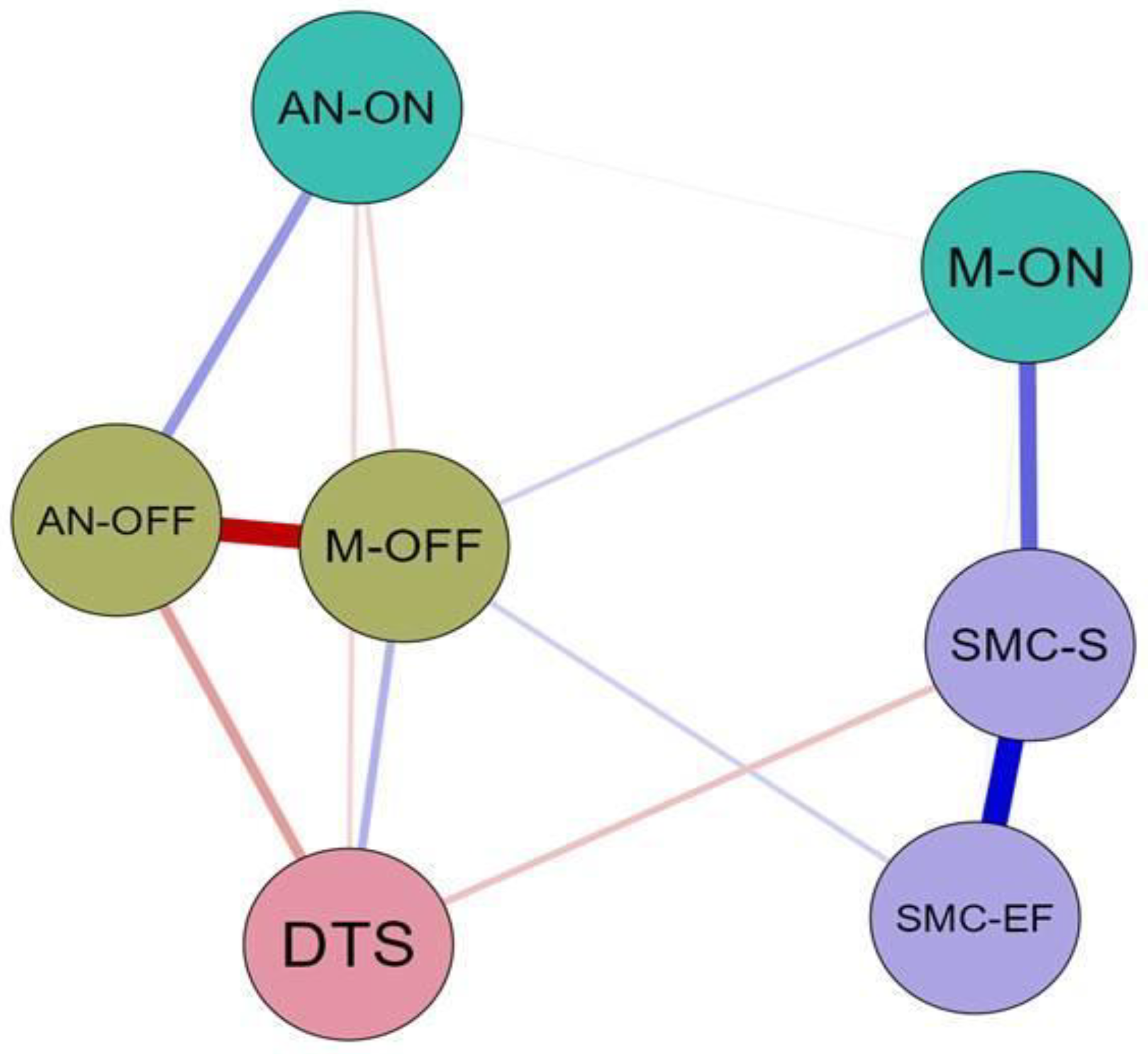
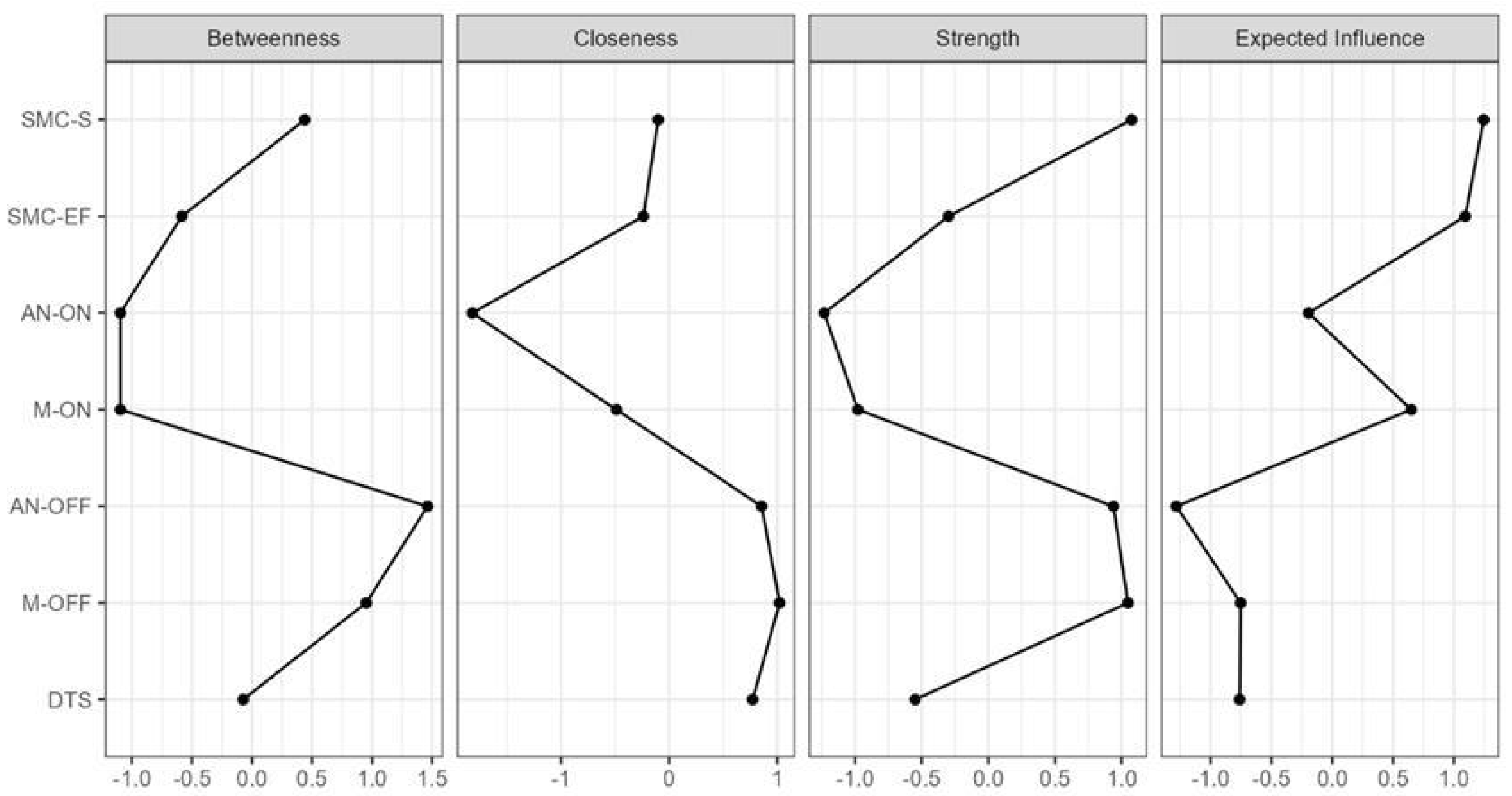
Furthermore, the NA related to the total dimension of DT highlighted the presence of 7 nodes with a sparsity value of 0.381. Centrality indices did not identify a single consistently dominant node across the whole network. Offline anti-mattering showed the highest betweenness value and the largest absolute expected influence, whereas offline mattering showed the highest closeness value (Table 8, Figure 1). In the weight matrix, DT was directly connected with offline mattering (r = 0.141), offline anti-mattering (r = −0.180), online anti-mattering (r = −0.076) and social of SMC (r = −0.115), whereas no direct connection emerged with online mattering or SMC efficacy (Table 9, Figure 2). Finally, the bootstrap analysis highlighted the need to interpret the NA results and parameters with caution (Figure S1). Furthermore, regarding centrality stability, the findings indicated that for the NA strength factor, the nodes corresponding to SMC-S, M-OFF, and AN-OFF are statistically more central than those for M-ON and AN-ON (Epskamp et al., 2018) (Figure S2). Conversely, however, the results showed that factors such as closeness and betweenness are unstable, thereby reinforcing the aforementioned need to interpret the results with caution (Epskamp et al., 2018) (Figure S2).

4. Discussion

Everyday interactions may become potential sources of stress and, over time, may contribute to declines in well-being. Given the substantial mental and physical consequences associated with psychological distress (Batty et al., 2017; Gaffey et al., 2022; Jackson et al., 2018; Pehlivan et al., 2021), there is a growing need to clarify how people cope with stressors and which personal resources can buffer perceived stress.
Within this framework, DT appears to play a key role in reducing psychological distress (Leyro et al., 2010) and it is also closely tied to social factors such as social capital and mattering (Carrillo-Alvarez et al., 2022; Giangrasso et al., 2022; Kobayashi et al., 2015). Consistent with the Digital Life Balance (DLB) perspective, the frustration of psychological and relational needs in offline life may heighten stress and increase reliance on the online environment as a potential source of need satisfaction. However, greater reliance on online interactions to meet these needs has been linked to a poorer balance between digital involvement and everyday life (Duradoni et al., 2022a; Kaloeti et al., 2026). Against this backdrop, the present study examined the association between DT and social factors in both offline and online contexts.
Overall, the findings showed a coherent pattern. Offline mattering was positively and significantly correlated to DT, whereas anti-mattering, both offline and online, was negatively associated with DT, thereby supporting Hypotheses 1 (H1) and 2 (H2). However, contrary to Hypothesis 3 (H3), DT was also negatively associated with social media capital (SMC; Social factor).
Regarding the link between offline mattering and DT, the results indicated that perceiving oneself as important to others is associated with a greater capacity to endure discomfort. This interpretation is consistent with evidence linking mattering to lower psychological distress (Giangrasso et al., 2022). Within offline relationships, feeling recognized may provide a relatively stable signal of validation that reduces threat appraisal and strengthens perceived coping resources. From a theoretical perspective, this pattern may be linked to higher self-efficacy and less avoidant emotion-regulation strategies, which could make discomfort more tolerable (Kyron et al., 2022).
The association between offline anti-mattering and DT was also consistent with prior literature (Ding et al., 2025; Flett et al., 2022). In particular, feeling “unnoticed” offline can be construed as a cue of social threat, eliciting distress and promoting avoidance responses (Flett, 2022). Such experiences may be linked to lower perceived coping resources and the capacity to remain in contact with distress. Accordingly, anti-mattering may be associated with rumination and avoidance or dysregulation strategies that ultimately reduce DT (Giangrasso et al., 2022; Kyron et al., 2022).
Furthermore, results showed a significant negative correlation between online anti-mattering and DT, whereas online mattering was not significantly associated with DT. This pattern is consistent with the idea that negative online social signals may be more salient and impactful than positive ones, potentially contributing to negative affect and self-devaluing cognitions (e.g., negativity bias) (Baumeister et al., 2001; Lee et al., 2020). In addition, the literature suggests that anti-mattering is more tightly linked to anxious-depressive symptoms and distress than mattering, which may help explain why the effect emerged in correlational analyses (Ding et al., 2025).
Finally, the negative association between SMC (Social factor) and DT should be interpreted cautiously, in light of the theoretically related dynamics described in the literature. Specifically, SMC does not reflect dysfunctional use, but rather connections with people who share hobbies or lifestyles, including common life experiences (Duradoni et al., 2022a). For this reason, it may be conceptually close to online bonding social capital, namely relatively homogeneous and emotionally close online networks (Ellison et al., 2007; D. Williams, 2006). Although such connections may provide support, previous research suggests that highly cohesive online networks may also entail social pressure, restrictive group norms, social comparison, and social overload dynamics, as well as expectations of constant availability and reliance on peer approval (Maier et al., 2015; McComb et al., 2023; Nesi & Prinstein, 2015; Villalonga-Olives & Kawachi, 2017). Accordingly, the present finding should not be taken as evidence that online social capital is intrinsically maladaptive. Rather, it may suggest that certain forms of perceived online connection may not necessarily operate as protective resources for DT, particularly when intertwined with more demanding, comparison-based, or approval-dependent relational dynamics, although these mechanisms were not directly examined in the present study. Considering the regression model, only offline mattering, offline anti-mattering, and the Social factor of SMC remained significantly associated with DT. This loss of significance for other predictors may reflect the greater strength and stability of offline experiences, which can account for a substantial portion of the explained variance in the full model (Duradoni et al., 2024a).
To our knowledge, this is the first study to examine potential offline and online social antecedents of DT within the same framework.

4.1. Social Factors and Distress Tolerance from a Complex Perspective

Taking a complex perspective on human phenomena (Heino et al., 2021), network analysis provided an exploratory representation of the pattern of connections among the investigated variables.
Consistent with the correlational and regression findings, offline relational variables appeared to be more consistently connected with DT than online relational indicators.
Specifically, offline mattering and anti-mattering were directly connected with DT, suggesting that perceived recognition and perceived invisibility in offline relationships may represent relevant social correlates of distress tolerance. This pattern can be situated within the broader literature on mattering and anti-mattering in terms of the perception of being important to others in sustaining resources, as well as the potential resilience of the person in coping with stressors (Elliott et al., 2004; Flett, 2022; Flett et al., 2022). It is also broadly consistent with stress-buffering and social support perspectives, which suggest that social relationships may be associated with how individuals experience and manage stressful states (Bekiros et al., 2022; Cassel, 1976; S. Cohen & Wills, 1985; Szkody et al., 2021). In line with this, people’s ability to tolerate distress may be related to the social support available in their relational context, consistent with evolutionary views that emphasize the importance of the social context and social resources when individuals face stressful or threatening experiences (Baumeister et al., 2001; Cacioppo et al., 2006; Szkody et al., 2021).
In sum, the present findings suggest that social and relational factors may be relevant to DT. However, centrality indices did not converge on a single consistently dominant node; therefore, these findings should be interpreted descriptively and cautiously, rather than as evidence that either offline mattering or offline anti-mattering represents the causal or mechanistic core of the network. Given the cross-sectional and exploratory nature of the present study, these results should be further examined in longitudinal or experimental research.

4.2. Implications and Future Perspectives

The implications of this study can be considered from both theoretical and practical perspectives.
On a theoretical level, the results suggest that DT should not be understood exclusively as an intrapsychic trait, as it appears to be associated with social and relational factors, with a clear asymmetry between offline and online, where face-to-face relationships carry greater weight (J. R. Cohen et al., 2016; Kyron et al., 2022; Mushtaq et al., 2014). This asymmetry aligns with the DLB perspective, which frames digital functioning as continuous between offline life and highlights face-to-face relational experiences as potentially relevant to digital balance (Duradoni et al., 2022b). Within this lens, offline mattering and anti-mattering can be interpreted as relational cues associated with the individual’s stress context and, in turn, their capacity to stay in contact with distress (Flett, 2022; Flett et al., 2022; Giangrasso et al., 2022). Accordingly, distress tolerance may function as a self-regulation resource that affects how likely individuals are to turn to ICT-mediated interactions as a rapid coping option under stress, with potential implications for sustaining harmonic technology use.
Another insight from the results is that social capital is not invariably protective: some configurations, such as homophilic networks, may be associated with lower DT (Duradoni et al., 2022a; El-Ashry et al., 2023). Finally, social mechanisms may not be uniformly associated with the entire construct, but act differentially on the subscales, inviting a dimensional modelling of DT (Hsu et al., 2023; Simons & Gaher, 2005).
From an application perspective, DT should be considered an explicit goal of assessment and intervention, considering its roots in relational experiences and digital contexts (El-Ashry et al., 2023; Leyro et al., 2010).
In clinical and preventive settings, the first implication would be to integrate DT measures into routine assessment, together with short mattering and anti-mattering scales, to identify people with low DT who also perceive themselves as unseen or irrelevant in meaningful relationships. Based on this, programmes could combine traditional specific DT and emotion regulation training with interventions that aim to work on beliefs such as “I don’t matter to anyone” and to build concrete experiences of recognition and support within offline networks. At the same time, the observed link between DT and online social capital suggests including a brief digital life assessment to identify situations where highly cohesive online networks may amplify social comparison, expectations of constant availability, and relational overload (Cao et al., 2020; Maier et al., 2015; McComb et al., 2023; Nesi & Prinstein, 2015). In these cases, working with the person on more sustainable digital boundaries, emphasizing offline mattering, can become a concrete component of treatment aimed at enhancing the ability to stay in touch with distress.
Although the final sample included participants from 18 years onward and did not include minors, these findings may still be relevant for future research on late adolescence and younger populations. This developmental stage may represent a particularly sensitive period for the interplay between DT, mattering, anti-mattering, and online social capital, given the central role of social bonds, peer relationships, and belonging in psychological adjustment (Brown & Larson, 2009). Previous longitudinal studies have indicated that low DT during adolescence can be associated with more pronounced trajectories of depressive symptoms, especially in the presence of negative life events. These findings highlight the importance of early interventions focused on the ability to stay in contact with distress without resorting to dysfunctional avoidance strategies (J. R. Cohen et al., 2016; Felton et al., 2019). Therefore, implications for adolescents should be interpreted cautiously and considered as directions for future research rather than as direct conclusions from the present sample. In this sense, future studies could examine whether the relationships between DT, mattering, anti-mattering, and online social capital observed in the present study also emerge in adolescent samples, including minors. In this perspective, school-based and adolescent-focused programs could integrate actions aimed at strengthening the sense of mattering in real-life contexts, such as family, peers, and educational figures, into DT training.
More broadly, future research should investigate whether DT acts as a factor promoting Digital Life Balance. This would be appropriate given that lower levels of DT are associated with problematic use of the Internet and social media as avoidance strategies, and that dysfunctional use of social media and the Internet has been associated with poorer DLB (Kaloeti et al., 2026). Future studies should also clarify whether attempts to satisfy relational needs online may contribute to poorer DLB (Duradoni et al., 2022a, 2022b; Lima-Costa et al., 2024), and whether participation in highly cohesive homophilic networks may, in turn, be associated with lower DT capacity.
Future research could adopt a specific measure of DT in the online context to explore whether an instrument that takes into account the specific characteristics of digital life could better explain how online factors relate to DT (Hsu et al., 2023).
Finally, future research could clarify the results on social capital by examining the DT of the reference group, to understand whether it is more influenced by the group’s collective resources than by the individual’s own capital (Ehsan et al., 2019). Multilevel designs could clarify the extent to which reliance on the online homophilic community supports individual DT through group-level resources, and whether such communities may, in some cases, become sources of vulnerability (Kobayashi et al., 2015; Murayama et al., 2012; Villalonga-Olives & Kawachi, 2017).

4.3. Limitations and Strengths

This study has several strengths. First, it offers an original contribution by filling a gap in the literature, integrating potential offline and online social antecedents of DT into a single framework. Second, it introduces a substantial innovation on the digital side, combining online indicators with traditional ones and anchoring the results to established theoretical rationales. Third, the online analysis is conducted using an exploratory approach, based on self-reported cross-sectional data, that generates hypotheses that can be tested in subsequent studies. Finally, the main results show consistency between methods and stability in the sign and direction of the associations, with insights into the subdomains of DT, which allow for a more in-depth understanding of the study. A further limitation concerns the demographic heterogeneity of the sample, with a wide age range from 18 to 85 years and a predominance of cisgender female participants. This is relevant because distress tolerance, mattering, anti-mattering, online social experiences, and social media capital may vary as a function of both age and gender. Accordingly, age and gender should not be considered merely descriptive characteristics, but potential confounding variables that may have influenced the observed associations. Although some analyses accounted for gender, age and gender were not systematically modeled across all analyses (e.g., Network Analysis). Future studies should therefore rely on larger and more demographically balanced samples and explicitly test the role of age and gender. Moreover, in the regression analysis, the use of selected variables based on prior significance in correlations may have inflated Type I error by underscoring the need to interpret the results cautiously. Moreover, another limitation concerns the NA results. As suggested by Ávalos-Tejeda and Calderón (2025), small networks (nodes < 10) may be unstable and dispersed. Accordingly, the NA results must be interpreted with caution, also in line with the results of the bootstrap analysis.
Despite the strengths, the study has some limitations. First, the cross-sectional design does not allow us to establish causal relationships between social factors and DT, nor to test the temporality or directionality of the effects. Furthermore, non-probabilistic and predominantly online sampling may have introduced a potential selection bias, reducing the generalizability of the results obtained.
DT was measured exclusively via a self-report questionnaire, meaning that the results reflect perceived DT. The literature suggests that behavioral DT tasks show only weak correlations with self-report measures, indicating that they capture partially distinct aspects of DT (Hsu et al., 2023). Furthermore, the exclusive use of self-report measures within the same assessment session may have introduced shared method variance and common-method bias, which could have inflated the observed associations among the variables. Thus, the results should be taken with caution.
Finally, although some factors refer to experiences in the digital context, the lack of a specific measure of online DT limits the ability to attribute the results to distress tolerance processes that are specific to the digital environment. Therefore, inferences regarding the online component should be considered in relation to the general DT being measured.

5. Conclusions

In conclusion, this study provides preliminary evidence that DT is associated with social factors across offline and online contexts. In particular, the findings suggest that the quality and perception of social ties, especially offline ones, may be relevant to individual differences in perceived DT. Overall, these findings provide a coherent basis for future research on the social dimensions of DT, suggesting that offline and online relational experiences should be further examined in longitudinal and experimental designs.

Supplementary Materials

The following supporting information can be downloaded at: https://www.mdpi.com/article/10.3390/psycholint8030044/s1, Figure S1: Edge stability; Figure S2: Centrality Stability.

Author Contributions

Conceptualization, S.B., M.B., G.C., A.G. and M.D.; methodology, S.B., M.B. and M.D.; formal analysis, S.B., M.B. and M.D.; investigation, S.B., M.B. and G.C.; data curation, A.G. and M.D.; writing—original draft preparation, S.B., M.B. and M.D.; writing—review and editing, G.C., A.G. and M.D.; supervision, A.G. and M.D. All authors have read and agreed to the published version of the manuscript.

Funding

This research received no external funding.

Institutional Review Board Statement

The study was conducted in accordance with the Declaration of Helsinki. Ethical approval was waived for this study since this was an anonymous survey with no personal data that could lead to participant identification. All data collected were completely anonymous to ensure confidentiality, in accordance with the EU General Data Protection Regulation (2016/679).

Informed Consent Statement

Informed consent was obtained from all subjects involved in the study.

Data Availability Statement

The data presented in this study are available upon request from the corresponding author.

Conflicts of Interest

The authors declare no conflicts of interest.

References

  1. Adams, S. K., & Kisler, T. S. (2013). Sleep quality as a mediator between technology-related sleep quality, depression, and anxiety. Cyberpsychology, Behavior, and Social Networking, 16(1), 25–30. [Google Scholar] [CrossRef] [PubMed]
  2. Ávalos-Tejeda, M., & Calderón, C. (2025). Psychometric network model recovery: The effect of sample size, number of items, and number of nodes. European Journal of Investigation in Health, Psychology and Education, 15(11), 235. [Google Scholar] [CrossRef] [PubMed]
  3. Bacchi, S., & Licinio, J. (2017). Resilience and psychological distress in psychology and medical students. Academic Psychiatry, 41(2), 185–188. [Google Scholar] [CrossRef] [PubMed]
  4. Batty, G. D., Russ, T. C., Stamatakis, E., & Kivimäki, M. (2017). Psychological distress in relation to site specific cancer mortality: Pooling of unpublished data from 16 prospective cohort studies. BMJ, 356, j108. [Google Scholar] [CrossRef] [PubMed]
  5. Baumeister, R. F., Bratslavsky, E., Finkenauer, C., & Vohs, K. D. (2001). Bad is stronger than good. Review of General Psychology, 5(4), 323–370. [Google Scholar] [CrossRef]
  6. Bekiros, S., Jahanshahi, H., & Munoz-Pacheco, J. M. (2022). A new buffering theory of social support and psychological stress. PLoS ONE, 17(10), e0275364. [Google Scholar] [CrossRef] [PubMed]
  7. Bhandari, H., & Yasunobu, K. (2009). What is social capital? A comprehensive review of the concept. Asian Journal of Social Science, 37(3), 480–510. [Google Scholar] [CrossRef]
  8. Billieux, J., Maurage, P., Lopez-Fernandez, O., Kuss, D. J., & Griffiths, M. D. (2015). Can disordered mobile phone use be considered a behavioral addiction? An update on current evidence and a comprehensive model for future research. Current Addiction Reports, 2(2), 156–162. [Google Scholar] [CrossRef]
  9. Brown, B. B., & Larson, J. (2009). Peer relationships in adolescence. In R. M. Lerner, & L. Steinberg (Eds.), Handbook of adolescent psychology (1st ed.). Wiley. [Google Scholar] [CrossRef]
  10. Butterworth, P., Watson, N., & Wooden, M. (2020). Trends in the prevalence of psychological distress over time: Comparing results from longitudinal and repeated cross-sectional surveys. Frontiers in Psychiatry, 11, 595696. [Google Scholar] [CrossRef] [PubMed]
  11. Cacioppo, J. T., Hawkley, L. C., Ernst, J. M., Burleson, M., Berntson, G. G., Nouriani, B., & Spiegel, D. (2006). Loneliness within a nomological net: An evolutionary perspective. Journal of Research in Personality, 40(6), 1054–1085. [Google Scholar] [CrossRef]
  12. Cao, X., Khan, A. N., Ali, A., & Khan, N. A. (2020). Consequences of cyberbullying and social overload while using SNSs: A study of users’ discontinuous usage behavior in SNSs. Information Systems Frontiers, 22(6), 1343–1356. [Google Scholar] [CrossRef]
  13. Carrillo-Alvarez, E., Andrés, A., Riera-Romaní, J., Novak, D., Rodriguez-Monforte, M., Costa-Tutusaus, L., & Guerra-Balic, M. (2022). The association between social capital indicators and psychological distress in Catalan adolescents. Frontiers in Psychology, 13, 964689. [Google Scholar] [CrossRef] [PubMed]
  14. Cassel, J. (1976). The contribution of the social environment to host resistance. American Journal of Epidemiology, 104(2), 107–123. [Google Scholar] [CrossRef] [PubMed]
  15. Chan, S.-M., Chung, G. K.-K., Chan, Y.-H., Woo, J., Yeoh, E. K., Chung, R. Y.-N., Wong, S. Y.-S., Marmot, M., Lee, R. W.-T., & Wong, H. (2023). The mediating role of individual-level social capital among worries, mental health and subjective well-being among adults in Hong Kong during the COVID-19 pandemic. Current Psychology, 42(12), 10260–10270. [Google Scholar] [CrossRef] [PubMed]
  16. Cohen, J. R., Danielson, C. K., Adams, Z. W., & Ruggiero, K. J. (2016). Distress tolerance and social support in adolescence: Predicting risk for internalizing and externalizing symptoms following a natural disaster. Journal of Psychopathology and Behavioral Assessment, 38(4), 538–546. [Google Scholar] [CrossRef] [PubMed]
  17. Cohen, S., & Wills, T. A. (1985). Stress, social support, and the buffering hypothesis. Psychological Bulletin, 98(2), 310–357. [Google Scholar] [CrossRef]
  18. Di Fabio, A., & Tsuda, A. (2018). The psychology of harmony and harmonization: Advancing the perspectives for the psychology of sustainability and sustainable development. Sustainability, 10(12), 4726. [Google Scholar] [CrossRef]
  19. Ding, J.-L., Zheng, X., Flett, G. L., Cao, C.-H., Gamble, J. H., Jiang, X.-Y., Zhao, L., Zheng, W.-M., Chen, X.-H., & Chen, I.-H. (2025). Psychometric analyses of the general mattering scale, anti-mattering scale, and the fear of not mattering inventory in Chinese youth. Scientific Reports, 15(1), 33224. [Google Scholar] [CrossRef] [PubMed]
  20. Drapeau, A., Marchand, A., & Beaulieu-Prevost, D. (2012). Epidemiology of psychological distress. In L. LAbate (Ed.), Mental illnesses—Understanding, prediction and control. InTech. [Google Scholar] [CrossRef] [PubMed]
  21. Duradoni, M., Meacci, S., Panerai, G., Salvatori, G., & Guazzini, A. (2022a). Development and validation of the social media capital scale (SMC): A brand new measure for online social capital. Human Behavior and Emerging Technologies, 2022, 1–15. [Google Scholar] [CrossRef]
  22. Duradoni, M., Serritella, E., Avolio, C., Arnetoli, C., & Guazzini, A. (2022b). Development and validation of the digital life balance (DLB) scale: A brand-new measure for both harmonic and disharmonic use of ICTs. Behavioral Sciences, 12(12), 489. [Google Scholar] [CrossRef] [PubMed]
  23. Duradoni, M., Serritella, E., Severino, F. P., & Guazzini, A. (2024a). Exploring the relationships between digital life balance and internet social capital, loneliness, fear of missing out, and anxiety. Human Behavior and Emerging Technologies, 2024, 1–9. [Google Scholar] [CrossRef]
  24. Duradoni, M., Severino, F. P., Bellotti, M., & Guazzini, A. (2024b). How mattering and anti-mattering experiences across offline and online environments contribute to people’s digital life balance and social media addiction. Journal of Community & Applied Social Psychology, 34(6), e70008. [Google Scholar] [CrossRef]
  25. Duradoni, M., Spadoni, V., Gursesli, M. C., & Guazzini, A. (2023). Development and validation of the Need for Online Social Feedback (NfOSF) scale. Human Behavior and Emerging Technologies, 2023, 5581492. [Google Scholar] [CrossRef]
  26. Ehsan, A., Klaas, H. S., Bastianen, A., & Spini, D. (2019). Social capital and health: A systematic review of systematic reviews. SSM—Population Health, 8, 100425. [Google Scholar] [CrossRef]
  27. El-Ashry, A., Hussein Ramadan Atta, M., Alsenany, S., Farghaly Abdelaliem, S. M., & Abdelwahab Khedr, M. (2023). The effect of distress tolerance training on problematic internet use and psychological wellbeing among faculty nursing students: A randomized control trial. Psychology Research and Behavior Management, 16, 4015–4032. [Google Scholar] [CrossRef] [PubMed]
  28. Elliott, G., Kao, S., & Grant, A.-M. (2004). Mattering: Empirical validation of a social-psychological concept. Self and Identity, 3(4), 339–354. [Google Scholar] [CrossRef]
  29. Ellison, N. B., Steinfield, C., & Lampe, C. (2007). The benefits of Facebook “friends”: Social capital and college students’ use of online social network Sites. Journal of Computer-Mediated Communication, 12(4), 1143–1168. [Google Scholar] [CrossRef]
  30. Epskamp, S., Borsboom, D., & Fried, E. I. (2018). Estimating psychological networks and their accuracy: A tutorial paper. Behavior Research Methods, 50(1), 195–212. [Google Scholar] [CrossRef] [PubMed]
  31. Eriksson, M. (2011). Social capital and health—Implications for health promotion. Global Health Action, 4(1), 5611. [Google Scholar] [CrossRef] [PubMed]
  32. Faul, F., Erdfelder, E., Buchner, A., & Lang, A.-G. (2009). Statistical power analyses using G*Power 3.1: Tests for correlation and regression analyses. Behavior Research Methods, 41(4), 1149–1160. [Google Scholar] [CrossRef] [PubMed]
  33. Faul, F., Erdfelder, E., Lang, A.-G., & Buchner, A. (2007). G*Power 3: A flexible statistical power analysis program for the social, behavioral, and biomedical sciences. Behavior Research Methods, 39(2), 175–191. [Google Scholar] [CrossRef] [PubMed]
  34. Felton, J. W., Collado, A., Havewala, M., Shadur, J. M., MacPherson, L., & Lejuez, C. W. (2019). Distress tolerance interacts with negative life events to predict depressive symptoms across adolescence. Journal of Clinical Child & Adolescent Psychology, 48(4), 633–642. [Google Scholar] [CrossRef] [PubMed]
  35. Flett, G. L. (2022). An introduction, review, and conceptual analysis of mattering as an essential construct and an essential way of life. Journal of Psychoeducational Assessment, 40(1), 3–36. [Google Scholar] [CrossRef]
  36. Flett, G. L., Nepon, T., Goldberg, J. O., Rose, A. L., Atkey, S. K., & Zaki-Azat, J. (2022). The anti-mattering scale: Development, psychometric properties and associations with well-being and distress measures in adolescents and emerging adults. Journal of Psychoeducational Assessment, 40(1), 37–59. [Google Scholar] [CrossRef]
  37. Gaffey, A. E., Gathright, E. C., Fletcher, L. M., & Goldstein, C. M. (2022). Screening for psychological distress and risk of cardiovascular disease and related mortality: A systematized review, meta-analysis, and case for prevention. Journal of Cardiopulmonary Rehabilitation and Prevention, 42(6), 404–415. [Google Scholar] [CrossRef]
  38. García-Guillén, M. J., Castillo-Paredes, A., Galán-Arroyo, C., & Rojo-Ramos, J. (2025). Group cohesion, motor self-efficacy, and socio-emotional skills in physical education students in a region of Spain: A descriptive study. Frontiers in Psychology, 16, 1631231. [Google Scholar] [CrossRef] [PubMed]
  39. Giangrasso, B., Casale, S., Fioravanti, G., Flett, G. L., & Nepon, T. (2022). Mattering and anti-mattering in emotion regulation and life satisfaction: A mediational analysis of stress and distress during the COVID-19 pandemic. Journal of Psychoeducational Assessment, 40(1), 125–141. [Google Scholar] [CrossRef]
  40. Gignac, G. E., & Szodorai, E. T. (2016). Effect size guidelines for individual differences researchers. Personality and Individual Differences, 102, 74–78. [Google Scholar] [CrossRef]
  41. Gu, M. (2022). Understanding the relationship between distress intolerance and problematic internet use: The mediating role of coping motives and the moderating role of need frustration. Journal of Adolescence, 94(4), 497–512. [Google Scholar] [CrossRef] [PubMed]
  42. Hair, J. F. (Ed.). (2010). Multivariate data analysis (7th ed.). Pearson Prentice Hall. [Google Scholar]
  43. Heino, M. T. J., Knittle, K., Noone, C., Hasselman, F., & Hankonen, N. (2021). Studying behaviour change mechanisms under complexity. Behavioral Sciences, 11(5), 77. [Google Scholar] [CrossRef] [PubMed]
  44. Hsu, T., Thomas, E. B. K., Welch, E. K., O’Hara, M. W., & McCabe, J. E. (2023). Examining the structure of distress tolerance: Are behavioral and self-report indicators assessing the same construct? Journal of Contextual Behavioral Science, 27, 143–151. [Google Scholar] [CrossRef]
  45. Hussenoeder, F. S. (2022). The bright side of social network sites: On the potential of online social capital for mental health. Digital Health, 8, 205520762210931. [Google Scholar] [CrossRef] [PubMed]
  46. Jackson, C. A., Sudlow, C. L. M., & Mishra, G. D. (2018). Psychological distress and risk of myocardial infarction and stroke in the 45 and up study: A prospective cohort study. Circulation: Cardiovascular Quality and Outcomes, 11(9), e004500. [Google Scholar] [CrossRef] [PubMed]
  47. Junus, A., & Yip, P. S. F. (2023). Preventing comorbidity between distress and suicidality: A network analysis. Npj Mental Health Research, 2(1), 2. [Google Scholar] [CrossRef] [PubMed]
  48. Kaloeti, D. V. S., Duradoni, M., Guazzini, A., & Baroni, M. (2026). Adaptation of the digital life balance scale and its associations with well-being and addiction tendencies among indonesian adolescents. International Journal of Human–Computer Interaction, 1–20. [Google Scholar] [CrossRef]
  49. Karami, A., Khodarahimi, S., Ghazanfari, F., Mirdrikvand, F., & Barigh, M. (2020). The prediction of distress tolerance based on the feeling of loneliness and self-handicapping in students. Personality and Individual Differences, 161, 109994. [Google Scholar] [CrossRef]
  50. Keramat, S. A., Comans, T., Pearce, A., Basri, R., Hashmi, R., & Dissanayaka, N. N. (2025). Psychological distress and productivity loss: A longitudinal analysis of Australian working adults. The European Journal of Health Economics, 26(8), 1503–1524. [Google Scholar] [CrossRef] [PubMed]
  51. Ko, C.-H. (2014). Internet gaming disorder. Current Addiction Reports, 1(3), 177–185. [Google Scholar] [CrossRef]
  52. Kobayashi, T., Suzuki, E., Noguchi, M., Kawachi, I., & Takao, S. (2015). Correction: Community-level social capital and psychological distress among the elderly in Japan: A population-based study. PLoS ONE, 10(12), e0144683. [Google Scholar] [CrossRef] [PubMed]
  53. Krygsman, A., Farrell, A. H., Brittain, H., & Vaillancourt, T. (2022). Depression symptoms, mattering, and anti-mattering: Longitudinal associations in young adulthood. Journal of Psychoeducational Assessment, 40(1), 77–94. [Google Scholar] [CrossRef]
  54. Kyron, M. J., Hooke, G. R., Bryan, C. J., & Page, A. C. (2022). Distress tolerance as a moderator of the dynamic associations between interpersonal needs and suicidal thoughts. Suicide and Life-Threatening Behavior, 52(1), 159–170. [Google Scholar] [CrossRef] [PubMed]
  55. Laposa, J. M., Collimore, K. C., Hawley, L. L., & Rector, N. A. (2015). Distress tolerance in OCD and anxiety disorders, and its relationship with anxiety sensitivity and intolerance of uncertainty. Journal of Anxiety Disorders, 33, 8–14. [Google Scholar] [CrossRef] [PubMed]
  56. Lee, H. Y., Jamieson, J. P., Reis, H. T., Beevers, C. G., Josephs, R. A., Mullarkey, M. C., O’Brien, J. M., & Yeager, D. S. (2020). Getting fewer “likes” than others on social media elicits emotional distress among victimized adolescents. Child Development, 91(6), 2141–2159. [Google Scholar] [CrossRef] [PubMed]
  57. Leslie-Miller, C. J., Joormann, J., & Quinn, M. E. (2025). Coping flexibility: Match between coping strategy and perceived stressor controllability predicts depressed mood. Affective Science, 6(1), 94–103. [Google Scholar] [CrossRef] [PubMed]
  58. Leung, L., & Lee, P. S. N. (2005). Multiple determinants of life quality: The roles of Internet activities, use of new media, social support, and leisure activities. Telematics and Informatics, 22(3), 161–180. [Google Scholar] [CrossRef]
  59. Leyro, T. M., Zvolensky, M. J., & Bernstein, A. (2010). Distress tolerance and psychopathological symptoms and disorders: A review of the empirical literature among adults. Psychological Bulletin, 136(4), 576–600. [Google Scholar] [CrossRef] [PubMed]
  60. Lima-Costa, A. R., Tosti, A. E., Bonfá-Araujo, B., & Duradoni, M. (2024). Digital life balance and need for online social feedback: Cross–cultural psychometric analysis in Brazil. Human Behavior and Emerging Technologies, 2024(1), 1179740. [Google Scholar] [CrossRef]
  61. Liu, W., Gamble, J., Cao, C.-H., Liao, X.-L., Chen, I.-H., & Flett, G. (2023). The general mattering scale, the anti-mattering scale, and the fear of not mattering inventory: Psychometric properties and links with distress and hope among Chinese university students. Psychology Research and Behavior Management, 16, 4445–4459. [Google Scholar] [CrossRef] [PubMed]
  62. Maier, C., Laumer, S., Eckhardt, A., & Weitzel, T. (2015). Giving too much social support: Social overload on social networking sites. European Journal of Information Systems, 24(5), 447–464. [Google Scholar] [CrossRef]
  63. Malas, O., Khan, M., Zubair, A., Guazzini, A., & Duradoni, M. (2025). Psychometric validation of the digital life balance scale in Urdu and its relationship with life satisfaction, social media addiction, and internet addiction. Human Behavior and Emerging Technologies, 2025(1), 7873343. [Google Scholar] [CrossRef]
  64. Marshall, S. K. (2001). Do I matter? Construct validation of adolescents’ perceived mattering to parents and friends. Journal of Adolescence, 24(4), 473–490. [Google Scholar] [CrossRef] [PubMed]
  65. Marshall-Berenz, E. C., Vujanovic, A. A., Bonn-Miller, M. O., Bernstein, A., & Zvolensky, M. J. (2010). Multimethod study of distress tolerance and PTSD symptom severity in a trauma-exposed community sample. Journal of Traumatic Stress, 23(5), 623–630. [Google Scholar] [CrossRef] [PubMed]
  66. McComb, C. A., Vanman, E. J., & Tobin, S. J. (2023). A meta-analysis of the effects of social media exposure to upward comparison targets on self-evaluations and emotions. Media Psychology, 26(5), 612–635. [Google Scholar] [CrossRef]
  67. Melnyk, B. M., Strait, L. A., Beckett, C., Hsieh, A. P., Messinger, J., & Masciola, R. (2023). The state of mental health, burnout, mattering and perceived wellness culture in doctorally prepared nursing faculty with implications for action. Worldviews on Evidence-Based Nursing, 20(2), 142–152. [Google Scholar] [CrossRef] [PubMed]
  68. Mirowsky, J., & Ross, C. E. (2002). Measurement for a human science. Journal of Health and Social Behavior, 43(2), 152–170. [Google Scholar] [CrossRef]
  69. Murayama, H., Fujiwara, Y., & Kawachi, I. (2012). Social capital and health: A review of prospective multilevel studies. Journal of Epidemiology, 22(3), 179–187. [Google Scholar] [CrossRef] [PubMed]
  70. Mushtaq, R., Shoib, S., Shah, T., & Mushtaq, S. (2014). Relationship between loneliness, psychiatric disorders and physical health ? A review on the psychological aspects of loneliness. Journal of Clinical and Diagnostic Research: JCDR, 8(9), WE01–WE04. [Google Scholar] [CrossRef] [PubMed]
  71. Nadkarni, A., & Hofmann, S. G. (2012). Why do people use Facebook? Personality and Individual Differences, 52(3), 243–249. [Google Scholar] [CrossRef] [PubMed]
  72. Nesi, J., & Prinstein, M. J. (2015). Using social media for social comparison and feedback-seeking: Gender and popularity moderate associations with depressive symptoms. Journal of Abnormal Child Psychology, 43(8), 1427–1438. [Google Scholar] [CrossRef] [PubMed]
  73. Nickerson, A., Kurt, G., Liddell, B., Keegan, D., Nandyatama, R., Yuanita, A., Argadianti Rachmah, R., Hoffman, J., Kashyap, S., Mastrogiovanni, N., Mai, V., Camilleri, A., Susanty, D., Tricesaria, D., Rostami, H., Im, J., Gurzeda, M., Khakbaz, M., Funnell, S., … Specker, P. (2025). The longitudinal relationship between psychological symptoms and social functioning in displaced refugees. Psychological Medicine, 55, e40. [Google Scholar] [CrossRef] [PubMed]
  74. Pehlivan, Ş., Tokur Kesgin, M., & Uymaz, P. (2021). Psychological distress and mental health literacy in university students. Perspectives in Psychiatric Care, 57(3), 1433–1441. [Google Scholar] [CrossRef] [PubMed]
  75. Pronk, N., Kleinman, D. V., Goekler, S. F., Ochiai, E., Blakey, C., & Brewer, K. H. (2021). Promoting health and well-being in healthy people 2030. Journal of Public Health Management and Practice, 27(Suppl. S6), S242–S248. [Google Scholar] [CrossRef] [PubMed]
  76. Raio, C. M., Orederu, T. A., Palazzolo, L., Shurick, A. A., & Phelps, E. A. (2013). Cognitive emotion regulation fails the stress test. Proceedings of the National Academy of Sciences, 110(37), 15139–15144. [Google Scholar] [CrossRef] [PubMed]
  77. Ridner, S. H. (2004). Psychological distress: Concept analysis. Journal of Advanced Nursing, 45(5), 536–545. [Google Scholar] [CrossRef] [PubMed]
  78. Segal, O., Hevron, H., Sher, H., Aderka, I. M., & Weinbach, N. (2025). A randomized controlled trial of an online dialectical behavior therapy skills intervention for war-related distress. Journal of Consulting and Clinical Psychology, 93(7), 500–510. [Google Scholar] [CrossRef] [PubMed]
  79. Simons, J. S., & Gaher, R. M. (2005). The distress tolerance scale: Development and validation of a self-report measure. Motivation and Emotion, 29(2), 83–102. [Google Scholar] [CrossRef]
  80. Song, L. (2011). Social capital and psychological distress. Journal of Health and Social Behavior, 52(4), 478–492. [Google Scholar] [CrossRef] [PubMed]
  81. Soysal, F. S. O., Kosar, E., Gursesli, M. C., Guazzini, A., & Duradoni, M. (2024). Digital life balance scale: Validity and reliability in the Turkish context. Human Behavior and Emerging Technologies, 2024, 9454784. [Google Scholar] [CrossRef]
  82. Spătaru, B., Podină, I. R., Tulbure, B. T., & Maricuțoiu, L. P. (2024). A longitudinal examination of appraisal, coping, stress, and mental health in students: A cross-lagged panel network analysis. Stress and Health, 40(5), e3450. [Google Scholar] [CrossRef] [PubMed]
  83. Szkody, E., Stearns, M., Stanhope, L., & McKinney, C. (2021). Stress-buffering role of social support during COVID-19. Family Process, 60(3), 1002–1015. [Google Scholar] [CrossRef] [PubMed]
  84. Tian, W., De Costa, F., Rahiman, A. R. A., & Roh, T. (2025). Linking components of social media usage to psychological distress: Integrating the situational theory of problem-solving and social capital theory. Journal of Retailing and Consumer Services, 84, 104187. [Google Scholar] [CrossRef]
  85. Tonini, B., Bocci Benucci, S., Flett, G., Fioravanti, G., & Casale, S. (2025). General mattering, anti-mattering, and depressive symptoms: A meta-analysis. Clinical Psychology Review, 120, 102626. [Google Scholar] [CrossRef] [PubMed]
  86. Tosti, A. E., Tereshchenko, S., Evert, L., Guazzini, A., & Duradoni, M. (2026). The digital life balance scale: Validation and gender invariance among urban Russian adolescents. International Journal of Human–Computer Interaction, 42(2), 1234–1245. [Google Scholar] [CrossRef]
  87. Vanden Abeele, M. M. P. (2021). Digital wellbeing as a dynamic construct. Communication Theory, 31(4), 932–955. [Google Scholar] [CrossRef]
  88. Van Den Berg, P. E. W., Arentze, T. A., & Timmermans, H. J. P. (2012). New ICTs and social interaction: Modelling communication frequency and communication mode choice. New Media & Society, 14(6), 987–1003. [Google Scholar] [CrossRef]
  89. Veilleux, J. C., Hyde, K. C., & Clift, J. B. (2022). When is your distress harder to tolerate? A qualitative analysis of situations in which distress tolerance is impaired and strengthened. Journal of Contextual Behavioral Science, 23, 85–91. [Google Scholar] [CrossRef]
  90. Villalonga-Olives, E., & Kawachi, I. (2017). The dark side of social capital: A systematic review of the negative health effects of social capital. Social Science & Medicine, 194, 105–127. [Google Scholar] [CrossRef] [PubMed]
  91. Walker, A., & Van Der Maesen, L. (2004). Social quality and quality of life. In W. Glatzer, S. Von Below, & M. Stoffregen (Eds.), Challenges for quality of life in the contemporary world (Vol. 24, pp. 13–31). Springer Netherlands. [Google Scholar] [CrossRef]
  92. Widyanto, L., & Griffiths, M. (2006). ‘Internet addiction’: A critical review. International Journal of Mental Health and Addiction, 4(1), 31–51. [Google Scholar] [CrossRef]
  93. Williams, A. D., Thompson, J., & Andrews, G. (2013). The impact of psychological distress tolerance in the treatment of depression. Behaviour Research and Therapy, 51(8), 469–475. [Google Scholar] [CrossRef] [PubMed]
  94. Williams, D. (2006). On and off the ’net: Scales for social capital in an online era. Journal of Computer-Mediated Communication, 11(2), 593–628. [Google Scholar] [CrossRef]
  95. Williams, K. D. (2007). Ostracism. Annual Review of Psychology, 58(1), 425–452. [Google Scholar] [CrossRef] [PubMed]
  96. Wolters, N. E., Mobach, L., Wuthrich, V. M., Vonk, P., Van Der Heijde, C. M., Wiers, R. W., Rapee, R. M., & Klein, A. M. (2023). Emotional and social loneliness and their unique links with social isolation, depression and anxiety. Journal of Affective Disorders, 329, 207–217. [Google Scholar] [CrossRef] [PubMed]
  97. Woo, J., Whyne, E. Z., & Steinhardt, M. A. (2024). Psychological distress and self-reported mental disorders: The partially mediating role of coping strategies. Anxiety, Stress, & Coping, 37(2), 180–191. [Google Scholar] [CrossRef] [PubMed]
  98. Wu, K., Doe, E., Roude, G. D., Wallace, J., Francois, S., Richardson, L., & Theall, K. P. (2024). Social capital and changes of psychologic distress during early stage of COVID-19 in New Orleans. Scientific Reports, 14(1), 5773. [Google Scholar] [CrossRef] [PubMed]
  99. Yıldız Durak, H. (2020). Modeling of variables related to problematic internet usage and problematic social media usage in adolescents. Current Psychology, 39(4), 1375–1387. [Google Scholar] [CrossRef]
  100. Zvolensky, M. J., Vujanovic, A. A., Bernstein, A., & Leyro, T. (2010). Distress tolerance: Theory, measurement, and relations to psychopathology. Current Directions in Psychological Science, 19(6), 406–410. [Google Scholar] [CrossRef] [PubMed]
Figure 1. Centrality plot. Notes: AN, Anti-mattering; EF, Efficacy; M, Mattering; OFF, Offline; ON, Online; S, Social; SMC, Social Media Capital.
Psycholint 08 00044 g001
Figure 2. Network analysis. Notes: AN, Anti-mattering; EF, Efficacy; M, Mattering; OFF, Offline; ON, Online; S, Social; SMC, Social Media Capital.
Psycholint 08 00044 g002
Table 1. Descriptive statistics.
VariablesMin.Max.MeanSDSkew.Kurtosis
DT1.34.93.1040.6670.107−0.140
Tolerance (DT)1.05.03.0450.8430.043−0.293
Absorption (DT)1.35.03.2780.745−0.047−0.455
Appraisal (DT)1.05.03.1600.6770.0450.354
Regulation (DT)1.05.02.9330.8850.079−0.343
M-Offline5.020.014.9172.997−0.2980.131
AN-Offline5.020.010.4053.6030.468−0.227
M-Online5.020.09.5003.7670.606−0.364
AN-Online4.016.07.6033.2870.733−0.152
SMC-Efficacy4.020.014.7403.700−0.7350.508
SMC-Social3.015.08.4522.917−0.020−0.358
Notes: AN, Anti-mattering; DT, Distress Tolerance; M, Mattering; Max., Maximum; Min., Minimum; SMC, Social Media Capital; Skew., Skewness; SD, Standard deviation.
Table 2. Correlation analysis results.
Variables DTTolerance
(DT)
Absorption
(DT)
Appraisal
(DT)
Regulation
(DT)
M-OfflinePearson’s r0.319
(0.317 ***)
0.288
(0.293 ***)
0.303
(0.305 ***)
0.315
(0.308 ***)
0.189
(0.177 **)
p-value<0.001<0.001<0.001<0.0010.003
Lower 95% CI0.2030.1710.1870.1990.067
Upper 95% CI0.4250.3980.4120.4220.305
Standard error0.0570.0580.0570.0570.061
AN-OfflinePearson’s r−0.351
(−0.323 ***)
−0.270
(−0.236 **)
−0.335
(−0.333 ***)
−0.335
(−0.319 ***)
−0.262
(−0.215 **)
p-value<0.001<0.001<0.001<0.001<0.001
Lower 95% CI−0.455−0.381−0.44−0.441−0.373
Upper 95% CI−0.238−0.152−0.22−0.221−0.143
Standard error0.0550.0580.0560.0560.059
M-OnlinePearson’s r−0.026
(−0.017)
−0.035
(−0.017)
0.000
(−0.002)
−0.003
(−0.021)
−0.042
(−0.015)
p-value0.6840.5790.9940.9640.503
Lower 95% CI−0.149−0.158−0.123−0.126−0.165
Upper 95% CI0.0980.0890.1240.1210.082
Standard error0.0630.0630.0630.0630.063
AN-OnlinePearson’s r−0.211
(−0.201 **)
−0.176
(−0.164 *)
−0.228
(−0.214 **)
−0.175
(−0.150 *)
−0.141
(−0.149 *)
p-value<0.0010.005<0.0010.0050.025
Lower 95% CI−0.326−0.293−0.342−0.292−0.26
Upper 95% CI−0.089−0.054−0.107−0.053−0.018
Standard error0.0600.0610.0600.0610.062
SMC-EFFPearson’s r−0.008
(−0.002)
0.070
(0.075)
−0.057
(−0.049)
0.018
(0.027)
−0.057
(−0.057)
p-value0.910.3140.4170.7960.413
Lower 95% CI−0.144−0.066−0.191−0.118−0.192
Upper 95% CI0.1280.2040.080.1540.08
Standard error0.0690.0690.0690.0690.069
SMC-SPearson’s r−0.159
(−0.155 *)
−0.093
(−0.089)
−0.156
(−0.150 *)
−0.141
(−0.135)
−0.148
(−0.148 *)
p-value0.0220.1830.0240.0420.033
Lower 95% CI−0.289−0.226−0.286−0.272−0.278
Upper 95% CI−0.0240.044−0.021−0.005−0.012
Standard error0.0680.0690.0680.0680.068
Notes: AN, Anti-mattering; DT, Distress Tolerance; M, Mattering; SMC, Social Media Capital; Values in parentheses indicate Pearson’s correlation coefficients controlling for gender; * = p < 0.05; ** = p < 0.01; *** = p < 0.001.
Table 3. Regression analysis result: distress tolerance and social factors.
VariablesBetatSig.Standard
Error
95% CIR2R2-adj
LowerUpper
M-Offline0.1892.4010.0170.01760.0080.0770.1620.146
AN-Offline−0.192−2.3470.0200.0148−0.064−0.006
AN-Online−0.072−1.0230.3070.0145−0.0430.014
SMC-Social−0.162−2.5210.0120.0145−0.065−0.008
Notes: AN, Anti-mattering; CI, Confidence Interval; M, Mattering; Sig., Significance; SMC, Social Media Capital.
Table 4. Regression analysis result: tolerance (DT) and social factors.
VariablesBetatSig.Standard
Error
95% CIR2R2-adj
LowerUpper
M-Offline0.1892.5530.0110.0210.0120.0940.1050.094
AN-Offline−0.135−1.7880.0750.018−0.0660.003
AN-Online−0.080−1.2420.2150.017−0.0530.012
Notes: AN, Anti-mattering; CI, Confidence Interval; M, Mattering; Sig., Significance.
Table 5. Regression analysis result: absorption (DT) and social factors.
VariablesBetatSig.Standard
Error
95% CIR2R2-adj
LowerUpper
M-Offline0.1571.9950.0470.01990.0000.0780.1630.147
AN-Offline−0.216−2.6480.0090.0168−0.077−0.011
AN-Online−0.085−1.2180.2250.0163−0.0520.012
SMC-Social−0.158−2.4640.0150.0163−0.072−0.008
Notes: AN, Anti-mattering; CI, Confidence Interval; M, Mattering; Sig., Significance; SMC, Social Media Capital.
Table 6. Regression analysis result: appraisal (DT) and social factors.
VariablesBetatSig.Standard
Error
95% CIR2R2-adj
LowerUpper
M-Offline0.1802.2670.0240.0190.0050.0780.1480.131
AN-Offline−0.216−2.6200.0090.016−0.071−0.010
AN-Online−0.016−0.2290.8190.015−0.0330.026
SMC-Social−0.145−2.2420.0260.015−0.064−0.004
Notes: AN, Anti-mattering; CI, Confidence Interval; M, Mattering; Sig., Significance; SMC, Social Media Capital.
Table 7. Regression analysis result: regulation (DT) and social factors.
VariablesBetatSig.Standard
Error
95% CIR2R2-adj
LowerUpper
M-Offline0.0770.9390.3490.025−0.0260.0720.0770.059
AN-Offline−0.146−1.7000.0910.021−0.0770.006
AN-Online−0.067−0.9180.3600.021−0.0590.022
SMC-Social−0.148−2.1980.0290.020−0.085−0.005
Notes: AN, Anti-mattering; CI, Confidence Interval; M, Mattering; Sig., Significance; SMC, Social Media Capital.
Table 8. Network analysis results: centrality measures.
VariablesBetweennessClosenessStrengthExpected Influence
DTS−0.0730.772−0.549−0.761
M-OFF0.9521.0231.048−0.753
AN-OFF1.4640.8550.938−1.282
M-ON−1.098−0.488−0.9800.651
AN-ON−1.098−1.822−1.231−0.195
SMC-EF−0.586−0.238−0.3001.094
SMC-S0.439−0.1021.0751.246
Notes: AN, Anti-mattering; EF, Efficacy; M, Mattering; OFF, Offline; ON, Online; S, Social; SMC, Social Media Capital.
Table 9. Network analysis results: weight matrix.
VariablesDTSM-OFFAN-OFFM-ONAN-ONSMC-EFSMC-S
DTS0.0000.141−0.1800.000−0.0760.000−0.115
M-OFF0.1410.000−0.4630.087−0.0780.0860.000
AN-OFF−0.180−0.4630.0000.0000.1890.0000.000
M-ON0.0000.0870.0000.000−0.0220.0220.288
AN-ON−0.076−0.0780.189−0.0220.0000.0000.000
SMC-EF0.0000.0860.0000.0220.0000.0000.457
SMC-S−0.1150.0000.0000.2880.0000.4570.000
Notes: AN, Anti-mattering; EF, Efficacy; M, Mattering; OFF, Offline; ON, Online; S, Social; SMC, Social Media Capital.
Disclaimer/Publisher’s Note: The statements, opinions and data contained in all publications are solely those of the individual author(s) and contributor(s) and not of MDPI and/or the editor(s). MDPI and/or the editor(s) disclaim responsibility for any injury to people or property resulting from any ideas, methods, instructions or products referred to in the content.