

Dealing with Stress Through Social Resources: A Complex Approach to the Investigation of Social Antecedents and Distress Tolerance




Abstract
1. Introduction
1.1. Distress Tolerance and Social Factors
1.2. Distress Tolerance in ICT Environments
1.3. Digital Life Balance and the Quality of Digital Experience
1.4. Aim of the Study
1.4.1. Mattering, Anti-Mattering and Distress Tolerance
1.4.2. Online Social Capital and Distress Tolerance
2. Material and Methods
2.1. Participants and Design
2.2. Instruments and Measures
2.2.1. Distress Tolerance Scale (DTS; Simons & Gaher, 2005)
2.2.2. General Mattering Scale (GMS; Giangrasso et al., 2022)
2.2.3. Anti-Mattering Scale (AMS; Flett et al., 2022)
2.2.4. Mattering Online Scale (MOS; Duradoni et al., 2024b)
2.2.5. Anti-Mattering Online Scale (AMOS; Duradoni et al., 2024b)
2.2.6. Social Media Capital Scale (Duradoni et al., 2022a)
2.3. Data Analysis
3. Results
4. Discussion
4.1. Social Factors and Distress Tolerance from a Complex Perspective
4.2. Implications and Future Perspectives
4.3. Limitations and Strengths
5. Conclusions
Supplementary Materials
Author Contributions
Funding
Institutional Review Board Statement
Informed Consent Statement
Data Availability Statement
Conflicts of Interest
References
- Adams, S. K., & Kisler, T. S. (2013). Sleep quality as a mediator between technology-related sleep quality, depression, and anxiety. Cyberpsychology, Behavior, and Social Networking, 16(1), 25–30. [Google Scholar] [CrossRef] [PubMed]
- Ávalos-Tejeda, M., & Calderón, C. (2025). Psychometric network model recovery: The effect of sample size, number of items, and number of nodes. European Journal of Investigation in Health, Psychology and Education, 15(11), 235. [Google Scholar] [CrossRef] [PubMed]
- Bacchi, S., & Licinio, J. (2017). Resilience and psychological distress in psychology and medical students. Academic Psychiatry, 41(2), 185–188. [Google Scholar] [CrossRef] [PubMed]
- Batty, G. D., Russ, T. C., Stamatakis, E., & Kivimäki, M. (2017). Psychological distress in relation to site specific cancer mortality: Pooling of unpublished data from 16 prospective cohort studies. BMJ, 356, j108. [Google Scholar] [CrossRef] [PubMed]
- Baumeister, R. F., Bratslavsky, E., Finkenauer, C., & Vohs, K. D. (2001). Bad is stronger than good. Review of General Psychology, 5(4), 323–370. [Google Scholar] [CrossRef]
- Bekiros, S., Jahanshahi, H., & Munoz-Pacheco, J. M. (2022). A new buffering theory of social support and psychological stress. PLoS ONE, 17(10), e0275364. [Google Scholar] [CrossRef] [PubMed]
- Bhandari, H., & Yasunobu, K. (2009). What is social capital? A comprehensive review of the concept. Asian Journal of Social Science, 37(3), 480–510. [Google Scholar] [CrossRef]
- Billieux, J., Maurage, P., Lopez-Fernandez, O., Kuss, D. J., & Griffiths, M. D. (2015). Can disordered mobile phone use be considered a behavioral addiction? An update on current evidence and a comprehensive model for future research. Current Addiction Reports, 2(2), 156–162. [Google Scholar] [CrossRef]
- Brown, B. B., & Larson, J. (2009). Peer relationships in adolescence. In R. M. Lerner, & L. Steinberg (Eds.), Handbook of adolescent psychology (1st ed.). Wiley. [Google Scholar] [CrossRef]
- Butterworth, P., Watson, N., & Wooden, M. (2020). Trends in the prevalence of psychological distress over time: Comparing results from longitudinal and repeated cross-sectional surveys. Frontiers in Psychiatry, 11, 595696. [Google Scholar] [CrossRef] [PubMed]
- Cacioppo, J. T., Hawkley, L. C., Ernst, J. M., Burleson, M., Berntson, G. G., Nouriani, B., & Spiegel, D. (2006). Loneliness within a nomological net: An evolutionary perspective. Journal of Research in Personality, 40(6), 1054–1085. [Google Scholar] [CrossRef]
- Cao, X., Khan, A. N., Ali, A., & Khan, N. A. (2020). Consequences of cyberbullying and social overload while using SNSs: A study of users’ discontinuous usage behavior in SNSs. Information Systems Frontiers, 22(6), 1343–1356. [Google Scholar] [CrossRef]
- Carrillo-Alvarez, E., Andrés, A., Riera-Romaní, J., Novak, D., Rodriguez-Monforte, M., Costa-Tutusaus, L., & Guerra-Balic, M. (2022). The association between social capital indicators and psychological distress in Catalan adolescents. Frontiers in Psychology, 13, 964689. [Google Scholar] [CrossRef] [PubMed]
- Cassel, J. (1976). The contribution of the social environment to host resistance. American Journal of Epidemiology, 104(2), 107–123. [Google Scholar] [CrossRef] [PubMed]
- Chan, S.-M., Chung, G. K.-K., Chan, Y.-H., Woo, J., Yeoh, E. K., Chung, R. Y.-N., Wong, S. Y.-S., Marmot, M., Lee, R. W.-T., & Wong, H. (2023). The mediating role of individual-level social capital among worries, mental health and subjective well-being among adults in Hong Kong during the COVID-19 pandemic. Current Psychology, 42(12), 10260–10270. [Google Scholar] [CrossRef] [PubMed]
- Cohen, J. R., Danielson, C. K., Adams, Z. W., & Ruggiero, K. J. (2016). Distress tolerance and social support in adolescence: Predicting risk for internalizing and externalizing symptoms following a natural disaster. Journal of Psychopathology and Behavioral Assessment, 38(4), 538–546. [Google Scholar] [CrossRef] [PubMed]
- Cohen, S., & Wills, T. A. (1985). Stress, social support, and the buffering hypothesis. Psychological Bulletin, 98(2), 310–357. [Google Scholar] [CrossRef]
- Di Fabio, A., & Tsuda, A. (2018). The psychology of harmony and harmonization: Advancing the perspectives for the psychology of sustainability and sustainable development. Sustainability, 10(12), 4726. [Google Scholar] [CrossRef]
- Ding, J.-L., Zheng, X., Flett, G. L., Cao, C.-H., Gamble, J. H., Jiang, X.-Y., Zhao, L., Zheng, W.-M., Chen, X.-H., & Chen, I.-H. (2025). Psychometric analyses of the general mattering scale, anti-mattering scale, and the fear of not mattering inventory in Chinese youth. Scientific Reports, 15(1), 33224. [Google Scholar] [CrossRef] [PubMed]
- Drapeau, A., Marchand, A., & Beaulieu-Prevost, D. (2012). Epidemiology of psychological distress. In L. LAbate (Ed.), Mental illnesses—Understanding, prediction and control. InTech. [Google Scholar] [CrossRef] [PubMed]
- Duradoni, M., Meacci, S., Panerai, G., Salvatori, G., & Guazzini, A. (2022a). Development and validation of the social media capital scale (SMC): A brand new measure for online social capital. Human Behavior and Emerging Technologies, 2022, 1–15. [Google Scholar] [CrossRef]
- Duradoni, M., Serritella, E., Avolio, C., Arnetoli, C., & Guazzini, A. (2022b). Development and validation of the digital life balance (DLB) scale: A brand-new measure for both harmonic and disharmonic use of ICTs. Behavioral Sciences, 12(12), 489. [Google Scholar] [CrossRef] [PubMed]
- Duradoni, M., Serritella, E., Severino, F. P., & Guazzini, A. (2024a). Exploring the relationships between digital life balance and internet social capital, loneliness, fear of missing out, and anxiety. Human Behavior and Emerging Technologies, 2024, 1–9. [Google Scholar] [CrossRef]
- Duradoni, M., Severino, F. P., Bellotti, M., & Guazzini, A. (2024b). How mattering and anti-mattering experiences across offline and online environments contribute to people’s digital life balance and social media addiction. Journal of Community & Applied Social Psychology, 34(6), e70008. [Google Scholar] [CrossRef]
- Duradoni, M., Spadoni, V., Gursesli, M. C., & Guazzini, A. (2023). Development and validation of the Need for Online Social Feedback (NfOSF) scale. Human Behavior and Emerging Technologies, 2023, 5581492. [Google Scholar] [CrossRef]
- Ehsan, A., Klaas, H. S., Bastianen, A., & Spini, D. (2019). Social capital and health: A systematic review of systematic reviews. SSM—Population Health, 8, 100425. [Google Scholar] [CrossRef]
- El-Ashry, A., Hussein Ramadan Atta, M., Alsenany, S., Farghaly Abdelaliem, S. M., & Abdelwahab Khedr, M. (2023). The effect of distress tolerance training on problematic internet use and psychological wellbeing among faculty nursing students: A randomized control trial. Psychology Research and Behavior Management, 16, 4015–4032. [Google Scholar] [CrossRef] [PubMed]
- Elliott, G., Kao, S., & Grant, A.-M. (2004). Mattering: Empirical validation of a social-psychological concept. Self and Identity, 3(4), 339–354. [Google Scholar] [CrossRef]
- Ellison, N. B., Steinfield, C., & Lampe, C. (2007). The benefits of Facebook “friends”: Social capital and college students’ use of online social network Sites. Journal of Computer-Mediated Communication, 12(4), 1143–1168. [Google Scholar] [CrossRef]
- Epskamp, S., Borsboom, D., & Fried, E. I. (2018). Estimating psychological networks and their accuracy: A tutorial paper. Behavior Research Methods, 50(1), 195–212. [Google Scholar] [CrossRef] [PubMed]
- Eriksson, M. (2011). Social capital and health—Implications for health promotion. Global Health Action, 4(1), 5611. [Google Scholar] [CrossRef] [PubMed]
- Faul, F., Erdfelder, E., Buchner, A., & Lang, A.-G. (2009). Statistical power analyses using G*Power 3.1: Tests for correlation and regression analyses. Behavior Research Methods, 41(4), 1149–1160. [Google Scholar] [CrossRef] [PubMed]
- Faul, F., Erdfelder, E., Lang, A.-G., & Buchner, A. (2007). G*Power 3: A flexible statistical power analysis program for the social, behavioral, and biomedical sciences. Behavior Research Methods, 39(2), 175–191. [Google Scholar] [CrossRef] [PubMed]
- Felton, J. W., Collado, A., Havewala, M., Shadur, J. M., MacPherson, L., & Lejuez, C. W. (2019). Distress tolerance interacts with negative life events to predict depressive symptoms across adolescence. Journal of Clinical Child & Adolescent Psychology, 48(4), 633–642. [Google Scholar] [CrossRef] [PubMed]
- Flett, G. L. (2022). An introduction, review, and conceptual analysis of mattering as an essential construct and an essential way of life. Journal of Psychoeducational Assessment, 40(1), 3–36. [Google Scholar] [CrossRef]
- Flett, G. L., Nepon, T., Goldberg, J. O., Rose, A. L., Atkey, S. K., & Zaki-Azat, J. (2022). The anti-mattering scale: Development, psychometric properties and associations with well-being and distress measures in adolescents and emerging adults. Journal of Psychoeducational Assessment, 40(1), 37–59. [Google Scholar] [CrossRef]
- Gaffey, A. E., Gathright, E. C., Fletcher, L. M., & Goldstein, C. M. (2022). Screening for psychological distress and risk of cardiovascular disease and related mortality: A systematized review, meta-analysis, and case for prevention. Journal of Cardiopulmonary Rehabilitation and Prevention, 42(6), 404–415. [Google Scholar] [CrossRef]
- García-Guillén, M. J., Castillo-Paredes, A., Galán-Arroyo, C., & Rojo-Ramos, J. (2025). Group cohesion, motor self-efficacy, and socio-emotional skills in physical education students in a region of Spain: A descriptive study. Frontiers in Psychology, 16, 1631231. [Google Scholar] [CrossRef] [PubMed]
- Giangrasso, B., Casale, S., Fioravanti, G., Flett, G. L., & Nepon, T. (2022). Mattering and anti-mattering in emotion regulation and life satisfaction: A mediational analysis of stress and distress during the COVID-19 pandemic. Journal of Psychoeducational Assessment, 40(1), 125–141. [Google Scholar] [CrossRef]
- Gignac, G. E., & Szodorai, E. T. (2016). Effect size guidelines for individual differences researchers. Personality and Individual Differences, 102, 74–78. [Google Scholar] [CrossRef]
- Gu, M. (2022). Understanding the relationship between distress intolerance and problematic internet use: The mediating role of coping motives and the moderating role of need frustration. Journal of Adolescence, 94(4), 497–512. [Google Scholar] [CrossRef] [PubMed]
- Hair, J. F. (Ed.). (2010). Multivariate data analysis (7th ed.). Pearson Prentice Hall. [Google Scholar]
- Heino, M. T. J., Knittle, K., Noone, C., Hasselman, F., & Hankonen, N. (2021). Studying behaviour change mechanisms under complexity. Behavioral Sciences, 11(5), 77. [Google Scholar] [CrossRef] [PubMed]
- Hsu, T., Thomas, E. B. K., Welch, E. K., O’Hara, M. W., & McCabe, J. E. (2023). Examining the structure of distress tolerance: Are behavioral and self-report indicators assessing the same construct? Journal of Contextual Behavioral Science, 27, 143–151. [Google Scholar] [CrossRef]
- Hussenoeder, F. S. (2022). The bright side of social network sites: On the potential of online social capital for mental health. Digital Health, 8, 205520762210931. [Google Scholar] [CrossRef] [PubMed]
- Jackson, C. A., Sudlow, C. L. M., & Mishra, G. D. (2018). Psychological distress and risk of myocardial infarction and stroke in the 45 and up study: A prospective cohort study. Circulation: Cardiovascular Quality and Outcomes, 11(9), e004500. [Google Scholar] [CrossRef] [PubMed]
- Junus, A., & Yip, P. S. F. (2023). Preventing comorbidity between distress and suicidality: A network analysis. Npj Mental Health Research, 2(1), 2. [Google Scholar] [CrossRef] [PubMed]
- Kaloeti, D. V. S., Duradoni, M., Guazzini, A., & Baroni, M. (2026). Adaptation of the digital life balance scale and its associations with well-being and addiction tendencies among indonesian adolescents. International Journal of Human–Computer Interaction, 1–20. [Google Scholar] [CrossRef]
- Karami, A., Khodarahimi, S., Ghazanfari, F., Mirdrikvand, F., & Barigh, M. (2020). The prediction of distress tolerance based on the feeling of loneliness and self-handicapping in students. Personality and Individual Differences, 161, 109994. [Google Scholar] [CrossRef]
- Keramat, S. A., Comans, T., Pearce, A., Basri, R., Hashmi, R., & Dissanayaka, N. N. (2025). Psychological distress and productivity loss: A longitudinal analysis of Australian working adults. The European Journal of Health Economics, 26(8), 1503–1524. [Google Scholar] [CrossRef] [PubMed]
- Ko, C.-H. (2014). Internet gaming disorder. Current Addiction Reports, 1(3), 177–185. [Google Scholar] [CrossRef]
- Kobayashi, T., Suzuki, E., Noguchi, M., Kawachi, I., & Takao, S. (2015). Correction: Community-level social capital and psychological distress among the elderly in Japan: A population-based study. PLoS ONE, 10(12), e0144683. [Google Scholar] [CrossRef] [PubMed]
- Krygsman, A., Farrell, A. H., Brittain, H., & Vaillancourt, T. (2022). Depression symptoms, mattering, and anti-mattering: Longitudinal associations in young adulthood. Journal of Psychoeducational Assessment, 40(1), 77–94. [Google Scholar] [CrossRef]
- Kyron, M. J., Hooke, G. R., Bryan, C. J., & Page, A. C. (2022). Distress tolerance as a moderator of the dynamic associations between interpersonal needs and suicidal thoughts. Suicide and Life-Threatening Behavior, 52(1), 159–170. [Google Scholar] [CrossRef] [PubMed]
- Laposa, J. M., Collimore, K. C., Hawley, L. L., & Rector, N. A. (2015). Distress tolerance in OCD and anxiety disorders, and its relationship with anxiety sensitivity and intolerance of uncertainty. Journal of Anxiety Disorders, 33, 8–14. [Google Scholar] [CrossRef] [PubMed]
- Lee, H. Y., Jamieson, J. P., Reis, H. T., Beevers, C. G., Josephs, R. A., Mullarkey, M. C., O’Brien, J. M., & Yeager, D. S. (2020). Getting fewer “likes” than others on social media elicits emotional distress among victimized adolescents. Child Development, 91(6), 2141–2159. [Google Scholar] [CrossRef] [PubMed]
- Leslie-Miller, C. J., Joormann, J., & Quinn, M. E. (2025). Coping flexibility: Match between coping strategy and perceived stressor controllability predicts depressed mood. Affective Science, 6(1), 94–103. [Google Scholar] [CrossRef] [PubMed]
- Leung, L., & Lee, P. S. N. (2005). Multiple determinants of life quality: The roles of Internet activities, use of new media, social support, and leisure activities. Telematics and Informatics, 22(3), 161–180. [Google Scholar] [CrossRef]
- Leyro, T. M., Zvolensky, M. J., & Bernstein, A. (2010). Distress tolerance and psychopathological symptoms and disorders: A review of the empirical literature among adults. Psychological Bulletin, 136(4), 576–600. [Google Scholar] [CrossRef] [PubMed]
- Lima-Costa, A. R., Tosti, A. E., Bonfá-Araujo, B., & Duradoni, M. (2024). Digital life balance and need for online social feedback: Cross–cultural psychometric analysis in Brazil. Human Behavior and Emerging Technologies, 2024(1), 1179740. [Google Scholar] [CrossRef]
- Liu, W., Gamble, J., Cao, C.-H., Liao, X.-L., Chen, I.-H., & Flett, G. (2023). The general mattering scale, the anti-mattering scale, and the fear of not mattering inventory: Psychometric properties and links with distress and hope among Chinese university students. Psychology Research and Behavior Management, 16, 4445–4459. [Google Scholar] [CrossRef] [PubMed]
- Maier, C., Laumer, S., Eckhardt, A., & Weitzel, T. (2015). Giving too much social support: Social overload on social networking sites. European Journal of Information Systems, 24(5), 447–464. [Google Scholar] [CrossRef]
- Malas, O., Khan, M., Zubair, A., Guazzini, A., & Duradoni, M. (2025). Psychometric validation of the digital life balance scale in Urdu and its relationship with life satisfaction, social media addiction, and internet addiction. Human Behavior and Emerging Technologies, 2025(1), 7873343. [Google Scholar] [CrossRef]
- Marshall, S. K. (2001). Do I matter? Construct validation of adolescents’ perceived mattering to parents and friends. Journal of Adolescence, 24(4), 473–490. [Google Scholar] [CrossRef] [PubMed]
- Marshall-Berenz, E. C., Vujanovic, A. A., Bonn-Miller, M. O., Bernstein, A., & Zvolensky, M. J. (2010). Multimethod study of distress tolerance and PTSD symptom severity in a trauma-exposed community sample. Journal of Traumatic Stress, 23(5), 623–630. [Google Scholar] [CrossRef] [PubMed]
- McComb, C. A., Vanman, E. J., & Tobin, S. J. (2023). A meta-analysis of the effects of social media exposure to upward comparison targets on self-evaluations and emotions. Media Psychology, 26(5), 612–635. [Google Scholar] [CrossRef]
- Melnyk, B. M., Strait, L. A., Beckett, C., Hsieh, A. P., Messinger, J., & Masciola, R. (2023). The state of mental health, burnout, mattering and perceived wellness culture in doctorally prepared nursing faculty with implications for action. Worldviews on Evidence-Based Nursing, 20(2), 142–152. [Google Scholar] [CrossRef] [PubMed]
- Mirowsky, J., & Ross, C. E. (2002). Measurement for a human science. Journal of Health and Social Behavior, 43(2), 152–170. [Google Scholar] [CrossRef]
- Murayama, H., Fujiwara, Y., & Kawachi, I. (2012). Social capital and health: A review of prospective multilevel studies. Journal of Epidemiology, 22(3), 179–187. [Google Scholar] [CrossRef] [PubMed]
- Mushtaq, R., Shoib, S., Shah, T., & Mushtaq, S. (2014). Relationship between loneliness, psychiatric disorders and physical health ? A review on the psychological aspects of loneliness. Journal of Clinical and Diagnostic Research: JCDR, 8(9), WE01–WE04. [Google Scholar] [CrossRef] [PubMed]
- Nadkarni, A., & Hofmann, S. G. (2012). Why do people use Facebook? Personality and Individual Differences, 52(3), 243–249. [Google Scholar] [CrossRef] [PubMed]
- Nesi, J., & Prinstein, M. J. (2015). Using social media for social comparison and feedback-seeking: Gender and popularity moderate associations with depressive symptoms. Journal of Abnormal Child Psychology, 43(8), 1427–1438. [Google Scholar] [CrossRef] [PubMed]
- Nickerson, A., Kurt, G., Liddell, B., Keegan, D., Nandyatama, R., Yuanita, A., Argadianti Rachmah, R., Hoffman, J., Kashyap, S., Mastrogiovanni, N., Mai, V., Camilleri, A., Susanty, D., Tricesaria, D., Rostami, H., Im, J., Gurzeda, M., Khakbaz, M., Funnell, S., … Specker, P. (2025). The longitudinal relationship between psychological symptoms and social functioning in displaced refugees. Psychological Medicine, 55, e40. [Google Scholar] [CrossRef] [PubMed]
- Pehlivan, Ş., Tokur Kesgin, M., & Uymaz, P. (2021). Psychological distress and mental health literacy in university students. Perspectives in Psychiatric Care, 57(3), 1433–1441. [Google Scholar] [CrossRef] [PubMed]
- Pronk, N., Kleinman, D. V., Goekler, S. F., Ochiai, E., Blakey, C., & Brewer, K. H. (2021). Promoting health and well-being in healthy people 2030. Journal of Public Health Management and Practice, 27(Suppl. S6), S242–S248. [Google Scholar] [CrossRef] [PubMed]
- Raio, C. M., Orederu, T. A., Palazzolo, L., Shurick, A. A., & Phelps, E. A. (2013). Cognitive emotion regulation fails the stress test. Proceedings of the National Academy of Sciences, 110(37), 15139–15144. [Google Scholar] [CrossRef] [PubMed]
- Ridner, S. H. (2004). Psychological distress: Concept analysis. Journal of Advanced Nursing, 45(5), 536–545. [Google Scholar] [CrossRef] [PubMed]
- Segal, O., Hevron, H., Sher, H., Aderka, I. M., & Weinbach, N. (2025). A randomized controlled trial of an online dialectical behavior therapy skills intervention for war-related distress. Journal of Consulting and Clinical Psychology, 93(7), 500–510. [Google Scholar] [CrossRef] [PubMed]
- Simons, J. S., & Gaher, R. M. (2005). The distress tolerance scale: Development and validation of a self-report measure. Motivation and Emotion, 29(2), 83–102. [Google Scholar] [CrossRef]
- Song, L. (2011). Social capital and psychological distress. Journal of Health and Social Behavior, 52(4), 478–492. [Google Scholar] [CrossRef] [PubMed]
- Soysal, F. S. O., Kosar, E., Gursesli, M. C., Guazzini, A., & Duradoni, M. (2024). Digital life balance scale: Validity and reliability in the Turkish context. Human Behavior and Emerging Technologies, 2024, 9454784. [Google Scholar] [CrossRef]
- Spătaru, B., Podină, I. R., Tulbure, B. T., & Maricuțoiu, L. P. (2024). A longitudinal examination of appraisal, coping, stress, and mental health in students: A cross-lagged panel network analysis. Stress and Health, 40(5), e3450. [Google Scholar] [CrossRef] [PubMed]
- Szkody, E., Stearns, M., Stanhope, L., & McKinney, C. (2021). Stress-buffering role of social support during COVID-19. Family Process, 60(3), 1002–1015. [Google Scholar] [CrossRef] [PubMed]
- Tian, W., De Costa, F., Rahiman, A. R. A., & Roh, T. (2025). Linking components of social media usage to psychological distress: Integrating the situational theory of problem-solving and social capital theory. Journal of Retailing and Consumer Services, 84, 104187. [Google Scholar] [CrossRef]
- Tonini, B., Bocci Benucci, S., Flett, G., Fioravanti, G., & Casale, S. (2025). General mattering, anti-mattering, and depressive symptoms: A meta-analysis. Clinical Psychology Review, 120, 102626. [Google Scholar] [CrossRef] [PubMed]
- Tosti, A. E., Tereshchenko, S., Evert, L., Guazzini, A., & Duradoni, M. (2026). The digital life balance scale: Validation and gender invariance among urban Russian adolescents. International Journal of Human–Computer Interaction, 42(2), 1234–1245. [Google Scholar] [CrossRef]
- Vanden Abeele, M. M. P. (2021). Digital wellbeing as a dynamic construct. Communication Theory, 31(4), 932–955. [Google Scholar] [CrossRef]
- Van Den Berg, P. E. W., Arentze, T. A., & Timmermans, H. J. P. (2012). New ICTs and social interaction: Modelling communication frequency and communication mode choice. New Media & Society, 14(6), 987–1003. [Google Scholar] [CrossRef]
- Veilleux, J. C., Hyde, K. C., & Clift, J. B. (2022). When is your distress harder to tolerate? A qualitative analysis of situations in which distress tolerance is impaired and strengthened. Journal of Contextual Behavioral Science, 23, 85–91. [Google Scholar] [CrossRef]
- Villalonga-Olives, E., & Kawachi, I. (2017). The dark side of social capital: A systematic review of the negative health effects of social capital. Social Science & Medicine, 194, 105–127. [Google Scholar] [CrossRef] [PubMed]
- Walker, A., & Van Der Maesen, L. (2004). Social quality and quality of life. In W. Glatzer, S. Von Below, & M. Stoffregen (Eds.), Challenges for quality of life in the contemporary world (Vol. 24, pp. 13–31). Springer Netherlands. [Google Scholar] [CrossRef]
- Widyanto, L., & Griffiths, M. (2006). ‘Internet addiction’: A critical review. International Journal of Mental Health and Addiction, 4(1), 31–51. [Google Scholar] [CrossRef]
- Williams, A. D., Thompson, J., & Andrews, G. (2013). The impact of psychological distress tolerance in the treatment of depression. Behaviour Research and Therapy, 51(8), 469–475. [Google Scholar] [CrossRef] [PubMed]
- Williams, D. (2006). On and off the ’net: Scales for social capital in an online era. Journal of Computer-Mediated Communication, 11(2), 593–628. [Google Scholar] [CrossRef]
- Williams, K. D. (2007). Ostracism. Annual Review of Psychology, 58(1), 425–452. [Google Scholar] [CrossRef] [PubMed]
- Wolters, N. E., Mobach, L., Wuthrich, V. M., Vonk, P., Van Der Heijde, C. M., Wiers, R. W., Rapee, R. M., & Klein, A. M. (2023). Emotional and social loneliness and their unique links with social isolation, depression and anxiety. Journal of Affective Disorders, 329, 207–217. [Google Scholar] [CrossRef] [PubMed]
- Woo, J., Whyne, E. Z., & Steinhardt, M. A. (2024). Psychological distress and self-reported mental disorders: The partially mediating role of coping strategies. Anxiety, Stress, & Coping, 37(2), 180–191. [Google Scholar] [CrossRef] [PubMed]
- Wu, K., Doe, E., Roude, G. D., Wallace, J., Francois, S., Richardson, L., & Theall, K. P. (2024). Social capital and changes of psychologic distress during early stage of COVID-19 in New Orleans. Scientific Reports, 14(1), 5773. [Google Scholar] [CrossRef] [PubMed]
- Yıldız Durak, H. (2020). Modeling of variables related to problematic internet usage and problematic social media usage in adolescents. Current Psychology, 39(4), 1375–1387. [Google Scholar] [CrossRef]
- Zvolensky, M. J., Vujanovic, A. A., Bernstein, A., & Leyro, T. (2010). Distress tolerance: Theory, measurement, and relations to psychopathology. Current Directions in Psychological Science, 19(6), 406–410. [Google Scholar] [CrossRef] [PubMed]


| Variables | Min. | Max. | Mean | SD | Skew. | Kurtosis |
|---|---|---|---|---|---|---|
| DT | 1.3 | 4.9 | 3.104 | 0.667 | 0.107 | −0.140 |
| Tolerance (DT) | 1.0 | 5.0 | 3.045 | 0.843 | 0.043 | −0.293 |
| Absorption (DT) | 1.3 | 5.0 | 3.278 | 0.745 | −0.047 | −0.455 |
| Appraisal (DT) | 1.0 | 5.0 | 3.160 | 0.677 | 0.045 | 0.354 |
| Regulation (DT) | 1.0 | 5.0 | 2.933 | 0.885 | 0.079 | −0.343 |
| M-Offline | 5.0 | 20.0 | 14.917 | 2.997 | −0.298 | 0.131 |
| AN-Offline | 5.0 | 20.0 | 10.405 | 3.603 | 0.468 | −0.227 |
| M-Online | 5.0 | 20.0 | 9.500 | 3.767 | 0.606 | −0.364 |
| AN-Online | 4.0 | 16.0 | 7.603 | 3.287 | 0.733 | −0.152 |
| SMC-Efficacy | 4.0 | 20.0 | 14.740 | 3.700 | −0.735 | 0.508 |
| SMC-Social | 3.0 | 15.0 | 8.452 | 2.917 | −0.020 | −0.358 |
| Variables | DT | Tolerance (DT) | Absorption (DT) | Appraisal (DT) | Regulation (DT) | |
|---|---|---|---|---|---|---|
| M-Offline | Pearson’s r | 0.319 (0.317 ***) | 0.288 (0.293 ***) | 0.303 (0.305 ***) | 0.315 (0.308 ***) | 0.189 (0.177 **) |
| p-value | <0.001 | <0.001 | <0.001 | <0.001 | 0.003 | |
| Lower 95% CI | 0.203 | 0.171 | 0.187 | 0.199 | 0.067 | |
| Upper 95% CI | 0.425 | 0.398 | 0.412 | 0.422 | 0.305 | |
| Standard error | 0.057 | 0.058 | 0.057 | 0.057 | 0.061 | |
| AN-Offline | Pearson’s r | −0.351 (−0.323 ***) | −0.270 (−0.236 **) | −0.335 (−0.333 ***) | −0.335 (−0.319 ***) | −0.262 (−0.215 **) |
| p-value | <0.001 | <0.001 | <0.001 | <0.001 | <0.001 | |
| Lower 95% CI | −0.455 | −0.381 | −0.44 | −0.441 | −0.373 | |
| Upper 95% CI | −0.238 | −0.152 | −0.22 | −0.221 | −0.143 | |
| Standard error | 0.055 | 0.058 | 0.056 | 0.056 | 0.059 | |
| M-Online | Pearson’s r | −0.026 (−0.017) | −0.035 (−0.017) | 0.000 (−0.002) | −0.003 (−0.021) | −0.042 (−0.015) |
| p-value | 0.684 | 0.579 | 0.994 | 0.964 | 0.503 | |
| Lower 95% CI | −0.149 | −0.158 | −0.123 | −0.126 | −0.165 | |
| Upper 95% CI | 0.098 | 0.089 | 0.124 | 0.121 | 0.082 | |
| Standard error | 0.063 | 0.063 | 0.063 | 0.063 | 0.063 | |
| AN-Online | Pearson’s r | −0.211 (−0.201 **) | −0.176 (−0.164 *) | −0.228 (−0.214 **) | −0.175 (−0.150 *) | −0.141 (−0.149 *) |
| p-value | <0.001 | 0.005 | <0.001 | 0.005 | 0.025 | |
| Lower 95% CI | −0.326 | −0.293 | −0.342 | −0.292 | −0.26 | |
| Upper 95% CI | −0.089 | −0.054 | −0.107 | −0.053 | −0.018 | |
| Standard error | 0.060 | 0.061 | 0.060 | 0.061 | 0.062 | |
| SMC-EFF | Pearson’s r | −0.008 (−0.002) | 0.070 (0.075) | −0.057 (−0.049) | 0.018 (0.027) | −0.057 (−0.057) |
| p-value | 0.91 | 0.314 | 0.417 | 0.796 | 0.413 | |
| Lower 95% CI | −0.144 | −0.066 | −0.191 | −0.118 | −0.192 | |
| Upper 95% CI | 0.128 | 0.204 | 0.08 | 0.154 | 0.08 | |
| Standard error | 0.069 | 0.069 | 0.069 | 0.069 | 0.069 | |
| SMC-S | Pearson’s r | −0.159 (−0.155 *) | −0.093 (−0.089) | −0.156 (−0.150 *) | −0.141 (−0.135) | −0.148 (−0.148 *) |
| p-value | 0.022 | 0.183 | 0.024 | 0.042 | 0.033 | |
| Lower 95% CI | −0.289 | −0.226 | −0.286 | −0.272 | −0.278 | |
| Upper 95% CI | −0.024 | 0.044 | −0.021 | −0.005 | −0.012 | |
| Standard error | 0.068 | 0.069 | 0.068 | 0.068 | 0.068 |
| Variables | Beta | t | Sig. | Standard Error | 95% CI | R2 | R2-adj | |
|---|---|---|---|---|---|---|---|---|
| Lower | Upper | |||||||
| M-Offline | 0.189 | 2.401 | 0.017 | 0.0176 | 0.008 | 0.077 | 0.162 | 0.146 |
| AN-Offline | −0.192 | −2.347 | 0.020 | 0.0148 | −0.064 | −0.006 | ||
| AN-Online | −0.072 | −1.023 | 0.307 | 0.0145 | −0.043 | 0.014 | ||
| SMC-Social | −0.162 | −2.521 | 0.012 | 0.0145 | −0.065 | −0.008 | ||
| Variables | Beta | t | Sig. | Standard Error | 95% CI | R2 | R2-adj | |
|---|---|---|---|---|---|---|---|---|
| Lower | Upper | |||||||
| M-Offline | 0.189 | 2.553 | 0.011 | 0.021 | 0.012 | 0.094 | 0.105 | 0.094 |
| AN-Offline | −0.135 | −1.788 | 0.075 | 0.018 | −0.066 | 0.003 | ||
| AN-Online | −0.080 | −1.242 | 0.215 | 0.017 | −0.053 | 0.012 | ||
| Variables | Beta | t | Sig. | Standard Error | 95% CI | R2 | R2-adj | |
|---|---|---|---|---|---|---|---|---|
| Lower | Upper | |||||||
| M-Offline | 0.157 | 1.995 | 0.047 | 0.0199 | 0.000 | 0.078 | 0.163 | 0.147 |
| AN-Offline | −0.216 | −2.648 | 0.009 | 0.0168 | −0.077 | −0.011 | ||
| AN-Online | −0.085 | −1.218 | 0.225 | 0.0163 | −0.052 | 0.012 | ||
| SMC-Social | −0.158 | −2.464 | 0.015 | 0.0163 | −0.072 | −0.008 | ||
| Variables | Beta | t | Sig. | Standard Error | 95% CI | R2 | R2-adj | |
|---|---|---|---|---|---|---|---|---|
| Lower | Upper | |||||||
| M-Offline | 0.180 | 2.267 | 0.024 | 0.019 | 0.005 | 0.078 | 0.148 | 0.131 |
| AN-Offline | −0.216 | −2.620 | 0.009 | 0.016 | −0.071 | −0.010 | ||
| AN-Online | −0.016 | −0.229 | 0.819 | 0.015 | −0.033 | 0.026 | ||
| SMC-Social | −0.145 | −2.242 | 0.026 | 0.015 | −0.064 | −0.004 | ||
| Variables | Beta | t | Sig. | Standard Error | 95% CI | R2 | R2-adj | |
|---|---|---|---|---|---|---|---|---|
| Lower | Upper | |||||||
| M-Offline | 0.077 | 0.939 | 0.349 | 0.025 | −0.026 | 0.072 | 0.077 | 0.059 |
| AN-Offline | −0.146 | −1.700 | 0.091 | 0.021 | −0.077 | 0.006 | ||
| AN-Online | −0.067 | −0.918 | 0.360 | 0.021 | −0.059 | 0.022 | ||
| SMC-Social | −0.148 | −2.198 | 0.029 | 0.020 | −0.085 | −0.005 | ||
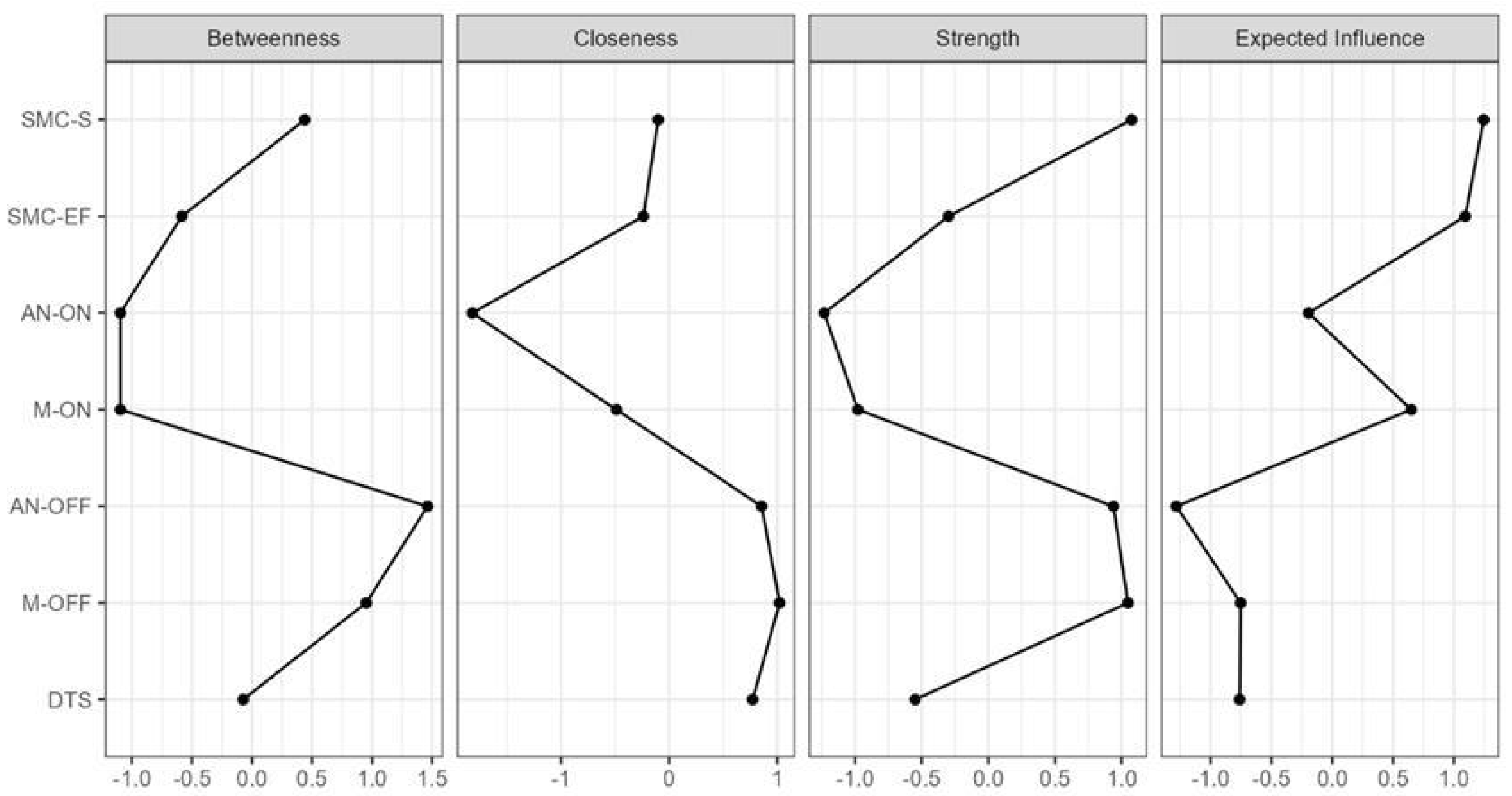
| Variables | Betweenness | Closeness | Strength | Expected Influence |
|---|---|---|---|---|
| DTS | −0.073 | 0.772 | −0.549 | −0.761 |
| M-OFF | 0.952 | 1.023 | 1.048 | −0.753 |
| AN-OFF | 1.464 | 0.855 | 0.938 | −1.282 |
| M-ON | −1.098 | −0.488 | −0.980 | 0.651 |
| AN-ON | −1.098 | −1.822 | −1.231 | −0.195 |
| SMC-EF | −0.586 | −0.238 | −0.300 | 1.094 |
| SMC-S | 0.439 | −0.102 | 1.075 | 1.246 |
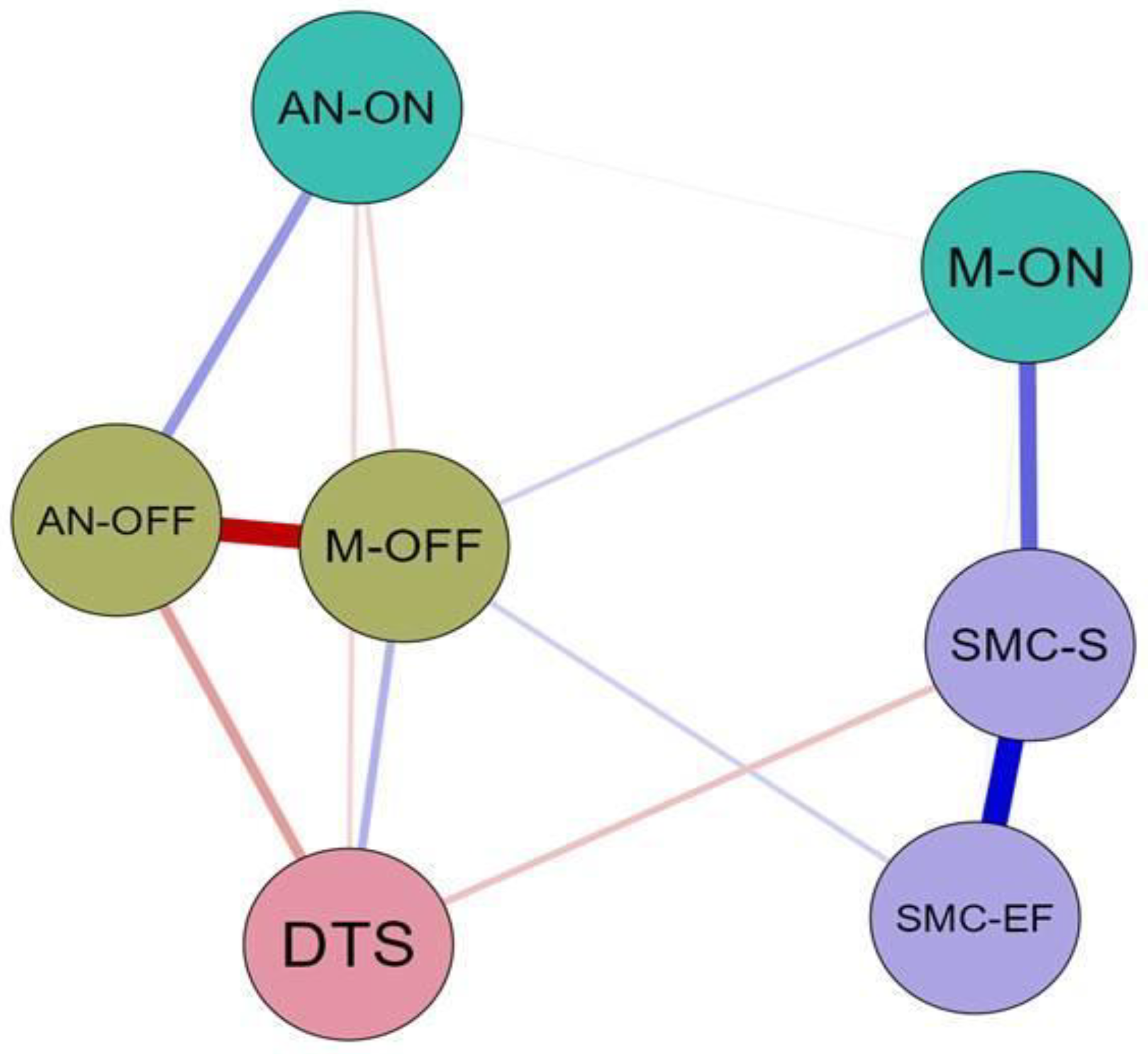
| Variables | DTS | M-OFF | AN-OFF | M-ON | AN-ON | SMC-EF | SMC-S |
|---|---|---|---|---|---|---|---|
| DTS | 0.000 | 0.141 | −0.180 | 0.000 | −0.076 | 0.000 | −0.115 |
| M-OFF | 0.141 | 0.000 | −0.463 | 0.087 | −0.078 | 0.086 | 0.000 |
| AN-OFF | −0.180 | −0.463 | 0.000 | 0.000 | 0.189 | 0.000 | 0.000 |
| M-ON | 0.000 | 0.087 | 0.000 | 0.000 | −0.022 | 0.022 | 0.288 |
| AN-ON | −0.076 | −0.078 | 0.189 | −0.022 | 0.000 | 0.000 | 0.000 |
| SMC-EF | 0.000 | 0.086 | 0.000 | 0.022 | 0.000 | 0.000 | 0.457 |
| SMC-S | −0.115 | 0.000 | 0.000 | 0.288 | 0.000 | 0.457 | 0.000 |
Disclaimer/Publisher’s Note: The statements, opinions and data contained in all publications are solely those of the individual author(s) and contributor(s) and not of MDPI and/or the editor(s). MDPI and/or the editor(s) disclaim responsibility for any injury to people or property resulting from any ideas, methods, instructions or products referred to in the content. |
© 2026 by the authors. Licensee MDPI, Basel, Switzerland. This article is an open access article distributed under the terms and conditions of the Creative Commons Attribution (CC BY) license.
Share and Cite
Basili, S.; Baroni, M.; Colombini, G.; Guazzini, A.; Duradoni, M. Dealing with Stress Through Social Resources: A Complex Approach to the Investigation of Social Antecedents and Distress Tolerance. Psychol. Int. 2026, 8, 44. https://doi.org/10.3390/psycholint8030044
Basili S, Baroni M, Colombini G, Guazzini A, Duradoni M. Dealing with Stress Through Social Resources: A Complex Approach to the Investigation of Social Antecedents and Distress Tolerance. Psychology International. 2026; 8(3):44. https://doi.org/10.3390/psycholint8030044
Chicago/Turabian StyleBasili, Simone, Marina Baroni, Giulia Colombini, Andrea Guazzini, and Mirko Duradoni. 2026. "Dealing with Stress Through Social Resources: A Complex Approach to the Investigation of Social Antecedents and Distress Tolerance" Psychology International 8, no. 3: 44. https://doi.org/10.3390/psycholint8030044
APA StyleBasili, S., Baroni, M., Colombini, G., Guazzini, A., & Duradoni, M. (2026). Dealing with Stress Through Social Resources: A Complex Approach to the Investigation of Social Antecedents and Distress Tolerance. Psychology International, 8(3), 44. https://doi.org/10.3390/psycholint8030044