Article

The Aging Vaginal Microenvironment: A Communication Toolkit


College of Social Work, University of Kentucky, 631 Patterson Office Tower, Lexington, KY 40506, USA
*
Author to whom correspondence should be addressed.
Acta Microbiol. Hell. 2026, 71(2), 12; https://doi.org/10.3390/amh71020012
Submission received: 25 March 2026 / Revised: 28 April 2026 / Accepted: 6 May 2026 / Published: 10 May 2026

Abstract

Background: The vagina undergoes important changes across the life course that are shaped not only by hormonal transitions but also by shifts in the vaginal microbial environment. Despite growing interest in the vaginal microbiome, research has disproportionately centered reproductive-aged populations, leaving the aging vagina comparatively understudied. Objective: This article examines the aging vagina through a life-course lens, with emphasis on microbial and clinical transitions associated with midlife and older adulthood. Key Content: The article highlights menopause-related changes and approaches for reducing stigma and missed clinical opportunities. Particular attention is given to menopause-related declines in estrogen, reduced glycogen availability, increased vaginal pH, and accompanying changes in microbial balance, as well as their relationship to dryness, irritation, genitourinary symptoms, and susceptibility to adverse outcomes. The article also provides health professionals with a practical educational framework for symptom recognition, patient communication, vaginal health assessment, menopause-related education, stigma reduction, and prevention of missed clinical opportunities. Conclusions: Positioning the aging vagina within life-course and microbial-health frameworks can strengthen prevention, improve symptom recognition, and support more age-inclusive, informed, and responsive care for older women.

1. Introduction

Sexual well-being remains a meaningful dimension of health across the life course. However, routine sexual assessment and sexual health education are often absent in care for older adults [1,2,3,4]. In practice, sexuality is frequently dismissed as irrelevant to later life or addressed only in the context of dysfunction, despite ongoing needs for prevention, counseling, and accurate interpretation of bodily changes [5,6,7]. This disconnect creates a practical problem: older women may experience pain, bleeding, discomfort, or heightened vulnerability to infection without receiving clear, non-stigmatizing guidance [7,8].
Meanwhile, scientific and clinical knowledge on later-life sexual health has expanded considerably—particularly regarding how menopause reshapes the vaginal microenvironment through hormonal and tissue changes that interact with local microbial ecology [9,10,11,12]. These alterations can affect comfort, susceptibility to injury, and disease vulnerability. Yet such knowledge is rarely integrated into community-based sexual health education or the conversational tools practitioners use when discussing issues with older women [13,14].
As a result, current practice is often variable and idiosyncratic. Whether older women are asked about sexual concerns, receive anticipatory guidance, or are referred appropriately may depend on a practitioner’s comfort, training background, and time constraints rather than on a consistent, evidence-aligned approach [15,16,17]. A structured framework can reduce this variability by offering a shared standard for what should usually happen. At the same time, it can allow flexible, case-based tailoring when client values, history, culture, or clinical presentation warrant a different approach. In this sense, structure supports—rather than replaces—professional judgment.
Social workers functioning as public health educators are well positioned to narrow this gap. Viewed as approachable professionals, they build close client relationships, guiding older adults through medication side effects, alerting them to potential impacts on sexual health, and offering therapeutic alternatives to help adapt to bodily and functional changes [5,18]. They bring strengths in holistic assessment, relational communication, culturally responsive practice, and stigma reduction—skills that directly address barriers suppressing later-life sexual health dialogue [19]. Yet without a clear, stepwise approach that translates menopause-related microenvironment knowledge into usable assessment and education steps, practice remains inconsistent and dependent on individual discretion.
Among women who are aging and at different stages of menopause or are post-menopausal, there are compositional shifts to the vagina that have clinical implications for health professionals when providing education and care. For those professionals who are less driven by the biomedical model of care, it is essential to identify and understand the shifts in the vaginal microbiome. The vaginal microbiome changes across the life course, reflecting the interaction of biological aging with social, behavioral, and structural factors. In reproductive-age individuals, vaginal microbial communities are often characterized by Lactobacillus dominance, particularly species such as L. crispatus, L. iners, L. gasseri, and L. jensenii [20]. While these shifts are frequently described in biomedical terms, they also have broader implications for how aging individuals experience vaginal health, sexual intimacy, bodily change, symptom disclosure, and access to appropriate care [21].
These shifts are important because they can affect how aging individuals experience vaginal and urinary health in everyday life. Lactobacillus species help support a balanced vaginal environment. When these bacteria decline and other bacteria become more common, individuals may be more likely to experience dryness, irritation, discomfort during sex, urinary symptoms, and infections. These symptoms can influence quality of life, sexual wellbeing, help-seeking behavior, and perceptions of aging. Lactobacillus species help maintain a protective vaginal environment, while lower levels of Lactobacillus and greater microbial diversity are linked to vaginal dryness, irritation, inflammation, painful sex, urinary discomfort, recurrent urinary symptoms, and increased risk of vaginal or urinary infections [21,22,23,24]. Thus, changes in the vaginal microbiome may contribute to the physical symptoms and quality-of-life concerns often reported during and after menopause.
Howard and Jenson [19] and others [20,21,22,23,24] provide a useful foundation to distinguish between elements that are evidence-based, such as menopause-related biological change, vaginal microbiome shifts, symptom burden, sexual wellbeing, and healthcare access barriers, and the proposed innovation of integrating these elements of biological aging with social dimensions. This integrated social science model of the aging vagina specifically aligns biological aging with lived experience.
To address this gap, this paper proposes a microenvironment-informed practice framework for social work health educators and other human service professions. This framework supports consistent, evidence-aligned conversations about the aging vagina without adding extra workload, providing up-to-date direction while preserving professional autonomy [19]. It emphasizes normalizing later-life sexuality, integrating menopause-related physiological and microbial shifts into education, and using concrete tools to improve communication and personalize support. Informed by the sexual health model [25] and drawing on applications of single-case research, these tools include a reproductive history questionnaire, an arts-based self-figure drawing activity, and aging-tailored labeled genital imagery. The sections that follow first summarize menopause-related changes in the vaginal microenvironment and explain why microorganisms matter for education and prevention. They then delineate gaps in current practice, before presenting the framework alongside implementation considerations, anticipated benefits, and potential criticisms.

2. Materials and Methods

2.1. Menopause, the Vaginal Microenvironment, and Why Microorganisms Matter

Menopause alters the vaginal microenvironment through hormonal and tissue shifts that interact with local microbial ecology [7,26]. Social work health educators require a foundational understanding of these changes to deliver clearer education and more effective prevention messaging.

2.2. Menopause-Related Tissue Changes and Sexual Comfort

Postmenopausal hormonal changes reduce vaginal elasticity and lubrication, rendering tissues more fragile and lowering the pain threshold during consensual sexual activity. Consequently, postmenopausal women are more susceptible to genital injuries overall [6]. This has critical implications for education, as many interpret such pain or bleeding as personal failure or “dysfunction.” A life-course perspective helps reframe these experiences as normal aging processes that affect resilience and healing capacity [27]. An apt analogy likens postmenopausal vaginal changes to those in aging skin or joints: reduced hormonal support decreases resilience, heightening susceptibility to irritation or injury without implying pathology. This framing fosters non-stigmatizing conversations while creating space to discuss care strategies and prevention.

2.3. The Microenvironment Lens: Linking Physiology and Microorganisms

The microenvironment lens underscores that risk and comfort are shaped locally, connecting age-related physiological changes to microbial shifts and challenging assumptions of uniform sexual resilience across the life course [28,29]. Microorganisms thus become practically vital for education and assessment; variations in the vaginal microbiome extend far beyond biological trivia. As previously discussed, menopausal changes in older women can alter vaginal ecology in ways that influence disease risk, prevention, diagnosis, and treatment within personalized sexual and reproductive health approaches.
Notably, to enhance feasibility and acceptability during framework development, we incorporated preliminary qualitative input from health professionals and older women through IRB-approved formative qualitative work. This study was approved for exemption (#102568) at the authors’ institution. The exemption was granted because the study involved anonymous survey data, minimal-risk interviews, and no private identifiable information was collected or reported. Health professionals completed semi-structured interviews on barriers to later-life sexual health conversations and desired educational tools. Older women participated in semi-structured reproductive health history discussions and arts-based self-figure drawing activities, followed by group discussions. We used these inputs to revise the stepwise protocol, simplify explanations of microenvironment changes, and strengthen trauma-informed, permission-based language.

2.4. The Development of Her Kit

An important part of concept development for a product is market discovery, the process of identifying and analyzing current products. Seven companies were identified that offer health models (e.g., skills trainers, condom kits, sexual health education tools, home care trainers, pelvic models), including models of the entire reproductive system as well as external genitalia. Common features of models were removable organs and/or the ability to disassemble parts. For example, a female pelvis model might have a removable uterus with fallopian tubes or the ability to disassemble the pelvis for a birthing demonstration. Some offer multiple flesh tone (usually two, light and dark). Most companies are authorized distributors and do not offer custom orders. Only one company stated that they offer customization. None of the models offer the ability to alter the existing models to aging or chronic condition specifications as suggested. Table 1 illustrates the model types and their ability to offer aging adaptations.
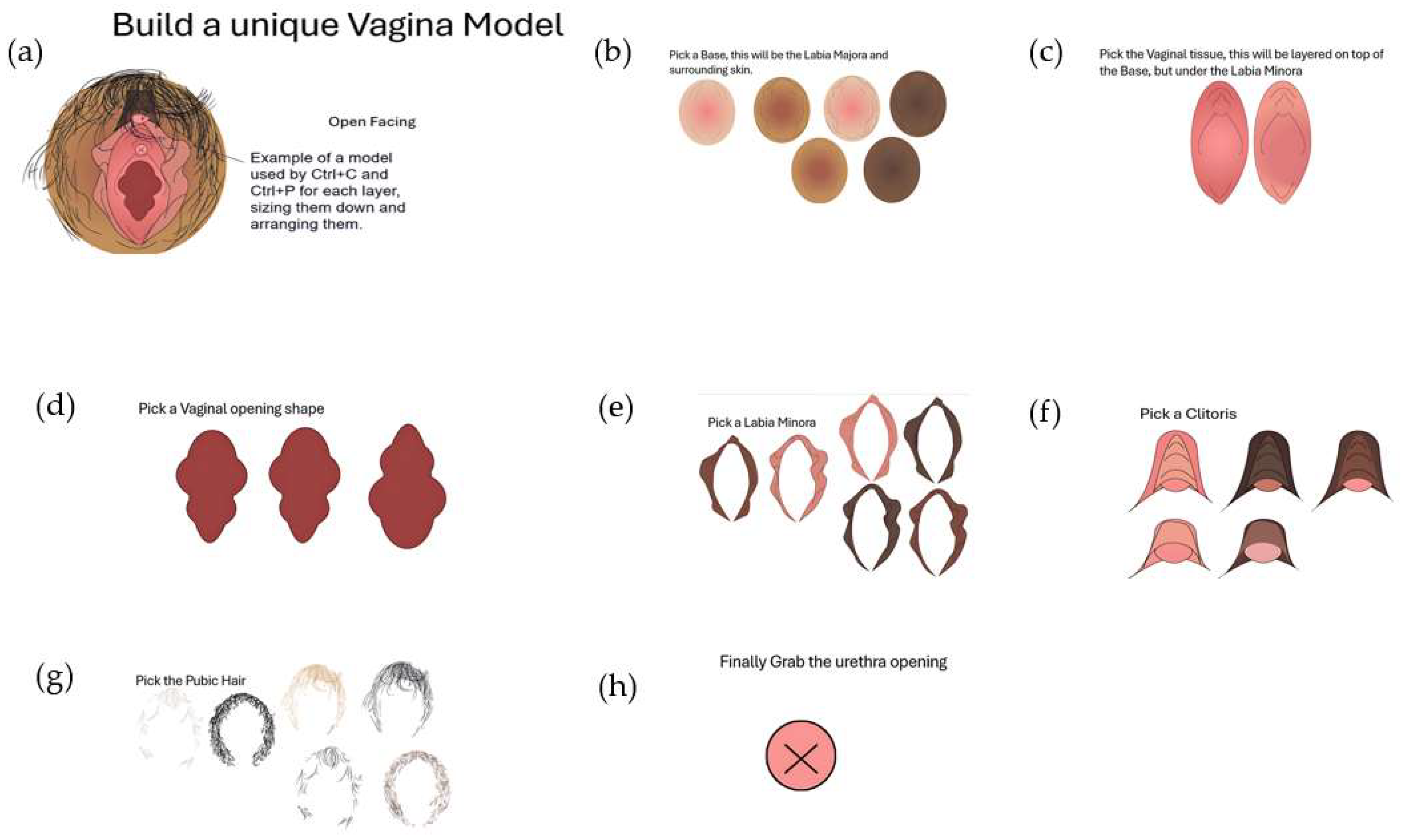
Upon review, and noting the lack of such a tool, the first author submitted an internal research proposal to support the development of the tool. Upon successful funding, the first author collaborated with the College of Fine Arts to develop prototypes of aging vagina mockups (examples) based on a medical literature review. A graphic illustrator designed the mockups based on a series of consultations with the research team, which included the first author and two professors in the art department. After several iterations of drafts, the final sketches were moved from Adobe Illustrator 2026 (version 30.0) to overlays used within Microsoft PowerPoint, facilitating the act of ‘building’ a custom vagina with various shapes and sizes of all the related tissue.
As seen in Figure 1, the illustrations were placed in a slide show. Each element could be changed in relation to participant’s feedback.

3. Discussion

This section presents a structured yet flexible framework to guide sexual health conversations with older women. Tailoring is essential when culture, trauma history, disability, or access barriers influence communication [30]. The goal is consistency without rigidity, as the framework supports a shared baseline for typical assessment and education while preserving clinical judgment and personalization.

3.1. A Microenvironment-Informed Practice Framework for Social Work Health Educators

Core Principles

  • Normalization and stigma reduction. Begin from the assumption that sexuality remains relevant in later life. Use nonjudgmental language. Treat questions about pleasure, pain, and risk as routine health topics.
  • Microenvironment-informed education. Explain that menopause can reshape local conditions (hormones, tissue, microbial ecology). Use this to contextualize symptoms and vulnerability without implying pathology.
  • Client-centered tailoring. Align education with the client’s values, relationship context, sexual practices, comfort level, and cultural background.
  • Trauma-informed and autonomy-respecting practice. Offer choices, ask permission, and avoid assumptions.
  • Prevention and appropriate referral. Pair education with clear “when to seek care” guidance, especially when symptoms suggest infection or other clinical issues.
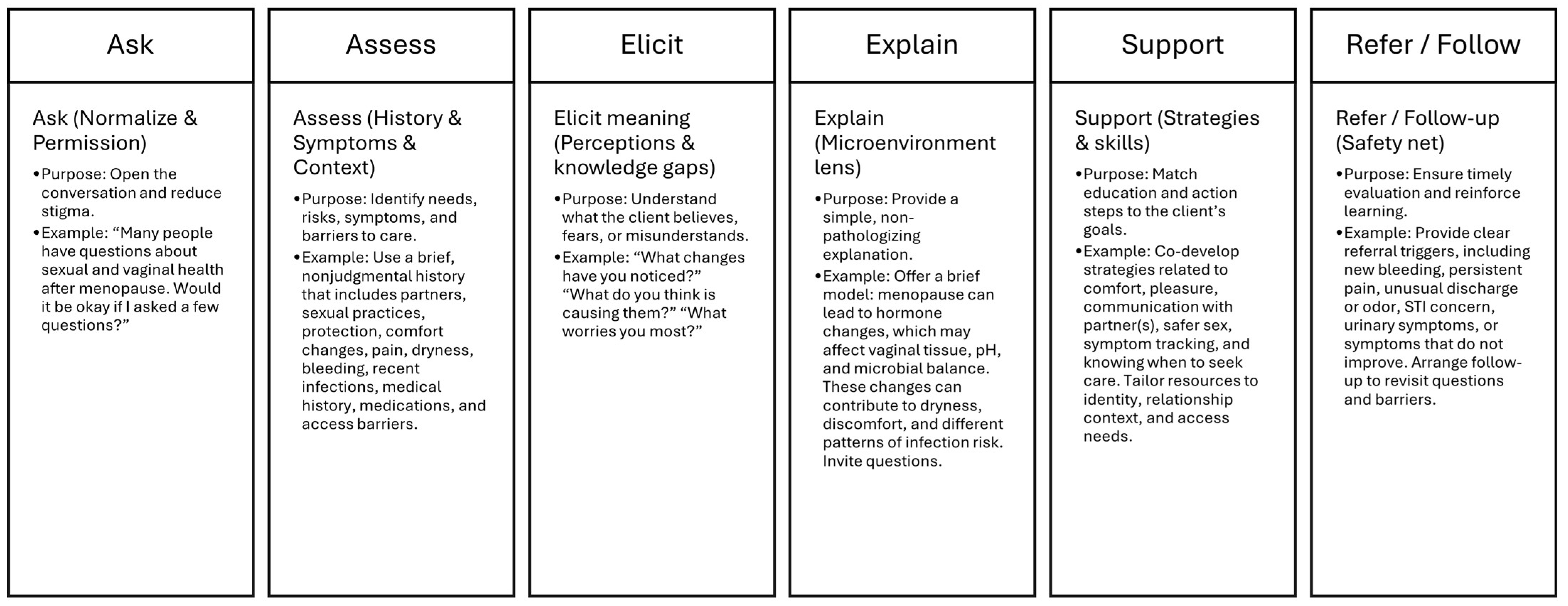
The framework follows a short, repeatable sequence: Ask, Assess, Explain, Support, and Refer/Follow-up (see Figure 2). It opens with a low-pressure normalization statement and permission-based question. Assessment then uses a reproductive and sexual history tool, alongside symptom prompts that address menopause-related comfort changes and risk factors. Next, the educator introduces a simple microenvironment lens, linking menopause-related tissue changes and microbial ecology to common experiences and prevention needs. The conversation then shifts to support, offering practical strategies—such as communication tips, comfort options, safer sex guidance, and resources—tailored to the client’s identity, partner status, and goals. Finally, it concludes with referral and follow-up: clear thresholds for clinical evaluation, brief follow-up questions, reinforced key messages, and strategies to address care barriers.
To put the framework into action, practitioners need concrete tools for assessment and education. A reproductive history questionnaire offers structured prompts to reduce missed topics and ease provider discomfort through clear language and logical flow. An arts-based genital self-figure drawing activity provides a client-friendly way to elicit perceptions, concerns, and knowledge gaps, especially for those lacking medical terminology [31]. Aging-tailored labeled genital imagery further strengthens education by depicting older bodies and enabling accurate, stigma-reducing explanations of anatomy and age-related changes.
For reference, the authors adapted nine questions from the publicly accessible Form 31-Reproductive History Questionnaire of the Women’s Health Initiative Clinical Trial and Observational Study SHARE [32]. They also collaborated with another unit to create illustrations that support, based on a medical literature review, the development of this imagery.

4. Implementation Considerations

This framework is designed for brief, real-world encounters. It can be used in primary care, community health programs, or social service settings. It can also be delivered over more than one session. In a short visit, educators can prioritize Step 1, Step 2, and a simplified Step 4. In longer encounters, the full sequence can be used, including the drawing activity.
Basic training is needed for consistent use. Educators should practice permission-based openings and nonjudgmental language. They should also learn a simple way to explain menopause-related microenvironment changes. Training should include trauma-informed safeguards, because sexuality and bodies can be sensitive topics.
The tools should be offered as options, not requirements. The questionnaire can be self-completed or guided. The drawing activity should be voluntary. The imagery should be aging-tailored and culturally responsive. Documentation should be brief and respectful, and privacy should be protected. Clear referral triggers should be stated at the end of the conversation and revisited at follow-up.

5. Conclusions

Menopause alters the vaginal microenvironment through hormonal shifts, reduced tissue integrity, and microbial changes. This also leaves professionals with implications for comfort, vulnerability, and prevention. Yet this knowledge rarely informs routine sexual health assessment and education for older women. This paper fills that gap with a microenvironment-informed framework that ensures consistency without rigidity. Its stepwise protocol sets a baseline for conversations while allowing professional autonomy and client-centered adaptation.
Future studies should test feasibility across settings, acceptability among diverse older women, and outcomes like comfort discussing sexual health, knowledge gains, help-seeking, and referrals. With careful implementation and refinement, this guidance can normalize later-life sexual health and bolster prevention and well-being.

Implications for Practice

Practice guidelines can strengthen evidence-based work and improve outcomes without adding extra burden [33]. When well designed, they provide up-to-date direction while preserving professional autonomy. In this paper, the proposed framework applies that same logic to later-life sexual health education by offering a clear sequence for routine care, while also leaving room for professional judgment and client-led tailoring.
A key implication is that microenvironment-informed education can become practical in everyday settings when paired with usable tools. The reproductive history questionnaire supports consistent assessment and reduces missed topics. The arts-based genital self-figure drawing activity helps clients express perceptions and concerns without requiring medical vocabulary. Aging-tailored labeled genital imagery supports accurate, stigma-reducing explanations and normalizes older bodies. Together, these tools operationalize the framework’s steps (Ask, Assess, Explain, Support, Refer/Follow-up) and reduce the likelihood that later-life sexual health is skipped because of discomfort, time pressure, or uncertainty about how to proceed.
These tools also extend to communication quality and equity. Research in health communication shows that tailoring improves message relevance when it reflects the audience’s norms, preferences, and lived context—including both “surface” features and “deep” features [30]. In this framework, aging-tailored imagery functions as a surface-structure support, while permission-based language, stigma reduction, and attention to personal goals function as deep-structure supports. The result is a practice approach that can be consistent and still culturally responsive.
This protocol does not intend to standardize client experiences; rather, it standardizes the opportunity for care. Professional judgment remains central, and steps can be reordered or omitted as appropriate. Microorganism and microenvironment content is presented in plain language to inform prevention and interpretation, not to pathologize sexuality in later life. Finally, the arts-based activity is optional: it should be offered with consent and replaced with other elicitation strategies when not a good fit.

Author Contributions

Conceptualization: L.C. and L.T.; methodology, L.C.; writing—original draft preparation, L.C.; writing—review and editing, L.C. and L.T.; visualization, L.C.; funding acquisition, L.C. All authors have read and agreed to the published version of the manuscript.

Funding

Research reported in this publication was supported by NIH Research Grant 1K0 AG092253-01A1 funded by; The National Institute on Aging (NIA) and the Office of AIDS Research (OAR). The content is solely the responsibility of the authors and does not necessarily represent the official views of the National Institutes of Health. The APC was funded by the UNITE Research Priority Area at the University of Kentucky.

Institutional Review Board Statement

Ethical review and approval were waived for this study due to it not involving human subjects or animals.

Data Availability Statement

No new data were created.

Acknowledgments

During the preparation of this manuscript, the authors used OpenAI (2026) to generate an initial table based on the study narrative, including summarizing key points and organizing them into structured rows and columns for presentation. The authors have reviewed and edited the table and take full responsibility for the content of this publication.

Conflicts of Interest

The authors declare no conflicts of interest. The funders had no role in the design of the study; in the collection, analyses, or interpretation of data; in the writing of the manuscript; or in the decision to publish the results.

References

  1. Conner, L.; Adatorwovor, R.; Robbins, S.K.; Machinga-Asaolu, R.; Showalter, K.; Oser, C. Geographic patterns of Human Immunodeficiency Virus (HIV) risk behaviors among older adults: A strategy for identifying space as a risk exposure. J. Appl. Gerontol. 2024, 44, 210–221. [Google Scholar] [CrossRef] [PubMed]
  2. Cornelius, J.; Moneyham, L.; LeGrand, S. Adaptation of an HIV prevention curriculum for use with older African American women. J. Assoc. Nurses AIDS Care 2008, 19, 16–27. [Google Scholar] [CrossRef] [PubMed]
  3. Durvasula, R. HIV/AIDS in older women: Unique challenges, unmet needs. Behav. Med. 2014, 40, 85–98. [Google Scholar] [CrossRef]
  4. Lindau, S.T.; Leitsch, S.A.; Lundberg, K.L.; Jerome, J. Older women’s attitudes, behavior, and communication about sex and HIV: A community-based study. J. Women’s Health 2006, 15, 747–753. [Google Scholar] [CrossRef]
  5. Conner, L.R.; Engstrom, M.; Junious, E.; Edwards-Knight, K. Woman to Woman (W2W): Adapting an HIV risk reduction intervention for older women. J. Women Aging 2017, 30, 428–443. [Google Scholar] [CrossRef]
  6. Gerten, K.; Markland, A.; Lloyd, L.; Richter, H. Prolapse and incontinence surgery in older women. J. Urol. 2008, 179, 2111–2118. [Google Scholar] [CrossRef] [PubMed]
  7. Farage, M.A.; Maibach, H.I. Lifetime changes in the vulva and vagina. Arch. Gynecol. Obstet. 2006, 273, 195–202. [Google Scholar] [CrossRef]
  8. Pilowsky, D.; Wu, L. Sexual risk behaviors and HIV risk among Americans aged 50 years or older: A review. Subst. Abus. Rehabil. 2015, 6, 51–60. [Google Scholar] [CrossRef]
  9. Bachmann, G.A.; Leiblum, S.R. The impact of hormones on menopausal sexuality: A literature review. Menopause 2004, 11, 120–130. [Google Scholar] [CrossRef]
  10. Brown, K.; Streubert, G.E.; Burgess, A.W. Effectively detect and manage elder abuse. Nurse Pract. 2004, 29, 22–33. [Google Scholar] [CrossRef]
  11. van Lunsen, R.H.W.; Laan, E. Genital vascular responsiveness and sexual feelings in midlife women: Psychophysiologic, brain and genital imaging studies. Menopause 2004, 11, 741–748. [Google Scholar] [CrossRef] [PubMed]
  12. Walsh, K.E.; Berman, J.R. Sexual dysfunction in the older woman: An overview of the current understanding and management. Drugs Aging 2004, 21, 655–675. [Google Scholar] [CrossRef]
  13. Conner, L.; Fernández, Y.; Junious, E.; Piper, C.; Rowan, D. Evaluating HIV educational materials for older adults. J. Int. Assoc. Provid. AIDS Care 2019, 18, 1–10. [Google Scholar] [CrossRef]
  14. Conner, L.; Ruppel, M.; Oser, C.B. A scoping review: Forced/coerced sterilization as a socio-cultural risk factor for sexually transmitted HIV for older Black women. J. Health Psychol. 2024, 30, 579–589. [Google Scholar] [CrossRef] [PubMed]
  15. Farrell, J.; Belza, B. Are older patients comfortable discussing sexual health with nurses? Nurs. Res. 2012, 61, 51–57. [Google Scholar] [CrossRef]
  16. Gott, M.; Hinchliff, S.; Galena, E. General practitioner attitudes to discussing sexual health issues with older people. Soc. Sci. Med. 2004, 58, 2093–2103. [Google Scholar] [CrossRef] [PubMed]
  17. Saunamäki, N.; Andersson, M.; Engström, M. Discussing sexuality with patients: Nurses’ attitudes and beliefs. J. Adv. Nurs. 2010, 66, 1308–1316. [Google Scholar] [CrossRef]
  18. McCord, L. Attention HIV: Older African American women define sexual risk behavior. Cult. Health Sex. 2014, 16, 90–100. [Google Scholar] [CrossRef]
  19. Howard, M.O.; Jenson, J.M. Clinical practice guidelines: Should social work develop them? Res. Soc. Work. Pract. 1999, 9, 283–301. [Google Scholar] [CrossRef]
  20. Szymański, J.K.; Słabuszewska-Jóźwiak, A.; Jakiel, G. Vaginal aging—What we know and what we do not know. Int. J. Environ. Res. Public Health 2021, 18, 4935. [Google Scholar] [CrossRef]
  21. Park, M.G.; Cho, S.; Oh, M.M. Menopausal changes in the microbiome—A review focused on the genitourinary microbiome. Diagnostics 2023, 13, 1193. [Google Scholar] [CrossRef] [PubMed]
  22. Byrne, E.H.; Song, H.; Srinivasan, S.; Fredricks, D.N.; Reed, S.D.; Guthrie, K.A.; Wu, M.; Mitchell, C.M. Association between vaginal microbiota and vaginal inflammatory immune markers in postmenopausal women. Menopause 2024, 31, 575–581. [Google Scholar] [CrossRef] [PubMed]
  23. Dubé-Zinatelli, E.; Cappelletti, L.; Ismail, N. Vaginal microbiome: Environmental, biological, and racial influences on gynecological health across the lifespan. Am. J. Reprod. Immunol. 2024, 92, e70026. [Google Scholar] [CrossRef]
  24. Micks, E.; Reed, S.D.; Mitchell, C. The postmenopausal vaginal microbiome and genitourinary syndrome of menopause. Clin. Obstet. Gynecol. 2024, 67, 79–88. [Google Scholar] [CrossRef]
  25. Robinson, B.B.; Bockting, W.O.; Rosser, B.R.; Miner, M.; Coleman, E. The sexual health model: Application of a sexological approach to HIV prevention. Health Educ. Res. 2002, 17, 43–57. [Google Scholar] [CrossRef]
  26. Farage, M.A.; Maibach, H.I. Morphology and physiological changes of genital skin and mucosa. Curr. Probl. Dermatol. 2011, 40, 9–19. [Google Scholar] [CrossRef]
  27. Pruchno, R.; Heid, A.R.; Genderson, M.W. Resilience and successful aging: Aligning complementary constructs using a life course approach. Psychol. Inq. 2015, 26, 200–207. [Google Scholar] [CrossRef]
  28. Brotman, R.M. Vaginal microbiome and sexually transmitted infections: An epidemiologic perspective. J. Clin. Investig. 2011, 121, 4610–4617. [Google Scholar] [CrossRef]
  29. Oliveira, N.S.; Lima, A.B.F.; Brito, J.C.R.; Sarmento, A.C.A.; Gonçalves, A.K.S.; Eleutério, J., Jr. Postmenopausal vaginal microbiome and microbiota. Front. Reprod. Health 2022, 3, 780931. [Google Scholar] [CrossRef]
  30. Griffith, D.M.; Efird, C.R.; Baskin, M.L.; Hooper, M.W.; Davis, R.E.; Resnicow, K. Cultural sensitivity and cultural tailoring: Lessons learned and refinements after two decades of incorporating culture in health communication research. Annu. Rev. Public Health 2024, 45, 195–212. [Google Scholar] [CrossRef] [PubMed]
  31. Paulovich, B. Design to improve the health education experience: Using participatory design methods in hospitals with clinicians and patients. Visible Lang. 2015, 49, 144–159. [Google Scholar]
  32. National Center for Biotechnology Information. dbGaP Study Document (phs000200.v2.p1; Document ID: Phd=1916). National Institutes of Health. Available online: https://www.ncbi.nlm.nih.gov/projects/gap/cgi-bin/document.cgi?study_id=phs000200.v2.p1&phd=1916 (accessed on 13 February 2026).
  33. Noar, S.M.; Benac, C.N.; Harris, M.S. Does tailoring matter? Meta-analytic review of tailored print health behavior change interventions. Psychol. Bull. 2007, 133, 673–693. [Google Scholar] [CrossRef] [PubMed]
Figure 1. Guide for building a unique vagina model.
Amh 71 00012 g001
Figure 2. Sequence for Ask, Assess, Explain, Support, and Refer/Follow-up.
Amh 71 00012 g002
Table 1. Market Discovery of Reproductive Health Training Models.
Model SpecificationsOffer Aging Specifications/Adaptability
Model Types (Company)Pelvic ModelsVagina ModelsPenis ModelsAtrophy, Dermatitis, Hair (Presence/Absence), Color Changes, Size Changes, Chronic Conditions
Anatomical Pelvic Models (Mentone)XX NO
Condom Training (Anatomy Warehouse)XXXNO
OB/GYN Education (Global technologies)XXXNO
Condom Trainers (3B scientific)XXXNO
Sex Education Products (Health EDCO)X NO
Interchangeable Catheterization and Enema Task trainer; In-Service Home Care Training Simulator (Laerdal)X NO
Genitalia (CAE) XXNO
Note. The letter X is used to indicate the presence of specifications for the model.
Disclaimer/Publisher’s Note: The statements, opinions and data contained in all publications are solely those of the individual author(s) and contributor(s) and not of MDPI and/or the editor(s). MDPI and/or the editor(s) disclaim responsibility for any injury to people or property resulting from any ideas, methods, instructions or products referred to in the content.