1. Introduction
Anemia, affecting approximately 30% of the world’s population [
1], is often monitored through repeated phlebotomy, which may delay clinical decision-making and patient care. Anemia is defined by hemoglobin concentrations below established reference ranges. For adult males, normal hemoglobin values are 14–18 g/dL [
1]. Laboratory hemoglobin (LabHb) measurements are common in inpatient and outpatient settings but have turnaround times ranging from one to several hours, depending on laboratory workflow, facility size, and staffing. Although hemoglobin values may not immediately reflect acute blood loss, some facilities use rapid venous blood gas or point-of-care analyzers (e.g., i-STAT). However, these methods remain invasive, require calibration, involve processing time, and may be influenced by hydration status and intravascular volume. In contrast, real-time, non-invasive hemoglobin monitoring (SpHb) may provide immediate trend information, reduce turnaround time, and minimize patient discomfort by reducing invasive serial blood draws while enabling continuous monitoring.
Non-invasive hemoglobin monitoring using SpHb relies on multi-wavelength spectrophotometry to estimate hemoglobin concentration from light absorption through pulsatile tissue, whereas laboratory hemoglobin measurement using Coulter-based analyzers determines hemoglobin levels via cellular analysis and electrical impedance [
2,
3,
4]. Because SpHb depends on peripheral perfusion and optical signal quality, physiological states such as dehydration, which alter intravascular volume and microvascular blood flow, may affect measurement accuracy [
5,
6]. In contrast, laboratory-based measurements are less influenced by peripheral perfusion. These differences in measurement mechanisms provide a theoretical basis for examining whether hydration status influences agreement between SpHb and LabHb.
Studies are inconsistent in assessing the accuracy of LabHb and SpHb across settings. Although the Masimo Rad-97 and Rad-67 have received U.S. Food and Drug Administration (FDA) clearance for clinical use (2008 and 2019, respectively), initial validation studies were conducted primarily in adult perioperative and critical care populations, and subsequent investigations have shown variability across physiological conditions and clinical settings (Masimo Corporation, Irvine, CA, USA). Al Aseri et al. (2023) reported a strong correlation (r = 0.81) between SpHb and LabHb in the emergency department [
7], whereas Ke et al. (2021) found a moderate correlation (r = 0.76) in a preoperative clinic [
8]. Tang et al. (2019) and Chang et al. (2019) reported a lower correlation (r = 0.69) in the operating room [
9,
10], and Xu et al. (2016) found a poor correlation (r = 0.29) in surgical critical care patients [
11].
Due to inconsistent accuracy, several investigators recommend that future studies assess SpHb utility across clinical scenarios, including fluid or blood loss and emergency surgery [
8,
9]. Based on prior literature and clinical observations, we hypothesized that hydration status may influence agreement between SpHb and LabHb measurements, with reduced concordance in dehydrated patients. Therefore, this study aimed to evaluate agreement between SpHb and LabHb and to determine whether dehydration, defined by fasting status and laboratory indicators of volume depletion (see
Table 1), affects concordance between hydrated and dehydrated patients.
2. Materials and Methods
A single paired SpHb and LabHb measurement was obtained per patient. Demographic data, fasting status, and laboratory markers of hydration status were extracted from the electronic health record. This single-center, exploratory, cross-sectional study was conducted at a 78-bed Veterans Affairs (VA) acute care facility. The facility is classified by the VA’s Complexity Level Model as an Inpatient Intermediate Invasive Procedure [
12]. The Institutional Review Board (IRB) granted an exempt determination (IRB #1693328-1). SpHb measurements were obtained as part of routine care and analyzed retrospectively without affecting clinical management. SpHb and LabHb measurements were obtained simultaneously in the emergency department, outpatient laboratory, and intensive care unit. Eligible patients were male veterans who had a complete blood count obtained between 6 January and 31 January 2022 in inpatient or outpatient settings. Female patients were excluded to reduce potential sex-related confounding in SpHb measurements [
8].
The Masimo Rad-67 and Rad-97 (Masimo Corporation, Irvine, CA, USA) were on loan from Masimo as the SpHb data-collection tools for this study. The devices measure parameters such as SpHb and provide either spot-check (Rad-67) or continuous (Rad-97) non-invasive hemoglobin readings. Traditional pulse oximeters use wavelengths between 660 nm and 940 nm (red and infrared, respectively) to calculate the ratio of oxyhemoglobin to total hemoglobin (SpO
2) and provide a pulse rate [
2]. Masimo Corp. (Irvine, CA, USA) had developed Rainbow Pulse CO-oximeters, such as the Rad-67 and Rad-97 SpHb, which build upon this technology by using up to 12 light wavelengths. These devices can assess carboxyhemoglobin, methemoglobin, total hemoglobin (SpHb), and conventional SpO
2 by distinguishing among various hemoglobin types. They achieve this by transmitting visible and infrared light through tissue and measuring the amount of light absorption [
2,
3]. According to a study conducted independently of Masimo Corporation, the updated technology is not affected by skin tone, unlike a pulse oximeter [
13]. Manufacturer-reported performance characteristics indicate that SpHb measurements have an accuracy range of 8–17 g/dL (Masimo Corporation, Irvine, CA, USA).
Phlebotomists in the emergency department, inpatient wards, and outpatient laboratory were trained on the Masimo Rad-67 device, a non-invasive hemoglobin monitor, and the data collection sheets. In these settings, blood draws occurred on the same limb on which the non-invasive SpHb finger probe was placed. After recording the SpHb value without tourniquet placement, venous blood was drawn according to standard practice and transported to the laboratory for analysis. LabHb values were recorded on the data collection sheet and documented in the patient’s electronic health record (EHR). In the intensive care unit (ICU), registered nurses were trained to use the Masimo Rad-97 monitor to obtain continuous SpHb measurements from the bedside patient monitor. The nurse recorded the SpHb value at the time of venous blood draw and documented the corresponding LabHb value when it became available.
LabHb was analyzed using the Beckman Coulter Cellular Analysis System DxH 900 (Beckman Coulter Inc., Brea, CA, USA). The DxH 900 measures hemoglobin as part of a complete blood count using the Coulter principle, which detects changes in electrical resistance as cells pass through a small aperture. Its integrated technologies enable comprehensive hematologic analysis, including hemoglobin measurement, by evaluating cell counts, sizes, and morphology [
4].
Patients’ age, sex, race, and ethnicity were collected from the EHR. Fasting status and laboratory values were extracted to determine hydration status. Patients were divided into two groups: dehydrated and non-dehydrated. Hydration status was determined using biochemical markers of volume depletion, including glomerular filtration rate (GFR), creatinine (Cr), blood urea nitrogen (BUN), sodium (Na), chloride (Cl), potassium (K), hematocrit (Hct), and urine specific gravity (SG), along with fasting status. A documented diagnosis of dehydration was recorded when present; however, group classification was based primarily on laboratory-derived criteria to reduce documentation bias. Institutional reference ranges were used. A patient was considered dehydrated if they met the criteria outlined in
Table 1 [
14,
15]. Clinical anemia was defined as Hb < 8.00 g·dL
−1 [
5].
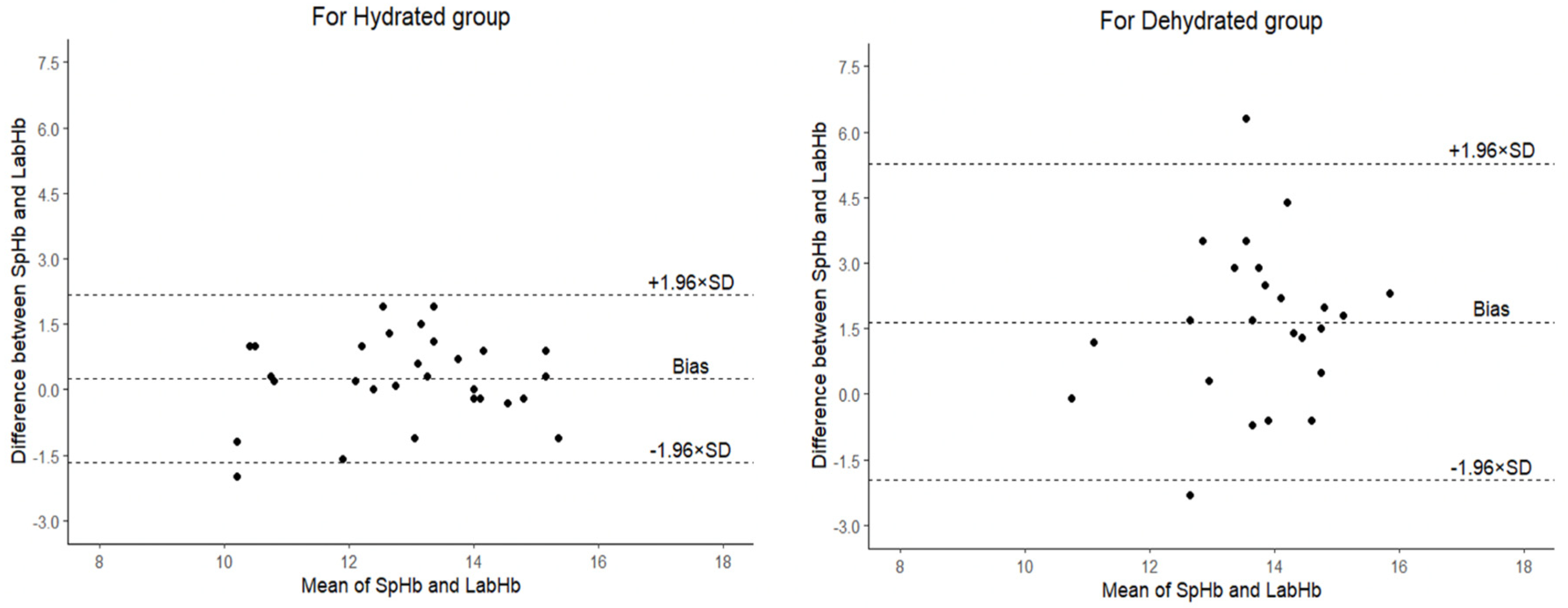
To assess the absolute agreement or concordance between SpHb and LabHb values, a Bland–Altman analysis [
16] was used, with a corresponding Bland–Altman plot visualizing the estimated bias, i.e., the mean difference between the two measurement techniques. The threshold for an acceptable agreement to the tolerability ratio between SpHb and LabHb values was set to ±1 g·dL
−1. Observed limits of agreement were calculated using the formula Bias ± 1.96 × SD, where bias is defined as the mean of the differences between the SpHb and LabHb values. To assess the uncertainty of the estimates, confidence intervals for the bias and for each limit of agreement were calculated. These analyses were conducted for the overall sample and each dehydration group. Pearson linear correlation coefficients were calculated to further assess the extent of the relationship between the two measures in the overall sample and stratified by dehydration status, with Passing–Bablok regression analysis implemented to further assess the comparability of the methods. Descriptive statistics were calculated, and differences in baseline characteristics between the dehydration subgroups were assessed utilizing either a Mann–Whitney U test for continuous variables or a chi-square test for categorical variables. R version 4.2.3 was used to analyze the data, with statistical significance defined as
p < 0.05 and confidence interval estimates constructed at the 95% confidence level.
4. Discussion
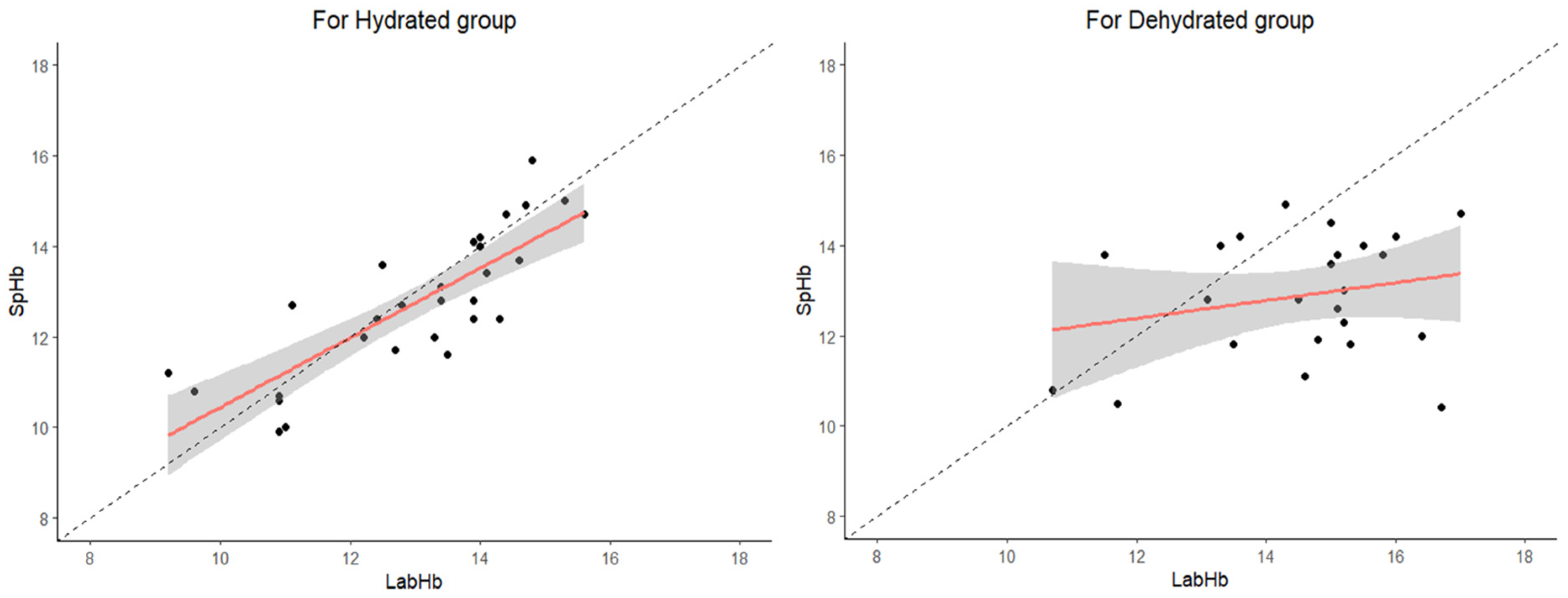
The data suggest that hydration affects the correlation between SpHb and LabHb. We found that patients without dehydration had a very strong SpHb and LabHb correlation (r = 0.82), with 69% of SpHb readings within the ±1 g·dL−1 threshold of agreement, as well as a lower mean bias and narrower limits of agreement [mean bias (limits of agreement): 0.25 (−1.67 to 2.18 g·dL−1)]. Conversely, patients with dehydration demonstrated a weak, non-significant correlation (r = 0.23) between SpHb and LabHb, with a higher mean bias and broader limits of agreement [mean bias (limits of agreement): 1.65 (−1.97 to 5.27 g·dL−1)]. Only 25% of their readings fell within the ±1 g·dL−1 threshold of agreement, with 70.8% overestimating LabHb.
Our findings suggest that agreement between SpHb and LabHb was strongest in non-dehydrated patients, which is physiologically plausible, as optical spectroscopy more accurately reflects hemoglobin concentration under stable intravascular volume conditions. Prior studies support this relationship, demonstrating that SpHb may accurately reflect LabHb during fluid administration and highlighting its value in detecting hemoglobin trends in hydrated patients [
17].
In contrast, disagreement was most evident in dehydrated patients, in whom SpHb frequently overestimated LabHb (mean bias: 1.65 g·dL
−1; r = 0.23). Clinically, this overestimation may lead to under-recognition of anemia and delays in confirmatory testing or in decision-making about transfusion, particularly in patients with evolving blood loss. Several mechanisms may explain this discrepancy. Reduced perfusion and increased optical scattering may impair SpHb accuracy, consistent with variability observed in capillary sampling techniques [
6]. Additionally, dehydration alters microvascular tone and hemoconcentration, reducing capillary blood flow and introducing signal noise into optical measurements [
5]. Together, these factors may explain the strong agreement observed in hydrated patients and reduce the agreement in dehydrated patients.
Recent literature suggests that SpHb monitoring accuracy is influenced by physiological and perfusion-related factors. Mohnke et al. (2025) found that SpHb was not suitable as a stand-alone diagnostic tool for children undergoing preoperative anesthesia consultation due to limited sensitivity for anemia detection and wide limits of agreement with LabHb measurements [
18]. Their analysis also demonstrated a tendency for SpHb to underestimate higher LabHb values, with patient age not significantly affecting measurement bias. These findings support the premise that physiological factors, rather than demographic variables, influence SpHb performance.
Similar to pediatric perioperative populations in which reduced diagnostic sensitivity and wide limits of agreement have been reported, our dehydrated cohort demonstrated reduced concordance between SpHb and LabHb. However, the magnitude of bias and agreement dispersion was greater in dehydrated adults, suggesting that intravascular volume depletion may more strongly affect optical hemoglobin measurement performance.
In contrast, Kazanasmaz and Demir (2021) examined patients in the neonatal intensive care unit and reported strong agreement between SpHb and LabHb under physiologically stable conditions [
19]. Findings from our non-dehydrated cohort align with this literature. Neonatal populations with preserved perfusion have demonstrated strong correlations and comparable limits of agreement between noninvasive and laboratory measurements. Collectively, these findings suggest that SpHb performance is preserved in well-perfused states but may deteriorate with intravascular volume depletion or compromised perfusion [
19].
Finally, Kazma et al. (2025) conducted a systematic review and meta-analysis evaluating agreement between SpHb and LabHb in surgical patients across age groups [
20]. Adult populations showed slightly higher LabHb values than SpHb, whereas pediatric cohorts showed the opposite trend. Despite this variability, no consistent overall difference was observed [
20]. Our findings extend this heterogeneity by identifying dehydration as a potential physiological modifier of agreement between SpHb and LabHb.
The setting in which hemoglobin was measured may have influenced our results and relates to hydration status. Sixty-nine percent of emergency department patients were classified as hydrated, compared with 62.5% in the outpatient laboratory. Al Aseri et al. reported a similarly strong correlation (r = 0.81) between SpHb and LabHb in 650 emergency department patients; however, their limits of agreement were wider (−2.58 to 2.87 g·dL
−1), and hydration status was not evaluated [
7]. Emergency department patients are more likely to have a full stomach than fasting outpatient populations. Bouvet et al. reported a full-stomach incidence of 56% in emergency patients versus 5% in elective surgical patients [
21]. Therefore, without accounting for hydration status, the measurement setting may influence agreement and interpretation.
Previous literature indicates that continuous SpHb monitoring correlates with LabHb in perioperative settings, particularly among patients receiving intravenous fluids. Patients under general anesthesia, especially after fluid boluses, may represent an optimal population for this technology [
10,
22]. One study demonstrated that SpHb monitoring in the operating room reduced unnecessary blood draws and enabled earlier detection of hemoglobin changes [
9]. Adel et al. reported a strong correlation (r = 0.94) with limits of agreement of −1.33 to 1.34 g·dL
−1 among euvolemic perioperative patients [
22].
Several perioperative studies that did not account for volume status also demonstrated promising results. Ke et al. (2023) reported a moderate correlation (r = 0.76), with 68.6% of measurements within the agreement threshold and limits of agreement between −1.95 and 2.23 g·dL
−1 [
8]. Tang et al. and Chang et al. evaluated patients intraoperatively after anesthesia induction and fluid administration, demonstrating significant correlations and acceptable agreement [
9,
10].
Although our cohort did not include anemic patients, the literature on anemia detection has demonstrated additional limitations. Honnef et al. evaluated 1216 adults and found reduced SpHb sensitivity for detecting preoperative anemia, with moderate correlations and wide limits of agreement [
23]. These findings, together with ours, suggest that hydration status should be considered when using SpHb for anemia screening.
Agreement between SpHb and LabHb at lower hemoglobin values is clinically relevant, as decisions about anemia management and transfusion thresholds are often made in this range. The similarity at the lower end supports the use of SpHb for trend monitoring when hemoglobin levels approach clinically actionable thresholds.
One study supports the utility of SpHb in transfusion decision-making when integrated into fluid management algorithms. Cros et al. evaluated 18,716 surgical patients and found that goal-directed therapy incorporating continuous SpHb monitoring was associated with reduced mortality and improved timing of transfusions [
24]. These data suggest that SpHb may provide clinically actionable information when used in physiologically optimized states.
From a clinical perspective, SpHb monitoring may enable early detection of declining hemoglobin, support transfusion decision-making, and reduce unnecessary blood draws. Continuous, real-time assessment of hemoglobin trends may offer triage value, particularly when laboratory turnaround times are prolonged or repeated sampling is undesirable. In our study, SpHb demonstrated better agreement with LabHb in non-dehydrated male veterans, suggesting that hydration status should be considered when selecting patients for this technology. Additional research is needed to evaluate performance in patients with fluid restrictions or volume depletion. As a noninvasive, point-of-care modality, SpHb may allow clinicians to obtain confirmatory laboratory measurements in response to sustained decreases rather than routine scheduled blood draws. Adoption of SpHb monitoring may reduce laboratory utilization, costs, and adverse events associated with repeated invasive sampling.
Our study has several strengths and limitations. This exploratory cross-sectional study had a small sample size, limiting precision as reflected in wide confidence intervals in subgroup analyses. A larger, fully powered trial is warranted. The homogeneous sample of White males limits generalizability, and additional studies are needed in diverse populations. SpHb represents a noninvasive capillary-based measurement, whereas LabHb was derived from venous sampling; physiological differences between capillary and venous measurements may have contributed to variability and represent a potential confounder. Hydration status was classified as dehydrated or non-dehydrated, and agreement across varying hydration levels was not evaluated, which may limit the interpretation of how volume status influences measurement concordance. Simultaneous SpHb and LabHb measurement strengthened internal validity; however, direct physiologic measures of hydration were not available.
5. Conclusions
Our study suggests that SpHb was comparable to LabHb in estimating hemoglobin levels in non-dehydrated male patients. Implementing SpHb in this population may reduce laboratory draws, costs, and adverse events and expedite clinical decision-making. Only approximately 25% of measurements in dehydrated patients fell within predefined agreement limits, indicating substantially reduced agreement and highlighting the importance of hydration status when interpreting SpHb values. As a noninvasive, point-of-care modality, SpHb may reduce routine laboratory testing by allowing clinicians to obtain confirmatory measurements in response to sustained decreases rather than relying on scheduled blood draws. This approach may reduce turnaround time and provide continuous hemoglobin data not available with intermittent sampling. These findings should be interpreted with caution, as the study population included only male veterans, which may limit generalizability to female and broader patient populations.
Future, fully powered studies should investigate perioperative fluid administration and outpatient fluid status to assess the accuracy and utility of SpHb across settings, including performance across varying hydration states, serial trend monitoring, and integration into transfusion decision-making algorithms. SpHb has the potential to provide a reliable, noninvasive, real-time method for hemoglobin assessment, enabling continuous monitoring or spot checks in patients with recurrent bleeding, iron deficiency, or other bleeding disorders. This technology may reduce phlebotomy frequency, minimize blood draws, improve patient comfort, decrease unnecessary transfusions, and expedite clinical decision-making. Adoption of SpHb monitoring in hospital and outpatient settings may reduce laboratory utilization, costs, and adverse events associated with repeated invasive sampling while supporting anemia monitoring in appropriately selected patients.




 ,
,