1. Introduction
Microtia is a congenital auricular malformation ranging in severity from minor structural hypoplasia to the complete absence of the external ear [
1]. The condition occurs with an approximate incidence of 1 in 6000 to 12,000 live births and is more frequently observed as a unilateral deformity, though bilateral involvement is noted in approximately 10% of cases [
1,
2]. Global epidemiological data suggest that microtia affects roughly 1.46 out of every 10,000 children [
1,
2]. Children and adolescents born with this malformation often face significant psychosocial burdens, including social isolation, heightened anxiety, and reduced self-esteem [
3,
4].
The exact etiology of microtia remains elusive, though current research points toward a multifactorial origin involving a complex synergy between genetic and environmental factors [
5,
6]. These anomalies may present as isolated clinical findings or as components of established multisystemic syndromes, such as Goldenhar syndrome or Treacher Collins syndrome [
1,
7].
The management of microtia requires a multidisciplinary team including plastic surgeons, otolaryngologists, audiologists, and geneticists to address the diverse aesthetic and functional needs of the patient [
8,
9]. Standard therapeutic interventions involve the surgical reconstruction of the auricle and, where indicated, the creation or repair of the auditory canal [
9].
Reconstruction is traditionally performed using either autologous costal cartilage, harvested typically from the patient’s 6th through 8th ribs, or alloplastic frameworks [
8,
10,
11]. However, emerging frontiers in bioengineering and additive manufacturing, such as 3D bioprinting, offer the potential for more personalized and minimally invasive reconstructive solutions in the near future [
12,
13,
14].
Autologous microtia reconstruction using costal cartilage grafts remains one of the most challenging procedures in plastic surgery, with the final aesthetic outcome heavily dependent on the contouring of the overlying skin envelope to the intricately carved costal cartilage framework [
8]. A critical postoperative challenge is the management of the potential space between the skin flap and the cartilage. The accumulation of blood and serous fluid in this dead space can prevent skin adherence, obscure the delicate topography of the framework, and lead to complications such as hematoma, seroma, and subsequent fibrosis, ultimately compromising the surgical result [
11].
Various techniques have been employed to address this issue, including compressive bolster dressings [
10] and commercial closed suction drainage systems [
8]. While tie-over bolsters can apply pressure, it may be non-uniform and risks pressure-induced ischemia. Standard surgical RediVac drains often generate excessively high vacuum pressure, which can be detrimental to the vascularity of the thin auricular skin flap.
Recognizing the need for a system that provides gentle, sustained, and controlled vacuum pressure, we developed a novel closed suction drain using materials readily available in any operating room
Table 1. This paper details the construction, surgical application, and clinical outcomes of this simple hardware system designed to safely obliterate dead space and optimize the aesthetic results of microtia reconstruction.
2. Design
The hardware is a manually activated, closed-loop suction system designed for single-patient use. The core design principle is to use the elastic potential energy stored in the rubber stopper of a syringe plunger to create a sustained, low-level vacuum.
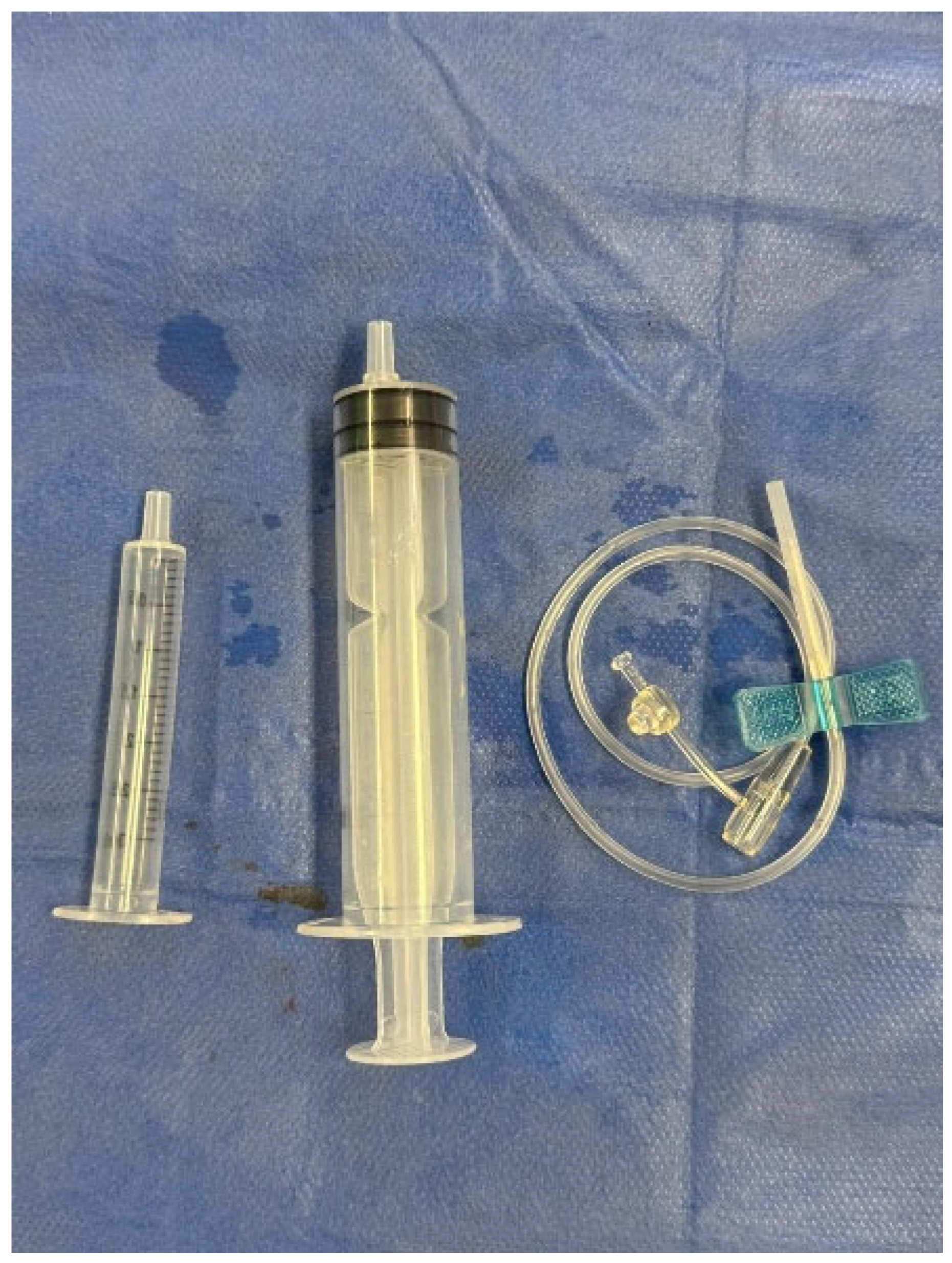
The design innovation lies in the use of a secondary 5 mL syringe barrel as a rigid locking mechanism. When the plunger of the 20 mL syringe is withdrawn, it creates a vacuum of approximately −68.93 kPa. The 5 mL barrel is then inserted between the plunger flange and the shoulder of the 20 mL syringe, acting as a structural brace that prevents the plunger from moving inward under atmospheric pressure.
Compared to commercial vacuum drains which can be costly, or other improvised methods like using a wooden tongue depressor to hold the plunger [
15], our design is entirely self-contained, requires no external parts, is assembled in seconds from sterile components already present in the surgical field, and is intuitively operated by clinical staff (
Figure 1).
The physics of syringe-generated vacuum provides a strong rationale for our device’s design and effectiveness. As demonstrated by Haseler et al. [
16], the maximum vacuum pressure generated is dependent on syringe size, with a 20 mL syringe capable of producing a vacuum of approximately −68.93 kPa. However, their research also reveals a principle of diminishing returns; a 10 mL syringe generates −58.80 kPa, only 15% less vacuum than the 20 mL syringe, due to an asymptotic relationship between plunger displacement and vacuum pressure.
This finding validates our use of a 20 mL syringe to achieve maximal safe suction, while also suggesting that the clinical goal is not maximum possible vacuum but rather an adequate and sustained vacuum. Furthermore, a key practical advantage of the 20 mL syringe is its larger volume capacity. This allows the system to maintain its target vacuum level for a longer duration between evacuations, significantly reducing the labor burden on clinical staff compared to smaller test-tube systems.
3. Build Instructions
The device can be assembled on a sterile field in under one minute.
Take a standard butterfly cannula (22 g or 24 g). Using a scalpel or strong scissors, transect and discard the needle component, leaving only the flexible tubing attached to the hub. Using Mayo scissors, create multiple small side-holes along the distal 5 cm of the tubing (this will be the indwelling portion).
Step 2: Prepare the Locking Barrel.
Take the 5 mL syringe. Remove and discard its plunger.
Step 3: Assemble the System.
Attach the prepared butterfly drainage tube to the tip of the 20 mL syringe and secured to the skin using single silk suture.
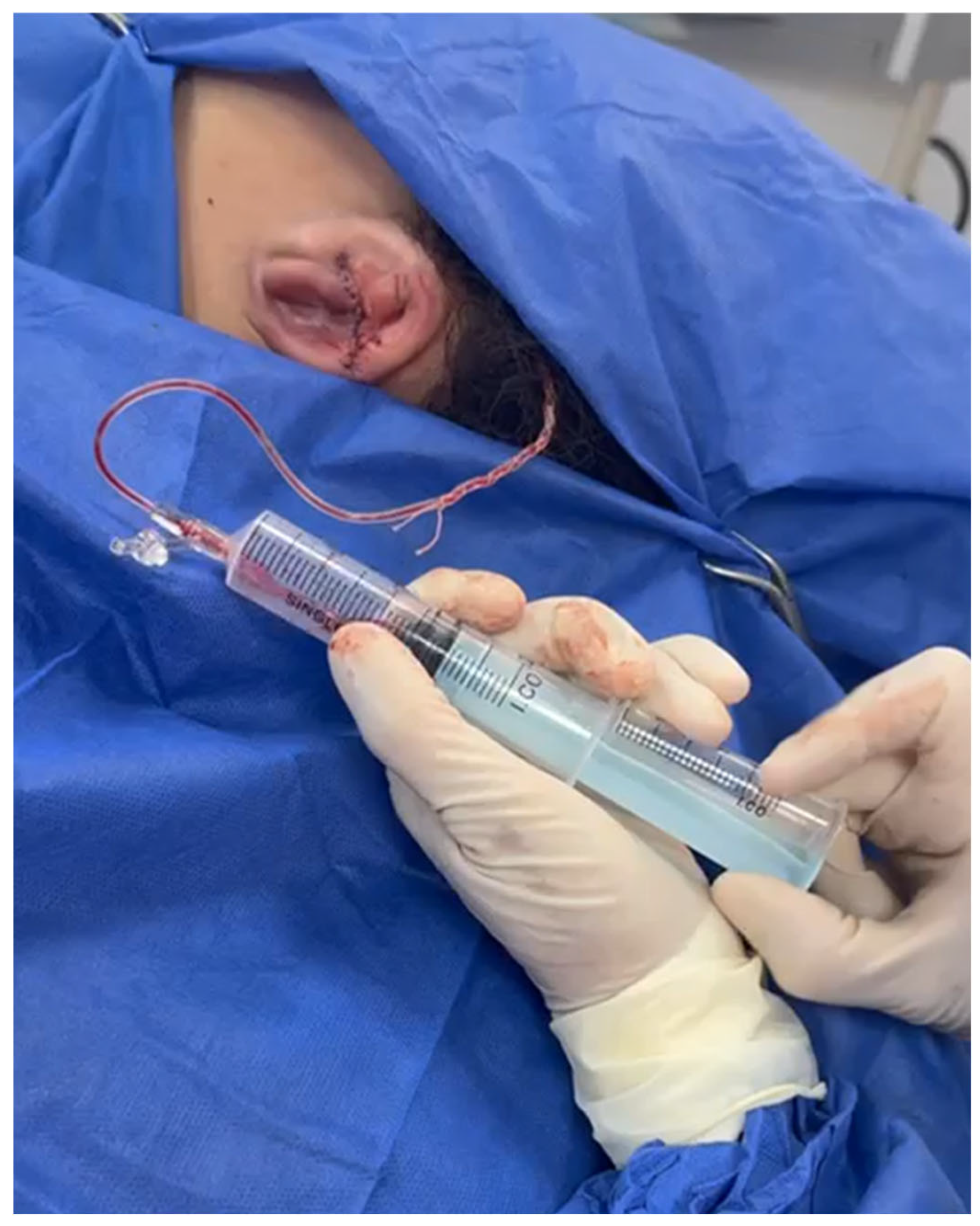
A vacuum pressure was established within a 20 mL syringe by fully withdrawing its plunger. The plunger was then immobilized in the retracted position using a custom brace, constructed from the barrel of a 5 mL syringe and fastened in place with medical silk tape.
4. Operating Instructions
Surgical Placement: After insertion and fixation of the cartilage framework, the prepared drainage tube was placed through a small incision within the scalp. The tube was then tunneled subcutaneously to the surgical pocket.
Locking: While holding the plunger, slide the 5 mL barrel down to brace it against the body of the 20 mL syringe and fastened in place with medical silk tape, locking the plunger in place and maintaining a constant vacuum.
Securing: The syringe assembly was secured using silk tape to the patient’s upper chest with a mesentery to allow head movement.
Postoperative Management: The drain was followed every 4 h and evacuated after collecting 4 mL, and the vacuum was recharged again. The drain was removed after 5 days or when daily output was less than 1 mL for 24 h.
5. Validation
To validate the device’s efficacy, it was applied in a prospective case series of 100 patients undergoing autologous microtia reconstruction by the senior author A.E. between January 2017 and January 2025. Patients were followed for 3–6 months.
A total of 100 patients (60 male, 40 female) with a mean age of 5 years were included. The system was successfully constructed and applied in all cases without intraoperative complications. The vacuum pressure created was sufficient to visibly coapt the skin to the framework immediately upon activation in 100% of cases [
17]. Performance metrics are detailed in
Table 2. Key findings include a mean Drainage Duration of approximately 6 days and 19 hours and a mean Total Fluid Volume of 17.36 mL (95% CI: 16.77–17.95 mL).
A one-sample t-test was performed to compare the observed mean drainage duration of our system (6.79 days ± 1.71) against the established 5-day benchmark for drain removal in autologous microtia reconstruction, as defined by Brent’s standard protocol [
18]. The analysis indicated that the syringe-based system required a statistically significantly longer duration for fluid drainage compared to the historical standard (
= 10.46,
< 0.001).
Objective Aesthetic Outcomes (Sharma Scale)
Evaluation of framework definition was performed 6 months postoperatively using the objective scoring system described by Sharma et al. [
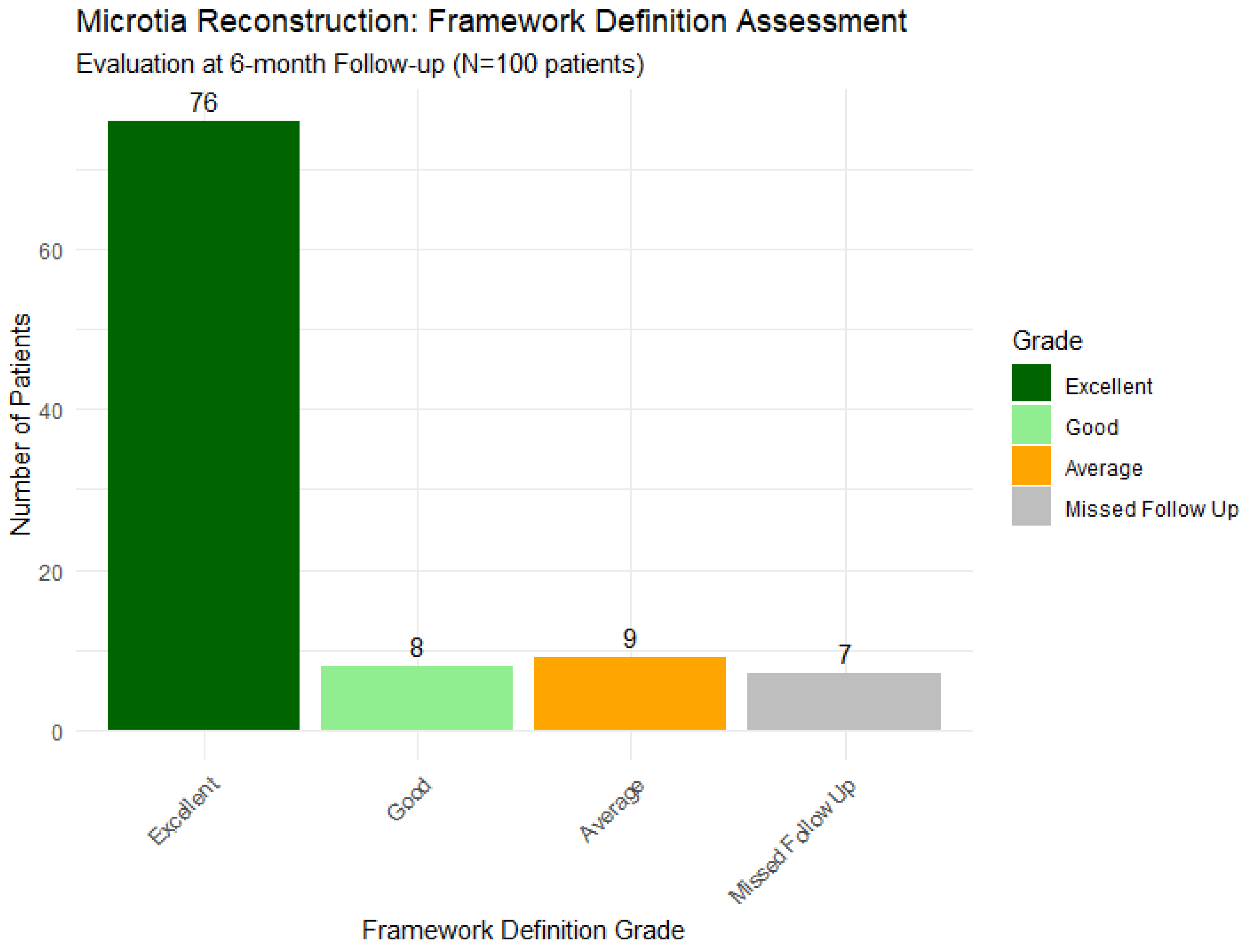
17]. At the 6-month follow-up, 7 patients (7%) were lost to follow-up, resulting in 93 patients available for assessment of framework definition.
For the assessment, three independent plastic surgeons, blinded to the specific hardware assembly, evaluated each patient’s reconstructed ear against 13 specific anatomical landmarks (
Table 3). A score of 1 point was awarded if the landmark was distinctly visible and aesthetically pleasing; a score of 0 was given if the landmark was absent, blunted, or obscured by fluid/fibrosis. The cumulative total score (max. 13 points) was then used to categorize each patient into a 4-grade assessment system.
Among the 93 assessed patients, a highly favorable outcome was observed: 76 patients (81.7%) achieved an “Excellent” grade (score 12–13), while 8 patients (8.6%) were rated as “Good” (score 9–11). Nine patients (9.7%) were classified as “Average” (score 6–8). Notably, no patient was rated as “Poor” (score 1–5). These findings are visually summarized in
Figure 3.
A one-sample binomial test confirmed that the combined proportion of patients achieving ‘Excellent’ or ‘Good’ framework definition (90.3%, 84/93) was statistically significant when tested against an 80% acceptable clinical outcome threshold ( = 0.005).
Inter-rater reliability for the cumulative 13-item Sharma scores was evaluated using Krippendorff’s alpha (α) under an interval data model. The coefficient of 0.40 (95% CI: 0.26 to 0.55) demonstrated statistically significant fair-to-moderate agreement.
There were no instances of major complications such as hematoma, seroma requiring intervention, or skin necrosis. One patient developed minor cellulitis, which resolved completely with a short course of oral antibiotics (1% overall complication rate). A Chi-square goodness-of-fit test was performed to compare this observed complication rate against the 9.43% historical standard complication rate reported for microtia reconstruction in the literature [
19]. The syringe-based system demonstrated a statistically significant reduction in overall complications (
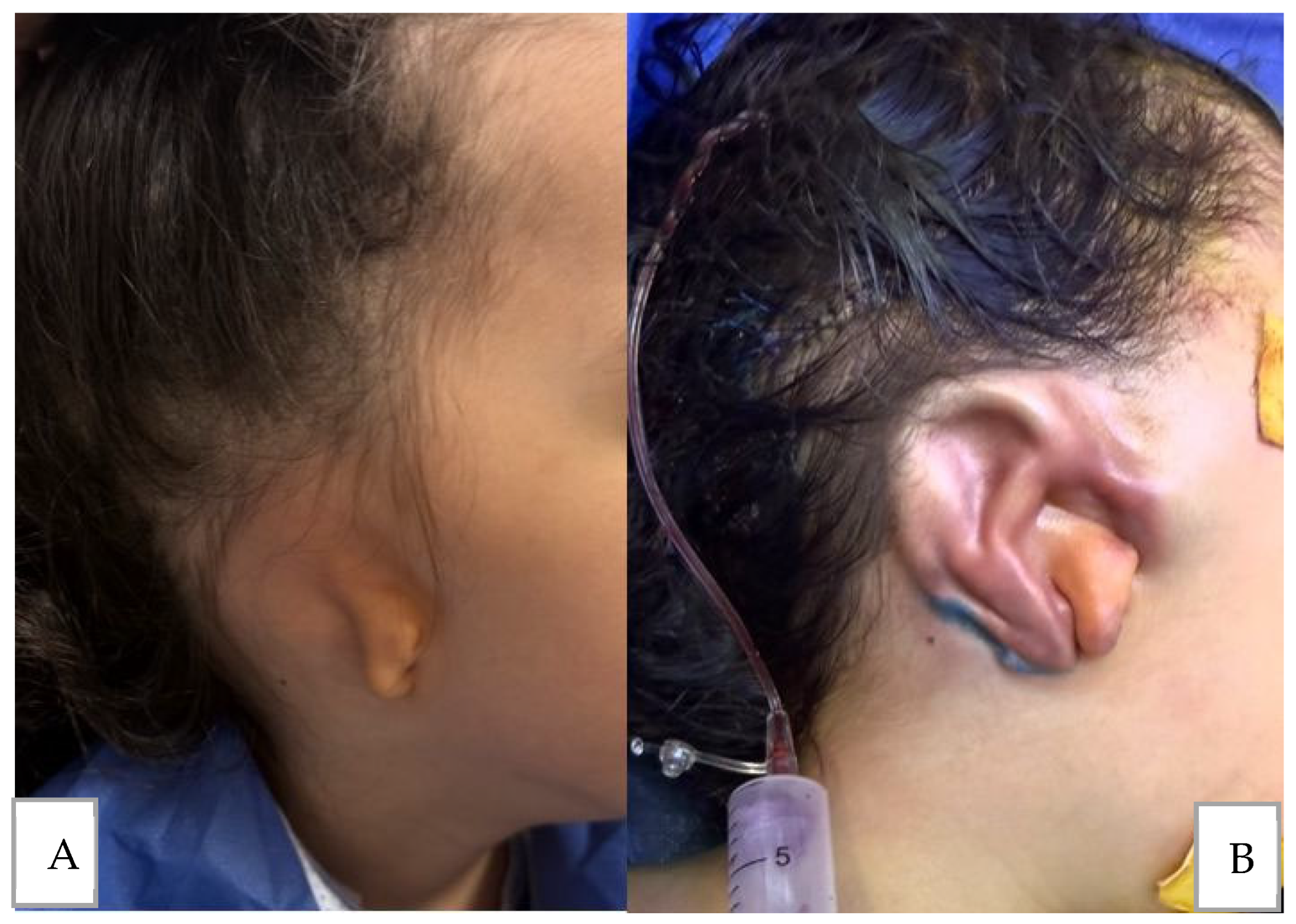
< 0.05). The device was well-tolerated, and no dislodgement occurred (
Figure 4—Pre- and intraoperative photos showing results).
6. Discussion
The aesthetic success of microtia reconstruction is inextricably linked to the precise transfer of the 3D framework’s detail to the overlying skin. This study demonstrates that a novel, syringe-based hardware system effectively facilitates this transfer by generating low, sustained vacuum pressure ideal for the delicate auricular skin envelope.
The critical importance of maintaining reliable coaptation is further underscored by large-scale retrospective analyses of complication profiles [
19]. Fu et al. reported an overall recipient-site complication rate of 9.43% across 470 procedures, with skin necrosis (5.39%) and framework resorption (2.24%) identified as primary failure modes. Notably, their analysis revealed that the more intricate Nagata technique significantly increased complication risks compared to the Brent technique (OR 6.14), highlighting the narrow safety margin when working with complex 3D frameworks and high-tension skin envelopes.
Recent investigations into advanced suction hardware, such as the application of Vacuum-Assisted Closure (VAC) devices in the first stage of reconstruction [
20] have demonstrated that automated, continuous vacuum pressure can significantly enhance aesthetic outcomes and reduce complications compared to traditional non-locked syringe methods. However, while the VAC device offers superior pressure monitoring and integrated audio-visual alarms for air leakage, its adoption is frequently limited by high institutional costs and bulkier hardware profiles that may restrict pediatric mobility. Our novel syringe-based locking mechanism provides the stabilized, constant pressure typically only achievable with expensive commercial units but maintains the cost-efficiency (
< 1.00 USD) and portability of manual syringes, thereby addressing the socioeconomic barriers to high-quality reconstructive care.
For optimal auricular definition, suction hardware must generate enough force that conforms to the framework without reaching the point of excessive tension that would compromise capillary perfusion. The calculated vacuum of −68.93 kPa effectively targets this biomechanical sweet spot. This is supported by our 81.7% “Excellent” grade rate and the complete absence of skin necrosis, which is a common risk when using higher-vacuum systems.
Our statistical analysis revealed that the mean drainage duration (6.79 days ± 1.71) was significantly longer than the traditional 5-day benchmark established by Brent [
18]. However, it is critical to note that foundational literature frequently reports fixed drain removal timelines based on clinical routine, without providing specific descriptive statistics for duration or the precise volume of fluid evacuated. We posit that the rapid evacuation achieved by standard high-pressure surgical drains may actually be counterproductive; aggressive suction can induce continuous micro-trauma, exacerbating vascular exudation and pulling excess fluid that would not otherwise accumulate. In contrast, our syringe-based system utilizes a gentle, low-level vacuum (−68.93 kPa) that safely extracts a minimal necessary volume (mean 17.36 mL) without traumatizing the capillary beds. Therefore, while our system requires a nominally longer drainage period, it offers a significantly optimized safety profile. By prioritizing delicate microvascular circulation over sheer suction speed, the system effectively mitigates the risk of flap ischemia, as evidenced by the complete absence of skin necrosis in our cohort.
A primary limitation of this study is the absence of a concurrent control arm or an active comparator group (such as a commercial VAC system or a no-suction cohort). As this was designed as a prospective, single-arm cohort study to evaluate the feasibility and safety of a novel hardware assembly, direct statistical superiority over existing methods cannot be definitively claimed. Future randomized controlled trials incorporating active comparator arms are warranted to validate these findings and perform direct cost–benefit analyses.
Device Safety and Failure Modes
Primary hardware failure modes include plunger slippage, vacuum loss, and compromised sterility. The 5 mL syringe barrel lock effectively mitigates slippage risks seen in earlier systems using wooden tongue depressors, which were prone to splintering and inconsistent mechanical tension. Furthermore, the transition away from wooden components addresses significant sterility concerns; wood is a naturally porous material that cannot be effectively sterilized, harbors high bioburdens, and risks shedding organic micro-particulates into the clinical field. Despite these mechanical improvements, vacuum loss remains a localized risk at the hub-syringe interface. Consequently, a rigorous 4 h monitoring protocol is required to manually detect and rectify leaks, ensuring that the necessary vacuum pressure is maintained throughout the early follow up period.
7. Conclusions
The described syringe-based closed suction system represents a significant hardware innovation for postoperative management in microtia reconstruction. It is a safe, highly effective, cost-efficient, and easily reproducible method for enhancing skin adherence and maximizing aesthetic framework definition while minimizing risks of vascular compromise. Its reliance on universally available components ensures that it can be implemented as a standard of care globally, particularly in resource-limited environments.
Supplementary Materials
The following supporting information can be downloaded at:
https://www.mdpi.com/article/10.3390/hardware4020009/s1, Video S1: Preparation of the drainage tube (Video (.mp4)). Video S2: Device assembly and creation of vacuum (Video (.mp4)).
| Name | Type | Description |
| S1 | Video (.mp4) | Preparation of the drainage tube |
| S2 | Video (.mp4) | Device assembly and creation of vacuum |
Author Contributions
Conceptualization, A.M.F.E.; methodology, A.M.F.E. and M.N.A.; validation, A.M.F.E. and R.Z.L.; writing—original draft preparation, M.N.A.; writing—review and editing, R.Z.L. and M.N.A. All authors have read and agreed to the published version of the manuscript.
Funding
This research received no external funding.
Institutional Review Board Statement
The study was conducted in accordance with the Declaration of Helsinki and approved by the Research Ethics Committee (REC) of the Faculty of Medicine, Ain Shams University (FMASU) (IRB 00006379, Date of approval: 24 January 2023).
Informed Consent Statement
Informed consent was obtained from all subjects involved in the study.
Data Availability Statement
Acknowledgments
During the preparation of this manuscript, Grammarly v.1.144.0.0 were used for linguistic editing, grammar checking, and enhancing the clarity of the text. After using these services, the authors reviewed and edited the content as needed and take full responsibility for the scientific integrity and originality of the study, including all reported data and findings.
Conflicts of Interest
The authors declare no conflicts of interest.
References
- Luquetti, D.V.; Heike, C.L.; Hing, A.V.; Cunningham, M.L.; Cox, T.C. Microtia: Epidemiology and genetics. Am. J. Med. Genet. A 2012, 158A, 124–139. [Google Scholar] [PubMed]
- Mastroiacovo, P.; Corchia, C.; Botto, L.D.; Lanni, R.; Zampino, G.; Fusco, D. Epidemiology and genetics of microtia-anotia: A registry based study on over one million births. J. Med. Genet. 1995, 32, 453–457. [Google Scholar] [CrossRef] [PubMed]
- Horlock, N.; Vogelin, E.; Bradbury, E.T.; Grobbelaar, A.O.; Gault, D.T. Psychosocial outcome of patients after ear reconstruction: A retrospective study of 62 patients. Ann. Plast. Surg. 2005, 54, 517–524. [Google Scholar] [CrossRef] [PubMed]
- Johns, A.L.; Stock, N.M.; Costa, B.; Billaud Feragen, K.; Crerand, C.E. Psychosocial and health-related experiences of individuals with microtia and craniofacial microsomia and their families: Narrative review over 2 decades. Cleft Palate Craniofacial J. 2023, 60, 1090–1112. [Google Scholar] [CrossRef] [PubMed]
- Huang, Y.; Huang, X.; Li, K.; Yang, Q. Risk Factors of Isolated Microtia: A Systematic Review and Meta-Analysis. Plast. Reconstr. Surg. 2023, 151, 651e–663e. [Google Scholar] [CrossRef] [PubMed]
- Zielinska, D.; Yosef, H.K.; Zollitsch, T.; Kern, J.; Jakob, Y.; Gvaramia, D.; Rotter, N.; Pontiggia, L.; Moehrlen, U.; Biedermann, T.; et al. Characterization of Distinct Chondrogenic Cell Populations of Patients Suffering from Microtia Using Single-Cell Micro-Raman Spectroscopy. Biomedicines 2023, 11, 2588. [Google Scholar] [CrossRef] [PubMed]
- Mukherjee, P.; Chung, J.; Cheng, K.; Gupta, R.; Haag, H.; Williams, Z.; Wallace, G. Invitro and Invivo Study of PCL-Hydrogel Scaffold to Advance Bioprinting Translation in Microtia Reconstruction. J. Craniofac. Surg. 2021, 32, 1931–1936. [Google Scholar] [CrossRef] [PubMed]
- Brent, B. The team approach to treating the microtia atresia patient. Otolaryngol. Clin. N. Am. 2000, 33, 1353–1365. [Google Scholar] [CrossRef] [PubMed]
- Truong, M.T.; Liu, Y.C.; Kohn, J.; Chinnadurai, S.; Zopf, D.A.; Tribble, M.; Tanner, P.B.; Sie, K.; Chang, K.W. Integrated microtia and aural atresia management. Front. Surg. 2022, 9, 944223. [Google Scholar] [CrossRef] [PubMed]
- Nagata, S. A new method of total reconstruction of the auricle for microtia. Plast. Reconstr. Surg. 1993, 92, 187–201. [Google Scholar] [CrossRef] [PubMed]
- Firmin, F. State-of-the-art autogenous ear reconstruction in cases of microtia. Adv. Otorhinolaryngol. 2010, 68, 25–52. [Google Scholar]
- Khan, N.; Zaki, D.P.; Brown, W.E.; Halaseh, F.F.; Willette, D.; Ziegler, M.; Athanasiou, K.A.; Widgerow, A.D. Tissue Engineering Auricular Cartilage: A Review of Auricular Cartilage Characteristics and Current Techniques for Auricular Reconstruction. J. Craniofac. Surg. 2024, 35, 768–778. [Google Scholar] [CrossRef] [PubMed]
- Chen, J.; Huang, T.; Liu, R.; Wang, C.; Jiang, H.; Sun, H. Congenital microtia patients: The genetically engineered exosomes released from porous gelatin methacryloyl hydrogel for downstream small RNA profiling, functional modulation of microtia chondrocytes and tissue-engineered ear cartilage regeneration. J. Nanobiotechnol. 2022, 20, 164. [Google Scholar] [CrossRef] [PubMed]
- Otto, I.A.; Simone, A.; Malda, J.; Kon, M.; Breugem, C.C. Engaging stakeholders in bioprinting research: Views and concerns of microtia patients’ parents on bioprinted auricular cartilage. J. Plast. Reconstr. Aesthet. Surg. 2020, 73, 2239–2260. [Google Scholar] [PubMed]
- Park, D.H.; Song, C.H.; Han, D.G.; Ahn, K.Y.; Byun, J.S. A simple negative suction drain for ear reconstruction. Plast. Reconstr. Surg. 1999, 103, 972–975. [Google Scholar] [CrossRef] [PubMed]
- Haseler, L.J.; Sibbitt, R.R.; Sibbitt, W.L., Jr.; Michael, A.A.; Gasparovic, C.M.; Bankhurst, A.D. Syringe and needle size, syringe type, vacuum generation, and needle control in aspiration procedures. Cardiovasc. Interv. Radiol. 2011, 34, 590–600. [Google Scholar] [CrossRef] [PubMed]
- Sharma, M.; Dudipala, R.R.; Mathew, J.; Wakure, A.; Thankappan, K.; Balasubramaniam, D.; Iyer, S. Objective analysis of microtia reconstruction in Indian patients and modifications in management protocol. Indian J. Plast. Surg. 2015, 48, 144–152. [Google Scholar] [CrossRef] [PubMed]
- Brent, B. Technical advances in ear reconstruction with autogenous rib cartilage grafts: Personal experience with 1200 cases. Plast. Reconstr. Surg. 1999, 104, 319–334; discussion 335–338. [Google Scholar] [CrossRef]
- Fu, Y.Y.; Li, C.L.; Zhang, J.L.; Zhang, T.Y. Autologous cartilage microtia reconstruction: Complications and risk factors. Int. J. Pediatr. Otorhinolaryngol. 2019, 116, 1–6. [Google Scholar] [CrossRef] [PubMed]
- Sawiris, M.A.; Kamel, I.; Badawy, M.S. Vacuum-Assisted Closure Device as a Suction Tool in First Stage Autologous Auricular Reconstruction. J. Maxillofac. Oral. Surg. 2026, 1–8. [Google Scholar] [CrossRef]
| Disclaimer/Publisher’s Note: The statements, opinions and data contained in all publications are solely those of the individual author(s) and contributor(s) and not of MDPI and/or the editor(s). MDPI and/or the editor(s) disclaim responsibility for any injury to people or property resulting from any ideas, methods, instructions or products referred to in the content. |