
Brief Report

First Fertile Pinnule Fossils of the Extant Southern American Tree Fern Genus Loxsomopsis (Loxomataceae) in Mid-Cretaceous Myanmar Amber

1
State Key Laboratory of Palaeobiology and Stratigraphy, Nanjing Institute of Geology and Palaeontology, Chinese Academy of Sciences (NIGPAS), Nanjing 210008, China
2
Department of Cenozoic Biological Evolution and Environment, Nanjing Institute of Geology and Palaeontology, Chinese Academy of Sciences (NIGPAS), Nanjing 210008, China
3
Department of Micropaleontology, Nanjing Institute of Geology and Palaeontology, Chinese Academy of Sciences (NIGPAS), Nanjing 210008, China
*
Author to whom correspondence should be addressed.
Foss. Stud. 2026, 4(2), 8; https://doi.org/10.3390/fossils4020008
Submission received: 18 January 2026 / Revised: 29 March 2026 / Accepted: 6 April 2026 / Published: 13 April 2026
(This article belongs to the Special Issue Continuities and Discontinuities of the Fossil Record)

Abstract

Mesozoic tree ferns related to the extant Loxsomopsis, a relict and taxonomically isolated genus endemic to tropical South America, are exceedingly rare, making it difficult to trace its origin and evolution. Here, we describe a mid-Cretaceous fossil attributable to Loxsomopsis, Loxsomopsis minor sp. nov., based on two fertile pinnules preserved in Myanmar amber. The new species is assigned to the extant genus based on a suite of diagnostic features, including pinnate fertile segments with short lobes, marginal paraphysate sori, narrowly cyathiform to urceolate indusia, columnar and exserted receptacles, oblique sporangial annuli, and trilete spores. This discovery extends the fossil record of Loxsomopsis back to the Albian–Cenomanian and provides new evidence that the lineage—now restricted to tropical South America—was once more widespread. The occurrence of Loxsomopsis in the Myanmar amber biota is consistent with a Gondwanan affinity for this mid-Cretaceous forest ecosystem and suggests that the genus may have likely originated prior to the breakup of Pangaea.

1. Introduction

The genus Loxsomopsis Christ represents the Neotropical member of the relict and taxonomically isolated fern family Loxsomataceae, whose only other extant genus, Loxoma R.Br. ex A.Cunn, is confined to the North Island of New Zealand (Figure 1A) [1,2,3,4,5,6,7]. The two genera are readily distinguished by their sporangial architecture: Loxsomopsis possesses sporangia with an oblique annulus in which approximately two-thirds of the annulus cells are thickened, resulting in transverse dehiscence, whereas in Loxoma, only the apical cells are thickened and the sporangia open longitudinally [8,9,10].
Although the familial placement of Loxsomataceae was historically controversial [9,10], broad molecular and morphological phylogenetic analyses now firmly resolve the group within the tree fern order Cyatheales [11,12,13,14,15,16,17,18,19,20]. Loxsomopsis comprises a single but morphologically variable species, L. pearcei (Baker) Maxon, which is generally rare and locally distributed along the Andean cordillera [8].
The remarkable modern disjunction between South America (Loxsomopsis) and New Zealand (Loxoma) has long been viewed as evidence of great antiquity within the family. This pattern is widely interpreted as the remnant of a once more continuous Gondwanan lineage that subsequently underwent severe range fragmentation during the rise of angiosperm-dominated floras and the progressive breakup of southern Pangaea [1,2,4,7,21]. However, because the family possesses an exceedingly sparse fossil record, this hypothesis has remained largely speculative.
Fossil evidence attributable to Loxsomataceae is limited to a small number of Cretaceous rhizomes tentatively assigned to Loxsomopteris J.E.Skog and related morphogenera [21,22,23]. None preserve diagnostic reproductive structures—such as sori, indusia, or sporangia—that would allow for confident assignment to either extant genus. Consequently, the evolutionary origin, early diversification, and paleogeographic history of the family have remained unresolved.
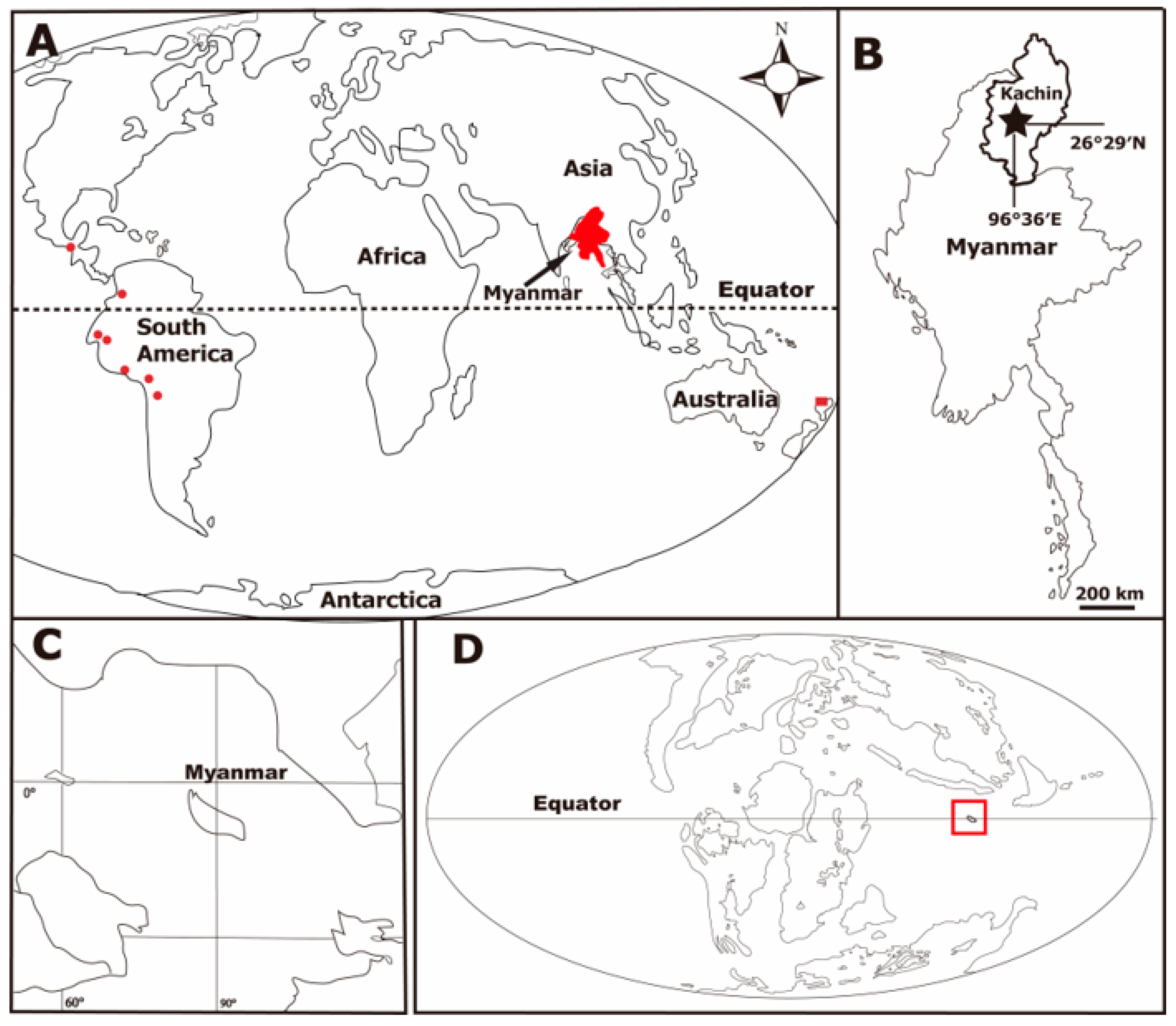
Figure 1. Geographic and paleogeographic maps of Myanmar amber deposits. (A) A part of the world map showing the present-day location of Myanmar amber deposit (read area, indicated by a black arrow) and the distribution of extant Loxsomopsis (red dots) and the other genus Loxoma of Loxsomataceae (red rectangle) based on Tryon and Tryon [9]. (B) A map of Myanmar highlighting the location of the Cretaceous Loxsomopsis fossils from Kachin (denoted by a black star). (C,D) Paleogeographic maps showing the position of Myanmar during the late Albian (adapted from Zhao et al. [24]).
Fossstud 04 00008 g001
In this study, we document the earliest known fossil record of Loxsomataceae based on two fertile pinnules exquisitely preserved in mid-Cretaceous Myanmar amber. The occurrence of this lineage in the Northern Hemisphere during the Albian–Cenomanian potentially expands its known paleogeographic range and provides evidence consistent with a broader paleogeographic distribution beyond its modern South American and New Zealand refugia. We evaluate the morphological features supporting its systematic placement within Loxsomataceae and discuss the broader implications of this discovery for the early evolutionary and biogeographic history of Loxsomataceae and the biotic origins of the Burmese amber forest.

2. Materials and Methods

The amber sample analyzed in this study was collected in 2016 from the Hukawng Valley in Tanai Township, Myitkyina District, Kachin State, Myanmar (Figure 1A,B). Grimaldi et al. [25] estimated the age of Burmese Kachin amber to be approximately Cenomanian to Turonian based on the stratigraphic distributions of Cretaceous insect families. Cruickshank and Ko [26] identified an ammonite, Mortoniceras, of middle or upper Albian age. More recently, Shi et al. [27] provided a U-Pb zircon dating of the sedimentary matrix of the amber-bearing beds, assigning it an earliest Cenomanian age of 98.79 ± 0.62 Ma. Yu et al. [28] further constrained the age of Burmese Kachin amber to the upper Albian to lower Cenomanian based on biostratigraphic and radioisotope data (Figure 1C). The amber specimens examined in this study were obtained legally and in accordance with all applicable regulations concerning fossil resources and relevant national legislation of Myanmar and China. The amber specimen is housed at the Nanjing Institute of Geology and Palaeontology, Chinese Academy of Sciences. Preparation involved trimming with a water-fed saw and grinding and polishing with a lap to expose the inclusions. Fossil specimen images were captured using a Zeiss Stereo Discovery V16 microscope system, (Carl Zeiss AG, Oberkochen, Germany) utilizing both incident and transmitted light in most cases. All images were arranged and labeled in plates using Adobe Illustrator CS4 from the Adobe Creative Suite 4 series.

3. Results

3.1. Systematic Paleontology

Classification: Eukaryota, Viridiplantae, Streptophyta, Embryophyta, Tracheophyta, Moniliformopses, Polypodiidae, Cyatheales, Loxsomataceae, Loxsomopsis.
Loxsomopsis minor C. X. Li, sp. nov. (Figure 2A–D, Figure 3, Figure 4A,B and Figure 5A).
Holotype. Fern inclusion in Myanmar amber piece, specimen No. PB205871.
Type locality. Amber mines near Tanai, Ledo Road, 105 km northwest of Myitkyina, Kachin State, Myanmar (26°200′ N, 96°360′ E, Figure 1A,B). This site occurs within the Hukawng Basin, which comprises folded sedimentary (volcanic) rocks of the Cretaceous and Cenozoic age.
Type horizon. Myanmar amber, earliest upper Cretaceous, lower Cenomanian, absolute age 98.79 ± 0.62 million years ago established by U-Pb dating of zircons from the rind of the unprocessed amber.
Etymology. The specific epithet was chosen after the characteristic feature: smaller sizes of sori, sporangia, and spores compared to that of the extant L. pearcei.
Repository. The holotype is deposited in the Nanjing Institute of Geology and Paleontology, Chinese Academy of Sciences (abbreviation of NIGPAS), Nanjing, China.

3.2. Description

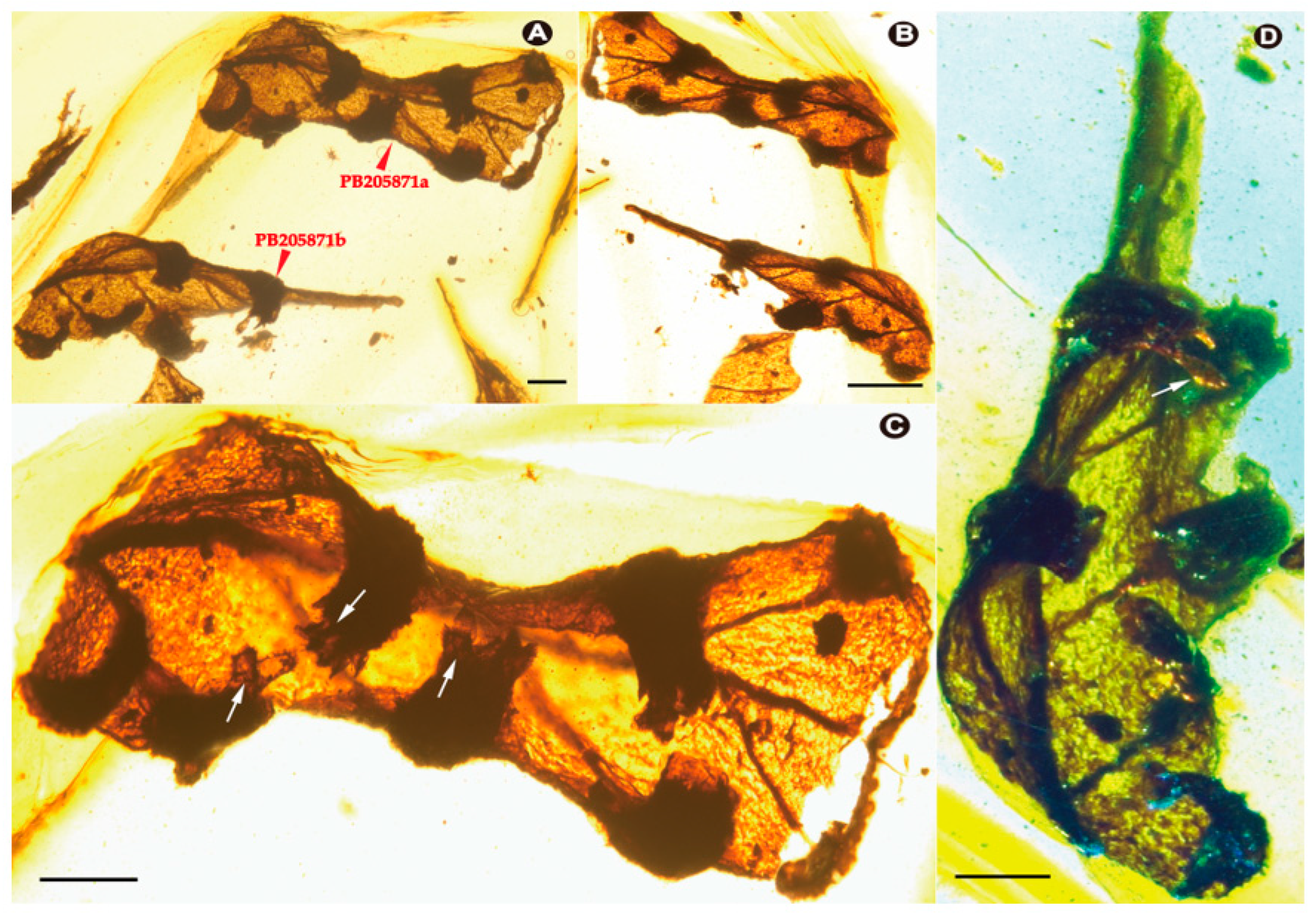
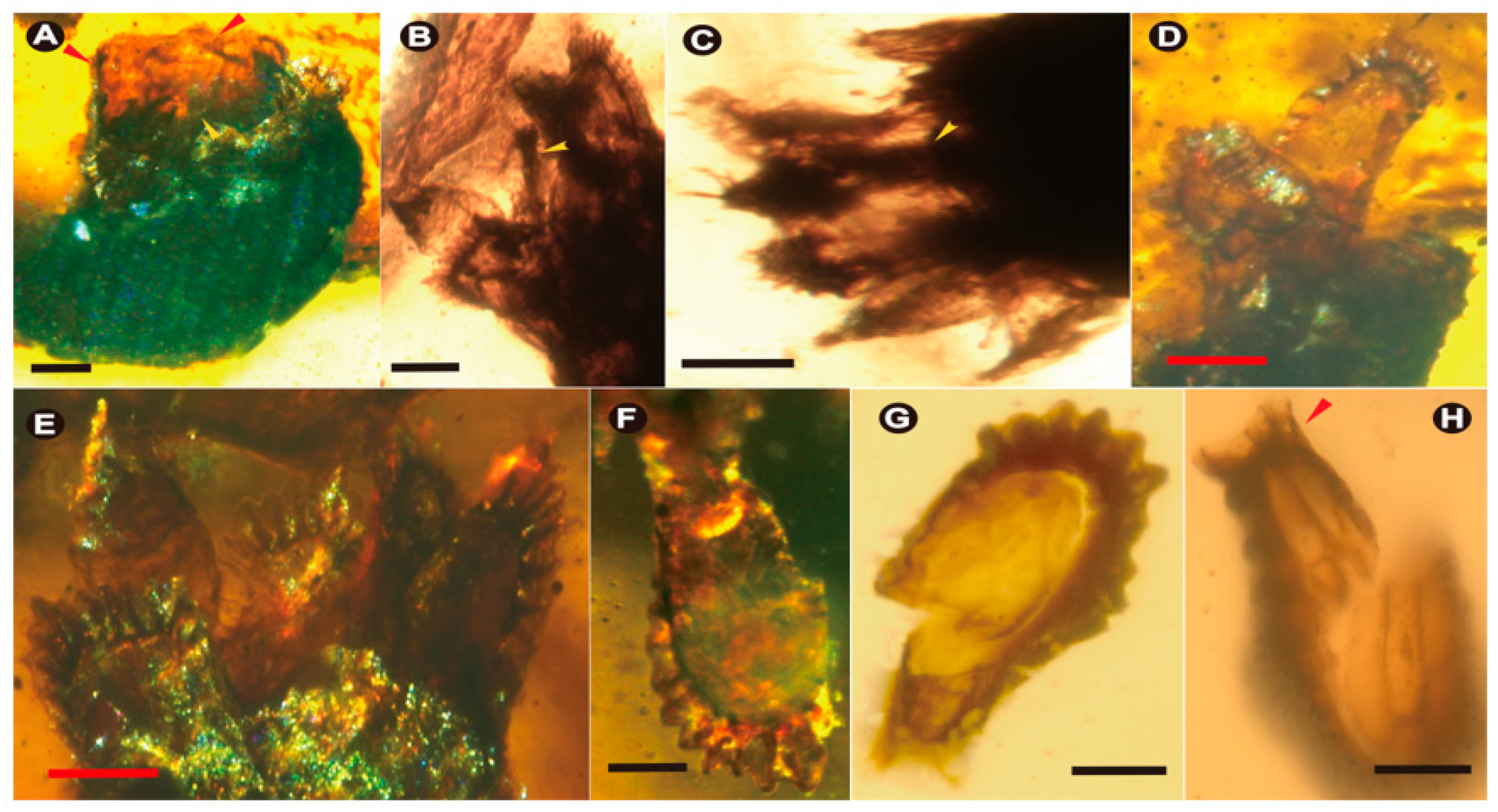
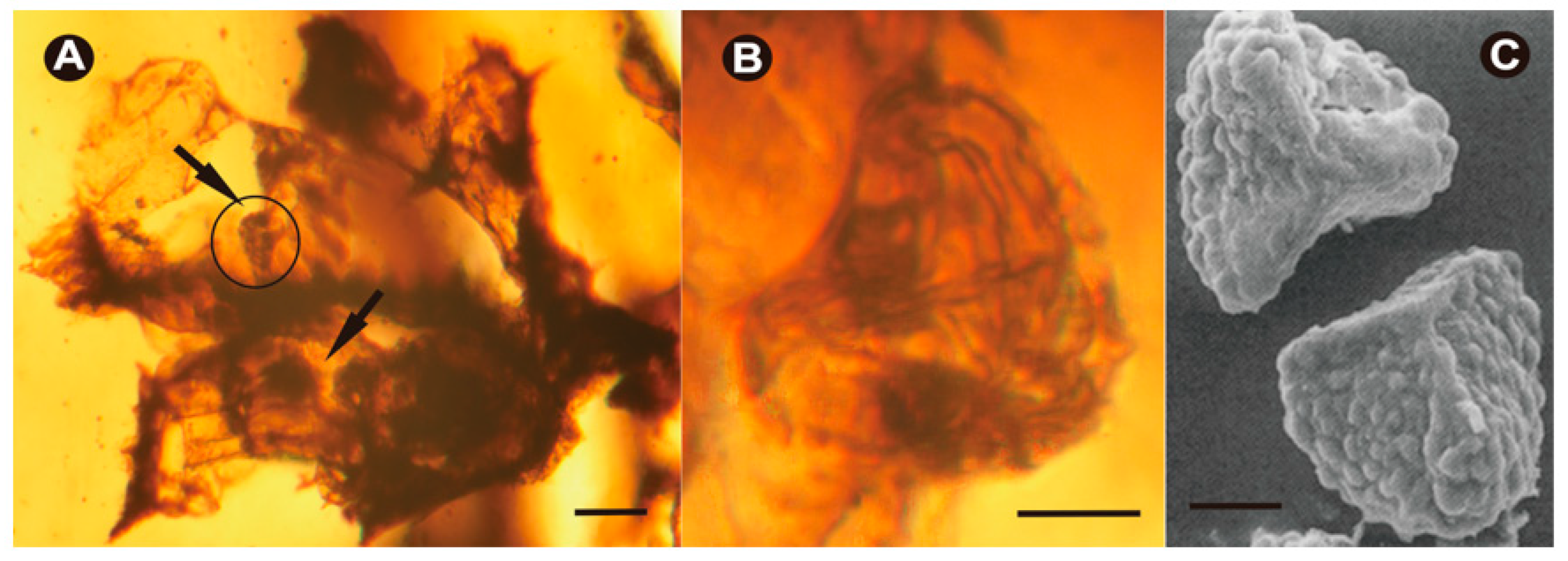
The two fertile pinnules of PB205871a and PB205871b likely represent ultimate segments derived from different positions along the frond. The venation is pinnate, whereas the pinnules are elongate (probably originally lanceolate) and pinnatifid, with shallow sinuses extending less than halfway to the midrib. PB205871a measures 4.49 mm × 1.90 mm and PB205871b 5.01 mm × 1.59 mm (Figure 2A–D). The lobes are entire and slightly unequal on the two sides of the midrib. Veins are free, forked-subpinnate, and branched. Sori are located marginally on the veins near the apex of the ultimate segments and are oriented downward from the lamina surface, with a few sporangia protruding beyond the more widely opened indusia (Figure 2C,D). The indusia are narrowly cyathiform to urceolate, with a laterally free and protruding indusium bearing an almost entire rim (Figure 3A). Sori measure 0.72 mm long and 0.49 mm wide on average (nine sori measured). Sporangia, together with several paraphyses and parts of the columnar receptacles, extend beyond the more open indusia, whereas other indusia conceal most of the sporangia (Figure 3A–E). The sporangia are elongate-pyriform, approximately 291 μm long and 114 μm wide on average (three sporangia measured). The annulus is oblique, consisting of about 25 darkened and thickened annulus cells (three sporangia measured) (Figure 3F–H and Figure 4A). The sporangial stalk comprises at least five rows of cells (Figure 3H). Spores are trilete, tetrahedral-globose with prominent angles, 24–37 μm in diameter, and bear longish ridges on the surface (Figure 4A,B).
Remarks. Both PB205871a and PB205871b are fully expanded and bear mature sori, indicating that they represent comparable stages of lamina maturity. However, differences in curvature, segment orientation, and lobe configuration suggest that they derive from different positions along the frond. In extant Loxsomopsis pearcei [8], pinnule morphology varies along the rachis, reflecting positional differentiation within a fully developed frond. Accordingly, the differences between PB205871a and PB205871b likely reflect positional variation along the pinna rather than distinct ontogenetic stages.

4. Discussion

4.1. Morphological Comparison with Extant Ferns and Loxsomopsis pearcei

The fossil material comprises only two fertile lamina segments (PB205871a and PB205871b; Figure 2A–D), which limits immediate assessment of its precise phylogenetic position. Nonetheless, several morphological traits support placement of the fossil within the tree fern order Cyatheales. Some of these features are homoplastic among extant ferns, including Hymenophyllaceae—particularly Trichomanes s.l.—as well as previously reported filmy fern fossils from Myanmar amber [29,30]. These taxa share a number of superficial similarities with the present fossil, including marginal sori borne terminally on veins, cup-shaped indusia, exserted receptacles, oblique annuli, and trilete spores.
However, comparison with Hymenophyllaceae reveals several decisive differences. Members of Hymenophyllaceae lack paraphyses; their sporangia generally lack a distinct stomium, and the stalks are short to (sub)sessile [9,10]. In contrast, the present fossil, Loxsomopsis minor, exhibits paraphysate sori (Figure 3C), clearly defined stomia (Figure 3G,H), and relatively long sporangial stalks (Figure 3F). Spore morphology further distinguishes the fossil: spores of Hymenophyllaceae are typically spheroidal with compact, low-papillate to nearly levigate or echinate surfaces [31], whereas those of L. minor are tetrahedral-globose with prominent angles and elongate surface ridges (Figure 4A,B). These differences effectively exclude affinity with Hymenophyllaceae.
Having excluded Hymenophyllaceae, comparisons were conducted with families within Cyatheales. Firstly, the sporangia are elongate-pyriform and possess oblique annuli (Figure 3F–H and Figure 4A), a trait strongly associated with Cyatheales [9,10,15,18,32,33]. Secondly, the soral morphology further narrows potential affinities. The sori are marginal, terminal on vein tips, with cylindrical receptacles and paraphyses protruding beyond partially open indusia, and the indusia themselves are narrowly cyathiform to urceolate with an almost entire rim (Figure 2A–D and Figure 3A–E). Among extant families bearing marginal sori at vein endings—Dicksoniaceae, Loxsomataceae, and Thyrsopteridaceae [9,10]—only Loxomataceae exhibit a combination of traits consistent with the fossil. Thyrsopteridaceae possess cup-shaped indusia on narrow, non-laminate segments, while Dicksoniaceae exhibit bivalved indusia; both conditions diverge from the fossil morphology. In contrast, the concurrent presence of marginal sori terminal on veins and narrowly cyathiform to urceolate indusia corresponds closely with the morphology of Loxomataceae.
Within Loxsomataceae, the two monotypic genera, Loxsomopsis and Loxoma, can be distinguished primarily by sporangial characteristics: Loxsomopsis has oblique annuli, whereas Loxoma displays lateral open annuli [8,9,10]. The presence of oblique annuli in the fossil, combined with its pinnule and sporangium morphology, supports its placement within Loxsomopsis.
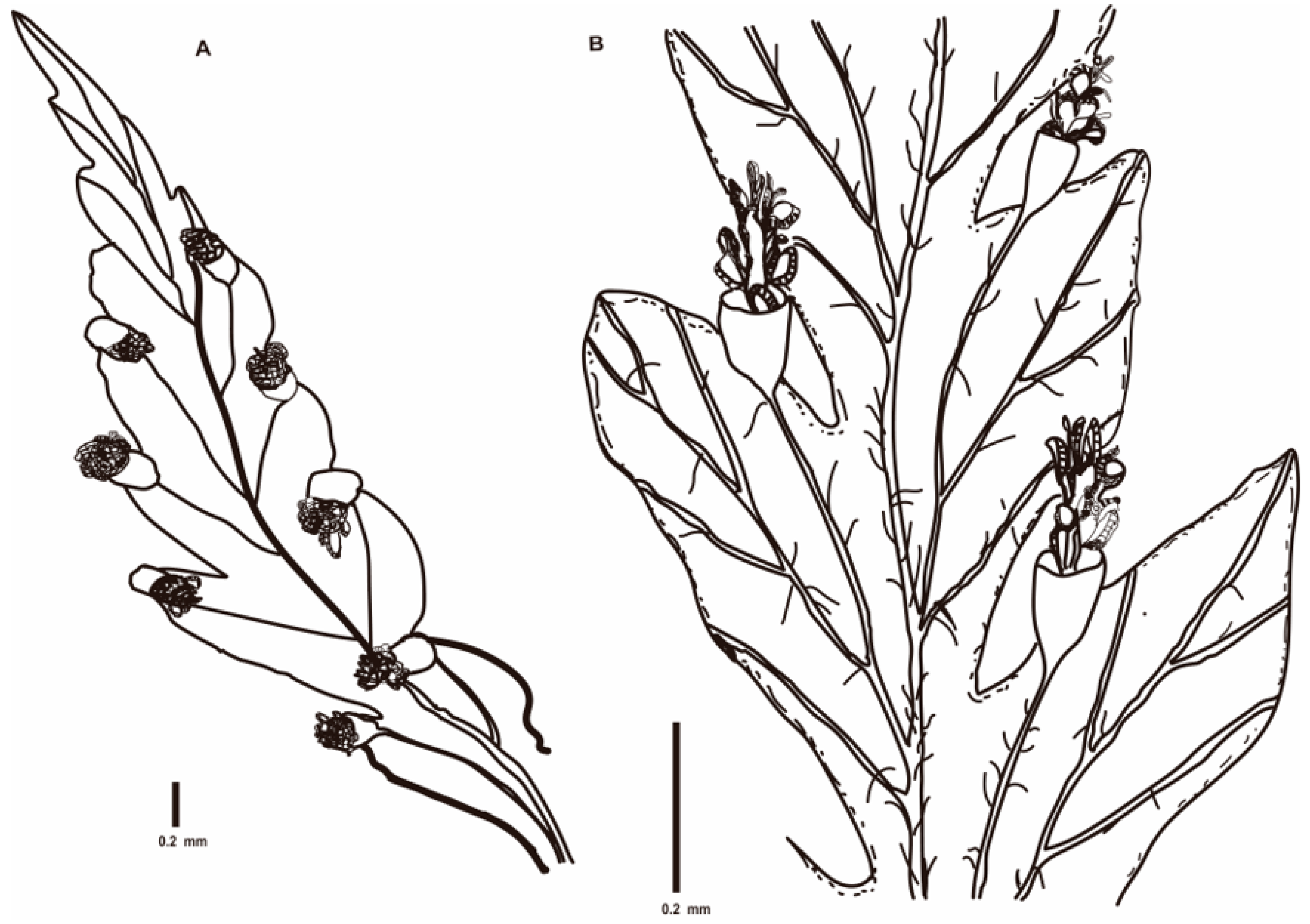
The fossil species, designated as Loxsomopsis minor, differs from the extant L. pearcei primarily in size. Sori, sporangia, and spores are all smaller in the fossil (Table 1); for example, sporangia measure 114 μm × 291 μm in L. minor, compared to ~350 μm × 450 μm in L. pearcei. In addition, sori in the fossil are positioned at the apex of ultimate segments, corresponding to the acroscopic side of each terminal pinnule, whereas in L. pearcei, a second sorus occasionally occurs basiscopically [8] (Figure 5B).
The pinnule morphological differences between PB205871a and PB205871b are interpreted as positional differentiation within a fully developed frond rather than taxonomic divergence. Collectively, these morphological comparisons support the recognition of Loxsomopsis minor as a new, extinct species within the genus, extending its known temporal and geographic range.

4.2. Comparison with Fossil Records Related to Loxsomopsis

Fossil evidence for Loxomataceae is exceedingly sparse, and most previously reported records consist of isolated rhizomes rather than fertile laminar material. The fossil described here preserves both pinnule and sporangial characters, allowing for a more direct morphological comparison with extant representatives of the family. Two fossil rhizomes, Loxsomopteris anasilla from the Lower Cretaceous of Maryland, North America [21], and L. loxsomoides from the Upper Cretaceous of Hokkaido, Japan [22], have been suggested as possible members of Loxomataceae. However, the systematic position of Loxsomopteris remains uncertain because these specimens lack associated fronds and reproductive structures, which limits their diagnostic value for assessing family-level relationships [21].
Additionally, several Lower Cretaceous rhizomes assigned to the morphogenus Solenostelopteris Kershaw—comprising six to seven species—may represent members of Loxomataceae, although their affinities remain ambiguous [23]. The fossil genus Stachypteris Pomel from the Middle Jurassic Bajocian has a similar sorus and possibly belongs to the family [10], while Wikström et al. [34] demonstrated a sister group relationship between Stachypteris and the extant Schizaeales such as Lygodium Sw.
Compared to these earlier, fragmentary records, L. minor provides the first well-documented laminar and reproductive evidence for the family. The combination of pinnule morphology, soral arrangement, and sporangial characters preserved in the fossil confirms the placement of L. minor within Loxsomopsis, bridging a critical gap in the Cretaceous fossil record of the family.

4.3. Paleogeographic Implications

The extant Loxomataceae exhibits a strikingly disjunct distribution, with Loxsomopsis pearcei occurring in Central and South America and Loxoma cunninghamii restricted to New Zealand (Figure 1A). Fossil evidence indicates that this family was once far more widely distributed. Two previously reported rhizome fossils tentatively attributed to the family—Loxsomopteris anasilla from the Lower Cretaceous of Maryland, USA [21], and L. loxsomoides from the Upper Cretaceous of Hokkaido, Japan [22]—suggest that Loxomataceae had already reached East Asia and North America by the Early Cretaceous. The discovery of L. minor in mid-Cretaceous Myanmar amber significantly extends the known northern distribution of the family. Its presence in the Burmese amber forest indicates that Loxomataceae occurred across eastern Asia and the Northern Hemisphere at least since the Aptian. This fossil, in conjunction with prior rhizome records, implies an earlier origin and a broader Early Cretaceous distribution than previously recognized.
The modern restricted distribution of Loxomataceae is thus best understood as the remnant of a formerly widespread lineage that originated prior to the breakup of Pangaea. Following the Late Cretaceous, its range contracted, leaving only the relict populations observed today in New Zealand and the Neotropics [9,10]. Similar patterns are seen in numerous Southern Hemisphere arthropod lineages, which represent relict remnants of once more extensive distributions [35,36,37,38].
The occurrence of L. minor in Myanmar also supports the hypothesis that the biota of the Burmese amber forest—likely situated on an island at the time of deposition—possibly was partially Gondwanan in origin. The fossil represents a close relative of Loxsomopsis pearcei, a genus with an exclusively Gondwanan distribution, appearing in what is now northern Myanmar. This biogeographic pattern is consistent with other Gondwanan lineages recorded in Burmese amber, including various angiosperms and arthropods [37,38,39,40,41].
Geologically, the Burma Terrane is thought to have drifted from eastern Gondwana during the Late Jurassic to Early Cretaceous [42,43,44]. Loxsomopsis and related lineages may have migrated onto the terrane prior to its northward drift, eventually becoming part of the mid-Cretaceous amber forest ecosystem. Thus, L. minor provides additional evidence for reconstructing the early paleobiogeography of Loxomataceae and underscores the significance of Southeast Asian amber deposits in understanding the Cretaceous distribution of Gondwanan lineages.

5. Conclusions

The discovery of Loxsomopsis minor sp. nov. from mid-Cretaceous Myanmar amber represents the earliest well-preserved laminar and reproductive fossil attributable to the genus and the family Loxomataceae in the Northern Hemisphere today. L. minor extends the known geographic and temporal range of Loxomataceae and indicates that this predominantly Gondwanan lineage was more widely distributed during the Early Cretaceous. Its occurrence in the Burmese amber forest is consistent with the hypothesis that the Burma Terrane harbored biotic elements of Gondwanan affinity prior to its northward drift, contributing additional evidence for mid-Cretaceous biogeographic and paleoecological connections between Southeast Asia and Gondwana.
More broadly, the fossil highlights the importance of amber deposits in documenting previously underrepresented evolutionary histories of relict plant lineages. L. minor not only fills a major gap in the fossil record of Loxomataceae but also offers insights into the early diversification, paleobiogeography, and ecological persistence of one of the most distinctive tree fern families. This discovery offers a framework for future studies on the evolution and historical biogeography of Loxsomopsis and its relatives.

Author Contributions

Conceptualization, C.L.; methodology, C.L.; software, C.L.; validation, C.L.; formal analysis, C.L.; investigation, C.L.; resources, C.L.; data curation, C.L.; writing—original draft preparation, C.L.; writing—review and editing, C.L., Y.L. and J.M.; visualization, C.L.; supervision, C.L., Y.L. and J.M.; project administration, C.L.; funding acquisition, C.L. All authors have read and agreed to the published version of the manuscript.

Funding

The research was funded by the Project of State Key Laboratory of Palaeobiology and Stratigraphy, NIGPAS (Grant No. Y626040108).

Data Availability Statement

All data are reported in this paper.

Acknowledgments

We are grateful to Bo Wang of NIGPAS for helping with the specimen collections and providing the stratigraphic information. The authors thank the anonymous reviewers and the editors for their time and comments that enhanced the paper. We are also grateful to Li-Mei Feng and Jing-Jing Tang of NIGPAS for their help in photographing the amber specimens under different models of microscopes.

Conflicts of Interest

The authors declare no conflicts of interest.

References

  1. Bower, F.O. Studies in the phylogeny of the Filicales. VIII. On Loxoma and Loxsomopsis. Ann. Bot. 1923, 37, 349–354. [Google Scholar] [CrossRef]
  2. Brownsey, P.J. A chromosome count in Loxoma. N. Z. J. Bot. 1975, 13, 355–360. [Google Scholar] [CrossRef]
  3. Wagner, F.S. New basic chromosome numbers for genera of neotropical ferns. Am. J. Bot. 1980, 67, 733–738. [Google Scholar] [CrossRef]
  4. Gómez, L.D.P. The origin of the pteridophyte flora of Central America. Ann. Mo. Bot. Gard. 1982, 69, 548–556. [Google Scholar] [CrossRef]
  5. Skog, J.E. Biogeography of Mesozoic leptosporangiate ferns related to extant ferns. Brittonia 2001, 53, 236–269. [Google Scholar] [CrossRef]
  6. Perrie, L.; Brownsey, P. Molecular evidence for long-distance dispersal in the New Zealand pteridophyte flora. J. Biogeogr. 2007, 34, 2028–2038. [Google Scholar] [CrossRef]
  7. Kessler, M.; Smith, A.R. Prodromus of a fern flora for Bolivia. XVII. Loxsomataceae. Phytotaxa 2018, 344, 93–94. [Google Scholar] [CrossRef]
  8. Lehnert, M.; Mönnich, M.; Pleines, T.; Schmidt-Lebuhn, A.; Kessler, M. The relictual fern genus Loxsomopsis. Am. Fern J. 2001, 91, 13–24. [Google Scholar] [CrossRef]
  9. Tryon, R.M.; Tryon, A.F. Ferns and Allied Plants with Special Reference to Tropical America; Springer: New York, NY, USA, 1982. [Google Scholar]
  10. Kramer, K.U. Loxsomataceae. In The Families and Genera of Vascular Plants; Kramer, K.U., Green, P.S., Eds.; Springer: Berlin/Heidelberg, Germany, 1990; Volume 1. [Google Scholar]
  11. Hasebe, M.; Wolf, P.G.; Pryer, K.M.; Ueda, K.; Ito, M.; Sano, R.; Gastony, G.J.; Yokoyama, J.; Manhart, J.R.; Murakami, N.; et al. Fern phylogeny based on rbcL nucleotide sequences. Am. Fern J. 1995, 85, 134–181. [Google Scholar] [CrossRef]
  12. Smith, A.R. Non-molecular phylogenetic hypotheses for ferns. Am. Fern J. 1995, 85, 104–122. [Google Scholar] [CrossRef]
  13. Stevenson, D.W.; Loconte, H. Ordinal and familial relationships of pteridophyte genera. In Pteridology in Perspective; Camus, J.M., Gibby, M., Johns, R.J., Eds.; Royal Botanic Gardens, Kew: London, UK, 1996; pp. 435–467. [Google Scholar]
  14. Pryer, K.M.; Schuettpelz, E.; Wolf, P.G.; Schneider, H.; Smith, A.R.; Cranfill, R. Phylogeny and evolution of ferns (monilophytes) with a focus on the early leptosporangiate divergences. Am. J. Bot. 2004, 91, 1582–1598. [Google Scholar] [CrossRef]
  15. Smith, A.R.; Pryer, K.M.; Schuettpelz, E.; Korall, P.; Schneider, H.; Wolf, P.G. A classification for extant ferns. Taxon 2006, 55, 705–731. [Google Scholar] [CrossRef]
  16. Korall, P.; Pryer, K.M.; Metzgar, J.S.; Schneider, H.; Conant, D.S. Tree ferns: Monophyletic groups and their relationships as revealed by four protein-coding plastid loci. Mol. Phylogenet. Evol. 2006, 39, 830–845. [Google Scholar] [CrossRef]
  17. Sosa, V.; Ornelas, J.F.; Ramírez-Barahona, S.; Gándara, E. Historical reconstruction of climatic and elevation preferences and the evolution of cloud forest-adapted tree ferns in Mesoamerica. PeerJ 2016, 4, e2696. [Google Scholar] [CrossRef]
  18. The Pteridophyte Phylogeny Group. A community-derived classification for extant lycophytes and ferns. J. Syst. Evol. 2016, 54, 563–603. [Google Scholar] [CrossRef]
  19. Du, X.-Y.; Kuo, L.-Y.; Zuo, Z.-Y.; Li, D.-Z.; Lu, J.-M. Structural variation of plastomes provides key insight into the deep phylogeny of ferns. Front. Plant Sci. 2022, 13, 862772. [Google Scholar] [CrossRef]
  20. Nitta, J.H.; Schuettpelz, E.; Ramírez-Barahona, S.; Iwasaki, W. An open and continuously updated fern tree of life. Front. Plant Sci. 2022, 13, 909768. [Google Scholar] [CrossRef] [PubMed]
  21. Skog, J.E. Loxsomopteris anasilla, a new fossil fern rhizome from the Cretaceous of Maryland. Am. Fern J. 1976, 66, 8–14. [Google Scholar] [CrossRef]
  22. Nishida, H.; Nishida, M. Histology of the rhizome of Loxsomopsis and affinity of Solenostelopteris loxsomoides Ogura. Acta Phytotaxon. Geobot. 1982, 33, 302–307, (In Japanese with English Summary). [Google Scholar]
  23. Little, S.A.; Stockey, R.A.; Rothwell, G.W. Solenostelopteris skogiae sp. nov. from the Lower Cretaceous of Vancouver Island. J. Plant Res. 2006, 119, 525–532. [Google Scholar] [CrossRef]
  24. Zhao, J.-Y.; Xu, C.-P.; Cao, C.-Q.; Jarzembowski, E.A.; Fang, Y.; Xiao, C.-T. A new genus and species of mud cricket (Orthoptera: Ripipterygidae) from mid-Cretaceous Kachin amber of northern Myanmar. Cretac. Res. 2024, 160, 105880. [Google Scholar] [CrossRef]
  25. Grimaldi, D.A.; Engel, M.S.; Nascimbene, P.C. Fossiliferous Cretaceous amber from Myanmar (Burma): Its rediscovery, biotic diversity, and paleontological significance. Am. Mus. Novit. 2002, 3361, 1–72. [Google Scholar] [CrossRef]
  26. Cruickshank, R.D.; Ko, K. Geology of an amber locality in the Hukawng Valley, Northern Myanmar. J. Asian Earth Sci. 2003, 21, 441–455. [Google Scholar] [CrossRef]
  27. Shi, G.-H.; Grimaldi, D.A.; Harlow, G.E.; Wang, J.; Wang, J.; Yang, M.-C.; Lei, W.-Y.; Li, Q.-L.; Li, X.-H. Age constraint on Burmese amber based on U–Pb dating of zircons. Cretac. Res. 2012, 37, 155–163. [Google Scholar] [CrossRef]
  28. Yu, T.-T.; Kelly, R.; Mu, L.; Ross, A.; Kennedy, J.; Broly, P.; Xia, F.-Y.; Zhang, H.-C.; Wang, B.; Dilcher, D. An ammonite trapped in Burmese amber. Proc. Natl. Acad. Sci. USA 2019, 116, 11345–11350. [Google Scholar] [CrossRef] [PubMed]
  29. Li, Y.; Wang, Y.-D.; Nosova, N.; Lu, N.; Xu, Y.-Y. Filmy ferns (Hymenophyllaceae) and associated spike-mosses (Selaginellaceae) from the mid-Cretaceous Kachin amber, Myanmar. Biology 2022, 11, 1629. [Google Scholar] [CrossRef]
  30. Li, Y.; Ebihara, A.; Nosova, N.; Tan, Z.-Z.; Cui, Y.-M. First fossil record of Trichomanes sensu lato (Hymenophyllaceae) from the Mid-Cretaceous Kachin amber, Myanmar. Life 2023, 13, 1709. [Google Scholar] [CrossRef] [PubMed]
  31. Tryon, A.F.; Lugardon, B. Spores of the Pteridophyta; Springer: New York, NY, USA, 1991. [Google Scholar]
  32. Shen, H.; Jin, D.-M.; Shu, J.-P.; Zhou, X.-L.; Lei, M.; Wei, R.; Shang, H.; Wei, H.-J.; Zhang, R.; Liu, L.; et al. Large-Scale Phylo genomic Analysis Resolves a Backbone Phylogeny in Ferns. GigaScience 2018, 7, gix116. [Google Scholar] [CrossRef]
  33. Li, C.-X.; Zhou, X.-L.; Wang, Y.-R. Fern Diversity in the Mid-Cretaceous Amber Forests Revealed by Exceptionally Preserved Sporangium Types. Int. J. Geosci. 2024, 15, 351–365. [Google Scholar] [CrossRef]
  34. Wikström, N.; Kenrick, P.; Vogel, J.C. Schizaeaceae: A phylogenetic approach. Rev. Palaeobot. Palynol. 2002, 119, 35–50. [Google Scholar] [CrossRef]
  35. Wu, H.; Li, L.-Q.; Ding, M. The first cyclaxyrid beetle from Upper Cretaceous Burmese amber (Coleoptera: Cucujoidea: Cyclaxyridae). Cretac. Res. 2018, 91, 66–70. [Google Scholar] [CrossRef]
  36. Cai, C.-Y.; Lawrence, J.F.; Yamamoto, S.; Leschen, R.A.B.; Newton, A.F.; Ślipiński, A.; Yin, Z.; Huang, D.; Engel, M.S. Basal polyphagan beetles in mid-Cretaceous amber from Myanmar: Biogeographic implications and long-term morphological stasis. Proc. R. Soc. B Biol. Sci. 2019, 286, 20182175. [Google Scholar] [CrossRef]
  37. Chitimia-Dobler, L.; Mans, B.J.; Handschuh, S.; Dunlop, J.A. A remarkable assemblage of ticks from mid-Cretaceous Burmese amber. Parasitology 2020, 149, 820–830. [Google Scholar] [CrossRef]
  38. Chitimia-Dobler, L.; Dunlop, J.A.; Pfeffer, T.; Würzinger, F.; Handschuh, S.; Mans, B.J. Hard ticks in Burmese amber with Australasian affinities. Parasitology 2023, 150, 157–171. [Google Scholar] [CrossRef]
  39. Poinar, G., Jr. Burmese amber: Evidence of Gondwanan origin and Cretaceous dispersion. Hist. Biol. 2018, 31, 1304–1309. [Google Scholar] [CrossRef]
  40. Licht, A.; Win, Z.; Westerweel, J.; Cogné, N.; Morley, C.; Chantraprasert, S.; Poblete, F.; Ugrai, T.; Nelson, B.; Aung, D.W.; et al. Magmatic history of central Myanmar and implications for the evolution of the Burma Terrane. Gondwana Res. 2020, 87, 303–319. [Google Scholar] [CrossRef]
  41. De Francesco Magnussen, I.; Müller, S.P.; Hammel, J.U.; Kotthoff, U.; Harms, D. Diversity of schizomids (Arachnida: Schizomida) revealed by new fossil genera and species from mid-Cretaceous Burmese amber with implications for a Gondwanan origin of the Burma Terrane. Zool. J. Linn. Soc. 2022, 196, 792–844. [Google Scholar] [CrossRef]
  42. Westerweel, J.; Roprech, P.; Licht, A.; Dupont-Nivet, G.; Win, Z.; Poblete, F.; Ruffet, G.; Swe, H.H.; Thi, M.K.; Aung, D.W. Burma Terrane part of the Trans-Tethyan arc during collision with India according to palaeomagnetic data. Nat. Geosci. 2019, 12, 863–868. [Google Scholar] [CrossRef]
  43. Morley, C.K.; Naing, T.T.; Searle, M.; Robinson, S.A. Structural and tectonic development of the Indo-Burma ranges. Earth Sci. Rev. 2020, 200, 102992. [Google Scholar] [CrossRef]
  44. Seton, M.; Müller, R.D.; Zahirovic, S.; Gaina, C.; Torsvik, T.; Shephard, G.; Talsma, A.; Gurnis, M.; Turner, M.; Maus, S.; et al. Global continental and ocean basin reconstructions since 200 Ma. Earth Sci. Rev. 2021, 113, 212–270. [Google Scholar] [CrossRef]
Figure 2. Holotype of Loxsomopsis minor C.X. Li, sp. nov. (PB205871). (A) Overview of the pinnules (abaxial surfaces). (B) Overview of the pinnules (adaxial surfaces). (C,D) Close-up views of and PB205871a, b from (A), showing marginal sori that are directed downward from the pinnule surface, with some sporangia (indicated by white arrows) protruding beyond the more open indusium. Scale bars: 0.5 mm (A,C,D); 1 mm (B).
Fossstud 04 00008 g002
Figure 3. Sori and sporangia of Loxsomopsis minor C.X. Li, sp. nov. (PB205871). (A) A single sorus with a cup-shaped, laterally free, and protruding indusium that has a nearly entire margin (indicated by red arrowheads), concealing the majority of the sporangia. (AC) Sori with a columnar receptacle (indicated by yellow arrowheads). (BE) Sori displaying several sporangia protruding beyond the more open indusium. (F) A single sporangium showing oblique annulus and sporangial stalk. (G,H) Different viewing angles of the same sporangium; in (H), the sporangial stalk is indicated by a red arrowhead. Scale bars: 0.1 mm (AE,G,H); 0.5 mm (F).
Fossstud 04 00008 g003
Figure 4. Trilete spores of Loxsomopsis minor C.X. Li, sp. nov. (PB205871). (A) Spores enclosed within the sporangia of the fossil L. minor (black arrows). (B) An enlargement of the circled area in (A) displaying a single spore. (C) Spores of extant L. pearcei, adapted from Figure 3C of Lehnert et al. [8]. Scale bars: 50 μm (A), 10 μm (B), and 20 μm (C).
Fossstud 04 00008 g004
Figure 5. Schematic drawing of fertile pinnules for two Loxsomopsis species. (A) Fossil L. minor C.X. Li, sp. nov. (PB205871b) from this study (Figure 2A,D). (B) Extant L. pearcei, adapted from Figure 1G from Lehnert et al. [8].
Fossstud 04 00008 g005
Table 1. Morphological comparison of fossil and extant species of Loxsomopsis (Loxsomataceae).
TaxonSori (Size)Sporangia (Size)Annulus
(Cell Count)
Spore SizeSorus PositionReferences
Loxsomopsis minor0.72 mm long × 0.49 mm wide291 μm long × 114 μm wide22–4024–37 μmAt apex of each lobe on both side of the ultimate segmentPresent study
Loxsomopsis pearcei1.75–2.75 mm long × ~1 mm wide ~450 μm long × ~350 μm wide30–5541–62 μm On acroscopic side of each ultimate segmentLehnert et al. [8]
Disclaimer/Publisher’s Note: The statements, opinions and data contained in all publications are solely those of the individual author(s) and contributor(s) and not of MDPI and/or the editor(s). MDPI and/or the editor(s) disclaim responsibility for any injury to people or property resulting from any ideas, methods, instructions or products referred to in the content.