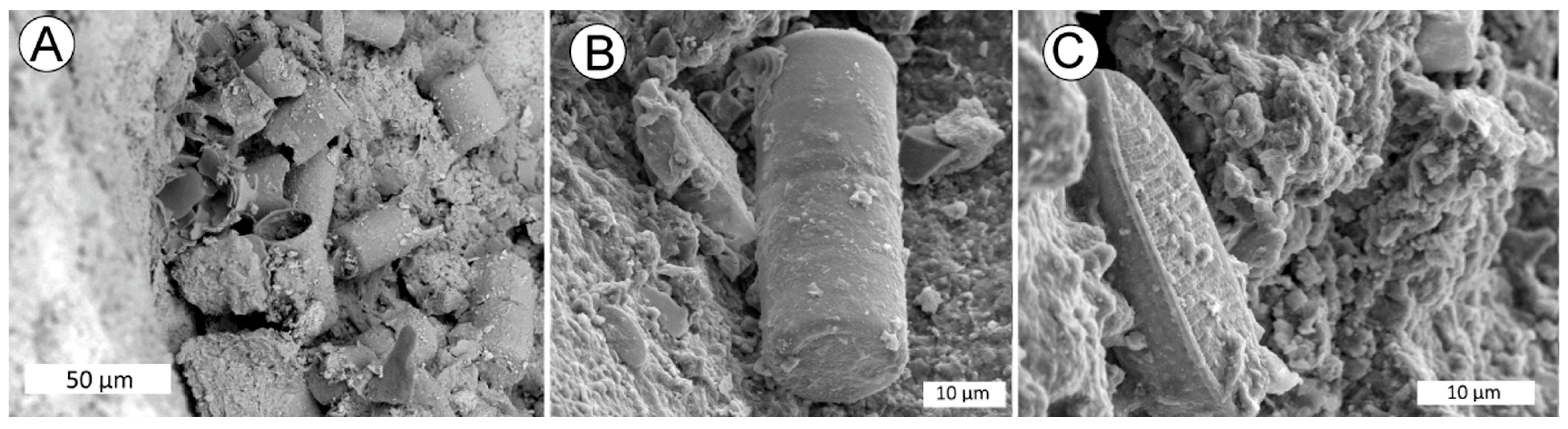
Figure 1.
SEM images of fossil diatoms from the Late Miocene Wilkes Formation, Washington State, USA. (A) Cluster of diatom tests in siltstone. (B) Single cell from a colonial chain diatom. (C) Solitary diatom in siltstone matrix.
Figure 1.
SEM images of fossil diatoms from the Late Miocene Wilkes Formation, Washington State, USA. (A) Cluster of diatom tests in siltstone. (B) Single cell from a colonial chain diatom. (C) Solitary diatom in siltstone matrix.
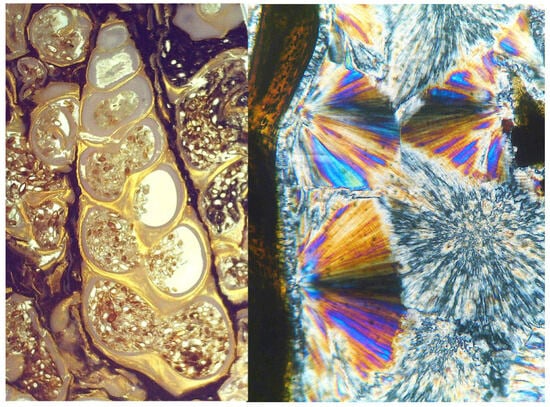
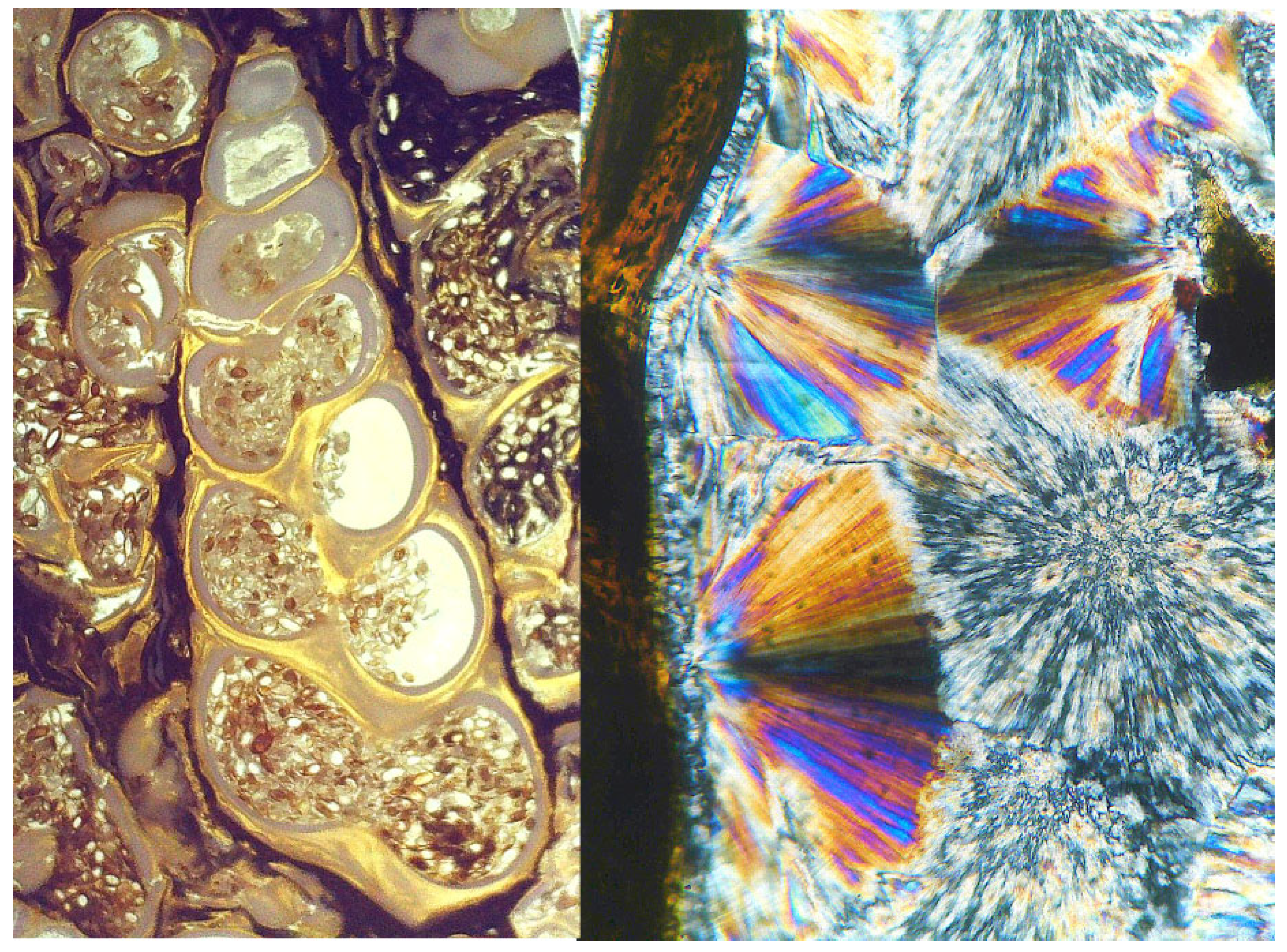
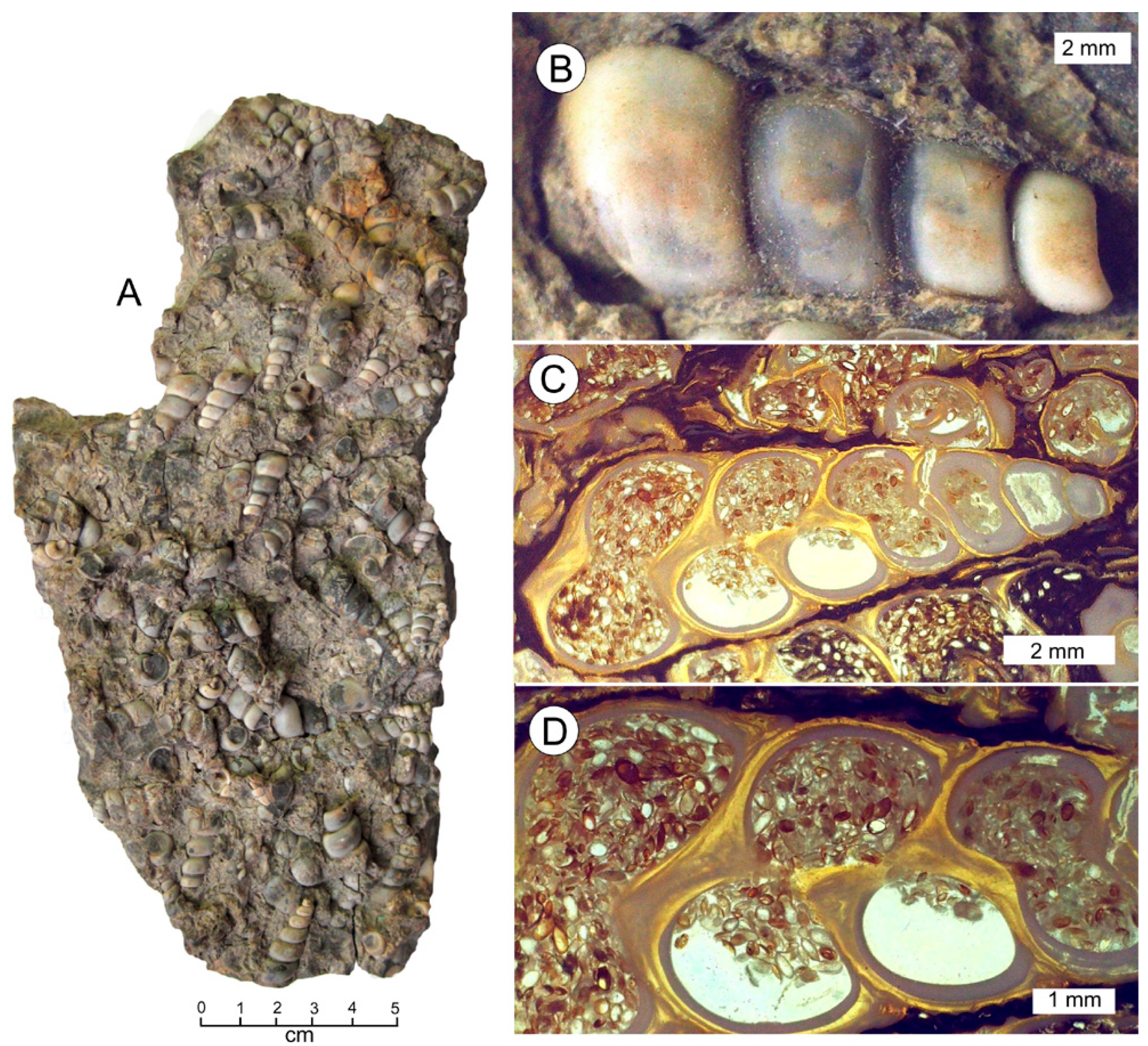
Figure 2.
Example of thin-section images of fossils. Silicified gastropods from the Eocene Laney Member of the Green River Formation, southwest Wyoming, USA. The popular name “turitella agate” for this material is unfortunate, because the gastropod shells represent the freshwater genus
Goniobasis (=
Elmia) [
3]. (
A) Typical specimen. (
B) A single gastropod fossil. (
C,
D) Thin-section views. Ostracod tests fill many of the shell chambers, a phenomenon that occurred when deceased gastropods accumulated on the ancient lake bottom.
Figure 2.
Example of thin-section images of fossils. Silicified gastropods from the Eocene Laney Member of the Green River Formation, southwest Wyoming, USA. The popular name “turitella agate” for this material is unfortunate, because the gastropod shells represent the freshwater genus
Goniobasis (=
Elmia) [
3]. (
A) Typical specimen. (
B) A single gastropod fossil. (
C,
D) Thin-section views. Ostracod tests fill many of the shell chambers, a phenomenon that occurred when deceased gastropods accumulated on the ancient lake bottom.
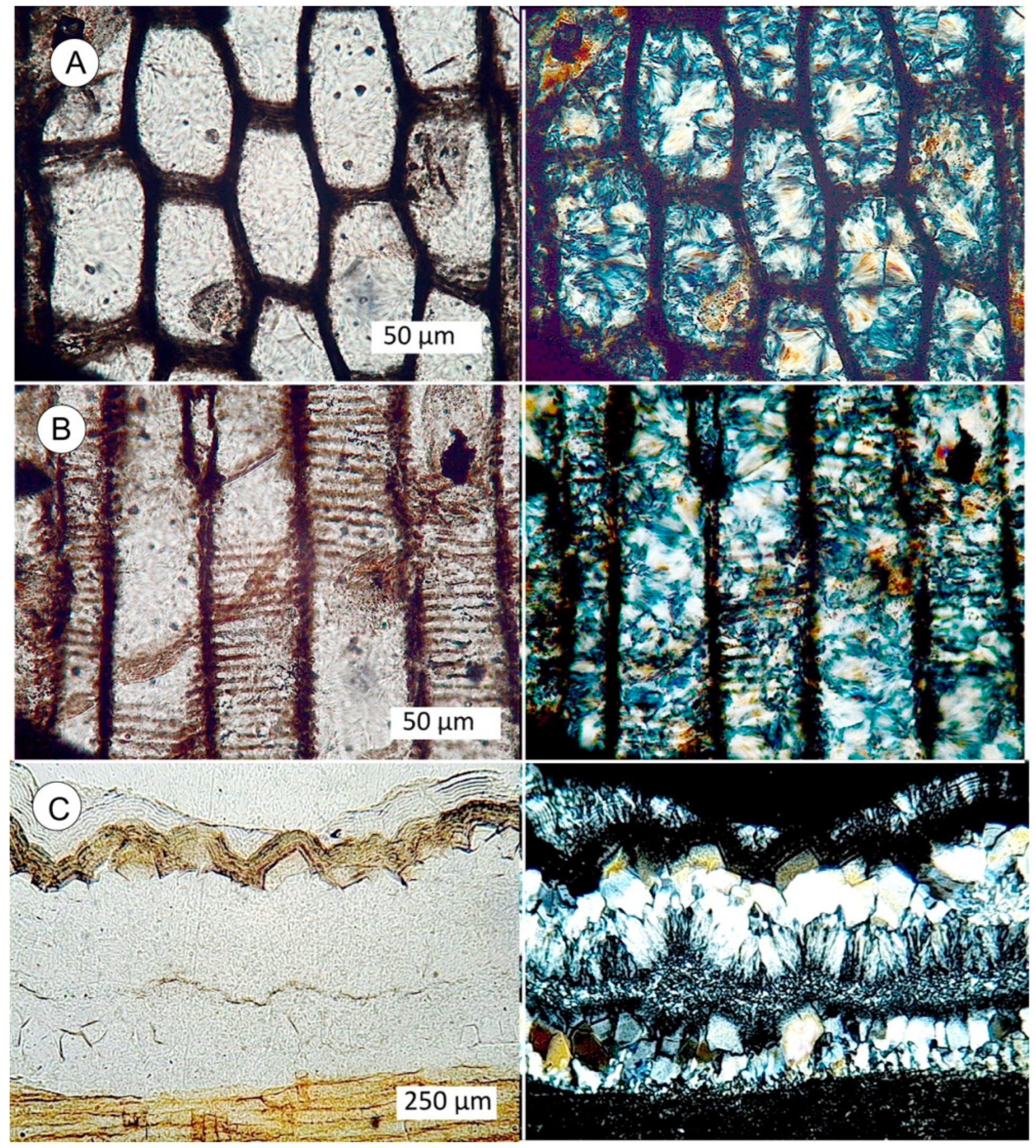
Figure 3.
Thin sections of fossil wood, ground to 30 microns. For each photo pair, the ordinary transmitted light image is on the left, and the polarized light image at the right. (A) A Pennsylvanian-age lycopod stem from Colorado, USA. (A) = transverse orientation. (B) Longitudinal orientation. (C), A fracture in Miocene wood from Washington, USA, that has been filled with successive layers of amorphous opal (opal-A), chalcedony, and hexagonal quartz microcrystals. Under ordinary transmitted light, the opal layers can be recognized by their brownish color, but the overall mineral assemblages can only be seen under polarized light.
Figure 3.
Thin sections of fossil wood, ground to 30 microns. For each photo pair, the ordinary transmitted light image is on the left, and the polarized light image at the right. (A) A Pennsylvanian-age lycopod stem from Colorado, USA. (A) = transverse orientation. (B) Longitudinal orientation. (C), A fracture in Miocene wood from Washington, USA, that has been filled with successive layers of amorphous opal (opal-A), chalcedony, and hexagonal quartz microcrystals. Under ordinary transmitted light, the opal layers can be recognized by their brownish color, but the overall mineral assemblages can only be seen under polarized light.
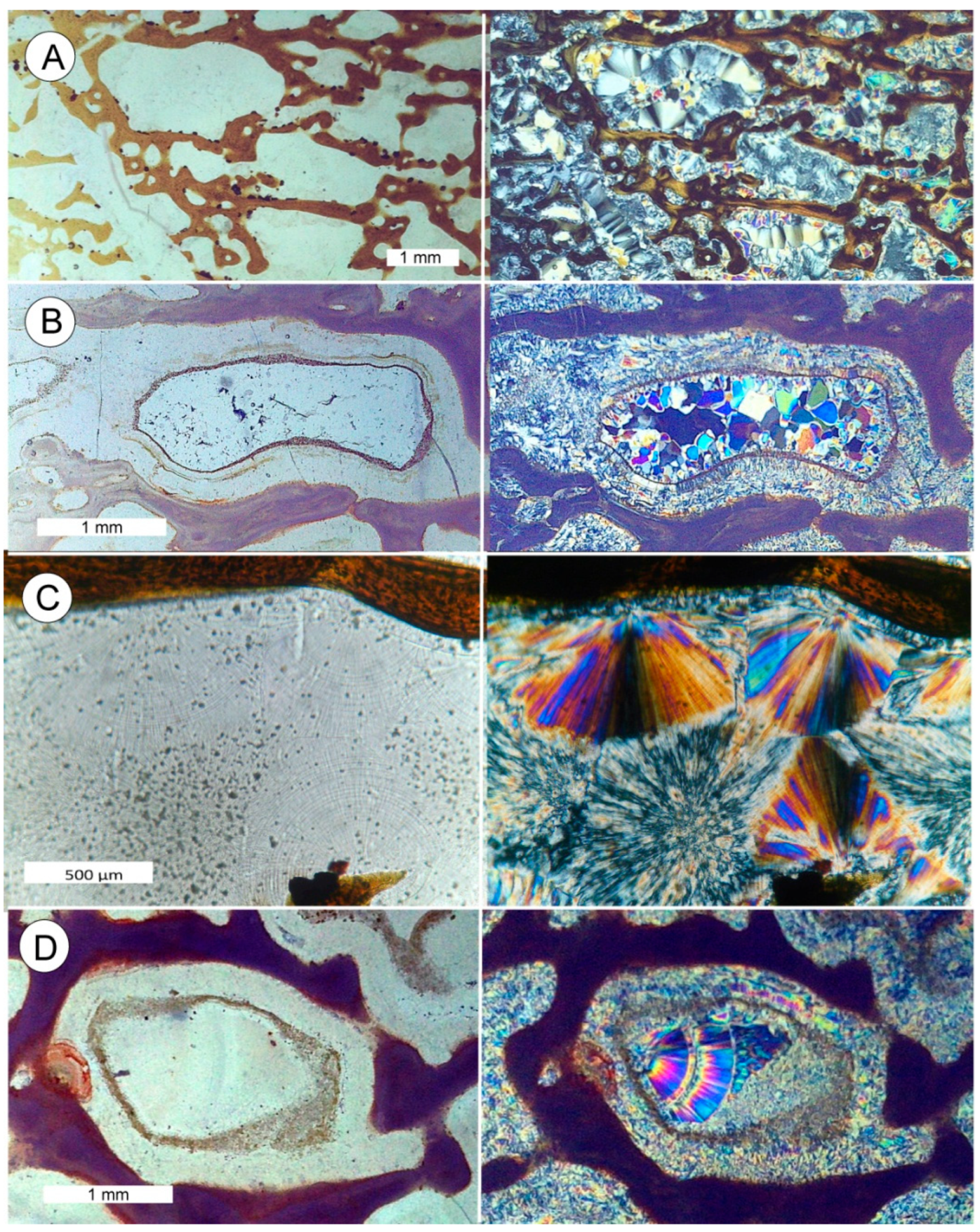
Figure 4.
Jurassic dinosaur bone, Morrison Formation, Utah, USA. Magnified images provide histology detail, but polarized light illumination is necessary to determine mineralization processes. For each photo pair, the image on the left is ordinary transmitted light; the right image is the same view under polarized light. (A) At a 30-micron thickness, bone tissue spaces can be seen to contain microcrystalline quartz. (B) A 50-micron specimen thickness shows subhedral quartz crystals that have bright interference colors. The surrounding bone has been mineralized with quartz of much smaller crystal dimensions. (C) A single bone cell shows a transparent fill material that shows faint concentric patterns. Polarized light illumination reveals that this material is composed of radiating chalcedony fibers. (D) This cell contains a mixture of quartz and chalcedony. The 50-micron thickness causes the radiating chalcedony to have brilliant colors.
Figure 4.
Jurassic dinosaur bone, Morrison Formation, Utah, USA. Magnified images provide histology detail, but polarized light illumination is necessary to determine mineralization processes. For each photo pair, the image on the left is ordinary transmitted light; the right image is the same view under polarized light. (A) At a 30-micron thickness, bone tissue spaces can be seen to contain microcrystalline quartz. (B) A 50-micron specimen thickness shows subhedral quartz crystals that have bright interference colors. The surrounding bone has been mineralized with quartz of much smaller crystal dimensions. (C) A single bone cell shows a transparent fill material that shows faint concentric patterns. Polarized light illumination reveals that this material is composed of radiating chalcedony fibers. (D) This cell contains a mixture of quartz and chalcedony. The 50-micron thickness causes the radiating chalcedony to have brilliant colors.
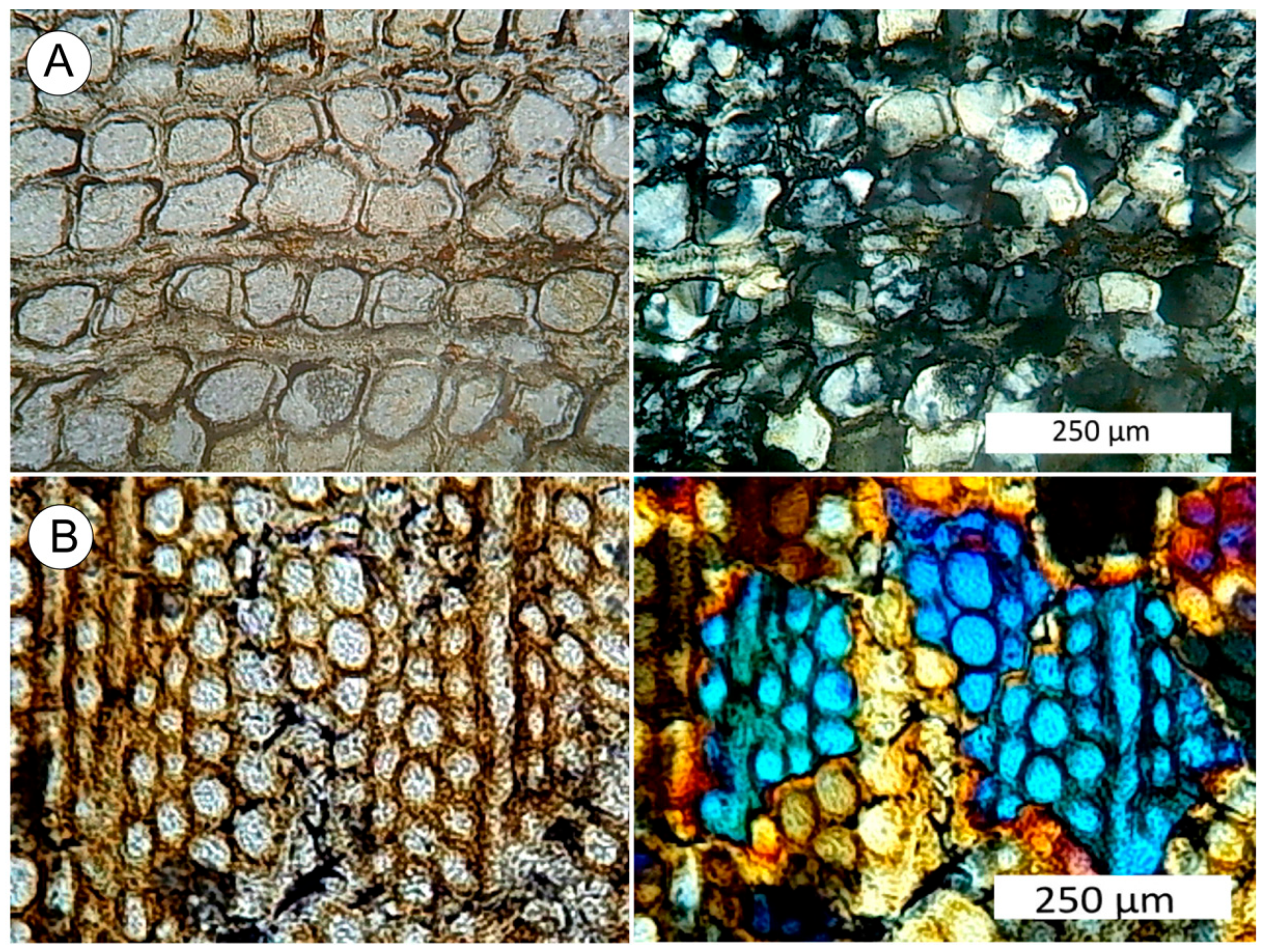
Figure 5.
Mesozoic fossil wood from Thailand. (A) Transverse views of fossil wood prepared at 30-micron thickness, where quartz has low birefringence. The ordinary transmitted light view at left clearly shows the architecture of the cell wall. The polarized light image at right reveals that each cell lumen has been filled with microcrystalline quartz. (B) Image pair from silicified wood that has a very different diagenetic history. The bright colors of quartz under polarized light are the result of the thin section having been prepared to a final thickness of approximately 50 microns. The occurrence of multiple cells within different color zones is a result of diagenetic recrystallization.
Figure 5.
Mesozoic fossil wood from Thailand. (A) Transverse views of fossil wood prepared at 30-micron thickness, where quartz has low birefringence. The ordinary transmitted light view at left clearly shows the architecture of the cell wall. The polarized light image at right reveals that each cell lumen has been filled with microcrystalline quartz. (B) Image pair from silicified wood that has a very different diagenetic history. The bright colors of quartz under polarized light are the result of the thin section having been prepared to a final thickness of approximately 50 microns. The occurrence of multiple cells within different color zones is a result of diagenetic recrystallization.
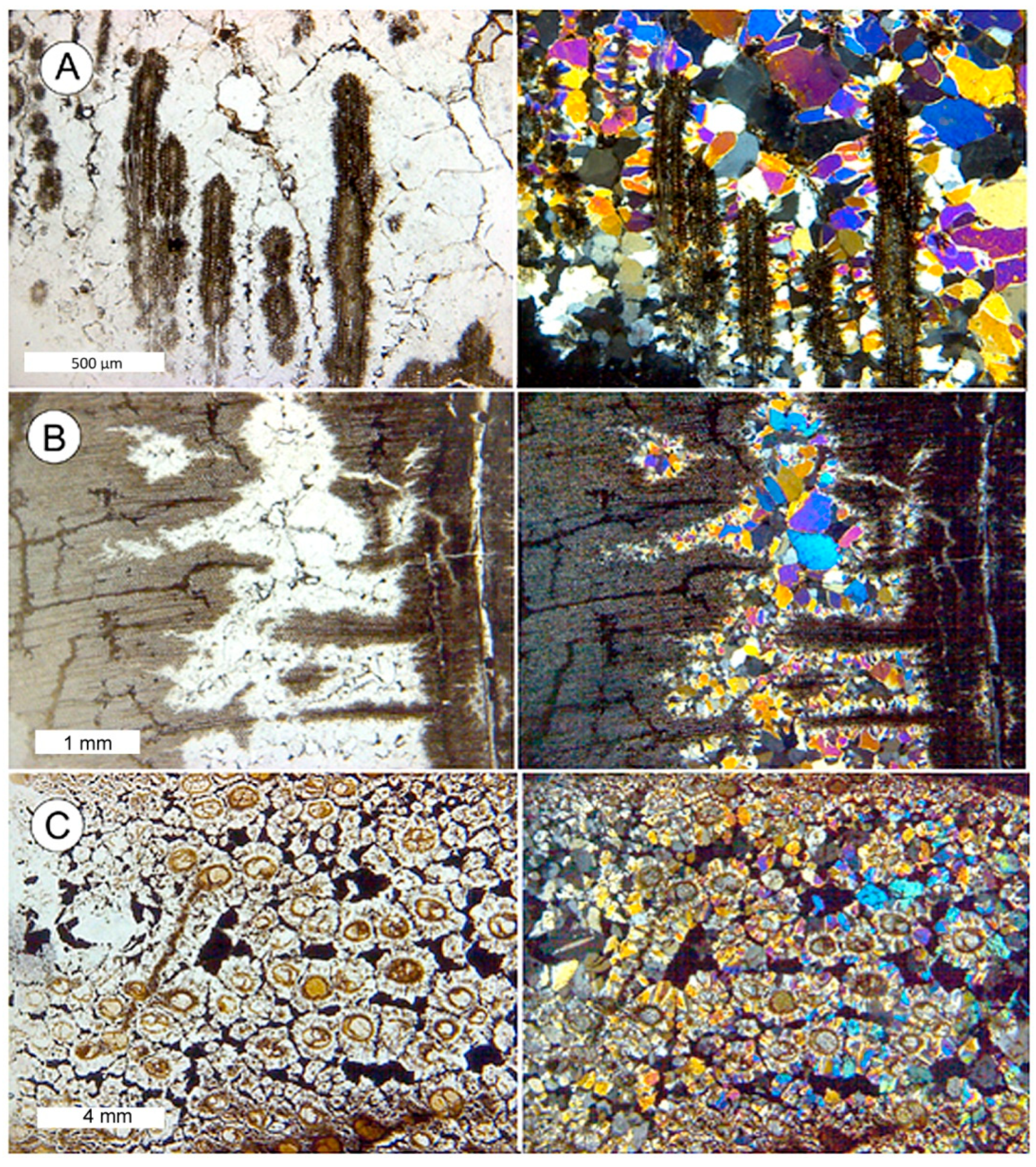
Figure 6.
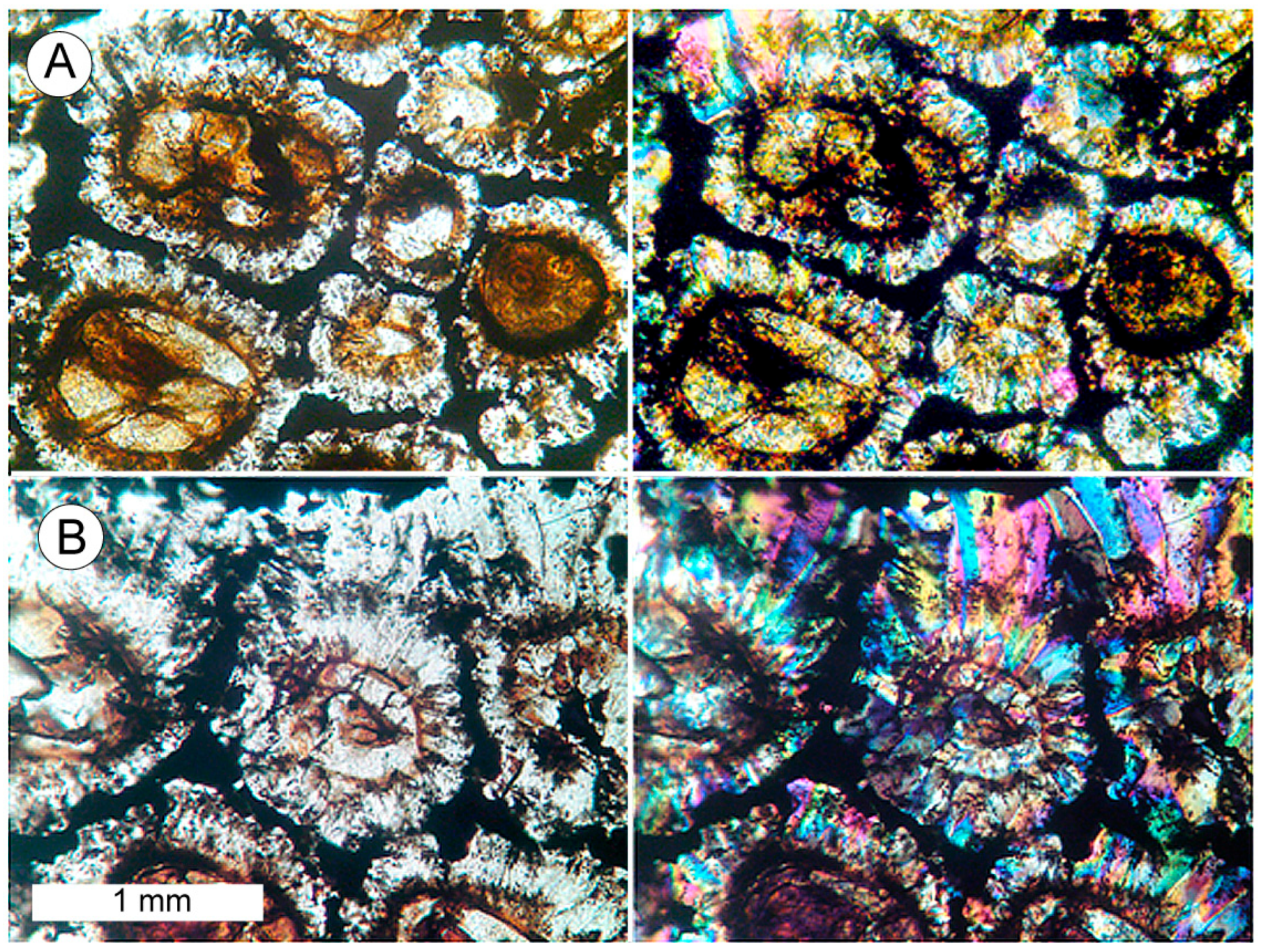
Thin section of Pleistocene silicified wood from Thailand. (A) Longitudinal orientation shows individual cells that have served as nucleation points for quartz crystallization. (B) The fracture zone in this silicified wood was e filled with quartz at a late stage of mineralization. (C) Transverse view of wood cells that are enclosed with radiating quartz crystals. Intercellular spaces remain unmineralized. For each photo pair, the image on the left is ordinary transmitted light; the right image is the same view under polarized light.
Figure 6.
Thin section of Pleistocene silicified wood from Thailand. (A) Longitudinal orientation shows individual cells that have served as nucleation points for quartz crystallization. (B) The fracture zone in this silicified wood was e filled with quartz at a late stage of mineralization. (C) Transverse view of wood cells that are enclosed with radiating quartz crystals. Intercellular spaces remain unmineralized. For each photo pair, the image on the left is ordinary transmitted light; the right image is the same view under polarized light.
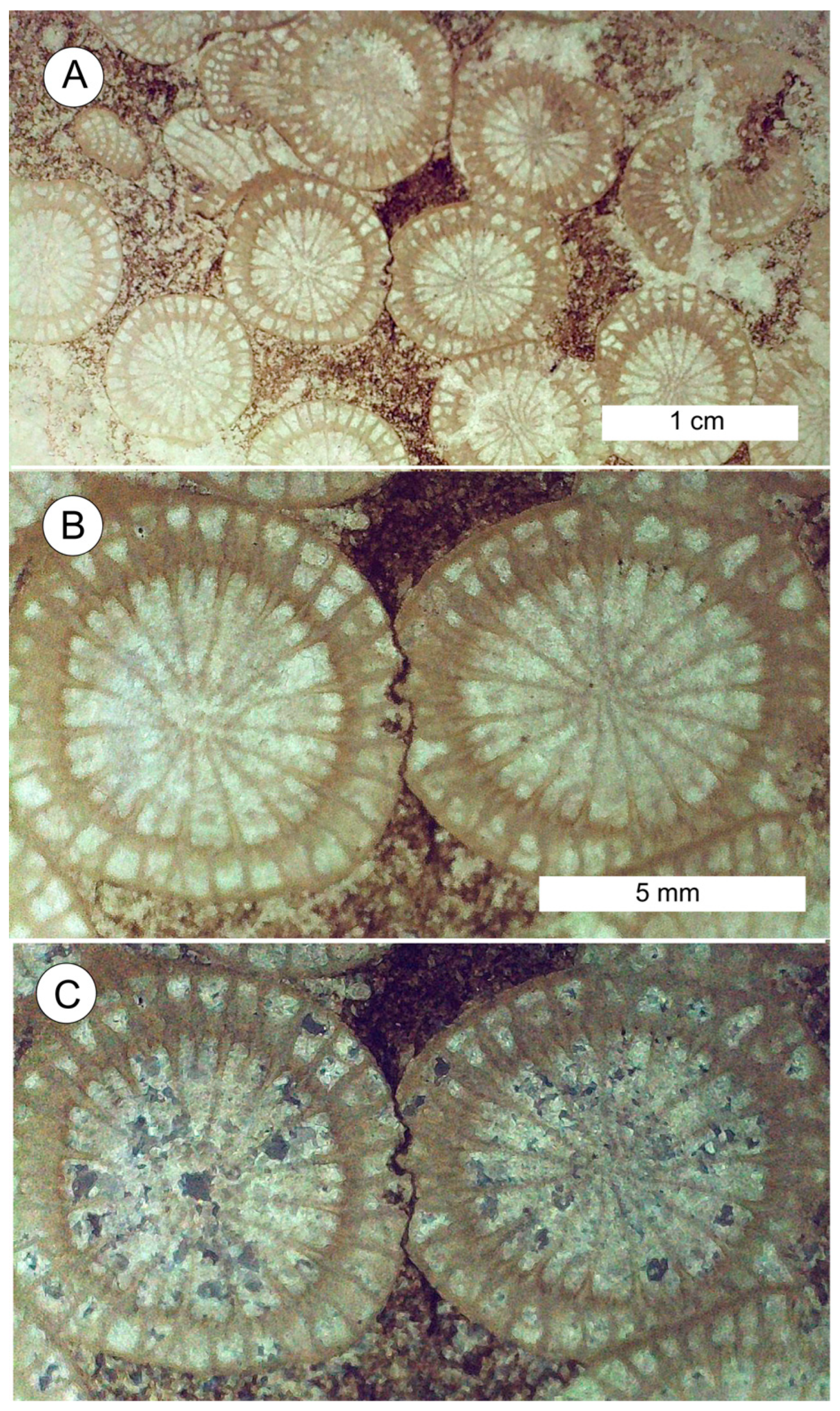
Figure 7.
Fossilized colonial coral where thin sections show the radiating septa of individual polyps. (A,B) Spaces between polyps are filled with fine calcareous sediment. (C) Polarized light image at the same magnification reveals that the spaces that originally contained living tissues have been filled by calcite that encloses small silica sand grains.
Figure 7.
Fossilized colonial coral where thin sections show the radiating septa of individual polyps. (A,B) Spaces between polyps are filled with fine calcareous sediment. (C) Polarized light image at the same magnification reveals that the spaces that originally contained living tissues have been filled by calcite that encloses small silica sand grains.
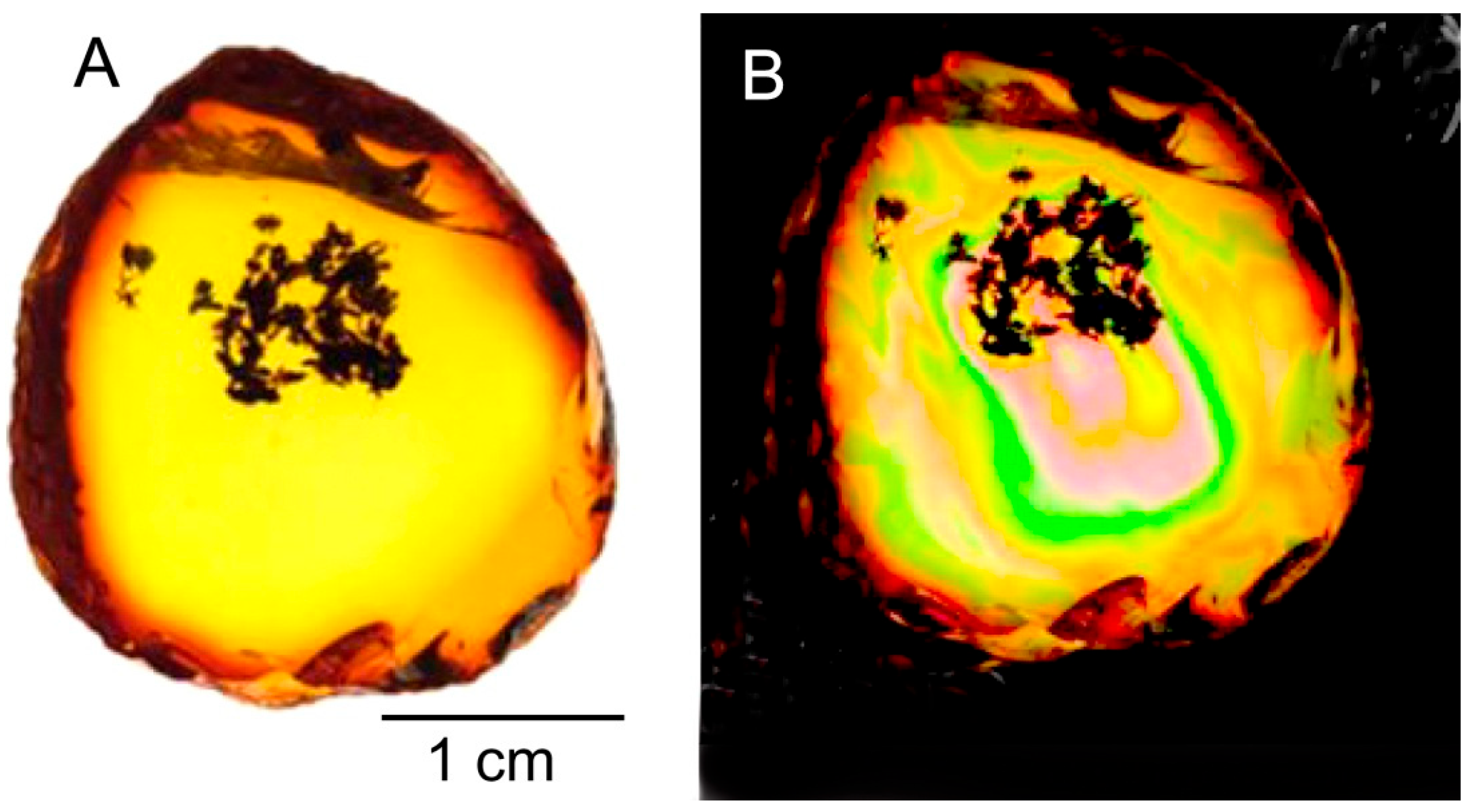
Figure 10.
Miocene amber from Chiapas, Mexico. (
A) Ordinary transmitted light illumination, revealing multiple insect inclusions. (
B) Polarized light view shows interference color zones that result from internal strain patterns within the non-crystalline material. Adapted from [
4].
Figure 10.
Miocene amber from Chiapas, Mexico. (
A) Ordinary transmitted light illumination, revealing multiple insect inclusions. (
B) Polarized light view shows interference color zones that result from internal strain patterns within the non-crystalline material. Adapted from [
4].
Figure 11.
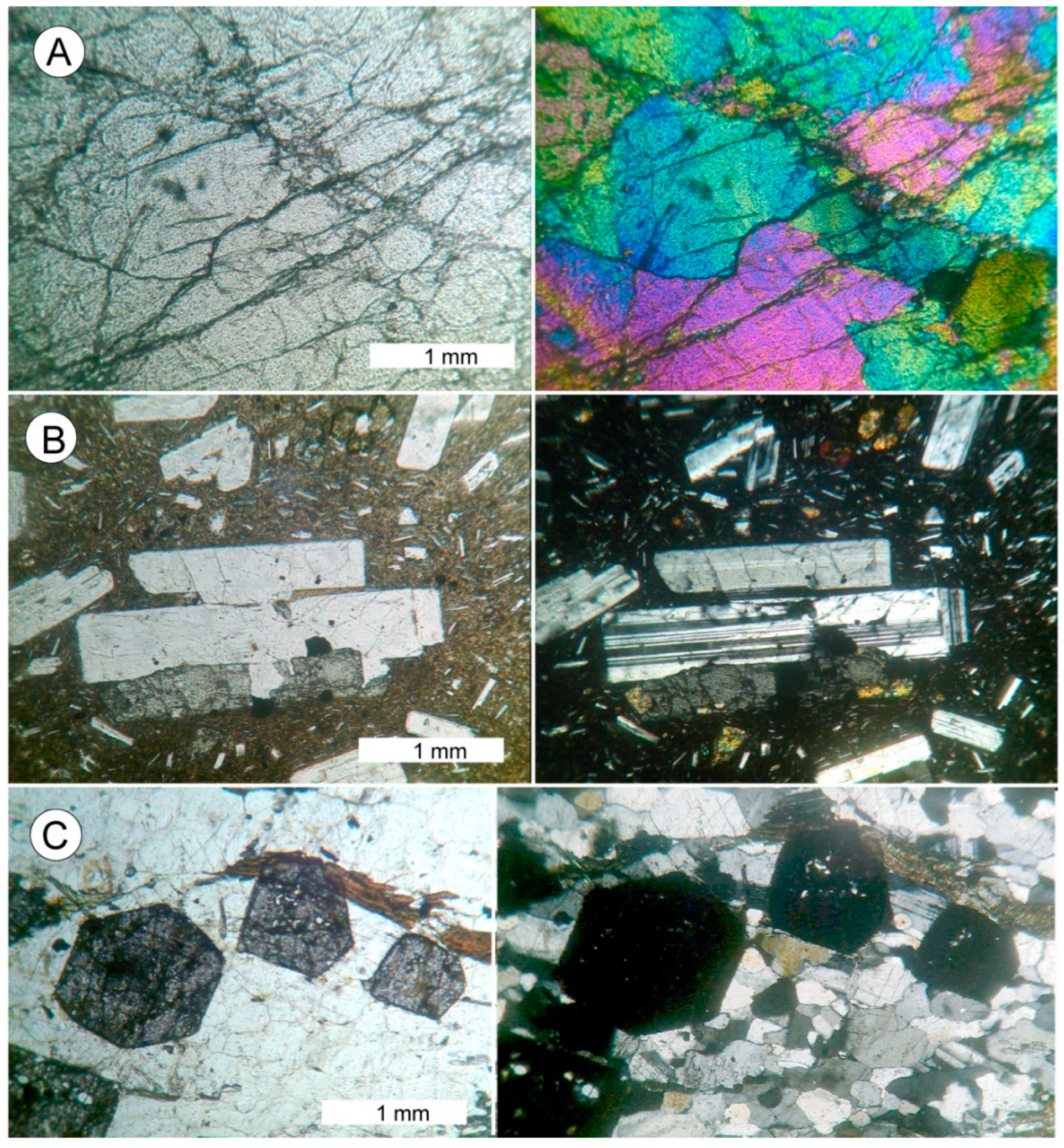
Thin-section views of rock-forming minerals show various aspects of polarized light images. Thickness is 30 microns. For each photo pair, the image on the left is ordinary transmitted light illumination; the right view is polarized light. (A) Olivine, showing characteristic high birefringence. (B) Andesite porphyry. Polarized light images show rectangular plagioclase feldspar crystals within a glassy matrix. Under polarized light, the feldspar crystals show low birefringence and the presence of twin planes. The isotropic glassy matrix is black. (C) Garnet schist, with inclusions of almandine garnet and biotite mica (brown). Under polarized light, the isotopic garnet is opaque black. The rock matrix can be seen to consist of an aggregate of quartz and feldspar.
Figure 11.
Thin-section views of rock-forming minerals show various aspects of polarized light images. Thickness is 30 microns. For each photo pair, the image on the left is ordinary transmitted light illumination; the right view is polarized light. (A) Olivine, showing characteristic high birefringence. (B) Andesite porphyry. Polarized light images show rectangular plagioclase feldspar crystals within a glassy matrix. Under polarized light, the feldspar crystals show low birefringence and the presence of twin planes. The isotropic glassy matrix is black. (C) Garnet schist, with inclusions of almandine garnet and biotite mica (brown). Under polarized light, the isotopic garnet is opaque black. The rock matrix can be seen to consist of an aggregate of quartz and feldspar.
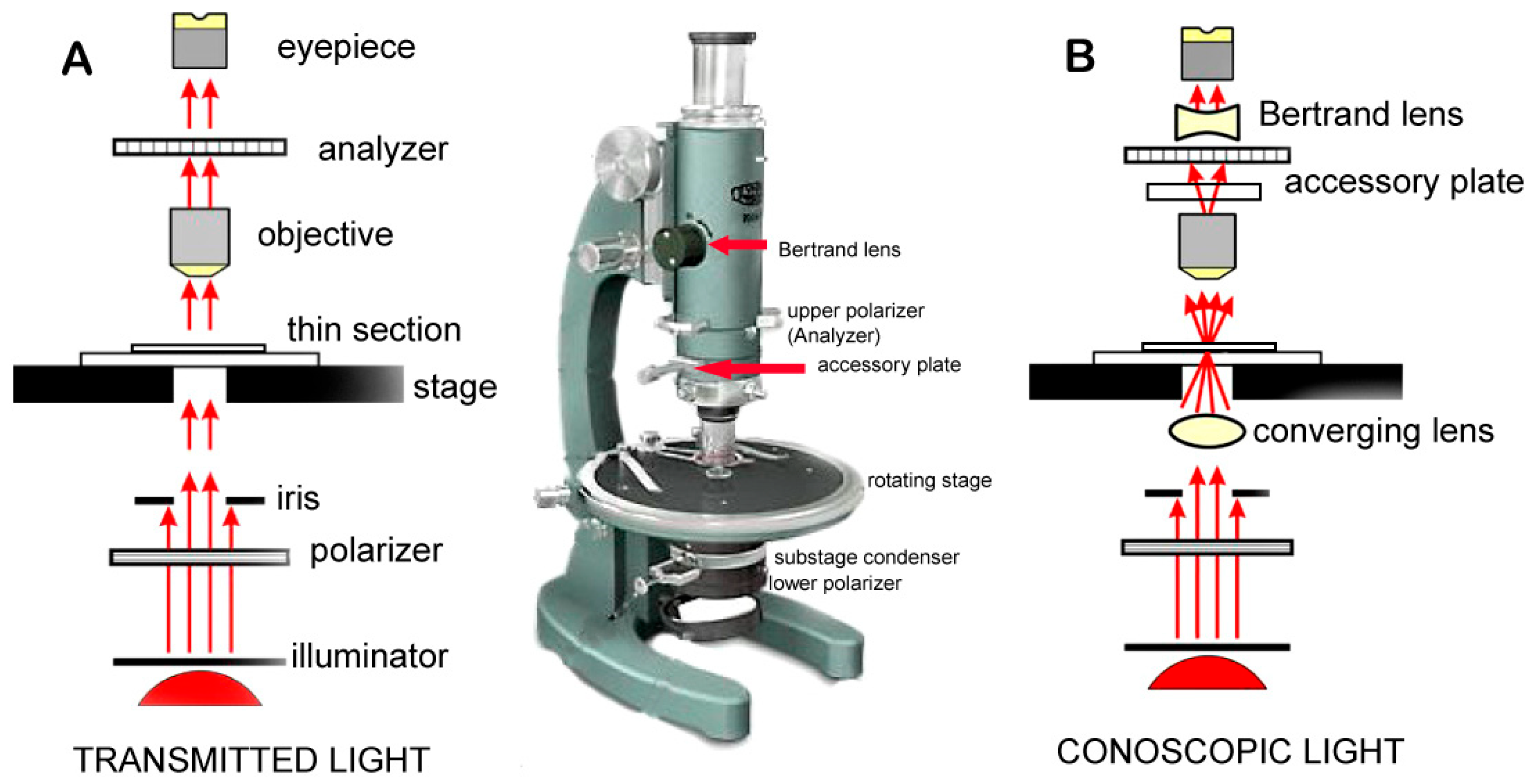
Figure 12.
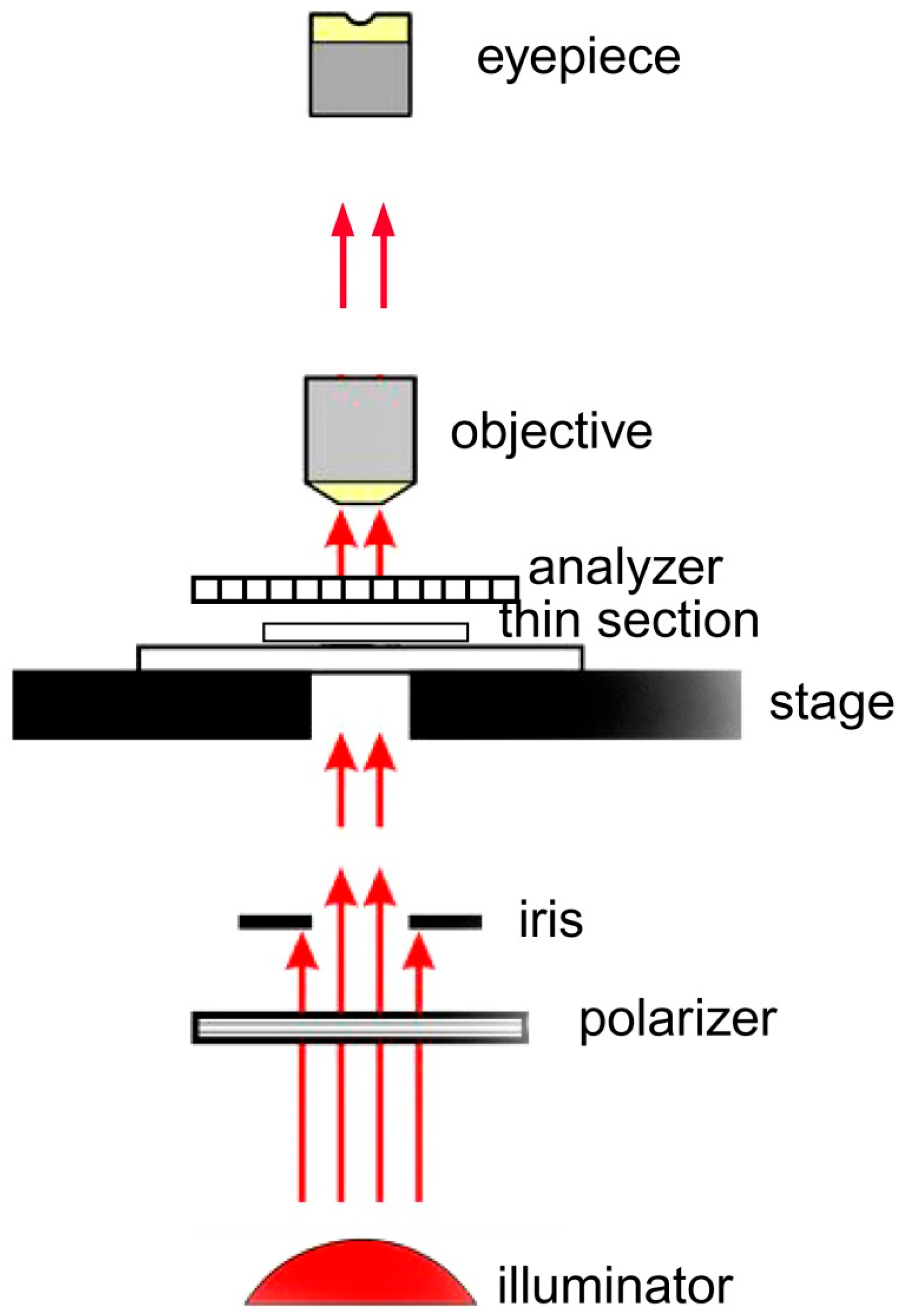
Light path (shown by red arrows) for a biological microscope adapted for polarized light. Compare this image to the light path shown in
Figure 8A. The main difference is the position of the analyzer (upper polarizer).
Figure 12.
Light path (shown by red arrows) for a biological microscope adapted for polarized light. Compare this image to the light path shown in
Figure 8A. The main difference is the position of the analyzer (upper polarizer).
Figure 13.
Thin-section photomicrographs of Miocene silicified wood from Thailand, showing individual fibers that are encased with radiating quartz crystals. In each pair, the image on the right is with polarized light. Photographs were made with two microscopes, using the same 5-megapixel CMOS microscope camera in place of the eyepiece. (A) Images from a Zeiss petrographic microscope, using an LED illuminator. (B) Images from an Olympus model KHS biological microscope adapted for polarized light using glass camera filters. Illumination is from the built-in 120 v tungsten filament bulb, with a blue glass filter to approximate the color temperature of natural light.
Figure 13.
Thin-section photomicrographs of Miocene silicified wood from Thailand, showing individual fibers that are encased with radiating quartz crystals. In each pair, the image on the right is with polarized light. Photographs were made with two microscopes, using the same 5-megapixel CMOS microscope camera in place of the eyepiece. (A) Images from a Zeiss petrographic microscope, using an LED illuminator. (B) Images from an Olympus model KHS biological microscope adapted for polarized light using glass camera filters. Illumination is from the built-in 120 v tungsten filament bulb, with a blue glass filter to approximate the color temperature of natural light.
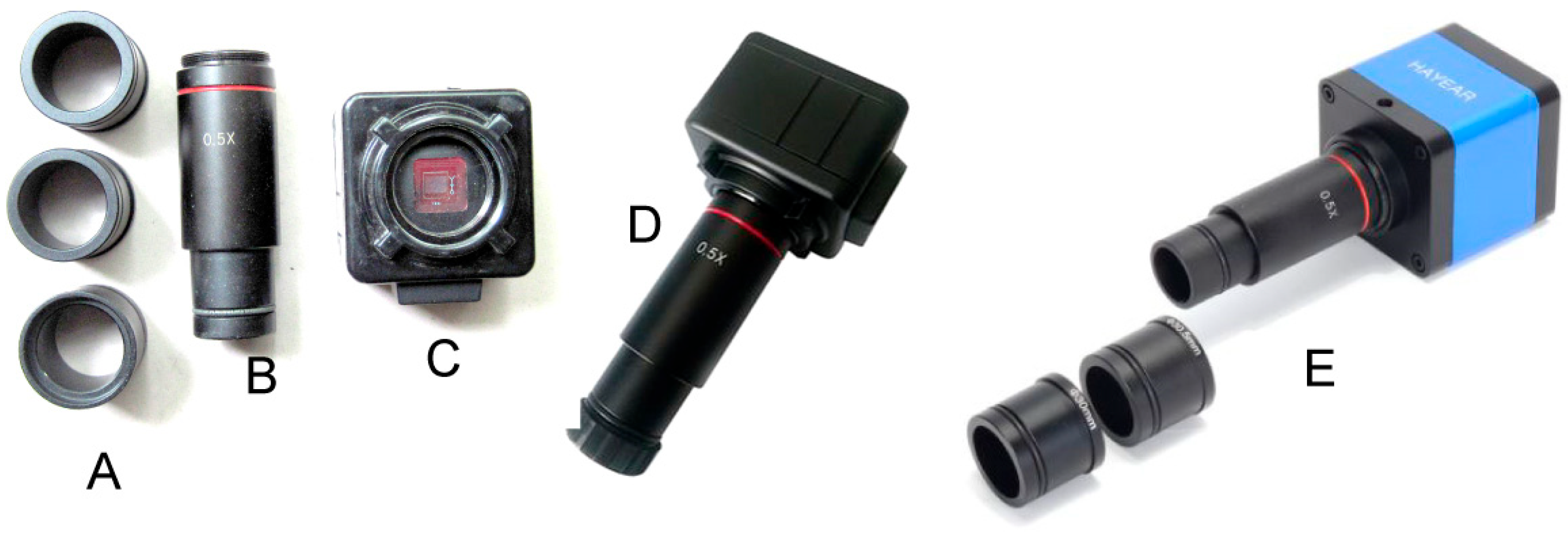
Figure 14.
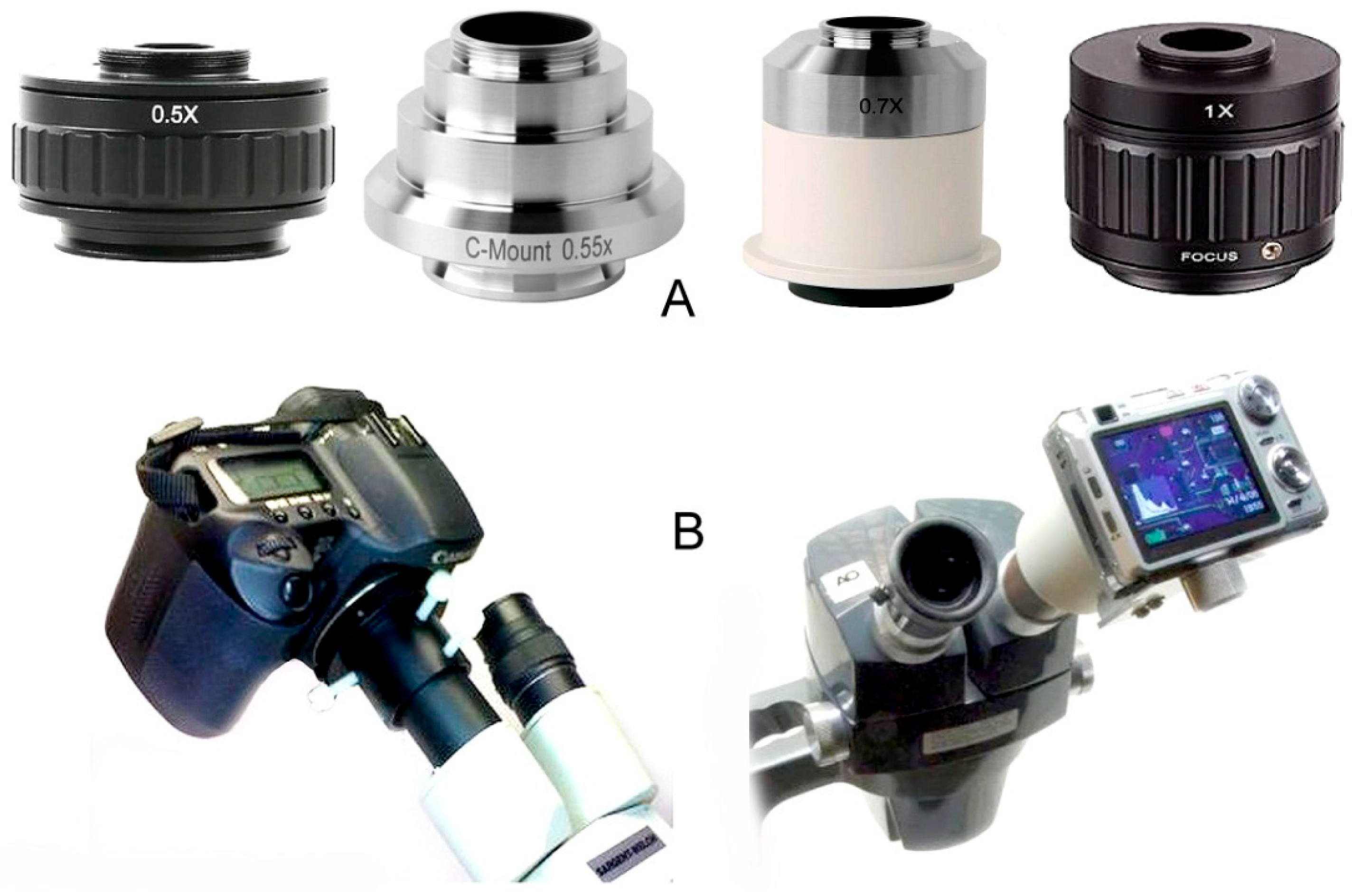
C-mount camera-to-microscope adapters. (A) For trinocular head mounting, the C-adapter must match the attachment design for the microscope. (B) An option is to use a C-mount that replaces an eyepiece lens.
Figure 14.
C-mount camera-to-microscope adapters. (A) For trinocular head mounting, the C-adapter must match the attachment design for the microscope. (B) An option is to use a C-mount that replaces an eyepiece lens.
Figure 16.
Digital microscope cameras (Shenzhen Hayear Electronics Co. Ltd., China,
www.Hayear.com) The HY-500B 5 microscope camera kit shown at left features (
A) adapter tubes, (
B) a 0.5× relay lens, and (
C) a 5-megapixel CMOS color camera. (
D) Complete camera assembly. For a standard 23 mm diameter microscope tube, no adapter is needed. The USB connector cable is not shown. I extensively use this camera model. (
E) The HDMI-1080P camera is a more recent model that has 16-megapixel resolution.
Figure 16.
Digital microscope cameras (Shenzhen Hayear Electronics Co. Ltd., China,
www.Hayear.com) The HY-500B 5 microscope camera kit shown at left features (
A) adapter tubes, (
B) a 0.5× relay lens, and (
C) a 5-megapixel CMOS color camera. (
D) Complete camera assembly. For a standard 23 mm diameter microscope tube, no adapter is needed. The USB connector cable is not shown. I extensively use this camera model. (
E) The HDMI-1080P camera is a more recent model that has 16-megapixel resolution.
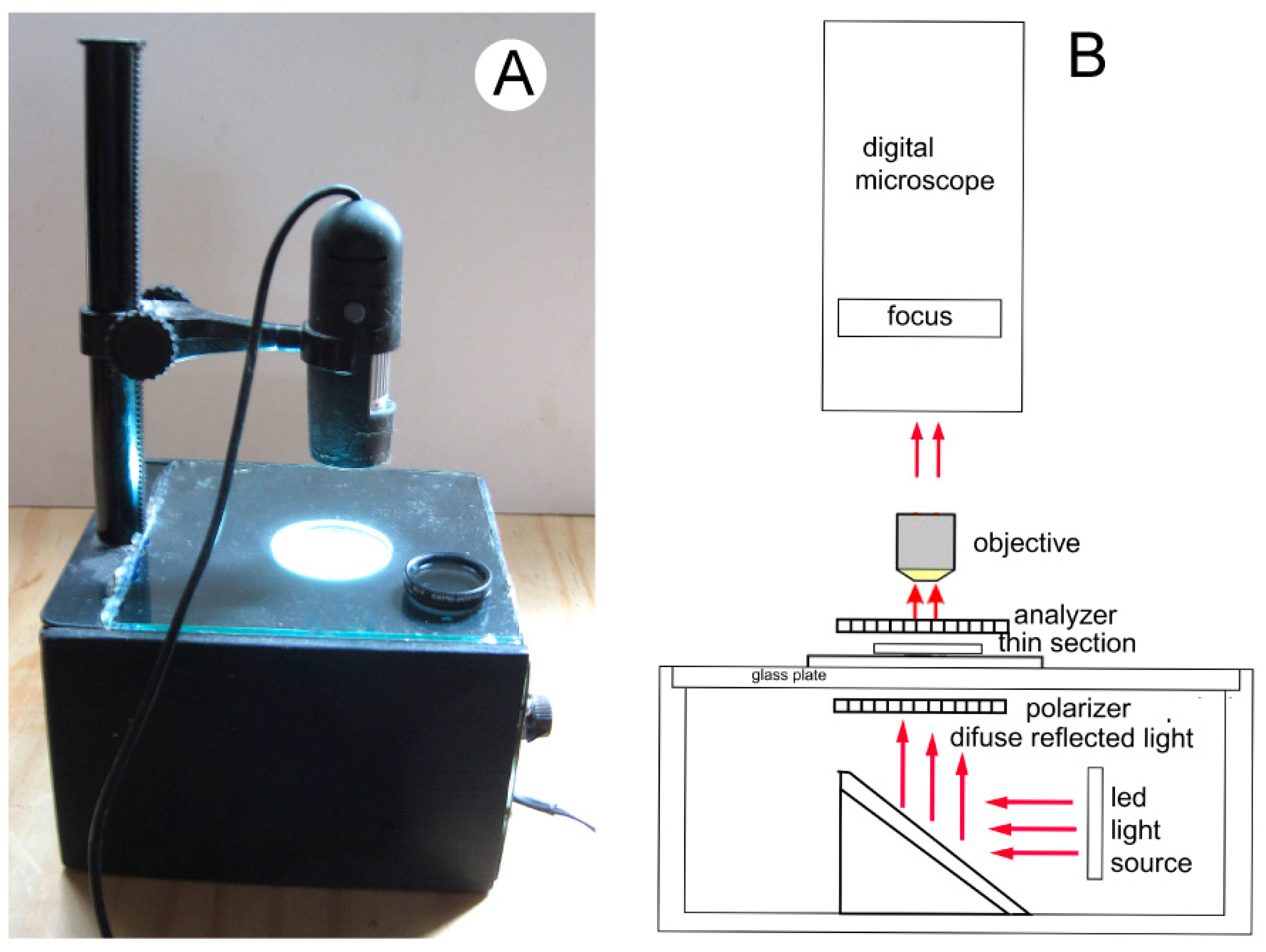
Figure 17.
An inexpensive digital zoom microscope was adapted for polarized light illumination. This camera came from
www.alexnld.com, but many competing brands are advertised online. (
A) completed illuminator. (
B) Sketch showing internal design, with red arrows showing light path.
Figure 17.
An inexpensive digital zoom microscope was adapted for polarized light illumination. This camera came from
www.alexnld.com, but many competing brands are advertised online. (
A) completed illuminator. (
B) Sketch showing internal design, with red arrows showing light path.
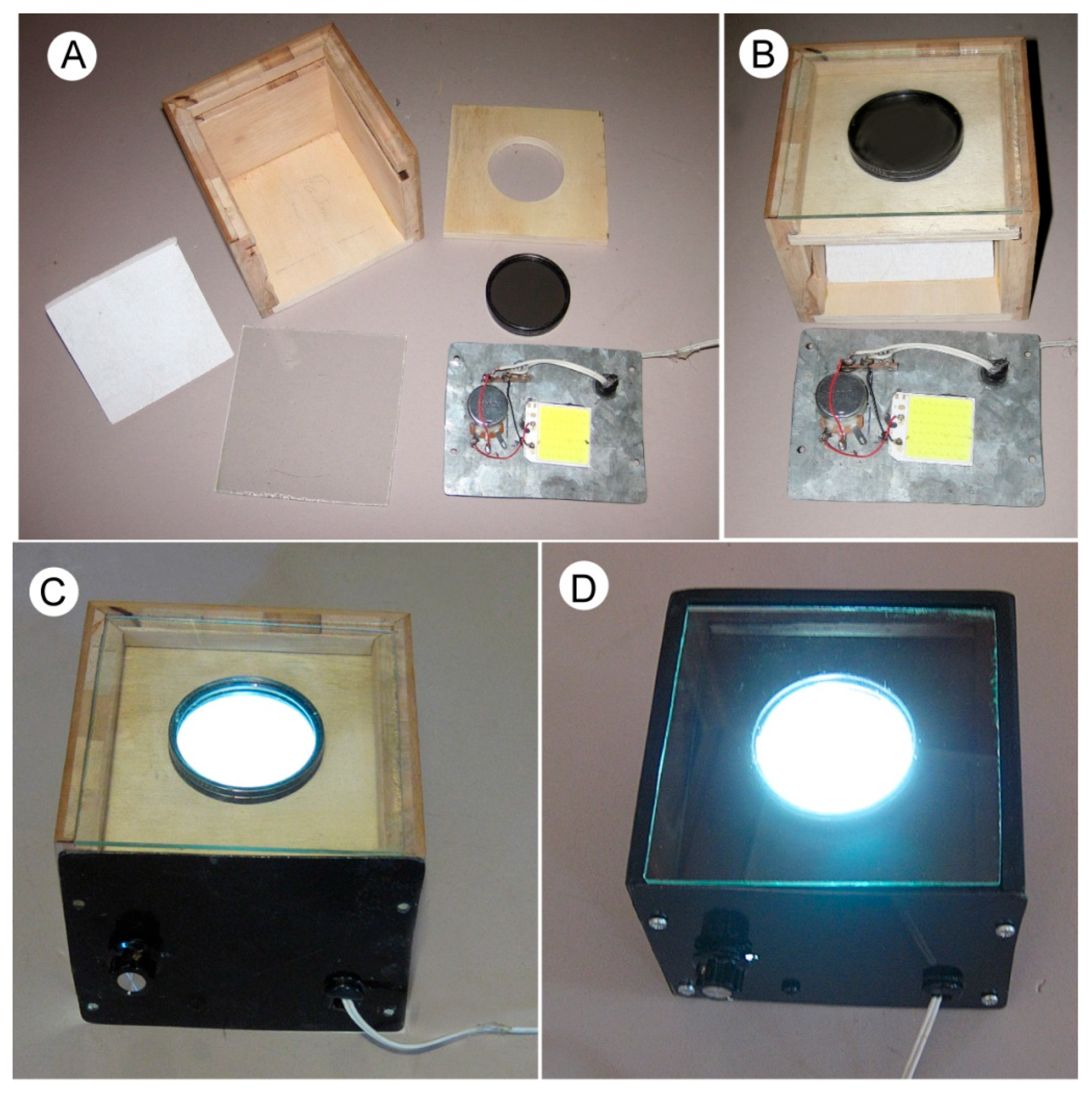
Figure 18.
Construction steps for constructing a polarized light illuminator. (A) Individual components. (B) Light box prior to final assembly. (C,D) Completed illuminator, before and after final painting.
Figure 18.
Construction steps for constructing a polarized light illuminator. (A) Individual components. (B) Light box prior to final assembly. (C,D) Completed illuminator, before and after final painting.
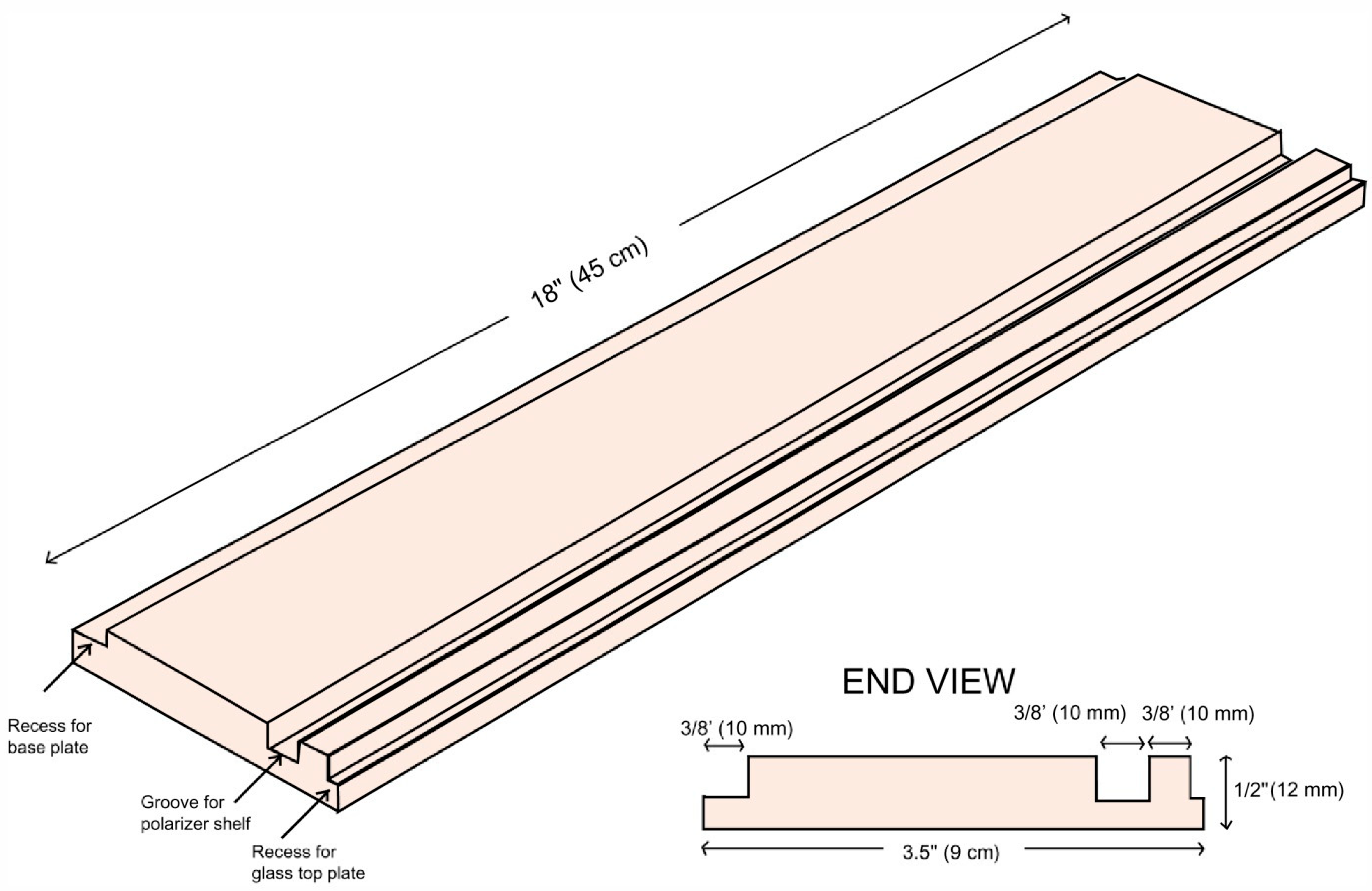
Figure 19.
Pattern for cutting wood for the light box. The easiest table saw procedure is to cut the various grooves while the wood is at its original full length.
Figure 19.
Pattern for cutting wood for the light box. The easiest table saw procedure is to cut the various grooves while the wood is at its original full length.
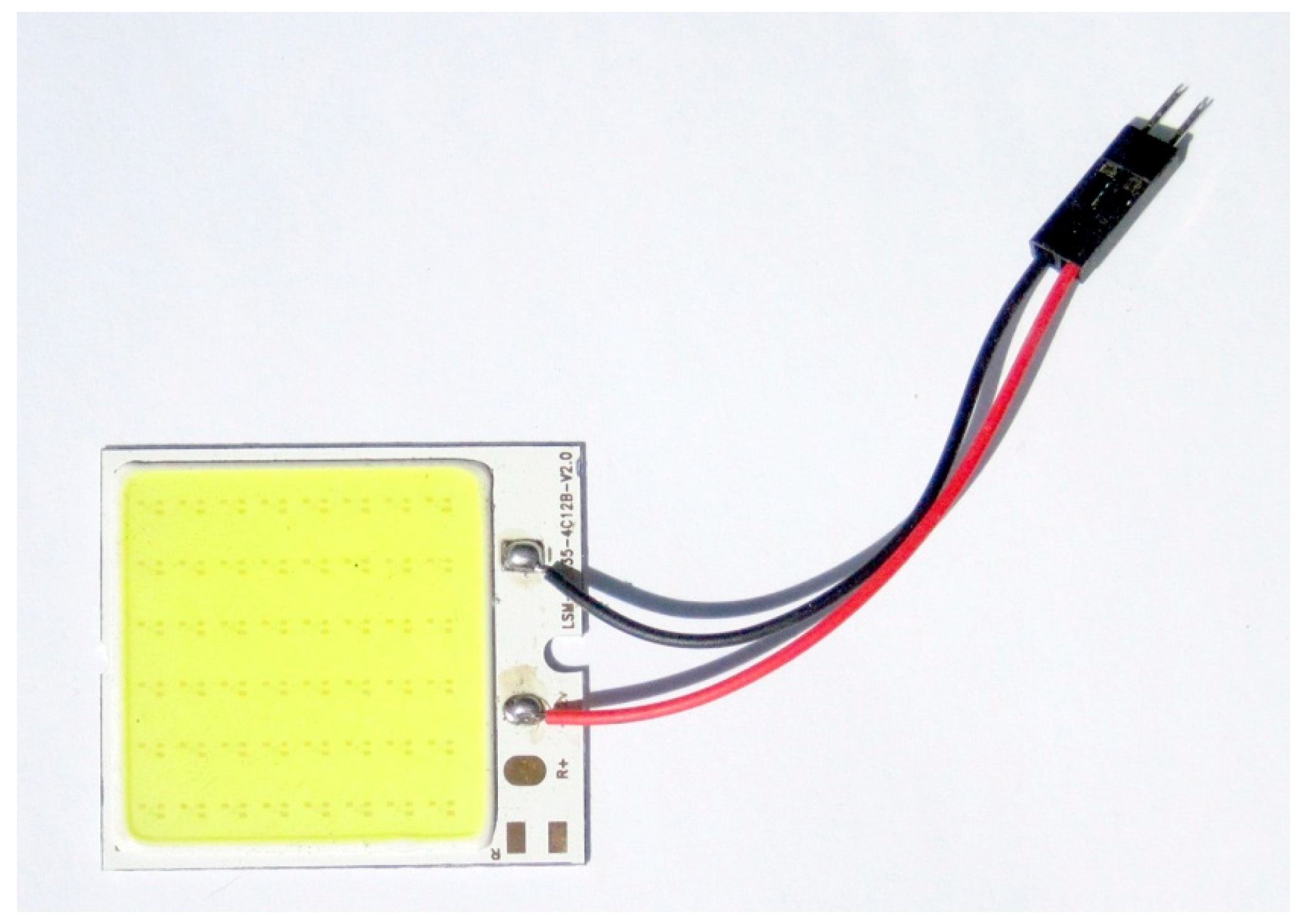
Figure 20.
LED light panel, Festoon T10 Ba9s white LED 48SMD.
Figure 20.
LED light panel, Festoon T10 Ba9s white LED 48SMD.
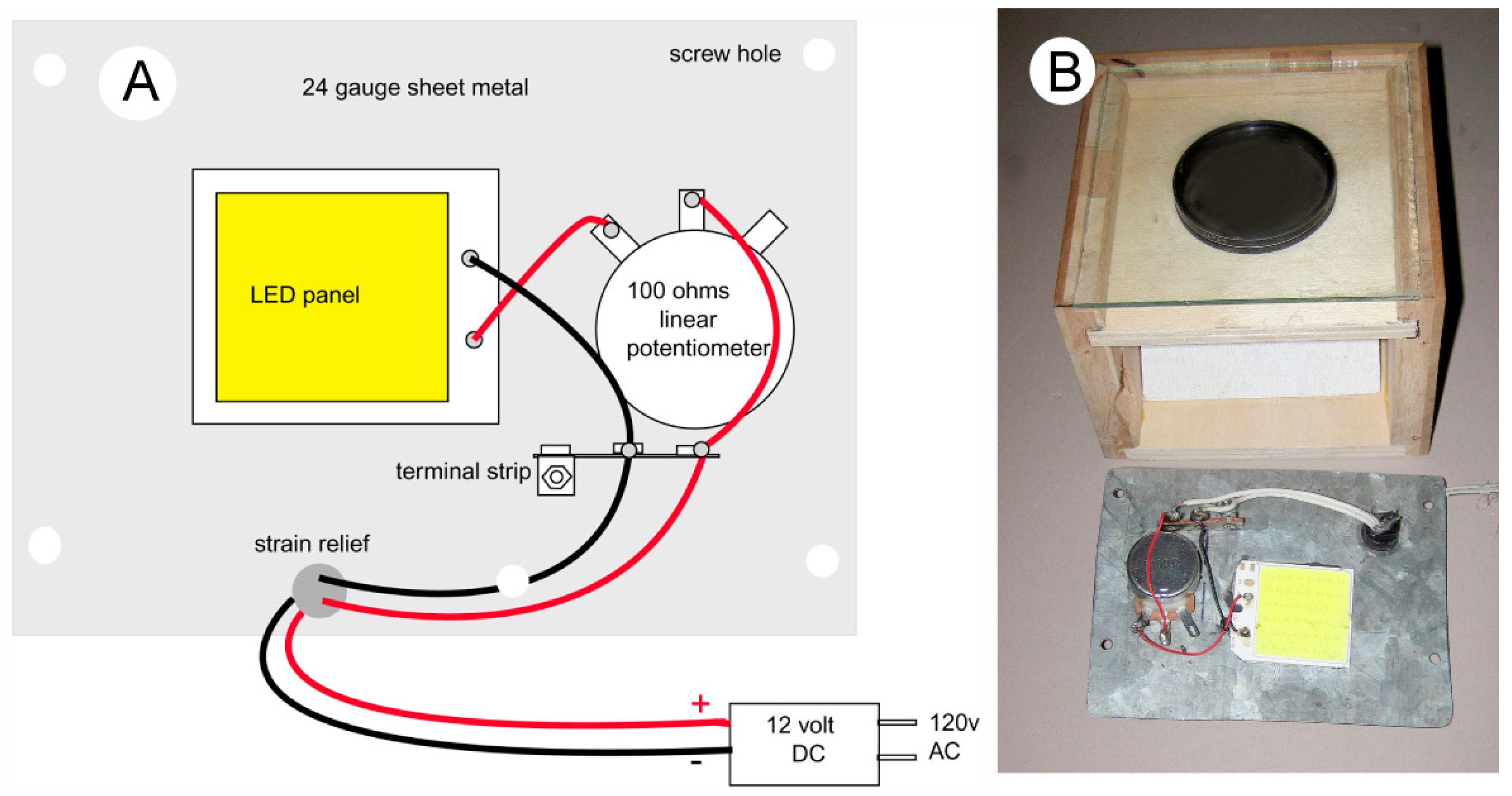
Figure 21.
LED light panel. (A) Wiring schematic. (B) Completed panel.
Figure 21.
LED light panel. (A) Wiring schematic. (B) Completed panel.
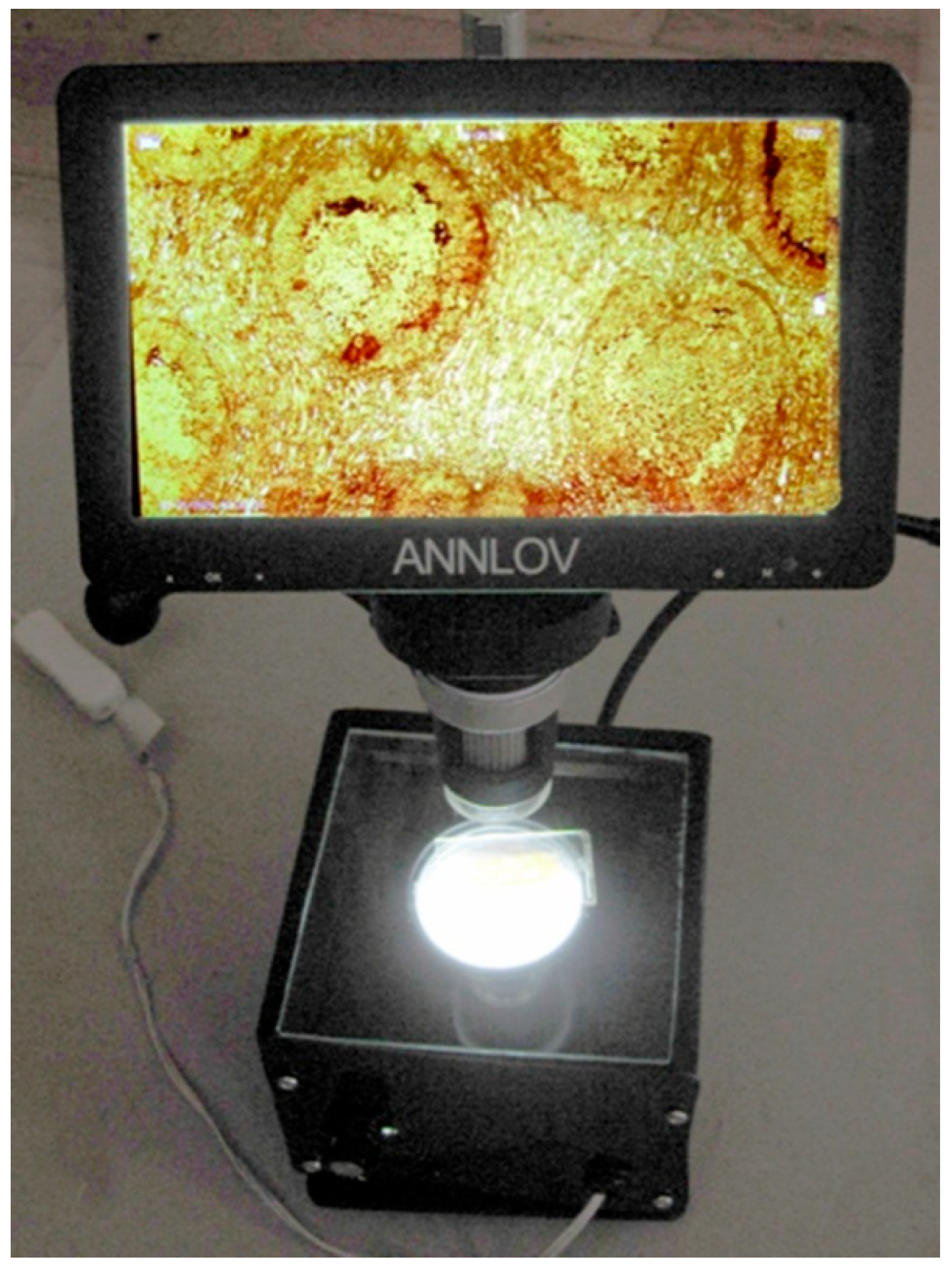
Figure 22.
Digital zoom microscope used with a polarized light illuminator. The screen image is a thin-section view of Miocene silicified palm wood from Costa Rica, viewed under ordinary transmitted light illumination.
Figure 22.
Digital zoom microscope used with a polarized light illuminator. The screen image is a thin-section view of Miocene silicified palm wood from Costa Rica, viewed under ordinary transmitted light illumination.
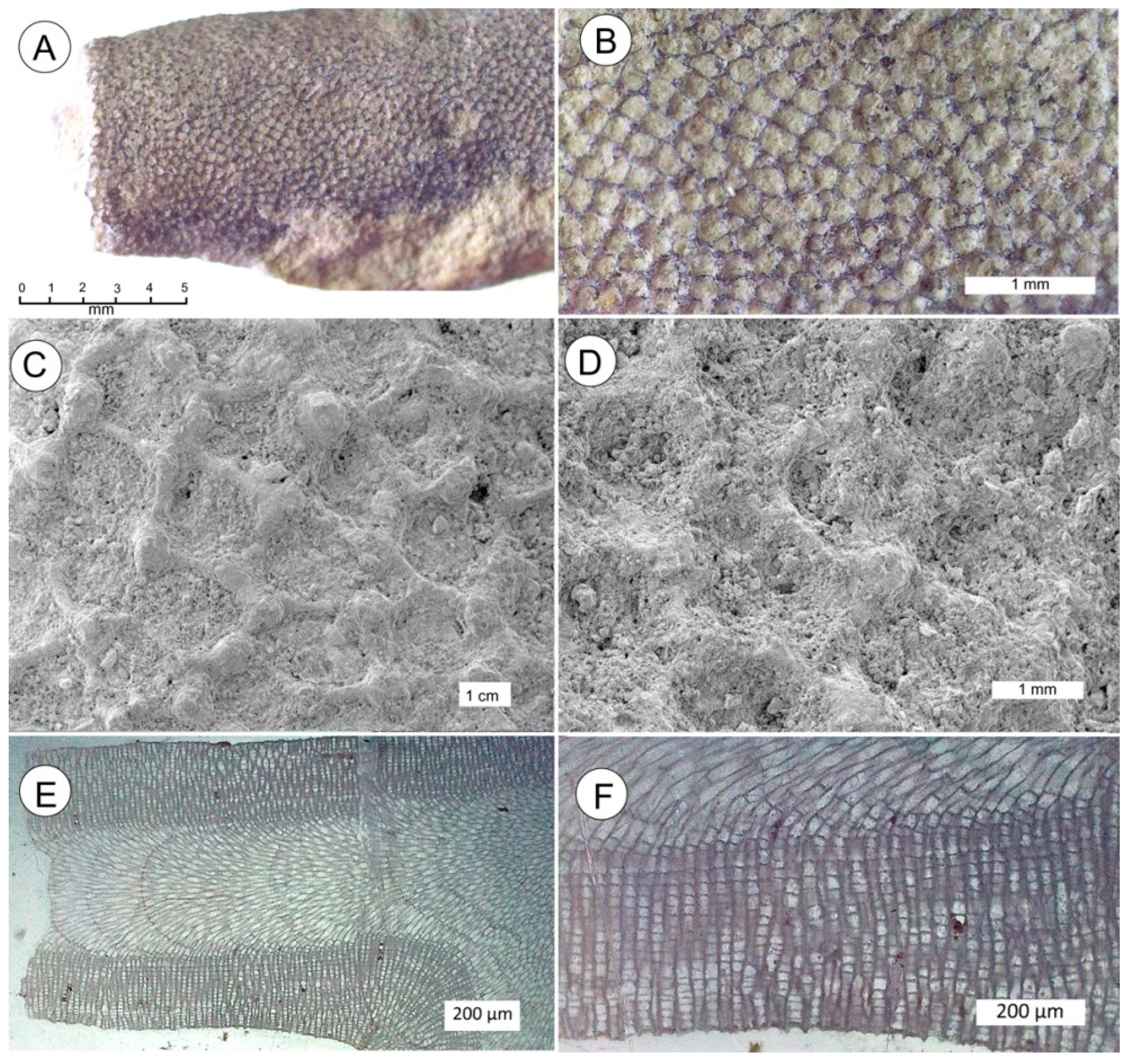
Figure 23.
Colonial bryozoans from the Pennsylvanian Round Valley Formation, Summit County, Utah, USA. (A,B) Low-power reflected light photographs show the patterns made by the mineralized walls of individual cells (zooids). However, the calcite filling of these spaces limits the recognition of anatomical detail. (C,D) SEM images provide higher magnification, but they otherwise offer minimal additional information. (E,F) Thin sections viewed under ordinary transmitted light provide far more anatomical detail.
Figure 23.
Colonial bryozoans from the Pennsylvanian Round Valley Formation, Summit County, Utah, USA. (A,B) Low-power reflected light photographs show the patterns made by the mineralized walls of individual cells (zooids). However, the calcite filling of these spaces limits the recognition of anatomical detail. (C,D) SEM images provide higher magnification, but they otherwise offer minimal additional information. (E,F) Thin sections viewed under ordinary transmitted light provide far more anatomical detail.
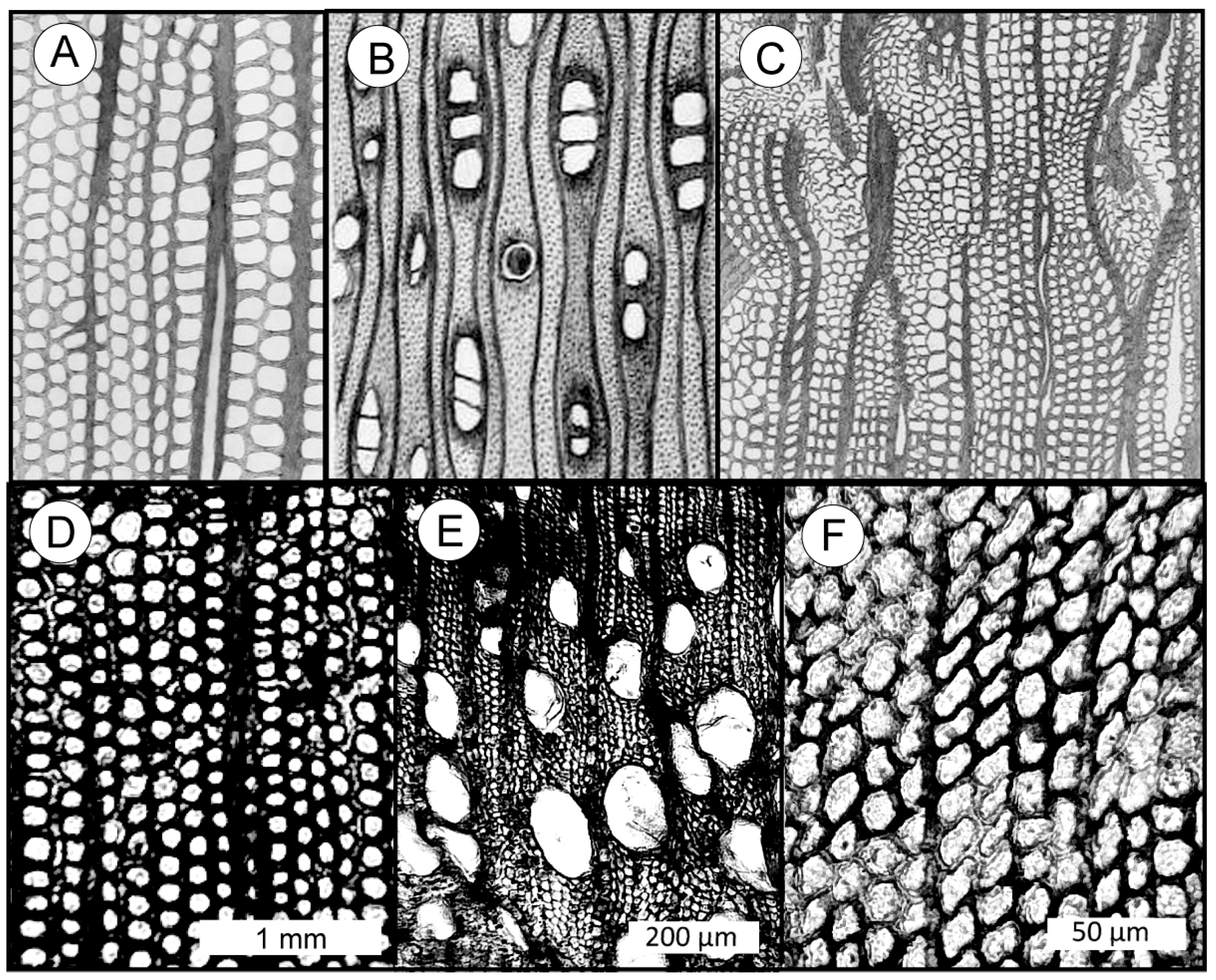
Figure 24.
For many years, all thin sections were made using non-motorized tools. (
A–
C) The early sections of fossil wood illustrated by Witham in 1883 [
7] are as good in quality as the thin sections made by modern paleobotanists. A primary difference is that the early illustrations required skillful drawing ability, because photomicroscopy had not yet been invented. Magnification scales were not included. Modern thin-sections are illustrated with photographs, but the optical quality of the specimens is similar to the specimens that were made 140 years earlier. (
D,
E) Transverse views of Cenozoic silicified wood from Iran. (
F) Transverse image of Miocene wood from Guatemala.
Figure 24.
For many years, all thin sections were made using non-motorized tools. (
A–
C) The early sections of fossil wood illustrated by Witham in 1883 [
7] are as good in quality as the thin sections made by modern paleobotanists. A primary difference is that the early illustrations required skillful drawing ability, because photomicroscopy had not yet been invented. Magnification scales were not included. Modern thin-sections are illustrated with photographs, but the optical quality of the specimens is similar to the specimens that were made 140 years earlier. (
D,
E) Transverse views of Cenozoic silicified wood from Iran. (
F) Transverse image of Miocene wood from Guatemala.
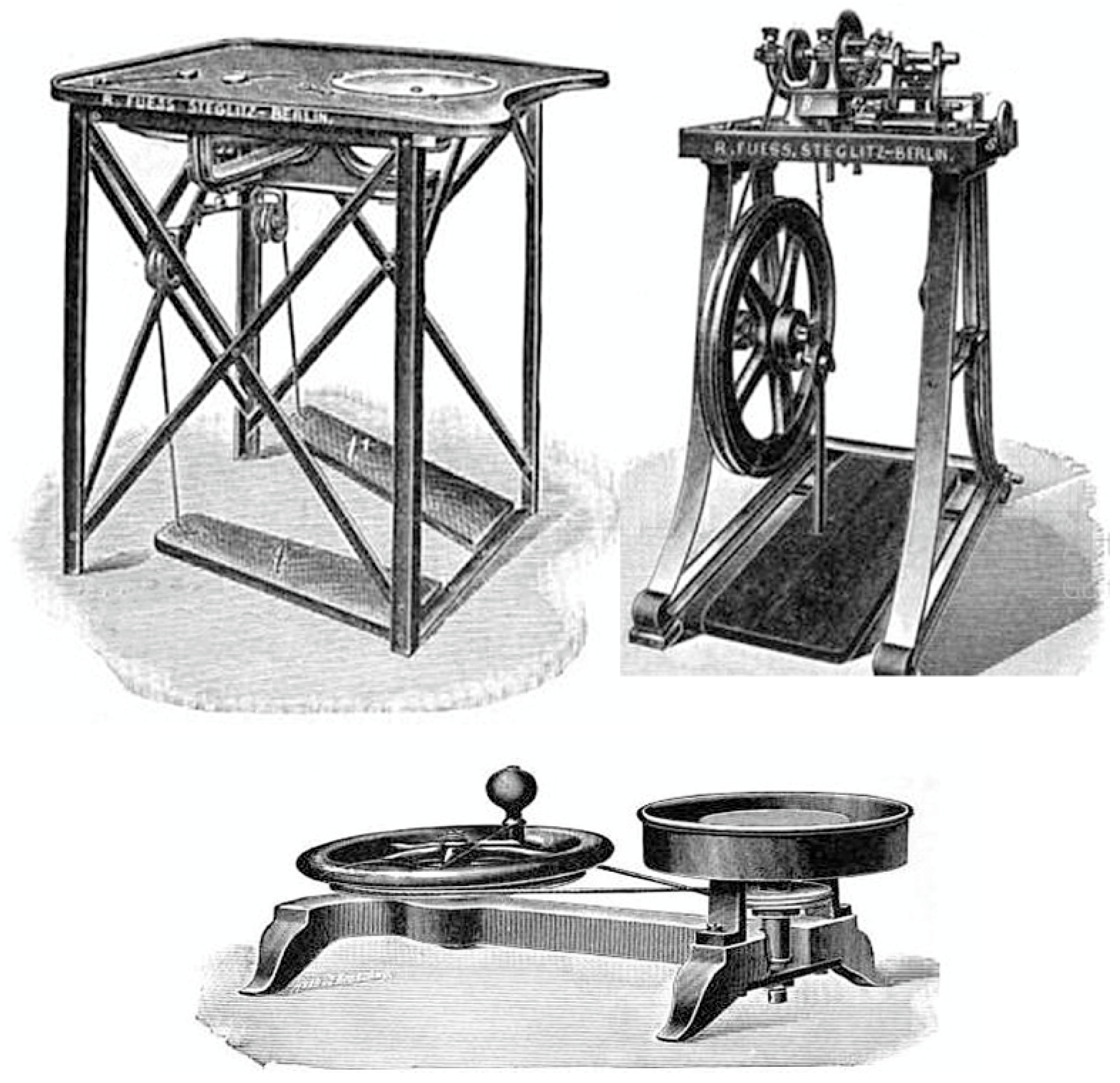
Figure 25.
Early machines used for making petrographic thin sections. A 1914 textbook describes the method in great detail [
13].
Figure 25.
Early machines used for making petrographic thin sections. A 1914 textbook describes the method in great detail [
13].
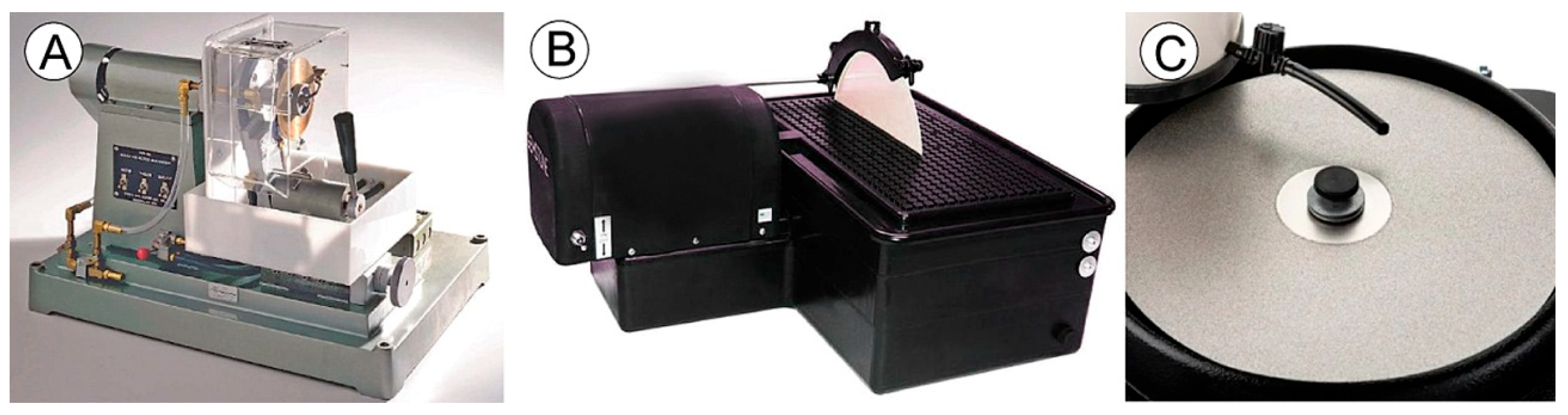
Figure 26.
For paleontologists, sophisticated thin section machines are a luxury, not a necessity. (
A) This Wards Ingram precision saw/grinder has a 2025 list price of USD 58,594 (
www.wardsci.com). With patience, thin sections can be made using only a trim saw (
B) and a flat grinding lap (
C).
Figure 26.
For paleontologists, sophisticated thin section machines are a luxury, not a necessity. (
A) This Wards Ingram precision saw/grinder has a 2025 list price of USD 58,594 (
www.wardsci.com). With patience, thin sections can be made using only a trim saw (
B) and a flat grinding lap (
C).
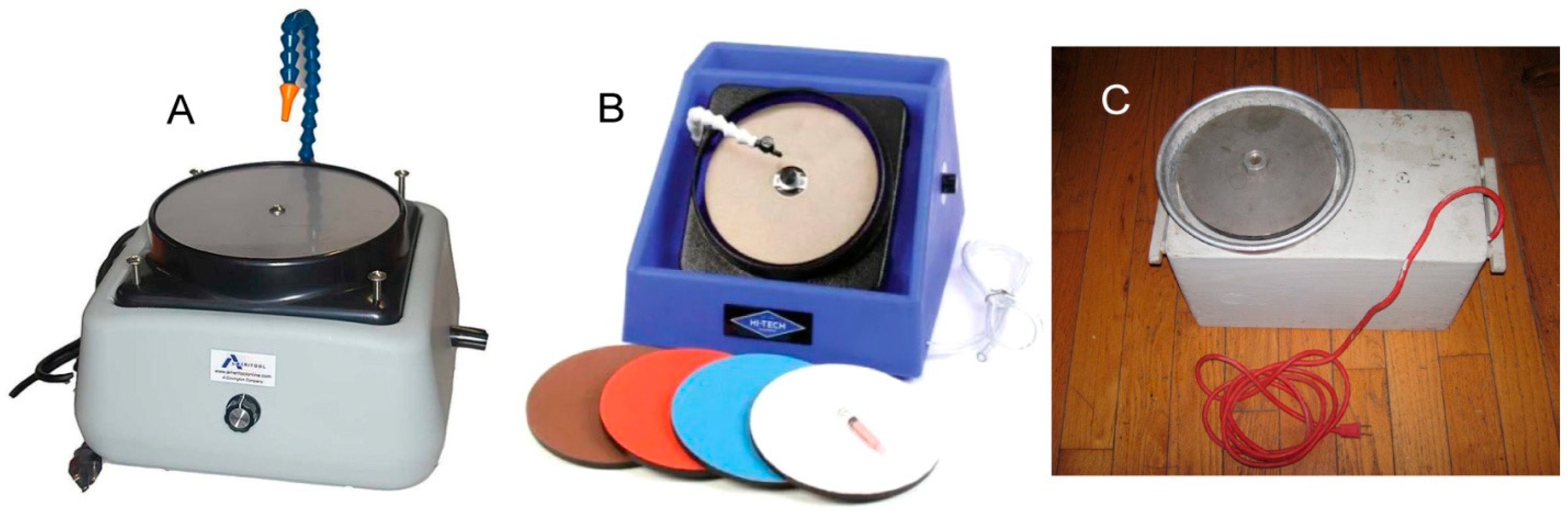
Figure 27.
Examples of diamond lap wheel systems. (A,B) Commercial models marketed for lapidary use. The main features are a variable speed motor and a source of a stream of water that lubricates the abrasion and carries away grinding debris. (C) A single-speed diamond lap system made by the author in 2024. The 8″wheel has an aluminum pie plate as a spray shield. During use, water is supplied using a plastic spray bottle.
Figure 27.
Examples of diamond lap wheel systems. (A,B) Commercial models marketed for lapidary use. The main features are a variable speed motor and a source of a stream of water that lubricates the abrasion and carries away grinding debris. (C) A single-speed diamond lap system made by the author in 2024. The 8″wheel has an aluminum pie plate as a spray shield. During use, water is supplied using a plastic spray bottle.
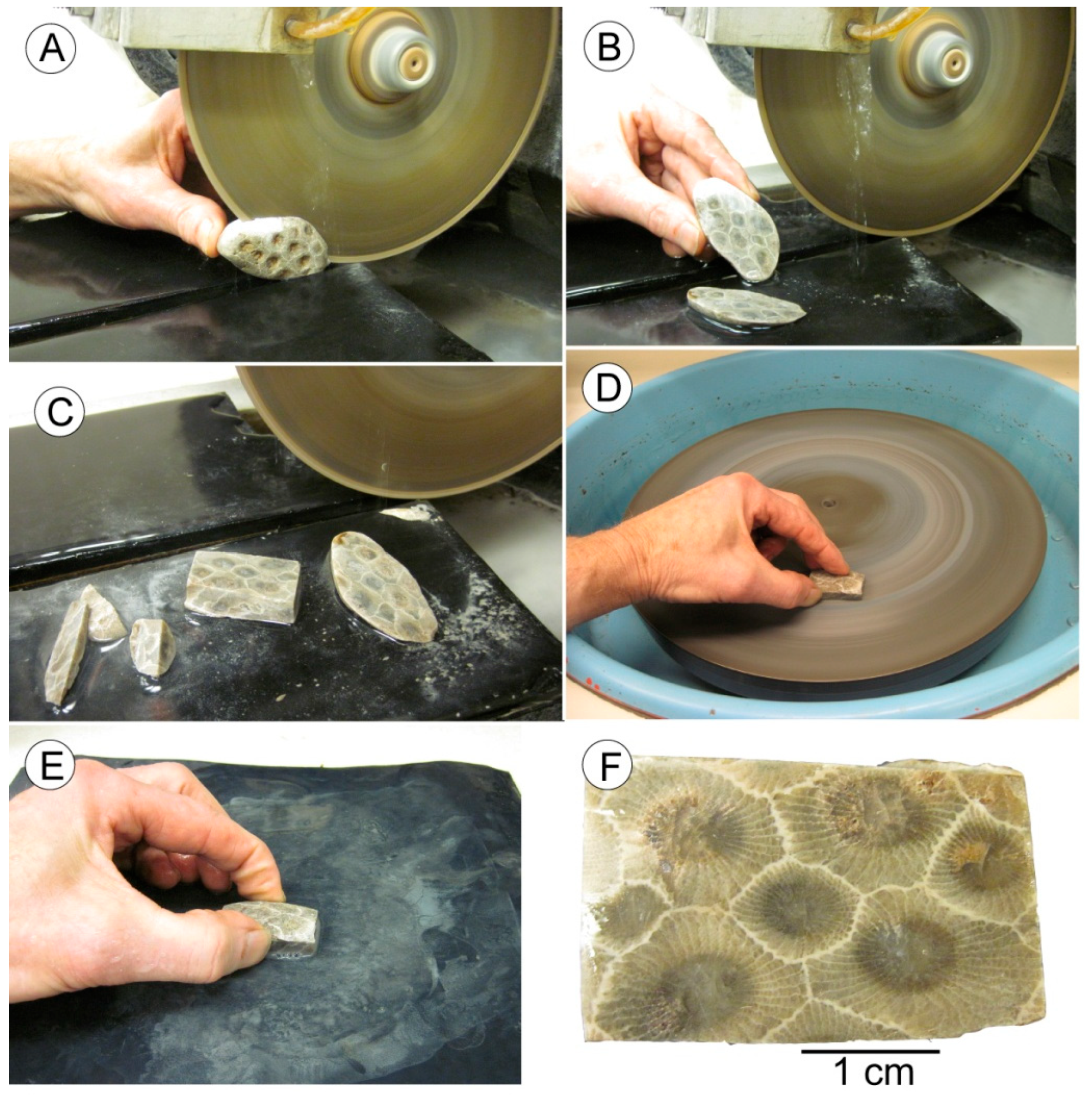
Figure 28.
Using a diamond saw to prepare a rock block for a thin section. In this example, the specimen is a Devonian colonial coral, Hexagonaria sp., mineralized with calcite. (A,B). Sawing the specimen to produce a flat surface. (C) The cut specimen is trimmed to a rectangular block. (D) One surface of the block is ground flat using a lap wheel. This photo shows the use of a steel lap wheel with a wet slurry of silicon carbide grit as the abrasive. Having variable speed control is an asset, but single speed is acceptable as long as the rotational speed is less than a few hundred RPM. The final surface can be ground using #400 or #600 grit. (E) An alternative to the lap wheel is to use emery paper laid on a flat glass plate, using water for wet grinding. (F) The final surface, which will be glued to a glass slide for preparation of the final thin section.
Figure 28.
Using a diamond saw to prepare a rock block for a thin section. In this example, the specimen is a Devonian colonial coral, Hexagonaria sp., mineralized with calcite. (A,B). Sawing the specimen to produce a flat surface. (C) The cut specimen is trimmed to a rectangular block. (D) One surface of the block is ground flat using a lap wheel. This photo shows the use of a steel lap wheel with a wet slurry of silicon carbide grit as the abrasive. Having variable speed control is an asset, but single speed is acceptable as long as the rotational speed is less than a few hundred RPM. The final surface can be ground using #400 or #600 grit. (E) An alternative to the lap wheel is to use emery paper laid on a flat glass plate, using water for wet grinding. (F) The final surface, which will be glued to a glass slide for preparation of the final thin section.
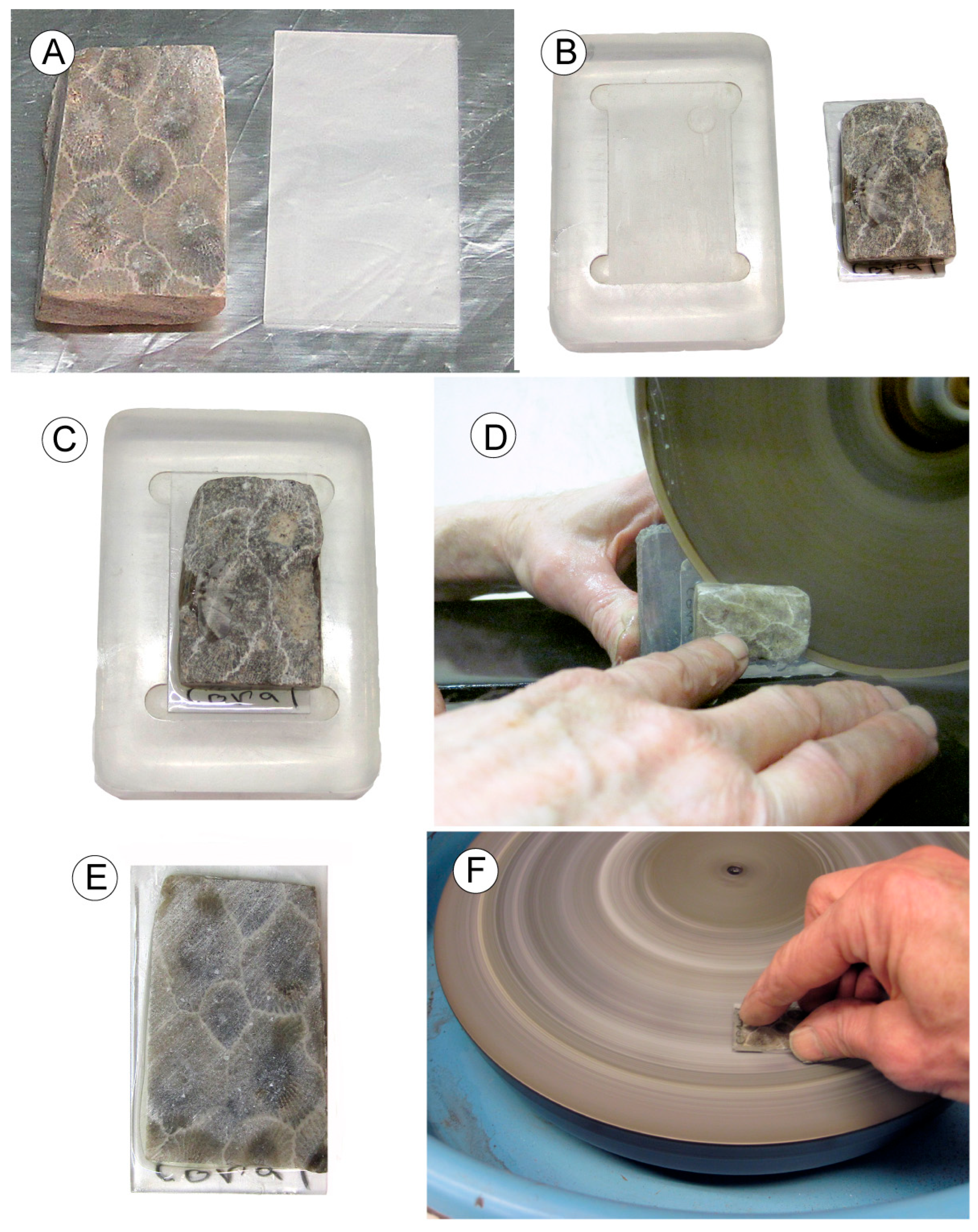
Figure 29.
Initial thin-section gluing, sawing, and grinding. (A) The flat surface of the rock block is glued to a glass slide using epoxy adhesive. The best results are obtained if the surface of the glass slide is “frosted” by brief grinding with #400-grit abrasive. (B,C) After the epoxy has cured, the slide is placed in a simple holder for sawing. A few drops of water in the holder provide sufficient surface tension bonding to hold the slide in place during sawing. (D,E) The goal is to produce a rock layer with a thickness of approximately 2 mm. (F) Initial grinding is performed with the flat lap wheel using #240 grit.
Figure 29.
Initial thin-section gluing, sawing, and grinding. (A) The flat surface of the rock block is glued to a glass slide using epoxy adhesive. The best results are obtained if the surface of the glass slide is “frosted” by brief grinding with #400-grit abrasive. (B,C) After the epoxy has cured, the slide is placed in a simple holder for sawing. A few drops of water in the holder provide sufficient surface tension bonding to hold the slide in place during sawing. (D,E) The goal is to produce a rock layer with a thickness of approximately 2 mm. (F) Initial grinding is performed with the flat lap wheel using #240 grit.
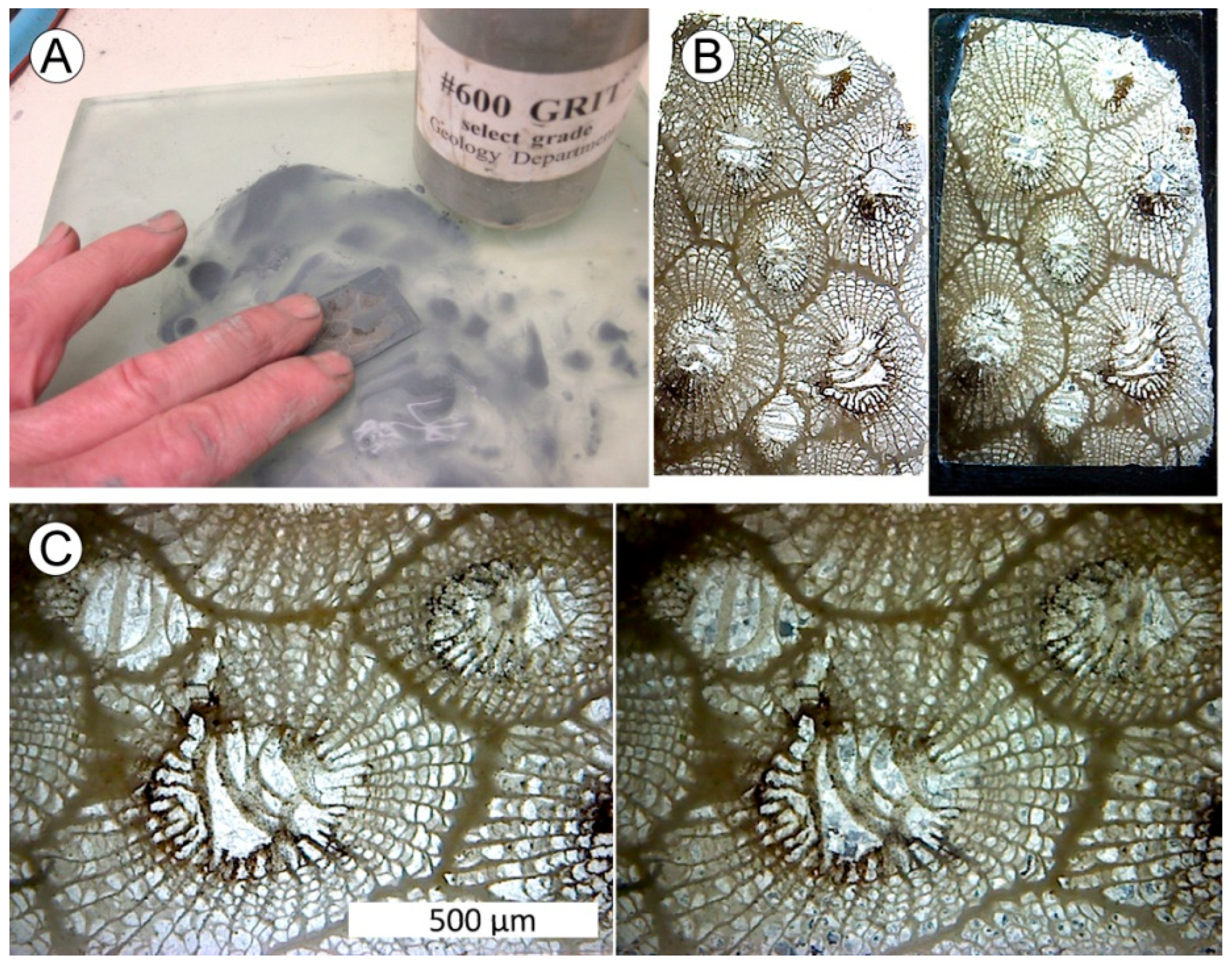
Figure 30.
Final grinding is best performed by hand. (A) One option is to grind the slide using a slurry of #600 grit and water. A glass plate provides a flat surface. Wet grinding on fine emery paper is another possibility. (B,C) Photomicrographs of the finished slide. For each photo pair, the image on the left was made with ordinary transmitted light. The right photo used polarized light. (B) Shows the full area of the thin section. These images show the slide after a glass coverslip was added, using a few drops of epoxy resin as the mounting medium.
Figure 30.
Final grinding is best performed by hand. (A) One option is to grind the slide using a slurry of #600 grit and water. A glass plate provides a flat surface. Wet grinding on fine emery paper is another possibility. (B,C) Photomicrographs of the finished slide. For each photo pair, the image on the left was made with ordinary transmitted light. The right photo used polarized light. (B) Shows the full area of the thin section. These images show the slide after a glass coverslip was added, using a few drops of epoxy resin as the mounting medium.
Figure 31.
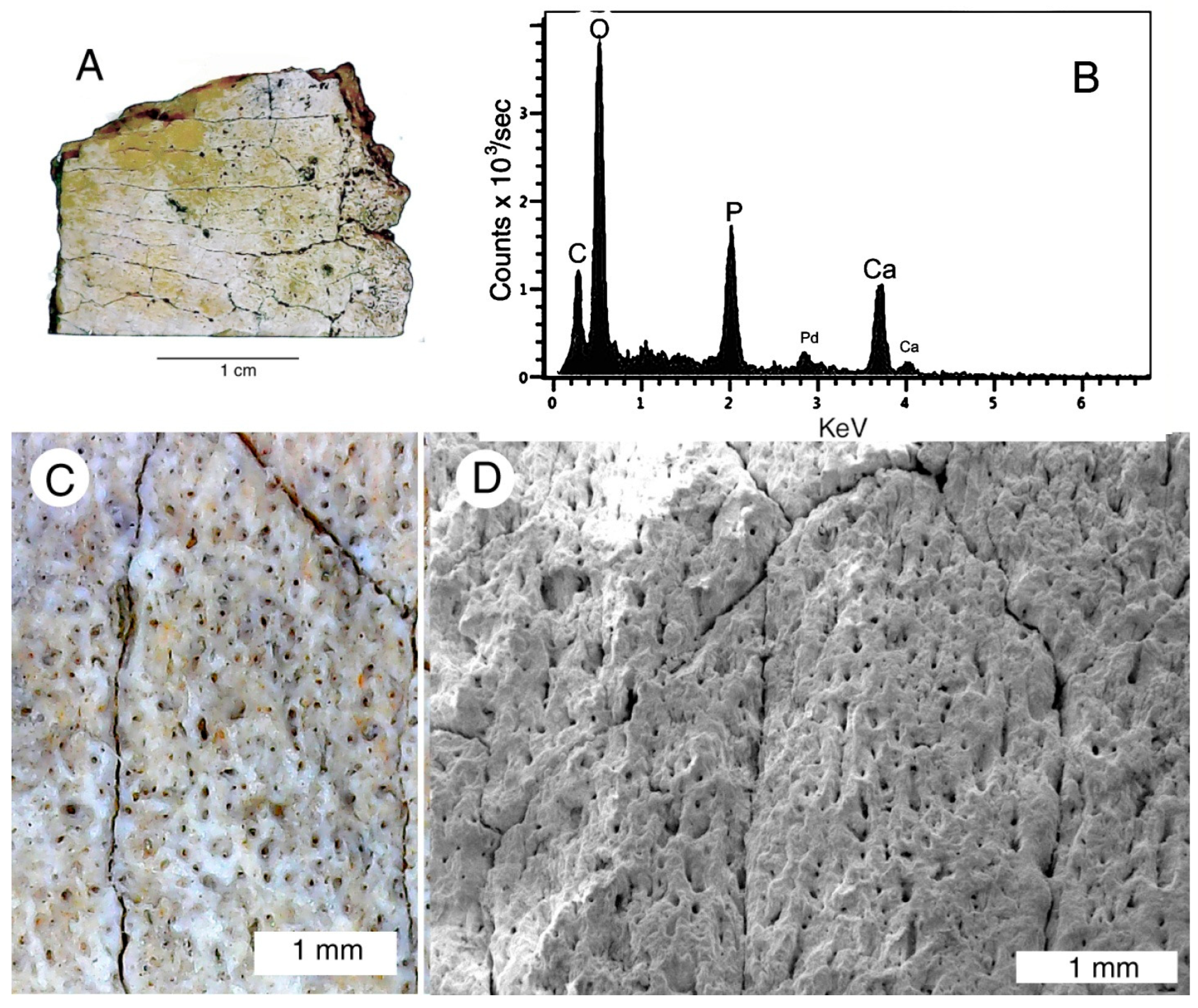
Microscopy of an Early Cretaceous ichthyosaur bone from the Griman Creek Formation, Queensland, Australia. (A) Bone fragment. (B) X-ray fluorescence spectrum obtained from an SEM specimen. (C) Transmitted light optical photomicrograph. (D) SEM image of a region from the same specimen.
Figure 31.
Microscopy of an Early Cretaceous ichthyosaur bone from the Griman Creek Formation, Queensland, Australia. (A) Bone fragment. (B) X-ray fluorescence spectrum obtained from an SEM specimen. (C) Transmitted light optical photomicrograph. (D) SEM image of a region from the same specimen.
Figure 32.
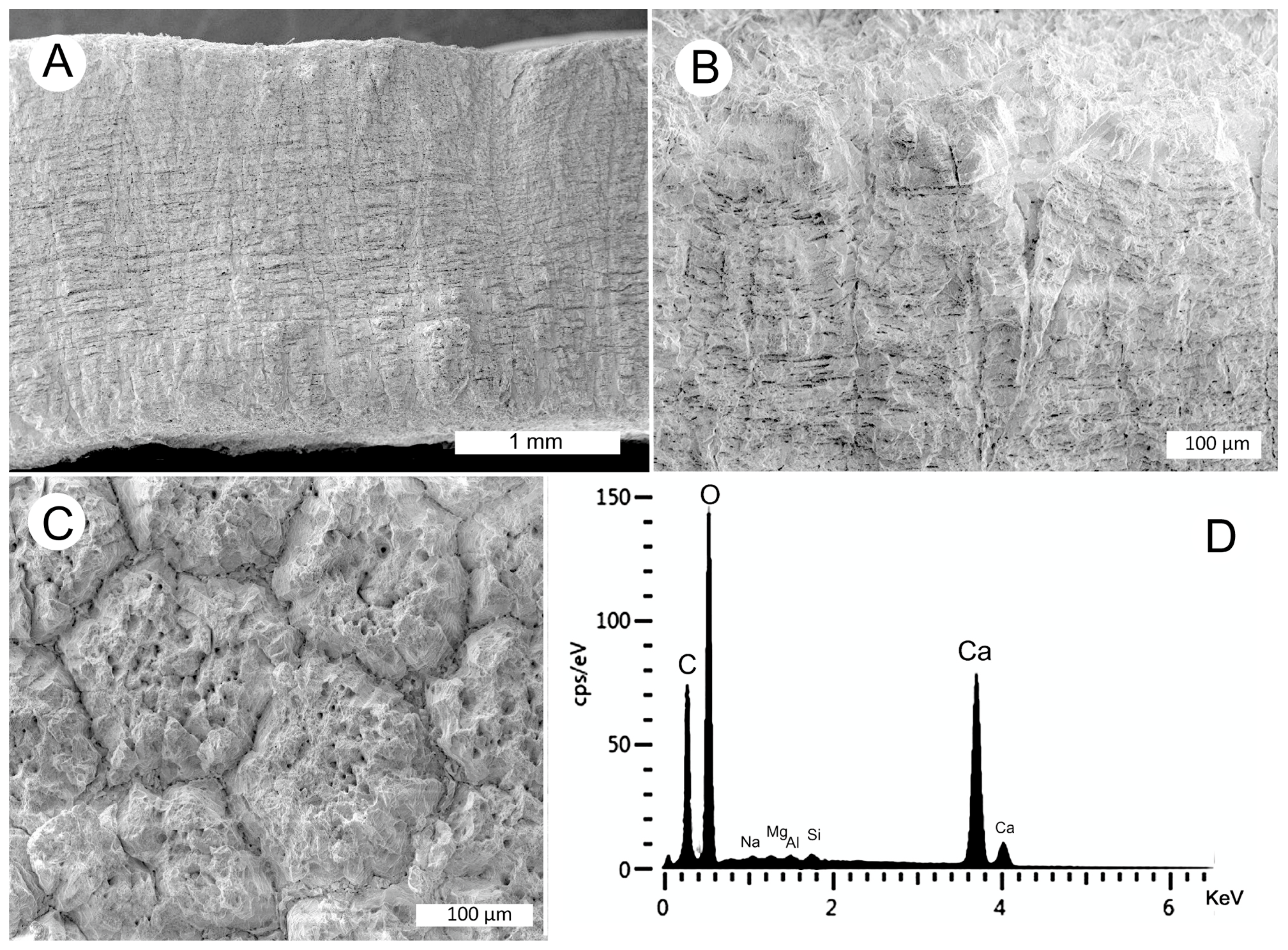
SEM of an eggshell fragment from a Paleocene Gastornis. (A,B) Transverse images of the shell, showing a layered structure. (C) The inner surface shows a polygonal structure. (D) The X-ray fluorescence spectrum reveals that the shell contains calcium carbonate as the primary consituent.
Figure 32.
SEM of an eggshell fragment from a Paleocene Gastornis. (A,B) Transverse images of the shell, showing a layered structure. (C) The inner surface shows a polygonal structure. (D) The X-ray fluorescence spectrum reveals that the shell contains calcium carbonate as the primary consituent.
Figure 33.
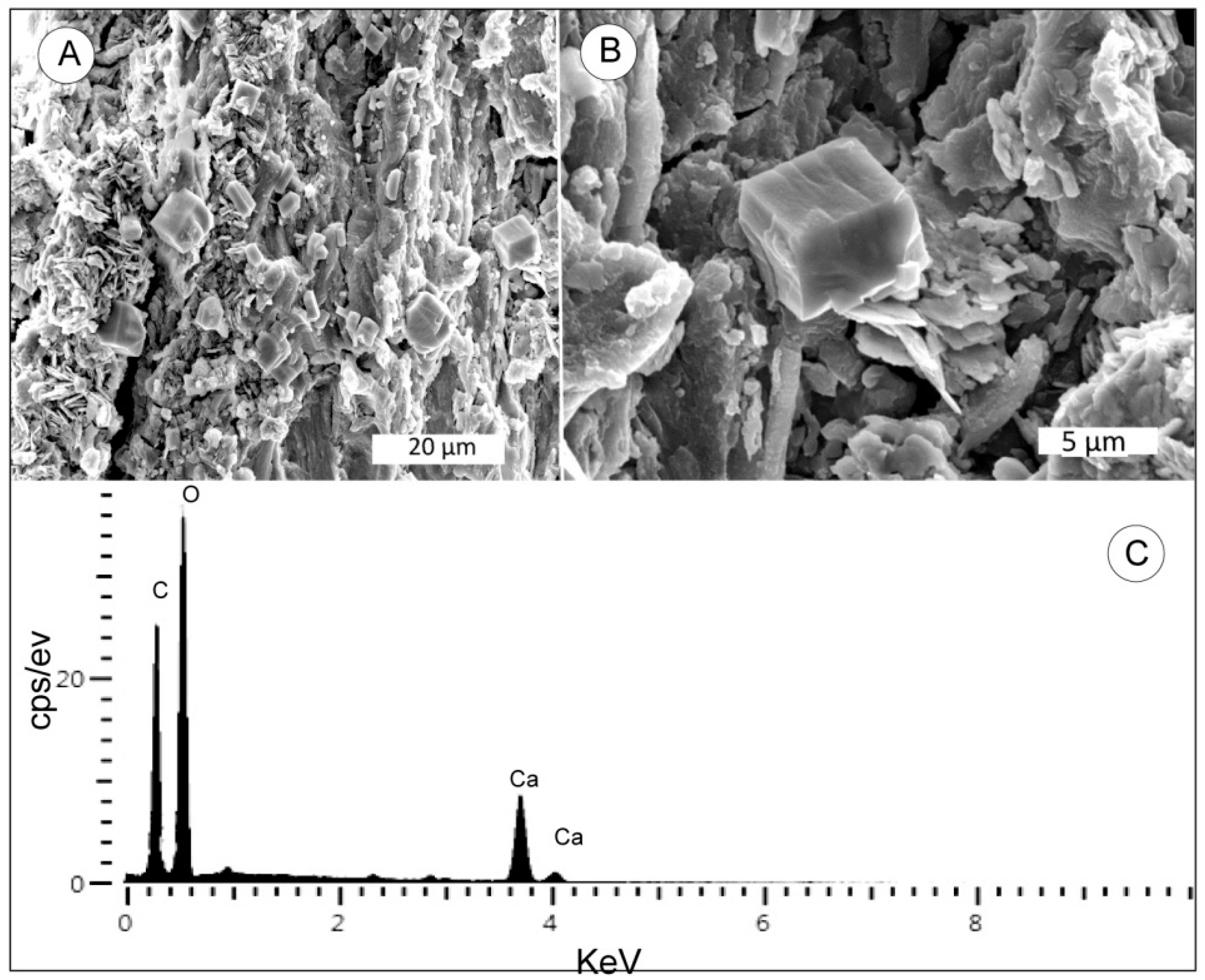
Late Cretaceous fossil wood collected from the banks of the Puntledge River, Vancouver Island, British Columbia, Canada. The wood has been mineralized with calcite. (A,B) High magnification images show scattered pseudo-cubic rhombohedral crystals. (C) The X-ray fluorescence spectrum obtained from the upper face of the crystal shown in (B) reveals the material to have a calcium carbonate composition.
Figure 33.
Late Cretaceous fossil wood collected from the banks of the Puntledge River, Vancouver Island, British Columbia, Canada. The wood has been mineralized with calcite. (A,B) High magnification images show scattered pseudo-cubic rhombohedral crystals. (C) The X-ray fluorescence spectrum obtained from the upper face of the crystal shown in (B) reveals the material to have a calcium carbonate composition.
Figure 34.
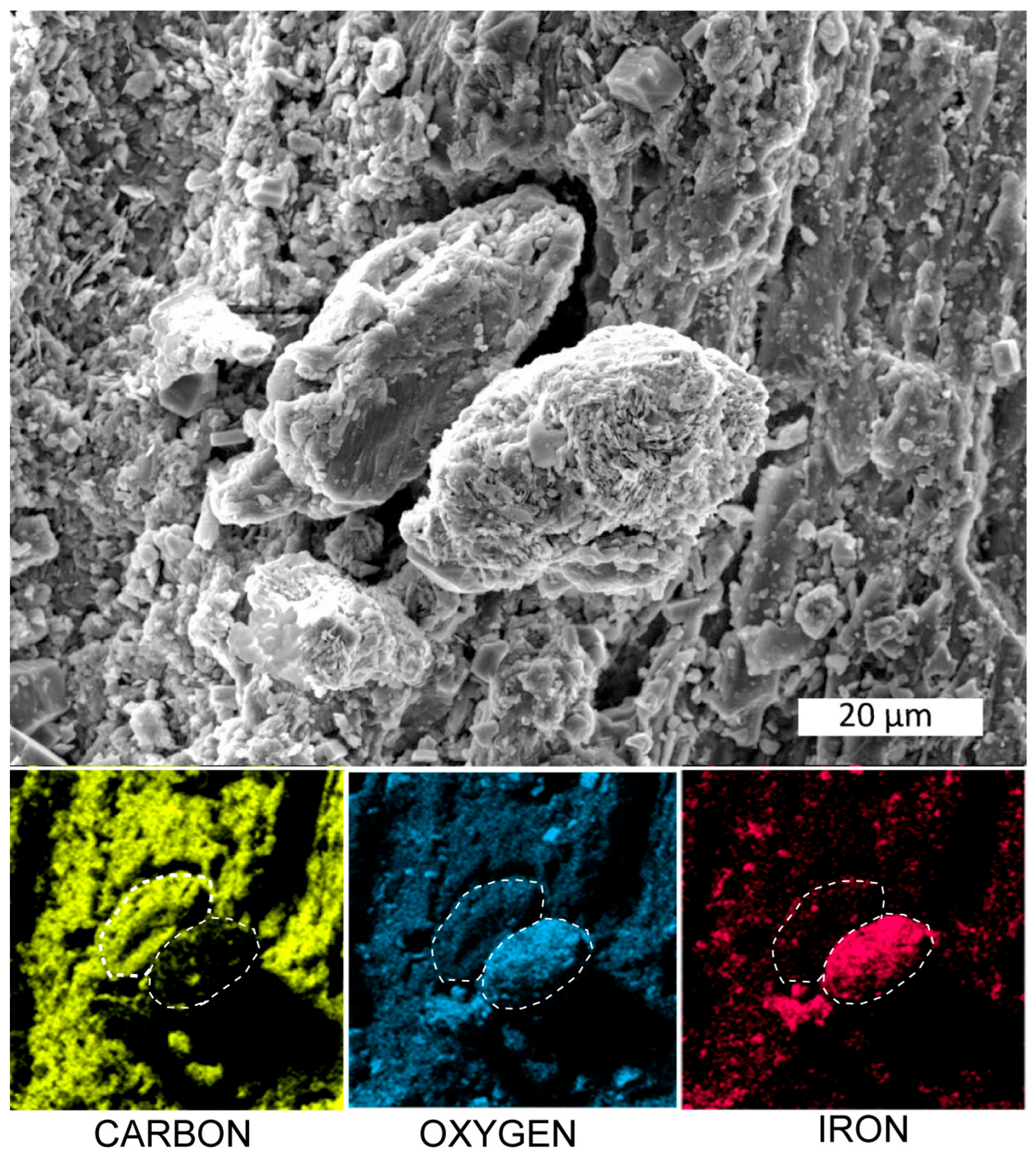
SEM image Puntledge River fossil wood, accompanied by X-ray element maps.
Figure 34.
SEM image Puntledge River fossil wood, accompanied by X-ray element maps.
Figure 35.
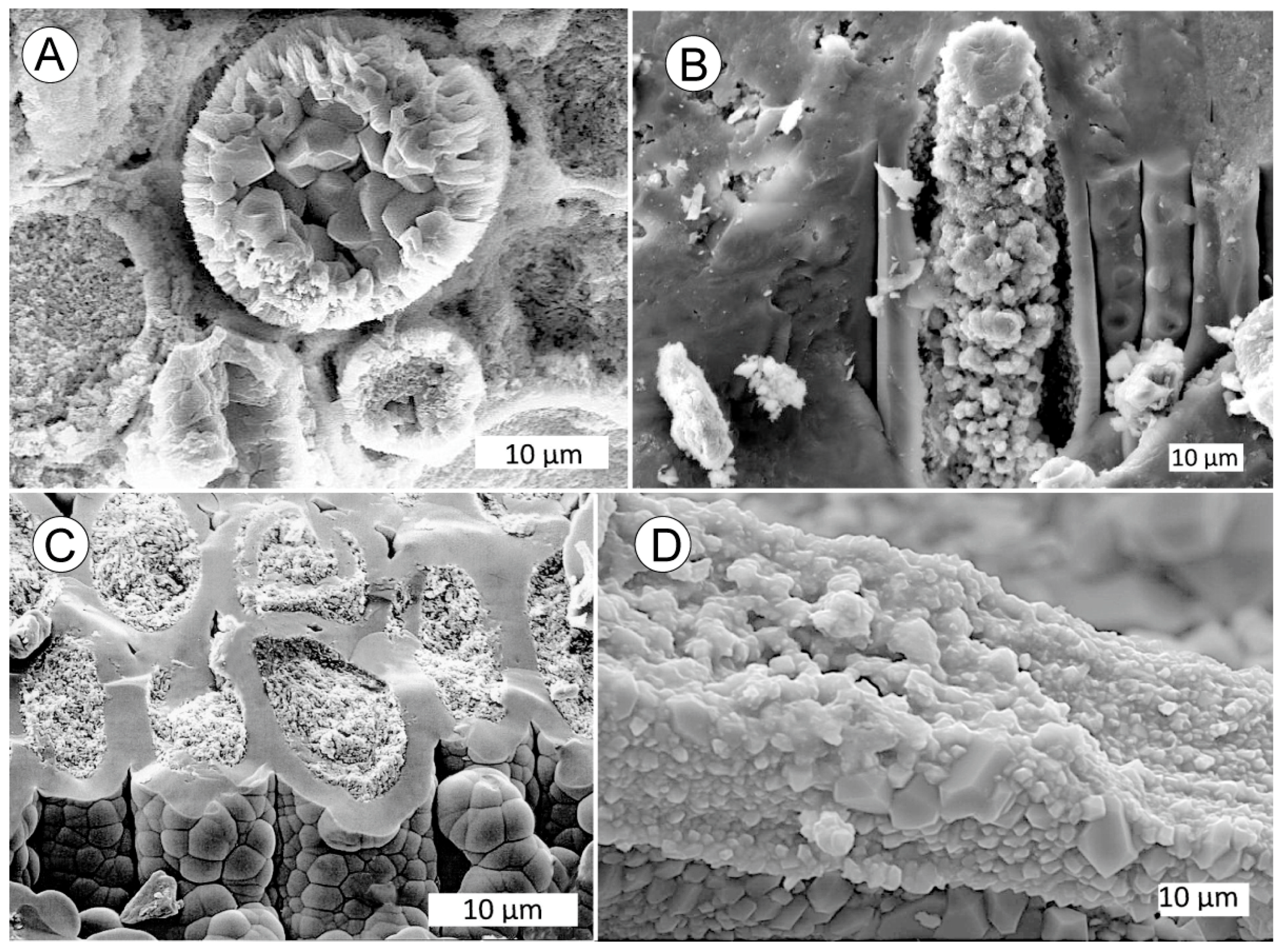
(A) Miocene wood from Washington, USA. Transverse view showing a single cell that has been filled with inward-directed quartz crystals, representing the last phase of multiple silicification events. (B) Microcrystalline quartz partially filling a conductive vessel in opalized Miocene wood from Washington, USA. (C) Oblique transverse view of Miocene wood from Nevada, USA. Individual cells have walls that have been replaced by botryoidal opal-A, with the cell lumen filled with porous opal. (D) Pennsylvanian-age lycopsid wood from Colorado, USA, replaced by crystalline quartz.
Figure 35.
(A) Miocene wood from Washington, USA. Transverse view showing a single cell that has been filled with inward-directed quartz crystals, representing the last phase of multiple silicification events. (B) Microcrystalline quartz partially filling a conductive vessel in opalized Miocene wood from Washington, USA. (C) Oblique transverse view of Miocene wood from Nevada, USA. Individual cells have walls that have been replaced by botryoidal opal-A, with the cell lumen filled with porous opal. (D) Pennsylvanian-age lycopsid wood from Colorado, USA, replaced by crystalline quartz.