
Article

Back and Neck Pain in Anesthesiology: A Survey-Based Study of 191 Providers at Four Departments of Anesthesiology in One Health System

Department of Anesthesiology, Perioperative, and Pain Medicine, Icahn School of Medicine at Mount Sinai, New York, NY 10029, USA
*
Author to whom correspondence should be addressed.
Anesth. Res. 2026, 3(2), 13; https://doi.org/10.3390/anesthres3020013
Submission received: 7 January 2026 / Revised: 25 February 2026 / Accepted: 7 May 2026 / Published: 20 May 2026

Abstract

Background/Objectives: Low back and neck pain are common musculoskeletal complaints among healthcare workers, including anesthesia providers. This study aims to quantify the prevalence of back and neck pain amongst anesthesiology providers to identify risk factors, mechanisms of injury, and recovery practices to guide preventative measures. Methods: A cross-sectional survey of anesthesiology clinicians in a multi-site academic healthcare system in New York City was administered using REDCap version 12.5.9. The recorded survey results were aggregated to determine percentages for each question. Descriptive statistics were used to determine the nature of low back and neck pain and detail causes. Oswestry Disability Index (ODI) and Neck Disability Index (NDI) scores were calculated. Results: The survey instrument was distributed to 380 anesthesiology clinicians at four separate institutions and yielded 191 responses for a response rate of 50.3%. Fifty-three-point-nine percent of survey respondents reported having current back or neck pain, with the majority reporting that it was chronic (87.4%). A substantial proportion of respondents reported not having back or neck pain prior to training (58.3%), and the majority reported that their back or neck pain was work-related (54.1%). Only 14.1% of respondents reported having had training in back or neck pain prevention. The most common location of pain was lumbar (81.6%). The most common inciting event for work-related pain was patient transfer/transport (68.6%). For ODI scoring, 98% of clinicians within the health system were classified as minimal disability and 2% of clinicians as moderate disability. For NDI scoring, 95.8% of clinicians were classified as minimally disabled, with 2.6% classified as moderate disabled. Conclusions: Back and neck pain are common pathologies amongst anesthesia providers. For most clinicians, the pain began to occur during training. Common inciting events include patient transfer/transport, procedure performance, and room setup. This provides a framework with which preventative practices can take place to reduce the prevalence of back and neck pain in anesthesiology and other related health care disciplines.

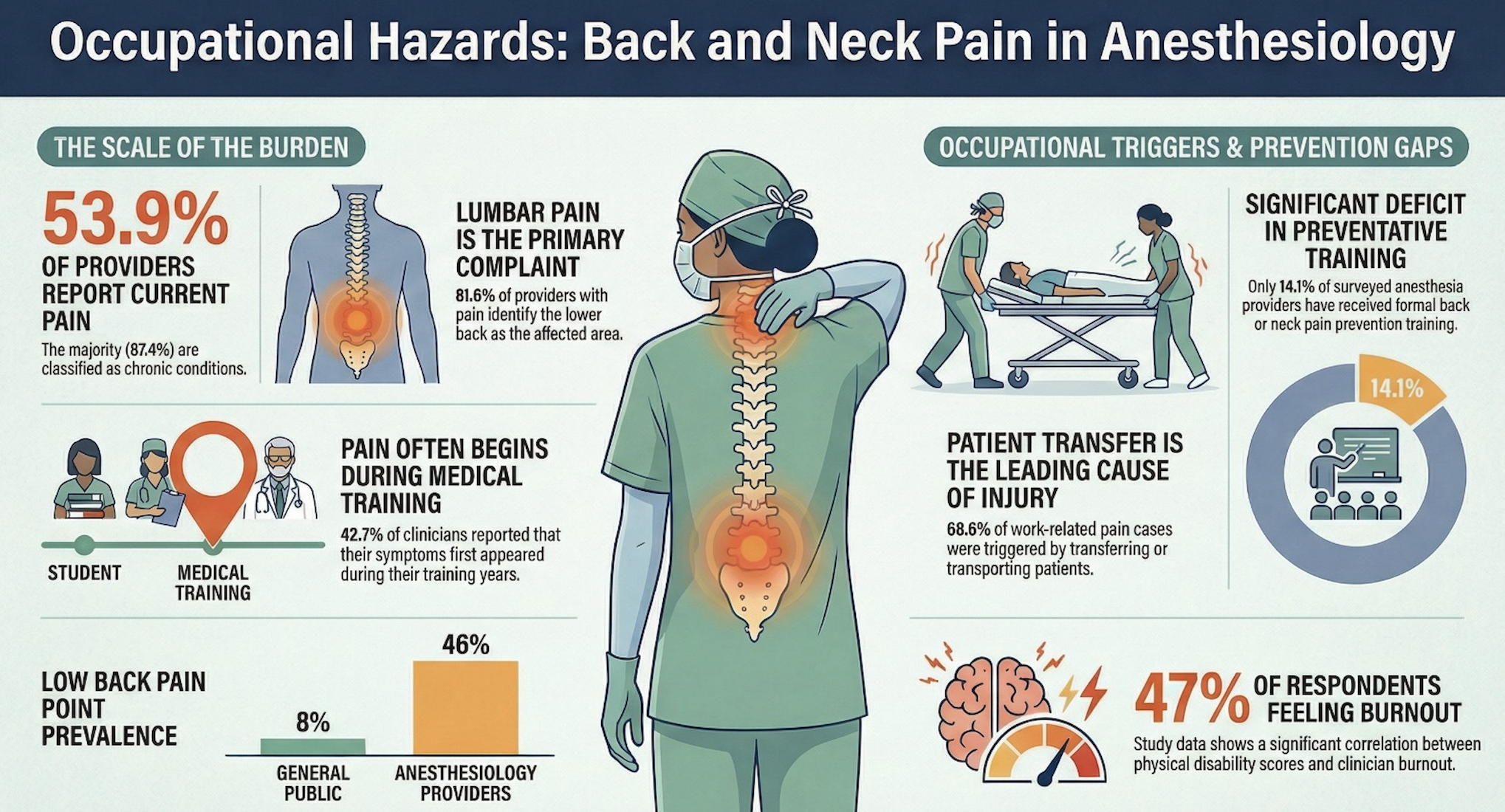
Graphical Abstract

1. Introduction

Low back and neck pain are common musculoskeletal complaints among healthcare workers, including anesthesia providers. The prevalence of back pain among healthcare workers varies widely but remains highly prevalent, with some studies reporting 68–94% [1,2]. The lumbar area is the most common site. Prevalence may be higher in anesthesiologists due to unique physical demands: prolonged static standing or sitting in fixed postures, repetitive neck flexion/extension during airway management and monitoring, manual patient handling (e.g., transfers, positioning), awkward trunk twisting during procedures such as central venous access or regional anesthesia and sustained forward head posture in dimly lit operating rooms.
These ergonomic stressors exceed those in many other professions and contribute to cumulative microtrauma. Within the general public, point prevalence of low back pain is ~8% [3], while neck pain is ~3.6% [4]. In contrast, anesthesiology-specific rates are markedly elevated: 46% for low back pain in U.S. providers [5], with recent international studies reporting a 12-month musculoskeletal disorder (MSD) prevalence of 69–78% for back pain and up to 100% for any MSD site [6,7,8]. Recent Egyptian and Nigerian cohorts similarly document 71.6% and 69% prevalence, respectively, with the lower back most affected [6,8].
Of clinicians with low back pain, ~70% report no symptoms prior to training [5]. Cervical disc disease in UK anesthetists reaches ~8.2% [9].
The significant difference between the prevalence of low back and neck pain among anesthesiology providers and the general public warrants further investigation to identify the potential causes of this difference to highlight areas of improvement that can be conducted on both the individual and institutional levels.
Given these disparities, understanding causes at individual and institutional levels is critical. This study quantifies prevalence, identifies risk factors/mechanisms of injury, recovery practices, and disability via the Oswestry Disability Index (ODI) and Neck Disability Index (NDI) to guide targeted prevention.

2. Materials and Methods

2.1. Study Design

A cross-sectional survey of anesthesiology clinicians in a large multi-site urban academic healthcare system located in New York City was conducted. In developing the survey instrument, a literature search was conducted on low back and neck pain in anesthesiologists and other healthcare workers to identify specific areas of interest that call for further examination.

2.2. Inclusion

The target population was all clinically active anesthesia providers (i.e., faculty, house staff, and nurse anesthetists) in the Department of Anesthesiology at the four urban academic locations.

2.3. Outcomes

The primary outcome of this survey was to understand the prevalence of back and neck pain including the location of pain, any self-reported diagnoses and descriptions associated with the pain, timing of the pain, and inciting events for the pain.
To address further research questions, the survey contained other metrics such as demographic information, injury history, days off from work due to pain, and most successful treatment.

2.4. Survey Design

The survey was administered using REDCap (version 12.5.9, Nashville, TN, USA) hosted at the Icahn School of Medicine [10]. REDCap is a secure web-based software application that supports online survey data capture [10,11]. The 35-item survey (administered via REDCap) was structured in four sections: (1) demographics and practice characteristics (age, gender, years in practice, subspecialty, hours worked); (2) pain history and characteristics (current pain yes/no, chronicity > 12 weeks, location, self-reported diagnosis, onset relative to training, work-related attribution, inciting events with multiple-select options including patient transfer/transport, procedural tasks, room setup); (3) associated factors (family history, burnout via single validated item “Do you feel burned out?”, prior training in back/neck pain prevention, days missed from work, most successful treatment); and (4) standardized disability instruments (full 10-item ODI for low back pain and 10-item NDI for neck pain). The survey instrument was pre-tested by 5 department faculty, residents, and CRNAs at an outside institution to ensure clarity and comprehensiveness in a test population similar to the target population. Based on their feedback, the survey was revised and improved to reflect simplicity in wording and clinical relevance using a modified Delphi approach. The survey was administered via email, with detailed instructions on the purpose and timeframe of the study sent to all potential respondents. Initial non-respondents received two additional email reminders. Respondents were not compensated in any way. The surveys were conducted from September 2022 to March 2023. Informed consent for this survey was exempt based on the Federal Policy for the Protection of Human Subjects (2018 Common Rule; 45 CFR 46) Exempt Category 2 [12]. The study was completed in accordance with the Declaration of Helsinki 1975 guidelines.

2.5. Statistical Analysis

For statistical analysis, the recorded survey results were aggregated to determine percentages for each question with denominators reflecting respondents to each question. Descriptive statistics were used to determine the nature of low back pain and neck pain and detail causes. Continuous variables are presented as mean (standard deviation) as appropriate. Percentages were compared using chi-square testing where appropriate. ODI and NDI scores were calculated by summing item responses (each scored 0–5), converting to percentages (total score/maximum possible × 100), and categorizing per established thresholds: minimal (0–20%), moderate (21–40%), severe (41–60%) disability [13,14]. Exploratory Pearson correlation coefficients assessed associations between ODI/NDI scores and continuous/categorical variables (age, burnout, days missed); p < 0.05 was considered significant [13,14].

3. Results

The survey instrument was distributed to 380 anesthesiology clinicians at four separate institutions and yielded 191 responses for a response rate of 50.3%. The majority of respondents were male (58.1%), with an average age of 37.9 years. Most respondents had been in practice for less than 10 years (42.6%) (Table 1).
Fifty-three-point-nine percent of survey respondents reported having current back or neck pain, with the majority reporting that it was chronic (87.4%). A significant proportion of respondents reported not having back or neck pain prior to training (58.3%), and the majority reported that their back or neck pain was work-related (54.1%). A significant proportion of respondents also reported feeling burnout out (47.1%), and a small proportion of respondents reported having had training in back or neck pain prevention (14.1%). A significant proportion of respondents reported having a family history of back or neck pain (38.2%) (Table 2).
The most common location of pain was lumbar (81.6%), followed by cervical spine (44.7%) and the most common diagnosis was myofascial pain syndrome (19.6%) followed by discogenic disease (15.7%). Of those with pain, clinicians also reported that their pain started during training (42.7%), and the most common inciting event for work-related pain was patient transfer/transport (68.6%). The majority of those with pain did not miss any days from work as a result of the pain (75.5%) (Table 3).
Ninety-eight percent of clinicians within the health system were classified as minimal disability, with 2% of clinicians classified as moderate disability based on ODI scoring. For NDI scoring, 95.8% of clinicians were classified as minimally disabled, with 2.6% classified as moderate disability (Table 3). There was a weak, yet significant correlation between ODI score and age (r = 0.23, p = 0.027). There was also a weak, significant correlation between ODI score and burnout (r = 0.265, p < 0.001) and days missed from work (r = 0.303, p = 0.003). Gender and subspecialty were not significantly correlated with ODI score (Table 4).

4. Discussion

In this observational survey of practicing anesthesia providers, we found that 53.9% of anesthesia personnel suffer from low back or neck pain, with pain symptoms beginning during training for 42.7% of those with pain. Fifty-four-point-one percent of respondents consider their pain to be work-related. Of this cohort, 68.6% of personnel attribute their work-related pain to patient transfer/transport (68.6%) and procedures (31.4%). While the majority of respondents classify as “minimal disability” by ODI/NDI scoring, a small subset of clinicians were classified as “moderate disability.”
Back and neck pain have a much higher prevalence in the population of anesthesia personnel compared to the general public [3,5,15]. This may be due to the nature of anesthesiology work, which includes long hours of specific repetitive ergonomic stressors.
The high prevalence of back and neck pain in anesthesia personnel reported in our study as well as its work-related nature, confirms the results reported by Anson et al., who found that 46.6% of anesthesia providers from Hershey suffer from back pain attributed to daily clinical activity [5]. Most respondents in both surveys did not have back pain prior to training. The data from both studies implies that anesthesiology personnel suffer from work-related back pain, and anesthesiology training appears to be associated with the onset of back pain. When taken in the context of an 8% prevalence of back pain and 3.6% prevalence of neck pain, both higher than the general population, the significant contrast highlights a serious problem that calls for system-based improvement.
Our 53.9% prevalence is consistent with but modestly lower than recent international reports (69–78% back pain; 71.6% overall MSD in Egyptian anesthesiologists [6]; 69% low back pain in Nigerian cohorts [8]; 78% back pain in Ismailia Governorate [7]). Differences may reflect regional variations in staffing ratios, equipment availability, or cultural reporting biases, yet the pattern of work-related onset during training (42.7% here; similar in Anson et al. [5]) and lumbar predominance (81.6%) is universal.
Mechanistically, patient transfer/transport (68.6% of work-related cases) imposes high compressive and shear forces on the lumbar spine, compounded by time pressure and suboptimal team coordination. Procedural tasks (31.4%) involve sustained awkward postures (neck flexion > 30°, trunk rotation), while room setup requires repetitive bending/lifting. These align with ergonomic analyses identifying lateral neck rotation and overhead arm extension as frequent non-neutral movements [16]. The observed correlations (ODI with age r = 0.23, burnout r = 0.265, days missed r = 0.303) underscore bidirectional links: pain exacerbates burnout via reduced resilience and sleep disruption, while burnout may heighten pain perception through central sensitization [17].
Low training rates (14.1%) represent a modifiable gap; only 14–20% of providers in prior studies report formal ergonomics education. Evidence-based prevention includes mandatory annual back-safety training (proper lifting, neutral posture, micro-breaks), use of mechanical aids (roller boards, inflatable transfer devices for patients above a certain weight), adjustable monitors/boom arms, and team-based protocols for patient positioning [18,19,20]. The American Society of Anesthesiologists’ 2025 statement explicitly recommends departmental ergonomic training and workspace evaluations to sustain workforce health [21]. Such low-cost interventions could reduce prevalence, absenteeism, and early retirement amid staffing shortages.
While back and neck pain were unlikely to result in days off from work in the majority of the providers we surveyed, a substantial subset (15.7%) of providers reported missing up to a week of work with 2% having missed over 2 months of work. Given the current nationwide staffing shortages of physician anesthesiologists and CRNAs, the workplace implications of clinicians unable to work will place significant pressures on an institution’s ability to meet the demands of patient care. Although the recovery process seems to be relatively straightforward given that the majority of pathology resolves with conservative therapy in 74.7% of providers, a small subset (10.2%) of personnel require more invasive treatment such as interventional or surgical options. These more invasive treatments are associated with greater risk and can contribute to additional time off from work. Table 4 examines the positive correlation between ODI scores and burnout, presenting another potential quandary that can decrease operating room output and impact patient care.
The examination on the impact on the workforce necessitates highlighting the high 47.1% burnout rate reported by survey respondents. While it remains unclear whether burnout worsens pain symptoms or if pain symptoms lead to burnout, its negative impacts are well studied. Burnt-out clinicians have been shown to call out of work more, can cause increased medical errors, poorer quality of care, and lower productivity [17]. Given the consequences to patients and hospitals, it certainly warrants investigating how to best prevent this exceedingly common pathology.
Considering the results in Table 3, there are potential actionable causes of the high prevalence of work-related back and neck pain in anesthesiology personnel. Of the clinicians who consider their pain to be work-related, 68.6% cite the inciting event to be due to patient transfer, while 31.4% consider it to be due to performing procedures, and 17.6% consider it to be due to room setup. Although these components of the daily workflow present inherent risks to injury, lack of training in back safety presents a lost opportunity to mitigate this risk. The low rates (14%) of back safety training at this institution implies a potentially widespread deficit in preventative teaching throughout training programs. Improvements in education and back safety training are a low cost, straightforward solution that can potentially bring tremendous value to an anesthesiology department. Furthermore, education regarding exercises to mitigate pain from prolonged static postures required in the operating room is another low-cost practice that can be established. Establishing system-wide practices can likewise be employed to mitigate back and neck pain as well as their negative sequelae. Establishing policies such as utilizing roller boards for patients above a certain weight can ensure teams are consistently practicing back safety; investments into tools such as inflatable patient transfer devices can likewise help prevent injury and safeguard the anesthesiology workforce within the department.
This study has several limitations that should be noted. First, the data are self-reported which may be subject to recall bias and social desirability bias. Second, while the study was conducted across multiple medical sites, the sites all belong to a single healthcare system. Thus, our results may not be generalizable to other populations. Finally, the study was cross-sectional, which limits the ability to draw causal inferences. While the study did report some exploratory correlations using Pearson correlation coefficients between ODI scores and age, burnout, and days missed from work, the modest sample size limited formal inferential modeling. Additionally, as this study was descriptive in nature there is a lack of formal reliability and validity testing. In addition to self-report and single-health-system biases, the cross-sectional design precludes causality; recall bias for inciting events or pre-training pain is possible. The modest sample and exploratory correlations limit multivariable modeling. Lack of objective ergonomic assessments (e.g., posture tracking) or validated multi-item burnout scales is noted. Future longitudinal or interventional studies should test training efficacy via pre/post ODI/NDI and include diverse U.S./international sites. Subsequent studies will involve achieving a better understanding of the basic pathophysiologic process of pain development and measuring the impact of preventative steps such as back safety training and system-wide policies aimed to mitigate high-risk events in the daily anesthesiology workflow.

5. Conclusions

Back and neck pain are common pathologies amongst anesthesia providers. For the majority of clinicians, the pain began during training. Common inciting events include patient transfer/transport, procedure performance, and room setup. ODI measures are positively correlated with age and clinician burnout. While the majority of respondents did not miss work as a result of their neck or back pain, nearly a quarter did have to miss work which shows the importance of this issue with regard to workplace productivity and patient care. The vast majority lacked training in prevention, presenting a clear opportunity for curriculum integration and institutional policies. Implementing ergonomic training, mechanical aids, and workflow modifications can reduce prevalence, enhance provider longevity and satisfaction, and optimize patient care across anesthesiology and related fields. This provides a framework with which preventative practices can take place to reduce the prevalence of back and neck pain in anesthesiology and other related health care disciplines.

Author Contributions

Conceptualization, A.Y. and M.S.; methodology, A.Y.; software, A.Y. and M.S.; validation, A.Y. and M.S.; formal analysis, A.Y. and A.T.; investigation, A.Y.; resources, A.Y.; data curation, A.Y.; writing—original draft preparation, A.Y., A.T., M.S., D.K., M.A.L. and S.D.J.; writing—review and editing, A.Y., A.T., M.S., D.K., M.A.L. and S.D.J.; visualization, A.Y., A.T., M.S., D.K., M.A.L. and S.D.J.; supervision, D.K., M.A.L. and S.D.J.; project administration, A.T. All authors have read and agreed to the published version of the manuscript.

Funding

This research received no external funding.

Institutional Review Board Statement

The study was conducted in accordance with the Declaration of Helsinki, and approved by The Icahn School of Medicine (protocol code STUDY-19-01166 and 3 January 2024).

Informed Consent Statement

Informed consent for this survey was exempt based on the Federal Policy for the Protection of Human Subjects (2018 Common Rule; 45 CFR 46) Exempt Category 2 [12]. The study was completed in accordance with the Declaration of Helsinki 1975 guidelines.

Data Availability Statement

The original contributions presented in this study are included in the article. Further inquiries can be directed to the corresponding author.

Conflicts of Interest

The authors declare no conflicts of interest.

References

  1. Mroczek, B.; Łubkowska, W.; Jarno, W.; Jaraczewska, E.; Mierzecki, A. Occurrence and impact of back pain on the quality of life of healthcare workers. Ann. Agric. Environ. Med. 2020, 27, 36–42. [Google Scholar] [CrossRef] [PubMed]
  2. Xie, X.M.; Huang, Z.H.; Xue, B.; Xiao, R.X.; Li, S.Y.; Wen, X.Y. Low back pain in medical workers and its influencing factors. Am. J. Transl. Res. 2024, 16, 2525–2532. [Google Scholar] [CrossRef] [PubMed]
  3. Wu, A.; March, L.; Zheng, X.; Huang, J.; Wang, X.; Zhao, J.; Blyth, F.M.; Smith, E.; Buchbinder, R.; Hoy, D. Global low back pain prevalence and years lived with disability from 1990 to 2017: Estimates from the global burden of disease study 2017. Ann. Transl. Med. 2020, 8, 299. [Google Scholar] [CrossRef] [PubMed]
  4. Safiri, S.; Kolahi, A.-A.; Hoy, D.; Buchbinder, R.; Mansournia, M.A.; Bettampadi, D.; Ashrafi-Asgarabad, A.; Almasi-Hashiani, A.; Smith, E.; Sepidarkish, M.; et al. Global, regional, and national burden of neck pain in the general population, 1990–2017: Systematic analysis of the global burden of disease study 2017. BMJ 2020, 368, m791. [Google Scholar] [CrossRef] [PubMed]
  5. Anson, J.A.; Mets, E.J.; Vaida, S.J.; King, T.S.; Ochoa, T.; Gordin, V. “Are We Hurting Ourselves?” What is the Prevalence of Back Pain in anesthesia Providers? J. Clin. Anesth. 2016, 34, 502–506. [Google Scholar] [CrossRef] [PubMed]
  6. Fouad, A.M.; Fahim, A.E.; Bedewy, A.A.; Al-Touny, A.; Al-Touny, S.A. Work-related musculoskeletal complaints and ergonomic risk factors among Egyptian anesthesiologists: A cross-sectional study. BMC Public Health 2024, 24, 279. [Google Scholar] [CrossRef] [PubMed]
  7. Albayadi, E.; Soliman, A.; Alyeddin, W.F. Prevalence of musculoskeletal disorders in anesthesiologists in Ismailia Governorate. Egypt. J. Anaesth. 2023, 39, 219–301. [Google Scholar] [CrossRef]
  8. Akolokwu, A.S.; Hart, F.; Mato, C.N. The Prevalence and Impact of Low Back Pain Among Anaesthesia Care Providers in South-South, Nigeria. Niger. Med. J. 2023, 64, 312–320. [Google Scholar]
  9. Leifer, S.; Choi, S.W.; Asanati, K.; Yentis, S.M. Upper Limb Disorders in anaesthetists—A survey of association of anaesthetists members. Anaesthesia 2018, 74, 285–291. [Google Scholar] [CrossRef] [PubMed]
  10. Harris, P.A.; Taylor, R.; Minor, B.L.; Elliott, V.; Fernandez, M.; O’Neal, L.; McLeod, L.; Delacqua, G.; Delacqua, F.; Kirby, J.; et al. The REDCap consortium: Building an international community of software partners. J. Biomed. Inform. 2019, 95, 103208. [Google Scholar] [CrossRef] [PubMed]
  11. Harris, P.A.; Taylor, R.; Thielke, R.; Payne, J.; Gonzalez, N.; Conde, J.G. Research electronic data capture (REDCap)—A metadata-driven methodology and workflow process for providing translational research informatics support. J. Biomed. Inform. 2009, 42, 377–381. [Google Scholar] [CrossRef] [PubMed]
  12. Protections (OHRP) O for HR. Informed Consent Posting Instructions (2022). HHS.gov. Available online: https://www.hhs.gov/ohrp/regulations-and-policy/informed-consent-posting/informed-consent-posting-guidance/index.html (accessed on 6 January 2026).
  13. Tonosu, J.; Takeshita, K.; Hara, N.; Matsudaira, K.; Kato, S.; Masuda, K.; Chikuda, H. The normative score and the cut-off value of the Oswestry Disability index (ODI). Eur. Spine J. 2012, 21, 1596–1602. [Google Scholar] [CrossRef] [PubMed]
  14. Vernon, H. The neck disability index: State-of-the-art, 1991–2008. J. Manip. Physiol. Ther. 2008, 31, 491–502. [Google Scholar] [CrossRef] [PubMed]
  15. Guo, H.R.; Tanaka, S.; Halperin, W.E.; Cameron, L.L. Back pain prevalence in US industry and estimates of lost workdays. Am. J. Public Health 1999, 89, 1029–1035. [Google Scholar] [CrossRef] [PubMed]
  16. Kowal, L. An Exploration of Anesthesia Providers’ Workspace: Impact on Ergonomics and Safety. Ph.D. Thesis, Georgetown University, Washington, DC, USA, 2020. [Google Scholar]
  17. West, C.P.; Dyrbye, L.N.; Shanafelt, T.D. Physician burnout: Contributors, consequences and solutions. J. Intern. Med. 2018, 283, 516–529. [Google Scholar] [CrossRef] [PubMed]
  18. Bailey, C.R.; Radhakrishna, S.; Asanati, K.; Dill, N.; Hodgson, K.; McKeown, C.; Pawa, A.; Plaat, F.; Wilkes, A. Ergonomics in the anaesthetic workplace: Guideline from the Association of Anaesthetists. Anaesthesia 2021, 76, 1375–1387. [Google Scholar] [CrossRef] [PubMed]
  19. Ruskin, A.C. Positioned for success: Ergonomics in anesthesiology. Curr. Opin. Anaesthesiol. 2025, 38, 808–814. [Google Scholar] [CrossRef] [PubMed]
  20. Riley, C.; Wilson, C.; Andrzejowska, I.; Giri, P. Reducing musculoskeletal pain in the operating theatre. BJA Educ. 2022, 22, 178–185. [Google Scholar] [CrossRef] [PubMed]
  21. American Society of Anesthesiologists. Statement on Maintaining the Anesthesiologist Workforce by Prevention of Injuries and Knowledge of Workers’ Compensation, Disability Insurance, Return to Work Requirements, Job Safeguards, and Accommodations. Available online: https://www.asahq.org/standards-and-practice-parameters/ (accessed on 15 October 2025).

Table 1. Demographic information of survey respondents. Aggregated survey responses are presented as percentages with denominators reflecting survey respondents.
Age
≤3560.2%
36–4521.5%
46–557.3%
56–657.9%
≥663.1%
Gender
Male58.1%
Female38.7%
Other0.5%
Prefer Not to Answer2.6%
Current Level of Practice
Intern2.6%
CA112.6%
CA211.1%
CA314.2%
Fellow4.7%
<10 Years in Practice28.4%
10–20 Years in Practice14.2%
20–30 Years in Practice3.7%
>30 Years in Practice8.4%
Subspecialty
General61.4%
Cardiac5.8%
Pediatric4.2%
Obstetric6.3%
Regional5.8%
Chronic Pain3.2%
Critical Care3.2%
Transplant4.8%
Other5.3%
Table 2. Results of anesthesiology-specific back and neck pain questions. Aggregated survey responses are presented as percentages with denominators reflecting survey respondents.
MeasurePositive Responses
Do You Have Back or Neck Pain?53.9%
Is your Back or Neck Pain Chronic (>12 w)? 87.4%
Is Your Back or Neck Pain Work-Related? 54.1%
Are You Feeling Burnout? 47.1%
Have you Had Training in Back or Neck Pain Prevention? 14.1%
Do You Have a Family History of Back or Neck Pain? 38.2%
Have You Had Training in Back or Neck Pain Prevention? 14.2%
Table 3. Descriptive statistics of back pain, disability and impact on workforce. Continuous variables are presented as mean (standard deviation) as appropriate. Percentages were compared using chi-square testing.
Location of Pain
Cervical44.7%
Thoracic14.6%
Lumbar81.6%
What is Your Diagnosis?
Discogenic15.7%
Myofascial19.6%
Arthritis2.9%
Facet2.9%
Sacroiliac Joint1.0%
Compression Fracture2.0%
Other6.9%
No Diagnosis63.7%
When Did the Pain Start?
Prior to Training31.1%
During Training42.7%
1–5 Years in Practice11.7%
5–10 Years in Practice9.7%
10–15 Years in Practice2.9%
>15 Years in Practice1.9%
If Your Pain is Work-Related, What was the Inciting Event?
Patient Transfer/Transport68.6%
Procedural31.4%
Room Setup17.6%
Other23.5%
ODI Category
Minimal Disability (0–20%) 18798.0%
Moderate Disability (21–40%) 42.0%
Severe Disability (41–60%) 00.0%
NDI Category
Minimal Disability (0–20%) 18395.8%
Moderate Disability (21–40%) 52.6%
Severe Disability (41–60%) 31.6%
Most Successful Treatment Modality
Self-Resolved26.3%
PO Medications26.3%
Physical Therapy22.1%
Interventional Treatment7.4%
Surgery3.2%
Other14.7%
Workdays Missed due to Pain
0 Days75.5%
1 d–1 w15.7%
1–2 w2.0%
2–4 w4.9%
1–2 mo0.0%
>2 mo2.0%
Table 4. ODI/NDI measures and Pearson correlation coefficients. The ODI and NDI scores were calculated after the answer choices were converted to numerical values.
MeasurePearson Correlation Coefficient
ODI and Age: weak significant correlation0.230 (p = 0.027)
ODI and Burnout: weak significant correlation0.265 (p = 0.05)
ODI and Days Missed: weak significant correlation0.303 (p = 0.05)
Gender and subspecialty were not significantly correlated with ODI score.
Disclaimer/Publisher’s Note: The statements, opinions and data contained in all publications are solely those of the individual author(s) and contributor(s) and not of MDPI and/or the editor(s). MDPI and/or the editor(s) disclaim responsibility for any injury to people or property resulting from any ideas, methods, instructions or products referred to in the content.