
Back and Neck Pain in Anesthesiology: A Survey-Based Study of 191 Providers at Four Departments of Anesthesiology in One Health System

Abstract
1. Introduction
2. Materials and Methods
2.1. Study Design
2.2. Inclusion
2.3. Outcomes
2.4. Survey Design
2.5. Statistical Analysis
3. Results
4. Discussion
5. Conclusions
Author Contributions
Funding
Institutional Review Board Statement
Informed Consent Statement
Data Availability Statement
Conflicts of Interest
References
- Mroczek, B.; Łubkowska, W.; Jarno, W.; Jaraczewska, E.; Mierzecki, A. Occurrence and impact of back pain on the quality of life of healthcare workers. Ann. Agric. Environ. Med. 2020, 27, 36–42. [Google Scholar] [CrossRef] [PubMed]
- Xie, X.M.; Huang, Z.H.; Xue, B.; Xiao, R.X.; Li, S.Y.; Wen, X.Y. Low back pain in medical workers and its influencing factors. Am. J. Transl. Res. 2024, 16, 2525–2532. [Google Scholar] [CrossRef] [PubMed]
- Wu, A.; March, L.; Zheng, X.; Huang, J.; Wang, X.; Zhao, J.; Blyth, F.M.; Smith, E.; Buchbinder, R.; Hoy, D. Global low back pain prevalence and years lived with disability from 1990 to 2017: Estimates from the global burden of disease study 2017. Ann. Transl. Med. 2020, 8, 299. [Google Scholar] [CrossRef] [PubMed]
- Safiri, S.; Kolahi, A.-A.; Hoy, D.; Buchbinder, R.; Mansournia, M.A.; Bettampadi, D.; Ashrafi-Asgarabad, A.; Almasi-Hashiani, A.; Smith, E.; Sepidarkish, M.; et al. Global, regional, and national burden of neck pain in the general population, 1990–2017: Systematic analysis of the global burden of disease study 2017. BMJ 2020, 368, m791. [Google Scholar] [CrossRef] [PubMed]
- Anson, J.A.; Mets, E.J.; Vaida, S.J.; King, T.S.; Ochoa, T.; Gordin, V. “Are We Hurting Ourselves?” What is the Prevalence of Back Pain in anesthesia Providers? J. Clin. Anesth. 2016, 34, 502–506. [Google Scholar] [CrossRef] [PubMed]
- Fouad, A.M.; Fahim, A.E.; Bedewy, A.A.; Al-Touny, A.; Al-Touny, S.A. Work-related musculoskeletal complaints and ergonomic risk factors among Egyptian anesthesiologists: A cross-sectional study. BMC Public Health 2024, 24, 279. [Google Scholar] [CrossRef] [PubMed]
- Albayadi, E.; Soliman, A.; Alyeddin, W.F. Prevalence of musculoskeletal disorders in anesthesiologists in Ismailia Governorate. Egypt. J. Anaesth. 2023, 39, 219–301. [Google Scholar] [CrossRef]
- Akolokwu, A.S.; Hart, F.; Mato, C.N. The Prevalence and Impact of Low Back Pain Among Anaesthesia Care Providers in South-South, Nigeria. Niger. Med. J. 2023, 64, 312–320. [Google Scholar]
- Leifer, S.; Choi, S.W.; Asanati, K.; Yentis, S.M. Upper Limb Disorders in anaesthetists—A survey of association of anaesthetists members. Anaesthesia 2018, 74, 285–291. [Google Scholar] [CrossRef] [PubMed]
- Harris, P.A.; Taylor, R.; Minor, B.L.; Elliott, V.; Fernandez, M.; O’Neal, L.; McLeod, L.; Delacqua, G.; Delacqua, F.; Kirby, J.; et al. The REDCap consortium: Building an international community of software partners. J. Biomed. Inform. 2019, 95, 103208. [Google Scholar] [CrossRef] [PubMed]
- Harris, P.A.; Taylor, R.; Thielke, R.; Payne, J.; Gonzalez, N.; Conde, J.G. Research electronic data capture (REDCap)—A metadata-driven methodology and workflow process for providing translational research informatics support. J. Biomed. Inform. 2009, 42, 377–381. [Google Scholar] [CrossRef] [PubMed]
- Protections (OHRP) O for HR. Informed Consent Posting Instructions (2022). HHS.gov. Available online: https://www.hhs.gov/ohrp/regulations-and-policy/informed-consent-posting/informed-consent-posting-guidance/index.html (accessed on 6 January 2026).
- Tonosu, J.; Takeshita, K.; Hara, N.; Matsudaira, K.; Kato, S.; Masuda, K.; Chikuda, H. The normative score and the cut-off value of the Oswestry Disability index (ODI). Eur. Spine J. 2012, 21, 1596–1602. [Google Scholar] [CrossRef] [PubMed]
- Vernon, H. The neck disability index: State-of-the-art, 1991–2008. J. Manip. Physiol. Ther. 2008, 31, 491–502. [Google Scholar] [CrossRef] [PubMed]
- Guo, H.R.; Tanaka, S.; Halperin, W.E.; Cameron, L.L. Back pain prevalence in US industry and estimates of lost workdays. Am. J. Public Health 1999, 89, 1029–1035. [Google Scholar] [CrossRef] [PubMed]
- Kowal, L. An Exploration of Anesthesia Providers’ Workspace: Impact on Ergonomics and Safety. Ph.D. Thesis, Georgetown University, Washington, DC, USA, 2020. [Google Scholar]
- West, C.P.; Dyrbye, L.N.; Shanafelt, T.D. Physician burnout: Contributors, consequences and solutions. J. Intern. Med. 2018, 283, 516–529. [Google Scholar] [CrossRef] [PubMed]
- Bailey, C.R.; Radhakrishna, S.; Asanati, K.; Dill, N.; Hodgson, K.; McKeown, C.; Pawa, A.; Plaat, F.; Wilkes, A. Ergonomics in the anaesthetic workplace: Guideline from the Association of Anaesthetists. Anaesthesia 2021, 76, 1375–1387. [Google Scholar] [CrossRef] [PubMed]
- Ruskin, A.C. Positioned for success: Ergonomics in anesthesiology. Curr. Opin. Anaesthesiol. 2025, 38, 808–814. [Google Scholar] [CrossRef] [PubMed]
- Riley, C.; Wilson, C.; Andrzejowska, I.; Giri, P. Reducing musculoskeletal pain in the operating theatre. BJA Educ. 2022, 22, 178–185. [Google Scholar] [CrossRef] [PubMed]
- American Society of Anesthesiologists. Statement on Maintaining the Anesthesiologist Workforce by Prevention of Injuries and Knowledge of Workers’ Compensation, Disability Insurance, Return to Work Requirements, Job Safeguards, and Accommodations. Available online: https://www.asahq.org/standards-and-practice-parameters/ (accessed on 15 October 2025).

| Age | |
| ≤35 | 60.2% |
| 36–45 | 21.5% |
| 46–55 | 7.3% |
| 56–65 | 7.9% |
| ≥66 | 3.1% |
| Gender | |
| Male | 58.1% |
| Female | 38.7% |
| Other | 0.5% |
| Prefer Not to Answer | 2.6% |
| Current Level of Practice | |
| Intern | 2.6% |
| CA1 | 12.6% |
| CA2 | 11.1% |
| CA3 | 14.2% |
| Fellow | 4.7% |
| <10 Years in Practice | 28.4% |
| 10–20 Years in Practice | 14.2% |
| 20–30 Years in Practice | 3.7% |
| >30 Years in Practice | 8.4% |
| Subspecialty | |
| General | 61.4% |
| Cardiac | 5.8% |
| Pediatric | 4.2% |
| Obstetric | 6.3% |
| Regional | 5.8% |
| Chronic Pain | 3.2% |
| Critical Care | 3.2% |
| Transplant | 4.8% |
| Other | 5.3% |
| Measure | Positive Responses |
|---|---|
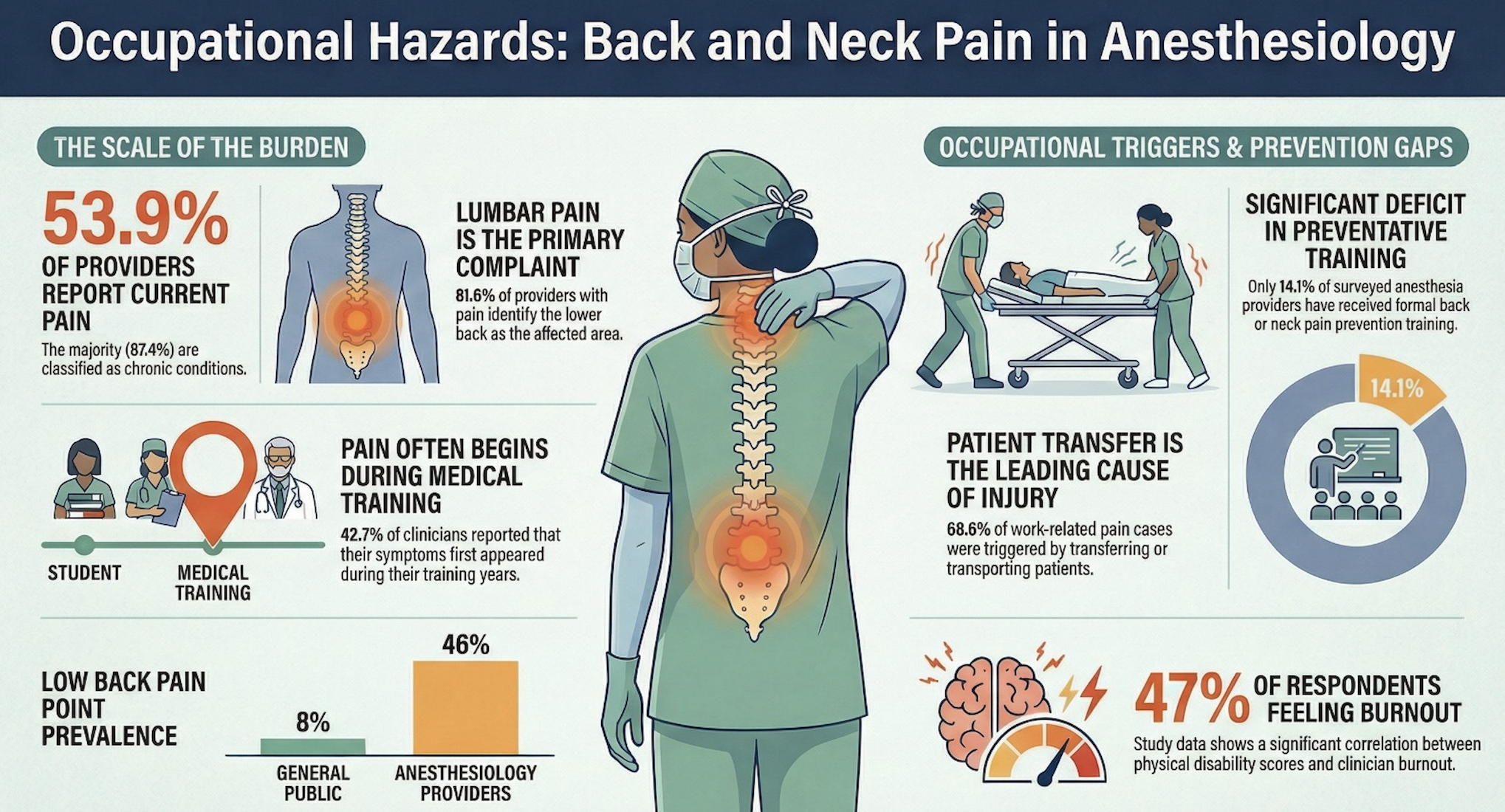
| Do You Have Back or Neck Pain? | 53.9% |
| Is your Back or Neck Pain Chronic (>12 w)? | 87.4% |
| Is Your Back or Neck Pain Work-Related? | 54.1% |
| Are You Feeling Burnout? | 47.1% |
| Have you Had Training in Back or Neck Pain Prevention? | 14.1% |
| Do You Have a Family History of Back or Neck Pain? | 38.2% |
| Have You Had Training in Back or Neck Pain Prevention? | 14.2% |
| Location of Pain | |
| Cervical | 44.7% |
| Thoracic | 14.6% |
| Lumbar | 81.6% |
| What is Your Diagnosis? | |
| Discogenic | 15.7% |
| Myofascial | 19.6% |
| Arthritis | 2.9% |
| Facet | 2.9% |
| Sacroiliac Joint | 1.0% |
| Compression Fracture | 2.0% |
| Other | 6.9% |
| No Diagnosis | 63.7% |
| When Did the Pain Start? | |
| Prior to Training | 31.1% |
| During Training | 42.7% |
| 1–5 Years in Practice | 11.7% |
| 5–10 Years in Practice | 9.7% |
| 10–15 Years in Practice | 2.9% |
| >15 Years in Practice | 1.9% |
| If Your Pain is Work-Related, What was the Inciting Event? | |
| Patient Transfer/Transport | 68.6% |
| Procedural | 31.4% |
| Room Setup | 17.6% |
| Other | 23.5% |
| ODI Category | |
| Minimal Disability (0–20%) 187 | 98.0% |
| Moderate Disability (21–40%) 4 | 2.0% |
| Severe Disability (41–60%) 0 | 0.0% |
| NDI Category | |
| Minimal Disability (0–20%) 183 | 95.8% |
| Moderate Disability (21–40%) 5 | 2.6% |
| Severe Disability (41–60%) 3 | 1.6% |
| Most Successful Treatment Modality | |
| Self-Resolved | 26.3% |
| PO Medications | 26.3% |
| Physical Therapy | 22.1% |
| Interventional Treatment | 7.4% |
| Surgery | 3.2% |
| Other | 14.7% |
| Workdays Missed due to Pain | |
| 0 Days | 75.5% |
| 1 d–1 w | 15.7% |
| 1–2 w | 2.0% |
| 2–4 w | 4.9% |
| 1–2 mo | 0.0% |
| >2 mo | 2.0% |
| Measure | Pearson Correlation Coefficient |
|---|---|
| ODI and Age: weak significant correlation | 0.230 (p = 0.027) |
| ODI and Burnout: weak significant correlation | 0.265 (p = 0.05) |
| ODI and Days Missed: weak significant correlation | 0.303 (p = 0.05) |
Disclaimer/Publisher’s Note: The statements, opinions and data contained in all publications are solely those of the individual author(s) and contributor(s) and not of MDPI and/or the editor(s). MDPI and/or the editor(s) disclaim responsibility for any injury to people or property resulting from any ideas, methods, instructions or products referred to in the content. |
© 2026 by the authors. Licensee MDPI, Basel, Switzerland. This article is an open access article distributed under the terms and conditions of the Creative Commons Attribution (CC BY) license.
Share and Cite
Yu, A.; Taree, A.; Shirur, M.; Katz, D.; Levin, M.A.; DeMaria, S., Jr. Back and Neck Pain in Anesthesiology: A Survey-Based Study of 191 Providers at Four Departments of Anesthesiology in One Health System. Anesth. Res. 2026, 3, 13. https://doi.org/10.3390/anesthres3020013
Yu A, Taree A, Shirur M, Katz D, Levin MA, DeMaria S Jr. Back and Neck Pain in Anesthesiology: A Survey-Based Study of 191 Providers at Four Departments of Anesthesiology in One Health System. Anesthesia Research. 2026; 3(2):13. https://doi.org/10.3390/anesthres3020013
Chicago/Turabian StyleYu, Alex, Amir Taree, Mo Shirur, Daniel Katz, Matthew A. Levin, and Samuel DeMaria, Jr. 2026. "Back and Neck Pain in Anesthesiology: A Survey-Based Study of 191 Providers at Four Departments of Anesthesiology in One Health System" Anesthesia Research 3, no. 2: 13. https://doi.org/10.3390/anesthres3020013
APA StyleYu, A., Taree, A., Shirur, M., Katz, D., Levin, M. A., & DeMaria, S., Jr. (2026). Back and Neck Pain in Anesthesiology: A Survey-Based Study of 191 Providers at Four Departments of Anesthesiology in One Health System. Anesthesia Research, 3(2), 13. https://doi.org/10.3390/anesthres3020013