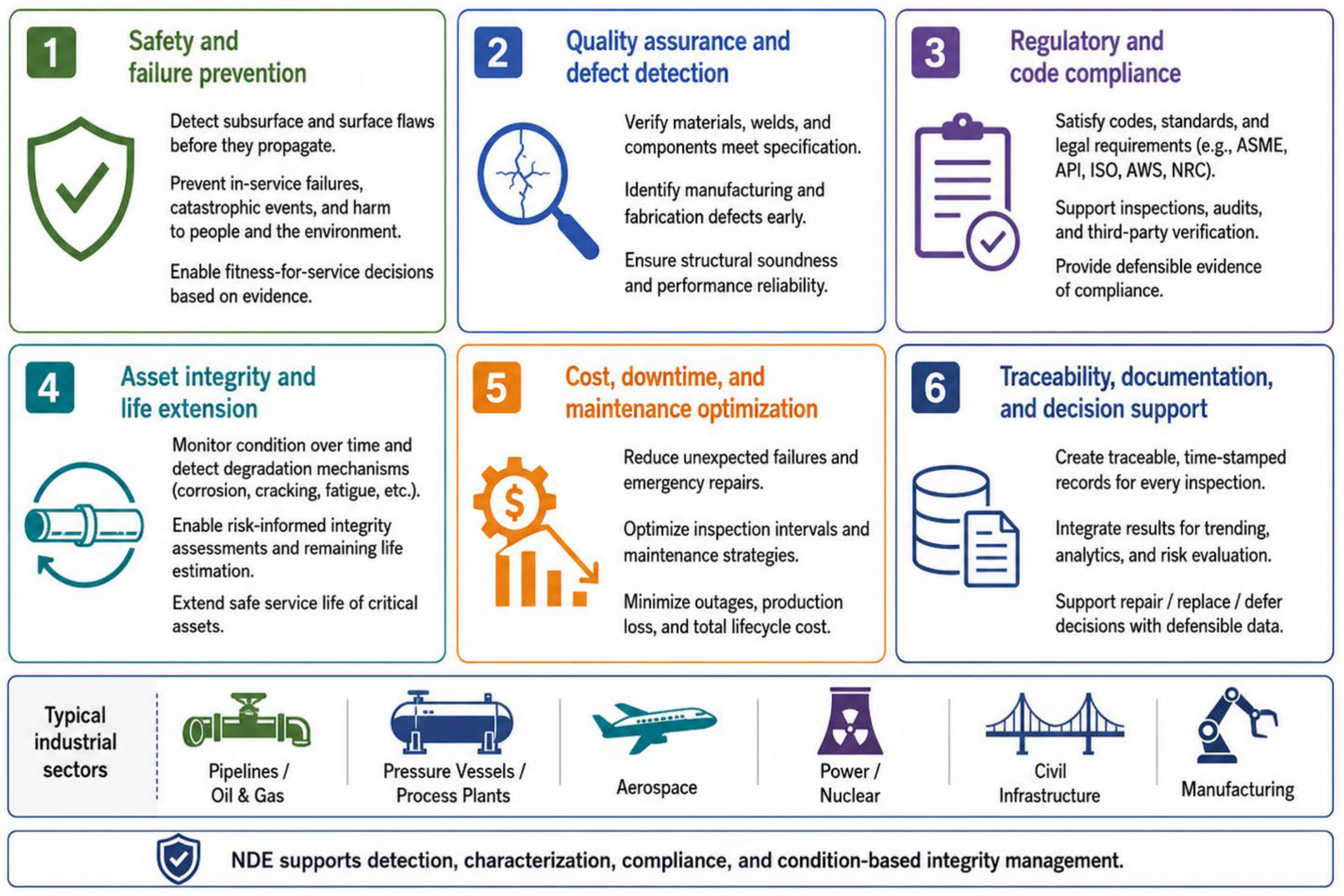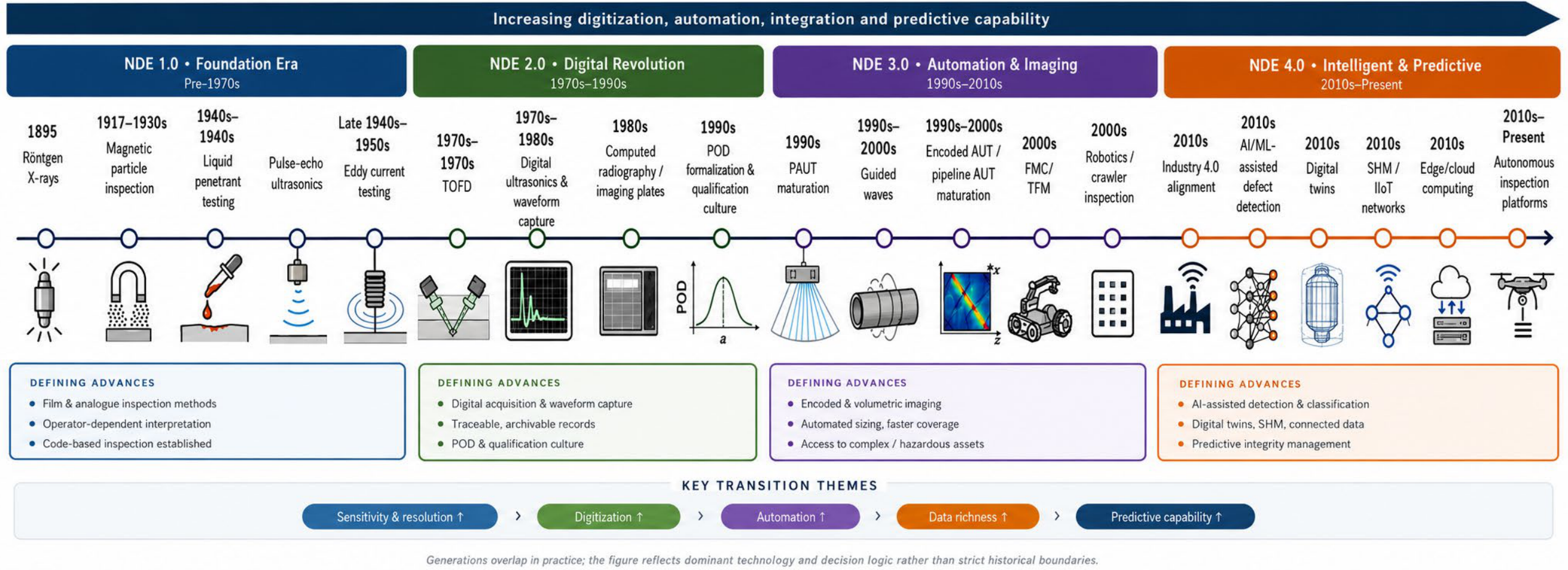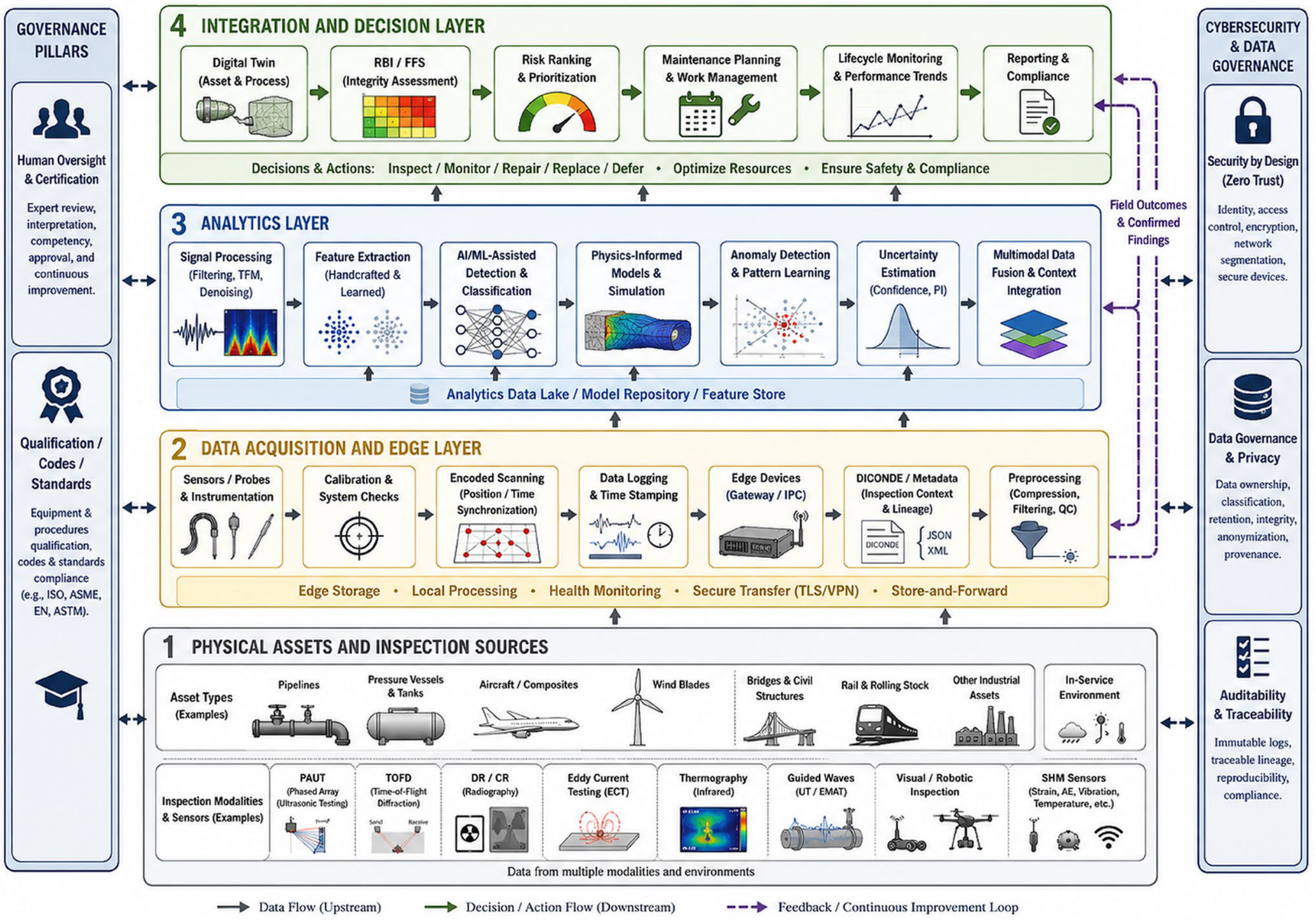

From Detection to Prediction: The NDE 4.0 Transition


Abstract
1. Introduction
Review Scope and Methodology
2. The NDE Generational Framework
3. NDE 1.0—The Foundation Era (Pre-1970s)
3.1. Historical Context
3.2. Defining Characteristics
3.3. Industrial Impact
4. NDE 2.0—The Digital Revolution (1970s–1990s)
4.1. Enabling Technologies
4.2. Probability of Detection Advances
5. NDE 3.0—Automation, Imaging and Quantification (1990s–2010s)
5.1. Phased Array Ultrasonic Testing (PAUT)
5.2. Full Matrix Capture and Total Focusing Method
5.3. Guided Wave Testing and Long-Range Inspection
5.4. Thermographic and Optical Methods
5.5. Robotic Delivery Platforms
6. NDE 4.0—Intelligent, Connected and Predictive NDE (2010s–Present)
6.1. The Industry 4.0 Alignment
6.2. Artificial Intelligence and Machine Learning in NDE
6.2.1. Convolutional Neural Networks for Defect Detection
6.2.2. Physics-Informed Neural Networks (PINNs)
6.2.3. Generative Models and Data Augmentation
6.3. Digital Twins in NDE
6.4. Structural Health Monitoring (SHM) as Continuous NDE
6.5. Autonomous and Semi-Autonomous Inspection Systems
6.6. Edge and Cloud Computing for NDE Data
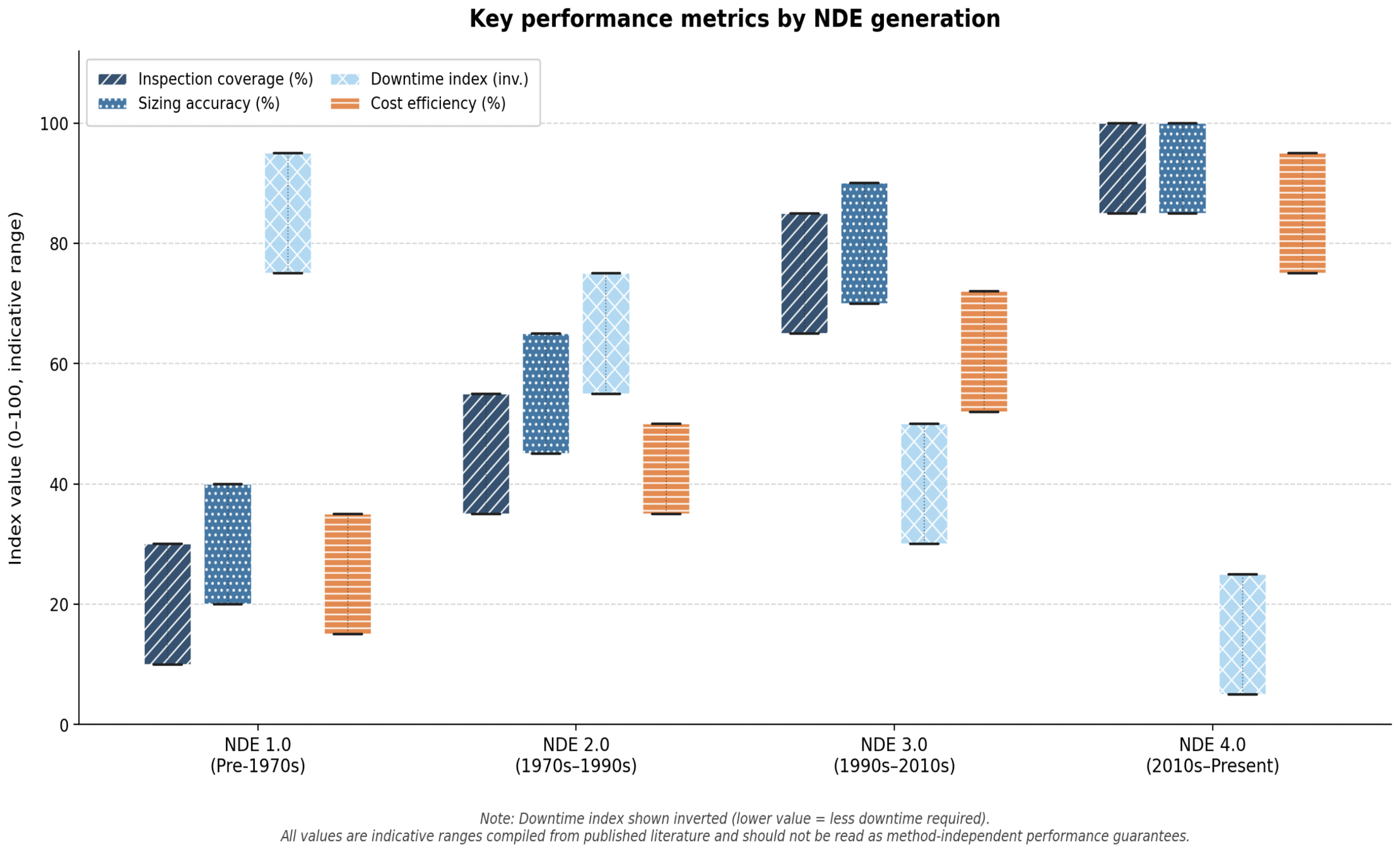
7. Cross-Generational Comparative Analysis
8. Current Challenges
8.1. Data Standardisation and Interoperability
8.2. Explainability and Regulatory Trust in AI
8.3. Physics-Informed Model Development
8.4. Cybersecurity and Data Integrity
8.5. Workforce Transition
8.6. Limitations and Failure Modes of NDE 4.0 Technologies
9. Future Prospects
9.1. Quantum Sensing and Imaging
9.2. Autonomous Robotic Inspection Swarms
9.3. Multi-Modal Sensor Fusion
9.4. 4D NDE and In Situ Process Monitoring
9.5. Integration with Additive Manufacturing Quality Assurance
10. Case Study: NDE Evolution in the Oil and Gas Industry
10.1. NDE 1.0 in Oil and Gas (Pre-1970s)
10.2. NDE 2.0 in Oil and Gas (1970s–1990s): Digital Inspection and the Birth of Smart Pigging
10.3. NDE 3.0 in Oil and Gas (1990s–2010s): Phased Array, Guided Waves, and Robotic Deployment
10.4. NDE 4.0 in Oil and Gas (2010s–Present): AI, Digital Twins, and Autonomous Inspection
11. Conclusions
Author Contributions
Funding
Data Availability Statement
Conflicts of Interest
Abbreviations
| AE | Acoustic Emission |
| AI | Artificial Intelligence |
| AUT | Automated Ultrasonic Testing |
| AUV | Autonomous Underwater Vehicle |
| cGAN | Conditional Generative Adversarial Network |
| CNN | Convolutional Neural Network |
| CUI | Corrosion Under Insulation |
| DVI | Direct Visual Inspection |
| ECT/ECA | Eddy Current Testing/Eddy Current Array |
| FFS | Fitness-for-Service |
| FMC | Full Matrix Capture |
| GAN | Generative Adversarial Network |
| GWT | Guided Wave Testing |
| HPC | High-Performance Computing |
| IIoT | Industrial Internet of Things |
| ILI | In-Line Inspection (intelligent pig) |
| LIDAR | Light Detection and Ranging |
| LPT | Liquid Penetrant Testing |
| MAPOD | Model-Assisted Probability of Detection |
| MFL | Magnetic Flux Leakage |
| MPI | Magnetic Particle Inspection |
| NDE/NDT/NDI | Non-Destructive Evaluation/Testing/Inspection |
| PAUT | Phased Array Ultrasonic Testing |
| PINN | Physics-Informed Neural Network |
| POD | Probability of Detection |
| RBI | Risk-Based Inspection |
| ROM | Reduced Order Model |
| ROV | Remotely Operated Vehicle |
| RUL | Remaining Useful Life |
| SHM | Structural Health Monitoring |
| SLAM | Simultaneous Localization and Mapping |
| TFM | Total Focusing Method |
| TOFD | Time-of-Flight Diffraction |
| UAV | Unmanned Aerial Vehicle (drone) |
| UT | Ultrasonic Testing |
| VAE | Variational Autoencoder |
| XCT | X-ray Computed Tomography |
References
- Dasgupta, A.; Sarkar, D.; Podder, S. Recent Trends in non Destructive Testing and Evaluation in Civil Engineering; Iterative International Publishers Selfypage Developers Pvt Ltd.: Chikkamagaluru, India, 2024. [Google Scholar] [CrossRef]
- Bond, L.J. Through the Looking Glass: The Future for NDE? AIP Conf. Proc. 2014, 1581, 21. [Google Scholar] [CrossRef]
- Smith, J.A.; Ramos, H.G. TC-01: Nondestructive Evaluation and Industrial Inspection (NDE & amp; II). IEEE Instrum. Meas. Mag. 2023, 26, 3. [Google Scholar] [CrossRef]
- Vrana, J.; Meyendorf, N.; Ida, N.; Singh, R. Introduction to NDE 4.0; Springer: Berlin/Heidelberg, Germany, 2022. [Google Scholar] [CrossRef] [PubMed]
- Tiwari, S.; Balasubramaniam, K.; Ananthanarayanan, R. NDE4.0 in Action—Driving Operational Efficiencies Through Unified Digital Platforms. e-J. Nondestruct. Test. 2025, 30, 1435–4934. [Google Scholar] [CrossRef]
- Sunil, P.; Chandu, P.; Vivek, D. A review: Non-destructive testing (ndt) techniques, applications and future prospects. J. Sci. Technol. 2024, 9, 9–15. [Google Scholar] [CrossRef]
- Chen, B. Exploring the Future of Ai in Industrial Automation Development. IET Conf. Proc. 2024, 24, 282. [Google Scholar] [CrossRef]
- Venkatraman, B.; Raj, B. Nondestructive Testing. Overv. Tech. Appl. Qual. Eval. 2019, 1, 1–55. [Google Scholar] [CrossRef]
- Moussa, J.R.; Harmon, D.; Rane, S. Industrial Radiography: Trends, Market Drivers, and Alternatives to Gamma-based Devices. Health Phys. 2025, 129, 174. [Google Scholar] [CrossRef] [PubMed]
- Schall, W.E. Techniques of Non-destructive Testing. Br. J. Radiol. 1961, 34, 639. [Google Scholar] [CrossRef]
- Brown, J. There’s More to NDT Reliability than POD—And Statistics Plays a Role. In Proceedings of the ASNT Research Symposium 2023, Columbus, OH, USA, 1 January 2023. [Google Scholar] [CrossRef]
- Crane, R.L.; Dillingham, G. Nondestructive Inspection. In Mechanical Engineers’ Handbook; John Wiley & Sons: Hoboken, NJ, USA, 2015. [Google Scholar] [CrossRef]
- Li, W.; Kundu, T. Nondestructive Evaluation (NDE) of Materials and Structures from Production to Retirement; CRC Press: Boca Raton, FL, USA, 2018. [Google Scholar] [CrossRef]
- Bossi, R.H.; Georgeson, G.E. The application of X-ray computed tomography to materials development. JOM 1991, 43, 8–15. [Google Scholar] [CrossRef]
- Lysenko, I.; Kuts, Y.; Uchanin, V.; Mirchev, Y.; Levchenko, O. Evaluation of Eddy Current Array Performance in Detecting Aircraft Component Defects. Trans. Aerosp. Res. 2024, 2024, 1–9. [Google Scholar] [CrossRef]
- ASTM E2373/E2373M-19(2024); Practice for Use of the Ultrasonic Time of Flight Diffraction (TOFD) Technique. ASTM: West Conshohocken, PA, USA, 2024. [CrossRef]
- Lei, X.; Wirdelius, H.; Rosell, A. Simulation-Based Investigation of a Probability of Detection (POD) Model Using Phased Array Ultrasonic Testing (PAUT) Technique. J. Nondestruct. Eval. 2022, 41, 40. [Google Scholar] [CrossRef]
- Guo, Y.; Yang, K. Composite Non-Destructive Evaluation System for Probability of Detection Assessment. Int. J. Qual. Eng. Technol. 2011, 2, 29. [Google Scholar] [CrossRef]
- Uzun, H.; Gustiani, D. Review of Phased Array Ultrasonic Testing of Weld Joints. J. Mar. Eng. Technol. 2024, 4, 77–92. [Google Scholar] [CrossRef]
- Haworth, W. The Evolution of Weld Inspection: Unlocking the Potential of Phased Array Ultrasonic Testing. Mater. Eval. 2024, 82, 32–37. [Google Scholar] [CrossRef]
- Dolmatov, D.O.; Zhvyrblya, V.Y. Optimal Design of Sparse Matrix Phased Array Using Simulated Annealing for Volumetric Ultrasonic Imaging with Total Focusing Method. Sensors 2024, 24, 1856. [Google Scholar] [CrossRef] [PubMed]
- Ingram, M.; Gachagan, A.; Nordon, A.; Mulholland, A.J.; Hegarty, M. Calibration of Ultrasonic Hardware for Enhanced Total Focusing Method Imaging. Insight—Non-Destr. Test. Cond. Monit. 2020, 62, 408–415. [Google Scholar] [CrossRef]
- Tavossi, H.M. Nondestructive Inspection of In-Service Pipelines by Guided Ultrasonic Waves. J. Acoust. Soc. Am. 2006, 119, 3336. [Google Scholar] [CrossRef]
- Raghu, D.; Figueroa, H.; Whittington, L.; Haupt, J. Experience with Torsional Guided Wave Ultrasonic Technique for the Inspection of Offshore Pipeline Installations. In Proceedings of the CORROSION 2004, New Orleans, LA, USA, 27 March–1 April 2004. [Google Scholar] [CrossRef]
- Lee, P.-H.; Yang, S.-K. Defect Inspection of Complex Structure in Pipes by Guided Waves; Springer: Dordrecht, The Netherlands, 2010. [Google Scholar] [CrossRef]
- Ibarra-Castanedo, C.; Grinzato, E.; Marinetti, S.; Bison, P.; Avdelidis, N.; Grenier, M.; Piau, J.-M.; Bendada, A.; Maldague, X. Quantitative Assessment of Aerospace Materials by Active Thermography Techniques. In Proceedings of the 9th International Conference on Quantitative InfraRed Thermography, Kraków, Poland, 2–5 July 2008. [Google Scholar] [CrossRef] [PubMed]
- Avdelidis, N.P.; Ibarra-Castanedo, C.; Marioli-Riga, Z.P.; Bendada, A.; Maldague, X.P.V. A Study of Active Thermography Approaches for the Non-Destructive Testing and Evaluation of Aerospace Structures. Proc. SPIE 2008, 6939, 693918. [Google Scholar] [CrossRef]
- Carpenter, C. Robotic Technology Enables Automated Nondestructive Weld Inspection in Subsea Zone. J. Pet. Technol. 2024, 76, 109–111. [Google Scholar] [CrossRef]
- AL Rashed, M.; Kimball, M.; Vega, L.; Vera, D.; Soler, J.; Correa, M.; Garcia, A.; Virk, G.S.; Sattar, T.P. Climbing Robots for NDT Applications. Clawar 2017. In Human-Centric Robotics; Word Scientific: Singapore, 2017. [Google Scholar] [CrossRef]
- Engelbrecht, A.; Saleh, V.; Rahman, M. Industry 4.0—Perspectives and Applications; IntechOpen: London, UK, 2023. [Google Scholar] [CrossRef] [PubMed]
- Rani, S.; Bhambri, P. Industry 4.0; CRC Press: Boca Raton, FL, USA, 2024. [Google Scholar] [CrossRef]
- Safhi, A.E.M.; Keserle, G.C.; Blanchard, S.C. AI-Driven Non-Destructive Testing Insights. Encyclopedia 2024, 4, 1760–1769. [Google Scholar] [CrossRef]
- Chen, C.H. Applications of Artificial Intelligence in Nondestructive Evaluation; Springer Nature: Dordrecht, The Netherlands, 1994. [Google Scholar] [CrossRef]
- Schulenburg, L. Artificial Intelligence in Digital Radiography. e-J. Nondestruct. Test. 2025, 30, 31297. [Google Scholar] [CrossRef] [PubMed]
- Applied Artificial Intelligence for Industrial Nondestructive Evaluation NDE4.0; Multidisciplinary Digital Publishing Institute: Basel, Switzerland, 2025. [CrossRef]
- Cantero-Chinchilla, S.; Wilcox, P.D.; Croxford, A.J. Deep learning in automated ultrasonic NDE–developments, axioms and opportunities. NDT E Int. 2022, 131, 102703. [Google Scholar] [CrossRef]
- Salehi, A.W.; Khan, S.; Gupta, G.; Alabduallah, B.I.; Almjally, A.; Alsolai, H.; Siddiqui, T.; Mellit, A. A Study of CNN and Transfer Learning in Medical Imaging: Advantages, Challenges, Future Scope. Sustainability 2023, 15, 5930. [Google Scholar] [CrossRef]
- Alzubaidi, L.; Duan, Y.; Al-Dujaili, A.; Ibraheem, I.K.; Ahmed, H.A.; Santamaría, J.; Fadhel, M.A.; Al-Shamma, O.; Zhang, J. Deepening into the Suitability of Using Pre-Trained Models of ImageNet against a Lightweight Convolutional Neural Network in Medical Imaging: An Experimental Study. PeerJ Comput. Sci. 2021, 7, e715. [Google Scholar] [CrossRef] [PubMed]
- Mohamed Salem, M.Y. Physics-Informed Machine Learning: Bridging Data-Driven Models and Physical Laws. Authorea 2025. preprints. [Google Scholar] [CrossRef]
- Li, Z. A Review of Physics-Informed Neural Networks. Appl. Comput. Eng. 2025, 133, 165. [Google Scholar] [CrossRef]
- Thawon, I.; Vo, D.; Bui, T.Q.; Rattanamongkhonkun, K.; Chamroon, C.; Tippayawong, N.; Mona, Y.; Wanison, R.; Suttakul, P. Physics-Informed Neural Networks: Current Progress and Challenges in Computational Solid and Structural Mechanics. Comput. Model. Eng. Sci. 2026, 138, 2. [Google Scholar] [CrossRef]
- Mohseni, E.; Mcknight, S.; Loukas, C.; Pierce, S.G.; O’Hare, T.; Mackinnon, C.; Macleod, C. GANs and Alternative Methods of Synthetic Noise Generation for Domain Adaption of Defect Classification of Non-Destructive Ultrasonic Testing. arXiv 2023, arXiv:2306.01469. [Google Scholar] [CrossRef]
- Gosswami, B.M.; Chanda, R.K.; Wittenberg, T. Synthetic X-Ray Image Generation for Non-Destructive Testing Using Generative Adversarial Networks. e-J. Nondestruct. Test. 2024, 29, 29930. [Google Scholar] [CrossRef]
- Posilović, L.; Medak, D.; Subašić, M.; Budimir, M.; Lončarić, S. Generative adversarial network with object detector discriminator for enhanced defect detection on ultrasonic B-scans. Neurocomputing 2021, 459, 361–369. [Google Scholar] [CrossRef]
- Ospina-Bohórquez, A.; López-Rebollo, J.; Muñoz-Sánchez, P.; González-Aguilera, D. A Digital Twin for Monitoring the Construction of a Wind Farm. Infrastructures 2023, 8, 10. [Google Scholar] [CrossRef]
- Daraki, M.-S.; Mina, B.; Almasoudi, M.; Charalambidi, B.; Mančić, M.; Junlin, H.; Baniotopoulos, C. Applications and Challenges of Digital Twins of Floating Wind Turbines. SimTerm Proc. 2024, 53–60. [Google Scholar] [CrossRef]
- Govindasamy, A. Building Digital Twins. Zenodo 2022, ahead of print. [Google Scholar] [CrossRef]
- Thomas, L.; Kernicky, T.; Whelan, M.; Park, Y.; Cox, R. Application of a Structural Digital Twin on a Laboratory Model for Performance Monitoring of Aging and Degradation; Pakzad, S., Ed.; Springer Nature Switzerland: Cham, Switzerland, 2023; Volume 2, pp. 11–18. [Google Scholar] [CrossRef]
- Smarsly, K.; Peralta, P.; Dragos, K.; Ahmad, M.E.; Al-Zuriqat, T.; Geck, C.C.; Al-Nasser, H. A Multivocal Literature Review of Digital Twins, Architectures, and Elements in Civil Engineering. e-J. Nondestruct. Test. 2024, 29, e29579. [Google Scholar] [CrossRef] [PubMed]
- Sundaram, R.; Kamath, G.M.; Gupta, N. Structural Health Monitoring of Composite Structures—Issues and Challenges. Int. J. Veh. Struct. Syst. 2012, 4, 83–94. [Google Scholar] [CrossRef]
- Giurgiutiu, V.; Soutis, C. Enhanced Composites Integrity Through Structural Health Monitoring. Appl. Compos. Mater. 2012, 19, 813–829. [Google Scholar] [CrossRef]
- Soto, J.R. Design of a Robotic Inspection Platform for Structural Health Monitoring. Ph.D. Dissertation, Florida International University, Miami, FL, USA, 2020. [Google Scholar] [CrossRef]
- Thompson, F.; Hansen, P.N.; Galeazzi, R.; Palma, M.; Brock, A.L.; Mariani, P. Autonomous Inspection and Data Fusion for Maritime Critical Infrastructures. In Proceedings of the 27th International Conference on Information Fusion (FUSION 2024), Venice, Italy, 7–11 July 2024; pp. 1–8. [Google Scholar] [CrossRef]
- Mahida, A. Impact of Edge Computing on Cloud Infrastructure- A Review Paper. Int. J. Sci. Res. 2019, 8, 1840–1844. [Google Scholar] [CrossRef]
- Belcastro, L.; Marozzo, F.; Orsino, A.; Talia, D.; Trunfio, P. Using the Compute Continuum for Data Analysis: Edge-Cloud Integration for Urban Mobility. In Proceedings of the 31st Euromicro International Conference on Parallel, Distributed and Network-Based Processing (PDP 2023), Naples, Italy, 1–3 March 2023; pp. 338–345. [Google Scholar] [CrossRef]
- Lin, J.-M. Research and Application of Cloud Non-Destructive Testing and Evaluation; Leibniz-Institut für Ost- und Südosteuropaforschung: Re-gensburg, Germany, 2015. [Google Scholar] [CrossRef]
- Pérez, E.; Ardıç, C.E.; Çakıroğlu, O.; Jacob, K.; Kodera, S.; Pompa, L.; Rachid, M.; Wang, H.; Zhou, Y.; Zimmer, C.; et al. Integrating AI in NDE: Techniques, trends, and further directions. NDT E Int. 2025, 156, 103442. [Google Scholar] [CrossRef]
- Osman, A.; Duan, Y.; Kaftandjian, V. Applied Artificial Intelligence in NDE. In Handbook of Nondestructive Evaluation 4.0; Meyendorf, N., Ida, N., Singh, R., Vrana, J., Eds.; Springer: Cham, Switzerland, 2021; pp. 1215–1243. [Google Scholar] [CrossRef]
- Chakraborty, D.; McGovern, M.E. NDE 4.0: Smart NDE. In Proceedings of the 2019 IEEE International Conference on Prognostics and Health Management (ICPHM), San Francisco, CA, USA, 17–20 June 2019; pp. 1–6. [Google Scholar] [CrossRef]
- Siddig, M. Scientometric Analysis of the Dynamics of Artificial Intelligence Applications in NonDestructive Testing and Structural Integrity Monitoring. e-J. Nondestruct. Test. 2023, 29, e28899. [Google Scholar] [CrossRef] [PubMed]
- Sampson, B. Unleashing The Power of 4.0. Aerosp. Test. Int. 2024, 2024, 80–84. [Google Scholar] [CrossRef]
- Batishchev, D.; Saad, M. The Black Box Problem: AI Decision-Making in Critical Infrastructure and Its Implications. Available online: https://www.preprints.org/manuscript/202511.2276 (accessed on 28 November 2025). [CrossRef]
- Andres, A.; Martinez-Seras, A.; Laña, I.; Del Ser, J. On the black-box explainability of object detection models for safe and trustworthy industrial applications. Results Eng. 2024, 24, 103498. [Google Scholar] [CrossRef]
- Xu, P.; Jones, R.; Sarris, G.; Huthwaite, P. Efficient Generation of Realistic Guided Wave Signals for Reliability Estimation. Struct. Health Monit. 2025, 25, 1353–1367. [Google Scholar] [CrossRef]
- Calmon, P.; Mesnil, O.; Miorelli, R.; Artusi, X.; Chapuis, B.; D’Almeida, O. Model Assisted Probability of Detection for Guided Wave Imaging Structural Health Monitoring. In Proceedings of the 12th International Workshop on Structural Health Monitoring 2019, Stanford, CA, USA, 10–12 September 2019. [Google Scholar] [CrossRef] [PubMed]
- Abdel-Basset, M.; Moustafa, N.; Hawash, H. Privacy-Preserved Cyberattack Detection in Industrial Edge of Things (IEoT): A Blockchain-Orchestrated Federated Learning Approach. IEEE Trans. Ind. Inf. 2022, 18, 7920–7931. [Google Scholar] [CrossRef]
- Ulybyshev, D.; Yilmaz, I.; Northern, B.; Kholodilo, V.; Rogers, M. Trustworthy Data Analysis and Sensor Data Protection in Cyber-Physical Systems. ACM Trans. Cyber-Phys. Syst. 2021, 5, 13–28. [Google Scholar] [CrossRef]
- Protasov, A. The Professional Training Features For Non Destructive Testing Graduate Students. In Proceedings of the 2020 ASEE Virtual Annual Conference, Virtual Online, 22–26 June 2020; p. 14.1245.1. [Google Scholar] [CrossRef]
- Singh, R.; Fernandez, R.S.; Vrana, J. Principles for Successful Deployment of NDE 4.0. J. Non-Destruct. Test. Eval. (JNDE) 2022, 19, 28–34. Available online: https://jnde.isnt.in/index.php/JNDE/article/view/21 (accessed on 28 November 2025).
- Sun, H.; Ramuhalli, P.; Jacob, R.E. Machine Learning for Ultrasonic Nondestructive Examination of Welding Defects: A Systematic Review. Ultrasonics 2023, 127, 106854. [Google Scholar] [CrossRef] [PubMed]
- Pyle, R.J.; Bevan, R.L.T.; Hughes, R.R.; Rachev, R.K.; Ali, A.A.S.; Wilcox, P.D. Deep Learning for Ultrasonic Crack Characterization in NDE. IEEE Trans. Ultrason. Ferroelectr. Freq. Control 2020, 68, 1854–1865. [Google Scholar] [CrossRef] [PubMed]
- Ye, J.; Toyama, N. Benchmarking Deep Learning Models for Automatic Ultrasonic Imaging Inspection. IEEE Access 2021, 9, 36986–36998. [Google Scholar] [CrossRef]
- Traina, P.; Degiovanni, I.P.; Gramegna, M.; Vidal, X.; Gil, G. Quantum (Sensing) Leap: Pushing the Technology Readiness of Nitrogen-Vacancy Sensors in Europe Forward. Photoniques 2025, 131, 28–33. [Google Scholar] [CrossRef]
- Vindolet, B.; Bourcin, G.; Nguyen, H.N.; Hingant, T. Diamond Quantum Sensors for Non-Destructive Testing. In Proceedings of the 62nd Annual British Conference on Non-Destructive Testing (NDT 2025); The British Institute of Non-Destructive Testing: Northampton, UK, 2025; Volume 2025, pp. 1–10. [Google Scholar] [CrossRef]
- Jahanshahi, M.R.; Shen, W.-M.; Mondal, T.G.; Abdelbarr, M.; Masri, S.F.; Qidwai, U.A. Reconfigurable Swarm Robots for Structural Health Monitoring: A Brief Review. Int. J. Intell. Robot. Appl. 2017, 1, 287–301. [Google Scholar] [CrossRef]
- Wong, E.; Litt, J. Autonomous Multi-Agent Robotics for Inspection and Repair of Propulsion Systems. In Proceedings of the 40th AIAA/ASME/SAE/ASEE Joint Propulsion Conference, Fort Lauderdale, FL, USA, 11–14 June 2004. [Google Scholar] [CrossRef]
- Correll, N.; Martinoli, A. Collective Inspection of Regular Structures Using a Swarm of Miniature Robots; Springer: Berlin/Heidelberg, Germany, 2006. [Google Scholar] [CrossRef]
- Wilcox, P.D.; Croxford, A.J.; Budyn, N.; Bevan, R.L.T.; Zhang, J.; Kashubin, A.; Cawley, P. Fusion of Multi-View Ultrasonic Data for Increased Detection Performance in Non-Destructive Evaluation. Proc. R. Soc. A 2020, 476, 20200086. [Google Scholar] [CrossRef] [PubMed]
- Sun, K.; Udpa, S.; Udpa, L.; Xue, T.; Lord, W. Registration Issues in the Fusion of Eddy Current and Ultrasound NDE Data Using Q-Transforms. In Review of Progress in Quantitative Nondestructive Evaluation; Springer Nature: New York, NY, USA, 1996; pp. 813–820. [Google Scholar] [CrossRef][Green Version]
- Baig, S.; Jam, A.; Beretta, S.; Shao, B.; Shamsaei, N. Non-Destructive Detection of Critical Defects in Additive Manufacturing. Sci. Rep. 2025, 15, 6740. [Google Scholar] [CrossRef] [PubMed]
- Obaton, A.-F.; Van Den Bossche, A.; Burnet, O.; Butsch, B.; Zouggarh, I.; Florent, S.; Johnson, W. Novel or Improved NDE Inspection Capabilities for Additively Manufactured Parts; ASTM International: West Conshohocken, PA, USA, 2022. [Google Scholar] [CrossRef] [PubMed]
- Zimermann, R.; Mohseni, E.; Foster, E.A.; Vasilev, M.; Loukas, C.; Vithanage, R.K.W.; Macleod, C.N.; Lines, D.; Javadi, Y.; Espirindio E Silva, M.P.; et al. In-Process Non-Destructive Evaluation of Metal Additive Manufactured Components at Build Using Ultrasound and Eddy-Current Approaches. J. Manuf. Process. 2023, 107, 549–563. [Google Scholar] [CrossRef]
- Hossain, M.S.; Taheri, H. In Situ Process Monitoring for Additive Manufacturing Through Acoustic Techniques. J. Mater. Eng. Perform. 2020, 29, 6249–6261. [Google Scholar] [CrossRef]
- Slotwinski, J.A. Additive Manufacturing: Overview and NDE Challenges. AIP Conf. Proc. 2014, 1581, 1173–1180. [Google Scholar] [CrossRef]
- Sherwood, P.W. Non-Destructive Techniques in Refinery Inspection. Corros. Technol. 1957, 4, 148–152. [Google Scholar] [CrossRef]
- Kishawy, H.A.; Gabbar, H.A. Review of Pipeline Integrity Management Practices. Int. J. Press. Vessel. Pip. 2010, 87, 373–380. [Google Scholar] [CrossRef]
- Yagi, K. Acquisition of Long-Term Creep Data and Knowledge for New Applications. Int. J. Press. Vessel. Pip. 2008, 85, 22–29. [Google Scholar] [CrossRef]
- Pandey, M.D. Probabilistic Models for Condition Assessment of Oil and Gas Pipelines. NDT E Int. 1998, 31, 349–358. [Google Scholar] [CrossRef]
- Akrasi, I.L.; Hamaqi, M.S.; Hathloul, T.I.; Almakinzi, A.F.; Naim, A.A. Field Experience on Why Pipeline In-Line Inspections (ILI) Fail. In NACE Corrosion; NACE: Houston, TX, USA, 2021. [Google Scholar] [CrossRef]
- Uzelac, N.I. In-Line Inspection (ILI) (“Intelligent Pigging”). In Pipeline Engineering Handbook; Wiley: Hoboken, NJ, USA, 2025; pp. 462–495. [Google Scholar] [CrossRef]
- Moles, M.; Dube’, N.; Ginzel, E. Pipeline Girth Weld Inspections Using Ultrasonic Phased Arrays. In Proceedings of the ASME Pressure Vessels and Piping Conference (PVP2003), Cleveland, OH, USA, 20–24 July 2003; pp. 19–27. [Google Scholar] [CrossRef]
- Rodriguez, A.C. The Phased Array Single Shot: Real-Time, Multidirectional Tubular Inspection for Enhanced OCTG Integrity. In Proceedings of the SPE Middle East Oil & Gas Show and Conference, Manama, Bahrain, 17–19 March 2026. [Google Scholar] [CrossRef]
- De Vries, R. Technology Update: New 3D Ultrasonic System Tests Pipeline Integrity. J. Pet. Technol. 2014, 66, 34–38. [Google Scholar] [CrossRef]
- Belanger, A.; Greene, K.; Goller, C. Data Fusion of Non-Destructive Evaluation and Inline Inspection for Higher Accuracy Integrity Evaluation. In Corrosion 2014; NACE International: Houston, TX, USA, 2014; p. 4139. [Google Scholar] [CrossRef]
- Lutfallah, M.H.; Felemban, T.O.; Alrashidi, A.F.; Alsubhi, Y.S.; Fandem, Q.A.; Batiste, R.S. Advancement in Asset Integrity Management through Digitalized Eddy Current Testing Technology for Corrosion Cracking Inspections. In Proceedings of the AMPP Annual Conference + Expo 2023, Denver, CO, USA, 19 March 2023; p. 19049. [Google Scholar] [CrossRef]
- Ali, A.; Sabry, H. Implementing a Successful Risk Based Inspection Program. In Proceedings of the Abu Dhabi International Petroleum Exhibition & Conference, Abu Dhabi, United Arab Emirates, 11–14 November 2019. [Google Scholar] [CrossRef]
- Aditiyawarman, T.; Kaban, A.P.S.; Soedarsono, J.W. A Recent Review of Risk-Based Inspection Development to Support Service Excellence in the Oil and Gas Industry: An Artificial Intelligence Perspective. ASCE-ASME J. Risk Uncertain. Eng. Syst. Part B Mech. Eng. 2022, 9, 010801. [Google Scholar] [CrossRef]
- Santos, A.D.; Al Hajri, A.A. Risk Based Inspection—A Valuable Approach. In Proceedings of the SPE International Oil and Gas Conference and Exhibition in China, Beijing, China, 13–15 October 2000. [Google Scholar] [CrossRef]



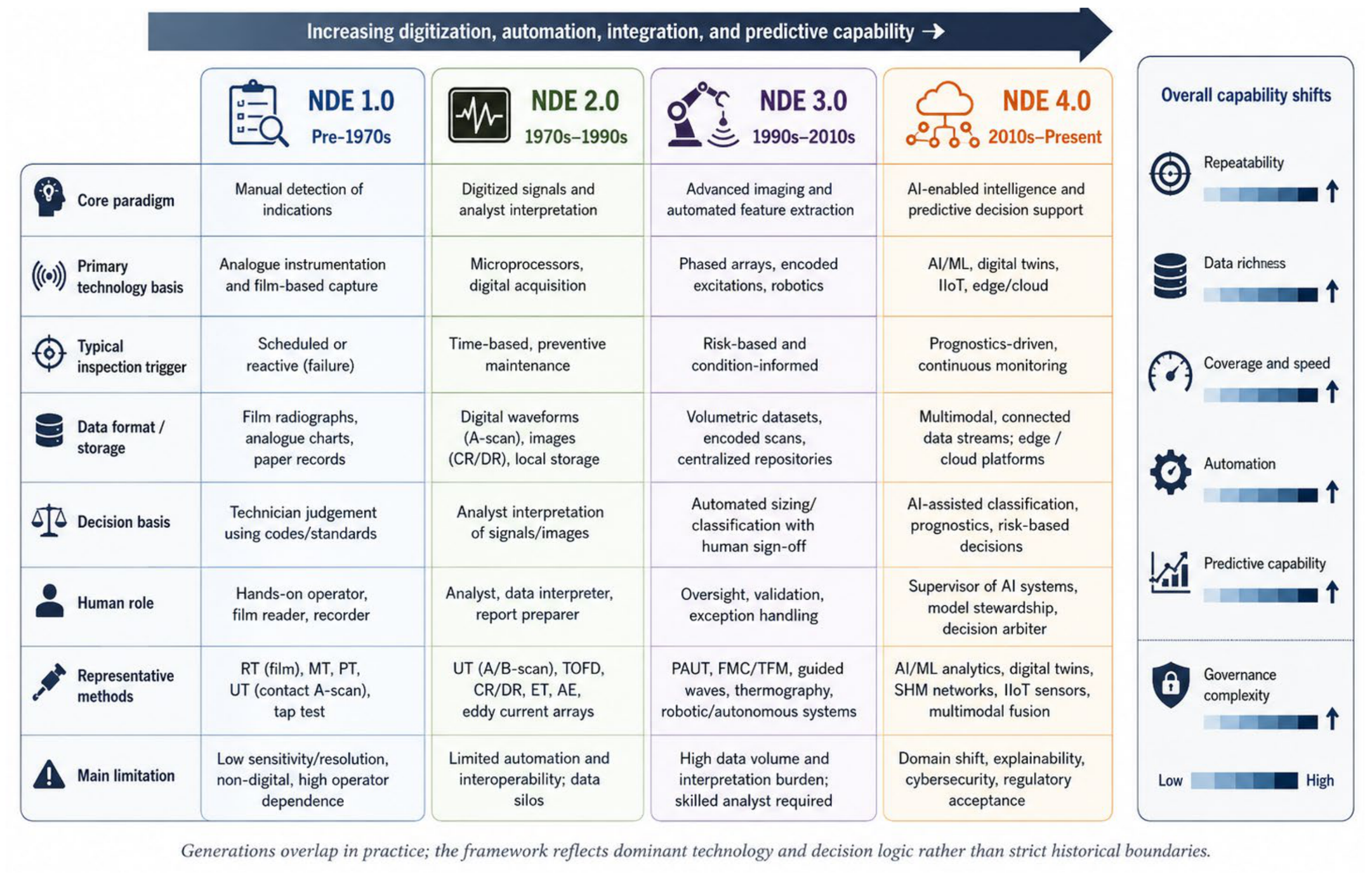
| Attribute | NDE 1.0 (Pre–1970s) | NDE 2.0 (1970s–1990s) | NDE 3.0 (1990s–2010s) | NDE 4.0 (2010s–Present) |
|---|---|---|---|---|
| Core Paradigm | Detection and documentation | Digitization and archival analysis | Automated imaging and quantitative evaluation | Predictive analytics and system integration |
| Primary Technology Driver | RT, MT, PT, manual UT | Microprocessors, ADC systems, TOFD, CR/DR (computed/digital radiography) | PAUT, FMC/TFM, guided waves, robotics | AI/ML, digital twins, IIoT, edge computing |
| Inspection Trigger | Scheduled shutdown or failure | Scheduled interval | Risk-informed interval | Continuous/condition-based |
| Data Format | Paper film, analogue A-scan | Digital waveform, stored datasets | Volumetric imaging (B/C/S-scan), encoded AUT | Cloud-scale multimodal streams (Volumetric imaging) |
| Decision Basis | Technician judgement | Analyst interpretation of stored data | Automated sizing with human sign-off | AI-assisted classification with digital twin–enabled prognostics |
| Human Role | Primary detector and judge | Analyst and archivist | Supervisor of automated systems | Validation, oversight, and regulatory governance |
| Key Limitation | High operator dependency; limited repeatability | Proprietary formats; limited interoperability | High skill requirement for advanced data interpretation | Regulatory acceptance gaps; domain shift; limited explainability |
| Parameter | NDE 1.0 | NDE 2.0 | NDE 3.0 | NDE 4.0 |
|---|---|---|---|---|
| Inspection reliability/POD evidence | Procedure- and operator-dependent; reliability must be demonstrated for each method and flaw class | Improved traceability and repeatability where digital records and qualified procedures are used | Higher repeatability for encoded/automated procedures when qualified for the target application | Potentially improved screening and consistency, but AI outputs require system-level validation before being treated as POD |
| Detectable flaw/sizing capability | Application-specific; limited by access, contrast, surface condition, and manual interpretation | Improved waveform and image storage support post-analysis and trending | Enhanced imaging and sizing for qualified PAUT, TOFD, TFM, CT, and guided-wave applications | Application-specific; AI may assist segmentation or classification but does not remove physics-based detectability limits |
| Inspection speed | Low; manual and access-dependent | Low to medium; digital acquisition improves record handling | Medium to high; encoded scanning and robotics reduce scan variability | Potentially high for screening, triage, and fleet analytics; constrained by validation and data governance |
| Automation level | None to very low | Partial digital acquisition and storage | High acquisition automation; human interpretation remains central | AI-assisted interpretation and connected workflows; autonomous acceptance remains limited |
| Operator dependence | Very high | High, with improved reviewability | Medium; reduced scanning variability but skilled analysis required | Lower for repetitive screening tasks, but qualified human oversight remains essential |
| Data volume per campaign | Low; paper, film, or analogue records | Moderate; stored waveforms and digital images | High; encoded scans, volumetric images, and robotic inspection files | Very high; multimodal streams, ILI, SHM, and digital-twin records |
| Real-time decision capability | Generally no | Limited | Partial for automated acquisition and encoded imaging | Possible for monitoring and prioritisation; acceptance decisions need qualification |
| Predictive capability | None | Limited trending where records exist | Risk-informed trending in selected applications | Digital-twin and RBI/FFS integration possible where models and data are validated |
| Defect characterisation | Location and approximate size in favourable cases | Improved sizing and archiving | 3D morphology in selected modalities and geometries | AI-assisted classification/segmentation possible; uncertainty must be reported |
| Regulatory maturity | Mature for established methods | Mature for many digital implementations | Mature for mainstream PAUT/TOFD and selected automated methods; newer methods require qualification | Emerging; AI-specific acceptance criteria are still limited and application-dependent |
| Cost profile | Low equipment cost but high labour and outage dependence | Moderate equipment and data-management cost | Higher equipment/training cost; potential savings through repeatability and reduced access time | Higher integration and governance cost; lifecycle value depends on avoided downtime, reduced false calls, and validated risk reduction |
| Key Challenges | Impact | Emerging Solutions in AI-Enabled NDE Systems |
|---|---|---|
| Data Quality and Volume | Massive datasets from SHM and automated scanning overwhelm traditional pipelines | Cloud high-performance computing (HPC), edge AI, federated learning |
| Standardisation | Weak comparability across instruments, vendors, datasets, and studies | DICONDE/ASTM E2339-style data structures, shared benchmark datasets, qualification protocols |
| Physics-Informed AI | Pure data-driven models lack physical interpretability | PINN, hybrid physics-ML models |
| Digital Twin Fidelity | High-fidelity simulation is computationally costly | Surrogate modelling, reduced order model (ROM) approaches |
| Cyber-Security | Connected inspection data and SHM systems increase exposure to manipulation, data loss, and audit failure | Secure edge devices, access control, encryption, audit logs, model/version control, data provenance |
| Skill Gap | Workforce lacks combined NDE + data science expertise | Cross-disciplinary training programmes |
| Regulatory Acceptance | Limited use of AI as a primary accept/reject authority in high-consequence inspection | Explainable AI, locked-model validation, human-in-the-loop governance, POD/MAPOD-style qualification |
| Harsh Environments | Extreme temperature, pressure, radiation degrade sensors | Radiation-hardened electronics, wireless power |
| Generation | Key NDE Techniques | O&G Applications | Key Advances/Limitations |
|---|---|---|---|
| NDE 1.0 (Pre-1970s) | Radiographic film, manual MPI/LPT, visual inspection, pit gauging | Pressure vessel weld QA, storage tank floor inspection, process pipework | High operator dependence; no in-service capability; reactive approach |
| NDE 2.0 (1970s–90s) | Smart pig MFL/UT ILI, digital UT thickness mapping, TOFD, EC tubing inspection | Long-distance pipeline surveying, offshore riser welds, heat exchanger tubing | First quantitative coverage of long pipelines; data archiving; POD frameworks |
| NDE 3.0 (1990s–2010s) | PAUT AUT girth welds, guided wave CUI screening, ROV-mounted probes, XCT | Pipeline construction QA, CUI detection, subsea structure inspection | Automated volumetric imaging; guided wave CUI breakthrough; subsea robotics |
| NDE 4.0 (2010s–Now) | AI-assisted ILI analysis, digital twins (RBI/FFS), autonomous UAV/AUV, AE networks | Fleet-wide integrity management, anomaly prioritisation, targeted monitoring, risk-informed maintenance planning | Data-assisted and predictive workflows; AI supports classification and prioritisation but requires validation for acceptance decisions |
Disclaimer/Publisher’s Note: The statements, opinions and data contained in all publications are solely those of the individual author(s) and contributor(s) and not of MDPI and/or the editor(s). MDPI and/or the editor(s) disclaim responsibility for any injury to people or property resulting from any ideas, methods, instructions or products referred to in the content. |
© 2026 by the authors. Licensee MDPI, Basel, Switzerland. This article is an open access article distributed under the terms and conditions of the Creative Commons Attribution (CC BY) license.
Share and Cite
Sharma, K.; Kumar, A.; Yadav, V.; Dhar, S.; Banerjee, D.K. From Detection to Prediction: The NDE 4.0 Transition. NDT 2026, 4, 17. https://doi.org/10.3390/ndt4030017
Sharma K, Kumar A, Yadav V, Dhar S, Banerjee DK. From Detection to Prediction: The NDE 4.0 Transition. NDT. 2026; 4(3):17. https://doi.org/10.3390/ndt4030017
Chicago/Turabian StyleSharma, Kuldeep, Ashok Kumar, Vineet Yadav, Sambit Dhar, and Dipak K. Banerjee. 2026. "From Detection to Prediction: The NDE 4.0 Transition" NDT 4, no. 3: 17. https://doi.org/10.3390/ndt4030017
APA StyleSharma, K., Kumar, A., Yadav, V., Dhar, S., & Banerjee, D. K. (2026). From Detection to Prediction: The NDE 4.0 Transition. NDT, 4(3), 17. https://doi.org/10.3390/ndt4030017