Article

Thermal Deformation Analysis of Large-Scale High-Aspect-Ratio Parts Fabricated Using Multi-Laser Powder Bed Fusion

Department of Mechanical Engineering, Pennsylvania State University, University Park, PA 16802, USA
*
Author to whom correspondence should be addressed.
J. Exp. Theor. Anal. 2026, 4(1), 6; https://doi.org/10.3390/jeta4010006
Submission received: 25 November 2025 / Revised: 14 January 2026 / Accepted: 20 January 2026 / Published: 29 January 2026

Abstract

Multi-laser powder bed fusion is an emerging additive manufacturing technology that enables the production of high-performance components with intricate geometries and large aspect ratios. These tall, slender structures are highly susceptible to steep thermal gradients and residual stress, leading to deformation that compromises dimensional accuracy and structural integrity. This study investigates how geometric compensation, support structure design, and part scaling influence thermal deformation in Inconel 718 components fabricated via multi-laser powder bed fusion. Using pre-compensation, iterative support refinements, and scaled experimental builds, the deformation response across multiple geometries and print strategies is evaluated. Both compensated and original designs are printed on a commercial system equipped with three simultaneously operating lasers. Results show that printing high-angle surfaces without support structures is infeasible, as thermally induced warping and delamination lead to catastrophic failures. Conical support structures spanning critical regions reduce deformation by more than 50% compared to unsupported builds. Reduced-scale parts, however, do not reliably replicate full-scale deformation behavior due to altered boundary conditions and thermal pathways. These findings highlight the need for integrated design-for-AM workflows where compensation, support design, and scale effects are addressed jointly. The study demonstrates that deformation mechanisms do not scale linearly, emphasizing the limitations of small-scale proxies and the necessity of full-scale validation when developing reliable, deformation-aware design strategies for multi-laser powder bed fusion.

1. Introduction

Additive manufacturing (AM), particularly laser powder bed fusion (PBF), has transformed the design and production of high-performance metal components [1,2,3,4,5,6,7]. Unlike subtractive methods, PBF builds parts layer by layer from digital models, enabling greater geometric freedom and reduced material waste [8,9,10,11,12]. These advantages have positioned PBF as a key production method in high-stakes industries such as aerospace [13,14], automotive [15,16], and healthcare [17,18]. Despite its precision and material flexibility, PBF remains limited by challenges such as residual stress accumulation and thermal deformation, especially in large or thin-walled parts [19,20,21,22,23,24]. Addressing these challenges is crucial for advancing PBF from a prototyping tool to a production-ready technology that consistently delivers high-quality parts for demanding applications.
To meet growing demand for throughput and scale, modern PBF systems increasingly employ multiple lasers to fabricate parts in parallel [25,26,27]. While multi-laser PBF (ML-PBF) enables faster builds and larger part volumes, it introduces new complexities in thermal management. Simultaneous laser exposure creates overlapping heat zones, which intensify thermal gradients, residual stresses, and part-scale distortion [28,29,30], especially in shrinkage-prone alloys like Inconel 718 (IN718). These effects are difficult to predict and mitigate, and can lead to geometric inaccuracy, surface warping, or part failure. Although modern machines include sensors and scan coordination tools, managing thermal distortion in ML-PBF remains a key barrier to producing high-fidelity, large-scale metal parts.
The effective management of deformation in PBF processes—especially within multi-laser configurations—relies heavily on compensation, pre-deformation, and support techniques. By modifying the digital model based on predicted deformation patterns, the final printed part is more likely to conform to its intended dimensions. In single-laser PBF systems, pre-deformation has been quite effective, as the thermal profile generated by a single heat source is relatively predictable [31]. However, in ML-PBF systems, implementing compensation strategies becomes increasingly complex due to overlapping thermal fields, unpredictable thermal gradients, and spatter from the melt pool onto the powder [32]. Similarly, support structures are crucial for maintaining stability during the build process. By anchoring overhanging sections and providing additional support, these structures help mitigate thermal deformation. However, designing supports involves balancing the need for stability against the requirements for ease of removal and minimal surface quality impact [33]. This balance is further complicated in multi-laser systems, where the combined effects of multiple heat sources can undermine traditional support strategies, emphasizing the need for compensation and support techniques optimized for ML-PBF.
Recent research has focused on developing compensation and support strategies specifically tailored to the complexities of ML-PBF systems. These studies aim to improve dimensional accuracy and part quality by optimizing the coordination of laser paths, thereby minimizing unwanted thermal gradients and residual stresses. Despite these advancements, there remain significant knowledge gaps, particularly concerning the scalability of these methods for large, complex parts. Geometries with high aspect ratios or intricate internal structures present distinct challenges in terms of thermal management and deformation control, as their unique shapes can exacerbate stress concentrations and magnify deformation effects. For example, Santos et al. [34] experimentally demonstrated that buckling failures during the cooling down phase are critical for high aspect ratio features. However, the Durelli specimen used in their study, although complex, was limited to a height of 38 mm. In contrast, modern ML-PBF systems can fabricate components with dimensions up to 500 mm in length, width, and height. This scale discrepancy raises important questions about whether deformation trends observed in smaller studies remain valid for full-scale industrial ML-PBF builds. Furthermore, while their work enabled informed design modifications to reduce aspect ratios, such design flexibility is often unavailable in practical applications where constraints limit geometric alterations. Therefore, minimizing deformation through optimization of process parameters is critical to ensure the structural integrity of high-aspect-ratio features in ML-PBF.
Additionally, while some studies have explored ML-PBF for Ti-6Al-4V [35,36], the literature on IN718 remains sparse, despite its widespread use in high-performance applications such as aerospace and power generation. The unique thermal and mechanical properties of IN718, including its high strength, corrosion resistance, and retention of mechanical properties at elevated temperatures, introduce distinct challenges in ML-PBF that are not fully addressed in existing studies. The lack of comprehensive research on IN718 limits the understanding of how its material behavior interacts with the thermal gradients, residual stresses, and deformation mechanisms unique to multi-laser configurations.
Given these challenges, exploring alternative approaches that streamline the deformation analysis process while maintaining accuracy is essential. One promising avenue is the use of scaled-down models to replicate the deformation behavior of full-sized components. By examining the deformation characteristics of smaller models, preliminary insights into stress distribution and critical deformation zones can be obtained, potentially reducing the need for multiple full-scale test builds. This approach leverages the assumption that while absolute deformation values may vary with scale, the relative locations of high-stress regions and general deformation patterns could remain consistent across different sizes. Symmetry-based strategies offer another potential method for simplifying the analysis process. By focusing on a half or quarter of a symmetrical geometry, engineers can conduct initial tests on smaller sections, allowing for the early identification of critical deformation zones without requiring a full-scale build.
The present study evaluates the use of scaled-down and symmetrically sectioned geometries as predictive tools for deformation in ML-PBF systems. A representative distortion-prone geometry was selected and fabricated at multiple scales using IN718 on a commercial ML-PBF system. Simulation-guided geometric compensation and iterative support refinement were applied to both full- and reduced-scale parts, and deformation behavior was evaluated across builds. To the authors’ knowledge, this is among the first experimental studies to document the fabrication challenges for large, high-aspect-ratio IN718 components of this scale using ML-PBF, where stitching zones, multi-laser thermal accumulation, and scan coordination are inherent to the process. Unlike previous studies that assess compensation or supports in isolation, this work provides an integrated experimental validation of their combined effects, offering practical insight into deformation mitigation for geometries that cannot be efficiently produced on single-laser systems. The results highlighted the infeasibility of printing high-angle surfaces without support structures, as thermal-induced warping and delamination led to catastrophic build failures. However, the introduction of conical support structures in critical areas reduced deformation by more than 50% compared to unsupported builds. The compensated parts demonstrated more uniform stress distributions with lower peak magnitudes.
The manuscript is structured as follows: Section 2 details the predictive modeling and experimental methodology, Section 3 presents the results from iterative builds and scaling analyses, and Section 4 concludes with recommendations for future research directions.

2. Methodology

The methodology adopted in this study consists of five key stages: (1) selection and design of a representative high-aspect-ratio geometry known to exhibit thermal deformation, (2) generation of scaled and simplified versions of the geometry to enable comparative analysis, (3) distortion prediction using Amphyon to produce compensated CAD models based on inherent strain simulations, (4) fabrication of both compensated and uncompensated versions using a ML-PBF system with iterative variations in support structures, and (5) post-build analysis through scanning and deviation mapping to evaluate the effectiveness of each strategy. While the simulation parameters used in this study are specific to IN718 alloy, specifically LaserForm® Ni718 (3D Systems Corp, Littleton, CO, USA) and the 3D Systems DMP Factory 500 platform (3D Systems Corp, Littleton, CO, USA), the overall methodology comprising simulation-guided compensation, scaling-based evaluation, and iterative support design is broadly applicable to other alloys and geometries in ML-PBF workflows.

2.1. Predictive Modeling

Predictive modeling was performed to anticipate deformation in the printed geometries. After finalizing the CAD models, distortion predictions were generated in Amphyon, a commercially available simulation tool developed by Additive Works (now part of Hexagon Manufacturing Intelligence). Amphyon employs the inherent strain method, a macroscale approach that applies calibrated strain tensors layer-by-layer to approximate cumulative thermal deformation. This method is widely adopted in industrial practice for its computational efficiency [37] and does not resolve melt-pool-scale physics or individual laser scan tracks. The simulations used a 1 mm × 1 mm mesh, with inherent strain values calibrated for the specific material and the equipment. Key process parameters informing the calibration included laser power (500 W per laser), layer thickness (60 μm), and volumetric energy density (50 J/mm3), with material thermal properties referenced from the manufacturer’s datasheet [38].
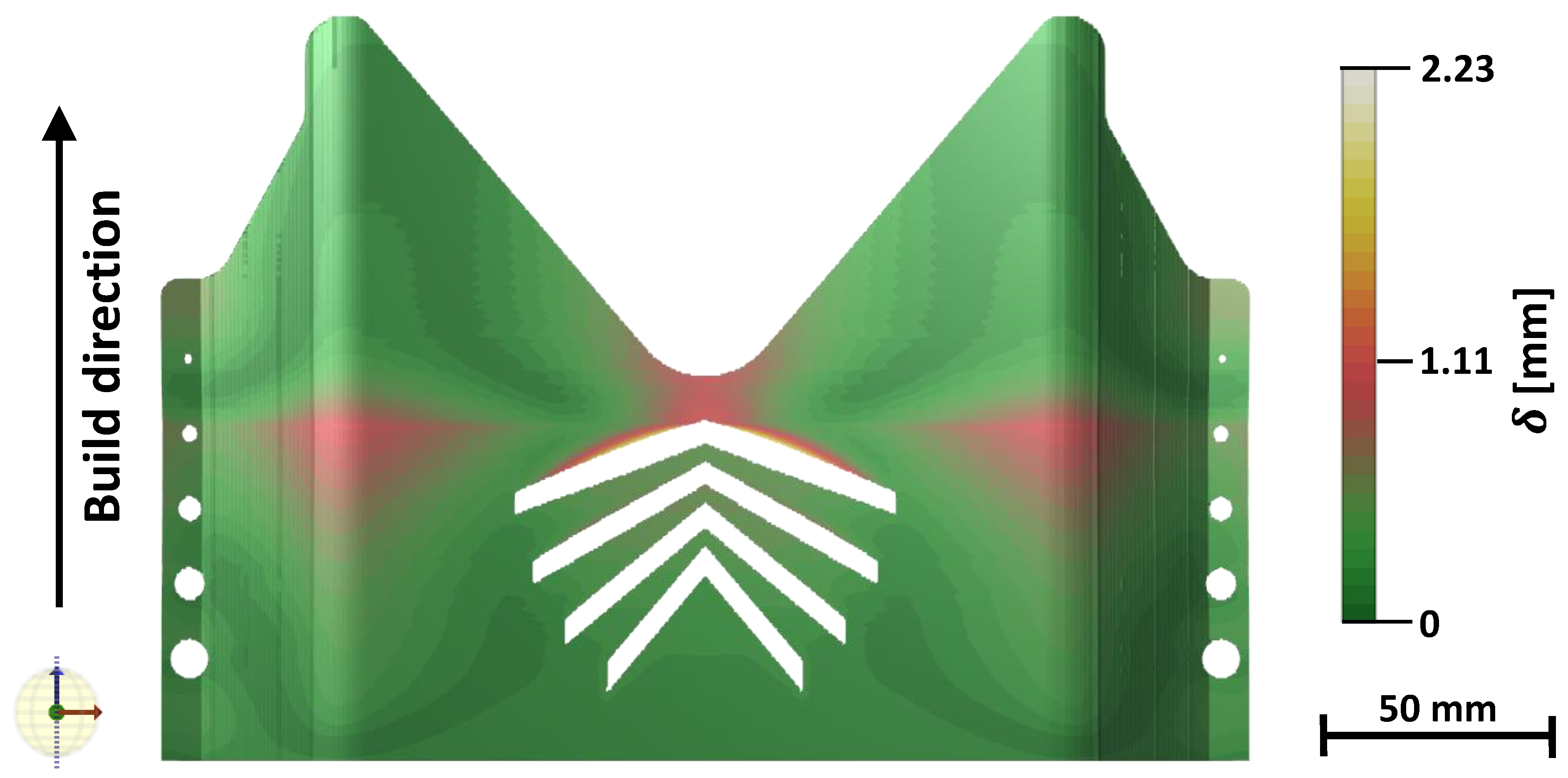
The compensation workflow involved predicting the cumulative displacement field and applying an inverse pre-distortion to the nominal CAD geometry. This intentional distortion helped counteract thermal strains during printing, bringing the final parts closer to their intended dimensions. The initial predictive simulation performed in Amphyon served as a critical step in evaluating the potential deformation patterns of the parts prior to the physical builds. By analyzing thermal-induced deformations across all parts placed on the build plate, the simulation identified high-risk regions prone to warping, enabling strategic planning for compensation and support structures. Representative results are shown in Figure 1, highlighting areas where thermal expansion, stress concentration, and residual stress accumulation could lead to significant deformation, particularly in complex and unsupported features.
The simulations revealed concentrated displacement in areas with sharp geometric transitions and unsupported sections, especially around the V-shaped slots and the sidewalls. This behavior aligns with the fundamental principles of thermal expansion, where localized heating and subsequent cooling produce uneven dimensional changes across the part. Thermal expansion can be quantified by the equation:
Δ L = α L 0 Δ T
Here, α is the coefficient of thermal expansion, L 0 is the original length, and Δ T is the temperature difference between the heated and ambient states. Due to the rapid cooling associated with the PBF process, large Δ T values emerged in unsupported areas, particularly near overhangs. Unsupported overhangs lack direct contact with the build plate or previously solidified layers, which serve as heat sinks. As a result, these areas experience limited conductive heat transfer, leading to localized heat accumulation and larger temperature gradients [39]. Additionally, the surrounding unmelted powder in overhanging regions acts as a thermal insulator, further impeding heat dissipation. This insulation effect exacerbates the temperature difference between the newly melted material and its surroundings.
Overhanging features typically have less surrounding solid material, resulting in a lower thermal mass. This reduced capacity to absorb and distribute heat contributes to more rapid and extreme temperature fluctuations [40]. Furthermore, the laser scan strategy in overhanging regions often differs from fully supported areas, potentially leading to non-uniform energy input and heat distribution, further contributing to larger Δ T values [41]. Consequently, these regions expanded and contracted disproportionately, leading to deformation hotspots observed as yellow and red zones in the simulation contours. This effect was especially pronounced in parts with high surface-to-volume ratios, as these features experienced increased thermal gradients, leading to more significant deformation upon cooling.

2.2. Experimental

2.2.1. Specimen Design

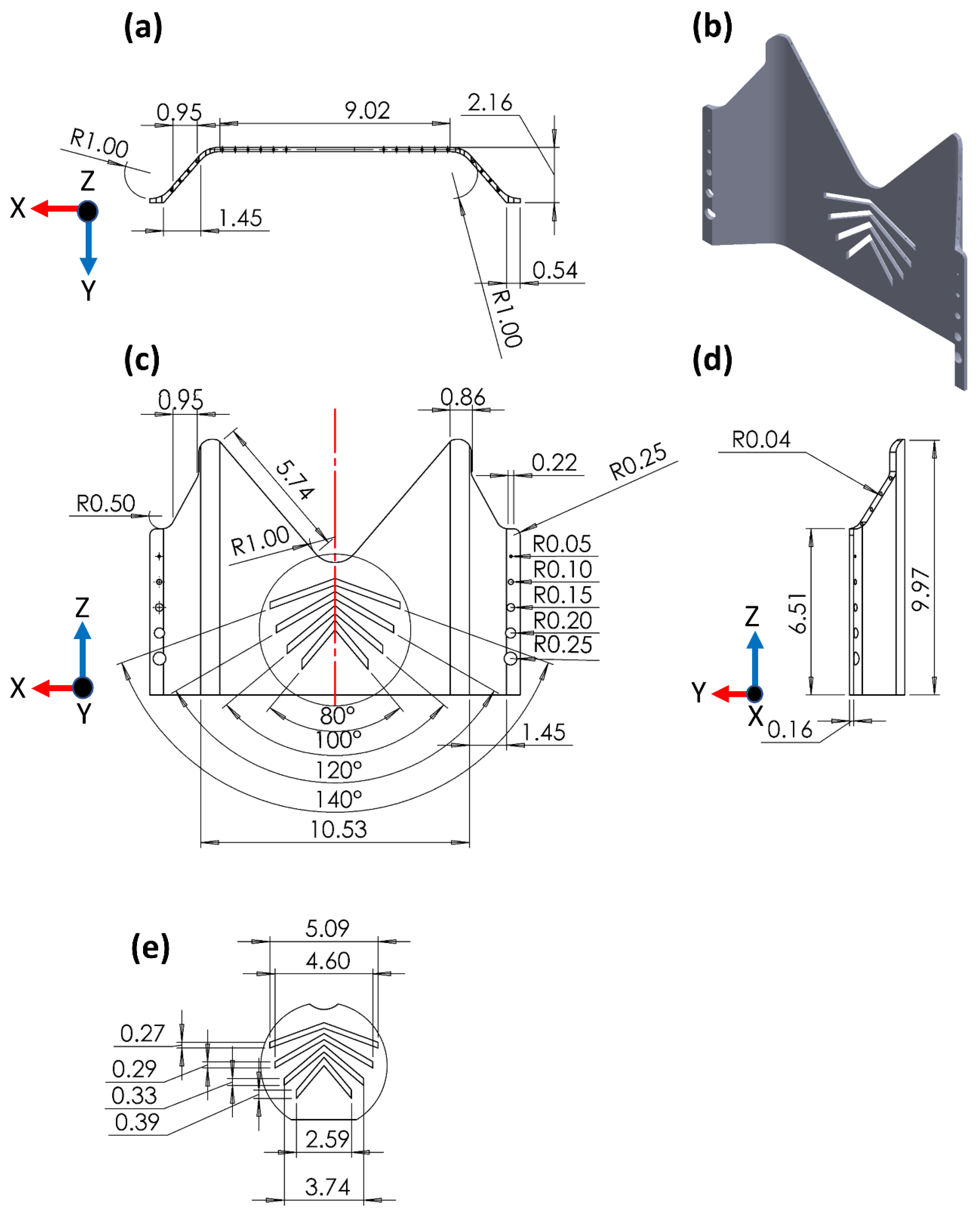
Figure 2 shows the specimen design, which is intentionally complex to test the capabilities of ML-PBF. The part measures 370 mm in length, 55 mm in width, and 254 mm in height, with a thickness of 3.8 mm. The high aspect ratio renders the part particularly susceptible to deformations during the printing process. Figure 2a–d display the top, isometric, front, and side views of the part, respectively. Key design features include twenty vertical holes running through the part, each with a diameter of approximately 2.0 mm, as well as five circular holes positioned along both the left and right sides, aligned with the Y-axis. These circular holes range from 2.5 mm to 12.7 mm in diameter, increasing incrementally by approximately 2.5 mm.
The front surface of the part incorporates several down-facing slots, each 6.35 mm wide, with angles ranging from 80 to 140 degrees in 20-degree increments, as shown in Figure 2e. A central circular feature with a 25.4 mm radius is also present on the front surface. These geometric features pose challenges for metal AM, as the holes and slots create geometric discontinuities that intensify thermal gradients during printing, leading to stress concentrations. Unsupported downward-facing features, such as these, are particularly difficult to print and are prone to sagging or warping. Overhangs at steep angles are also vulnerable to deformation, as molten material can collapse under its own weight [42].
To understand the effects of scaling on deformation behavior, the slots and holes were removed, and the part was printed at three reduced scales—0.5×, 0.25×, and 0.1×. While the removal of internal features in the scaled models inevitably alters local stress distributions, this simplification is intentional. It isolates size-dependent deformation behavior by eliminating the influence of localized stress concentrators. By eliminating these features in the smaller models, the study aimed to investigate broader deformation patterns across different scales. This approach allows for a clearer evaluation of whether deformation behavior remains consistent when the part is scaled down, before reintroducing more intricate geometries. Additionally, halved versions of the scaled-down parts were printed to assess the symmetry of deformation patterns.

2.2.2. Specimen Fabrication and Characterization

The parts were fabricated by 3D Systems using LaserForm® Ni718 (UNS N07718) (3D Systems Corp, Littleton, CO, USA) alloy on a DMP Factory 500—a large-frame metal additive manufacturing machine located in Littleton, Colorado. This machine features three simultaneously operating 500 W lasers, enabling efficient and precise production within a build envelope of 500 × 500 × 500 mm. LaserForm® Ni718 or more commonly IN718 is a nickel-chromium-based superalloy renowned for its exceptional mechanical properties, corrosion resistance, and high-temperature performance. The powder composition conforms to the ASTM F3055 standards, and its mechanical and thermal properties have been reported in [38]. A consistent layer thickness of 60 μm was maintained throughout the build to ensure high precision, while the process was conducted in a controlled inert gas atmosphere (using Argon) to prevent oxidation and preserve material integrity. A volumetric energy density of 50 J/mm3 was applied during fabrication. Post-processing involved stress relief and homogenization at 1065 °C for 1.5 h, followed by an Argon quench to minimize warping during subsequent machining. All specimens were printed on a wrought IN718 substrate.
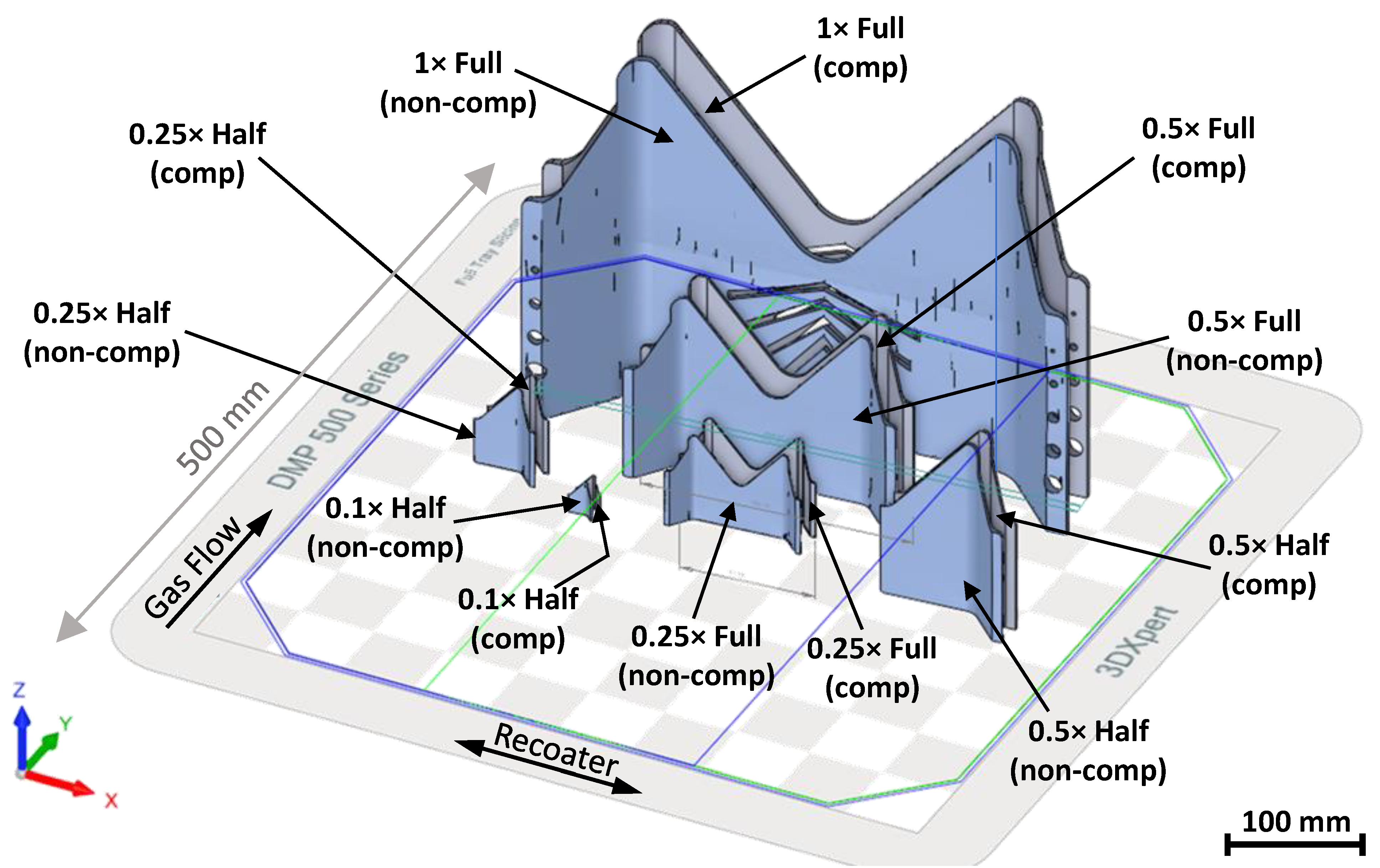
Two variations in each specimen were printed: an uncompensated model (blue) and a compensated model (gray). Figure 3 shows the build plate arrangement, highlighting these two approaches. The compensated geometry was generated in Amphyon using mechanical simulations with a 1 mm × 1 mm mesh to predict thermal distortions; this pre-distortion technique counteracts anticipated thermal stresses, thereby improving dimensional accuracy. In contrast, the uncompensated geometry was printed without adjustments and served as a baseline. This dual-model strategy provided a direct comparison for evaluating how effectively compensation reduced deformations and enhanced overall dimensional fidelity.
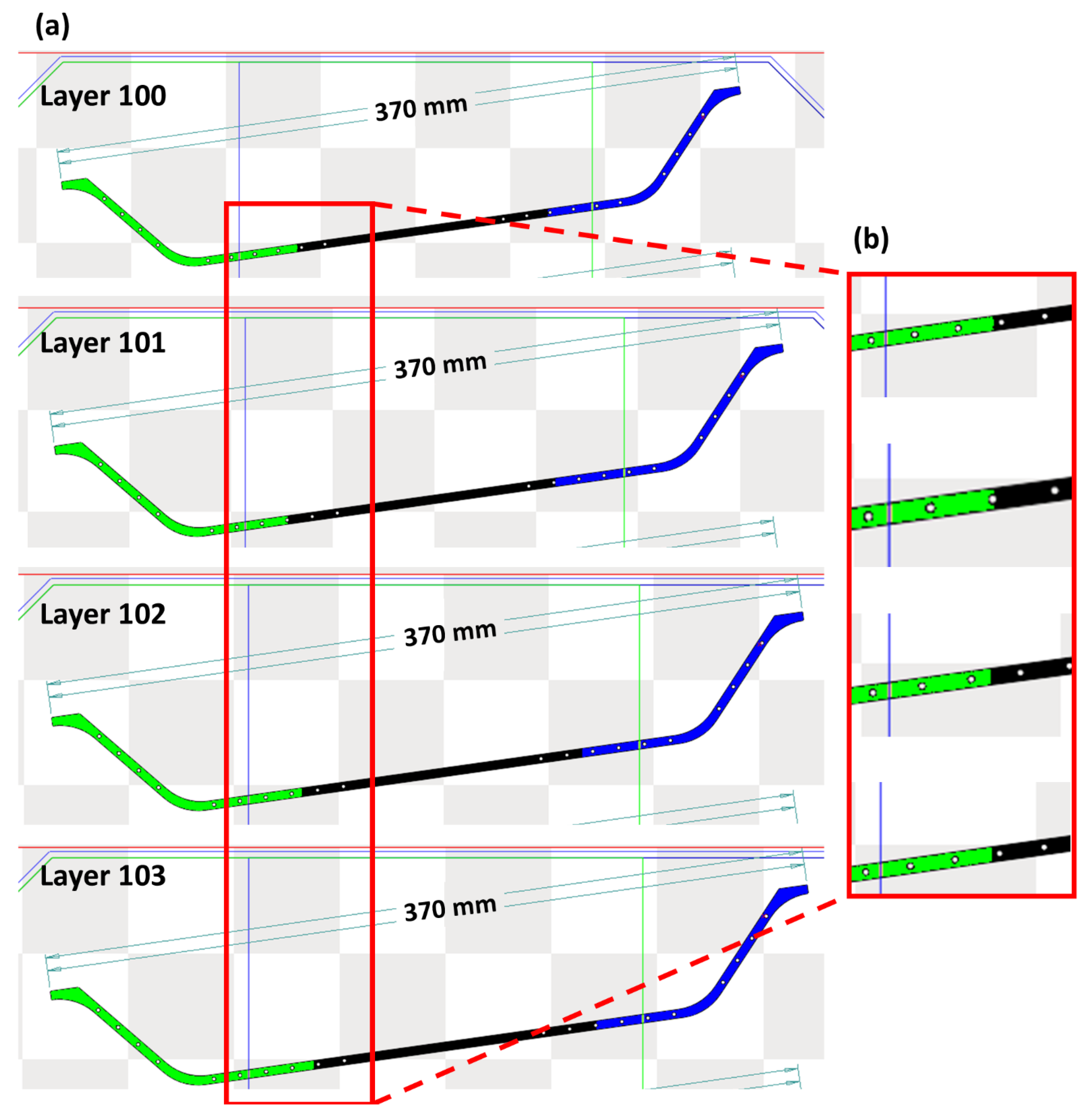
The parts were oriented upright to enhance surface quality and minimize the need for additional support. Their placement on the build platform was strategically planned: some parts were printed using a single laser, others with two lasers, and the largest part with three lasers. Figure 4a illustrates the scan paths of the three lasers while printing the largest compensated part (1× Full Comp), covering layers 100 through 103. Each laser was assigned to a specific region: the green laser printed the left section, the blue laser the right section, and the black laser handled the contour and middle region. Figure 4b provides a detailed view of the stitching zone, where the regions printed by the black and green lasers overlap. Importantly, the stitching line was deliberately varied within a 5 mm zone across layers. This dynamic variation reduces localized heat accumulation and mitigates thermal gradients, promoting homogeneity in material properties. By shifting the overlap zone between layers, the process fosters stronger inter-layer bonding and ensures uniformity in the stitching region, ultimately enhancing the parts’ structural integrity and performance.

3. Results and Discussion

3.1. Analysis of Build Iterations

In total, 3 iterations were necessary to successfully fabricate the geometry. No failures occurred in the scaled-down parts, underlining the heightened challenges of printing larger, high-aspect-ratio components.

3.1.1. First Build with No Support Structures

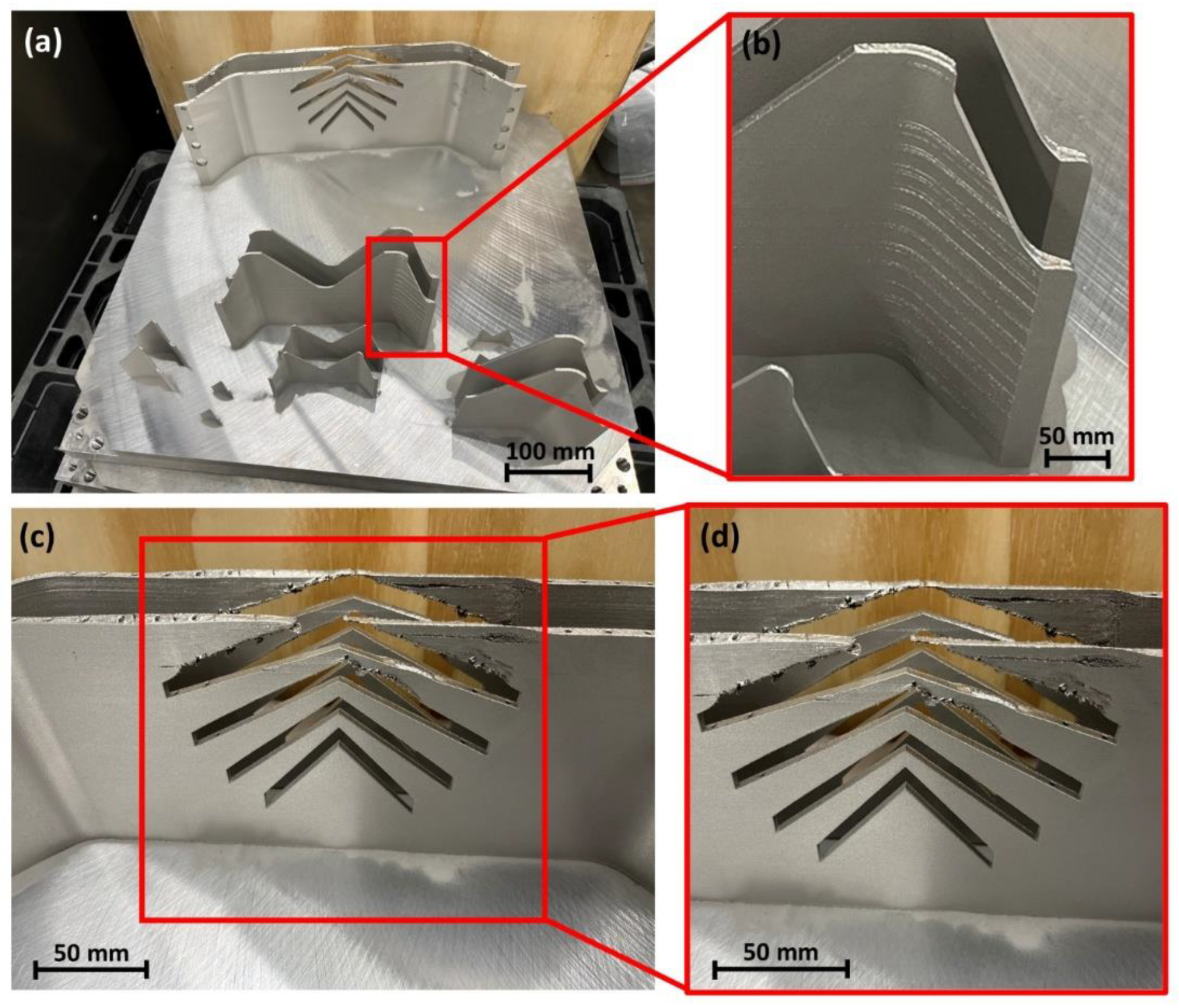
In the initial build iteration, no support structures were used, allowing an examination of how thermal stresses affected both compensated and uncompensated geometries at various scales. Figure 5 presents the outcome of this approach. In Figure 5a, the entire build is shown on the substrate, encompassing part sizes from 0.1× to 1×. While the smaller geometries generally remained intact, the 0.5× and 1× versions exhibited pronounced warping and incomplete layers.
A closer view of the uncompensated 0.5× geometry is provided in Figure 5b, where significant layer shifts are visible along the curved side walls. These shifts suggest that repeated heating and cooling cycles compromised inter-layer bonding, leading to structural instability. In Figure 5c, the front region of the 1× geometry highlights severe warping and partial delamination at the V-shaped slots. Although the compensated model (in the background) performed slightly better, it too failed to maintain full structural integrity. Finally, Figure 5d offers a close-up of these slots, underscoring how high-aspect-ratio and overhanging features generate large thermal gradients that geometric pre-distortion alone cannot fully offset.
The V-slots are particularly vulnerable due to the thermal mechanisms discussed in Section 2.1; as thin-walled overhanging sections, they lack efficient conduction pathways, resulting in steep thermal gradients and significant residual stresses. Although compensation techniques pre-distort the CAD model to counteract some of the expected deformation, they do not address the fundamental lack of mechanical support in these regions. Consequently, the warping seen in Figure 5c,d confirms that geometric compensation alone cannot prevent failure in unsupported, high-stress features such as the V-slots.
These observations establish that while smaller, simpler parts printed successfully without supports, larger geometries with complex overhangs and thin walls demand a combination of compensation and robust support strategies. The next build iteration therefore introduced targeted supports to stabilize high-stress regions, reduce thermal gradients, and improve overall print stability.

3.1.2. Second Build with Basic Support Structures

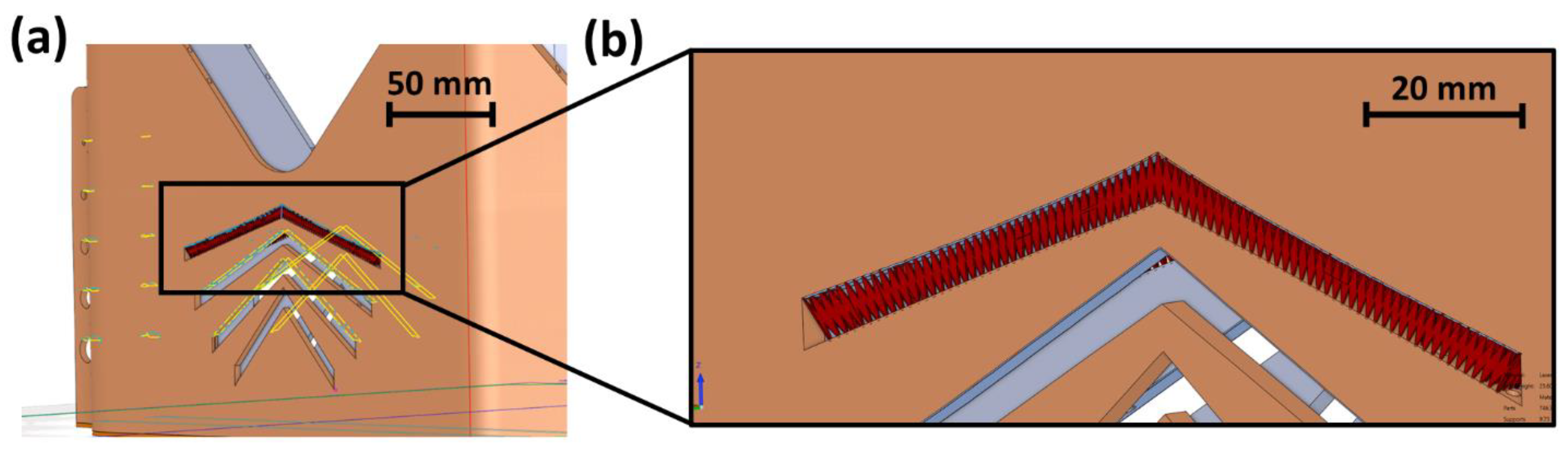
In the second iteration, triangular support structures were introduced to stabilize the regions that experienced the most severe warping in the first build, particularly the outer edges of the topmost V-slot (Figure 6). These supports were added to provide mechanical restraint to the overhanging edges while improving local heat conduction during fabrication. The triangular configuration was selected based on prior studies demonstrating the effectiveness of angled or gusset-type supports in reducing distortion in thin-walled, high-aspect-ratio features. Their inclined geometry provides a continuous path for heat dissipation and offers improved anchoring against curling forces. A magnified view in Figure 6b highlights the supports’ orientation and the way they brace the unsupported edges. While this strategy reduced some of the distortion observed in the first build, noticeable warping persisted in the uppermost sections, indicating that further refinement of support density and placement was required to fully stabilize the print.
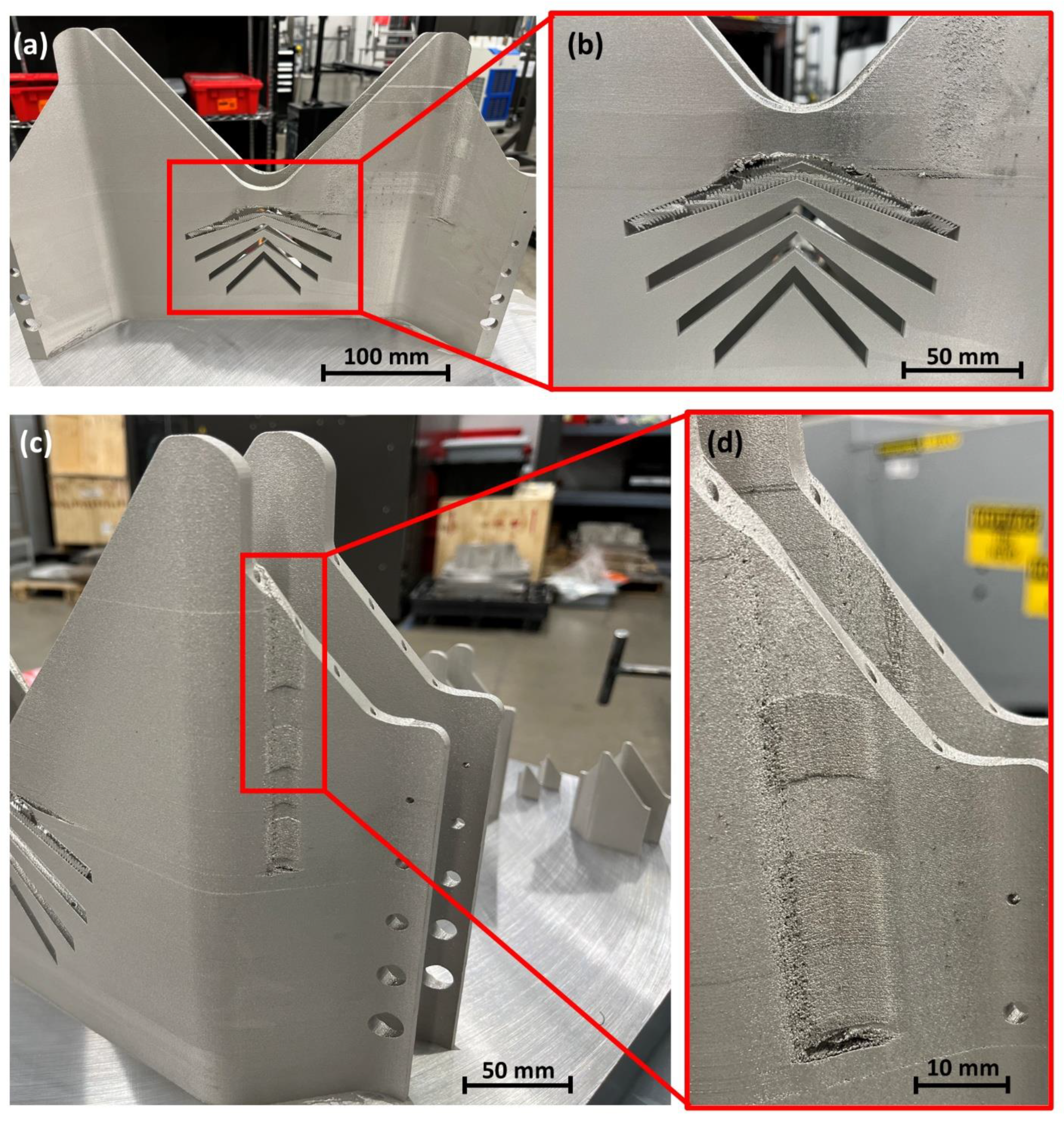
Figure 7 depicts the resulting full-scale part after the second build. In Figure 7a, the overall geometry remains largely intact—a notable improvement compared to the unsupported version. The second-highest slot, which had warped severely before, now appears more stable. This change likely stems from the supports forming bridging points between the slot edges and the main body, enhancing heat conduction and mechanically reinforcing thin-walled sections. By anchoring both sides of the slot, the supports helped counteract the curling forces that arise from repeated heating and cooling cycles.
Despite these gains, Figure 7b shows that the topmost V-slot continues to exhibit warping and partial delamination, suggesting that the triangular supports did not fully accommodate the higher residual stresses at greater build heights. As discussed in Section 2.1, conductive heat transfer diminishes with distance from the substrate, amplifying thermal gradients near the top of the build. The existing supports appear insufficiently dense to handle these intensified conditions. Figure 7c,d highlight surface roughness and localized distortion along narrow channels near the front face. These features trap heat due to their limited cross-sectional area, and since triangular supports did not extend into these regions, delamination and layer misalignment persisted.
Overall, the second build iteration demonstrates that triangular supports effectively reduced warping in certain V-slots and prevented catastrophic failure, yet they remained inadequate in the uppermost slot and other tight features. These findings inform the approach for the final build, where support density was increased, and placement was further optimized using Amphyon to achieve enhanced structural integrity across all geometries.

3.1.3. Third and Final Build with Increased Support Density

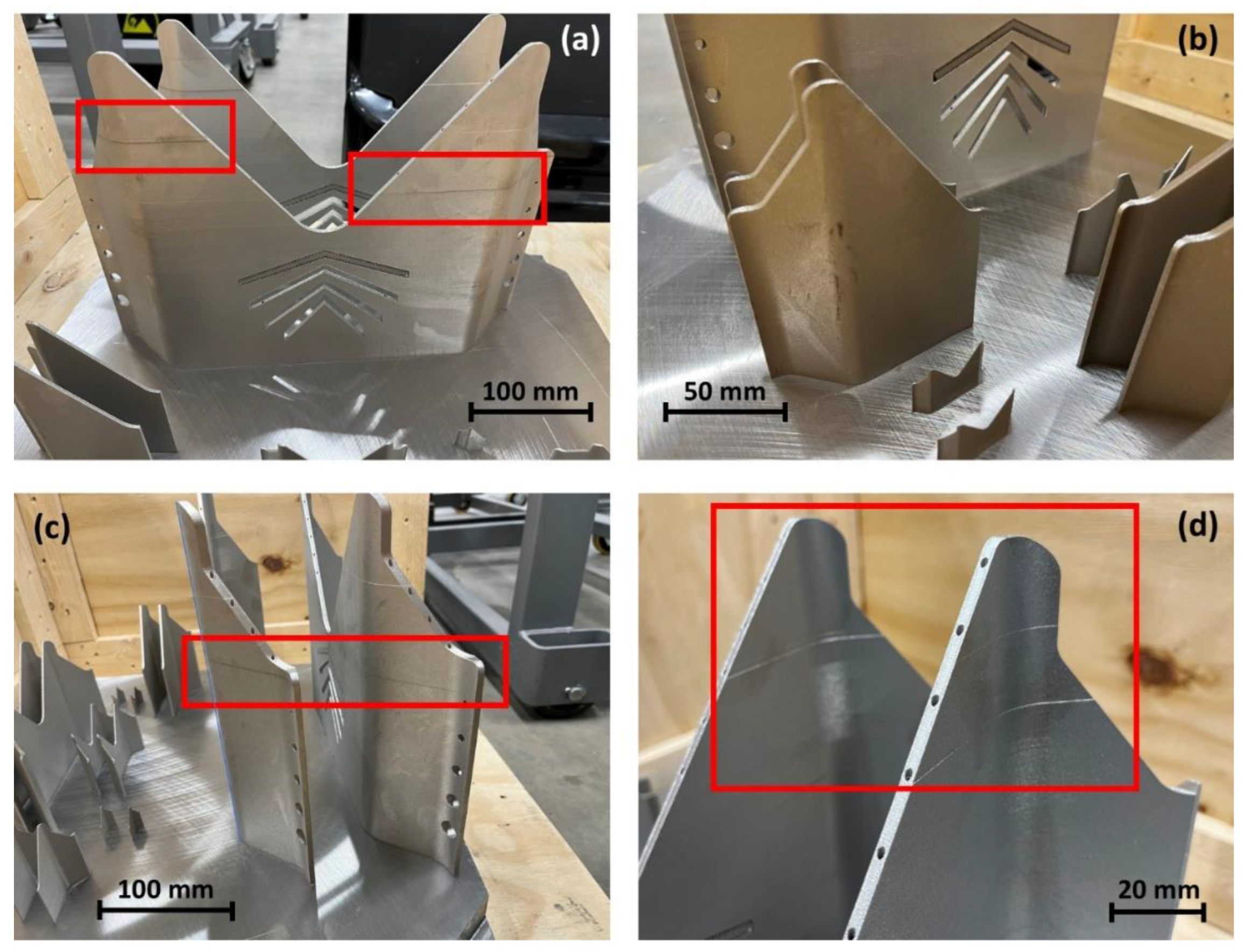
Based on the insights gained from the second build, conical supports were introduced across the width of the top V-slot in the final iteration, supplementing the triangular supports already in place along the outer edges. This strategy aims to reinforce the most deformation-prone region by providing a broader contact area for heat dissipation and mechanical anchoring. Figure 8 illustrates the outcome of this approach. In Figure 8a, the full-scale part is shown with minimal signs of delamination at the V-slots, indicating a marked improvement in structural stability compared to earlier builds. Figure 8b highlights several scaled-down specimens, which exhibit similarly reduced warping due to the less demanding thermal conditions at smaller dimensions.
Although the new conical supports successfully mitigated warping at the top V-slot, subtle layer shifts persisted in the largest geometry. Figure 8c,d focus on these shifts, which remain evident even in the presence of additional supports. These residual deformations suggest that while the conical supports reduce localized thermal gradients, the tall, slender geometry still concentrates stress in the upper regions. As noted in Section 3.1.2, reduced heat dissipation at increasing build heights leads to elevated thermal gradients and differential expansion, producing the observed layer shifts. The conical supports prevented severe delamination between the slot surfaces and the support structures—a recurring issue in previous iterations—yet some minor misalignment arose due to the accumulation of thermal stresses over the course of the build.
Overall, this final build iteration demonstrates that comprehensive support strategies—combining triangular and conical elements—are crucial for stabilizing complex geometries with large overhangs and tall features. The conical supports in particular proved effective in reinforcing the topmost V-slot, reducing the severe warping seen in earlier builds. However, slight layer shifts in the tallest sections indicate the need for additional measures such as advanced in situ thermal monitoring, adaptive scanning strategies, or dynamic support configurations. These refinements would help distribute heat more evenly, further mitigating residual stresses and enhancing dimensional fidelity in large-scale, high-aspect-ratio parts under multi-laser PBF.
The progression from no supports to triangular supports to combined triangular-conical supports was guided by two principles established in the literature: (1) supports serve as heat dissipation pathways by providing conductive links to previously solidified material, and (2) supports provide mechanical anchoring to resist curling forces induced by thermal contraction. Triangular supports at V-slot edges provided localized anchoring but limited heat conduction pathways. The subsequent addition of conical supports spanning the full V-slot width increased both the contact area for heat transfer and the mechanical restraint across the deformation-prone region. This rationale is consistent with recent studies [43] demonstrating that increased support contact area reduces peak temperatures and vertical thermal gradients, correlating directly with reduced part deformation. Table 1 summarizes the support design rationale and their observed effects across the three builds.
The deformation behavior observed in the compensated and supported builds is consistent with broader trends reported for IN718, which is known to exhibit higher thermal distortion than materials like Ti-6Al-4V under similar PBF conditions. This increased sensitivity is attributed to its higher thermal expansion, lower thermal conductivity, and the absence of stress-relieving phase transformations. Previous studies have reported that IN718 components can experience 50–80% greater distortion than their Ti-6Al-4V counterparts, even when processed under comparable thermal input and scan strategies [44,45,46]. Additionally, Ball et al. [47] and Xie et al. [48] highlight the need for carefully tuned scan strategies and thermal control to manage distortion in ML-PBF systems for Ni-based superalloys. As such, compensation methods and support schemes validated for Ti-6Al-4V may not be directly transferable to IN718. In this study, although distortion was significantly reduced through compensation and support refinement, residual warping persisted in unsupported regions, underscoring the need for material-specific calibration and combined mitigation strategies. These findings reinforce the importance of co-designing supports and compensation based on the alloy’s thermal and mechanical behavior, particularly in the context of ML-PBF.

3.2. Effect of Compensation Strategies on Deformation

The following section delves into a detailed comparison of the parts from the final build against their original CAD geometries. This analysis examines the effectiveness of the compensation strategies by comparing actual deformations in both compensated and uncompensated models. All post-build deformation measurements were obtained using a handheld structured-light 3D scanner with sub-millimeter resolution. The scanned models were aligned to the nominal CAD geometry using best-fit alignment, and deviation contours were computed to quantify displacement. Potential sources of measurement uncertainty include registration errors when merging multiple scans, surface reflectivity variations on as-built metallic surfaces, and algorithmic assumptions in best-fit alignment. Structured-light scanners of this type typically achieve dimensional deviations of 0.02 to 0.15 mm relative to coordinate measuring machine (CMM) references when applied to metal AM parts. Importantly, the comparative nature of this study, where all specimens were scanned using identical equipment, protocols, and operator procedures, ensures internal consistency. Any systematic errors would affect compensated and uncompensated parts equally, preserving the validity of relative comparisons. Therefore, overlaying the scanned data onto the design geometries effectively reveals the impact of the implemented support structures and compensation measures in minimizing deformation, particularly in areas with complex features.
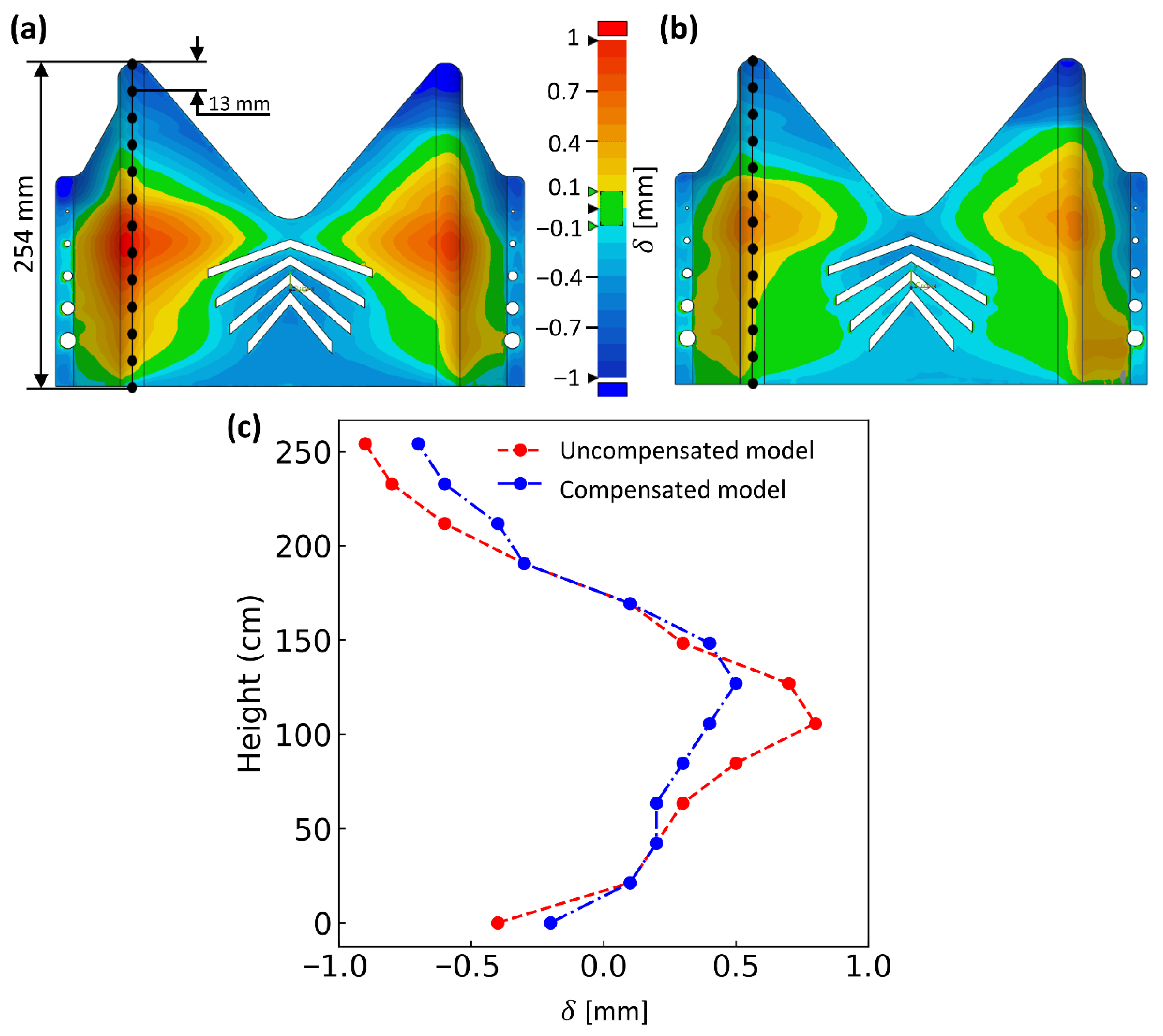
Figure 9a,b compare the final deformation fields of the full-scale geometry for uncompensated and compensated builds, respectively. Both contour plots span from −1 mm to +1 mm, with the tolerable deviation (−0.1 mm to +0.1 mm) indicated by a green band on the color scale. Notably, even the uncompensated model in Figure 9a exhibits deformation values lower than those initially predicted by Amphyon’s early simulations, which forecasted displacements exceeding 2 mm in critical overhanging regions. This reduction partly reflects improvements made in support placement and scanning strategies throughout the build iterations.
Despite these refinements, the uncompensated part still displays large positive (red/orange) and negative (blue) displacements, particularly along the sidewalls and central section of the geometry. These “hotspots” suggest that thermal expansion and contraction remain uneven, producing stress concentrations capable of jeopardizing dimensional accuracy and mechanical integrity. In contrast, Figure 9b shows the compensated model, where the red/orange zones are significantly smaller, and the areas of pronounced contraction (blue) are more localized. This more uniform deformation pattern indicates that geometric pre-distortion has successfully countered the worst of the thermal gradients, leading to a final shape closer to the nominal CAD.
Figure 9c offers a quantitative comparison of δ measured at the black-circled points in Figure 9a,b. The red curve (uncompensated) oscillates widely across the part’s height, reflecting persistent thermal stresses and layer misalignments. In contrast, the compensated model (blue curve) remains within narrower bounds, showing up to a 37.5% reduction in peak displacement compared to the uncompensated build and aligning more closely with the target geometry. By reducing extreme out-of-plane distortions, the compensation strategy not only enhances structural fidelity but also minimizes the risk of assembly misfits and operational failures. These improvements confirm that combining refined support designs with a robust pre-distortion approach is crucial for mitigating residual stresses in high-aspect-ratio, thin-walled components under multi-laser PBF conditions.
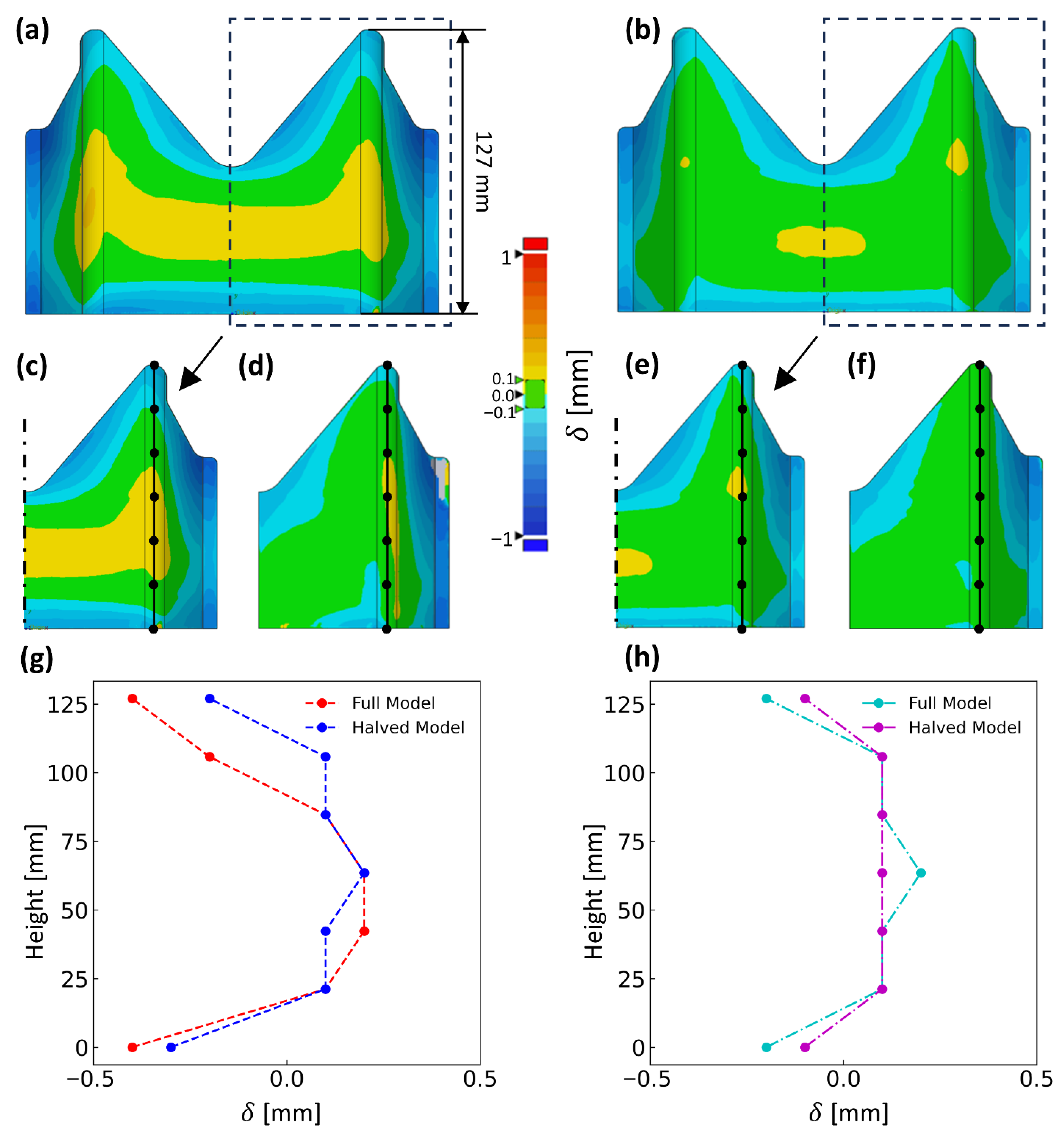
Figure 10 examines the deformation behavior of the 0.5× geometry in both uncompensated and compensated forms. In Figure 10a, the uncompensated full model displays its overall displacement field, while Figure 10b shows the compensated full model. Although the 0.5× scale omits certain complex features from the 1× version, these scaled-down parts still reveal how thermal gradients evolve in relatively slender geometries.
Figure 10c,d focus on the uncompensated case. In Figure 10c, the right half of the full model (from (a)) is isolated for closer inspection. Meanwhile, Figure 10d shows the physically printed halved geometry, highlighting how removing the opposing half changes thermal boundary conditions and heat dissipation pathways. A direct comparison between Figure 10c,d indicates that the standalone half-part does not fully replicate the stress and deformation patterns of the corresponding half in the full model. This discrepancy arises because the complete geometry’s thermal mass and structural continuity influence heat flow and residual stress development. Once the part is “halved,” the absence of the other side alters both conduction routes and mechanical constraints, resulting in a distinct deformation profile.
Figure 10e,f repeat this comparison for the compensated geometry. In Figure 10e, the right half of the compensated full model (from (b)) is shown, whereas Figure 10f presents the printed halved version. Although compensation strategies reduce the overall magnitude of deformation, notable differences persist between the halved and full scenarios. This outcome implies that even a pre-distorted design cannot fully capture the thermal-mechanical behavior when the geometry is physically truncated, underscoring the importance of analyzing the entire part for accurate predictions.
Finally, Figure 10g,h plot δ along the black dashed line for the uncompensated and compensated cases, respectively, contrasting the full (red/cyan curve) and halved (blue or magenta curve) models. In Figure 10g, the uncompensated profiles show larger deviations, with the full model exhibiting more pronounced oscillations. By contrast, Figure 10h reveals that the compensated models remain closer to zero displacement, demonstrating that pre-distortion strategies do mitigate warping. Nevertheless, both plots confirm that halving the geometry changes the stress distribution, as the thermal and mechanical boundary conditions in the half-part diverge from those in the full assembly. Thus, relying solely on halved builds to predict final deformations can be misleading, even with geometric compensation in place.
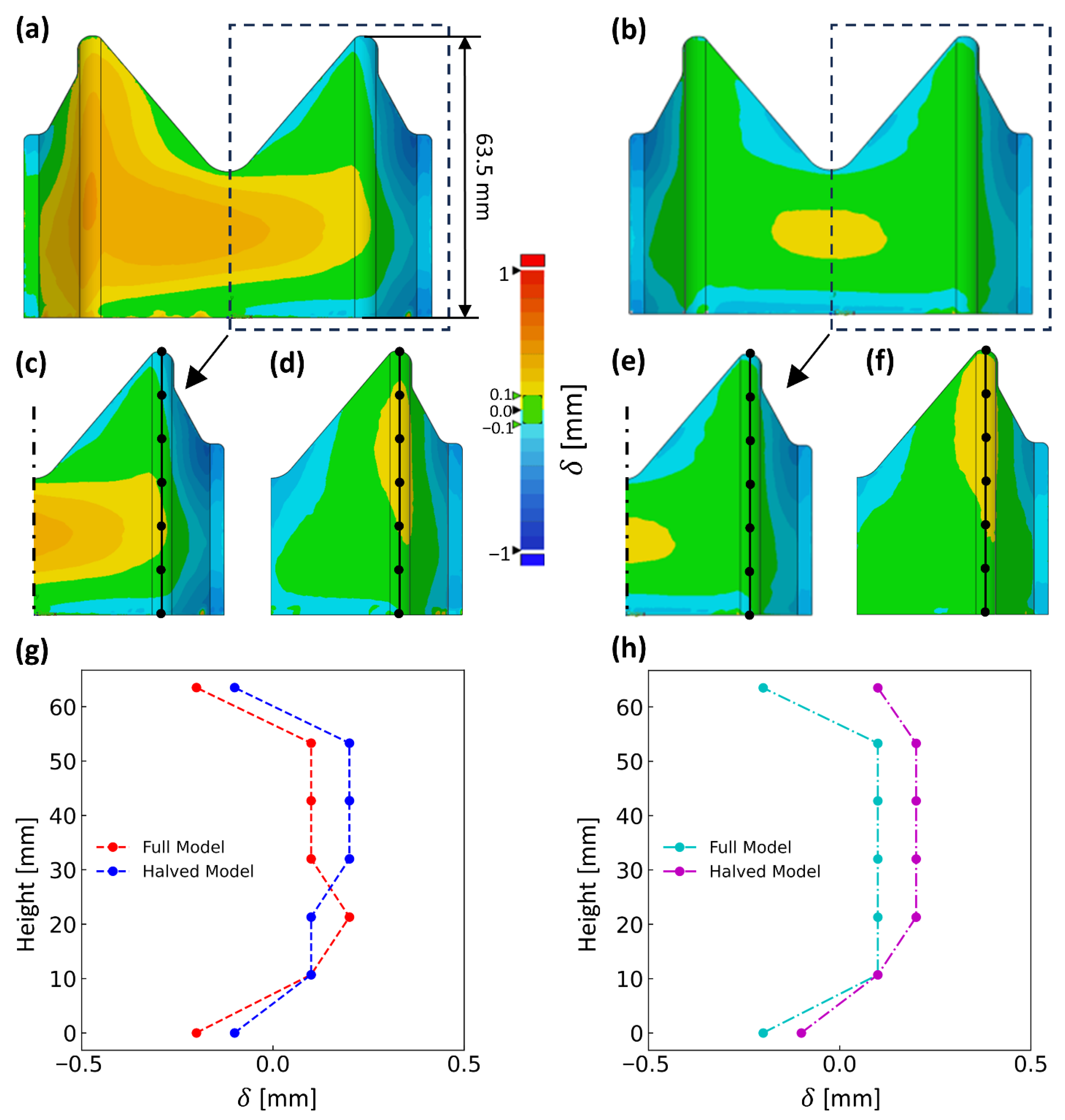
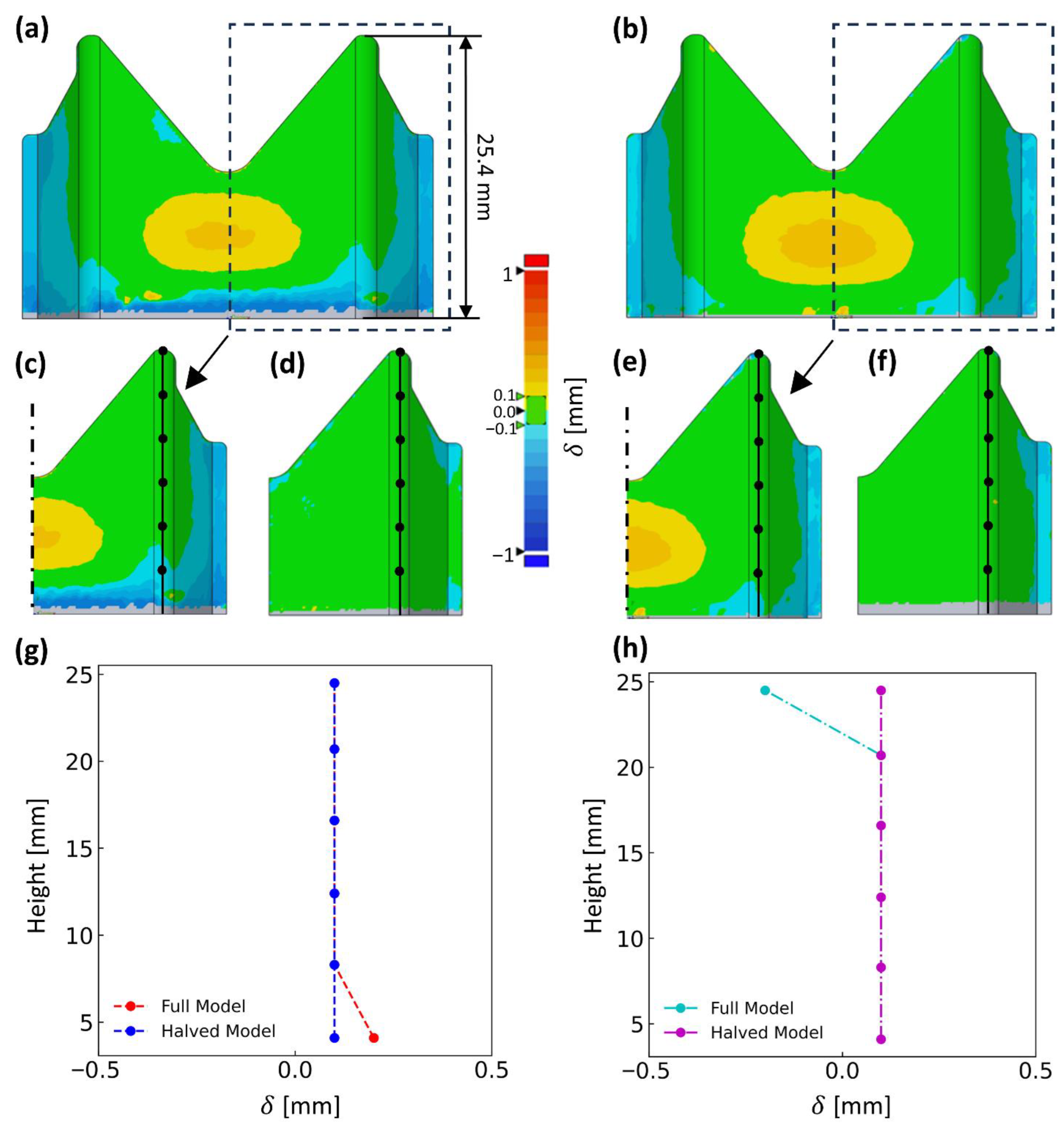
Figure 11 and Figure 12 examine the deformation behavior of the geometry scaled to 0.25× and 0.1×, respectively, under both uncompensated and compensated conditions. Compared to the full-size version, these smaller parts lack certain complex features, resulting in less pronounced distortions. However, they still exhibit notable deformation patterns that provide insights into thermal management and the influence of geometric compensation.
In Figure 11a,b (0.25× scale), the uncompensated and compensated full models are shown, with Figure 11c–f focusing on the right half of each and the corresponding printed halved geometries. The compensated model Figure 11b displays fewer extreme displacements than the uncompensated counterpart Figure 11a, but panels (c)–(f) reveal discrepancies between the half extracted from the full model and the actual halved print. These differences further underline that the thermal and mechanical behavior in the half-part cannot fully replicate the stresses that develop when the entire geometry is present. Panels (g) and (h) confirm this observation by plotting the vertical displacement profiles along the black dashed line for both uncompensated and compensated cases, showing that the full model experiences broader variations than its halved counterpart—even at this reduced scale.
A similar trend is observed at 0.1× scale in Figure 12, where the overall magnitudes of deformation are smaller but still follow the same distributional tendencies. In Figure 12a,b, the uncompensated and compensated full models highlight that geometric pre-distortion moderates the peak displacements. However, the side-by-side comparison of Figure 12c–f again illustrates that halving the geometry alters the heat flow and residual stress development. Figure 12g,h present displacement curves for the uncompensated and compensated builds, respectively, demonstrating that even with a more uniform deformation field at 0.1×, the halved models do not perfectly mirror the behavior of the full geometry.
These findings confirm that while scaling down the part reduces absolute distortion values, it does not eliminate the underlying thermal gradients that drive warping. Moreover, halving the geometry introduces boundary conditions distinct from those in the full model, leading to differences in both deformation patterns and magnitudes. Consequently, small-scale builds and halved models serve as cost-effective preliminary tools for identifying likely deformation hotspots but cannot fully replace the insights gained from examining the entire part. In practice, combining small-scale analyses with compensated full-scale builds is essential for accurately predicting and mitigating distortion in high-aspect-ratio components under multi-laser PBF.

4. Conclusions

This study investigates the impact of geometric compensation, support strategies, and scaling effects in ML-PBF of large high-aspect ratio IN718 parts. An intentionally complex tall and slender geometry was printed at 4 different scales (full scale, 0.1×, 0.25×, and 0.5×) with and without geometric compensation, to understand the effect of geometric compensation and support structure requirements. Once printed, these geometries were scanned and the scanned STL files were simulated in Ansys Additive for deformation and residual stresses, to understand their difference with the idealized CAD geometries. The results confirm that distortion behavior in IN718 significantly differs from alloys such as Ti-6Al-4V, with higher thermal stress sensitivity and more pronounced deformation.
To clarify the origins of the observed deformation behavior, this study distinguishes the dominant contributing factors under constant process parameters. First, geometric effects play a critical role: the high-aspect-ratio configuration, thin walls, and V-slot features result in low bending stiffness, making the structures particularly sensitive to thermal gradients and associated contraction forces. Second, build height effects contribute significantly, as residual stresses accumulate with increasing height, especially in unsupported upper regions where mechanical restraint and heat dissipation are limited. Finally, ML-PBF-specific effects further exacerbate deformation, including thermal accumulation from simultaneous multi-laser exposure, the presence of stitching zones, and scan field partitioning inherent to multi-laser systems. While these ML-PBF characteristics were not independently varied in this study, their interaction with slender geometries and increasing build height results in a coupled, non-separable influence on deformation behavior. Collectively, these findings emphasize that deformation in large, high-aspect-ratio components arises from the combined interaction of geometry, build height, and multi-laser process characteristics rather than from individual process parameters alone.
Simplified or scaled-down models demonstrated significantly different displacement distributions compared to their full-scale counterparts, suggesting limitations in their fidelity and predictive accuracy for replicating the mechanical behavior of actual components. These discrepancies highlight the challenges in using reduced-scale prototypes as reliable surrogates in structural analysis or performance evaluation.
Overall, the results demonstrate that distortion in IN718 parts produced via ML-PBF can be substantially reduced through a combination of simulation-guided geometric compensation and iterative support refinement. However, the effectiveness of these strategies depends on build scale, geometry simplification, and the interaction between compensation and structural support. Future work could include a detailed investigation aimed at isolating the specific effects of ML-PBF by comparing them with single-laser systems, enabling a deeper understanding of how multi-laser interactions influence thermal distortion and paving the way toward intelligent thermal control strategies for improved part quality.

Author Contributions

R.R.: Methodology, Software, Validation, Formal analysis, Investigation, Data curation, Writing—original draft preparation, Writing—review and editing, Visualization. A.B.: Conceptualization, Methodology, Formal analysis, Investigation, Resources, Writing—review and editing, Supervision, Project administration, Funding acquisition. All authors have read and agreed to the published version of the manuscript.

Funding

The work reported in this paper is funded by the Defense Advanced Research Projects Agency (DARPA) through Grant Number D22AP00147. Any opinions, findings, and conclusions in this paper are those of the authors and do not necessarily reflect the views of the supporting institution.

Data Availability Statement

The data presented in this study are available on reasonable request from the corresponding author.

Acknowledgments

The authors gratefully acknowledge Abdul Malik Al Mardhouf Al Saadi for his assistance in preparing Figure 3. The authors would also like to thank Christopher Rees, Beehive, and Nachiketa Ray, 3D Systems, Leuven, for their valuable input regarding the experimental setup and process parameters. During the preparation of this work, the first author, Riddhiman Raut, used OpenAI ChatGPT-3.5 in order to improve grammar and readability. After using this tool/service, the first author reviewed and edited the content as needed and takes full responsibility for the content of the publication.

Conflicts of Interest

The authors declare that they have no known competing financial interests or personal relationships that could have appeared to influence the work reported in this paper.

References

  1. Zhang, C. 3D printing: A catalyst for innovation in modern industries. Appl. Comput. Eng. 2023, 9, 241–246. [Google Scholar] [CrossRef]
  2. Wong, K.V.; Hernandez, A. A Review of Additive Manufacturing. ISRN Mech. Eng. 2012, 2012, 208760. [Google Scholar] [CrossRef]
  3. Ngo, T.D.; Kashani, A.; Imbalzano, G.; Nguyen, K.T.Q.; Hui, D. Additive manufacturing (3D printing): A review of materials, methods, applications and challenges. Compos. Part B Eng. 2018, 143, 172–196. [Google Scholar] [CrossRef]
  4. Guo, N.; Leu, M.C. Additive manufacturing: Technology, applications and research needs. Front. Mech. Eng. 2013, 8, 215–243. [Google Scholar] [CrossRef]
  5. Kruth, J.-P.; Leu, M.C.; Nakagawa, T. Progress in Additive Manufacturing and Rapid Prototyping. CIRP Ann. 1998, 47, 525–540. [Google Scholar] [CrossRef]
  6. Sing, S.L.; Yeong, W.Y. Laser powder bed fusion for metal additive manufacturing: Perspectives on recent developments. Virtual Phys. Prototyp. 2020, 15, 359–370. [Google Scholar] [CrossRef]
  7. Wei, C.; Li, L. Recent progress and scientific challenges in multi-material additive manufacturing via laser-based powder bed fusion. Virtual Phys. Prototyp. 2021, 16, 347–371. [Google Scholar] [CrossRef]
  8. Tofail, S.A.M.; Koumoulos, E.P.; Bandyopadhyay, A.; Bose, S.; O’Donoghue, L.; Charitidis, C. Additive manufacturing: Scientific and technological challenges, market uptake and opportunities. Mater. Today 2018, 21, 22–37. [Google Scholar] [CrossRef]
  9. Pereira, T.; Kennedy, J.V.; Potgieter, J. A comparison of traditional manufacturing vs additive manufacturing, the best method for the job. Procedia Manuf. 2019, 30, 11–18. [Google Scholar] [CrossRef]
  10. Vafadar, A.; Guzzomi, F.; Rassau, A.; Hayward, K. Advances in Metal Additive Manufacturing: A Review of Common Processes, Industrial Applications, and Current Challenges. Appl. Sci. 2021, 11, 1213. [Google Scholar] [CrossRef]
  11. Vyatskikh, A.; Delalande, S.; Kudo, A.; Zhang, X.; Portela, C.M.; Greer, J.R. Additive manufacturing of 3D nano-architected metals. Nat. Commun. 2018, 9, 593. [Google Scholar] [CrossRef]
  12. Gao, M.; Li, L.; Wang, Q.; Ma, Z.; Li, X.; Liu, Z. Integration of Additive Manufacturing in Casting: Advances, Challenges, and Prospects. Int. J. Precis. Eng. Manuf. Technol. 2022, 9, 305–322. [Google Scholar] [CrossRef]
  13. Khorasani, M.; Ghasemi, A.; Rolfe, B.; Gibson, I. Additive manufacturing a powerful tool for the aerospace industry. Rapid Prototyp. J. 2022, 28, 87–100. [Google Scholar] [CrossRef]
  14. Tepylo, N.; Huang, X.; Patnaik, P.C. Laser-Based Additive Manufacturing Technologies for Aerospace Applications. Adv. Eng. Mater. 2019, 21, 1900617. [Google Scholar] [CrossRef]
  15. Vasco, J.C. Additive manufacturing for the automotive industry. In Additive Manufacturing; Elsevier: Amsterdam, The Netherlands, 2021; pp. 505–530. [Google Scholar] [CrossRef]
  16. Dalpadulo, E.; Petruccioli, A.; Gherardini, F.; Leali, F. A Review of Automotive Spare-Part Reconstruction Based on Additive Manufacturing. J. Manuf. Mater. Process. 2022, 6, 133. [Google Scholar] [CrossRef]
  17. Moridi, A. Biomedical Applications of Metal Additive Manufacturing: Current State-of-the-Art and Future Perspective. Am. J. Biomed. Sci. Res. 2020, 7, 6–10. [Google Scholar] [CrossRef]
  18. Sing, S.L.; An, J.; Yeong, W.Y.; Wiria, F.E. Laser and electron-beam powder-bed additive manufacturing of metallic implants: A review on processes, materials and designs. J. Orthop. Res. 2016, 34, 369–385. [Google Scholar] [CrossRef] [PubMed]
  19. Arısoy, Y.M.; Criales, L.E.; Özel, T. Modeling and simulation of thermal field and solidification in laser powder bed fusion of nickel alloy IN625. Opt. Laser Technol. 2019, 109, 278–292. [Google Scholar] [CrossRef]
  20. Peng, H.; Ghasri-Khouzani, M.; Gong, S.; Attardo, R.; Ostiguy, P.; Rogge, R.B.; Gatrell, B.A.; Budzinski, J.; Tomonto, C.; Neidig, J.; et al. Fast prediction of thermal distortion in metal powder bed fusion additive manufacturing: Part 2, a quasi-static thermo-mechanical model. Addit. Manuf. 2018, 22, 869–882. [Google Scholar] [CrossRef]
  21. Zhang, W.; Abbott, W.M.; Sasnauskas, A.; Lupoi, R. Process Parameters Optimisation for Mitigating Residual Stress in Dual-Laser Beam Powder Bed Fusion Additive Manufacturing. Metals 2022, 12, 420. [Google Scholar] [CrossRef]
  22. Terrazas-Najera, C.A.; Mayoral, F.L.; Garcia, O.F.; Hossain, M.S.; Espalin, D.; Fernandez, A.; Murr, L.E.; Wicker, R.B. Effects of process interruptions on microstructure and mechanical properties of three face centered cubic alloys processed by laser powder bed fusion. J. Manuf. Process. 2021, 66, 397–406. [Google Scholar] [CrossRef]
  23. Feng, S.; Ai, Z.; He, J.; Yang, B.; Gou, G.; Han, L. Effect of Annealing and Hot Isostatic Pressing on the Structure and Hydrogen Embrittlement Resistance of Powder-Bed Fusion-Printed CoCrFeNiMn High-Entropy Alloys. Metals 2023, 13, 630. [Google Scholar] [CrossRef]
  24. Zhang, Z.; Chen, W.; Liu, Q.; Li, Z.; Li, C.; Wang, C.H.; Li, X. Deep Cryogenic and Thermal Aging Treatments of Ti–5Al–5Mo–5V–3Cr Alloy Additively Manufactured by Powder Bed Fusion–Laser Beam. Adv. Eng. Mater. 2024, 26, 2400751. [Google Scholar] [CrossRef]
  25. Wong, H.; Dawson, K.; Ravi, G.A.; Howlett, L.; Jones, R.O.; Sutcliffe, C.J. Multi-Laser Powder Bed Fusion Benchmarking—Initial Trials with Inconel 625. Int. J. Adv. Manuf. Technol. 2019, 105, 2891–2906. [Google Scholar] [CrossRef]
  26. Sanchez, S.; Hyde, C.J.; Ashcroft, I.A.; Ravi, G.A.; Clare, A.T. Multi-laser scan strategies for enhancing creep performance in LPBF. Addit. Manuf. 2021, 41, 101948. [Google Scholar] [CrossRef]
  27. Masoomi, M.; Thompson, S.M.; Shamsaei, N. Quality part production via multi-laser additive manufacturing. Manuf. Lett. 2017, 13, 15–20. [Google Scholar] [CrossRef]
  28. Zhang, W.; Tong, M.; Harrison, N.M. Scanning strategies effect on temperature, residual stress and deformation by multi-laser beam powder bed fusion manufacturing. Addit. Manuf. 2020, 36, 101507. [Google Scholar] [CrossRef]
  29. Li, S.; Yang, J.; Wang, Z. Multi-laser powder bed fusion of Ti-6.5Al-2Zr-Mo-V alloy powder: Defect formation mechanism and microstructural evolution. Powder Technol. 2021, 384, 100–111. [Google Scholar] [CrossRef]
  30. Cao, L. Numerical Investigation on Molten Pool Dynamics During Multi-laser Array Powder Bed Fusion Process. Metall. Mater. Trans. A 2021, 52, 211–227. [Google Scholar] [CrossRef]
  31. Chen, C.; Xiao, Z.; Zhu, H.; Zeng, X. Deformation and control method of thin-walled part during laser powder bed fusion of Ti–6Al–4V alloy. Int. J. Adv. Manuf. Technol. 2020, 110, 3467–3478. [Google Scholar] [CrossRef]
  32. Philips, S.P.; Tetteh, A.; Di Prima, M.A.; Burchi, A.; Porter, D.A. Additive manufacturing inert gas flow path strategies for multi-laser powder bed fusion systems and their impact on lattice structure mechanical responses. 3D Print. Med. 2024, 10, 11. [Google Scholar] [CrossRef]
  33. Dimopoulos, A.; Zournatzis, I.; Gan, T.-H.; Chatzakos, P. Multi-Response Optimization of Ti6Al4V Support Structures for Laser Powder Bed Fusion Systems. J. Manuf. Mater. Process. 2023, 7, 22. [Google Scholar] [CrossRef]
  34. Santos, L.S.; Gupta, S.K.; Bruck, H.A. Simulation of buckling of internal features during selective laser sintering of metals. Addit. Manuf. 2018, 23, 235–245. [Google Scholar] [CrossRef]
  35. Wei, K.; Li, F.; Huang, G.; Liu, M.; Deng, J.; He, C.; Zeng, X. Multi-laser powder bed fusion of Ti–6Al–4V alloy: Defect, microstructure, and mechanical property of overlap region. Mater. Sci. Eng. A 2021, 802, 140644. [Google Scholar] [CrossRef]
  36. Caglar, H.; Liang, A.; Groom, K.; Mumtaz, K. Multi-laser powder bed fusion of Ti6Al4V: Diode area melting utilizing low-power 450 nm diode lasers. J. Mater. Process. Technol. 2024, 325, 118303. [Google Scholar] [CrossRef]
  37. Giubilini, A.; Calignano, F.; Galati, M.; Minetola, P. Assessment of simulation software for predicting induced distortions in laser-beam powder bed fusion of Ti6Al4V. Int. J. Adv. Manuf. Technol. 2025, 138, 1039–1054. [Google Scholar] [CrossRef]
  38. 3D Systems. LaserForm Ni718A Material Data Sheet (MDS). 2023. Available online: https://www.3dsystems.com/sites/default/files/2023-12/3d-systems-laserform-ni718a-mds-letter-us-revd-web.pdf (accessed on 21 March 2025).
  39. Wang, D.; Wu, S.; Fu, F.; Mai, S.; Yang, Y.; Liu, Y.; Song, C. Mechanisms and characteristics of spatter generation in SLM processing and its effect on the properties. Mater. Des. 2017, 117, 121–130. [Google Scholar] [CrossRef]
  40. Mercelis, P.; Kruth, J. Residual stresses in selective laser sintering and selective laser melting. Rapid Prototyp. J. 2006, 12, 254–265. [Google Scholar] [CrossRef]
  41. Yadroitsev, I.; Yadroitsava, I. Evaluation of residual stress in stainless steel 316L and Ti6Al4V samples produced by selective laser melting. Virtual Phys. Prototyp. 2015, 10, 67–76. [Google Scholar] [CrossRef]
  42. Patterson, E.A.; Lambros, J.; Magana-Carranza, R.; Sutcliffe, C.J. Residual Stress Induced in Thin Plates During Additive Manufacturing. In Additive and Advanced Manufacturing, Inverse Problem Methodologies and Machine Learning and Data Science; Taylor & Francis Group: Abingdon, UK, 2024; pp. 13–16. [Google Scholar] [CrossRef]
  43. Khobzi, A.; Mehr, F.F.; Cockcroft, S.; Maijer, D.; Sing, S.L.; Yeong, W.Y. The role of block-type support structure design on the thermal field and deformation in components fabricated by Laser Powder Bed Fusion. Addit. Manuf. 2022, 51, 102644. [Google Scholar] [CrossRef]
  44. Denlinger, E.R.; Heigel, J.C.; Michaleris, P.; Palmer, T.A. Effect of inter-layer dwell time on distortion and residual stress in additive manufacturing of titanium and nickel alloys. J. Mater. Process. Technol. 2015, 215, 123–131. [Google Scholar] [CrossRef]
  45. Afazov, S.; Rahman, H.; Serjouei, A. Investigation of the right first-time distortion compensation approach in laser powder bed fusion of a thin manifold structure made of Inconel 718. J. Manuf. Process. 2021, 69, 621–629. [Google Scholar] [CrossRef]
  46. Mishurova, T.; Cabeza, S.; Thiede, T.; Nadammal, N.; Kromm, A.; Klaus, M.; Genzel, C.; Haberland, C.; Bruno, G. The Influence of the Support Structure on Residual Stress and Distortion in SLM Inconel 718 Parts. Metall. Mater. Trans. A 2018, 49, 3038–3046. [Google Scholar] [CrossRef]
  47. Ball, A.K.; Basak, A. Numerical Investigation of the Thermal Distortion in Multi-Laser Powder Bed Fusion (ML-PBF) Additive Manufacturing of Inconel 625. Chin. J. Mech. Eng. Addit. Manuf. Front. 2023, 2, 100103. [Google Scholar] [CrossRef]
  48. Xie, D.; Lv, F.; Yang, Y.; Shen, L.; Tian, Z.; Shuai, C.; Chen, B.; Zhao, J. A Review on Distortion and Residual Stress in Additive Manufacturing. Chin. J. Mech. Eng. Addit. Manuf. Front. 2022, 1, 100039. [Google Scholar] [CrossRef]
Figure 1. Amphyon simulation of the full-scale geometry, showing predicted deformation ( δ ) from 0 mm to approximately 2.23 mm. The regions (with red and yellow contours) indicate the highest deformation around the upper center and near the top edges, while green areas exhibit minimal deformation. The black arrow indicates the build direction.
Jeta 04 00006 g001
Figure 2. Specimen design. The top, isometric, front, and side views are shown in (a), (b), (c), and (d), respectively, while (e) details the dimensions of the V-shaped slots in the middle of the specimen. All dimensions are in inch.
Jeta 04 00006 g002
Figure 3. Build plate arrangement for the first two build iterations, showing scaled (1×, 0.5×, 0.25×, and 0.1×) geometries in both compensated (comp, represented in blue) and uncompensated (uncomp, represented in gray) forms. Note that the 0.1× full specimens are behind the 0.5× half geometries and are thus not visible in this view. The axes (X, Y, and Z) represent the re-coater direction, gas flow direction, and build direction, respectively.
Jeta 04 00006 g003
Figure 4. ML-PBF scanning strategies in DMP 500. Panel (a) indicates the scan strategies of the three lasers (marked in green, black, and blue) across layers 100 to 103 for the compensated 1× full geometry. A zoomed-in plot of the left stitching zone is shown in (b) denoting the shifting of the stitching line in consecutive layers.
Jeta 04 00006 g004
Figure 5. Initial build of the geometries without support structures. In (a), the entire build is shown on the substrate. Layer shifts along the curved side wall can be seen in (b) for the uncompensated 0.5× full geometry. In (c), the V-shaped slots of the uncompensated geometry (foreground) exhibit severe failure, while the compensated geometry behind it fails to a lesser degree. Finally, (d) provides a closer view of these slots, highlighting the disparity in distortion between the two builds. The scale bar in (a) is 100 mm, and those in (bd) are 50 mm.
Jeta 04 00006 g005
Figure 6. Triangular support structures introduced in the topmost V-slot. In (a), the overall geometry is shown with the supports highlighted near the upper region. Meanwhile, (b) provides a magnified view of the V-slot, illustrating the shape, orientation, and spacing of these supports. The scale bars in (a) and (b) measure 50 mm and 20 mm, respectively.
Jeta 04 00006 g006
Figure 7. The second build iteration of the full-scale geometry, with (a) showing the entire part and highlighting the topmost V-slot (red box). Panel (b) provides a closer view of warping in that slot, indicating persistent thermal stresses despite added supports. Panels (c,d) focus on a narrow channel exhibiting high surface roughness and localized deformation, with (d) offering a magnified look at these defects. The scale bars measure 100 mm in (a), 50 mm in (b,c), and 10 mm in (d).
Jeta 04 00006 g007
Figure 8. Final build iteration showcasing both full-scale and scaled parts. In (a), the full-scale geometry is shown, with red boxes highlighting areas of layer shifting. Panel (b) presents scaled-down versions of the part. In (c), side views of both compensated and uncompensated builds illustrate that these layer shifts persist, while (d) offers a closer, magnified view of the affected regions. The scale bars measure 100 mm in (a), 50 mm in (b), 100 mm in (c), and 20 mm in (d).
Jeta 04 00006 g008
Figure 9. Deformation distributions for the full-scale geometry. In (a) and (b), contour plots show the uncompensated and compensated models, respectively, with black circles marking the points where displacement was sampled. Panel (c) plots the measured deformation at these points as a function of build height.
Jeta 04 00006 g009
Figure 10. Deformation distributions for the 0.5× geometry under uncompensated and compensated conditions. In (a), the uncompensated full model is displayed, while (b) shows the compensated full model. Panel (c) isolates the right half of (a), and (d) presents the corresponding printed halved geometry for direct comparison. Similarly, (e,f) focus on the right half of (b) and its matching printed halved geometry. Lastly, (g) and (h) plot the vertical displacement profiles along the black dashed line for the uncompensated and compensated models, respectively, contrasting the full (red/cyan) and halved (blue/magenta) geometries.
Jeta 04 00006 g010
Figure 11. Deformation distributions for the 0.25× geometry under uncompensated and compensated builds. In (a), the uncompensated full model is shown, and (b) presents the compensated full model. Panels (c) and (d) highlight the right half of (a) and the printed halved geometry, respectively. Panels (e,f) focus on the right half of (b) and its matching halved print. Finally, (g,h) compare the vertical displacement profiles for the uncompensated and compensated cases, contrasting the full (red/cyan) and halved (blue/magenta) models along the black dashed line.
Jeta 04 00006 g011
Figure 12. Deformation distributions for the 0.1× geometry under uncompensated and compensated conditions. In (a), the uncompensated full model is displayed, and (b) shows the compensated full model. Panels (c,d) highlight the right half of (a) and its corresponding printed halved geometry, while (e,f) illustrate the right half of (b) and the matching halved print. Panels (g) and (h) plot the displacement profiles for the two models, respectively, contrasting the full (red/cyan) and halved (blue/magenta) geometries along the black dashed line.
Jeta 04 00006 g012
Table 1. Summary of support structure design rationale and outcomes across build iterations.
BuildSupport TypeTarget RegionThermal FunctionMechanical FunctionObserved Outcome
1NoneNot applicableNote applicableNot applicableSevere warping and delamination at V-slots; build failure in 1× geometries
2TriangularOuter edges of topmost V-slotLimited heat conduction at edge contactsAnchoring of overhang edges against curlingReduced warping in lower V-slots; persistent deformation at topmost V-slot
3Triangular + ConicalOuter edges + full width of topmost V-slotBroad heat dissipation pathway across slot widthDistributed mechanical restraint spanning critical regionSignificant reduction in V-slot deformation; minor layer shifts in upper regions
Disclaimer/Publisher’s Note: The statements, opinions and data contained in all publications are solely those of the individual author(s) and contributor(s) and not of MDPI and/or the editor(s). MDPI and/or the editor(s) disclaim responsibility for any injury to people or property resulting from any ideas, methods, instructions or products referred to in the content.