3. Results
Robot electrochemical machining (RECM) integrates the precision and non-contact material removal capabilities of ECM with the flexibility and dexterity of robotic systems. In RECM setups, the robotic arm provides precise multi-axis motion control of the tool or workpiece, maintaining stable inter-electrode gaps and enabling the machining of complex three-dimensional geometries. The use of 5 or 6-axis robotic manipulators allows dynamic tool orientation and continuous feed motion, expanding the range of feasible machining paths far beyond conventional fixed setups. This flexibility makes RECM particularly relevant for processes requiring complex trajectories and variable feed directions, such as through-mask ECM (TMECM), pulsed ECM, and jet-ECM, where maintaining a consistent inter-electrode gap and electrolyte flow is critical.
Robotic integration also offers a viable pathway to address many of the persistent challenges associated with traditional ECM, including limited flexibility, tool design complexity, and difficulties in achieving uniform material removal. Multi-axis robotic manipulators provide superior trajectory control and accessibility, enabling effective machining of intricate geometries that are difficult or impossible to achieve with conventional ECM equipment. Robots enhance gap control accuracy and feed stability, mitigating defects such as taper formation, burrs, and geometric distortion. Additionally, adaptive robotic handling of electrolyte delivery systems improves flushing uniformity and reduces stray corrosion effects.
In hybrid electrochemical processes such as electrochemical honing (ECH), electrochemical slurry jet machining (ESJM), and electrochemical grinding (ECG), robotic automation facilitates seamless transitions between mechanical and electrochemical actions, ensuring consistent performance and minimizing tool wear. Similarly, in micro- and laser-assisted ECM, robotic positioning enhances local machining precision, allowing high-resolution features with minimal thermal or structural impact. While RECM demonstrates clear advantages across various ECM technologies, the degree of improvement varies depending on process characteristics; for example, gap compensation and trajectory control show marked gains, whereas electrolyte control and high-speed synchronization still pose challenges.
This section reviews the progress and outcomes of integrating robots into different ECM technologies, emphasizing how robotic control improves accuracy, flexibility, and process stability while identifying areas where further optimization is required.
3.1. Electrochemical Deburring
Electrochemical deburring (ECD) is a non-mechanical, non-contact finishing process used to remove burrs from electrically conductive components through localized electrochemical dissolution [
13]. In this process, the workpiece acts as the anode while a shaped tool electrode (cathode) is positioned near the burr region, allowing controlled anodic dissolution to selectively remove burrs without affecting the surrounding material. Due to the absence of mechanical contact, EC deburring is particularly suitable for delicate parts and for components made of hard or difficult-to-machine alloys. Despite these advantages, several challenges limit its broader industrial adoption. The process often requires custom-designed cathode tools tailored to the specific burr location and component geometry, which increases tool design complexity and setup cost. Additionally, conventional ECM systems used for deburring may lack flexibility for small-batch or customized production. Process stability can also be affected by inaccurate tool positioning and difficulties in maintaining a consistent inter-electrode gap, which directly influences current density distribution and material removal uniformity. Furthermore, electrolyte flow management and localized reaction control remain critical challenges in achieving consistent burr removal quality. Although EC deburring has demonstrated significant industrial potential, research exploring its integration with robotic systems for improved positioning flexibility and automation remains limited.
3.2. Through-Mask Electrochemical Machining (TMECM)
TMECM is a precision micro-machining technique in which the non-relevant regions of the workpiece are shielded using an insulating layer as a coating mask, while the relevant areas remain unmasked and serve as the anode [
4]. Wang et al. [
14] conducted a comprehensive study on the hole formation mechanism in double-sided TMECM by using both numerical simulations and experimental analysis. Their findings revealed that the double-sided TMECM approach significantly reduces the taper angle of the machined holes, resulting in improved dimensional accuracy and uniformity. The study showed that this method enhances the quality of micro-hole fabrication, making it advantageous for applications requiring high precision and minimal geometric distortion. Li et al. [
15] described a method of fabricating hole arrays on a sheet using a TMECM process in a neutral NaNO
3 solution, as TMECM is an effective method of fabricating hole-type components.
Miao et al. [
16] demonstrated the feasibility of producing semicircular micro-grooves on Ti–6Al–4V using a through-mask scanning electrochemical machining technique. The method utilized a masked work surface and a scanning electrolyte nozzle to confine anodic dissolution to selected regions. The study showed that controlled nozzle movement and stable electrolyte delivery enabled the formation of uniform micro-grooves with good dimensional consistency and limited stray corrosion. The results confirmed the suitability of TMECM for generating precise micro-scale features on difficult-to-machine titanium alloys.
Wang et al. [
14] and Li et al. [
15] highlight strengths in micro-hole fabrication using TMECM, but also point to limitations such as the alignment of masks and electrodes, non-uniform electrolyte distribution, fixed geometry limitations, taper control and dimensional accuracy, and scalability for large or 3D components. However, research on its integration with robotic systems remains largely unexplored.
3.3. Electrochemical Sinking
3.3.1. Electrochemical Sinking with Constant Voltage
Rajurkar et al. [
17] explained that electrochemical sinking, where a pre-shaped tool cathode is advanced toward the workpiece under controlled conditions, is one of the most widely used ECM processes. Despite its capability for machining hard-to-cut alloys with high surface quality, ECM sinking has several inherent limitations such as tool design dependency, stray corrosion and overcut, electrolyte flow challenges, high energy consumption, and limited flexibility. There is a notable scarcity of experimental work investigating robot-mediated implementations of the process.
3.3.2. Electrochemical Sinking with Pulsed Voltage
Electrochemical sinking with pulsed voltage (pulsed ECM) applies voltage in discrete, controlled bursts rather than a continuous DC signal. This pulsed approach helps achieve higher precision, better surface finishes, and reduced thermal effects by limiting anodic dissolution to exact time intervals.
Kozak et al. [
18] report the application of micro-ECM processes for generating micro-parts and micro-features. The pulse micro-electrochemical machining (micro-ECM) process operates on principles similar to those of pulsed ECM, utilizing a pulse generator to deliver voltage pulses across the tool and workpiece electrodes. These pulses may be applied as individual events or in grouped sequences. The proposed pulse micro-ECM technique achieves highly localized electrochemical dissolution down to sub-micrometer precision through the use of ultra-short voltage pulses, enabling a minimal inter-electrode gap to be maintained. Research on pulsed ECM has demonstrated notable enhancements in dimensional precision, profile accuracy, machining stability, and tool design simplicity. These advantages, when coupled with the highly localized reaction zone enabled by ultra-short pulses, position pulse micro-ECM as a promising and efficient method for fabricating intricate and highly accurate three-dimensional micro-scale components.
Li et al. [
19] developed a micro-electrochemical machining (micro-ECM) system, which incorporates a horizontally configured feed mechanism capable of achieving precise macro/micro dual-axis motion. The system employs a high-speed, high-precision motorized spindle to rotate the tool electrode, thereby enhancing the evacuation of electrolytic by-products and promoting continuous electrolyte renewal in the machining zone. Furthermore, a novel nanosecond pulse power supply was engineered for this setup, following a detailed analysis of the effects of ultra-short voltage pulses on the micro-ECM process. A series of experimental trials done using this configuration demonstrated that the integration of macro/micro feed motion and ultra-short pulse control contributed to improved machining precision.
Kozak et al. [
18] and Li et al. [
19] presented findings for pulsed micro-ECM, but they also mentioned certain disadvantages of this process from their findings, such as electrode positioning and alignment challenges, by-product evacuation difficulties, limited flexibility in multi-axis micro-machining, tool wear and electrode shape control, and process stability with ultra-short pulses. The utilization of industrial robots to automate and adapt this method has not been effectively addressed in the literature.
3.3.3. Electrochemical Sinking with Oscillation
Pulsed electrochemical machining (PECM) with tool oscillation and pulsed current supply has been widely studied for its ability to improve localization, surface quality, and process stability.
Schaarschmidt et al. [
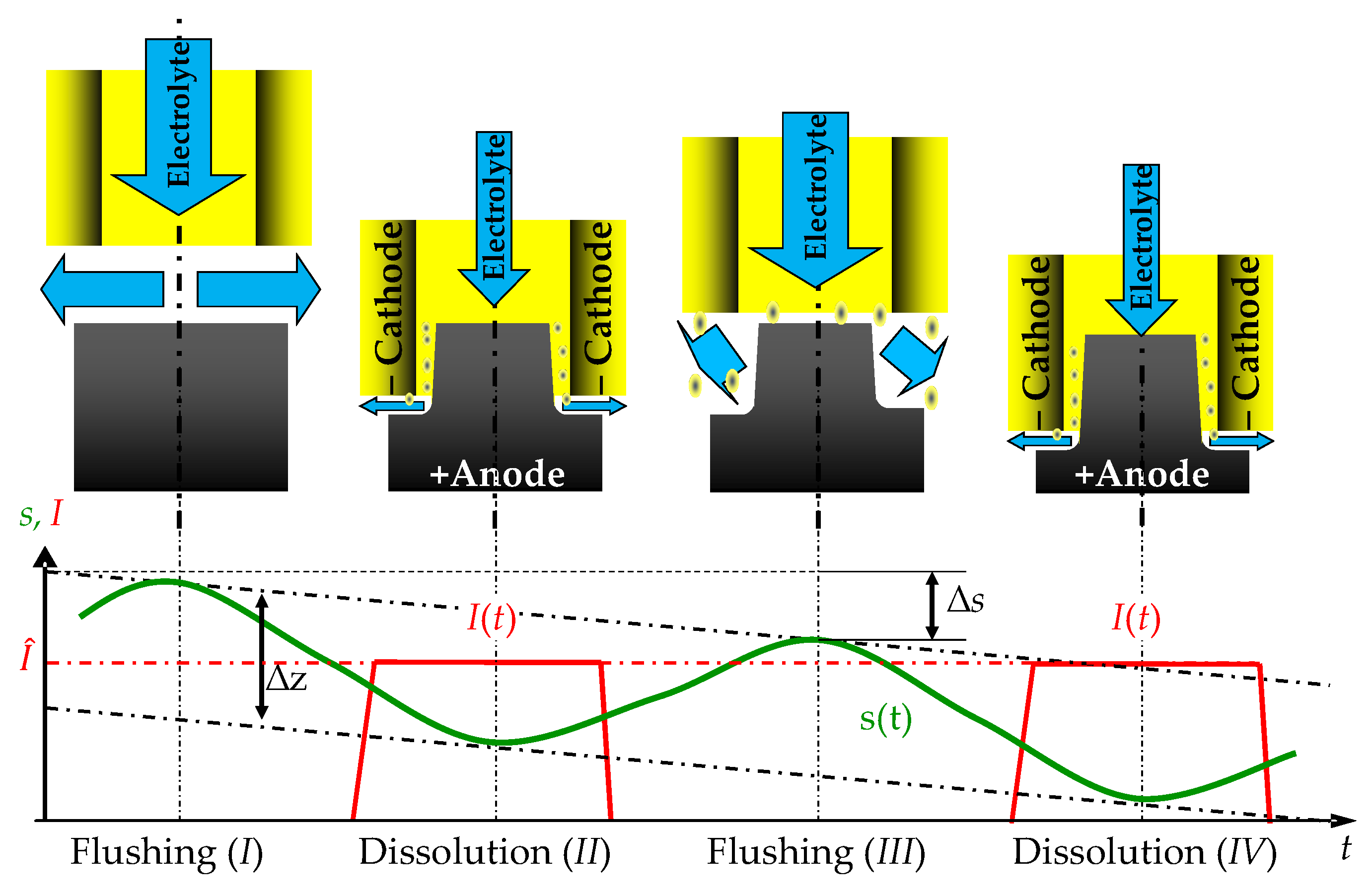
20] implemented machine tool–specific current and voltage control characteristics into a multi-physics simulation of PECM, explicitly modeling the effects of oscillating cathodes under pulsed current conditions. Their work (
Figure 2) demonstrated how superimposed low-frequency tool oscillations, when combined with precisely controlled current pulses, improve electrolyte renewal, stabilize the inter-electrode gap, and enhance machining precision.
The graph illustrates continuous feed over time by dash-dotted, black lines; tool oscillation is highlighted by the green sinusoid; red trapezoids indicate current pulses at minimal working gap by synchronization with tool oscillation. Sections I–IV represent processing states, where I is the initial state at large working gap with high electrolyte supply rate indicated by blue arrows; II is the electrochemical dissolution process at minimal working gap offering high precision but low electrolyte supply; III is a flushing status at maximum gap, where reaction products (yellowish particles) are removed at through high electrolyte supply rate; IV represents the recurring electrochemical dissolution status, comparable to no. II, but on the pre-shaped workpiece.
PEMTec SNC [
21] plays a leading role in transferring PECM from laboratory research into industrial practice. Their commercial PECM machines, such as the PEM 400 series, are designed for high-precision and high-current operation, enabling the machining of complex geometries and achieving surface finishes down to Ra ≈ 0.03 µm without inducing thermal or mechanical damage.
Schaarschmidt et al. [
21] highlighted limitations in PECM process simulations due to the inherent complexity of the process and the large number of interacting parameters. The oscillating cathode introduces a periodically varying working gap, which complicates accurate prediction of current density distribution and material removal behavior. As a result, precise machining outcomes require tight control of multiple process parameters. However, empirical investigations exploring robot-assisted implementations of this technique remain largely absent.
Cebi et al. [
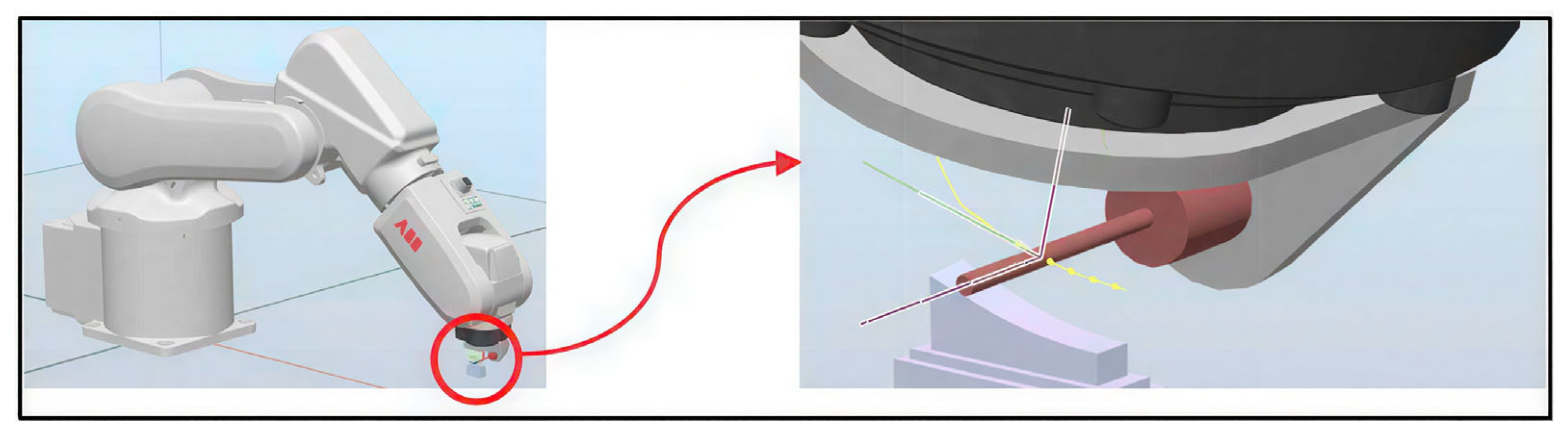
22] described robotic electrochemical machining (RECM) as an innovative integration of a robotic arm with the ECM process. This machine tool concept (
Figure 3) is designed to efficiently machine hard-to-cut materials while minimizing investment costs. It addresses key limitations associated with traditional ECM, including trial-and-error procedures, complex cathode design, and machining instability such as chattering. The RECM system consists of a machining platform, DC power supply, programmable logic controller (PLC), robotic arm, and PC-based interface. The study also emphasizes that critical ECM parameters, such as electrolyte flow rate, temperature, voltage, current, and inter-electrode gap, significantly influence the resulting surface quality. The detailed image below shows a tool cathode (red) and a workpiece anode (light grey) below the cathode with a secondary coordinate system.
Jiang et al. [
23] proposed an electrochemical machining approach integrated with industrial robots (
Figure 4) to address surface machining challenges. Recognizing that robotic arms lack the positional accuracy of conventional machine tools, the study introduced a simulation-based method to analyze the ECM process. This simulation helped to investigate the effects of positional deviations (normal errors), processing voltage, and the
X-axis feed rate on the material removal characteristics, providing insight into optimizing RECM performance.
3.4. Electrochemical Milling
Hou et al. [
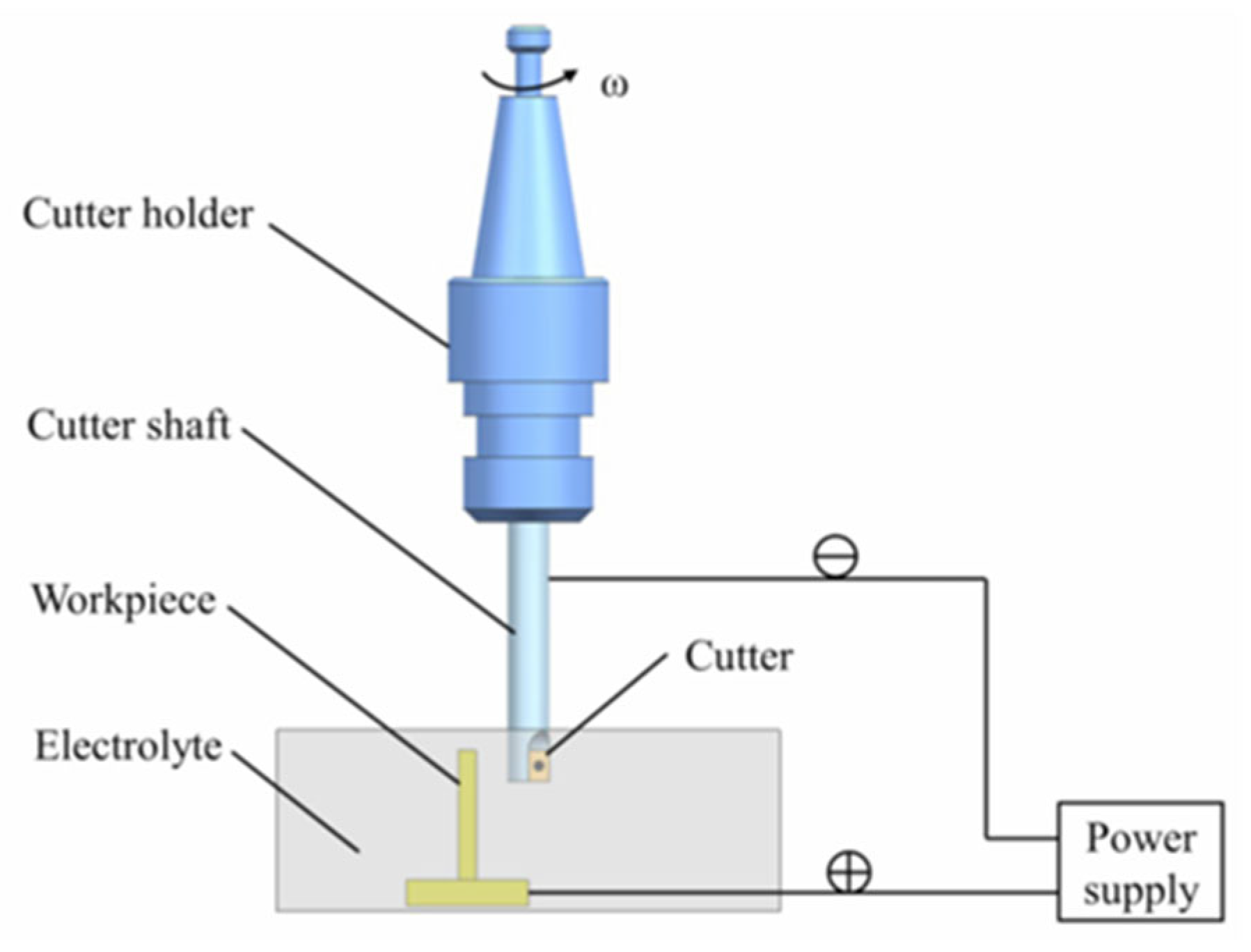
24] investigated the application of electrochemical milling (EC milling) (
Figure 5) for the machining of thin-walled components, focusing on how process parameters influence accuracy and surface quality. Their study assessed the effects of key variables such as feed rate, spindle speed, machining voltage, and electrolyte concentration on dimensional accuracy and stability. The findings concluded that by carefully optimizing these parameters, EC milling can efficiently reduce deformation, improve surface integrity, and enhance the overall machining precision of delicate thin-walled structures.
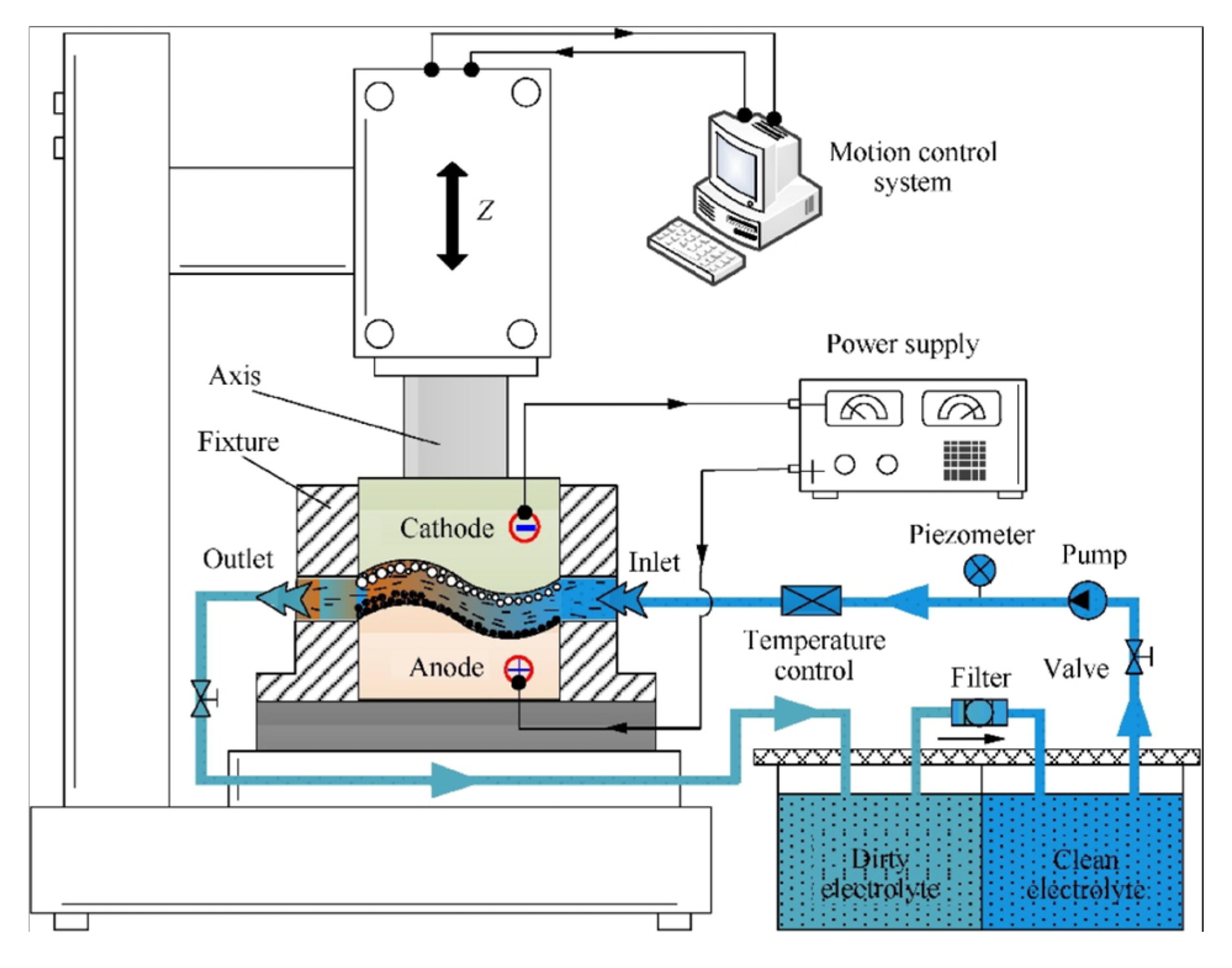
Figure 5 below highlights the EC milling process where the tool rotation and its direction is indicated by ω.
He et al. [
25] introduced a novel electrochemical milling technique specifically for machining cemented carbide. In this approach, a composite rotating tool cathode was designed, and electric field simulations were performed to analyze the process dynamics. The proposed method combines the high efficiency of numerically controlled (NC) flexible electrochemical machining with the precision of mechanical grinding. This hybrid strategy effectively mitigates common machining issues such as cracking and thermal damage typically encountered in conventional methods, offering a promising alternative for the accurate and defect-free processing of cemented carbide materials.
From the research performed by Hou et al. [
24] and He et al. [
25], certain limitations were observed, such as electrolyte jet control and stray corrosion, uniform electric field and tool path precision, machining of complex 3D surfaces, process stability at ultra-high-current density, hybrid machining defects, dimensional accuracy sensitivity and process complexity.
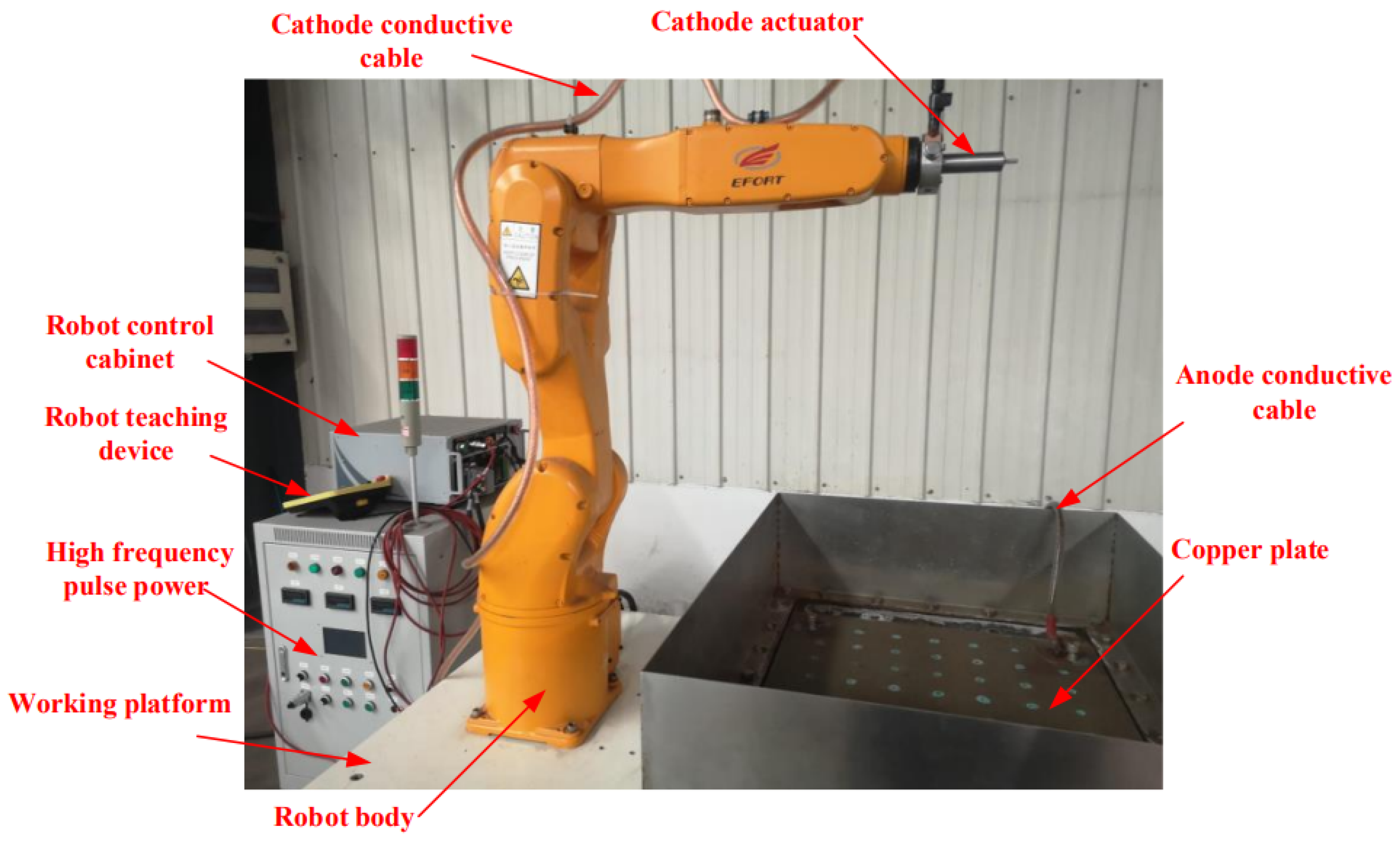
Yu et al. [
26] proposed a gap compensation control method specifically designed for robotic electrochemical milling (EC milling), focusing on the effects of multiphysics field coupling—namely, electrical, chemical, and mechanical factors. In their study, they developed a control strategy that addresses the variation in the inter-electrode gap (IEG) caused by perturbations in the robot’s trajectory. By integrating a constant-current control mechanism and real-time feedback, the system ensures stable and accurate electrochemical machining. The authors introduced a dual-module system consisting of a robotic unit and an electrochemical machining unit. The robotic unit, based on a six-degree-of-freedom industrial robot (EFFORT ER20-1100, with high repeatability of ±0.03 mm), handled complex electrode movements. Meanwhile, the machining unit featured an electrolyte circulation system, a power supply, a data acquisition module, and a control system integrating the robot controller and a servo drive. This research significantly contributes to enhancing machining accuracy and stability in robotic EC milling by compensating for dynamic machining gap fluctuations. It offers a practical approach to improving precision in applications involving intricate tool paths and electrochemical processing conditions.
3.5. Wire Electrochemical Machining
The main difference between ECM and wire electrochemical machining (WECM) is the design of the cathode; in the case of WECM, the cathode is a wire instead of a massive form electrode. The wire is connected to the negative terminal of the power supply, and the workpiece is linked to the positive terminal of the power supply. The wire traces a predefined tool path. Like in ECM, the electrolyte is supplied between the workpiece and the wire cathode [
4]. Zeng et al. [
27] introduced the use of a monodirectional traveling wire in the WECM process to improve mass transport within the inter-electrode gap. The study involved systematic experimentation to evaluate the effects of key process parameters—including wire traveling speed, tool feed rate, applied voltage, and electrolyte concentration—on machining accuracy and process stability. The findings demonstrated that employing a monodirectional moving wire significantly enhances electrolyte renewal and facilitates the efficient removal of electrolysis by-products in the narrow machining zone, thereby improving the overall effectiveness of the WECM process.
Zeng et al. [
27] showed in their study that a monodirectional traveling wire improves electrolyte renewal and machining stability, but WECM still faces challenges such as wire positioning and path accuracy, limited flexibility in complex geometries, electrolyte distribution and flushing issues, difficulty in multi-angle operations, process monitoring and repeatability. There are limited findings in peer-reviewed journal papers specifically on using robotic arms for WECM.
3.6. Jet-Electrochemical Machining
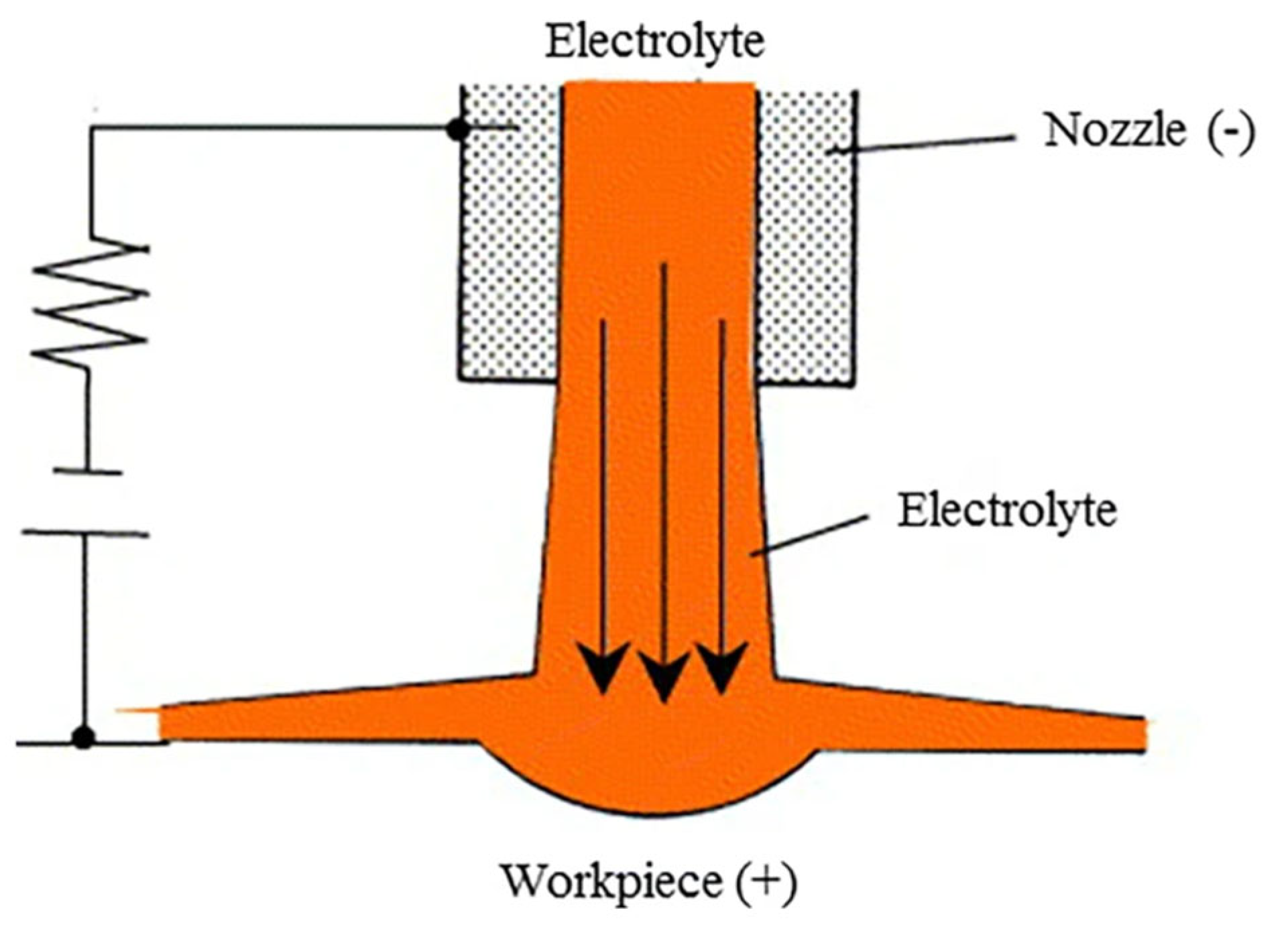
There are a few synonyms for jet-electrochemical machining (jet-ECM), such as electrochemical jet-assisted machining (ECJM) or electrolyte jet machining (EJM) that represent the same principle. In jet-ECM, the cathode is a nozzle, and it passes a jet of electrolyte, which removes the material after anodic dissolution. The constricted nature of the electrolyte jet not only enables precise targeting of the machining area but also enhances the current density at the point of impact, thereby accelerating the material removal process.
Kumar et al. [
28] demonstrated the potential of the jet-ECM process, which utilizes the distinctive tool-less nature of electrochemical machining to refine the surface of additively manufactured components. Among the key process parameters, the applied voltage and the nozzle’s traverse speed were identified as having a significant effect on the surface roughness of the finished parts. The jet-ECM technique effectively removed surface irregularities and defects, resulting in post-processed samples that exhibited a notably smoother surface. Only minimal stray corrosion and minor irregularities, previously caused by the large molten pool overflows during AM, remained after processing. A microporous surface with pore sizes ranging from 1 to 4 µm was observed after finishing. The formation of these pores is associated with localized electrochemical dissolution during ECJM as well as the removal of partially melted particles and molten pool irregularities originating from the additive manufacturing process.
Liu et al. [
29] introduced an innovative metal machining method known as Electrochemical Slurry-Jet Machining (ESJM), which integrates the principles of Abrasive Slurry-Jet Machining (ASJM) with jet-ECM. To validate this hybrid approach, a novel ESJM prototype was developed and experimentally tested on Stellite 12 alloy, a material known for its high machining difficulty using traditional techniques. The study concluded that ESJM shows strong potential as an effective method for the micro-machining of hard-to-machine metals, offering better material removal capabilities and surface quality using the combined mechanical and electrochemical actions.
Figure 6 shows the principle of jet-ECM, where the electrically conductive workpiece becomes the anode and the nozzle becomes the cathode. The arrows indicate direction and averaged velocity of the electrolyte jet.
Kumar et al. [
28] and Liu et al. [
29] both highlight the strong potential of jet-ECM for finishing additively manufactured components and hard-to-machine alloys. But there are inherent disadvantages like nozzle positioning and path accuracy, surface uniformity and overlap issues, limited control in hybrid ESJM, accessibility for complex AM surfaces, process monitoring and adaptability. To date, there are no reported studies on the integration of robots in jet-ECM.
3.7. Hybrid and Combined Processes Assisted by ECM
3.7.1. Electrochemical Grinding
Yang et al. [
31] demonstrate that electrochemical grinding (ECG) is an ideal machining strategy for Ti–6Al–4V due to its ability to combine the strengths of both grinding and electrochemical dissolution. The method improves material removal, reduces thermal and mechanical damage, and overcomes challenges related to passive film formation, thereby ensuring precision and process stability. Yang et al. [
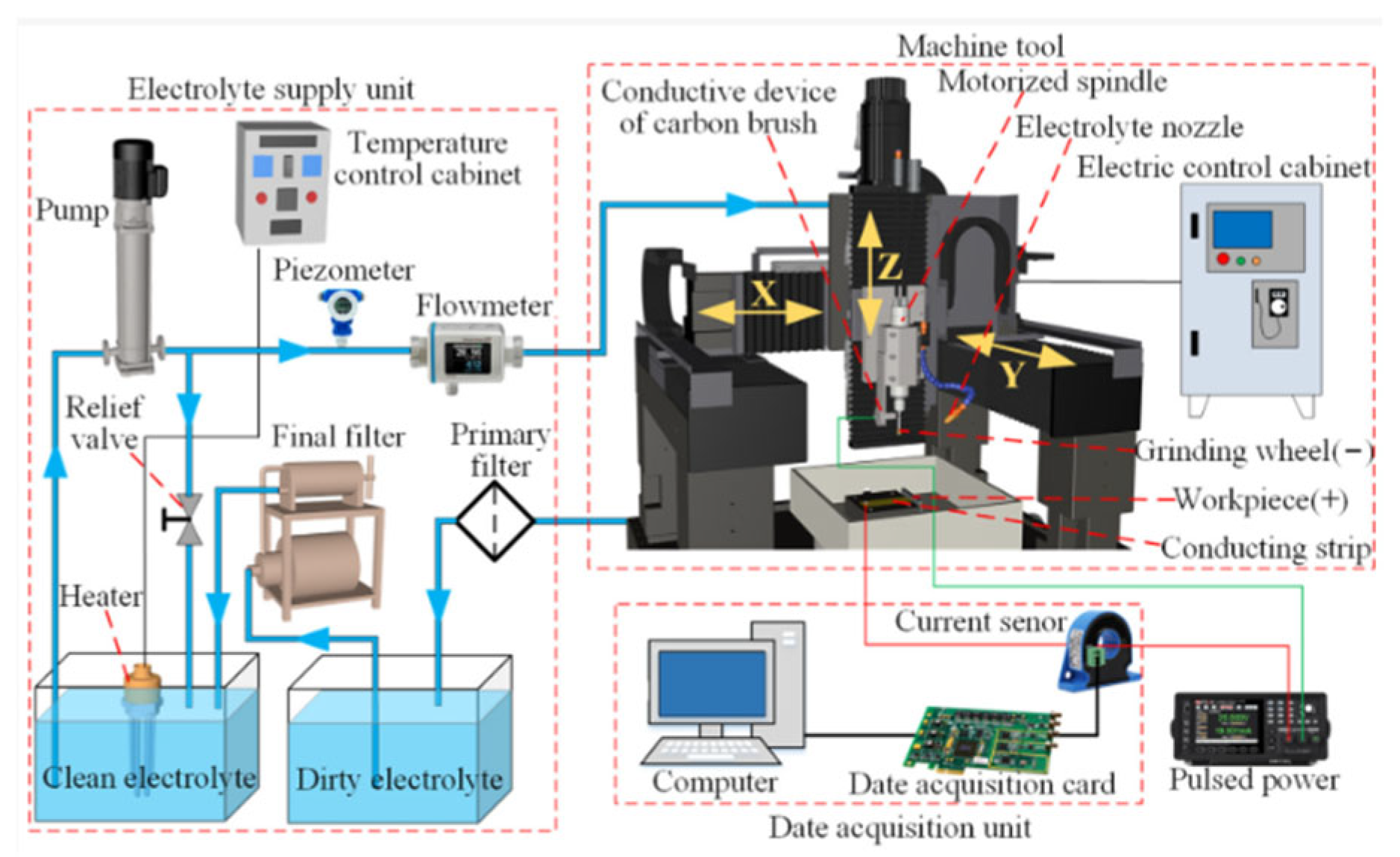
31] proposed an efficient ECG (E-P-C-ECG) process for Ti–6Al–4V, applying high-pulsed voltage with an optimized duty cycle and low DC voltage in the efficient ECG stage and precise ECG stage, respectively, without changing the grinding wheel. The process is shown in
Figure 7. The blue arrows indicate electrolyte supply, the green and red lines highlight electrical connections. Black lines represent data transfer wires. X, Y and Z indicate three degrees of freedom for linear movements of the tool.
Zhu et al. [
32] introduced a hybrid machining approach that integrates grinding and electrochemical material removal for fabricating precision small holes in hard-to-machine materials. The study demonstrated that by carefully optimizing key process parameters such as applied voltage, tool rotation speed, and feed rate, a balanced contribution from both grinding and electrochemical mechanisms can be achieved. As a result, the method enables the production of high-precision holes with sharp edges and minimal burr formation, ensuring improved dimensional accuracy and surface quality. ECG combines the advantages of electrochemical dissolution with mechanical grinding, enabling efficient machining of hard-to-cut materials such as Ti–6Al–4V (Yang et al. [
31]) and precision small holes in difficult alloys (Zhu et al. [
32]). Despite these benefits, several limitations remain in terms of precise feed and tool motion control, heat and electrolyte flow management, tool wear and alignment issues, limited access to complex features, process scalability and automation challenges.
Mohammad, A.E.K. et al. [
33] noted that the use of industrial robots for ECG had not been previously explored. In their study, an articulated robot was employed to hold the conductive workpiece, which serves as the anode of a DC power supply. The grinding wheel used in the process contains a conductive bonding material that is embedded with non-conductive abrasive particles. The cathode of the power supply is connected to the conductive bonding material, while the non-conductive abrasives help maintain separation between the anode and cathode, thus preventing electrical arcing. An electrolyte is delivered from a reservoir to the workpiece via a pump and a controlled valve, completing the electrolytic circuit. A low-voltage, high-current DC supply is applied across the setup to initiate material removal, which occurs through a combination of anodic dissolution and mechanical abrasion. A key advantage of this configuration is its ability to polish complex-shaped workpieces without the need for specialized fixtures. This flexibility contributes to reduced overall polishing time and cost.
3.7.2. Electrochemical Honing
Pathak et al. [
34] present a comprehensive review of electrochemical honing (ECH) as a sustainable and highly effective finishing process, particularly for complex components like bevel and cylindrical gears. ECH integrates the high material removal rate of electrochemical machining with the surface refinement capabilities of mechanical honing, enabling precise and burr-free finishing without inducing thermal or mechanical stresses. The authors detail the mechanism of ECH, emphasizing how the mechanical abrasives assist in removing the passive oxide layer formed during electrochemical dissolution, thereby enhancing form accuracy and surface integrity. Various tool and equipment configurations, including single and twin-cathode setups, are discussed with consideration for gear geometry and operational parameters. Shaikh et al. [
35] conducted a significant experimental study on the application of ECH for the precision finishing of bevel gears. Their work focused on improving both surface finish and geometric accuracy of hardened steel gears, which are traditionally difficult to finish using mechanical processes alone due to problems like burr formation, residual stresses, and tool wear. Their findings demonstrated a noteworthy improvement in surface roughness values, enhanced form accuracy, and elimination of burrs without causing thermal damage. Additionally, the twin-cathode configuration led to a more uniform electric field distribution, contributing to consistent material removal across complex gear tooth profiles.
Pathak et al. [
34] and Shaikh et al. [
35] both emphasize that ECH is powerful for burr-free, stress-free gear finishing, but it faces limitations like complex tool positioning and alignment, limited flexibility across different gear geometries, uneven electrolyte distribution, scalability and accessibility issues, process monitoring and repeatability. Nonetheless, studies addressing its application in combination with robots are still lacking.
3.7.3. Electrochemical-Mechanical Polishing
Mohammad et al. [
33] presented advancements in conventional electrochemical mechanical polishing (ECMP) by introducing several robotic-integrated modifications. These include the development of a robotic ECMP system, robotic electrochemical grinding, robotic electrochemical polishing with burnishing force, and a robotic electrochemical polishing system enhanced with an assistive magnetic field. The study delves into the core principles of ECMP, highlighting its hybrid nature that combines anodic electrochemical dissolution with mechanical abrasion. The authors identified key parameters influencing the polishing performance, such as applied voltage, electrolyte concentration, rotational speed, and polishing pressure. The polishing mechanism operates through the formation of a passive oxide film on the anodic workpiece surface. This film is selectively removed at surface high points by abrasive particles, allowing the exposed material beneath to undergo continued electrochemical dissolution, thereby achieving precise and smooth surface finishes.
Hung, JC et al. [
36] successfully developed a robotic ECMP system designed to polish curved additively manufactured titanium-based materials quickly, achieving a passive surface. This study incorporates a robotic arm into the ECMP process for AM titanium alloys to improve surface quality and corrosion resistance while acknowledging the need for automated polishing. ECMP is a surface treatment method capable of producing a high-quality, mirror-like finish. It is commonly used on stainless steel and nonferrous metals such as aluminum, titanium, and copper. The process removes material from the workpiece layer by layer through electrolysis, combined with auxiliary micro-buffing using a viscoelastic abrasive. In this research, a six-axis robotic arm, the Denso VS-068, was utilized along with certain parameters such as workpiece material, applied current, machining gap, etc.
3.7.4. Ultrasonic-Assisted Electrochemical Machining
Yang et al. [
37] investigated ultrasonic-assisted electrochemical machining for a trepanning process to improve machining performance in shaped electrode sinking-ECM processes. In their study, ultrasonic vibration was applied to the tool electrode during the trepanning of a rectangular groove with an internal cylindrical structure. The superimposed ultrasonic oscillations enhanced electrolyte circulation in the inter-electrode gap, which improved the evacuation of gas bubbles and reaction by-products. As a result, machining stability was improved, stray corrosion was reduced, and the dimensional accuracy of the machined groove was significantly enhanced. The study demonstrated that introducing ultrasonic vibration into ECM sinking operations can effectively address common drawbacks such as poor electrolyte renewal and limited precision, especially in complex geometries.
To address challenges such as low machining accuracy, limited material removal rate, and suboptimal surface quality in ECM, researchers have explored the integration of vibrational assistance in the process. Vibration-assisted ECM involves the application of controlled vibrations to the anode, cathode, or electrolyte, which enhances electrolyte circulation, improves the evacuation of reaction by-products, and stabilizes the machining process [
4]. El-Hofy et al. [
38] presented a comprehensive review of vibration-assisted electrochemical machining (VA-ECM), detailing its fundamental principles, key research trends, critical process parameters, and performance metrics. The study thoroughly explored various applications of VA-ECM, including micro-slotting, micro-drilling, macro-drilling, electrochemical wire cutting, surface polishing and finishing, and micro-tool fabrication. The review highlighted the significant advancements in these areas, demonstrating how the integration of vibrational energy into the ECM process can enhance machining precision, improve material removal rates, and refine surface quality across diverse manufacturing scales.
Skoczypiec [
39] presented that in ultrasonically assisted ECM (USAECM), electrode vibration significantly altered electrolyte flow patterns in the inter-electrode gap. Through computational fluid dynamics (CFD) simulations, researchers demonstrated that ultrasonic oscillation facilitated better electrolyte renewal and reduced electrode polarization. Yang et al. [
37], El-Hofy et al. [
38] and Skoczypiec [
39] report drawbacks of this method such as electrode vibration control complexity, non-uniform electrolyte flushing, limited applicability to complex geometries, process integration difficulty, tool positioning and fixture dependence. Despite these advances, little attention has been given to its integration with robots.
3.7.5. Electrochemically Assisted-Mechanical Drilling and Mechanical Milling
In drilling applications, Zhu et al. [
40] introduced ultrasonic-assisted electrochemical drill-grinding, where the mechanical grinding action removes passivation layers while ECM reduces tool forces, and ultrasonic vibration enhances electrolyte flushing. This combination led to improved hole geometry, reduced taper, and enhanced surface finish for small-diameter holes. Similarly, Zeng et al. [
41] demonstrated that electrochemical micro-drilling with rotating tubular cathode tools promotes effective electrolyte renewal and bubble evacuation, enabling stable drilling of high-aspect-ratio microholes with improved machining precision.
Electrochemical–mechanical milling (MECM) has also been explored as a means of stabilizing the ECM process while improving removal efficiency. Van Camp et al. [
42] experimentally studied MECM for titanium alloys and reported that the hybrid process achieved more stable machining behavior and slightly higher material removal rates compared to pure ECM. Extending this concept, He et al. [
25] proposed a rotating composite cathode tool that integrates abrasive mechanical action with ECM for milling cemented carbide. Their findings showed significant improvement in surface flatness (achieving surface roughness as low as 0.389 µm) and emphasized the critical role of parameter optimization—including voltage, feed rate, duty cycle, and tool rotation speed—in balancing removal efficiency with surface quality.
Despite their benefits, electrochemical–mechanical hybrid processes still face challenges such as tool wear in abrasive-assisted configurations, difficulties in precisely maintaining inter-electrode gap stability during combined mechanical and electrochemical interactions, and limitations in handling complex 3D geometries. However, the potential of integrating this process with robots has not been thoroughly investigated.
3.7.6. Electrochemical Discharge Machining
Oza, A.D. et al. [
43] described hybrid electrochemical discharge machining (ECDM) processes that combine electrochemical material removal (anodic dissolution, i.e., ECM) with electrical-discharge material removal (spark/thermal erosion, i.e., EDM). The hybrid material removal may be implemented simultaneously (both electrochemical dissolution and discharge occur during machining) or sequentially (one process roughs, the other finishes). Another widely used principle in ECDM is the formation of a gas film at the tool and the generation of electrical discharges in the gas bubbles, so that thermal impacts cause melting or evaporation of the workpiece after precise alignment to the tool, which also offers the possibility to machine electrically non-conductive materials.
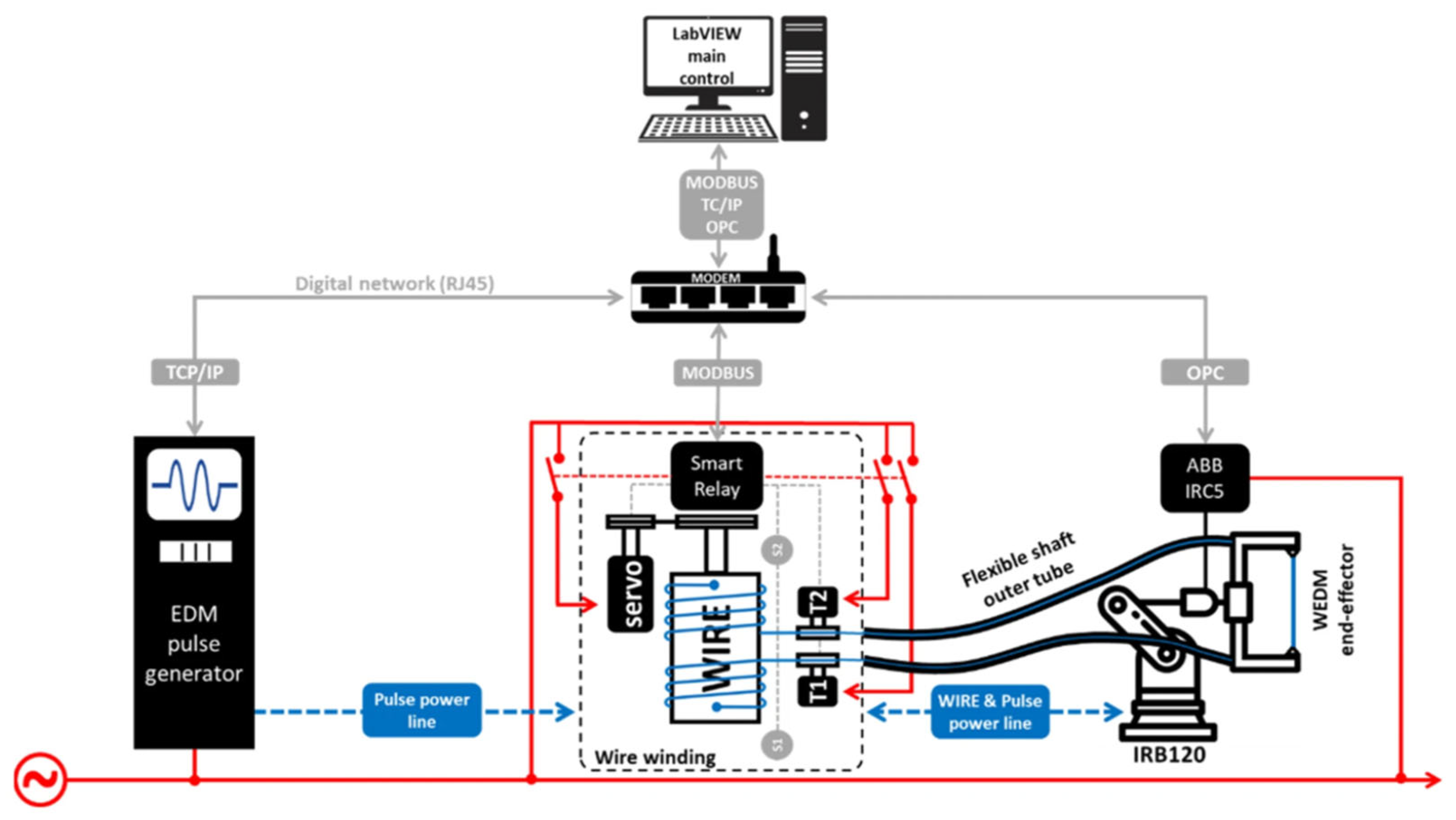
However, opportunities to leverage robotic dexterity and adaptive control to overcome existing process limitations remain insufficiently explored. But a study related to research on robot-integrated wire EDM (electrical discharge machining), which is conceptually similar and provides helpful analogies, was found. Almeida et al. [
44] presented a study related to wire EDM that reported experimental findings of the first robotic WEDM apparatus (
Figure 8) based on a high-speed winding system with 600 m of wire length, capable of controlling the wire speed from 1 to 10 m/s and wire tension from 0.1 to 10 N. The system adopts flexible outer cases to travel and reciprocate the wire into a 7-axis robotic system composed of a 6-axis robot and an external rotating axis. The proposed design is a highly dynamic process whose wire tension and speed are achieved by a hybrid controller to cope with the non-linear relation of speed and tension provided by the magnetic clutch. It combines a regression open-loop control for optimality and wire breakage avoidance with a closed-loop control to guarantee admissibility while coping with wire friction disturbances. The findings describe a novel wire winding system capable of controlling usual wire disturbance and stepped surface of reciprocating high-speed WEDM, as well as additional friction and elastic behavior of the flexible case, delivering wire tension of ±12% along with a stable EDM process and uniform surface roughness between wire reciprocation areas with a Ra of 2.94 μm. The red arrows depict the electrical power flow and control connections that supply and manage the EDM process.
3.8. Laser-Assisted Electrochemical Machining
Laser-assisted ECM (LAECM) combines electrochemical reactions of anodic dissolution and photon energy as a laser beam for material removal. The utilization of a laser for ECM helps to target a specific area for machining, localizing the dissolution process and increasing efficiency and precision. Malik et al. [
45] introduced an indigenously developed laser-assisted jet electrochemical machining (LAJECM) system, specifically designed for drilling operations on Inconel-718. Experimental investigations demonstrated that the incorporation of laser assistance significantly enhances both the material removal rate and machining precision when compared to conventional jet-ECM, highlighting the effectiveness of the hybrid approach in improving process performance. As stated by Di Silva et al. [
46] in their paper, the laser also facilitates the removal of brittle oxide layers, thereby enabling ECM of oxide-forming metals such as titanium. Thermal analysis has shown that a temperature rise in the machining zone does not cause heat damage or structural alterations of the surface, so the machined surface remains stress-free after the LAJECM process. Li et al. [
47] reported the development of a novel laser-assisted electrochemical machining (LAECM) technique utilizing an optical fiber-based tool electrode, referred to as LAECMOF. In this approach, the laser beam is transmitted directly to the machining zone through the optical fiber, enabling localized heating and enhanced electrochemical reactions. The study demonstrated the successful fabrication of microstructures using this method. The authors suggested that LAECMOF holds significant potential for widespread application in three-dimensional micro-machining and polishing of materials that are challenging to machine through conventional methods.
Malik et al. [
45], De Silva et al. [
46], and Li et al. [
47] explain that the laser-assisted ECM combines localized thermal energy with electrochemical dissolution, leading to enhanced material removal rates and the ability to machine oxide-forming or hard-to-machine materials. However, despite these advantages, several limitations remain, such as alignment and synchronization challenges, limited accessibility for complex geometries, process stability and electrolyte control, thermal effect management, scalability and repeatability issues. To date, the integration of this process with robotic platforms has received minimal scholarly attention.
3.9. Magnetic Field-Assisted ECM
Magnetic field–assisted electrochemical machining (MECM) is a hybrid machining technique that integrates an external magnetic field with the conventional ECM process to improve MRR and surface finish. The application of the magnetic field induces a swirling or rotational motion of the electrolyte within the inter-electrode gap, promoting enhanced electrolyte circulation. This dynamic flow assists in the efficient removal of machining debris and electrochemical reaction by-products from the machining zone, thereby stabilizing the process and improving machining performance in terms of both productivity and surface integrity [
4]. Li et al. [
48] introduced a MECM technique, which is distinguished by its high current density, improved current efficiency, refined metal crystallization, and enhanced machining precision. This method not only advances conventional mechanical processing techniques but also significantly improves machining quality and overall process efficiency. As an emerging and rapidly evolving area within the field of specialized machining technologies, MECM continues to attract growing interest and is driving the development of novel applications. The study also highlighted the promising potential of integrating magnetic fields with electrochemical additive manufacturing processes, suggesting that magnetic field-assisted electrochemical additive manufacturing could enable the direct fabrication of micro-scale components with enhanced precision and material properties. Chavoshi et al. [
49] reviewed hybrid micro-machining processes that combine electrochemical machining with auxiliary energy sources, including magnetic assistance, to enhance machining performance and process stability. The authors explained that the application of a magnetic field during ECM can improve electrolyte circulation and assist in the removal of gas bubbles and reaction products from the inter-electrode gap. This enhancement leads to improved current density uniformity, increased material removal rate, and better surface integrity, particularly in micro-scale machining.
Li et al. [
48] and Chavoshi et al. [
49] also cover the limitations of the MECM technique, such as complex setup and alignment, non-uniform magnetic field distribution, electrolyte flushing challenges, integration with multi-axis machining, bulky fixtures and process rigidity, in their papers. The coupling of this technique with robotic technologies remains an underexplored area of research.
4. Discussion
In this paper, several ECM technologies have been studied for use in combination robots. These methods have been effective, and every technique has some negatives, which can be reduced or even nullified using robots. Direct experimental comparisons between conventional and robotic-assisted ECM remain limited in the literature; however, clear functional distinctions can be identified. Conventional ECM machine tools provide high stability and accuracy for repetitive and well-defined geometries but are constrained by limited degrees of freedom and low adaptability. Robotic-assisted ECM, in contrast, offers enhanced flexibility through multi-axis motion and a larger workspace, enabling the machining of complex, freeform, and large-scale components that are difficult to process using established ECM systems. The integration of robots into ECM has emerged as a transformative approach to addressing the limitations associated with established ECM setups that usually only provide one to three degrees of freedom, particularly when machining complex geometries.
As shown by Cebi et al. [
22], the robot-based configuration eliminates the dependency on customized cathode design, a factor that typically prolongs lead times and inflates costs. Instead, a single universal nozzle can be guided along complex paths, reducing preparation times from weeks to mere hours. Importantly, industrial robots are capable of maintaining inter-electrode gaps within approximately ±10–30 µm and controlling tool orientation within about ±1°. Such positioning capabilities can improve gap uniformity and tool alignment, which may help reduce geometric deviations such as side-wall taper—a common limitation in conventional ECM sinking The results indicate that a robot with high precision not only helps enhance machining accuracy but also stabilizing the current density to realize high removal rates. Furthermore, by dynamically orienting the electrode to sustain electrolyte flow velocities above 5 m/s, robots effectively prevent stray corrosion and improve debris evacuation.
As highlighted by Jiang et al. [
23], robotic motion errors exert a direct influence on the electrochemical machining process by disturbing the delicate balance of the inter-electrode gap (IEG), which typically lies in the range of 10–100 µm. Even small trajectory deviations introduced by the robot, for instance in the order of ±50 µm instead of the ±10 µm achievable on conventional machine tools, can significantly alter the current density distribution across the machining zone. Similarly, motion errors in the range of 100–200 µm can disrupt electrolyte flushing, resulting in the accumulation of gas bubbles and insoluble by-products, which reduces local conductivity and degrades machining stability. Consequently, surface roughness, which can typically be reduced to Ra ≈ 0.2–0.5 µm in precision ECM, may deteriorate to values exceeding Ra ≈ 1.0 µm under unstable robotic feed. Moreover, geometric accuracy of micro-features, such as channels and holes, is highly sensitive to trajectory fidelity—deviations as small as ±50 µm can distort feature profiles, increase taper angles, and impair dimensional repeatability.
To this end, Yu et al. [
26] proposed a gap compensation control method based on multi-physics field coupling, which effectively maintained a stable inter-electrode gap and reduced process fluctuations. Their findings emphasize the importance of advanced control strategies for enhancing machining precision in RECM systems.
Beyond kinematic flexibility, robotic platforms enable the incorporation of real-time and intelligent control strategies into electrochemical machining processes. By integrating sensor feedback related to machining current, voltage, inter-electrode gap, electrolyte flow, and tool position, RECM systems can dynamically adjust machining parameters during operation. Such real-time adaptation allows compensation for motion-induced errors, gap fluctuations, and process instabilities that commonly arise in ECM. Furthermore, intelligent control frameworks combined with model-based prediction or data-driven approaches offer future potential for autonomous optimization of machining trajectories, feed rates, and electrical parameters, thereby improving machining accuracy, surface integrity, and overall process reliability.
Robotic systems have also shown considerable promise in polishing and finishing applications. Mohammad and Wang [
33] comprehensively reviewed the recent developments in robotic ECMP, highlighting hybrid configurations that incorporate mechanical abrasion with electrochemical anodic dissolution. This dual mechanism enhances both efficiency and surface integrity. In line with this, Hung et al. [
36] demonstrated that RECMP can be effectively applied to improve the surface finish and passivation quality of titanium-based additively manufactured components. The robotic platform enabled uniform polishing pressure and consistent tool-surface contact across complex geometries, resulting in brightened and defect-free surfaces.
Furthermore, the ability to dynamically control tool positioning systems in RECM has opened opportunities for higher machining speed and increased precision. Although developed for robotic EDM, the wire feed system presented by Almeida et al. [
44] offers valuable insight into the synchronization and motion-control challenges that are also applicable to ECM processes. Similar high-speed delivery systems could enhance electrolyte renewal in ECM and debris removal from confined machining zones.
In multi-task environments, RECM systems rely primarily on software-based reconfiguration rather than mechanical redesign. Tool paths, orientations, and feed strategies can be rapidly adapted through offline programming, while modular end-effectors enable switching between ECM variants. This flexibility allows a single robotic platform to perform diverse ECM operations with minimal setup time, making it well-suited for flexible manufacturing applications.
Based on the reviewed literature, robotic assistance in electrochemical machining is particularly advantageous in application domains where conventional ECM machine tools face inherent limitations. Robots enable machining of complex, freeform, or large-scale geometries that require multi-degree-of-freedom motion and flexible tool positioning. Their benefits are especially evident in ECM variants such as jet-ECM, wire ECM, electrochemical milling, and LAECM, where adaptable tool or nozzle orientation is critical for achieving uniform material removal. Robotic systems further support adaptive control of the inter-electrode gap and compensation of trajectory deviations along long or curved tool paths. These capabilities make RECM particularly suitable for low-to-medium batch production and prototyping, whereas conventional ECM systems remain more efficient for high-volume manufacturing of simple and repetitive geometries.
In addition, RECM provides a suitable platform for implementing real-time and intelligent process control. By integrating sensors for current, voltage, force, gap distance, and electrolyte flow, robots can dynamically adjust tool trajectories, feed rates, and inter-electrode gaps during machining. Closed-loop control strategies enable compensation for process disturbances and robotic motion errors, thereby improving machining stability, surface quality, and dimensional accuracy.
Despite its advantages, RECM implicates several challenges. Industrial robots typically exhibit lower stiffness and positioning accuracy than dedicated machine tools, which may lead to trajectory deviations and gap instability. Additional challenges include system integration complexity, synchronization of power supply and electrolyte delivery, and safety concerns associated with corrosive electrolytes. Addressing these issues requires robust error compensation strategies, corrosion-resistant system design, and appropriate safety measures. These challenges represent critical barriers to industrial implementation and must be addressed to ensure reliable, safe, and repeatable robot operation in RECM.