1. Introduction
In many mechanical systems exposed to non-uniform temperature fields, the solid response is often described within a thermomechanical framework based on the “weak coupling” assumption [
1]. In this formulation, the thermal field is computed independently of the stress state. This assumption is usually justified by the fact that mechanical effects typically have a negligible influence on the thermal evolution of systems under most practical conditions. Accordingly, the problem reduces to two governing equations [
2] as follows:
1. Heat equation
with
the density,
c the specific heat,
k the thermal conductivity, and
r a volumetric heat source.
2. Constitutive law
where
is the Cauchy stress tensor,
is the stiffness tensor,
the strain tensor,
the thermal expansion tensor, and Δ
T the temperature increment. : denotes the tensor double contraction.
However, this weak coupling assumption fails under rapid thermal transients. In particular, a team in our laboratory investigated heating conditions representative of a Reactivity Injection Accident (RIA) in cylindrical nuclear fuel (UO
2). To reproduce these situations, a flat cylindrical pellet of (UO
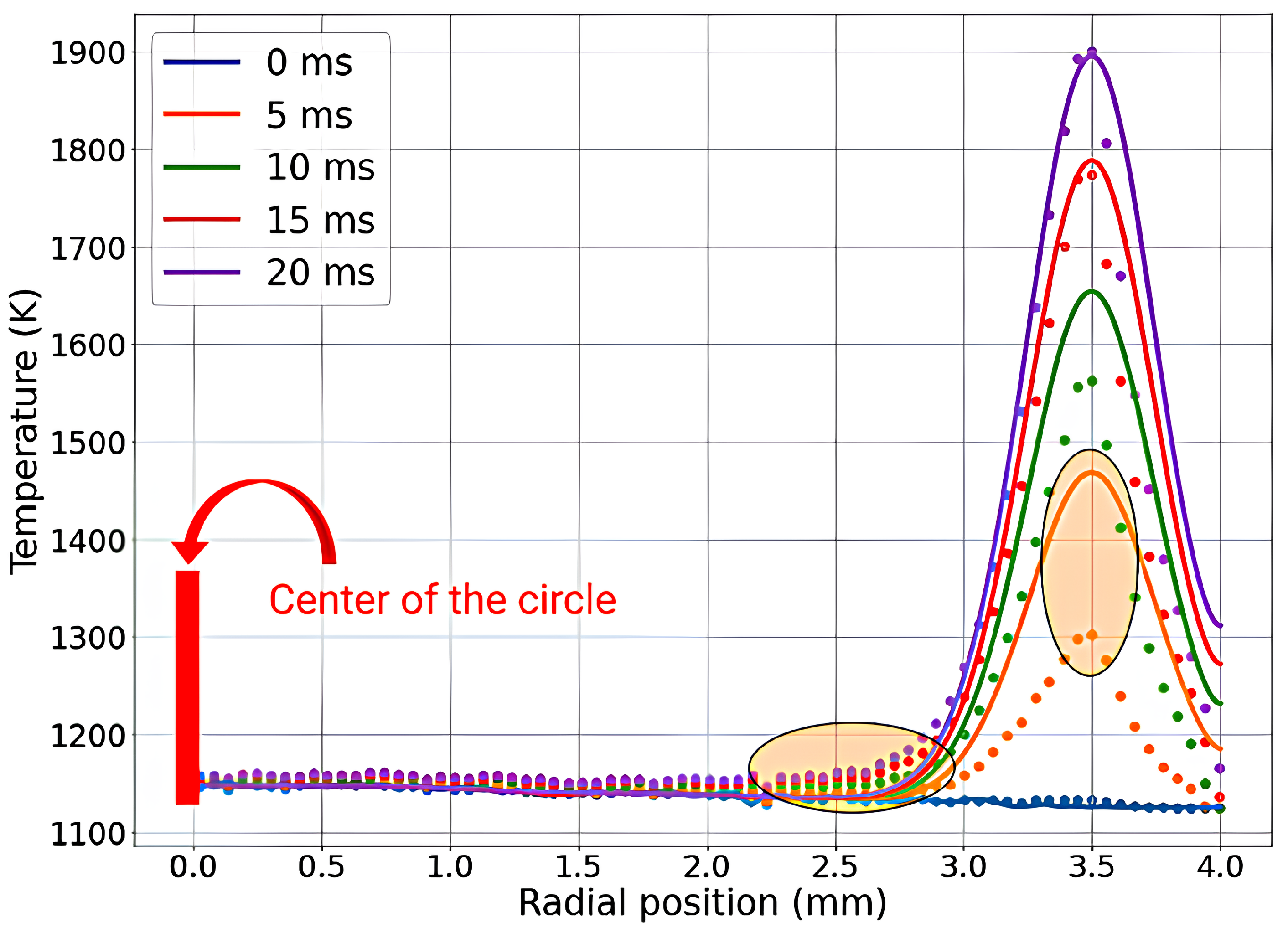
2) is submitted to inhomogeneous heating: the pellet periphery is subjected to abrupt laser-induced heating. The process is fast enough for the temperature of this area to increase abruptly, even before the inside of the pellet has time to heat up. A clear discrepancy between predicted temperature profiles (under weak coupling assumption) and experimental measurements was evidenced [
3],
Figure 1, thereby questioning the validity of this conventional approach.
The authors who reported these measurements suggested that experimental parameters could contribute to the observed discrepancies. However, their magnitude and the quality of the equipment used [
3] suggest that a purely experimental explanation is insufficient. It is therefore legitimate to inquire about a physical origin that would explain these discrepancies, which seem to represent a “heating delay”.
One might argue that “strong coupling” theory should correct these errors by justifying the heating delay through a well-known mechanical feedback effect. In
Section 2, we quantify the influence that mechanical feedback, as formulated by the strong coupling framework, can exert on temperature for the considered experiment. Our analysis clearly shows that this traditional formalism cannot explain the observed discrepancies.
The particular geometry of laser heating implies that the peripheral ring undergoes thermal expansion while the interior of the pellet has not yet had time to heat up. This situation causes, in the first moments, a stress gradient that drives the propagation of a deformation wave aimed at mechanically rebalancing the pellet. One can therefore wonder if this deformation flux could actually be coupled to the heat flux and be at the origin of heating delay phenomena. To investigate this, the most obvious approach would seem to be applying the flux coupling theory from thermodynamics of irreversible processes (TIP) to the deformation flux and heat flux.
Currently, existing references on thermomechanical coupling developed within the TIP framework remain local. The mechanical fluxes are identified with the local time derivative
and the conjugate thermodynamic force with
[
4,
5,
6]. These formulations, by neglecting spatial transport of deformation and stress gradients, do not account for spatial propagation phenomena. They cannot therefore capture any coupling between heat flux and deformation flux that actually designates propagation. On the other hand, some works propose models that incorporate dependencies on strain gradients
. They belong to strain-gradient elasticity theories [
7,
8]. These models introduce higher-order stresses (hyperstresses) and assume that elastic energy depends on both
and its gradient
. While effective for size effects and singularity regularization, these models are purely mechanical and do not arise from entropy production principles. They therefore do not belong to TIP and cannot reveal any coupling phenomenon between heat flux and deformation flux.
Thus, in
Section 3, we will propose an extended formalism based on TIP that explicitly introduces the notion of deformation propagation. We will therefore address the definition of a deformation flow
and study its potential coupling with heat flow. We will see that this approach enables the appearance of an additional coupling term, which could cause heating delays during thermal transients. We will also demonstrate that this could quantitatively explain the temperature discrepancies observed during the heating experiment presented above.
2. Strong Coupling Formalism Approach
2.1. Observation of Heating Delay and Calculation of Corresponding Energy
In
Figure 1, pronounced discrepancies between the measured and simulated temperature profiles are evident. In particular, within the core of the directly heated zone, the temperature rises more slowly than predicted by the simulation. The largest discrepancy occurs at the center of the heated zone (3.5 mm) at 5 ms, with a difference of approximately 150 K between the simulation and the experimental measurement.
Considering a specific heat capacity of
and a density of
[
9], this temperature difference
corresponds to a missing volumetric energy density of approximately
2.2. Theoretical Framework of Strong Thermomechanical Coupling
Adopting a theoretical framework of strong thermomechanical coupling requires explicitly accounting for the mechanical influence on thermal behavior [
10]. Within this context, and based on the constitutive laws of solids at equilibrium, the aim is to derive a comprehensive heat equation that incorporates mechanical feedback.
The fuel pellet is modeled as a continuous and homogeneous medium subjected only to thermal and mechanical variations. No mass exchange, chemical reaction, or charge transport is considered. The analysis assumes infinitesimal deformations and the validity of the local equilibrium hypothesis so that the thermodynamic state variables remain well defined at each point of the material. At the boundary, the solid is subjected to a heat flux imposed by the laser (Neumann boundary condition). It is not subjected to mechanical forces coming from the outside, but, as we have seen, the heating geometry implies mechanical forces. Under these conditions, the local internal energy balance can thus be expressed as
where
is the density,
e the specific internal energy,
the Cauchy stress tensor,
the strain rate tensor,
r a volumetric energy source, and
the heat flux vector.
Under the assumption of infinitesimal deformations and following the local state approach, the strain reduces to the linearized strain tensor
, such that
. The total strain tensor can be decomposed into thermoelastic and plastic contributions
Introducing the Helmholtz free energy
as the thermodynamic potential, where
s is the specific entropy and
T the temperature, and applying the Clausius–Duhem inequality, the following constitutive relations are obtained
Details regarding the choice of independent variables to express
are provided in
Appendix A.
Without detailing the derivation (such derivations are provided in [
10]), the above considerations finally lead to the heat equation in the framework of strong thermomechanical coupling
where the following apply:
is the heat capacity at constant thermoelastic strain,
is the stress sensitivity to temperature,
is the mechanical dissipation.
For thermodynamic consistency, several restrictions delimit the applicability of the present formulation: (i) the heat capacity is strictly positive, (ii) the thermal conductivity (implicit in Fourier’s law ) must be positive definite, (iii) the elasticity tensor derived from is positive definite, ensuring stability, and (iv) the plastic dissipation in accordance with the second law.
This extended heat equation introduces several terms that are typically neglected in standard thermomechanical models based on the weak coupling assumption. Notably, the term
represents thermoelastic coupling, i.e., the influence of reversible elastic deformation on the thermal response. Within the framework of the present study, this is the only term that could plausibly account for the observed energy deficit.
Conversely, the term
which corresponds to mechanical dissipation, cannot explain the discrepancy, as it solely contributes to heating. Moreover, under the thermal and mechanical conditions experienced by the pellet during the first 5 ms, plastic effects are negligible.
Accordingly, in the following section, we estimate the order of magnitude of the energy potentially associated with the thermoelastic coupling term
2.3. Quantification of the Energy Associated with Thermoelastic Coupling
Under the linear thermoelastic assumption, Hooke’s law implies that the sensitivity of stress to temperature can be expressed as
The objective is to estimate the order of magnitude of the energy contribution associated with the thermoelastic coupling term. To simplify the calculation, the tensorial formulation can be approximated by a scalar representation, yielding a first estimate of the internal volumetric energy variation due solely to thermoelastic effects
where
E is the Young’s modulus and
is the relative volumetric strain.
To maximize the estimate of
at
, we assume purely thermoelastic deformation and free expansion of the peripheral ring, i.e.,
. This leads to
Assuming
E and
are constant over the interval, the integral simplifies to
For the numerical evaluation, we consider uranium dioxide at approximately
[
9]:
and
. From
Figure 1, the temperature at the center of the heated zone rises from
to
. The resulting energy estimate is
Despite employing strong approximations intended to maximize the influence of the thermoelastic coupling in the classical sense, the magnitude of remains orders of magnitude smaller than the observed missing energy density, . Therefore, the energy deficit observed in the heated zone cannot be attributed solely to the absence of strong thermomechanical coupling as conventionally understood.
Having established that the conventional theory of strong coupling cannot explain the observed discrepancies, we now turn to the development of a more comprehensive thermomechanical coupling framework. Based on the thermodynamics of irreversible processes, it explicitly takes into account spatial transport phenomena that are neglected in traditional approaches.
3. Thermomechanical Coupling Based on the Thermodynamics of Irreversible Processes
The thermodynamics of irreversible processes (TIP) provides a rigorous framework for analyzing systems evolving out of equilibrium. Unlike classical thermodynamics, which focuses on reversible transformations and equilibrium states, TIP addresses transport phenomena and dissipative processes, making it particularly suited for studying coupled irreversible mechanisms in our system.
Through our work, we adopt the local equilibrium hypothesis, a cornerstone of TIP, which assumes that each infinitesimal volume element is locally at thermodynamic equilibrium, even if the system as a whole is not [
11]. This allows the definition of local intensive quantities and the application of equilibrium relations while accounting for macroscopic gradients and fluxes.
Appendix B.1 provides a justification for its validity in fast transient phenomena, demonstrating that microscopic relaxation times remain much shorter than the macroscopic timescales of interest.
Our analysis is restricted to thermoelastic deformations, neglecting plastic effects. Existing thermomechanical coupling laws already provide comprehensive formulations for plasticity-related heat transfer, which are outside the scope of the present study. This restriction allows focusing on the development of a new theoretical framework for thermoelastic coupling. We also place our study within the context of continuum mechanics.
For clarity, all tensorial quantities (order
) are denoted in
boldface, with their rank specified upon introduction.
Appendix B.2 details the full notational conventions, including tensor products and special tensors.
3.1. Energy and Entropy Balances
The internal energy balance remains
but TIP emphasizes entropy exchanges and production. Thus, let
denote the total system entropy and
the local entropy per unit volume
The local thermodynamic identity, ensured by the local equilibrium hypothesis, reads
which expresses the differential variation in internal energy in terms of local entropy and strain, forming the basis for deriving entropy production and coupling laws.
3.2. Entropy Production
The local entropy evolves according to
where
is the entropy flux and
is the local entropy production.
The entropy production density, derived in
Appendix B.3, is
with
and
the energy flux density.
As previously mentioned, part of the originality of this work lies in the introduction and consideration of the strain flux density
. When a system is subjected to mechanical constraints, stress and strain propagate through the material. For instance, compression of a spring generates stress changes in regions remote from the applied load. The strain flux
represents the spatial transport of local strain. Concretely, it is an order 3 tensor, and each component
represents the flux of the strain component
in the direction
k. The unit of
is m · s
−1 (dilation flux in m
3 · m
−2 · s
−1). In the continuous framework considered here, this flux satisfies the local conservation equation
where the divergence is applied to the third index of
.
This relation expresses that the local temporal variations in the strain are balanced by spatial transport, consistent with the interpretation of the flux as a mechanism for the propagation of elastic deformations.
Then, defining
and
as thermodynamic forces, we obtain the canonical force-flux form
expressing that entropy production arises from gradients of intensive quantities driving fluxes that restore equilibrium.
3.3. Determination of Thermodynamic Forces
From Equation (
18), the differential of entropy is
yielding
The entropy production then reads
Expressed in the heat/strain basis
, as detailed in
Appendix B.4, we have
and the associated thermodynamic forces are
3.4. Linear Phenomenological Relations
Assuming small deviations from equilibrium, the fluxes can be linearized as
where
are the Onsager phenomenological coefficients.
The diagonal coefficients describe direct effects, while the off-diagonal terms represent coupling effects. In the thermomechanical context
where
is a second-order tensor,
and
are fourth-order tensors, and
is a sixth-order tensor. According to the Onsager reciprocal relations [
12,
13],
.
To be consistent with the second law of thermodynamics, these material constants must satisfy the following restrictions:
3.5. Extension to Non-Stationary Situations and Finite Propagation Speeds
The developments above have been restricted to stationary or quasi-stationary situations, in which the linear phenomenological relations of Onsager apply directly. However, in many systems involving very fast transients, memory effects and finite propagation speeds must be taken into account. Several works have seriously studied this question, particularly examining the impact of memory effects and finite propagation speeds on wave propagation in thermoelastic media [
14,
15]. These theories are entirely compatible with the TIP formalism. Indeed, in 1961, Zwanzig [
16] generalized Onsager’s framework by introducing convolution relations between fluxes and thermodynamic forces. He therefore incorporated temporal correlations between past states of the system and its present response
where
is a memory kernel characterizing the relaxation of flux
under force
.
3.5.1. Cattaneo–Vernotte Formulation
For the case of heat conduction, choosing an exponential kernel [
16] for
leads to the so-called Cattaneo–Vernotte equation [
17,
18]
which introduces a finite thermal relaxation time
.
Physically, this means that the heat flux does not adjust instantaneously to a temperature gradient but rather relaxes with a characteristic delay. This delay originates from the finite time required for microscopic energy carriers (e.g., phonons or electrons) to relax toward local equilibrium after a perturbation.
This modification is directly connected to the principle of the local equilibrium hypothesis. Fourier’s law assumes that microscopic equilibration occurs on timescales much shorter than macroscopic variations, such that the heat flux is always locally equilibrated. When becomes comparable to the observation timescale, the system cannot be described as being in local equilibrium at every instant, and memory terms must be retained.
The same situation arises in mechanics: Hooke’s law assumes instantaneous stress–strain adjustment, while some models (Maxwell, Kelvin–Voigt, and Zener) introduce relaxation times and memory kernels [
19]. In this context, the mechanical flux (strain rate) responds to the thermodynamic force (stress gradient) with finite delay, in direct analogy with the Cattaneo–Vernotte correction for heat flux.
3.5.2. Relevance to Our Study
In the case of the considered laser heating experiment, the divergences appear for times of the order of 1–10 ms. These are many orders of magnitude larger than the microscopic relaxation times governing local equilibration, whether thermal (nanosecond to microsecond time scales) or mechanical (rather 10 to 100 picoseconds) [
20]. Consequently, the macroscopic evolution of the system is well described within the framework of TIP under the local equilibrium hypothesis, with constant Onsager coefficients and without explicit memory effects. Although these generalizations are of theoretical and experimental interest, they remain confined to ultrafast phenomena (picosecond to microsecond regimes) and are irrelevant for the processes studied here.
We therefore conclude that the coupled phenomenological relations
with constant Onsager phenomenological coefficients, provide the appropriate description of thermomechanical coupling in our work.
3.6. Decomposition of the Heat Flux
To elucidate the mechanisms underlying the thermomechanical coupling and the observed heating delay, it is instructive to rewrite the heat flux in Equation (
29) as the sum of two physically distinct contributions. The detailed derivation, which involves setting the strain flux to zero and manipulating the kinetic coefficients, is provided in
Appendix B.5. This yields the following structure:
where
denotes the thermal conductivity tensor in the absence of strain flux, and
represents the coupling tensor relating strain flux to heat flux. The first term corresponds to standard Fourier conduction, independent of any mechanical transport, while the second term accounts for heat carried by purely mechanical motion.
It is equally crucial to distinguish between microscopic relaxation times, discussed previously, and the macroscopic characteristic times of thermal and mechanical responses. The former describes the equilibration of microscopic degrees of freedom (phonons, electrons, dislocations, etc.), typically on ultrafast timescales. In contrast, macroscopic characteristic times govern the observable evolution of temperature and strain fields at the continuum scale. These times are dictated by transport coefficients, boundary conditions, and geometric dimensions, and they control how the system evolves at the observable level.
From this macroscopic perspective, both the thermal response time and the mechanical response time are of central importance. One is associated with the diffusion of heat through the material, while the other corresponds to the propagation and equilibration of mechanical deformations. In solids, thermal diffusion occurs much more slowly than the propagation of elastic waves and the establishment of mechanical equilibrium, so that . This clear separation of timescales implies that, during transient dynamics, the thermal response governs the overall system evolution. The mechanical fields can therefore be regarded as adapting quasi-instantaneously to the evolving thermal state.
In terms of fluxes, this means that the strain flux
reaches its maximum almost immediately at the onset of the transient, before relaxing to zero as steady state is approached. Indeed, since
,
is directly proportional to the temporal derivative of the thermal expansion of the heated area. And the latter is at its maximum at the very beginning of the transient. As a consequence, it is precisely during these very early instants that the thermal evolution is most strongly influenced by the mechanically induced feedback term
in Equation (
35).
3.7. Determination of the Coupling Tensor
In order to determine the coupling tensor
introduced in Equation (
35), we must first clarify the nature of the stresses considered in our formulation.
In classical continuum mechanics theory, the constitutive relation is usually written as
where
is the stiffness tensor,
the thermal expansion tensor, and
the temperature variation. This relation already embodies a form of thermomechanical coupling, widely documented in the literature.
However, to remain consistent with our approach, it is essential to separate purely mechanical stresses from thermally induced stresses. The stresses
appearing in our kinetic formulation correspond exclusively to mechanical contributions
The additional stress arising purely from thermal effects is denoted
, with
When a system approaches the steady state, the temperature stops changing, and the gradients of thermal and mechanical stresses must exactly balance each other. Locally, this reads
Substituting the definition of
, we obtain
Moreover, at steady state, the strain flux
vanishes. As shown in
Appendix B.6, this condition combined with Equation (
40) constrains the Onsager coefficients, leading to
Consequently, the coupling tensor defined in Equation (
35) becomes
This explicit identification highlights the fact that originates from the interplay between elasticity and thermal expansion.
3.8. Origin of the Heating Delay
3.8.1. Sources of Heat Emission and Absorption
Knowing now the expression of
, the heat flux Equation (
35) can be rewritten in terms of known physical parameters
To assess in detail the different sources of heat emission or absorption, it is necessary to evaluate the divergence
. Without considering the temperature dependence of
and
, the divergence can be written as
This decomposition highlights three distinct contributions. The first two are known and allow us to confirm the compatibility of our approach with others, and they are presented as follows:
1. Pure thermal conduction: The term
represents the power released by classical thermal conduction, corresponding to Fourier’s law in the absence of mechanical transport. It is equivalent to what is called
in the heat Equation (
7).
2. Strong thermoelastic coupling: The term
corresponds exactly to the thermoelastic coupling term
that appears in Equation (
7), which was of particular interest in our strong coupling approach. This term quantifies the heat associated with thermoelastic contractions and expansions.
The third term
, however, is completely new. Studying it, we notice that it represents mechanical work production by heat-to-work conversion in the presence of a temperature gradient. It describes the energy supplied by heat to
to induce boundary displacements during its propagation. We provide a more detailed analysis of this phenomenon in
Appendix C. Basically, the presence of
signifies not only the transfer of heat but also the concomitant production in mechanical work associated with the establishment of the stress field. Accordingly, during the short initial regime where
is at its maximum, a fraction of the incident thermal energy is irreversibly converted into mechanical work. The system thus operates transiently as a diathermal heat engine.
This latest and newest coupling term bears a strong formal resemblance to the thermoelectric case. Indeed, in thermoelectricity, a heat flux
interacting with an electric current
in the presence of a temperature gradient leads to electrical work production. In this context, the term
(with
being the Seebeck coefficient) quantifies the power generated by thermoelectric conversion [
21]. Here, a similar coupling arises between the strain flux and the thermal gradient, leading to mechanical work production through purely thermomechanical means.
3.8.2. Physical Meaning for Rapid Thermal Transients
This new coupling term is all the more important for phenomena studied over times between and . Rapid thermal transients such as the laser heating experiment mentioned above are perfect examples of this. Taking this new coupling term into account, we now understand that the spatial and temporal distribution of temperature may actually differ from that predicted by conventional thermomechanical simulations, which neglect this effect.
If we refer back to
Figure 1 showing the differences between the simulated temperature profile and the temperature profile measured during the laser heating experiment, the term
could explain the delay in heating observed at the center of the heated zone at the start of the transient. Indeed, it is from this zone that the flux
(maximal at the very beginning of the transient) propagates toward the center, crossing the thermal gradient zone where it participates in the conversion of thermal energy into mechanical work. This conversion acts as cooling, which, in the context of heating, manifests as a slowing of the heating process.
We have just explained that the flux
originates from the periphery and propagates toward the center of the pellet. To justify this statement, it is necessary to specify the boundary conditions concerning this flux. Previously, we have detailed the notion of deformation flux and written the associated conservation Equation (
21). This clearly defines the divergence of
, and thus defines it up to a constant. To determine its absolute value, we must establish its value at the system’s interfaces with the exterior. This can be achieved by applying the Green–Ostrogradsky formula. In the case of laser heating, it suffices to determine its value at the cylindrical surface (interface with the exterior). The Green–Ostrogradsky formula allows us to write
From Equation (
21),
. Moreover, the system has rotational symmetry, so
can be considered uniform over the entire cylindrical surface. Finally, the propagation
is collinear (and opposite) to

because it results precisely from a dilation of the cylinder along radial directions. Details on this “collinearity” are given in
Appendix D. Finally, Equation (
45) becomes
and thus,
The boundary conditions are thus defined, and we have access to the boundary value that was necessary to have a complete definition of the flux .
3.8.3. Quantitative Estimate of the New Coupling Term
We have shown that this new coupling term can qualitatively explain heating delays. Now, we want to draw on the laser heating experiment to evaluate whether the energy density
represented by the coupling term over the early transient
(with
)
could quantitatively explain the observed heating delay.
We have limited means and information, so this is an approximate calculation whose main objective is to give us orders of magnitude. A first difficulty is to clearly identify and measure the deformation flux
. To remedy this, we can use a simplifying assumption that considers this flux constant over the first 5 ms and takes this constant as the average value
of the flux leaving the heated zone toward the center over the first 5 ms of the experiment. The detail of this calculation is given in
Appendix E, which yields
We consider the value of the product
constant and can be approximated by the scalar order-of-magnitude
, with
and
[
9].
Evaluating the term
is perhaps the most complex to establish. The first temperature profile given by
Figure 1 is at 5 ms, and it is clear that thermal diffusion has already begun to establish itself. Indeed, according to [
3] the laser waist used is 0.5 mm, while at 5 ms, the zone that has undergone temperature elevation has a thickness greater than 1 mm. It is therefore impossible to have an idea of the temperature gradients present around the heated zone during the first moments.
This leads us to approach the problem inversely. To estimate whether the term
can legitimately account for the observed heating delay, we evaluate what order of magnitude of temperature gradient would allow us to approach the equality
By setting
, the calculation gives an average value
for
over the first 5 ms of the experiment.
This value corresponds to orders of magnitude of temperature gradient that are entirely plausible and regularly observed in the first moments of laser heating experiments. Indeed, experimental studies found in the literature generally report the range
–
for laser powers similar to those of the experiment in
Figure 1, i.e.,
[
22,
23].
This quantitative evaluation, although based on numerous approximations, gives a promising result. It demonstrates that the order of magnitude of the influence of the coupling term can very well correspond to the thermal energy missing during the heating experiment. Beyond the application to the laser heating experiment taken as an example, this result legitimizes the importance that must be given to this phenomenon for all experiments involving similar thermomechanical evolutions.
4. Discussion
4.1. Experimental Challenges and Quantification Perspectives
While we have provided a quantitative estimate of the strain flux and its coupling effects during rapid transients, our approach relies on several simplifying assumptions.
The most significant limitations include the following:
The assumption of uniform strain flux over the first 5 ms, whereas in reality it varies exponentially as mechanical equilibrium is approached;
The approximation of isotropic material properties, while exhibits anisotropic behavior at high temperatures;
The indirect estimation of temperature gradients from final temperature profiles misses the critical early-stage evolution.
To overcome these limitations and provide rigorous experimental validation of the theoretical framework, direct measurement techniques are essential. Potential experimental approaches include the following:
Laser Doppler velocimetry to measure strain rate fields in real-time [
24];
Digital image correlation for high-resolution spatio-temporal strain mapping [
25];
Time-resolved X-ray diffraction to probe local stress states during transients [
26].
Crucially, given the coupling term , simultaneous measurement of both temperature gradients and strain flux is required. This necessitates combining thermal imaging (e.g., high-speed infrared thermography) with mechanical diagnostics to capture the full thermomechanical state evolution. Only through such comprehensive experimental campaigns can the magnitude and significance of the newly identified coupling mechanism be definitively established.
4.2. Interpretation of the Observed Heating Delay
Experimental observations indicate that the initial heating delay dissipates as the system approaches steady state. A possible explanation is that a lower-than-predicted temperature gradient reduces classical conductive fluxes, partially compensating for theory–experiment discrepancies. This supports the notion that the transient strain flux temporarily diverts energy from thermal to mechanical work.
4.3. Implications for Numerical Modeling and Applications
These findings have significant implications for numerical modeling of thermomechanical systems, particularly under rapid transient conditions. Accurately capturing these effects may require revising existing simulation codes.
Applications include the following:
Laser heat treatment, where transient effects are critical [
27];
Additive manufacturing, where thermal gradients induce residual stresses [
28,
29];
Microelectronics, where repeated thermal shocks necessitate precise transient modeling [
30,
31].
Understanding heat-to-mechanical-work conversion could inform process optimization and novel design strategies.
5. Conclusions
This work aims to fill a fundamental gap in thermomechanical modeling revealed by recent experiments on rapid laser heating of nuclear fuel pellets. Our main contributions and conclusions are as follows:
1. Demonstration of classical theory limitations:
We quantitatively showed that conventional strong coupling theory can account for at most 1K temperature variation, whereas experimental discrepancies reach 150 K;
This definitely establishes that existing frameworks cannot explain the observed heating delays.
2. Development of an extended thermomechanical framework:
We introduced the concept of strain flux as a fundamental variable in the thermodynamics of irreversible processes;
This approach yields a previously unknown coupling term: ;
The new term represents mechanical work production through heat-to-work conversion during transient deformation propagation.
3. Physical interpretation and quantitative validation:
The coupling mechanism acts as a transient heat sink during rapid thermal loading, explaining the observed heating delays;
Our quantitative estimates show that with temperature gradients of , which are common in laser heating experiments, the new coupling term can explain the missing energy density of ;
This order-of-magnitude agreement validates the relevance of the proposed mechanism.
4. Broader implications:
The framework applies to any system experiencing rapid thermomechanical transients where ;
Applications extend beyond nuclear materials to laser processing, thermal barrier coatings, and electronic packaging;
The formalism provides a consistent bridge between classical thermoelasticity and non-equilibrium thermodynamics.
5. Future directions:
Development of numerical schemes incorporating the strain flux conservation equation;
Experimental campaigns combining high-speed thermography with strain field measurements;
Extension to anisotropic materials and finite deformation regimes.
This work establishes that spatial deformation transport, long overlooked in thermomechanical coupling theory, can play a crucial role in rapid thermal transients. The proposed framework is not only capable of resolving the discrepancies observed in rapid heating experiments, but also opens up new perspectives for understanding and controlling thermomechanical processes under extreme conditions.






 because it results precisely from a dilation of the cylinder along radial directions. Details on this “collinearity” are given in Appendix D. Finally, Equation (45) becomes