1. Introduction
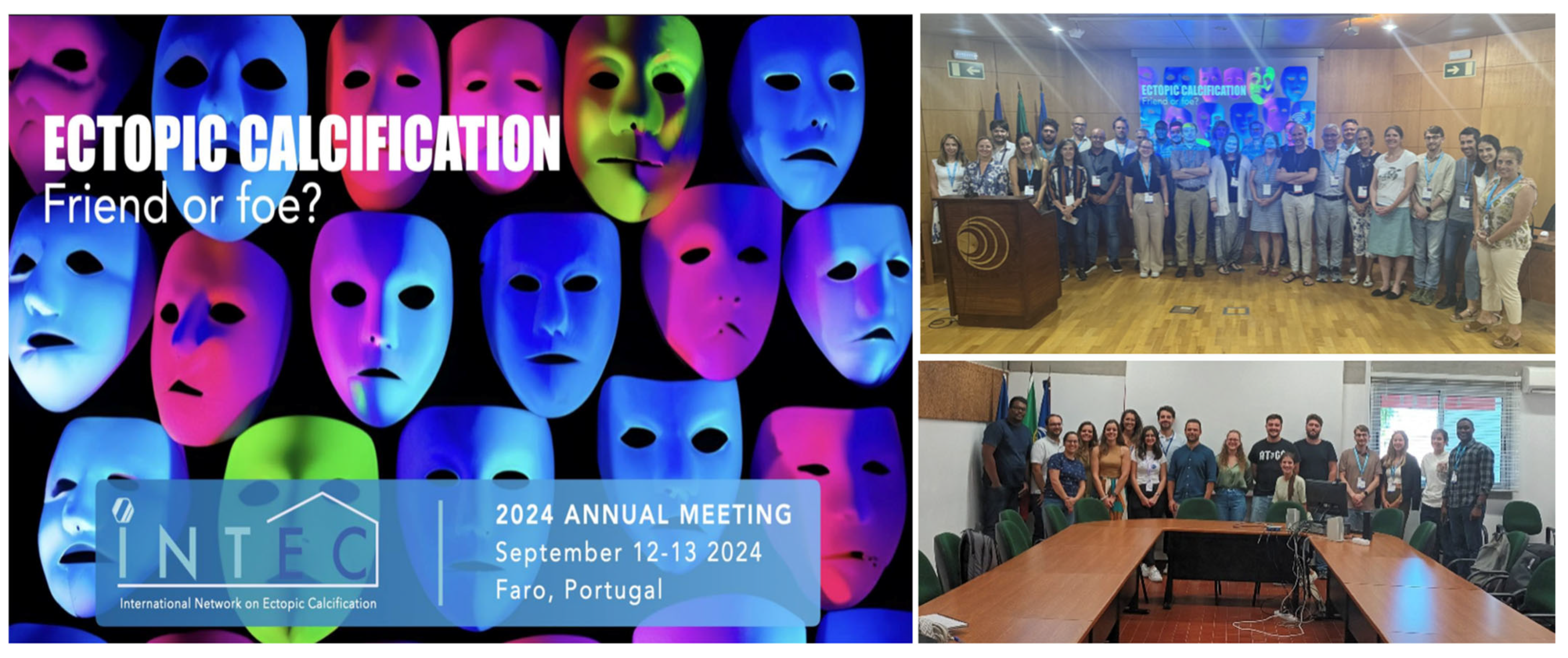
The 3rd Annual Meeting of the International Network on Ectopic Calcification (INTEC) was held in a hybrid format at the Campus de Penha, University of Algarve, on 12–13 September 2024. We extend our sincere thanks to all attendees who joined us from across Europe, Canada, the USA, and Asia (
Figure 1). Their participation helped make this a truly international event, designed to foster networking, knowledge exchange, and engaging thoughtful discussions in both formal and informal settings.
The INTEC meeting brings together researchers and clinicians focused on the molecular, (patho)physiological, and clinical aspects of ectopic calcification in hereditary and acquired conditions, as well as in aging [
1]. Understanding the underlying mechanisms, along with the genetic and environmental triggers, is essential to deciphering the dualistic “friend or foe” nature of ectopic mineralization and improving patient outcomes [
2,
3,
4,
5,
6]. The findings presented in this year’s meeting emphasised the complexity of the field, offering new insights into both mechanistic pathways and translational hurdles. Presentations spanned a wide array of approaches, from molecular biology and animal models to clinical case studies and industrial innovations, underscoring the interdisciplinary and multifaceted nature of ectopic calcification research.
This year, we received 23 abstracts including 7 from invited speakers, 10 selected for short oral presentations and 6 presented as posters. Among the six poster submissions, the highest-rated abstract was honoured with the 2024 INTEC/ISSEC Prize. The award was presented to Mr. Virgil Tamatey, MSc and PhD candidate of the HUN-REN Research Centre for Natural Sciences in Budapest (Hungary), who shared his findings on the kinetics of pyrophosphate homeostasis in mice and humans.
The full program of the 2024 INTEC meeting is available at
www.itnintec.com (accessed on 1 July 2025). Besides four scientific sessions—on animal models and human pathologies, human case studies, and two sessions of selected abstracts from researchers and industry—two professional development workshops were organised for master’s students and early-career researchers (
Figure 1). Highlights from this year’s meeting included novel mechanistic insights from animal models, such as Medaka fish, which highlighted the role of cellular polarity in ectopic bone formation. The application of CRISPR-mediated knock-ins advanced our understanding of how mutations lead to aberrant bone formation, emphasizing the importance of cellular behavior in disease progression. Genetically modified mouse models elucidated the distinct roles of serine and Gla residues in MGP, identifying FAM20C as a crucial kinase. Studies focusing on retinal calcification shed light on the pathological roles of mineralization in ocular diseases like age-related macular degeneration (AMD) and pseudoxanthoma elasticum (PXE). The identification of mineralized spherules as progression markers in AMD could pave the way for earlier diagnosis and intervention. Work using
Enpp1 transgenic mice highlighted the role of Bruch’s membrane calcification in the functional decline of the retina. The role of extracellular matrix components in calcification was further documented, with protective effects of glycosaminoglycans against elastin degradation-induced calcification highlighting potential strategies for matrix-targeted therapies, such as in atherosclerosis, where matrix integrity plays a critical role in disease progression.
Human case studies provided clinical relevance to these mechanistic insights. The identification of microbial DNA in calcified valve tissues suggested an underexplored link between infection and calcification, warranting deeper investigation. Exploration of the ATX-LPAR pathway in PXE introduced a novel therapeutic target, with LPAR inhibitors showing efficacy in reducing calcification. However, the variability in patient responses highlighted the need for personalized approaches in therapy development.
Industrial innovations, such as the T50 test and FOXO3-targeted therapies, exemplify the bridge between research and clinical application. The T50 test’s potential for early risk assessment could transform clinical practices in managing chronic calcification disorders. Meanwhile, FOXO3-targeted therapeutics offer exciting possibilities for addressing age-related degenerative conditions. Nevertheless, these innovations require comprehensive validation to ensure their long-term safety and efficacy. The abstracts of this year’s meeting are collected in this conference paper, with permission from the corresponding authors.
The INTEC 2024 meeting reinforced the importance of collaborative and interdisciplinary approaches in addressing ectopic calcification. Continued exploration of molecular mechanisms, innovative therapies, and effective communication strategies will be essential for advancing both research and clinical outcomes. We thus have much to look forward to during our next meeting, which will be a Joint Ectopic Calcification Meeting organised together with the International Scientific Society of Ectopic Calcification (ISSEC).
2. Animal Models and Human Pathologies
2.1. The Japanese Medaka Fish as Model for Human Chondrodysplasias and Heterotopic Ossification Disorders
Abstract: Small laboratory fish, such as zebrafish and medaka, have become popular models in bone research and to model human skeletal disorders. We have established protocols that allow the highly efficient knock-in of human disease mutations into the medaka genome by using CRISPR-mediated homology directed repair (HDR). Using this method, we have introduced a disease mutation in collagen type X into medaka that is found in human patients suffering from metaphyseal chondrodysplasia type Schmid (MCDS). We show that the resultant medaka mutants faithfully recapitulate human disease phenotypes and discovered that impaired cell polarity of skeletal cells results in irregular bone matrix deposition and ectopic bone formation. In a second project, we have introduced a R206H mutation into the medaka locus encoding activin receptor type 1 (Fibrodysplasia). This mutation is reported to lead to heterotopic ossification in soft tissues in patients suffering from Fibrodysplasia ossificans progressive (FOP), a rare disorder with unknown mechanism. In my talk, I will focus on our methodological approaches that are similarly useful to study ectopic calcification in fish models.
2.2. Matrix Gla Protein Mutations in Vascular and Cartilaginous Tissues: New Insights from Genetic Studies
Abstract: Matrix Gla protein (MGP) is a key inhibitor of soft tissue calcification, and its deficiency leads to Keutel syndrome—a rare disorder characterized by widespread cartilage and vascular abnormalities, including abnormal mineral deposition (calcification). We used a genetic approach to understand how MGP’s conserved residues—the N-terminal serine residues and γ-carboxylated glutamic acid (Gla) residues—contribute to its anti-mineralization function. Our findings indicate that the serine residues are essential for preventing mineral deposition in both vascular and cartilaginous tissues, while the Gla residues are primarily necessary for inhibiting cartilage calcification. We also identified FAM20C as a kinase responsible for phosphorylating MGP’s serine residues. More recently, we examined a dominant mutation in MGP’s signal sequence, which impacts both cartilage and vascular tissues and presents with traits overlapping with Keutel syndrome, such as shortening of long bones, facial anomalies, and short distal phalanges. This mutation also causes spondyloepiphyseal dysplasia, which is not seen in Keutel syndrome. Mouse models reveal that this mutation impairs MGP secretion, leading to ER stress, abnormal chondrocyte death, and premature growth plate cartilage calcification, but does not induce vascular calcification. Instead, vascular smooth muscle cells transdifferentiate into chondrocytes, resulting in arterial wall thickening. These results advance our understanding of MGP’s role in vascular and cartilage tissues and offer insights into potential therapeutic approaches for diseases linked to MGP mutations.
2.3. Modelling Developmental Capacity and Constraint in Skeletal Differentiation in Akt and PROS Somatic Mosaic Activation in the Zebrafish
Matthew Harris
Harvard Medical School, Boston Children’s Hospital, Boston, MA, USA
Abstract: The Harris lab is focused on the genetic and developmental basis of skeletal form and differentiation. We use the zebrafish and other small laboratory fish as windows in which to identify the instructions of skeletal development, maintenance with age, and how these signals are integrated in cases of skeletal disorders. One key insight arises from studies of how skeletal progenitor cells, carrying a somatic mutation, behave when out of context with their surroundings, as the conflict in signals can illuminate mechanisms of their control. Through modeling of somatic mosaic overgrowth disorders in zebrafish, we can show distinct tissue, temporal, and environmental constraints and capacities on activation and maintenance of growth programs determining susceptibility to bone overgrowth. Through these models we define molecular contexts that can break growth constraints. Lastly, we have developed a new model for damage-induced heterotopic ossification that shows distinct areas for study of this disorder in light of our identified regulators. These findings in the zebrafish model open up areas for therapeutic intervention.
3. Human Clinical Studies
3.1. Calcific Aortic Valve Disease (CAVD): Expression Analysis of Osteoblastic Biomarkers and Calcium Content
Abstract: Calcific aortic valve disease (CAVD) represents a frequent valvular heart disease for which, besides surgery, no definitive treatment is available. The investigation of alternative strategies for early diagnosis, for better understanding of CAVD progression, and to find new therapies is a need for the patients. The expression of osteoblastic markers in CAVD human samples, the calcium content and a complete microbiology analysis have been evaluated in aortic valve leaflets from 37 CAVD patients (stage III and IV) and 9 controls (affected by nonvalvular cardiac disease). Aortic valve leaflets were classified as right (R), left (L), and non-coronary (NC). Total valve RNA was extracted from samples to determine the tissue expression of early (RUNX2, OSX) and late (ALP, COL1A1, BGLAP) osteogenic markers by RT-qPCR. Multivariable analysis evaluated the role of risk factors (age, gender, chronic kidney disease, and dyslipidemia) on osteogenic markers expression. The expression of ALP, OSX, and COL1A1 was significantly increased in patients compared to controls; for BGLAP an increasing trend was present. Calcium quantitation of the samples was also performed by mass spectrometry, revealing significantly increased amounts of calcium in all patients. Of note, isolation of cells from cardiac leaflets demonstrated for the patients an intrinsic ability to be mineralized in vitro compared to control isolated cells. Bacterial DNA was detectable in 38% of the patients’ samples, at least in one leaflet, and in 22% of the controls. Correlation studies of molecular data with clinical features are undergoing and will provide new insight into the disease, likely paving the way for novel targets and therapies.
3.2. Calcific Tendinitis, a Concise Review
Abstract: Calcific tendinitis is a painful tendon disorder characterised by either single or multiple calcium hydroxyapatite crystal deposits within the tendon. The process is unique and distinct from degenerative joint disease. It’s a dynamic process that evolves through several stages. Successive stages have been characterized as having distinct radiographic and pathologic features, which often correlate with clinical symptoms. The exact mechanism of calcification and the process of spontaneous resorption of the calcific deposits are yet not clearly understood.
3.3. Case Studies on Debilitating Ectopic Soft Tissue Ossifications and Calcifications
Abstract: Ectopic soft tissue ossifications and calcifications often result in significant morbidity. Within the musculoskeletal system, Heterotopic Ossification (HO) disorders are particularly notable for causing such morbidity. While some rare forms of this disorder are driven by genetic mutations, others occur in response to triggering events, such as injury, and are relatively common. Among the genetic varieties, Fibrodysplasia Ossificans Progressiva (FOP) is the most extensively studied and debilitating form. All reported FOP patients carry a heterozygous gain-of-function mutation in the gene encoding activin A receptor type I (ACVR1). This mutation leads to dysregulated bone morphogenetic protein (BMP) signalling, resulting in extensive HO at extra-skeletal sites, including muscles, ligaments, tendons, and fascia. In contrast, acquired heterotopic ossification, which occurs in response to trauma, is more localized to the site of injury and can be classified into two varieties: Myositis Ossificans Traumatica (MOT) and Neurogenic Heterotopic Ossification (NHO). MOT is relatively common and is triggered by either a single episode or repeated instances of injury to the same area, leading to localized ossification within the soft tissues at the injury site. NHO, while also localized, typically occurs alongside central nervous system injuries, such as spinal cord or traumatic brain injury, and is often more extensive and severe than MOT. This presentation will focus on these debilitating conditions, showcasing clinical examples and discussing disease progression, as well as the diagnostic and therapeutic challenges they present.
3.4. Patients—Partners for Life
Abstract: Patients do all sorts of things for a living. They may be nurses, teachers, electricians, IT personnel, lawyers, doctors, caregivers, you name it. When getting the label ‘patient’, everything else seems to vanish when it comes to the ones following the former as such. Nevertheless, the knowledge patients had beforehand never vanishes and their expertise can be put to a good use and this should be kept in mind. Moreover, some patients go beyond the diagnosis and gather with others to build Patient Associations in order to help other patients, their families, scientists, and health professionals, who will then help the patients back with their effort and findings. Some of the goals are to raise awareness, improve empowerment and give hope. This voyage is an amazing one. I for one can testify for it in what comes to ectopic calcifying diseases, Pseudoxanthoma Elasticum (PXE) in particular, but also beyond a particular group of diseases, with the National RD Patients’ Organizations in Portugal. What is the reality concerning PXE in Portugal? Which projects did the Portuguese Patient Association develop? How can the patients be of help to health care, research and academic professionals? How do the several associations relate in Portugal, in Europe, globally? Which projects could be replicated elsewhere? These are some of the questions to be addressed.
4. Selected Oral Presentations from Researchers
4.1. Mineralisation in the Eye: A Biomarker and Target for Treatment
Abstract: Introduction: Calcification is required to form and maintain skeletal and dental tissues in health. However, dysregulation of the mineralisation process can lead to ectopic calcium phosphate mineral deposition. In our work, we explored how ectopic calcification contributes to age-related macular degeneration (AMD) and Alzheimer’s disease (AD). Materials and Methods: Our study involved the ethical acquisition of post-mortem eyes and brains from patients diagnosed with AMD or AD, as well as from healthy controls. We employed various techniques, such as flat-mounting whole eyes onto glass slides and embedding eye and brain tissues in paraffin for sectioning. To visualise calcification, we used OsteoSense680EX, a fluorescent dye specific for the calcium phosphate hydroxyapatite (HAP). We also utilised advanced analytical tools such as energy-dispersive x-ray spectroscopy (EDX) and time of flight secondary ion mass spectrometry (TOF-SIMS) to confirm the elemental composition of the structures stained with OsteoSense680EX. Results: We found that AMD and AD are associated with increased deposition of mineralised spherules in sub-RPE deposits and Bruch’s membrane. In AMD, large, calcified nodules heralded the rapid progression to end-stage disease. We also found that ectopic calcification of neurons and their nuclei is associated with p-Tau in the brains of AD patients. Conclusions: Our findings suggest that ectopic calcification could be a promising target for interventions in AMD and AD. Alterations in calcium and phosphate levels, either through dietary changes or supplementation, as well as targeted interventions involving proteins and lipids associated with mineralisation, are potential strategies for further research and development.
4.2. ENPP1 Is Associated with Ectopic Calcification of the Bruch’s Membrane and Functional Changes in the Mouse Retina
Bertelli PM 1, Pilgrim MG 1, Brown C 1, Augustine J 1, Friedel T 1, Cunningham F 1, MacRae V 2, Kortvely R 3, Lengyel I 1
1 Wellcome-Wolfson Institute for Experimental Medicine, Queen’s University Belfast, Belfast, UK
2 The Roslin Institute, The University of Edinburgh, Midlothian, Scotland, UK
3 Roche Pharma Research and Early Development, Immunology, Infectious Diseases and Ophthalmology (I2O) Discovery and Translational Area, Roche Innovation Centre Basel, Switzerland
Abstract: Introduction: Under physiological conditions, calcium and phosphate concentrations are tightly regulated, ensuring that calcification is restricted to bones and teeth. However, ectopic calcification in the extracellular space of soft tissues has been associated with ageing disorders, including age-related macular degeneration (AMD), pseudoxanthoma elasticum (PXE), and generalized calcification in infancy (GACI). Ectopic calcification is associated with mutations on ectonucleotide pyrophosphatase/phosphodiesterase 1 (ENPP1). Here, we characterized the effects of exon 9 deletion in ENPP1 on ocular calcification and retinal structure and function. Materials and Methods: ENPP1 transgenic mice were generated by deletion of the functional exon 9 and maintained for up to 6 months. Retinal function was assessed by colour fundus photography (CFP), optical coherence tomography (OCT) and electroretinography (ERG). In addition, murine eyes were assessed for calcification using hydroxyapatite-specific fluorescent staining (Osteosense-680RD) and confocal microscopy. ENPP1−/− animals were compared to ENPP1+/− and ENPP1+/+ controls. Results: Visible lesions were identified in the ENPP1−/− animals using CFP. However, OCT retinal segmentation showed no structural differences among the groups. When using ERG, no changes were seen in scotopic a-wave and b-wave. ENPP1−/− showed significant decreased c-wave amplitude, used to assess the functional integrity of the photoreceptors, the pigment epithelium and the interactions between them. Osteosense staining showed ectopic calcification in the Bruch’s membrane and vasculature ENPP1−/− retinas but not in ENPP1+/− < ENPP1−/− control animals. Conclusions: Here we show that deletion of exon 9 in the ENPP1 results in changes to retinal structure and function. We show the functional changes in the retina to be associated with Bruch’s membrane calcification. Our results suggest ENPP1 transgenic animals as a valuable pre-clinical model to study the effects of calcification in ocular diseases, such as AMD, PXE, and GACI, for the development of novel intervention strategies.
4.3. The Role of Elastin Degradation in the Calcification Process
Quaglino D, Lofaro FD, Mazzilli A, Bonacorsi S, Boraldi F
Department of Life Sciences, University of Modena and Reggio Emilia, Modena, Italy
Abstract: Elastic fibres (EF) are mainly composed by elastin and microfibrillar molecules that assemble during development and have a very low turnover rate throughout life. This makes EF more prone to enzymatic proteolysis, oxidation, calcium accumulation, and carbamylation. Calcification of EF has been linked to progressive degradation of elastin, that exposes sites promoting mineralization, as observed in several pathologic conditions, either acquired (e.g., vascular calcification in atherosclerosis) or inherited (e.g., PXE, pseudoxanthoma elasticum). Indeed, PXE patients exhibit elevated levels of matrix metalloproteinases, and PXE fibroblasts are characterized by raised degradative potential. To demonstrate that elastin degradation precedes and favours the mineralization process, an in vitro cell-free model was used to explore if: (i) conditioned media from human dermal fibroblasts isolated from calcified or from healthy tissues could differently degrade elastin fibrils modulating their calcification; (ii) the addition of glycosaminoglycans (i.e., HS, heparan sulphate or CS, chondroitin sulphate) during the coacervation phase of elastin fibrils could counteract the mineralization. Results indicate that: (i) conditioned media from fibroblasts from calcified areas have an increased proteolytic potential compared to healthy cells; (ii) calcification is increased on fibrils degraded by pathologic conditioned media; (iii) the presence of HS significantly reduces calcification in a dose-dependent manner, whereas CS has no effect. These data, further supported by the analysis of the fibroblasts’ secretome, underline: (i) the correlation between elastin degradation and mineralization, and (ii) the importance of glycosaminoglycans in modulating the resistance of elastin to degradation. Moreover, fibroblasts play an active role in this process, having a different capacity to secrete proteases and their inhibitors, and this can explain why not all elastic fibres are calcified even in the same tissue of the same subject.
4.4. Activation of the Autotaxin–Lysophosphatidic Acid Receptor Pathway Contributes to the Pathogenesis of Pseudoxanthoma Elasticum
Derudder R 1,2,3, Dangreau L 1,2,3, Coucke P 1, De Kesel P 4, Nollet L 1,2,3, Vanakker OM 1,2,3
1 Department of Biomolecular Medicine, Ghent University, Ghent, Belgium
2 Ectopic Mineralization Research Group Ghent, Ghent University, Belgium
3 Center for Medical Genetics, Ghent University Hospital, Ghent, Belgium
4 Department of Laboratory Medicine, Ghent University Hospital, Ghent, Belgium
Abstract: Introduction: Pseudoxanthoma elasticum (PXE) is a rare hereditary disorder caused by bi-allelic ABCC6 mutations, leading to calcification of the skin, arteries, and eyes. Autotaxin (ATX/ENPP2), a lysophospholipase D enzyme, produces lysophosphatidic acid (LPA) from lipoprotein(a) phospholipids. LPA signalling, via LPA receptors, promotes IL-6 and BMP-2 secretion, stimulating osteochondrogenic transdifferentiation and calcification. This study evaluated the involvement of ATX-LPAR signalling in PXE-related ectopic calcification. Materials and Methods: Skin tissue and dermal fibroblasts (n = 5) were obtained from PXE patients and age- and sex-matched controls (n = 5). Immunohistochemical staining for ATX, LPAR, and downstream targets was performed, and calcium crystals were visualized using Von Kossa staining. Differential gene expression analysis of ATX/LPAR pathways was conducted in PXE and control fibroblasts using RT-qPCR. In an in vitro calcification assay, mRNA levels of ATX/LPAR targets were measured in PXE fibroblasts at 0, 10, and 20 days. PXE fibroblasts were treated with the LPAR inhibitor Ki16425 (10 µM), and calcification and soluble TNAP enzyme activity were assessed. In PXE (n = 26) and control (n = 25) serum samples, ATX levels were measured using ELISA, and lipoprotein(a) concentrations were determined by immunoassay. Results: Immunohistochemical staining revealed high expression of ATX, LPAR3 and downstream targets in PXE skin, co-localizing with osteogenic markers and calcium deposits. Increased mRNA levels of ATX, LPAR1, PIK3CA, ERK1, and IL-6 were found in PXE fibroblasts compared to controls. In a 20-day in vitro calcification assay, ATX, LPAR1, ERK1, and IL-6 mRNA levels increased with calcification. Treatment with Ki16425 significantly reduced calcium deposits and soluble TNAP activity. In serum, ATX levels were 2-fold higher in PXE patients compared to controls, while lipoprotein(a) levels were normal. Conclusion: Increased ATX/LPAR signalling may be involved in PXE-related calcification. LPAR inhibition reduced matrix mineralization and TNAP activity in vitro. Currently, experiments evaluating ATX/LPAR inhibitor HA130 are underway.
4.5. Therapeutic Applications of ENPP1-Fc Prevent Muscle Calcification Following Cardiotoxin-Induced-Muscle Damage in Abcc6−/− Mice
Price T 1, O’Brien K 2, Howe J 2, Flaman L 2, Lynch A 2, Moran M 3, Li J 4, Husson H 2, Plaas A 4, Sabbagh Y 2
1 Departments of Surgery, Rush University Medical Center W Harrison Street Chicago
2 Inozyme Pharma, 321 Summer Street, Boston MA USA
3 Anatomy & Cell Biology, Rush University Medical Center W Harrison Street Chicago
4 Internal Medicine, Rush University Medical Center W Harrison Street Chicago
Abstract: Ectopic mineralization (EM) from burns, blast injury, spinal cord injury, or surgical trauma range from dystrophic calcifications to heterotopic ossification. No effective therapeutic intervention exists, apart from surgical intervention which can prolong or exacerbate recovery from the initial injury. Specific mutations in genes in the Pi/PPi metabolic pathway such as ABCC6, ENPP1, ANKH, and FETUIN A are known to cause hereditary disease of EM in humans and knock-out mouse models. ABCC6 is highly expressed in liver and proximal collecting kidney tubule cells. It is presumed to transport ATP from inside to outside of the cell, where ENPP1 hydrolyzes ATP into AMP and pyrophosphate (PPi), the latter of which is a potent inhibitor of mineralization. The Abcc6−/− mouse strain has 50% lower circulating PPi, leading to spontaneous mineralization of soft tissues. 12-week male Abcc6−/− mice were injected with Cardiotoxin, Naja pallida (CDTX) in the left quadriceps muscle. 10 mg/kg ENPP1-Fc was administered weekly subcutaneously for 2 weeks, starting 1 day after CDTX injection. Muscle tissue was assessed via µCT and gene expression changes were assessed using qPCR. Terminal plasma was collected to measure circulating PPi levels. Mineralization begins in damaged muscle starting 7 days after CDTX injection and increases through day 14, preceded by transient increases in macrophage/inflammation genes (Itgam, Siglec1, Emr1, Il6, Tnf), myogenic genes (Myf5, Myog, Myod1), and followed at 7–14 d by induction of chondrogenic/hypertrophic genes (Vcan, Cd44, Has2, Acan, Col10, Mmp3,9&13). Dosing of ENPP1-Fc prevents >90% of muscle mineralization. Experiments are ongoing to confirm the effect of ENPP1-Fc on circulating PPi, and RNASeq analyses of muscle to elucidate the effects of ENPP1/PPi on inflammation, chondrogenesis, mineralization, and resorption pathways during the regenerative responses of the injured muscle tissue. The data support our previous publications to highlight the therapeutic potential of ENPP1-Fc in mitigating and possibly resolving post-traumatic or genetically induced soft tissue mineralization in a variety of clinical settings.
4.6. Ferroptosis of Valvular Interstitial Cells as a Result of Erythrophagocytosis Promotes Calcific Aortic Valve Stenosis
Qin Z 1, Bäck M 1,2, Franco-Cereceda A 2,3, Pawelzik S-C 1,2
1 Translational Cardiology, Department of Medicine Solna, Center for Molecular Medicine, Karolinska Institutet, Stockholm, Sweden
2 Heart and Vascular Center, Karolinska University Hospital, Stockholm, Sweden
3 Department of Molecular Medicine and Surgery, Karolinska Institutet, Stockholm, Sweden
Abstract: Calcific aortic valve disease (CAVD) progresses to severe Aortic Stenosis and heart failure. Recent evidence indicates that intra leaflet hemorrhage (ILH) promotes valve calcification; however, how ILH contributes mechanistically to CAVD remains poorly understood. Additionally, it has been shown that dysregulated iron metabolism correlates positively with osteoblastic differentiation of valvular interstitial cells (VIC). Ferroptosis, a regulated form of cell death characterized by lipid peroxidation, has been implicated in CAVD, but the detailed mechanisms remain unclear. Therefore, we aim to determine the role of ferroptosis in CAVD progression in the context of ILH.
VIC directly erythrophagocytosed red blood cells (RBC), which led to an excess intracellular iron overload and significantly exacerbated VIC calcification. Suppression of VIC calcification by ferroptosis inhibitors indicated a link between ILH and valvular calcification through ferroptosis. Using transcriptome data from our human aortic valve biobank, we identified ferroptosis-related genes that were upregulated in calcified valve tissue, e.g., 5-lipoxygenase (5-LO) and acyl-CoA synthetase long-chain family member 4 (ACSL4). To verify the role of ferroptosis in VIC, we cultured VIC in the presence of the ferroptosis inducer RSL3 and observed an increased vulnerability to oxidative damage and cell death, which was reversed by inhibition of 5-LO and ACSL4. Finally, we demonstrated that oxidative stress triggered by osteogenic medium was inhibited by both ferroptosis inhibitors and 5-LO inhibitors.
Our findings connect ILH- and erythrophagocytosis-induced valve calcification with oxidative stress and ferroptosis. Additionally, we identified 5-LO and ACSL4 as crucial components for the interplay between ferroptosis and oxidative stress in VIC. By connecting these pathways, we suggest that 5-LO and ACSL4 process polyunsaturated fatty acids as part of the pathophysiology of CAVD. Inhibition of ferroptosis not only reduces oxidative damage but also attenuates VIC calcification, underscoring its potential as a therapeutic target in the treatment of CAVD.
4.7. The Vascular Calcification Process in PXE
Alouane A 1, Stefano J 1, Clotaire L 2, Martin L 3, Padovani B 1, Duranton C 2, Rubera I 2, Lefthériotis G 1,2
1 University Hospital Nice, Nice, France
2 Laboratory of Molecular PhysioMedicine (LP2M), Nice, France
3 University Hospital Angers, Angers, France
Abstract: Introduction: PXE is a monogenic disease characterized by a progressive calcification of the peripheral arteries of the lower limbs. The progression and natural process of development of calcifications in the peripheral vasculature is not well known in this disease. As part of the PROPHECI trial (NCT0486857), we are studying the segmental progression of peripheral arterial calcification. Methods: The analysis of the peripheral arterial calcification process is extracted from CT scans of the leg arteries, without contrast injection, using an automated segmentation method developed in our laboratory. For each CT section (n = 1000), calcification density (determined by a threshold >132 HU), surface area and relative calcification were determined. Quantification and mapping of calcification topology before and after 12 months of treatment was determined in PXE patients enrolled in the PROPHECI trials. Results: The first results reveal that the development of calcifications in PXE is singular, with different patterns depending on the patients. In particular, the popliteal artery remains preserved in almost all patients, which suggests a specific response of this arterial segment compared to the supra- and infra-popliteal segments to the pro-calcific context. Conclusions: These first results will allow us to better analyse the progression/regression of calcifications in the natural history of the PXE disease and the clinical trials.



 ,
,