
Systematic Review

Global Perspective and the Current Characterization of Buffelgrass (Pennisetum ciliare (L.) Link) with Emphasis on Arid Mexican Territories


by
Luis Ángel Barrera-Guzmán
1,
Héctor Tecumshé Mojica-Zárate
1,*,
Jorge Cadena-Iñiguez
2,*,
Juan Guillermo Cruz-Castillo
1,
Óscar Díaz-José
1,
Juan Ángel Tinoco-Rueda
1,
Sergio Alejo-Bello
1,
José Orlando Rojas-Reyes
1,
José Gervasio Partida-Sedas
1 and
Haydée Xanat Téllez-Hernández
1
1
Centro Académico Regional Sede Huatusco-Veracruz, Universidad Autónoma Chapingo, Carretera Federal Huatusco-Veracruz Km. 6.5, Veracruz 94100, Mexico
2
Posgrado en Innovación en Manejo de Recursos Naturales, Colegio de Postgraduados, Campus San Luis Potosí, Salinas de Hidalgo, San Luis Potosí 78600, Mexico
*
Authors to whom correspondence should be addressed.
Grasses 2026, 5(2), 22; https://doi.org/10.3390/grasses5020022
Submission received: 2 March 2026 / Revised: 8 May 2026 / Accepted: 14 May 2026 / Published: 18 May 2026
(This article belongs to the Special Issue Advances in Grazing Management)

Abstract

Characterized as one of the most controversial and widely used grasses in various regions, buffelgrass (Pennisetum ciliare (L.) Link) is considered a significant and problematic invasive exotic species and an adaptable and resilient forage source with relatively high biomass production and resistance to harsh agroecological conditions. Objective: The objective of this documentary research is to present a systematic review of buffelgrass dynamics, focusing on its global management and specifically on the arid regions of Mexico, particularly Sonora. This review highlights its forage potential, invasive capacity, adaptability, and the different scales of its multifactorial relationship within the productive-environmental sphere. Methods: Information on buffelgrass in various regions of the world, with an emphasis on arid regions, was reviewed and summarized. This information was gathered from a selection of 59 articles, considering common aspects such as appropriate methodologies, location within the geographical limits of aridity, and originating from Web of Science repositories. The search criteria included “Pennisetum ciliare and Cenchrus ciliaris”, “invasion”, “livestock”, “forage”, “sustainability”, and “restoration”, among other key concepts, with a timeframe limited to the year 2026. This allowed for the definition of thematic axes for the descriptions presented. Main results: The results highlight various treatments in agriculture and livestock farming, its use in combination with other grasses, and the implementation of adjuvants, which improves its performance. In this regard, its use as a substitute for primary forage with 500 mm of annual irrigation is emphasized, achieving biomass production levels of up to 18.4 t ha−1. Conclusions: Buffelgrass in vulnerable arid territories, such as Sonora, Mexico, could improve soil cover, nutrient content, and biological presence; however, in a state of equilibrium, it can cause alterations that are difficult to reverse and that compromise local ecology and water resources.

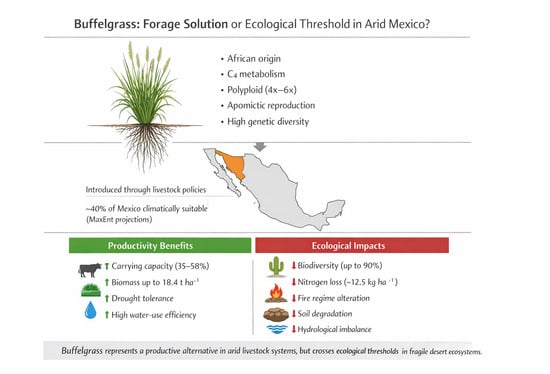
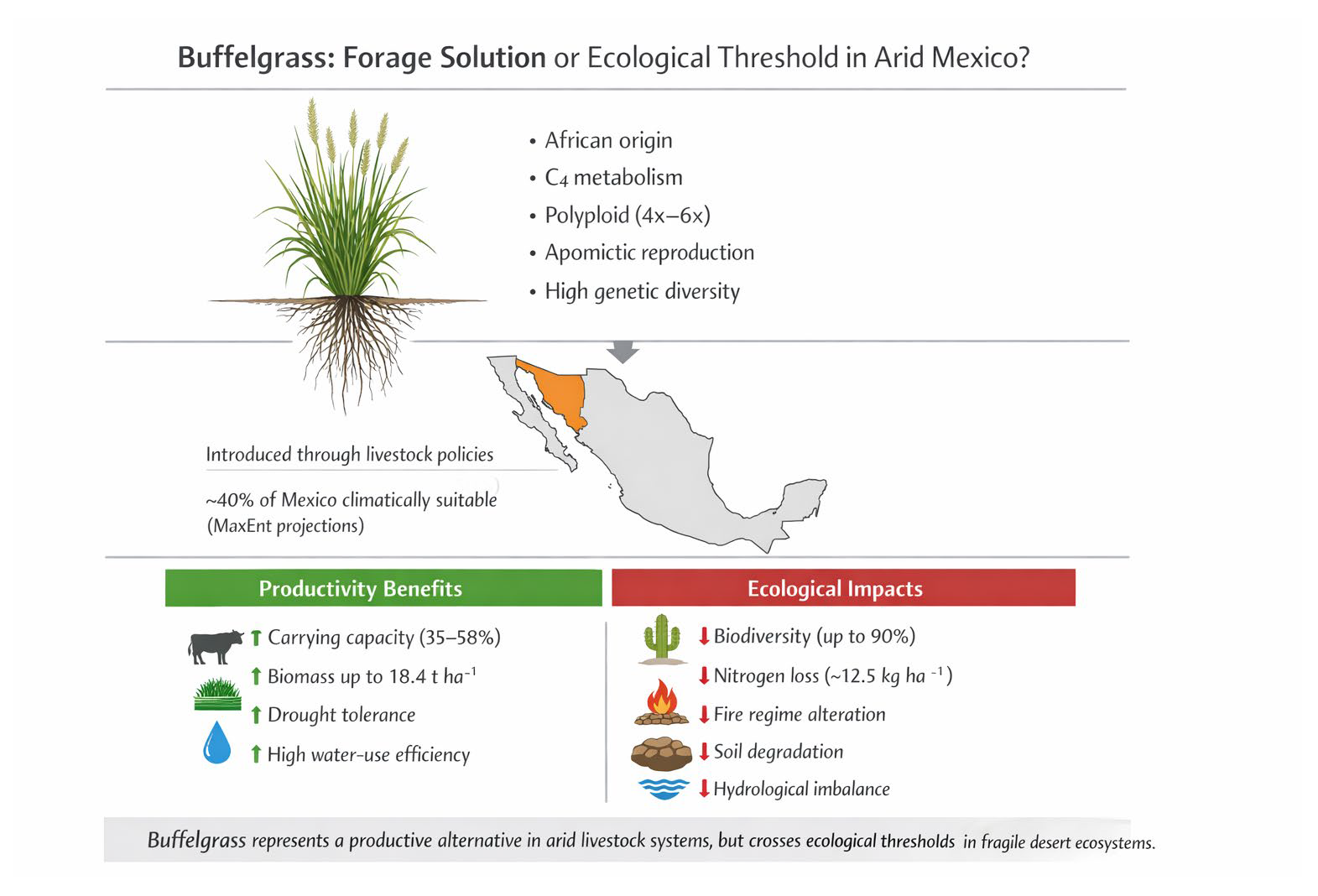
Graphical Abstract

1. Introduction

Buffelgrass [Pennisetum ciliare (L.) Link (Poaceae)] is a species of African origin [1] that, due to its adaptability, has been successfully introduced into arid and semi-arid regions throughout the world. It has a wide distribution in Mexico, the southern United States, Central America, Ecuador, Colombia, Venezuela, Bolivia, Argentina, Brazil, Spain, Italy, countries in the Middle East, and much of Africa, where it has the status of an introduced and invasive species. This grass is characterized by its high forage productivity and has been an alternative for livestock production systems, especially in those where local production is insufficient to achieve high productivity [2]. Since its introduction to various parts of the Americas and Australia, buffelgrass has invaded a considerable area, giving rise to pastures [1,3] and grassland habitat. An important aspect of this grass has been its high capacity to produce dry matter (30–60 t ha−1) in sites with annual rainfall ranging from 150–750 mm [4], making it indispensable for regions with low production technology or scarce resources. In some cases, buffelgrass is considered an invasive species, which negatively affects the balance of ecosystems [1,5]. In the United States it is considered as being a highly invasive “Watch” category taxon by the California Invasive Plant Council (CAL IPC https://www.invasive.org/browse/subject/73106?tab=subject-info, accessed on 1 May 2026).
In Australia, it is estimated that over 10 million hectares are covered by buffelgrass, which has gradually displaced and affected the ecology of native species [6]. In Queensland, the invasion of this grass significantly reduces species richness, as its reproductive mechanisms are highly efficient and produce a large number of seeds. Other important factors regarding invasive species are related to the alteration of biogeochemical cycles, as well as the dynamics of water and nutrients in the soil [7,8].
In Pakistan, there is a high degree of morphological variability among buffelgrass populations, given that the arid environmental conditions are favorable for its development and growth. Outstanding characteristics were found to be related to the number of tillers per plant, number of internodes of the main tiller, number of leaves, plant fresh weight, height, leaf area, and number of productive branches [9]. These characteristics give buffelgrass the ability to adapt successfully and rapidly to diverse environments. Anatomically, buffelgrass exhibits characteristics such as thick epidermal layers in its leaves and stems, high sclerification of the main stem, a greater number of vascular bundles, bulliform growth, a larger metaxylem area, and lower stomatal density, which allows it to maximize resource use for survival [10] and exhibit high growth rates [11]. At the molecular level, buffelgrass also possesses high genetic diversity, as demonstrated by a study of single nucleotide polymorphism markers [12].
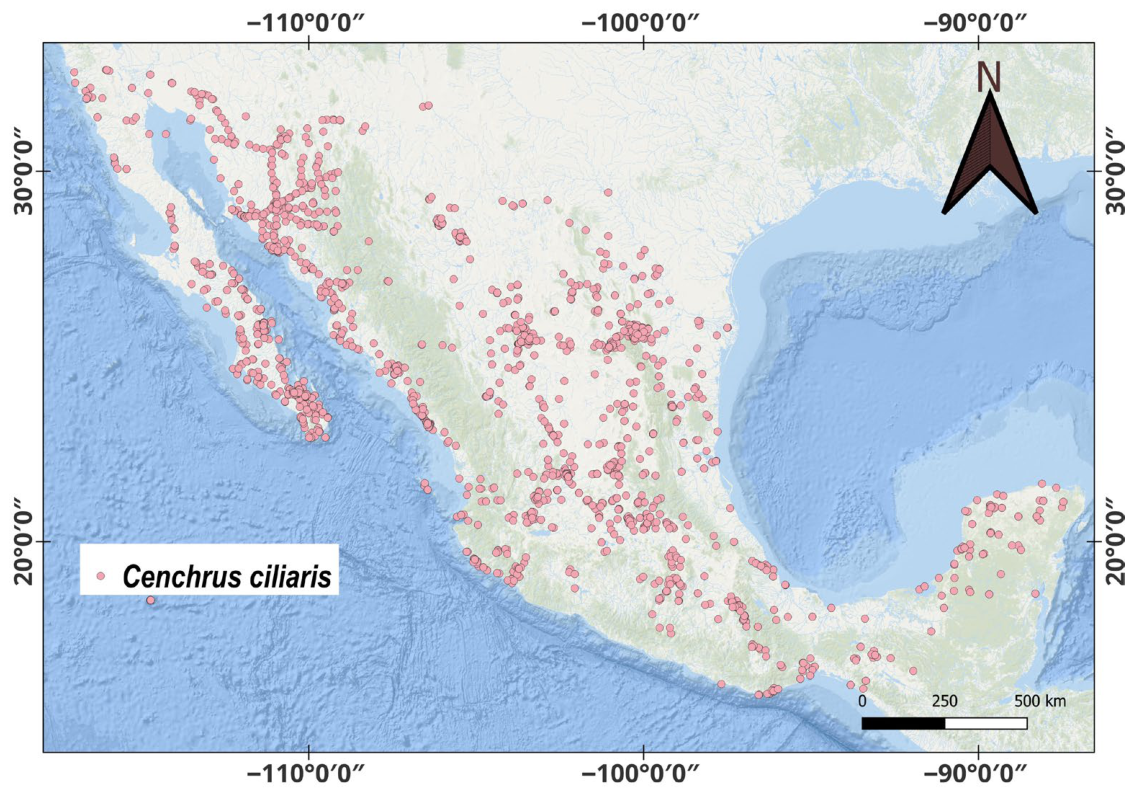
Although buffelgrass exhibits apomixis, there is moderate variation in diversity among its populations. Inter-Simple Repeat Sequence (ISSR) molecular markers identified similarity indices ranging from 60–90% in Saudi Arabia, indicating that this diversity may be reflected in buffelgrass morphology, which is important for establishing a genetic basis for traits of interest [13]. In northwestern Mexico, ISSR molecular markers were implemented in 16 buffelgrass populations, yielding a Nei genotypic diversity index of 0.75. This suggests that, despite its reproductive method, this species exhibits significant genetic variability, which may be associated with greater phenotypic plasticity, contributing to its successful invasion process [14]. The first investigations in buffelgrass regarding its cytology revealed that they can be facultative apomictic, that is, certain hybridization patterns can be observed that result from a wide morphological diversity [15]. The introduction of buffelgrass to Mexico was linked to political entities and government programs such as the Alianza para el Campo (ALCAMPO) and the Programa de Estímulos a la Productividad Ganadera (PROGRAN). Figure 1 shows the distribution of buffelgrass in Mexico, which is concentrated in the arid zones of the northern region of the country. This pattern reflects the suitability of these ecosystems for the growth, development, and expansion of this species. Livestock production systems, in which buffelgrass is used as part of the animals’ diet, are also common in these regions. Because northern Mexico comprises xerophytic vegetation and arid climates, buffelgrass was introduced to the states of Sonora, Chihuahua, Coahuila, Nuevo León, and Tamaulipas [16].
These government programs offered incentives to transition from native scrublands to buffelgrass cultivation, based on the argument that significant yields in livestock feed could be obtained [17]. Regarding morphological diversity, significant differences were found among four buffelgrass accessions in Tamaulipas, Mexico, which differed in characteristics such as the number of ears and caryopsid weight, indicating that the ecogeographic richness of a region can promote species diversity [18]. Other studies in Tamaulipas also found diversity in leaf and stem morphology [19]. In the Altiplano Potosino, Mexico, some varieties of buffelgrass such as “Titan” and “Regio” had an average yield of 2120–2582 kg h−1 of dry matter under rainfed conditions. However, under irrigation, yields increase considerably to 5180–9160 kg h−1 of dry matter [20].
Is it possible to consider P. Ciliaris as a sustainable forage alternative in arid regions, based on its proven productive benefits as well as its environmental risks already described in several research, considering it as an invasive species? This review takes a critical perspective on buffelgrass. While it has important applications for forage production, its invasive characteristics are unsustainable in the long term, or at least the cited studies do not suggest otherwise. It is in arid regions where this species has been introduced, and where the vulnerability of both water and soil resources, as well as a decrease in biodiversity, has been observed. In this context, the present review not only compiles global evidence but also aims to comparatively analyze the ecological and productive behavior of buffelgrass across different regions, distinguishing the underlying environmental and management-related factors that explain its contrasting effects.
Figure 1. Geographic distribution of buffelgrass (Pennisetum ciliaris) in Mexico based on occurrence records from the Global Biodiversity Information Facility (GBIF) [21] (Available online: https://doi.org/10.15468/dL.72e9sm (accessed on 13 February 2026)). Occurrence points are concentrated in arid and semi-arid regions of northern Mexico.
Grasses 05 00022 g001
In Mexico, “Servicio Nacional de Inspección y Certificación de Semillas” (SNICS) developed a guide establishing the regulations for registering new buffelgrass varieties [22]. This guide describes 37 characteristics related to ploidy level, stem morphology, leaves, color, inflorescences, and seeds. Ploidy in buffelgrass is varied, with tetraploids (2n = 4x = 36), pentaploids (2n = 5x = 45), and hexaploids (2n = 6x = 54). This polyploidy, along with hybridization, generates a continuum of diversity that increases the genetic diversity of this species [23]. Emerging literature indicates that approximately 80% of buffelgrass is tetraploid [24] and amphiploid, as genetic and molecular patterns suggest that this species arose from two ancestors [25].
Sonora, Mexico, is a state with a high incidence of buffelgrass. It is characterized by an arid and semi-arid climate with low annual rainfall of between 200 and 600 mm. In 2003, buffelgrass represented 25% of the nearly 4 million hectares, which were almost entirely covered by native vegetation [2], especially in the municipalities of La Colorada and some others in the Sierra de Sonora, where radical changes have been seen and columnar cactus species have been displaced by buffelgrass [3,4].
The objective of this research is to conduct a systematic review of buffelgrass dynamics in arid regions, with emphasis on Mexico, to identify and analyze the mechanisms underlying the trade-off between its productive value as a forage species and its ecological risks as an invasive organism. Specifically, this review examines the biological, environmental, and anthropogenic factors that determine under which conditions buffelgrass functions as a viable forage alternative and at which point its invasive dynamics compromise the long-term sustainability of arid and semi-arid agroecosystems. Evidence from agriculture, livestock systems, biodiversity, soil, water resources, and management strategies is integrated to build a context-dependent mechanistic understanding of buffelgrass behavior across different geographic regions.

2. Materials and Methods

This systematic review focused on scientific publications about buffelgrass in arid and semi-arid regions, with particular emphasis on Mexico. A structured search strategy was implemented across five academic databases: Web of Science, Scopus, Google Scholar, SciELO, and Mexican institutional repositories specializing in agricultural research. The search was conducted between October 2025 and January 2026 using Boolean operators to combine the following terms: (“buffelgrass” OR “Pennisetum ciliaris” OR “Cenchrus ciliaris”) AND (“arid” OR “semi-arid” OR “desert” OR “Sonora”) AND (“invasion” OR “invasive species” OR “forage” OR “livestock” OR “soil” OR “water” OR “ecosystem” OR “sustainability” OR “restoration” OR “biodiversity”). Searches were conducted in both English and Spanish to ensure comprehensive coverage of regional literature. No language restriction was applied during the identification stage. The time frame was limited to publications up to January 2026, although seminal works published before this period were included when deemed essential for contextual understanding. Grey literature, including technical reports, institutional documents, and theses, was also considered to capture information not published in indexed journals (see Supplementary Materials).
Although a quantitative meta-analysis was not conducted, this decision was methodologically justified by the substantial heterogeneity in study designs, outcome measures, and environmental contexts across the included literature. Buffelgrass research spans-controlled greenhouse experiments, field-scale observational studies, remote sensing analyses, and qualitative case studies, with outcomes reported in incompatible units and across non-comparable spatial and temporal scales. Under these conditions, pooling effect sizes would produce misleading results and violate the statistical assumptions underlying meta-analytic procedures. To compensate for the absence of formal meta-analysis and strengthen the systematic nature of the review, key quantitative data were extracted from each included study where available, including: (i) study location and geographic coordinates, (ii) sample size and replication structure, (iii) measured outcome variables and reported units, (iv) principal findings expressed as numeric values or effect directions, and (v) evidence tier classification (as described above).
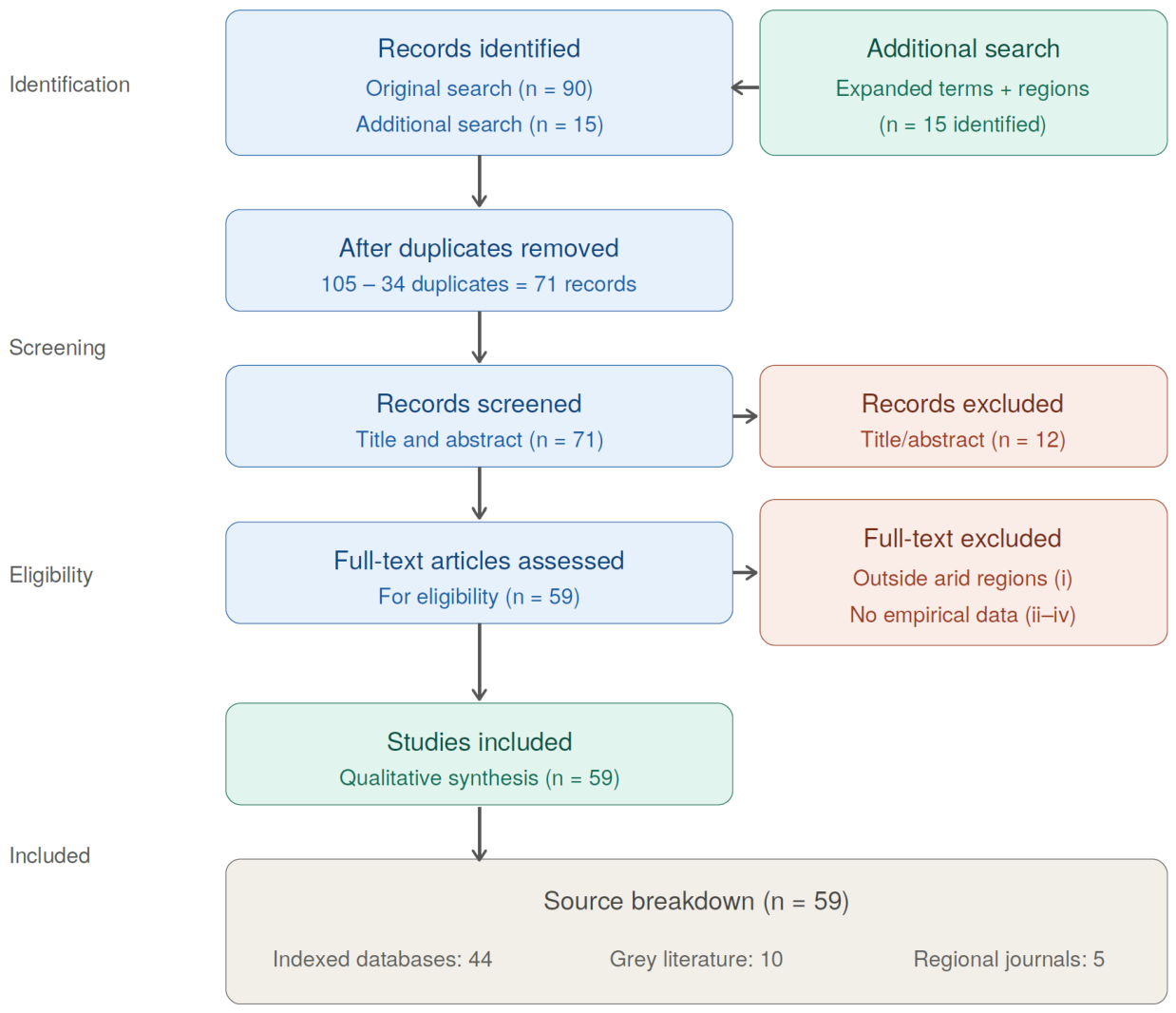
Of the 59 studies included in the final analysis, 44 were obtained from indexed databases (Web of Science and Scopus), 10 corresponded to grey literature (technical reports, theses, and institutional documents), and 5 were sourced from regional peer-reviewed journals. To further strengthen the evidence base in response to peer review, an additional search round was conducted expanding the geographic scope to include arid regions of Africa, the Middle East, South Asia, and Australia, and broadening the search terms to incorporate soil microbiota, carbon dynamics, fire ecology, and hydrological impacts. This expanded search yielded 15 additional records; after removing 4 duplicates, 11 records underwent title and abstract screening, all of which were excluded due to lack of relevance to arid environments or absence of empirical data directly addressing buffelgrass dynamics. Consequently, the total number of studies included remained at 59, confirming the comprehensiveness and robustness of the original search strategy. In total, 105 records were identified across all searches. After removing duplicates (n = 34), 71 records remained for screening based on title and abstract. Subsequently, 12 studies were excluded, and 59 studies met the inclusion criteria and were used for qualitative synthesis. The study selection process is presented in the updated PRISMA 2020 flow diagram [26] (Figure 2).

3. Results

3.1. Impact on Agriculture and Livestock

Buffelgrass has primarily been evaluated in terms of forage production, as well as the components of a technological package that can positively or negatively affect its productivity; however, the genotype-environment interaction plays a significant role. In the arid regions of Mexico, experiments have been conducted with buffelgrass and Bouteloua gracilis (a native grass) using diverse planting methods and moisture conditions. The results showed that corn stubble cover increased plant survival by an average of 31.5% in both species [27], although it is not specified whether these results have effects on the nutraceutical quality of both grasses.
Although buffelgrass shows adaptability to harsh environments, its productivity in Sonora is quite limited and has been largely unsuccessful. Research indicates that 75% of buffelgrass production has unsatisfactory yields related to areas with little or no rainfall, eroded and uncultivated soils, inadequate planting densities, and, in general, poor knowledge of its integrated management [7]. While it has been mentioned that buffelgrass requires little water during its phenology, there are critical periods immediately after germination and in early vegetative stages that directly influence its productivity. Therefore, it is necessary to implement strategies capable of retaining water. Yáñez-Chávez et al. [28] applied hydrogel, a polymer used to absorb water, at a rate of 20 kg ha−1 in a buffelgrass cultivation system. The results indicated moisture retention during the first 20 days, which is the period of the early phenological stages of buffelgrass. To achieve greater water retention, it is necessary to apply up to 10 t ha−1 of corn stubble to retain moisture for a longer time, which will be reflected in a higher photosynthetic rate and an increase in biomass as a response.
The increased animal carrying capacity in Sonora, which is 35–58% [7], and the forage yields (0.63–1.46 t ha−1) [6], are important for local food and economic security. This information requires in-depth analysis, as the literature indicates that these benefits for producers can become long-term problems, whether due to soil compaction, the low success rate of buffelgrass pasture establishment (<20%), or the lack of productive diversification focused on native species. This grass can be an alternative for feeding livestock; however, these benefits would be short-term, as the effects and damage it causes to ecosystems are negative [8].
This negative perspective on buffelgrass in Sonora may differ when viewed from another geographical area. In Saudi Arabia, faced with a scarcity of pastureland, alfalfa has been cultivated instead; however, this species requires considerably high water consumption. Consequently, vigorous ecotypes of buffelgrass were introduced. With irrigation of up to 500 mm per year, buffelgrass can produce up to 18.4 t ha−1, while alfalfa produces up to 22.6 t ha−1 of forage but requires up to 3000 mm of water per year. This highlights the high effectiveness of buffelgrass over other forages, as it exhibits better salinity tolerance [9] and, despite having a lower protein content than alfalfa, this is compensated for by its greater digestibility [10]. Although to combat the negative effects of salinity in buffelgrass, arbuscular mycorrhizal fungi such as Claroideoglomus etunicatum, Funneliformis mosseae, Rhizophagus fasciculatum are recommended as they help to accumulate proline and phenolic compounds that are essential to reduce salinity stress [11].
Although buffelgrass has been evaluated in terms of its animal carrying capacity and its overall suitability for livestock production, the information reveals that this species has expanded considerably as an exotic and invasive plant, leaving serious environmental problems and ecological alterations. This calls into question whether it was truly a good idea to have introduced it to promote the development of livestock production systems.
Some buffelgrass genotypes have nutritional and silage properties comparable to corn for sheep [12]; although they have acceptable amounts of protein, they lack nutrients such as P, Na, Cu, and Zn, which are insufficient for cattle [13]. López-Reyes [2] documented the effect of buffelgrass on animal carrying capacity in Sonora. It was found that 15% of a site’s area can increase carrying capacity by up to 45% in areas considered low production. This data is important, especially for producers seeking alternatives to native forages. It is important to mention that the successful establishment of buffelgrass does not justify its introduction or cultivation in the arid zones of Sonora, as it has only been successful in about 20% of cases. Although increases in carrying capacity are correlated with increases in livestock production, they do not necessarily imply causality, since there are multiple factors such as forage quality, nutrition, health management and the commercial aspect that can significantly affect income for producers.
The livestock situation in Sonora and northern Mexico has been quantitatively successful due to extensive and severe overgrazing. By 1990, the stocking rate was just over 632,000 Animal Units (AU), while the same variable for the United States was 1,488,479 AU, which translates to a grazing rate of 135%. This effect has led to serious consequences and significant degradation of grasslands, as well as the loss and displacement of species, soil erosion, compaction, and a reduction in the productivity capacity of agroecosystems [7,14]. The origin of this problem stems largely from the lack of research on the effects of buffelgrass on ecosystems, as well as on its biology that allows it to spread rapidly and widely. The lack of awareness of government policies regarding the provision of economic or in-kind support (seeds or fertilizers) did not yield the expected results, and the outcomes are now beyond reach; it is practically impossible to eradicate this invasive species [4]. Morales-Romero et al. [29] maintain that buffelgrass is a good alternative to increase the production of livestock systems in Sonora; however, it is important that studies provide data such as the benefit/cost ratio, the internal rate of return, and other socioeconomic variables that justify the introduction and cultivation of buffelgrass.

3.2. Environmental Impact and Impact on Biodiversity

In Mexico, buffelgrass is considered a weed and an invasive species that causes serious damage to the functioning and stability of ecosystems. Regarding plant diversity, Bravo-Peña et al. [16] explain that buffelgrass can reduce species richness by up to 90% in areas converted to pasture, impacting the herbaceous, shrub, and tree layers. Celaya-Michel et al. [8] documented the structural changes in a xerophytic scrubland converted into a buffelgrass savanna in La Colorada, Sonora. They determined that buffelgrass had a cover of up to 55%, gradually displacing the appearance and extent of other species. This displacement represents a biodiversity loss of up to 90%. Some affected species are the saguaro (Carnegiea gigantea), some legumes such as Parkinsonia microphylla and Prosopis spp., as well as some shrubs of Larrea tridentata and Ambrosia deltoidea [29], further arguing that many of these species are susceptible to fires, where buffelgrass is flammable [2].
Fensham et al. [5] conducted a 10-year experimental study in the Australian savannas on the effects of buffelgrass related to grazing, fire, and its impact on native flora. They found that this grass significantly reduces species richness at a 1000 m2 scale, especially of perennial grasses. An important finding of this research is that local policies prohibit or restrict the mechanical or manual clearing of buffelgrass, as this is a form of contamination and seed dispersal.
Buffelgrass possesses qualities that have contributed to its success and spread as an invasive species. This grass has an extensive, fibrous root system that forms dense mats, occupying water, nutrients, space, and light, giving it an advantage over other species [17]. This plant is highly efficient in some physiological aspects; for example, it has low transpiration due to its small leaf area and is highly effective in nitrogen utilization since it secretes allelopathic substances (phenolic compounds) that drastically reduce the root growth of other plants [18], even their roots drastically reduce the water potential of tree species [19].
This same root system makes it resistant to mechanized or manual clearing, leaving behind meristems that give it the ability to resprout, even when pruned or cut to as little as 10 cm [20]. In addition, buffelgrass savannas are excellent fuel for the spread of fires, while simultaneously eliminating other competing plants [2,7]. The extensive coverage of buffelgrass creates a microclimate at ground level that modifies and inhibits the germination and growth of native grasses and other species [21]. Other effects of buffelgrass on species diversity include the elimination of plants that serve as hosts for pollinators and seed dispersers, thus disrupting food webs [22].
Some Pennisetum species from Tanzania can spread certain fungal diseases, such as leaf spot, to other grass species and some can be carriers of streak virus (SSMV isolates), which puts the health of native vegetation at risk [18]. Buffelgrass seeds can serve as hosts for some pathogens such as Phoma spp., Curvularia lunata, Alternaria alternata (14.1%) and Bipolaris spp., Fusarium pallidoroseum, Exserohilum rostratum, and Nigrospora oryzae [23].
In Kenya, buffelgrass plots were studied for six years to quantify the diversity of associated arthropods, particularly those feeding on its leaf tissue. This represents yet another way in which buffelgrass ecologically becomes a niche where countless species and other vertebrates can live and subsequently parasitize livestock, including other homeothermic wild species. Around 25 species were identified, 66% of which were Diptera, primarily the gall midgeon (Diptera: Cecidomyiidae). This midgeon inhabits buffelgrass stems, and its larvae deform the stems, causing abnormal growth and physiological damage to the plants [24]. This is important because it could be an alternative for biological control.
The invasion of buffelgrass also affects the life of terrestrial or semi-aquatic ecosystems. In Australia, plots invaded by this grass were treated with mechanical and chemical methods. Following these treatments it was quantified that native plants were restored naturally and rapidly during the rainy season, which in turn favored the recovery and richness of reptile biodiversity [25]. In Australia the increase in understory biodiversity has been proven to benefit species such as the endangered nail-tailed wallaby (Onychogalea fraenata) [30].
The Centro Ecológico de Sonora is a protected natural area that preserved its native plant biodiversity until the end of 2000, when buffelgrass was introduced and began to spread. The site’s climatic conditions are beneficial for this grass; an average annual temperature of 24.8 °C and annual rainfall of 300 mm favored its rapid invasion. Although the soils are sandy and poor in minerals, the high phosphorus content is important for good root development. Some buffelgrass populations managed to survive for just over three months without rainfall [27].
Regarding climate, it is evident that with the invasion of buffelgrass, some species were displaced or eliminated to convert land use. Many tree species are important carbon sinks due to the large amount of biomass they generate [3]. Other risks to consider are soil carbon degradation and the increase and intensity of fires, since buffelgrass is highly flammable. While buffelgrass was initially touted as an alternative for livestock production systems, the reality is that it has become a problem requiring comprehensive management strategies.
Climate change scenarios for Mexico projected for the coming decades appear favorable for the proliferation of buffelgrass. Climate niche models and future distribution patterns using the Maximum Entropy (MaxEnt) model indicate that approximately 40% of Mexican territory is highly suitable for the establishment of buffelgrass, meaning that Mexico would face a severe ecological crisis due to the invasion of this invasive species. It is important to remember that there are many invasive species and many phenomena that also alter the stability of ecosystems, highlighting that the impacts of buffelgrass will be more severe in arid and hot-humid regions [28].
Buffelgrass can reduce species richness by up to 90% [2]. Many species, which are endemic or native to Sonora, are being displaced or eliminated. This grass has altered biogeochemical cycles and the balance of ecosystems, both at the soil level and among the native flora and fauna [3,8,22]. Removing buffelgrass can provide an opportunity for the re-establishment of native and forage species, especially perennial herbaceous plants [29].

3.3. Impact on the Soil

Celaya-Michel et al. [8] studied the changes in soil properties resulting from the invasion of buffelgrass in La Colorada, Sonora. They found a significant nitrogen loss of approximately 12.5 kg ha−1, largely due to the loss of legume species, which at that time represented 42% of the vegetation cover. This cover was reduced to 2% after the introduction of buffelgrass. Other negative effects of this grass on the soil include changes in water distribution across different horizons or layers, changes in pH (6.43–7.42), and a root system that consumes a large amount of water. While the consequences for nutrient availability are alarming, the nitrogen loss and the elimination of nitrogen-fixing plants cause soil degradation and erosion, making it practically impossible to convert the land to a new crop. In Sonora, buffelgrass plantations combined with overgrazing systems are causing severe damage to soil structure, making it vulnerable to different types of erosion [7]. Buffelgrass establishment also depends on nutrient availability. High concentrations of phosphoric compounds are essential for root formation in this grass [31], even if the soil is poor in other nutrients [32].

3.4. Impact on Water Resources

Buffelgrass is recognized for its drought resistance and high water use efficiency, consistent with its C4 physiology. Its roots can store water in deep soil layers (150–200 cm); however, this water is not necessarily an asset to other species due to its low availability [3]. Although it is adapted to arid and dry environments, its reproductive success depends on water availability. In grasslands in Kuwait, a water deficit of −0.5 MPa was shown to reduce germination by up to 40%, and this can decrease to even lower percentages (17.5%) of germination and survival with water potentials of −1.0 to −1.5 MPa [33]. Despite buffelgrass’s ability to store a large amount of water, this can limit caryopsid germination. It is estimated that this germination requires approximately 6.3 mm of precipitation, and records in the Sonoran Desert indicate that rainfall has exceeded these requirements, allowing buffelgrass to successfully develop [34]. The consequences of buffelgrass invasion are related to groundwater dynamics [3,7,35]. These impacts are serious for a state like Sonora, which is characterized by limited water resources; in addition, rainfall patterns have changed due to climatic factors, and groundwater recharge is decreasing.

3.5. Management of Established Pastures, Control and Restoration

Sonora stands out as a predominantly extensive livestock-raising region, meaning that overgrazing negatively impacts native and introduced species populations, whether grasses or other species. An efficient way to manage the incidence of buffelgrass is through rotational grazing, which allows for soil recovery and the incorporation of biomass or nutrients into the soil [4]. Other alternatives include controlling stocking rates based on actual carrying capacity [7]; and incorporating organic or chemical fertilizers to compensate for nutrient loss [3]. However, these measures are not always used because they can increase production costs and thus negatively affect the cost–benefit ratio, especially when fertilizers are added, as they can encourage weed growth and development.
The application of some herbicides can counteract the growth of buffelgrass populations. Espinoza et al. [36] evaluated the response of native Sonoran trees to treatment to eradicate buffelgrass with the application of glyphosate. The herbicidal effect was positive in combating this invasive species; however, the regeneration, growth, and development of native species were considerably affected, suggesting that caution should be exercised with the application of broad-spectrum systemic herbicides and that future studies should be conducted on the implications for soil health and groundwater levels. New strategies for obtaining synthetic herbicides based on deoxyradoxycinin could be highly efficient in controlling buffelgrass [37,38]. Tebuthiuron, in particular, has significant effects on reducing buffelgrass cover without affecting the emergence of other grasses [39]. One form of biocontrol of buffelgrass is that toxicity and compounds generated by Cochliobolus australiensis and Pyricularia grisea have been discovered with potential to be applied as herbicides through the compounds epipiriculol, radicinin [40] and picloram [41].
Glyphosate applications are effective in controlling buffelgrass, but the consequences for soil health are significant, so it must be applied with caution, especially if tree or shrub species are present, as these can suffer considerable damage [37]. In Sonora, an investigation was conducted to determine if native legume seeds can germinate after buffelgrass eradication. These seeds showed low emergence rates of 10% and only 1.4% survival for the species Parkinsonia microphylla [6]. These results indicate that buffelgrass causes serious changes to soil structure that prevent the growth of native species, so restoration could take years or decades.
The economic costs required to restore territories invaded by buffelgrass can be high. In Texas, procedures such as controlled burns, herbicide applications, and planting of native species have been used, producing positive effects on increasing plant and even animal species richness. However, these measures are unsustainable in the long term for economic reasons [42]. Another important issue to consider is that fires can be highly devastating, and only some species may survive, which could lead to the dominance or presence of one or a few species [43].
The analysis presented suggests an ambivalent and contextual behavior of buffelgrass, which depends on ecological conditions, management practices, and geographic location. In Mexico and Australia, for example, a strong invasion and alarming loss of biodiversity have been documented; while in the Middle East, in irrigated systems, buffelgrass represents an economical alternative for forage production when complemented with other species such as alfalfa. This confirms that the role of buffelgrass cannot be expressed in isolation, but rather depends on its management and interactions with other species.
Scientific and methodological approaches vary significantly. There are rigorous and systematic experiments that define objectivity and theoretical elements regarding the productivity and physiology of buffelgrass; additionally, there are qualitative studies that describe the impacts on ecology and biodiversity [44].
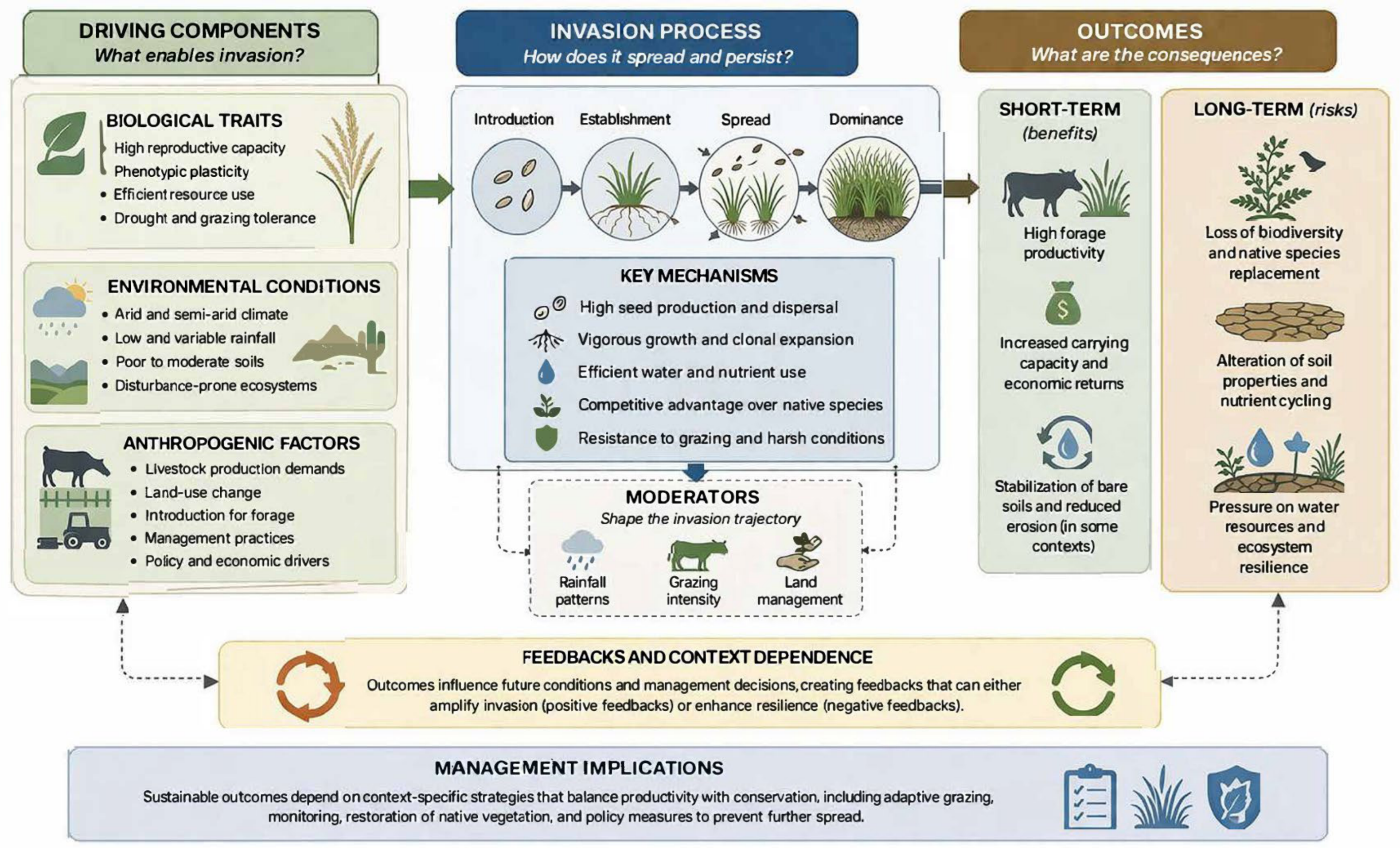
The aforementioned heterogeneity could lead to inconsistencies in the results obtained. Some studies do not assess certain variables, such as the carrying capacity of the pasture and its availability as consumable biomass in extensive livestock systems. Other studies, on the contrary, link the pasture to certain levels of soil degradation and biodiversity loss, indicating that the benefits of this pasture are observable in the short term. Based on the above, it is possible to highlight biological traits of the plant, environmental aspects, and anthropogenic factors, which, when analyzed in an integrated manner, improve management alternatives for buffelgrass in arid regions (Figure 3).

4. Discussion

A central question emerging from the comparative literature on buffelgrass is why this species behaves as a manageable forage resource in some arid regions—particularly in its native range across sub-Saharan Africa and parts of the Middle East—while exhibiting uncontrolled invasive dynamics in introduced regions such as Mexico, the Sonoran Desert of the United States, and arid Australia. This contrast cannot be attributed to climate or aridity alone, as all affected regions share broadly similar precipitation regimes and thermal conditions. Instead, the evidence points to a convergence of at least four interacting mechanisms that collectively determine whether buffelgrass remains within productive bounds or crosses ecological tipping points.
The first mechanism is co-evolutionary regulation. In its native range, buffelgrass evolved alongside a suite of specialist herbivores, fungal pathogens, and soil microbial communities that impose density-dependent controls on its spread. In Mexico and other introduced regions, these biotic regulators are absent, allowing buffelgrass to exploit resource pulses—particularly post-rainfall periods—without natural population checks. This release from co-evolutionary constraints is widely recognized as a primary driver of invasive success across taxa and is directly applicable to buffelgrass dynamics in the Sonoran Desert region.
The second mechanism is land use legacy and disturbance history. In the Middle East and parts of Africa, traditional pastoral systems have maintained buffelgrass within managed grazing circuits for centuries, creating a cultural and institutional framework that limits uncontrolled spread. In contrast, buffelgrass was deliberately introduced into Mexico and northern arid zones during the mid-twentieth century as part of large-scale rangeland improvement programs, without the accompanying management infrastructure needed to contain it. Once established beyond managed pastures, it colonized degraded roadsides, disturbed soils, and abandoned agricultural lands—all of which are disproportionately abundant in the arid Mexican landscape due to historical overgrazing and land fragmentation [45].
To improve the practical applicability of buffelgrass management strategies, it is necessary to move from general recommendations to a more operational and context-specific framework. In arid regions such as Sonora, management actions should be prioritized according to the degree of invasion and ecosystem conditions.
In relatively conserved ecosystems or areas with high biodiversity value, the use and expansion of buffelgrass should be strictly restricted, and early detection and rapid response strategies should be implemented to prevent its establishment. In moderately invaded systems, management should focus on containment, including controlled grazing practices, reduction in seed dispersal, and selective removal combined with the introduction of native species. In highly degraded or fully transformed areas, where buffelgrass is already dominant, complete eradication may not be feasible; therefore, management should aim at mitigating its ecological impacts through rotational grazing, soil restoration practices, and gradual diversification with native or adapted forage species. Risk thresholds should also be considered, particularly in relation to water availability, fire risk, and biodiversity loss. For example, in areas with annual precipitation below 300 mm and high ecological vulnerability, the introduction or promotion of buffelgrass should be avoided due to its potential to exacerbate soil degradation and alter hydrological processes [46].
Building on the mechanistic framework presented above, management recommendations for buffelgrass must be differentiated according to the current level of invasion at a given site. A tiered management plan is proposed here, structured around three invasion levels defined by buffelgrass cover, landscape connectivity, and ecosystem impact. This tiered approach allows land managers, conservation agencies, and policymakers to prioritize interventions according to ecological urgency and available resources, rather than applying uniform strategies across heterogeneous landscapes [47].
At this invasion level, buffelgrass has not yet established self-sustaining populations and landscape connectivity remains low. The primary management objective is containment and eradication of existing foci before they reach reproductive maturity and seed dispersal thresholds. Recommended actions include: (i) systematic monitoring through remote sensing and ground-truthing transects at least twice per year, timed to coincide with post-rainfall germination peaks; (ii) manual removal of individual plants or small patches, targeting the root crown to prevent resprouting, with removal conducted before seed set (typically March–May in Sonoran Desert conditions); (iii) establishment of buffer zones of at least 500 m around high-value conservation areas, with zero-tolerance protocols for buffelgrass establishment within these zones; and (iv) community-based early warning networks that engage local ranchers in reporting new establishment events [30]. At this tier, eradication is biologically and economically feasible and should be treated as the primary goal. Cost-effectiveness analyses from comparable invasion systems suggest that early intervention at Tier 1 reduces long-term management costs by a factor of 5–10 relative to control at later invasion stages [48].
At this level, buffelgrass has established reproductive populations across a significant portion of the landscape and is actively expanding through seed dispersal and vegetative growth. Eradication is no longer cost-effective at the landscape scale, and the management objective shifts to reducing cover, interrupting landscape connectivity, and preventing fire regime alteration. Recommended actions include: (i) targeted herbicide application using glyphosate or imazapyr at the recommended concentrations, applied during active growth phases (post-rainfall periods), with follow-up treatments at 6-month intervals to address resprouting and new germination; (ii) strategic grazing management, maintaining stocking rates above the threshold required to suppress buffelgrass biomass accumulation (typically >0.5 AU/ha during the dry season) while avoiding overgrazing of native perennial grasses that provide competitive resistance [49]; (iii) mechanical control along road corridors and water courses, which function as dispersal highways, using mowing or grubbing equipment at intervals of no more than 90 days during the growing season [50]; (iv) prescribed burning under controlled conditions only where native fire-adapted vegetation is present and fire can be contained—buffelgrass-fueled fires in non-fire-adapted ecosystems must be avoided; and (v) restoration planting of native perennial grasses and shrubs in cleared areas to provide competitive resistance against buffelgrass reinvasion, prioritizing species with high drought tolerance and rapid establishment rates [51].
At this invasion level, buffelgrass has fundamentally restructured the plant community and ecological processes, including fire regimes, soil nutrient cycling, and pollinator networks. Eradication and even significant cover reduction are not realistic short-term goals. The management objective is to protect residual biodiversity refugia, restore ecosystem function in priority areas, and prevent further degradation while long-term restoration plans are developed and resourced. Recommended actions include: (i) identification and designation of high-priority refugia—areas retaining native plant diversity, critical wildlife habitat, or hydrological function—where intensive control efforts are concentrated regardless of broader landscape dominance [52]; (ii) large-scale mechanical and chemical control in priority refugia, accepting that buffelgrass will persist at reduced levels in the surrounding matrix [36,53]; (iii) community engagement and incentive programs that provide economic alternatives to buffelgrass-dependent ranching, including payments for ecosystem services, diversified forage systems incorporating native palatable species, and market-linked certification schemes for sustainably managed rangelands; (iv) long-term monitoring programs designed to detect any natural or management-induced reductions in buffelgrass dominance that could open windows for accelerated restoration; and (v) policy-level interventions to prohibit further intentional planting of buffelgrass in new areas, enforce existing regulations on invasive species management, and integrate buffelgrass control into broader land-use planning frameworks at the municipal and state levels.
The contrasting effects of buffelgrass across continents are not random but are driven by a combination of ecological, climatic, and anthropogenic factors. In arid regions of Mexico and Australia, where ecosystems are biodiversity-rich but fragile, buffelgrass invasion leads to significant ecological disruption [54]. In contrast, in highly managed systems such as those in the Middle East, its performance is enhanced under irrigation and controlled conditions. Buffelgrass is of African origin and has a high adaptability that has allowed it to expand and invade geographic regions of other continents through introduction. This grass possesses morphological, anatomical, physiological, and genetic characteristics that have allowed it to survive in arid and harsh environments. In northern Mexico, its introduction was carried out through social programs, which justified it as an alternative for producing forage in areas with limited native grasses and water resources. Although yields and increases can reach up to 85% [7], its long-term profitability and effectiveness are unsatisfactory from an economic and ecological standpoint. Added to this are the costs associated with establishment, input application, and the difficulty of conducting a cost–benefit analysis. This grass was introduced and promoted by public policies that were unaware of its true biology, especially since it is currently considered a weed and an invasive species, both of which are difficult to eradicate. In Chihuahua, Mexico, pastoral systems have been established with mesquite (Prosopis spp.), chamizo (Atriplex canescens) and buffelgrass to evaluate the characteristics of the forage and the ecological changes that can be generated in the long term by the interaction of these three species [55], which will serve to determine the feasibility of introducing or promoting their cultivation.
The lack of longitudinal studies must have been significant in understanding the effects of buffelgrass on arid ecosystems in Mexico, especially since it can lead to a hydrological crisis at the state level, where a large percentage of the land is used for agricultural production. There are even grasses that can serve as alternatives and are of better forage quality than buffelgrass, for example, Digitaria pentzii, which has a lower lignin and fiber content [45]. Current political strategies, and especially those individuals and institutions responsible for managing agricultural production, need to develop strategies for soil restoration and prevent the further spread of this species [56]. Long-term benefits will be essential to safeguarding the region’s plant genetic and water resources. It is important to mention that in other areas, buffelgrass is highly effective, as it is very efficient in water consumption and can produce the same forage yields as other species like alfalfa. Areas with considerable biodiversity are most easily affected by buffelgrass.
The research reveals both advantages and disadvantages to establishing buffelgrass in extensive livestock production systems. Among the adverse effects of this species are soil erosion and nutrient loss, reduced diversity and displacement of native plant species, primarily legumes, and decreased water availability. This suggests that the intensity of pasture management may depend on how these resources and factors are managed. From a sustainability perspective, buffelgrass should be studied from various angles to determine its medium- and long-term viability. Management strategies for this species should promote a balance between production and conservation, incorporating native species, controlled grazing practices, and policies aimed at the integrated management of these pastures [57,58].
The comprehensive management and control of grasslands must incorporate economic, social, political, and environmental components. Although mechanical and chemical removal are effective, their implementation is limited by the cost of inputs and labor, the lack of technical training, and the dependence of some producers on buffelgrass as a forage source. Incorporating legumes and native species can improve soil conditions; however, in the long term, this practice may be financially limited, especially for small-scale farmers [59]. Therefore, efforts to eradicate buffelgrass can significantly impact rural livelihoods. Policies should focus on comprehensive control strategies, but it is also necessary to promote practices to prevent soil erosion, diversify forage species, and restore ecosystems [60]. These strategies will depend on the socioeconomic characteristics of the site, the cost–benefit ratio, and the resilience of the ecosystems.
Compared to other invasive grasses like Imperata cylindrica, buffelgrass has the advantage of being able to be implemented in production systems due to its forage yield. These invasive grasses share common characteristics, such as adaptability, rapid establishment, and physiological traits that allow them to be efficient in competitive processes. Despite the advantages and disadvantages, in northern Mexico, extensive and intensive livestock systems highlight the negative effects associated with buffelgrass.
The literature indicates that changes in vegetation structure can affect soil microbial dynamics. For buffelgrass, these effects are not well documented or well supported; therefore, this topic is considered a potential line of research that could explore and quantify the diversity and function of microbiota.
It is important to acknowledge that the included studies vary considerably in terms of sample size, replication, and experimental rigor. Controlled field experiments with adequate replication and statistical analysis—predominantly from indexed databases—provide the strongest basis for conclusions regarding forage productivity, soil dynamics, and water use efficiency. In contrast, several findings related to biodiversity loss and ecosystem alteration rely on observational or case-study designs with limited spatial or temporal replication. Grey literature sources, while valuable for understanding regional policy context and management history, should not be interpreted with the same level of confidence as peer-reviewed experimental evidence. This heterogeneity in research quality represents a recognized limitation of the present review and reinforces the need for more standardized, long-term field studies on buffelgrass dynamics in arid ecosystems.
Finally, future research should incorporate interdisciplinary approaches that integrate ecological, agronomic, and socioeconomic variables, allowing for the development of more comprehensive management frameworks and public policies aimed at balancing productivity and conservation in arid and semi-arid regions.

5. Conclusions

This review addressed a central question: under which conditions does buffelgrass represent a sustainable forage alternative, and when do its invasive dynamics override its productive value? Based on the synthesis of 59 studies, five evidence-based conclusions are drawn. First, productive use of buffelgrass is justifiable only where cover is actively maintained below 30% of landscape composition, invasion into native ecosystems is monitored biannually and controlled within one growing season, and native forage alternatives are simultaneously established. Where these conditions cannot be guaranteed, transition to native forage systems is recommended. Second, the production-invasion trade-off is governed by four mechanisms—biotic release, land use legacy, fire regime alteration, and institutional capacity—none of which are fixed. Of these, fire regime alteration carries the highest irreversibility risk in Mexico and should be treated as the priority intervention in Tier 2 and Tier 3 landscapes. Third, management investment must be front-loaded: Tier 1 interventions (cover < 10%) are 5–10 times more cost-effective than Tier 3 control. Resources should therefore concentrate on buffer zones around protected areas rather than on heavily invaded landscapes where full recovery is not achievable in the short term. Fourth, the relative controllability of buffelgrass in the Middle East compared to Mexico reflects differences in biotic regulation, pastoral management tradition, and institutional capacity—not climate. Mexico can partially replicate these conditions through community-based monitoring networks, integration of buffelgrass control into existing land-use planning instruments, and economic incentives for native forage diversification. Fifth, three research gaps require urgent attention: empirical thresholds for fire feedback self-sustainability across arid Mexican ecosystems, socioeconomic feasibility of native forage adoption among smallholder ranchers, and standardized remote sensing protocols for landscape-scale buffelgrass monitoring. Buffelgrass in arid Mexico is neither unconditionally useful nor inevitably destructive. It is a management challenge that is scientifically tractable and institutionally addressable—but only if interventions are applied early, spatially targeted, and mechanistically informed.

Supplementary Materials

The following supporting information can be downloaded at: https://www.mdpi.com/article/10.3390/grasses5020022/s1, Table S1: PRISMA 2020 Checklist.

Author Contributions

Conceptualization, L.Á.B.-G., H.T.M.-Z. and J.C.-I.; methodology, L.Á.B.-G., H.T.M.-Z., J.C.-I., J.G.C.-C. and Ó.D.-J.; software, L.Á.B.-G., J.Á.T.-R. and S.A.-B.; validation, J.Á.T.-R., J.G.P.-S. and H.X.T.-H.; formal analysis, L.Á.B.-G., H.T.M.-Z., J.C.-I., Ó.D.-J., J.Á.T.-R., J.O.R.-R. and H.X.T.-H.; investigation L.Á.B.-G., H.T.M.-Z., J.C.-I., J.O.R.-R., J.G.P.-S. and H.X.T.-H.; resources, J.G.C.-C., Ó.D.-J., J.Á.T.-R., S.A.-B., J.O.R.-R., J.G.P.-S. and H.X.T.-H.; data curation, H.T.M.-Z. and J.C.-I.; writing—original draft preparation, L.Á.B.-G., H.T.M.-Z. and J.C.-I.; writing—review and editing, H.T.M.-Z., S.A.-B., Ó.D.-J., J.Á.T.-R. and J.O.R.-R.; visualization J.O.R.-R., J.G.P.-S. and H.X.T.-H.; supervision, H.T.M.-Z. and J.C.-I.; project administration, H.T.M.-Z. and J.C.-I.; funding acquisition, L.Á.B.-G., H.T.M.-Z. and J.C.-I. All authors have read and agreed to the published version of the manuscript.

Funding

This research received no external funding.

Data Availability Statement

No new data were created or analyzed in this study.

Acknowledgments

During the preparation of this study, the authors used ChatGPT 5.3 for the purpose of generating Figure 3. The authors have reviewed and edited the output and take full responsibility for the content of this publication.

Conflicts of Interest

The authors declare no conflicts of interest.

References

  1. Marshall, V.M.; Lewis, M.; Ostendorf, B. Buffel Grass (Cenchrus ciliaris) as an Invader and Threat to Biodiversity in Arid Environments: A Review. J. Arid Environ. 2012, 78, 1–12. [Google Scholar] [CrossRef]
  2. López-Reyes, M. Degradación de Suelos En Sonora: El Problema de La Erosión En Los Suelos de Uso Ganadero. Región Y Soc. 2001, 13, 73–97. [Google Scholar] [CrossRef]
  3. Abella, S.R.; Chiquoine, L.P.; Backer, D.M. Soil, Vegetation, and Seed Bank of a Sonoran Desert Ecosystem Along an Exotic Plant (Pennisetum ciliare) Treatment Gradient. Environ. Manag. 2013, 52, 946–957. [Google Scholar] [CrossRef]
  4. Hussain, M.I.; Akhtar, N.; Qureshi, A.S.; Gallacher, D. Perennial Forage Grass Production on the Marginal Arabian Peninsula Land. In Sustainable Agriculture Reviews 52; Lichtfouse, E., Ed.; Sustainable Agriculture Reviews; Springer International Publishing: Cham, Switzerland, 2021; Volume 52, pp. 279–308. ISBN 978-3-030-73244-8. [Google Scholar]
  5. Fensham, R.J.; Wang, J.; Kilgour, C. The Relative Impacts of Grazing, Fire and Invasion by Buffel Grass (Cenchrus ciliaris) on the Floristic Composition of a Rangeland Savanna Ecosystem. Rangel. J. 2015, 37, 227–237. [Google Scholar] [CrossRef]
  6. Meffin, R.; Ryan-Colton, R.; Read, J.L.; Bowman, T.; Heinson, M. Buffel Grass in South Australia: Progress and Future Directions. In Proceedings of the 21st Australasian Weeds Conference, “Weed Biosecurity-Protecting our Future”, Sydney, NSW, Australia, 9–13 September 2018. [Google Scholar]
  7. Castellanos, A.E.; Celaya, H.; Hinojo, C.; Ibarra, A.; Romo, J.R. Biodiversity Effects on Ecosystem Function Due to Land Use: The Case of Buffel Savannas in the Sky Islands Seas in the Central Region of Sonora. In Merging Science and Management in a Rapidly Changing World: Biodiversity and Management of the Madrean Archipelago III and 7th Conference on Research and Resource Management in the Southwestern Deserts; Gottfried, G.J., Ffolliott, P.F., Gebow, B.S., Eskew, L.G., Collins, L.C., Eds.; U.S. Department of Agriculture, Forest Service, Rocky Mountain Research Station: Fort Collins, CO, USA, 2013; pp. 191–196, RMRS-P-67. [Google Scholar]
  8. Celaya-Michel, H.; García-Oliva, F.; Rodríguez, J.C.; Castellanos-Villegas, A.E. Cambios en el almacenamiento de nitrógeno y agua en el suelo de un matorral desértico transformado a sabana de buffel (Pennisetum ciliare (L.) Link). Terra Latinoam. 2015, 33, 79–93. [Google Scholar]
  9. Arshad, M.; Ashraf, M.Y.; Ahamad, M.; Zaman, F. Morpho-Genetic Variability Potential of Cenchrus ciliaris L., from Cholistan Desert, Pakistan. Pak. J. Bot. 2007, 39, 1481–1488. [Google Scholar]
  10. Mansoor, U.; Fatima, S.; Hameed, M.; Naseer, M.; Ahmad, M.S.A.; Ashraf, M.; Ahmad, F.; Waseem, M. Structural Modifications for Drought Tolerance in Stem and Leaves of Cenchrus ciliaris L. Ecotypes from the Cholistan Desert. Flora 2019, 261, 151485. [Google Scholar] [CrossRef]
  11. de la Fuente, E.G.; Solís, H.D.; Fitzmaurice, A.S.; Encinia, F.B.; Tristán, V.V.; Grant, W.E. Patrón de crecimiento de pasto buffel [Pennisetum ciliare L. (link.) sin. Cenchrus ciliaris l.] en Tamaulipas, México. Rev. Mex. Cienc. Pecu. 2007, 45, 1–17. [Google Scholar]
  12. Negawo, A.T.; Assefa, Y.; Hanson, J.; Abdena, A.; Muktar, M.S.; Habte, E.; Sartie, A.M.; Jones, C.S. Genotyping-By-Sequencing Reveals Population Structure and Genetic Diversity of a Buffelgrass (Cenchrus ciliaris L.) Collection. Diversity 2020, 12, 88. [Google Scholar] [CrossRef]
  13. Al-Soqeer, A.; Al-Otayk, S.M.; Motawei, M.I. Molecular Characterization of New Buffelgrass (Cenchrus ciliaris) Genotypes. Plant Omics 2020, 13, 104–107. [Google Scholar] [CrossRef]
  14. Gutierrez-Ozuna, R.; Eguiarte, L.E.; Molina-Freaner, F. Genotypic Diversity among Pasture and Roadside Populations of the Invasive Buffelgrass (Pennisetum ciliare L. Link) in North-Western Mexico. J. Arid Environ. 2009, 73, 26–32. [Google Scholar] [CrossRef]
  15. Hignight, K.W.; Bashaw, E.C.; Hussey, M.A. Cytological and Morphological Diversity of Native Apomictic Buffelgrass, Pennisetum ciliare (L.) Link. Bot. Gaz. 1991, 152, 214–218. [Google Scholar] [CrossRef]
  16. Bravo-Peña, L.C.; Doode-Matsumoto, O.S.; Castellanos-Villegas, A.E.; Espejel-Carbajal, I. Políticas Rurales y Pérdida de Cobertura Vegetal. Elementos Para Reformular Instrumentos de Fomento Agropecuario Relacionados Con La Apertura de Praderas Ganaderas En El Noroeste de México. Región Soc. 2010, 22, 3–35. [Google Scholar] [CrossRef]
  17. Ibarra, F.F.; Medina, M.S.; Martín, R.M.; Denogean, B.F.; Gerlach, B.E.G. La siembra de zacate buffel como una alternativa para incrementar la rentabilidad de los ranchos ganaderos de la sierra de Sonora. Rev. Mex. Cienc. Pecu. 2005, 43, 173–183. [Google Scholar]
  18. Conde-Lozano, E.; Martínez-González, J.C.; Briones-Encinia, F.; Saldívar-Fitzmaurice, A.J. Producción de semilla de pasto Buffel (Cenchrus ciliaris L.) bajo diferentes ambientes agroecológicos en Tamaulipas, México. Rev. Fac. Agron. Univ. Zulia 2011, 28, 360–375. [Google Scholar]
  19. Garza-Cedillo, R.D.; Garay-Martínez, J.R.; Cisneros-López, M.E.; Ortiz-Chairez, F.E.; Álvarez-Ojeda, M.G.; Granados-Rivera, L.D.; Galicia-Juárez, M. Evaluation of three varieties of Buffel grass, in the North of Tamaulipas. Agro Product. 2022, 15, 43–50. [Google Scholar] [CrossRef]
  20. Beltrán-López, S.; García-Díaz, C.A.; Loredo-Osti, C.; Urrutia-Morales, J.; Hernández-Alatorre, J.A.; Gámez-Vázquez, H.G. “Titán” y “Regio”, variedades de pasto Buffel (Pennisetum ciliare) (L.) Link para zonas áridas y semiáridas. Rev. Mex. Cienc. Pecu. 2017, 8, 291–295. [Google Scholar] [CrossRef]
  21. GBIF. GBIF Occurrence Database. 2026. Available online: https://doi.org/10.15468/dl.72e9sm (accessed on 13 February 2026). [CrossRef]
  22. SNICS Buffel (Cenchrus ciliaris L.). Guía Técnica Para La Descripción Varietal 2014. Available online: https://www.gob.mx/cms/uploads/attachment/file/120820/Bufel.pdf (accessed on 5 March 2026).
  23. Kharrat-Souissi, A.; Siljak-Yakovlev, S.; Brown, C.S.; Baumel, A. The Polyploid Nature of Cenchrus ciliaris L. (Poaceae) Has Been Overlooked: New Insights for the Conservation and Invasion Biology of This Species—A Review. Rageland J. 2026, 36, 11–23. [Google Scholar] [CrossRef]
  24. Visser, N.C.; Spies, J.J.; Venter, H.J.T. Aneuploidy in Cenchrus cilliaris (Poaceae, Panicoideae, Paniceae): Truth or Fiction? S. Afr. J. Bot. 1998, 64, 337–345. [Google Scholar] [CrossRef]
  25. Rathore, P.; Schwarzacher, T.; Heslop-Harrison, J.S.; Bhat, V.; Tomaszewska, P. The Repetitive DNA Sequence Landscape and DNA Methylation in Chromosomes of an Apomictic Tropical Forage Grass, Cenchrus ciliaris. Front. Plant Sci. 2022, 13, 952968. [Google Scholar] [CrossRef]
  26. Page, M.J.; McKenzie, J.E.; Bossuyt, P.M.; Boutron, I.; Hoffmann, T.C.; Mulrow, C.D.; Shamseer, L.; Tetzlaff, J.M.; Akl, E.A.; Brennan, S.E.; et al. The PRISMA 2020 statement: An updated guideline for reporting systematic reviews. BMJ 2021, 372, n71. [Google Scholar] [CrossRef]
  27. Brenner, J.C. Pasture Conversion, Private Ranchers, and the Invasive Exotic Buffelgrass (Pennisetum ciliare) in Mexico’s Sonoran Desert. Ann. Assoc. Am. Geogr. 2011, 101, 84–106. [Google Scholar] [CrossRef]
  28. Yáñez-Chávez, L.G.; Pedroza-Sandoval, A.; Sánchez-Cohen, I.; Velásquez-Valle, M.A.; Trejo-Calzada, R. Growth, Physiology, and Productivity of Bouteloua Gracilis and Cenchrus ciliaris Using Moisture Retainers under Different Planting Methods. Agriculture 2023, 13, 1134. [Google Scholar] [CrossRef]
  29. Morales-Romero, D.; Rosas-Becerra, R.; Ortega-Rosas, C.I.; Molina-Freaner, F. Can Legume Seeds Establish after Land Degradation by Buffelgrass? Evidence to Initiate Restoration in Central Sonora, Mexico. Land Degrad. Dev. 2023, 34, 5430–5437. [Google Scholar] [CrossRef]
  30. Wright, B.R.; Latz, P.K.; Albrecht, D.E.; Fensham, R.J. Buffel Grass (Cenchrus ciliaris) Eradication in Arid Central Australia Enhances Native Plant Diversity and Increases Seed Resources for Granivores. Appl. Veg. Sci. 2021, 24, e12533. [Google Scholar] [CrossRef]
  31. Griffa, S.; Ribotta, A.; López Colomba, E.; Tommasino, E.; Carloni, E.; Luna, C.; Grunberg, K. Evaluation Seedling Biomass and Its Components as Selection Criteria for Improving Salt Tolerance in Buffel Grass Genotypes. Grass Forage Sci. 2010, 65, 358–361. [Google Scholar] [CrossRef]
  32. Ghorbel, M.; Alghamdi, A.; Brini, F.; Hawamda, A.I.M.; Mseddi, K. Mitigating Water Loss in Arid Lands: Buffelgrass as a Potential Replacement for Alfalfa in Livestock Feed. Agronomy 2025, 15, 371. [Google Scholar] [CrossRef]
  33. Malik, J.A.; Alqarawi, A.A.; Alotaibi, F.; Habib, M.M.; Sorrori, S.N.; Almutairi, M.B.R.; Dar, B.A. Alleviation of NaCl Stress on Growth and Biochemical Traits of Cenchrus ciliaris L. via Arbuscular Mycorrhizal Fungi Symbiosis. Life 2024, 14, 1276. [Google Scholar] [CrossRef]
  34. Singh, S.; Koli, P.; Singh, T.; Das, M.M.; Maity, S.B.; Singh, K.K.; Katiyar, R.; Misra, A.K.; Mahanta, S.K.; Srivastava, M.K.; et al. Assessing Genotypes of Buffel Grass (Cenchrus ciliaris) as an Alternative to Maize Silage for Sheep Nutrition. PLoS ONE 2024, 19, e0304328. [Google Scholar] [CrossRef]
  35. García-Dessommes, G.J.; Ramírez-Lozano, R.G.; Morales-Rodríguez, R.; García-Díaz, G. Ruminal digestion and chemical composition of new genotypes of buffelgrass (Cenchrus ciliaris L.) under irrigation and fertilization. Interciencia 2007, 28, 220–224. [Google Scholar]
  36. Espinoza, D.O.; Molina-Freaner, F.; Tinoco-Ojanguren, C. Response of Four Species of Sonoran Desert Trees to Buffel Grass Removal Treatments. Plant Ecol. 2020, 221, 255–264. [Google Scholar] [CrossRef]
  37. Iñigo-Gámiz, G.; Touceda-Suárez, M.; Bustamante, E.; Gornish, E.S.; Martínez-Yrízar, A.; Búrquez, A.; Barberán, A. Above and Belowground Effects of Buffelgrass Invasion in the Sonoran Desert. Biol. Invasions 2025, 27, 195. [Google Scholar] [CrossRef]
  38. Sohrabi, S.; Rojano-Delgado, A.M.; Gherekhloo, J.; Palma-Bautista, C.; De Prado, R. Cenchrus Setaceus as an Invasive Weed: Invasiveness, Distribution, and Management (A Review). Agronomy 2026, 16, 125. [Google Scholar] [CrossRef]
  39. Alexander Eilts, J.; Huxman, T.E. Invasion by an Exotic, Perennial Grass Alters Responses of a Native Woody Species in an Arid System. J. Arid Environ. 2013, 88, 206–212. [Google Scholar] [CrossRef]
  40. Beltrán-López, S.; Pérez-Pérez, J.; Hernández-Garay, A.; García-Moya, E.; Kohashi-Shibata, J.; Herrera-Haro, J.G. Respuesta Fisiológica Del Pasto Buffel (Cenchrus ciliaris L.) a Diferentes Alturas de Defoliación. Agrociencia 2002, 36, 531–539. [Google Scholar]
  41. Franklin, K.; Molina-Freaner, F. Consequences of Buffelgrass Pasture Development for Primary Productivity, Perennial Plant Richness, and Vegetation Structure in the Drylands of Sonora, Mexico. Conserv. Biol. 2010, 24, 1664–1673. [Google Scholar] [CrossRef] [PubMed]
  42. Mlay, J.A.; Kuwi, S.O.; Maleko, D.; Mtengetic, E.J. Incidences of Fungal Leaf Spot Disease in Buffel Grass (Cenchrus ciliaris) in Some Selected Pasture Farms in Tanzania. Multidiscip. Sci. J. 2022, 4, e2022015. [Google Scholar] [CrossRef]
  43. Morrison, C.R.; Plowes, R.M.; Ng’iru, I.; Rhodes, A.C.; Martins, D.J.; Gilbert, L.E. Arthropod Associates of Kenyan Buffelgrass (Cenchrus ciliaris): A Field Survey for Biological Control Candidates of a Globally Important Invasive Grass. Afr. Entomol. 2023, 31, e16178. [Google Scholar] [CrossRef]
  44. Schlesinger, C.A.; Kaestli, M.; Christian, K.A.; Muldoon, S. Response of Reptiles to Weed-Control and Native Plant Restoration in an Arid, Grass-Invaded Landscape. Glob. Ecol. Conserv. 2020, 24, e01325. [Google Scholar] [CrossRef]
  45. Melzer, A.; Melzer, R.; Dinwoodie, A.; Beard, D. Recovery of Herbaceous Species Richness Following Herbicide Treatment of “Cenchrus ciliaris” (Buffel Grass)—A Pilot Study in “Onychogalea fraenata” (Bridled Nailtail Wallaby) Habitat Restoration. Proc. R. Soc. Qld. 2014, 119, 7–20. [Google Scholar] [CrossRef]
  46. De la Barrera, E. Recent Invasion of Buffel Grass (Cenchrus ciliaris) of a Natural Protected Area from the Southern Sonoran Desert. Rev. Mex. Biodivers. 2008, 79, 385–392. [Google Scholar]
  47. Siller-Clavel, P.; Badano, E.I.; Villarreal-Guerrero, F.; Prieto-Amparán, J.A.; Pinedo-Alvarez, A.; Corrales-Lerma, R.; Álvarez-Holguín, A.; Hernández-Quiroz, N.S. Distribution Patterns of Invasive Buffelgrass (Cenchrus ciliaris) in Mexico Estimated with Climate Niche Models under the Current and Future Climate. Plants 2022, 11, 1160. [Google Scholar] [CrossRef]
  48. Silcock, R.G. Some Soil Factors Constraining Buffel Grass (Cenchrus ciliaris L.) Seedling Growth Rate across a Range of Acid Red Kandosols in Queensland, Australia. Rangel. J. 2022, 44, 77–95. [Google Scholar] [CrossRef]
  49. Ziegler, A.D.; Warren, S.D.; Perry, J.L.; Giambelluca, T.W. Reassessment of Revegetation Strategies for Kaho’olawe Island, Hawai’i. J. Range Manag. 2000, 53, 106. [Google Scholar] [CrossRef][Green Version]
  50. Madouh, T.A. The Influence of Induced Drought Stress on Germination of Cenchrus ciliaris L. and Cenchrus setigerus Vahl.: Implications for Rangeland Restoration in the Arid Desert Environment of Kuwait. Res. Ecol. 2023, 5, 1–11. [Google Scholar] [CrossRef]
  51. Ward, J.P.; Smith, S.E.; McClaran, M.P. Water requirements for emergence of buffelgrass (Pennisetum ciliare). Weed Sci. 2006, 54, 720–725. [Google Scholar] [CrossRef]
  52. Mnif, L.; Derbel, S.; Chaieb, M. Las Poáceas perennes: Una alternativa para la rehabilitación y la restauración de pastos degradados en el Túnez presahariano. Ecosistemas 2005, 14, 57–66. [Google Scholar]
  53. Marsico, G.; Ciccone, M.S.; Masi, M.; Freda, F.; Cristofaro, M.; Evidente, A.; Superchi, S.; Scafato, P. Synthesis and Herbicidal Activity Against Buffelgrass (Cenchrus ciliaris) of (±)-3-Deoxyradicinin. Molecules 2019, 24, 3193. [Google Scholar] [CrossRef]
  54. Tjelmeland, A.D.; Fulbright, T.E.; Lloyd-Reilley, J. Evaluation of Herbicides for Restoring Native Grasses in Buffelgrass-Dominated Grasslands. Restor. Ecol. 2008, 16, 263–269. [Google Scholar] [CrossRef]
  55. Siciliano, A.; Zorrilla, J.G.; Saviano, L.; Cimmino, A.; Guida, M.; Masi, M.; Meyer, S. Insights into the Ecotoxicology of Radicinin and (10S,11S)-(—)-Epi-Pyriculol, Fungal Metabolites with Potential Application for Buffelgrass (Cenchrus ciliaris) Biocontrol. Toxins 2023, 15, 405. [Google Scholar] [CrossRef]
  56. Baur, J.R.; Bovey, R.W.; Holt, E.C. Effect of Herbicides on Production and Protein Levels in Pasture Grasses. Agron. J. 1977, 69, 846–851. [Google Scholar] [CrossRef]
  57. Gowdy, G.; Hernández, F.; Fulbright, T.; Grahmann, E.; Wester, D.; Vreugdenhil, E.; Henehan, A.; Smith, F.; Hehman, M. Plant, Avian, and Butterfly Response to a Native-Grassland Restoration in Southern Texas. Ecol. Restor. 2022, 40, 44–52. [Google Scholar] [CrossRef]
  58. Jackson, J. Impacts and Management of Cenchrus ciliaris (Buffel Grass) as an Invasive Species in Northern Queensland. Ph.D. Thesis, James Cook University, Queensland, Australia, 2004. [Google Scholar]
  59. Ríos-Saucedo, J.; Valenzuela-Núñez, L.M.; Rivera-González, M.; Trucíos-Caciano, R.; Sosa-Pérez, Y.G. Design of a Silvopastoral System in Degraded Areas with Mesquite in Chihuahua, Mexico. Medio Ambiente Desarro. Sustentable 2012, 6, 174–180. [Google Scholar]
  60. Menor, T.R.F.d.L.; Ferreira dos Santos, M.V.; Coêlho, J.J.; Gonçalves, G.D.; de Mello, A.C.L.; da Cunha, M.V.; dos Santos, A.M.G.; Ferraz, I.; Dubeux Júnior, J.C.B. Bromatological and Histological Features of Native African Grasses under Grazing in Brazilian Semi-Arid Rangelands. Afr. J. Range Forage Sci. 2023, 40, 231–235. [Google Scholar] [CrossRef]
Figure 2. PRISMA flow diagram of the study selection process. Blue boxes represent records and articles in the main flow; coral boxes represent records excluded at each stage with their reason; teal boxes mark the supplementary search input and the final set of included studies; the gray box summarizes the provenance of the 59 included studies.
Grasses 05 00022 g002
Figure 3. Conceptual framework of P. ciliare invasion in arid and semi-arid regions. The framework integrates biological traits, environmental conditions and anthropogenic factors that drive invasion processes and generate short- and long-term outcomes. Feedback and context dependence highlight the dynamic nature of these interactions and their implications for management.
Grasses 05 00022 g003
Disclaimer/Publisher’s Note: The statements, opinions and data contained in all publications are solely those of the individual author(s) and contributor(s) and not of MDPI and/or the editor(s). MDPI and/or the editor(s) disclaim responsibility for any injury to people or property resulting from any ideas, methods, instructions or products referred to in the content.